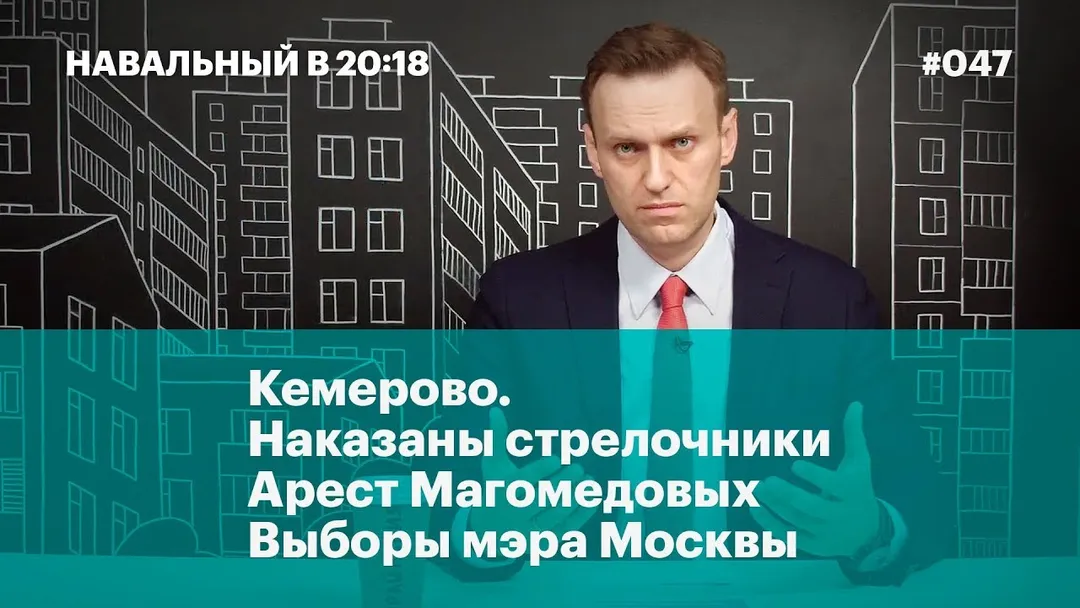
Kemerovo. Scapegoats Punished, the Magomedovs Arrested, Moscow Mayoral Election
[music]
Hello everyone. It's 8:18 p.m. in Moscow, here in the studio.
This is Navalny Live, Alexei Navalny speaking.
The so-called blogger, as she called me.
The wonderful Yelena Mizulina, whom we'll
definitely talk about today, because
I've been following her political
biography for a long time, and I really want to discuss it
with you. A wonderful, wonderful
woman. But of course, we'll start with Kemerovo.
I want to once again thank everyone who
made donations during our last broadcast
to help
those affected by the fire in the city of Kemerovo.
We raised 500,000 rubles, as you may remember
— those who watched the previous show know that we raised 400,000
rubles live on air, and then
people apparently kept watching afterward, offline,
and kept sending money. We raised
half a million rubles. You were all amazing.
Well done, everyone who made that happen. Right now we're in
a difficult process, because we need
to decide whom to give it to. There are many different
families, and it's not simple. We can't just
go around randomly
calling everyone and asking who
needs help the most. They all
need help desperately. We'll try,
as delicately as possible,
to identify one family, or two or three families,
who are in the most severe
financial hardship, and we'll give them the money.
I'll publish all the receipts, that is,
it's a delicate process, so I ask
for your understanding that we simply couldn't
do it properly in just a week, because
we didn't want to bother
the relatives with intrusive phone calls
and
and unpleasant questions at such a time. But
we'll get it all done. Once again, you were all amazing,
well done.
Everyone who took part in this—thank you.
Kemerovo still remains the main
issue on the political agenda, and you
remember that when people were discussing, after
the fire, in the immediate following week,
everyone was asking: so how exactly will
punishment and accountability be carried out? What
conclusions will be drawn from this situation? And
many wrote—and it wasn't exactly hard to predict—that
the people punished would be
the scapegoats. And judging by everything, that's
exactly what's happening. A fairly substantial
amount of time has already passed—enough to make
some definite conclusions.
What we're seeing now, unfortunately, is
precisely what you call punishing scapegoats.
Let's just take a look now at
the list of those who are currently
under arrest or detained. There may
well be other people too, probably, but
here's what we see right now—look:
the shopping mall manager, the technical
director, a person from the
company that designed the fire safety
system, a security guard, the general
director—these are all owners or managers there,
from the Kemerovo Confectionery Plant.
The only official—and you can't even call her
a high-ranking official—
is the former head of the inspectorate
of the Kemerovo Region State Construction Supervision agency.
So it's not just that there isn't a single
general or someone with a major
position—there aren't even people in
mid-level positions here. It was rather
interesting to watch how
some media outlets
announced that the head of the Emergency Situations Ministry (EMERCOM) in
the Kemerovo Region was being searched. This man
certainly deserves to have his
activities investigated. But here's the thing:
first they reported it and showed [__]
— some photo supposedly showing that
searches were underway at his place, or photos from
his vacation—and then he himself denied it.
The Investigative Committee said nothing.
There was a report from Interfax, and
it ended up being unclear whether
the local top official was actually searched
or not, whether he is being held
accountable or not. But accountability
is, of course, a matter for the investigation,
and not everything necessarily has to
take place in a fully
public, maximally transparent mode. But
I repeat: enough time has already
passed for at least
the basic political conclusions to be drawn.
Obviously, the people I just
showed you who have been arrested may very
well deserve to be
arrested. But still, what interests us most, it seems to me,
is
the punishment of those people who made this
possible in the first place. Because, well,
the word "absurd" always feels
unpleasant in the context of the Kemerovo
tragedy
to use, but nevertheless, the authorities
are saying this was an unauthorized building, meaning
the Winter Cherry shopping mall, which is in
the center of Kemerovo and practically
the city's largest shopping mall, was an illegal construction.
And supposedly we're not to blame—some
woman is to blame, the former head of this
poor State Construction Supervision office.
Tell me, please: the mayor drove past this building
and didn't know it was
an unauthorized building? And Tuleyev, who sat there for 27 years
(Aman Tuleyev, the longtime governor), he didn't know it was unauthorized either?
And he wasn't taking bribes from the developers? And
the deputy governor, and the deputy mayor in charge of construction,
and this woman's superior,
this woman from State Construction Supervision, and the current
director of State Construction Supervision—they all didn't
know? So it all just somehow happened by itself?
you know
a shopping mall that thousands of people go to
every day
the Emergency Situations Ministry, as we know, last year or the year before
held some kind of
even a conference there on fire
safety in a building that is
an illegally built structure. You’ve probably read that book
*Night Watch*
and if you haven’t read the book, then you’ve seen the film
well, in it there was the building of the Night
Watch, and
an ordinary person couldn’t see it; you had to
be an Other to be able to see it
that kind of secret building. But in Kemerovo it was the opposite:
ordinary people somehow
could see that, well, standing in the middle of the city
was a shopping mall, a huge shopping mall
while officials drove past and didn’t notice that there
was an illegal building there—it just didn’t exist for them. They drove by and
saw some kind of empty space, or it seemed to them
that there were still workshops of some
enterprise there, because now everyone is saying with
astonishment, my God, so
this was an enterprise—just imagine, it was still
officially a factory, a confectionery plant or
whatever it was there. So, arrest the director of the confectionery
factory, arrest the director
of the confectionery factory—he converted
it wrongly, improperly, criminally, he
converted
his workshops into a shopping mall. For years they
went to this shopping mall, for years they
drove past it, for years they took bribes from
all of this, because just think about it yourselves
any inspection by the Emergency Situations Ministry, any police inspection
lease agreements, documents confirming the right
of ownership, permits for the right
to trade, whatever, licenses
for the cinema and restaurants surely existed
were being processed, and for an alcohol license they
had to bring in a document and show
that we are located in such-and-such a building
but there is no building—the building is illegal. If the building
is unauthorized, and yet inside it there is
massive commercial activity going on, well
then obviously, excuse me, the regional leadership
and the city leadership knew about it
were taking bribes from everyone, and that’s why everything
stayed as it was
and none of them has been punished. And now there
the main thing is
the political conclusion, of course, is
Aman Tuleyev’s resignation, which was presented
as his voluntary resignation, although
it is perfectly clear that it wasn’t exactly
voluntary. Here’s a man who “voluntarily”
resigned on April 1
saying that with such a burden, with such a burden
in fact, with
this burden, he cannot, he has no moral
right to remain governor. Let’s watch 25
seconds from his address now
today. I want to tell you now: I have submitted
to the President of the Russian Federation
a request to resign. I consider it for myself
the correct, deliberate, the only
right decision, because with such a
terrible burden, to continue working in the post of
governor is impossible
and you know, at the moment when we were watching
all this, I was watching and even thought, well
after all, there is still something
human in this man—sorry for the tautology
he did at least say, “I can’t.” No matter whether Putin
forced him out or something else, he came out and said
I can’t carry on with such a burden. Fair enough. But
then it turned out that with such a burden
he cannot be governor, but
he is keeping the governor’s residence for himself
that state residence—he is keeping it
for himself. He is also keeping the title of
“People’s Governor,” and that title is not
just something printed on a business card; with
that title come money and 3
million rubles a year (about $50,000), despite all
that burden, which he will continue to receive
from the Kuzbass budget
more than that, what happened after this
turned everything into, excuse me, simply
some kind of disgusting farce, because
unable to bear this monstrous burden
Tuleyev said that he was stepping down, and we
assumed that he had left public service, but
it turned out that immediately, within
a single day, he became a deputy, and the whole country
said: how can that even be? Without
an election? And today it became clear that
an absolutely ingenious, in its sheer brazenness
and nastiness, scheme had been
carried out
so, Tuleyev, like all the other crooked
governors, headed the list
of United Russia in the regional assembly; he was
the “locomotive” candidate. Then when they
there, you see, right now you can see the list
so, Tuleyev headed the list
of United Russia candidates, then they get into the assembly
well, in Kuzbass apparently, I don’t know
they got 99 percent or 146. He was supposed to become a
deputy, and he officially comes in
and says, you know, I’ve changed my mind, I don’t want
to be a deputy. And with this obvious lie
that everyone expected every year: I’ve changed my mind, I don’t
want to be a deputy, I’d rather remain
governor, and he officially declines
the mandate. Then for several years he
works as governor, and now it turns out
that at some point, when under the
burden of responsibility he decided to submit
something there, he can come back
and say, by the way, I’ve changed my mind
again, please give me back my mandate
and they hand the mandate back to him, and he becomes
a deputy. How is that possible? This is
essentially just mockery of the entire
electoral system, of the whole system
of power—you can do this several times
you can change your mind; at the same time, you can be both
governor and, potentially, well, that is,
first you're a deputy, a governor,
a potential deputy, then an actual deputy
already elected, and at the same time a potential governor
you decline it, become governor, and
but after serving as governor for several years, you
still potentially, at any moment,
can become a deputy again. But that's
absurd, nonsense. But still, I asked
I read it and thought: impossible.
If he gave it up many years ago, how can he
possibly get the mandate back?
I asked our lawyers, and they looked into it
and said there had been a ruling by the
Constitutional Court in a similar
case, which said this was improper,
some kind of abuse
of the electoral system. But overall,
legally, in Russia, this is impossible. Except, sorry,
excuse me, it is possible simply to
just go ahead and get a deputy's mandate. So, well,
fine, he became a deputy. But today came the news
that a group of United Russia members
naturally loyal ones, announced that
they are nominating him for the post of speaker
of the legislative assembly. So he would, in effect,
remain the boss of Kuzbass (a coal-mining region in Siberia),
just having moved over from
the governor's chair
where he could no longer stay because of such a
heavy burden, into the speaker's chair
of the regional legislature, while keeping his dacha
and now receiving a double salary. He would
receive one as speaker of the legislative assembly and also
continue receiving one as the 'people's governor'
keeping everything for himself, and he would
still remain this same
master of Kuzbass, speeding around in his
splendid motorcades, as you may remember.
He didn't even come there on the day of the fire, saying
that his motorcade would interfere with the work
of the rescuers. You can google it on YouTube
and see for yourself: the motorcade really is
impressive. Nothing has changed, not even
the person directly responsible for all this, who
has been sitting in his post for 27 years
— 28, even; we don't even remember anymore.
In any case, it's been well over twenty years.
He of course bears direct responsibility
for the illegal construction
for the collapse in EMERCOM (Russia's Ministry of Emergency Situations), for all of it; he bears direct
responsibility. Nevertheless, he remains.
There will be some kind of figurehead under him,
a formal governor — Sergey
Savelyev, the very same one who at the rally
said that the people who came to the rally
had come there for self-promotion. Let's
watch that 15-second clip, but we need to keep
watching those 15 seconds. Let's look again.
Let's watch.
[laughter]
[music]
So what do we have now, after
several weeks? A few
scapegoats; they are quite likely
guilty, they are under arrest, and most
likely will go to prison.
The political leaders, both at the
regional level and at the national level — because, overall,
I repeat, EMERCOM is responsible for all of this —
they all remained in their positions, all of them
stayed right where they were. More than that,
the Kemerovo authorities, after recovering from
that brief shock when the spotlight of the whole country
was turned on them, they
returned to their usual state
of organized lawlessness, and it even seems to me
that they have gone further than they did before.
Because an absolutely fantastic
case — well, yesterday it seemed fantastic,
but today it has turned into a
completely realistic incident — happened at
Kemerovo airport, where Mikhail Svetov, a
fairly well-known
political activist and libertarian, arrived.
He travels around cities and towns giving lectures
on libertarianism, and in particular he
went to Kemerovo simply to deliver a long-
scheduled lecture.
Well, they must have checked the database there and thought, aha,
some guy is flying in from Moscow who has
a lot of followers on Twitter,
so he must be coming here to say something bad about us.
So, at Kemerovo airport,
when he landed, he was surrounded by
a group of plainclothes men who said
they were miners. Behind them stood
some police officers. They beat him,
stuffed him back onto an empty plane and
sent him back to Moscow. Let's listen to 27
seconds from Svetov himself.
So, I have just arrived in
Kemerovo.
About 15 people just forcibly
dragged me into a room and held me there for 40 minutes,
tore my shirt,
and forcibly shoved me onto the next flight back to Moscow.
What is this — Somalia? The Central
African Republic? Afghanistan?
Some tribal zone? How can this happen in
a city — not even in the North Caucasus, but in a
regional capital?
A person arrives — you've been to an airport,
there is security everywhere, police, cameras
hanging all over the place.
And then some people simply walk up to this person,
some thugs — even in the 1990s, something like this
would have been hard to imagine. These thugs
grab him, lock him up, and then drag him
onto a plane and say: that's it, fly back.
How can this be possible? It can only be possible
because, of course, it was organized by the local
police. Of course it was organized by the local
FSB (Russia's security service), because otherwise it
couldn't happen. This is an airport — a high-security
zone, an area with special measures to combat
terrorism and various threats.
It’s impossible to do otherwise—there is a person
there making statements, writing on Twitter
posting videos, causing a scandal—and nothing
happens in response.
You can send it to Moscow: zero attention, zero
people punished. Everything is the same. This
Kuzbass, Kemerovo mafia—gangster
instead of being broken up and
purged after this enormous tragedy,
when dozens of people lost their lives
and the whole country watched in horror
at it—this mafia feels even
better, even safer, because now
they can hide behind all these
stories about how it was supposedly CIA agents
spreading information about the dead, and
so on. They’re simply using this to
protect their own mafia-style
interests even more strongly. I’m speaking about all this
so passionately because
during the election campaign, I
went to Kemerovo twice,
spoke twice in Kemerovo,
and spoke once in Novokuznetsk. It’s a
great region. I’m very grateful to the people
who came to the meetings.
It’s an excellent region, full of
wonderful people. There I
was convinced—I saw that I received
tremendous support, and I’m very
grateful to everyone. So somehow I
want to do something good for these people,
because when I came,
for example, to Novokuznetsk,
there was a rally at the same time—mine and the city mayor’s.
The mayor of Novokuznetsk, who supposedly got 90 percent there—
well, our rally was bigger than the mayor’s.
That’s why I’m fighting for the residents
of Kemerovo Region, as if they were my own. I
was in the city of Kemerovo and saw that it is
one of the most devastated cities
I’ve ever seen. Novokuznetsk is
a little better, but Kemerovo is just
a nightmare—ruined shacks right in the
city center. And of course it’s simply
infuriating that this
mafia has spent 27 years claiming that they
have achieved something, when in fact they’ve simply
destroyed the entire region.
There, 70 percent of sources—from drinking water sources—
are contaminated. The environmental situation there is monstrous,
there is poverty,
there is terrible healthcare.
In the program where I gave the statistics
in detail for Kemerovo Region,
it was among the worst by almost every indicator
in its category—one of the worst in Russia.
The standard of living there is awful, the
life expectancy is awful—everything is bad. And this
mafia, instead of as a result of these
tragic events getting what they deserve,
has only grown stronger. And now they’ll also
steal more money—funds will now be allocated for
fire safety, and all that
money will be stolen together with our
wonderful federal EMERCOM (Russia’s Ministry of Emergency Situations), where,
I repeat, no one has been punished, not a single
resignation has happened. They haven’t even
acknowledged the obvious: that something in this country
is seriously wrong with fire safety.
Even now it’s practically pouring out of every
crack. After all, we
naturally started paying closer
attention to news about
fires. We saw that in Moscow, at the
shopping center
Persey for Children, you understand, there was a fire and
once again one person died.
A toy store in Tyumen—let’s
watch 20 seconds of it burning.
How can this be in a country where we
spend 160 billion rubles annually on
fire safety? Let’s show the footage from Tyumen.
Let’s take a look at the clip.
[music]
But
of course,
this isn’t just a fire—it’s a massive blaze.
And this is happening all across the country. It
happens more here than almost anywhere else.
Last time I cited the number of people killed in
fires since the catastrophe, the tragedy at
Winter Cherry (the Zimnyaya Vishnya mall in Kemerovo). This time the figures look
absolutely monstrous. If we take
Russia’s annual statistics for deaths in
fires, then simply
extrapolating for the period since
the Winter Cherry fire, in Russia
450 people have died in fires. We simply
don’t notice it. If, God forbid, it
happens in one place, we all see it,
especially if people start writing
text messages saying, “We’re dying, we’re dying,
help us.” But when here one
person dies in Moscow in a shopping-center fire,
there one person dies, and all across the
country people are overcome by smoke, suffocate,
we are worse than Africa—I said this in the
last program,
I’m saying it now, and every time we
discuss the work of EMERCOM, when we discuss
the work of rescue services, we need to say this:
we are worse than Africa,
worse than any European country,
worse than in Ukraine,
worse than everyone else. And these people sit in
their posts and keep skimming enormous,
staggering sums—tens of billions
of rubles every year—puffing themselves up,
covering their chests with medals, and
nothing changes from the standpoint of
fire safety. We see no light at the end of the tunnel.
Go right now, simply
to the official statistics site,
to EMERCOM’s official website, and you
will see that fire-related mortality in
Russia is not decreasing. This has failed, it
has failed, and no one has been punished for it.
I should say: let me answer.
A few tweets about them—I thought, why not.
Will you talk about the fire here in Moscow, and also in
St. Petersburg there were several fires too, writes in
the account Overkill, our regular viewer. Well,
look, it's impossible to talk about every fire.
They happen across the country constantly.
Almost 10,000 fires a year, 30 people
every day—it's just that we wouldn't have paid
attention to another shopping mall fire
in Moscow if it weren't for Zimnyaya Vishnya (the Winter Cherry mall fire in Kemerovo).
But this happens every single blessed day. Show me
a few more tweets—let me do it this way.
Anastasia writes: fire is the topic. Ru...
Tuleyev, cancellation of elections, Excel... I didn't manage
to read it all. In Kazan they want to build
a waste incineration plant. The local population
is against it. How do you make the authorities listen
to us? Listen—protest, hold rallies.
In today's Russia, nothing except
rallies works, and even rallies
barely work—you need to gather a lot of people.
Tuleyev resigned. That was
a pseudo-resignation by Tuleyev, but at least it
happened.
And it happened solely because a rally was held.
If furious residents hadn't come out
with cameras onto the central square, then even
Tuleyev's resignation wouldn't have happened—whatever they say there.
About the working title—I'm being asked: we have
a party congress on May 19, and as you know, our
names keep getting stolen. We had
a party with the name People's
Alliance.
That name was stolen. Their mechanism for theft
is very simple: they take one of their own
Kremlin parties and simply
rename it as our party, stealing
all the symbols and everything else along with it.
Then the same thing happened with our Party of Progress.
We tried several times
to register it, and we were refused.
And then they stole that name too, stole all
the symbols, so we've scheduled the congress for
May 19. Once again, we will
demand registration of our party,
because we know that our party
is the largest mass party in the country. But so that
they don't steal from us before the congress, we literally
wrote down the working title as just that:
we submitted a paper to the Ministry of Justice saying
Party Congress, quotation marks open, Working
Title, quotation marks close. At the actual
congress, at the last moment, we'll come up with some
new name. Honestly, as of
today, there is no name yet, because
well, it no longer matters that much what
the name will be.
That's more of a technicality. The main thing is that
we have a party.
In essence—I'm being asked by Ovan:
why in today's video did you compare
regional ratings with nationwide ones?
A lot of people didn't understand that. I released a video today—
a ratings video today, sorry.
Right now, in the previous program... I'm getting tongue-tied again.
And I wrote—well, a lot of people wrote,
there were lots of comments: Alexei, you're starting
to slur your words. That's absolutely true.
I am slurring my words. I really need a vacation.
I am planning to finally take one when
I can, for about 10 days. In this program,
I'm just trying to speak more slowly
so I trip over my words less.
I really did release a video with a very
simple idea: no one should be frightened by
Putin's huge 76 percent ratings.
It's simply complete nonsense. Take any
governor in Russia and you'll see that
his rating is even higher.
And yes, in that video I compare
Putin's rating with governors' ratings.
Of course, a governor's rating
in the most recent election is within
his own region, but essentially that changes nothing.
If propagandists tell us
that Putin is the top man, the coolest,
then he should have the highest ratings
everywhere. And naturally, take
any governor and ask him who's more
popular—you or Putin?
Of course: Vladimir Vladimirovich is the most
popular.
It is precisely from Vladimir Vladimirovich, our
tsar-emperor, that all power flows, and that is
in fact true. Putin is the foundation of this
corrupt system of power; it is a personalist
regime of Vladimir Putin. I'm simply
comparing him with governors' ratings to
show once again that these governors—you
know yourselves—are most often complete
[__], and nobody even knows
who they are. How many do we have now—two,
I think, governors who are just former
Putin bodyguards—and they all get 80
percent. A person shows up,
runs for governor, and he has never
lived a single day in that region,
and gets 85 percent. That's why I say:
don't pay attention to these
ratings, to these numbers. They mean
nothing. They mean only one thing: that lies,
propaganda, and falsification work very
well. So
that's exactly how I'll treat them. As for what's coming next—
there will be new investigations, but
investigations take time. We
are working on them; it's a fairly
complicated process.
So, I was just talking about
the party, and there are a lot of questions about what
will happen to our future structure—this
structure that we created during
the election campaign. That is our main
achievement: we created it, they created...
created.
Even though I'm speaking slowly, I'm still
getting tongue-tied—creating a real...
a nationwide political network
an active one that can actually do things
various things for you, not just some
names
a regional branch in Kazan—we know
that in Kazan there is a functioning
regional branch that can
carry out an investigation, can
organize a rally, can hold
a party event—that is, it can
engage in political activity
We had offices like that all across the country
—eighty-four of them. Now we
should show you a little graphic: it was
and now it is this: 83 offices—well, 83 after all
including the volunteer-funded ones, we now have
45 offices left. Why? Because
we simply cannot maintain 83. It is
very expensive. During the election period
for that short stretch of a year and a half, we
were doing this, we were gathering, raising a lot of
money. Remember, on every broadcast I
was raising money, we were sending out mailings
about money. We will continue to do
that, but we understand that that much money
to maintain all of them and manage them
as an organization—83, 84—several of those
83 offices, we were funding more than 70 of them, and
several offices were so-called
people’s offices, when people finance
all of it themselves
But now, having realistically assessed
our capabilities, we have gone through a very
painful and, of course, difficult process of
downsizing
Everywhere there are wonderful people, everywhere people
are doing great work. We want to keep everyone
we want to preserve it all. Besides, in some
places—but in general, take Kemerovo Region, for example
(a federal subject of Russia)
we had two offices, in Kemerovo and in
Novokuznetsk, because they are two large cities
one of the regions where there is no clearly defined
capital—Kemerovo and Novokuznetsk are roughly
the same size. But within one
region, we can no longer keep 2
offices, so we kept the one in Kemerovo and closed
the one in Novokuznetsk, even though the Novokuznetsk office worked
wonderfully. And so this is the difficult path
we are taking. But we will preserve most of the structure—45
offices. Among these
offices, several volunteer-funded ones remain—that is, people
said: don’t cut us. If there is no
money, we will raise the money ourselves
we will chip in, but we will keep the office, and
therefore most of our structure
will remain, and we will use it
together with you for political struggle
for work. This is not my structure, not
some personal structure, and not a party structure
—the working title is: it is your structure
your structure, and we
we will all coordinate together and
try
to learn how to work with it, because until
now, unfortunately, in Russia there has not been
a single example of a political
party or movement being able to create
and maintain a real regional
political structure. More often than not, it is
a regional branch that does nothing
and merely exists on paper
That is not interesting to us, and it is not interesting to you
either. You are not going to give money for that
We want this structure
to work effectively
to report back to you, and for you to continue
supporting it. This is all something that
from scratch
all of us will have to invent, and then
make happen. And we will figure it out, and then
we will do it—I have no doubt about that
Kasper 985: will the trips
around the country continue? Yes, trips around
the country will continue, though not as often, of course, as they did
before. But this is one of the most
wonderful and amazing things
I have done, and I will continue. Besides, this is
part of a politician’s job. If a
politician claims that he is
a federal-level politician, if he claims
that he influences the situation in the country, wants
to influence the situation in the country, understands what
is happening in the country, then he must travel—and I
will, of course, continue doing that. Now, about
the Magomedov brothers
a great many questions have come in about why they were
arrested. People read the press, and the press
is writing some astonishing nonsense—that this is
an attack on Dvorkovich, that this is a weakening of
Medvedev’s group, that this means some
people have defeated others, and I have received
quite a lot of questions, because those
who follow our work closely
know that we have been paying close attention to the
Magomedov brothers. We did
an investigation into Dmitry Peskov, and in
that investigation the
Magomedov brothers
showed up in a big way, so
we have been watching them closely, and of course I
have been following very carefully what
is happening to them now
They ended up in a SIZO (pre-trial detention center), and there were some interesting
media reports saying that they
got there and were surprised—how could it be
that there is no hot water here? There was this article
in *Moskovsky Komsomolets* (a Russian newspaper), where
a correspondent spoke with Magomedov, and
they said: how can this be, there is no hot water
and showers only once a week, and there is also no
gym. Well, I am not saying this
out of gloating—I am not going
to gloat over people who
have ended up in the inhuman conditions of our prisons
but one simply wants to say this
to the Magomedov brothers: and when
other people were being thrown in jail, everyone stayed silent
that was normal, and in that sense I have
this universal Ildar
Dadin formula. When I once wrote a post on
this topic,
when Ildar Dadin, arrested for
holding one-person pickets, was tortured
in a prison in Karelia, everyone
kept silent. And so now, to people like the
Magomedov brothers, who kept silent when
Dadin was being tortured, we should give exactly
as much sympathy as they
once gave him. Well, that’s a kind of
Old Testament principle of revenge. Several
smart people wrote to me saying you can’t
say that, it’s wrong, but nevertheless
—
I still stick to this
concept. I feel sorry for the Magomedov brothers
exactly as much as I felt sorry
for the absolutely innocent Ildar Dadin.
That is, for example, zero percent. So,
anyway, you remember we released a series of
investigations about the remarkable liar
Dmitry Peskov, and one of those episodes
was devoted to his wonderful trip
on the yacht *Maltese Falcon*
— renting that yacht, the largest
sailing yacht in the world, cost 26
million rubles a week at the time when he
used it.
And we said then, and continue
to say now, that it was precisely the
Magomedov brothers who chartered this yacht for
Peskov. In this way, they were paying him
a bribe. When we released the investigation
about Peskov’s son, a British citizen,
who had been living in the UK and, after coming
here, turned into a member of Russia’s
golden youth, there too
the same Magomedov brothers appeared in our findings.
The Magomedovs. Let’s watch 30 — actually,
37 — seconds from that investigation of ours,
so you remember what I’m talking
about. Already on Facebook we can see that Choles
calls himself the creative director at
the company Fight Nights. They organize
fights, various shows, and competitions. This
doesn’t surprise us at all. He
really can work there as
creative director, lord
of fights, ruler of the ring — whatever he wants.
After all, this whole spectacle is sponsored by
Peskov’s friend, businessman Ziyavudin Magomedov,
the very same Magomedov who, as we
claimed two years ago, paid for
Peskov and Navka’s honeymoon on the
largest and most luxurious sailing yacht in the world,
*Maltese Falcon*.
In other words, the crooks, the Magomedov brothers,
were bribers, paying off everyone in sight —
Peskov in particular.
They provided favors, gave bribes, delivered cash,
and hoped that things would go very
well for them. So the question is:
what suddenly happened to them
that was so important that even these bribes
to Peskov didn’t work? I can tell you — I
think I understand what happened to them.
I can tell you my version, and
I’m sure it’s quite close to the truth and
to what really happened. In fact, this
has nothing to do with Medvedev or
Dvorkovich.
The thread is connected to the Novorossiysk
Commercial Sea Port. If you go now
to this company’s website, you
will see a very recently
published company report.
There is an interesting line in it:
on April 5 there was an attempt to hold
a shareholders’ meeting, and it was disrupted,
and it was disrupted precisely by
shareholders connected to Magomedov. Let me
show you one slide from that report. You
can see it here —
there’s a lot of stuff and it’s not clear
what it all means, but in this
little rectangle at the top, the shareholder
structure, it says NMTP — that is
Novorossiysk Commercial Sea Port.
And if you look at the little boxes
on the right, you will see
a box labeled LLC PTP. And that is
essentially the whole problem for the
Magomedov brothers.
And to explain it, as much as possible,
without any complicated
legal explanations, let me explain
it all with duckies. There are two
little ducks. Look: what are the
Magomedov brothers known for, what did they make their money on?
In the town of Primorsk — God knows where that is,
it’s nowhere near Novorossiysk, it’s on
the shore of the Gulf of Finland — they bought
a useless piece of land that was worth nothing.
Then they contributed this piece of land
to the share capital of that very
— and what was written there as PTP is
Primorsk Trading
Port. Let this duck be
the Primorsk Trading Port. They contributed
this land, which was worth nothing, and
received 50 percent. Everything else
was provided by Transneft, and Transneft
also gave the Magomedovs the contract for
the construction of this
trading port. Even then they stole
a huge amount of money from the construction and got
50 percent of a very valuable and impressive
enterprise for nothing. This was still under the
previous head of Transneft,
the one — those of you who have followed
my work for a long time probably remember him.
I had that big, loud
investigation into Transneft called
“Theft in Transneft” (a play on words in Russian).
It was devoted precisely to this
scheme, and this was one of the frauds.
One major fraudulent scheme was precisely this:
the theft of a huge amount of money from Transneft, together with
Magomed, involving the Primorsk commercial port.
Then Novorossiysk
Commercial Sea Port appears.
The main troubled enterprise, at
some point, came in and bought
the Primorsk port for 2.5
billion rubles, which they borrowed from
Sberbank. The money that the
shareholders of this scheme received, they then paid back here,
and it turned out that they essentially got it for nothing,
because it came to them for free. They
continue to own it because
subsidiaries of Novorossiysk
port received a significant stake in this.
That.
But in the Novorossiysk Commercial Sea
Port, that is, they invested zero, but as a result
of purely legal manipulations, they ended up owning
enormous, enormous assets
worth many billions of rubles.
If we bring back that slide now and
look at it again, we can see that
it even lists the dividends by year
that were paid out by the enterprise
Novorossiysk Commercial Sea Port.
You can see they were paying out billions of rubles
to shareholders.
And among those shareholders were
the Magomedov brothers, who received a lot
of money from it. In other words, they got
this enterprise for nothing and were drawing
large amounts of money from it, and all of this was also
financed through Sberbank loans.
And as I understand it, right now
events developed in such a way that
they said to Transneft: Transneft, you should
buy our stake here, in this
port, and accordingly, at this
point, for some huge,
gigantic, colossal amount of money. Transneft
said, well, we don't want to. Then they
simply went ahead and disrupted
the shareholders' meeting of Novorossiysk
Commercial Sea Port, after which
Tokarev ran to Putin and said, well,
those people of yours there,
your people, because of course all these
machinations around buying the stake, all of that
happened under Putin, and it could not have
happened without Putin's knowledge.
His FSB (Federal Security Service) people there, all sorts of overseers,
former colleagues, and everyone else, of course
knew everything. They were getting some
share of it. But then Tokarev came and said,
sure, the Magomedovs are paying your
press secretary, and paying someone else too,
but right now they're getting too bold and trying
to rip something away from us by sheer lawlessness.
After that, Putin said, all right, I
authorize you to devour the Magomedov brothers.
There was a meeting with Tokarev, and
Tokarev, the head of Transneft,
met him in the morning or afternoon, and by evening they had already all been
arrested. So what we are observing
is simply one group of corrupt officials and crooks
devouring another group of corrupt officials and crooks.
This has no
grand political consequences.
It just means Peskov will have to find someone else
next time to pay for
his Maltese Falcon yacht, or buy something, or
place his son in some other
company.
A certain number of officials have lost
this cow that was giving them
wonderful sweet milk, but overall
this has no grand, highly
significant political consequences.
The material base is shrinking, there is less money
in the country, and so they are
devouring one another.
Overall, though, it is still one big
process of robbing you and me. In the
end, if Sberbank financed
all these deals, and Sberbank is a
state bank, then who ultimately paid
for all of this? We did. If money was stolen
from the state and from Transneft for these
schemes, then who paid for it all? We did.
You and I, the viewers of this channel, teachers,
doctors, everyone — we paid for all of it.
That means we paid for Peskov's
yacht, we paid the salary of Peskov's
son through these Magomedovs. As I understand it,
now they will be forced to hand over this
Novorossiysk port. They may
be released, or they may not be released,
but that is not important. In any case, their
families, this whole mafia, will still keep
many, many millions of dollars. Those
millions of dollars will be
redistributed a little internally, but you and I
still won't get anything. We won't see
the money, we won't see hospitals, we won't see
roads, we won't see anything good. And this
is happening in part because the people
do not participate in governing the state,
and last week we
once again saw
a truly striking example of this,
because in Yekaterinburg
one of the country's largest cities,
despite a very impressive
demonstration organized by the city's mayor,
Yevgeny Roizman — good for him
for doing that — our штаб (campaign headquarters) was involved there too.
Thousands of people took part, many thousands
came out to this rally. In this regard,
I of course saw comments, the usual kind,
the traditional Kremlin-style ones: oh come on,
Yekaterinburg has a population of 1.5 million,
and only a few thousand came out — that's
nonsense. No, it isn't nonsense, because you have to
compare it with other rallies, and this one
was definitely one of the largest in
recent years, and we know perfectly well
It’s clear that even according to polls
by sociological services close to the Kremlin
or oriented toward the Kremlin
people—we can see this. This issue, it seems to me,
is simply, in general—though it isn’t written here
—65 percent of people
in a nationwide poll said that
city mayors should be elected through direct
elections. We constantly conduct such
surveys.
Government sociological services
conduct such polls, everyone conducts them, and
they consistently show one thing:
the country’s residents, the people of the Russian Federation,
demand direct mayoral elections, and that is not
happening. In that sense, we see—well,
yes, communists usually use this kind of
language, but there’s no other way to put it—the most
blatantly anti-people policy of Vladimir
Putin and the United Russia party, because
they are acting directly against the will of the people. In
Kazan, this has happened many, many times,
and that is exactly how it happens.
What’s interesting is that in today’s, in
the modern political system, when
everything is completely squeezed shut and nothing can
be done,
the struggle for direct mayoral elections,
for direct elections of mayors, is turning into
one of the main political slogans and
political demands. We saw in
Yekaterinburg one of the largest
rallies take place, and despite that
rally, the very next day
United Russia voted to abolish
mayoral elections. Interestingly, for example, in
Magadan, what is happening there now—
the movement for elections for the mayor of Magadan—has become
the opposition’s main issue.
It’s striking how ferociously,
how brutally they are trying to crush
this movement there.
A completely
fantastic situation occurred, even by
Russian standards. If you
google these reports, you’ll see
what happened there in more detail.
It’s written about there. One peculiarity of Magadan is that we
looked into this a bit because
we wanted to take part in the elections to the Magadan
regional legislative assembly; Georgy Alburov even went
there. The internet there was very slow until
recently, and it still remains
an isolated region. There are very
popular internal chat groups there. There are
regions like that—for example, Yakutia (Sakha Republic)—where
people sit in WhatsApp and take any
information and simply forward it to one
another from phone to phone. And in Magadan
it’s exactly the same: large
group chats are very popular, with hundreds of
people in them. And in one of these chats, someone
insulted the mayor of Magadan. Unfortunately, I can’t
find exactly how
the insult was worded, because
I would very gladly repeat it to that
person before a much
larger audience, that insult, because
—
do you know what they did over it?
Over that insult, they opened a criminal case.
So, someone in a chat wrote that the mayor
of Magadan was an idiot—used a different word, but
they have that right. If you’re a politician, then please,
go look at my comments—they call me
all sorts of names. If you’re a politician, then you
automatically give people the right to write
various things about you—that you’re an idiot,
a fool, whatever. If someone spreads some
actual slander about you, that’s a different matter, but
just insulting you? That’s normal. People
insult politicians; that’s part of the rules of the game.
But the mayor of Magadan apparently can’t just let it go,
so they opened a case.
And they started confiscating phones from people
who were in that chat—actual,
real searches began to be carried out at
people’s homes. They came and said: we’ve opened
a criminal case; the mayor of Magadan was called
an idiot, so we’re conducting a search of your home
and taking your phone. Naturally, people
were in shock. This is an unprecedented situation.
And in fact, that’s exactly what happened, and the coordinator
of our штаб (campaign office/headquarters) in Magadan, Yablokova Arina,
said that over several days, from several people
they took phones. This really is some kind of
horrific investigation, a sensational
investigation of the century—and this is in Magadan, with
all its problems, with its level of
crime. And they are seriously
investigating who exactly insulted the mayor there
in that chat, and who exactly there is demanding
the return of direct mayoral elections. This is a
sign of the times: even when people
are demanding something absolutely basic, something
that the overwhelming majority of people clearly support,
these bastards
run after them, trying to take away
their phones, trying to suppress them, trying
to crush them, trying to eliminate even
these poor little chats where someone
is simply discussing how it would be good, in general,
to hold a rally for the return of direct
elections for the mayor of Magadan. So, my friends,
across our entire huge
beautiful Russia—not the Russia of the future,
but the Russia of today—
direct mayoral elections are still in place, actually,
how many regional capitals do you think still have them?
In 7.
Though we also added Moscow and
St. Petersburg—but Moscow and
St. Petersburg are separate; they are
separate federal subjects, but in essence
that leaves only Abakan, Anadyr,
Kemerovo, Novosibirsk, Tomsk, and Khabarovsk,
and Yakutsk.
These are the cities where direct elections still exist.
the mayor—that is, it's impossible, we don't elect anyone.
In our country, gubernatorial
elections can't really be called elections. There is
a municipal filter, and that way
it is simply controlled one hundred percent who
will be allowed to participate.
At least mayoral elections offered some
opportunity to engage in politics there.
United Russia is getting rid of that. Why? Because
they lost mayoral elections one after another.
In Yekaterinburg, where they elected
Roizman; in the Novosibirsk mayoral election, where
the Communist Lokot was elected; in the mayoral election
of Petrozavodsk—they would have
lost the Moscow mayoral election
if it had not been rigged. They
manufactured a first-round victory for Sobyanin
and, seeing that, they got scared and
decided simply to deprive all of us of elections.
This is critically important, because without
municipal self-government, without this
main level of government, where people actually live,
where most problems are discussed and resolved,
of course nothing good can happen in the country.
The system is fundamentally
broken. If you don't have normal city mayors,
then Moscow runs everything.
And everything is run by one specific person—Putin.
Even snow removal on the streets of your city
is controlled by Putin, because he
also appoints the mayor through his United
Russia party, and as you can easily see,
he does it very, very badly. And this
topic, I can see, is quite relevant right now.
I just saw a tweet about the mayoral
election in Moscow. This whole, whole
system
of squeezing out mayoral elections across the country
naturally brings us to the most important topic,
the most important discussion taking place right now.
It is a discussion about what exactly
will happen with the Moscow mayoral election.
It is supposed to take place in September of this
year, so that's already quite soon. We
won't even have time to look around before it is
announced, something happens, someone
gets elected. Naturally, Sobyanin will
try to be re-elected. Moscow is a big,
huge city—the largest in Europe—with
an enormous population that
they still haven't managed to brainwash. People
use the internet, they get
news from independent sources, and for us—
for all of us, no matter where you live—
it is very important that in Moscow
this system gets a real, strong fight.
Right now I see a lot of
stupid messages in Telegram
channels about how, supposedly, there is some kind of
Navalny position: Navalny wants this,
Navalny wants that. My favorite, Alexei
Venediktov, the king of intrigue,
especially the king of Moscow intrigue,
wrote something and amused me with his
message. Many journalists
quoted it, saying the scheme would be
as follows: United Russia nominates Benin,
Yabloko nominates Mitrokhin, Sobchak
nominates Gudkov,
and Navalny nominates Yashin—and that is where
the intrigue lies, and we will watch how this
intrigue develops. Now I want to tell you all
very clearly:
I have two interests in the Moscow mayoral election.
Interest number one: that the candidate
who runs gives Sobyanin a real fight and says
plainly everything he thinks about
Sobyanin, everything he thinks about Putin,
everything he thinks about this failed
system of governance, everything he thinks about
corruption in Moscow; that he calls things
by their real names and gives the real numbers,
and turns this election into a war
of decent people against crooks and thieves.
And second, my interest is that we
choose a candidate together,
someone who will wage that fight—that we choose
together the person who
will run and represent our interests.
I cannot run. I would not be able
to run now for the post of Moscow mayor,
but I also simply can't, because, well, you all
understand perfectly well that they will once again not
allow me onto the ballot. But I need
a candidate who represents me. I
see only one way to choose the best
candidate: to hold primaries for such a
candidate. And
this is a very interesting discussion that
is now taking place around the primaries. Some
people are judging it incorrectly, as if
the opposition is quarreling among itself or
there is some kind of intrigue. No, no, in fact
it is not like that at all. It is much bigger.
It is a discussion about how to choose a candidate for the
post of Moscow mayor; it is a discussion about what
the opposition should look like and on what
principles it should be built. Therefore I urge everyone
to follow it very carefully,
to speak out on the matter,
and to take part in this discussion, because
in reality it is not about the candidates. It is
a discussion about us—about how much we will be able to
influence the situation. Well, say I am simply
a resident of Moscow, Alexei Navalny,
and I want somehow, somewhere,
to speak out, do something, put
some kind of check mark, and influence whether
it will be Ivanov or Petrov.
So let's take a look at who has already
announced that they
are running for the post of Moscow mayor, which candidates.
We should have a slide about that.
Look, Sergei Mitrokhin has stated
and has already spoken at length about the fact that he is running for
mayor, that he will run for Moscow mayor.
My opponent last time was Dmitry
Gudkov.
about a year ago, he said that he
would run for mayor of Moscow.
Yelena Rusakova wants to as well; she heads
the municipal council of the Gagarinsky District.
By the way, she’s an excellent deputy. I’ve
known her for a long time — one of those deputies who
actually said that when I
was collecting these signatures from municipal
deputies, it was no problem at all — we could organize that right away.
Ilya Yashin is on
this slide, but so far he still hasn’t said
that he will take part in the mayoral
election. I think that, in this
list, these are my personal preferences — they’re
probably obvious from the standpoint of my
number one priority, from the standpoint of
organizing a fight against Sobyanin.
Well, of course, out of all of them I would prefer
Yashin, because right now I myself
am engaged in this fight with Sobyanin, and with all
my respect for the other candidates, I don’t
see them actively, proactively, with real
energy, organizing people and
taking on this mayor’s office, doing things that actually
make it uncomfortable. Yashin, for example,
did an interesting little thing — some kind of
“municipal inspector.” Let me
show you 51 seconds
of what he does. At the very least,
it’s interesting. Let’s take a look here for
a second. You know, municipal
deputies don’t actually have very many powers,
but there is one important area
of responsibility: we oversee
repair work that takes place in residential
buildings — major renovations, facade repairs,
entrance hall repairs, and so on. So
today I want to show you how we
actually do this work, to show
this area of our activity.
[inaudible]
[inaudible]
[inaudible]
[inaudible]
[music]
[inaudible]
[inaudible]
Thank you, bye.
I want all candidates to be doing this kind of thing.
As a voter, as a Muscovite (resident of Moscow), I want
and demand that all candidates be engaged in
something similar. They don’t necessarily have to run around
apartment entrances — conduct investigations,
do something. Conduct investigations into
snow removal, conduct investigations into housing and utilities services,
conduct investigations into construction,
speak out, expose and tear into
this disgusting, thieving Moscow
government on any issue. Fight them, and
I, as a voter and as a politician,
can say once again, very clearly, on air,
that yes, this is my demand
of the candidates. But I will support whoever
wins the primary, whoever wins
the primary.
It doesn’t matter whether it’s Yashin, Rusakova, Gudkov,
Mitrokhin, Semyon Semyonovich Gorbunkov (a comic fictional character from the Soviet film *The Diamond Arm*), maybe
even some politician there whom I
don’t like at all because of what he does —
I commit myself absolutely to supporting
whoever wins these primaries,
provided that a lot of people come out and
vote in them. Why do I consider this
so important? Because you cannot
run for the post of mayor of Moscow if you’re
afraid of a primary.
If you want to become mayor of the largest
city in Europe,
then, excuse me, you should at any
moment be confident that you’ll show up and
win that primary. I ran
for president, and well,
there simply were no primaries, but I have no
doubt that I would have won them.
Maybe easily, maybe not
so easily — I would have relied on you, I would have persuaded
you, and I would have won those primaries.
That’s why I’m always happy to support
such procedures. I organized elections to the
Opposition Coordination Council (a Russian opposition body),
because for me this is a clear way for
a politician to address you, convince you,
gain your support, and win or
lose. If I lose, I try again
to win. It’s clear how
it works, and it seems to me that for you and me this is
also
also beneficial, because then the candidates
— and now I’m speaking not only of myself
as a politician, but as a Muscovite —
then the candidates are accountable to us. They
then, I don’t know, record video addresses,
say, “Guys, vote for us,” and
I feel that no one is saying, “Alexei,
will you vote for me because I’m
such a great guy?” I want that. I
want the opposition to answer to me, and
right now a very interesting discussion is underway
about what exactly these primaries should look like. And
two points of view have clashed, each of which
generally has some, well, some
grounds and some support. This discussion
was started by Dmitry Gudkov,
who published a fairly long
post on Facebook — you can see it now — and
he criticizes the system of these broad, general
primaries, especially online ones, and says that
there should be primaries
among municipal deputies — that is,
municipal deputies should
vote, because behind every
municipal deputy there are people as well.
That would be a more proper approach. Dmitry
Gudkov is opposed by Ilya Yashin, who still
isn’t officially running for anything, apparently,
hasn’t announced anything, and it’s actually unclear
whether he will or not. But he says that
this is not the right system, because we
We should give every Muscovite (Moscow resident) the opportunity
to take part in such a selection process, but I
certainly
hold the second point of view, because
well, excuse me, when primaries
are organized among municipal
deputies
what is that called? It is called
the municipal filter. That is what Putin
and United Russia came up with. They said:
no, you should not choose the governor by direct
vote; we will choose the candidates for you
and let them pass through the municipal filter. So
and here we are being offered the same thing: let us
put the opposition primaries through
a municipal filter. I do not really
like that, and it seems to me—in fact, I am convinced
that most people do not like it either. At
least, most of the questions
I have seen—there was just a poll
[music]
by Alexander Plushev, a correspondent for Echo
of Moscow (the Russian radio station Echo of Moscow), on his Telegram. If we look
at the voting results, 93 percent are in favor of
direct primaries and against the municipal
filter. I also ran a poll on my Telegram
and there too
more than 90 percent—92 percent of my
Telegram channel audience—
people support having direct
elections. Interestingly, municipal
deputies themselves—many of them, at
least—have also written rather
quite
passionate posts saying that direct
primaries are needed. I noticed that the head
of the Yakimanka municipal district
Andrei Morev also wrote a post—you can
go and read it. He proposes a kind of
mediation between Gudkov and Yashin, but
he states directly that there should
be
there should be direct primaries, not
a municipal filter, because when
tens of thousands of people—or at least a thousand
people—come and vote, then those
people will later be interested in
working as volunteers and donating money
to the candidate. That strengthens
the candidate. I repeat: what we all need is
a candidate who is not afraid to come forward and
win in these primaries. Only
such a person will be able to give Sobyanin a real fight
I will repeat once again, because there is a lot of
misinterpretation: I am saying, I am making
a public promise that I will support any
politician, whether I like them or not,
whoever wins the primaries
Volokolamsk—let me say a few words. Goodness, I
am running over time again, I apologize
but I cannot help saying a couple of words about Volokolamsk
because arrests have taken place there
but entirely the wrong people were arrested
were arrested. We more or less know the whole
mafia that created the problem in
Volokolamsk
That is, essentially, Governor
Vorobyov, Mayor Sobyanin, Chaika’s children (the family of former Prosecutor General Yury Chaika),
and various other officials who
are part of this vile mafia. You
can see this chart from the investigations
that we carried out several
years ago. They organized this
filthy mafia network that
makes money simply by taking garbage
away and dumping it somewhere in the Moscow
region
They make money from it, while people
are suffocating. And how do the Moscow authorities respond?
They arrest—
they arrest whom? The organizers of the rallies
and in Volokolamsk right now under
administrative arrest are Artyom
Lyubimov and
Andrei Zhdanov
They are fairly active members of the initiative
group. One was given 15 days
of arrest, the other 14. Lyubimov has announced
a hunger strike, so I simply wanted
to call on all of you to support these
people, to support the movement in
Volokolamsk, and in Kolomna, and in Klin, because
this is a movement of ordinary people
against the mafia. The fact that they are now
putting such pressure on members of these initiative
groups—besides the fact that they have
arrested them, they have started checking someone's
business, going after clients—well,
that is, they are taking revenge for these rallies—not on
the mafiosi, but on the organizers
of the rallies, and that is disgusting
We all must, of course, support
such people right now. One last topic
Sorry, I have gone past the time limit again
of our program. Elena Mizulina—the very same one
who called me a so-called
blogger. As it turned out on the previous program,
I inflicted a cruel insult on her
and Mizulina appealed to the prosecutor’s office
because I showed a video clip here and
supposedly misinterpreted her
words and created some kind of
impression for you that she did not mean
what she said she meant. Well, if the video we showed
somehow offended Elena Mizulina
so deeply, then
it is probably absolutely necessary
to watch it once again. I would like
to express words of sympathy and support
to our leader
Vladimir Vladimirovich Putin. I have never anywhere
publicly declared that I am a member of his
team. I did not shout it in the squares
but today I want to say it: I am a member
of his team, the team of the Russian people
who are with him, because for him
this video is a stab in the back, and
it distorted the senator’s opinion specifically on
the opinion of Elena Mizulina, which
which, strictly speaking, is exactly this
senator—that's an important detail, by the way
I started thinking, because Elena Mizulina
she's not just some girl, some young woman—she
was very active; in 2013 there was even
a criminal case opened against
people who had somehow, in some way
insulted her in a similar way and said online
or on television something against her
something inappropriate. I started wondering: how can the opinion
of a senator—what exactly does it consist of? I don't
I went on YouTube and
found an old opinion of Senator Mizulina
that differs from what she
is saying now. Let's watch these 50
seconds: "I believe that Yavlinsky
is, really, Russia's destiny. It's just, well,
that's how it happened, that's how it turned out, Russia was lucky
to have such a man as Grigory
Alexeyevich among the candidates
that thanks to his participation
he sets a very high bar of expectations
for a candidate, that he creates the possibility
for comparison. And of course, if the choice fell on
him—and I would very much like to
hope for that—then I think Russia
would leap forward, with the election of just
one person to the presidency,
would leap ahead by several
decades."
Interesting how that works. So where is that very
opinion of the senator that, apparently, we all
don't understand, distort, and are supposed to interpret correctly?
Right—now she's on Putin's team, and he is
her national leader, whom she adores, and
at the same time
Grigory Yavlinsky is Russia's
destiny,
the only person with whom the country
can leap forward, and so on. How does that
fit together in her head?
And what you get is 50 seconds from which
it's impossible to understand anything at all. Let's
listen: "I would like to express words of
condolence and support to our leader...
"Yavlinsky is, really, Russia's destiny. I
have never publicly stated that I am a member of his
team. It's simply
that that's how it happened, that's how it turned out, Russia was lucky
that what he is doing for Russia today
is incredible.
"Defending Russia on the international stage, and at home
carrying out reforms of incredible force.
"This man truly is open; he
throughout all his years in politics
has proven that everything he proposes, he
proposes openly. He doesn't just propose things
in words—he sets them out in the form of
fairly well-founded, carefully thought-out
programs, as it should be. I am a member of his
team—the team of the Russian people
who are with him."
If Elena Mizulina is outraged that I am
distorting her words here, it seems to me
that nothing is more distorted than
Elena Mizulina's own position. This is
the height of perversity, the absolute height of perversity.
Because before 1995, as I saw in her biography, she
was a member of the CPSU (Communist Party of the Soviet Union).
Then she was a member of the party
together with me—I was a member of the party
Yabloko, and Elena Mizulina was there with me. I
remember her perfectly well.
She was a member of the Yabloko party. I
have talked about all these things before.
Grigory Alexeyevich
was the best man in the world. After that, in 2001,
she left Yabloko and said that
it was shameful to be in Yabloko—even though just a moment before
she had been saying that Yavlinsky
was the only one. Then suddenly she was ashamed of Yabloko.
From Yabloko she moved to SPS (Union of Right Forces).
She was in SPS until 2003.
After some time she left SPS.
Things started going badly for her there too.
She lost her seat in the State Duma, and immediately
things got bad, so she joined A Just Russia.
She spent some amount of time in
A Just Russia, after which she
left A Just Russia as well, and now
she has joined Putin's team
and sings him astonishingly flattering
praises. Dear Elena Mizulina, your
political position cannot be
distorted, because your political
position can be described in only
two words:
political prostitution. You may
be upset, you may complain about me
to the prosecutor's office, but Elena Mizulina is not
a senator, not a servant of the people, but a political
[__] who is sitting on our necks
taking our money, running from party to
party, praising and fawning over the leader of whatever
party she happens to be in at the moment
for one reason only: in order to
stay in her chair, in order to
receive—effectively steal—money
from taxpayers, in order to have
her official car, in order to
lecture us on how to live. This is political
prostitution, dear Elena Mizulina.
File a hundred thousand
million complaints against me—for each one I
will repeat exactly the same thing. Thank you all very much.
See you next Thursday.
[music]
Tags