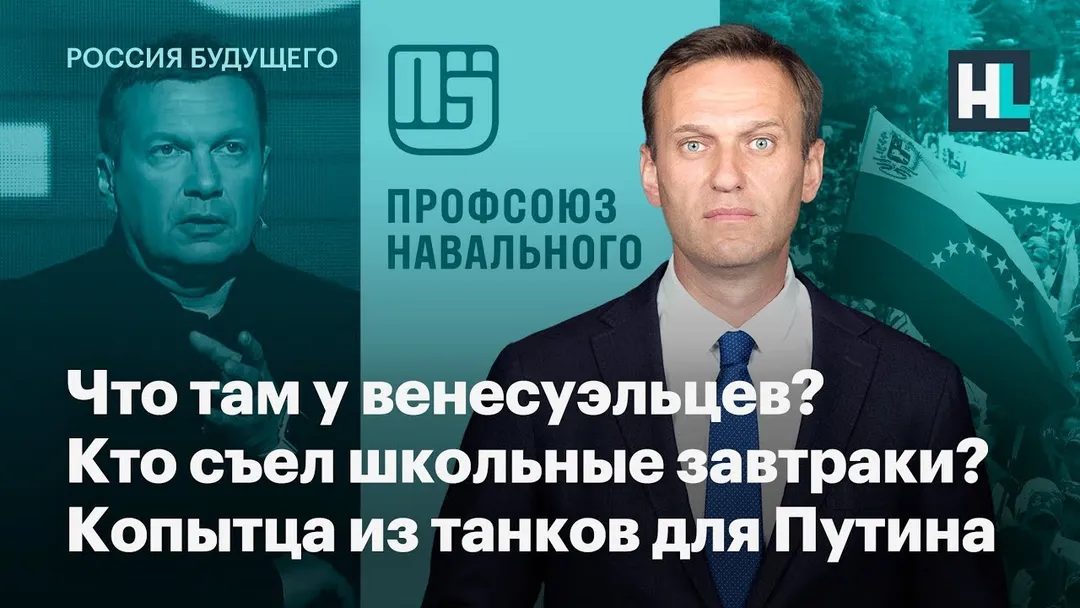
What’s going on with the Venezuelans? Who ate the school breakfasts? They’re going to make hoofs for Putin out of tanks.
[music]
Hello everyone. It’s 8:00 p.m. in Moscow, which means
that we’re live from the Navalny Live studio. I’m Alexei
Navalny, and this is my program, *Russia*
*of the Future*.
This week, Alexei Navalny is the man
who supposedly woke up ISIS — but that’s not all.
Besides that, this week I’m also the person
who, according to
my favorite TV channel’s version of events,
Tsargrad, ought to be dealt with by psychiatrists. Well, actually, yes — psychiatrists, according to
Tsargrad’s view of life, should probably deal with all of us,
not just me. Please send your
questions with the hashtag #RussiaOfTheFuture, and if
they show up on Twitter, send them to us — we’ll
put them on the screen, and I’ll try
to answer them. So, what do you want to discuss first?
Venezuela, because the phrase
“So, how are the Venezuelans doing?” is obviously
going to replace, for quite a while, the phrase
“What about the Ukrainians?” or “Think about your own 7,500 rubles
(about $115 at the time) instead.”
Actually, haha, that was a joke, because
the question “How are the Venezuelans doing?” and the question
of your own personal 7,500 rubles
are one and the same question, because
congratulations, dear citizen
of the Russian Federation: regardless of
your age, social status,
salary, and so on, you have invested in
the wonderful Venezuela of the present — or rather, in
the terrible Venezuela of the past — 7,500
rubles each, because here in power we have
these mighty
geopolitical masterminds. They outplayed everyone. Putin
outplayed everyone, and on top of that he also has
this guy Sechin (Igor Sechin, head of Rosneft),
so even if Putin somehow hadn’t outplayed everyone,
Sechin would have rushed in and outplayed them too. Over the past few years, they
have invested in
Venezuela
$17 billion — that’s about 7,500
rubles for every
citizen of the Russian Federation.
Now, for those who are thinking: is that a lot
or a little? Who the hell knows,
on Russia’s scale maybe
it doesn’t seem like much, maybe we somehow had
an extra $17 billion lying around. But those 17
billion — I made a video about it
and said back then, when there was another round
of investments, that this money would never come back.
It was an idiotic decision to invest
in Venezuela. The money would never return. In the
comments there were tons of people writing,
“Come on, Alexei, don’t meddle in geopolitics. These are
important matters. We have to support this.”
“We’re investing now, and later it’ll come back to us
many times over — whether in bananas or
oil.” Well, let’s take a look. And today on Facebook I
saw a chart and, let’s be honest, stole it
from a political analyst — by the way,
a pro-Kremlin one — Mikhail
Vinogradov. Nina, keep
this image on screen a bit longer so we can all
enjoy it. You can see the bars here — these are
this year’s federal budget expenditures.
And here — one, two, three, four, five, six, seven — we see not
a bar but this big fat marker: that’s the debt
of Venezuela. You see, proportionally speaking,
in terms of our country’s actual life, it’s bigger
than education. It’s bigger than interbudgetary transfers
between budgets — interbudgetary transfers
are what the federal center allocates
to the regions, to all the regions of enormous
Russia, so that they don’t go completely bankrupt
and end up destitute. It’s bigger than
healthcare, never mind environmental
protection, housing and utilities, and so on. In other words,
these are unimaginable,
enormous sums of money that, for some reason,
we poured into Venezuela. And with that money we
could have built a great many things here in
Russia. Not that we could have rebuilt absolutely everything,
but an enormous number of
infrastructure projects could have been completed.
A huge number of people could simply
have received higher salaries. And as for
that famous issue of treatment for sick
children, for which everyone is always fundraising
— we could have
guaranteed, for the next 20 years,
to any parents whose children, God forbid,
fell seriously ill, we could have guaranteed
that all of it would be
paid for from public funds. But that money,
for some reason, Putin, Sechin, and the rest
of that whole gang invested in Venezuela.
So what are we going to get now, and what exactly
is happening in Venezuela? I see, just like you do,
just the picture: a huge
number of people in the streets of Caracas,
a huge number of people in the streets
of other cities. Well, you can see this kind of
footage.
According to the “Moscow city authorities” style of reporting, almost no one
showed up to this rally again.
An enormous number of people. And interestingly enough,
all sorts of our
Kremlin crooks and propagandists are lying about it. But it’s not
just them — not only are they lying, but
many perfectly normal people
have also been misled, because many people
seem to think that all this means
something like: people came out into the streets and chose
some random guy, some obscure
guy named Juan Guaidó — we need
to remember that name; obviously we’ll be hearing it often — and then
basically
those who love revolutions are saying,
“Great, people came out into the streets,”},{
“picked a leader for themselves,”},{
“and made him president.” And all sorts of
crooks are saying, “What about legitimate authority?”
“Did they all just get together and this mob of nobodies,”
“appoint some upstart?” Medvedev (Dmitry Medvedev, former Russian president and prime minister)
posted a whole series of tweets today: how could this be,
this interference in the affairs of who-even-knows-whom?
they appointed him, the people who rose up, so this is
an absolutely incorrect understanding of the situation
a misunderstanding of what is happening
in Venezuela, because there
this is a completely legitimate process
a legitimate process is accompanied by
demonstrations, of course, but the person
who declared himself president, he
did not do it simply by a show of hands at
a rally — “Oh, Juan, come on, we like you,”
“you’re a cool guy, let’s choose you,” and
make him president. He is the speaker of parliament, he is
the chair of the National Assembly, well
that is, it is an elected body. He not only
was elected there as an opposition figure, despite the fact that
despite all that
Maduro controls the courts and controls
the mass media and a great
many other things, this man
was elected to parliament and won a majority
in parliament, well, reached some agreements, and he
was elected speaker of parliament
the parliament, the National Assembly, by the way
has been at war with Maduro for two years already
who, in fact, illegally usurped
power
is reducing parliament’s powers and simply
by controlling the country’s Supreme Court
is trying to dissolve this
parliament altogether, and convened some kind of constituent
assembly made up of some obscure
random guys — so in that sense
Venezuela’s parliament is a much
more legitimate authority than Maduro
who, as a result of obvious
falsifications, came to power and
is holding onto that power, usurping power
and when I see a statement by the speaker
of the Russian parliament, Volodin, saying that
well, some nobody-knows-who
was brought in there, basically just some man off the street, well
Volodin should really keep quiet on that subject
let’s take a look and remember those
wonderful charts showing how Volodin was elected in
the Saratov region — remember
those famous sixty-two point two
percent? The elections, supposedly, were honest
in the Saratov region. Amazingly
at every polling station, one after another, everywhere
United Russia’s result was 62.2, 62.2, 62.2
that was Volodin’s district. Thanks to that
vote for United Russia — obviously
a falsified vote in his favor — there
it was just such a
mathematicians calculated that not even a
one-in-a-trillion chance existed that at
several polling stations, straight across the board
the result would be 62.2
Volodin is a man off the street who, having stolen
the election, wormed his way into parliament and sits there, and
as we know, secured for his mother a
500-square-meter apartment — now that is a real nobody-knows-who
that man off the street. But Juan Guaidó
is the speaker of parliament, and in that sense
right now
in Venezuela there is an undeniable conflict between two
branches of power: the less legitimate
presidential one and the more legitimate
parliamentary one, and from the standpoint of simple
common sense
of course one wants
the parliamentary branch to win, simply because
the presidential власти — Chávez and Maduro — they
have driven the country into catastrophe. One should not
forget that Venezuela, in terms of
oil
is the richest country in the world, richer than
Russia, richer than Saudi Arabia in terms of
oil reserves — that is, it could simply have
become the wealthiest state on earth
but these two clowns, Chávez and now Maduro
they — let’s show a graphic from Meduza (an independent Russian media outlet) — but
here is what these wonderful people have done, you
see
inflation during the Maduro years — I can’t even
be bothered to count the number of digits — it is
two billion percent inflation. GDP
fell by 45 percent. Three
million people fled the country — that is, 10 percent
of the country’s population simply fled
Venezuela. What is happening there now, and what
has been happening over the past years, is an
economic crisis far worse than
what existed in the Soviet Union before its collapse
far worse than the Great Depression
during the time of
the Great Depression in the United States: enormous
lines for basic food products
riots, constant looting of stores
all of this is what Maduro has done — he simply
turned a wealthy oil state into an
officially ultra-poor state, well
just imagine: if three million people
simply fled across the border, there were even
cordons set up by neighboring
states on the border with Venezuela
afterward because people were just pushing through
just running away. You also have to understand that
in the USSR there was a crisis, shortages, and huge
lines for soap, but that was in 1982
whereas there, in 2018, in 2017, people had nothing
to eat. And one of the — it is actually hard
even to imagine this, but
one infuriating factor for Venezuelans
was that since food
was genuinely scarce and everyone was losing weight, they
looked at government officials on
television
just Maduro’s people, and saw that they were
just getting fatter and fatter and fatter, like in
those meme pictures
about Prosecutor General Chaika (former Russian prosecutor general) — it would be
a challenge: these ten-year
little cheeks versus those massive cheeks. And in fact
that really enraged people because
they were literally losing weight, they
literally did not have enough food, they
were going hungry, while Maduro had plenty of everything
It's a good thing that, apparently, more and more...
...most countries hate him more and more, and...
...his victory in the most recent election was...
...completely rigged. By the way, that...
...once again shows us what all these figures are worth.
I mean, come on, the guy supposedly...
...won a month ago, won with...
...something like 65 percent, if I remember right—and so what?
Hundreds of thousands took to the streets. You can't...
...say Maduro has no support at all.
He still controls the army.
The army is supposedly staying neutral, but...
...the military leadership has declared its support for...
...Maduro, and he still controls...
...the courts. But it seems to me—let's hope...
...his days are numbered.
And, sadly, so are the days of our hope that...
...these $17 billion...
...or about 7,500 rubles per person...
...for each of us, will ever come back. Well, I...
...think the new government is unlikely to just...
...cross it all out entirely, but there will be some kind of...
...restructuring stretched out over 130,000 years or something...
...like all those African debts and other...
...Latin American debts to the Soviet...
...Union. Sooner or later, they will still...
...have to be forgiven. And here we see in the picture...
...two great geopolitical masterminds, and we...
...have to ask ourselves a question: well, there they are...
...shaking each other's little hands, and those...
...handshakes cost us, as we saw in the...
...image, simply unimaginable sums of money...
...many times greater than annual spending...
...on education and healthcare. What did we get...
...out of it? Why was there...
...this whole absurd...
...idealistic spectacle staged around it? Do you remember the...
...Tu-160 bombers that flew...
...there and all that? What for, exactly? I mean, in...
...Putin's head there is some strange picture...
...that for the sake of Maduro—and before him...
...Chávez—who kept coming to Russia constantly...
...I mean, they came here just an endless...
...number of times. More often than them, only...
...leaders of foreign...
...states from the former...
...Soviet Union visited Russia, and right after them...
...came these Venezuelans...
...who came here as if it were their day job.
Every time, they were loaded up with suitcases of money.
Why? Because they said, "Putin is...
...wonderful," and they also recognized...
...the independence of South Ossetia. Great. Was all that...
...really worth paying them $17...
...billion? No. But getting back to it...
...I just want to show you these...
...hellish videos about how...
...the bombers flew there, how...
...they were received. Let's watch 47 seconds...
...of meaningless, idiotic hype.
A few more seconds, and in the cloudless sky...
...the silhouette becomes clearly visible...
...of a Tu-160 strategic missile-carrying bomber.
First to touch down is Vasily...
...Reshetnikov, followed by an honorary escort of...
...Venezuelan fighter jets. Nikolai...
...Kuznetsov.
Each "White Swan" (nickname for the Tu-160) has its own name. From the Barents...
...Sea, the Norwegian Sea, and the Caribbean Sea...
...across the Atlantic Ocean: 13 hours and 10,000...
...kilometers (about 6,200 miles).
The welcome was not just warm, but hot in...
...the literal sense: outside, the temperature was over 30°C (86°F).
The flight, the pilots admit, was not an easy one...
...and not only because of its duration. For almost...
...the entire route, the Tu-160s were escorted...
...by aircraft from NATO countries. This is not just...
...cooperation—this is friendship based on...
...respect. Such warm relations...
...in the military-technical sphere began in...
...the time of Hugo Chávez...
...and continue under President Nicolás...
...Maduro.
And this, excuse my language, crap cost us...
...$17 billion. A few more seconds, and...
...in just a few more seconds, the missile-carrying bombers...
...touch the runway.
Thirty degrees, a sea of joy—what even...
...was this stupidity? And what was it...
...supposed to be—intimidating the U.S.? They couldn't care less.
Support for the people of Venezuela? They...
...couldn't care less. At that very moment, people were standing in line for soap.
Did this help them in any way? Well...
...they burned a huge amount of aviation fuel...
...kerosene, flew in—fine, okay...
...they flew in. We demonstrated that our...
...bombers can fly. In other words...
...they did what, generally speaking, we...
...built them for and maintain an army for. So it's...
...pure showmanship.
This is some kind of strange bravado...
...a stupid foreign-policy...
...game again. Fine, if you're supporting...
...an authoritarian but somehow...
...strong regime that is developing the country...
...that's one thing. But here you're shoveling money...
...into suitcases for people...
...who created 2 billion percent...
...inflation, under whom GDP fell by half...
...and you're giving them money. And all...
...you get in return are these videos...
...clearly aimed at the dumbest part...
...of the population, which enjoys this while sitting...
...there broke.
But they enjoy the idea that our...
...look, our bombers made it all the way to Venezuela, and...
...there they are greeted by people like this, all...
...covered in stars. Well, we have people with...
...gold stars too. You could put one...
...somewhere in Kubinka (a town near Moscow known for military airfields), and he would walk...
...around some aircraft, and the picture would look...
...very similar.
To sum up, people ask me...
...what new levy the government will come up with...
...to make up for Venezuela's debt...
...to Russia. A tax on air?
Utility bills for garbage removal at 544 rubles?
No, they won't invent a new tax.
you paid for it
with your own hard-earned money, for all these
the infamous retail tricks like prices ending in 9,
all these so-called one-liter
milk cartons that actually contain 900 grams,
of milk
low wages—but that’s exactly what this is:
money. It’s already gone. That tax, your
labor, our crushing poverty—we have all
become
$17 billion poorer.
We didn’t get several new
bridges. We didn’t get several
new high-quality roads. We didn’t get
any additional demand in the economy.
Once again, we have to send more
text messages to raise money to get someone treated,
and some people we won’t be able to treat—children,
horrible as it is to say, children and adults,
anyone at all,
will die because they don’t have medicine,
because we couldn’t get it for them,
couldn’t treat them, while we’ll be lying on planks in
hospitals—like in that infamous case of
two stools and two boards in some
hospital,
used to create extra beds. That is the
tax we have already paid. So
I think—I am convinced—that this money
is lost to us, because of the way the
Russian government behaves, when it
declares: we support
the one and only legitimate Maduro.
Most likely, soon enough he’ll be spending his days
somewhere in Rostov or on Rublyovka (an elite suburb of Moscow).
It’s obvious that the new government of
Venezuela will hardly be eager
to return this money to us. And of course,
even for purely political reasons, Putin
can’t just switch sides now and start
supporting the new authorities. But to push
harder than anyone else and support
Maduro more than anyone else—that makes no sense
from any rational point of view. Fine,
even if
it turned out Sechin was an idiot—we already knew he was
an idiot, and now it’s confirmed: Sechin is an idiot,
and he persuaded everyone to invest money in
Venezuela, he poured Rosneft’s money into it.
What should be done?
If we’re being rational, first of all he should be kicked out
to hell. Second, they should start
some kind of back-channel negotiations,
say: guys, we’re taking
a flexible position here; for us this is a substantial
sum—$17 billion—so let’s somehow
quietly establish informal contacts, let’s
not put all our eggs in one basket.
That would be a very cynical position regarding Maduro,
and I do not support it. But even if
you’re being completely cynical—maybe Maduro will hold on,
and we’ll make a deal with him; if these others
win, then we’ll make a deal with them—we’ll
be a bit more cunning. But no—they boldly, without
a second thought,
sacrifice our money. Old man Putin
Continuing on the subject of money,
to paraphrase Yuri Dud (a well-known Russian interviewer), who
asks everyone: if you found yourself standing before
Putin, what would you say to him? If you found yourself
standing before your salary,
what would you say? Most residents of
Russia, unfortunately, would probably say:
“My salary is so tiny.” I’m joking,
of course, but really it’s not funny at all: we have 22
million people living below the poverty line, and today we
launched a major project,
possibly the biggest one we’ve ever
launched, and
I’ve already written about it, but it is also a kind of
personal political manifesto for me,
because I believe that what we
have now begun to do—without abandoning
anything else we’re doing—is exactly what
Navalny’s team has started; the video is out, you
can watch it. This is what the
opposition should be doing. I’ve been thinking about
this for quite a long time. Those who have seen my
speeches when I traveled to
the regions know very well that I always
began by asking what people’s salaries were
and comparing them with the official figures. It was
a very funny part of my
speech, because people would simply
laugh when I cited the official
Rosstat figures for salaries in their
regions.
It all finally came together in my head
while I was under arrest in a special detention center. The best
ideas come when you’re under arrest. I
deliberately
signed up to see the paramedic there.
There are detainees there, and there are
paramedics. Detainees are, well, a rather
specific contingent:
some have delirium tremens, some are drug addicts,
some are simply sick people, with pain,
blood pressure issues, all sorts of things. And there is a paramedic
there all the time, around the clock, though on
weekdays in particular, they actually
have quite a lot of work to do,
because, well, someone is always
having some kind of episode. So I deliberately
knocked on the door and said: I need to see a doctor.
I needed to test a hypothesis
about the paramedic’s salary. I was sitting there
with those papers—the so-called May decrees
issued by Putin, in which he
guaranteed a certain level of wages,
tying them to the average salary—and I saw
figures there, something like this:
the average salary in Moscow was, say,
80,000 rubles. So I think: here sits either a
nurse, meaning mid-level medical staff,
or a paramedic, meaning junior medical
staff, so this person’s salary
should be somewhere between 60,000 and 80,000 rubles.
Let me ask her now.
I knock on the door and say, "Come on, you see..."
To see the doctor. After a while, the escort guard
takes me up to him, and I go in.
"Hello, hello, could you take my blood pressure?"
And meanwhile, I sort of spread out
a piece of paper and say, "Listen, may I just
ask you something, please? It's not
a very comfortable question, but what is
your salary? Because I want to compare it
with the official figures, which say that your
salary...
And there it says from 60,000 to 80,000 rubles (about $650–$870), and the woman
very pleasantly says to me, "Well...
I'm a little embarrassed to say it, but my salary is
27... well, 25, actually."
I say, "Wait, 27? 25? In Moscow, to live on
that while working here? Your average salary
should be something like 60,000, no
less." And then she says a phrase
after which I understood everything: "Alexei, come on,
who would ever allow us to be paid that kind of
money?" And I thought, damn, wow—so this is it.
A person works in medicine, and her job
is, first of all, considered
something that should come with special pay,
because you're working with
prisoners, a special contingent,
you're definitely working with people who are
constantly dealing with all kinds of problems, you see.
You have to treat people with delirium tremens (severe alcohol withdrawal), too.
And she says, completely seriously, "Well, who
is going to pay that kind of money?" She herself
doesn't even really believe, in principle, that
a situation is possible in which they would
pay 60,000 rubles (about $650). That's not some incredible amount of money,
you'll agree—especially not an incredible amount
for living in Moscow. That's when I
realized: damn, there are all kinds of
politicians, all kinds of parties, there are
theoretically trade unions in Russia, but
there is no political force at all that
represents the interests of this woman and
will finally come out and say: if
Putin guaranteed and promised the May decrees (a set of presidential social spending orders issued in May 2012),
and claims that he has
fulfilled them, then pay up—pay exactly
what you promised. Let's take a look, by the way.
There's a short video where Putin
tells us that everything is fine, everything is
great with the May decrees. For a whole range of
categories of public-sector workers,
wages in state-funded institutions have long
not been raised for several
years. In this connection, I propose carrying out
indexation of wages precisely for
these categories of public-sector
employees.
Back in 2016, they reported that indexation had been done,
that everything had been raised and indexed,
but they still don't pay. There are various
ways around it—they move people onto some
quarter-time position, a fraction of a full-time post, and so on.
But they don't pay. And I thought that this
is exactly what needs to be dealt with.
So if you're a politician, and if in the country there are
millions of people who are being underpaid—because here
pretty much everyone is underpaid—then if you're going to create
trade unions, then of course trade unions need to be created.
Remember, I discussed this in detail here,
before.
How in Berezniki, at that collapsed
Uralkali mine, people died—that's how
trade unions should act.
There should be active trade unions at all factories.
That is, people should
fight for normal wages.
But these public-sector workers—there are some 6 million of them,
or 5 to 8 million—they have it
guaranteed on paper, written down,
and at all these meetings the ministers sit there
nodding their heads, saying, "Yes, we pay them all."
That is, for this woman I spoke
to, someone went there and reported back,
saying, "Yes, we paid
60,000 rubles (about $650)." But many are not being paid that, which means
someone has to defend her.
Someone has to talk about this, after all,
because there will be no
economic growth
if there are no wages and the population is impoverished.
Nothing can be done that way. It really is
just as I said in the video—our fight against
corruption from below.
We all need to unite and finally
say: enough, this has gone too far.
We don't need to be spending money on Venezuela
—there won't be money for that damn Venezuela
if they start paying normal wages
to people. Not gigantic wages—just normal ones. Very often
you hear this nonsense:
"Oh, but then hyperinflation will start." Why would
hyperinflation start?
Because a paramedic in Moscow would
earn 60,000 rubles (about $650), as they should? Or
because in the Novosibirsk region
a kindergarten teacher would earn 32,000 rubles (about $350)? Is that where
hyperinflation would begin? Hyperinflation
would begin because billions are spent on all sorts of
nonsense—billions here, billions there.
Just look at how much is spent on
Margarita Simonyan, how much is spent on
state television, just on
endless Venezuela, Venezuela. Okay, money has been
spent there, but even inside the country
far more is spent on all kinds of absurdities, and
therefore, of course, we need to defend those people
who
are simply being underpaid.
I'm getting a lot of questions right now
about why we
started with public-sector workers, and what about miners,
and what about everyone else? Well, this is the first step,
because these people have guaranteed entitlements, and here we
can make a clear demand
to governors and mayors, to Putin and everyone
else: you promised, so pay. We can
bring in trade unions that will
work on this. Let me just show you the website...
I’d only just started working on this, and I printed out
a few pages for myself of what
people are writing, just to reassure myself once again
how necessary this project is. It says here:
Moscow: junior nurse, monthly salary
14,300 rubles in Moscow; 14,300 rubles in Ryazan Region
daycare worker: 11,907. How are people supposed to live on
11,907? And how shameless it is to say that this
person in Ryazan is supposedly earning
according to the statistics somewhere around
28,000 or 30,000
when you’re paying them 11,900. Cultural institution
employee.
Oryol: 15,454 rubles. That’s an adult
person earning 15,000. How is he supposed to send his
children to school? So it’s no wonder
that not everyone can make ends meet.
People survive off what they can grow themselves, planting potatoes
just to stay alive. Tomsk Region:
I’m looking again: orderly, 15,000 rubles.
Do these people need protection? Of course
they do. And it’s strange, really, that only now
we’ve finally started talking about this,
actually setting side by side
an orderly in Tomsk and
the 17 billion dollars Putin
is giving to Venezuela. He’ll stop giving it
when all these orderlies finally rise up.
We understand perfectly well that many
public-sector workers are simply afraid. And again, I
look here and see that people most often want
to complain, but they write anonymously, a little
hesitantly—someone writes,
"I’m ready to let you use my..."
I understand that they’re afraid, but unless we
push all this forward, nothing will come of it.
Either the authorities will feel
pressure from below—pressure from millions of people
pressure from below over their own
incomes—or they’ll just keep on
sending billions here and there.
Of course, he seems to think that this is
his personal money, because nobody is demanding anything from him,
and Putin thinks he
can hand it all out, while the orderly
just stays silent.
Well, our project exists so that people
won’t stay silent. We have people who
are ready to fight for all this right now.
There’s a union we’re working with on this.
And while we’re on the subject,
let me show you
a short video clip—1 minute 20 seconds.
It’s the medical union we’re working with.
They’re real fighters, and I was especially
pleased when they
brought us this video and said, maybe
you could post it on your channel, because more
people will see it. And I said, of course I can,
because that’s exactly what we collect donations for.
This whole studio exists
so that any independent
trade union can come here, and we’ll help any of them if they’re
truly fighting for a just cause. So, they
came and showed that they’re fighting not only for the rights
of doctors, but for patients’ rights as well.
A normal, humane trade union. 1
minute 20 seconds.
Hello, I’m Anastasia Vasilyeva,
chair of the medical workers’ union
Doctors’ Alliance. After our last
video, we started receiving emails
from staff and patients of Clinic No. 218.
Among those who wrote to us was
Valentina Nikiforova, who suffers from diabetes
and for a long time had been unable
to get them to provide her with
the subsidized medications she was entitled to.
She had an appointment scheduled with the chief
doctor and invited us to go with
her.
Of course, we agreed to support her
and went there together with Valentina Alexeyevna.
As expected, the chief doctor,
Olga Kolesnikova,
got flustered and immediately promised
to resolve Valentina’s problems.
The system works, everything works
perfectly. You’re lying... You claimed that
you had seen the original.
For six months they ignored her, but as soon as
she loudly stated her demands, they
were fulfilled immediately. Within 20 minutes,
Valentina received the medications
she was legally entitled to, and a month’s supply costs
almost 5,000 rubles.
Well, that’s money I won’t have to spend from my
pension, which of course makes me very happy.
So that’s the story. Thank you very much.
I’m very grateful. I don’t know—tell everyone that
they should contact Nastya, and she’ll go with them.
And there must be
tens of thousands of people like me, probably.
It’s a slightly funny video in terms of
how it’s presented—these union representatives,
the way she explains it sounds almost like a schoolteacher,
but in essence, you have to admit, if there
were 100 unions like this, if there were
one in each of Russia’s 80-plus federal subjects (regions),
and they were out there running around
dealing with these issues, from salaries to
free medicines, life would be
much better, right? Because the authorities
will act, will do something in
our interests, only when there is pressure.
In a normal system, there should be pressure
from trade unions, from a federation
of independent unions. As it stands now,
there is no pressure at all—these are just people
who fawn over the authorities. So,
let me show you a slide. It lists
the categories of people
who can take part in our project
right now. You can see: doctors and
nurses,
teachers, lecturers, and so on. If
you’re watching, get involved. If you have
friends or acquaintances like this, send them this link.
This is a major project that we will be
working on, and it is only possible with
your help. I am absolutely convinced that this is
the future of the opposition. We are not stopping
anything else we do: we will fight
corruption, we will work on
human rights issues,
we will do everything that decent, honest people
are supposed to do. But we will also
devote a lot of attention to this too—maybe
more attention than anything else, because
this
about millions of people being robbed. Today it is
public-sector workers; tomorrow it will be someone else, and we will
work on that too. So if you are, if you are
the leader of a local trade union and want to work with us,
go to the website and write to us as well.
Our entire infrastructure is quite extensive;
it is there for you, and we will be able to organize
political pressure on your local
bosses, and
well, maybe they will
refuse to pay wages right away,
but at the very least we will not let them
have the chance to lie that they have paid everyone
everything and that everyone
is doing fine. Clark Petrov writes:
What about the salaries of EMERCOM employees (Russia’s Ministry of Emergency Situations)? We just
have no strength left anymore. By the way,
an amazing thing: after
we launched this project, I actually saw
several letters from firefighters, from EMERCOM
employees—what is going on there? They are simply not
being paid. But we will keep adding, we
will keep adding new and new categories.
You cannot embrace the infinite, but we are
a nonprofit organization.
Form a trade union—you in EMERCOM, form a trade union.
We will help you, and together we will
work on your wage issue. So,
Sasha Peppa asks, in connection with
your latest video about trade unions:
I work as a barista. How can I support
the campaign, given that I do not know anyone in these
fields? Sasha, you are already supporting it.
It may seem to you that you do not know anyone,
but post something about it somewhere on your social
media.
Among the people you know, there are people whose
parents work in the public sector.
The state in Russia controls virtually
80 percent of the economy,
so certainly among your acquaintances, your
friends, relatives, and parents, there are those
who are public-sector workers. But besides that, you should
simply talk about it, just
discuss these things. Just do not stay silent—
say it.
Tell an acquaintance that in Tomsk Oblast
nurses earn 15,000 rubles, and I, a barista from
Moscow, am not exactly happy about that either,
or pleased with it. Sasha, I cannot tell whether you are a young
man or a young woman—just talk about
it. Say that there is such a project. Sooner
or later the information will spread; sooner
or later each of these 6 million people
will come to our website and compare their
salary with what they are supposed to be receiving.
So support us by continuing.
On the issue of poverty: yes, Kemerovo Oblast
of course stood out, stood out this
week probably among all the regions of Russia.
And I talked about Kemerovo Oblast more
than anything else in this program because there
the political order is worse than in
Chechnya even now, while at the same time it is a rich
region, an industrial region, and yet a
poor one. And this week the children’s rights ombudsman made a major
statement, telling us that in
Kemerovo Oblast—excuse me—
children are fainting from hunger because
their parents are so poor
that they cannot give them 50 rubles for
a school breakfast. And I know who ate
the school breakfasts in Kemerovo Oblast.
I can show you a photograph of this
man, because when I read this
news, I thought: these are just some
absolutely shameless people.
The children’s rights ombudsman told
this
the deputies of the regional assembly—the very same
regional assembly deputies. He was telling us,
saying: guys, in our
region,
children are fainting from hunger; their
parents do not have 50 rubles to buy breakfast,
and
the deputies just sat there and said: we do not know how
to solve this issue. But the ones who should solve it are
them—these United Russia deputies. Meanwhile, for this
guy,
this guy with the big broad face,
they are still paying for the upkeep of that
very dacha (country house) that I showed you. There are
1 million square meters of forest alone,
gas, electricity, its own road, several houses—
and he is no longer governor, but for some reason he is still there.
For some reason.
The upkeep of this dacha, frankly speaking,
more than covers everything needed
to give children from low-income families
50 rubles each so they would not collapse from
hunger. I will tell you even more: if we
look at the sources of income for
that very man himself,
Aman Tuleyev—why did I say that he
ate those breakfasts?
But that is not even a figure of speech. He filed
a complaint against me with the Investigative Committee
and even had an investigator from
Kemerovo come to see me at the special detention center
when I was under arrest, and interrogate
me because I had allegedly slandered Aman
Tuleyev. So I will mention again
that Aman Tuleyev invented for himself
a special piece of nonsense
called the title of “people’s governor,” and
the title of honorary citizen
of various districts, cities, and villages
in Kemerovo Region, he is an honorary
citizen of 11 cities and 7 districts, and for
that he gets paid, and these
shameless United Russia deputies
passed this law under which Tuleyev
receives money because he is an honorary
citizen of some village in the middle of nowhere
they simply pay him for it, and for that he
gets 3 million rubles a year in total
altogether, and that is, excuse me, 6
ten thousand of those very school
breakfasts. So stop paying him, that
smug face who sat there for many
years and ruined Kuzbass (the Kemerovo coal-mining region), don’t pay
him, and you will solve the problem of poor
schoolchildren, poor parents, poor
schoolchildren. Don’t sit there, dear United Russia members,
at the Kemerovo regional assembly, and don’t pretend
to us that you don’t know the budgets are
tight, that somehow you can’t
solve this problem. You can solve
this problem simply by stopping the enforcement of
this illegal, this unlawful decision under
which you are paying who-knows-whom,
a former governor, from the
budget for a huge, colossal dacha and
also paying him for the title of honorary
citizen of some backwater village. It’s all
very simple, very simple. They
have to do this, and for them to
do it, we must not stay silent. In
Kemerovo Region, please, somehow
talk about this. If you see your
local deputy, talk to them. And
as for schoolchildren fainting from hunger, well,
I think, of course, that perhaps this
ombudsman exaggerated things; probably there
isn’t literally a mass situation where
bang, children stand up in front of the teacher
and all collapse from hunger, well
that’s a stupid joke too, but nevertheless
I think it’s unlikely that this is truly
massive, but Rostovtseva said that
such cases did happen. And if such
cases exist, then take it away from Tuleyev and give it to these
children, and everything will be fine. Now let’s
talk about that guy who has never
fainted from hunger—quite the opposite,
he fainted from happiness
and self-satisfaction because he has lots of
money. He’d open his
mobile phone and get a message about
what else had come in from the
state-funded institution
TV channel
Rossiya 24, or whatever it’s called
the Rossiya TV channel: another
1 million rubles or 5 million rubles has been credited to you
and he’d nearly faint with happiness. This is
Vladimir Rudolfovich Solovyov
our wonderful man, and this
week I released an investigation into his
second villa on Lake Como, and this is of course
simply marvelous because
it shows us just how much all these
people do not believe for a second in
Russia’s prospects. Because, come on,
he has two villas. What does that say? Either
he’s buying a house for his mother or
for some relatives in Italy, if we assume
he’s buying them, then the whole family
has decided to move there, or he is simply
taking all the money we pay him and
investing it in real estate on Lake Como
So he sat here in Russia thinking,
where should I invest my money
received from a federal budget-funded
institution? Maybe in Venezuela?
No, probably not. Maybe
buy some stocks in Russia? No,
certainly not, because I understand that with
these
Putin and Medvedev there will be
no prospects at all. So I’d better take
this money in my beak over to Italy
and buy in a great place where there are none of
those people I praise on television—they
aren’t there, all those disgusting mugs
that I drag onto my show
aren’t there, which means it’s some kind of
great place to
invest money. And so he bought another
villa. Let me show you
exclusive, previously unseen
video, recently filmed, of the same place, and
while I’m at it, I’ll correct my mistake
let’s take one minute for the old flyover
or rather the new flyover. You can already see
it’s not as green because this was filmed recently
and I said that he was building a
pool. I was mistaken: he is building another house
you can see they’ve already started putting up the walls there
apparently it’s a house there, and next to it
a pool. So our Vladimir Rudolfovich
on his large plot of land—about 0.39 hectares (roughly 0.96 acres)
37 sotkas—and with two houses already, he is building yet
another house and a pool. He’s set himself up nicely,
Vladimir Rudolfovich
everything is very, very good for him. He does not
believe in Russia for a second; he
puts his money into Lake Como
and here, meanwhile, just to
brighten up his daily life a bit, he drives a
Maybach worth 15 million rubles
A curious situation: this post
was up for just under a year, about how
Solovyov bought a Maybach. There were
quite a few comments there, and all
the comments were along the lines of
‘Cringe, ugh, Mercedes, shame—I’m switching from
Mercedes to BMW. Why did you put this freak
in the post?’ After we
told everyone about this situation, they closed
comments under that post altogether
on Instagram, because everyone came and
told the blunt truth there, everything they
think about this
this utterly disgusting fellow who
buys himself a Mercedes
One of the notable topics this week—not
not because it was interesting, but because it’s interesting how
it was being pushed—there was a dispute involving that same
Solovyov (Vladimir Solovyov, Russian TV host and propagandist) on one side and Maria
Zakharova (Russian Foreign Ministry spokeswoman)—good Lord—and Anatoly Chubais on the other
and we saw quite clearly how the state
media were openly pushing it, with news alerts coming out like
“Maria Zakharova
mocked Anatoly Chubais; Vladimir
Solovyov backed Maria Zakharova,”
who mocked Anatoly Chubais.”
Anatoly Chubais, in turn, responded to them, and
then they all started trading insults, and so one part
of this disgusting rabble was bickering with
another part of the same disgusting rabble.
Chubais this, Solovyov that—and Vladimir Solovyov
was really going hard in his program
throwing a few insults at Chubais. Let’s
listen to 31 seconds of Vladimir
Solovyov raging about the vile liberal
Chubais: “He should be jailed, absolutely.”
What other options are there? And convenient as it may be, but
this is Chubais, after all.
He simply can’t help lying. We’ll be waiting to see you again
in the arena—sorry, strike that—on the screen
of our blue TV sets.
But listen, if even your
TV is blue, that shows just how
alive—sorry—those popular associations still are;
people don’t call you that for nothing, given who you really are
and in the bad sense of the word at that.
If even your TV is blue, then
glory be to the screen...
Chubais says Solovyov is a fool,
Solovyov says in response that Chubais
should be jailed, that you should be locked up,
that all of you should be jailed. So this
this segment of mine is called: “When Sweethearts Quarrel”
“When sweethearts quarrel, they only amuse themselves”—it’s one and the same
organism.
Chubais and Solovyov grow on the same
body. When Solovyov says Chubais
should be jailed,
just remember, please: who was it that appointed Chubais?
If he’s so terrible,
if the public dislikes him so much, if he’s
such a nightmare, and if even
Maria Zakharova, who crawled out of
who-knows-where, can’t stand him,
then why on earth does Putin not just keep him around
—not only that, he gives him the same kind of
fancy Mercedes cars with flashing lights
and, on top of that, reaches into our pockets
pulls out money and gives it to Chubais for this?
For Rosnano (the Russian state nanotechnology company). And Rosnano fails year
after year; everyone laughs at Rosnano, and
we have none of those flexible tablets or whatever,
none of those wonderful LED
light bulbs, no lithium batteries—nothing at all.
Chubais, together with his entire
team, basically stole everything, and whatever
they couldn’t steal, they simply
blew on all sorts of nonsense.
So why does Putin keep him? Because
it was Chubais who taught Putin how to steal. They
started out together in the St. Petersburg mayor’s office
when they were still young men. They
took envelopes together from some
St. Petersburg businessmen and so on.
And while Chubais was skimming off the electricity sector,
Putin was skimming off the St. Petersburg mayor’s office, and then
in 1996 Putin moved
to the Presidential Administration. There they were.
You keep cursing the damned ’90s, but since 1996 your
Putin has been sitting in Yeltsin’s Presidential Administration
and Chubais was among those who brought him there.
And all his life Chubais has protected your
Putin. Chubais and Putin kiss each other,
hug each other, and say, “Remember, Vova (diminutive of Vladimir), how back in
St. Petersburg we conned that one sucker out of five
thousand dollars?” And the other replies,
“Of course I remember—weren’t we great
guys even back then? But now, of course,
now we squeeze people for billions, not
for five thousand dollars.”
They pat each other on the shoulder, pat each other on
the back, laugh at Vladimir
Solovyov, laugh at Maria Zakharova,
and what’s more, standing there will also be
Solovyov and Zakharova, all of them together
sort of laughing at us because of how brilliantly
we staged it all.
This supposed conflict—Chubais, Putin, Solovyov, and
Zakharova—is all the same thing. It’s a gathering
of disgusting, degenerate, talentless
crooks sitting on our necks with their legs dangling
and making you want, somehow, to finally
at long last
drive them out. Since we’ve started talking about the city of
St. Petersburg, where these
wonderful
twin brothers, Putin and Chubais, came from, we need
to talk about the future governor
of St. Petersburg, whose last name is
Beglov. You may think he’s Beglov, but
yesterday he turned into Belyov.
This is actually a very interesting
story, and in general what is now
happening in St. Petersburg
is going to be one of the most gripping and
interesting political stories—follow it closely.
It doesn’t matter what region you’re from,
because in St. Petersburg there will be, at the same time,
elections for local deputies and the
gubernatorial election, in which this very
same
Beglov is running—a bureaucrat nobody knows,
who very much wants to be governor
of St. Petersburg, though it’s completely unclear why,
since he has not the slightest grounds for it,
not the slightest talent, and not the slightest
support. And right now he’s running a very funny
campaign, and in some ways it’s
copied from Sobyanin’s (Moscow mayor Sergey Sobyanin) campaign,
this campaign is built on such lies and on a narrative
So, that means he does too.
a strong, competent manager
and just look at how it has been transformed,
and at the same time, look at how
Moscow was transformed under Sergey Semyonovich (Sergey Sobyanin).
And here, look, Beglov came in and
started transforming the city of St. Petersburg.
They came up with this meme, “Beglov’s shovel,” and
started promoting it on social media, and Beglov
is photographed with a shovel, and this
shovel is supposed to symbolize that they need
to clean all this up, and they’re pushing all of it, and
promoting it, of course, across
social media, and Fontanka, a St. Petersburg media outlet,
published an amusing investigation
showing that a few months earlier
this group of bots had been working for Kozhemyako,
the man who became governor
of Primorye as a result of rigged
elections, and for a couple of months they wrote
about what a strong, competent manager Kozhemyako was, how
great he was at cleaning things up, how well he
had gotten everything in order.
And now, all these people have apparently
suddenly moved from Vladivostok to the city of
St. Petersburg, and now they’re telling everyone there
how great Beglov is. So why
did Beglov get up and leave? Because, well,
aside from the fact that he’s some kind of unclear,
hard-to-understand figure who suddenly decided
he wanted to lead the country’s second-largest city,
he also turned out to be a fantastically
cowardly and worthless politician. He came to the
St. Petersburg Legislative Assembly, where
various candidates were being discussed, and then
deputy Maxim Reznik took the podium
and said some very simple words.
He wasn’t shouting at Beglov there,
he wasn’t insulting him; he said, “You are not
suited to our city, you are saying
some kind of nonsense.” Reznik actually put it
much more politely. But this “cultural capital” (a common nickname for St. Petersburg),
Beglov jumped up and ran out of
the hall.
At that moment, Beglov fled, basically.
Just imagine: a man wants to become
governor, but he is incapable of listening to
even the most basic criticism from his own
St. Petersburg deputies in the legislative assembly,
the very people he is supposed to work with. Let’s
watch 51 seconds of the speech and
Beglov’s escape in the middle of it.
Maxim Reznik: “And in that sense, I will not
support any of the
candidates presented here, simply because,
with all due respect, Alexander Dmitrievich, I do not
support your candidacy for the post of
governor, and I believe that you are not
suited to our city.”
“That is exactly what I would like
to speak about today, because I consider it important. I
will try to be as brief as possible, but
I’m not sure I can fit it all into one speech,
into just three minutes, because this is a matter
of principle.”
“You and I have spoken only
once, at a government meeting
at the end of last year, and it seemed to me
that was enough. But now you don’t even
want to listen. That’s very unfortunate, but
nevertheless I will speak, because
I am addressing the voters. In his programmatic
statement, Alexander Dmitrievich said that
he considers the main task to be protecting the minds
of the population from Western influence. I believe that
everything about that phrase is unsuited to St. Petersburg.”
Do you get it? People say, well, there he is,
he came, he took his seat of honor, he
listens to the deputies, and then finally
a deputy comes out who isn’t flattering Beglov
and says, “Well, I believe you are not suited
to our city,” and then he
jumps up from his seat and leaves the hall. He
doesn’t want to listen to these terrible “insults.”
So, Beglov is an absolute
political [__].
He isn’t even capable of listening to
an opposition deputy who is speaking quite
politely. And it will be very interesting
to watch how Putin is going to get this
shovels,
elected, what they will try to do to
the people of St. Petersburg in order to make them
vote. I have only one
hypothesis: they must, I don’t know, find some kind of
absolute hellish freak
just for contrast,
so that everyone says, “My God, well, okay, I don’t know,”
maybe actor Panin, or Dzhigurda, or
Sobchak — who would they have to put up so that
people would say, “Anyone but that one — we’ll vote
for Beglov.”
It will be very interesting to watch this
campaign, how they are going to promote all these
shovels of theirs, how they are going to fight with our
headquarters, which is now working very
actively. And in response to these Beglov
shovels,
it launched the “Into Beglov’s snowdrift” flash mob, where
people simply paint “Beglov’s snowdrift” on snowbanks.
And interestingly, there was a similar
flash mob last winter in Moscow, when
some witty people wrote on huge
snowbanks in Moscow in red paint
“Navalny,” after which
Moscow municipal equipment would immediately arrive and
clear away that snowbank. There were many such examples.
It was very funny. But in St. Petersburg it’s even
funnier, because Beglov is not
capable of removing a snowbank that has
“Beglov’s snowdrift” written on it. Utility workers arrive,
and they come fairly
quickly — the police or someone else informs them —
they take shovels and mix the snow and the
paint together so that the writing disappears from the snowbank.
The snowbank itself remains, and after that they
get back in the vehicle and leave.
It will be very funny to watch how they handle it.
they'll be choosing how to break the whole
city of St. Petersburg over their knee. I
hope the city doesn't break, but I don't
see the gubernatorial election as anything
but predetermined, because they control who
gets in and who doesn't. So I very much
hope that people in St. Petersburg, at least,
will hit back at this trash through
the municipal elections and won't elect a single
United Russia member. And I really
hope that our штаб (campaign office) will also
play some significant role in that.
Let me answer some questions. Maria
Drevo writes: "I'm from St. Petersburg. Where did they even find
Beglov? Who even is he? I'm not going to
vote for him." Everyone keeps asking who he is.
Well, he was the presidential envoy in the Northern
Northwestern Federal District, a close friend
of Putin, again from those old days in
that old, old
St. Petersburg. He, Chubais, Putin — the whole
same gang. They're all old friends.
They're all trusted insiders because back
in the 1990s they were all making money together in
the St. Petersburg mayor's office and in all that
St. Petersburg business. So for you he's not
some random nobody — for Putin he's always been
a trusted person. And now they're going to
push this trusted
man
so that you, Maria, will vote for him. Alexei asks:
"Saulsky, your view on the law against
insulting the authorities — how strong is your
outrage?" It's always at the maximum. I
always have consistency in life:
my level of outrage is always pretty high. But
as for the law on insulting the authorities, I
discussed it in quite a bit of detail. I released a video about it.
They've already passed it in
the first reading.
A lot of political analysts were saying
they wouldn't pass it — but they did pass this law.
They'll be issuing fines under it. The fine for
individuals for fake news is 5,000 rubles
(about $50 / €45). Just watch: of course all that
endless lying from Solovyov, Maria
Zakharova, Russia Today — that will all be fine,
but they'll fine me for some nonsense.
That infuriates me, of course, but I think
that in this situation it will hit them
harder, because do you know who
will be the first to file a complaint over
fake news? Me. Because when they
say things like what's written here — when they
tell me that in Tomsk
a nurse earns 30,000 rubles
(about $300 / €270), I'll bring them a letter I received from
that nurse in Tomsk, who won't be afraid
to sign it herself, and I'll say: here she is, she earns
15,000 rubles (about $150 / €135). You're fake news — fine them
5,000 rubles," I'll shout. And they'll
awkwardly try to laugh it off. Unicorn Geralt,
a regular listener and commenter,
asks: "Why does Saratov pay for gas,
but Chechnya doesn't? Are we a federal
state or not?" Vladimir Milov had a broadcast today
where he went into the Chechnya situation in quite a bit of detail.
It's not all so straightforward there. First of all,
of course everyone should pay for gas — both Chechnya
and Saratov — because that's just
not even up for discussion. The situation is absurd.
But apparently in Chechnya
the issue was that the regional network had
charged people for non-existent gas debts.
That's what the head of Dagestan's
Mezhregiongaz was recently jailed for.
He used gas for commercial purposes,
and then shifted those debts
onto the population through various
non-existent properties.
Supposedly, non-existent people
had consumed this gas, and in order to collect
that money, they billed real people.
That's why they say they're afraid of public
outrage — and they should be afraid of public outrage,
because when a person already doesn't
want to pay for gas, and then they also
get a bill for gas they never consumed,
they really could start a revolt,
especially in Chechnya.
So it's a complex issue there.
On the one hand, Kadyrov certainly
wants to create special preferential
conditions; on the other hand, there's horrific
corruption, where these debts are simply
dumped on the population. We'll sort it out
and see how the appeal court ruling goes.
Golova Chik Arte asks:
"My mom works as an accountant.
Her salary is 15,000 rubles
(about $150 / €135). She works from 8 a.m. to 9 p.m.
It's unfair to have such a salary.
I don't know what to do. She comes home already
exhausted. Can you help? Dear Arte,
only we can help each other. But
it would be dishonest of me to tell you,
"Write to me and I'll help," if she works in
the public sector — healthcare,
culture, or education.
If she is a public-sector employee, write to us, and we
know what to do in a situation like your
mother's. But in general, of course,
this is the same answer I always give, and it
may not satisfy everyone: we need to fight
this government, because low wages
are a direct consequence of the fact that Putin
has been in power for 20 years, and the country's economy
isn't growing, people's incomes have been falling
for the fifth year in a row, and Putin can only
respond to our outrage, yours and mine, with
repression. And this week we saw
some new level of cynicism and monstrosity — when they started
...
right now
to pressure and persecute the Open Russia organization
Open Russia, which is Mikhail
Khodorkovsky's organization—they declared it,
an undesirable organization, and moreover
only a foreign organization can be declared undesirable
and this one is
Russian. Well yes, this organization
belongs to Khodorkovsky, and of course they
don't like it, but they lied by saying that
this organization had been declared undesirable abroad
and they really started jailing people
in total lawlessness, complete arbitrariness
people who worked for Open Russia
Now you'll see a photo with me
standing with two volunteers from the election
campaign. These two people have now been
locked up.
The young woman was placed under house arrest, and the young
man, Artyom Milushkin, was sent to jail.
He was put in pretrial detention (SIZO), and his wife, Liyа Milushkina,
was placed under house arrest.
Allegedly, they were buying drugs, and this is,
well, a story that is genuinely infuriating.
This Milushkin
had previously been detained for organizing [missing text]
Let's watch 37 seconds from
his detention in Pskov. He was detained there; he is
an opposition activist.
"You're taking him away—explain to me, explain, I am
his wife. Explain what you're doing."
Well done, heroes. If only you worked this hard
This man had filed the notice for a small rally,
and these bastards
grabbed him on the street and detained him as if
he were some kind of terrorist who had hijacked a plane.
After that detention, they told him that
next time we'd find drugs on you, and
now they've jailed him on the accusation that
drugs were found on him, even though
no drugs were actually found on him, and this
charge is based on the testimony
of a witness who in some documents
is listed as Viktor, and in other documents
is listed as
Olga, who allegedly bought drugs from him.
Just think about it: literally anyone
can be jailed tomorrow if some
anonymous secret witness says that he
"Well, I bought from him there..."
"300 grams of marijuana or heroin," and then you're jailed
for drug possession because
some witness testified that
he bought those drugs from you.
You're hearing this now and saying, "No way, that can't
possibly happen." But it can, and it is happening.
In Pskov,
a man is sitting in pretrial detention (SIZO) on exactly this
absurd charge—that someone said
they bought drugs from him. And of course
he's a political activist who
is constantly being detained, searched, and surveilled,
so naturally he just loves selling drugs
to some random shady guys. And his wife
also apparently loves selling drugs. They
have to be jailed—it's total lawlessness. And
an even more monstrous situation may be
unfolding right now in Rostov, where
Anastasia Shevchenko
has been arrested.
She is an activist, the coordinator of Open Russia
in Rostov, and she also worked there
including as a volunteer for our [campaign/project]. She is
a mother of three children, and they arrest her
because, can you imagine,
she committed such a terrible crime:
she is a member of an organization. That is
the accusation. They aren't even accusing her of
making Molotov cocktails or
anything like that. The point is: she is a member of an organization
that is banned, and on that basis
a mother of three can simply be locked up.
This is just genuinely monstrous
swine-like behavior, and of course this is being done personally by
Vladimir Vladimirovich Putin.
With the backing of all these people
from Solovyov and Zakharova to Chubais, they
want precisely to preserve their
status quo, under which everything is fine for them
and
they have a villa on Lake Como. So this
Anastasia Shevchenko
must be jailed, and to hell with her children
and whatever is happening to them, whatever is going on in that
family right now—can you imagine? But that's their attitude:
like, "The mother was jailed." I'll wrap up today's program
today
by discussing the main act
of idiocy, the prolonged
ongoing idiocy that has been taking place in
our country over the course of, well, several
weeks. It was just a
dance with tambourines, an act of state paganism.
I looked at it and thought, good grief,
it feels like we are some kind of country
of Papuans; it feels like
we've ended up in the year 805, or I don't know,
302—back when
across the territory of our country there ran
Vyatichi and Krivichi (early East Slavic tribes) worshipping a bear. But
now we're not worshipping a bear,
we're worshipping a piece of metal that we hauled in from Laos.
The whole damn country stood out in the freezing cold
welcoming tanks produced after
the war in Czechoslovakia. But to us they were
presented as sacred T-34 military tanks.
And it turns out that now we're supposed not only to
pray to the St. George ribbon (a Russian military symbol), we also have to
pray to this hunk of metal
that was produced in Czechoslovakia
in 1953—or 1952, 1948, 1950,
in any case, it was made in Czechoslovakia.
Those tanks were sold to Laos,
and now we're bringing those tanks back from there.
They spent an enormous amount of money
to transport them—just think, where is Laos and where is Moscow?
to the Moscow region, where the Kantemirovskaya division is based,
all the way across practically the entire globe.
Why the hell did we drag in these damn Czechoslovak
pieces of metal so they could be brought onto the territory
of our country, and here they could drive out soldiers,
schoolchildren, and some generals, so that they
would bow down
to these chunks of metal as if, as if they were actually
some kind of holy artifact, as if
they really were. Yes, there was a war, and a lot of
people died. There was a tank in that war that
proved itself, sure; there was the PPSh submachine gun,
the PPSh, the Katyusha rocket launcher—so now are we supposed
to bow to some multiple rocket launcher
systems? Let's watch the video: the governor
is standing there—and this is the governor in Chita, on the day
when it was around minus 30 degrees Celsius, and there are
some people standing there, bowing and
delivering these pompous, insane speeches,
a full 21 seconds of madness.
Russian daily... and to fall asleep...
doomed... like the ancient bogatyrs (medieval epic warriors),
our partnership, our troubles...
have provided the process within it...
tens of thousands of our ancestors... you cannot forge...
The heavy tanks are coming from Laos and have already
been to Vladivostok. The equipment
has covered more than four and a half
thousand kilometers by sea. The tanks are coming
from Laos and have already been to Vladivostok.
Thank you, sacred tanks...
The governor is standing there—good Lord, he's a governor, and in his
region, in Chita Region (now part of Zabaykalsky Krai), a huge share of the population lives
below the poverty line—almost 25
percent of the population. One of the poorest
regions, absolutely destitute.
And the governor stands there babbling something about bogatyrs (medieval epic warriors) in
this armor, like the ancients... You want
to say to him: not everything you're saying
even makes sense. Listen to yourself. This has absolutely nothing
to do with anything. It's just
old Czechoslovak scrap metal. But here,
you see, our deputy defense minister
declares: successfully completed
the most important state task of
Sergei Shoigu's initiative; as a result of
military-technical cooperation, some number of
T-34 tanks... But these tanks' homeland is
Czechoslovakia and Laos—they have nothing
to do with any of this. And again,
I apologize for constantly using
the example of the neighbor's kids, but how many
could have been
operations carried out if we weren't doing this
nonsense—hauling these metal chunks around,
by sea, by rail. They must have bought these tanks,
presumably, or rented them, or something. Now they're
going to bring them to
the Kantemirovskaya Division. I lived for many years—most of my life,
I spent there,
near the Taman Division.
There is plenty of this kind of stuff there—tanks standing on
pedestals, as many as you like. These
tanks, this metal—there's a sea of it. Why bring in more?
And now, surely, one of them
will be put on a pedestal,
and the others will be melted down into little crosses that
the Patriarch will consecrate,
or maybe they'll make some other sacred horseshoes
to shoe something with, I don't know,
not sacred experience—sacred horseshoeing.
They'll put them on Putin's little shoes so that when he
walks somewhere in America,
as he walks, he'll be clacking along
with these horseshoes, and that way
the T-34 tanks will make it to Washington too, onto the
territory of the probable enemy. You'll see,
that's exactly how it will be. This is
state paganism already; it's right here,
and it's already simply unbearable. Our
state has simply turned into
a state of some kind of wild,
absurd shamans. In the Beautiful Russia of the Future
(a slogan meaning a hoped-for democratic future for Russia), we will of course deal with this
strictly: no shamanism whatsoever, except
in the territories of the Far North, where
it is a traditional religion.
Until the next program. Goodbye.
[music]