A Gazprom Pensioner
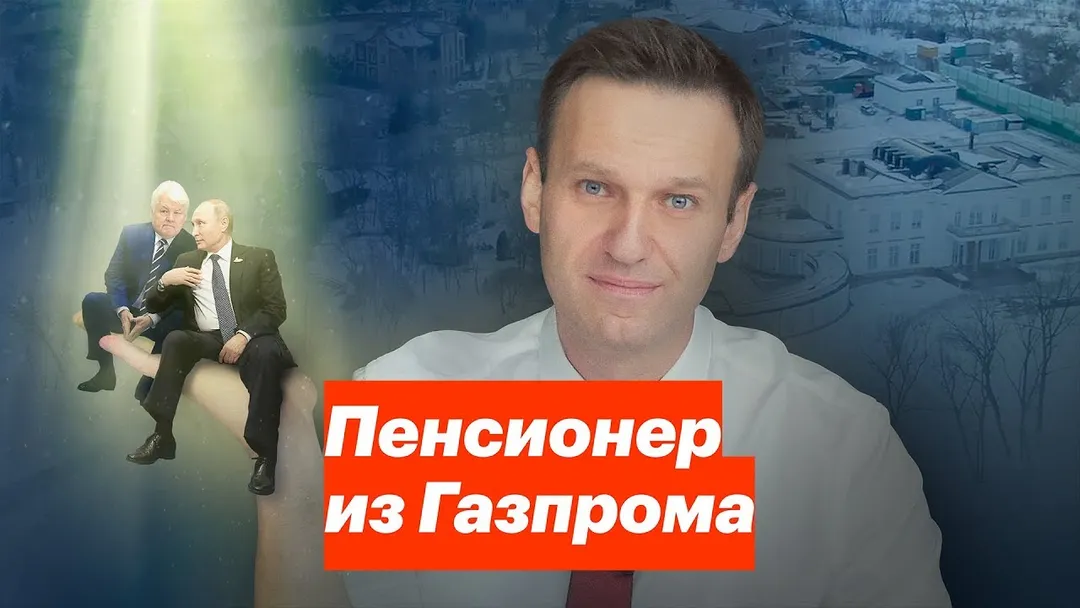
"Parasites and drunks" — that’s what a deputy called them.
He was referring to all pensioners who
receive pensions of around 9,000 rubles (about $100) a month.
So today, we’re going to
take a look at how a pensioner lives — one who
meets United Russia’s standards.
[music]
Hi, this is Navalny. We all know, of course,
that 8,800 is a typical pension amount
received by many millions of people who honestly
worked for 40 or 50 years. But United
Russia obviously knows better: one of its deputies called
all such pensioners parasites
and drunks living off pensions paid for by those
who actually worked. But when ordinary people
were working, were they given decent wages
or a decent pension today?
Or is it somehow their fault that the funds from those years
produced this result? "Drunks" — and that
gave me a simple idea:
to show you how a pensioner lives — one who
is perfectly acceptable to the party of power,
to the ruling party and the government — what, so to speak,
a Putin-style working man looks like. For the sake of
a clean experiment, I decided to find a pensioner
who worked in the very same place
as the deputy who considers everyone
parasites — and that deputy works at Gazprom.
What’s more, we need a pensioner who
is close to the authorities, just like our brazen
United Russia man. We had to dig through the news
about Gazprom, but we found exactly the right person
for you.
Luckily, a couple of weeks ago, one of Gazprom’s
deputy chiefs resigned.
It was one of the top boss’s deputies: Valery
Alexandrovich Golubev. So he is our
ideal United Russia pensioner for today.
And, not coincidentally, given his closeness to
the authorities, everything in his life is just wonderful. The thing is,
Valery Golubev doesn’t understand a damn thing
about gas, energy, extraction, or
drilling. But he did serve in the
Leningrad KGB, and later in the secretariat of
the St. Petersburg mayor’s office.
Then he became head of the Vasileostrovsky
district, where he performed the main feat
of his life — something well documented in
numerous media reports.
Golubev once allocated an apartment to
a not particularly important St. Petersburg official
named Vladimir Vladimirovich Putin.
By the standards of the time, it was an incredibly luxurious
living space — and by today’s standards too, frankly.
We’re talking about an apartment measuring 140
square meters (about 1,500 square feet), in this building on
2nd Line of Vasilyevsky Island.
Golubev himself moved into the same building and
the same entrance, one floor below. In other words,
they served, worked, and lived together. Then their
paths diverged for a while: Putin left for
Moscow, while Golubev stayed behind and held
not especially important positions in
St. Petersburg — he was a member of the
Legislative Assembly and head of the city’s tourism committee.
In 2002, he was delegated to the
Federation Council (Russia’s upper house of parliament) and moved to Moscow. And
here comes my favorite part: how does some
tourism committee chairman end up
in the post of deputy chairman
of the country’s largest and most important
state company — our so-called national treasure,
Gazprom? Like this: Golubev once
attended some kind of
meeting with Putin, and as Putin was leaving,
he noticed him in the back rows,
recognized him, and asked, "Valera, what are you doing here?
What are you working on?" And within a couple of months
after that meeting, in early 2003,
Golubev left the Federation Council, to which
he had only just been elected, and was appointed
CEO of a Gazprom subsidiary.
He joined Gazprom’s management board and later
became deputy chairman, remaining in that role until
2019.
And you say there’s no career advancement in Russia.
So, we’ve established that
we have before us
a model Putin-era
pensioner: he’s from Gazprom, he’s close to
the authorities, and now we want to see what
a dignified old age looks like for this
hard worker — not some parasite,
unlike you and me. For any
pensioner, a dacha (country house) is terribly important.
That’s where we’ll start. Let’s just search online.
Luckily, the country’s main
state news agency, in its
business section,
informs us that because of the Yamal-Europe gas pipeline,
Golubev’s dacha lost its porcini mushrooms.
Our hero laments: "The pipeline went through
and cut across all the
cow migration routes. The cows can’t go
into the forest and eat grass. Before, the cows
used to wander through the forest, knocking over the mushrooms, but
now they don’t go into the forest.
They don’t eat the grass there, the forest is overgrowing,
and the porcini stopped growing. There used to be
excellent little porcini, like champagne
corks." Besides the porcini and champagne corks,
the article also states fairly precisely where
the dacha is located. So of course,
we sent our special
correspondent there, hoping to film yet another
palace.
[music]
[music]
Well then, the place is certainly strange, but
the rich have their quirks.
[music]
I’m baffled. We’ve never seen anything like this.
But it seems we’ve found an honest Gazprom
man. Here is his palace:
[music]
And that, basically, is the whole fiasco.
A crooked little house in the village of Bibikovo.
Cows, porcini mushrooms — but no gas.
probably electricity too
Could it really be? Dear God, we’ve found
at last an honest Putin associate
a former colleague who didn’t steal billions and
Deputy Nabiyev has already raised his finger and
is threatening me: “You hear me, Navalny, don’t you dare
slander Vladimir Vladimirovich and
our United Russia party.” Sorry, I’m already
ready, ready to apologize
but then I thought: what if this isn’t the only
dacha of our pensioner
because besides that wonderful village and
Bibikovo, there are other nice places in Russia
too. And yes, my friends, it turns out that one
small, modest little dacha
pensioner Golubev doesn’t mention in
his interview. Apparently porcini mushrooms don’t grow there
but we’ll show it to you anyway. Here it is,
the dacha where the porcini don’t grow. Here
she is, a beauty. And of course, we’re on Rublyovka (Moscow’s ultra-elite suburb)
right now, looking at
the main house: 3,000 square meters
in the main section, and along a curved gallery
you can walk to the bathhouse complex
on the right. The total area of this
building is 3,800 square meters
You can see two floors and an attic
above ground, but there’s also a full
underground floor of the same size
Let’s look a little farther across the property
that’s a 418-square-meter garage, enough for about 20
cars
next to it, some kind of greenhouse and a tennis court
and that pit covered with snow
is an outdoor pool. To the right of it is a
two-story guest house
And by the way, take a look at the fence—impressive
really quite
something. Do you know who fenced themselves off like that? We don’t know
but we suspect. That huge building—you can
see it in the center of the property—is an indoor
ice arena for hockey. Behind it
is a helipad. Unfortunately, residents of the Moscow region
can’t get in there. This entire
territory is completely closed off to
ordinary people and belongs to the FSO,
that is, Putin’s protective service, just like in
the good old St. Petersburg days. Putin and
Golubev are neighbors again. Golubev’s plot
covers 5 hectares (about 12.4 acres). And by the way, in this footage
you can clearly see the cleared entrance to
Golubev’s underground area
It’s a car tunnel leading to the house and
to the river. And take note: Golubev
illegally seized all of this—both the land and the
houses—with a total value of more than 3 billion
rubles (about tens of millions of U.S. dollars), and they belong to Golubev
Vyacheslav Valeryevich, the 23-year-old son
of Gazprom’s deputy chairman
He supposedly bought and built all of this when he
was nineteen. We’re pulling away now, once
again admiring the scale of this state official’s
estate, and in general
the vast expanses of Rublyovka, and while we’re at it
we send greetings to Alisher Usmanov
who lives right here. He, one of
the richest men in Russia and the world, has a house
that’s smaller and more modest than pensioner
Golubev’s
We began examining the life of our
pensioner by doubting that
the wooden house near Torzhok was all that he
had—and we were right to doubt it. But I want
to tell you that it doesn’t stop with a 3-billion-ruble house
The Golubev family also has
we also found a 200-square-meter apartment
in the very same building as
the head of Gazprom
Miller. It’s in Moscow’s Presnya district, right behind
the government building, where this house is located
a 260-square-meter apartment in Khamovniki
and he also transferred to his daughter a plot
in southwestern Moscow measuring one and a half
hectares (about 3.7 acres). And then there’s
the St. Petersburg jewel, probably the most
closed-off and elite residential building in Russia, where
almost the entire membership of that
famous Ozero cooperative (the dacha association linked to Putin’s inner circle) moved
in: Kovalchuk, Shamalov, Fursenko, and
their fellow travelers
Timchenko and Rotenberg. There are no random people
in that building on Kamenny Island in
St. Petersburg, and there cannot be
Golubev’s wife, Tatyana, has there
a four-story apartment with an area of 460
square meters. A place like that costs 60
million rubles. Not a bad retirement life,
you’d agree. But there’s also an obvious
question: where did he get the money for
all of this? Even over 15 years at Gazprom
Golubev could not possibly have earned anything close to
that much. We take the company’s financial statements
look at media reports, calculate everything as favorably as possible
for Golubev
and we find that over the entire period his income
could have amounted to 2.5 billion
rubles. That’s an enormous sum
but even that wouldn’t be enough for this mega-construction project
and 5 hectares (about 12.4 acres) of land on Rublyovka. So how was
everything else purchased? The explanation isn’t far to seek
Back in 2011
a newspaper wrote about Golubev’s wife
She was a former physics teacher, but as soon as
her husband got a job at Gazprom, she immediately
straightened her shoulders and felt drawn to
business, after which she became a supplier
of large-diameter pipes for Gazprom contractors
and made very good money from it. Besides that,
we have already managed to find another
enterprising member of this family, about whom
nothing was previously known. This is
Yevgeny Yuryevich Khitin. He appears in
the transactions for the purchase of those same 5 hectares
on Rublyovka that we’ve already seen
and he was also registered for quite a long time in
the same apartment as Golubev and his wife
We’ll venture to assume that he is the son
of Golubev’s wife from her first marriage, that is
the stepson of Gazprom’s deputy chairman, and he too
works at Gazprom, hooray, as deputy
director of Gazprom Komplektatsiya
this company handles centralized
procurement of basically everything for Gazprom, and in
2004, when he was only 27, he
became a shareholder
in a holding company that was the largest manufacturer and
supplier of various turbines and
gas-compressor units for
Gazprom. Later, the shares of this company were
bought up by
Gazprombank. So that’s the formula we have
for a comfortable retirement
serve alongside Putin,
work alongside Putin, live with
Putin in the same building—that’s enough, that’s all it takes.
You drunks and freeloaders have to work, while
for these real hard workers
Putin brings everything: a 500-square-meter apartment
(about 5,400 sq ft), houses of 3,000 square meters
(about 32,300 sq ft), a hectare or two of land
where every little porcini mushroom will look like a champagne
cork. And this simple formula
is shocking in its universality. Just look for yourselves:
Chemezov, head of Rostec, served
with him, Putin appointed him, his wife gets contracts,
an apartment worth 5 billion rubles. Sechin—they worked
together, Putin appointed him: apartment, yacht, houses.
Miller—the same story, worked with Putin in
the St. Petersburg mayor’s office, then Gazprom, apartments, villas, a
private jet. The Rotenbergs used to go with Putin to
judo, and dug up a chunk of Gazprom for themselves.
The richest family in the world. Another pensioner,
Yakunin, served with him, ended up heading Russian Railways (RZD),
handed contracts to his children, houses in London,
retirement in Germany. I could go on like this for a long time,
and every time you hear, or think to yourselves,
“Well, but he’s the head of
Gazprom, RussNeft, Rostec—these are
obviously major figures, executives,
rich people.” No, it’s obvious: these are random
incompetent people, crooks,
who at some point simply
found themselves on the same stairwell landing as Putin
or on neighboring dacha plots. That’s it.
That’s where their achievements end, and
after that begins what you yourselves
can plainly see: state companies looted clean,
failed performance indicators,
nonexistent successes, forecasts that never come true,
shameful wages and working conditions
that drive workers to desperation,
even to murders right there at the factories, literally out of
poverty. But for the people responsible
for all this, dreams did come true, because after all
it’s all “Dreams come true” (Gazprom’s slogan),
just only for you. Oh, and by the way, one last thing:
deputy Nabiev is running for election again,
you drunks, and he’ll become a deputy again in his
Volgograd Region and remain a deputy
for as long as none of you
take part in Smart Voting
Roskomnadzor
is banning this link, but we have one
they still can’t block yet. In
September, many Russian regions
will hold elections.
Register now, and by election day
we’ll send you instructions on
whom to vote for in order to inflict
maximum damage on United Russia, Putin, and
all these brazen people living high on the hog.
Subscribe to our channel. Here
they tell the truth.