Mr. & Mrs. Bottom made a movie, the prosecutor general bought a crab for a murderer, and idiot deputies
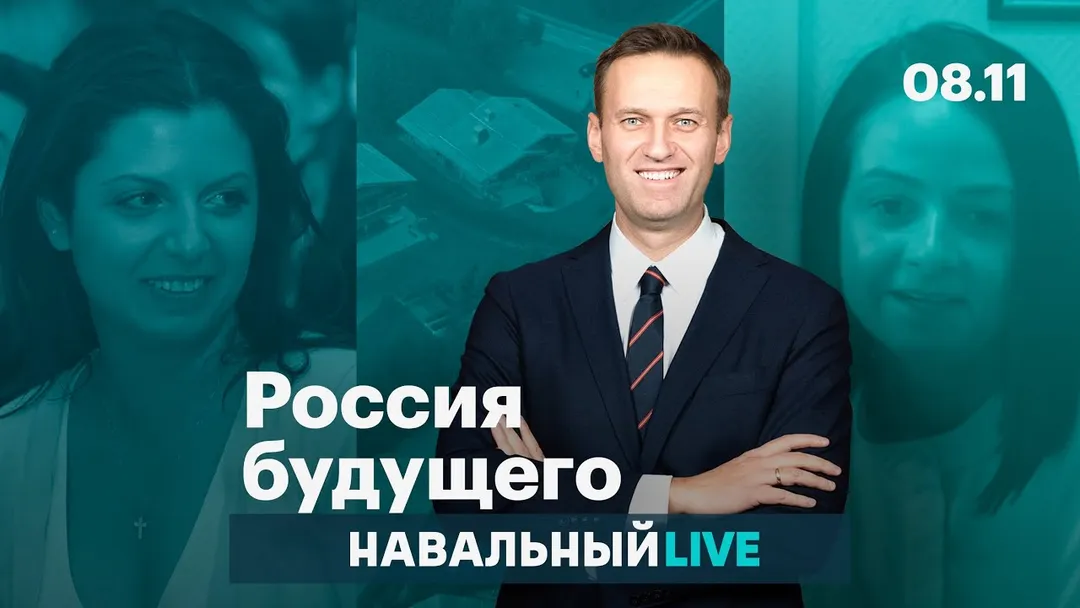
[music]
Good evening. It’s 8:00 p.m. in Moscow, and that
means we’re live on the channel
Navalny Live with the program *Russia*
of the Future. And I’m Alexei Navalny, who
last time complained to you that, well, they haven’t
been coming up with funny nicknames for me lately.
But this week, there was a breakthrough.
I can’t choose. I’ve got three names
I could sign off with. First,
“the embodiment of the devil.” Sorry, that’s
from deputy Vitaly Milonov. He also called me
a “charismatic pastor.” And, uh, the third name,
which the newspaper splashed across a full page about me,
was in *Moskovsky Komsomolets*,
which, by the way, has a large circulation:
“opposition
monarch.” So, well, those are the
powerful names I got this week.
I mean, “the embodiment
of the devil.” “Opposition monarch.” Respect,
respect. I’m a big deal. I should do this
and show that I’m pleased. I’ll start by
briefly plugging once again
a really cool thing we’ve
launched. It’s a social media
aggregator. We basically made it for
ourselves, so we could better understand
the picture of the day: *Trending Today*. There’ll be a link in the description.
Click it, use it.
It really will help you. Because
you, ordinary people, what do you do
during the day? Well, you work a little,
spend a little time with your kids or
your parents, do a few
useful things. But mostly, of course,
you sit on your phone and open
Twitter, Instagram, or somewhere else
68 times a day, or 268 times a day,
to check whether there’s anything
interesting there. Now you don’t need
to do that. All 268 times a day, you can
go to our aggregator and see what
interesting things have come out. Really,
it’s genuinely a good resource.
Check it out, use it. And now I’ll move straight, straight
to the Culture News section, which I usually don’t even have
in this program.
And, uh, if it does
appear, it’s usually at the end. But
culture news belongs on the last page, after all.
But here I want to start with culture
news, because I feel bad about 80 kopecks.
Actually,
I paid it, just like you did, just like the people in this
studio, just like my wife, my children, and
every citizen of the Russian Federation did.
We all helped fund a wonderful
couple whom I call Mr. and
Mrs. Bottom. They are absolutely
disgusting people: Margarita Simonyan and
her husband Tigran Keosayan. These people
received 100 million rubles (about $1.5 million) for their film,
which is called *The Crimean Bridge*.
*Made with Love*.
And it’s such a great story,
because
the money was allocated without any competition. Well, we
understand that the Cinema Fund, basically,
has only nominal competitions. The money
goes to whoever is, uh, liked by our
culture minister, Mr. Medinsky,
and whoever is, well, sufficiently, sufficiently
busy licking the authorities’ boots. But still,
there is some formal procedure there,
some kind of competition, some kind of
applications,
some pitching and selection procedures. I don’t
know what a pitching procedure is,
forgive me, please. But some kind of
procedure exists. And this film, *The Crimean
Bridge*, which flopped—I admit that
I haven’t seen it and don’t plan to watch it,
but basically I know enough from, uh,
the fact that its ratings on
a ten-point scale on
all the film-rating websites,
KinoPoisk and so on, are from 2-point-something to 3-point-something
out of 10—so, a complete
box-office failure. But even so, you and
I paid 100 million rubles for it. And those 100 million
rubles were given out on the basis of some
letter, as the BBC told us.
That is, a letter came to the Cinema Fund
saying Tigran Keosayan, the film’s director, had such an important project,
and Margarita
Simonyan, the film’s screenwriter, was involved too.
Such important, brilliant people, that
they needed to be given 100 million rubles immediately
without any procedures at all, and they would make their
great masterpiece. I can’t show you
a clip from *The Crimean Bridge*, but
that would probably be some kind of copyright
violation. I’m waiting—I’ll probably watch it when
BadComedian (a popular Russian YouTube film reviewer) does some kind of
review of it. But, uh, actually,
the genius of Tigran Keosayan
I can demonstrate it to you,
and show why, in fact, I call them both
Mr. and Mrs. Bottom. Uh, but
Margarita Simonyan is a person who,
at a minimum, besides the 80 kopecks she
just stole from us for this pathetic
film of hers, also takes from each of us
128 rubles a year, because for her channel
Russia Today, the Russian Federation
allocates 18—almost 19—billion rubles a year. And
we absolutely do not want to allocate that
money. It’s miserable television
that almost nobody watches. And,
well, it is an absolutely disgusting,
low-grade propaganda channel. And yet,
18 billion rubles—we took that out of
our own pockets and set it aside. Fine then,
let the hospitals wait. Children, don’t run
over here, children, and don’t ask for your
free children’s medicine. We need
to fund Margarita Simonyan, uh,
and
her
ideas about what
information policy should be. And,
Tigran Keosayan, her husband, hosts
an absolutely astonishing
show on the NTV channel. It's called
— I don't have it written down here. Well,
some kind of show, anyway, on the subject of
geopolitics. It's a kind of comedic
political show. You know, they're very
popular, for example, in the United
States of America. They really are
quite funny. They're, uh, very, very
popular. And they have a very strong
influence on politics. I mean, there are
always some shows that are more left-wing,
more right-wing; there's competition between
these shows. It's a very popular format —
making jokes about politics. And so in
Russia, this same Tigran Keosayan,
who recently got 80 kopecks from you
to make his masterpiece, which flopped at the
box office, makes this kind of show on
NTV. The NTV channel
will ban us if I just play this. But I
want to show you 1 minute and 12 seconds
of this show, just so you understand
what a wonderful, brilliant person,
Mr. Bottom, is, and why you should give him 100
million rubles (about $1.1 million) without a tender. So now I'm going to
play 1 minute and 12 seconds for you, and I'll
sit in the corner, because under
YouTube's rules, if I'm sitting in the corner like
this, the NTV people won't be able to block
this broadcast. But please, be
careful. If you have a saucer or something
nearby, because your eyes are going to
bleed — please hold it right
here. And in general, please move
the faint-hearted away from the screen, because
the genius director is about to make jokes. 1
minute and 12 seconds. Of Great Keosayan.
I don't know about other irresponsible
journalists, but we personally have never joked
about Macron. We have always spoken
only the truth.
Back in school, he realized that being a married
gay gerontophile was somehow more elegant than
just being an ordinary gay man.
Oh, don't shove that furry thing in my
face. I'm getting excited. Our people are filming. And that makes me
even more excited.
Emmanuel Macron.
wants Putin to respect him.
Well, what advice can you give here?
Change your name.
Persistent rumors say that Macron is gay.
Of course not. They're not rumors. If I were
Emmanuel Macron, my first
visit would be to Emomali Rahmon.
Just because the names sound alike.
Cute Emmanuel, as befits
a flighty Frenchwoman, was late with another
cute guy in glasses; they were
counting the cute ones in the crowd.
Just yesterday, the surname Macron sounded like
a brand of macaroni, and the first name hinted at
the bedroom. What can you expect from
Emmanuel?
Macron,
macaroni — don't shove that furry thing
in my face. That was aired on a federal
TV channel. That costs a lot of money. As you
know, all these federal channels, including NTV,
are, one way or another, still
funded from the budget, from
state-owned companies. But most
importantly, you were able to appreciate the tremendous,
creative, comedic
talent of this man, who has now made
his amazing romantic
comedy. Well, uh,
it's not even that I'm afraid of giving it
extra — uh, additional
publicity; please, I am giving it
additional publicity. Go see it — after all, you
already spent your 80 kopecks on it, so, well, spend
another 300 rubles (about $3–4). Go to the cinema
just so you can walk out and
understand that all these people need to be driven
the hell out, because, well,
they've landed on their feet. In any
normal country, these people would simply
be where they belong,
Mr. and Mrs. Bottom. They are
absolutely talentless, absolutely
worthless people whom nobody
needs. All of their talent consists of
being lackeys. And they are lackeys of this
regime. And in Russia they are simply swimming
in money. They get everything without
waiting in line; money is handed to them. Well, look,
what a family operation this is. Money
to be a director, fine. The wife
is the screenwriter; I don't know, there was probably someone else
too — likely the whole extended family
was involved. And all their whims are paid for with our
money. And if you're unhappy about something,
you'll hear from them: "Well,
guys, you have to sit quietly, because
we are the authority here." As Margarita
Simonyan once so memorably said,
that if Russia
ever has democracy and we
let people do what they want,
they'll take us and hang us from the lamp posts.
Well, after things like these,
these so-called comedy shows, or stories
about how 100
million rubles (about $1.1 million) get allocated without a tender to some film by your
family, then yes, Margarita, you
are probably right. The risks of such a scenario
really do increase.
And, uh, it seems to me that if we've already started
talking about, uh, these
wonderful people who, uh, well,
are absolutely useless and repulsive
idlers and crooks bathing in our
money—then of course this is a good segue
to the woman who,
of course, delivered last week's biggest hit.
This has been discussed from every angle. I
was wondering whether we should talk about it at all or
not, whether we should mention it or not. Well, because
it seems like everyone has already chewed this topic over. Do I have
anything to add to it? But I still want
to say my piece. This is Olga
Glotskikh, director of the Department
of Youth Policy, who first
gathered various people in her office who
work on issues related to childhood,
motherhood, and then delivered to them, like
a boss sitting at the head of the table, uh, this kind of
sermon about how the state
owes you nothing, and in general the state did not
ask you—did not ask you—to have children.
You've probably seen it. Still, let's
watch those 22 seconds again. Olga
Glotskikh, a member of United Russia (the ruling political party),
a high-ranking regional
official, explains to us how
life works.
As of today, it has somehow turned out that
among young people, in the rising generation,
for some reason there is this understanding
that the state owes us everything.
No, the state, in principle, owes you
absolutely nothing; the ones who owe you are your
parents. Well, because they gave birth to you.
The state did not ask them to have you.
This is actually very important, because
it is very candid and very much
the way things are actually arranged in their
heads. In other words, it was this very
Olga Glodtskikh speaking, because what
was in her head is exactly what she
blurted out. But in fact, you should understand that
speaking to you through her were
Margarita Simonyan and Tigran Keosayan,
Vladimir Putin and Dmitry Medvedev—they
were all speaking, because this is the
most important article of faith for them: that
the state owes you nothing. We never
asked you for anything, and in general the state
and society are not some kind of dialogue
or debate. You have no right to outvote us
or demand anything. Rather,
it is a relationship between a boss and
a subordinate. That is, well, you come to us,
you ask us for something, and we will
look at you and say, and think to ourselves,
what fools, here they are again
asking us, begging. Well, if they are
sufficiently, uh, willing to bend before
us, then maybe we won't
give them something. If they get cocky, we'll put them in the
corner or throw them right out the
door. But overall, in general, we are your
superiors. And this is an extremely important
thing that actually sits in the
heads of almost all officials. Unfortunately,
it also sits in the heads of many
of our fellow citizens, who also
think this way. Well, uh, you can't. People there
get scared that I criticize
officials on this program, people
get scared that I expose
officials and call them all sorts of names.
They say: "How can that be? Good
grief, he's the prime minister—how can you
have the right to criticize him?" Because
even people who are not
officials still carry this thought:
"Well, he's above you,
he's my superior; if he sits in
that office, then he's not just the head of some
youth policy department that, well,
that is basically just seven
people sitting in three more offices and
doing nothing." He's the boss
in general. In principle, in any
situation—whether you meet him at the theater, or
in a café, or in a bar, or on the street, or
standing with him in line at the post office—he is still
the boss in any situation. He is
always, by definition, above you. And this is a very
important thing that we must
talk about. It is a very important thing that
we must overcome within ourselves. And,
of course, it is a very important thing for which
we must go after people—those
who, uh, say this, say it
out loud, as this utterly brazen
Olga Gladkikh did. I even saw several
comments saying that, well, everyone has really gone after
her, steamrolled her. And
some silly girl just said a bunch of foolish things.
She was expelled from United Russia today,
they came to their senses, yes, and apparently she also
left the country, and so, well, how could it be that
she suddenly became the one to take the hit. She took
the hit quite rightly, unfortunately
though,
to a much lesser extent, the one who took the hit was
her immediate superior,
Governor Kuivashev. Kuivashev, uh,
the governor of Sverdlovsk Region. In any
case, those who follow my
work know that I have not the slightest
sympathy for him. He became
governor solely because
he kept Yevgeny Roizman off the ballot. That
is, this is a man who effectively
stole the governor's seat. And he
appointed her—he knew she was stupid, he knew
absolutely everything about her. What's more, after
this whole
huge scandal happened, uh, there surfaced
audio recordings and video recordings where, basically,
she explains
how she became an official. And this is what
you are about to hear now—I'll play you
44 seconds. Olga Glotskikh explains
how she got this position. Don't
think of her, of this Olga Glotskikh,
Like, what an idiot she is, or whatever else,
right? You think about what this
Kuivashev is like, you think about what
Medvedev is like, what Putin is like. That these
people get appointed to positions, these
people will retire early, these
people use official cars, these
people get enormous salaries. Forty-four
seconds of, uh,
remarkable
candor from a female official about how she
became an official, and how, in fact,
power in Russia is actually structured. Forty-four
seconds.
So there I am, sitting with the governor. After
a week-long binge, I had lost the election. I
was drinking at home, not going anywhere. Then
the governor's office calls me and says:
"The governor is expecting you in two hours, can you
come?" Olga Vyacheslavna, are you ready
to take charge? I agreed to the whole thing.
I don't have a team. I've been living in this
region for two months. I don't know anyone here
at all. And, well, I had no other
choice but to agree.
On September 24, I come out, and there are two
cars waiting for me by the residence, one belongs to a brother
of some friend there, and everyone there is
congratulating me.
But what are they congratulating me for? I don't know what
to do. They handed me the executive branch
authorities, and I don't know what to do with it. I
don't understand anything at all. It was funny.
It sounds like a joke. There I am, sitting at home, drunk
at home. I'm on a week-long binge, and then
the governor calls me and says, "Well, come on over,
we're going to appoint you right now." So I went to him,
and he really did appoint me. And then I
come out, and everyone's there to greet me, giving me flowers.
And I have no idea what I'm supposed to do. And
just like that I became the head of an
executive government body. I don't know what
to do. Well, I'll do something. And those
idiots running around there,
all those people there, all those
nobodies, those slaves—well, they'll put up with it. Since
they appointed me and put me in this office,
I can do pretty much
whatever I want in it—or do nothing at all. And
that would have been fine if someone—apparently
some enemies of this Golodskikh woman,
hadn't posted this little fragment
of video where, in her naivete,
she just openly says: "Well,
the state didn't ask you to give birth, so why
are you pushing in? We don't owe you anything."
She would still be sitting in office to this day and
would be very much loved. And Governor Kuivashev
would be telling everyone what a great,
competent employee she is. United Russia
would love this person and say:
"Did you know that our Department
of Youth Policy is headed by some
champion athlete, a very, very
good person, selected through a competitive
commission, who entered
the civil service. She has seven grades
of education."
That's another astonishing story.
Everyone started digging through her biography. We
looked too and found her 2015 interview.
Now, in some of her recent
interviews, she has somehow already
acquired an education from somewhere—Moscow State University,
she graduated from the Financial Academy,
apparently. But in that 2015 interview
she's asked: "What about your
career? You were involved in your
rhythmic gymnastics, you went to school,"
and she says that from the seventh
grade on, I didn't go anywhere anymore."
That's it, all my education ended
in the seventh grade. What was the point? Everything
was honest. I mean, basically, I really was
an athlete.
I trained in rhythmic gymnastics.
They put a ball in your hands, they put a ribbon
in your hand. I jumped over the ball, jumped
over the ribbon. That's what my parents decided.
That's an athlete's fate. Well, seven grades
of education. What are you appointing her to?
Why are you appointing her? I mean, she
can't even string two words together. And, well,
probably, in part, that's some kind of
thing you can hardly blame her for.
Her parents decided everything for her. They said:
"Our dear girl, you've, well,
learned that two plus two makes four,
that's enough. We've decided to make you into a
brilliant athlete." And they set about doing it.
So she's an athlete, and beyond that she
never studied anywhere else. And she
won some medals. And while she was an
athlete, no one had any
complaints about her. She competed for our country.
We all supported her there,
applauded, shouted, "Come on, come on,
go!" And if she said some
stupid things—fine, let her say
stupid things, no problem. Anyone
can say stupid things, but
why does this government absolutely have to take
someone with seven grades of education and
put her in charge of us?
And besides, it's also one of those cases where
seven grades of education
don't prevent her from having certain other
remarkable talents, which, apparently,
is how she got into the United Russia party
and landed this position, because
now some astonishing things are already coming to light:
that
first, she has left the country, according to
local media reports, because the local
Investigative Committee (Russia's main federal investigative authority) launched an inquiry
into her over the fact that she
funded
some youth projects and housed people in
local hotels
gifted children, spent 131 million rubles on it
million rubles. Local deputies calculated that
this was based on 84,000 rubles
per child. They were supposedly running
children's camps at 80,000 to 84,000 rubles per
person in Yekaterinburg. Well,
you can imagine, it's such an obvious
scam. I wonder, can you verify
that?
On the Investigative Committee's website
a news item appeared saying that an inquiry was underway in
connection with the fact that this 131 million rubles
had been siphoned off by her and, accordingly,
the owner of this hotel, who apparently
has now left the country together with her
abroad. And then that news item disappeared.
Why did that news item disappear? Who
so powerful could have been involved in
this? Ah, it turned out that all of this
was being done for that very center for
gifted children, Sirius. Remember
Roldugin, Putin's wallet (a slang term for someone who holds assets for him),
the cellist,
into whose accounts billions of
dollars were flowing, and we all understood perfectly well that
this was simply Putin's money, stolen
from state-owned companies. When all this came to light,
Putin said that he was involved there with
creative children, gifted children.
That Roldugin. And in Sochi, a
huge amount of various property was transferred. And
there really are talented children,
there are very good teachers at this
center, but around it there is, well, Roldugin,
the cellist, and money, and some strange
things. And in particular, it seems that
some kind of scheme has come to light involving outright
theft of money from summer camps. But
since this is connected to Sirius, to
a Putin project, to Roldugin,
the Investigative Committee first shouted
that they were conducting an inquiry, and then, uh,
removed that press release. I'm very
interested to see how this situation
will develop. On the one hand,
United Russia (the ruling political party), trying to get ahead of the story,
understanding the public outrage over this
woman, expelled her from
the party itself. On the other hand, well, we
understand that she was appointed by the governor, and
apparently she was skimming money together with some
of these Putin-connected people. I mean,
the sums aren't such that, of course, Putin himself
or Roldugin himself would have been
personally interested in it, or the director of this
Sirius center. But around it there were
some very interesting things happening involving
tens of millions of rubles. Well, we'll see
how all this develops. Now, and
I also
wanted to say one more thing, and it seems to me
it's time to start talking about it,
because it's, you know, a bit
taboo all the same, because, well,
it's awkward to talk about.
I mean, it feels like you're offending athletes,
but they're good people, and they're not
to blame for anything, and somehow people don't talk about it that often.
But I'll say it, and I want us
to start acting accordingly.
So, we need to
speak openly about this
trash and hell that Putin creates with his
personnel policy, when it drags all these
athletes
into the State Duma, into the executive
branch. Everywhere you look, there is already
either an actor, or an athlete, or someone
of the same sort. And why? Well,
let's say it honestly. I'm not going to
say the phrase, you know, something like: "All
athletes are stupid." Of course that's not true,
but, unquestionably, people who are
professional athletes, like
this Glodskikh, who only studied through the seventh
grade, simply cannot be there
even if they are wonderful
champions. Again, they devoted their
lives to winning medals. We love them for that.
We do. We respect them, we do. We watch with pride
their profiles when they
climb onto the podium, with their
medals and all the rest. Great. We
support them, we root for them, we cry at the
sound of the anthem. But then we're told:
"Uh-huh, she finished seven grades."
Look, she achieved everything. She
won two medals for Russia. Great,
we're ecstatic, we're happy. And now she
is going to be your boss."
Why? She has seven grades of schooling. She can't
put two words together. And most of them, again, though people differ,
to be fair. To
be a good official,
a good politician, you don't necessarily
have to read 140 million
books and have 12 university degrees. You
basically need to be a normal
person. You need to have life
experience. Many athletes have it, many
do not. It's the same as with other
people. But we have to say honestly that
most professional athletes
simply because of the circumstances of their lives
did not have the opportunity to get a proper
education even at school. And when they are brought to us
all into the Duma and we're told: "Well, he
was the best at jumping around with a ball, so
let him write your laws now." But
that's insane. And I decided to say this
actually, in this rather, uh, well,
perhaps unpopular way after
reading a quote. By the
way, before the speech by this
lady from Sverdlovsk Region, there was
Tikhonov, our well-known
four-time Olympic champion
Alexander Tikhonov, the biathlon guy, yes, him.
There’s an interesting quote on his website, where he
writes about athletes in government.
Stick to what you know.
Have you ever taken part in passing any decent law
at all? Have you, well,
I mean, you can see that quote now.
The point of it is basically: guys, you don’t understand a damn thing,
and all your voting does
is produce yet another
pension reform. And the man is right,
he knows what he’s talking about. He deals with these
athletes all the time.
So let athletes focus on
sports, let them become coaches,
let them be whoever they want
to be. But in general, this personnel policy where
someone wins a medal at the Olympics
and that automatically means we’ll definitely shove them into the
State Duma (the lower house of Russia’s parliament). Then they’ll be sitting at
some round tables. Then
now they’ll be expressing their opinion
on all sorts of issues of life
and the state and politics. And we’re supposed to
just nod along. And we can’t
say, “He’s an idiot.” Because, well, how
can you say that to him? He’s an Olympic
champion. He gave everything, he sacrificed his health
to win that
medal. Let’s just be honest
and say it plainly: well done, you won an Olympic
medal, but you’re an idiot. You can’t sit
in the Duma, you have no education,
nothing. And all these Putin-era athletes,
this is deliberate. Not just athletes either, there are
plenty of actors too, lots of people like that — it’s
a deliberate policy, because they’re
dragging stupid people into power because
they’re easy to manipulate. We’ll appoint
some female athlete as chair of some
committee, and she’ll do everything we
tell her, because she has no idea
what’s going on. Which,
as a matter of fact, was perfectly
illustrated by Ms.
Glodskikh herself: “I sit at home, drink, understand nothing.”
“Then they call me up, appoint me
to something. Fine, I agree.” That’s how
she works. We have several people like that in the Duma.
We have several like that in other
executive bodies too. Look,
in every regional
government — Putin set the fashion, and
the governors follow
the same path — they too go and
take some local athlete
and appoint them to something. And that
athlete isn’t just serving as a
figurehead, you know —
they sit there, collect a state salary, appoint
other people, and maybe
80% of the time they’re just sitting around,
but 20% of the time they do stupid, foolish
things because they don’t understand, because
they’re not capable of doing this kind of work.
So, my friends, I think
the time has come when we really need to
lift the taboo on this subject. And
when we see that in elections they’re once again
pushing athletes, singers, or some other, well,
people whose achievements may
indeed be impressive, whose accomplishments
consist of the fact that, well,
they sang and danced or played ball,
we shouldn’t be shy about telling these people
that we are not prepared to forgive
your, I don’t know, inability to speak clearly or
your stupid ideas or simply
your inability to string two words together
just because you’re athletes. We do not need you
in government in that capacity.
Please, go do some
other wonderful things. As for the issue of
stupid people in power, unfortunately
it’s not just athletes — there are a great many of them in
all sorts of other varieties as well.
And quite astonishingly, we’ve now got
an idiot deputy popping up — from Bulgaria,
residents of Saint Petersburg. I’m talking
about your deputy, cultural capital. You
elected a guy named Sergei
Vostretsov, who this week
said that, uh, people should be stripped of
their parental rights if their children
have gone more than twice to
unauthorized rallies. You just want to say to him,
“Are you an idiot or what? Where did you
even come from?” When I heard that, I thought, “My God,
where did they find such a stupid deputy?”
Maybe he was somehow co-opted, or I don’t
know, maybe it was some tiny district
or something. Maybe he got in by some shady
means. But then it turned out that he was
elected from Saint Petersburg’s 213th district.
Shame on you, shame on you, residents of the 213th district, for
electing this blockhead as your deputy.
Please, let’s make sure this
never happens again. And he’s not an athlete, by the way,
right? In fact, quite the opposite.
He comes from trade union work, that is,
the kind of person who is supposed to
stand up for ordinary people, the kind of person who
heads the independent trade union
Sotsprof, which in theory should spend all day
being involved in things like
rallies, pickets, petitions, protest
actions, and strikes.
And first of all, he’s a member of United Russia,
and he comes out and says, “Well then, let’s strip
parental rights from people whose children
go to rallies.” Great idea. But, well,
whenever I hear some
new statement from some idiot deputy — and this one is clearly
very much one of those, well,
a textbook idiot deputy — I
immediately go look up his asset declaration on the website.
5 million rubles (about tens of thousands of U.S. dollars) and apartments in Bulgaria, for God’s sake,
you understand — a trade union activist.
a union activist, a defender of the working
class, uh, with an apartment in Bulgaria. Well,
no, no, there’s nothing, well, I mean there’s nothing
terrible in itself about having an
apartment in Bulgaria, right. Uh, it’s not
the most expensive real estate, but it
really shows the style of these people.
You’re posing as—well, I looked at his biography—
a union leader.
I wondered what he used to be, what kind of representative,
I mean, what industry he came from in order
to become a union leader. Where do you
think he came from? A former militiaman (police officer in Russia before the 2011 reform).
A former militiaman (police officer in Russia before the 2011 reform).
And then somehow he wormed his way into this
trade union movement. And now, apparently, he
goes around saying that he represents
the interests of the working class. Uh, he bought
an apartment in Bulgaria and talks about
how, uh, you should be stripped of
your parental rights if your children went
to a rally. Great deputy, just an
amazing deputy. I’m talking about this for so long
because I’d really like
for you never to elect him again, and when he
runs in the next election, I
will specifically be in St. Petersburg, uh, I don’t know,
well, to put up against him, probably,
some, naturally, pretty feeble
candidates who can’t even beat someone
this dim-witted. Well, even so,
we’ll see what feeble
candidates there are. Even among those feeble
candidates, we’ll find someone
to unite around and
vote against that very
Stretsov. So, Sasha writes to me: "Please once again
show your support and urge Khakassia to come out
to vote." Once again, I urge you, once again I
express my support. In Khakassia, the situation is that
the authorities want to steal victory from the Communist
candidate, and there is only one
person left in the election. This is a
unique situation. And that’s why right now
you simply need to come out and vote for
him. He will become governor
if he simply gets a majority of votes
in favor. The authorities are now trying to make sure
that everyone comes out and votes against him.
So in Khakassia, go to the polls and
vote for this sole
candidate. There is some good news. On our
program, good news comes up rather rarely,
but I’ve just told you about a terrible
union leader. The good news
is that, thank God, right
now tears of emotion and happiness are about
to start streaming from my eyes, because, well, I
follow the trade union movement
quite closely. I think it’s a
major problem in Russia that there is no
genuinely independent trade union movement
here, and nothing normal will ever exist
in this country until
well, interests are balanced. Here
there are entrepreneurs, there are big
businesses, there is the state, and there
must also be trade unions that
defend the interests of ordinary workers. We have
miserable wages in this country, in part
because there are no unions and no one is
putting forward the most fundamental, the most basic
political demand: we
want wages to rise. Well,
look at who in this country is demanding that.
No one. Well, in the presidential election I
called for the minimum wage
to be 25,000 rubles (about 25,000 RUB). But no one is doing
any systematic work on this. No one is engaged in
protecting people. And finally, there has appeared
a medical trade union, which
interestingly enough, uh, is doing this
work. A rather curious thing
happened with it. You know that
right now, well, the logo of this
trade union has appeared; it’s called the Doctors’ Alliance.
Right now, healthcare is undergoing the so-called
"optimization." What is optimization?
in healthcare? Well, if you’ve been to your local
district hospital, especially if you don’t live in
Moscow—though even if you do live in Moscow—
you’ve seen roughly what
optimization means: staff are cut,
wages are effectively reduced,
using all sorts of manipulations, like
moving doctors to half-time positions, uh, turning
orderlies into cleaners—well, in other words,
they fiddle the numbers so they can formally
say that a doctor’s salary rate is some
large amount, while in practice
they only pay half-time wages. And doctors still
end up receiving, even in large
cities, around 40,000 rubles, even though in theory
they should be getting 80,000 to 90,000 rubles.
So this optimization is underway. And in
the Moscow suburbs, in the Moscow suburbs, in
the Moscow region, in the near Moscow suburbs,
the town of Vidnoye, by the way—
the fiefdom of our famous "people’s candidate,"
from the people,
Grudinin. I mean, this is the closest and
very wealthy part of the Moscow region. You drive
your car along the MKAD (Moscow Ring Road) and see
all these fancy shopping centers
standing there. All of that is located in this
part of Moscow Oblast. In other words, there’s
plenty of money there. The Moscow region as a whole
allocates 176 billion rubles to healthcare
a year. And the governor
is saying that the budget is growing by 45%. And yet
optimization is still going on. Hospitals are
simply being shut down. And, uh, in this
hospital in Vidnoye, the infectious diseases
department was cut, and residents were told to
travel from the town of Vidnoye to the town of
Domodedovo. Now, for those who aren’t from
the Moscow region or don’t really
have a clear picture of it, yes, I specifically took a segment
I asked them to show it on a map. It’s 20 km (about 12 miles). So
when you tell someone, "You
know, in our town we’ve got
optimization to make things better, but
optimization is supposedly about improving things."
You know, residents of the town of Vidnoye, in your
best interests we carried out this optimization,
so now you’ll be taking your
child to the infectious diseases ward 20
km (about 12 miles) away."
20 km. The year is 2018. Densely populated
Moscow Oblast (the region around Moscow). This isn’t Chukotka (a remote far-northeastern region of Russia),
you know, where basically the distance
between populated places is never
less than 400 km (about 250 miles). Right, this isn’t the Urals, this isn’t
Siberia, this is the most densely populated part
of the country. Well, apart from Moscow and St. Petersburg. And
they shut down a hospital and say, "Well, you
can drive 20 km to another one." Well,
naturally, everyone there rebelled.
The doctors rebelled, the local
residents rebelled, they’ve been holding constant
protests there. And, well, the chief doctor
said, "Well, as usual, you know,
like that Glatskikh woman, right?" He said, "No one
promised you anything here. And anyway, anyone who
starts showing off—I’ll fire all of you
and twist you into a ram’s horn." And
that was, well, a pretty realistic threat,
because what is a chief doctor
at a hospital in
some small town? Well, he’s basically
a member of the local mafia. There’s the head of the town,
the top police officer,
some other senior official in charge of
something or other, the main oligarch, the owner of
the biggest enterprise, and the chief
doctor of the main hospital. That’s the local elite.
They all sit together in the banya (Russian bathhouse) and hang out.
So he said, "Right now I’ll have
the police called on you." And then the doctors
turned to the union.
Usually, turning to a union
means you run into
someone like Sergei Vostretsov, whom
I was just telling you about,
a member of United Russia, who says:
"Everything is great, we support
Governor Vorobyov, we support
the mayor of the city, and you’re the idiots." But
this union actually went there
in person. And there was an absolutely amazing
exchange. We posted the video, but I’ll
still show you a few seconds
from it now. Just so that
you can understand what kind of
conversation was taking place there. Here’s
what happened when the medical union
came to the hospital.
Please understand: right now materials will be sent to the
FSB (Russia’s security service) about destabilization
in society. So, I am a representative
...it’s being linked to terrorism.
[music]
We had to take the child to Domodedovo.
Domodedovo? Is that far from here?
Well, quite far, because before, if
we could get there in 5 minutes,
there used to be a pediatric infectious diseases ward
here, right?
So you see, at first everything followed the
standard script. What does an official do?
Whether it’s that Glatskikh woman or this
doctor here—what was his name again, good
Lord? Bobrov, was it? Ah, I think
Bobrov—sorry, it slipped my
mind
for a second. Barsuk. Barsuk. Exactly,
Doctor Barsuk. Well, he acted in the standard way.
Olga Glatskikh says, "The state
doesn’t owe you anything." And this one
says: "What, paid medicine?
You want paid medicine and for me not to
fire you? I’ll call the FSB right now. I’ll
crush all of you. Right now
the police chief will come here, the one whom
I treated last week for
a venereal disease—secretly, of course." And
he’s obviously an old friend of mine. He’ll
just steamroll all of you into the asphalt.
A standard conversation. And the official, basically—
well, official, chief doctor, same thing—
he assumes, it’s just hardwired into him,
deep in his subconscious, that
he switches this on and everyone
gets scared, everyone says, "Oh, Chief Doctor
Barsuk, forgive us, we’re so afraid of your
FSB,
we’re so afraid of your police and your
police chief whom you supposedly
treated for something. Please forgive us,
we’ll buy the supposedly free medicines,
we’ll put up with our wages being cut
and so on." But then, finally, thank God,
a union appeared
that said, "We’re not afraid at all
and we’re not leaving your meeting."
You want the police to
throw us out? Fine, call the police." So he
called the police. And in fact, yes,
the police came. What else could they do? But
the union chairman had come, and he has the
right to go to those workplaces
where his union has a local branch. And, well,
it actually worked. And today I was very
glad to read that, at least
temporarily, this very Barsuk has been suspended
from his post. And the Moscow Region Ministry
of Health also deserves some credit for
being crafty. They
also decided to get ahead of things. They
have already announced that they allocated 105 million
rubles (about US$1.7 million at the time) so that these
necessary free medicines could be purchased. That
means people will no longer have to buy them
with their own money; the budget will cover it after all. There
was some kind of rally there today,
which Grudinin also came to, naturally,
those same corrupt trade unions showed up,
the ones that had done nothing before. But
the fact remains: when we see
that there is real trade-union
activity, uh,
things can start to change. I find it quite
interesting exactly how,
well, this doctors' union is acting in this way
because doctors, after all, in
the overwhelming majority of cases,
work for the state. They are very
dependent on the state. And, well,
it was assumed that they were in such a
subordinate position that these thugs
would always be able to intimidate them. But even so,
it works. You know, I connect this with
the recent wave of activity, including
from the Investigative Committee (Russia's main federal investigative body), which started
jailing doctors for medical errors.
By the way, this is a real problem. Doctors
do make medical mistakes. Doctors
perform operations while drunk. They make a lot of
different mistakes, and if they commit
a crime, they should be jailed. But there
were some cases where, well,
the Investigative Committee, obviously
without understanding at all what it was doing, tried
to bring criminal charges against Dr. Misyurina
It was a high-profile case. I
saw it in my Facebook feed: all the doctors
were writing about it. So we saw
this kind of coming together, in that sense, uh, well,
a kind of faction, I guess, I don't know,
a guild of doctors. It was quite
interesting. And probably, maybe,
these processes pushed things toward
the emergence of a real trade-union
movement. That's very encouraging. Now let me
answer some questions before we
move on to discuss
the most interesting part: Prikhodko, Rybka,
and everyone else. So, "Oxygen
Guy" asks me:
"What will the consequences be after the introduction of
new U.S. sanctions?" Well, there won't be any
special consequences. The main consequences
that we will feel are
simply lower wages, or
the absence of wage growth. Which is to say,
it's the same thing. Your salary will
stay at the same level. But inflation
will be 4% on paper, but in reality
12%. That means that every year you
will be 12% poorer. This will be connected
to the economic policy of the Russian government
and Russian President Putin, and to a
much lesser extent to American
sanctions. And because of the sanctions, well,
business simply won't develop, yes,
and there won't be any jobs. And people
who, in a normal situation, well,
how does it usually work? There's some
person or bank that has
money, or maybe no money but a desire
to start a business. He starts
doing business. He hires you,
he hires her, her, her,
produces something, pays taxes.
That's how economic growth
happens. In Russia's situation, if you
have money, you will never in your life
invest it. Now, especially when
there are sanctions, Putin has clearly gone off the rails, and the whole
country is being run by god-knows-who, and 100 million
rubles gets handed to, damn it, Margarita Simonyan and
Tigran Keosayan for their films. Of course,
you would never invest your money; you'd
stash it away in your Swiss bank
or put it into a Cypriot company. If you
don't have money but are thinking of starting
a business, you won't do it; instead
you'll seriously be thinking about
emigration. So tens of thousands of people,
enterprising people who, in a
normal situation, would start
businesses, pay taxes, and
thereby make all of us richer, are
getting out of the country and somewhere in America
starting to do it there. So there, that is,
that's where economic growth is happening, in
Western Europe or the United States, while here
nothing happens. A gradual
decline, and unfortunately it will
definitely continue as long as Putin
sits in the Kremlin. And American sanctions
against that backdrop are just some minor
nuisance. Another big question: What should we
expect in 2019? Well, in
2019, as far as the authorities and
everything else are concerned, we should expect
more of the same decline. There will be elections in
2019. Uh,
well, what do I expect in 2019? I
expect that in 2019 I will
work better, and I will persuade you
through this program even more effectively. And we
will be able to put pressure on this government, on
the authorities, more effectively than we have
all these years, in order to force
them to change something. The government,
for its part, will
push back against us and will try to
crush us, intimidate us, and push us aside.
That's specifically what we should expect in
2019. All right, Drogot 64.
Is there any progress with registering
the party? Is there any way around
the bureaucratic obstacles? Unfortunately, no,
there is no such possibility. Registering a party is
a process in which we fill out
many, many, many, many pieces of paperwork. And
then some person there, the minister of, uh,
justice, goes to Putin and says: "So,
Navalny is trying to register a party again
What do we do?" Putin
tells him: "No Navalny party,
goodbye. We already have excellent parties,
there are the Communists, there's Yabloko (a Russian liberal party). There is
Ksenia Sobchak’s Party of Change. Let
all Navalny supporters choose what
they prefer: to go with Zhirinovsky
or with Ksenia Sobchak. Let them choose and then
go to the elections. That is enough.
So, unfortunately, there is no clever
legal maneuver here
that exists. I also see questions here about the party.
Questions about the party.
Is your strategy still
to keep making videos, or is it something
else? What is it? Dmitry asks me.
Dmitry, my strategy is
to do a variety of things.
Making videos. There is a kind of
little jab in that question. Like, here you are,
you consider yourself a politician, and yet
you make some little videos and write
some funny things on
your mug. And that is not real
activity.
We choose the kinds of activity
that at a given moment seem
more effective to us. Maybe we are
mistaken, maybe I am mistaken. I
believe that right now establishing and
building up information flows
is the most important political
activity. Besides that, we
have taken part in elections and will
take part in elections; for example, on
the next September there will again be a single voting day
(Russia’s nationwide election day). At minimum, Moscow and
St. Petersburg, the regions that interest us.
We will take part in the elections; we are already
recruiting candidates and working on all
of that. We will hold rallies, organize rallies,
and make videos—absolutely we will keep making
videos, because if I do not
make videos, then no one at all will
be able to find out what is happening in the
country. No one will ever learn that
the family of the deputy
head of the Russian government staff
Prikhodko
owns a chalet in France. And that is important
information; it is not society gossip,
you understand, it is not, well, not something
abstract. It is a completely concrete
fact that you and I, Dmitry,
must tell people, must tell
Grandma Zinaida Petrovna, Grandma
Valentina Alexandrovna, and everyone
else, so that these grandmothers
do not support Putin, do not vote for
them, and vote against United Russia.
As we can see, that is exactly what is happening now in
many regions of the country. Four—in
four regions, United Russia lost
the elections. Why? Well, partly because of
the videos, partly because we
made videos and promoted them specifically in
those regions about the increase in the retirement
age. Videos matter, and we will keep
making them. So, Prikhodko, whom we
talked about—let me remind you
with 58 seconds about the house of this wonderful
Prikhodko, and then we will talk about him. 58
seconds: a chalet in France. This is how it goes in
our country. You start building
a hyper-mega supersonic super-missile,
and what you end up with is a chalet in the French Alps.
That is the scheme. Two Putin-era
officials run a secret military
corporation, while their daughters and sons-in-law
make money by
latching onto that corporation’s money and
carrying out various projects at its expense. We are
above the French ski resort of
Megève, right near the borders with Switzerland
and Italy. One of the most prestigious
ski resorts in the world. And now
let us fly a little closer. Right in front of us is that
very chalet. The house has an area of 170 m², and beneath
it are 11 sotkas of precious French
land (about 0.11 hectares). We believe that the
Prikhodko family acquired this house in 2014
through a chain of other companies. And this
little house costs €2,100,000
.
28,000 people are watching us live
right now. We are discussing Prikhodko, his dacha (country house), and
the chalet. And as for this video,
quite a lot of people have watched it already—1.7
million, I think. And yet I received
a huge number of, well, rather
disappointed comments.
Do you know why? Because mostly
people wrote, mm, that it was kind of a small
house.
Usually, you show something and say:
"Oh, the officials stole and stole,
and then at the end—bam—you fly over and there stands
a palace." But here you fly and fly, and
there is a house in France, a chalet, well, kind of
small. It is funny, actually,
that we have already, well, sort of lowered
our threshold of sensitivity. That means I can
surprise you only with something like
some hundred-story palace,
with golden lions standing around, while naked girls
toss burning torches into the air and dwarfs run around nearby.
And the chief official, Prikhodko,
must be sitting in a chair upholstered in
leopard skin, smoking a cigar. That is what it takes. In other words,
they are so brazen, they steal so
much, that when I simply show
a chalet worth €2,100,000—yes, $2.5 million—
people say: "Well, his house is kind of
small." But in fact,
yes, why is this little video important? Because
the typical person you argue with
about politics will обязательно tell you
something about the defense industry, about
the military-industrial complex, and will definitely tell you that,
well, Putin may do some things wrong.
Of course, he should not have raised the retirement age,
but the Americans, you see, want to
to seize Siberia. Just look,
Western Europe has set its sights directly
on Yakutia and wants to come into Yakutia and
steal the diamonds. And for that, we must
build missiles,
to protect Yakutia’s diamonds from
some person in Germany, and in Japan, and
in Australia or the United States, who, of course,
dreams of nothing else. He dreams of it constantly,
you understand? He already has a salary there of
an average of $5,000 a month. So,
of course he dreams of stealing our Yakut
diamond, and Putin is protecting it. And this video
is not even so much about what kind of chalet
Prikhodko has in France, but about the fact that
the notorious nuclear shield has turned
simply, uh, into a cash cow
for corrupt officials. And apparently, to an
even greater extent than any
civilian projects. We talk a lot there
about money being siphoned off there,
kickbacks, procurement schemes, but here
everything is mostly classified.
If we have a top-secret
enterprise whose managers,
this wasn’t in the video, but if you read
the main investigation by Novaya Gazeta (independent Russian newspaper),
they set up Cypriot companies, well, in general,
at every such enterprise, the Tactical
Missile Armament Corporation is involved. Yes, there
are more FSB officers working there than ordinary
workers who actually make the missiles. And can
you imagine that the corporation’s
executives set up Cypriot offshore companies and
channel military money through those offshore accounts?
That the daughter of the head, the general
director Obnosov, and the son-in-law of the former
chairman of the board, uh,
Prikhodko, are running some kind of schemes involving
the procurement of grain elevators. For this,
companies are set up, and they appear there under their own
last names. In other words, the schemes are
so primitive, so blatant. I mean,
just imagine how many even
more sophisticated schemes there must be. Can you imagine
the kind of corruption going on there under the label
of secrecy? Can you imagine? And how much is
hidden there, if with that money, well, take
Prikhodko, for example, a man to whom
Medvedev publicly says on television:
“Prikhodko.”
“Western countries are once again plotting against us,
they want to impose sanctions. Work out
the issue of sanctions against the West.”
Prikhodko says, “All right, I
will look into that.” After that,
he gets on a private jet and flies to
his family chalet in France. We found
it, after all. It’s in open registries under
the names of his daughter and his son-in-law. And,
well, somehow nothing happens. And
Novaya Gazeta wrote: “We published it.” And
really, at the Tactical
Missile Armament Corporation there should already
be searches underway. The FSB should be in an uproar. How
can this be? A breach of secrecy. Uh, and
Cypriot companies, chalets, foreigners, and
some kids, some
23-year-old girls, hairdressers,
setting up companies and getting into these completely
classified funds and completely secret
construction projects. And nothing happens. That
speaks to the scale of the theft. And this is what
we need to talk about with those who are
convinced. There are quite a lot of such people. They
sincerely believe that we must build
missiles in order to protect Yakut
diamonds from the people of Germany. So you
should discuss missiles and Yakut diamonds with them,
talk about how we allocate money,
how your pension is smaller, how you
have fewer medicines, and how your hospital
is being closed and you’re being forced to
travel somewhere else, because the money is going to
the sacred defense sector, and in that sacred
defense sector it turns into chalets. This
is very important. We need to talk about it. And
that’s why I’m simply urging everyone
to use this, uh, video in arguments with
that kind of people, of whom there are quite
a lot. And Peskov, by the way, was
asked, well, what do you think about
the corporation? And he said: “I
doubt its credibility.”
But what is there to doubt? There are the companies,
there is the Russian state property registry, here are all these
Russian databases, these people with specific
last names are in the databases of the Russian
state. So as a matter of legal fact,
everything that Novaya Gazeta described and
that we talked about does exist. But they
say, “Well, we doubt that this is,
well, of course, something white has been placed right in front of them,
and they say, “Well,
we doubt that it’s white.”
Prove it to us.”
We need to conduct an independent
examination to determine whether it is
white. Maybe it isn’t white
at all—maybe it’s black.”
Oligarchs.
Interestingly, oligarchs have become a little
less loved. That can’t help but be pleasing. You
know that I don’t like oligarchs, I don’t
feel sorry for oligarchs, and I don’t consider them
real businessmen. And I welcome the fact
that they are, uh, being jailed abroad. They
are not my fellow citizens in any sense,
they are not Russian people to me, and in fact
not people at all. Uh, to me they are
enemies. Especially resource oligarchs, especially
people like Dmitry Rybolovlev,
who was recently detained in
Monaco. What is
Dmitry Rybolovlev? When we show
a photograph of Dmitry Rybolovlev, well,
usually he looks like a rather, uh, pleasant,
youthful-looking man, like he does here now
appeared in the photo. In fact,
the photo of Dmitry Rybolovlev is actually
a photo of a giant sinkhole in the city of
Berezniki. A place famous for its giant sinkhole.
That is, it is a collapse in the ground that
was caused by the operations of the company
Uralkali. Because this very
Rybolovlev, sometime back in the 1990s,
as a result of some shady
schemes and manipulations—he had never actually been involved in this business
at all. Just some random person
cheated several other random people
and ended up with a huge Soviet-era
enterprise that earns
billions from exporting fertilizer abroad.
No achievements, no
business acumen, nothing of the sort was there.
It was just a matter of the dice being thrown, and the chips
falling in such a way that it ended up
in Rybolovlev's hands—he was simply, at that moment,
the luckier crook. He invested
all of it abroad, and left behind here
a huge hole. And now in Monaco
whether they jail him there or not, I
don't think they actually will; more likely
he'll somehow be released on bail, uh—
or put under some form of travel restriction, some
version of that. But the fact that there is an investigation underway against him
at last is very
good, because before this the man had simply
bought up all of Monaco, including the police,
and corrupted absolutely all
the officials. And this is a very positive
process, what is happening now, as they finally begin
to investigate their activities.
I very much hope that in the course of investigating
these activities, some portion of the money
that was ours will be returned, because, well, that same
Rybolovlev, yes, he, in
particular, is known for the fact that he
owns AS Monaco football club, and he
funded it, but beyond
that financing, he also illegally put
additional money into it. Well,
because there are certain limits there and
there are
requirements for a transparent structure of
football club financing. And he
put into AS Monaco, in
violation of the rules, €140 million. How
wonderful that must sound to the people who live
on the edge of that enormous sinkhole in Berezniki?
How wonderful that must sound to everyone else
in Perm Krai (a region in Russia), where this money is actually being extracted from?
Those very funds, in fact. How
nice that is for us to hear. And how nice it must be
for the residents of Vidnoye, who
now have their hospital closed, and have to
travel all the way to Domodedovo, damn it, with a
sick child. He put €140 million into
AS Monaco football club. Great,
just great. We should all be thrilled.
So the fact that they are being arrested, hounded, and
there was news that in Davos they are not
letting in Kostin and some of our other
oligarchic state crooks—I
welcome these decisions. They, uh, all these
people are not our fellow citizens at all. They are all our
enemies. Let them all be thrown in jail, for all I care,
before we throw them in jail ourselves in the
beautiful Russia of the future. The only very
important thing is that at least some of this
money be returned to the Russian
budget. Uh, and I will finish with an optimistic
photo of a man eating
shashlik (grilled meat skewers).
A great deal was written about this over the
past week, because
Tsepovyaz,
Vyacheslav Tsepovyaz,
was a name that made headlines several years ago,
when this monstrous
crime in the stanitsa (Cossack village) of Kushchyovskaya
in Krasnodar Krai, where
several people, including several children, were murdered. Well,
to be precise, they had been killing people; there was
the so-called Tsapok gang. They were all
members of United Russia, by the way. The local authorities,
members of United Russia, friends of the governor,
friends of all the security services. They held
power there; they literally
raped everyone. The things described are simply
monstrous. Like driving up to a school
and picking out older schoolgirls, taking them away. And
no one in that district, in that stanitsa,
could say a word to them, because they were
the authorities. They simply, well,
went too far. If they had not killed
so many people at once and had not
killed so many
children at the same time, it probably would have
been swept under the rug for them, just like everything else had been
before. Criminal cases against them were, uh, being closed
even when they were occasionally opened.
But in the end they were imprisoned. That
Tsapok, as I understand it, was simply killed in his
cell because he started giving
testimony against local prosecutors. And
Tsepovyaz was ultimately sentenced to 20 years, and
his
photos caused a huge stir. He is serving time somewhere far away—he was sent off to
Amur Oblast—and there he is,
grilling shashlik, eating some kind of crab, and all the rest.
And now everyone is outraged. And
what is interesting is that even on television
they showed it on federal channels, and
various state propagandists like Vladimir
Solovyov are outraged and say, "Oh,
my God, Tsepovyaz, how can he be there eating
little kebabs." But I would like none of
us to forget that this Tsepovyaz
is, well, the best friend of Vladimir
Solovyov.
He himself is a member of United Russia. His brother was
a United Russia deputy. And by the way,
his brother knew about this murder. He was
charged with concealing a
crime. And guess what terrible
The one who was actually punished was, uh, this very man,
Tsepovyaz.
for covering up a murder there—a mass
murder of people. A 150,000-ruble fine,
because he is a United Russia party member,
because he is a deputy from United Russia. And in that way,
he effectively just escaped
punishment. I wrote a post about this back in 2012.
Well, they showed all of it. And
the reaction was astonishing. They showed all those
crabs. An astonishing reaction. So,
Tsepovyaz was thrown into solitary confinement.
The question is: for the fact that Tsepovyaz was eating
barbecue,
should Tsepovyaz have been put in solitary,
or should it have been the person who let the barbecue into
the penal colony? Our federal
penitentiary system
is completely corrupt. For
money, anyone there—even Chikatilo (a notorious Soviet serial killer)—could
be eating barbecue and crab. Let me plug a book by
my brother Oleg, called
"Three and a Half with British Respect, Brotherly
Warmth." Buy it and read it. He
describes all of this brilliantly. How
corrupt this whole system is. It doesn’t matter
if you’re some mass murderer. If, on the other hand, you’re
a political prisoner—that’s what he writes about—then
everything will be strictly by the book for you, you won’t
get anything, and you’ll be sitting in solitary
constantly. My brother was put in solitary 15 times,
or maybe 20 times—some huge number.
But Tsepovyaz was put in solitary only
because he got caught in
photos with those kebabs. And
why wasn’t the colony warden removed? And
why wasn’t the entire leadership of the penitentiary service in
Amur Region jailed? Why, in that sense,
did nothing happen? Sure, they said he was eating
barbecue and put him in solitary. But who
brought the crab? Who brought all of it in?
Why are they silent about that?
They’re silent because, in reality, Tsepovyaz is
still ideologically close to them. And you may
remember that we—and I personally—
most often mentioned the Tsapok gang and
Tsepovyaz because they were
business partners of the current
Prosecutor General of Russia. They did business with his
family. Let me show you
43 seconds from our film about
the Prosecutor General, to remind you
that these were not just some random gangsters,
they were gangsters who
committed crimes and did business together with
the families of the leaders of the Russian
Prosecutor General’s Office. Forty-three seconds.
The most interesting question, of course,
remains this: where did the wife of the deputy
prosecutor general get millions of euros to buy
a hotel in Greece? Olga Lopatina did not
state in her declaration that she was involved in
the sugar trade. She is
a founder of two companies
specializing in sugar in Moscow and
Krasnodar Krai. In fact,
Olga Lopatina, the wife of the deputy prosecutor general,
has very strong reasons to hide this
business. Her partners,
the co-founders of the sugar
enterprise, are Angela-Maria Tsapok
and Natalya Tsepovyaz. They are the wives of
the leader of the Kushchyovskaya organized crime group, Sergey Tsapok,
and his right-hand man, Vyacheslav Tsepovyaz.
Well, you saw it: there are the surnames of the children of the
Prosecutor General. And alongside them are
Tsapok and Tsepovyaz. That’s why he gets to eat
crab. He is a business partner of the
Prosecutor General. Sure, yes, there was some
small, God knows, little stain in his biography—
something like 20 people were murdered,
children were burned alive. But he’s one of ours,
we made money with him,
so let him eat crab—
that’s what the Prosecutor General thinks. There are people
to stand up for this man.
So I don’t know what exactly is happening with Tsepovyaz.
He was put in solitary. But what we should demand is not
just that Tsepovyaz serve his
20 years. What I don’t understand is why, together with
him, there are not also sitting in prison
Yury Chaika, Artyom Chaika, and all the other
Chaikas, the Lopatins, all the other
prosecutor’s office officials who
took part in all of this. And now they
are still involved in everything. And they are eating the same
kebabs and crabs, only now they’re doing it
out in the open. And to their buddy and accomplice
Tsepovyaz, they’re probably now
speaking through some mobile phone and saying,
"Just wait, brother, for now
you’ll do a little fifteen days in solitary, and
then you’ll come out and everything will be fine for you.
The boys in blue uniforms with gold
stars will send you a little gift—we’ll send you, I don’t
know, crab, or maybe oysters."
We’ll fly oysters into Amur Region by plane.
In the beautiful Russia of the future,
we will move all these people from the witness stand
to the defendants’ dock, and they will eat only
what they are supposed to eat in a
maximum-security penal colony. Next week
there will be no episode of my show, because I
will be at the Strasbourg court. In Strasbourg,
at the European Court, where the decision will be announced
in one of my cases, in which I am
seeking recognition that there was political
persecution against me. It is important for me
to go there. So, unfortunately,
I’ll have to miss the next program, but the Thursday after
that we’ll meet again. Bye.