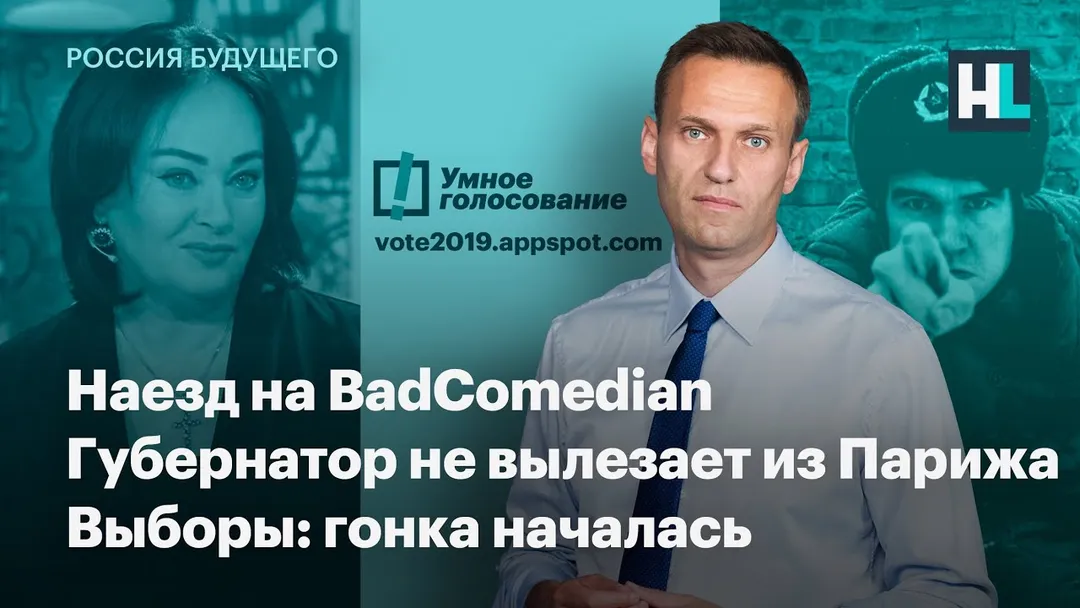
A crackdown on BadComedian. The governor never leaves Paris. Elections: the race has begun
[music]
Good evening, everyone. It's exactly 8:00 p.m. in Moscow,
which means we're live on air with
the program *Russia of the Future*, and I am Alexei
Navalny—or a political corpse, as
the media called me this week.
Those media outlets belonging to my favorite, Putin's chef Prigozhin (Yevgeny Prigozhin),
also amused me, of course—our whole office
was entertained by their very funny and excellent description of my
birthday the year before last. They all wrote
about it—I don't know whether they were Prigozhin-linked
or from the old LifeNews-style media—but they
made up a story that at my birthday party
Alla Pugacheva (a legendary Russian pop singer) performed. This time, though, those
records they fabricated didn't seem
luxurious enough to them, so they switched
to a different concept and accused us of the fact that everything
was somehow too cheap and drunken:
a drunk group gathered on the terrace of some
place in one of the business centers in
the southeast; allegedly Alexei himself and
his associates, Lyubov Sobol
and Ilya Yashin, got blind drunk on cheap
alcohol. Then comes a vivid description
of how everyone got so drunk that they started throwing
food around. It's very funny to read,
especially for those who know Yashin, who in
his entire life, by some strange
personal principle, has never even tried any
alcohol at all. He was forwarding these
amusing quotes too, about how he, dead drunk
on cheap booze, was throwing
food products around. I want to begin with a very
funny event that is taking place
right now, as we speak. It happens every year.
You know, there's this thing called Comic Con.
It's very popular abroad, and in Russia
it's fairly popular now too, and there
all sorts of pleasant people gather.
They put on various costumes, they
pretend to be, I don't know,
Sailor Moon or
Catwoman or superheroes or
hetmans, and they entertain one another
and entertain themselves by pretending to be people
they are not.
And in St. Petersburg right now, what is happening is something
officially called the St. Petersburg
International Economic Forum,
but in reality it is, of course, the St. Petersburg
Economic Comic Con, because in exactly
the same way, some rather
unpleasant people—in most cases simply
complete crooks, fools, and idiots—
gather together and dress up in the costumes of
governors, economists, heads of
state corporations, and so on, sit on
panels, and with perfectly straight faces
spout some monstrous nonsense about
how Russia will develop and what they
must do for Russia's development, or
what should not be done for Russia's development.
And at the same time,
hanging over all of this, obviously, is
something enormous, like a giant dinosaur
shouting: you've been in power for 20 years,
and the main reason why Russia
is not developing is that you, a pack of idiots
and blockheads, have seized these posts—
governors, heads of corporations, and so on.
Let's take a look.
Here's the Kudrin video everyone is discussing today. I saw
that it was quoted more than anything else, about
what exactly we must do and who exactly should
do it in order for
Russia's investment attractiveness to grow.
What is standing in our way? Alexei Kudrin gives
wise advice: 70 percent
of our businesspeople consider doing
business unsafe. That is, in general,
it's difficult work, very dangerous and risky, and
the situation with Michael Calvey
shows that once again. On the one hand,
it is said that he has
a high reputation; on the other hand,
for some reason he is being kept under arrest while
there could be a calm, objective legal process.
And after that, let me remind you, I called this
event with Michael Calvey a shock
for the economy. Beyond any doubt, since the beginning
of this year, capital outflow from Russia
has doubled and is now more than $40 billion.
Just think about that, Alexei Leonidovich.
Kudrin—and you see, sitting next to him are
the finance minister, the head of the Central Bank, and
some other people. So, capital outflow
has doubled this year, can you imagine—
$40 billion. Why?
Why doesn't Elvira Nabiullina say,
I don't know, shrug her shoulders and now
say something clever from the usual series:
a powerful thought—
we must improve the investment climate.
Yes, yes, yes, says Siluanov, we must
keep an eye on macroeconomic
indicators. Alexei Leonidovich,
the problem is that you
came to work in the Kremlin in, what, 1996,
and brought with you
some guy named Vladimir Putin, and
then the rest of your thieving
St. Petersburg mayor's office crowd, from Miller
to Sechin and the others, and all of
your gang, which used to engage in
petty bribery, has now been engaged
for 20 years straight—for more than 20 years
straight—in large-scale bribery and
banditry in Moscow. That is why capital is fleeing.
Capital does not want to live together with
you, Alexei Leonidovich,
with your Putin. And the fact that all these
people sitting on the panel
are, again, merely pretending, having put on
the costumes of decent people—they give
comments to newspapers, comments
are being recorded. As I was preparing for the broadcast, I was reading
funny headlines: Sergei Sobyanin had a verbal sparring match
with German Gref over the fact that
all of you
pretending to be decent people
are too cowardly to say even a single
word about the fact that capital is fleeing because
of the kind of political regime this country has
because idiots, thieves, and bandits
are in power. They jailed Calvey, and
they jail all the other businessmen too. Why?
So they can take away their businesses. The people
who belong to Putin’s inner circle
will go on enriching themselves by
taking from other people what they
rightfully earned—unjustly taking it
away. It doesn’t matter—they won’t take money from
just anyone else, because they themselves
can’t create anything. And this isn’t my
just a guess—this comes from 20 years of
observation in this regard. But this is
really like some kind of Comic-Con. Every
year we watch all this, and every year
they, every year,
say the same thing. Today,
Medvedev once again—who knows for how many years now—said
that we will not allow pressure on
business to worsen
They say, we won’t allow it, we won’t allow
greater pressure on business, and
the government is supporting
a bill so that the law on
crimes involving failure to pay
taxes
would have no statute of limitations. That means
it is effectively a lever
for keeping businessmen indefinitely under
the threat of arrest. But of course the funniest part
is this delightful discussion about how
Michael Calvey himself
is supposed to come to the St. Petersburg
Economic Forum, because after all he is
such an important guy, and they promptly
released him from pretrial detention (SIZO), and then Peskov said
it would be good if he came to
the economic forum. But he is under house
arrest—he can’t come. And the Federal Penitentiary Service
says they’ll let him out if
the investigator gives permission; the investigator says something
or other, but so far Michael Calvey hasn’t come
apparently they didn’t process the paperwork. But as for me,
the enforcement officers
used to transport me in roughly this
way
from house arrest—and even without house
arrest. Let’s take a look at what that
looks like. And it would be really great if
Michael Calvey
were escorted in exactly the same way by these wonderful
people
and brought like this to
the St. Petersburg Economic Forum. I thought,
I think it would reflect wonderfully on
Russia’s investment climate. And where was I being
taken, and for what reason?
And they were rushing around with the same sense of importance
taking me like this
iPad
just a moment
your account has sufficient balance
you don’t need to take the documents
that’s entirely possible
Alexei, what are we watching during the break?
Well, here it is
This is a very funny procedure that
I went through many times. You’re not exactly
under arrest, meaning they don’t put
handcuffs on you in this particular kind
of transport. As you can see, I’m even riding in
my own car, but with you there are
like two or three guys—they’re guarding you
they stay with you
they fly on the plane with me. You
can find funny videos online
You have the right to eat, so you get to McDonald’s
they stand at the entrance to McDonald’s, and then they
just hover there—you see, everyone is filming them all the time
people turn around and stare
they probably want some fries too, but
they can’t—these sullen police officers
stand next to you and watch you somehow
while you eat fries at McDonald’s, and
then they take you on further. And it would be
wonderful if Michael, Michael Calvey
were transported like this, and it would
be simply
the most magnificent PR continuation of this
Comic-Con, because by now
this costumed ball would
be splendid—there would be bailiffs, these
guys, though now they wouldn’t be in
greatcoats but in some kind of camouflage
uniform. It would be cool if there were also
balaclavas so that foreign investors wouldn’t see their faces
and all that sort of thing
Overall, this St. Petersburg Economic
Forum
is, of course, absolutely such a useless
piece of junk for the outside world, but a very expensive one. Essentially
it is an annual party
that
this whole crowd throws for itself, a kind of
free business trip for them to hang out
I’ve already seen posts on Instagram
showing that they’ve already managed to get there and
of course, of course, there are huge parties
For example, our team did an investigation into how
Governor Beglov
the acting governor
paid 15 million rubles from the city budget
(about $160,000) to organize this
party for the governor of St. Petersburg, and
in fact this giant
party works like this: first they sit on these
panels, boring or supposedly interesting, and then
of course the band Leningrad performs
And just recently, only a few
months ago, Shnurov (Sergey Shnurov, frontman of Leningrad) said
that he was stopping touring and
would perform only on rare occasions
for enormous sums starting at
something like €150,000 or €300,000
thousand euros — an unimaginable sum
he said, well, for the St. Petersburg forum
and it’s no problem — I just saw it there
everyone is dancing to the song, “What are you ladies kneading”
“boobs, if you want a drink, then buy”
a liter of vodka, and they’re all jumping around
some vice governors
businesspeople, and these state
corporate big shots, and they’re partying there
they came there on public money, even
very poor regions too — Udmurtia, for example
paid 700 million rubles (about €7–8 million) in order
to send its delegation, and
separately they paid 120,000
rubles (about €1,300) for this blonde girl, some assistant
to someone there — I saw that the Udmurt forum
was actively discussing how she went there
because all of this has turned into, like,
“Come on, Natasha, let’s go to St. Petersburg and hang out
at the economic forum,” and so all this
riffraff from all over the country comes there
says some strange words, then
disperses again, in order to, well,
basically, as they say, go on being
an obstacle to the economic
development of our country. That is the objective reality.
That’s what it is.
Siluanov and Kudrin were arguing there again
Kudrin said Russia would grow only
by 1 percent, and Siluanov replied,
no, no, no, no — Russia will grow by 2
percent. Meanwhile, the whole world is still growing
faster — by 2.5 percent or more
developing countries, countries that are
poorer and worse off than ours, are growing faster. So
that means we are falling behind the entire
world
precisely because this gang is sitting there, and the gang
comes there every year and acts smug
send me your questions with the hashtag
#RussiaOfTheFuture, and I’ll try to answer them
The next topic I want
to talk about is very important. I think in
every program I repeat that it is very
important. I’m going to keep pushing it, and until September 8
I’ll be talking about it
endlessly, because it really is
very important. Elections have been announced, and now
today the elections in Moscow were announced. You
are probably saying now, “What elections?”
“Nothing has actually been announced.”
But they have. Elections in St. Petersburg have also
been announced, and Beglov, whom we
already showed, has submitted his documents
having somehow appeared at the election commission, amazingly,
before the commission had even started work. But
there is an official time and date
when the election commission begins work, and yet
Beglov submitted his documents and posted a video
showing how he submitted them before
the election commission had started working, and that of course
shows the whole style of this campaign
and it is very important. So don’t you dare now
tell me that these are some kind of, I don’t know,
small, meaningless elections. They are taking place in 22
regions. Yes, in Moscow it’s the City Duma, in
St. Petersburg municipal and gubernatorial races, but
overall, is that insignificant? No. These elections
will largely determine the political
landscape and, in general, the format of political
struggle going forward, because
for the Kremlin these elections are crucial. They are approaching them
in a completely new way. Look at
Beglov himself: he joined United Russia, and
back in 2002, when it was founded, he was part of it
he even headed — not just belonged to — the Supreme Council
of United Russia. So if there is such a thing in
this country as a super-United Russia man, someone who was there
from the beginning, a founder of the party — that’s him
and he is running in the election as an independent candidate in
Moscow
Open the papers and read them — everyone is writing that
the directive is this: United Russia
will not be participating in the elections. All
United Russia candidates will be disguised. They will be
some chief doctors and vice rectors who
are even allowed to criticize the authorities. In other words, in
these elections, for the first time, United Russia
will effectively not exist at all. We have seen
that they have been moving toward this for quite a while, and
Sobyanin has never run as a United Russia
candidate, but this time
it looks like they will not merely
distance themselves — they will even slightly
criticize United Russia, and we will see
whether they can — well, the Kremlin will see, and we
will see too — whether this
elementary system of deception works, when they
present not a bunch of United Russia people, but a bunch of
independent candidates. These independents are running
in single-member districts. It’s unclear — I mean,
you and I understand perfectly well, and we
can tell some bureaucratic
mug from a normal person
of course. But the question is whether
the average ordinary voter will be able to tell the difference
whether you and I will be able to spread the idea
of Smart Voting and get everyone to vote
in a coordinated way. And the question is whether
the Kremlin
will be able to fool everyone
effectively enough, effectively remove
some undesirable candidates, while at the
same time leaving some candidates in place
so that some illusion of
competition remains
This is very important, because in these
elections they are testing out their future
general strategy, in which there will be no
United Russia — there will be something else. And in
these elections we must — what’s a polite
equivalent for that word? Let’s put it this way —
we have to give them a proper drubbing
We have to come out and make them feel it; we must
upset them, because look at what
they are doing right now in
St. Petersburg itself
Beglov is not running as a United Russia candidate, so he needs
to collect 90,000 signatures. That is an enormous
number. Today our штаб (campaign headquarters) released
a recording showing how these signatures
are being collected. I can already see that all
St. Petersburg media outlets and forums are simply flooded
with reports saying things like this:
they are forcing teachers, forcing people in kindergartens,
and in the St. Petersburg metro they are being forced
to hand over employees' signatures, and people are simply
walking around collecting them, even though on the territory of
the metro this is not allowed. Let's
listen to how, in St. Petersburg universities,
students are being persuaded and pressured
into signing.
I don't want to talk.
But this is supposed to be voluntary, and we
are doing it consciously.
We are on the premises of our
institution.
Well, the main point is that in our district
we need to protect it from the Moscow
jackals. Why is Bortko doing this?
Because if we leave, it won't be very
good. He doesn't say it directly, but that's the kind of
message coming from the administration.
Like all other city department heads, they received
instructions because elections are coming up.
The governor may be new, and I ask you
to support his candidacy.
Somehow, back in winter,
now they say we need to
support the nomination of candidates, not
the voting itself. Well, this is probably some kind of bureaucratic
procedure, I understand, but still
he says, in so many words, let me tell you:
it turns out you are forcing me here
to make others sign and collect signatures too.
No? If that's the case, then don't.
No, I just want to explain to the person that
we are interested. Well, I understand your
I understand your concern, but, well,
you understand that at the same time you are
asking me to break the rules.
What exactly are you teaching us to do?
Have you ever gone this far for
Do you understand? It has literally gotten to the point where
a student says, 'I won't do it,' and then
the deputy dean says, 'Well, try to understand our
position,' and in astonishingly direct
terms explains the entire structure of power:
'You have to understand, this is the authorities. We come to
them asking for something, and in response they
tell us: well, support this candidate,
and we have to support him.'
'Otherwise we'll be devoured.' But why should they even
be devoured? And why are officials
protecting themselves like this, when in fact
that is simply part of their official duties? And the most
interesting thing, yes, the main question of these
elections: everyone knows that here in St. Petersburg
they will now force people to sign
for Beglov, or pressure them, or, people say,
coerce them, forge signatures—90,000 people, and another
300,000 people will know perfectly well
how all of this is happening.
Out of principle, these people will still go and
vote for anyone against Beglov,
or
the authorities will be able to deceive them. Will we be able, together with
you, as I already said, in the literal
sense—the viewers of this program, we
are numerous enough, there are several
hundred thousand of us, enough of us
to make this work,
to persuade millions of people across
the country, all residents of St. Petersburg,
to tell them to go to this
link, this SPB link, and
take part in Smart Voting, or
won't we succeed? That is really the main question
of the political struggle around this.
A political struggle is unfolding around it,
and this will determine the future
landscape. By the way, note
that on
our website, for municipal deputy candidates,
SPB, new options have appeared
that make it possible to generate
your own campaign page. In other words, we built an entire
system that helps candidates
take part in these elections. And of course, if you
register there, you will receive
the name of the person to vote for in your municipality,
and the same applies across the rest of
the country if there is an election there and
a major
race. If you register,
Now, people here are asking a lot about Smart
Voting. We are getting questions about why
we need to leave our address. The address
you provide is not because we want
to know where you live, but so that we can
understand who is running in your district
and then send you
the name, so that everyone living in that district
votes against the United Russia candidate for the same
person. In the gubernatorial election too,
you can vote for anyone against
Beglov; there are two rounds there. But in all other
elections, you need to beat the United Russia candidate in a single
round. That is difficult, but possible if
we all vote
the same way. So, guys, Smart
Voting. I can see people asking me now:
please explain why
Lyubov Sobol was registered. Is this
some kind of cunning move by the authorities?
But so far no one has been registered.
Lyubov Sobol, Ivan Zhdanov,
Ilya Yashin, Vladimir Milov, and others
—all these good people—have submitted
their documents today. They could not be
refused; they handed in the paperwork.
Next, these people have to collect signatures
just like Beglov, except they will collect them honestly
because Beglov cannot collect them—people
simply do not want to sign for him, and he cannot do it. And that is not our problem.
method
and it is very difficult to do, so I
urge everyone to help these people; we also
are trying to help not just these five
and are actively supporting not only them, but all
independent candidates. We will create a
special signature collection center, and no matter where
you live in Moscow, you will be able to come
to a single location, so you do not have to look for a candidate’s штаб (campaign office)
candidate and be left at [ __ ]
regardless of which candidate is running in
your district. It does not matter to us — we will
support them. Whether we ultimately support them or not,
they have the right to take part in the elections, and we
will support them with our signature
so come to our signature collection center
to sign up as a volunteer — we need
people. The St. Petersburg team asked me
to say that they need an election lawyer
— write to their штаб (campaign office), in other words, get involved
This is real and very important politics
— real politics. Politics is not
that [ __ ], excuse me, written in
Telegram channels, discussing some
thing. It is what is going to happen by
September — that will be real, and
there will be a real clash. In Moscow, there are 45 State Duma deputies
and among them, United Russia members or
disguised United Russia members number 38. So
our task is to make that number smaller. If there are fewer of them,
then one way or another we will have secured
at least some small victory. If there are more of them,
then it means that you and I
have lost. That means our Smart Voting
failed to persuade people. Of course, it would be easier
to stay away from politics and say,
well, let it pass, because if we
lose this Smart Voting campaign, everyone will
say: Navalny launched Smart Voting,
but he lost. It is risky,
risky, because if it loses, then will
my personal popularity somehow
decline because of it? Of course. But
nevertheless, I still think it is important
to do everything possible in order to
take this fight to United Russia, especially since
to be honest, if we are not talking about
candidates, this does not really require much from people
— register on the website,
then come on voting day and
vote for the person whose name
the system gives you. You get a surname — say,
Ivanov, Yashin, Sobol — you go
and vote for them. That is all. It is not
hard. What is hard is persuading
large numbers of people to take part in this
Now let us discuss a few
brief things — I will answer a couple of questions
Beslan asks: I want
to develop Smart Voting in Taganrog
but I could not find any addresses or phone numbers. How
can I do that? Beslan, look, if you
are in Taganrog
and there are elections in the city itself
or in the federal subject (region)
then you do not even need any штаб (campaign office)
to organize. You just need to
promote Smart Voting
because everyone who has registered in
your region, and in Taganrog in particular,
will receive the name of the person they should
vote for. Smart Voting is not
designed in such a way that it requires a штаб (campaign office)
If a штаб (campaign office) were needed there, then, Beslan,
the police would come to that office. We
are trying
to do everything in such a way that
there are as few things as possible
that can be seized,
taken away, or blocked. It is an
internet campaign, but it has to reach
a large number of people, so just
promote Smart Voting, especially
if in your region
elections have been scheduled. There are 22 regions.
So, Alexei, when will you conduct the analysis by
region so that we know whom to vote for?
asks Azamat Dagaev. Azamat, well, you understand yourself
that when candidate registration
is complete, then we will say, because
if I tell you right now, for central Moscow,
vote for Sobol, I fully understand that
Sobyanin is terribly afraid that
Sobol could win against whatever pro-government figure is running there
and therefore they may
simply not allow her onto the ballot, as they have often done
before. Or Yashin — of course, if I tell you
that if you live in Basmanny, vote for
Yashin — well, it is pointless to talk about that now
because registration has not yet
been completed, and Yashin could be removed from the election, and
then you and I will be sitting here
thinking, good grief, what are we
supposed to do now?
There are no good candidates left;
all that remains is some trash —
a disguised United Russia candidate and some kind of
phony riffraff — and then you and I will still have to
figure out which of that fake crowd
to support simply in order to
reduce the chances of United Russia
getting through. That is how it is, and how it will be
We will see
closer to the time. Once all candidates
are registered, by the end of the summer it will actually
be clear whom to support, and then we
will start naming names. Right now, we need
to attract as many people as possible
by explaining to them the general idea of
consolidated voting for one
candidate against the United Russia candidate. The concept
is fairly complicated for people who do not
understand politics. All hope is that
you will help explain it. A collective
question from Viktor Medvedev: how can your
movement be helped by teenagers aged 14 and
older adults over 45? This is a collective
question from teenagers and older adults, but
Likewise, first of all, those who...
if you're over 18, you can simply come
and vote, and everyone else—there's the internet.
You've got a keyboard, you've got friends, you've got acquaintances.
If you have friends and acquaintances, urge them
to take part in my vote—there it is.
The most important help is this: if you live in Moscow or in
St. Petersburg, or anywhere there are elections, help
the opposition candidate. If there's
an opportunity to send 100 rubles
to someone's election campaign,
to one of the candidates who can gain traction, send it to them.
Send 100 rubles—that's how you need
to participate. Alexei asks me:
"Alexei Popov: why didn't you yourself
run in the elections to the
Moscow City Duma? Have you forgotten? I'm a
convicted repeat offender; I'm banned from taking part in
elections. Putin doesn't want that
and is afraid that I would take part in
elections at any level. So not in the
Moscow City Duma, not for president, not even for district deputy
in a local district.
I don't know, Marino or Danilovsky district,
I can't run.
And I want to, and I will fight for that, but
right now, legally, I can't. Let's
talk about Sobyanin and Guzeeva—
in effect, Sobyanin's Guzeeva,
and all these wonderful people we
released our investigation about.
Many thanks to everyone who supported it.
It was sitting at number one in the trends
despite the fact that it was 25 minutes long.
We spent a long time dealing with all these people.
Why did it seem so important to me, and
why am I so glad people supported it?
A lot of people did. As I already said
in the video itself, I really want to explain to everyone,
damn it, that officials are much
richer than people usually say they are, that
this so-called official income is
complete nonsense. And when we hear
about these big sums—most often
5 million rubles, 4
million rubles, 10 million rubles—
look at the income declaration of any
major official. They all receive, let's
say, from 400,000 to 700,000 rubles per
month. That's a lot of money, but the truth is
that their real income—the income we don't
see listed as income in their declarations, and on which they
pay no tax at all—their real income
consists of the fact that they are effectively
handed several more
million dollars or tens of
millions of rubles in the form of in-kind
benefits: apartments. Apartments are supposed to go to whom?
Who is supposed to be given an apartment? Well, you know—to those
who have housing problems, or
even, let's say, to an official
who has come to Moscow and needs to be given
an apartment. The standard is 18
square meters per person. If you don't
meet that—if you're living in a dorm, or you have
a tiny apartment, you're living with your grandmother,
grandfather, nephew,
and, I don't know, your crazy great-grandmother—
you file an application, and they tell you: well, in your
apartment you're short by this many
meters, so based on
the standard of 18 square meters per
person, we'll give you an apartment. Since, in
general, apartments aren't given to everyone else.
Even this arrangement raises ethical
questions. But when a family of
three people,
already provided with a giant apartment of
200 square meters, gets another apartment for free or
almost free—another 150 square meters—
well, that's just outright
lawlessness, guys. It's no different
from them simply walking in, you know,
to the state treasury vault
with a suitcase, loading up 70 million
rubles, and driving off with the suitcase. In that
case, we'd be shouting:
they're thieves, they stole 70 million! But
how is this any different? It isn't, absolutely
no different. It's even worse.
It's a completely legalized bribe. And
what's more, who are all these people? They're
just some real riffraff.
Let's look at a large part of the video.
Of course, I won't show it all, but I will
show part of this video
where they're listed. You don't know a single
one of these surnames. This really is some kind of
petty riffraff, each of whom we are
basically handing tens and tens
of millions of rubles. Here's a clip from the video—listen
and remember the names and positions.
This is important: Yemelyanov, Alexei
Alexandrovich, head of the Moscow Department
of Cultural Heritage. His apartment is
almost 180 square meters. The new apartment is worth 90
million rubles. Shakhmuradova Sabina
Ruslanovna.
Head of the Directorate for Coordinating Work
on Land Management Facilities and
District Operations in the Department
of City Property of Moscow.
Dilerov Ilnur Ilesurovich.
No one even knows who he is. He worked
as an assistant to the Minister of Economy of the Republic of
Tatarstan. On the Moscow mayor's office website, there isn't
a single word about him. Next: an apartment of one hundred
forty-four square meters. The owner is
Natalya Vladimirovna Kuznetsova,
deputy head of the directorate
for coordinating the activities of the
construction policy and development complex
of the city of Moscow. Just so you understand: there's
Sobyanin, he has a deputy, Khusnullin,
Khusnullin has a deputy, and that
deputy has yet another deputy, and
you and I are giving him an apartment worth 70
million rubles.
Please hang in there, dear viewers, we
are continuing. Apartment 144
square meters. Logacheva, Yekaterina Ivanovna.
Deputy head of the department
for territorial bodies of the executive
authorities of the city of Moscow.
Stepanov, Maksim Sergeyevich, born in 1989.
He is not even 30 yet, our
Maksim Sergeyevich. He works as
deputy head of the department
for urban planning policy of the city of Moscow.
Another owner, not much older,
is Boris Alekseyevich Bulloy.
He is Deputy Press Secretary to Sobyanin.
I will not even get into the fact that this
position is ridiculous, but in 2012
the Presidential Property Management Department already allocated him
an apartment in an elite residential complex on
Starovolynskaya Street.
But please explain to me: why the hell does he need
another apartment from us? What is he doing
in our building?
25,000 people are watching us live, and
before I move on with the continuation
of this discussion about the apartments,
just now, during the pause, people came to me
and told me that this wonderful
young man, Ivan Mezentsev,
whose recording you heard from St. Petersburg, he is
a student at the St. Petersburg Law
Academy and recorded that very conversation
where he was being pressured to sign up for pro-government campaigning,
and is now receiving some kind of threats. They are telling him,
"Come on, let's meet there and talk it over," well,
it is clear the scandal has already spread across the whole city over
an obvious violation of the law. It is obvious that
the Central Election Commission should do something about it.
If it will not do anything, then at least
it should discuss it. I just want
to say: you there,
you crooks hounding Ivan Mezentsev,
please back off. We are going to
protect him, and of course we will not let him be
pushed around. Still, let me get back to the apartments. Two
people on this list simply
stunned me. I mean, all of it outraged me,
of course, it infuriated me when we started
digging into this building and saw that
they had simply built a building supposedly for people on the housing waiting list
and then gave themselves apartments there for free, and
also handed them out to various minor hangers-on. But two
people really stand out.
Larisa Guzeeva, who is not even a government official.
Well, sure, maybe someday
Sobyanin—and I hope we will pin him down either in
court or by some other means—
they will have to answer for this, and he will
say something along the lines of, "Well, you know,
we gave apartments because they were
civil servants. There is a regulation under which
we can give civil servants
certain subsidies, apartments, and so on."
That would all be complete nonsense, but at least one could
construct some kind of logic. But what the hell
is Larisa Guzeeva doing there—a wealthy
TV host who clearly does not need any improved
housing conditions, not a civil servant, who
has never been any kind of civil servant? She
got an apartment there. Why? Or rather, we
know why: because she fawned over
Sergei Sobyanin during the election, because during
the campaign she was posting those messages on
Instagram. You remember: "It is not an easy choice, but I am for
Sergei Semyonovich," she literally wrote.
"If you do not like Sobyanin—suitcase, train station..."
and so on. In other words,
we now understand how it
worked. She grabbed an apartment, and to everyone
who does not like it, she says, "Suitcase,
train station, and off you go." This is my
city, and the city of the wonderful Sergei
Semyonovich, who gives me tens of
millions of rubles. Maybe you yourselves
should be the ones leaving, dear Larisa
Guzeeva, together with your Sobyanin. Maybe
you will give the apartment back. Maybe you will
stop lying on TV shows that
you never lived in the city center and never
received a single
square meter. Let us watch these few
seconds: "Not a single day in my life have I
lived in the center, for example—not in St. Petersburg, when
I had my own apartment, not here. I
have always... in this same example, I never
had... it was never possible, there were never
rich lovers or husbands, never,
and no one in my life has ever given me
a single square centimeter." With all this
such a neat, elegant narrative: no one
ever gave me anything, no one ever
gave me anything—and then, bang, it turns out an apartment
worth 90 million rubles was simply
bought with
taxpayers' money and handed to you as a gift, and suddenly everything
does not look so good anymore. And Larisa Guzeeva
refuses to speak with me, and Larisa
Guzeeva closes the comments on Instagram
so as not to see these questions and not
hear these questions, and continues
posting little photos with boxes,
little videos, as if, as if nothing is
happening.
Those of you who watched the video remember how
she told me that she would not
talk to me because
she does not know who I am. But she never
received anything at all; everything she has
was earned through backbreaking labor. All these
people are built the same way: they tell stories about
their backbreaking labor, how they simply
toiled and broke their backs,
and therefore they somehow deserve to take from us
these huge, fat chunks. Well then,
then let them at least start
a dialogue with us. Let her come out and honestly say:
"I am an honored actress, I acted in the film
*A Cruel Romance* (*Bespridannitsa*).
And you all know my lines from it, I..."
I looked for love but never found it, so
now I’m going to look for gold, and I live by
that principle. Everything is
fine. I’ve praised Sobyanin too, so
let him explain. If it’s all so legitimate, he shouldn’t
be afraid. But they won’t even do that. They
despise us that much.
That’s exactly why Smart Voting in
Moscow is so important. And Dinara—well, Russia
covers all of this up. The second figure
who probably made an even bigger impression on us than
the first one—despite all the garbled nonsense around his name—
made a striking impression. It’s just some kind of incredible—
I’m sorry—this gloomy-looking guy, Boris
Alexeyevich.
Please show him to us. This is, damn it,
the deputy press secretary. Good Lord, who
even is this deputy press secretary?
And I don’t mean to insult
all deputy press secretaries, although
it seems to me that it’s not a very
common position. It’s pretty rare, isn’t it?
There aren’t that many people in the country who
have a press secretary, let alone a
deputy press secretary. So apparently
when the press secretary is especially busy
with something, the deputy
press secretary steps in.
And this deputy press secretary—he’s
not even 30 years old.
They gave him one apartment—how big was it, 170
square meters, and it says right there in the records
that the state, the Russian Federation, is
transferring it to this tattooed creep
who isn’t even 30 years old—we’re giving him
a 170-square-meter apartment. There you go,
Boris Alexeyevich, an apartment from us. Enjoy it.
He moves in, he’s happy, and then he says,
“Listen, maybe you could give me another apartment
worth 80 million rubles?” And Sobyanin says,
“Well, I suppose somehow 80 million rubles won’t
hurt.”
Sure, I’ve got some pensioners somewhere
there,
who’ll be demanding that I buy free
medicine, or that something in a
hospital needs fixing, or that children are sick with
dysentery—but all that can wait.
Let’s get Borya Buloy, the deputy
press secretary, another
apartment. And I’m not making this up—this
is all in the documents. The documents show that
they gave him one apartment worth over 100
million rubles, and then another apartment
worth 80 million rubles.
What do you call that, sweetheart? Aren’t you
going to burst? Seriously, can someone explain to me
please—I invite
Buloy, Boris Alexeyevich, to record
a one-minute video
address through our program so that he
can explain everything: who he is and where he
came from, and what exactly he does that is so
extraordinary. Is he some kind of orphan,
maybe? I don’t know. Does he have no arms or legs?
We see him here, but maybe in reality
it’s only a head, and everything else is
bionic, and he’s some kind of—I don’t know—
super-injured person, and he can’t
live without two apartments in elite
residential complexes? Explain it to us, Sobyanin, and
you explain it too, Buloy—who are you people, why
are you handing apartments out to each other?
It’s very important to understand this. And this isn’t just about
Moscow officials—the same applies to
federal officials, the same applies to
regional officials,
the security services, and everyone else.
Their salaries are nothing but dust compared
to the apartments they
receive—and then receive again, as
you can see in Buloy’s case. And in this
sphere, this is far from the only such case.
Then they get efficiently divorced, or
register some of their children somewhere, and get yet
another apartment. These are people
who extract, in the regions,
tens of millions of rubles, and in Moscow, hundreds
of millions of rubles, from these “gifts,” and
somehow all of this gets ignored. In fact,
no one talks about it, and I really want
people to talk about it. I asked many people—
even our own Ivan Zhdanov, director of the Anti-Corruption Foundation,
to raise
this issue somehow during the election campaign,
so that Muscovites would know more
about what kinds of apartments they’re buying
for people no one can even account for.
Now, if it were a deputy mayor, fine—I
mean, I’d still be against it, but I’d understand
the logic. A deputy mayor—if he’s poor, maybe we
buy him some kind of apartment, again
at 18 square meters per person, or 25—he’s a
deputy mayor. But when we’re buying apartments for a
deputy press secretary, I will not
accept that, and we will
fight it. Let me answer some questions.
About Guzeeva.
Ivan Stein writes: “He’s not lying—they didn’t gift her
those square meters. She earned them
in Sobyanin’s service.” Well, you could put it that way,
yes. In a sense, she did earn them in Sobyanin’s service.
Buloy, too, steadily “earns” them, and
the paperwork for all these apartments gets processed.
What matters to me is how it works—there are dozens
of people, Rosreestr (Russia’s state property registry), legislative acts, and
so on. Not a single document appears out of nowhere.
So once again, I appeal to
employees of City Hall and Rosreestr
—to the people who work under
the supervision of various Buloys and all
the rest of those guys: if you know anything about
this, write to us through the black box. Just remember
there’s no feedback there, so if you want
us to be able to contact you,
leave your email, because it’s an
absolutely anonymous way to communicate with us.
We need documents showing how they did this.
Everyone got it—how this scheme was set up, who
signed off on it, who else was involved in schemes like this
took part. Vovka is asking, not Alexei.
What’s the story with the fact that
film director Nikita Mikhalkov’s income was concealed?
It’s a genuinely very interesting story.
Mikhalkov heads a state-run
theater and, by law, is required to publish
his financial disclosure, but it’s missing, and apparently that
is connected to the fact that last time he
published his declaration, and it showed 500
million rubles in income (about US$5–6 million), and everyone kind of
well, was pretty stunned by the fact that, somehow,
you know,
wow, our Nikita Sergeyevich
has really done well for himself. We understand what kind of
schemes are being run there. And he also presents himself as
some grand nobleman-type figure,
a statesman, when this isn’t really
public service at all on the part of a public figure—
it’s a businessman latched onto the state budget, and
as you can see, not just latched on a little, but
to the tune of half a billion from the budget, because this
year he probably made even more.
That’s why they’re hiding it. We’ll look into this
situation more closely. They appointed a bodyguard,
then removed the bodyguard—just like that.
That’s basically what the personnel situation in
the country looks like. At the St. Petersburg Economic Forum,
they were discussing why
nothing is happening here, why our
economy isn’t developing. Well, this is why.
That’s what’s happening. And yesterday, I think, they removed
the acting governor
of Astrakhan Region, and nobody understood
what the hell had happened, because
this was Sergey Morozov himself, the man who
had been appointed there—he was one of Putin’s bodyguards,
that is, Putin’s personal bodyguard. I don’t mean—
I mean, I don’t want to say that
being a personal bodyguard is something bad.
No, it’s fine. It’s just strange that they
appoint them as governors, and as governors,
as we can see, they’re very bad, because
they appointed this one—well, let’s
watch 36 seconds from his
press conference. You’ll understand right away—well,
the guy was a bodyguard, and his level of
thinking, and his understanding of politics in general,
are exactly what you’d expect from a bodyguard. He speaks Russian and
uses stock phrases, and he’s afraid of himself, and
afraid of those strange people
who are looking at him and filming him. Thirty-six
seconds of a bodyguard who almost became
governor: I want to assure you that
the achievements of Astrakhan Region
will be multiplied, and the projects already underway will receive
further development. The principle of my work is
constant dialogue and constructive
discussion of tasks and ways to solve them, that is,
with my team, experts, and other
interested parties. I assure you
that the goal of my work as acting
governor will be service to the people and
the development of our region’s strong economy.
That’s it.
You can see the man is suffering through every
second of his public speech. His entire
job consisted of—perfectly normal work,
absolutely respectable, all jobs are important—
his job consisted of, basically, Sergey
securing the perimeter so that nobody
could get close—standing there with an earpiece and
blocking the perimeter. Why are these people
being appointed governors? So he
was appointed governor, acting
governor, and there were supposed to be
elections in September, but as you can see,
the residents of Astrakhan would have
said: are you out of your minds? Who even is this?
What is this? He comes in and says,
what are you going to do? All the achievements
of Astrakhan Region will be multiplied.
But nobody wants to vote for him.
Nobody.
They ran a poll and found that
nobody wanted to vote for him, so they removed this
same guy and appointed some other
former security-service type, another one just like him, from the FSB (Russia’s security service),
the same sort.
And everyone is looking on and asking: explain why the кадровая
policy is like this. What’s more, this is the second
time it’s happened now—there was exactly the same kind of case
with that same Zinchuk, who was appointed—
Senychev, who was appointed in Kalin—
ingrad Region, also a former Putin bodyguard.
Putin’s.
He was appointed, spent a little time
as governor, and became famous for his
press conference—he came out,
spent 30 seconds there, turned around, and left.
Let’s watch. I think we’ll
talk about it again when the third such case happens,
on this topic.
A fine mind, buried in the sand, so to speak.
The main, first, and only
press conference of the governor.
Holding press conferences is not a governor’s main duty,
to answer questions from the press
and the public—come on, press conferences—
but what is very important is that people in the region
should at least roughly understand who
you are and what you’re going to do. But people can’t,
because Putin has this
personnel reserve.
And this is exactly what it looks like: just some bodyguard.
Around him, there’s Seryoga grilling shashlik (meat skewers), all good,
Zhenya
is dancing to an accordion, Seryoga and Kolyan
too—and then when everyone gets a bit drunk,
they’re great at shooting pistols at
bottles. Yeah, let’s appoint this one
as governor.
Send him to Astrakhan Region, and that one to
Kaliningrad—well, what have they got there,
like, Zhenya, Seryoga, and they don’t understand a thing.
Couldn’t handle it? Fine, to hell with him.
We’ll replace him. And somehow this is supposed to pass for a system.
that there would be at least some explanation
for why these people were put in charge
of regions where millions of people live
and there is absolutely no explanation for it, which is exactly why
nothing works at all. What kind of business can there be?
What kind of overall development can there be if any person
can wake up and tomorrow just
be told, “Thank you,” with no explanation whatsoever
for why Chertkov
was appointed governor—a former bodyguard
And I’m not, of course, trying to judge them personally
they may be stupid, they may be smart, but
the job of a governor is a bit different
it’s a different field; you can’t just
We already have many regions that
are headed by former bodyguards. It really
looks like a deliberate personnel
policy
This whole pipeline—those who ride around in
the motorcade, all these people from the inner circle
all these details point to one thing: physically, the people who are there
next to you, carrying your suitcases, the ones you
talk to in the car—whatever else
the bosses may discuss in the car, they talk about ordinary
people with the drivers and the guards
and then: all right, let’s say they’ve gotten to know
the common people—so let’s appoint them governor
Go ahead. Everyone stays silent, and that’s why no
development is going to happen under Putin now
I want to talk about the police
I want to defend them, and I want to criticize them too
Well, in defending them, I want to scold the system, not everyone personally
There is, in fact, one real thing that
really irritates me a lot, and I saw that
a police union
that the authorities refuse to register, and the public
ombudsman for police officers spoke out for the right
of police officers, and I very much want to
support them in this and criticize our system
which is genuinely engaged in idiocy. Do you
know that police officers, like security personnel in general,
have effectively been banned from traveling
abroad? They were banned from traveling to certain
what used to be called “capitalist countries” in the Soviet sense
that is, capitalist countries. So if you are a
police officer, then most likely your
international passport is sitting in your boss’s safe
and you can travel only to places where you may be allowed
to go abroad—to former
Soviet Union countries, except now
Ukraine, the Baltic states, and Georgia
You can go to China, Cuba, and
Vietnam, and that’s basically it. What I want to say is that
this head of the Police Ombudsman public group
went to court on behalf of all
police officers, and the Supreme Court ruled that
yes, this idiotic and wild ban
is legal. But what exactly is legal about it, and what
is normal about it? We may feel differently
about police officers, sure, but they are
still ordinary people, and we certainly do not
want them to become worse
more hounded, more corrupt. But
when, you know, an ordinary cop
with a family wants to go somewhere
he wants to go somewhere cheaper, where the sun
is shining. He wants to go to Turkey, or maybe
to Bulgaria, or to
Spain—just like any person who
earns, say, around 45,000 rubles a month
or 35,000 rubles a month and has been saving all year, and wants to go to Turkey
so it’s all-inclusive, so that in the evening I can
drink as much beer as I want and eat grilled
sausages
or shawarma, and so that I don’t have to
buy ice cream for my kids—they can just
run around and grab ice cream there because
everything is already paid for. That is a perfectly normal desire
perfectly normal. And do we want
police officers to have the chance to take a
good, affordable vacation? We do. But instead we tell them:
go to Vietnam, go to
Cuba. I actually took the time to look up
the average package tour to Cuba, Vietnam, or
China, and because of the obvious cost of
airfare, it is twice as expensive as a
trip to Turkey, Spain, or
Bulgaria
Why? For what reason, really?
What kind of idiocy is this? What state secret does
the average Russian cop know? That he has
a cucumber lying in his lunchbox, or that
not everyone spends the evenings drinking instead of
doing their job? That district officers
are buried in pointless paperwork and
don’t do a damn thing except fill out
forms? That’s all
There are no other secrets. Well, also
every detective in the country is formally cleared for
state secrets because, supposedly,
there are informants who tell him things, and
the operative just makes it up himself
sits there inventing it: “Informant Buttercup
reported to me that at such-and-such an address
drug deals are taking place there,”
and then, you know,
the newly recruited informant, Agent Buttercup,
puts that slip of paper in the safe, and that
is considered a top-secret
document. Let’s be honest: this is of little
interest
to the intelligence services of NATO countries. All
police officers all over the world travel around perfectly calmly
and all these security-service people—fine,
say they are super-special people
with access to especially super-mega
state secrets
maybe there should be special rules for them. But
there are hundreds of thousands of cops in the country, and all these
security personnel—why the hell torment them? The
Level.Travel portal compared prices for
package tours in Russia and in Turkey, and it is
absolutely astonishing statistics
because we can see that the cheapest
tour to Alushta costs 44,000 rubles
while the cheapest tour to Alanya in
Turkey costs 24,000 rubles. In other words,
vacationing at home is twice as expensive, and
We—there are actually millions of us.
People.
Police officers, FSB officers (Russia’s security service)—all of them, basically.
the participants right now and spread this idea.
Outward, to everyone else—we tell them:
Guys, if you want to take a vacation,
you don’t need to steal more, or
steal at all, or extort bribes,
because your vacation will cost twice as much
as it does for the average Russian.
The average Russian can go to Turkey, but you
for some reason have to go
to Vietnam or Cuba, as if some secret
Israeli intelligence service, for all I know,
might recruit—who knows—
an operative from the city of
Naberezhnye Chelny in Vietnam just as easily
as it could in Turkey. I mean,
it’s truly idiocy—legalized police
idiocy. And once again I want to say that
of course we need a normal police
union, the kind that exists in every
country, so that police officers can fight for their
rights. Because police, the National Guard (Rosgvardiya, Russia’s internal security force),
and everyone else in this whole system—
they have no decent pay,
no housing, nothing at all, endless
paperwork,
endless overtime, and on top of that
you can’t even travel abroad and have a proper
vacation. The issue isn’t that they have to go
abroad specifically—the issue is that
you should have the opportunity to отдыхать well
and cheaply. Unfortunately, vacationing in Russia
is fairly expensive, and I know that from personal experience.
For many years I didn’t have a foreign passport,
so I know perfectly well that, you see, my most
expensive trip was to Altai (a mountainous region in southern Siberia).
Expensive airfare, expensive
accommodation there—going to Europe was twice
as cheap.
So why are we tormenting our
cops? I want to speak up in support of
them and call on them to organize unions.
And next I’d like to talk about some
—moving from praising police to criticizing them—
about some strange people who
look like—well, let’s take a look at
this video. Who do you think
these people in the video are?
[music]
[music]
I’ve been flooded with questions here about Evgen
BadComedian. Of course I’ll say something about that, but
for now let’s get back to the video. Who did you see
just now? You’ll probably say
police officers. But if you look closely,
these are some kind of Russian, hard-to-identify
Sonderkommando-type squad—people in masks.
On their backs there really is
a patch that says OMON (Russia’s riot police), but in fact, if you—well, I
looked closely, our lawyers looked closely, and we
concluded that these are not police officers.
They’re just local private security guards.
This footage is from Shiyes in Arkhangelsk Region,
and this is simply how, as you can see,
they operate—not as police, pushing people out,
but sort of pretending to be
police. And what have we seen lately? Let’s
take a look at this photograph,
the much-discussed one from a school in Vladivostok.
What do we see in the photo? We see
a girl who was amusing herself by
putting on a police uniform and having
some kind of costume party.
Everyone lost their minds, and this girl’s parents
were fined for the unlawful
wearing of a police uniform. Even though this is
obviously not a real police uniform—it’s like, you know,
when someone dresses up in
nurse costumes and
goes to some party, or
dresses as Catwoman or something. It’s
just a costume performance. Nevertheless, they were fined. And now let’s look
at this video too,
this clip, also very well known, from
the FIFA World Cup.
Why were the participants in this
action jailed?
Pyotr Verzilov, Nika Nikulshina, and whoever else was there—
for unlawfully wearing
a police uniform. So I want to officially
notify the Main Directorate of the Ministry of Internal Affairs
for Arkhangelsk Region and the Russian
Ministry of Internal Affairs that I demand
that this whole riffraff that
is dispersing people in Shiyes be treated exactly the same way.
Lock them all up, bring them all
to administrative liability for
illegally using insignia
and distinguishing marks. Or, if they are police officers,
come on—they’re wearing sneakers, they’re clearly not in
proper uniform. Make up your minds: if
they’re police, then let them
dress according to regulations and take off those
weird things they use
to cover their faces. They cannot
cover their faces in this situation; helmets
they may wear, but they cannot hide their faces.
These masked storm-trooper types cannot. Either this is
just security guards pretending to be
police officers so they’re less likely to get
smacked around by local residents—that seems
obvious to me. Second, I demand and I call on all
residents of Arkhangelsk Region and Komi (a republic in northern Russia)
who are protesting to file complaints.
Let all these lowlifes be fined
in exactly the same way; let every one of these clowns
be arrested for however many days as well.
And the police officer I want
to criticize is this absolute
[__] named Yevgeny Kryukov, Major
Kryukov. Let’s take a look at his
photograph—put it up on the screen—because
he’s terribly afraid that everyone will
see him there and say his last name.
And this is a photograph from Yekaterinburg,
where, after the wonderful local...
The residents seem to have defended it for now.
They defended their park, where they wanted to build a
church. And now they’ve started, little by little, using this kind of
method. Remember, on the previous program
I said that the authorities had backed off, but now they
would slowly start using administrative pressure and so on.
Well, they’ve opened a criminal case over
insulting a police officer. The “insult”
consisted of the fact that this
bastard, Yevgeny Kryukov, as you can see,
was walking around in plain clothes, filming with his camera
to record everyone and then
later, apparently, use it somehow
against people. And someone there
flipped him off and cursed at him,
swore at him. Since he had the camera, he recorded all of it.
So they found that person and
opened a criminal case against him.
The funniest part is that this
person against whom they opened the
criminal case
was actually one of those who supported the church. But in
this situation, I honestly don’t care
whether he was for the church or against it, because when
some media outlets published a photo
of this Major Kryukov, those
lying, disgusting snitches
opened a criminal case against a person
because, in plain clothes—well, you can see it yourself—
some jerk with a camera and a cap
is running around filming you there, but you supposedly don’t have the right
to tell him to get lost. Of course you do have
every right to tell him off, but they opened
a criminal case for insulting an officer
in the line of duty. How exactly am I
supposed to know that this is an officer
on duty?
Then let the officer wear his uniform,
his cap and all that, so everyone can see that
he’s on duty.
But first he changes into plain clothes and then
wants to drag people through the courts. And when his
photo was published,
the Interior Ministry office for Sverdlovsk Region demanded
that the officer’s photo be removed. So I
would like all of you to take another look
at this disgusting, corrupt piece of trash.
Please, let them file
a complaint against me for insulting a police officer
named Major Yevgeny Kryukov, and
let him be ashamed, and let his neighbors and
fellow residents spit in his face for
doing something this vile against his own
fellow
countrymen. Now, questions—BadComedian.
BadComedian—everything is flooded with questions about BadComedian.
Of course I’ll say something about it.
BadComedian—just in a moment,
but before we get to BadComedian, let me say
please, about one more thing. Since we started talking about
Yekaterinburg, I can’t help but
mention one magnificent man. There really is
a magnificent man living there, just
the kind of man who, you know, understands how to live
beautifully—who understands *dolce vita*.
That’s the governor of Sverdlovsk Region,
Yevgeny Kuyvashev.
He’s been governor for two years.
How many working days is that? Well,
about 400 working days, if we count only
working days—maybe a little more.
Out of those, he spent 100 days abroad.
So, our штаб (campaign office/team) released
an investigation, and we pointed out—I mean, we didn’t just
estimate it, we officially counted his trips: seven
trips to Paris. Can you imagine what
the governor of Sverdlovsk Region could possibly be doing
that requires him to fly to Paris seven times in two years
on taxpayers’ money?
These weren’t private trips.
If it’s a private trip, fine—go ahead. There’s
vacation time; go wherever you want, we don’t care. Go to
Cuba, like the police officials do, or to Vietnam.
Want to go to Paris? Fine, go relax there.
Spend a day in the town of Kyshtym
or somewhere else for all we care.
Kyshtym, by the way, is in Chelyabinsk Region, which is basically
next door to Sverdlovsk Region.
But no—he went to Paris seven times, went
to New York, went to the UAE, went to
China. And when he went to Paris, he spent just
on souvenir products from the regional budget
300,000 rubles (about $4,700 at the time).
Let’s watch a short investigation by our
team in Yekaterinburg.
Over the past two years, Yevgeny Kuyvashev
made 45 trips lasting
at least 110 days in total, and we paid for all of it for him:
flights, accommodation, interpreter services
if needed—all of it
is financed from the budget. The governor
naturally prefers not to stay in any
modest hotels, but exclusively in
luxury rooms in expensive hotels.
Many media outlets wrote about this and published
his travel expense reports—for Paris, for example,
which, incidentally, over
the last two years happened no fewer than seven times.
In other words, Parisians see our governor
more often than local residents do.
And from this expense report it’s clear that the governor
spent 2 million
400 thousand rubles (about $37,500 at the time) on three days in Paris.
Meeting with partners: 100,000. Accommodation:
three days of lodging
cost 250,000 rubles (about $3,900 at the time). There you go.
Actual VIP service at
Charles de Gaulle Airport—what the hell do you need that for?
Why should we have had to pay for all of that?
Sure, when the president flies somewhere, that’s understandable, but
otherwise—same as everyone else. When I fly to
Paris in order to get to Strasbourg,
for example, I fly via Paris or via
Frankfurt. Totally normal: you show up with a bag, get on
a train or call a taxi, get where
you need to go. Then if you have
some gubernatorial business to attend to,
why do you need VIP service?
Why does the governor of Sverdlovsk Oblast need to
go to Paris seven times? I would like
all residents of Sverdlovsk Oblast
to know about this and ask why
they should have to pay for all of it. The
best part is that on June 16 our штаб (campaign headquarters)
is organizing a rally for the resignation
of Governor Kuivashev, and he is a very
unpopular figure there. Well,
in fact, he was elected only because
Yevgeny Roizman was not allowed to run in the
election. And so, in order to let them
hold this rally, he supposedly approved the application
but sent people to
a swamp, literally. Let’s
watch a short, just a short video about how
Governor Kuivashev sees the place where
a rally for his resignation can be held.
20 minutes by tram from the center, plus another 10
minutes on foot.
And here we are in a park—no, actually, a forest
where they sent us to hold the rally
on the 16th for Kuivashev’s resignation.
[music]
Yevgeny Kuleshov is so afraid of seeing us
in Labor Square that he is sending us
four kilometers away, to this
deserted area. There is at least
one objective reason why we
cannot agree to this alternative,
and that is the number of participants. We stated
at least 3,000 people. Look at these
paths—there isn’t room here for even one
thousand. We will submit notice for other
central sites in the city.
We will definitely hold the rally in the center, but
it is already clear that Yevgeny Kuivashev
is afraid, afraid because
his seat is wobbling under him, and he understands that he
could easily lose it. So all we have left to do
is gather, come out, and
state our demands: Kuivashev
must resign. Of course, I call on all residents
of Yekaterinburg to take an active part in this
rally. Whether it is approved or not, it
must be attended, because
Kuivashev cannot be governor.
I mean, guys, he is just—first of all,
he’s stupid, and second, he’s also brazen and
just some kind of lover
of strange luxury. Seven times, in
two years, the man went to Paris and New York.
What business could he possibly have there? He cannot have
any business there. Before moving on to
discussing Evgen, first of all I will respond
and read his comment on Shtein’s post,
which concerns this. He writes:
“No badge numbers, faces covered, operating in a crowd—
that’s a bandit, not the police.” I absolutely agree.
All these bandits must be brought to
justice.
Before discussing BadComedian, I
still cannot help but support the blogger
from
Krasnodar, because Kuban (a region in southern Russia) is just an
anomalous zone of lawlessness. It’s just
complete chaos there. There is
a blogger there, Kharchenko, who speaks not
very favorably, not very complimentarily, about
the local authorities and talks about various
problems, and they literally tried
to kill him. And they tried to do it in such
a way that they contacted him,
pretended to be police officers, and said that
they had some compromising material to give him. And
when he came to this meeting, they
shot at him, stabbed him, and told him
to get out. And this is a standard situation for
Krasnodar, a standard situation for
Kuban. Of course I want to support this person.
Let’s watch a minute and a half
from his address from a couple of weeks
ago. A person contacted me, just
called me from a hidden number,
introduced himself as a police officer, and
explained that he had very
interesting video material—not just
one video, but a whole flash drive about what
was happening in one of the district
police departments—about how people there
beat detainees, about how people
plant drugs, about how
they draw up reports against people who
in fact did nothing at all. And this
person said that he himself works in
the system, and frankly I do not know his
specific goals, what exactly he wanted.
I needed to go to Fadeeva Street.
Fadeeva.
That’s in the airport district here, for those who
are not from Krasnodar and don’t know. He set a time
at a bus stop. I arrived at the place, walked up,
stood there for 10–15 minutes—no one was there.
I turned around and started walking back, and that’s when
the most interesting part happened. From behind
me
someone called out, that is, they shouted to me,
‘Vadim!’ Then he fired once
and missed; the second shot hit me in the
area—you’ll see all these photos—
around the spleen area, and likewise
the third shot also hit. At that moment,
from behind, I was struck once
in the right side area, as I
understand it, with a kick.
I will repeat once again, and I want the whole
country to understand: Kuban is a zone
of absolute, abnormal lawlessness, and there
the entire leadership simply needs to be arrested—
all of them, every department, the whole
top of the city, the whole top of the region,
the prosecutor’s office, the police, the FSB (Federal Security Service)—it is just
a gathering of bandits. We ourselves know perfectly well
that even the FBK (Anti-Corruption Foundation) was attacked by some drifters
in Cossack uniforms at the airport, and it
ended in nothing. And then it was just
lawlessness again and again, constantly.
Now the carmakers have written...
In a collective letter, they complained about
the work
of the Krasnodar courts. This is an unprecedented
situation, when cowardly businesspeople
first from car manufacturers, and then also from
an Italian bank, wrote because
the Kuban courts (in southern Russia) came up with a scheme
by which corporations can be robbed. They
simply issue unlawful rulings
— completely standard ones — ordering compensation payments.
Somehow, you've got a piece of paper from the court,
and suddenly everyone is supposed to pay for parts
and some enormous sum of money, and in this way
tens and hundreds of millions of rubles
are paid out by these car companies.
And again, these businesspeople
and foreign companies are incredibly timid
people — they already wrote, almost hysterically,
a collective letter to the higher, uh,
judicial body of Russia, asking, "Will you
look into what is happening there in Kuban
where these very real bandits —
like Kushchyovskaya (a village notorious for organized crime) mixed with prosecutorial
gangsters — are simply carrying out their absolute
lawlessness. The entire leadership of Krasnodar
Krai should simply be arrested, all of them.
The heads of the law enforcement agencies
in Krasnodar Krai are just bandits,
real bandits, absolutely real ones. I
am, of course, amazed by those people who still
manage to do anything in Krasnodar Krai,
to speak any truth at all, because
it's worse there now than in Chechnya.
BadComedian — what can I say about
BadComedian? Well, listen, I receive
complaints about these copyright issues all the time.
Remember, *He Is Not Dimon to You*
was blocked for a time over copyright
claims, and we understand that this is not
about copyright — it's the authorities using
the copyright mechanism in order to
block content.
The same thing happened with the investigation into
Chaika (Russia’s former prosecutor general). What is happening now is
outright censorship and a real attack
by the authorities on Yevgeny himself,
BadComedian, because they want to
shut him up. Let's watch a short clip
from his video to remind ourselves
what he was talking about: "Hello, my name is
BadComedian, and it occurred to me — should I
shut down my channel? Why? Because
I've been in court for half a year already.
Attempts to strike the channel began in the summer of 2018,
and the legal battle has been going on since early 2019. And this also
answers the question of why it takes me so long to make
a review. The thing is that for alleged
copyright infringement, I was sued by
the film company Kinodanz, or as people
call it colloquially, because all its films
flopped at the box office — KinoFail.
Based on expert opinions, for example
from Oleg Motin, the studio claims that despite
the fact that the law does not set specific limits for
quotation,
my review somehow managed to violate them.
The point is that for every film the company made,
KinoFail received money from the Ministry
of Culture of the Russian Federation.
So in essence, we taxpayers
are paying ourselves for an attempt to censor
criticism. And there is no one behind me — I am
just a user of the Runet (the Russian-language internet), and without other
users like me, without you, the viewers, I am
absolutely nobody. No matter how you feel about me,
you
and I — all of us — must have the right to express
our opinion,
especially when we criticize something made with
our money."
What I see now is a tendency
to say that, well, in fact nothing
terrible happened. At first everyone got worked up,
and then, of course, in stepped
Sobchak, quietly starting to help out there,
to whitewash these crooks who
went after BadComedian and shift
the agenda to talk of a settlement — haha, hee-hee.
But in fact, I think this
must be treated with complete seriousness. I
fully agree with the post written by
the editor-in-chief of Sports.ru,
Dmitry Navosha, who writes that this is
an outright attempt at censorship, and he rightly
recalls that there was a similarly scandalous
and absurd story when Match TV
tried to strangle Sports.ru
using exactly the same methods. Why is this
happening specifically to BadComedian? Well,
he himself answered that question. In
that video he says: well, there is
no one behind me, I'm an ordinary blogger. As we
discussed on this program, what is it with
some obscure deputy
press secretary — why should he be
bought apartments? And there in the Ministry
of Culture, Medinsky, and the Cinema Fund
— they hate him, because
some random guy on YouTube
with a camera, all on his own, managed to grab
this whole Cinema Fund by the throat.
Because you and I really do understand it, and we
say it ourselves all the time. I only recently
started watching him, but I already say the phrase:
some movie comes out,
and my wife says to me, 'Will you watch it?' I say,
'I'll wait until BadComedian releases a review,
then I'll watch that and laugh at this
movie there.' And they hate him for that,
because they sit there discussing it in exactly the same way:
'What kind of nonsense is this? So apparently
some nobody on YouTube
— he's nobody at all, just a lone guy, while we
here have suits, and we have ties, and we
have flashing official lights, and Medinsky has a penthouse worth 200
million rubles, we have big business, we
sit here — and yet, just listen, they're all worked up,
just imagine, people are sitting there, some kind of
Funky, but they say, "Kolyan, here's what we'll do for you..."
"We'll give you however many million rubles
and this much in distribution.
We'll support you, we'll move things around for you,
some
shift some screenings, push back these premieres,
those premieres.
And to the theaters they say something like,
"Theaters, sit quietly. We're the ones here
who matter.
This is supposedly a serious business, and then on
YouTube there's this random BadComedian
who really ruins everything for them. He
has already created this image of the Cinema Fund (a Russian state-backed film financing body)
as a bunch of crooks and thieves.
My son Zakhar, who's eleven,
has been watching BadComedian for a long time, and somehow
they mentioned Funky, and I said to him, "You know,
that Funky guy at random?" "Of course I know the Cinema Fund,
they're outright bandits.
They steal tons of money and make terrible
movies."
"How do you know that?" he says. And that's
such a weird question, because by now
everyone knows about it, since millions of people
watch BadComedian, and they
hate him because he's one person
who breaks the game for these big shots, and
they really want to devour him.
And the simplest mechanism is copyright
claims, lawsuits. But we've
been through this many times. It's just that we're
relatively big and have
some legal muscle, right? We have lawyers
who've been handling lawsuits for a long time. They come after us, and we
fight back, we're prepared, we raise
money, we don't depend on anyone. They
thought, "He's alone, now we'll
take him out through copyright. Well, what
assets does he have?
A YouTube channel. When this arrogant bastard
realizes we're about to block
his YouTube channel—and YouTube is fairly
strict about copyright—he'll
be
singing a different tune. That was exactly
the kind of conversation they were having, because really, what
does BadComedian have? Sure, he'll open
another YouTube channel, but getting back to millions
of subscribers will take quite a long time.
He'll have to grow again, and how will he make money?
And
he'll lose a huge number of viewers
while rebuilding. And during that time, we
can live more or less comfortably here,
so let's squash this brazen
scumbag." That was the dialogue, exactly.
That was the dialogue.
I don't doubt for a second that
of course it's those very same
big shots, not just some
pathetic film company. It's this whole
mafia that basically hates
YouTube, hates all the people they
can't control, because they genuinely believe
in complete seriousness—not just as some
passing thought or assumption—
this is actually one of their
core ideas: they think that you and I
are all supposed to obey them, that they are
our bosses. And these big shots, and even
some people who've entered into video
partnerships with them,
they think everyone else should
obey them because they're at the St. Petersburg Forum (the St. Petersburg International Economic Forum)
forum,
and we're on YouTube; because they're rich, while
we're just here, you know, with this chair and
this wall and a cat in the window—this is
our set, our whole backdrop.
So since we're like this, they say, "Well, if they're
so smart, why are they so poor? And if they're
poor, they should sit quietly and not
show off." And of course I want
to support
BadComedian. I want to support everyone
who gets targeted regularly—not just him.
A lot of independent channels are attacked
specifically through copyright; we ourselves
run into this constantly.
I want to support everyone, and I want to
urge everyone simply to spread this
information and push back against these bastards
in every possible way—from Smart Voting (an opposition tactical voting strategy)
to spreading information to going out to
protests. Thank you very much to everyone who watched.
See you next Thursday.
[music]