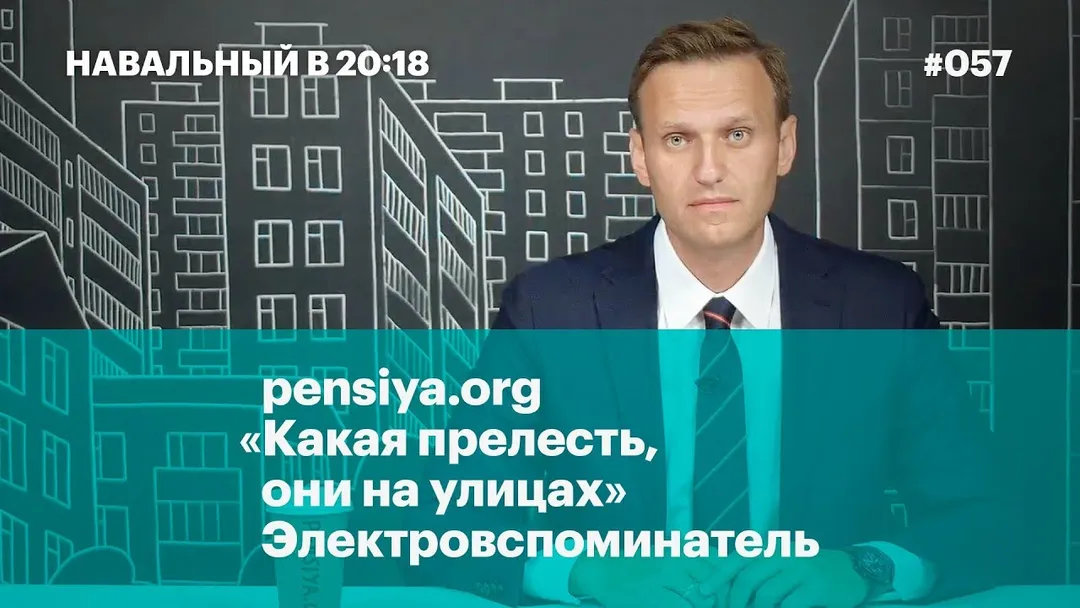
pensiya.org, “How lovely, they’re out in the streets” and the electric memory refresher
[music]
Hello everyone. It's 8:18 p.m. in Moscow. Alexei is in the studio.
Navalny, or irresponsible politics,
as Valentina Matviyenko called me.
Well, she, of course, is a responsible politician,
and at her briefing
where she was talking about how important it is
to raise the retirement age, she scolded
irresponsible politicians who
only want to hold rallies,
and refuse to meet Russians halfway,
who are longing,
longing and demanding that their dear government
please raise the retirement age.
Valentina Ivanovna, please, it's too low.
We're working—raise it for us. So there you have it.
So she scolded us. Today we'll also spend quite a bit of time
talking
about the retirement age. I want
to remind you that you can ask me
questions with the hashtag #Navalny2018. Please write
to Twitter,
and I'll answer them.
Today we're raising money; for that
there's Super Chat, and there's also
a special thing below that you can find
on YouTube. All the money will go toward
paying fines for various good people
who take part in rallies. I wanted to begin
today's episode with some good news:
to say that, guys, for the first time in
a year and a half, finally,
it has happened that none of the staff
or activists from our headquarters across the
country is under arrest, because
I got out, Kira got out, our press secretary Ruslan Shaveddinov got out,
all those people
all those people
whom I showed you in
the previous program—they were released from
rather lengthy arrests of 25 to 30
days, and we had almost reached the point
where—bang—there was nobody in jail.
But Zakhar Sarapulov from the city of
Irkutsk seriously let me down—let all of us down,
when he came to a May 1 rally in his
hometown of Irkutsk.
And this is what he looked like when he came—he was holding
a duck.
You see, he came with a rubber duck, but
obviously, by doing that he immediately
turned a cultural event into
a sharp socio-political one, and that's exactly
how the police wrote it up, and then the court
—a judge, imagine, a judge in a federal
court, with a robe and a big
salary—issued a ruling
saying that when a person came to
a May 1 rally with a duck, he of course immediately turned the May 1 rally
from a cultural event
into a socio-political one.
So she—or he—slapped Zakhar Sarapulov with 8
days of arrest. Because of our Zakhar, I can't
—sorry—say that
right now we have nobody
in the cells. So we're waiting for
Zakhar to get out, and maybe on the next
program, I hope, I'll jubilantly
say: guys, for the first time in a year and a half,
this
has happened, and none of our people is sitting in jail
simply for going out into the street. Meanwhile,
this comment—how lovely, isn't it?
Out on the streets—that's the main thing. At least, from what I've tracked
on social media
over the past week, while the World Cup is going on
in Moscow and St. Petersburg and other major cities,
everyone is just enchanted: my God, look,
there are Peruvians on the streets, Brazilians,
people from various exotic countries in
funny outfits, literally running
through the streets of Russian cities, and this is
something everyone likes, it's great. No, I'm not
joking at all—it's genuinely great.
But there were two such videos I really liked.
This is Peruvians in the central square
of the city of Saransk. Let's watch
and enjoy 30 seconds of it.
Ah.
Yes.
[applause]
Ah.
It's great, really great. I myself
retweeted this video on Twitter
with the caption: Great—how beautiful Saransk is.
With all due respect to Saransk,
it has never been this beautiful. Peruvians,
non-Peruvians, whoever—they walk through
Saransk, and they feel good, and we feel good,
and the police feel good, and the people who
sell ice cream are doing great, and those who
rent out hotel rooms—everyone's happy. We
enjoy it and rejoice, and you just
watch this video and your face
just spreads into a smile. Another 30
seconds—let's watch how the Swedes
walked through Nizhny Novgorod. And these were not
some Swedish invaders reaching
Nizhny Novgorod.
These were cool people walking down
the main street, enjoying themselves, and we
were enjoying it with them. Thirty seconds of
Swedes in Nizhny Novgorod.
Well, it's freaking awesome, right? Forgive me
for the expression, but it's just
awesome. They're walking, and it's great. We
are enjoying
something almost unseen in Russia: when city streets
actually belong to the people
for whom cities are built—to people. Right now,
the most popular place for
taking photos in Moscow is Nikolskaya
Street.
It has spontaneously become this kind of
pedestrian-only street
where people walk along the roadway, and everyone
loves it. And there's one thing
that darkens this enjoyment we're experiencing.
it all comes from how great it is
how wonderful it was on the streets of Russian
cities—the fact that in two weeks, just a little
a little later, no one will be left
and for stepping out onto the roadway
you can be jailed for 15 days or locked up for
30 days
foreigners can do this; right now we can
live and rejoice there because foreigners are here
because this Putin government, United
Russia
they want to throw dust in people’s eyes and
show how great we are, how
good-natured we are, how friendly we are, well
that’s supposedly what we’re like, yes—but as soon as
the foreigners leave, no, Kolya, you can’t
and you can’t either, Masha; it means you’re not
allowed even to stand on the sidewalk with a one-person
picket—not for a celebration, not for
joy, not for political demands
not for anything at all. As soon as the foreigners
leave here, this holiday
ends, and the city once again belongs
to Putin, Vladimir Vladimirovich
to Boris Rotenberg, Arkady Rotenberg,
to Dmitry Anatolyevich Medvedev, and to everyone
else—and no one else is allowed to be there
I would really like this wonderful
feeling of enjoyment and pleasure from
the fact that people simply go out into the streets with
any demands, with any
demonstrations, to somehow remain with us
even after
the foreigners leave Russia, so that we still
have at least some sense of our own
dignity grow a little, and
we would say to ourselves: why can’t we
go out in exactly the same way? Look
at June 12 last year—people
were arrested, detained, dragged into
police vans because they were doing the same
thing: they were walking with the flags of their own country
but Mexicans walk with theirs, Swedes walk
with theirs, and on June 12, Russia Day, we walked
with our Russian flags, and
for that, people were arrested. So we
must make sure that during
championships and during any
festive or protest events
the streets belong to the people, and everyone will be
better off for it—police officers included
and the people themselves. Dmitry Navosha, editor-in-chief
of Sports.ru
Sports.ru, sorry, one of the leading
sports websites, later
wrote something interesting that I saw on Facebook
in Nizhny Novgorod
there, on some little lawns near the Kremlin (city fortress),
he says, people are lying there in jerseys
that clearly show they’re Germans or from Brazil
who came here; the police don’t bother them. But if lying there is
someone who is identified
as Russian
they immediately come over and say, right, come on
get up off the grass, please go somewhere else
this should not be happening; this is what
we need to eradicate, because what kind of
beastly attitude toward ourselves is that?
Why is it that we’re not allowed? Even if you look at those same
football fans
look at how our
fans are treated
all of YouTube is full of videos of them being
shocked with stun guns
held for hours in those sections at
stadiums, with these huge
massive lines where it’s impossible
to get through—how they’re treated overall, like
subhumans. And now how we love
foreigners—we kiss them, we hug them. I
flew in yesterday, and there were many
Mexicans, many Icelanders, and all of them
were being welcomed at the border, and there were a lot of
border guards sitting in their little booths
and there were no lines at all. Maybe
I just got lucky, but at least I didn’t see any
lines, and it was really great. And they, well, they
were all energized, and you feel it too
as you come in, and you feel proud of the country, of how
they see this country, how they
are encountering it, and you understand that now
these Mexicans
will go to Nikolskaya Street, grab some beer
hang out, and say what an awesome
country Russia is
let it remain just as awesome for us too
That is the most important thing
we are working for, what we are defending in
the course of our political struggle: so that
Russia will always be like this
and belong not only
to foreigners when they come here
to hang out, but also to us in our ordinary
lives, because we also want to
hang out, and live, and
protest, and walk around however we like
and protest too, because unfortunately there is plenty
to protest about, unfortunately. Now, about
the cups
the most attentive of you noticed that
it says pensiya dot org
some of you saw in the description
that it says pensiya dot org, and I will be referring
to this website, to this domain name
for a long time to come, not just in
the immediate future, in the next few
months
because this is one of our key
campaigns. Those who follow our
work know that we are constantly
involved in campaigns concerning
pension reform, when the state
first once and then a second time
stole our pension savings, we
made a special website, we also collected
signatures, we organized a mass appeal to
members of parliament. And now we are calling on everyone
regardless of your political views
regardless of your views, I often say this phrase, but I
would put it even more sharply now: even if you voted for
Putin, I don't care.
Come here and join us.
Because your leader deceived you.
You voted for him because
he said, "As long as I am president, the retirement
age will not be raised," and he deceived you.
He betrayed you, he robbed you, so
come here — we're collecting signatures here, and
this, it seems to me, is a little more
meaningful than all the other signature
campaigns, although they are useful too. For example, the petition
on Change.org gathered more than two
million signatures.
That's wonderful. And 100,000 people
voted — that's very good. But we want
not only to collect a lot of
signatures, but also to create together with you
a huge machine for putting pressure on
officials and deputies who do not want
to listen and are trying to raise the
retirement
age, because 95 percent of people
are categorically against it, but they are still
raising it anyway. They are telling us:
we don't care about Russians — this is what we want to do.
Here's what we want to do: you register on the
website and provide your address, at least
down to your city. We don't need your house number, we don't
need your apartment — just
your city, so we can put pressure on
officials. What are officials afraid of, especially
deputies and politicians? That you will stop
voting for them. And even more, they are afraid
that you will vote in a coordinated way
against them. So we are taking
the first step toward creating this machine of
coordinated voting against them in
any election at any level — whether it's a
local deputy,
the State Duma, or a governor,
whatever it may be. We will send you an email
saying that in your area
some people are running in the election. We are not
registered as candidates ourselves, so vote however
you like — for this one, maybe for that one — but
for this guy
or these two guys, do not vote
for them under any circumstances, because he or his
party supported raising the retirement
age. I call on everyone
to register and take part in this
initiative. Please note: on this website
there is no Navalny name there, and there is no
photo of me or of our Party of the Future of Russia.
This is a shared project, and it is outside
party politics — not apolitical, but
political, of course — just outside
ideology. We want to fight those
people who are robbing us, who
in this way
are brazenly acting against us and, well,
to put it mildly,
are behaving outrageously. Look: it was
announced that there would be some kind of
rallies across the country,
everyone got stirred up, the petition got 2 million
people, and then Valentina Matviyenko (speaker of Russia's Federation Council)
— let's watch her short video, 56
seconds.
When
she was asked about it, she said: no,
there are just some troublemakers out there
making noise; we must not delay, we
must do everything necessary to pass it
right now. Fifty-six seconds of Matviyenko.
Matviyenko.
Indeed, a very active public discussion has unfolded
around the discussion of the proposed bill on
the proposed law on
pension reform. Colleagues, when
some call it a law on raising the
retirement age, that is incorrect — it is a law on
pension reform.
Simply going out into the square and saying, "We are
against it," is irresponsible politics. As for
whether perhaps it should be postponed — no,
it cannot be postponed. If the authorities act in
that way, it would be
irresponsible on the part of the authorities, because we
openly
explain and say why this issue is overdue,
why it is necessary,
why it cannot be postponed, why
it is impossible
to remove responsibility from ourselves and place
that responsibility on those who will come
in five or ten years, when it will lead
to a whole range of even more serious problems.
It can be discussed and adjusted, but it must be adopted.
It must be adopted without delay, in the autumn of this year.
It must be adopted without delay, in the autumn
of this year. Just look at how hard-line they are,
how determined they are — you can't intimidate them with anything.
So let's register
here, and all of Valentina Matviyenko's allies
will be subjected to this kind of public rejection.
If you want, we will vote in a coordinated way
against them. I'm not saying that
right now who you should vote for — we are not going
to give you recommendations on whom
to vote for. But there is a list of people against
whom we must vote and act
with all our strength so that, well, they do not
keep acting so brazenly. Of course,
Valentina Matviyenko does not want to postpone anything.
She has her pension, she has her
salary — around 500,000 rubles a month, probably more.
Her pension will be
something like 450,000 or 300,000 rubles, but even without
a pension everything will be perfectly fine for her, and she has no desire
to delay anything. If you
are watching, she doesn't want to postpone anything.
And if you are watching this program from, say, the
Novosibirsk Region, Sverdlovsk Region,
or Altai Krai,
you will die before reaching retirement age, because
the life expectancy of men in these
regions, in a large
in a large number of regions of Russia, in
the Samara Region
it is 65 years. These people will work
until they die, and this is the phrase I will
keep repeating constantly. I urge you not
to forget it. I will keep recording videos. They
are offering us all this, they are offering
to make us work until we die, and we will see nothing
from our pension contributions
because that is simply the kind of
life expectancy we have. So come in
guys
register, send this to your
grandmother, send it to your grandfather
post it on the forum, write
about it, explain this idea to people, why we are
doing this. Everyone who supports the pension
reform, the increase in the retirement age,
will get these black
balls from us, will get votes against them from us
and let that be some kind of
threat to them, so that somewhere, in the sense that we
in Irkutsk, a person from United Russia (the ruling political party) is celebrating
and
as a deputy from a single-member district, he
will think about whether he wants to be in United
Russia, whether he wants to support
the retirement age increase, because
it will mean that when he goes out into
his city, in his district, as a deputy, and
thinks, well, everyone has probably already forgotten that I
once supported raising the retirement
age
everyone in his district will get an email, those
who register here at pensiya.org
will receive emails
saying: don't vote for this guy, vote
against him. And at that moment it
will hurt, he will feel bad, and he will remember it
This is very important, because closer to elections
you understand, they will all suddenly become wonderful, like
that Party of Pensioners, you know, at
every election they shout themselves hoarse: we are for
pensioners. They are especially active in
the regions
during elections, they outright
deceive old people, saying, we are
the Party of Pensioners, we will defend your interests
but this Party of Pensioners
today adopted a statement saying that it
supports raising the retirement
age
Crooks, crooks, scoundrels, and we
made this website so that no one
would forget what crooks and scoundrels they are when
they run in some regional legislative assembly
election, we will send emails: do not
vote for these villains, because
they deceived you. So it is very, very
important to come and register. A lot of people
ask me about the rallies
what kind of confusing thing you did with
the rallies, filed applications there, did not file them here
Let me explain very simply: the main
mechanism of pressure on the authorities is
of course taking to the streets, and we
have called and continue to call on everyone to go out
into the streets and take part in any
protest actions against the increase
in the retirement age. Right now, because of
the World Cup, in those cities where
the championship is taking place, there are much stricter
rules for filing applications. Frankly, we
do not recognize these rules, we do not give a damn about
these rules, but the Anti-Corruption Foundation
and our party do not want
to pull the blanket over ourselves and
make ourselves the center of attention. We proposed
to everyone publicly, I said publicly once again
that we are ready to participate with
everyone
with libertarians, with trade unions, well
in principle, trade unions make the most sense
because I am a little surprised by their
passive behavior, but I hope they
will still be more active here
I mean, of course, real
independent trade unions, not that
Federation of Independent Trade Unions, those
crooks supporting United Russia, that is
the so-called Confederation of Labour and
the Free Trade Unions there, which in fact
really defend the interests of working
people. There is no need to be afraid of that phrase, and we
are ready to take part in their actions, and we want
them to be involved and take part in our
actions. Well, actually, it is not even right
to say their action or our action, this is all
a common action. So for now we have organized
first in 20 cities, then that
number increased to 33
cities, because we have democracy
Some people said to us:
we have a small city, but we will still go ahead
and file an application against
the increase
for a rally against raising the retirement
age, because, well, a lot of people
are asking for it
and now 33 cities have submitted such applications
in seven cities these rallies have already been approved
by the authorities, and in these cities, as
a first step, we
are organizing them. I invite everyone
to join these protest actions. As for
the largest cities in Russia, these are
the same cities where the
World Cup matches are taking place. There, well, we will
act according to the situation. Some will
do it as early as July, like everyone else
we will hold them together with them
the trade unions seem to want July 18. In my
view, it is not worth dragging this out so long, but
overall we need to approach this soberly. We
will hold them more than once, in July, in
mid-July, and in September, because
The government is firmly set on
stealing these pension savings.
It is determined to push through a rise in the retirement
age, and that is why we will still need to make a great deal of effort.
We will still have to take many more steps. We are not going to
rush; we will try, together with
everyone. Frankly, we understand
that when we submit an application to the authorities,
it is like waving a red flag in front of a bull. But that is not a problem.
In that sense, we are not proud people. If the trade unions
have received official approval, we will come to the trade unions' rally.
We understand that there, on whatever
stage they may be afraid to let me or
representatives of our headquarters speak —
that is not a big deal.
What matters more to us is the common cause, not whether I
personally stand on stage and shout
some slogans at you. This is a big, long-term
campaign. Come in and register right
now. Let me answer some
questions on Twitter. A reminder that with the
hashtag #naval2018, Aleksandrova Rosio
asks how the party registration is progressing.
The documents are ready. I think tomorrow
we will submit the documents to the Ministry of Justice. We have already
held the federal meeting and held
a meeting of the regional branches.
We already have a sufficient number; I
saw these boxes of documents lying with the lawyers.
We are ready.
Once again, we are going to demand registration
for the party. Our documents are absolutely impeccable. I
think that even our opponents
have no doubt that we have more than
enough people to register a party. For a
federal party in Russia, 500
people are required.
In most regions — in fact, probably no one —
doubts that we have 500
people in every region.
So, we are beginning this round.
Alex RM asks, in connection with the protests
against the increase in the retirement age,
whether there will be unauthorized protests in Moscow
or whether it would be better to go to nearby cities.
But also bear in mind that Moscow is hosting the World Cup,
so, well, first of all, I do not think
that the championship is an obstacle to this protest.
The libertarians filed an application for July 1; they
seem to have already been refused. I do not know whether they are prepared
to hold an unauthorized protest
or not, and in general I do not think — you
know my position — that protests can be
unauthorized. Nevertheless, there is
this view, this opinion, that, well,
holding them right during the championship
is probably not very good because,
well, because there they are, those cheerful
Mexicans walking along, and here we are
doing something — it seems to me this is a bit
far-fetched. But of course we are very
constructive in our approach, so we are also
taking this into account, and a large
number of different forces are discussing all of this.
We are discussing it together with them.
So in Moscow, follow the updates.
In any case, in all cities where there is no
World Cup, especially the largest ones, we will hold protests.
They will take place on July 1. Be sure to come.
Promote them as much as possible. Make sure
that as many people as possible turn out.
Soblaznitel asks whether
during the last Great Lent (the main Orthodox fasting period before Easter), I managed
not to yell at anyone even once. Well, yes,
he probably knows that before every Great
Lent, which I try to observe,
I set myself a goal not simply to
stop eating meat, yes, I
try to demand something more difficult of myself,
for example, not to yell at anyone
even once. Unfortunately, I did not manage that.
That was during the last Great
Lent.
Vera Lugovskaya asks what to do
if your city did not submit an application for
a rally — for example, should you go from Moscow to Tver?
No, there is no need to go from Moscow to Tver. There will be a rally in
Moscow; from Moscow you should support
the Tver rally and all the others there
by promoting them and urging
people to attend. But follow the news, in Moscow as well.
Of course, in Moscow, in St. Petersburg, and in
Yekaterinburg — anywhere.
There will be rallies. Probably even in those
cities where there are World Cup matches,
some people will say, well, we want
to hold a rally. Again, we have
a democratic organization: if a headquarters
decides that it wants to hold one anyway,
they hold it. We do not have a situation where I
can forbid them. So just keep watching
and in your own city, come to that
rally. And she asks whether
the headquarters are doing calculations on this issue.
Yes, they are doing some work on it; in particular, on pensions we
will keep working, and we are doing a lot of work
on this topic, namely on the pension
and pre-retirement age.
And of course I cannot fail to mention one
of the vilest and most disgusting people —
Dmitry Kiselyov. And not only the vile and
disgusting Dmitry Kiselyov — this week we learned
that he also has
an equally vile and disgusting wife, perhaps
even more vile and disgusting, because
on the website of RIA Novosti (a Russian state news agency),
a state agency, this
very wife
posted some absolutely
astonishing piece — not just an article,
you could call it a manifesto of crooks and thieves —
about how the retirement
age has to be raised, and those who do not want that, who are afraid of it,
are these infantile people who
do not want to work, they are all like that,
and
they are losers, and they are somehow constantly
offended — there is clearly something wrong with them.
If you smoke and drink, you won’t live to see retirement. I...
I strongly recommend that all of you, guys, go
to the RIA Novosti website and read all of this
so that, well, in a way, you can also
get charged up, charged up with some kind of
righteous anger, so that you have
more motivation to send this
link everywhere, because you—don’t forget
just don’t forget not to simply read
the article
by Dmitry Kiselyov’s wife, but then go
for example to my blog and look at
the apartment where Dmitry Kiselyov lives
himself, together with his wife. It’s the residential
complex Legenda Tsvetnogo, right on Tsvetnoy
Boulevard. If you go out there, well,
just turn your head and you’ll see the most
luxurious, the most beautiful building in that
area, an apartment in which costs, well,
some millions of dollars, and we
published information about it. There’s even
the purchase contract for this apartment.
Dmitry Kiselyov, together with his wife—
people who have done nothing
good in this life, who are simply, well,
a meaningless burden sitting on our
shoulders, who eat and drink and buy
apartments at your and my expense, drank vodka
there—apartments for 162 million rubles (about $2.6 million at the time)—and
now, you understand, they tell us that
well, those who speak out against
raising the retirement age are somehow
resentful losers who really ought to
stop whining about it and just work harder.
9,800 people are watching us
right now.
Let’s move on. By the way, I’ve still got
these 43 seconds on this issue.
Dmitry Kiselyov—43 seconds of how
the federal TV channels suddenly started
aggressively pushing for raising the retirement age.
And these are the same people who only recently were praising
Putin and saying what a great guy he was
because he didn’t want to, he refused to raise
the retirement age—and then suddenly Putin
changed his mind.
Obviously he changed his mind—there’s no money.
So they’re going to raise the retirement age, and all
the same people on the federal TV channels
started zealously saying: let’s raise it,
let’s raise it. Forty-three seconds.
The government is proposing to extend
working age. Russia is joining
this global trend. In recent years,
pension changes are necessary. We need
an active life position from the older
generation. We need to build a modern
economy—a great economy. The proposed
solution turned out to be surprisingly
mild—I’d even say
gentle.
Now, who benefits from this?
Young people benefit. Older people benefit too,
because the age is extended
at which they can work, be useful, and
earn, in any case, more than
their future pension. ‘I want to retire,’
and they say, ‘No, listen, you’ve still got—Dad, you’ve still got’
‘another 13 years.’ Just amazing, yes, really.
Just wonderful for everyone. Who benefits from this?
Young people, pensioners—and again, excuse me,
for repeating this phrase, this
figure over and over: 40 percent of men do not
live to retirement age. That is,
they die before reaching retirement.
And these brazen scoundrels tell you
how this benefits everyone, how it benefits everyone. So we’re
going to take away their money, then. They spent their whole
lives working, they paid those damned
pension contributions.
An enormous, gigantic amount is taken from every
salary as a pension contribution, and I’ll
get nothing.
Their heirs—their children, grandchildren—won’t
get anything either. Everything will go
to Dmitry Kiselyov, so that we can
buy him a fancy apartment.
Why is it, generally speaking, that people here retire
earlier now, or want to retire
earlier? Well, you probably have
a grandfather or grandmother who is
retired, a parent who is retired,
maybe you yourself are retired, and you’ve hardly
ever heard someone’s motivation
when they said, ‘Well, actually,
I’m still full of energy and in great shape,
it’s just that I’m tired of working, I’m tired
of working, I don’t need much money, I’d
just like to, I don’t know, smoke a cigar
sitting on a bench, or I just want to, you know,
go on a drinking binge, retire, and
drink a bottle of vodka every day. Well,
I’m just tired, I want to be
a pensioner.’ You’ve hardly ever heard
exactly that kind of motivation. That is, people
of course don’t really want to work, but they’re
poor, and they are forced to work. They retire
because they no longer have the health for it,
because they’re too weak, they’re
ill, and very often already disabled at
that age. But listen, here, by age 60
most people have some degree of
disability—both men and women. When
we discuss the retirement age, for me
this is important, and I want to say it
so that this becomes
one of the key topics in the discussion
of the retirement age here.
Our healthcare system has collapsed. From 2000 to
2015—the Putin years—the number of
hospitals, as government experts themselves
calculated, fell from 10,700 to 5,400.
The number of hospitals dropped. Our education system—
well, excuse me, our healthcare system,
education too—but our healthcare system,
it has sunk absolutely through the floor, and I
actually have, well, on this subject,
a personal story that just...
What has really struck me over the past two weeks—well, you
remember, those
Kremlin crooks splashed me with *zelyonka* (a bright green antiseptic), burning my eye.
I almost lost it, and until the moment when
I was allowed to go abroad, I was able to
have surgery there. But overall,
my eye was saved by our Russian doctors
at the eye disease institute, and this
federal institution is located in
central Moscow. It is constantly packed,
absolutely full—you can never just walk in. And that is exactly
why you constantly see these elderly
people, of retirement and
pre-retirement age, getting treated for
their cataracts there, and whatever else
the most common conditions are there—
glaucoma, cataracts—yes, glaucoma too. Among
older people, the place is completely overcrowded.
And now they are breaking it up. Last
week there was some furious picket when
20 patients there simply
burst into the hospital shouting, “Don’t
you dare fire our doctors, don’t
you dare dismantle our staff.”
By the way, I received a notice here
that they sent me
saying that despite the World Cup, and
frankly, to hell with the World Cup,
tomorrow, June 22, about
six people will gather at the eye disease institute—
patients and doctors—who again there
plan to storm into the hospital and
demand that they stop destroying
the team that works there. So I
kind of wrote back to them: guys, this always
sounds very harsh, maybe
even like an exaggeration—“they’re dismantling
the staff.” Maybe they are not dismantling
the staff, maybe it is some kind of planned
downsizing or something else, but perhaps something
reasonable is happening. And in
response I was told: “Well, Alexei, if you
think something
reasonable is happening here, first of all, have you seen the lines
we have there?
And second, here are two documents showing how they are
breaking us up. Let’s look. Document number
one is a notice. If you
look closely at the screen, you’ll see—yes, it
says there:
to a junior research associate,
an actual doctor, a person
who holds a fairly high
position, they say: “We are laying you off, but
if you don’t want to be laid off, here are
your options: you can take a job as a lab assistant
with a salary of 7,000 rubles (about $75), or take a job
as a cleaner with a salary of 4,000 rubles (about $45). Let’s look at
another notice just like it.
Please: head of the scientific
organizational department. Well, presumably
the head of a scientific-organizational
department is still someone who has
some expertise. The same thing is being
offered: choose between
accountant for 11,000 rubles (about $120),
lab assistant for 7,000 rubles (about $75), or cleaner
for 4,000 rubles (about $45). This is Moscow.
This is the city of Moscow.
This is not Altai or some, I don’t know,
region where the cost of living might be
a little lower. This is Moscow,
where that money would not even cover transportation.
And this is happening there right now, and
that is why I do not need any kind of
abstract proof, you know,
reports, or anything else. I can see how these
research institutions are being destroyed
right now, and the doctors who made sure
that I am not sitting here with one
some kind of
glass eye—those very doctors are now being
transferred into lab assistant and cleaner jobs with
a salary of 4,000 rubles (about $45).
How is this happening? I just do not understand. Fortunately,
there are some people there who are ready
to protest. But this is happening all across Moscow,
all across Russia.
If they slash half the hospital staff from
10,000 to 5,000, that
is happening everywhere, constantly. So
the question is: with healthcare like this, in
what condition, in what shape, will people
be by age 65? They will be
wrecks. In fact, by 65 they will not be in any
condition at all, because half
of them will already be gone.
Once again, once again, guys, sorry that I
keep hammering this number endlessly, but
go to Google right now and type in “average
life expectancy by region,”
and you will see a big table.
There will be 83 or 84 entries there, and you will see
Dagestan with high
life expectancy,
Karachay-Cherkessia, Moscow—high
life expectancy; mostly
the Caucasus regions and the south. And then you will see
that the average life expectancy for men is
64, 60, 62.
That means these people do not live to reach retirement, on
average, including because
the healthcare is monstrous, except in
the biggest cities. Although, as we have
just heard from the example in Moscow,
it is basically impossible to get
quality medical care. So we have to
fight. This is not something abstract; it is
a concrete struggle for your rights. That means
pension.
org—it is written here in the video description.
Go there, sign yourself up, become
part of this machine that will
fight the crooks and thieves. Let me
switch over and answer some tweets.
From Anastasia: “Well then, we are waiting—soon
another palace built with pension
money will surface.” Absolutely. Absolutely.
They are cutting these pension payments.
Because there is no money—but where did the money go?
Well, it went there too—into corruption, these
the money was simply looted from the budget, but
again, a basic calculation shows
if we take the number of
working-age people, if we
take those who are paying pension contributions
right now, then we will see that
already now there should be enough for everyone to get
a pension much higher than it
than it is, but it is lower. Why?
Because that money was stolen, including
the fact that it was turned into palaces. Palaces
do not appear out of nowhere. They cost
tens of millions of dollars, and those
tens of millions of dollars were taken from you and me
and taken by Volodya Fedorov.
The State Duma has passed a law that will help
convicted prisoners reduce their sentences.
But it forgot to calculate how many inmates
this will affect. It is the right law,
which was finally passed in a much
softer form. They passed it so that
if you are being held in a SIZO (pre-trial detention center), then for you
it counts toward time in a penal settlement
as one and a half days. In other words, if you spent one day in a SIZO,
then that one day is counted as
one and a half days in a colony, in a general-regime colony
while in a penal settlement it is one-to-one.
And, I think, in a strict-regime colony as well
it is also one-to-one, but that is completely wrong.
Still, this will affect
quite a large number of people.
I just think the State Duma was unable to
calculate it because only
the FSIN (Federal Penitentiary Service) has that data, and in general, throughout that
prison statistics system there is some kind of huge
chaos and madness.
But at last this law has been passed, because
people are being kept in these
pre-trial detention cells for years.
Before, they would sit there for five or
six years; even now they are kept there for years.
Obviously, being locked in a cell is much worse,
much harder, and much more harmful to
your health—people lose their health there—than in
a general-regime colony. So this is
fair; it just should have been counted
even more generously.
Alexei, how would you comment
on the situation with Leonid
Slutsky and Utkin? Well, I already
commented on it. I am very sorry, of course,
but Slutsky...
You probably—we unfortunately cannot
show you a clip of that video because
it will get banned, because all rights to
the match belong to FIFA, and
that is very strictly enforced. I will show you
a few seconds from the match here, not
to show the match itself, but
to show how Slutsky had this kind of
play on words there—'Navalny football' and so on.
There is this term, 'Navalny football,' and anyway
you get the idea: everyone is running somewhere,
all together, attacking very fiercely, and so he
just used the similarity in sound
of the name and surname and said it that way.
It was interesting to watch their 'Navalny
football'—it was such a harmless joke.
Now Slutsky has been removed from
commentating on Channel One matches.
The official explanation is that
his contract expired, but that is ridiculous because
obviously Channel One knew about
Slutsky's other commitments, and this could not
have come as some sudden move.
I think, I assume with one hundred percent certainty,
I do not know for sure, of course. Slutsky, possibly
and commentator Utkin suffered because of this.
I am very sorry about that. How
can I put it—I apologize to Leonid
Slutsky, even though I did not really do anything. In short,
I am very sorry it turned out this way. I
feel awkward—that is the right word.
I feel awkward before Utkin and before
Leonid Slutsky. I hope everything
will be fine for them, and I hope that someday
we will end up in a normal country where
you can say any surname however you like
and nothing will happen to you for it. Alena Anikina,
Alexei, what question should be asked to Putin at
the Big Challenges event at Sirius, to catch him in
a lie? Sirius, as I understand it, is a school in
Sochi where various talented children ask
Putin questions, where last time
a wonderful girl—I do not remember her name—
asked a question and basically caught Putin in
a lie. She said: why is the number of
state-funded university places shrinking? Putin lied
and said that the number was not shrinking,
the number of state-funded places at universities.
I also released a video about this, and
there are statistics showing that Putin
is lying. But here is the thing: catching Putin in
a lie
is very easy. Ask him even about
the retirement age: if you spoke so confidently about
it, then why did you lie? He
lies endlessly. Again, the entire internet
is full of examples of how Putin lies
constantly, about everything. The thing is simply
that you will ask him a question, and he will lie again
in response, and by then your microphone will already
have been taken away. So to all Sirius students I
would advise either asking the question
in such a way that you immediately tell him:
'But please do not lie, because
when you answer this question, you usually say
such-and-such, but that is not true'—or
else try afterward, so to speak, to catch up with him
and say, 'But you are misleading us right now, so'
Just keep in mind that he always has
the same standard manner: at every
call-in show, he simply lies
in response to the question and then moves on to
the next question. No one can
to pin him to the wall, because, well, because
that’s just how it is — just recently there was this
sensational kind of
review. They called it sensational because
it was simply an Austrian journalist, and
he was telling Putin, basically, you’re living
now in a different situation. Putin
was trying once again to dodge
the answers, squirming around, but all of it
looked like an Austrian
journalist beating up a baby, because he
was simply catching our old man Putin
in lies.
But just now, here’s a question, as I can see:
“Navalny’s daughter” — and she’s not actually Navalny’s real daughter
Navalny’s real daughter is writing to me
that right now she’s supposed to be taking some kind of
online course, doing
self-education, and just now there was some kind of
message saying he flew away.
My mom loves Putin — how do I explain it to her?
Well, okay, for example,
ask your
mom: “Dear Mom, they raised the retirement
age for you to 63.”
Please tell me, can a woman like you —
young, beautiful,
healthy, or maybe not so healthy — at that
age find a job? At 60
years old, or even at 55, can a woman in
Russia over 55, even over 50, find
work for herself?” And your mom will say — because she’s
a real person — “Sweetheart,
no, unless it’s as a cleaner.” And that’s where
you need to work on her a bit and say,
“Well, you can see then that Matviyenko (Valentina Matviyenko, senior Russian official) is lying, and
Kiselyov (Dmitry Kiselyov, pro-Kremlin TV host), and everyone else, and your Putin too, when
he says that here
older people can find jobs and everything’s fine,
that women here at 55–60, women at 60,
are all so energetic and healthy that they
really want to work.” This time
it was crystal, crystal clear — I didn’t quite manage to
catch the rest.
Electric torture marks — I want to
tell you about electric torture marks
again. There are probably already ten thousand
five hundred people watching us now; you’ve probably
of course heard about this astonishing
story from the city of St. Petersburg
which has effectively now become
the torture capital of the Russian Federation.
It’s not only the cultural capital, but also
the capital of torture, because the local
FSB directorate — they absolutely do not
care anymore, they literally torture people
— people who are sitting in jail simply on
fabricated criminal charges, in order
to beat confessions out of them. And quite
recently we were reading
testimony, case materials,
statements, court complaints, where young people and
young men who had been grabbed in order
to invent some kind of criminal or
terrorist organization — they wrote about
how they were tortured with electric current:
one wire to the genitals, another wire
to the head; or one wire to the tongue, another
wire to the ears, and they shocked them like that. When
a person is shocked with electricity, on the body there
remain these so-called electric marks —
basically little burns, these
tiny dots. So they were tortured, and afterward
they showed: here’s how we were tortured, here are the electric marks.
After all, all of this can now be documented, and
they described all of it, and doctors wrote
that yes, these were electric marks.
And then the investigator told them:
“Mosquito bites.” And then the court said,
“These aren’t signs of torture, these are
mosquito bites.” And until very recently it was
impossible to believe, but now we
know for certain that this torture is happening, and
the whole system — the prosecutor’s office as the oversight
body, the courts, and the St. Petersburg authorities —
they are covering for this group of
hellish sadists that has formed
inside the St. Petersburg FSB. Though, to be fair, this
organization has never exactly been known
for gentleness of manners.
But simply torturing people with electric current,
just ordinary people, so that they
confess to
some ridiculous, fabricated
crimes — and for everyone to know about it
and not even be ashamed of it — that is something
truly beyond the pale. And then we have
Scientologists. You know, there are such people —
Scientologists are people who go around
knocking on doors,
wanting to talk about God. You can
call them a sect, and you can
call them religious people, or you can call them
religious fanatics, whatever you like. In general,
they’re fairly harmless guys, but
they’re obsessed with religion — there are lots of people like that — and
they have the right to practice their
Scientology.
As long as they’re not harming others — and they
aren’t — but anyway, a criminal case was opened against them.
They were declared
an extremist, an extremist
organization, even though this Scientological
church exists quite legally in many places
and has millions of members.
And the documents, the case materials — in the volume with
the interrogation records — these FSB goons
there, or whoever from the Investigative Committee, they
published them, and there were some amazing
things in there, because right there in pencil
there were notes written like this:
which witnesses were useful, which local witnesses
were bad, others had written — well,
it was clear there was no extremism. And the most
astonishing note, of course, was:
“Knows a lot but keeps quiet. Before interrogation — electric
torture marks,” you understand? Well, of course there
someone will laugh now, ha-ha, hee-hee.
they came up with a funny name for it: electro
"electro-memory," but guys, just think about it
basically, this is how they live, and they write to each
other, passing around these little notes
saying, "let's torture this person
with electricity," and in practice, I assure you,
the sight of a person being tortured
with electric current
is extremely ugly, the whole thing
looks awful. I probably haven't tortured anyone
with electric current, and
but I have an idea of it — I've spoken with
people who
were tortured. It's something that
is practically impossible to endure, it is
unbearable, and for the human
body — this is what it looks like: if you've
ever watched some film about fascists and they
are torturing someone there, and you think, damn, I
would strangle him with my own hands — that's
exactly what people in uniform are doing in
the city of St. Petersburg, and they leave each other
all sorts of these notes, so
I really want to say this so that
all of us understand very clearly
who these people are. By the way, all of them,
those who torture people with
this so-called "electro-memory," have fairly
high pensions, and they will retire not at
65, but at around 40 or 45, because
their work is considered, you see,
hazardous working conditions. Well, of course — when he's
there, beating someone with those
electrodes, it's such a huge, huge
strain, you know, on the eardrums
— you could go deaf. Hazardous
working conditions. Or you're beating him and
his head is shaking and saliva is flying
everywhere — unpleasant, you see. There you are
standing there in uniform with epaulettes, and all that
saliva from the people you're shocking
with electricity is flying at you. Hazardous working conditions,
so you need to retire earlier, and
meanwhile you'll retire at 65 and you'll
get a miserable pension, and in fact you probably
won't even live long enough so that more money can be
paid to this kind of "defender"
of the Fatherland who beats someone
with an electrode, and then once a year, when
he watches a concert for Police Day or
FSB Day or something like that, he stands there
under a portrait of Dzerzhinsky (founder of the Soviet secret police), and the song
"Officers, Officers" is playing
— "your hearts are in the crosshairs" — and he stands there
with vodka, saying, "Let's drink to
officers' honor," and starts in on this as if it's our job
because, well,
otherwise I'd go home, but I still have
this so-called "electro-memory"
to deal with — some Scientologist is sitting here, caught
because he believes in God, and of course I have to
hook him up to
a few volts or amps so that
he doesn't think that faith in God or
walking around in white clothes in Russia can
just go unpunished like that
It seems to me that in Russia right now, and in the media,
we talk far too little about this. We need
to talk about it, because it destroys
the law enforcement system, the security system.
Where, in a society, this kind of thing
happens, and only
Mediazona and people on the air at
Navalny LIVE talk about it, nothing good will come of it
at all
Torture happens in many places. Someone will object to me:
"Well, they tortured people in America too." Yes, of course they did,
in Abu Ghraib prison
and in the CIA's secret prisons. But what a
scandal it caused. President Obama
said he would shut down that
prison, tried to shut it down, and failed,
incidentally. But there were fierce debates at
the Senate level. The woman who was then
chosen to head the CIA had to explain separately
whether she supported certain
interrogation methods. And they weren't even talking about
beating people with electric current — they were talking about the so-called
waterboarding, where a person is held under it
and water is poured over them; physically, they cannot
die or suffocate from it, but they
have the sensation of
drowning. It's agonizing. That too is torture.
This is used, and it is discussed at
the very highest level — all the media discuss it,
all the politicians discuss it. But here, somehow, it's as if by magic
electro, electro
"electro-memory," electro
"memory," and nothing happens
there — "electro marks," as if mosquitoes bit them
I'll answer a few more questions
Konstantin Akhmatov writes: right now, service in
the security agencies is a stain for life. They don't
Let's not make it quite so
absolute — there are different kinds of people
It's a big system, and there are different people in it.
But of course, it must be noted that
for example, in that same, let's say,
St. Petersburg FSB
can you call all of them
terrible executioners? Probably not. They don't all
torture people with electric current.
But they all know that there is, say,
office number such-and-such, and in there is
some guy — a captain or a major or
someone — who tortures people
with electric current. He has there
that little field telephone machine, and clamps
or some kind of device to make it easier
to attach it to a person. They know
this is happening, and that unquestionably makes all of
them participants in the crime. D Rot writes:
How exactly do you plan to punish
those guilty of torture and prevent new
cases of torture? Dear D Rot, I don't need
to invent anything
We open the Criminal Code and read everything
there about cruel treatment, about
abuse of official position under
exceeding official authority
as for torture, these are all specific articles
of the Criminal Code, so I don’t need
to make anything up. It’s just that when people
come and say, “Excuse me, we have
here all the medical documents,”
“we were tortured in the beautiful Russia of the future,”
the prosecutor will not justify all this and
say, “Oh, most likely you were just
bitten by mosquitoes.”
He will say, “Good Lord,” and run
to demand that a criminal case be opened.
The investigator will open a criminal case,
and the case will then be sent
to court, and there will be jurors sitting in that
court
who will be shown photographs of the victims,
electrical burn marks and injuries,
and witnesses will testify
and explain how they were tortured, and if this is
documented,
then those jurors will probably put
themselves or their own children in the place of those
children who were tortured, or in the place of those
religious fanatics there,
Scientologists, whatever—whether they are good people
or bad, whoever they may be, you cannot
torture them. They will put themselves in their place, and the jurors
will say the word “guilty,” after which the judge, on the
basis of the law in force, will sentence all of these
people
in accordance with the law to eight, nine, or ten
years in a general-regime penal colony
or a strict-regime colony, because that is the kind of
punishment torture should carry. If you
are vested with power and you torture people, well,
then of course you are a dangerous psychopath, an abnormal
person, and your place is in prison, mister.
What should deputies’ pensions be like?
And what about ordinary people’s?
Both deputies and ordinary
people should have decent,
high pensions, corresponding to the
overall economic situation in our country. If
we look at oil prices overall,
what dividends state-owned
companies and
private companies ought to be paying, and how much
we actually still have
in terms of working-age population, we can see that
pensions should be much higher for what are called
ordinary people. That is, a pension of
20,000 rubles a month (about $220) as a minimum—again,
that more or less follows simply from
the current figures, even though right now it is much lower,
around 16,000, 17,000, 14,000 rubles, whereas it should be 20,000 based
on the sums that are already going into
the pension fund. As for deputies’ pensions,
they should be proportional; they should not
be so enormous. Every
deputy,
if he is a good deputy, a representative
of the people, represents maybe half a million
people in a district.
There should be a high salary, and there should
be a high pension, but all of this
must be proportional. There cannot
be such a monstrous gap that
some people simply do not have enough for food. If one person
gets a pension of 14,000 rubles, and another gets
250,000, well of course that is absurd.
Quite simply. What progress has the project made?
Rustam asks—well, Volodya Fedorov asks.
Thank you for that question, Volodya.
Last weekend we dedicated it to the project
RosYama (a civic road-pothole reporting project), in many cities across Russia.
Several thousand reports have been filed; today I already
saw the first reports.
Officials have started moving and patching
things up, so RosYama is very much alive and
developing. Take part in the Ros
Yama project. Not all Russians are destitute, not all
Russians are so poor; some Russians are
getting richer. I would like to end
my program
with my favorite—one of my favorite
Russians. It is not Vladimir Putin; probably
my even more favorite Russian is
of course Igor Shuvalov, about whom our
foundation has published a large number of
investigations. There was one really memorable
investigation that really stuck
with me because while I was recording it, I had on
this very table a little dog
—a corgi—that I was petting during the
investigation, during the actual recording
of the video. I was talking about how corgis like these
belong to old man Shuvalov,
and how he uses his privately owned
jet to take them to dog shows, and he
and his wife, in different countries, spend
40 million rubles a year (about $440,000) on that alone
just to transport dogs to
shows. And it seemed to me that somehow
the plane itself, after all, costs 50
million dollars—I said 50
million dollars for the plane—and
I hoped to shock everyone, and probably
I did. But Igor Shuvalov
did not stop there. He probably
thought, “Damn, Navalny still hasn’t
really shocked people with the price of my
pricey, elite
50-million-dollar plane,” and last
week we saw media reports
showing that Igor Shuvalov
has acquired a new plane that now costs
70 million
dollars. An official who for the last
many, many, many years worked in
public service and has now moved to
a state bank is buying himself
a 70-million-dollar plane. In what other
country could this happen?
But even just from a basic logical standpoint, even
if we assume that he had money
before he entered public service, still...
It’s unlikely that, if you’re a deputy prime minister,
you could devote so much
time to business that your
assets would grow so much that you
trade in your super jet worth 50
million dollars for an even more super-duper
jet worth 70 million dollars. Nevertheless,
in a country called Russia, this
does happen.
Everyone knows about it; some
media outlets write about it. Obviously,
officials know it, and Putin knows it. Those very
FSB officers know it too, with their electrodes and
all that other stuff.
But nothing happens, and the only hope is
in us. And we need to say, among other things,
personally to Igor Ivanovich Shuvalov:
Dear Igor Ivanovich,
we are not prepared to hand over our pension
contributions so that you, our dear man,
can buy yourself a 70-million-dollar
jet. {URL_1}
Sign up, sign up — we are creating
a system that will help everyone
vote against these crooks and
thieves and scoundrels. On July 1, there will be rallies in
many Russian cities — take part, and
we’ll see you next Thursday.
Bye.
[music]