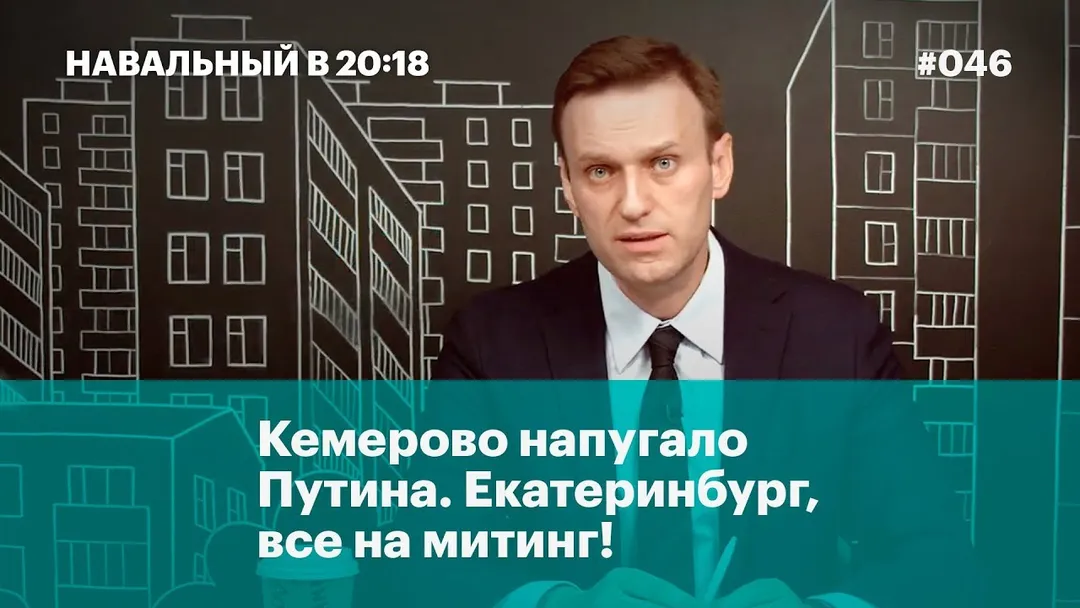
Kemerovo scared Putin. Yekaterinburg, everyone to the rally!
[music]
Hello everyone. It's 8:18 p.m. in Moscow, which means
that we're live in the Navalny LIVE studio. I'm Alexei
Navalny, or
the repeatedly almost-jailed, almost
candidate for almost-nowhere.
And if you're thinking right now, come on,
Alexei, you're just making that up
yourself — no, I'm not. I have
proof. That's what one TV host called me,
and he did it at the start of a talk show
about Kemerovo, which will be
the main topic of today's program. I have
seven seconds of confirmation — let's
watch it. "The repeatedly almost-
candidate for almost-nowhere." So you see, I
didn't make it up. Yes, Vladimir Solovyov, we
absolutely have to talk about Kemerovo.
The whole country needs to talk about
Kemerovo. The federal TV channels should
be talking about Kemerovo — but not the way
they are. It seems to me that a normal
discussion should be different, so today I'll try,
at least, to discuss this issue — this
horrific tragedy — in a substantive way. It has, of course,
shaken the entire country. In Russia, sadly,
unfortunately,
there are regularly terrorist attacks and disasters, but
it seems to me that society's reaction to
the Kemerovo tragedy has been unprecedented.
The reaction has been unprecedented even among
the completely non-politicized part of society,
and the authorities have behaved in an unprecedentedly
inhuman, piggish,
disgusting, and indecent way, and continue to
behave that way in this
situation. And that, too, has been noticed from below — by
what seem to me to be the least
politicized parts of our
society, by non-politicized people. That is
very interesting, very telling. And
this whole Kemerovo tragedy —
its aftermath, the context of the discussion — will, I think,
quite clearly have
a significant impact on Russian
politics, at least in the near
future.
The most important thing about what's happening now,
if we set aside for the moment
the details of the tragedy itself — which is
of course a horrifying, nightmarish thing —
and many condolences have already been expressed.
Today I spoke
with a man — a difficult conversation.
What can you say to a person
who lost 55
people in a fire? You talk to him
and just hearing his calm
voice throws you into a state of horror, because
every second you're thinking: my God, how is this
person surviving all of this?
How can he speak to you so calmly?
How is he even still living?
It's ужас. And of course I want once again
to say, as we begin this broadcast, that all of us
are with Kemerovo right now. But on this
program I would like to talk more about
the authorities, about those responsible,
about the causes, because there can be no
proper mourning without discussing
why the events happened
that are forcing us to mourn now. The main
sign of what is happening now
with the authorities is that suddenly they have started
defending Putin. That's very interesting,
because the head of state, in principle,
at a moment like this, should
step forward as a kind of father
of the nation. He should go there — and Putin
did go there. He should speak with people,
and he should comfort them, he should comfort
the whole country,
explain why this will never
happen again, what measures had been taken
before, what measures are being taken now. He
should punish those responsible. He should
act as the head of state. But
something astonishing is happening: we see
that the Russian bureaucracy
is comforting Putin. It is defending him,
apologizing to him, and trying
in every possible way to cuddle this poor,
offended little child close, as if
Putin were the one who had suffered. And you
have seen this many times — from
Aman Tuleyev (then governor of Kemerovo Region), and
the wonderful Mizulina, who were saying
things about Putin. But I have 32
seconds — actually 31 seconds —
and I think it's worth watching again.
He personally called me. Once again, thank you
very much. I ask his personal forgiveness for what
happened on our territory. I would like
to express words of condolence and
support to our leader,
Vladimir Vladimirovich Putin. I have never
publicly declared that I am a member of his
team, I have not shouted it in the squares,
but today I want to say it: I am a member
of his team, the team of the Russian people,
which is with him, because for him this is
a stab in the back.
I wanted to leave it at that, because, well,
yes, that's already quite enough filth.
But literally half an hour before going on air, I found
a quote — and video of the quote — from deputy Fokin,
a State Duma deputy from Kuzbass (the coal-mining region in Siberia), that is,
a deputy who represents these
people. And I'm glad that I found it
half an hour before airtime, and not
15 minutes before, because I simply wouldn't have been able
to hold back the epithets. Yes, I already
let it all out here at the Anti-Corruption Foundation
and said everything I think about
this man, who said what
you're about to hear — 41 seconds of his quote.
But the general idea is this: the children
died so that we would unite.
around Putin. 41 seconds. Today, those people
who failed to use the Skripal case to turn
the presidential election, who failed to stir up, as
they put it, in quotation marks, “the people” into
some kind of protest action, are now
using this tragic, this horrifying
situation. Kuzbass residents, today we are all
blinded, blinded, in fact
by grief. We do not hear; today we come out with
these protest-type things, but it seems to me
it is time for us to stop, take a breath, and breathe the air
of Kuzbass, and today say to ourselves: let us
support the president. These angels who
sacrificed their lives today—you
must understand that they should
consolidate us in this serious
political situation in which
the country finds itself. Do you understand? Children burned to death, and he
says: these angels who sacrificed
their lives, they should
consolidate us around the president. Better
to get this sofa (likely a garbled transcript; possibly “deputy from this region”) out of the region—how will he look people in the
eye? He will still be
coming there and speaking with these
people. How, how? I simply cannot
imagine what must be inside
these people for them to have so little
conscience. This caricature that
is now on the screen—I specifically checked
various tweet rankings—it is the most
popular caricature, the most popular
image that was released in connection with
the discussion of the Kemerovo tragedy. It
describes the situation perfectly, absolutely perfectly.
You see, the authorities began defending this
little boy, who, it turns out, is the one who
needs to be protected in this situation. Why?
That is very interesting, and the artist of this
picture
image captured the situation quite clearly.
And the officials themselves—Mizulina and Solovyov
and Tuleyev, this Fokin—they very clearly
with some kind of their own
bureaucratic instinct sensed what
needs to be done for Putin right now, what
he needs. He needs protection.
That is really so, because what
happened in Kemerovo after the tragedy—
Kemerovo scared Putin to death,
Vladimir Vladimirovich.
The residents of Kemerovo who came out to
the square frightened this entire ხელისუფლება (likely intended: “authority/government”)
terribly, because they realized: well,
how can this be? In this city where just
82 percent had just voted for Putin
a week ago, 82 percent voted,
and now they are forced to hide from these
people, despite their supposed nationwide support,
simply from people—not necessarily from the victims’
relatives, from the victims of the terror attack—from the terror attack,
sorry, not a terror attack, of this fire—from
the people of Kemerovo.
They are forced to hide from everyone, and it seems to me
that, well, if we are not considering
the footage
directly from the scene of the tragedy,
then the very main, the most
revealing few seconds about what
is happening in Kemerovo right now
is how Putin laid flowers. Let us
look at these
53 seconds. It is very instructive, actually,
how it happened. It was not the most
popular video, but here you can see on
an absolutely empty, completely, totally
cleared of people square, there arrives
Putin’s motorcade. He arrives to lay
flowers at the spontaneous memorial
as a head of state should do.
Presumably, he should do it with
the relatives; presumably, he should
try to comfort people, insofar as
that is possible in this situation.
At the very least, presumably, he should
demonstrate that he is with the people, that he is
part of the people. And what we see is a completely
total clearing-out; surrounded by security, on
an empty square, Putin goes to lay down
his bouquet.
He is afraid of the people of Kemerovo, he is afraid of people, he
is afraid of his own people, despite the fact that
on paper it says that 82 percent of people voted
for him. It seems to me that this
is very important in this situation. All this, all this
very nervous reaction from the authorities, these
hysterics that propagandists are now
throwing in social media and on television,
it is precisely about this, because they
got scared.
Putin got scared, and they understand that any
context of discussing, in fact,
the Kemerovo problem, any questions from people
about what happened there, why it
happened, how to make sure it does not
happen again in the future—these things are
not in their interest; it is terrifying, and impossible, to answer them.
That is exactly why neither Putin nor
Tuleyev came out to the rally. But that too would have been a completely
completely
proper, logical thing to do.
No one would have torn them apart there, but
they were afraid, afraid to go there,
afraid to answer the questions of these
people, because this is the real
people—not some figure on a ballot where
it says 82 percent, but real people
to whom they have nothing to say except
“you are exploiting this for publicity.” Again,
turn on any talk show right now, any
talk show, and there all the officials and journalists
all say: “You are exploiting this for publicity.”
They condemn those who are seeking publicity, they condemn
the pranksters, and nothing more—not a single
word beyond that. But there, at the rally, that
could not be said. And of course, you have
also seen these 44 seconds many times over,
but it seems to me—no, not “it seems”—they
I am absolutely certain that they will be in
They will be in all those histories of Russia,
in all the encyclopedias about Russia in the 2010s,
and in the textbooks. All of this will be there: the dialogue between
Vice Governor Tsoev and that very
Igor — the man who, after 44 seconds of watching,
you can tell that meeting this man
is terrifying, that it would be hard for anyone to face him,
because, as I already said, well, what
words can you possibly say to him in this
monstrous grief?
But you are the head of state, you are the one,
the head of the region,
who is supposed to go there and speak to them.
It is frightening. And this fear in the current
authorities is simply overcompensated for by that
aggression that we are seeing now
and will continue to see. I forgot to tell you,
guys, at the beginning, that all the money
that we are raising today during the program,
we — we are collecting donations, the details are in the description,
there is a link, you can send money there. We are collecting it for
the victims in Kemerovo.
I have read many different posts
about who is collecting money now. Right now it is being collected by
the Kemerovo regional government, the Kemerovo
Red Cross, and a local civic organization. We trust none
of the three at all. We can
guarantee with complete certainty that all
the money that we raise during
this program — our coordinator will go
and find out who is currently most
in need of money, and to one specific
relative of the victims we will go and
hand over this money. On the next
program I will simply show you the receipt. So
everything you donate right now,
all of it will go to the victims of
this horrific tragedy in Kemerovo.
One of the most important examples of why
they are so nervous right now
is what happened with the national day of mourning.
Putin is furious over Kemerovo because
the situation with Kemerovo forced him,
he was made to do it — in fact, you and I
made him declare a national day
of mourning. You remember how it was at
the very beginning: in Russia there is
some strange and incomprehensible but
generally accepted unofficial rule that
a national day of mourning is declared only
when there are more than 100 dead. And things
were proceeding in a fairly standard way:
a regional — it was announced,
a regional day of mourning in Kemerovo,
which meant that a federal day of mourning
would no longer be declared. Usually that does not
happen: if there is a national day of mourning,
a regional one is not declared. But
the country was shaken, and everyone said, well,
what difference does it make how many people died there?
Whether it was more than a hundred, whether it was
fewer than a hundred — we were effectively watching
these horrific, nightmarish deaths online.
The particular horror of the Kemerovo tragedy
also lay in the fact that the people were still
alive, they were writing, and it is impossible to read
posts by a 13-year-old girl who writes
that, well, goodbye everyone, I
love you all very much. It is absolutely impossible
to read all of that and not imagine your own
child. So of course everyone
said: what the hell, it does not matter that there were
fewer than a hundred — we demand a national day of mourning.
Model Natalia Vodianova wrote a post
on Facebook, and it got something like
tens of thousands of likes: “I demand
a national day of mourning.”
I wrote about it, the whole country wrote about it,
but the Kremlin did not want to; they stayed silent even though
it was already clear how many victims there were.
Well, they are used to not
giving in to pressure from the crowd, not
giving in to the influence of social media,
so they simply did not do it, that was all. And then
a very interesting thing began to happen:
the regions.
Some regions began declaring days of mourning.
It was declared in Ingushetia (a republic in Russia’s North Caucasus), it
was declared in Primorsky Krai (a region in Russia’s Far East).
Mayor Roizman, the mayor of Yekaterinburg,
— by the way, we will also talk about the situation with
the mayoral election in Yekaterinburg —
went ahead and declared mourning, and it was
an absolutely astonishing situation, because
as soon as he did, the prosecutor’s office came to him
and launched an inquiry into
abuse of official powers.
Imagine that — some mayor just goes and declares
mourning. You do not have the right to declare mourning. And
while they were conducting that inquiry of theirs,
a national day of mourning was finally declared. It was
completely — if one can say such a thing
— absurdly comic, in a grim way. The situation in
Ryazan Oblast and in Novosibirsk was like this:
in Ryazan Oblast, mourning was first
declared, and then it was canceled,
because the federal authorities
said, “What mourning? We are not
allowing you to declare mourning.” In
Novosibirsk, mourning was first declared,
then canceled, and then declared again.
That is, it really was this kind of
movement across the whole country, when thousands,
tens and hundreds of thousands of people demanded
the declaration of a national day of mourning.
The regions were declaring mourning, while the federal
authorities remained silent.
They were forced to do it; they declared
a national day of mourning — fine, though
belatedly — but they, well, as it were, harbored
resentment. Against whom? Against us, against
the people who forced them to do it.
Because Putin has this rule:
“I do not act under pressure.” In fact,
translated into plain human language, that
means, “I do not care about people.” But they
call it “I do not give in to pressure.” Therefore,
for example, they will not remove the governor now.
Tuleyev
because of this same idiotic
mourning, because of this same idiotic
situation, but the fact that mourning was declared
they were forced to declare national mourning
it was truly such a pain
your achievements, although, well, why
should we call this an achievement
the authorities should have done it themselves, and
Putin was offended, Putin was upset, Putin is
furious, and that is why all these Tuleyevs, all these
these Mizulinas, all these deputies, Fokinas, are saying
let's leave Putin alone, let's feel sorry for him
because in this situation we are just so
strongly
supposed to love him, we so strongly
must protect him, we must embrace him, and
this is happening in part because, well,
I know that later this part will be cut out and
they will start showing it here and saying
that Navalny is grandstanding on corpses, and so on
furthermore, I certainly believe that, of course,
specific guilty individuals will be found
the people who locked the doors, the people who
signed something, the people who there
did certain technical things
because of which this monstrous
fire happened, but the main thing is why the authorities
now feel that we need to sympathize with Putin
because Putin is, of course,
directly responsible for the fact that
this tragedy happened, because in order
for there not to be fires
for people not to die in these fires, there needs to be
a fire prevention and response system; this man
has been in power for 18 years, and there is no system
at all, and this can be confirmed with
figures; there is evidence for this, all kinds of
evidence you could want, but you have probably seen
my video, but nevertheless I
will repeat the main figures: Russia
is at the level of African countries in terms of deaths in fires
at the level of African countries, except that even
many African countries are ahead of us, and
try putting this
image on full screen so that we can really see
what a monstrous catastrophe this is in terms of
people dying in fires; let's look at another
image, this is data from the
International Fire Association
look at how many people die; for 18 years
the specific head of state has been responsible for
his government, responsible for the fact that
there were, well, those very
fire safety measures—there is nothing
10,000 people a year, guys, that
means, as for the question of Kemerovo
they say fewer than a hundred died, considering
that 9,000 people a year, almost
10,000 people a year, die in fires
since the Kemerovo tragedy, in fires
another 150 people have burned to death, can you imagine
that this is happening? It is simply a catastrophe
a catastrophe. Meanwhile, the budget of EMERCOM (Russia's Ministry of Emergency Situations), if we
look at it—let's look at the EMERCOM budget
170 billion rubles
the federal targeted program
for countering emergency situations
and fires—this year, I see, 180
billion rubles, a large amount
of money. Go right now, if you want, while
you are watching the program and listening to me
go to the website of the Federal
Treasury of Russia and you will see that in
2017, for all types of fire prevention
work and fire protection systems
164 billion
rubles were allocated
220,000 people work in the system, and
what is there? Well, there is nothing there, a complete and
absolute catastrophe. Let's listen
simply to people who are telling us
that the building is burning, people are jumping out of
windows, and residents of neighboring buildings are dragging out carpets
in order to try to catch these
horrible—within 30 seconds, men ran up, took this
rug and stretched it out
someone was jumping often, Elena
they were all jumping, Yulia says, and in the crowd he
about twenty people—he jumped, basically
he knocked out two of our teeth
and split it open
[music]
[music]
let's listen to Igor Vostrikov
who describes how
the firefighting unfolded, that the local EMERCOM unit
arrived after 40 seconds
but they only started putting out the roof after an hour and a half
it was literally 38 seconds
there are also more questions about how
the fire was extinguished, how quickly
the rescuers got there
how quickly they began putting out the roof
they started extinguishing it, as far as I know,
after an hour and a half, while the firefighters themselves
got there—well, the truck arrived after 40 minutes, not
and helicopter crews were not deployed
who was making those decisions about the fire there
I arrived by ten o'clock, it was blazing so much
and they were already fighting it with two little streams of water
we collected 55,000 rubles in order
to transfer it to the victims in Kemerovo
which is 10 times more than Aman
Tuleyev transferred; he said he was donating his
daily earnings to the support fund
for the victims. So you see, for 18 years Putin
has been in power, for 18 years he has run
the government, which is supposed to take
some measures on fire safety
and rescue during
fires. For 18 years we have allocated enormous
amounts of money, we maintain 220,000 people in
a major city, a regional capital, there is a fire
in a shopping mall
at a top-category facility, and
the firefighters arrive and they do not have a tarpaulin, and
people run up and hold some kind of
Towels, carpets, and blankets—how can this
be happening?
Where are the helicopters? And besides, Kemerovo Region
(in Siberia) — you have to understand that if
there is anywhere in the country a truly powerful
rescue service, it should be in Kemerovo Region
(in Siberia).
Industrial disasters happen there regularly;
there are regular
mine accidents.
It is exactly the kind of region that should have
the best rescue service in Russia—simply
the very best. And what did we see? How it all
worked out. So who is responsible for this?
Who is responsible? Here we are—
some unfortunate firefighter who will end up
being jailed. Well yes, unfortunate—if he is
guilty, then let him be jailed. But they will lock up
some scapegoats, and now they have
jailed the director of this shopping
center—rightly so—and some
security guard was also detained—rightly so. But
where are all the people who
signed off on these papers, who
allowed this shopping center to operate,
who botched the evacuation? Where are they all?
Who is responsible for all this? Of course, if
Putin had come to power yesterday,
the day before yesterday, or four years ago,
then he could say, “It’s all the cursed
1990s.” But he has been in power for 18 years
already. Of course he bears direct
responsibility for this complete,
utter, monstrous collapse, because
because
it was his system that led to this. His
police and the Interior Ministry
were supposed, among other things, to approve
the evacuation plans. I specifically looked into it:
there are special
classifications for places where large numbers of
people gather, and according to those classifications,
the Zimnyaya Vishnya shopping mall
falls into the first category—the very highest
priority one—where drills must be conducted
and evacuation plans coordinated
with the Interior Ministry and EMERCOM (Russia’s emergency services),
the National Guard, the FSB—all of Putin’s favorite
agencies. So how did it turn out like this?
You remember that Russia has gone through
and is still going through a wave of these
false bomb threats. But every false
bomb threat still means a real
evacuation. And Zimnyaya Vishnya was
evacuated two or three times, and it seemed to all of us
that this evacuation plan
must surely have been practiced
to the point of routine. If the place had been evacuated several times in
recent times—after all, you
see the news about these evacuations—
then it should work. But no: it
doesn’t work at all. They had no helicopters,
and they were fighting this enormous fire
with two fire engines, as Vostrikov told us.
And at the very height of
the fire,
they were using plain water. They did not have
rescuers who could run
inside. And now it is emerging—though the information probably still needs
additional
verification—that people themselves
barricaded themselves inside that
movie theater and stuffed
rags under the doors because they were waiting
for rescuers. They were waiting for rescuers. Where were
those rescuers? That is how the system works.
Yes, there are heroic firefighters. After my
video, I received quite a lot of emails
saying, “Alexei, we support you, from
EMERCOM, but this is how bad things have become for us,”
from ordinary, decent workers,
firefighters and rescuers. Yes, yes,
there are heroic people who, at risk
to their own lives, run in there and save people.
But the system as a whole—the system does not work.
And I am more than sure that every one of
you has a fire story. I am more than
sure that if you told your computer right now
a story about a fire,
it would be something like this: “I had a story—
my dacha (country house) burned down,” or “my neighbor’s dacha burned down,”
“the firefighters arrived 40 minutes later,” and
“their truck had no water, and then they spent
another hour and a half looking for water. By that time
everything had burned down.” That is a standard Russian
fire story. In other words, the fire-fighting system
does not work at all. This
is confirmed by statistics, and of course,
of course now Putin, Solovyov, and all
those people in government are talking
only about the Ukrainian prankster, because
they cannot say anything else.
How could they squeak out anything
at all?
Because the natural question arises:
guys, look at the statistics—our EMERCOM
is a failure, worse than everyone else’s. What can
they say to that? So for them this
Ukrainian prankster is, of course, a rare
[__], just a real bastard,
but he has basically become their best friend, and they
might as well give him a medal now, or put him on the payroll,
because it is simply such a
colossal gift: now they do not have to talk about anything
else and can endlessly
chew over this one thing: he called
300 people and spread information. Yes, he is
a terrible scoundrel and creep; he spread
information and misled many people
for three days.
But besides that, there is also a substantive
question. Yes, we are glad—
well, “glad” is not the right word—
you cannot call it wonderful, but
it is good that not 300 people died, but
a much smaller number. But
the substantive question is not about
the prankster.
the Ukrainian, against whom a criminal case has already been opened
a criminal case
Well done, you opened one—now please, let's go ahead and
open cases against the participants
please, let's open cases against
the National Guard and the FSB—let's open
criminal cases against the police officers
who were supposed to carry out the evacuation, but
they failed completely. Let's
dismiss those who botched the entire
operation
No, the only thing being discussed is the prankster. By the way,
I've long been convinced that these
supposedly crazy people in Ukraine
who do all these
stupid things, like blocking an embassy
or something else, and give material for
discussion on Russian talk shows—they
are probably on the Kremlin's payroll
because they do this absurd stuff, and
the people in the Presidential Administration sit there
practically worshipping them, shouting hallelujah
thank God there's some prankster there, and
today I was simply curious who
when talking about Ukraine, would be the first to say
that behind all of this
stands the CIA
And of course it was the chairman
of the State Duma, Vyacheslav Volodin
He said today that, of course, these
information dumps are backed by
the CIA, because, you see, the CIA is sitting
inside the Ukrainian special services, and the Ukrainian
special services
set pranksters on us, and the pranksters
spread some terrible
information—and that's the entire context
of the discussion. What fire safety? What
money? What failures in the response?
None of that exists. And do you know why?
This information was spreading, but I
am sure that among those watching this
broadcast, quite a few were there when it was burning,
when the fire happened, when the whole country was going
out of its mind
reading those text messages. We were watching
a livestream
a very strange one. On that stream there was
just a radio set, and the camera was filming that
radio, the audio was coming through, and over the radio
they were saying the fire was still raging, while on the news
they were saying the fire had been contained. And people in
Kemerovo were standing there, surrounding that
shopping mall that was ablaze, and it
was only fully extinguished the next morning, and on
the news on their phones they saw
"fire contained." I mean, just
put yourself in those people's place: you're
standing there, seeing the fire, seeing
huge numbers of relatives, and they
are hysterical; you can see that the
firefighters cannot cope with it, they
can't do anything, and it's nowhere near
contained. And you can watch that
stream and understand from the Emergency Ministry communications that
everything is still in full swing, and then you see
the headline: "contained." So you think,
why are they lying? If they're lying this
blatantly, there must be some reason. And
naturally, your first thought would be,
well, they probably want to hide the number
of victims. Since they're lying so obviously while we are
standing in front of the fire and they say that there
already
is no fire anymore, or that everything is under control and
the firefighters can handle it
then they must be hiding something, and what they're
hiding is the number of victims. That
would be the natural first thought. And that's why
those people whom, of course, the prankster
that scumbag
targeted—but the people who were spreading
some of that information on social media—it is hard
to say they had malicious intent. They
understand that the authorities are constantly lying. We
have examples of that
Remember Beslan (the 2004 school hostage tragedy in North Ossetia)—when that happened,
when the tragedy in Beslan happened, remember
what the first reports said about the number, about the
number of hostages there—354
people. First we were told 100, then
then 354, then the number kept rising, and later
after some time we learned there had been
more than a thousand. This is our history, this is
the history of our country. They lied about Kursk (the 2000 submarine disaster),
saying they had established contact and could
save them, could rescue them on their own. And
remember Nord-Ost (the 2002 Moscow theater hostage crisis), when they already knew perfectly well
that hundreds of people had died, and out came
Vasilyev, now the head of Dagestan,
and said—I remember it very well, I was watching it on
television—he said, yes, unfortunately
six people died in the tragedy
even though he knew it was far more. But for them it's a PR
strategy: you have to release it little by little so that
people won't all be shocked at once. You need
to say 60, then say unfortunately
the number of victims is rising
then say something else, and only then
give the real figure. That's how it was here too
If people know about this endless
lying, about the practice
of the authorities lying during tragedies, then of course
when they see someone sending around some
information—300 dead, this is from a local
ambulance doctor
some relatives, some kind of
information about children from an orphanage, and
so on—just a flood of information. The authorities
instead of providing
proper information, Tuleyev
announces that he didn't go there
because his motorcade would get in the way. A motorcade
comes with the office, of course
so naturally any person would try
to spread at least
some information—any information at all—and go
and sort it out, whether it's reliable or not
or the unreliable information put out by the authorities
is obviously unreliable, because they lie about
the location; they lie that everything there
has been put out, that the fire is under control
so apparently what needs to be spread
is different information, and now in these few
videos by bloggers
some people—an actor, I’m looking at it now
are going after actor Kozlovsky for the fact that he
somewhere, I don’t know, on Instagram—I haven’t even
seen it myself—he wrote that more than
100 people had died. Well, then Kozlovsky
can delete it, no problem; at least he
didn’t do it out of malice. But you
why are you so brazenly going after Kozlovsky?
Take him—he’s a private individual.
But you are officials receiving salaries; you
lied, and because of that all this
information spread
So, I’m simply interested in this:
will this whole discussion about
the prank caller and the spread of true
and false rumors at least a little
well, in the federal context at least
ever turn even slightly toward who
is actually to blame and what kind of
conclusions should be drawn? Apparently not, because
it would be a very unpleasant discussion for Mr.
Putin: why he failed
why he failed this
all of this. Here, someone asks: is it worth
thinking about why people believed this nonsense?
Because they lie—yes, that’s exactly it.
They don’t say a single word
of truth, they really don’t say a single
true word—not about the attack, not about anything,
when we all know that they
are covering for themselves. But again, look
at the people who were held responsible
for the sinking of the *Bulgaria* riverboat and for the fire
at the Lame Horse nightclub in Perm
some people got short prison terms
and they were scapegoats
they were scapegoats; the people responsible for
the system did not bear even political
responsibility—not a single major one in a long time
Andrei Ivanov writes correctly: during the period of
“stability,” there were many tragedies—Lame Horse,
the *Bulgaria*, Lokomotiv
—and in every case the ones found guilty were
scapegoats. Of course, we have never once
seen a major resignation. But now
really, the Russian government ought to
Putin—Putin should hold
an emergency government meeting there; he
should address the nation and say: listen, everyone,
this entire fire safety system that
we built—it didn’t, it didn’t work. We
set it up over many years, and it does not work.
We have more people dying in fires than
almost anywhere else; we have an unimaginable
number of fires; we are worse than Africa in this. We must
completely rebuild all of it. We acknowledge
our mistakes. But they will rebuild nothing; they
will not admit their mistakes, and people will
continue
to die in fires, because that is how their
system is built. It is a gigantic
system of extortion, and part of the money
collected by corrupt officials in the Emergency Situations Ministry (EMERCOM)
inside EMERCOM, inside the fire service
is swept up across the whole country on a huge scale—it’s
billions, not
millions, of dollars. And it doesn’t stay only with them;
it goes, goes, goes up this
pyramid, and a lot of people make money
from it—and make very good money. They have not the slightest
desire to sacrifice their
income. Someone writes to Alexei: meanwhile, at the Ivanovo
EMERCOM institute they are opening a department of theology
—as of January 2017. I saw a great
post about it; I didn’t include it in the program
before, but now it is apparently Lent (the Orthodox fasting period), and I
am a believer myself, so perhaps this is not the right occasion
to troll them further. But EMERCOM really
is just incredibly obsessed
with endless blessings, prayer services,
and religious ceremonies. And now they’ve opened a theology department.
Theology in itself is a perfectly
normal thing—fine, open it if you want. But
why in EMERCOM? Who needs that there? Why
is it needed? They should be dealing with fire
protection, and they are not doing that
Alexei, hello. I’m writing to you from Kemerovo
On Tuesday there was a rally. Can you tell me
whether it really helped? Another one is being planned for Saturday
to be held again
What should be done if the rally doesn’t help? Well,
look, first of all—help with what exactly? I
spoke with one of you and asked him a simple
question: what needs to be done right now, what
needs to be said in order to somehow
help the relatives
I mean, to do something for them. He
said that right now there is one problem:
we were promised that the DNA results would be ready
in three days, but now they have announced that instead of
three days, the DNA results will take three weeks. We want
to bury our people, our relatives
so that there is at least somewhere to stand and say
a few words. That is what they need more than
anything else. But that is unlikely to be solved
by means of a rally. In general, the system
of corruption, the fire safety system across
the country, probably also cannot be fixed by means
of rallies in Kemerovo alone
But here it is extremely important simply
to talk about it. Rallies need to be held
all across the country, and likewise the same
kind of rallies about corruption. It’s not that I’ve
become fixated or gone crazy over the topic of corruption, but
the truth is, wherever you look, whatever
problem you touch, you always find
corruption popping up. EMERCOM does nothing else
except collect money from
property owners. They have neither the money nor
the desire nor the time to deal with
fire safety. Therefore, it is necessary
In general, we need to fight for a change in the political
system, and to fight against this government, and
in that sense it was also very interesting
there was that rally in Moscow which
was announced by journalists and by Detka Surganova
and Moscow City Hall said that
I supported it, let us note, although my
support no longer meant anything there
and a whole lot of people immediately signed up
Moscow City Hall organized its own special rally
on Manezhnaya Square in order to
well, as they said, to show that Moscow had its own
and thus split the turnout and accuse
the participants of the rally on Pushkin Square of
having somehow come with political
slogans. But in fact we should be making political
demands. Well, I was at that rally, I saw
that some people were chanting and some were not; I did not
chant myself. In that atmosphere it feels awkward, as if you
are standing there thinking about the dead, with candles burning
it just feels, well, awkward for you
to chant, but in essence to proclaim
political slogans is necessary, and that alone
matters, because right now this is a political
problem
Corrupt officials killed these children, these
people; they must be fought accordingly
accordingly. And these so-called pledges, these
non-disclosure agreements about information
in fact, at first
Mr. Menyailo, the presidential envoy to the Siberian
Federal District, said there were no such pledges
of non-disclosure, and then it turned out there were
after all. Then the investigator stated that
this was required to protect the victims, as
the criminal procedure code supposedly demands. Well, that is a lie too
as well. And just imagine yourself, God forbid,
in the place of one of those relatives: you come
for identification, and they tell you to sign a pledge
— what are your first thoughts? Well, then it means
something is going on there in that
morgue
that they do not want me telling everyone about
it; so there must probably be hundreds and
hundreds of bodies lying there. Naturally, that person
comes out and says: they asked me
to sign a pledge because they are hiding
something. What do people think? I think it is obvious
they think a huge number of bodies are being hidden
Tell me, I cannot see from here
how much money has been collected so far?
Two hundred seventeen thousand rubles (about 217,000 rubles) have been
collected. All the money we collect today
will go to those affected in Kemerovo
For those who did not watch the program from the beginning,
we will not donate through any Kemerovo
administration, nor through the Red Cross. Our
coordinator will go to the victims
and find out who is in the most difficult
financial situation
and we will simply hand the money over directly. I will
show you the receipt on the next broadcast. This is
the best way
it seems to me to help in this situation. I
saw quite a lot being written about how
people argued with me, objected to me,
saying, well,
you are criticizing Russia's EMERCOM (the Ministry of Emergency Situations), criticizing everyone
— but look at the statistics
and these things happen in other countries too
— fires happen everywhere. That is absolutely true
Of course, terrible tragedies, terrible fires
do happen in many countries. Nightclubs
are often mentioned; it is often
a basement venue, quite often, sometimes
just as in Russia: a basement
space, fireworks, only one exit,
drunk people — such things do happen. But I saw on
the Republic website a truly
remarkable set of statistics showing
that if
we look at global experience, then
fires specifically in shopping malls — in the U.S.
the last one in a shopping mall was
in 1903; in Europe, in 1967; in Japan,
in 1973. In other words, the problem of fires
in precisely these places, these highest-risk
facilities, has been solved in developed countries
Only here they keep on and keep on
burning — shopping centers catch fire, and this happens only in
Russia. In all more or less
developed countries this is practically
ruled out. So once again we see
an objectively verifiable failure, simply
the failure of this system. But will anyone answer for it,
will anyone at all, or will we still be
told fairy tales about how
our EMERCOM management system is the very
best
the coolest of all. Thank you, Sergei Kuzhugetovich (Shoigu)
and so, in 2017, in shopping
centers and markets, there were 17 fires
seventeen. And considering how often
shopping centers look, especially in
the regions, this is always a major problem
because they are often converted factories, and
inside there is some kind of labyrinth. In that very
Winter Cherry mall, some people
you can see on video: they ran out of the auditorium
some ran to the right and survived, others
ran to the left and all died because
it was a dead end. They did not know where
to run. There was smoke there, no illuminated
signs — apparently there were none, or they
were not bright enough. The fire
alarm — much has already been said about it
a lot has been said. A complete failure of the entire
system. Just conduct, I do not know,
a simple experiment, especially if you live in the regions
— go to a theater
you will see an Exit sign; try to get
outside
I strongly doubt it, strongly doubt it. Or you
go into your office center and you will see
an Exit sign there, an emergency exit
try to get outside — you will not. They
board them up in Russia, they seal them off in
Russia. That is a Russian tradition.
There is always some door with a sign on it saying
"Emergency Exit," and it is always
locked. But I am more than sure that you
yourself are sitting there right now saying, yes, honestly,
that is exactly how it works. It was always like that at school,
it was always like that at university,
it was always like that in kindergarten too. It is simply
a fact.
That is how things are set up in Russia. So who bears responsibility for this
thing? Or did it
just happen by itself? Or are we supposed to be told that
it is people's mentality, or that Ukrainians somehow
or some Ukrainian prankster, or the CIA, are to blame? Who is
responsible for this? You are responsible for everything. Those people
who have been in power for 18 years are responsible.
Excuse me, but specifically in Kemerovo
Region,
Mr. Tuleyev. Let us
take a look at the ranking of long-serving
governors. Aman Tuleyev—do you know
how long he has been in power? Twenty-eight years. Twenty-
eight years. I am 41.
He has been running things for most of my life,
as the leader of Kuzbass (the coal-mining region in Kemerovo). What do you think—
who else, if not him, can be held
responsible there? He has been sitting there
so long he has put down roots there,
he controls absolutely everything.
He draws 99 percent of the vote for himself; he is completely
mired in corruption, in corrupt
connections. His son, as far as I understand, heads
the federal highway administration for
Siberia, which is a very lucrative kind of post,
where he distributes—where
multi-billion-ruble contracts are handed out.
So this is that kind of family clan.
If someone has been sitting there for 30 years, then who is responsible?
Who bears responsibility for anything that happens in
Kemerovo—anything at all?
Tuleyev bears responsibility for it,
and Tuleyev should resign now
and be put on trial. But that is not
happening. Why? Well, as some
sources in the Kremlin say,
Putin does not like making decisions under
pressure. But what is pressure? It is
simply people's objective dissatisfaction.
Tuleyev is not coping.
Just look at him—they prop him up, and besides,
he is simply, in keeping with
the Russian tradition, supposed to cling
to this power until death and hold on to it
with teeth and claws. Not a single organ in his body
works anymore except this very
grasping reflex—to clutch at
money and power. And this is considered
normal. And who cares if people there
are unhappy? If they are unhappy,
that is what the National Guard is for. So, to wrap up
the Kemerovo topic—although I have other
topics to discuss—I think that
the most important thing now is not to let these
crooks on television and in the Kremlin
keep dragging us back endlessly to the subject of some
pranksters, spreaders of this and that,
and everything else. Yes, we have decided, we have all
agreed, we have established it.
The prankster is a scoundrel. The people who
deliberately spread information
are scoundrels and bastards.
And now let us discuss who is to blame in
this situation. And now let us discuss
the failure of the Emergency Situations Ministry system. And now let us
discuss why, since the fire at Winter Cherry
("Winter Cherry," the Kemerovo shopping mall),
huge numbers of people have still been dying in fires.
Why is it that 30, 33, 37 people every day,
every single day in Russia, die in fires?
The system does not work. Why do
firefighters arrive with neither water nor tarpaulins,
and some random people have to pull out
carpets? This is what we should be discussing, and we should not
allow them
the opportunity to shift our
attention to some nonsense.
Let me answer a question from Baranov.
Oleg asks: did the FSB demand that exits be kept
closed, and did the Emergency Situations Ministry demand that exits be closed too?
Both collect fines.
But now they will start backpedaling.
But this is the plain truth. There were many
different instructions published.
There is a man named Mikhail Svetov—you can
find his video on YouTube—where, using the example of an orphanage,
they go through it, and there is literally an instruction from the
FSB saying that all emergency exits must be
sealed and locked. What do you call that?
But that simply means that they are supposed to be
sealed and locked. There are not even words enough
to describe it: if there is
a fire, everything burns, and emergency exits
are required by building codes
so that people can run out of
the building. But in Russia, they are locked.
Daniil Podelin asks: what about
the rally in Volokolamsk? In Volokolamsk
we have video of what is happening
in Volokolamsk right now, because there
today instruments recorded emissions—
an increase in emissions of those damned
gases by 70 times.
The authorities admitted only a 12-fold increase, but even
that 12-fold increase they were forced to acknowledge
because all the instruments were off the charts. In fact,
it was much higher. And right now
another spontaneous protest is underway in Volokolamsk;
there are about 3,000 people there.
I think we have video. Let us take a look
at what is happening there.
I
[music]
How many?
Well, you see, these are thousands of people. Let me
remind you that the population of the city of
Volokolamsk is 20,000 people, and the entire
Volokolamsk district, which is huge, has 50,000
people. So this is a massive rally
with an enormous turnout.
an unauthorized protest at which
practically the entire population of Volokolamsk came out, and it is very
important what is happening there, because there
are, so to speak, two problems at once
Problem number one, once again, is that we
are seeing a demonstration that the authorities are not
even capable of dealing with
the environmental catastrophe that is now
unfolding across the entire Moscow region
because, as we, as we
heard
quite recently from Governor Vorobyov
that in Russia there do not even exist
the technologies that would make it possible to actively
carry out
degassing of these landfill sites. Let’s
watch these 20–21 seconds
Right now we are building landfill sites that
are going to be equipped with a degassing system
in their fifth year of operation, when
active rotting begins
decomposition, excuse the graphic detail
Only now have we mastered these
technologies; only now have we
brought in the Dutch and the Germans
those who have been thoroughly engaged in
landfill degassing in Europe for several decades
already
Only now have we finally
started dealing with it. My friend, where did you
fly in from, Mars? Were you just brought here?
Your party has been the ruling party since
2003, and the leader of your party, Mr.
Putin, has been in power since 1999. What are you even talking about?
And now he tells us: only now have we
started dealing with it. Are we supposed to embrace
him and say, “What a fine fellow you are, only now
you’ve started dealing with it”? But why did you
create the dump in the first place? Why didn’t you build
waste processing, which exists
in every country, instead of making a dump?
Without having degassing technology, it was
already obvious that if you build landfill sites
on a gigantic scale and you don’t have the technology, those
landfills will emit foul, poisonous gas
and you will poison everyone around them
Money—huge amounts of money. Look at
the investigations by the Anti-Corruption Foundation
that concern
and not only ours—the investigations
that deal with this filthy garbage business there
everyone is involved there: the Prosecutor General, Prosecutor General Chaika
the whole
Shoigu-Vorobyov Moscow regional
mafia—everyone is there, everyone is taking part, and
of course, in order to make
this enormous money, they simply
set up the most, well, the most
unsightly, utterly unmodernized
landfills and make enormous
profits from them. And now they are forced to deal with degassing
because otherwise, in Volokolamsk
people there will simply tear everything apart, and they do not want
to close the landfill in Volokolamsk
while claiming that, well, this is such a
long process, generally speaking, so they
keep feeding everyone promises that they will close it
but they do not want to give up that money
They don’t want to. Here are 41–43 seconds about
the fact that they are not planning to close the landfill
for 27... well, that is exactly
what was said today: it will be closed, and Yadrovo
is practically closed, the landfill site there
is undergoing reclamation procedures, but we cannot
all at once, on one fine day
in the morning, close every landfill, because that is not how
life works: we produce garbage, and
you produce garbage, and I produce garbage
and those who are today in Moscow and
the Moscow region do too. So this is a serious issue, and
to simply say, “Let’s close the landfills,”
is just irresponsible, and unfortunately we cannot
do that. We must very
carefully modernize this system. But
can it be modernized overnight?
In three, six, or eight months, this
cannot be done
We cannot just close them, you understand, we cannot
simply do that. But why is one part of this
the same old Vorobyov, who has been sitting there for many
years, saying: “But that would be
an irresponsible decision, to just go ahead and close
the Volokolamsk landfill.” And the fact that children there
are fainting at school—is that somehow
normal? Even if you approach this very cynically
and weigh the costs and
the additional public spending and people’s
healthcare expenses against this
filthy business of theirs, we will see that for the sake of
hundreds of millions of rubles, for the sake of billions
of rubles that these crooks will earn
tens of billions of rubles will be
spent on healthcare, will be
spent by these people. How can one even
calculate the value of these children’s health?
If your child faints at
school because some
new cloud drifted over from the landfill
what price would you put on that? I’m not saying
this is some kind of populism or simplistic nonsense
It can all be closed—simply go ahead and
close it, because children are fainting
All of this can be done, and right now we need to
start building waste-processing facilities
so that in five years
there will be some kind of systemic solution
But right now, at the very least, the landfill sites
that are poisoning entire towns, as is
happening in Volokolamsk, can of course
be closed. Of course they need to be closed. It is possible
to find a solution; I keep saying
the Moscow region is larger
than Belgium in area; a solution can certainly be found here
to the problem of landfill sites, absolutely
without question
It is interesting how the authorities are acting toward
the initiative group in
Volokolamsk, in relation to
that kind of political protest which
arises there in a fairly traditional way, but
quite cunningly, and unfortunately I just want
to say that many people, even among us,
fall for this nonsense. Last
Sunday there was some kind of rally there.
Various
pro-Kremlin media outlets posted a 40-
second video titled “Residents of Volokolamsk”
saying they don’t need Navalny or these
Let’s watch those 40 seconds.”
And this nonsense was spread around, and
many people, even perfectly reasonable ones, started
writing things like, “Well, if the residents
of Volokolamsk are saying they don’t need
any help, then to hell with it—let them deal
with their landfill themselves.” Guys, don’t fall for
it. This was set up specifically
for that purpose, in order to, in order to
simply divide all of us. The initiative group
told me how it
all happened: the Moscow Region authorities sent
about ten drunken drifters there,
well, not exactly homeless people, but declassed elements,
who showed up and said, “We’re from
Navalny, we came here with political
slogans—Navalny for president.” Well,
naturally, some local elderly women
said, “Kids, take your Navalny and get
out of here.” The police took away those half-drunk drifters,
they filmed this video, and
started spreading it around. Great. But in
Volokolamsk, of course, there are different kinds of people,
but they welcome any support.
They have a rally on April 1; support
them and come to the rally. I just, due
to long-planned commitments, won’t be able
to come on April 1, though I was indeed
invited to speak there, and
the initiative group there is absolutely
wonderful—these are people who need
our help, who need our
informational support, who need
coordination too. And it’s not just
Volokolamsk. Let’s just look at
a few shots of what’s happening
where was it—Kolomna, I think, VDO
in Kolomna, exactly right. There is
the Volovichi landfill—or Volovichi, I’m not sure—and
people blocked the road to that landfill.
Let’s watch 14 seconds of how
the authorities
responded to the people.
Very well.
It’s like in *Star Wars*: imperial stormtroopers
in helmets marching in to disperse these
poor people who blocked
the road because they simply want fresh
air. They didn’t even come asking for money.
They came because of their health,
because it’s impossible—the water
is poisoned, and we understand what
a dump is: it’s a giant landfill where
unsorted garbage is dumped. There’s gas,
poisonous gas, and there’s leachate from so-
called high-tech
processes—a highly toxic liquid
that seeps into groundwater,
which contaminates drinking
water sources.
This is literally poison.
You simply pour water from the tap and
realize that it is, basically,
poisoned. And when your child says,
“Mom, make me some tea,” you understand that you’re
giving them poisoned water to drink.
Or you have to go buy water
in bottles. Nobody is going to like that.
So when it comes to all these
protests, it is extremely important not to listen
to any crooks or provocateurs, not
to fall for all these various schemes like creating
conciliation commissions, or these
videos saying, “The residents said that
we don’t need political slogans.” Residents
understand perfectly well now that without
political slogans, nothing can be done
there anymore. We must express
solidarity with the residents of Volokolamsk,
the residents of Kolomna, the residents of Klin, and all
the others who have faced this
landfill problem, because soon it
will affect every major city.
The garbage mafia makes money everywhere. They
make money from waste incineration plants,
they make money from these dumps, and
that is why they do not want to engage in
waste recycling the way it is done
in all normal countries, because
waste recycling is a long process
that also, generally speaking, brings in money,
but it is much easier simply to take
a few hectares of land and send
truck after truck there.
One truck unloads garbage—10,000 rubles (about $100)—next
truck, next truck. There are
hundreds and hundreds of such trucks. Right now in
Volokolamsk itself,
under the restricted regime, 84
trucks a day are allowed in with garbage, but in fact
it’s actually many more, according to
local residents. So these are huge
amounts of money that practically come out of
thin air. It’s big business. This is a problem
for every major city. Let’s express
solidarity. Yekaterinburg:
On April 2, every decent
resident of Yekaterinburg—whether you like me or
don’t like me, whether you like Roizman (Yevgeny Roizman, former mayor of Yekaterinburg) or
don’t like Roizman, I don’t even know,
whether you like United Russia (the ruling political party) or not,
if you consider yourself
a person who has the right to a voice,
then on April 2 at 19:00, come to Defense Square.
Yekaterinburg is one of the last
major cities where direct
mayoral elections still remain. Now, on April 2,
there will be a rally, and on April 3 they may be abolished.
Yekaterinburg used to hold out because
people there were constantly protesting,
and now they have once again formed a fairly broad
coalition. It includes all the local celebrities,
who live in Yekaterinburg, as well as
representatives of United Russia, incidentally,
the Communists too—everyone under the sun, because
after all, Yekaterinburg is a very
special city. Until quite recently, it still had
a living political culture,
an opposition mayor elected by the people,
and, as I was just saying,
a mayor who was not afraid to declare mourning before
national mourning was officially declared
over the situation in Kemerovo. So this is all
very real politics, very proper
politics, and now absolutely everyone is uniting—
everyone who is ready to come out under a completely
normal, sensible slogan: we,
the people of Yekaterinburg,
believe that we are not fools, we are not stupid, and
we can elect a decent mayor for ourselves, and
the mayor we elect will
be accountable to us, and our mayor
whom
we elect will be far better than
some appointed lackey
of the governor. And for all of us, the rally in
Yekaterinburg and the struggle in
Yekaterinburg are very important, because, well, this
concerns the whole country. In every city,
an elected mayor is always better than
an appointed one. And right now this struggle
has moved to Yekaterinburg, so let’s
support it: April 2, Defenders’ Square,
7:00 p.m.—please come. One last
topic: I’ve gone a little over my
time again, but this is important, because
all of Russia has been subjected to searches.
Across Russia, people are being harassed piece by piece and not allowed to live,
and no business here will
develop, because that is exactly the situation.
That is what a report by
the human rights organization Agora says.
It released this report today, and it is devoted
to searches. This is a very close subject for us,
because just during our
election campaign, at campaign headquarters,
there were more than 150 searches over the last year.
Some of them can’t even really be described as searches—
it’s just that the police
come in and...
Agora prepared a report; it
analyzed all of this
and established quite clearly that in
Russia there is effectively no right to
the security of one’s home at all, and for
entrepreneurs there is, in principle, not even
the slightest guarantee of being able to conduct
business normally, because a police officer can always
come and take everything you have
in your office, and he will face no
problems. And in 98 percent of cases, the court
will grant permission. And every time
a criminal case is opened, the court first of all
authorizes a search, even though
a search, in theory, is supposed to be one
of the later stages of an investigation,
somewhere in the middle. Here, everything
starts with searches,
because it is intimidation. Over the
last 10 years, 2 million court
authorizations for searches
and inspections of residential premises in Russia
have been issued.
That’s 500 searches a day. And based on Agora’s materials,
we made a special short video
about this report. It’s two and a half
minutes long, but I really want you to
watch it,
understand it, and be horrified, because this is actually
the real answer to the question of why there
will be no economic growth: because
business cannot survive, nothing
can survive or develop here, because
the most basic, absolutely fundamental idea
of security—that in your own home or
office you can work normally—simply
does not exist in Russia.
So be sure to read Agora’s report.
And now, two minutes and thirty seconds.
[music]
[applause]
[music]
[applause]
[applause]
[applause]
[applause]
[music]
[music]
[music]
Well, you see—that’s how we live. I have to
give advice like: don’t keep
important things on your computer,
encryption is everything to us.
But really, this part of life in
modern Russia is what prevents us
from developing, because if someone
is thinking about starting some kind of
business, and then reads Agora’s report, and
at the end the recommendations say: please do not
keep anything valuable in the office, encrypt all
your information, and take these
security measures—but most likely the police will still come
and take everything away from you anyway—then
of course that person thinks: maybe I just won’t
go into business; I’ll leave, or do
something else. And that is why nothing
happens because of this government. There are a lot of
questions right now about the fact that
there was a press conference by one of the
victims in Kemerovo, namely
this man,
Igor Vostrikov, who was shown many times
and who probably became one
of the symbols of this terrible tragedy.
Five members of his family died. He said that we
have nothing in common with the Maidan supporters (a reference to the Ukrainian Maidan protest movement).
...with their cheeks, and they made it about Putin, and that’s not the point.
In Tula, I... don’t attach too much importance to it.
Don’t place too much weight on this—this person is experiencing immense...
grief, simply enormous grief, and...
naturally, he is very vulnerable in this...
situation, and honestly, he’s doing incredibly well just by...
saying anything at all right now, recording these...
videos for VKontakte (a Russian social network).
I’m sorry, I can only imagine the pressure he is under...
right now. When I...
called, we had the idea today of bringing him...
on live air.
But then—because that wasn’t a very good...
well, really, not a very good idea, because, I don’t know, he...
would be sobbing, I would be sobbing, and all of it would...
just be... it would all be very bad.
So we need to remember the most important...
key things: that this tragedy...
happened because of the authorities who have been in power...
for 18 years, and that these authorities must...
answer to us and make sure that this...
never happens again. That is the most...
important thing we must remember. But those...
people who are somehow trying...
to use the victims of this tragedy and their...
relatives in order to protect...
themselves—this was meant to be shown in that direction...
to protect themselves, to protect their right to steal...
...blamed it on the U.S., but let all of that remain on their...
conscience. Thank you to everyone who watched the program.
Together with you, we raised 364...
thousand rubles (about 364,000 rubles) and we will pass them on...
to the family in need affected by...
the horrific tragedy in Kemerovo. Thank you...
very much for watching the program. This was "Navalny Live".
See you next Thursday. Bye.
[music]