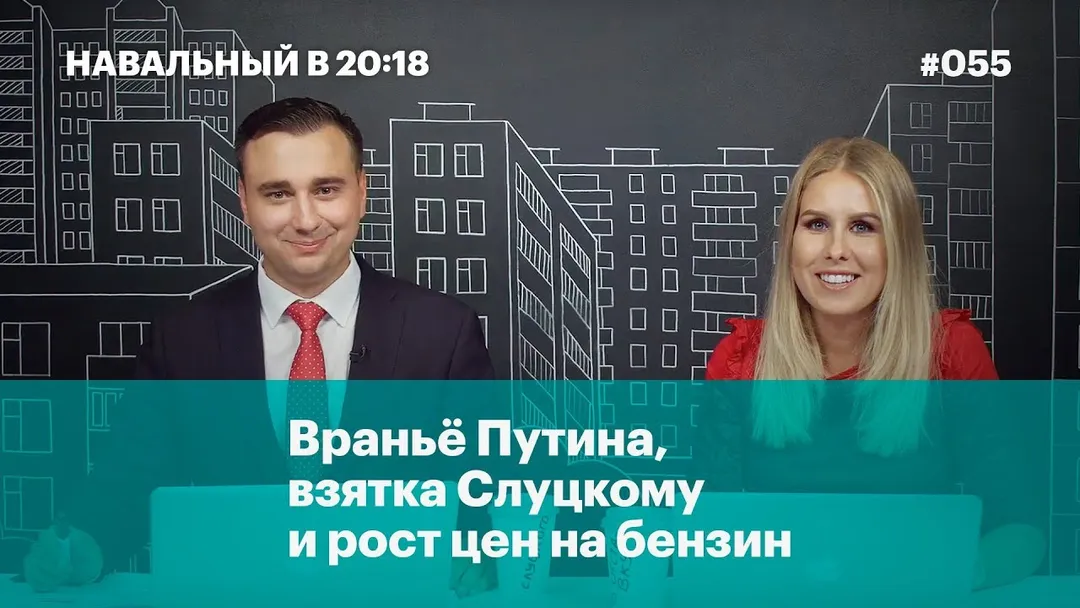
Putin’s Lies, a Bribe for Slutsky (Exclusive), and Rising Gas Prices
[music]
Hello, everyone. Today is Thursday, which means
the Navalny 2018 program is airing as
usual. In the studio are Lyubov Sobol
and Ivan Zhdanov.
We, uh, I think, I hope that the next time in this
studio it will be Alexei
Navalny, because he has only
seven days left to serve of his administrative arrest
sentence. So next Thursday, I
hope he will already be here in the studio
talking to you and telling you about
the most important events of the past
week. This week there was,
I think, actually, that Alexei
will probably spend half an hour telling stories from
the special detention center (a facility for short-term administrative detention), where he is serving 30 days.
That is, of course, a very long time. And
special detention centers have fairly harsh
conditions for people serving
administrative arrest there. We very much
hope that both Alexei Navalny and
our other colleagues, and other
political prisoners who are currently
being held in places of detention,
will be released as soon as
possible. We are waiting very much, we hope, and we will
be glad to see Alexei Navalny
free.
It seems to me that after the number of books
Alexei Navalny has read
while serving administrative arrest, he
will come out a sage and will simply enlighten all of us
with his wisdom, just
radiating it over everyone.
And
it will conquer everything. But today,
obviously, the topic everyone was still
discussing was Putin’s interview and
his live call-in show. On Twitter, this topic somehow
was not as prominent as usual; it was
clear that this theme really is, well, an opera
that has already been lost for the twentieth time and does not
generate any excitement. And those
glassy, affected poses of the people
asking questions were discussed
less, but it was still somehow
noticeable. Did you watch today’s
broadcast?
Well, not really noticeable, actually.
I opened my Twitter feed today,
and everyone was once again discussing Vladimir Putin’s
Direct Line (the annual televised call-in show with the Russian president). And I was like,
here we go again, the same old tune. I just immediately
put my phone away. I thought, no, I need
to work, because this is just
unbearable by now. I’m sick of the same
questions, the same repetitive answers. And year
after year we hear the same thing on
Russian television screens about how
our economy is going to grow, how our
foreign partners are unfairly restricting us,
how Vladimir Putin is heroically defending
the interests of the citizens of our country. And honestly,
this is no longer interesting to me,
because probably the main
intrigue of the day was how many
minutes late Vladimir Putin would be
for his Direct Line—or whether he would be late at all.
Everything else simply has no
significance, because words—of course, he
knows how to crack a joke,
answer a question somehow, say something
pleasant to someone, I don’t know—but behind
these words that he says year
after year, no actions, unfortunately,
follow. It was hard to expect,
and naive to expect, that during
his Direct Line he would announce
some serious reform, that he would
make some serious statements
that he had not made before.
Naturally, it was all exactly the same,
in exactly the same phrases. I think that
if Dissernet (a Russian anti-plagiarism watchdog) analyzes it,
there will clearly be a lot of plagiarism from
his other speeches. And Vladimir Putin—
listen, weren’t you surprised by the number of these
bootlickers who appeared on the broadcast? I mean,
seriously, Gazzaev, instead of
asking a question, thanked him
ten times, and in some kind of
subservient tone he fawned over him and
in the end didn’t ask a question. There was just
a ton of that over those four hours,
really.
Well, forgive me, but that happens on every
Direct Line. There has simply never
been anything else there. And about Gazzaev, I even
saw that people counted that in his
remarks, when he was supposed to ask
some kind of question, he could have asked
many questions about Russian
football, probably, because the whole country right now—well,
all
the people who follow Russian
footballers, it seems to me, now have
a lot of questions for our national team,
the team’s management, and the country’s sports
leadership about what on earth
is going on. Why didn’t we beat
Turkey? How are we going to perform at the
World Cup?
Why are there no changes, and so on.
But what did Gazzaev do? I saw this
statistic: he said “thank you” to Vladimir
Putin five times. Three times he wished him
good health. And zero times did he ask him
any specific question. And today journalists
called me a lot and
asked me too: What question would you
ask Vladimir Putin, Lyubov?
Do you have a question?
And I answered honestly that I
have no questions for Vladimir Putin. I
have only demands: to comply with the
Constitution and to leave, to resign,
to step down from his post, because, uh, Putin
He is no tsar to us, and I have no questions for him. In fact,
it seems to me there is also this
myth that you can probably ask some
complicated, tricky question to
Vladimir Putin and that he will suddenly
understand what is happening in the country.
Vladimir Putin already
the surname Navalny—say the surname
Navalny.
Vladimir Putin already understands perfectly well
what is happening in our country. He created this
situation both in the economy and in politics
with his own hands, right? That is, he—
all the levers of governing the country lead
directly to his office. We have no
decentralization of power. Vladimir Putin
does whatever he wants in this country.
So I have no myths or
illusions—he understands everything
perfectly well himself, and no questions will throw him
off balance, because he knows perfectly well
what is going on here. So I have no
questions for Vladimir Putin. What I do
have is a demand that he obey
the Constitution and resign, leave
this post, and ensure a real turnover
of power in our country, real
political competition, and real
reforms that our homeland needs.
I completely agree. And a vivid example
of the fact that Putin understands the whole
situation perfectly well—many people say,
"Maybe Vladimir Vladimirovich
is not aware of what is happening to the country,
how many people are being persecuted, how many are being jailed
for likes, reposts, and retweets." And
today one indication is that he himself
said he had been closely following
the situation on Telegram. He knows perfectly well
that people are being jailed for likes,
reposts. And there is no need for these extra
illusions that he is somehow unaware and
doesn’t know something. He knows everything
perfectly well. And this call-in show (Putin’s annual televised Q&A)
shows that it is a cold,
cynical performance, a cold
spectacle. He has not gone mad yet, unfortunately.
Well, or fortunately—I
don’t know. If he had gone mad,
maybe it would be even worse. But we can
say after this interview that he is still
perfectly, cynically on top of everything
that is going on, and what is happening is
his handiwork. And there is no need to indulge the illusion
that he is unaware of certain situations. And
the more significant event this week, of course,
was his interview with the Austrian
channel ORF. That interview, of course,
showed his mastery of how to
wriggle out of things
and dissemble and lie. He is very good at
shifting questions to the topic that is
advantageous to him. He is very good at answering
questions about domestic policy by turning
everything into international politics. Did you
read that interview? It was simply
a landmark event that happened
on
I completely agree. And in fact,
I would advise no one to watch the call-in show
if you missed it. You really
didn’t miss anything at all.
Nothing original, nothing new.
Just utterly crude, brazen lies
pouring today from the screens into the ears
of our fellow citizens. But this interview,
which my colleague Ivan just mentioned,
the one Putin gave when he came to
Vienna to extend Gazprom’s contract
for gas supplies to Europe—this
interview is quite significant, because
I can’t even remember the last time
Vladimir Putin was asked so many
substantive uncomfortable questions, questions
about Russia’s domestic policy and
Russia’s foreign policy, about his
election campaign, about the opposition in
Russia. And these questions were really
you know, as people say on YouTube,
a battle of facts. In other words, very important and
very well-formulated questions were asked by
a foreign journalist. And I was
very interested to hear what answers
Vladimir Putin would give to them, because
on Russian television, unfortunately, no one
asks him questions like that.
He didn’t just ask questions—he
pressed them. He asks a question,
sees Putin dodging it, and then
pushes again on the same topic. He says:
"No, answer the question: were there
little green men there? Did you lie or not lie
when you talked about the little green men in
Crimea?" And he kept pressing. It was really
excellent. Really. And remember how Peskov
gave some interview? How in an
interview, I think with the BBC, he was directly
twisting and turning, and they kept pressing him. And
when a journalist is not just
obsequious,
and we all watch not only these call-in shows,
but also remember how he meets with
journalists, and there one question is like
something a journalist is lucky to snatch
for themselves, asks it, and that’s it—they
can’t develop the topic any further. Well,
often 90% of it is, of course, the usual
nonsense, but there are 10% of somewhat normal questions
in there. Putin calmly dodges them, and
the subject goes no further. But people like that
need to be pressed and shown
to be lying. And that is the clearest
indicator.
Vladimir Putin always avoids
such questions. That is why he gives so
few interviews to foreign
journalists, because his favorite
formats are press conferences and live
line. Precisely because it’s impossible there
to ask a probing question. You simply can’t
ask a follow-up to that question,
catch him in a lie, because at a
press conference, a Russian journalist
stands up, asks a question, and then Putin
answers. If he lies straight to the faces of
the viewers and that journalist, then
the journalist can’t continue anymore,
because the microphone has already been passed
to someone else. And Putin
really likes formats like that, where he can
answer and remain the king of the situation.
But in an interview, which he
very rarely gives to real journalists, he
doesn’t like them precisely because he
can be caught in those lies, he can be
pressed on that situation.
Naturally, I both read and watched this
interview. I read it first, then
I was curious what it looked like. And
if in text form I still read it with some
degree of calm, then when I
watched a smiling, laughing
Putin talking about the downed
Boeing, talking around the issue,
hypocritically dodging those questions,
disgustingly lying straight to people’s faces, I—I
was honestly furious.
He even switched into German there
and was practically shouting “Scheiße, Scheiße”
or something like that. Yes, he, he really
was really trying to look like the master
of the situation, getting ahead with various
questions, answering with questions of his own,
counterattacking, and so on. It looked
disgusting, because that
hypocrisy and lying were simply
completely out in the open. And I could clearly see even
people who, you know, people whom
probably nothing affects anymore and
who already understand perfectly well everything about
Russian reality, about our
authorities, and who are already used to this
coming from television screens and from our
authorities—even they found this interview
to be some kind of peak of hypocrisy. And
even they were not left indifferent by it.
To speak more specifically, I
would first of all advise everyone to watch and
or read this interview, because
then you will simply form a final
picture of the Russian
president. Of course, not a word of it
was true, because you could
go through it for a very long time. Literally,
every single answer to every question—I have it
printed out here—this interview could simply
be read aloud, and then probably
we wouldn’t finish the program at 21:18, but
sometime much later. They asked before the broadcast
to print it out because, well, it’s worth
dwelling on some moments. What
caught your attention? A lot of things caught mine.
But first of all, of course, the question
he was asked, one of the first ones—
it was about Prigozhin, where he is asked about
Prigozhin, Putin’s “cook,” a close
trusted associate of his, who,
of course, is now involved in Syria,
and Defense Ministry contracts, and
state tenders, and takes part in hacking
attacks
abroad, trying to influence elections and
the politics of other countries, and so on, and so
forth. And when he is asked about this
Prigozhin story, what does Putin answer?
That Prigozhin is a private individual, even if he receives
state contracts and state orders. Let’s look at what Putin
literally says right there. “Do you
really think that a person
who is in the restaurant
business even has some kind of hacking
capabilities, has some private
company, and from that position can influence
elections in the United States? What do you
think?”
Well, of course, you can answer a question with a question.
Naturally, if we say,
“Well, let’s look at this
man—he’s a restaurateur, an independent
person who has nothing to do
with the politics of the Russian state.” If
someone has just arrived from Mars
and hasn’t been in our country for the last five years,
then maybe they’ll believe
Vladimir Putin. But as someone who has
spent years investigating the illegal
activities
of Yevgeny, Yevgeny Prigozhin over the course of
the last several years, I can
say that a closer and more
trusted person to Vladimir Putin
would probably be hard to find right now. There are,
probably, very few people whom
Putin trusts that much, and he entrusts him
with anything but clean business—specifically
the dirty work. And Yevgeny Prigozhin
always carries it out. And he has received more than
200 billion rubles in state contracts over the last
several years—more than 200
billion rubles (about $3.2 billion USD at approximate historical rates). These are Defense Ministry contracts. For
the Defense Ministry, he does practically everything. He
builds—builds bases, services
military towns, supplies fuel,
supplies food, he provides
cleaning services for the Defense Ministry.
A man who is deeply embedded in
state contracts, who
is a trusted associate of the president.
Knowing the nature of people like that, I am absolutely
sure he sits there and just enjoys it,
you know, enjoying what a clever
joke they came up with—that he’s supposedly my cook,
and how convenient it is to say that. Well, well, he’s just
a cook. Even though he understands perfectly well that
it’s like in criminal gangs, you know—“the cook,”
“Yaponchik” (a famous Russian mob nickname), “Pasha Tsvetomu” (apparently another underworld-style nickname). It’s the same thing.
that's what they call him. That's how they identify themselves in these groups. And
I'm sure they're talking about the "cook" as well. And
I actually understand perfectly well that this is
a man who runs a private military
company, living off contracts from the
Ministry of Defense, a man who is, well, basically on the
payroll
of the presidential administration. And he, of course,
he is now,
yes, in direct contact with Volodin.
That was proven. It was, uh, the New
Times, I think, some newspaper or other, that directly
published phone records showing that
the frequency of calls between the PMC,
between, uh, Prigozhin and the presidential
administration, increased sharply during
the attack near Deir ez-Zor (in Syria), I'm afraid
I'll say it wrong now, but that frequency
rose dramatically. So this is
indirect evidence that
the man is directly commanding troops,
private military companies that
operate on Syrian territory, and
then says: "Ah, you know, he's just a restau-
a man in the restaurant
business. Well, how could he possibly influence
the U.S. elections?" And now these, these
people under his control are
right now artificially boosting
dislikes so that we won't
talk about this, but we are talking about it,
so like, retweet, and
share it around.
He really is Putin's cook
because he started out and entered
Vladimir Putin's inner circle precisely through
the kitchen, so to speak—the presidential
kitchen. He really did organize
banquets; he supplied catering for
the St. Petersburg International Economic Forum, he
was involved in those well-known episodes where he
walked up at the St. Petersburg Economic
Forum and personally brought Putin a dish and
uncovered it right there. That's described somewhere
in some publication. But the main thing is that
a man who started out by providing catering services
for the Presidential Property Management Department
and who organized birthday
parties, birthday catering,
is now in fact
a man involved in private
military companies, government contracts, and
more than that, a man who is not
any kind of official of the Russian
Federation, yet takes part in
Vladimir Putin's domestic and foreign policy
like probably no one else. And, uh,
naturally, he is not some kind of
private restaurateur, which,
of course, foreign journalists and
all Russian journalists who follow this, and
the public at large, naturally,
know. The restaurant business is a pretext and
a kind of cover for his shadow
activities.
Criminal activity—not shadowy,
criminal. This is criminal
activity: mercenarism. It's explicitly
written into the Criminal Code of the Russian
Federation, and it carries very long prison terms
under the Criminal Code.
So it's a very convenient cover,
which Vladimir
Vladimirovich, back when he was, as he likes
to say, working in the security services,
probably learned to use—these very cunning,
so to speak, maneuvers.
Let's move on, let's move on. We could probably talk about Prigozhin
for a long time. We had
several videos on the main channel,
uh, the one called Navalny. There
several videos are devoted to the activities of
Yevgeny Prigozhin, his illegal
activities, including those involving
government contracts. You can watch them
to refresh your memory. But what really,
to put it mildly, really rubbed me the wrong way
was the phrase saying that Putin
has never violated the Constitution
of the Russian Federation. Do you know what kind of
unanimous laughter and cackling broke out at the Anti-Corruption Foundation
after that phrase? Uh,
well, it seems to me that this is
well,
a phrase as cynical as it
could possibly be.
It's just that I almost feel
awkward even talking about it. I think
everyone understands perfectly well, starting with
public events and the right to
disseminate information. Again,
take the same example of Telegram—that is
a violation of the Constitution. Absolutely,
a direct violation of the Constitution. And the fact that
we effectively have no separation
of powers, that our legislative
and judicial branches have become one single
centralized authority, all of it
controlled from the presidential
administration—it's ridiculous to even discuss. You could take
literally every article
of the Constitution in order, starting from the very first ones,
starting with compliance with international
treaties, compliance with international legal
norms, and go on through every article
and say that here, everything is being violated—
absolutely everything: freedom of the press, censorship. Well,
I, I could mention
the independence of Russian courts. Good
Lord.
And also, since you mentioned freedom of
speech, there are also these wonderful lines about how
here in Russia, we supposedly have
an independent internet. Let's set aside the fact that
Putin has probably simply forgotten
all the laws he signed over
the last couple of years,
which impose incredible restrictions
on the internet. Right now, the VPN law has been passed in
its third reading, and we all remember
the Yarovaya law (a package of anti-terror legislation in Russia), and so on, and so
on. And he tells us that we have
a free internet, you know. Somewhere
Pavel Durov is probably crying.
And we have independent— no, he laughed. He
isn't crying; he's watching it all from above and
laughing about how he'll outplay everyone, because
for now, Durov is winning.
Durov's a legend. And hi, if he's
watching us right now. Ah, and independent
media. And it seems to me that you really have to
watch the video version of this
interview, because you need to look at
the face of the Austrian journalist to whom
Putin is telling all this about
Russia's independent media. It seems to me that
he just froze up at that moment and
didn't know what he could say in response or
how to answer.
Let's watch a short video
made by our colleagues at Meduza. How
to dodge questions properly—it's very
funny. Let's watch a short
clip.
Where do these close ties come from between
the Russian leadership and
political parties in the European Union that are critical of it?
You'd better ask, of course,
the head of the Russian government,
Mr. Medvedev, about that.
The so-called troll factories
belong to Yevgeny Prigozhin. He is
called Putin's chef. And he spends millions
of dollars on this troll
factory so they can produce these
posts. Why would a restaurateur need that?
Ask him. The Russian state
has no
you know him yourselves. So what? You know, I
know many people both in St. Petersburg and in
Moscow. Ask them.
You know, if you don't like my
answers, then don't ask
questions.
It's very funny, of course. How can you actually
turn this into what? Where—
how? No, what's it called?
Who Wants to Be a Millionaire?
Older people call it *The Lucky One*.
Ah, well, there were other funny moments
in that interview too, of course. Unfortunately, we
didn't include, didn't include
the answer to—ah, I think it was the last
question about Alexei Navalny. And where he was,
for the umpteenth time?
That was the last question. I've studied that interview very
carefully. I remember it
almost by heart—the last one was
a promo question about Putin's bare torso, and
Putin didn't answer that one either and also
dodged even that question. And one of the
important questions was, naturally, about
the opposition, about Alexei Navalny, and
why Vladimir Putin cannot
bring himself to say Navalny's surname out loud for
several years in a row now.
Saakashvili.
The answer is: Saakashvili. I don't know, maybe he
sees things, but as our friend
Alexei Alexeyevich Venediktov says, he has
a complete association between Alexei Navalny and
Saakashvili. Well, it's, you know, this kind of
totemic animal fear, when
if you say the enemy's name, the enemy
will devour you. That existed in many, many
tribes. You couldn't say the enemy's name. And
there was even a film about that—those, those, the ones
we do not name. There was a great
American film—haven't seen it? No,
it was a film where some kind of
wild beasts run around, around
a human settlement. And they don't say the names
of those beasts because they're afraid. And if
they say the name, then
the beasts will definitely come and eat them. The same
goes for Vladimir Putin. He simply
is afraid to say it because he thinks
that if he says Alexei
Navalny's name, well, I don't know, he'll have to
somehow—it's a form of legitimization, you know, in
Vladimir Vladimirovich's eyes. That's why he
is afraid. The journalist asks him directly, and he
compares it—very amusingly:
"Do you know how much I got in
the presidential election in Moscow?" The journalist
asks him: "But he got 27% in
the election in Moscow." And Putin replies: "And
how many people do you think voted for
me in Moscow in the last election?"
Look. Well, here the journalist, of course,
wasn't very prepared—probably more
than 27%.
But he makes an excellent point: it's just that
Navalny wasn't allowed to run
because of the laws that
were passed,
that Vladimir Vladi—Vladimir Putin passed. It's
very convenient, you know: I won't let him run, and
that way I get a higher percentage
of the vote.
The best part of the answer about Navalny
is that the journalist tells him: "You can't
say Navalny's surname—
say it." Vladimir Putin. And
Vladimir Putin spends five minutes answering that
question without saying the surname. It's
just spectacular. And then, of course, he
naturally says that Navalny
has no support, that supposedly only 1–2% of
people are ready to vote for him,
so there's no point in allowing him onto
the ballot. Well, first of all, that's a direct
contradiction of the constitution: even a person
who—well, no matter how much support
someone has, they still have the legal right
once they turn 35.
to run for president of our
country. And secondly, the talk about 1% is quite
ridiculous, because we know that in the
election they allowed Ksenia Sobchak to run, and she
received 1% of the vote. So why then
does that not apply to her? And why then does Vladimir Putin
according to his awful, unconstitutional,
illegal logic, think that
Navalny should not be allowed to run, while Ksenia
Sobchak can? Well, of course,
there were a lot of such contradictions in the interview.
And one more thing stood out to me.
We should probably start wrapping up
and move on to the next topics. But I cannot
help noting that Vladimir Putin,
of course, does not answer questions, and lately he
has recently been very fond of
publicly shifting
all this responsibility away from himself, redirecting all these
questions to someone
else. None of this is for me, none of this is
me. We have separation of powers. When he is
asked about United Russia,
the party that is, of course,
Vladimir Putin's party, which
is like an octopus that has wrapped itself around
the entire State Duma and the whole,
political system in our country,
it is a party of crooks and thieves. He says:
"Well, ask Medvedev, who
is its chairman." So that too is supposedly
not me; it's a private company, it's
the cook, it's Medvedev, it's anyone at all,
you know, I bear no responsibility. What kind of
position is that for the country's leadership? What kind of
position is that for a president, who
just tells you to go ask Masha or Vasya (generic Russian names meaning "someone else")?
And I am, you know, somehow somewhere else
entirely.
Well, of course, everyone understands perfectly well that
Dmitry Medvedev is not
an independent figure. He is not even the kind of
person who can appoint
the cabinet of ministers, because the cabinet
was obviously approved by the
president. First of all, that is how it works under
the law. And secondly, it was
obvious from the composition of the cabinet
of ministers, which clearly is no longer
in any way something you could even call
Medvedev's people, as, you know,
many Telegram channels say,
that there is some kind of Medvedev clan. There is no clan
around Medvedev. This is all Putin's doing.
The studio is telling us that all donations
now appearing on the screen—
donations of 2,018 rubles are being shown
on screen—will go toward paying fines for those detained on
May 5. We have fairly
large expenses: around 9 million rubles have been spent
on covering fines since March 26.
So these are expenses that, well,
still need to be reimbursed, because
I will never tire of repeating this: fines of
20,000 rubles, and now fines of 150,000, 250,000, and
300,000 rubles—these are impossible fines for
one person to bear, especially if this is
some poorer region. So this is
something around which we need to come together,
unite, and help people in a situation where they
go out and express their opinion
at entirely lawful rallies
that comply with the Constitution of the Russian
Federation, specifically Article 31 of the Constitution. One
for all and all for one. And here we are receiving
wonderful comments; we cannot
read them all in time, but I liked this one:
"Who Wants to Become
a Billionaire?" That was their comment on
that excellent video by Meduza, which they allowed us
to show—about Vekselberg and all his
associates.
And Vladimir Vladimirovich Putin. Let's
move on to the next topic. It is no less
important. Today a video came out on
the main Navalny channel, where our
colleague's work is being discussed even more than this
call-in show, and certainly is 100% far
more interesting,
much more interesting and important. It is
a video investigation by our colleague
Georgy Alburov and the investigations department
about a bribe in the form of a penthouse to deputy
Slutsky.
Let's watch the video of this penthouse,
if we have it ready. We can
play a short excerpt.
We are in western Moscow, right next to
Kutuzovsky Prospekt. There is so much greenery here
that you might think
we had ended up in a forest. But this is a specially protected
natural park, the Setun River Valley. Its
area is 700 hectares (7 square kilometers). Let's fly closer.
The huge buildings in front of us are the residential
complex Kutuzovskaya Riviera. It was
built by Sergei Polonsky. Here we
found the very penthouse that, as Polonsky himself claims,
Polonsky used to give
a bribe to Slutsky. The entire building here has
thirty floors. The penthouses occupy
the top three. They are easy to spot by their
panoramic windows. On each of these
floors there are four apartments. Slutsky took
all three stacked one above the other and
combined them into a grand three-story penthouse
with an official area of 561
square meters.
What is this?
You have just watched a short excerpt
from the video on the main channel. If you have not yet
watched the full video, we urge
you to do so right after our
broadcast. You will enjoy it.
It is only 7 minutes long and tells the story
of the bribe that businessman
Polonsky gave to deputy Slutsky. And as for
deputy Slutsky, we have already made a video about him,
where we talked about how and what
the crimes he is committing and why he
must be immediately sent into
resignation. If you can see our
cups, they say exactly the same
thing here: Slutsky must resign. In
fact, there just wasn’t enough room on the cup
to add “and into the dock,”
because the actions that
Slutsky is committing are not only
immoral, they are also a violation of
our country’s criminal law. This is not
just a story about a bribe; it is
a story about the face of an official. It is about
a kind of composite image of the official
who has now taken up residence in power here
and is shaping both our legislative framework
and, in effect, governing, making
socially important decisions. This is a story
about an official who drives in the
oncoming lane, does not pay fines, and
accumulates more than 700 fines. This is
a story about someone who harasses
journalists and thinks that this is
normal, who can laugh about it with
fellow lawmakers and simply
say: “I’ll keep doing it—give me another
little journalist.” That’s how they
message each other on Facebook, that’s how they
talk about it. This is a story about
a lawmaker who clearly does not match
his income, clearly does not match the
luxurious lifestyle in which he
lives. These are penthouses, foreign
real estate, this is
the purchase of a Maybach and a Bentley, whose
cost exceeds by several times his
official income over several years,
which he definitely could not have afforded.
We’re not, not
this is an undeclared Lexus that
he drives, and in the photograph with
it—that photo with the Lexus—
it spread all over the internet when
there was the scandal, and when
Leonid Slutsky’s harassment of
female journalists was being widely discussed, and this
no, this car was not
declared, which we also talk about in
this video. We have plenty of lawmakers like that. We
have done investigations into them. And it would be
strange to do an investigation into
some lawmaker who simply
failed to declare property. There are plenty of them. But
this is simply a composite image of the
most disgusting, most vile
official, a petty bureaucrat-lawmaker, someone who
is simply revolting even to look at
at all. This composite image of this
lawmaker is a composite image of our
government. Just look at him, take
his photographs, look. This is what
our government looks like. It does not
look like some smart
intellectual faces—you might also mention
people like German Gref or Alexei
Kudrin. They are, after all, intellectuals.
Our government is like this. And the officials
making decisions are not Kudrin and
Gref, but precisely lawmakers like this.
People like Prikhodko, like this
guy here. What you’re saying is absolutely right,
because this is not the exception; it is
the rule. And the system, as we can see, does not
give up its own, because in this system
everyone is exactly the same kind of person, sitting
everywhere alongside Slutsky, passing laws
for our country. They are completely
the same. They are just as corrupt
as he is. They are just as immoral
as he is. And that is why they do not turn him in.
They did not even issue the most basic
reprimand to Leonid Slutsky for the
criminal offenses he
is committing, for the bribes he
is taking. And again, that penthouse is
a 400 million ruble bribe (about US$6 million at the time). Why do we know
it is a bribe? Because the person who
gave that bribe officially and
publicly—not officially, but publicly—
said so himself. And that was Sergei
Polonsky, the businessman. And we obtained
an interview, a brief comment, from
a representative
of Polonsky about this situation, because
we were interested in whether there had been any
official actions on the part of our
law enforcement agencies after
Polonsky stated that he had given
a bribe to a lawmaker.
Please play it. Well, this story
was covered quite
widely when Polonsky was on trial,
and at the time he filed a statement, and he
submitted it both to the prosecutor involved in the case
and, accordingly, sent it
to law enforcement agencies. And yes, he
did make such statements.
I do not know whether he gave a bribe, because
we did not know him at that time. I
can tell you that he made such
statements at the time, filed the relevant
reports with law enforcement agencies, and
made a statement in front of TV cameras
in the courtroom. This was widely
reported. Yes, that did happen.
The statement was addressed to the Prosecutor General’s Office
of Russia. The Prosecutor General’s Office
forwarded it to the central office of the Interior Ministry.
The statement. The central office of the Interior Ministry
passed it down the chain. And the last
thing
that came to us—to the lawyers and to Polonsky, in fact—
the last trace was that this
statement had reached the police directorate for the
South-Western Administrative District
of Moscow. And from there
from there, uh, no one even came to question Polonsky
about the matter raised in the complaint.
the complaint. In other words, it got lost.
The last trace we have is
the Internal Affairs Directorate for the South-Western Administrative
District. After that, the story developed in such a way
that, essentially, with the whole sordid mess
around Polonsky, what happened happened.
So. And in that connection, we didn’t really pursue it any further.
We have received no replies from the Internal Affairs Directorate,
of the South-Western Administrative District
at all. We only know that they conducted no
inquiry, because,
well, as we see it, if an inquiry
had been conducted, the first thing
they should have done was question
Polonsky. No one questioned Polonsky.
No one interviewed him.
Well, of course, we understand that
Polonsky is also an odious and
highly dubious figure, but what he is saying
in this situation deserves
at the very least to be checked. And
the law enforcement authorities refused
to verify this information. But this is not a job for just one
lawyer. Clearly, this requires
a whole team of lawyers. I think
the legal team of the Anti-Corruption Foundation
will file a complaint tomorrow regarding
these facts: bribery,
unjust enrichment
by deputy Slutsky, because his income
clearly appears to be of illegal origin, as well as
failures to declare assets. We have already
filed complaints before, and as you could see from
the video, he was forced to declare
a forest plot of land
directly adjoining his house,
which he had simply seized. On these
grounds, and regarding the still undeclared
car as well, we are filing complaints and submitting
a complaint to the law enforcement authorities, and
we will even file a complaint against that—what’s her name—
Poklonskaya, who obviously does not know
the law. And of course, Zhora
gave her an excellent lesson today.
An excellent lesson. And under the very same
law for which she somehow even managed
to vote for amendments to
this law on the procedure for maintaining the Unified
State Register of Rights to
Real Estate. That’s it. Today Zhora
demonstrated it perfectly. Use
the internet, Natasha. It’s convenient and quite
simple. You put it correctly,
Poklonskaya—what’s her name—because actually,
it seems to me that Poklonskaya’s name
only comes to mind, uh,
for everyone only when the subject is
some news connected with the name
of Nicholas II (the last Russian tsar). Because for some reason we never see any statements from her
about corruption crimes
committed by officials and deputies.
And in the media, all that flashes by is
a headline about whom she quarreled with and what she
said about the Romanov family. It’s
Ward No. 6 (a Russian expression meaning sheer madness). That’s obvious, by the way.
The Investigative Committee. Before going on air, I managed
to speak with the team, and we received
a letter. She had filed a complaint against us
with the Investigative Committee, claiming that we
were obtaining information illegally somewhere.
The Investigative Committee even refused
to consider her complaint and forwarded
it somewhere else. So
that’s how even the Investigative Committee treats her.
That’s their attitude toward her.
And I wanted to say very briefly,
because this story probably doesn’t deserve any more
time, about the parliamentarism forum.
I’m sure none of our
listeners—not Vanya, not anyone else among our
audience—has probably even heard of it.
But if you read the transcripts
of the State Duma sessions,
you can see that a parliamentarism forum was held recently
and that Russian parliamentarians took part in it, along with parliamentarians
from other countries.
They all gathered there. And you think to yourself:
what exactly were they discussing there?
I think it would have been better if they had just recited tongue twisters about
parliamentarians discussing
parliamentarism in parliament.
Unfortunately, they were discussing
not tongue twisters—because that would have been
better. There, with particular cynicism and with
those grave, self-important expressions on their faces,
they discussed freedom of speech and the fight against
fake news. And do you know who was there?
There was a deputy there,
who said that if
you find out who shot down the Boeing,
will that make you feel any better—that was the quote. Volodin was there too,
the well-known champion of freedom
of speech. And Leonid Slutsky was there too, the one
we were just talking about. These are the people
who represent Russia and lecture others, with
those solemn faces, about how freedom of speech
should be upheld in Russia.
It’s the height of cynicism and brazen arrogance. And,
of course, they should all be kicked out. They all ought
to be put in the dock and tried
by an honest court, because simply
these are people who are not merely unfit
to pontificate from high podiums about any kind of
morality—these are people who ought
to be tried for their crimes.
As the author says, effectively: M-m-m, fake
news. Bad, bad, very bad. Shall we move on,
perhaps, to the next topic—gasoline? Yes,
it’s a very important topic, and naturally
we want to discuss it.
Maybe let’s answer a couple of
questions, since they’re coming in fast.
For example, I’ve seen many times people asking about
Prokhorov’s lawsuit for the protection of honor and dignity.
Today was the first
hearing. Judge Vasina—the same one
who heard Usmanov’s lawsuit over
the film *He Is Not Dimon to You*—and she is very
quickly, within five minutes, postponed it, not
postponed it, but scheduled the main
hearing for the twenty-sixth at
10:00 a.m. So that’s another topic as well.
We invite everyone. It’s an interesting case,
because in this instance we have
we don’t even need to call any
witnesses. We have all the
evidence, all the contracts, which we will
present to the court. It will be amusing to see how they
will try not to accept this
evidence. And Slutsky was developing
economic zones. No need to send
questions like that. The approximate cost
of the apartment is 1 billion rubles (about US$11 million). I think it was
worth around 500 million (about US$5.5 million).
Not 400 million rubles. Again, we refer you to
watch the video. But let’s move on,
because the next topic is very important,
and I think it concerns everyone
who uses transportation in Russia.
It’s the issue of rising gasoline prices. On the
main channel, a video by Vladimir
Milov was released, in which he explains simply and
shows, with excellent charts,
the rise in gasoline prices and explains why
it happened.
What’s striking about this chart is that the increase
in gasoline prices from January to March was effectively
at the same level. What do we remember happened
in March? The presidential election. And,
of course, before the presidential election
you can’t upset people. That’s not the right chart.
Before the presidential election—or is that the
right chart, sorry, studio. Before
the presidential election, you can’t upset
the Russian people. Otherwise they might not vote
the way you want. But now, just
look, you can see the point where the price shot
up—that’s March. The election is over, so
now they can raise it as much as they like. And as I
understand it, Milov said in his video that
there would be an official appeal to the authorities
regarding violations of competition
law, to the antimonopoly service.
What do you say to that? I’d probably
say that he was absolutely right, and
as for why this increase
in gasoline prices, which has now
really affected everyone
even people who were far removed from
politics, because it directly hits
not only motorists in the wallet, but
also people who, in general,
buy groceries, because
food is transported to stores, to
the stores by vehicles, and those vehicles also
run on gasoline. If the price of gasoline has gone up,
then accordingly even
the products you simply buy at
the store will also be affected by that
as well. I’ve heard people say, “Oh, great,
I don’t drive, so this won’t
affect me.” It definitely will.
And he explains what the main reason is. And
the main reason—a small spoiler before
the video, if you haven’t watched it yet,
although it was very popular and now,
I think, already has around 2 million views—is
that this is happening because of collusion among
companies that have monopolistically taken over
this market in Russia. This is an entirely
man-made problem. This is happening,
of course, because of many different factors,
yes, because of excise taxes, because of
the economic situation, and so on, and
so forth. But the main factor is
the monopoly that has been organized
by these companies. And it is the desire of these
companies and their management, in
particular Igor Ivanovich Sechin,
the head of Rosneft, to enrich themselves at the
expense of people who buy and spend
their money, including on
gasoline. That is the specific reason behind this
story. And in fact, I was following the
antimonopoly service, because it
in this situation sort of played
on the side of good, because it doesn’t
always do that, but in this
case it issued an order to
Rosneft to increase fuel supplies
to the Russian market in order to
bring these prices down. And what
was the response? I was interested in what action
Rosneft would take in response to this order from the Federal Antimonopoly Service. And
we saw the answer today, because
it became known today—I read about it
in an article in *Vedomosti*—that several
companies, including Transneft and several others,
they submitted, they wrote a letter
to the government asking that the FAS
the antimonopoly service be stripped of its powers
over tariff regulation and that they be transferred
to the Ministry of Economic Development. The FAS and
the Ministry of Economic Development have always been
antagonists within the government; they have always
been dividing powers. And here they decided
to take revenge on the antimonopoly service,
apparently for that order. And they
decided, “Now we’re going to take away
your powers over tariff regulation.” And
instead of actually
complying with this order—which is entirely
the right thing—instead of
actually working to ensure that
these gasoline prices do not keep rising but remain
reasonable, so that the population can afford
them—and this can be done, as
Vladimir Milov says—they instead begin
taking revenge through this kind of behind-the-scenes
infighting. I don’t know, it seems to me you’ve been
in politics for a long time, but to me this is just
a revealing example. Look at how they
reacted. Well, first of all, we’ve had
the first protests across Russia
connected to gasoline prices. And the very first
reaction was—I open the business newspapers,
the government will freeze gasoline prices,
the government will freeze the increase in
excise taxes, and the Federal Antimonopoly
Service has issued a certain number of orders.
This is a campaign they have become very good at
running whenever they need to tamp down, uh,
this kind of public outrage. Then
A Just Russia (a Russian political party) introduces a bill,
saying, why don’t we abolish the vehicle tax
instead of, uh, and the vehicle tax
will be shifted into the excise tax. And let me
remind you that the vehicle tax
was supposedly already covered when excise taxes were raised long ago, justified by
the promise of abolishing the vehicle tax, but
the vehicle tax was never abolished. So
there will be plenty of these piecemeal measures, especially
media publications, in order to make sure
that people, above all, stop discussing this issue. And, of course,
that they do not go to protest rallies.
It is good that even something as demonstrative as this
thing
is being done by the Federal Antimonopoly
Service. They still somehow have to
respond to this. But this is already one of those
jar-of-spiders situations, where they are all there
still trying to tear each other apart over this issue
and devour one another. That is normal.
It is clear. It is clear that they have now announced
that prices will be frozen, but
it is obvious that you cannot keep the cat in
the bag. It will jump out anyway, and
these prices will keep rising anyway, because
the underlying causes of the situation have not
changed in any way. That is, the reasons I
just, uh, mentioned to you
a moment ago — the monopoly, the fact that
there is, uh, embezzlement of funds from
state-owned companies, the fact that there is, uh, not
honest earning but corrupt profiteering, and that money,
including in this area, on this very issue,
will not stop — and therefore prices,
naturally, will rise. If not
tomorrow, then certainly in the near term.
Unfortunately, this will hit all of
us.
Right. One of our listeners asks: "Why
didn’t the government freeze
gasoline prices earlier? They go up like crazy
every year. Dmitry, well, they froze them until
the presidential election, when you were still needed
— when, conditionally speaking, you were still
needed to come to the polling
station, because turnout was exactly what mattered in
that election. But now they do not need
anyone anymore, so now they can raise them. This,
by the way, perfectly proves that
the government and the president are perfectly capable of
controlling gasoline prices and perfectly capable of
keeping those prices from rising.
Everything that is happening now, uh,
all of this increase is the result of
the fact, really, that the government
approved these price hikes for them.
Rosneft does not act in isolation. And,
by the way, Putin said today during his Direct Line call-in show
that they had in effect managed to nationalize Rosneft, and yet
Rosneft
still somehow manages to tell
the Federal Antimonopoly Service to go
take a hike and calmly raise
gasoline prices. As for Rosneft,
we could probably talk about it for a long time,
because there is, of course, no
real nationalization here, not even close. It is simply
just
a company that belongs to Igor Sechin,
who runs it not like a hired
manager but as if it were his personal, I don’t know,
property, with which he can do whatever he wants,
including buying
cornices for 80,000 rubles (about US$850).
Well, Rosneft’s setup is remarkable; this really is something
one could talk about
endlessly — the structure of Rosneft.
Rosneft is not just one company. There
are shell entities between Rosneft
the parent company and Rosneft
the operating company. One really could
devote an entire program to this. I think
maybe Vladimir Milov or I will someday
tell you all about it in detail.
Let’s move on and discuss the retirement
age, because this is a topic that
directly concerns Ivan and me, uh,
though we are not that old,
wait, millennials, because
the Central Bank has identified millennials as a
threat to the pension system.
Aren’t those the people born in 2000?
That is what I thought too. Well, if you believe
the Central Bank and the media outlets that
are citing the Central Bank’s report,
it is talking about Generation Y. Rea— it is about
Generation Y, that is, people who
were born between 1980 and 2000.
Naturally,
the pension system,
pension reform, and raising the
retirement age are being discussed very actively
because it was already clear to everyone
even before the presidential election, and for quite
some time now, that there are major
problems there, that there is not enough money to pay pensions,
that, uh, this is
Wait, how can there not be enough? Let us
take a look. There are wonderful — just look at
the palaces the Pension Fund has. There cannot
possibly be too little money. There is plenty
of money there. Can we put up a photo?
We will see it now. This is probably
the photo. There. Yes. Why even need photos?
You can all easily find your local
district Pension Fund office and
see that it will be one of the most
well-kept buildings, one of the most
luxurious buildings, where everything is
beautifully provided for. So there is a hell of a lot of money in
the Pension Fund. By the way, I have been
literally the day before yesterday at the Pension Fund.
It’s a disgusting way to treat people.
So I went there as an individual
entrepreneur, and the Soviet Union is genuinely
still alive there. The building is beautiful, but
they send you running around for every single piece of paper,
and they basically tell you to get lost. So I already
switched to a different language—a different language
of complaints. Because it’s impossible
to talk to them. I can imagine how they
talk to pensioners.
I can talk to them as a
lawyer, but pensioners can’t. It’s simply
disgusting. Do we have photos of the
buildings? No. As for
inefficiency, and the way
they talk to people—actually,
there really is quite a lot of money, but
it gets spent on maintaining this very
pension system itself. We have an inflated
staff, with employees who
deal with bureaucracy, who
perform their duties inefficiently,
things that could have been automated
are done manually. And the Pension Fund’s expenses
again go toward these
luxurious buildings.
6% of the
money they receive, including the money
you pay in insurance contributions
or that your employer pays on your behalf,
which have a huge impact on
your salary—well, 6% of that whole
sum goes toward maintaining
the Pension Fund. These buildings,
these now supposedly beautiful
cars, and so on. Right. But as for
what’s happening now, naturally,
they’re discussing raising the
retirement age. And, uh,
the Central Bank released a report in
which its analysts said
that the current generation is not inclined toward
saving and prefers to invest
its spare money in gaining
quality experiences. So,
it turns out—who is to blame for everything? The people
who invest their money
in experiences, who aren’t inclined toward
saving, who
rely only on themselves, as it says in this
report. It’s a fairly astonishing,
cynical thing, because it seemed to me
that anyone could be to blame for the fact
that the pension system is in bad shape. But surely
not me, because I, as a
law-abiding citizen, pay
all the contributions—or rather, my employer pays them
all from my official declared salary
on my behalf. And now, it turns out,
Ivan and I are to blame for the fact that there isn’t enough money
in the country.
Even though we paid quite a lot into this
Pension Fund. In fact,
back when I was still running my own,
private practice, before I worked
at the Anti-Corruption Foundation, I would just
look at the sums going into
the Pension Fund, and it made me very
sad. I could see that this money would never
actually go where it was supposed to. And besides, the funded part
is about to be scrapped now. There will be no
funded part. Remember how wonderfully they used to
advertise it—how you were funding your own
funded pension account? Soon it,
literally, won’t exist. And by the way,
the report Lyubov mentioned is
excellent. Anyone who wants to understand this
in a bit more detail—the Central Bank report
is still only a draft report,
but as we know, in drafts the most
interesting things, which may not make it into
the final version, are often there. It contains
several charts. You can take a look
and put on screen, for example, the development of the financial
market.
And look there at what places we occupy
in terms of investment
attractiveness, in particular. Right now I
can’t see that specific
chart there directly, uh
Russia is in 83rd place out of
90 countries. What country is there?
Malaysia.
Malaysia is in last place, I think.
Well, that’s awkward. I think the viewers
can see the chart on the screen themselves. Again,
you can see: one indicator is in 137th place, and Russia is in
107th place. That’s the development of the financial
market. And look, here there are specific rankings for
the development of financial
services—110th place; ease of obtaining
credit—112th place; regulation of
stock exchanges—121st place. And we keep saying
that everything is wonderful in
our economy. Come on, guys, it’s enough
just to look at this report and, uh,
examine it carefully. So,
let’s move on to the next topic, probably about
pensions.
Well, again, yes, we could probably talk about pensions
for a long time. And again, unfortunately,
they’re going to tighten the screws now
and try to find ways out of
this situation that are completely the wrong ones,
terrible ones,
like raising the retirement age, even though
it’s obvious that what’s needed is reform—
reforming this whole system.
You have to start elsewhere: by reducing
the Pension Fund’s expenses,
reviewing and improving the efficiency of
the management of pension savings, by
stopping the stealing, stopping
the commission of corrupt
crimes. And then, probably,
there would be money. Putin, as I recall, was the one who
said he was against raising it.
the retirement age.
We even have a video clip. And this is,
I think, if I'm not mistaken, a live call-in show
with Vladimir Putin from 2005, where he
talks about—well, what exactly he says
there, you should probably see for yourselves,
you'll see everything in a moment.
At the same time, I want to draw your
attention to this circumstance. I am against
raising
uh, the retirement age, and as long as I am
president, no such decision will be
made. I generally believe that we have no
need to raise the age for going
into retirement. We need to encourage people
who believe that after reaching
working
retirement age, they can
continue working if their
health allows it. That is what should be encouraged—
creating economic conditions
that make people interested in continuing
their working lives, but without infringing on their
pension rights.
I will repeat once again: I am against raising
the retirement age for both men
and women.
Well, there it is again—another lie, an entirely
unsurprising lie from Vladimir Putin,
when he said in 2005 that under
his leadership, raising the retirement age
would never happen as long as he was president.
And now only some
13 years have passed, and Vladimir Putin is president again.
And now it is already being discussed as
something entirely real. In childhood,
they teach you that lying is wrong. Well, apparently he was never taught that,
so he lies and keeps on lying.
Maybe let's talk about what I wanted
to say on our front—but is it even our
front at all? Let's talk about what
is happening more broadly on the party front. This
week, unexpectedly for everyone—or at least
for many people—they announced, first of all, the
Moscow mayoral election. And in this election—why
was it unexpected? Because, well, according to the plan, it
was supposed to be announced a little later, but
nevertheless, within the legal timeframe, on Saturday
they announced the Moscow mayoral election. It is clear
that
that there are not many candidates, and the candidates
are now facing certain
obstacles. And right now United Russia
can effectively choose
its own opponent, because, as you may remember,
they introduced the so-called municipal filter,
under which a candidate needs, uh, more than 130
municipal deputies, who
must come from different districts, to
sign in support of a candidate in order
for that person to be allowed onto the ballot.
It is clear that in the current
situation only United Russia can make that happen, but
this filter is completely illegitimate, and they
can effectively choose
their own competitors. And those competitors are now
struggling to, uh, try
to get through at all, to try to become
a candidate. Although it is obvious that in any case
United Russia will be the one deciding. And this week
we also saw the party
Yabloko, which is still considered
a liberal party, an honest party, and
it was holding primaries. Lyuba and I, actually,
watched this with interest,
really.
Oh, oh-oh-oh. Vanya, speak for yourself,
because I was not watching it with much
interest.
Well then. And I was watching Sterligov,
who came out with a statement saying that
he too would run for mayor
of Moscow. And his platform consists of
giving every Muscovite
their own small farm in the Moscow region. Now that,
seems more interesting to me. Although, well,
everyone understands that it is probably a joke.
I was joking just now. Anyway, as for Yabloko,
of course I watched these
primaries. And they gave me nothing but disappointment,
shame, and embarrassment—those are the only feelings they
honestly stirred in me.
Yes, it really was interesting,
because the primary process itself
is excellent. It is the kind of
mechanism that can identify
the truly strongest, most genuine
candidate. It is the kind of mechanism that
should become standard. It's just that we all
perfectly understand how, uh,
the primaries held by
United Russia discredit the whole idea. But there are no real
primaries there. The person
whom state employees are told
to vote for is the one who gets through. And that is why
it was very interesting to watch. So here was
Yabloko. We have known this party for a long time, uh, and
have been watching it for a long time. Never mind that, for heaven's sake,
this is the same party
that filed a lawsuit against Navalny.
Although no, we have not forgotten. It is impossible to
forget that. Never mind that this is the party
that did not nominate Roizman for
unclear reasons. But in this situation,
yes, there seemed to be some kind of clear, honest
procedure, or so it seemed to us. And although
many people said—I spoke there with
people in these political circles—everyone
was saying, "No, they'll nominate Mitrokhin
anyway." And what happens?
On Monday, their second
round of voting ends, and the winner is, well, a
candidate not really known to many people,
Yakov Yakubovich, but nevertheless everyone sort of
chair of the municipal assembly in
Moscow,
in the Tverskoy District, if I'm not mistaken,
the Tverskoy District, right? Yes, and everyone,
probably watched this process.
Well, okay, fine, whatever.
Metrokhin, who probably, well,
really,
was actually glad, because
a new face had appeared in politics,
someone who didn't have a negative approval rating,
who, uh, is now already heading
the municipal council, who
was elected to that council in an election,
who made it through that barrier, uh,
and won, and is now working for the benefit
of the residents in his district. And I know him personally
because we've crossed paths,
during the rallies in central Moscow. I
remember that, uh, the municipal deputies
of the Tverskoy District really
helped. They came to the detained people
at the police stations, uh, and to the places where they were
being held in police vans, and they tried
to get in, because municipal
deputies have those powers,
they tried to pass them water and
so on. That is, they tried, uh, to do
something, I don't know, to help in some
way. I remember, uh, Yakubovich
very positively, as a person
who is honest, uh, and someone who
really stands by his principles, who
wants to work for the benefit of the residents of his
district.
Well, and then something wonderful happens. Well,
of course, you could talk about this with, with,
well, it's just a disappointment, of course
it is. As soon as Yakov Yakubovich announces
the winners of these primaries, he comes out with
a statement and says on camera that he
is withdrawing from the election, even though just
three hours earlier he had been standing outside the door of
the polling station urging everyone
to vote for him. And
what exactly happened, Vanya? Can you
tell me what happened in those three hours?
I read that article in *Vedomosti* that
you
I'm hinting at. Uh, the one I'm
referring to, because I urge everyone
who is interested in Moscow
politics, who wants to know what exactly
happened in the primary, to read the article
by journalist Mukhamedshina in *Vedomosti*. It
came out, I think, two or three days ago. And
it explains, uh, with references to
sources, with references to, uh, people
who are familiar with the situation, that
what really happened there. If
I briefly retell that article,
what happened was this: Grigory
Yavlinsky, according to the newspaper
*Vedomosti*, one of the country's largest business
newspapers, had gone, uh, he had gone
to meet with Sobyanin and discussed the issue
of nominating a candidate from the Yabloko party
for the Moscow mayoral election. And Sobyanin
said that no one would get through the municipal filter,
except Metrokhin. Yakubovich, uh,
would never get the votes of municipal deputies needed
to pass the municipal filter
in order to make it onto the ballot.
And so this article
really stirred me up. I even wrote
several tweets. And I'll tell you why.
Because what happened here was a public
accusation against the head and leader, yes,
that is, the informal leader. And
the main face of the Yabloko party, that he
coordinates a candidacy in the election in
the capital, uh, with a direct competitor, with
Sobyanin, a person who has
administrative resources; that he enters into
informal arrangements that
he does not disclose publicly, and coordinates
those candidacies there, discusses them. And for me,
of course, as a voter, as someone
who does care about who
will be the next mayor of our city, it would
be interesting to hear Grigory
Alexeyevich Yavlinsky's position on this,
for him to comment, because
when, as I remember, he was accused of, and
people said that he had gone to meet with
Putin,
among other things,
he responded, he commented
on it. But here
he said: "I don't comment on this." His
answer was: "I don't comment on this." He
at least in some way
reacted to the event, right? But now
a day has passed, or even, you know,
more time since the publication of that article,
and we hear no denials from
the leadership of the Yabloko party that
they coordinate their candidates
as an opposition party with the leadership
of the city of Moscow, with their direct
competitors and with the people who make
these elections unfair and unfree.
Not just the election, but even the primary itself. The very
procedure that democratic
forces have always adhered to. The
procedure that inspires trust. And
when we held democratic
primaries in Novosibirsk, Kaluga, and
Kostroma—Kaluga, Kostroma, Novosibirsk—
those were genuinely democratic
primaries, where everyone could
trust the process, could leave their
personal data knowing that this
data would not leak. But the parties we
trust—PARNAS (an opposition political party)—later had
personal data and email addresses leak
and spread all over
the internet. Yabloko, which is now
under the most obvious pressure, is removing
the candidate who won the primary.
Watching all this is not just
disgusting—it just makes you want to
trust in the primary process among
I want to say, in the words of one of our
colleagues: "Don't fall for it, just don't fall for
it." Well, you can see what
Sobchak in the elections is, what Yavlinsky
in the elections is, what the party
Yabloko is, and who these guys are.
Please don't fall for it. I'm not saying
that, uh, unity is in principle
impossible. Unity in itself,
yes, may be impossible, but at certain
specific points we can always
cooperate. We have to hold these
fair primaries, if, well, obviously,
certain forces support, say, the same
Yabloko, but to discredit
the primary mechanism and this
preliminary voting process like this is
simply disgusting. And please read
the excellent posts on this subject.
First of all, those by Vladimir Ashurkov and
Leonid Volkov, whose main point is,
all in all, they are interesting and
thoughtful, but the essence comes down to
this: unite—but with whom? Who exactly
are we supposed to unite with if this is what's
happening?
But let's talk about something positive instead. For example, we
during this time, over this past weekend
and the previous week, held 53
regional meetings of the political
party called the political
party Russia of the Future. And, uh,
members of the Central Council, which
Ivan and I are part of,
we should do a high five here.
High five.
Right. And actually, as you remember,
we held the party congress. After that, we need
to hold, uh, at least
in no fewer than half of the
federal subjects (regions) regional
meetings. Here you can see these photos from
the regional meetings; for them we are
preparing documents, preparing minutes,
preparing lists of party members. This is
a huge volume of paperwork that our
legal department is now preparing at a
breakneck pace. And
basically, a lawyer's day now consists of
checking documents, drafting these
documents, and sending these documents to
the regions. I hope that in the near
future we will submit the documents to the Ministry of Justice, and as soon as
we receive the minutes from the
regions, we will be able to file with the
Ministry of Justice. And just try to
deny us. Go ahead, find something—you
won't find a single mistake there, but it will be
funny to watch how they try to
refuse us. No, we've done everything according to the law.
We absolutely must have a political party.
And what you just saw
in the photos was not a very large
number of people. That's easy
to explain, because right now—I saw
a question here: how do you become a
party member? Right now, admission to party membership is
strictly limited. It's literally
set up this way so that there are no
VIP members of Russia of the Future—party members
because we are asking, for now, not to let in
people whose
registered address is difficult to process, because we
know perfectly well that if there is
anything extra in the address fields, then
we won't be able to fit it into the application form.
Yes, I'm digressing, but essentially this should not, strictly speaking,
right now—we are going through the formal
procedures to register our party.
The lawyers, led by Ivan Zhdanov, are doing
everything possible to ensure that these
documents, which are now being submitted
to the Ministry of Justice for registration,
because the party was established at the congress, but
now it has to be officially
registered. And for this, an enormous
package of documents is being assembled; it is
being checked over, and everything there must be
perfect so that the Ministry of Justice,
which will very much want to deny
this registration, has not the slightest
grounds to refuse us. Let me remind you that
the previous times when we were denied
party registration, the Ministry of Justice found—you know what kind of
errors? They, they
made up these errors in the form of an extra
space between words that appeared in the
documents, and other things of roughly
that same level.
Spaces. Right now we are recruiting
the minimum number of party members. Under
the law, 500 are required, but we will recruit
more than that, of course—600 party members—
to minimize the number of
errors, because, well, if we recruit
tens or hundreds of thousands—which we easily
could do—then of course we would not
be able to prepare a perfect package
of documents. And right now, it's not that we
can't do it, but it would take us a couple of years.
We must not give the crooks in the
Ministry of Justice and in the authorities a chance to say that some error
in our system led to the
non-registration of this party. We will
register this party. This party has
a future; behind this party stand living, real
people who want to defend their
political rights, their political
beliefs, their rights and freedoms, which are
guaranteed by the Constitution. We are a real
political force in this country, and we will
fight for our representation and
participation in elections through our party. And
we urge you to do the same,
to join us. Right now, unfortunately,
that is difficult to do, but when
this formal period is over,
Naturally, you will be able to become a member
of the Russia of the Future party. So that you can
trust these fair mechanisms in the form of
primaries, and so that in our party—and I
guarantee that as long as I am in this party,
all fair mechanisms will be
upheld in it, and all primaries will be
open, transparent, and there will be no
pressure, let alone any coordination with
Rakovа, or with Volodin, or with
Kiriyenko—there definitely will be nothing like that.
I’ll answer the very last question directly. I
see questions about Yabloko (a Russian liberal political party), about
the party, asking how one really
was supposed to get through the whole municipal
barrier. After all, Alexei Navalny in
2013 also had to get through this
difficult municipal filter, and there were
signatures from United Russia members, and so on. And how
the situation with the Yabloko party and
coordination with Yavlinsky differs from
getting through the municipal filter
with Sobyanin, compared with the situation
in 2013. And I’ll put it very
simply: it differs because
you can get through the municipal barrier
only if—and if you are an honest opposition
politician and you stand up for justice in
our country, stand up for the law, then you
must get through only thanks to
political pressure, political
weight, and the people who stand behind
you. And Alexei Navalny in
2013 managed to get through
the municipal filter thanks to his
active political work,
thanks to the people who worked on
his campaign, thanks to the people
who supported his nomination for
the post of Mayor of Moscow. And not thanks to—but in spite of
all the backroom deals, in spite of
the decision of the Presidential Administration,
which did not want to let him onto
the ballot, he won the right to participate. And
there were ballots in the election in September
2013. And that is exactly what
other opposition politicians should do
if they want to take part in
our unfair and unfree elections in
the country. Not go around making deals,
not beg, not humiliate themselves, not get down on
their knees, not try to curry favor so
that somehow they might be allowed
in somewhere. Because if they are let in on
such terms, then they will be
hamstrung. And then they will not be able to do any
real politics, even if they are
real candidates in an election. And all
of this was thanks to your support—if you
remember, back then tens of thousands came out for Navalny,
people came out onto Tverskaya Street, came out onto
Manezhnaya Square. It was all thanks to you.
Thank you very much for
supporting us. Thank you very much for
sending donations today to help
pay the fines of those people who
have the right to freely go out to
rallies. Thank you very much. We’ve reached the end of
today’s broadcast. It was
interesting. Thank you. This was Lyubov Sobol.
I hope it was interesting for you too, not just for us and Ivan Zhdanov.
We covered the main
events that took place in
the country’s political life this
week. But the next broadcast will feature
Alexei Navalny. We all hope to see him
in this studio, where he will
answer your questions and
share his views on current
political and social news. Thank you
very much, everyone. Have a good Friday,
a productive Saturday, and happy
holidays. And let me congratulate you in advance on June 12,
on the day—uh, on the wonderful day of
our country.
Bye, everyone,
goodbye.
[music]