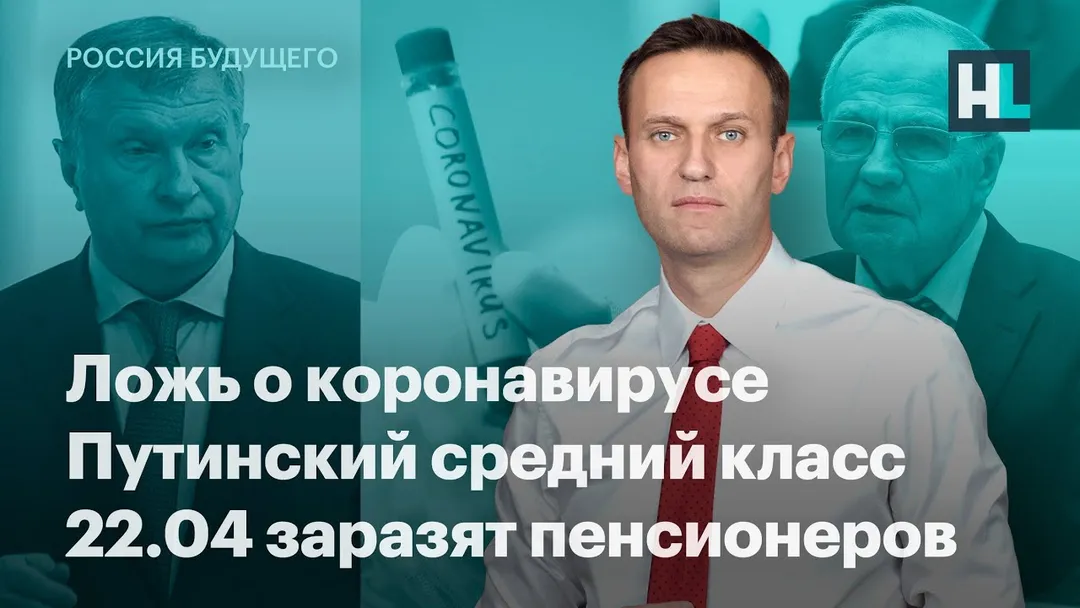
Lies about the coronavirus, Putin’s middle class, and on April 22 pensioners will be put at risk of infection
[music]
Good evening to everyone who is in strict
self-isolation and quarantine, and good evening to everyone else as well.
It is exactly 8:00 p.m. in Moscow,
which means we are live with
the program *Russia of the Future*, and I am its host,
Alexei Navalny, or "the madman with pale
eyes," as Milonov called me.
Let's listen to him, because I don't
know a single normal person
who is ready to pay
to vote for that madman with pale
eyes. Really, he doesn't know the political mood at all.
He says he doesn't know a single such person, but nevertheless,
30 percent of people in Moscow voted for me.
Apparently my eyes
seemed perfectly normal to them. Please send me
your questions, suggestions, and
complaints with the hashtag #RussiaOfTheFuture on
Twitter. We won't be putting them on screen,
but I will be reading them and trying to answer
them during the program. Thank you very much
that so many people have signed up
as sponsors. Right now, there will be a link in the corner,
and under the video player where
you are watching, there is a button that says "Become a sponsor."
So, two thousand
nine hundred eighty-seven people
clicked that button—not just clicked
that button, but actually subscribed
to provide regular support for our
program. Thank you so much.
That's great. Now, of course, we are thinking
about how to entertain you, because for
these three thousand people we will have to
make separate content. We will be doing a little of that—
answering questions and things like that.
And despite the fact that I will begin with the fact that
the topic of the coronavirus is not just
dominating the news agenda—it has
somehow completely scorched the entire information
space. Practically nothing is being discussed
except the coronavirus—coronavirus and
a little bit of Putin. But in any case,
some issues on the agenda are very important, and we
will discuss them.
I will start with Lyubov Sobol, the producer of this
channel, who this week announced her
intention to run for the State Duma.
That is absolutely the right move. More than that, I think
the timing is completely right,
and well chosen, despite the fact that
there is the coronavirus and so on. But still,
the response to Putin's madness with
resetting presidential term limits should be that
all kinds of young, wonderful—and not so
young, simply wonderful—
politicians clearly state their plans and
ask us for support. Let's
watch 56 seconds from our Sobol.
How can we say that we agree
with being treated like this? My answer to that
has always been: in every election, vote against
United Russia, against candidates from
United Russia, and against candidates
who appear to be independents but are
supported by United Russia.
They really do not want that, because
they know that if people vote against them,
they will lose.
Metyelsky, the head of the Moscow branch
of United Russia, lost, and they can lose too.
Along with them, a very important
battle will also be lost by Putin himself, because
the State Duma today is one big
collective legislative Putin. It is
a continuation of Putin, one of his
many tentacles. We can deprive him
of this tentacle. I will be taking part
in
the 2021 State Duma elections in
the Central single-member
electoral district.
You saw how softly our Lyubov says:
this is one of Putin's tentacles, and we can
take that tentacle away from him. And she is absolutely
right. I will repeat once again:
it's great that she has put herself forward, because
personally, I am against the kind of strategy where,
you know, all sorts of politicians sit around
doing absolutely nothing,
and then three months before the election
they suddenly pop up from nowhere and say, "I will run
in this district, I will run in that district." Well,
first of all, that creates a huge amount of
unnecessary competition. Competition
will always exist, of course, yes, but it can be
resolved through primaries. But most importantly,
we as voters clearly understand it, and
after some time we can ask
Sobol in particular: well, you
announced your candidacy—what have you done?
And what are you planning to do? And I would like
first of all to ask everyone else the same
questions, and secondly to see what they are doing—
some useful work. When a person has already
declared their candidacy, we understand that they are fighting for
the support of their voters, that they are responsible for something,
that they are doing something. That is great. Until
specific politicians who
lead people are engaged in
clear, concrete things and
implement specific
plans that are understandable to everyone else,
the opposition will remain weaker than we would like.
That is why I support Sobol, and I urge all of you
to support Sobol, and I urge everyone
else to put themselves forward too, instead of just
doing what happened last time, when, you know, there were only two
weeks left before nominations closed and the messages started:
"Alexei, I would like to discuss with you
my candidacy. Alexei, how
can we talk about support in this district
or that district?" I mean, of course we will talk
to everyone, and everyone will want to get into
Smart Voting, but why not
start working with voters right now,
go out there, go door to door in apartment buildings?
to talk about what’s happening, people
say we should address both the federal agenda
and the local agenda, and it would also be
great if
there were 225 districts in Russia, and in each of them there was
some person who, already now,
under our slogans, under opposition
slogans against Putin, against United
Russia, was doing active work. Yes, that would be
very good. I see Daniil is asking
me a naive question:
“Alexei, why didn’t you run in
the State Duma elections?”
Because I’m not allowed to. Putin, on the other hand, is allowed
to run again and again—he reset
One of the more popular tweets on my
Twitter lately was when I wrote
that an interesting thing is happening with
our Constitution: the Constitution
explicitly prohibited Putin from running for
a third consecutive term, and it does not allow
him to become
president once again. But the Constitution explicitly
allows me to take part in elections at any
level. Nevertheless, in practice
I’m not allowed onto the ballot, while Putin is running for
another term. That’s how everything
is arranged.
Despite the fact that I won in
the European Court of Human Rights and
proved that the cases against me were
fabricated, I am still, supposedly,
a repeat criminal, and therefore I
am not allowed to run. So, Ivan
Bukhonov asks me, “Alexei,
tell us, how accurate is the information
about a possible lockdown of Moscow? We’ll talk about that later
when we discuss the coronavirus. So, what
does ‘closing Moscow’ even mean?
What, are they going to block the roads with tanks and not
let anyone into Moscow or out of
Moscow? I think that’s unlikely and
generally impossible. But in principle, I
support tightening quarantine measures, and
now, well, schools have finally
closed. I think universities should have been closed long ago
—all universities.
Because more vigilance is better than
less vigilance. But as for some kind of
apocalyptic scenarios, like
you know, all of us sitting at home,
streets being patrolled by soldiers in
full gear, shooting at people for
trying to run to the store for a loaf of bread—
of course that won’t happen. In no
country in the world is anything like that happening, and in
that sense, there is definitely no need to give in to
panic. Moscow is not going to be ‘closed.’ If anything
is shut down, it may be certain institutions, which
would only be a good thing. This morning I went
to check in, like a criminal, at the
criminal supervision inspectorate
(the penal enforcement inspectorate)—that definitely should have been shut down long ago too.
It’s a breeding ground for coronavirus there; those
poor employees sit there, and
all sorts of people come in, including people
who lead fairly asocial
lives. It’s obvious that it’s just a chaotic mess
where all kinds of bacteria and viruses
spread. You could certainly
for example, for two or three months
suspend the work of such institutions and
in general, of such government bodies
whose necessity is not exactly
obvious—sorry for putting it that way, but
I mean, you could suspend the criminal inspectorate
temporarily for several months
and of course that should be done. So,
Vladislav is asking about
the Constitutional Court. I’ll explain everything now, but
before moving on
to the term reset and the Constitutional Court,
Putin, this week, generally speaking, right now
with this new run of his, has had to
talk a lot. He is constantly making appearances, and
of course he is spouting some truly
astonishing nonsense. Basically, he always talks this kind of
astonishing nonsense, but now, against the backdrop of
what is probably, among other things, nervous
tension—after all, this is an important
moment for him—
to go ahead and reset all his terms, that is,
to do what he denied for all 20 years, and
now he still has to keep a straight face and
go through with it. So apparently
some things are kind of slipping out
—he just keeps talking, talking
and talking, he can’t
stop. Let’s look at several different quotes from him.
One of them was especially good: this week he was once again
outraged by the rise in gasoline prices.
And that’s amazing. There are compilations
—many different compilations—showing how he
every year, several times a year, for 20 years
in a row, is outraged by the
rise in gasoline prices. And for the last several
years, he’s been outraged that
gasoline prices are rising while oil prices are falling. Let’s
listen to what he said this
week: “AI-92 gasoline over the year has risen not even by 10, but
by 44... appreciate that...”
“I’m not even talking now about the fact that
oil has fallen by almost half. Well, fine, it would be good
if prices stayed at the previous level.”
“Wonderful. Profits have been cut in half...”
“The Ministry of Energy is keeping
the situation under control. We need to understand that, in
principle,”
“gasoline includes many components... but nevertheless...”
“I understand, I understand, nevertheless...”
“We’ll work it through... did you hear that?”
“All right then, enough—give them a kick.”
“Pay attention to this, all right? Over the year...”
“Well, all right, over the previous months...”
“Oil prices collapsed, simply collapsed.”
“It used to reach 65 to 70, now it’s around 30...”
...”
“Take a look at it somehow, all right.”
Such an amazing dialogue, so there it is.
What happens is that the price of oil falls, while
gasoline prices go up. And this is, this is little
Patrushev Jr. (the son of Nikolai Patrushev, former head of Russia’s Security Council), the head of the council
security, the former head of the FSB (Russia’s Federal Security Service), and we
hear: yes, we just sort of
told him, he didn’t know. It’s going up? Well, actually,
all right, my colleagues and I will work through this
issue. What does that even mean? Could you please
work through this issue? Yes, Vladimir,
Vladimir, we will work through this issue. In
2014, let’s listen to the same thing.
They were saying exactly the same thing: how can it be that the price of
gasoline is already rising? There are some
things — he was told about this, and publicly too. I
already spoke about this when we met with the project,
for example, gasoline prices, prices
for food products.
This needs to be dealt with, and it needs to be dealt with
in such, in such, in a situation like this, under such
conditions, it has to be handled, no matter who
criticizes it, specifically in manual mode (direct personal intervention by the top leadership), and
get to work. So in 2014 he says
that now they’re going to handle this here in manual
mode and work through this issue.
Four years pass, and then comes
2018. What does Putin tell us?
But if we come back to it, I can
talk about it in more detail, but, but
overall,
even though it’s under manual control, overall
it worked, and I hope it will continue to work the same way.
Keep working so that there simply won’t be
any spikes in the growth of prices for
petroleum products next year.
That was in 2018: the government will not allow it.
And nevertheless, spikes
do happen, despite the fact that the price of
oil is falling.
And so their answer is always the same: we’ll work through
this issue. Everyone knows why the price
of gasoline is rising: because we are in the realm of
monopolies. Whose?
Putin’s best friend Sechin’s. Because
he was the one who created these state or
state-backed giants; they have taken over the whole country.
Monopoly in Russia is, generally speaking, the main
word in the economy.
And here Ksyusha asks me:
Alexei, how far does the price of
oil have to fall for Putin’s system to collapse?
Is there such a calculation? No, Ksyusha, there is no such calculation, and
unfortunately there cannot be one. If we are talking about
the possibility that the price of oil could fall very sharply
and there would be much less money,
dear Ksyusha, Putin’s regime will not
fall on its own. It will not go away without
some effort on our part. Look at what is happening in
Venezuela — there is simply
an absolute economic collapse there, and yet
the Maduro regime still stands. What happened
in Zimbabwe? It was completely destroyed. You saw
the many photographs of how people, in order
to buy a bag of chips, were hauling
money in a cart — literally in a
cart stuffed with money, billions
and trillions — and yet Mugabe’s regime
did not simply fall. It requires some
effort from us. But of course, when we
look at all this, in particular
when he comments on gasoline and pretends that
there is no elephant in the room — this giant elephant
called Sechin’s monopoly — I [mean], all the rest of it,
the entire gasoline trade is squeezed by it,
as if it doesn’t exist. It’s just absurd.
‘Work through this issue’ — it’s like a joke about
working through it. Two years will pass, and then they’ll say:
Guys, so how are you working through
this issue over there? Yes, Vladimir Vladimirovich (Putin’s first name and patronymic, a formal mode of address), we
were working through the issue last week, and
starting this week we will begin working through
the issue even more actively. Well, all right, but
just remember that there is no time
to waste. Please, keep working through it.
We will keep working through it.
And that’s how it goes — just this endless
discussion of who knows what, because
in reality nothing is being done. And
continuing on the subject of Putin’s interview,
right now I myself am waiting with great anticipation
for
— well, that’s not quite the right way to put it —
I’m eagerly waiting for the next episode in their
series to come out.
This amazing series, which
is produced by the state news agency TASS,
what’s it called — *20 Questions for Putin*?
Putin is asked questions,
and they post them. It’s actually great, I mean
the journalist who undertook
this whole thing clearly started it as
some kind of sycophantic project, and there
are people helping him. I already talked about it here on the program:
they put fake statistics
on the screens when Putin is spouting
obvious nonsense. But nevertheless, the questions
they ask are fairly interesting, and it’s clear that
Putin, being absolutely prepared for
these questions, knowing that these questions
would be asked, still answers with such utter nonsense that when we
look at these questions and the answers to
them, we can understand the depth of the bottom to which
we will sooner or later sink
if Putin remains in power, because
one person
Let’s listen to his answer to the question
about the salaries of the heads of state corporations.
You understand, it clearly bothers him — this, this
is a very important question, truly
very important, because the whole country
is baffled as to why there are such gigantic
salaries for Sechin,
for Gref, for Miller — far higher than everyone else’s.
And Putin appoints these people, and
Putin sets their salaries. But when
he gets this question, he’s like: well yes, I don’t like it either.
Listen, by the way, speaking of incomes,
how does that square with our state corporations?
When it comes to market-rate salaries, a manager here
it really doesn’t add up when they’re paid badly. I
agree with you. Listen, it really gets under my skin
— it bothers me too. So, a top
manager earns a million rubles a day.
Somehow, taking everything into account, but as for that, I
wouldn’t go that far. No, about that — I don’t know, but
it’s definitely too much, I agree with you.
I agree with you. Well, if I agree,
you can’t imagine how many letters I’ve actually
written saying: guys, you have no right
to pay such gigantic salaries. All
Buru once made a really great
Just create, in silence — well, not exactly in
silence, except for my voice — can we
just show right now how this
website works? Its address is maniivbk.info.
There’s nothing there except a counter. You
see, if you go there right now, you’ll
just stare at the screen and watch
how, in real time,
the numbers keep rising. Look — while I was speaking just now,
they earned 1,300 rubles, 1,400 rubles
— Kostyan, 1,100. That’s how it works.
That’s how it works, and, and...
And these are still data from two or three years ago.
By now they’re earning much
more. If you go there, you won’t be able
to take your eyes off it. Probably, if we hadn’t
removed that counter by now — and before
this moment, if it had kept going, they would already have
each earned 17,000 rubles,
which, as we know,
is considered a middle-class salary in
Russia. We’ll definitely talk about that.
Everyone knows this, everyone discusses it
endlessly, everyone is endlessly outraged, and
everyone understands perfectly well that it is specifically
Vladimir Putin who is the person
who allowed them to receive such
salaries, because the pay of the heads
of state corporations in Russia has long ceased to be
market-based. It is far higher than any
market salary, and certainly higher
than what these people ought to be earning
if they were working in a market
economy, especially considering that they
have wrecked things. Just look at the achievements
of Miller
as head of Gazprom, or
Sechin’s achievements at the helm of Rosneft.
These people have simply failed at their jobs.
They have wrecked the companies; their market capitalization
has shrunk. I mean, come on —
they are very bad managers, and they
receive fantastic salaries that
even very good managers in the
West do not receive. Putin personally made all this happen. He
understands that people don’t like it,
and so he acts like, well yes, it bothers me too,
but at the same time, like, what can I
do? Well, that’s how they were appointed — not
because we’re like that, it’s just life, and that’s
— well, it’s simply hypocrisy, of course.
It’s always very unpleasant to watch, but the
size of this hypocrisy, its scale,
keeps growing and growing. Today — well, the other day —
the day before yesterday,
Proekt (an independent Russian investigative outlet) released something exactly on this
topic.
An absolutely excellent investigation.
You can find it on YouTube, you can
go to their site. This investigation is connected with
the mistress of Eduard Khudainatov, a
guy who used to head the company Ros
neft. I mean, I don’t know him personally, but back in the day
when I was suing Rosneft and
all that mess, I wrote letters about him too. Then he was replaced by
Sechin. It’s generally believed that he
is one of Sechin’s money men. In the
Proekt investigation, they stubbornly do not
say this outright, but it is basically
implied. Apparently they’re afraid that
he’ll sue them. Anyway, this man
headed the state oil company Rosneft.
The investigation concerns a woman named
— Lord — Marina Amafia, Marina
Amafia. She is, I don’t know, his common-law wife,
his mistress — call it whatever you like.
In general, Khudainatov’s personal life
doesn’t really interest us in itself. What does interest us
is that somewhere on Kutuzovsky Prospekt (a major avenue in Moscow)
you can find this Marina
Amafia’s flagship store, and what she does is
produce perfumes, and a bottle there
costs $10,000. When I
looked, I didn’t even suspect that such a thing
could exist. It’s hard for me to imagine how
there could be a person, even a super-rich
person, who would buy perfume for 10
thousand dollars. It’s just so absurdly
beyond reason — and simply meaningless.
Such a thing shouldn’t even exist.
Perfume for $10,000. But there is a
special legend behind it: that there was some mega-
perfumer who once made perfume
for Napoleon, and Napoleon was so
delighted with it that he supposedly said
it would be for him alone, and no one else
was to dare wear it — but then
the perfumer killed himself, and the legend says
— this is all written on the website of this
Marina Amafia.
The perfumer killed himself, then apparently someone
informed on him to Napoleon, and Napoleon supposedly said he should be
shot, and
the recipe was lost until it was revived in
a descendant of that perfumer, by the name of Marina
Amafia,
to whom, of course, through her genetic code,
the exquisite recipe for this
perfume was passed down, and that is why she now produces it.
That’s why the perfume is so expensive and exclusive,
costing $10,000 a bottle. And all of this is financed by
none other than Khudainatov himself,
who worked at the state
company Rosneft. And in Proekt’s investigation
it is recounted very amusingly that
Of course, all of this is a perfect example
of Putin's aristocracy. This young woman
Marina Amafia was once a woman by the
name of—I don't remember exactly, something ordinary, like
Marina Porosenochkina, or something like that.
Marina—I don't know—Petrova, some common new surname.
She worked somewhere at McDonald's, just normally,
worked there, then worked as a flight attendant.
Then she met Khudainatov,
changed her last name to Amafia, and
declared herself a direct descendant of the aristocracy,
a direct descendant of Napoleon, and then went all in.
A billion here, a billion there,
private jets,
palaces, everything else. Let's take a look
at 50 seconds from this investigation.
Khudainatov's lover owns
an estate in Zarechye, on Rublyovo-Uspenskoye Highway
(an elite residential area outside Moscow).
Its approximate value is 5 billion rubles.
In the company's founding documents,
Marina Amafia lists her address in
Cyprus.
It is the Coral Sea complex of luxury villas in
the city of Paphos.
Approximate value: €600,000. Marina
Amafia drives only luxury
cars: Bentley, Mercedes-Benz, and
Porsche.
Eduard Khudainatov's son, Alexei, also
owns a luxurious estate.
Though recently he put it up
for sale for nearly 2 billion rubles.
Eduard Khudainatov's own house
is located nearby, a 10-minute walk
from Marina Amafia's mansion, and the land alone
there may be worth more than 2 billion
rubles.
Khudainatov's first wife, Marina, owns
a mansion in the Rechnoye settlement;
it may be worth around 600 million rubles.
The same goes for the house of Eduard's brother,
Khudainatov, Zhan, who settled in
the Zhukovka-3 settlement.
This is Putin's aristocracy, you understand, and all
of this is given to them by the state-owned company
Rosneft—our state company, yours and mine.
But for some reason it did not give you
a pay raise, it did not give you
better healthcare, it did not give you
better education, but to some
obscure women it bought billion-ruble
houses. Khudainatov himself, back in the 1990s,
described in his biography how he
built a cafeteria somewhere in that
town. Well, that's wonderful, excellent.
He built a cafeteria and still managed to rise
into the oil business, and that's all very well, let
him be a rich man—but not
that rich. You can become rich
by heading a state company, but he
did, and now they sit there in
their beautiful chalets and their
castles, which they buy in
Russia, Spain, Italy—wherever they want.
They douse each other in perfume that costs
$10,000 per bottle, and really
they are the masters of life. What is so
disgusting is that everyone else—and
Putin looks at all this and says, well, yes,
well, it bothers me too, it rubs me the wrong way,
but maybe somehow we should start
investigating the origin of this
wealth? But no, that does not happen
at all.
Unfortunately. Take a look
at the investigation—it's very funny, I see
a lot of people, 49,000 people may be
watching us live, and our link for online
donations
when ducks swim across the screen, or
Medvedev pops up there, or whoever else—but
this was Margarita Simonyan's people who knocked it out
last time, again. This all started
when the investigation came out
about Margarita Simonyan. She has a budget of
20 billion rubles. Last time,
as I understand it, throughout the whole
broadcast, for about five
minutes there was some problem, but they
put this link for
online donations on the screen, and now they brazenly
—as I understand it—
it isn't working, I'm being told. Well,
what can I say: Margarita
Simonyan is spending 20 billion rubles
that she got from us on
very, very useful and effective work. I
always wonder at moments like this:
did they really sit there holding meetings,
deciding, let's make some kind of
attack on Navalny's donation link, yes, let's do it,
this will be our strike right in the back.
I mean, of course it's unpleasant.
You wanted to send me
200 rubles to support the work, and you
couldn't send it. Well, okay, but I
am simply curious how much money
they wrote off for this little stunt. 50,000
people are watching us live.
Danil asks: what do you think about
the amendment related to the supremacy of
domestic law over international law?
I see a lot of questions here about all sorts of
institutional matters.
Nikolai Dolzhenko.
Nikolai asks where Ruslan
Shaveddinov has gone, where they moved him to hide him—we
don't know. About Ruslan Shaveddinov,
only one thing is known: one
fine morning, the day before yesterday,
he woke up and was told, pack your things,
we're taking you away. They took him somewhere,
they drove him to an airfield, as his fellow servicemen wrote to us,
and after that contact with him was lost.
And we do not understand whether he was sent
deep into Novaya Zemlya (a remote Russian Arctic archipelago), because now he
is in some place not far from there.
There is an airfield there, but maybe some kind of
communication is possible if you arrange it with someone.
He could at least send word to his fellow servicemen, or to us,
send a message saying that Ruslan is alive and
well.
You could send someone deep into Novaya
Zemlya—it is enormous, actually, and there
there is no communication at all, and apparently twice as many
polar bears, plus
as far as we understand, some people
are being sent somewhere even farther away, even farther north.
There is also Alexandra Land, where
there is no communication whatsoever, only
satellite phones, and three times the
number of polar bears.
Polar bears, apparently. But of course, despite
the fact that I am joking, I am very concerned about what
is happening. And, in any case, if you
work for the Defense Ministry and have any
information at all—this is really a bit of a disgrace—
someone has apparently been kidnapped and taken away by boat,
we cannot find him; please let us know
what is going on. There are a great many
questions. I can already see questions about the Constitution,
about the Constitution.
What are we supposed to do in connection with this, and how do you
see it? Last
Thursday, you and I were here, and last Thursday
we were discussing it precisely while those
votes were taking place in the regions of the Russian
Federation—in all regions of the Russian
Federation there was a special
vote initiated by United Russia, and
after that the amendments were to enter into force
legally after some time; then
Putin was supposed to sign them, was supposed to
have to,
was supposed to review them, and the Constitutional Court was to consider them.
And in fact, I had planned that even on this
program—that is, a week later—you and I
still would not yet be able to discuss that all of this
had been adopted in an emergency manner,
because there was still the Constitutional Court, and there
was supposed to be some lengthy procedure, as
required—an open hearing, and so on.
And this is astonishing: the Constitutional Court—
the program was on Thursday—
the documents were submitted to the Constitutional Court on
Friday, and on Saturday they announced a
closed session. That is, in
principle, the most important hearing in the
history of the Constitutional Court,
with a nationwide vote approaching
and very important issues at stake—we expected that they
would at least stage some kind of circus, with various
lawyers and non-lawyers coming out, and all sorts of
Valentina Tereshkovas speaking to the Constitutional
Court: 'Dear Constitutional Court, we
believe this should be done this way,' and there would
be some people making speeches with pseudo-
legal opinions. In general, all of this
shows very clearly how important these amendments are to Putin
and how he is simply
trying, at a truly manic speed,
to get them adopted. That is exactly why they
scheduled their vote for April 22,
right in the middle of the coronavirus outbreak.
We will discuss all of this, but for now just consider
this: the court, in a closed session,
began deliberating on Saturday and
had already issued its ruling by Monday. And moreover,
they themselves are ashamed of this ruling, because
as I said, it was a closed session,
and to this day they have not even said who was
the reporting judge in this case; they have not disclosed
information on who voted how, who was for it and who was
against it, because this is an absolutely, massively
unlawful decision. And the court—
perhaps this is a bit harsh in wording, but nevertheless
there is simply no other way to put it—
it is a gathering of lying, elderly
prostitutes who, in reality,
traded away, well, simply their, you know,
cheap buckwheat and cheap cafeteria food,
well, of course, official dachas and official
apartments. As far as we can tell, just from a quick
look, there are no
super-rich people there.
Each of them was given a dacha in Moscow, a dacha outside
St. Petersburg, an apartment in Moscow, an apartment outside
St. Petersburg, and he built for himself this kind of
little socialism inside the Constitutional
Court. But basically, those people who
simply sold all of us out for their lousy
official apartment—because there are no countries in the world
where leaders have extended their own
powers through a referendum and
those countries then lived well. The court,
these very elderly
people understood perfectly well what they
were doing, and they did not even release their
super-mega-lying decision. It is just that when
you read the official text, and there it
officially says, in effect, that all this
can be done.
The number of terms is not a major
problem, because in Russia there is—
attention—
developed parliamentarianism, real
multi-party politics, and the presence of political
competition, as well as an effective model of
separation of powers. I mean, we all
know—and even people who support
Putin do not try to assure us that in Russia there really
is
political competition or parliamentarianism.
They rather say that we very much
do not need all that European stuff,
we do not need it, no and we do not need it. But these lying
scoundrels, in all seriousness,
say that Putin can extend his
term, his term, for as long as
he likes, because, well, there is such great
competition—after all, anyone can
take part in elections, and political
parties exist here, and parliament
is wonderful. They say this in complete seriousness,
people who work in
The Constitutional Court does not deserve
any respect at all, I mean,
someday, in the beautiful Russia of the future,
in law schools they will
study them as people who never really
were outstanding lawyers, by and large.
The Constitutional Court is simply
a bunch and a rabble of random people who
were pulled in from somewhere, from some
universities, seated in office, given those
gold chains, and they started thinking that
they were
prominent lawyers. But supposedly their very
position obliged them to
sit there for many years and
grow a little, try to become
something like genuinely
more or less distinguished figures in the field
of law, and they turned out to be, quite literally,
complete cheap hacks.
And people really will study this and
discuss it, and it is an incredibly shameful story.
I think some of them are watching this
broadcast, and they will be upset, they will
be indignant: how can they be called that?
You call them bad names, but there are no good
words to describe you. In fact,
you are cheap sellouts who sold absolutely
everything. As a lawyer, I am simply
outraged. Of course I take it to heart,
because it is impossible — they actually
literally wrote that
when deciding whether Putin can
reset his term limits or not, one must
take into account specific
historical facts
and factors. In other words, they mean that
they are effectively saying, almost verbatim: the country is
surrounded by enemies, and right now we need a leader
like Vladimir Vladimirovich Putin.
That is what these lawyers are saying. And yet, in
this same composition, back in 1998,
they considered the same question
regarding Yeltsin: could Yeltsin
run for a third term, because
there had also been changes to the Constitution?
And they said: no, Yeltsin cannot, but
Putin can, because the specific
historical factors are completely different now.
But of course we expected this decision,
because the chief
of the Constitutional Court, Valery Zorkin,
is known, widely known, for the fact that
in 2014 he wrote an article
like this.
He likes to show off, he writes articles,
he apparently thinks of himself as a great
thinker, and there he wrote, literally,
that serfdom, for all its
drawbacks — that is, serfdom in
Russia, in Tsarist Russia — was one of the
main bonds holding together the nation's internal
unity. It was no accident that peasants,
according to historians, said to their
former masters after the reform: you were
ours,
and we were yours. That is what they want.
You understand, they... I released a video on this
topic today, and in it I talked about how
they think we are their serfs.
Because
they really do have that attitude.
They sit there with their gold chains, in
their Mercedeses, and this whole
marinated mafia atmosphere
they give off — they genuinely think
that we should come up to them, bow down,
and say, guys, like,
we are yours, but you are a little bit ours too.
Serfdom is what makes us one.
The fact that you stole all our money while we
sit here earning 17,000 rubles (about 170 euros / 185 US dollars)
and got classified as middle class — that
is what makes us a united nation. What a
wonderful thing.
You put the stable hand there in the stable,
by the stove,
and he is grateful, because he
understands that he is a fool, that he cannot
do anything on his own, headless and helpless.
Right, he is useless, but the master guided him,
and that is the unity of the nation.
And this was written in 2014 by the man who
heads the Constitutional Court, so how
else can I call him except the chief
— well, of course, I do call him that, yes.
And then they will tell me: come on, Alexei,
you are a politician, why are you insulting the head
of the Constitutional Court? The chief of prostitutes —
that is what he is. I cannot put it any other way.
He betrayed all of us, he sold all of us out for
some shabby official apartment of his own.
Putin will stay there, he will remain in power until
we finally remove him from
power, but by that time Russia
will have fallen dramatically behind, and simply
all of us will be in very bad shape. When I
was talking about how
the Constitutional Court was about to
approve all of this, approve it, approve it, and
it was supposed to consider it all
week, and after some time all of this was then
to be signed by Putin — and do you
know that when Vladimir Putin was only
just starting this whole mess, he stated
quite clearly that he would sign all of it
only after the people had voted.
It was said there word for word: let us
listen — in this case
that alone is not enough.
They came and said whether they want
or do not want the citizens of our country
to in fact be the final
authority that either accepts this
law or rejects it.
And only after people have had their say
will it either come into force or not. It was stated clearly:
after the people vote.
We’ll discuss the voting before the vote.
It’s a fake, but it was said nonetheless.
After that, people will sign, they’ll vote, and I...
will sign it. What happened in practice?
The Constitutional Court, in a closed session,
meets over the weekend and issues this,
decision saying that everything is perfectly fine.
There are many different amendments there, a huge
number of them, and the objections to them are absurd.
There are supposedly no issues with any of the amendments; everything is just fine.
Putin signs it instantly, just
immediately.
Not even taking time to think, not even pausing
for a moment, as if something were actually happening there, either
in our old man’s head
or, I don’t know, some kind of process is underway.
Because we can see, sorry, just how
important it is to get all this done as quickly as possible.
I mean, it gives the impression that he
read something like: the train is leaving, the plane is taking off,
it’s flying away — they need to
push this thing through immediately. And of course,
of course, it’s very upsetting and outrageous
that across the country, when the legislative
assemblies were voting on this,
as far as we could see, there was very little, well, any kind of
real resistance apart from Moscow.
No one even tried to challenge any of this. In
Moscow there were some genuinely great speeches.
Let’s look at Shcherbakova’s speech.
I’ll show you the deputy who, by the way,
incidentally,
also brilliantly mentioned Simonyan and this whole pack of
our parasitic characters, which provokes
extreme outrage at the fact that our people
are being treated as completely stupid, as if
they could be fooled this cheaply.
Having gotten carried away, the political technologists were in full
earnest convinced that, by force-feeding us all this, they had
already raised generations of brainwashed
consumers, and that people like Tessa, Margarita Simonyan,
Babayan, and the rest of those mischievous types
had already knocked out the last remaining brains in the older
generation. Let me remind you that we are not
addressing people who came to him not to
pay attention in that hall and hoping that they
are gravely mistaken. This is the cheapest kind of
con job, on the level of ‘what, are you too scared to challenge it?’
or ‘too scared to jump from the twentieth floor?’
It’s aimed at people who have completely
forgotten how to switch on and use
their mental faculties.
Deputies elected through Smart Voting
are doing a great job, and that’s why I count this as a plus
for Smart Voting, because even if
we weren’t able to outvote them across all
federal subjects (regions), the very presence of
such people — the kind who
annoy United Russia, who at least
can get to the podium and say something publicly —
is already very important, because
they already have to be taken into account. But there are very
few of them, because we devote too little time to
regional elections.
And we have regional elections coming up in
September, and already — I can see it, I talk
to people — ‘Guys, let’s do something about
Novosibirsk, Chelyabinsk, Cheboksary, and so
on,’ and they say, ‘Good Lord, who cares
about regional elections?’ But this should
interest everyone. In practice, it is very
important and absolutely right to be involved in all this,
because if we don’t
do it, then there won’t be, there simply won’t be, people like this.
No one will be sitting either in
Chelyabinsk or in Novosibirsk, and that
means there will be no network
of resistance. Because as soon as
some really cool guys like that appear,
like deputy Bondarenko there — I often
show him to you here, in the Saratov Duma (regional legislature), in
the Saratov Duma.
Well, he has an enormous amount of
public support, and that means
practical opposition. We need to support exactly
these kinds of deputies and candidates.
Support them. We need to devote a great deal of
effort
to Smart Voting and campaigning. You may be sitting
in Moscow, but you can influence an election
in Chelyabinsk if you want to influence it.
So then, what happened next?
We saw that after
Putin signed all of this, the rhetoric changed
very sharply. Sorry that I’m
repeating a bit of what I said in
my video on the main channel today.
It came out today, and I was so struck by these words
from Kiselyov, when he said that
Russia is not viable. That is really
a major upgrade of everything
they had been saying before. Because after all,
before this, the narrative was that
our dear Russia is huge and wonderful,
it has always been great, future Russia
will be magnificent, the present is wonderful,
and the past is amazing — all that old
Pobedonostsev formula, I think, repeated
in different variations even now: a great
country needs a great leader. Now all of this
has turned into this: you’re told that in
fact the country right now isn’t all that
great, and it isn’t viable at all
without Vladimir Putin. That’s just — well,
an incredibly powerful few seconds. Let’s
watch Kiselyov: ‘held together with string,’ to put it mildly.
Let’s be honest: Russia without Putin
is not yet viable. Our political
system is unfinished and unbalanced.
There are 8,600 people
watching the broadcast right now. I hope they’re as
outraged as I am. ‘Held together with string’ — I mean,
it really gives the impression that there were
some smoking ruins lying around,
with naked ‘Papuan’ tribesmen running over them in the 1990s, and everyone
was walking around naked, and then Putin came and, with string,
stitched it all together. And now, for 20 years,
he’s been tying it all together, but it still...
haven't connected it until now, and so now
right now he is holding all of this together, and this
I think what was said is very important
by Kiselyov, because this will be the leitmotif
of everything that is about to unfold
next, the April 22 vote, and here I see
a question: "Alexei, why is there no
single position on the Constitution among
the opposition? Why not adopt a unified
position in public debates?" I don't know what
"show debates" means or who is showing them,
but here is a video, in this form, subtype
they showed it, debates took place—I'm not making this up, I
don't know what "show debates" are. Let's just
talk about it normally, and as for whether—I don't know
whether they will be in person, but in any case it is not
necessary, even remotely, because there are different
opinions, first of all, regarding what exactly
needs to be done about this on April 20, and I very
well understand that a huge number
of people are furious, they are outraged, they
are saying: yes, we will come and vote against it, and
it seems everyone around is saying: we will come and
vote against it. It's impossible otherwise, this is
outrageous, just look—they have shoved in
absolute nonsense: God, pensions, whoever
you like, and resetting Putin's terms, of course
we must come and vote. No,
people are saying this, and this approach is supported
package voting is one of the proposed
formulas for opposition action. Let's
look at this carefully, and from my point
of view, Putin understood perfectly well and
anticipated that the public reaction would be
exactly like this
If he had hoped that he would actually
receive the support of the majority of the population,
he would have held
a re-fe-ren-dum, just as
Lukashenko once did, and Nazarbayev as well
Well, everyone who extended their terms
held referendums, and there they
falsified them, yes, falsified those
referendums, but still, a referendum
is at least some kind of mechanism where you can
observe something
He is genuinely afraid, but he understands
that of course, with the help of the North
Caucasus, where there will be total
falsification, and with the help of the Volga region
—Tatarstan and Bashkortostan—
he might perhaps scrape together some kind of
required result, but he understands that in those
cities where it is hard to falsify the vote—
Moscow, likewise Novosibirsk, the whole
north, the northwest—there everything will simply
collapse, and all these cities will overwhelmingly
show that people do not want
Putin's term to be extended. That is precisely why
he reset not only his own terms, but also
effectively reset the entire voting procedure
itself. There will be nothing there for me to
vote for; it will not be possible there
to vote in such a way that
the will of the people could somehow actually be established
This isn't even me saying it; this is what
the Golos movement is saying, which, by the way,
has often sharply disagreed with me on
the question of debates, and regarding
a possible boycott, because I believe
that our opposition must be flexible
if there are real elections, we need
to participate in them; if the elections are fake, not
real elections, they should be boycotted, or we should stage
a voter strike, as we did
during the presidential election. Yet Golos
has always been in favor of participating in elections
I go to their site and I see a huge
headline saying that in this vote
it is impossible to establish the will
of the voters. And do you know what infuriated even
people at Golos? Well, they are, they are
very decent people, honestly, and there are many
people there who initially
supported Ella Pamfilova and believe
that I am being too radical, that one should not
go after the Central Election Commission so aggressively
—but the last straw was this
advertisement with our Sergey Bezrukov
Bezrukov, who is, well, a fine
actor—why is he getting involved in all this filth?
At the Central Election Commission they showed campaign material. What you
are about to see was made with the Commission's money, that is,
with your money—a campaign piece in favor of
the referendum. They claim that this
campaigning is not campaigning for the referendum—
sorry, for the vote—that it is
neutral messaging where they urge people
not to vote for
or against. Let's take a look.
between people. You must agree, it would be difficult
to communicate using only gestures
or sounds. Such metaphors, comparisons,
epithets, images—there are none in any language
in the world, which is why it is so difficult to translate
Pushkin's words into a foreign
language
And we speak this language, feel in it,
declare our love, notice things, tell stories
about the Russian language, and Turgenev (the Russian writer Ivan Turgenev) once
called it, in difficult days,
my support and my pillar:
the great and mighty Russian language. The Russian
language as support and a pillar
That is why I think it is so important
that the amendment to the Constitution of the Russian
Federation on the protection and preservation of the Russian
language be adopted
On April 22, the vote will take place
Don't miss it. It concerns all of us
[music]
So, in your view, was that neutral
messaging simply encouraging people to come to
the vote? Obviously not. It was
specific campaigning, a rather sly kind, in favor of
the Russian language. But what's wrong with that?
The Russian language really is
great; everything he said about Russian
The language issue really is being used to...
to lure people in: "Come on, let's go vote."
For the Russian language. But the Russian language on its own
isn't being offered separately. The Russian language comes
as part of a package deal with everything else: with God, with
same-sex marriage, with the priority of
Russian law
over international law, and with resetting
Putin's term limits. And that's why Sergei Bezrukov may
not be too worried about
having agreed to appear in this
advertisement. But even so,
what he did is absolutely shameful and
shameless, because Sergei Bezrukov
is campaigning this way not for the law, not for
the Russian language, but to get people to come
and vote for resetting Putin's terms,
and that is where the enormous lie lies.
A colossal lie and a colossal deception. I
hope that one day he will feel
very ashamed of it, and that everything there will be arranged
accordingly. And of course this simply
came out after I had already released
today's video, where I talk about that
old strategy of resistance. Because if
I had read Andrei Buzin's post
— one of the key figures
in the election monitoring movement — and everyone who
is involved in election monitoring
of course knows Andrei Buzin — he wrote
a post... Buzin has always been in favor
of clean elections, but here he writes
something that honestly leaves me not even knowing what to say.
Because do you know how they will determine
the number of people who
took part
in this so-called Putin vote?
Well, you might say: by the voter lists
or by the protocols. But usually
the protocol is posted on the wall, observers
fill it out, and based on that protocol
everything is then
recorded and the control ratios are checked.
Not this time. This time, the number
of people who voted will be determined by
the number of ballots lying
inside the ballot box.
Now, maybe if you have never
been involved in election monitoring,
this doesn't sound insane to you. But
guys, it really is insane.
Because the way the election process is currently organized,
and in general the main
barrier standing in the way
of falsifiers — the main barrier —
is that there is a polling station,
and a large copy of the protocol is posted there.
It says that at this
polling station, 1,700 voters are entered in the voter register.
Then they record that
such-and-such number of people came here —
800 people.
We gave them 800 ballots. So many
ballots were taken out later — 20 of them,
because of at-home voting.
There were another four ballots for some kind of
mobile voting, and so many
ballots were spoiled, so many
ballots were canceled, so many votes
were cast — all of it, yes, all these numbers
have to add up.
And that is the main, fundamental
safeguard. That is why United Russia
has to resort to complicated schemes — this whole
"carousel" operation, when people travel
— you've seen it many times — there is
a bus with 20 people in it, and they
go from one polling station to another.
They show some badge, and they are given ballots.
Then someone simply enters them under other people's names
in the voter lists. In other words,
it's complicated and difficult to carry out —
a kind of falsification that allows them
to add
100 votes for United Russia and Putin at each polling station,
or 50 votes,
which across a region and across the country adds up
to millions of votes. So this is the kind of
thing that happens in almost
all regions of Russia and gives them
a few extra percentage points. But this time they
have scrapped even that. Roughly speaking,
anyone can come in there —
a school principal, the head of the local housing services office,
some local United Russia people — and simply throw in
a whole stack of ballots.
The polling station may have 1,700
registered voters,
but suddenly 5,000 ballots are found there.
That's it — that means that many people voted.
Five thousand voted, and of them 4,500
voted for Putin. That's all.
And there are no observers. The most interesting part is that
observers are effectively banned.
The only observers will be from the Public Chamber
— that is, effectively from the state itself.
On top of that, it will go on for several days,
and Putin has already announced that there will also be
at-home voting. So in reality
it is absolutely impossible to ensure that
your votes are counted. And of course I
also want to go along with everyone else and
simply, as a political statement, vote
against it.
And in fact, you can go
and vote — but at this point it no longer
has any significance. There will be no real battle here
for the result, because everything loses
its meaning.
There is no oversight there. You can go
and vote — just don't be upset
that your vote will not be counted, because
it will not be counted. Therefore, our main
attitude toward this vote
must be one of non-recognition. In the previous
program I said it, in the video I said it, and I will say it
again: we do not recognize this procedure.
This is a real fake. This is no way to do it.
to hold elections, and Putin, having refused
to hold referendums, having started holding
this thing, this whole thing, this vote
he is simply showing in advance that
he is losing the referendum, and so this whole thing began
what is very interesting about this vote is that for the Kremlin
it does not matter how you vote, but what matters is that
they do not understand that not everything can be fixed, but for them
it is very important that you show up, so
right now they are simply sending me from everywhere
the same campaign guide over and over, and it is being handed out
to doctors, and distributed in schools, in the EMERCOM (Russia's Ministry of Emergency Situations),
everywhere, to all state employees, sending instructions on how
they are supposed to campaign, and send it to me because
at some point my surname is mentioned there. It is funny, there
is a guide on how to bring people
to this very vote, and in
particular there are different groups there
of people, how to campaign to active people, how
to campaign to patriotically minded
citizens, how to campaign to loyal
and disloyal ones. As for patriotically minded
citizens,
they are to be persuaded as follows
the suggested message is this: right now Ukraine too,
Poland,
Navalny, and anyone else can dictate
to Russia what it may and may not do
and punish it for invented transgressions
by exploiting legal loopholes left behind many years ago
through legal loopholes. It is very
funny that, according to this nonsense, Russia is now being
manipulated by Ukraine, Poland, and Navalny
but a new constitution must be adopted, and then
of course Vladimir Vladimirovich
Putin will receive into his hands a sword
of legend with which he will drive off Navalny,
Poland, and Ukraine
and then Russia will be able
to make decisions independently. And for
active citizens, the following
slogans are proposed
A new constitution without authoritarianism
and permanent rule. Want Putin
to leave?
I am voting for the constitution. So, basically,
United Russia is literally sitting there writing
a guide on how to lure in people like you
to this vote. Want Putin
to leave? Come vote. And there are lots
of different ones there
there they say that Putin has achieved a great deal while in
the office of president for the country, and for
pensioners the proposed message is this: we all
remember how we lived in the 1990s (the turbulent post-Soviet decade): humiliating
poverty, unemployment, hungry elderly people
blah blah blah, come to the vote on April 22
and, by the way, this is being written to us by
a man who in the 1990s worked in
the Saint Petersburg mayor's office, that is, he was one
of those who created those very 1990s with
their humiliating poverty, unemployment, and
hungry elderly people. But now they
with all sorts of slogans want
to drag people in. Why do they want to drag people in?
Because they will not fake the result, but
if everyone around you is saying that
they did not go, and you yourself see where it will be
held, it will be located
in your shopping mall
it will be located in your school, and they can of course
tell you as much as they want
something like 70 percent
of people came and voted, but if you do not
see people actually going, then you will not
believe any of it. That is why they very, very much need
turnout, because, well, on top of that, people's mood
is changing radically. What struck me
this week
was the singer Trofim, that is, the singer Trofim,
Sergei Trofimov, Sergei Trofimov, Sergei
Trofimov gave an interview to the newspaper Sobesednik
and said
the following words
A man who can barely stand on skates and
yet scores ten goals, or who dives
with scuba gear for the first time and finds
Greek amphorae, may think all of that is
real, but reality, sadly, is quite different
It is a pity that the citizens of the country will have to pay
for this illusion, a country that is driving
along a dirt road
while anxiously peering into the rear-view
mirror
Well said by Sergei Trofimov, the singer and
musician. But let us just look at the video
that Sergei Trofimov recorded in 2012
Vladimir Putin is a man who
can correct, while in office, his own
mistakes. We are not choosing a tsar,
we are choosing a manager to whom the reins
of governing the country will be entrusted. I understand that he is
a man of his word, a man whose duty
as a Christian
and as a citizen of Russia is to correct the situation
in the spirit of social justice
I expected decisive steps from Vladimir Vladimirovich
[music]
I really do not want to take a jab at the singer
Sergei Trofimov, and I think that he
said all this absolutely sincerely and, apparently, genuinely
to Sobesednik, but obviously
sincerely, I fully allow for that, that in
2012 that was the case. I just do not really
understand how in 2012 one could
vote for Putin and support
him after the crackdown on Bolotnaya (the Bolotnaya Square protest), after
the falsifications in the 2011 elections, well
and support him while saying, we are not
choosing a tsar, but a manager. And now this
manager is telling all of us, including
the singer Sergei Trofimov: man, after all you
were choosing a tsar, and there will be no more elections, only
a nationwide vote. Come
And even loyalists, you see, people like that
who were official campaign surrogates are already
saying: how much longer can this go on, really, how much longer
can this go on? The man is genuinely just losing his mind
but he is maniacally determined
to remain president, so of course
the Kremlin. Putin may not feel it himself—Putin
is already completely out of touch somewhere up there—but the Kremlin and
everyone else feel it very well,
these moods, and they do not like any of it.
That is why there is no referendum, and that is why—
Daniels asks: “Alexei, what do you
think? Is this the same Daniil
or are there really that many people named Daniil?”
People keep asking me whether there will be large-scale
ballot stuffing like there was in 2017.
You cannot even say there “will be,” Daniil, because
everything that happens on April 22
will be one continuous fraud, as I already
said. There is no oversight mechanism there
whatsoever. They will simply pull out a stack
of ballots. Well, it is just hard
to explain this to people who have never
worked as election observers at a polling station. If
you have been an observer at a polling station, you
know what a complicated system there is
for counting votes, which does not always
work if people are trying
to falsify the results. But in principle it
is designed fairly well if everything is
done honestly, and now they are simply
abolishing it completely. So it is not a question of
there being many votes and how many of them
will be stuffed in; it will be a huge pile of fake votes
with just a few real ones mixed in. That is exactly
what it will be. Viktor Medved asks: “Alexei,”
“How, in practice, will your refusal to recognize
the vote on April 22 be expressed?”
That is exactly how it will be expressed: I
do not recognize this vote. I do not recognize it.
I think you, Viktor, should say
exactly the same thing. And when, sooner
or later—after all, it cannot go on forever,
Putin will not rule indefinitely—there is
a normal parliament in Russia, and this will be
the main thing that not only
the
opposition, but any politicians at all, will say in
their platforms.
They will have to say: of course, we
will repeal this, because all of it was
a sham. And as soon as a new parliament
is elected, you do not even need
to go through any procedure or hold any
popular vote at all.
We simply say: all of this is null and void,
none of it exists—neither these new
powers for Putin, nor
any resetting of term limits. Besides,
of course, we already consider Putin’s
power illegitimate,
but after all this, his bid for yet
another term is simply absolutely
illegal, absolutely illegitimate. It is
essentially a coup d’état, a seizure
of power. 363,000 people on the live stream
—I am being told that we already have 3,100
sponsors, those wonderful people who
click the button below, right
under the little screen you are watching me on.
By the way, one of the
very noteworthy things, I think, which the
Kremlin is also watching, is the reaction
from the North Caucasus. You know how the North
Caucasus works: whenever you
talk to people from the North
Caucasus—really, with anyone
from the North Caucasus—they all, you know,
curse the authorities in the strongest terms, but when it comes to any
initiatives from the authorities,
the local bosses vote as instructed. Look at what
is happening in Ingushetia.
It is very much a typical North
Caucasus system—the North Caucasus is the North Caucasus.
And now, there, the council of teips
(Ingush clans) has issued an official statement saying:
“We are not going to vote for your damn
Constitution.” It literally says there,
“Why should the people vote for
constitutional amendments that are not
being implemented? We are tired of the authorities’ hypocrisy.”
That is being said by the head of the council of teips,
that is, by the very people who have always
supported the authorities—these are the kind of
people who, in effect, are not usually against
them. And after this statement, an administrative case was immediately
opened against him. By the way,
for what? Does he no longer even have the right to say
that he will not vote? They opened
administrative cases there against many
people, and criminal cases were initiated against some. But
officially, the elders gather
and say: “We will not vote for this.”
This shows that grassroots
discontent is building very strongly.
It is breaking through where no one expected it. I
think that Putin and the presidential
administration, not least of all,
did not expect that in Ingushetia anyone would
say anything on this issue.
But it is happening, and that is why
they are not holding a referendum. That is why
there will be this absolutely total
falsification. I saw many questions:
“Alexei, was it really the case that…” Right now, I
cannot see it on the screen anymore, but the question was
something like: “Do you think Putin
deliberately timed this
nationwide vote to coincide with the coronavirus
epidemic?” I do not think so.
But it seems to me that now, after an hour on air, I
want, toward the end of the broadcast, when more
people are watching, to say something that
I think is very important: what they
are doing now with this announcement of
the vote on April 22
is a real crime against everyone, and
against pensioners in particular. This
really hits me hard.
I urge all of you to think about this too
and to make them—really, we
must make them.
Of course, it would be better to postpone this altogether.
Or cancel it and not hold any vote at all.
But at the very least, it should not be on the 22nd
of April, because what will be done
would be a genuine crime.
It really looks like an attempt—
as cynical as this may sound, like some kind of dark
joke,
but nevertheless it is as if they want
to vote for Putin and at the same time
save on Pension Fund spending,
because many elderly people will simply
die after this. What is happening now
with the coronavirus—let's look at
the chart. We are told that there is very little coronavirus
in Russia right now. Looking at
the chart, it is indeed low, but we can see
that in those countries—please show
the chart Alexashenko is referring to—
there, you see?
The bars at the bottom are Russia, while these
curves that have shot
way upward are France and the U.S., where the situation
is much worse, especially in France. But
the gap is only 4 to 15 days. Our
bars are moving in exactly the same way as
those graphs, and in that sense we are being told
that the situation in France is terrible,
that the situation in the U.S. is alarming, while for us, so far, in terms of
the trend, unfortunately, the situation is exactly
the same—just 14 days later.
If the same pace continues, then we
will have as many infected people, as many dead, and as many
dying as Italy has,
as France has, and as the U.S. has. And how,
against that backdrop, can anyone hold
a nationwide vote, the whole point of which
is that many people gather in one room,
including elderly people?
You've seen how this works: there is a person sitting there with
the coronavirus, God forbid, and they hand this
grandfather or grandmother a ballot, and there they are
peering at it with their weak eyesight,
saying, 'Sonny, give me the pen.' That whole
pen has been licked, touched a hundred times,
they chat, take that grandmother by the arm, and
lead her over to the voting booth,
and of course infect her. The number
of infections will be simply enormous. One
member of an election commission will infect
hundreds of people that day.
One person from the election system—after all,
Putin said they would go door to door.
Great idea, right? Of course, not everyone who
goes door to door will be infected with this
virus, but if 500 people are going
door to door in your federal subject (region),
and 3 of them are sick, then they
will infect hundreds of people—and they will infect
whom? The elderly, those who have
an enormous risk of death, real
death. We are constantly told 3
percent, 2 percent, 0.7 percent, but
no one disputes that for elderly
people this is truly—imagine it like this:
four people are standing there, and one will be shot—that is about the same
probability. Let's listen to what Channel One (Russia's main state TV channel)
has to say about it. I'll stay in the
corner so you don't get banned. 'The population-level rate
is around 3 percent. However,
for a 30-year-old, the estimated fatality rate
would be 0.2 percent, while for a patient over
80 years old, it reaches 22 percent.
That is what our Chinese
colleagues are telling us.'
Today, you understand, today they are introducing
some new heightened-readiness
measures, and in every—I don't know, right now
every ten minutes we hear that this has been closed,
that has been closed, quarantine here, quarantine there,
and more quarantine measures need to be announced. I
know a lot of people—what should we call them,
corona-skeptics, perhaps?
People who think all this
is not such a dangerous disease, or those
who believe that these
restrictive economic measures
will do even more harm than the
coronavirus epidemic itself. Maybe that is true.
Maybe in a year we will realize that all of this
was too much commotion,
and that it was not actually that страшно. Maybe
that will be the case, or maybe not. But is it worth
taking the risk and testing that now, if we
really are seeing mortality among
elderly people at the level of 15 to 20
percent? That, that tells us
that we should not take risks, we should not
test it—we would be better off taking more
measures rather than fewer. And Putin—
look, at the beginning of the program I
said that he is acting almost like
a maniac over these amendments. That is why everything
is moving so fast, why the Federation Council (upper house of Russia's parliament)
and the regional legislatures immediately
and the Constitutional Court shamefully decide everything—he simply
runs and signs it all at once, even though he had promised not to.
They need this vote by
April 22. They tell him: coronavirus.
Then: we'll do it door to door. Whatever it is
that is driving him, whatever is tearing him apart to get this
done so urgently—we do not know. Maybe we will find out.
But the task now for everyone, regardless
of their political views,
simply because we are normal people and
we do not want to put at risk
our parents, our grandparents, and so
on, is simply to demand that they at
least postpone their idiotic vote.
Come on, they can wait. Good Lord, he has been in power for 20
years—he can wait a little longer before this
gets voted on. There really needs to be
some kind of major lobbying
campaign, and I think that of course— but
returning to the question of whether Putin deliberately timed
all this to coincide with his own—
with the coronavirus epidemic: of course not.
It is impossible to time something like that. But the fact is that
Now, speaking of conspiracy theories,
this is not a conspiracy theory at all. It is an absolute
fact that the authorities are now simply
lying on a massive, colossal scale about
what is happening, and of course we must talk about it.
This is not panic at all; it is
simply the reasonable thing to do. But let us
look at the simplest question: how many
people are being tested? If you try
to get tested for coronavirus, you will
never manage it. But when we look
at the data, we see that Russia is in one
of the top positions. In Russia,
there have supposedly already been
122,000 coronavirus tests. That is more than in the United Kingdom,
in France, in Australia, more than in the United States,
more than in many developed
countries combined. And yet no one
can actually get this test.
But that is simply a colossal lie.
An even more dangerous offshoot of that lie,
apparently, is that they are not detecting cases. But
look, literally just 10
minutes before going on air I saw this figure, so
I cannot show you the slide. In New York
today they carried out 11,000 tests and
identified
I think around a thousand infected people there. In
Russia, over the course of today, according
to the official figures, they supposedly carried out 9,000
tests and identified 50 people.
That looks unrealistic. But even if
we assume that is what happened,
that coronavirus somehow passed Russia by—no,
there is no such possibility.
But of course we do not believe that we
really conducted that many tests, because
you can ask any doctor, especially
a doctor who works in an
infectious diseases hospital: there are no tests, no reliable
tests. There is only this Novosibirsk
institute where these tests are sent,
half of them do not come back, and no one
understands how many false results they are producing.
There are no proper procedures. Now, when
we are told about South Korea,
that they tested a million people, and by the way
it was a very effective
method: it was absolutely comprehensive
testing there. People were tested by the thousands, by tens of
thousands. But this is what
it looked like. Let us see how
all of this looked in
Korea.
[music]
Kantora gave me people where she is, POV case
let the words, chapter 3, of a special system
except ramen, dictation, tip-top, Kuptsova
Olga Belova
giant usually use brain rent by
we will have mushrooms, integration of butterflies
region
at the entrance, trampling of the upper, in general
little sheep, onigiri, photo, fio6 of the market on
yoga, orderly, here
I
[music]
The people who understood that clip best were those who
speak Korean. But even in English
everything was clear enough anyway. There,
right on the streets, they set up these
transparent booths on a mass scale. Inside each booth,
fully equipped, as you can see, in full protective gear,
there is a doctor. A person goes in there, and
without any direct contact, they are given
tests. Tens of thousands of people went through these tests,
and millions of people
saw that this was mass testing.
They did the same thing in Singapore, and now
Singapore, which quite effectively
resisted it and, as far as I
understand, remains one of the most successful
examples of combating
coronavirus. In Singapore, which is exactly
the kind of country that is highly vulnerable, with endless travel by
Chinese visitors,
a huge airport, traffic from all over
Asia, people constantly moving and interacting—
it should have been devastated.
Singapore should simply have been overwhelmed there
by coronavirus, but they have almost none of it there
because what did they do?
Mass, universal testing. Anyone
who wanted to could go and get tested.
For some reason, our doctors are now saying—
they often show this doctor who
heads the hospital in Kommunarka (a Moscow settlement known for its COVID hospital),
he seems like a normal enough guy, but
he has been told to keep repeating this to everyone:
why do you need to get tested? And he
tells every reporter: why on earth would you
go get tested for no reason? In other words,
mass testing is harmful, because
you do not have a fever, you do not have
symptoms, so why do you need it? It only
stirs up panic, according to them. But that
is complete falsehood and hypocrisy. What causes panic
is exactly the opposite, because
people do not understand.
There are many people among us
who are worried about vulnerable people. Even I,
for example,
I do not have a fever or anything, but I
for example cannot go visit my
parents, because they are
elderly.
Like many elderly people, they have health conditions, and I
am afraid to go. But probably if I
got tested and saw that I did not have
coronavirus—well, because after all
it can be present even without a fever—then maybe I
could go to my parents and
bring them groceries or something else, just
talk to them. But I am not going, because I do not
know. The same goes for this: say tomorrow you
have a fever, a runny nose, and then you are sitting there
not understanding anything. Of course you are immediately
in a state of alarm.
...like any normal citizen, all of you...
...have hidden away somewhere quite well, but you would still...
...prefer to know whether you do, in fact, have...
...the coronavirus right now or not, because...
...a lot depends on that: whether you should simply sit...
...quietly at your computer, or somehow...
...get treatment, stock up on things. But if you have...
...a chronic illness, maybe you would be...
...even more worried about it. In Singapore...
...they acted very clearly: they carried out mass testing, and...
...everyone they found was isolated, and they immediately rushed...
...to find out who had been in contact with whom. In...
...South Korea, what did they do? In South Korea as well...
...there are cameras everywhere, video cameras all over...
...everywhere, across all the cities, just like in Moscow. And in...
...Moscow, Sobyanin (the mayor of Moscow) is very proud that...
...they can identify all protest participants using these...
...cameras. In South Korea, they...
...used the cameras in order to...
...trace the contact circle of those who...
...had contracted the coronavirus. So, for example...
...a person got sick, and then they simply looked...
...using these AI-powered camera systems...
...which were configured to determine whom...
...this person had come into contact with somewhere, and then...
...they rushed to test those people. But overall...
...they carried out mass testing. In Russia...
...there is no mass testing at all. I’m sure...
...that you hardly know even a single...
...person who has taken a test and...
...actually received the test results.
Maybe you do know some, but they’re just...
...writing on Facebook.
They all write the same thing: “They took us away, we...
...don’t know anything, some kind of tests for...
...Selikha (?) will be ready in a week because...
...we sent them to Novosibirsk,” and at the same time they...
...are lying that they supposedly...
...conducted 122,000 tests. But that is simply a lie.
And it is precisely this lie that causes panic...
...because if they are lying about the number...
...about the number of tests, why are they lying?
It means they are hiding something.
It means they understand that the number of infected people is...
...much higher, and they do not want to...
...say it. That is the logical conclusion, and I am sure...
...absolutely sure that this conclusion is correct. They were told...
...because the vote on April 22...
...Putin wants to hold this...
...vote, and he will keep suppressing things and...
...lying about these statistics until...
...he gets it done. But after that...
...there will be an absolutely enormous...
...outbreak. Therefore...
...lying about this is simply criminal, and...
...keeping silent about it is criminal as well. In fact, there will be no...
...panic at all. But in all these...
...countries—in Singapore, in South Korea...
...and now in the United States—mass...
...testing is underway, and there is no panic. Sure...
...people go to stores and buy up toilet...
...paper and food products, but that is not...
...panic.
No one is running through the streets in terror, no one...
...is attacking people or snatching from some grandmother...
...I don’t know, a turnip or potatoes. It is normal...
...for people to go to stores and stock up...
...on food, because people were told: “Stay...
...home and don’t go out.” So people said, fine, they...
...are following that instruction in a disciplined way.
“All right, we’ll go to the store now...
...buy food, and then we’ll stay home.” But how else...
...are people supposed to act? So these...
...truly degenerate statements on...
...television, where they ostentatiously say...
...“Look how stupid these people are, they’re buying up all the...
...food.” No, they are not stupid people, they are...
...normal people. They were told, “Folks, stay...
...home, especially if you’re feeling unwell, stay...
...home.” Fine—but they still need to eat.
They went to the store, bought food, and went...
...back to their apartment. And our authorities—they...
...really are lying, they are stirring up panic, they...
...for some reason start fighting those who...
...buy food in stores. Let them...
...buy it—what’s the problem? If they say...
...that we have everything...
...fully supplied with food, then...
...there should be enough food. But this is just...
...endless, endless lying. They sent me...
...you know that we work a lot...
...with the Doctors’ Alliance trade union...
...and they sent this into the chat...
...a photograph showing how...
...coronavirus testing is being done in Perm.
Let’s take a look. And everyone there...
...is laughing, ha-ha.
Please show that picture. I’m reading it...
...and it says there that they are going to conduct...
...a bacterial culture. So I’m asking, basically, what...
...is wrong with this picture? Probably those of you...
...who studied biology better than I did...
...or know medicine better than I do, you...
...have probably started laughing too. And then...
...the doctors accordingly tell me: “Alexei...
...you should be ashamed of yourself, because...
...they teach this in the sixth grade at school: what the difference is...
...between a bacterium and a virus. Because...
...the coronavirus is a virus, and there really...
...the hospital’s chief doctor...
...not only that—this wasn’t in Perm, it was in Kurgan.
In Kurgan.
Please show it again. She really...
...writes: “Let’s carry out testing...
...for the coronavirus, and to do that we’ll perform...
...a bacterial culture.” In other words, with that...
...it is impossible to detect the coronavirus. But...
...it probably made its way into the statistics: they...
...said, “You know, we conducted...
...100 tests, we carried out 100 tests...”
...a bacterial culture. But with that it is impossible...
...to detect the coronavirus. And for...
...a person who works in medicine...
...this is, first, hilariously funny; second...
...it shows complete...
...incompetence on the part of the doctor; and third...
...it shows a gigantic system of lies...
...all across the country.
They carried out a bacteriological
bacteriological test, which
cannot detect a virus—that’s just
how it works, so it’s simply
endless. Plus there’s this endless
lying. It also feeds on
well, sort of thrives on just
the colossal, of course, incompetence
of chief physicians. They vary—there are some very
good chief physicians, and many
different good doctors—but in principle
a chief physician in Russia is
an administrative position where, more often
than not, the person in charge is someone who is very
interested in arranging
various deals
with drug procurement, and who always
salutes the head of the health department,
who in turn reports
to the deputy governor for
healthcare and social policy, and so
on. The system in the country is like the army.
They all steal a great deal; they’ve turned
healthcare into that, and they are ready to falsify
any statistics. Plus, I mean, if your main
thing—the thing you have to be
competent at—is stealing, then very many
of them are genuinely stupid. I was simply struck by
a speech in the Moscow
this speech, a public speech in the
Moscow City Duma by a deputy,
Sharapova, the head of an enormous
hospital. Remember when I was being held in a
special detention center and they poisoned me with something there?
I was hospitalized in that hospital, and
then they urgently discharged me on orders from the Interior Ministry
even though the doctors said I should not
be discharged, and they said it was
nonsense, that no one had poisoned him, he just had
an allergy. So, she is the chief physician
of that hospital and, at the same time,
a United Russia deputy in the Moscow City Duma.
It really is one of the hospitals—namely, Nina
Vinogradova.
A gigantic one. Here is what the chief physician says:
They’re sitting at a Moscow City Duma session. Let’s listen.
Three weeks ago I was at the Lavra (a major Orthodox monastery), and I
met with an elder and asked, Father,
what awaits us, what awaits our Russia? He
said: prosperity. And here I hear from this
podium what our Communists are saying about
the fact that
how, like astrologers, they are already claiming, they already
know what awaits us in 2024.
So listen to the elders, to what the elder
says.
At least do that. What are you, what are you,
some astrologers now? They know everything, apparently.
Thank you. Listen to the elders, to what the elder
says—he wants to save us here. Excuse me, but are you
really the chief physician of a huge hospital?
I mean, this is just some crazy woman
who is absolutely incompetent. She cannot
run an institution like that
in healthcare. But they are all like that there.
And so, of course, they will lie about
anything at all. And quite rightly, today
there was an address recorded to doctors—maybe by that
same medical trade union that
told doctors: don’t stay silent, guys, you
know that across the country people do not have
even basic protective equipment. Yet they
keep lying that we are fully prepared for
the fight against coronavirus. Go into any hospital
and ask: do you even have enough medical
masks? No, we don’t.
Especially in the regions, they fold gauze four
times and attach it with some kind of strings
or clips to their ears, because
maybe surgeons have some for going into
the operating room, but the rest of the staff
do not. And in any hospital it is obvious that in
a hospital, first and foremost, everything
must be arranged in such a way that none of the
staff gets infected
with coronavirus, because one infected
orderly or nurse can cause terrible
damage, and there must be guarantees that none of the
doctors will become infected. But they have no
protective materials at all. A short
excerpt from Vasilyeva’s address: All over the world
the new coronavirus is raging, while here in
Russia what is raging is “community-acquired pneumonia,”
and as usual, what is also raging here is the lies
of the authorities and the intimidation of medical
workers. Colleagues, you have been mobilized to
fight supposedly against community-acquired pneumonia,
and at the same time you are being forced
to conceal the real situation, to stay silent about
the lack of protective equipment.
You are being forced to wear, sew, and wash
gauze masks; you are not being supplied with protective
suits, putting both you and
our entire country at risk. I urge you to stop
going along with the authorities and their ambitions,
to refuse to work without
personal protective equipment and demand that it
be properly provided to you. It’s 2020.
People and doctors are being told: come on, there’s an epidemic
all around, coronavirus, my God, we’re all going to die,
so please take your gauze mask
and wash it.
And besides, this costs next to nothing compared
with the gigantic spending
of the state—if only on
propaganda campaigns, on
maintaining some, I don’t know,
your whoever, or Vladimir Solovyov—it’s
just pennies to buy this
protective equipment. But they don’t buy it, they won’t buy it.
Meanwhile, this whole propaganda gang
just squeals when they come across
doctors who do not want to stay silent and
who do not want to cover up all these
falsifications and manipulations of the statistics
on coronavirus. Solovyov here was simply
screeching, and by the way he released his latest
program on YouTube, apparently intending to...
The show is called Solovyov Live, and he
has a much more flamboyant, vaudeville-like style there,
a much more theatrical kind of program. What I mean is,
he of course shows
all sorts of clips there and discusses things in that format.
He was literally squealing when he mentioned
the Doctors’ Alliance union and called it now
— you’ll hear it yourselves in a moment — very close to
leading into yet another point.
At the same time, in the clip you’re about to hear
the voice of one young woman, and let me remind you that
she has protection — not just anyone, but a general.
A very intimidating structure from foreign intelligence
is covering for her — it’s simply that her husband’s father is one, so she can do anything.
And they call themselves
the leaders of the so-called Doctors’ Alliance.
They’re provocateurs too,
scoundrels, alarmists, liars, as Arturas Krivonos correctly writes.
Arturas Krivonos says, of course, they shouldn’t be
strangled, but brought to heel under the law, as
Artur Krivonos writes. Again, the Doctors’ Alliance
cannot be interrupted.
He isn’t outraged that some
doctors are being told to wash and reuse gauze masks.
He isn’t outraged by that — he’s outraged at people
who say, ‘Just buy proper
masks already,’ because yes, they don’t care
that people will die. Just imagine: a doctor,
an orderly, a nurse who, wearing this
gauze mask, gets infected accidentally
from an incoming patient and then goes on
to infect others.
She’ll spread the coronavirus through a hospital where
there are elderly people with chronic
illnesses — the very group with that
20 percent mortality rate. But this is just
catastrophic madness, and still
the day before yesterday
Danilkina from a municipality
in St. Petersburg simply posts
a photo. I look at it and you realize
that people should simply be jailed for this. Right now
the coronavirus epidemic has been officially recognized, and there is quarantine everywhere,
yet United Russia is holding a
concert for the 70th anniversary of Victory in the municipal district
Kommendantsky Aerodrom (a district in St. Petersburg).
They gathered a bunch of elderly people into one
room, put on a concert for them, gave them new
— apparently they were handing out some kind of
packages there, I don’t know, sausage or sprats — well,
give them that sausage or those sprats,
just send it to them in some way
so that these people, during quarantine
and during an epidemic — elderly people,
veterans — aren’t exposed to this. It’s genuinely disgusting. Are they
not afraid that one person there
who is infected will infect them all and that
half of them will simply die after that?
United Russia doesn’t give a damn. United Russia and
Putin want to hold their vote
before April 2, so this is not
alarmism at all.
It is absolutely right that every
one of us should specifically tell our own
elderly relatives, among others,
‘Don’t go, and be outraged
if this vote is held.’ It seems to me that
even the political aspect
is less important than the
medical one, because this is a crime.
They’ll also be driving people there; they’ll
be bribing and manipulating these
pensioners, luring them with food. They’ll
say, ‘Come, we’ll give you food,’ and
these unfortunate people will go there, to those
polling stations during an epidemic in order to
vote for Putin simply for
some can of green peas or something,
because they are poor, and this is simply
the most real, genuine
crime. 21:25 — our program has been on for almost an hour and a half.
Our program is on the air; 67 people are watching
live.
Well, speaking of poor people and a can
of green peas, I still can’t help but
say something about the many people in
Russia’s so-called middle class, because this
statement by Putin impressed
the entire country this week.
I was even just monitoring
the social media of various pro-Putin
oddballs — I’m curious what talking points
are being handed down to them and what they’re saying there — and even I
saw a certain amount of shock there because
Putin actually stated that in Russia, 70
percent are middle class, and that the middle
class includes those who earn 17,000
rubles a month (about 17,000 rubles, roughly equivalent to a very low monthly income by international standards). In other words, grandpa has completely drifted off
into outer space. Let’s listen to what he said about the middle
class — where they said it would be more than
half. Listen, so this is what ‘middle
class’ means.
If you think that the middle class means
living the way people do in France, Germany, or
the United States, then that does not correspond
to reality. The middle class is different in every
country. There is a corresponding
methodology.
The World Bank’s methodology is that
the middle class is calculated by the number of
households
or people whose incomes are one and a half times
higher than the minimum wage.
[music]
We have a lot of people like that.
Our minimum wage is 11,280 rubles,
I think, this year, and average
salaries are much higher, so we have quite a lot of such people.
You hear how confidently he says
‘70 percent’ and ‘middle’
— mediocre class, really. But you know,
we have to proceed from reality
— or rather, not from reality, but from the World Bank’s methodology.
And the man understands perfectly well that this
will be seen by millions of people. How can you
tell millions of people, among whom there are millions
who are destitute — that is, people who are genuinely poor?
earning 17,000 rubles
someone who earns 17,000 rubles pays
then 6,000 rubles for utilities and housing services and
and then they’re not just counting every kopeck of
wages by Western standards, and they can’t buy
themselves anything — for them, if you earn 17,000
rubles and live in Moscow — or even in the regions — you
can’t afford to buy yourself a coffee and a bun for
lunch, and they understand perfectly well that they are
not middle class at all — they are very
poor people; they are already in the
lower end of poverty. He understands that
all this talk about the middle class — you
know, the World Bank has a methodology, and according
to the World Bank’s methodology, if we’re not lying
and just look at the reality, here in Russia
the middle class is not 70 percent — take away the zero,
it’s 7 percent. You can
just google it right now and see, but
7 percent is the real
share of the middle class in Russia. But
I mean, people are just juggling
numbers, and still have the nerve
to say — what is Putin’s logic here? We have
a minimum wage of 11,000 rubles
and the World Bank says that if you earn
70 percent more than the minimum
amount,
then you’re middle class. Well then just lower
the minimum wage to one ruble
and then, it turns out, 1.70 rubles
would count as middle class, and someone earning 5
rubles a month would be
insanely rich. I mean, this is
just absolutely, brazenly false and
hypocritical, based on first-grade
math. Any first-grader
understands that 17,000 rubles is not
middle class. Middle class is a person
who
can afford to buy things. Middle class means
a person who can save money. Middle
class is a person who says,
“I need boots,” and goes out and buys
boots. A person earning 17,000 rubles
cannot do that. Middle class is
a person who wanted to buy a TV
and bought one two months later, not on credit;
someone who wanted to buy a car and
bought one a year or two later.
That is not the majority of people in Russia, unfortunately.
That’s exactly why I saw that
one of the most popular tweets — I
even asked, if it’s available, please show it —
it said that if the price of
oil drops by another $10 per barrel,
then in Russia, middle class will include
literally anyone wearing pants.
That’s exactly how it will be. By
Putin’s logic, that’s exactly how it is. And
the question is: why is he saying this? When I
heard all this, I thought, well,
it’s obvious that he is interested in being
more popular, not less
popular, and clearly Putin is not interested
in having the whole country, including all
Putin supporters, discussing and getting outraged over this
statement about 17,000 rubles
being middle class. It’s just — excuse me — the man has
drifted off into parallel worlds, and
that’s not an exaggeration. Since what year has he
been a big boss?
Since the early-to-mid 1990s. This man
was deputy mayor of St. Petersburg
then moved on from there and joined
the Kremlin’s Control Directorate, then
went on to become head of the FSB (Russia’s security service)
and before that, by the way, he lived in
Germany, when the entire Soviet Union
was in utter poverty, while this guy was living in
Germany, where everything was much, much
better. I lived in a military town myself, somewhere
and there were some kids there whose
parents had not served abroad, and there were
a small number of kids whose fathers
came back from Germany, from Hungary, having
served in the Western Group of Forces, and of course
those were super-rich people. They had
Salamander shoes, they had a Madonna dinner set,
they had colorful wrappers
from chewing gum — other kids didn’t have any of that. And
Putin, in fact, has been living for 30 years
the life of
a high-ranking nomenklatura official (Soviet-style ruling elite), and in that
sense, the gap
between him and any ordinary
person is simply astonishing
and colossal. Still,
even a deputy mayor in the mid-1990s
of the country’s second-largest city after Moscow — this
was a man sitting in an office with
a line of petitioners outside it,
in St. Petersburg’s city hall, where they stole
on a huge scale. Even back then they were
Putin, I think, was already
a millionaire by then, because that whole
gang under Sobchak (Anatoly Sobchak, St. Petersburg’s mayor at the time), of course,
were super-corrupt people. And
basically, all of them — Sechin,
Miller, and Dima Medvedev — they all
remained. So ever since those times they have
simply been living in some other universe. This
is, by the way, perfectly illustrated by
the current head of St. Petersburg, Beglov
I mean, who is he, really? Just
some kind of minor
ridiculous mustached man, pretty insignificant,
but even for him
they stage an entire little performance. Look, even
for some basically insignificant
governor, whose political weight is far less
than governors had in the 1990s,
when governors had real powers — he goes into a
store
and talks to a woman. Let’s watch.
From
so that
no
Tell me.
Well, there doesn't seem to be anything interesting so far.
Some pathetic Beglov came into a
store and chatted with this woman.
The woman was planted; she was immediately
exposed. She turned out to be an actress
from some TV series, and it turned out she was the mother of
Beglov's security guard. Good Lord, even for him
they managed to arrange some lousy staged footage in a
store, showing them buying something there,
some pasta, with a planted person. And for Putin,
these planted people have been around for 20 years already.
He doesn't see anyone except
planted people. Every time he—well, you've
seen plenty of those ridiculous photos
where he's meeting with some fishermen or
ordinary lumberjacks or just regular people
who, supposedly, surround the church—it's all
some kind of extras. All these people are, well,
I mean, it's just absolutely, absolutely
all staged. And because of that, he—well, he
has completely lost touch and is somewhere totally
detached from reality. That's exactly why, in that same
interview, the guy first
said that in Russia
70 percent of the middle class lives on 18,000 rubles (about US$200)
a month, and then he starts talking about how in
France—well, in France, basically, in
France things are supposedly very bad. Let's listen to a clip
about how things are in France.
He didn't want to increase incomes—like in
France. Well, look at what's happening there.
All right, and then there are these constant
protests—entire sectors
of the economy stop functioning during these
riots. One person was killed, many
were injured, eyes were shot out
by rubber bullets. Nonsense. Is that what you
want? I don't think so. But the point is,
in France, people came out into the streets.
Macron made a move, then backed off,
he reversed course. Well, all right,
I don't know—was that good for the French people? I think yes.
Though I don't mean to advocate
it. First of all, nothing substantial
changed. They were discussing pension
reform—France was also carrying out
a pension reform, and Macron backed down.
There's nothing good about that either.
No, but in France the average salary is 251,000 rubles (about US$2,800)
and this guy, completely seriously,
says there's nothing
good about France, because he thinks
a good country and a bad country are not defined by
the fact that here people get 17,000 and there it's 251,000.
So, well,
both of us still think it's better
to live in a country where the average is 251,000 rubles (about US$2,800),
rather than one where the 'middle class' lives on 17,000. But Putin
seems to think a good country is one where
the people stay quiet, where if anyone goes out
into the streets, no decisions
get reversed. In France, the authorities are forced
to yield.
Of course, in his view, there's nothing good about that. Fine, and
here it doesn't matter that it's 17,000, and he
really does think that. And he thinks that
we think so too—that a good country is one
where the master and the tsar order everyone around.
Because, again, because
with the ice-cream seller, it was the same story, because
back in 2017 he came
to the MAKS air show (a major Russian aviation exhibition) and saw
that same ice-cream vendor.
There were lots of people around.
He went to buy something for himself.
And then two years pass, and Putin again
goes out among the people. He wants to talk
to ordinary people, and there's that same simple
woman again. Two years later, he
walks up to her, and the team sees that
it's the very same person, the very same
ice-cream seller. It's all just so absurd.
It has turned into a clown show. But when
this goes on for one year, two years, three
years—when it goes on for 20 years straight, and before
that you were still some kind of
untouchable big shot, a deputy governor,
director of the FSB (Russia's security service),
some very rich man who
moves around with security, with an official car,
and an official apartment,
you really do simply lose touch with
reality. I'm just saying this outright: the 70
thousand people watching this live
can see that he has, of course, completely lost touch with
reality. And, by the way, you can see it very
clearly in those moments when he
can't always be
surrounded only by accomplices, and when he finds himself
somewhere there are actual
real people. He starts, rather comically,
discussing salaries with these people and
trying to prove that their salaries are actually
a little higher than they really are.
Let's look at his meeting at a
factory. 'On average?' 'About...'
'At the enterprise, the average is around 90,000.'
'Well, not exactly.'
'Our average is a bit higher.'
'HR says 70,000.'
'HR would know.'
You see? That's how it all works.
So he says, 'Well then, comrade, tell us
the average.' And apparently at that very moment the man got flustered,
the performer who was supposed to
play the role of a worker, and he says, '30–40, you understand?'
How do you get from 30–40 to 90? Exactly. And he probably
walked away from there thinking, 'What a
stupid woman—she doesn't know that actually
the average salary at the
enterprise is, of course, 90,000 rubles (about US$1,000). She simply
doesn't understand how it all works.' Even though
30–40 thousand is actually fairly good
30–40 thousand is twice as much as
what a person who is supposed to belong
to the middle class gets.
Smart Voting—none of these people, they don't...
They will never step aside on their own; they can only be pushed aside.
They can be removed in different ways—through rallies and so on.
There is a wide range of things that need to be done.
People need to campaign, but they have become so detached from reality
that they seriously
believe this internal idea that
that
17,000 rubles a month is the middle class, and that at any factory
people earn 90,000 rubles, and that the ice cream maker should always
be the same one—that this is normal, that
you can simply walk into a store and
run into your security guard’s mother by chance, and that
a photo with you has already
become the very essence of this government. They will never leave on their own.
So they must be fought.
Let’s
do it with all our strength. Thank you
very much to everyone who watched my
rather long livestream. See you
next Thursday. Don’t call Nenasheva by that name.
And don’t forget to click the button
to sponsor the channel. Thank you very much. Bye.
[music]