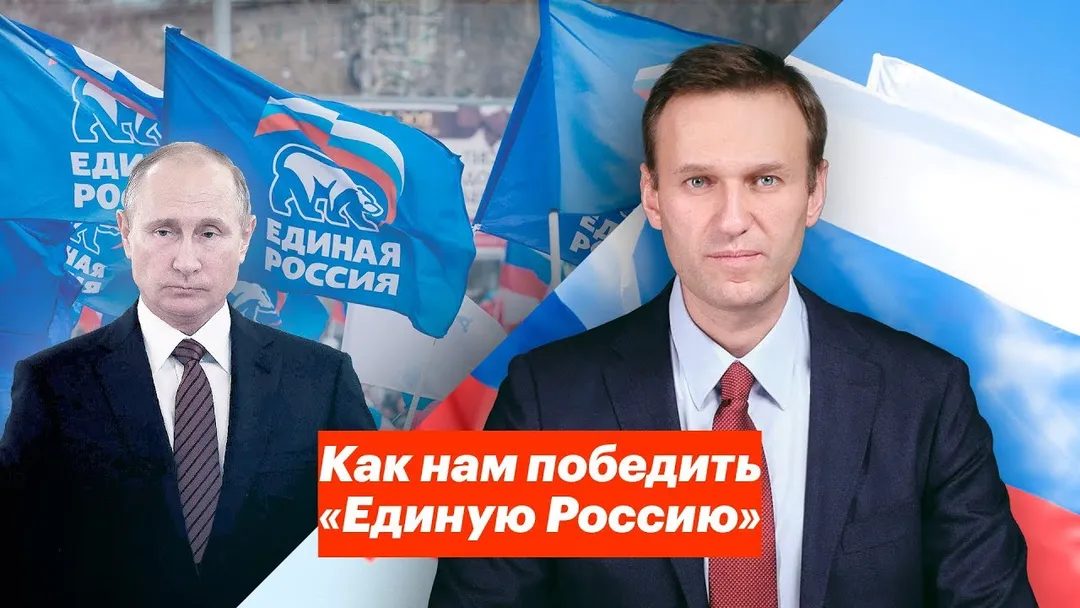
How Can We Defeat United Russia
Hi, this is Navalny, and now I’m going to tell you
how we’re going to beat
United Russia in elections. No, this is not
a joke video — it’s a video about our new
project, with the help of which we
really will be able to start defeating
United Russia in elections — but only if, of course,
we act smart. Please watch
until the end, think it over, and
join us.
This is very important. I’m warning you right away:
while you’re watching, several times you’ll
think, “My God, how boring this is.” But at
those moments, don’t you dare turn the video off.
Watch it through to the end, and then
we’ll be able to upset Putin too.
[music]
So, every year in this country there are
hundreds of elections at various levels, and almost
always United Russia wins them.
And yet, as you can see, this party is
quite unpopular. Even Putin, in
elections, ran as an independent — he was
not nominated by his favorite party. Nevertheless,
a United Russia candidate, or its
disguised candidate calling himself
an independent, always wins. Fine,
maybe in a village — but no, they win in
Moscow, in St. Petersburg, and in
Novosibirsk too.
That is, in places where there are lots of
educated people who actively
use the internet. Why does this happen?
Well, there’s a very
simple bit of math behind it. Look:
a typical United Russia candidate in regional
elections in a large city gets between 35
and 45 percent. Against the United Russia candidate,
the majority of voters cast their ballots for other candidates —
55 percent or 65
percent. But those votes
are split among the so-called
systemic opposition: some go
to the Communist, some to Zhirinovsky’s party,
A Just Russia gets some,
Yabloko gets a little, someone else gets a little — and your
interests in the local parliament are once again
represented by a United Russia member, even though you know for sure
that most people in your
district
hate United Russia.
Hearing every voice is our duty.
United Russia.
And of course the obvious
solution comes to mind:
why doesn’t the opposition unite,
reach an agreement, and divide
the districts among themselves?
I mean, say your city has 20 districts:
in 10, everyone backs the Communist; in 5, they back
A Just Russia; in 3, LDPR; and in 2,
Yabloko. Makes sense — and then we easily
defeat United Russia, and it doesn’t get
a single seat. But in
practice, of course, this is impossible.
For many years this has been
the ruling party’s main tool in
elections: splitting the electorate among
several opposition parties that are, overall,
under control. And no matter how much you and I
try to persuade or beg
Zyuganov, Zhirinovsky, Mironov, or
Yavlinsky — “please, just divide
up the districts” — they will never do it.
They simply won’t be allowed to. Their parties
will be shut down if they start
making deals with one another. And in
the next election in your city, I
guarantee you’ll see the same thing again: you’ve got
20 districts, and the CPRF will nominate candidates in all 20,
A Just Russia in all 20, LDPR in all 20,
and Yabloko in all 20. In the end, 100 percent
of the seats will go to United Russia.
Because they have this kind of guaranteed
minimum vote share — no less than thirty-
five percent, almost without fail —
because they have television on their side,
administrative resources, money, and
simply, in the end, fraud. And in this situation, you and I
feel
terribly foolish. You can campaign as much as you like
against Putin, you can call on people
all you want — of course, you and I will increase
significantly the total number
of votes that go to the opposition
overall. But the votes will still
be split, and the winner will still be
the United Russia candidate, and our vote once again will have
no value. So what can we do
in this situation, if the parties and their leaders can’t
reach an agreement among themselves to divide
the districts?
Then you and I can make that agreement ourselves.
We need to act smart and
vote in such a way that our
votes first and foremost
break United Russia’s monopoly, and only
secondarily
reflect our personal ideological
preferences. And at this point, of course, you’ve
rolled your eyes, waved your hand at the screen,
and said, “What nonsense. It’s impossible
to listen to this. It’s utopian. So many people could never
agree among themselves.”
But I’m telling you it is possible, and we will do
it if we try. And to convince you,
I have both concrete examples and
the math.
First, exactly what I’m proposing
right now is exactly what happened in the most recent
elections in four regions where
United Russia candidates lost — except
it happened spontaneously. In the first
round, people went and voted for any
candidate at all — the main thing was to vote against
the United Russia candidate.
And in the second round, voters realized that
whether or not we like the Communist or the candidate from
LDPR
most often we don’t like them, but if we want to
defeat a United Russia candidate
then we need to go and vote smart
that is, based on who came in second place, but
that is, for the strongest of the
opposition candidates
United Russia lost; specifically in
Primorye, they had to falsify
the election and remove the candidate, but even so
nevertheless, when United Russia lost there
because people organized
consolidated voting for one
opposition candidate—just spontaneously like that
it works because in
gubernatorial elections
there is a second round, but most often there is no second round in
elections, and that’s why we need to
agree in advance—the math
is on our side too. Look, our
next major election is the election of
deputies to the Moscow City Duma
let’s look at the results of the last
vote for this body so that we don’t
consider my
proposal only in theory
but evaluate it using real numbers. In
the Moscow City Duma, forty-five deputies were elected
of them, the Communists won 5 districts, one went to
the Rodina party, 1 to LDPR, and 38 to United Russia
an absolute majority—they pass
whatever laws they want, control all the committees, and
this is Moscow
at the same time, more than 50 percent
was received by the United Russia candidate only
in 16 districts; in the others, United Russia candidates
won with 38 percent, 40
percent, 43, or even 28
percent. That means that, in theory, in those districts
the majority of people came out and voted
against United Russia, but its
candidate still won. That’s how the electoral
math works. Now let’s imagine
that you and I, relying on polling
and the results of previous elections, simply
agree and start voting for
the strongest candidate. Most often
it’s easy to identify them—they have already
run before, came in second, or
are running an active campaign. How
hard would it really be for us
to agree in order to defeat United Russia candidates
it wouldn’t be hard. We only need to bring to the polls
just an additional 3 percent
of new voters, and among those who have already
voted against United Russia, we need
to persuade one third to vote
smart—that is, according to our plan
to consolidate around one
candidate. That is more than realistic. I
understand that you all hate math
I don’t like it myself. I understand that you’ve long
wanted to turn this video off because
it’s hard to take in by ear, but once
again, this is incredibly important, so listen
to me—I need to convince you
because for us to do this together
and if I can convince you, then we will start
beating United Russia. Specific
examples: let’s take two specific districts
in southeast Moscow, a United Russia candidate won there
with 40 percent, and second place went to
a Communist with 26
if only a small part of us
stops being picky and saying,
“no, we’re not going to vote for
the Communists,”
then we’ll crush United Russia. Take
northern Moscow
a United Russia candidate wins with 36
percent, and a Yabloko candidate is in second place with
23 percent. So if
we don’t run around here waving party
flags, but understand: over there they voted
for the Communists, so here we’ll vote
for Yabloko
because that candidate is the strongest, then here we
will knock out the United Russia candidate
and there are many such examples. We will get
a majority
if we vote smart. We are
launching a project that is
called Smart Voting. It is a project
for fighting United Russia’s monopoly. We
understand all the difficulties and all the doubts
many of you do not believe in
elections at all, and you have your arguments. Many of
you want to vote only for your
favorite party, but I maintain that until
we start acting
smartly, we will achieve no success
United Russia and the Kremlin are very cunning
vile
and sophisticated people, so we need to be
smarter
in every situation, acting based on
the circumstances
for example, it’s clear how they will
counter this
system of Smart Voting: they will simply
not allow that very
number-two candidate onto the ballot, just as
happened, in fact, in Primorye
in some places the candidates are better, in others they are
quite unpleasant; in some places there are single-member
districts, in others multi-member ones; in some places there is one
round of voting, in others two rounds
most people do not want
to figure all this out, so we will
figure it out for you and conduct
both analysis and polling. I promise that
setting aside ideological preferences, we
will find and recommend to you, wherever you live,
the candidate who, by voting for them,
will weaken United Russia
and fight its monopoly. And then you say to me
“Navalny, you’ve changed your tune on the fly
and you’re messing with our heads—you used to say…”
"Don't go vote"—that's what you're saying now.
Go to the polls—we'll campaign
against these fake elections and
persuade people not to take part in them. Well,
guys, honestly, that's more or less what I'm telling you.
Because elections differ, situations differ,
and there are many methods of struggle. We have to
do everything.
We have to go to rallies and boycott
elections when they're a complete sham, and
take part in them when we can
make things worse for United Russia. What needs
to be done in practice? We bring together people
who are ready to vote together, strategically.
As I already said, our goal is not
to persuade
50 percent of voters to join us.
We need a much smaller
number of people—but they all have to
vote the same way. We have a website where
you need to register and become
a participant in Smart Voting. You
tell us the address where you live, and we
determine which
district you're in, who the candidates are, and before each
election we tell you, on the basis of
polling, previous elections, and other
factors, who is the best person to vote for against
United Russia. This won't be a quick
process.
It will be a long campaign. I will still be
coming to you with calls to register on
this website.
But I assure you: if you're still interested
in going to vote, and you want your
vote to actually matter, then you need to vote
smartly.
the way our system suggests. Simply
going to the polls is now losing all
meaning if you haven't coordinated with everyone
else. Register, vote
smartly, subscribe to our channel,
they tell the truth here.