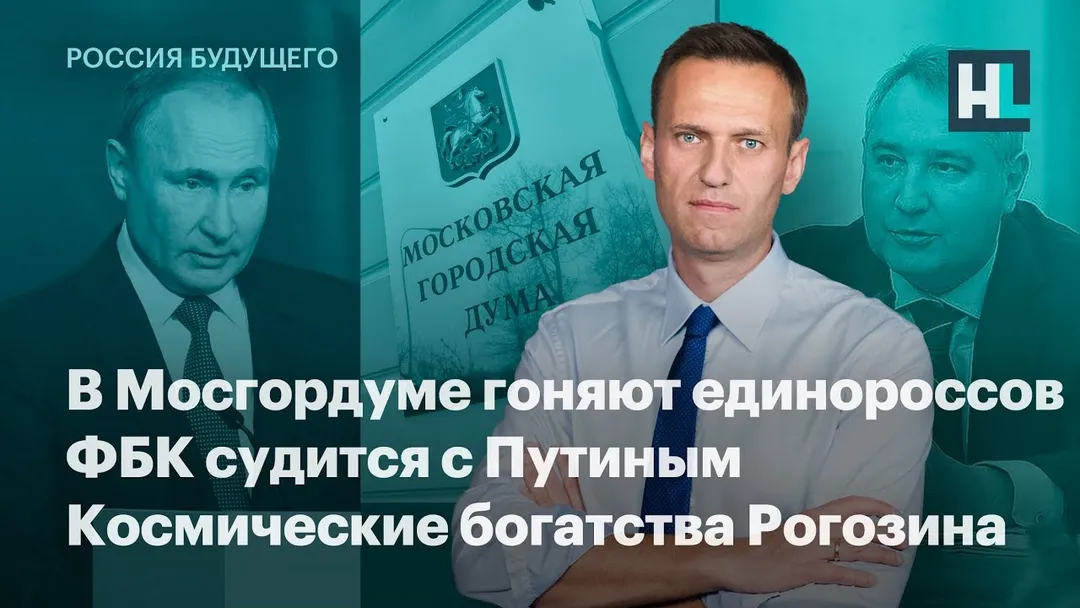
United Russia members are being hounded in the Moscow City Duma, the ACF is suing Putin, and Rogozin’s space-age riches
[music]
Good evening, everyone. It is exactly 8:00 p.m. in Moscow.
That means we are live on air
with the program *Russia of the Future*, and I am its host,
Alexei Navalny.
Or, as the man supposedly hatching plans for bloody
protests—that is what the Kremlin
media called me this week. I really am nurturing
some plans, and if you are nurturing some too,
then nurture them together with me—please send
your questions, comments, and
so on via Twitter with the hashtag #Russia
OfTheFuture. They will be shown to me here, and I will
read them out. I wanted to begin with the topic of
the falsification of history. You know, lately this topic has
also been troubling me lately,
just as it has been troubling Vladimir Putin, because both he and
the entire Russian government—just look at what
Yarovaya is saying—
they are outright obsessed with erecting some kind of
barriers against the falsification of history,
because villains all over the world,
in the West first and foremost, are apparently doing nothing but
thinking about how to falsify history,
especially
the history of our wonderful little Russia,
or of the Soviet Union. Heaven forbid they
do something wrong over there, or cast doubt on our
greatness. Falsifying history—there is
criminal liability for that. Remember, they wanted
to introduce it, and even now there is criminal
liability, or at least it is being planned,
for denying the role of the... and so on. Well then,
they really are so concerned about
the falsification of history. They even started giving
Putin—let's watch for twenty-one seconds
to see how personally concerned he is: "Unfortunately, the most
sacred things sometimes become the object
of speculation. Of course, none of this is new.
This is not the first time we have seen and heard it. We
have repeatedly encountered a selective
approach to history in service of political
expediency.
But now these processes have taken the form
of a truly aggressive campaign."
A selective approach to history in service of
political expediency—an aggressive campaign has now begun,
says Vladimir Putin,
and that is exactly what is happening
right now. This is actually not even
a minor thing, but an important one that shows
quite clearly that the real
falsifiers of history are in the Kremlin.
The point is that a big book was published some time ago,
a large book about the sporting achievements
of the sports society
Spartak, and in general the sporting achievements
of our country. And
the authors of this book included in it, because it was related to
the Spartak sports society,
Spartak,
the triumphant—without any irony—
triumphant victories of the great Soviet
and Russian chess player Garry Kasparov.
And then, just like that—gone. They cut it all out of the book.
So they literally falsified
history. Come on, guys, really—
you cannot erase words from a song; real
history is what it is.
Garry Kasparov now criticizes Putin, and
criticizes him quite harshly, but even so,
he is in fact
—and probably no one would argue with this—
the greatest living chess player,
the greatest chess player on planet Earth
to have lived in our time. And he is real—
he is right here, he speaks Russian,
language,
he has a Russian passport, so you can
touch him, you can talk to him,
he publishes books about chess,
some computer programs, he
—remember—
played against all kinds of supercomputers and
beat one once, then lost the second time. So,
Garry Kasparov is an incredibly great
chess player, truly an outstanding
figure—well, as a chess player, super-mega-extra
great, and part of our history, actually. We are
supposed to be proud of that. But they just walked up and
cut it out. Why? Because right now
Garry Kasparov does not like Putin. And yet
let's look at 1985, at how he was
honored after his victory.
It really was a triumph, and it was our victory.
Why should we cut that out now
simply because Putin does not like it,
because some people do not like it? Here, they love
making films about how, say, in 1962
in a semifinal we almost scored there,
or some marvelous puck
flew into the net in 1983, and in some year
we broke through or won something, and to this day
everyone loves remembering how at the
World Cup we played Yugoslavia, or
in Yugoslavia—well, I am very into
football,
but they chew that over endlessly. And here,
you simply beat everyone outright,
basically. They were competing at the top level:
Karpov and Kasparov, two of our people, one
of them won, and the whole world watched and said,
"Wow, these Russians are amazing." And now
we are supposed to forget it? Falsifiers—
real falsifiers and falsifiers
of history.
Which once again, of course, shows us that
Putin and all this government, in essence, do not care at all about
the country or its heritage.
They could not care less, even though this is part of our
heritage, and we must not hand it over to
these crooks and scoundrels. Let us see
how this whole
book story develops; quite a serious
scandal has flared up. And really,
there is no answer to it. There he is, Kasparov—he
really is a great athlete there,
and it is impossible to cut him out. Let us see what happens.
what they will do and how they will
wriggle out of it. You’ve probably heard that
today we filed a lawsuit against Vladimir
Putin. When I say “we,” I mean
the Anti-Corruption Foundation as an organization,
me, the founder of the Anti-Corruption
Foundation, and more than 10 people,
employees of the Anti-Corruption Foundation. There
is a long video about this on our
channel, Navalny LIVE. Let’s
show a minute of it as a reminder.
Right now, lying on the table in front of me,
is a document. It’s an ordinary lawsuit. You’ve
seen dozens of them. What makes this one unusual is one
name of the defendant.
That defendant is the President of the Russian
Federation, Vladimir Vladimirovich Putin.
Our constitutional rights have been violated,
and we intend to defend them. We are filing
a lawsuit against Putin because we believe it is precisely
this offended man with his lips tightly
pressed together
who is guilty of the largest political
repression case of the past decade.
The FBK case is an attempt
to shake a fist and a petty act of revenge
by the president for our anti-corruption
investigations, and an illegal
attempt by the president to hold on to power
in the country by criminal means. The President of Russia
directs and oversees the activities
of the Investigative Committee, so the attack on
FBK
is the president’s direct responsibility.
Thank you, Vladimir Vladimirovich.
Our rights and freedoms have been violated:
the constitutional right to association,
to form trade unions, and to
disseminate information. We demand
that the FBK case be closed. The Constitution must
be observed. Stop puffing yourselves up and
pursing your lips in offense. Do your
job the way we do ours.
Follow the laws and the Constitution the way
we do. That was recorded in one take back then,
those heartfelt words about
“follow your own Constitution.” Why did we
do this? You can hear the reproach:
“Well, this is just a political gesture, guys. How
can you possibly sue Putin?”
It is, in a sense, a statement, not
just a legal act, of course.
It is a statement, but it is also very definitely
a legal matter. In America, people sue
Trump, and sometimes they win, and
lawsuits are filed against him there.
Legislatures, judges, and
prosecutors themselves initiate certain
cases. In particular, when Trump was in
office, his decision to ban entry
and restrict the admission of Muslim
migrants was overturned
by the Supreme Court because people
sued over that Trump decision, and it
was canceled. In the beautiful Russia of the future,
people will be able to sue the president and
apparently win against him in court. And we, we
act as though we are already in the beautiful
Russia of the future. After all, we
stand for the law, we act according to
the law. And really, who is organizing these
searches? Well, of course they don’t like us.
Bastrykin doesn’t like us, Chaika doesn’t like us,
none of those sitting in the Kremlin likes us,
that’s obvious. But the order to organize
all of this, obviously, came from Putin. Putin
directly, under the law,
organizes it; he is in fact the chief
boss of the Investigative
Committee. So we want to put on record
that we accuse him. And the amount
of lawlessness in this case is simply
enormous—these insane searches,
seizures, they come and take things away from people, from
us too, and
then there is the designation of us as a “foreign agent” (a Russian legal label for organizations deemed under foreign influence). In
court, the Justice Ministry came in and said, yes, foreign
agent. We said, well, show us the document—what
foreign money, exactly, did we
receive? They said, the judge has been shown
a certain memo, here it is.
Please take a look. But no, we won’t
let you photograph it, we won’t give you the memo.
Everything is written there. The judge looked at
this memo, which we were not allowed to see, and said:
yes, yes, yes, I recognize you as foreign agents.
Of course, it’s all part of one package. This
case against FBK, which consists of
all sorts of these fabricated
money-laundering charges that were publicized,
the foreign-agent designation, and so
on—of course it was initiated by Putin.
Putin chaired the meeting
where all these decisions were made.
They were adopted there.
And today there was a funny photo.
Zhanna—well, not funny, really, but striking—
Zhanna, the wife of Ivan Zhdanov, director of FBK, went to
an interrogation. The director’s wife was summoned for
questioning, and she photographed this
remarkable document. It’s called a roadmap,
a roadmap for the investigation in the
criminal case against the director of
FBK, Ivan Zhdanov—a whole roadmap.
All these roadmaps were approved at
a meeting where Putin was present. Putin
is directly involved in this, and we are
directly bringing our claims against him. And
sooner or later, this will be investigated.
This is very important to us. We are doing it,
among other things, so that, of course, people do not
forget. We’re doing it because, well, otherwise
it all starts to feel routine: everyone’s accounts are being drained,
cards are blocked, but somehow we’ve
been living with this for several
months already, God knows how, and it’s like, well, let
people go on thinking—even our supporters,
even you may think, well, it’s all somehow become normal.
Navalny is doing fine there, sounding upbeat.
He’s rattling away on air, so that means everything is fine, but
we’re fine, everything is fine with us, we’ll keep talking,
keep talking, keep releasing investigations,
keep putting out investigations, and of course we
will become even stronger.
And we will, after we get out of
this situation—or even if we don’t and remain
in it, we’ll still grow stronger. But
all the same, we still need your support.
We still want you to keep
talking about all of this. So, well, I have
a question from Alexei: tell us more about
the lawsuit against Putin you mentioned on air—it’s just not very
clear what the mechanism and the goals are. Look,
the mechanism is very simple. Under
the law, we have the right to demand recognition
that actions or inaction are unlawful.
There is a law on the Investigative Committee,
and there are constitutional provisions under which
Putin is the guarantor of the Constitution. If across the whole country
there is a completely unprecedented,
unprecedented in scale number
of searches—hundreds at once—then Putin,
as guarantor of the Constitution, should say:
what is going on here? These searches, this
money-laundering case—
you cannot open a case under such a charge if there was no
underlying crime from which the funds
were supposedly laundered. This whole case is absolutely
fabricated. Besides, why are they taking
phones away from random grandmothers in villages
and so on? That is
completely lawless. So as
guarantor of the Constitution, Putin should say
to the prosecutor, to the head of the Investigative Committee,
to stop it. He does not do that—that’s first. And
second, we can see that the Investigative
Committee is organizing all of this, and Putin, under
Article 2 of the law on the Investigative
Committee,
is effectively its de facto head.
He directs the work of the Investigative Committee,
and in that sense
the mechanism is very clear: we demand
that his inaction be recognized as unlawful,
and we demand that
his actions be recognized as unlawful. We are ready
to present
evidence in an independent court.
Whether they accept the claim or not, we’ll
see. But as I wrote today in my
post,
under him, they just accept
claims from some noodle shop, damn it, some shabby restaurant
in Armenia, where some taxi company shows up and
says, you know, let Navalny
and Sobol both pay compensation there
because people would have eaten more noodles that day
otherwise, but instead, supposedly, people
lost their appetite because of the rallies, and we
have to pay them all. This is
absolutely unlawful nonsense, and yet they accept those claims.
So they ought to accept ours too, at least a little, because
among this whole flood of lawsuits,
ours is actually the most reasonable one. Viktor
Medved asks me: Alexei, can
Putin in any way respond to
your suit? Viktor, well, let me say this:
please understand, over the course of
his whole time in power, has Putin ever
responded in any way to even one of our
complaints? I think, of course—I’m sure
that Putin will pretend that nothing
is happening, and that the court will try to throw out
our lawsuit. Remember, at one point we filed
an exactly similar, very clear and straightforward
lawsuit when Putin, by his personal decision,
allocated a cash subsidy that
benefited his son-in-law Kirill Shamalov.
That is a direct conflict of interest under the law.
We said that Putin cannot do that,
that it is illegal, and in exactly the same way our
lawsuit was not accepted. Putin pretended that
nothing was happening. The entire press wrote about it,
everyone was interested, well, because
it really was illegal: he had effectively
signed over, given, essentially, to his
son-in-law, if I remember correctly, about a billion
dollars. Putin did not respond in any way, and here
he will try not to respond either. But the fact that they do not
respond to our investigations does not
mean that we should stop doing them. All of this
goes into a folder, as they say.
They said I was supposedly nurturing plans for
bloody protests. Sooner or later,
all these files of ours,
they are part of what we are building. And it is
not bloody at all—just absolutely
within the law. But all the same, we are not going to
drop any of this. And I also want to say a few more words about Putin,
because it has become so great and
funny—just hilarious—to watch him.
We are simply going to get
enormous enjoyment over the course of his
remaining
years in power. Quite possibly there are
still quite a lot of them left, unfortunately.
But that depends on you and me. Still,
I guarantee it will only get funnier and
funnier, at the very least because
it’s all just running out: the guy has been in power so long
that he has genuinely forgotten what
happened ten years ago, fifteen years
ago, and the people around him have forgotten too. And
besides, the vocabulary and the number of
political ideas they have are
limited, so now they’re simply starting
to say the same things over and over in circles, hoping
that everyone has forgotten they were saying this
10 years ago or 15 years ago.
But the internet is the internet—it forgets
nothing. This week, for example,
it was just funny: it’s 2019, and right now there’s the forum
“Russia Calling!” (a Russian investment forum), this regular forum
that Putin always attends, an economic
forum where he talks about his breakthrough
economic ideas—his main thing, so to speak.
a platform where he says something very
important from an economic standpoint. Let’s
watch. 29 seconds. The most important thing
that Russia must do—what
key structural changes I mean. We
talk about this often and at length, but
unfortunately, so far we are moving forward—and this needs
to be said openly—we are moving forward
slowly so far, and this is a serious challenge
that we must respond to.
First and foremost, the Russian government, our
business community, must achieve
radical shifts in increasing
labor productivity on the basis of
modern advanced technologies, simply
qualifications, and new competencies, because
what is the most important key task?
Raising labor productivity, and
he says every phrase very clearly,
you can see he has these cue cards, and on them
the thesis is written in large letters: increasing
labor productivity and machine
time. This takes us six years back
to the same forum, in this very tower,
the Russia Calling! forum, 2013. So what
is Vladimir Putin demanding?
And this is where the good news, so to speak,
as the saying goes, comes to an end. At the same time,
we lag behind developed economies by more than two times in
terms of
labor productivity.
Such a gap between the level of consumption and
efficiency is undoubtedly dangerous.
Living off natural-resource rents at the expense of
future generations—unearned
prosperity. Labor productivity
is everything to us. We instructed the government.
Years passed, six years passed, and nothing
changed. And before that he was demanding
labor productivity, and he’ll demand
higher labor productivity again,
again in another six years,
if he remains in power. That’s all he does—demand it
an endless number of times.
If you just google right now “Putin
demanded an end to rising gasoline prices,”
you’ll just laugh, because once a
year, or once every two years at the very least, he
resolutely demands of himself—Putin
demands an end to the unjustified rise
in housing and utility tariffs. He has been demanding this constantly for 20
years in a row, and it gets funnier and funnier,
because, well, okay, there are things like
that which the public, in principle, wants—
to stop gasoline prices from rising.
But even things like
labor productivity, or whatever
macroeconomic decisions—everything
has already been demanded many, many times, a lot
has been said about it, and now all he has left
is to repeat himself. More than that, the project
and those magnificent projects that
were announced with such enormous fanfare and
started being announced a second time in 2006.
Remember how some time ago literally
every TV channel was broadcasting that
at last, from Krasnoyarsk Krai (a region in Siberia)
to Tuva there would be a railway? In 2011,
Putin hammered in the ceremonial spike and launched the construction.
Vladimir Putin launched the construction
of the Kyzyl-Kuragino railway. It is a
strategically important line. Its
length is 401 kilometers (about 249 miles). It
will connect Krasnoyarsk Krai with Tuva.
The opening ceremony took place
not far from the capital of the republic.
That is exactly where the first station will be.
Kyzyl-Passazhirskaya. The prime minister was handed
a sledgehammer and entrusted with driving in a silver
rail spike for the first section of the railway
track.
By order of the Chairman of the Government
of the Russian Federation, Vladimir
Vladimirovich Putin. What a sight—
a silver spike, a hammer, sweeping
blows. Back then Putin said the railway
would begin operating in four years. 2011.
Year.
What do we have in 2019? In 2019
we are being told that
work on this section will begin in
the following
year, 2020. Well, because basically, yes, yes,
this is how the authorities and officials operate:
they start doing something and say,
“In five years we’ll build it.” But in five
years there’s a new election cycle, and
most likely you won’t be in power anymore.
And in eight years you definitely won’t be in
power. Or, as you may remember, I showed
a lot of funny images from 2005, 2003,
when Roscosmos officials—we’ll talk more about them—
loved to say that
we would already be
landing on the Moon by 2018 and
landing on Mars, and then basically heading off
to another galaxy—everything would be
absolutely amazing. Or those famous videos
where they said that by 2020 there would be
a mainline built from St. Petersburg
to Kamchatka.
You’re just sitting in power, and then the time comes
while you’re still in power. By the way, it’s very
funny: 2020 is about to begin in
a month and a half, and they had that program
for socioeconomic growth through 2020,
and it had many completely specific
targets. It was the most important program
of Putin’s, essentially. Putin’s government
was governing Russia
and making this program. It’ll be hilarious when
now everyone—including me, of course—
starts comparing what exactly they declared, what
they announced, and what they actually did.
Roughly nothing. Roughly nothing.
In Russia there is not a single
kilometer of high-speed railway, not
a single kilometer, because what runs from
From Moscow to St. Petersburg on the Sapsan (high-speed train) is not
high-speed rail at all — there’s nothing of the sort.
Let’s discuss it, it’ll be interesting. So, a question:
Shelest asks me: what do you think
about mandatory pre-installation
of domestic software on smartphones?
Indeed, today they passed, in the third
and final reading, a law under which in
Russia it will be impossible to sell your iPhone
or your Samsung or your Huawei if
they do not have domestic software installed.
Well, everyone got worked up and
started thinking: is this going to be spyware
that will be installed? But in practice, what
this will lead to is that on all phones
that are sold here, there will be
things like Yandex Maps installed,
definitely Yandex something-or-other, some kind of
junk, the Sputnik search engine,
and whatever it is they now have instead of Wikipedia,
that thing they’ve already spent
20 billion rubles on (about $220 million), and people who
buy a phone will spend their time
deleting it all immediately, I have no doubt.
I’m sure that mobile carriers that
sell phones will
immediately start offering services, just like now
they offer services saying, let us sell you
an iPhone for a few thousand rubles (tens of dollars)
2,000 rubles more expensive (about $20).
For the iPhone, we’ll install various
programs on it — there’ll be a similar service:
we can sell you your Samsung, and for another 1,000
rubles (about $10) we’ll remove the domestic software from it.
Besides, obviously this will lead to
people simply buying them abroad.
You understand, even in Belarus
or any other country now, if you just
go there, or if an acquaintance is going, then you’ll
say: buy me an iPhone without
any domestic software on it.
But I think that at the first stage, of course,
they won’t install any kind of spyware,
but overall, of course, they’re
looking at China, right, and they want to make
something similar to what is happening in China,
where — well, not everywhere, but in part of the country, in the
north, where Uyghurs live — you are required
to have spyware on your phone
that monitors your
messages and your movements. It’s not a law,
but you can be jailed
if they discover that your phone does not
have such a program installed. Ideally, that’s how they
see it working, but for now it will be
just this, just plain stupidity. Alexander
asks: Alexei, please comment
on your position regarding
Valery Rashkin’s statement
about impeaching Putin. I didn’t have time and
was preparing for the program. I know that he made
such a statement; I saw it trending on YouTube, and the
statement is up there. In any case,
I support it, because there are many, many
grounds on which Putin should be
impeached. At the very least,
the case we are making against Putin is that he has
committed such a number of absolutely
illegal actions that he most certainly
deserves it. Dima Akhmedzyanov asks
me: Alexei, what do you think about the logo
for St. Petersburg for 7 million rubles (about $77,000)?
It’s a pity there’s no picture of this logo. Well, I
am not trying to intrude into the realm
of art,
but in general this strange
obsession of all cities and some state
organizations, first and foremost, with
ordering logos from Artemy
Lebedev (a well-known Russian designer),
cities order them for a ruble, while
state corporations order them for hundreds of
— well, not hundreds, but for many millions
of rubles — or not from Lebedev anymore, the point is
from some other designers, real
or not-so-real designers — this is,
frankly speaking, complete nonsense. All these
logos — they exist, but what are they for?
Why does St. Petersburg need one, where, as
we’ve seen, they can’t even clear the snow?
To urgently change the logo, and especially
to spend 7 million rubles (about $77,000) on it — I
have no doubt that St. Petersburg is the kind of place
where you could announce an international competition
and say: design a logo for
St. Petersburg for one kopeck, and all
the world’s agencies, unknown designers,
whoever — they’d line up, because
it’s St. Petersburg. Of course they’d want
to draw a logo for St. Petersburg.
They’d want to, even if you only know how to draw
a little.
23,500 people are watching us live.
I want to talk about Penza — there
a rather tragic situation happened there.
People were snickering about it online too:
they boiled people alive. But in fact,
those people who were boiled — let’s watch the video — people
were driving in a car and fell in.
Let’s take a look. Here you can see the car
simply fell into a hole. You can see in this
video — this is a pit of boiling water, as
you can see. It was basically a roadway,
a road people drive on. A pipe burst,
boiling water started pouring out, it undermined the ground, well,
it simply turned into a lake of boiling water. Into it
fell a car, and two people died instantly.
As you can see, no one could do
anything. All of this would look like
the usual tragic situation for Russia
caused by the collapse of public utilities, if not for one
particular feature: these utility networks
belong to such a great guy by the name of
Viktor Vekselberg.
And this Viktor Vekselberg — we’ve known him for a long time,
we’ve been dealing with him for a long time. Back in
2011, we published a major
investigation into how he made his money.
simply several hundred million dollars
on flies, on the fly, on the nation, with the creation of
which he sold to the state, but in
reality, to the general public this man
Vekselberg is known for the fact that in 2004
he declared that he was doing a huge
service to all of Russia
by buying back abroad the Fabergé eggs that
had belonged to the imperial family, and with
those Fabergé eggs everyone made a huge fuss
naturally, there were lots of jokes about
the Fabergé eggs, and people joked about Vekselberg
he displayed them in some museums, and apparently
there was even talk that he would donate them
as a gift to a museum, though he never did, or
maybe he gave away a couple, but the point is
that Vekselberg’s business consists, among other things, in
grabbing enormous
chunks of the housing and utilities sector across the country, and from that sector
he extracts money, and with that money he, among other things,
buys those damn Fabergé eggs
buys real estate in Switzerland — all of
them there, well, that kind of oligarch
buy themselves yachts and planes — that’s
an important point, because
but people often tell me: why are you stirring up
hatred toward the rich? Maxim Galkin (a Russian TV host and entertainer)
remember, I argued with him about this
about the rich — why do you deliberately
draw attention to their yachts and
palaces? Because it’s not just officials
or just millionaires — why are you going after
Vekselberg over those Fabergé eggs? I
go after him because 90 percent of what
makes up
Russian billionaires, with rare
exceptions — like the guys behind Yandex or
Magnit, who built something from scratch —
this is simply
money earned from collapse and
poverty. This housing and utilities system in Penza, in
particular, is in such terrible
condition — that damn pipe had never been
repaired
and it burst, and there
two people died
because they spend money on all this
nonsense, because they think differently:
the state allows it, and the idea is that
we can simply keep raising utility rates. Abyzov (a former Russian minister) did
the same in Novosibirsk and across the
country: rates go up, but money for
improving the infrastructure is invested by no one
absolutely no one. We saw in Penza
in a fairly large city
that this does not happen — that money is simply
spent on some luxurious lifestyle, and
when another New Year comes around and
we are told that utility rates will rise
they attach a pile of papers, and on those
papers it says: technical and economic
justification
for raising rates above inflation, blah blah blah
there’s a whole stack of
documents in which, first of all, you
won’t understand anything, and second, they won’t
even show them to you. But the essence of those documents
is that somehow
Vekselberg once again needs a house
or a yacht, or his business is in trouble and
he needs to cover losses, and therefore
the pipe in Penza
no one will ever repair until
as long as we have these
housing and utilities monopolists sitting in Moscow, in monopoly positions
and in all the other cities there exist
in most cities there exists this kind of
monopoly. That is precisely why a major
part of my program has always been
demonopolization. Milov, in his program,
constantly talks about this: until we
smash apart all those people in the housing and utilities sector
— I almost called them fat cats
— just plain crooks who
historically grabbed for themselves
huge chunks of it — this should not
be the case. Housing and utilities is a highly competitive
sector, and we pay quite a lot for these services
people can earn money there under conditions of
a market economy
but if everything is arranged so that you have
monopolists, then in any case you will
have to pay them
we will keep seeing these
monstrous stories: someone
fell into a pit
someone was boiled alive there. I’m being asked:
Alexei, what do you think of the bill
on the prevention of domestic violence? In our country
in general, with these draft laws on
domestic violence, strange
things are happening — outrageous and unacceptable things
at first the state
declared that it would
decriminalize the article on battery because
most cases of battery
are, like, when a husband
beats his wife
90 percent of such cases, they said,
well, you know, a husband beat his wife — that’s
a private family matter. But if in your
apartment someone smashes my face in,
that can somehow be dealt with, but here
it’s all this “if he beats you, he loves you” nonsense
and all the rest of that crap. They said they would
decriminalize it, after which
naturally, a huge scandal broke out
because one woman was killed, then another was killed too
that’s how it used to work before:
the husband got drunk and started fighting with his wife and
the children; she could at least call the local police officer
and he would be locked up for 15 days or taken
to the police station. Now they say, well,
it’s all decriminalized — “if he beats you, he
loves you” — but then he killed one, then another
then a third, and a huge scandal began. There are
women’s organizations, and not only
women’s groups — any normal people are speaking out
for what, of course, should be
criminalized. If a person
beats their relatives at home, they
are committing a crime, and that is in no way
different—quite possibly it's even worse
than when he simply beats up some
passerby on the street, because his
family members are far more defenseless, and
now this whole
mess is starting up—a special law,
they're introducing something like that. None of
that is necessary. Unfortunately, a phenomenon
like domestic violence—a husband beats his wife, a wife
beats the children, the head of the family beats everyone
indiscriminately—has always existed. We must
eradicate it. It existed in the Russian Empire
it existed in the Soviet Union, and
it was regulated—there was, damn it, a normal
criminal code where all of this
was covered. If there's the will, there's an article of law.
So if he's getting violent,
then let's lock him up for 15 days or for a year, but
instead they first come up with a bunch of bullshit because
they're fighting against this so-called juvenile
justice system.
They say the state must not interfere in
family matters, so *Domostroi* (a traditional patriarchal Russian code of household rules)
is supposedly fine: a bearded man in a *kosovorotka* (traditional Russian shirt)
comes in and smacks everyone around,
and that's apparently how they imagine
people ought to live. That's the kind of idea
they have in their heads. So there is constant
pressure, including from the church, under
the influence of strange people who
call themselves conservatives, but in fact
they are just some kind of
crazy, dangerous lunatics. We constantly
see a push in favor of
not prosecuting anyone
for domestic violence. That is, of course, complete
nonsense. Alexei will talk about what's happening in
Shiyes (a protest site in northern Russia)—well, to give you an idea of what's going on there,
there is a genuinely heroic
resistance by local residents. I saw
people forming chains, linking up like that,
trying to encircle the area, and
that's why people from the city council went there to defend
the camp from being stormed. In other words, there is
a truly desperate civic
standoff there. I may talk about it
in more detail in future broadcasts, but for now
I wanted to say something about Rogozin. In
the last program—I’ll brag a little—
in the previous episode I showed you this
video of Putin sighing
and worrying about how
everything had been stolen at the
Vostochny Cosmodrome. A hundred times, he said, everything had to be transparent,
you must work transparently,
the funding is transparent, huge sums are being allocated,
the project practically has
national significance—yet no, they steal
hundreds of millions, hundreds of millions.
There is still no order there; they still haven't
managed to put things properly in order.
I showed that, and then we thought: listen,
the man really has the nerve
to say that he was demanding
transparency. So let's try
to quickly, maybe within
a week, find something interesting and
tell the public what Putin
is being told about this so-called transparency. But
it's obviously nonsense, because corruption at
the top level is rampant, and we simply took a list of
the leadership of Roscosmos, the leadership
of Vostochny, and thought: now we'll
check them against the databases, take a look, and then
sort of let the machine help us with Rogozin
and just have a look. It seemed like—well, what is there
to look at? He's been checked a hundred times, a hundred times
people wrote about his apartments.
We won't find anything on Rogozin. The thing is,
he used to publish his asset declarations
on the government website, but now on the
government side no one publishes declarations
anymore, and no one looks at what
he has hidden who-knows-where
on the Roscosmos website. So we did a simple
thing: we went onto the Roscosmos website,
looked at it, and were honestly stunned by
his official salary: 23
million rubles a year (about 230,000 euros / 250,000 US dollars), one and a half times more
than ours—2 million rubles a month instead of thousands
of rubles a day. The guy is an employee
of a state corporation. So we started
looking further into his declaration and simply
found things for ourselves that we decided to
show you—and Putin, naturally,
who knows all of this already—but just to rub
his face in it once again: don't tell us
anything about transparency when
right next to you everything is happening openly.
Our investigation
consisted of the following: we
took the declaration, and then simply
looked at how this dacha (country house) is laid out and
showed you an aerial flyover of it. Let's watch
the 13-minute video posted on Mail.ru—on the
main Alexei Navalny channel. One
moment, I'll show you. We are in the north of Moscow,
just beyond the MKAD (Moscow Ring Road), in the Khimki area, and here is
Rogozin's brand-new country house, almost 800 square meters
in size. It stands on a pleasant wooded
plot of 25 sotkas (0.25 hectares / 2,500 square meters), which we also see in
Dmitry Olegovich's latest declaration.
Rogozin expanded his holdings by exactly
two times, and now it is a plot of
half a hectare, and as you can see, work is boiling away here
full steam.
Just like at the Vostochny Cosmodrome, we notice
a path
that at first seems to lead nowhere.
Let's look closer, and we can clearly see
a gate to the neighboring plot, and quite a substantial house there
—larger even than Rogozin's: 808
square meters. The answer to this question
can usually be found in extracts from
Rosreestr (Russia’s state real estate registry)
but not this time, because according to
the official documents, all of this is owned by
a private individual. The neighboring 800-square-meter
house was, in 2017,
purchased by Rogozin’s aide from
the government, Valentin Vasilkov
Semyonovich. Rogozin’s plot—half a hectare (5,000 square meters)
of land and an 800-square-meter house—is worth 200
million rubles. The plot belonging to Rogozin’s elderly father-in-law
and Rogozin’s—we estimate at 150 million rubles. 35,700 are watching
live right now, and just as I was
speaking, Igor Drozdov—37—was correcting me
already. Igor Drozdov asks: what do you
think about the fact that they’ve allowed
drones to be shot down with military weapons?
Indeed, today really was such a
productive day for our State Duma (Russia’s lower house of parliament). They
passed, in the third reading, a law under which
they allowed basically everyone there to
—the National Guard, the police, well, just about everyone—
to shoot down drones. Why? Well,
for exactly that reason. They’re not concerned about
any other use of drones. There’s only one thing
that bothers them, one thing that infuriates them: all these
drones, in their minds, are associated exclusively with
the activities of the FBK (Anti-Corruption Foundation) and other organizations
that simply fly these drones around and
show people the dachas (country houses).
Well, that’s exactly the point.
You see, we thought, let’s
see how quickly we can find
some obvious corruption at the highest
level, connected with the space sector, and we didn’t even
need to search for anything. I mean, it’s just
there in plain sight: he registers a 150-million-ruble house,
an 800-square-meter property worth 150 million
rubles, in the name of his father-in-law or grandfather or whoever.
He bought one car for 12
million rubles, a second car for 8
million rubles—20 million rubles
spent on cars in a single year.
He’s the head of a state corporation, but how
does this even work for them? What
especially got to me, by the way, while we were preparing this
and digging through everything, was this situation. We, we
naturally wanted to compare his salary.
When we saw 23 million rubles there for
a deputy, 20 million rubles—is that a lot
or a little? It’s useful to look at NASA’s website; there
on many of their pages it’s written
about transparency, and all the figures are there.
We can see that the head of NASA earns
one and a half times less than Rogozin. Then
we start googling how much
an engineer at NASA earns, and how much an engineer at
a Roscosmos enterprise earns, and the engineer
here earns several times less.
Meanwhile, the bosses here earn
several times more than in America,
while the engineer here earns several times
less. Does it still surprise you, then, why
Russia, for example in the number of
launches, has already fallen behind not only the United States, but also
the European Union, and even China has left us
far, far behind? Because, well,
all the drive,
all the ambition, the entire intellectual
resource of these people—where did it go? That’s right,
it went into securing their own
schemes—one relative here, another relative there,
this got re-registered here, that got shifted there.
As we say in the video: classified, removed from the registries,
transferred here, siphoned off there, and boom—everyone’s
rich, everyone has some kind of Mercedes, and it all seems
to be legal. And Putin goes around
ranting about some kind of
transparency, some kind of—well,
we would very much like
Putin—though of course he himself won’t say anything,
he’s forbidden from speaking about it, from mentioning us—
but maybe Peskov can always tell us:
what do you have to say about transparency? Just
explain to us: where
did the money for all this come from?
What’s especially outrageous, of course, is that all this
is happening with Dmitry Rogozin. The most
glorious of his actions, of course, in
recent times is this legendary
tweet.
Let’s take a look at it. Guys,
“I would trade, without a second’s hesitation,
all my thoughts, all my
positions, for the chance to be in the same trench
with the defenders of Sloviansk.” Do you understand what a
spectacle of hypocrisy this is? These guys, damn it,
set themselves official salaries of 20
million rubles and sit there typing, pretending they’d give it all up
and go straight to the trenches.
“An automatic rifle here, a mess tin nearby—or better yet,
not even a mess tin, better an upturned helmet,
with some buckwheat porridge in it, and I’d pull a spoon
out of my boot, eat, and then go off
to shoot at Ukrainians”—that’s what he’d supposedly give everything for.
But in reality, these people really are
just going mad from excess, spoiled by luxury, and
it’s our duty to fight them however
we can. There are a lot of questions about what
I think about how great it is that they launched
the MCD—the Moscow Central Diameters
commuter rail lines. I wasn’t following it
very closely today, but I know that
they effectively launched these suburban trains. The topic
is pretty close to me because
from age 16 to my early twenties, every
single day I rode the commuter train from
Golitsyno to Belorussky Station
and I’ve hated all those trains ever since
because I spent so much time on them.
And I just saw that today
Putin came to Belorussky Station
specifically
to open and launch these trains, and it
apparently caused some kind of collapse up and down the line.
People were stuck in those trains for hours,
and at the same time the trains arrived shortened, all
packed to the brim, with people cramming into the cars. It was this kind of
small-scale but very real breakdown.
A transportation disaster, fortunately without
any casualties. The idiots responsible for it
were people who decided to use it for publicity and
shoot some kind of reports, and they blocked off
all the railway tracks there.
Besides, it seems pretty obvious to me that
they simply miscalculated everything there.
And the trains started running more slowly.
These commuter trains are operating oddly somehow, they
have been shortened. I’m not going to
go into detail right now because I haven’t
looked into it fully, though I’ll try to. But
the fact is that today the entire internet
and Twitter were flooded with photos
and videos of people packed in like sardines
trying to escape from these shortened
cars.
They were forcing open the doors of these commuter trains and
jumping out to freedom because they were sick of
standing there for hours and hours because
Putin was at Belorussky Station in Moscow.
That kind of thing. Natalia asks me, “Alexei,”
“do you know any details about the ties between
Abyzov, Svyaz Bank, and the withdrawal of
800 million rubles (about $12.5 million)? I only know
that an investigation was published by
the journalistic organization OCCRP.
You can easily find it online. I think
they did it jointly with *Novaya Gazeta*.
There’s quite a long article there about how
Mikhail Abyzov, who, by the way, was also
in the housing and utilities business—I already told you
about Penza and Vekselberg—the same kind of
thing. This was in Novosibirsk Region.
Well, now he’s already in jail, so he’s not
doing it anymore. But an investigation about Abyzov
came out while he was still a minister, and it’s
no secret to anyone that we consider him
a crook and a villain. I have no doubt that everything
written in that article is true. On my
paper cup it says, “Watch your back.”
For those words, “Watch your back,” a man
named Yevgeny Yurzinnov has already been
held for several days
behind bars, in jail, because
he wrote those words: “Watch your back.”
Judge Krivoruchko—the very judge to whom I myself would gladly
say, “Watch your back,”
because this is Judge Krivoruchko, and he has
tried me more than once. A more disgusting,
lying, vile swindler, who isn’t even
really a judge but a parody of one, is hard
to imagine. He’s a kind of special judge
at the Tverskoy District Court (in Moscow).
He’ll rubber-stamp any nonsense there.
It was this very Judge Krivoruchko who handed down four years
in prison to Ustinov—you
remember him, the one who was later released.
They said, “Good Lord, of course he was
jailed by mistake, the whole thing was completely wrong.”
They didn’t acquit him, but they gave him a one-year
suspended sentence. But the fact is that
everyone acknowledged that Judge Krivoruchko had issued
an insane,
absolutely unlawful decision. And when
he issued that unlawful ruling,
many people, including Yevgeny Yurzinnov,
wrote unflattering things
on Twitter and elsewhere about this judge,
Krivoruchko. And, broadly speaking, I can
sign my name under those words: Judge
Krivoruchko is simply a scoundrel. He himself
should be put in prison; he should be driven
the hell out. But against
Yurzinnov they opened a case for making a threat
to kill. For example, if I say
that Judge
Krivoruchko should be sent to the glue factory,
is that a death threat? I mean,
the authorities were stung at first, bitterly
and painfully, because they were reproached for having
handed down absolutely unlawful
verdicts. Everyone was outraged by it. But then
they decided to take revenge on some people and
literally started running through
comments and jailing those who wrote
something. His wife is now recording
a very sorrowful appeal
to tell you that he was beaten in the pretrial detention center (SIZO).
All right, two seconds, let’s take a look at the clip.
My name is Karina Amirzanova.
Alexandrovna.
I am the wife of the accused, Yevgeny Arzu-
nov, who was detained on November 12,
2019. He was detained in my
presence, in a hotel room. We were there
not by accident: on the 13th, on November 13,
we were supposed to fly out of
Vnukovo Airport for a trip to Italy.
The investigators claim that we wanted
to flee the country. There was nowhere for us to flee to.
I have the impression that he
was beaten there, and that’s why all this time it feels
as if they’ve been hiding him from us. And
he’s not the only one—there are two others, Sergey Polovets
and Alexei Meresov. These are people who,
when Krivoruchko handed down
an unlawful ruling—which has already been recognized as such—
they wrote to him online,
something like, “I hope you
drop dead, you bastard.” Any normal
person said those completely
justified words about
that lawless thug of a judge,
Krivoruchko. They’ve now been jailed, and they are being tried.
Krivoruchko himself is not on trial—Krivoruchko
continues to receive a salary of about
500,000 rubles a month (about $7,800),
rides around in an official car, and in his
black robe
and little glasses keeps on handing down
unlawful sentences. People are being tried
for what they wrote on the internet. And separately, you understand,
there’s clearly a whole gang of idlers
whose job is to run through
comments and read what exactly
people wrote about Judge Krivoruchko, and then
open criminal cases over it. That’s right.
There is, of course, a criminal statute covering threats
of murder. And if it were actually being applied
to protect me, then all of Prigozhin’s people
would have to be thrown in jail, because
comments like “watch your back”
or “death is coming for you” — I get a hundred
thousand of those a day, and no one
in the Interior Ministry cares.
But when it comes to Judge Krivoruchko,
they run around opening all these criminal cases.
Then they’ll go on about how
their clearance rate has improved. So yes,
that offense certainly does exist. Fine.
Even if Judge Krivoruchko is trying
a gangster or a criminal, and he fears that
someone might crack him over the head with a stick, he files
a complaint saying he received death threats.
But then the police should go out and find
this Ryzhy, or Plovets, or Veresov,
and see that the guy was just flying with his wife
to Italy on vacation.
They come up to him and ask,
“Excuse me, why exactly did you write this?”
“Do you want to kill Judge Krivoruchko?” Well,
he says, “No, no, come on, I wrote it
because I think Vova is a scumbag, you know,”
you know.
“Drop dead,” “I’ll kill you” — that’s the sort of thing
people say to each other
all the time. In that sense, the offense of
making a death threat should include
some actual reality to the threat. When people
write something online, that doesn’t
necessarily mean anything. But here they immediately
throw people into pretrial detention (SIZO, a Russian remand prison) because the state
the state really wants to lock up
someone it is very fond of — Judge Krivoruchko,
who, in turn, is ready to
put absolutely anyone away for any
nonexistent crime,
shoot them, crush them,
and burn them. In other words, he does exactly the same thing
only
as gangsters do, except
in a judge’s robe. So I just want
to express my support for all three of these people,
who are completely innocent and are sitting in jail
not only despite being innocent, but also because of
a complete bastard and thug,
which is what Judge Krivoruchko is. So, Vitaliy
WSOF asks me: “Alexei, will there be
something today about ‘snatch-and-grab’? That really
was hilarious — whether it was about oil or processors.”
You wrote that, and I think we should have
shown that video where Putin says
something like, well, we’ll just
snatch-and-grab, steal American
technologies. By the way, that perfectly
captured something about him — that smug,
self-satisfied attitude, like the Americans will create the technology, and then
we’ll just snatch it. And in that whole
‘snatch-and-grab,’ ‘swipe it,’ ‘make off with it’ business, you can clearly see
his very essence. He lights up at the thought
that something can be pinched, swiped,
stolen. But it never even occurs to him
to say, “You know, we also have
science, we also have technology, and we don’t
necessarily have to steal anything. We
can invent something ourselves, create something.” But no —
it’s all ‘snatch-and-grab,’ we’ll just haul it away.”
And there are people just like that sitting in the hall, you know, at
that same “Russia Calling!” forum,
and it’s kind of awkward — everyone understands what nonsense this is,
but those bankers are such cowards
that they giggle, “Ha-ha-ha, snatch-and-grab, what a
great line.” Right, another question — something
about Yakutia (Sakha Republic). Is it true that in Yakutia, on November 21,
all schoolchildren will be required
to perform
the national anthem in order to foster
social responsibility, writes
Presidentushka to me. Well, this little president
of Yakutia came up with this nonsense. It’s like
that saying about what a cat does when it has
nothing better to do. These people are busy with
absolute crap. They’re sitting there in Yakutia —
good Lord, there are so many problems in Yakutia,
a huge number of real problems —
and this bunch of idiots calling themselves
United Russia, the party in power,
sit around thinking up things like,
“Hey, let’s make the children sing the anthem before
every lesson.”
That’ll teach them social
responsibility. Even in the Soviet Union
that didn’t exist. I was a child
of the Soviet Union, and even then there was nothing like that.
There was plenty of idiocy there, and yes, we sang
all sorts of Pioneer songs and had all kinds of
events, and they raised the flag,
and there were ceremonial assemblies — all of that existed, but
not every day. But in Yakutia, apparently,
the current bosses think
it should be every single day. Let the kids do it.
Let all the children in
Yakutia understand from an early age
that the people running our country are idiots, and
that will be enough — no one will need
to prove or explain anything to them. They’ll just, after the first time,
and painfully, hear: “Kids, let’s
stand up, now we’re going to sing the Russian anthem.” They’ll
sing it, and the next day she’ll say,
“Kids, stand up. Lenochka, Valechka, let’s sing
the Russian anthem.”
And so on every day. And by the 10th, the 20th,
the 100th day, the children will simply — well, first of all, they’ll
hate that anthem
and hate this government.
Then they’ll come to rallies with us.
That’s how, as they wrote there, church protests
and all those protests grow out of this sort of thing.
That’s exactly how church protests arise, and sooner or later,
anyway, the last thing I want
to end this program with: I love, absolutely love,
watching broadcasts from the current Moscow City Duma,
because, unlike the empty show it used to be,
thanks to you and me, we elected
great deputies — genuinely great deputies — and
There are 45 people there now.
You know, out of 45 people they managed to gather 20
opposition deputies through a lot of
voting. Well, about three of them kind of
keep disappearing all the time, but 17 are actually there,
pretty desperate, hardcore guys.
And in the Moscow City Duma, well, first of all, at last
these United Russia members really
got pushback.
People openly argue with them, and the sessions
go on for hours because
the opposition members are no longer just sitting quietly and not standing up for their rights.
What's more, we were just talking
about Judge Krivoruchko, and finally
— thank God, hallelujah — in the Moscow City Duma there was finally
a proper assessment of what
the judicial system actually is. And by the way, because
of that,
it also includes justices of the peace, and before them
the chair of the Moscow City Court reports back —
Yegorova.
The main gangster of the entire judicial system.
Deputy Oleg Sheremetyev from
the Communist Party (KPRF) — let's listen to what he said
about the Moscow case and the judicial system.
They're just showing him, but you can
imagine the looks on
the United Russia members' faces. First of all, of course,
absolutely everyone who was detained and
convicted this summer must not simply
be released — they must be recognized
as victims of political repression, with
appropriate compensation paid to them,
benefits provided, and so on. But that's not
all. The point is that there are people
responsible for all of this
happening and for innocent people ending up in prison.
First, of course, there are the officials who
restrict the right to hold
rallies, meetings, marches, and so on.
That means employees of the mayor's office and
the Presidential Administration — their
involvement in everything that happened over the summer
must not be overlooked either. In other words,
these people must not simply be fired;
there must be an investigation, because
this was provoked and
organized. Second — or maybe
this should even be called the first thing — there is one
very specific, very big problem
that has
a specific name: Olga Alexandrovna
Yegorova. As long as this person heads
the Moscow City Court, you can forget about justice
in Moscow.
That is why I believe we must make
every effort to ensure that the leadership of
the Moscow City Court
is finally replaced, and I think
that we too can make
our contribution to that — and should.
Here you need to understand who this Olga
Yegorova is — that same gangster. She is the most
powerful person in the judicial
system in Russia, absolutely — far
more powerful than the chairman of the Supreme
Court, who is basically just small fry
compared with this old, vicious witch
who controls all the judges manually,
and they are simply slaves — all of them.
All the judges in Moscow's courts are simply
Olga Yegorova's slaves. She has built the system perfectly:
it hands down any kind of
illegal ruling just like that, at the snap
of a finger. This whole system of 'telephone justice'
is organized perfectly.
That's why everyone is afraid. And these debates
in the Moscow City Duma before, in previous convocations — well,
whether it was the opposition or, naturally, the authorities,
they all just tiptoed around her.
And now, finally, guys have appeared who
actually say it. What's more, this was Sheremetyev —
because it's one thing to say it behind someone's back,
but she came into the chamber and he said roughly
the same thing to her right there in the hall, directly.
Let's take a look. Olga
Alexandrovna,
does the concept of judicial honor exist —
something like an officer's honor, for example?
And if it does, then why did you and your subordinates
not resign after everything
that happened this summer? I have worked my whole
life honestly, in accordance
with the law. I believe I can continue working.
She's worked honestly her whole life, sure.
Dmitry Rogozin says he earned everything honestly,
Moscow prosecutor Popov says everything is very honest too,
but in any case,
it's great that this has finally started
to happen. But there in the Moscow City Duma,
besides all that,
the United Russia members are genuinely
in a daze because, well, basically,
people have finally appeared who
not only argue with them, but also
speak back. Today there was an incredibly funny exchange
between the crazy deputy
Stepanova-Belkova, whom we did an investigation on,
who back in the
1990s literally worked
for the U.S. State Department, as a staff member
of the National Democratic Institute's office
— an organization funded there by the State Department
and American foundations. She worked for them in the
1990s; now, of course, she's in United Russia.
Now she's a super-conservative, and here is what —
let's watch, it's very funny — how she
complains that a Communist is threatening her
and says he'll have her shot. I would like to
ask you, first of all,
to reprimand the deputy who just spoke,
and second, what I would like
to inform everyone present is that
literally a few minutes ago, that same
deputy told me that for all
of us, if the Communists come to power,
being shot would be considered a blessing,
whereas the rope and the gallows...
This is Lyudmila... This is not relevant to the proceedings.
I ask everyone to observe the rules of the session.
Colleagues, please stick to the agenda. But the funniest
story, unfortunately, was not caught on
video, but deputy Tarasov, with whom she was
arguing, described it on Facebook.
Well, they naturally started
trading insults, and in her usual manner she
— that crazy woman Stebenkova — said, "Go on
United Russia" (the ruling political party in Russia).
So she stood up and asked them,
"Why do you include prostitutes
on your Communist Party lists?"
Tarasov, completely unfazed,
said, "Come on, Lyudmila Vasilievna, we never even
considered putting you on our
lists." So there are some really funny
and great things happening there. But United Russia's
response is quite traditional. They don't like it
that FBK (Anti-Corruption Foundation) staff go there
and work with Moscow City Duma deputies, so
today I once again went there with
a larger video crew in order to... well, I don't know,
to discuss a bill, they were doing something,
it was interaction with deputies, which is what they
are supposed to do.
That is the deputies' duty, and our
duty is to work with these deputies.
And we work with them perfectly well. What happened was
that they simply didn't let us in. They said,
you know, you're on some kind of blacklist. One
moment.
Like Sobol
and Shirinov and other people are stuck in the reception area
— they are simply not being let in. What a mess.
A deputy is standing there with them, the one they
came to see. I am standing at the
entrance to the Moscow City Duma
together with Ruslan Shaveddinov
of the Anti-Corruption Foundation and
Moscow City Duma deputy from the
Communist Party, Yelena Shuvalova.
We came to discuss work-related matters, and
a pass had been ordered for Ruslan and me,
but for some reason we were not on the list.
Right now the security staff
are not letting us through and are saying that
we are barred from entering the building. There is no request for
you, none of your names are in the pass
system, so you cannot enter the
Moscow City Duma premises.
Certain individuals have effectively been put under
quarantine, and now they will not be allowed into the Moscow
City Duma, despite the fact that
I have specific work to do with
these people. You know, of course,
they say that when things are very bad, people
cry, but when
things are very, very bad, they start laughing.
And really, this situation has already become
so tragic that it simply
makes you laugh. We are following the development of the
situation. But this is yet another act of cowardice, another fear
on the part of United Russia members, afraid even to let you
step onto the grounds of the Moscow City Duma.
What do they have to hide? Apparently their own
corrupt little schemes. That's how it is.
Sobol ended up under quarantine. Yes, the situation
developed in such a way that the
deputy went to the head of security
and said, "Have you lost your minds? How can you
possibly have the right not to let people come to
see me? I am a deputy."
She insisted there are no blacklists.
Blacklists cannot exist under any
circumstances. Nevertheless, for
FBK staff, an exception has apparently been made.
We'll see how the
situation develops further, but in any case I am very
happy and want to once again say thank you
to everyone who voted strategically ("Smart Voting," an opposition-backed tactical voting campaign)
so that we elected such great deputies
who are now giving United Russia a hard time
even while being in the minority.
Thank you very much to everyone who watched
the program. See you next Thursday.
Bye.
[music]
