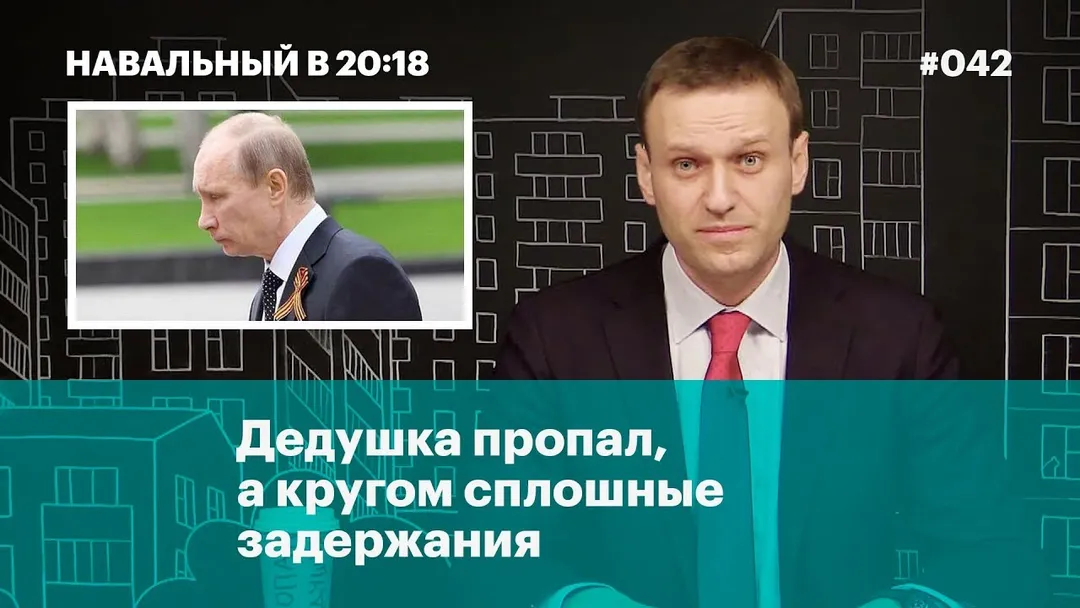
Grandpa has gone missing, and there are arrests everywhere
[music]
Hello everyone, it's 20:18, and Alexei is in the studio.
Navalny, or a candidate with a criminal
pathology, as my friend called me.
Ella Panfilova recently spoke about this.
round-table discussion, and
she was asked about it, and she said: what do you want?
We once had people with criminal
records, with unexpunged convictions,
who, if elected, would bring in
a whole team of thugs into power, along with
rather exotic relations with
law enforcement and the judicial
system.
And now, apparently, relations are no longer
so exotic between the president and
the judicial system—we'll talk a bit more about
that in a moment. Oh, Ella Panfilova.
First and most importantly: on Sunday, the Nemtsov March.
Come on February 25, this
Sunday, at 2:00 p.m., to Strastnoy
Boulevard. The gathering point for the Nemtsov March is there. It is very
important—come there in order to
honor Boris Nemtsov's memory, and also
to speak out against a murder that
has still not really been solved when it comes to
those who ordered it, and to
express your overall attitude toward this
government, which does such things—to
the elections, to everything. Come out, because
that matters, because you are citizens.
Come, it's very important. Well, as for the detentions—
not overnight, of course—I myself was detained, because
today is not just a day of detentions,
it's a whole week, a week
of strange detentions. I think they
will continue. Right now, in a special detention center,
Roman Rubanov from the Anti-Corruption
Foundation has been arrested.
Right now, Leonid Volkov is awaiting a decision about
his fate.
Not far from here, in our beloved
Simonovsky Court, where we are now. I live in the area
covered by that court, and the Anti-Corruption
Foundation is also located within the jurisdiction of
the Simonovsky Court, so over there
all the judges have already sent some of us
to jail, and I have no doubt that
Volkov will be arrested too. As for how
absurd his case is, it's simply
completely laughable. Here we even had
a kind of experiment: Volkov, on his
program in this studio, said that we had
a task. We understood they wanted to shut down
all the leaders of our
organization, so
before the January 28 rally, we came up with this:
they considered it unauthorized,
we considered it completely lawful. I even
sent out an official letter: Volkov was forbidden
from mentioning
the January 28 rally in interviews, on these broadcasts,
in tweets, retweets, in any form—and he
followed that flawlessly, so there could not
have been any grounds for complaints against him. But
they need to lock him up because
our strike scares these people,
and the election-monitoring program scares
them too. So today he was taken
literally off a plane as he was flying to Ufa
to work there, including
organizing election monitoring. He was taken to
the police, and it turned out that Volkov is now
going to be arrested because, while in
Yekaterinburg,
he was at an unauthorized rally there and
at that unauthorized protest
retweeted a tweet containing a video of my
detention. You can now see a fragment
of the report
on the administrative offense.
He retweeted a tweet with a video recording of my
detention, and
that is being treated as grounds—
sufficient grounds to pull a person
off a plane almost a month
after the rally, bring him to court, and
now apparently put him under arrest for
today. I also had a funny
situation: I had a toothache, and I understood that
I had some kind of court hearing coming up soon, and
the situation with my
January 28 detention had to be resolved.
I thought it would be a bad idea
to end up in a detention center with an aching
tooth, so I went to the dentist, and as if
I had a premonition—they pulled my
tooth, quite painfully. So there I was,
half my face numb from the anesthetic, unable to
think straight, lisping to him uselessly:
please write me a note saying
you pulled my tooth and that I need
to come back one more time, because he said
I absolutely had to come back again on
Monday.
Just in case they detained me too. He laughed, but he did write me the note. So I walk out, and
he gave me the certificate, and as I'm walking,
a whole group spills out of a minibus across from me—
a whole crowd,
seven men from the 2nd operational regiment. 'You are
detained.' They hustle me inside, and I
try to mumble, with my
tongue barely moving from the anesthetic,
'You have no right...' Some kind of silence follows.
They themselves don't know anything,
they put me on their bus and take me to
the Yakimanka police station, and I have no idea what
happened on the way, but by the time we arrive
at Yakimanka, the door opens,
someone comes out to meet me and says,
'We'll let him go.' Why all this was done with such
fanfare is unclear. They gave me various
documents there and said I had to return to
court, and that they would probably bring me to court
later. There is actually a very funny
explanation for this, and I absolutely
believe it—why Volkov will be jailed now,
while I will be jailed only on
next week, because I'm supposed to be
tried by the Tver District Court in Moscow
today, on February 20. In fact,
a couple of lawyers called
and said that for today, the twenty-
second, they're not even taking any cases
because they're drinking heavily there at the
Tver court, and they said they wouldn't take anyone
or even bring anyone to us,
and that's why they let me go
— apparently the judges at the Tver court will be drinking
tomorrow or later, so Volkov
will be convicted today. I absolutely believe
this version, because that's how the whole system works.
On the one hand, there's the vertical of power
with orders and so on, and on the other hand,
those bastards are getting drunk, and so, excuse me,
deal with your Navalny yourselves, fit him
into another slot. So everything will happen
next week. And this is happening not only in
Moscow — in Tambov,
Arkhangelsk, Cheboksary, people have been detained
there too. Let me give you a bit of
statistics: over the entire course of the campaign,
our people have served a total of 2,443 days under arrest
altogether, and 13 million rubles in fines
have been imposed, along with 3,343 hours of compulsory
labor. And now I will actually
show you
a chart that will perfectly answer
the question: besides the voter strike,
why are they, of course,
afraid of it, why does it infuriate them, why are they
so aggravated right now, why have they now
started grabbing people? Here you see a list
of federal subjects (regions of Russia)
where turnout was over 70 percent
— no, actually, they are ranked by
population. In other words, these are the most important
federal subjects, and voter turnout in them
— look, the first column is falsified
everywhere. Of course, nobody believes that
turnout in Bashkiria (Bashkortostan) was 80 percent, or that in Tatarstan
it was 83 percent. It's obvious that all of this is
fake. And what are the authorities afraid of now?
We've announced an observer campaign, and in
these specific regions, we don't even need
to lower turnout — we don't even need
to shout "voter strike" there.
We do shout it, of course, we are doing that and
reducing turnout, but in order to bring it down
simply by 20 percent,
all we have to do is place observers. Because
it's obvious, excuse me, that in Tatarstan
there was no 83 percent. It was
40, maybe 55 — fine, let's say 60 at most. So if
our observers are standing at
polling stations, if you take part in
this campaign — there's a link in the description to this video,
go there and sign up
as an observer right now — then turnout will
drop by at least
20 to 30 percent in these regions. That's what they are terribly
afraid of. They will have two alternatives: either
they effectively show that it was always
falsified,
that turnout simply collapsed in Tatarstan,
Bashkortostan, Krasnodar Krai,
and Kemerovo Oblast,
because who believes in 79 percent in Kirov
Oblast? Of course there was no such 72
percent. Or else
they will throw our observers out of
the polling stations, and that will cause a huge
scandal. That's why they are now trying
to paralyze our work. They detained
Volkov,
Rubanov, they're trying to paralyze our
finances, our headquarters, the whole structure, so that we
can't deploy observers, so that
you can't sign up on the website,
the system doesn't work because people have been
taken away, or there's no money to pay salaries, or
something else. But in general, we are
ready for this. We understand this kind of scenario.
We
know who we're dealing with. We understand that
this government cannot act
in any other way. So
sign up — we will organize this work anyway.
We understand that there will be some
absolutely colossal, colossal
attempts to throw obstacles in our way,
to jam the wheels of our campaign,
but nevertheless we will keep doing it.
Sign up. Now, I have
a few more topics, but you know that
humanitarian considerations are sometimes
more important than whatever current
agenda there is. And in Russia there is a problem:
people go missing. Very often they leave
home and simply disappear, and they have
many relatives, many friends,
and finding them is often completely impossible.
That's why it's extremely important to tell each other,
to share information and photographs,
Very often you see photos online,
photos saying that such-and-such a person has gone missing.
It's good when people share things like that, and I
would like to draw your attention
and ask you to take part in this kind of humanitarian action as well,
because an elderly man has gone missing,
a grandfather, and they can't find him.
No one can find him. He was last seen in public
ten days ago. He has, well,
many people who love him, and even more
people who say they love him.
In any case, he has many friends,
acquaintances,
relatives, former colleagues, and so on,
as well as business partners. He's quite
a prominent man, let's put it that way, within
his circle, and he has disappeared. And mind you,
no one can find him. Well, if for 10 days
you didn't show up at work, if for 10 days
you were nowhere to be seen, then probably
your colleagues and your circle would already have
raised the alarm. But this elderly man is
This elderly man worked in some kind of place like that.
Cruel people imagine that no one is looking for him.
He disappeared, so what did we do?
We made a special flyer, so please,
here are the distinguishing features of this elderly
man. He is 65 years old, and he responds to the name
"National Leader," so if
you can, if you're somewhere and start shouting,
"National Leader! National Leader!"
and someone turns around, it might be him.
He was last seen on February 12
at the Leaders of Russia forum.
He has a very clear sense of his place in the broader public
hierarchy: he follows the rustling of money.
Again, if it seems to you that you
have seen someone who looks like him, but you're not
sure, take out some banknotes and rustle them.
He will almost certainly come over, even reaching out
his hands to take that money from yours.
And of course, he has these kinds of
episodes. After all, even at 65 years old
that's not very old, but by Russian standards
it's already advanced age. He has started undressing often, very often.
He undresses.
He goes swimming somewhere, climbs into an ice hole,
gets on a horse, very often half-naked.
He seems to have some kind of fetish like that, and
of course, there is one more very important
distinguishing feature.
You can ask him absolutely anything. If you walk up to
him and ask, "Are you the National Leader?"
then right away he will start talking about Ukraine
or about Syria or about the U.S. national debt.
That often happens with him, so
please, guys, let's take a break from
the immediate news agenda. I had planned to deliver this
item without once
laughing.
And let's try—if you find him, don't bring him back.
But seriously, jokes aside,
this man is taking part in the presidential
election. There are 20 days left until the presidential election,
and where is he? What is he doing?
Where is he? I think they tell us
his rating is 86 percent, and in general
he is the head of state. He receives from us
a salary. We are a nuclear power,
a nuclear state—and where is he?
You simply cannot just disappear
for such a long time. But more than that, look:
he refused to take part in debates.
What a great presidential candidate: he didn't even come to
his own nomination event.
His own videos, his own
campaign ads, where he would stand
in front of the camera and say, "I am Vladimir
Putin, vote for me"—he refused
even to record his own ads. There will only be
some old
speeches of his, and now he has disappeared too.
Now that's a great election campaign.
Excellent. Well, maybe they are doing it on purpose
because they have this kind of
program for educating
the Russian people through respect—through
humiliation, through training, you understand.
As it is, these are not really elections at all,
and on top of that, to just
disappear and vanish somewhere so that you are nowhere to be found
on the eve of the election—well, that is of course
simply astonishing behavior. And it seems to me
that this is one more reason simply to say:
no, no, no—we will not take part
in this. What kind of elections, for heaven's sake?
A person who goes now to the
polling station and receives
a ballot is voting for the idea that this
is normal behavior: do nothing,
and then just disappear right before the election.
There are many different theories—about illness
and other things—but in such cases I always
stick to one
hypothesis. It seems to me, as life keeps
proving me right, that he regularly
disappears for a while. I don't think there is
anything especially terrible about it.
You know what?
He is simply into plastic surgery.
He just had some work done, and the bruises haven't gone away yet.
On March 1 he is supposed to appear at
the event with his address to the Federal Assembly
which they are holding not even in
the State Duma or the Kremlin, but in the Manege (the central Moscow exhibition hall), as I understand it.
There will be a huge crowd there,
trusted representatives, all sorts of celebrities,
all squealing with delight: "Vladimir
Vladimirovich, how we love you so much!" He will look
refreshed, like new, his skin
pulled tight as a drum. Everything will be fine.
For now, he is just recovering after the plastic
surgery and resting a little.
But there is an important point connected with his disappearance, by the way.
Do you remember how we had those
ideologues who liked to tell us:
"No Putin, no Russia; if there is Putin, there is
Russia." Well, for several days now in Russia
there has been no Putin at all—he has vanished.
He is absent from the public space.
No meetings, nothing
is happening where Putin would be present—and yet
we are living normally. We haven't died, the earth
has not crashed into the celestial axis, it has not fallen apart.
Russia, contrary to what they try to prove to us,
if this man is no longer there, we will only
be better off without him. And in order for him
to be gone, we need to fight him,
to take part in the voters' strike.
There are a lot of questions. All right, here's a question
from Twitter: "Andrei, did you watch
the interview with Serebrennikov? What do you think
about the words 'strength, brazenness, and boorishness'?"
I watched it. It is an excellent interview, I highly
recommend it to everyone.
In fact, I recommend watching all of them, all
the interviews. Yes, I watch them, they are great. But
strictly speaking, Serebrennikov's position
is not new at all; he has
quite often spoken out sharply on this.
The interview struck me as honest.
And the reaction to all of this has been telling.
From all these bootlickers and crooks who
are jumping on Serebrennikov, shouting,
"How can you do that? You live in Canada and
you make money, you earn money in
Russia—how can you criticize Mother Russia?"
But Serebryakov is not criticizing Mother Russia.
Serebryakov, excuse me, is not criticizing
Mother Russia. He loves her far
more than all those scoundrels who are now
coming after him. There have also been a lot of questions about
the blocking and everything else. Indeed,
for almost two weeks now we've been living with
blocked websites, but thank you very much.
Thank you.
We believe we accomplished the main goal of
distribution: our
investigation about Rybka was watched
by six million people thanks to you. You
shared it very actively, and so
basically, that very link
because of which they tried
to block my blog—we can already see that
hardly anyone visits it anymore. Mostly, everyone
is watching the investigation on YouTube, so we
are now going to close it and move all this
information to an external link. That is, it
won't disappear anywhere, and people will still
be able to find it. And we will demand that Roskomnadzor (Russia’s media and communications regulator)
unblock it. We believe this exercise
went quite successfully—that is, we
resisted this blocking, and about 60
percent of people were still able to access
our site without any special tools. In other words,
we gave Roskomnadzor a bit of a—what's a
polite way to put it?—well, we
fought them pretty successfully.
Once again, many thanks to everyone who
helped spread this information. But in any
case, guys, we understand perfectly well that
they will keep blocking websites, and in an ever more
lawless, outrageous
way. Removing the link alone
won't be enough, so
use tools to bypass blocking.
Learn how to use them.
As for turnout, you can see that our voters' strike
is underway, and in response they are making
simply extraordinary efforts.
They're going to extreme lengths, and now I'm curious myself
what kind of
non-turnout they may end up facing—quite a large one, apparently.
Because in my entire life I have never seen
anything like this. Because this is
just everywhere: workers are being forced
to hand over their passports, to sign up;
students, teachers, doctors, members
of election commissions are all
going door to door and
making lists of who will vote,
who won't vote, who plans
to go, who doesn't. And it's highly
likely that for those who don't plan to go, they
will stuff in votes. That is exactly why we will run
an observation program. And one of the
most remarkable campaigns
is happening in Perm right now: a project called
"Choose Cinema." Basically, everyone who
comes and votes will be given tickets
to the movies.
Free movie tickets—that is, outright
voter bribery, plain and simple.
A blatant violation. And on top of that, all of this
is being funded from the budget, of course—either
the city budget or the regional one. Our money
is being spent on this nonsense. We even thought,
well, this can't possibly be real.
But we checked, and now you can see it:
Perm State Pedagogical
University. The notices were posted in
several other places too: a construction
college, Stroganov College, Onyx College—
everywhere, all educational institutions in Perm
are plastered with this campaign: get a movie ticket.
The Russian Union of Journalists—now that's a rather
disgusting
organization—has launched
a campaign called
a contest, "Why I'm Going to Vote." In other words,
these people stayed completely silent and did nothing
throughout the entire past year, when
journalists were being attacked, when they were
being beaten, when media outlets were being blocked,
when censorship was being
introduced, obviously. But now the
Russian Union of Journalists is holding
a contest called "Why I'm Going to Vote." So
everywhere, in big ways and small, all across the country,
the whole place is flooded with it. Look in the metro:
these things are hanging there; in stores, these notices
are posted everywhere.
Go vote, go vote, go vote.
There, you can see it in the metro—they've put them up
in all sorts of places, and I
think that as March 18 gets closer,
everything will be completely covered with it.
But guys, that makes it all the more satisfying right now to
go to the link in the description,
print out a couple of flyers, and put them up
in your apartment building entrance,
in your school, in your university, and watch
how these people go crazy because
we are promoting the voters' strike.
Quite a lot of people may not know about it, but I
am sure they wouldn't be losing their minds like this
the way they are, if
our voters' strike had no
real impact. So please take part in it.
Please. I also wanted to show separately
a video that, well, in short, made me want
to show it to you. This is the city of Yekaterinburg,
and there is one particularly awful man there.
I wouldn't even show him now
and denounce him to the whole country, but it's Mikhail
Ivanovich Barashkov, dean of the Faculty of
Veterinary Medicine
at the Ural State Agrarian
At the university, he seems to be very
a good person, a good teacher.
Everyone praises him.
I was getting ready to tear into him here, but then I went online
and looked through various forums, and students
say what a good person he is. And let's
take a look at how this good person
campaigns, what he says to his students.
In connection with the fact that
the system—whether he wants it himself or whether he was
asked to make them go to the elections. After three
seconds: you're adults, by December 5...
I'll tear you apart.
Seriously. And most importantly, you need
to vote in the first half of the day. Here at our
place, among the teachers, I held a meeting.
There are just a few groups left.
They will vote and call me
so that I know no one is resisting—there's no cheating with
it, because everything is tracked together, because
that kind of vote is counted. You know what
the situation is, how politicized everything is. I'm not
telling you who to vote for. You are
adults. I'll say only one thing:
those who study on state-funded places also
receive stipends. You'll vote... I'm
just emphasizing this once again.
Decide for yourselves.
But in any case, you must
go to the elections. You won't be able to fool anyone,
because everything is counted. I'm not urging
you, says Mikhail Ivanovich, to vote for anyone in particular.
Wonderful, Mikhail Ivanovich.
Mikhail Ivanovich tells his students:
especially those on state-funded places, you know who gives you
all this. So here's an open
appeal to Mikhail Ivanovich:
why do you need all this?
You are a respected person, judging by the reviews, so
why are you humiliating yourself and your students?
Who gives this—Putin? Is he the one giving us these
state-funded places? Students study tuition-free because
their parents paid taxes here, because
they are citizens of Russia, because they
have every right to it, because they
passed their exams, and Putin has nothing to do with it.
Putin is cutting the number of state-funded places.
Putin is cutting your salary. You, Mikhail
Ivanovich, receive a low salary
because Putin does not allocate money for
education and healthcare. How can an
adult stand there and say,
say to his students, whom he
is supposed to teach something worthwhile,
say: but you are
on state-funded places, remember who gives you all this,
implying that Putin and United
Russia (the ruling political party)
are the ones giving you everything. Mother Perm land gives you all this.
You understand, they extract oil there, and
Uralkali mines potash fertilizers there,
all of this is sold abroad, we receive
money, and on that money the country exists.
It existed that way
without Putin.
It exists now under him, but he
gives us nothing. On the contrary, from that money he
steals, Mikhail Ivanovich. So I very much
hope that Mikhail Ivanovich Barashkov
hears me, and next time, speaking
before his students, says: well, yes, I
would, guys, still like
to apologize, because those of you who study on
state-funded places
got in because you have the right to be there,
not because Putin is your master, your
benevolent benefactor.
Well, yes, I suddenly
caught myself starting to shout
in the studio, but it really is a rather
unpleasant situation. It's just
disgusting, very disgusting to watch.
By the way, of course, this continues:
some kind of political science debate about whether
a boycott is good
or bad as a method of political
struggle. Well, of course it's not the best
method, but I would simply like to draw your
attention to the fact that right now there is modern
authoritarianism.
All the critics of a boycott describe
various strategies and argue with
strategies that were used
earlier, 10, 15, 20 years ago. But
note that now
authoritarian leaders like Putin,
like those in the CIS countries (the former Soviet republics), like those
all over the world today, have in fact
learned to use
the electoral system in such a way that
on the one hand, elections exist, but on the other
hand, they do not become an instrument of political struggle
at all. That is precisely why
boycotts are now happening.
In Azerbaijan, the opposition declared a boycott
of the elections. In Venezuela,
in Egypt, the opposition declared a boycott
of the elections. In Venezuela, the opposition announced
a boycott of the elections. In Malaysia, the same
thing. This is now happening all over the world, and it is one
of the most important political
trends: when crooks in power
do exactly what they did
here—announce elections, allow only
candidates who are completely under their control,
these puppets,
simply conduct these
puppets and try to convince
the public: go to these elections,
it doesn't matter, vote for someone,
vote against us, just come.
Naturally, all over the world there is emerging
a movement against this, and we are
part of such a movement, against these
slick operators who, even under new
conditions, when there is the internet, when
it is impossible to completely block the mass
media, still somehow manage nonetheless.
I have less control over the electoral system.
They turned elections into a mockery, and we
are not taking part in them. I am declaring a strike, and in that
sense
but what we are doing is a normal
Russian practice when it comes to elections. We
actually very much want to participate.
It is no accident that we are now in the process
of registering the Progress Party for the fifth
time.
Or the sixth, or even the seventh—I’ve already lost count of how many
times we have tried to register the party,
because we want to take part in
elections. We want it very badly, and we are fighting for
it, and we are still fighting for it now. On March 3,
there was supposed to be—and there will be—a congress
of the Progress Party.
Though now, as we can see, not of the Progress Party anymore,
because this is the story we ended up with.
It turned out absurdly: when our party was called
People’s Alliance,
we went through two rounds of registration, and we
were not registered. And then some
Kremlin crook and political operative, Bogdanov,
renamed one of his parties
People’s Alliance—he stole our name,
stole all our branding, right down to the logo, and we
had to come up with a new name. We
came up with Progress Party, and several times
we tried to register it, we are registering it now, and on March 3
there is supposed to be a congress. We have already printed things,
already spent money on all sorts of
nice backdrops, and today
the news comes in that this same
political operator Bogdanov has taken one of his parties and
once again renamed it the Progress Party.
But the most wonderful thing we saw was
the congress itself. Show the photo from that congress.
What you see here is not just
some strange creative gathering,
some kind of “long-forgotten stars” reunion
in a concert hall—this is what they call a congress
of the Progress Party. As you can see on the screen,
all of our symbols have been completely stolen,
the name has been stolen, and sitting on the presidium is
Vitaly Serukanov,
the “disillusioned Navalny volunteer.”
If you remember, back in the summer, this
petty crook, who really
worked with us for several years
as a volunteer—but honestly, we understood
that there was something off about him. I clearly
remember how I met him: he
came up to me at the train station when I was traveling to
Kirov. “Hello, Alexei, I head the
youth wing,”
“the youth wing of Prokhorov’s party.”
And I thought right then: there is something
wrong with this guy. A normal person cannot
be in Prokhorov’s party,
let alone in the youth wing
of Prokhorov’s party.
But nevertheless, there were no formal grounds
for any claims against him, and so he
was just an ordinary volunteer,
and then, right on the eve of
the rally
that was being organized by
Ilya Yashin—and you remember that it was a
rally that provoked such a
painful reaction from the authorities—he declared
that he had become disillusioned with Navalny,
and called on everyone not to go to
the rally. And for me, everything became completely
clear. On this program, I basically
said in plain terms
that I considered him a crook and a plant—what else is there to say?
And then it all came down on me—you all attacked me,
and many of you felt terribly sorry for him, saying,
“How can you do that, Navalny? Right away,
without any proof, you said that this
person was planted.” And now, boom,
it turns out I was right, and you all turned out—well, not
all of you, of course, but many of you turned out to be
wrong. Because
guys, you need to remember and understand one
main thing: if a person looks like
a Murzilka (a fake, clownish front figure), then that is exactly what he is.
You can become disillusioned with Navalny,
of course. Lots of people can.
They can lose interest, they may not
like it—but then what do you do?
You say, “I’m disappointed in Navalny,”
“Navalny is an idiot,” and usually you stop working, or
you even record a video statement: “I
am disappointed, Navalny is an idiot.”
But when you make a video statement saying,
“I’m disappointed in Navalny,” and then add,
“Don’t go to the rally,” then it is obvious that you are a stooge,
because you are acting in the interests
of the authorities. Then you are a Murzilka-type operative, and there are quite
a lot of them. And we endlessly have this
discussion about whether we should talk about it
or not. Well, the point is simply this:
I suggest that all of you be a little
more attentive, show a little more
intelligence, and be a little tougher toward
all people who do suspicious
things, instead of endlessly forgiving them.
But this is an unpleasant situation for us,
because on the 3rd we will
definitely hold a party congress with
some unclear name. We need to come up with
some kind of name, and at this point we
now have to keep it somehow
secret, because if we now
say what the party will be called—if I say here,
“Send me text messages with party name ideas,”
“Send me a great party name,”
and I announce it here, then tomorrow that same
Serukanov will hold another congress and
steal yet another name.
I don’t know, but maybe some part of it—let’s
call the party “Putin Is a Thief”; let him steal
that name if he likes. Irina Stolyarova
writes, Irina
says: “They won’t steal that name, and they’ll register it,”
and then they’ll have to take it to the streets. Though, by the way, they say...
A good name for the party is “Putin Is a Thief.”
I think quite a lot of people
would vote for such a party. Well,
one way or another, I just wanted once again
to explain, because there have been a lot of questions. We
will definitely hold this meeting, we will definitely
register our party, we
definitely want to take part in the elections. More than
that, I am absolutely convinced that this party is the
only one that will be able to clear
the five-percent threshold and win
elections in general, because we are ready for that.
We have an organizational structure. Apparently, I will not
be in this party, accordingly.
If they don’t detain me as well, they’ll probably arrest me,
so I won’t be able to be elected
chairman of this party. Probably one
of the reasons for this paperwork
that happened today is that they
took me to the police station.
They want to make sure that I do not
get to the party congress either, but that
doesn’t matter much. In the end, as for
another person—we’ll choose someone else, after all.
It doesn’t matter who holds the formal
position; what matters is that this is our party,
which will represent our interests.
But still,
we will, of course, run into difficulties when
registering it.
The sad part of our program is
the weekly polling ratings—well,
over the last two broadcasts
we recorded, for example—well, that is,
very little. Because when we came up with this
idea—that I would tell you every day
about polling—I assumed that
it would be interesting. I would talk about
how this person’s rating had gone up,
that person’s rating had gone down, how interesting
it all changes. We conduct polling, and it is very
honest, very good, but
let’s see whether anything is changing. So,
if the election were held this Sunday,
what results would we get? Let’s
look at the candidates’ ratings. First
slide.
As you can see, practically nothing
has changed. Putin’s rating—here we have
our first poll here, the January one,
the blue bar, compared with the red
bar, the latest one. So in January
Putin had 78 percent; now he has 82.
That’s not surprising, but overall, since we need
to raise the issue of the margin of error,
which is about 3 percent, essentially nothing
has changed. Zhirinovsky and Grudinin
were both at 8 percent at the beginning; now they are
both at 6 percent, but essentially we should
say that they have not changed.
Within the margin of error, Sobchak, Titov, and Yavlinsky are all
at 1 percent each, and they are listed in the order
Sobchak, Titov, Yavlinsky, but that
means nothing. They all have 1
percent; their ratings cannot even really be
measured within the margin of error. Well,
essentially, nothing new has
happened here. The Kremlin’s scheme is working:
the fake candidates have no
support at all. Let’s see whether
the negative ratings have changed. Unfortunately, no—and the negative
ratings haven’t changed either. It’s all the same
thing.
Sobchak is still the leader in the negative ratings.
It was 70, now it is 68.
Again, within the margin of error, we can
say that practically nothing
has changed. Zhirinovsky is in second place,
the same 24 percent negative rating.
Zhirinovsky’s negative rating is 21 percent; Gru-
Grudinin’s was 14, now 16. Again, we believe
that nothing has changed. There is no
movement at all—not in the ratings, not in the negative
ratings, not in anything at all.
And where could any movement come from,
when nothing is happening?
Let’s look at the third slide; there
it gets a little more interesting, there is at least some life
there, because the third slide shows
how Russian citizens—in a nationwide
survey—answered the question about which campaign materials
of which candidates they had come across
over the last two weeks. And here we do, after all, see
changes beyond
the statistical margin of error. Grudinin
is noticeable; people have noticed some kind of Grudinin
campaign.
Probably that famous woman in the ad
that the whole internet is laughing at,
and the comments that are being posted everywhere
saying, “I’ve never gone
to vote before, but this time I will—
Grudinin is the people’s candidate.” But billboards
have appeared in some places; some advertising is underway.
Besides that, this week direct TV advertising
has already been allowed, so people
are noticing Zhirinovsky—they have noticed him
quite significantly.
He was at 8 percent, now 16. Sobchak
was at 7 percent, now 13.
Yavlinsky was at 3 percent, now 7.
Still, of course, 67 percent of people—
that is, the overwhelming majority, most
people—do not see at all, point-blank,
any campaigning, any of these fake
candidates—let’s call them what they are. Well,
some changes have started, at least.
Apparently, this is simply connected with the fact that
television advertising has begun.
We can see the ads. Well, I can’t say that
they impressed me much, but one ad really impressed me.
It completely overshadowed all the other ads
by comparison.
And this ad is by a candidate whom I
would never even have been able
to suspect of such over-the-top
creativity.
Now I’m going to show you that ad.
and in exactly the same form it was
shown on this TV channel
because that’s how it works there:
candidates can buy advertising, and
sometimes at the beginning, sometimes at the end, often they
buy it — they have money, so they buy
a lot of it, and so if you have just one ad
the same one, they’ll just leave it there three times
in a row. So they showed it three times in a row,
this ad — the one that goes, “Let’s together...”
I watched it and was simply amazed by the sheer audacity
“What?
Like,
“What?
Titov? What about Titov?”
Apparently that was the expression on people’s faces
who were watching the channel at that moment:
“Wait, what is this even?
What is this supposed to be?” I mean, we can more or less
imagine some loafers sitting there
saying, “Well, that’s what you said, but listen,”
“you’re completely invisible. Let’s
make an ad that people will definitely
notice. It’ll be insane, it’ll
be idiotic.”
People will just start
slapping their foreheads, but they’ll notice it.
They’ll laugh at us, they’ll curse us,
even Navalny will notice us and make fun of us
and maybe even show it on his program.
Guys, it worked.
So yes, people noticed you, but
I just have one question: do you really
think this wins you votes?
I mean, sure, now viewers of my program
and viewers of that
channel probably know you more as some kind of drug addicts
or something, because this is, of course,
astonishing. It’s astonishing that these people
still seriously claim that they
have support, that they really
collected signatures,
that they’re not some Kremlin-made spoilers
brought in specifically so that
people would say, “What? Titov? Because
the reaction is obvious.”
A person looks at this like this,
stays silent for a while, and then says,
“You know what, I’d rather vote for Putin. What is this?”
Maybe Titov was going for some kind of suspense
in the ad, maybe something else, but
this is just infernal overkill.
Regular viewers ask, “What kind of brainwashing is this?
It’s creepy.” No, it’s not brainwashing.
They came up with an ad that everyone
would laugh at so people would remember it, and it’s supposedly
considered effective, because, you know, they
always say: people only speak ill of you
in an obituary. That old famous
saying. But
I don’t think it works. Valeria Bychkova asks:
“I don’t want to go to the election, but
my dean and my parents are pressuring me. How
do I deal with that pressure?”
Valeria, how exactly are they pressuring you?
Your parents are probably going overboard,
coming up to you and saying, “Valeria,
please, you absolutely have to go vote.”
And you say, “I’m not going.” “No, Valeria,
you must go vote.” And you say, “I’m not
going. Leave me alone.” What can they actually do to you?
What is your dean saying — that if you don’t vote,
he’ll call someone higher up?
You say, “Dear Pavel Pavlovich,
my leg hurts, I’m sick, I don’t want to.” Better yet,
I assure you, if you tell him directly:
“Dear Pavel Pavlovich, your pressure
on me is inappropriate. My political views are such
that I cannot take part in this election. I do not
recognize it. I am participating in the voters’ strike
and I support Navalny,”
your dean will back off immediately.
That’s exactly how it works.
They pressure the people who give in to pressure.
If you were sitting in prison and they were
beating you, or starving you, or
torturing you — that would be pressure that could force you.
But when they’re just, well,
simply saying, “Valeria, go
vote,” that’s not really pressure at all.
Because what’s actually going to happen?
On March 18, it will all be over, and everyone will forget
that they wanted something from you and that you
refused to go along with it.
People ask how I feel about my
surname being used to fight
snowdrifts.
It really is a rather
strange thing, but very funny. At first
I thought it was just some people
who came up with it just to
have a laugh at the authorities, and that they had
basically staged the whole thing:
wrote “Navalny” on a snowdrift and then
cleared it away themselves, claiming that because they
wrote “Navalny” on the snowdrift,
the janitors were ordered to remove it faster.
But after that there were many
experiments conducted, in Moscow and
in other regions too, and indeed,
if you spray-paint on a snowdrift
“Navalny,” they remove it.
There simply is no better example of the authorities’ idiocy.
There just isn’t. But I’m glad
that if I can help in the field of urban maintenance
at least in this way — though not only
in this way. We also have a wonderful
project, RosZhKH, so in fact
in the area of public utilities and urban upkeep
we’ve been making a fairly major
contribution for quite a long time. But what can I say? They’re
idiots. They don’t want to clear anything away, they
don’t want to remove the snow, but even more than that, they
don’t want people to encounter
the name Navalny anywhere. Let’s use that.
I’m writing for the second time, don’t
ignore me.
Come back here — and please, don’t be rude.
criticizes the fact that you were given 60 seconds
on the Print channel, saying, well, if
I were given 60 seconds, I would
have prepared something more precise so that
to fit into those 60 seconds, but I would
talk about specific cases of corruption
involving Putin. I would mention, for example,
his son-in-law, the youngest billionaire
in Russia. I would ask the viewers: do you believe
that Putin's son-in-law could have become the
youngest billionaire in Russia without
Putin's direct personal involvement
in this corruption? Do you think he is
corrupt? I think many people would
answer that question the way I want them to.
In other words, I would speak in concrete terms
— not just go on and on about
some beautiful Russia of the future,
but cite specific facts of corruption and
the theft committed by Medvedev and Putin and all these
people, and compare the money they
make with the salaries of ordinary people
whom they are robbing. Anna Fadeeva.
Alexei, she only wanted to be
an observer on 18.03, but I won't be
in the country—I didn't manage to read the rest.
But how else can I help besides that?
I'm already campaigning against the election. Money—
money... apparently, money.
I'm sending some. In any case, you should register.
We have lots of different kinds of
work there.
There is work standing at polling stations, there is
work doing logistics, there is work
reviewing video recordings, after all.
So if you won't be in the country, you
can still take part in this work. So
register, and we'll try to find
something for you. But
if we don't, then we don't. Abroad,
there will be some monitoring, and it
isn't all that significant. The fact that
help from abroad amounts to only 300
thousand people right now, but still
we will be doing it there, so you
should register. If there's work for you, great.
If not, then not. Next question: what should be done
about the huge number of election
posters—damage them? asks Chris
Matsuoka. If it's possible to damage them
without getting taken to the police for damaging
someone else's property—that is, if it's some kind of
notice hanging in your apartment building saying 'Come
to the election,' then feel free to take out a marker
and write 'Boycott the election' on it, or whatever
you want—alter it however you like.
It's your building entrance; they have no
right to hang anything there. The same goes for
an institute or university if it's hanging there. But you know
that right now, across all of Russia, we already
know that across the country
police officers are guarding posters of Putin.
A man with such colossal
support that at night, without a police crew
guarding them around the clock,
it's impossible to prevent those posters
from being pelted with paint, eggs, or
something else. So don't really take the risk
of trying to damage large posters
about the election or about Putin. But smaller-scale
campaign materials—sure, tear them down.
Alexei, will you have to pour it over the tires on
the Nemtsov memorial march? I still didn't
manage to read it—bring it back to me, please.
Please, who would you like to see
as mayor of Moscow? asks Alex RM. As for the march
in memory of Nemtsov, which will take place on
Sunday at 2:00 p.m., gathering
at Pushkinskaya Square—roughly speaking, I will definitely come.
If it's on Strastnoy Boulevard,
or on Pushkinskaya—if
I'm detained there and taken away so that I can't
be there, then so be it. But I will do everything possible
to be there, and I urge everyone
to do the same. Who would I like to see as mayor
of Moscow? I'd like to see someone
normal—someone we elect
in a fair election, and who will
clear the snow for us, among other things. So this is a very
serious subject, and a very sad, very
tragic one. You know that a terrorist attack took place
in Dagestan: a man ran up to a church
during
festivities, during the service,
and opened fire on several people. Five people were killed,
and four were injured.
The attacker was killed by return fire.
It is known that his name was Khalil Khalilov; he was
22 years old. While doing it, he kept shouting
'Allahu Akbar.'
So this is a classic case
of a terrorist attack, a terrorist attack carried out by a
deranged
Islamist, and that is exactly how it should be
treated. There is no need here to try
to hide something or to insist
on adding that this person—we
deny him the right to be called a Muslim
or anything like that.
Of course, no one is saying that all
Muslims in Dagestan support this man.
I am sure they are all absolutely shocked
by this crime, just as we are. But
the fact remains the fact:
this crime, this terrorist attack, was
committed on the grounds of radical Islamism.
And it is the task of Christianity and Islam and all
decent people—atheists, agnostics,
and Buddhists as well—to fight such people. But
why did I decide to talk about this on the program?
Why bring it up here? Because I do not
see any reaction—no reaction at all.
No serious reaction. First of all, they are still
afraid to say that this was a terrorist attack. It is being
covered extremely little in the mass
media, and we do not see an appropriate
proper reaction, not from
the Islamic communities—though they did express outrage.
Of course, you posted condolences, but
what we would have liked to see was more action, and most
importantly, action from the Russian Orthodox Church
because I noticed a very
interesting and very apt post by Protodeacon
Andrei Kuraev. Let me show you—he
writes, and he pointed out something important. Remember
when Pussy Riot danced in the church?
No one killed anyone, but the full force of the Russian
Orthodox Church came down on them.
They held all sorts of
special prayer services, issued open
letters, expressed outrage, made calls
to anathematize everyone, and for
many months this was a major topic
of public discussion. And now, against
believers who came to church simply because
they are believers,
a terrorist attack was carried out—they were shot dead.
One would like to see more reaction.
There should be some sense of proportion here.
If you whipped up that kind of hysteria
over the fact that someone there—what was it they said—
those girls, those young women,
had desecrated the Cathedral of Christ the Savior, then
now believers have been gunned down in a terrorist attack,
so why are you silent?
Let’s sound the alarm and say
that we need to do a better job
working with communities in Dagestan,
that we need to do something, and that the position of the ROC (Russian Orthodox Church) on
this matter is as follows: we consider this
a terrorist attack, and we will take these specific steps.
But no—nothing. They do nothing, they simply
stay silent. And the state stays silent too. They have
a rather dishonest position:
don’t talk about it, talk about it as little as possible,
because it will only bring problems.
Because if we say we are mourning
Muslims, or we are mourning Orthodox Christians,
someone might be offended. But I’m saying this:
what exactly is offensive about that?
For Muslims, this should be entirely normal. All of this
needs to be said out loud, because
Muslims themselves are not interested in
the fact that there are maniacs who call themselves
Muslims, running around shooting
and killing people. It is Muslims’ task to fight them,
and I think this is precisely in the
interests of Russia’s Muslim community:
to say, yes, this madman
committed a monstrous crime,
using religion as cover, motivated by religion.
He did it shouting ‘Allahu Akbar,’ so
let’s discuss this, let’s
condemn it.
And let’s do our best to make sure
such things do not happen. Silence
will lead absolutely nowhere.
The next sad topic: Dmitry Borisov
was sentenced to one year of imprisonment
for taking part in the March 26 rally. You
remember, this was the rally I called
against corruption after
the ‘He Is Not Dimon to You’ investigation, in response to
the authorities’ total lack of any reaction
to that investigation, to
the facts of corruption. We announced
rallies; naturally, the authorities banned them. They
detained a number of
people then, and he was detained too. And later, in
their usual disgusting style of
meanness and intimidation, they didn’t just pick
some random person—they decided that, as a
warning to others, they would jail Dmitry Borisov.
He became one such victim.
He is a brave man. He did not admit guilt
because there is no guilt to admit, and in this
case there was an enormous amount of simply
obvious inconsistency and fabrication.
He was accused of the fact that when
he was being dragged away, he somehow freed one leg
and kicked
a police officer in the helmet, and the policewoman
allegedly felt acute pain—though only two
months later did all this suddenly emerge,
right in time for the trial.
And
the video footage shows that nothing
of the sort happened. So all of this is lies,
deception, and fabrication, and Borisov is simply
a hostage—a randomly seized
person whose story they want to use
to intimidate all of us. But he is admirable,
as are all the others, in fact.
Those detained over the twenty-sixth are conducting themselves
with great courage, so I want to wish
him strength, and also his parents, his
close friends. This man is in prison for
all of us, and that is how we should
view it. But at the same time, we must clearly send
a signal to the authorities that this will not
scare us. Yes, we clearly understand that after
every rally now, people come out, and they
grab one or two people
and jail them. Yes, that possibility exists.
In fact, the probability of that is lower
than the chance of being hit by a car—which is no joke.
That does not, of course, make things any easier for Borisov,
or for his mother, his father, or his other
relatives. But nevertheless, we simply must not
allow ourselves to be intimidated by all this. We
must support these people, we must
be proud of them, and we will not let ourselves be
intimidated. Dmitry, stay strong. And all
the other guys who suffered because of the 26th,
you are the truest of
heroes. So, Ilya asks: ‘Alexei,
why not write an appeal to the leaders
of other countries, with an explanation and a request
As soon as I start reading your tweet, you
interrupt me—please let me finish—and
a request not to recognize the elections in the Russian Federation?’ Ilya,
Ilya,
what is your name? Fine—suppose Trump is sitting there, and into
his administration comes a letter from
Alexei Navalny,
setting out in that letter the reasoning and
a request not to recognize the elections in Russia and
to say thank you for something like that
at last you sent me a letter with
a justification
and a request — that changes everything, and therefore
I will forget about the problem of nuclear non-proliferation
about terrorism, about thousands
of other things that need to be dealt with alongside this
crook Putin — simply because he
controls a huge nuclear power, and
therefore, of course, one has to engage with him
no one is going to solve our problems for us, and
therefore it is pointless to appeal to
the leaders of Western countries; we must
engage with them, we must explain
there must be a normal dialogue with Europe
and with the United States, and of course those people are right who
travel to international conferences
and make the case for this — it is a very good
and useful activity
but to think that some leaders of other
countries will solve our problems — that is simply
ridiculous. Viktor Bondarenko: Alexei,
Grudinin proposed introducing in Russia
the death penalty for major
corrupt officials. What is your opinion on
this issue? Viktor, I am asked about this quite often
at rallies. I am
a principled opponent of the death penalty
and not because I love
major corrupt officials or some kind of
maniacs and so on — it is simply that our
judicial system
is such that, well, how can you possibly
allow
it to be entrusted with killing people? Even if we
set aside, in principle, the question of whether
anyone has the right to take a human life — do you
trust the judicial system, these very
judges who are now trying Volkov
and everyone else? But these are federal
judges — so they would also be able to hand down death sentences
You do not trust them. No, these
judges, together with the Investigative Committee
and everyone else, are now acting on orders
to jail people; just as they work on command now,
they would execute on command too
If you need to take away some ironclad
business from a person, you just pay money
to the Investigative Committee, the FSB (Federal Security Service) — they will hustle behind the scenes
the judge signs off, and suddenly you are declared a major corrupt official
and shot, hanged,
or given a lethal injection. No, I
believe that, in principle, one should not
believe that the state may take
a person's life. I believe
that life imprisonment is a more cruel
punishment than the death penalty
and in general I also believe that under the current
judicial system
it must never be introduced under any circumstances. Elena
Logo writes: Alexei, also, is it true that in
Krasnodar there is no snow? Rejoice over something else
You write quite often that what needs to be
removed — there have already been quite a lot of jokes on this
topic, like
I really do not want to shave my beard, so I will write on
my beard: Navalny, pride of... with a shaved one
Well, alas — I mean, somehow it
works
Georgy Raketa: Alexei, I study
and live in
another country. Does it make sense for me
to be an observer there? I registered on
the website but have not received any reply yet
You have not received one because we have very many
— tens of thousands of people
registering. Georgy, if you live abroad
in another country
in a large city and there is a polling station there
for voting, then you can go there
as an observer — that is the right thing to do
but I repeat, overall, sorry, abroad
only about 300,000 people vote
so that is roughly like one large town outside Moscow
therefore it is not a priority
for our work. If you live abroad
and are online anyway
focus on
spreading information, I do not know,
raising money — find 10 people
each of whom will donate 100
rubles (about €1) to the campaign; work on
spreading the message — focus on that
Drimmer: Am I right in understanding that if
I am 14 years old, I cannot be an observer?
What, then, can I do for the strike? If
you are 14 years old, you cannot be
an observer at a polling station, that is
we will not be able to give you an official paper
showing that you are indeed
an observer from a party
or candidate, but even in our
questionnaire we separately identify
minors and ask how old you are
You can still observe: if they do not let you into
the polling station, you can stand outside and watch
video recordings — that is, there is work for
those who are still underage, so
register; we will try. I am not sure
that we will find such work for everyone
but for many we will. In the case of
the strike, first and foremost
spread information, campaign
and encourage people to join the strike. Ust-Labinsk
that is the correct way to say it, Ust-Labinsk
my favorite sort of town, belonging
to Deripaska (Russian oligarch Oleg Deripaska); from there they blocked
our blog and
the TV Rain channel (independent Russian TV channel). Many people actually
went to Ust-Labinsk and made
such
quite interesting reports about how
this town lives, a town that is effectively
supported by Deripaska, and everything
there is subordinate to Deripaska, and
the local residents say that, well, he does
help a little, although
Well, some kind of school, a playground, and so on.
This is a billionaire, and one who made his own fortune.
He made his billions from raw materials, from
the energy sector, from things that had been acquired there
beforehand—that is, he didn’t create anything, he simply
privatized something that had been Soviet-owned, and so
these investments in, that is, Labinsk, are
frankly speaking, nothing extraordinary, but
I really liked how the correspondent
from the TV Rain channel (an independent Russian outlet), Ilya Shepelin, went
there and spoke with representatives of the court.
These are the very people who carried out this
remarkable legal maneuver. Meanwhile, between
the time everything is officially logged by
timestamp, between the moment Deripaska submitted
his petition and the moment the court issued
the decision to block my blog and
block the video, only 24 minutes passed, and they
say, yes, yes, yes, that can happen, and they
even act offended. Let’s watch
a very short video, 28 seconds long. What exactly are
the representatives of the Ust-
Labinsk court so offended by?
The depressed little town of Ust-Labinsk.
The average salary here is such that it barely
covers utility bills. Everything
has changed for the worse; life has become
much harder.
A judge from a small district town threatened
to block YouTube and Instagram across
the whole territory of Russia, and they complied
for now, at least in our case.
And apparently negative reviews about us are somehow considered
appropriate to say on camera—they were called
Oleg Deripaska’s yard mutts.
They’re offended—“Oleg Deripaska’s yard mutts,”
that’s very insulting to them, and they
act surprised: some kind of negative
reviews of our court?
But all we did was simply, without even
notifying anyone, block
Navalny’s video, issue a whole bunch of
various rulings,
issue a decision to block information,
there, across 19 media outlets, and do all of that in 24
minutes. In that amount of time it’s impossible even
to type it all up, and yet somehow negative reviews
are coming our way.
And they call us Oleg Deripaska’s yard
mutts. Is it right to call them that?
Of course you are Oleg Deripaska’s yard
mutts. More than that, you are two disgusting
mutts of Oleg Deripaska—mangy
dirty mutts of Oleg Deripaska. You are not
judges or civil servants at all; you are his
pack of disgusting crooks. Dear
Labinsk court, I hope every
employee of the Ust-Labinsk court
watches this and learns that yes, I believe
you are Oleg Deripaska’s disgusting yard
mutts, and you disgrace
Russian justice, and justice
in general, the legal profession, if you will,
the educational institutions where you
studied—you disgrace the city of Ust-Labinsk,
you disgrace Krasnodar Krai (a region of Russia), you disgrace
the Russian Federation, you disgrace the Eastern
Hemisphere of the Earth, and you disgrace the entire
planet Earth, and, for that matter, the damn galaxy,
the Milky Way, in which you live, in which
we all live—you disgusting
yard mutts of Oleg Deripaska.
My time is up. Nothing makes me
less inclined to end on a note like that.
Alexander Kuznetsov writes: “A push-button
phone for the military for up to 115,000 rubles (about US$1,800 at the time).”
Why isn’t that a reason for an FBK (Anti-Corruption Foundation) investigation?
It was announced that military personnel in Syria
would be given some kind of—well, over there in Syria—
some kind of super-secret phones, and
naturally not simple push-button ones—wait, 115,000—and
the Ministry of “Crows” (a mocking play on “Ministry of Defense”).
And they explain such a crazy price by saying they’re
secret.
We’ll see what can be done, but I
suspect they classified everything there.
The phone is secret, so why it’s priced the way it is
will be secret, what kind of phone it is will be
secret, and what’s going on with this phone will be
secret too, and
in public procurement it will all be secret, there will be
secrecy everywhere. But I have not the slightest
doubt that out of the 115,000
that this phone costs, roughly 95,000
rubles were simply stolen and pocketed by someone.
Pavel Russia asks: “Alexei, how
would you comment on the Russian
government’s refusal to take part in
Elon Musk’s global satellite system?”
You know that Elon Musk announced
that he would create free global
internet.
Russia stayed silent, stayed silent, and then refused
to allocate frequencies to his satellites. Then
there were even statements going around that
Russia would deploy some kind of
group of jammers, supposedly almost on
the North Pole, in order to
jam Elon Musk’s free internet
so that you wouldn’t be able to use it. But
that hasn’t been officially confirmed yet.
So far, fortunately, Russia
has not yet said outright, “Musk,
we’re jamming your internet.” But looking at
how things work here, they’ll probably try
to do it. And how can I possibly
feel about that? It’s idiotic. Some people
are trying to make the world better. Maybe
they’re also trying to make money from it—probably
Elon Musk wants to create free
global internet, but somehow also
build a business around it and still earn money.
Maybe there will be global mobile
communications that he’ll profit from. In any
case, here is a person who wants
to do something good for us, while in our own
country, speaking the same language as us, there are
people who, for some reason, want to do us harm.
badly, and to stop this American guy
whom we've never even seen in person
to package a mortgage and make things good for us, I
naturally feel very negatively about this
this once again shows
the idiocy of their 'Beautiful Russia of the Future'
we ourselves, without Elon Musk, will create for ourselves
cool free internet, and in general
we will compete, and Russia will
declare that no, we will be the first to create
free internet for the whole planet
because we know how to launch satellites
because we are a developed
high-tech country, because we are
awesome and want to do good for all
humanity — that is our mission
take part in the voters' strike
go there right now and print out
the leaflet, and put it up wherever you can
sign up as election observers, especially in those
regions where turnout is above 70 percent. Thanks, everyone
thank you, bye
see you, maybe in some amount of time
depending on the decision of the Tverskoy District Court (in Moscow), well
or by next Thursday
[music]