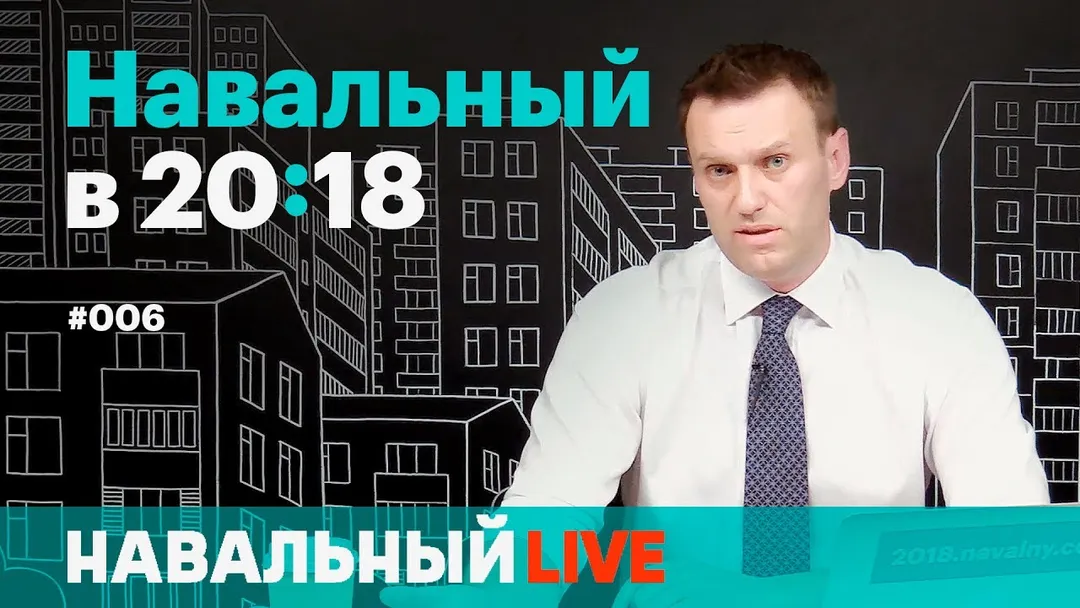
Navalny at 20:18. Broadcast #006, 25 May
[music]
Hello everyone, Moscow, 20:18. That means
that you're watching Navalny Live in the studio. I'm Alexei
Navalny, and this is the program *Navalny in 2018*. I'm
here to discuss with you
some important issues, to talk over the news
that has happened, and maybe answer
some new questions
that come to your mind. To
send them in, please write on Twitter
with the hashtag #Navalny.
2018. I've written down some things that
people asked me. Earlier today I asked
on Twitter, and I have several topics here:
Google Center, an additional funny
development in the story with the villas and Rosneft,
we haven't talked about that yet; the June 12 rally;
those guys from SERB (a pro-Kremlin activist group) who
attacked me; various video addresses
to me that are being published now and
demand answers. I want to discuss all of that
with you. And of course I want to start with
the continuation—forced to, rather. I don't want to. I'm
already a bit tired of
talking about it, but I have to begin with the continuation
of the story called Like Share Alisher.
Alisher Burkhanovich Usmanov released
a second video address to me. It blew up
the dance floor, so to speak. Yesterday I logged onto Twitter
and saw that once again everyone was writing about some kind of
video address. Aren't people tired of discussing
the same thing over and over? It turned out he had released
a second, second video address. We cut out 40
seconds of the most interesting part from
it. Let's take a look. Well, actually, if
we're being honest, a long time ago the great Russian
writer
Bulgakov, in his novella *Heart of a Dog*, described
a character with an enormous mess in
his head—Polygraph Sharikov—who
dreamed only of taking and dividing everything up. So you,
Alexei Polygraphovich, are becoming a real
worthy successor. You lied, and now you
personally owe an apology, and
what debates are we even talking about? That's the same as
holding a debate between truth and
lies. Our debate with each other will now take place
in court, Alexei Polygraphovich Navalny.
Phooey on you once
again. I liked this video much
more—it was better made, despite the fact
that all the familiar markers were still in place, for example
the signature faceted glass for
whiskey—like my glass here,
yes—but it was still recorded in
that cheerful, I'd say rather boorish
manner, with the trademark 'phooey on you once
again,' which amused all of us very
much. From that video it's obvious that
Dmitry Anatolyevich Medvedev asked
Usmanov to draw attention away from him, and
overall it's working quite well.
Look, yesterday absolutely everyone wrote about it—
all the newspapers, all the mass
media, everything everywhere was filled with
'Navalny vs. Usmanov battle,'
*Versus* is showing the best clips, who
responded to whom, lots of funny
jokes on the subject, political scientists
are analyzing it, someone is counting how many books there used to be
in the background and how many there are now,
the microphone used to be worse, now
the microphone is better. In terms of substance, it's being
commented on with lots of conspiratorial
theories—what does it all mean? But there's only one
question: where is Medvedev in this discussion?
He's nowhere. And their ploy is working, because
some supposed duel between me and Usmanov,
discussion of issues that have absolutely nothing
to do with the essence of our
investigation—
rape or not rape, whether he served time, for
what he served time—
and whether he should address me informally or
formally, and whether saying
'phooey on you' is graceful or not—this has become the main,
indeed the only topic of discussion. But there's no
Medvedev, no major corruption,
and it seems to have slipped out of the mass
consciousness that, essentially, Usmanov and
the palace on Rublyovka (an elite area outside Moscow) that Usmanov
gave to Medvedev—I insist, and I will prove
that it was a bribe.
That's just one episode. There are many palaces there,
there's a lot of different stuff there, but again
only Usmanov is being discussed. This is being done
completely deliberately. It's being done, among other things,
so that—well, he sued me, and
there, well, we understand what
a Russian court is, right? If Usmanov
wins, they'll say: well, Usmanov
has disproved Navalny's investigation.
Does this bother me? Well, it
certainly irritates me a little that
the mass media are structured in such a way
that they very easily
switch focus, and in that sense they're fairly easy
to manipulate. You just do
something bright and new like this, and every
day an oligarch addresses someone on YouTube,
and everyone rushes to that topic, forgetting what
happened only very recently. On the
other
hand, Usmanov is a very harmful person. He is
a harmful oligarch. He is a harmful corrupt official's associate,
he is
one of the corrupt figures, and that's why dialogue with
him is something important and substantive for us.
I consider one of the most important goals of my
election campaign to be that we
must return to the political agenda
the question of who the Russian
oligarchs are, especially the commodity-sector oligarchs.
Because unfortunately it's considered that
if you're a person with democratic views,
if you're someone who supports a market
economy, then for some reason you must love
oligarchs. But I don't love them, and I don't think
that they represent a market economy, and I do not believe
that they are businessmen, and I believe they should be
rightly criticized, because they are destroying
both the structure of the economy there and
the structure of society; they impose
completely false stereotypes about
what business is. Overall, they instill
hatred of businessmen in the public. Well,
because an ordinary person looks at
this face and at these lines like, 'You
should all apologize to me here,' and he
basically begins to view
business negatively. That is why this polemic with
Usmanov is also important for us, and that is why I
am taking part in it with pleasure.
And I will release the video that I need to
put out in response to Alisher Burkhanovich; we
To be honest, I have really immersed myself in
Usmanov's life quite thoroughly.
We have read several thousand pages of documents
over the last
while, and now I could probably write a book about
him; the investigations department could certainly
write a book about him. But
we will release a video, and in this video, unlike
what Usmanov is telling us,
who has nothing as evidence except
a glass, it will be
supplied with the full body of evidence.
On that date, in the Lyublinsky District Court
there will be a trial,
mine with Alisher Burkhanovich Usmanov, on
the subject of his honor and dignity. I more or less
know how trials are conducted in this, my
home Mariinsky
court. Before this, several prominent United Russia (the ruling political party) members
sued us and sued me, and every
time it is the same picture: none of
our evidence is
accepted, none of our motions are
granted. We show photographs
of houses, and the United Russia members laugh in our faces and
say, 'That is not my house, it is my mother-in-law's house,'
as happened with the well-known United Russia member
Sergei Neverov. Nevertheless, in
this court as well, I hope it will be open.
I hope there will be a broadcast there; at
the very least, we will petition for
such a
broadcast. We will present all the documents, and
of course we will prove that we are right in
every word regarding Usmanov's corruption
and in every word regarding
our assessment of his character. But what decision
will the court make? It is a Russian court, after all. But
still, we shall see. I am confident in
my being right. The next topic I wanted
to discuss is, of course, the situation with Gogol
Center and Kirill
Serebrennikov, the Russian director, whose
home was searched,
and who is now
involved in a criminal case, either as a
witness or perhaps they are preparing to bring charges against him.
We know that
searches were conducted in the Gogol Center theater itself,
the performers there were detained for some
time, shoved somewhere, and there are a huge
number of questions about how I view this
and whether I believe that there really was
no smoke without fire, that they must have been
doing something improper with budget funds.
Well, I rely exclusively on my own
experience, and I want to say that, looking at how
this is unfolding, I of course believe that the case
against Serebrennikov is fabricated,
because this is a completely typical course
of events: this is how it happens. Nobody is told
anything; absolutely nothing is explained.
At the same time that
it is being claimed that Serebrennikov was
involved in some kind of fraud, the next
news item is that they have already found
at his home
hashish. This happens all the time,
because they do not have enough evidence
for the main case, and so they either
plant something or try
to find something on a computer or in a
phone. And based simply on this
outward appearance of things, I can say that
this looks very much like a fabricated case.
And fabricated cases are usually handled
this way. In the Beautiful Russia of the Future (an opposition slogan referring to a hoped-for democratic Russia),
such things should happen
completely differently. If it is a high-profile
case involving the embezzlement of public funds, and the
investigation has already reached the stage
where it is necessary to conduct a search of a home and
mass searches of people, then it is necessary
for a representative of the Investigative Committee
or someone else to come out and explain in detail
what is happening. And when you
carry out a search in someone's home,
that is a serious matter, an unpleasant matter. I
have had searches conducted several times, and
each time you do not understand why your home is being
searched. They show you
a piece of paper from which either nothing is clear
or the substance of the accusation is unclear. It is just,
'The judge said I authorize
the search.' But at this stage there should
be clear explanations given to all of us, to society,
to Serebrennikov, to the Gogol Center, to everyone
in the world, about what exactly happened there
that warrants the following:
that we must lock the troupe in a hall, confiscate their
phones, and keep them there for several hours.
After all, this concerns people's freedom. Therefore,
well, again, I have no doubt that many people
would like to take Serebrennikov's place, and
I have no doubt that the authorities as a whole
view his theater as
oppositional, as something unpleasant, despite
the fact that for a certain period
of his career Serebrennikov was fairly
close to these authorities. We remember
that he staged a play based on a work by Surkov.
Around zero. And in general, it was like their...
Their friendship with us, nevertheless... Of course, they
see the theater as oppositional; this is
on the level of intuition, like the Taganka Theater (a famous Moscow theater) in
the Soviet era — it was an oppositional
theater. It was never quite clear why they
weren't shouting things like 'Down with the Soviet'
government,' but in terms of style, in terms of the feeling,
it was obvious that they were against the authorities. The same goes
for the Gogol Center, which of course
exists on state budget funding, but
everything about it makes it clear that what is happening there
is, well, at odds with the main
line of government policy. So this really
infuriated everyone, and still does. It's a wealthy
theater, a new theater, and many people want
to take it over. And I think that in this way
different interests became intertwined, so it was like: well, let's
stir things up a little here, and
then Serebrennikov can either
and
or, well, be jailed. I hope that won't
happen. And the theater can be taken over. The whole
discussion was
greatly enriched by an interesting thing that
I was watching on social media, and which
I think is interesting to discuss now.
People gathered around the Gogol Center who
had come
to show support. These people are showing support — do they have
the right to? Are they supporting strongly enough,
or, on the contrary, too strongly?
Too weakly? Are they being hypocritical, standing
there and reading out some angry
their own
addresses to the crowd? This is quite
an interesting question. Let's first
listen to what Chulpan Khamatova said
to those gathered there in front of the theater
to stand up for her friend Serebrennikov,
who, it seems, is being unfairly
pressured by this regime. Please play us
the video. 'All the promises made
by Vladimir Putin to the Gift of Life Foundation
have always been fulfilled. Help must be
tangible. I will vote for him.' Oh,
that must be the wrong clip. My God,
the producer made a mistake and played some
wrong recording of Chulpan Khamatova. Well, there was also
Fyodor Bondarchuk in front of the Gogol Center
— he also came to stand up for his friend
Kirill Serebrennikov, who
is being unfairly pressured by this regime
and subjected to lawless searches. Let's
— since Khamatova didn't work out, let's listen
to what Bondarchuk said there: 'On December 2, we
will all vote for Putin, for Russia,
for a new country, so that nothing
changes in the direction that
Vladimir
Putin has chosen for himself.' But again, that's not quite the right video either.
The producer made a mistake, but maybe he
— actually, it was quite an interesting
mistake. He inserted those videos quite appropriately, and
at this point, of course, you thought: 'Well, Navalny, have you
finally decided to join those
people who are snickering and
trying to hound and insult those artists
who came to stand up for their
friend Serebrennikov?' No, actually,
no. I simply believe that
people have the right to remind our
wonderful artists that they are
part of this very system that is now
specifically pressuring Kirill
Serebrennikov. They made a major
contribution to supporting those
people who imprison not just famous
directors, but any ordinary people as well,
evict them, shut down their social media,
make their lives unbearable. That is their great
responsibility. But at the same
time, jokes aside, I really
believe that Khamatova, Bondarchuk, and
Mironov, whom you can see on your screen now,
— there were a lot of jokes about that; there was even
a headline, yes: 'Yevgeny Mironov
whispered to Putin about what was
happening with Serebrennikov,' and people
mocked it quite a lot. But I want
to say this:
it's important to remember that artists
— athletes too, by the way — all these
representatives of the creative
intelligentsia are, of course, terribly
dependent on the authorities, and most often they are — well,
let's be honest — terribly
afraid of the authorities, because their entire
life, career, and future work depend on it.
That's just how it is: they cut you off
from television, and that's it — you're nobody, and
no one will buy advertising from you, and no one
will do anything for you. Therefore,
we should value any people from
this artistic milieu who
overcome their fear and say at least
something. And all the more so, we should value
truly brave people in general. Of course, among artists
there are brave people who do not
hide their point of view at all. You know
such people; you know they are driven out from everywhere, but
nevertheless, they speak with complete honesty
and say everything plainly. These are
heroic people. But even Khamatova in this
situation, and Bondarchuk, whose
political views, obviously, I do not
like at all, and Mironov, who is also
not at all close to me in terms of his
political views — this should be appreciated:
the fact that here he is, handing this note to
Putin, and of course every cell in his
body is telling him: fall to your knees, as you
always do before this authority. But
he still overcomes himself, takes out
the note, and speaks about Kirill
Serebrennikov, speaks about his friend
who is being subjected to repression. Therefore,
everything possible must be done, and support must be given.
to appreciate all the people who, after all,
said something. There are many artists, but
far from all of them came to the Gogol Center (a Moscow theater and cultural venue), but
some did come. Good for them, they came, but at
the same time, looking at this absolutely proper
gesture, it would not be at all unnecessary and
would be quite appropriate to remind them, to say:
Guys, you helped create this system. You
also bear responsibility for the fact
that now some people are going through
Serebrennikov's apartment, turning everything upside down
and, well, finding some—I don't know—
little baggies there, or planting them. You
helped this system, so remember that
and don't act otherwise in the press. It seems to me
this is a very important point.
And none of us needs to, so to speak,
go after one another; those who
criticize them are not being supported by anyone.
Everyone simply has to look at this
situation as a whole.
Eva, people are writing to me: they've made themselves very comfortable,
the Ministry of Defense. Well, yes. A lot of them have
settled in comfortably—artists, athletes, and
so on—because that is the kind of life they have.
They don't know how to do anything else, and
they can
live more or less comfortably and
without hardship, most of them, but only
by attaching themselves to the authorities. Unfortunately, that's how
the Russian state is structured, and
so this artist understands that without
the state he is nobody, without budget money
he is nobody. Theaters in Russia, well, effectively
do not exist
on private money, except for some rare
very exceptional cases. Mostly it is
state budget money. It is absolutely
wrong that it is personally distributed by
the minister of culture. Everything depends
on the minister of culture,
so yes, that is the situation.
The next topic is quite interesting
because I wanted to tell you about those same
little spoons. This week we had
three victories of sorts
for the FBK (Anti-Corruption Foundation), important ones for us. First,
I believe we did ultimately secure
the resignation of the mayor of Nizhny Novgorod, Ivan
Karnilin. Of course, he said he was resigning
because
because, because, because he was simply
tired, because he was old, because he had reached
a certain age. But we understand perfectly well
that this was simply, with a certain
delay, effectively
a forced resignation, because we found
his apartments in Miami, and now it is very easy for us
to work in Nizhny Novgorod
because to any objection from
the authorities, to any reproach
that somehow we are doing
something wrong or that the West is behind us, we
say: Well, guys, be quiet. Your
mayor has hidden apartments in Miami
that he bought with money from unknown
sources. For United Russia, this was very
painful. We knew they discussed it for a long time:
you can't give in to Navalny,
you can't remove people. But nevertheless,
you did remove him, you sent him into retirement, and this
is an excellent example of how
real public pressure and broad
dissemination of information help
achieve results. And we achieved it.
Besides all that, we also achieved the fact that
the Federal Antimonopoly Service
finally acknowledged the existence of a cartel
organized by the so-called
"Putin's chef," Yevgeny Prigozhin. This is
also truly a major victory.
The largest cartel, worth 23 billion rubles (about US$390 million at the time). We, unfortunately—
there he is, Putin's chef, as you can see,
standing on the left in this picture. Unfortunately,
we were unable to push the antimonopoly service
all the way, and they did not include in
this cartel conspiracy all the companies
that we pointed to. But at least we
did excellent work. The cartel
conspiracy has been proven; it is now a legal
fact that this man created a cartel
and stole money by the billions from the
Ministry of Defense, and we very much hope
—and will keep watching this—
that they will face punishment, and already
criminal punishment, because a cartel is
a criminal offense. The spoons—
the spoons are a wonderful story.
Rosneft's spoons—you probably saw it. It was
a fairly popular video that we
recorded very quickly because there appeared
this procurement notice in which we saw that
Rosneft was buying caviar dishes for
80,000 rubles and teaspoons for 14,000 rubles each. Well,
naturally, we got angry, quickly recorded a video,
put it out, and it got millions
of views. The company's press secretary
said all sorts of ridiculous things—
Rosneft's Mikhail Leontyev—but nevertheless,
no matter how much they shouted about
how
Navalny was supposedly proposing that we eat
with our hands, no matter how indignant they were, no matter how much they
made various statements, we
forced them to cancel this purchase, and they
did cancel it. At the same time, Leontyev said many times
that they were canceling it for their own
reasons, but that in fact the prices
were reasonable. And today some
very meticulous person—I admit, we
didn't do this ourselves—did a simple thing
and wrote to us about it: he found
how much these spoons cost. The procurement notice itself lists
the exact
specification. This spoon, on the manufacturer's website,
costs $58, that is,
3,300 rubles, while they were buying them for
14,000 rubles. Do you understand the level of sheer audacity?
that is,
even when they are forced to cancel this
procurement, even when they have been caught, when
the whole country is already talking about them, they
still keep trying to convince us that the price
was normal, and even in such a
high-profile procurement, you are buying
some kind of—this is a risky procurement, right, or
buying some caviar dishes, putting it on the
website—a blanket for 124,000 rubles (about $1,350). Well, it is risky
because someone might find it and someone will
start shouting. Well, at least in such a risky
procurement, at least do not inflate the price four
times over. But they still do, because
that is how the whole system is set up: they cannot
steal less than what is called
a fourfold markup, 400% profit—they want
to make that even on procurements like these, where
there is a high probability they will be caught, and
it is an astonishing story. We will demand that
Rosneft conduct an investigation into this
matter, and we will demand that law enforcement
agencies conduct an investigation into this
matter, and we are very interested to hear what
will be said by
the wonderful press spokesman, the “drunk,” as everyone
calls him at Rosneft, Mikhail
Leontyev, who called these prices
inflated fourfold
adequate and fair. But if these are
adequate and fair prices, then I suppose you buy pipes too
when you build, overpaying
by a factor of four. Well, that is a rhetorical question.
We know they overpay, and every
Rosneft procurement is monstrously
corrupt; this is just another
very specific example of
what—of what
is happening. The June 12 rallies: I have received a large
number of messages, letters, and tweets
about the June 12 rallies, specifically asking
what exactly we need to do. Guys, you
need to do one simple thing: on May 29
the period begins when you can submit
applications
to hold these very
rallies. A sample application form for this
application is available here in the video description.
Go there, download the template, and submit
an application for the central square of your
city. We more or less understand what
will happen around all this; we understand
that they will say they already have
events scheduled in connection with
the official celebrations, and that they cannot
possibly
authorize it; they will offer some sites in
remote places. We are acting exactly the same way
as we did on March 26: submit
an application for the city center.
The March 26 rallies proved one
very important thing to us about our rallies, about
the fact that to us
more real, free people come than to
any other official event—
more than to official events.
That is simply an established fact. We bring out
more people. Therefore, we should get
priority, and yes, we are part of this
celebration of Russia Day (the June 12 national holiday).
Especially since our anti-corruption
event will take place
under Russian flags.
Do not ask for some distant square somewhere—
clearly submit for the central square
and demand that they approve
the central square. If no proper
place in the center is found for us, despite
the fact that we bring out more people than anyone else,
then that means we do not need any permits
and we will once again act in
accordance with the ruling of the Constitutional
Court, which clearly states that
first, an alternative venue must be offered;
second, there must be
a proper venue.
You cannot give us permission for a rally
somewhere out there next to the city
cemetery on the outskirts, as happened in
some
regions. So please go to the
description; there are more than 200 cities there, if I
am not mistaken—actually, I think 117 cities have now
said they are participating. Guys,
download the application template and
go do it yourselves. As always, you can
get in touch with our lawyers
if you have any questions.
There was a tweet—one
student asked me about his thesis. He writes and asks:
“Denis Karasyov here. My thesis defense is on June 20. What
if the valiant police
make me spend 15 days in jail as a preventive measure?” Well,
first of all, Denis, that is a valid reason.
If they lock you up for 15 days, you will bring
a certificate—you will have paperwork. They give me those all the time.
So you will be able to
take care of it at another time.
That is first. Second, they are not going to slap you with
15 days; the probability of that
is extremely low. The probability that
I will get 15 days—well, that
is always close to 100%. But that is fine, I will
sit it out and get through it all. Let us
use some simple
math: at the rallies on the 26th,
specifically at the
unauthorized ones, at least 60,000
people actively took part. That is
the minimum; most likely it was more. But let us
take 60,000. Actually, only
were arrested for
a few days—about 80 people across the whole country.
Fine, let us take 100 for simplicity
of calculation. Thus, the probability that
you will end up under administrative
arrest is
0.1%—that is a very, very low probability.
that you’ll leave the house, break
your leg, and miss your thesis defense
because you’re out sick is much higher than
the probability of being detained at this
rally. Well, of course, yes, we
can see even today how people are being jailed,
some of them. Yes, I’ll say a couple more
words about that. Uh, that risk does exist, and we
understand how the authorities work. They always
want to grab some innocent
person and demonstratively throw them in jail,
but when there are many of us, people shouldn’t
be afraid. Bad things do happen, but
again, the probability of that is extremely, extremely
low. They cannot repress masses of
people, so go out boldly to any
rally, authorized
or unauthorized, any one at all. We will, of course,
do everything we can to, uh, obtain
official approval for these rallies, but you
shouldn’t be afraid to go. You simply shouldn’t
provoke anyone, and all the more so you shouldn’t
get into it there with
law enforcement officers. You need to behave
normally and peacefully, but remember that
if you are lawfully in your own country, nothing will
happen to you. I got not 100,000, but 500 questions
about the news that
was published yesterday evening,
saying that the police have no complaints whatsoever against
the SERB movement, whose member, well,
carried out this attack on me and splashed
zelyonka (a bright green antiseptic dye) on me, and that’s it.
They have been identified and established; we know their
names, we know absolutely everything about them, but
nevertheless
no one has any claims against them, and
no one is going to investigate their activities.
And everyone asks me: how can that be?
My God, why is this happening? Are you surprised,
Alexei? Well, guys, first of all, I on
the previous program said that I was
not surprised at all, and I explained that
no investigation is being conducted. And
now I’ve even brought you
a unique
document here: it’s the transcript
of the interrogation of the very person who
attacked me and was
a prosecution witness, I think
the only prosecution witness in the
case under which they sentenced actor Kuliy to 8
months in a penal settlement colony,
and as I understand it, the testimony of this
man, Petrunko, appears in all
the other criminal cases opened
over the events of the 26th, and we can simply see—well, look—
the man writes outright:
“While there, I observed the commission of
unlawful acts against
police officers, which I wish
to report voluntarily to the preliminary
investigative authorities.” And then
come the specifics: “At 4:00 p.m. I was at such-and-such
a place and saw a bearded man
grab a police officer’s baton
and try to wrench it away,” and then a detailed
description of what exactly he saw. On the next
page we see again: “Then, at approximately
5:00 p.m., I observed the following. While located
at such-and-such a place, I saw a young
man of such-and-such an age...” And what does all this
mean? It means that these
representatives of the SERB movement, and in
particular those who attacked me, are simply
freelance operatives. Well, if you like,
informers for the Investigative
Committee, who are needed in order to
fabricate cases against completely
unknown people. They grabbed
several random people, then they take
someone like Petrunko and say: you will be
the witness, and he writes these made-up
statements. And you see, four
people were arrested there, and in all
four cases the necessary witness
just happens to be on the scene. So he
recorded all the unlawful acts and
wishes to report voluntarily to the police about
what
was happening. Who is going to jail him? He
works for them, he’s with them; there they are
right beside him dictating what kind of
testimony
to give. Together they are fabricating
a criminal case, committing a serious
criminal offense jointly—that is,
what is called
acting as a group by prior conspiracy. How
are they going to jail him? They gave him
immunity for doing this, and
let’s take a look. That’s why no one
will ever jail him. But they will jail another
person.
The verdict.
Ladies and gentlemen,
let’s watch the video recording of his
detention. He’s fairly easy to recognize in
this video recording—it’s very short. Yes, he has
a Russian flag on his shoulders, and with
that Russian flag on him they dragged him into
the police van I’m in. Please go ahead and
play this
[music]
recording.
So strong. How strong you are.
Bea— Well, you saw it: he didn’t do anything at all.
He didn’t touch a single
policeman. They themselves grabbed him,
beat him, shoved him into the police van. After that, I in the
police van watched them start beating him
right in front of me, and only after I
started yelling obscenities at them and began
filming it all on my phone did they
stop doing it. But meanwhile this
Petrunko character
goes into detail describing how this
Shpakov struck some colonel.
the police, and so on and so forth. That is,
this case was fabricated. It is
simply obvious to everyone, obvious to every
person. So do you think they are going to
bring criminal charges against
such a
key false witness? Of course not.
Because if they start putting him away,
he'll stand up in court and say, "Guys,
how can this be? We were in contact, I
for you
wrote statements under your dictation, I for you
put that man behind bars — remember, the carpenter from
Lyubertsy (a city near Moscow) who is raising
a child without a wife, and whose mother is disabled. I
got him imprisoned for your sake, so why don't you
love me now?" That's how it happens.
That is why, regarding Shpakov, tomorrow I want
to announce that we need to raise money for him, at least
half a million rubles (about 500,000 rubles). There really is
a monstrous situation there. The man is a carpenter,
a working man, raising his daughter.
He has dependents, and this daughter needs
tuition paid. I really don't want
him, sitting somewhere in a pre-trial detention center (SIZO), to be thinking about
whether his daughter is now going to be expelled from
college because there is no money.
Tomorrow I'll announce it. A registered
Yandex wallet has now been set up. I think we can raise 1,500,
but at least we'll cover some
urgent needs.
But people often ask me, "Tell us,
please, first of all, do you feel
responsibility?" I do. Of course I
feel my responsibility for the fact that
a person who, in part because of my call,
came to the rally and ended up among
these random people they are imprisoning.
Of course I feel responsibility, and it is
terrible to feel all this. And the second, most
common question is: "Doesn't this
scare you? And shouldn't this scare everyone
else? Shouldn't this drive them off the streets?"
Well, honestly, I don't understand how
a normal person could, on the contrary, leave the
streets after seeing something like this, seeing how
they jailed Shpakov for nothing. This is
confirmed on video. It just makes everything inside me
boil. I do not want to live in a
state where some random
carpenter can simply be grabbed and thrown in prison
so that Medvedev can steal more easily.
I am absolutely not prepared to put up with that
for even a second. So of course I
will keep going out into the streets for as long as
it takes to make sure that things like this do not happen in my
country. And I call on everyone else
to do the same. It is impossible —
it is impossible to tolerate this.
This is public abuse. It is not even
some kind of quiet fabrication of
a criminal case. The video
is right there, and you are telling us to our faces
that he beat some colonel, when
we can see he did not, of course he did not. We must
go out into the streets for him, among other reasons for
him, because there are
hundreds of thousands of cases like Shpakov's outside politics — just imagine.
That is why in our country you can
take anything from anyone, seize anything by force,
any business. I don't know, maybe some
lieutenant colonel
takes a liking to someone's wife — let's lock him up
so that she is left here alone. This
happens in practice. That is why, among
other things, we need to come out
on the twelfth. And someone writes:
"Mr. Sovlad: June 12, rallies against
tsarist power." Well, essentially that is
what they are: rallies against autocracy, against
tsarist rule, because they have decided
that they really are autocrats, that they personally
control everything, starting with things like,
"Let's jail the carpenter,"
and "This state company belongs
to me." Artos writes: "He touched the police van." Yes, but
essentially, yes, he touched
the police van. As for the headquarters, an interesting thing happened with
our Moscow headquarters. Those of you who follow
our campaign know that, in
general, our process works as follows:
we prepare an opening, we rent an office,
people start working in the office, we gather
volunteers, after which I usually
come to the region and hold a meeting with
volunteers either at the headquarters or in a
rented venue, after which the headquarters
physically opens and begins
to operate. In Moscow, of course, we wanted
to open a headquarters as one of the first cities, but
here, I have to admit, they really
boxed us in. We have a lot of volunteers here,
and it does not suit us
to have a venue for 200, 300, or even 1,000
or 2,000 people. We need a venue for
5,000 people. Right now, the number of registered volunteers is
17,000.
Even if we ask, "Guys, don't
come unless you really have to; if you can skip it,
then skip it," we still understand that thousands of
people will come.
And I don't know whether it was Moscow City Hall, the Kremlin, or
whoever else, but they literally went around all the venues
with that kind of capacity and told everyone not
to give them to
these
us. Just the other day, we signed
a contract with some rock club, and that
rock club
and its founder sent only
some sad emojis, and then
they posted an announcement on their
website saying that they could not
rent the space to us. But we decided
that we would simply do it differently. So starting
Monday, the headquarters will simply, well, simply
open its doors and start working. We will not
be holding
There won’t be any kind of grand opening ceremony.
The address of our headquarters is Sadovnicheskaya
Embankment, 69. It will start operating on
Monday, so just come by already.
There won’t be any ribbons or, I don’t know,
garlands or confetti — we’ll just open and
start working. And the meeting with volunteers,
as Volkov rightly said in his
video — for those who saw it — we’ll hold on the 12th,
June 12, June 12. Come, and we’ll meet outside,
talk — well, maybe not talk,
maybe you’ll just see me already at the moment
when the court is putting me into that very bus.
Well, never mind. If they don’t let us
gather inside the building, we’ll
gather outside, because basically
everyone understands everything already, and at these
meetings with volunteers, it’s nice for me to
talk to everyone there, but there’s nothing particularly
special or new that I say, so I
think the Moscow headquarters will
start working anyway. Please come,
sign up as volunteers,
sign up as people who
are ready to give us their signatures. It’s very
important, of course, that you also financially
support our campaign — it’s very
important. We’re not oligarchs, and all of this is sustained
solely and entirely by your
donations. In the description to this video
there’s a link. You can go there and make a
donation. We’re now entering
a period in the campaign when we need money
even more. We’ve already opened quite a lot of
headquarters — more than thirty. We have
an enormous infrastructure already, the largest
political infrastructure in the
country, ready to distribute
leaflets, campaign, and so on, but this
already requires
a lot of expenses. Even if your
volunteers — our volunteers — work
for free, it’s impossible to print leaflets for free.
So we need money, and
please, if you have the
opportunity and the desire to support us, then
send your hard-earned
rubles. The last thing I still wanted
to discuss is
YouTube video appeals.
YouTube is full of video appeals addressed to me, and that’s
an interesting thing. Yes, I, I
am constantly praising YouTube and
celebrating how it allows us to break
the monopoly of television. And now
this interesting thing has happened — it
annoys me on the one hand, but I
won’t lie, on the other hand it
shows how cool YouTube is. So, so,
feminists recorded a
video appeal to me. Let’s watch a little
bit of the feminists.
Hello, Alexei, this is
the feminists. In the upcoming presidential
election, we would like to vote for
Simone de Beauvoir or Maria Trubnikova, but
they are already dead; for Mari Davtyan or Olga
Strakhovskaya, perhaps, but we are left with two
options: either boycott the election or
vote for
you. That was the feminists, and on the one
hand I’m flooded with tweets asking, when are you
going to respond
to the feminists? On the other hand, a bunch of people write to me,
asking, Alexei, how are you going to fight
the feminists? Judge Novikov wrote
some kind of video appeal to us, and I’m
flooded with messages saying: respond to Judge Novikov. There’s also
the video blogger, the video blogger Shariy
who, well, as I understand it, is kind of
pro-Kremlin, or I don’t know, anti-Ukrainian
— he mostly talks about Ukraine — and he
has also already recorded a million appeals
on video. Everyone writes to me: respond to Shariy. It’s
interesting, because the feminists
recorded one, and I went and looked —
they had a thousand views. And, well, why
respond to them? Especially since, substantively,
I can say to them: dear
feminists, actually, in our platform
you would like most things
a great deal. That’s first. Second,
the gender balance in both the FBK (Anti-Corruption Foundation) and
the headquarters overall is in favor of women — we have
more women working with us than men. I think
I won’t respond to them, because that would only
promote these feminists. But then
an interesting thing happens:
the pressure inside YouTube is such that, well,
you have to respond. At every meeting in the
regions, people asked me about Judge
Novikov, and we got in touch with Judge
Novikov and will somehow settle
the conflict, answer his questions probably
— maybe Sobol will invite him on air if she wants
to, or somehow this issue will
be resolved. Same with Shariy — he recorded
that appeal to us, and now at meetings I already
say that, well, I’m not going to respond
to him specifically, but I’ll answer all these questions
in my address to Usmanov. This is
a cool thing. It shows that here
you can’t ignore the audience, even
if it annoys me — still,
I’ll have to respond, even if it’s only
a small number of views, well,
a few thousand people. Yes, YouTube creates
a space in which you cannot
ignore the political
agenda; you cannot
ignore, so to speak, what people are demanding.
People ask me this:
yes, maybe they want to
use you for publicity; if you have more women
that doesn’t mean they’re feminists,
and so on. Well, that’s all true, of course.
Of course they want publicity — everyone wants
publicity, everyone wants to get noticed, they want to
We invited them onto Navalny Live in
the feminists’ appeal, where it was pretty, well,
clear and explicit: they want us to
invite them on air. Well, okay, they want
to be invited on air, and quite cleverly, uh,
they’re using YouTube’s capabilities so that, well,
I, so to speak,
get pinned down
by everyone else. And it works in a
pretty interesting way. I mean, basically,
you can’t dodge it, you can’t ignore it,
and you can’t say, well, you know, I didn’t
notice it. You’ve got, what, not many
subscribers on your channel, and I didn’t even see
what you wrote there. That doesn’t work. That
works for Putin with television, yes,
or Peskov keeps saying all the time, we’re not
aware of this matter, even though the whole
information space has already exploded
over it, everyone is
discussing it, and they still have the option
to say, wow, how interesting. We
didn’t even know. That’s not within our
competence. Well, ask someone
else. But I can’t do that.
On the one hand, that puts me, sort of,
in an unequal relationship with them, with
everyone. But on the other hand, if
you like, it toughens up any politician, and any
politician should be able to work in that kind of, well,
aggressive environment. They should constantly
be coming at him from all sides, I mean,
running up to ask uncomfortable questions. I
am forced to answer those uncomfortable questions,
and on the one hand the feminists are
attacking me, and on the other hand those who are
annoyed by the feminists—Novikov, Shariy, and everyone
else. I answer these questions,
and probably, it seems to me, that can
make me—and anyone, not just me,
any politician—a better politician
because you’re forced to work with, among
other things, an audience that
aggressively demands something from you.
That, in fact, is what
the art of politics is. You become president,
and there is always some group that wants
something from you: trade unions want one thing from
you, employers want something else from you,
oligarchs want one thing, the public
wants another, for you to pay, and
doctors want this, teachers want something else,
students want a third thing, and they write in. Some
say, let’s abolish the Unified State Exam (Russia’s standardized school-leaving exam), others
say let’s
not abolish the Unified State Exam. Right, and people write to me, blah blah,
like, yeah, damn it, sure, let’s go ahead and answer everyone.
Why bother going after corrupt officials?
Well yes, of course it takes up
a significant amount of my time, and
you’re absolutely right—I won’t lie,
sometimes it irritates me that I have
to spend time on this and answer
some silly questions that I
may already have answered. But this is
a presidential campaign. If I were just
the head of the Anti-Corruption Foundation
the founder of the Anti-Corruption Foundation
I could say, yes,
leave me alone, I’m really not at all
interested in what you’re writing there or what you’re
asking me. But if I’m a candidate for
president, I’m obliged to answer these
questions, obliged to show that I can
work with all groups, because
the president of Russia must be
a president for everyone. He must be
a president for Judge Novikov and for
feminists and for anti-feminists, and for
that Shariy too—well, if he is a Russian citizen,
then of course he should be included too.
That’s very important.
So YouTube is an interesting thing,
YouTube. I still
even having noticed this, sing its
praises. Karl Ukrav asks me,
where’s the Instagram promo? Did you forget again?
Navalny 4 million, and subscribe.
We really do spend a lot of time on
it,
promoting it.
Is it hard with the feminists? It’s not
hard for me at all, because I’m
asked these questions fairly often at
meetings. So, first of all, I
am absolutely in favor of gender equality. Second,
as for the gender balance in our team,
we don’t regulate it; I don’t have any quotas.
I’m against quotas. I don’t have any such rule as
there must be 50% women or anything like that.
But historically, it just so happened that
we have more women working both in the foundation and in the organization
than men, and they work
wonderfully. Third, I really do believe
that there are specific issues affecting women.
Well, they’re not just women’s issues—they’re our issues in general,
because they’re men’s issues too, and anyone’s,
really. When a
woman is paid less than a man
as is often the case, and in Russia the gap is significantly
large, that means the income of the whole family
is lower, right? And a family consists of
a man and a woman, a couple. So yes, that is
really a major problem. Childcare,
care for children,
getting children into daycare and kindergarten—there are, of course,
specific problems that feminists understand
and raise. These are important problems.
I’m not going to brush them aside, so
by and large, I quite share their aspirations
and their demands and concerns. The other
thing is that I know perfectly well that in the country—well,
in Russia,
Western-style feminism is not
widely supported right now by many people, and I know perfectly well
that now I’m simply going to have
a huge amount of criticism come crashing down on me
just for having anything to do with them at all.
So, with these crazies, basically no one...
...supports them. And there are still many women...
...who will scold me for this, but again, this is...
...a significant group that we need to...
...engage in dialogue with. What do you think about...
...Aram Gabrelyanov's involvement in the show?
Will the current authorities move into the internet? Will there...
...be propaganda? Someone asks me—I'm not even going to...
...read it out loud, but the point is...
It's a very funny show. I really...
...honestly—I know that it's made by LifeNews.
And of course, that suggests that it's quite...
...likely that closer to the elections they...
...will start pushing some kind of propaganda. That is...
...they may just slip it in there, but it really is...
...very funny, especially the first two...
...episodes. I watched them and was genuinely laughing...
...not just thinking, "that's funny," but actually...
...laughing out loud. As I understand it, there are some...
...excellent writers involved—they're making a genuinely...
...very good product. Well, I hope that...
...they won't...
...insert any propaganda into it, but LifeNews...
...this Gabrelyanov—they're such vile...
...complete crooks, liars, and fraudsters that...
...they'll probably use it for that too. But...
...then the show will simply be ruined, and no one will...
...watch it. That's what's great about the internet:
...it's easy to spot that stuff here, any little...
...from your manipulations with...
...likes and dislikes to...
...some kind of fakery and attempts to slip in...
...planted information—it picks up on that pretty easily.
That's really what makes...
...the internet so great. So, what else do we have here?
They're asking: put some more...
...tweets on the screen if there's anything...
...interesting. Modern YouTube is like this:
...everyone chasing hype gets into either...
...rap or other people's blogs, and now they've moved into politics.
Well, people go where it's interesting...
...they go where there are views, where there's...
...some kind of buzz—sorry for using that...
...word—but generally speaking, I'm actually...
...glad about it. All these people who record...
...video appeals—they're recording them for me.
They're not recording video appeals to...
...Yavlinsky,
...or to Zyuganov, or even to...
...Putin—they don't record video appeals to him.
Well, because Putin won't answer, and as for...
...everyone else, nobody really cares. And the fact that...
...they record these video appeals to me—I actually...
...value that, because...
...first, they know that I will...
...respond, and second, everyone is interested in my...
...opinion. If this kind of political interest is forming around me...
...this sort of political attention, then...
...that's good. It means we're doing some things...
...right, because it draws attention...
...to our...
...campaign. Navlany asks me...
Andrei Kontsevoy asks: what's going on with the issuance of...
...government bonds to borrow money from the public...
...at interest, like they once did in...
...the USSR (Soviet Union)? Well, as far as I can see, this...
...has failed. All these "people's loans"...
...simply don't work. It was called a...
..."people's loan," but there are no fools...
...willing to bring in their money and buy...
...government bonds. No, because...
...all the Soviet bond issues that...
...are mentioned here—well, it was all...
...a scam. Everyone was deceived and cheated, starting with...
...some of Stalin's loans and ending with...
...the last ones issued in the USSR. I remember...
...my grandmothers. I saw these...
...colored pieces of paper that they kept...
...somewhere in a chest or...
...somewhere else, like family heirlooms. They were...
...bonds from who-knows-what issues, going back to Stalin's time.
And everyone understood perfectly well that no one would ever...
...return the money...
...for those loans, but they still...
...kept them because, well, maybe someday...
...a hundred years later, on this Stalin-era...
...loan, someone might pay something out. Of course...
...no one ever paid anything. People know that perfectly well.
Everyone has that kind of inherited memory of it.
No one is going to buy any...
...Finance Ministry "people's loans" now, especially not...
...with our economy in the state it's in.
Hello, I live in a small...
...town...
...it's easy to rig things there, because there's no one to monitor them.
There are many towns like that,
...someone asks me.
About 50,000 people? That means...
...there are people who can monitor. Right now we have 110...
...probably thousand volunteers, and our volunteers...
...in our overall campaign are in every...
...city in Russia, in every populated area.
I'm sure that among your 50,000 people...
...right now, at least 50 people...
...are already registered in our campaign as...
...volunteers. That means that at every...
...polling station in your town, even now...
...as early as tomorrow, we could place one...
...observer. So guys, you just shouldn't...
...underestimate yourselves.
The number of people who are...
...unhappy with corruption is enormous. The number of...
...people who want an alternative is enormous.
The number of people who simply do not want...
...Putin to be elected for another 12 years...
...is enormous. And they—they are ready to work, they...
...want to be observers. You shouldn't think...
...that you're the only great person in your...
...town. There are lots of great people like that—you just...
...need to find them. Alexei, where can you legally...
...put up campaign flyers? Well, put them up wherever...
...you want. Just do it somehow...
...properly and tactfully. You don't need to...
...use superglue (Moment glue) to stick them on so that...
...they can't be torn off. Use tape...
...and neatly attach one in your...
...elevator. Then the next person walks by; if they don't...
...like it, they can tear it down, and there'll be no trace left for anyone.
So, you went back into the elevator again,
you ride it twice a day—just put it up,
carefully and delicately, this little flyer, and
you can put it anywhere.
You can hang it anywhere. They’ll tear it down, but then
you need to put it up again. You put it up, and after
a few hours they tore it down, but five
people saw it, ten people saw it,
so stick them wherever you want—just don’t
damage the walls, don’t damage
the elevators, don’t damage anything.
My assistant asks me: the Direct Line
with Putin was moved to June 15. What do you
think the agenda will be? It was
moved to June 15—note that, from
June, because you and I are holding
a rally on June 12, exactly why they
rescheduled it. They can’t very well hold
the Direct Line and ignore
questions about corruption—what is this, what
is happening all the time—when at the same
time
dozens, many dozens, possibly hundreds
of thousands of people in 200 cities across Russia took
to the streets to ask about
corruption? They want to see how everything
goes on the 12th, and then on the 15th
answer questions based on
well, what happened—did we get a lot of people,
was it a small crowd, did they detain anyone or not,
they monitor all this every day too.
March 26 scared them, but
now they want to understand whether this is a rising
wave—our anti-corruption protests—or
a declining one. So how many people
come out on June 12, and how you
conduct yourselves, will strongly affect what they
say on June 15. I mean, they
will lie on June 15, of course, but the degree
of brazenness in Putin’s lies
will depend on
us. Alexei Fyodorov asks: my
boss says that if you win
the election, none of the improvements will
affect me—that it doesn’t matter, everyone in power is the same,
everything will stay as it was. But I don’t
agree with him. Alexei Fyodorov, well, you
are right not to agree with him, because
you’re a sensible person, and unlike
your boss, you can connect
a few elementary facts. So, it won’t affect you?
If I win the election, I will make sure
that the raw-materials oligarchs stop
sending money offshore and instead
pay taxes here, inside the country. If
I win the election, I will make sure that the
1 trillion rubles (about US$11 billion) stolen every year
through government procurement stays in
the budget and is allocated to
healthcare and education. After some time, you’ll
go to a hospital in
your city and see that it has been
renovated.
You’ll see that teachers are earning
higher salaries. You’ll see that we’ve started
sending doctors abroad for training. I
will make sure that the several trillion
rubles stolen in state-owned companies
remain in the budget and serve the common
good. I will make sure that urban improvement projects
going on there in Moscow are not another way
to siphon off money. I will make sure that at
Rosneft they won’t be buying little spoons for
3,000 rubles (about US$33) apiece.
They simply won’t be buying spoons for 3,000 rubles
at all—they’ll go to a store and
buy ordinary, normal, decent
spoons, I don’t know, for 100 rubles (about US$1) or whatever
they cost. And that affects you directly,
because it will improve your
life, because I will make sure we have decent
roads at last, because in the 21st century
it is possible to repair all the roads. I will repair them, and
we have enough money. It will affect
you, your boss, and everyone around you
directly. So we need to believe that
Russia can live a normal life.
How do you become an election observer?
Marina asks. Marina, it’s easy to become one:
first, register
as a volunteer on our website. Then, closer to
the election—actually quite soon—we’ll start
training these volunteers and preparing them to be
observers. Then we’ll issue assignments,
and you’ll go to a polling station together with
your colleagues, other volunteers.
It’s very easy—all it takes is the desire, and of course you
can become that kind of volunteer. I’m also asked:
Kurmaev asks about relations between the regions and the center:
federal or centralized—what is your
vision? Please say a few words. In every
region I talk about this, and I’ll repeat it once again.
What is your vision? For 17 years we
have been building a centralized system. And what—does it
work? For 17 years we built a system—Putin
and Kudrin mainly, they built this
system under which all the money
is pulled into the center. And there was this legend
that this would somehow minimize corruption
and help someone. But it didn’t work.
All we achieved is that the regions
became impoverished, but corruption did not become
any less, and the budget process did not become
any better. In other words, the system has simply
gone bankrupt; it doesn’t work. There is
not a single developed,
prosperous federal state
that has a system like the one in
Russia—not one. It simply does not work.
So of course I support returning both
money and powers to the regions, where
that money is, generally speaking, earned. And
there’s a huge message in all caps saying that I
have to
wrap up. Turn the glass over—I’m turning the glass over.
June 12—don’t forget to come to the
rally. Get ready, submit your application,
support our campaign, and
Please stay with us on the channel
Navalny Live — we have many different
programs. Thank you very much to everyone who watches
us. We tell the truth here. Until next
Thursday
[music]
L
Tags