Militaristic Putin, the State Drug Cartel, Rybka in Danger
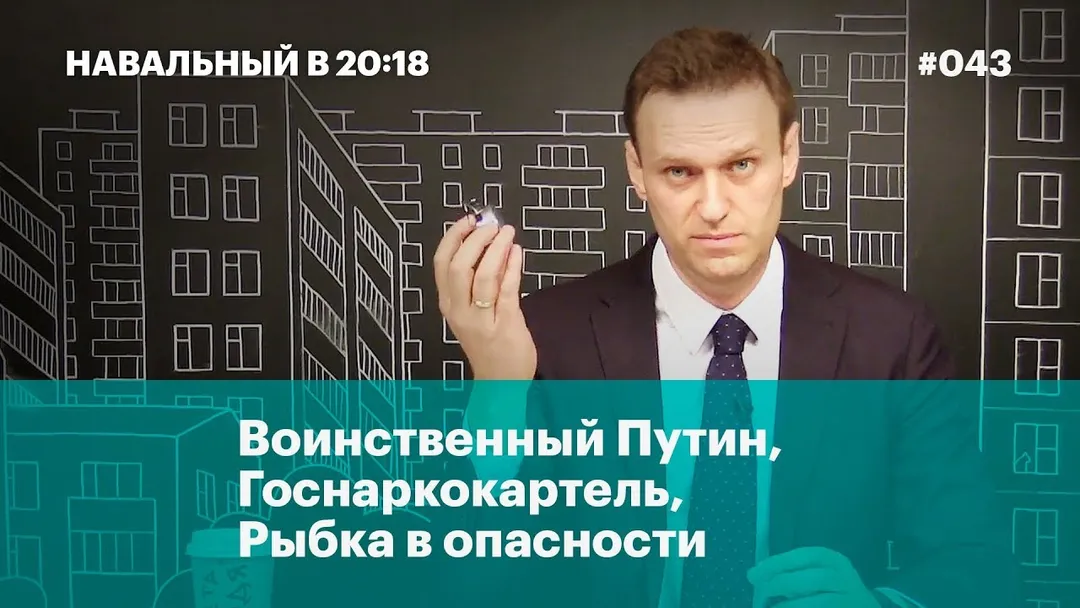
[music]
Hello everyone. It's 8:18 p.m. in Moscow, and in the studio—
Alexei Navalny, or rather,
"a certain individual," as Vladimir
Putin called me at the Interior Ministry board meeting. He spoke about a number of
individuals who organize
unauthorized rallies, and said that these individuals
must be fought and stopped. So,
that's all—three times "individuals."
They're insolent and provocative, so
there you go: I am insolent and provocative.
And today I also have a weapon with me. We
will be talking a lot on our program about
weapons.
Here is our weapon. It's this little device—you may have
seen it with flight attendants or with some
other people whose job is to count things.
Because on the 18th, at those elections
that we do not recognize, we will be counting
people, and all of our observers will have
one of these cool devices. And there's also
an even cooler version—
an electronic one that somehow fits on your finger
and counts people. Already
tens of thousands of people have signed up, and I urge you
to sign up as well for our
observation campaign. We are boycotting
the election, and we are urging everyone not to go, but
we are going to count those who do come
so the authorities can't rig things and
claim that the whole country, supposedly,
turned out in one great patriotic surge.
A lot of people will apparently come because they'll be forced to, but
we'll count them anyway. Today we have
item number one, item number two, and
item number three in our giveaway. We are
raising money to run the observation campaign,
and those who send the
largest donations will receive this
counter with an autograph—this very counter
signed. And the grand prize is Nastya Rybka's book,
that very book by Nastya Rybka. We'll talk a little
about it today, though I can't promise
Nastya Rybka's signature on it, because she
has certain problems—she often
ends up in jail in Bangkok.
Well, I'll probably sign it for you myself. That would be
a little strange, but anyway, you can
ask me questions on Twitter using the hashtag
#Навальный2017, and I will
try to answer them.
Three prizes in our program—sign up
to be observers.
A huge number of things happened this
week—it was genuinely hard
to choose what to cover, because things happened
that seemed impossible.
So impossible that if we had seen
all this in a TV series, we would of course have said,
"Come on, what kind of nonsense is this? This can't
possibly happen—some cocaine in an
embassy, and a plane belonging to the head—
the former head of the FSB (Russia's Federal Security Service), now
the head of the Security Council—carrying
something dubious, or flying off somewhere
to Bangkok
to rescue a girl—Nastya Rybka, no less—and
all of this is impossible to imagine, and yet
it happened. A disappearing and
reappearing nephew of Deputy Prime Minister
Dmitry Rogozin—we'll try to talk about all
of it. But of course it's impossible
to start with anything other than our
grandpa, who reappeared—you remember, in the
last program he had vanished, and I was looking for him.
Where had our grandpa gone for a whole week?
Vladimir Putin.
He had disappeared somewhere, and now he was back—and
he came back in a very belligerent mood, because
at this public appearance of his
today—his address to the Federal
Assembly, an annual mandatory
event—they postponed it.
It should have been held in 2017, but they held it in
2018, and staged it with maximum pomp.
And, really, this was apparently
the main—probably the only—
campaign event in which
Vladimir Putin is taking part. And it was
right there in the Manege (the exhibition hall by the Kremlin); they packed in
the maximum number of people. There were two
giant video screens that
showed various graphics, and everyone was
very surprised that for 47 minutes
Vladimir Putin talked about the successes
of our defense industry and basically
gave us a virtual
tour of new secret types of
weaponry.
This is something almost unthinkable in
Russian politics—even in Soviet
politics. The Soviet Union and Russia are, of course,
known for loving to talk
about weapons and rattle the saber,
and that's not necessarily bad. I myself
like parades—they're interesting. But it was impossible
to imagine Leonid Ilyich Brezhnev
listing, in his address,
some tactical and technical
characteristics of weapons. But that's
just silly; it's somehow beneath the level. Nevertheless,
Putin spent 47 minutes talking about it,
surprising the whole world, and showed us
some astonishing computer graphics. So let's
probably start with that: 47
seconds of Vladimir Putin, President
of the Russian Federation, presenting
new weapons—retaliatory weapons. Forty-seven
seconds.
The project—well, in this phase we will install
giant
—you know, the Moon revolves
around the Earth like this.
When the Moon reaches the proper position
in its orbit, I will destroy the city of
Washington. As you can see, I have turned the Moon into
something like a Death Star.
[laughter]
This isn’t the video, but you know the one I mean.
It’s better because, well, first of all,
the audience listening to it
looked more respectable
than those strange people who were sitting in
the hall today, representing
the Federal Assembly. Second, actually,
you’ll laugh, but these
mock-ups and this computer graphics, this
what we just saw in this clip from
the film *Austin Powers: The Spy Who Shagged Me*
looks far more
convincing than what was shown today
by Vladimir Putin, because
well, he really stunned us. By now, you probably already know
and have heard that there’s already
a huge discussion on social media that
basically, Putin has, well, beaten his own
previous record. Not long ago, in the
interview with American director Oliver Stone,
he showed missile strikes by the
Russian Aerospace Forces, and
it turned out that it was footage of
Americans in Afghanistan. Then we were shown
video game footage passed off as
some kind of recordings from military
operations. But today we were shown
some fragments from a film that aired on
Channel One (Russia’s main state TV channel) in 2007, that is, 11 years
ago. Channel One showed
some nonsense back then, and today it was shown to us
as some kind of prototypes of super-weapons
that supposedly have absolutely no
equivalent. Still, let’s take a look, without
any jokes. It’s 1 minute 52
seconds, but it’s worth it. And I
hope this footage captured the
moment when they show the hall during this whole
story about the missile, they show the audience, and
even they are laughing. Let’s watch: 1
minute 52 seconds of video, I’ll show it
to you now.
[applause]
[music]
By the way, the provisional names of these two
new types of Russian strategic weapons,
the global-range cruise missile
and the unmanned underwater vehicle,
have not yet been chosen. We are awaiting suggestions on the
Ministry of Defense website.
I was watching all this and thinking—one
thought was in my head: Lord, Lord,
please let our achievements in the field of
weaponry be at least a little better than our
achievements in computer graphics.
Because, well, the computer game
I played when I was still in school
looked better than all of this, and
well, well, well—it’s even a little embarrassing
to look at all this. Already now I can see in the
press that comments have appeared from
various scientists and physicists, very
prominent ones, who are simply laughing at
what Putin is saying about some kind of
nuclear-powered missile. I think that
in the near future we’ll hear many more
sarcastic comments of that
kind.
What I wanted to say is this: I read that
quite a lot of people
interpreted these statements,
these belligerent, strange
computer videos, as a kind of
preparation for war, or that
Putin’s rhetoric is going to move into a
practical stage and we’ll see the start of
a new war, a new Cold War with the United States,
or a new arms race will begin, or
something else like that will happen. It seems to me
that it’s nothing like that at all. No new arms race
can begin, because
unfortunately, Putin’s Russia does not
produce anything. Everything we have is
still the legacy of the Soviet Union, no matter what
Putin may say. During his years in power, we
have ended up with absolutely nothing. We aren’t even capable of producing
a calculator now, and all
our so-called high technology is all Chubais-style stuff (a jab at Anatoly Chubais, a Russian reformer/business figure), like
these smartphones, phone cases
that don’t exist, that exist only
virtually.
At some exhibition, when
they show a single prototype and then
talk about it on television, then apparently
that means the technology exists. In real life, none of
this exists. I am convinced that the main reason
why Putin talked so much about these
weapons, and why
he showed all these videos, is
that this is the only subject on
which he can lie with impunity.
Because, really, listen—what can he
tell you? Every time he talks
about successes in healthcare, well,
you laugh, because you go to those hospitals.
How can anyone convince you that
healthcare has improved? It’s impossible.
As for education—
you laugh, because you or your children go to
school. You know what it’s like. You can’t be fooled.
Security, good roads, economic
development—but today Putin once again
said that they would ease the pressure on
business owners. He has been saying this for 18 years,
every year, and every year he says it
several times. But everyone understands that it is
complete nonsense, and it’s impossible even to lie
convincingly. But when it comes to weapons,
you can spin all sorts of tales about how we have
these kinds of devices,
but we won’t tell you about them—that you can do.
You can still talk about some
top-secret weapons that
are already in service, and that means we’ll
defeat everyone, crush everyone, and all that.
You can lie about that as much as you want.
It’s impossible to disprove, because to
any refutation you make, well, you say
Well, listen, all Russian physicists
say that right now no kind of
nuclear-powered rocket is possible, because
that would have had to be preceded by
decades of development, and
you all know that such developments did exist
but they ended back in the 1950s.
But then they tell you: this is just a very
secret project, you know, it's so, so
secret that even those physicists
don't know about it. It was supposedly developed at
the secret Omega facility
so just trust us. That's what
all this is for. There won't be any
arms race, nothing like that. What there will be is
endless lies, and that
has, in fact, already begun. This
absurd statement that we have
a super-weapon, and it doesn't even have
a name yet, so anyone interested, please take part
in the contest to name the
super-weapon. Putin announced this
billboard-style appeal—you just heard it in that clip.
And already Margarita Simonyan is rushing in and saying,
"I've got it: the rocket should be called Volodya"
"I'm entering this contest—let's
call the rocket Volodya." And then they'll
say, well no, naming it after Volodya is immodest,
let's give it some other name, but then
its unofficial name will still be Volodya, and there'll be
a vote. And some kind of laser
system doesn't have a name either, and they need
to come up with one, and there'll be
voting, and there'll be scandals, and there'll be
discussions, and there'll be this whole
endless fuss around
some supposed weapons. A bit later we'll
talk about Mr.
Rogozin, not only Russia's failures in space but also
unfortunately the failure with thermal imagers. But
everything we can actually assess, we
see that Putin's economy has failed at
everything. Putin's entire
way of governing the state has failed at
everything, including in the defense sector.
The only thing they know how to do is PR, and already
Volodin—look at him, the legend is already
growing instantly.
So, about this super-weapon, it turns out
Volodin has spent the whole day on the super-weapon theme, and
Volodin, the former deputy head of
the presidential administration, now
the speaker of the State Duma, has already declared
that, you know, Putin personally took
part in developing the super-weapon. Well,
good Lord, it's just ridiculous.
But nevertheless, the myth lives on.
Wait a little longer and we'll learn that he was
a master designer, and that when one
engineer made a mistake, Putin came over and pointed it out
and said, "You know, you've calculated this incorrectly here
because back when I was in school
the KGB taught me in math class, and I found
the error in your calculations." And then the engineer
and everyone applauded him, and only
thanks to Vladimir Vladimirovich Putin
did the rocket fly exactly to its target. This is not
a joke—that's how it will be. Well, in North
Korea that's exactly what happens. At their
parades
they literally haul mock-ups
of this or that weapon around in order
to show North Koreans
what powerful weapons they have. In North Korea
they air reports saying that
the North Korean national football team
or whoever else has become world champion
even though they didn't even compete anywhere.
Of course, all this won't be on quite the same
scale as in North Korea. You and I
will laugh at it, but a significant
number of people—well, they'll have this nonsense
fed to them. So this is not an arms
race, and it's not a new Cold War.
It's just a load of nonsense from a man
who has completely wrecked and
failed at everything
and can now only lie about some
amazing secret developments. Let me
remind you that today we have
we are raising money for election monitoring, and we have
three prizes. Our weapon is far more
powerful than Volodya's rocket: it's this
counter. At the very least, the presidential administration and
Putin himself are clearly much more afraid of this
thing than they are of
any weapon. That's exactly why they are so
hysterically driving up turnout. Svetlana
Lazovskaya asks me how
to resist people being herded to
polling stations under threat of expulsion
or dismissal. Just don't go. No one is going to
expel you, no one is going to fire you. How
could they possibly fire you for not going
to a polling station? It's that kind of threat—
just a figure of speech. In reality they can do
nothing to you. Just don't go. Ideally,
you go up to the person
who is trying to herd you there and say,
"You know, I'm actually in the opposition, I'm against
these elections, I'm not going," and I assure you, they'll
leave you alone immediately. They'll leave you alone, no one
will want to mess with you. You
can also just nod along and
do absolutely nothing. March 19 will come
and they'll forget all about it, and in general
no one will care anymore. So just
don't.
Don't go. So, Obormot 2018 writes that he
knows the names of several people
who are currently organizing carousel voting (multiple voting by bussed-in voters).
Well, for 1,000 rubles for themselves, 1,000 rubles
for the carousel voters—they've already recruited about 200
people. But of course, not a single election in
Russia has ever gone without fraud,
so this time there will be fraud as well.
There will be ballot stuffing for Putin too, although it's not
really that necessary—they mainly need it for turnout.
ballot stuffing
So, guys, that’s why you should join
us — there’s a link in the description of this video
to sign up as election observers.
We’ve already received 2,400 rubles (about $25), and there is already one contender
for our prizes. Sign up as
observers in order to catch these
carousel voters — they’ll be out in huge
numbers, especially in certain regions:
Kemerovo, Tambov Region, Tatarstan,
Bashkortostan — they simply can’t do anything there without fraud and falsified additions to the vote totals.
They can never do anything there
without that, so that’s where they’ll do it first.
Dmitry asks how many training courses on
election observation you’ve organized and how to take them.
So, we run observer training courses at
our campaign offices. Go to the public page of our headquarters
in your region, and you can sign up for
the courses. But mainly we try to make it so
that being an observer is easy. This
time, observing is easy because we are
primarily tracking turnout, so
don’t be afraid.
Don’t be afraid — sign up. In fact,
from my personal experience, I’ve been
an observer at polling stations many times.
What you really need there is, well, not exactly nerve,
not brazenness, but rather the ability
to stand up to the authorities when they
try something. It doesn’t happen often, but if they
try to throw you out or somehow
push you into a corner, you need to say: no,
I’m not leaving, I’ll stand right here and
press my clicker, counting every
ballot. That’s the main quality
of observers, along with knowing the law. So, well,
let’s talk after all about how such
astonishing things
happen in our country — that when we
discuss what’s happening and politics in
our country, we end up
having to discuss cocaine, because
two weeks ago in Russia there erupted
an absolutely enormous
scandal, of course.
A scandal on such a scale that, really,
the entire leadership of the Ministry of
Foreign Affairs
and the leadership of the Russian security services
should resign. Unfortunately, that
is not happening. But in general, the situation
deserves extraordinary attention.
400 kilograms of cocaine were found at
the embassy in Argentina, and in fact
somehow this did not make it into the Russian press.
Argentine newspapers were writing about it until
a remarkable person named
Maxim Mironov brought it up. He helps us a great deal
in the election campaign. He has
written many articles; he is a fairly well-known
economist and mathematician. He works at
a Spanish business school, and he lives in
two places: part of the time he lives in
Spain, and part of the time he lives in
Argentina. It so happens that his children
attend the school at the embassy,
and, as it happens, it was in
the premises of that school that the
drugs were found. And Maxim Mironov,
understanding what an embassy is
and how strict access control is there,
which is quite strict, after reading all
the Argentine newspapers and all the papers that
wrote about it, wrote a post that
essentially brought the story of this
cocaine into the Russian media space.
Mironov wrote some fairly simple and
obvious things: that of course this was not the first
time;
that of course this was obviously a
standing channel for drug trafficking
through diplomatic channels via the Russian embassy
into Russia; and that
this could not have happened without the involvement of
diplomats and security service officers. Then
it all started: Mironov was
denied by the Foreign Ministry and denied by the embassy.
And the denials were very characteristic:
they started dragging his name and his wife’s name through the mud,
saying that he was the leader of some kind of
Argentine
opposition cell,
that he was generally a very bad person, that his wife
had supposedly fallen out with someone somewhere
over money — in other words, they dumped a pile of
gossip. Then not only the Russian embassy
in Argentina, but the entire Russian Foreign Ministry
started denying all of this, and in particular
responding to Mironov’s statements. It was very interesting to watch.
I asked
Maxim Mironov himself today,
we called him on Skype, and we have
literally two minutes of what he thinks
about this whole
scandal, and about the position of the Russian
Foreign Ministry — why they are so actively
denying him. Let’s listen to Mironov.
As for the cocaine scandal, this whole
story began on Thursday, if memory serves,
in Moscow,
with a report in the Argentine newspaper *Clarín*
saying that 400 kilograms of cocaine had been found
at the Russian embassy, and very quickly
it got thousands of views, and so on, and
there was complete silence from the Russian Foreign Ministry.
Then there was an official comment, a standard one,
basically saying that the cocaine belonged to a former
former
technical employee, and that
this was a successful operation. But if you start
looking into it, it becomes clear that
it wasn’t just one technical employee involved.
certain
And within that framework, well, I simply
wrote down some facts myself,
and some conclusions based on my own
experience, since my children attend the embassy school,
and apparently I hit the mark very precisely.
it turns out I was right, and that is exactly what caused
the hysteria, and the further it goes, the worse it gets
I was right on this point; you can see it in every
Kovalchuk came out and started saying that
the poor guy was transporting coffee in a private jet that
costs—well, I happen to know roughly how much it costs
again, it costs at least 300 euros
I don't know of any coffee that costs 1,000
dollars per kilogram—there simply isn't any such coffee
that would justify even
sending a little plane out for it, let alone
the fact that they are all essentially admitting to
smuggling—whether it's cocaine, cognac,
or coffee, if it's brought in without customs clearance, that means you are using
a diplomatic status as a cover for smuggling
any ordinary person understands that
no one is going to
go to such lengths over coffee that doesn't even grow there
they do make cognac there, but in general, what are you
really chasing after?
It seems to me that one of the main
pieces of evidence that, after all,
senior officials
of the Ministry of Foreign Affairs were involved in
this drug-smuggling operation involving Russia
is the astonishing way they lie
so brazenly. But in general, Zakharova and
all these people basically lie in
every sentence—they do not speak
any truth
ever. But now, interestingly, in fact
it's worth looking at what their real dialogue is
They are not arguing with Mironov; they are already
arguing with the Argentine police, because
they claimed it was a lie that
the drugs were transported out on the plane on
which Security Council Secretary
Patrushev flew, saying it was a fake
photograph, after which the Argentine
police said: here is the video recording
These are case materials; this is not a photograph, but a
screenshot from the video recording, and
and now we know for a fact that on
Patrushev's plane, somewhere there sat
Patrushev, and somewhere nearby with him
there were 400 kilograms of cocaine. We do not know
whether he had anything to do with it or not
whether the delegation of FSB officers (Russia's Federal Security Service) was using it or not
whether they were sniffing cocaine or not, but the fact
is that Patrushev's plane
was carrying this cocaine. They claimed that
the Russian Foreign Ministry said that this involved
only some technical staff
and that no real
diplomats were involved, after which
the Argentine police leaked wiretaps
from which it is absolutely obvious that
diplomats were involved in all of this
It is now clear that the Russian ambassador did not
just suddenly, on his own initiative,
come forward and say something—the Argentine
police tracked the shipment precisely by
seeing how cocaine was being brought into the
embassy. After that, under the pressure
of such facts, the Russian ambassador was
forced to acknowledge it. By the way,
that tells you quite a lot about the ambassador
But in reality, unfortunately, of course
we do not know, and apparently under this regime we
will not find out what really happened. We
simply have several facts that
seem impossible to refute
First, Yevgeny Roizman said something absolutely correct about this
matter
This was obviously not the first shipment
If it had been the first shipment, there would have been
one kilogram, or two kilograms, maybe 10
kilograms—but no one is going to
test a route with 400 kilograms
of cocaine worth tens of millions
of dollars. Second, this of course could not
have happened without the involvement of
high-ranking diplomats
and senior embassy officials
because, well, it is impossible
to just carry it in under a coat—there were 12 suitcases
Anyone who has ever been in an embassy
any embassy, including a Russian one, has seen
what security measures are in place
You cannot even bring in a mobile phone
everything is scanned, and yet these
suitcases were moving around everywhere
Obviously, the plane on which
the head of the Security Council apparatus
or the Security Council secretary flies—but
that is probably not the kind of plane on
which you can bring absolutely anything. If
you can bring aboard a suitcase full of cocaine, then
you could bring a bomb aboard too. There were
twelve such suitcases—400 kilograms
Besides, let's look at the other
side of this. After all, 400
kilograms of cocaine, even for a city as large as
Moscow, is, I don't know, half a year's
consumption, or several months' worth
of consumption. So on this end, in
Moscow, there must be a huge
distribution system
You are not just going to transport
400 kilograms if you cannot
move them here. If this was a route through which
dozens of kilograms or hundreds of
kilograms were passing, that means here in Moscow
there is some kind of extensive
drug-mafia network for selling this cocaine. And
when officials of the Russian Federation
from the security services say that
they arrested two people—well then, two
people? Where is everyone else, then?
It turns out one person was arrested at the
embassy, one person is somewhere on the run in
Germany, and two other people
were arrested here who were supposed to
receive it. It all looks as though
the Russian authorities—well, of course, probably, I
hope Putin was not involved in this, and
that would be strange—but some
high-ranking diplomat and staff members
the intelligence services organized such a large-scale
drug mafia, and when they were forced to
shut it down, well, yes, they arrested four people
because if this had been
a normal police operation, they would have needed
to catch everyone who was supplying
the cocaine — Argentina is responsible for that part — but
once it was brought here, presumably it should have been delivered under
the control of the FSB (Russia’s Federal Security Service) to
the major dealers, and then those major
dealers, at some warehouse where they
store other things too, where there should have been
some kind of packaging operation — well, we’ve seen it in movies
at least, and in reality all the viewers
of this program have only seen this in movies
how all this gets distributed, at least
through medium wholesale or large wholesale channels
but still, nobody writes
on the dark web, “a suitcase of cocaine for sale” — no,
it’s sold in batches, portions of 100
grams, 50 grams, well, maybe by
the kilogram — so there must have been somewhere
some kind of lab where it was somehow
what do they call it — diluted or
mixed or packaged — why was none of that
raided? It wasn’t raided because
they themselves were organizing it. Here are some frequently
asked questions and objections.
Well, it seems kind of stupid — why would they do this?
These are people who can simply
steal from the state budget, so why get involved in heroin too?
That would be stupid on the part of
officials, to engage in smuggling
heroin and cocaine — or heroin, I don’t know
what exactly they’re transporting there. Listen, but siphoning off
money from the tax service
and buying houses in Dubai with that money, and then
killing lawyer Magnitsky (Sergei Magnitsky, the Russian anti-corruption whistleblower) who
exposed that scheme — wasn’t that stupid too?
And all the other things, from the war in
Ukraine to the downed airplane, and those
Wagner people who tried to
storm an oil facility guarded
by Americans, where they were killed, and
now we’ve disowned them —
wasn’t that stupid? So these people
who are in power now are driven
only by greed and avarice, and
further down, at different levels — someone at
Gazprom may be stealing, some people in
the media — well, those lower down also want their
million dollars somehow, and some
FSB guys
handling embassy security
or with Patrushev (Nikolai Patrushev, senior Russian security official), who travel the world with him,
they also want to get a million
dollars, and they want to grab it however
they can. On cocaine? Sure, no problem, on
cocaine — because who’s going to do anything to us?
We are the power here. And they were right, weren’t they?
Look, they didn’t bust any drug mafia.
They arrested two people, and one of them
has already said that this was an American
provocation, and the officially accepted
versions being discussed here are things like
coffee, or cigars, or something else — right,
Mironov said it’s simply laughable
to discuss whatever kind of
coffee or whatever kind of
cigars — you’re not going to charter a plane
for tens of thousands of dollars to bring in
coffee or cigars. That’s ridiculous. So it seems to me
an absolutely indisputable fact
that this very drug mafia existed
and was being covered up or organized
by intelligence officers and Foreign Ministry staff.
Maybe at some point it started as
an operational game: they found
a drug mafia, they infiltrated it, and
then, after some number of years,
they were supposed to shut down the whole
network. But they infiltrated it and realized that, well,
there was cash — here’s a million,
there’s another million — and gradually they simply
put this drug network to work for themselves.
And when the Argentines started saying, well,
let’s finally do something, after all this had been
discovered a year earlier, let’s move already
and expose it — they didn’t expose it. Why would they?
It was bringing in money. That’s why I
absolutely do not rule out — in fact,
I am convinced — that none of this could have happened
without the Foreign Ministry and without the FSB, without
the leadership, without generals and ministers
and deputy ministers. The fact that our Foreign Ministry is mired in this
is absolutely disgusting.
It’s very revealing, by the way. You may
remember that I once did
not even an investigation — it wasn’t an
investigation, just a piece based on the American
press, which wrote when our
diplomats in the U.S. were caught cheating on
insurance claims. Again, it seemed like,
well, idiots — why were you doing this?
As diplomats in the U.S. — in the U.S., obviously,
you are under constant surveillance. It’s the most
risky country from the standpoint of
any kind of cheating or illegal side income.
Nevertheless, dozens of embassy
employees were cheating on insurance claims,
making a few thousand
or tens of thousands of dollars from it. They
did it there; with heroin, the same thing, and with cocaine
they can do the same and did do the same, unfortunately.
What can you say?
Degradation, degradation. Roge writes to me:
“The missile should be called ‘Pensions.’” Well yes, that is,
the missiles should be named
‘Instead of Pensions.’ On the website of the Ministry of
Defense, after all,
they announced that there is a vote underway on their site.
Go there and name the
missile ‘Instead of Pensions.’ I think that
would be very popular.
Let me remind you that today we are giving away three
items: two tally counters
that will help — we’ll sign them and
reserve them — they’ll help election observers count.
people in the by-elections on the 18th, and
Nastya Rybka's book, which Nastya Rybka
won't sign, but I will sign it, by the way.
Speaking of which, let's talk about Nastya Rybka then.
I've already mentioned it, but I'll say a couple of words because
I feel a certain responsibility.
There are a lot of jokes about this.
There are also a lot of conspiracy theories about it
because there can't help but be.
Conspiracy theories, because it was the very same
"cocaine plane" that Patrushev
used to bring here either cocaine or
flour disguised as cocaine, or something else entirely.
It was exactly the same plane, with the same
Patrushev, that suddenly flew to Bangkok
when this whole situation there began with
Nastya Rybka, thanks to Instagram,
through which the investigation was released
about oligarch Deripaska and Prikhodko
who was sailing with him on a yacht, all together
with this Nastya Rybka. And now it has been announced that
they will be deported—and deported are Nastya Rybka,
this Alex Lesley, their sex coach,
they are being deported to Russia. There are plenty of jokes,
about this, but I, without
but without any snickering, I think that
of course, if they are deported to Russia, then
they are in danger. This Les-
ley spoke with Kira; we have 36 seconds.
They are literally being taken from one
sort of prison and deportation facility to
another prison, and journalists gave them a
phone; over Skype he said a few
words. Let's listen—three seconds, look.
This really does look very strange.
You can talk about whether
he went there by chance or not by chance, whether he
went to rescue someone else or not—
but listen, these people, sex coaches,
were arrested in Thailand. That already sounds
a little absurd. Thailand is a rather
specific country,
with effectively legal prostitution,
countless sex bars, sex
shows, and so on—and suddenly these people are arrested
for some kind of sex seminar.
That hardly sounds believable. Then they
are, for some reason, not released on bail,
the appeals for bail go nowhere, and then they are
again
detained, their visas are canceled, and they are
told that they will be deported to
Russia, even though Rybka is a citizen of Belarus,
and many other
surprising things are happening. They are being moved from
one place to another, but they say that
they have some kind of
kompromat (compromising material) on Trump, Manafort, whoever,
you like. This is already in all the world's
news outlets—I saw a CNN report about them.
And even if the things they are saying now—
the claims that they
know certain things about American
politics—even if they are making it up and
inventing it—most likely they are inventing it,
yes, but they are doing it to save
their own lives, simply because, well,
it's more or less clear why they want to
take them to Russia: they want to bring them somewhere,
I don't know, to a police station or
just to a safe house,
hook wires up to them, and then, you know,
turn that little telephone machine,
beat them with electric current until they
record a video saying that
State Department agent Navalny bribed us
to slander
Deripaska and Prikhodko, or that all of this
was made up, that there was no yacht at all,
something like that. That is obviously what
the Russian Federation expects from them.
So I really do, in fact,
believe they are in danger. They are
not my heroes by any means.
I have no
admiring attitude toward them, but in this
sense, of course, I think that they should not
be handed over to the Russian Federation.
They obviously will receive no fair justice there,
but we need
to follow their fate, because overall
this scandal is, of course, very important for
understanding how power is structured. I
still want to remind everyone that if you
are discussing Rybka, then please discuss
Prikhodko along with her; please discuss
Deripaska as well, because this
is a story about monstrous corruption,
a story of monstrous corruption
that was witnessed by a young woman
who worked in escort services and wrote some kind of
little book about it—and for that, for having been
a witness to all of this, they are now hunting her down.
Aha, Putin V.V. donated 10,000 to us.
He clearly wants to get this book
signed not by Rybka, but by me.
So anyway, our state, instead of
dealing with Prikhodko,
sends planes in order to
hunt down this unfortunate
Nastya Rybka. Today is Cat Day, apparently,
and there is also a cat behind me. I send
my regards to the cat.
Behind me, Voda is sitting in our window.
Greetings to all cat owners.
So, 21 Green writes: tomorrow the film
**He Is Not Dimon to You** turns one year old. And that is
true—one year ago we released the investigation
**He Is Not Dimon to You**.
And yet it feels as though ten years have already
passed; many different things have happened,
but the main thing did not happen: Medvedev
remained in power. Putin has already said that
Medvedev should continue as prime minister
after his re-election.
After his reappointment, essentially nothing changed for you.
Only we got dragged through the courts here; they
seized our equipment and dispersed people at
at protest rallies, so, well, a year has passed
and we need to understand that if we haven’t
achieved all this in a year, we must
keep pushing forward, because it’s impossible
to just put up with all of this. So, Yelena
Yatsenko writes: “Alexei, the MFC (multifunctional public services center) is herding people to
Luzhniki (a major Moscow stadium) for the concert on March 3. I’m planning to go. They say
you have to check in three hours before it starts,
at the beginning and at the end, and then they’ll give you
time off,” writes Yelena, with a smiley face.
You can clearly see it’s bought-and-paid-for. What I like is that they break up
the illusion for me — and I like that. But
at one time, friends, I saw it differently. To me,
all mass rallies of any
significance — if there are
more than 1,000 people at any event
in support of the authorities, that means they were rounded up
either for money, or for time off, or
simply forced to go. That always happens. And
on March 3, we’ll once again see this dreary
spectacle.
When work collectives start marching in, everyone
will be checking in. You need to document all of it,
record it all, expose it all,
record audio, record video,
upload it online. This is the best, the perfect
example that there is no such thing as 80 percent — not
a damn chance. It exists
only in a vacuum; it does not exist in
real politics. And since we’re talking about this,
let’s move on to the ratings.
This is quite interesting for us, because
today we have Moscow’s ratings. It’s the
main city for candidates, especially those
with a democratic orientation. But
it is a federal subject with the largest
number of voters — 10 percent
of the country’s population lives here — and in
many ways, how Moscow votes
will determine the outcome of the election. And many believe
— we published polls, and you saw
the polling figures —
that all the candidates except Putin are getting
very little. And there was a common objection:
“Well, Moscow will change everything. You’re not measuring Moscow.”
Moscow is very hard
to measure. Muscovites — our sociologist, and
the head of our sociological
service, was cursing Muscovites in the strongest
terms, because of course no one here
wants to talk about anything, and they immediately
tell everyone to get lost. Muscovites are brazen and secretive.
But nevertheless, thanks to volunteers
who had to serve as a logistical center,
we conducted quality polling, surveyed
a sufficient number of people so that later
we could weight the results by demographic groups
and do everything properly. And now I want
to tell you what
the voting results in Moscow are likely to be.
Let’s look at slide number one. If
we imagine that the election were held
next Sunday, which of these
politicians would you vote for? You can see
the red is Moscow, and the blue is
the nationwide poll. Let’s just
look right away at the very last line
in the second column: you can see that in Moscow, “won’t say / undecided” is
significantly higher than in
the rest of Russia. And as I already said,
Muscovites are secretive, and of course that affects
all of the poll results. We
can see that
out of 100 percent, Putin in Moscow has
significantly less. Grudinin here is clearly
ahead of Zhirinovsky. Sobchak, yes, has
2 percent, but if we look — that is,
it’s also somewhat higher than in
the rest of Russia. Now let’s
measure this approximately — well, not approximately, but quite precisely —
by looking at the rating among decided voters, that is,
if we remove that 41 percent,
what will happen? What will the result be
in the actual ballot-box vote?
We immediately see here that Putin gets
significantly less — 75 percent — although it is still
an enormous lead. Apart from him,
no one really sees anyone else. We can see that
in Moscow, Grudinin will almost certainly
overtake Zhirinov
sky: his Moscow rating is above 10
percent, compared with 6 percent
nationwide. Zhirinovsky is also in Moscow
a little above 7 percent, compared
with 6. There is a margin of error, but in
any case,
Zhirinovsky is in third place. Sobchak gets 3
percent among decided voters, and
that is already significantly more than across
the country, where it is 1 percent. Yavlinsky has 2 percent
— also higher in Moscow than in Russia as a whole.
Nationwide it’s 1. So this is exactly
why the ratings of these liberal candidates, or
candidates presenting themselves as liberal,
are higher in Moscow, but not as high as
they usually are. Which suggests that
of course
Muscovites, too, have figured out what these
elections are. They don’t want to support anyone.
Forty-one percent of them don’t even
want to say anything, and those who do want to
speak — 75 percent support Putin.
But by the way, don’t take down
this slide just yet.
If we conduct a little thought
experiment, and take this 41 percent of those
who refused to say whom they
would vote for, and divide them equally
among everyone except Putin — the hypothesis
is that no one was afraid to say they were for Putin,
but they were afraid to say it for all
the others, and we divide them among
all the others — there’s no slide for this, but simply
these figures would turn into, for Grudinin,
in that case — that is, this is the assumed
upper-bound maximum estimate for our
candidates — Grudinin would have 20 percent
in Moscow, Zhirinovsky 15, Sobchak 7.
Yavlinsky gets 5, but let me repeat,
assuming that everyone who refused
is redistributed only among the opposition
candidates, and Putin gets 0 from them, that is,
that’s the maximum upper-bound estimate, but
still, frankly speaking, it shows no super
breakthroughs at all. Let’s
look at the negative ratings in Moscow. These
ratings in Moscow are different too. We
can see that Sobchak’s negative rating in Moscow
is 63 percent, which is slightly lower than
the 68 percent nationwide
across Russia, though it is still
off the charts, enormous—interesting.
Yavlinsky is very interesting: for some reason, in
Moscow—honestly, we just, well, we
were surprised ourselves—but in Moscow his
negative rating is higher than across
Russia as a whole: 27 percent of people say they would not
vote for him under any circumstances.
It’s 24 percent nationwide.
But, as expected, Zhirinovsky is disliked in Moscow
even more than in the rest of
Russia: his negative rating is 26 percent, compared
with 21 percent
For Grudinin in Moscow, the same thing
is happening: his rating in Moscow is higher, and
so is his negative rating, because he was more
well known here. What’s interesting is Putin.
Across the country, in the rest of the country,
people are obviously afraid to say that they do not
like Putin that much. In Moscow they are afraid too,
but in Moscow many more people say it openly:
8 percent of people clearly and directly
state that under no circumstances would they
vote for Putin. Let’s
take a look at whether campaigning is at least noticeable in Moscow,
whether the candidates’ campaigning is visible.
And we can see that yes, this is where the biggest
differences are: Muscovites notice the election
campaign, while in the rest of the country
somehow people barely see it. In Moscow, well,
that is, still 47 percent
—almost half of Muscovites—do not notice any election
campaign at all, but in the
rest of the country that figure is 67 percent. But at the same time,
37 percent of Muscovites see
Zhirinovsky’s campaign, while in Russia overall only
16 percent do. 30 percent see Sobchak’s campaign, 29
percent see Grudinin’s campaign, and Putin’s
is noticed by 24 percent. Around 19 percent
have noticed Yavlinsky. Interestingly,
Zyuganov and Mironov are also mentioned in Moscow
—though Mironov is not taking part; we
include them simply as reference indicators—but
Muscovites clearly say that they do not see
any campaigning by Zyuganov or Mironov. Well,
strictly speaking, that is entirely correct:
they do not see it. So overall, what I want to say
is that, broadly speaking, the results in the
country’s largest city, the city with the
largest number of voters, are not very
different from the nationwide ones. In Moscow too,
people have figured out and understood what kind of
strange, murky, and fake
election campaign this is.
The candidates who were put forward
to pretend that there was some kind of contest
enjoy no real support, because
everyone can see that there is no real contest, and
of course, I have already seen a lot of
tweets asking, precisely, what do you think
about the statement by Sobchak’s campaign chief
regarding the lack of choice. There were many
questions about what I think of the debates, what I
think of everything else. Well, indeed,
we were waiting for the debates, and I was waiting for them too. Everyone
was interested, and in fact for
these candidates—but Putin is not taking part
anywhere. He has already won. Putin
is getting 80 percent—this is a
reappointment, and there is no point discussing it
in Putin’s case. But for the other candidates,
the puppet candidates, obviously, it still
matters who comes in second
and who comes in third, whether they get
1 percent or 4 percent—that is still
a big difference. And we were all waiting for the debates, and
I was waiting for them too. They could have gone in two
directions. Option number one: create
a scandal and draw attention to themselves through
harsh criticism of Putin, attacks on Putin,
and exposing Putin. Of course, I
expected that; I hoped for that path.
Option number two: draw attention to themselves through
some kind of scandal, a fight, splashing
water around. Here, in our weekly editorial meeting,
my colleagues won’t let me lie,
I kept saying to them constantly
that there would be debates, and all these campaign teams that
had done nothing would try to attract
attention simply by starting a fight,
a squabble, and throwing things at each other.
And that is exactly what happened. We
saw debates in exactly that format. Of course,
it was pre-programmed: Zhirinovsky
does this at every election. Zhirinovsky
shouts and does not let anyone say anything, and everyone
else shouts back at him, and in this
predictable clown show, in this complete
trashiness, even
Vladimir Solovyov seems to feel
his own superiority. 3,500 rubles (about 35 euros / 38 US dollars) have been received
from Karina. Let me remind you that
we are raising funds for election monitoring. Even
Vladimir Solovyov—there he is, standing there already,
saying: I am forced to put up with all this,
I, the respectable Vladimir Solovyov, even I
am better than these pathetic candidates.
Come on, of course you all saw this
water-splashing and everything that
happened. Let’s look at it once again,
just please do not analyze it from the
point of view of who acted correctly
or incorrectly, or whether it was a brave act.
But look at the happiness on Ksenia
Sobchak’s face—real happiness. She is smiling.
At last, she has found herself in a setting familiar to
In this format, Zhirinovsky is pleased too, you can tell.
Everyone is happy with it except Yavlinsky and, apparently, Lesky.
He stood there looking sad because, well, somehow...
He turned away and was clearly upset, while everyone else...
finally got what they wanted.
They splashed water around, they caused a scandal.
They got their clip, which ended up with a million
views on YouTube, and that is exactly what
their election campaign basically amounts to, by God.
Their campaign. One minute six seconds. Let's
watch it, ladies and gentlemen.
Gentlemen, but I keep saying...
And you, Baburin, broaden it...
Everyone is satisfied, everyone is happy, everyone got
what they wanted. And the happiest of all is
Putin, because, naturally, any
ordinary voter—just read the comments under
the YouTube video—this isn't even
an unusual reaction. A voter from
the internet looks at all this and thinks:
"Well, they're clowns, aren't they?"
"Sure, I don't like Putin, I'm sick of him, but
I'd still rather vote for Putin
than for these
squealing, shouting, and on top of that
water-splashing people." That was all obvious. But I
took part in similar debates during
the Moscow mayoral election; I was there too.
At one point there was an LDPR (Liberal Democratic Party of Russia) representative who wouldn't let
anyone get a word in, constantly
babbling on. But if you want to play
that game of shouting over him,
then he'll gladly play it with you.
And there was Ksenia there,
pushing and pushing at Zhirinovsky,
shouting and shouting something at him, and then she got
what was coming to her: he splashed water. And now everyone is
talking about it. And the only question is whether
it was worth causing this scandal, or whether she should have drawn
attention to herself by doing something through
criticism of Putin, somehow
exposing him, bringing up his son-in-law or
some other things like that. You're a candidate—
say something about him, about how he
personally singled out Kiriyenko (likely Sergey Kiriyenko, a senior Kremlin official)...
Say something about that. No—none of that
is of interest to anyone. If you don't like
the debate format—and the debate format
is monstrous—then Grudinin was absolutely
right. I saw several questions here asking
whether Grudinin did the right thing by
walking out. He absolutely did. But
if you guys are real
candidates and you really want real
debates, then don't stand in the studio shouting that you don't
agree. All of you have members
on the Central Election Commission, with the right
to vote decisively—the Communists and
Zhirinovsky do, and Sobchak has the right
to an advisory voice. Go make a scene there.
Cause a scandal there.
Tell Ella Pamfilova (chair of Russia's Central Election Commission) that you
will disrupt a CEC meeting if you are not given
proper debates, that you will walk out
in protest, that all of you will refuse
to continue, that you will withdraw from the election
if you are not allowed to debate properly.
But they don't do that, you see. They
perform outrage in public, like when they
were splashing water around, but they don't take
the right steps. They don't go after the CEC, they don't
threaten to withdraw. That's what they should
be threatening, because they're happy. They
exist quite comfortably in this
format that suits them. But in the end, this
format is clearly uncomfortable for Yavlinsky.
He feels bad there, it's unpleasant for him. This format
is clearly uncomfortable for Grudinin too. But for everyone
else, it's just great. It's exactly what
they need.
But the ones who lose from all this are us.
I hope these debates once again
showed what a sham all these elections are.
And let me remind you that today we are
raising money for election observers.
We have three prize lots, and the person who
sends the largest donation
will receive the grand prize: a book by Nastya Rybka (a Russian media personality known for scandalous memoirs),
which also would have fit in perfectly at
these debates. I noticed two
things. Let's start with this: there are only
six seconds where one of the candidates directly
assesses his prospects in this
election and says what kind of
election this is: "None of us will
become president of Russia. Unfortunately, in our country
the president is always the same
person." Great. Just great.
It's wonderful to take part, go into these elections, and then
tell the whole country
right from the start: "Well, of course none of
us will become president. We're basically
just some random people here." And then later
splash water around. Everything is simply being done
to play into Putin's hands
completely. Why say that? Talk about
Putin, at least somebody talk about him. But neither
Yavlinsky nor Grudinin—nobody there—said the surname
Putin more than just a few
times. And then there was the person who—I ended up
talking a lot about Sobchak in this
episode—but Sobchak's campaign chief, Igor
Malashenko, simply astonished me, really
pleasantly surprised me, genuinely impressed me,
because he probably formulated his
attitude toward these elections on this program
even better than I could. It's 43 seconds.
Let's listen to the only honest
person among all the campaign staffs of all
the candidates. Here's how he relates to these
elections—and this is how we should relate to them too.
Igor Malashenko. Forty-three seconds. Look, he
said, in essence: it turned out the way it turned out.
Putin—Putin is already president of
Russia again, forgive me.
I'll try to be brief: he is again
the president. There are no elections, as you
know. That's what your participation is called...
candidate Ksenia Sobchak
She is taking part in a certain political
process that
was organized, so to speak, in connection with the day of
the nationwide vote on March 18, and
Come on, really, why kid ourselves
there is no election, Putin is the next
president
There is no election; Putin is the next president.
Who are we to argue with that?
If Igor Malashenko, the campaign chief
of the candidate, says, Igor, I agree with you
completely.
We have our weapon: we will count
the voter turnout. We won't go. Somehow I've
been talking about Rogozin for too long, and I
absolutely have to say this:
it's an amazing story.
Novaya Gazeta released a report, and for
us it was very important, because we had also
been looking into this topic a little, only from
a different angle. We were not dealing with
Rogozin's relatives, let's say.
What interested us was a situation in which
1 billion rubles was spent on
thermal imagers, an absolutely essential
type of equipment for the Russian
army, absolutely crucial in modern
combat conditions. A billion was spent, but
nothing was received, and after several
different iterations, the shares of the company into which
huge sums had been invested turned out
to belong to the son of one of the
top officials of the FSB (Russia's Federal Security Service).
And on the board of directors of this company
sits Rogozin's nephew. And with this
nephew, Rogozin simply got into
a comedic farce. I know Dmitry
a little personally; you can
feel differently about him, generally speaking,
but he is a rather cunning, smart man
who understands PR well—what can
be said and what cannot. And here I don't
know, maybe in the government they had some kind of
collective brain freeze, because
with Rogozin, the classic thing happened.
Novaya Gazeta published this investigation
—read it, by the way, it's very good.
Rogozin started denying it and said,
"I don't have any nephew, never have,
Novaya Gazeta, learn the facts." But
you can still find a huge
number of screenshots, because Dmitry
Rogozin is proud of his relatives.
He wrote many times about his nephew.
You can see there was just a whole set of tweets, photos
of this nephew, congratulating him on
various things. And when
the scandal naturally broke out, Rogozin
started saying, "I never had a nephew," and
deleted all those tweets. It got even funnier
because he's such an international
guy, right? Look, screenshots are still all over the place.
By the way, those screenshots were published everywhere
because he too,
Dmitry Olegovich, likes to joke around.
He started sort of trolling journalists and
saying, "I called my
aunt and asked whether she had given birth to any
nephew, and she said she hadn't, haha."
But Rogozin forgot to delete
his English-language Twitter.
And there too it was full of all these references
to his nephew. So, in other words, the nephew exists.
After that, Dmitry Olegovich began making
some truly chaotic
moves. First he
deleted his Facebook, and made access to his Twitter
restricted, so then he
deleted
his English-language Twitter. Then he deleted
—actually, he restored the deleted Facebook
but locked it, and he also locked
his Twitter. And now we simply
can no longer enjoy his wonderful
gems, like that one about trampolines
and the American rocket—remember how he bragged
and said that the Americans still couldn't
manage it at all? Or those heart-rending
statements about how he would give anything
to leave this warm
government post and end up in a trench
near Sloviansk (a city in eastern Ukraine).
He has deprived us of a lot. I've been following him for a long time,
but for me he
didn't delete me, so I won't be able to
enjoy all that. But the real question is:
all of this is pretty funny, it's a kind of
media fiasco for Dmitry Rogozin.
But 1 billion rubles disappeared, the thermal imagers
are nowhere to be found, and the company that received the 1 billion rubles
belongs to the son of an FSB general, and on the board
of directors sits this nephew. So
explain it, Dmitry Olegovich, explain
it to us, government; explain it to us, FSB: what
happened? Where did the 1 billion go?
Military experts—and in fact
this is not even denied, not denied even by
Russia's own defense-industrial complex—
say that nothing worked out with
these thermal imagers. Putin can
tell fairy tales about some super-
missile
at the Federal Assembly,
but thermal imagers—which, let's be honest,
are less technologically complex to produce than
a nuclear-powered missile—
could not be made. What did succeed
was siphoning off the money. Of course, we would very much like
this story
to end with something other than simply
deleting Twitter and Facebook and all sorts of
comic antics like these.
We want an answer: where did you put
the 1 billion rubles, and why are your
relatives suddenly involved in
the production of thermal imagers when they
should have absolutely nothing to do with it?
relations — I mean, this is an extremely important thing.
a corrupt, corrupt manifestation.
to which we have no answers at all.
Our time is coming to an end, but of course I
can't help but mention the disgusting
things that are happening. One such
disgusting thing was the arrest of
Konstantin Sudakov — he was arrested.
He was detained together with me. Here he is,
they were detaining me, and they detained him because
he supposedly grabbed a police officer the wrong way,
and he spent 30 days in custody, and yesterday
he was arrested again — they simply opened
a criminal case and put him under arrest. Let's
watch these few seconds of his
detention and try to understand what exactly he
did that could have caused, as they say,
the police officer such acute pain that
a person has to be kept in a cell for a month
and now needs to be sent on to a
pre-trial detention center. Let's watch these
few seconds of the detention.
So, you can see this fair-haired guy
next to me, standing at first in
the line beside me. He was immediately pushed aside there, then he
then grabbed one of the police officers,
tried to pull him away from me, and this
is supposedly inflicting acute pain so severe that
it means a person has to be kept behind
bars. These same police officers at every
rally do things like this all the time.
And that's not even mentioning what they do as part of their
ordinary work — things for which,
if this is enough, then they should all simply be locked up for life.
If this is grounds for arresting
a person — a young man — he has no
parents, he lives alone. Right now my team there
is helping him, we're helping with a lawyer, helping
however we can. But we're simply seeing yet another
example of a random person being simply
snatched up for no reason and then they try
to jail him. Today, Mikhail Golyashkin as well,
who was prosecuted over the protest on the 12th, fortunately received
a suspended sentence. And what does “fortunately” mean here? It means that
he was punished for nothing — yes, he sprayed something from a canister there,
he shouldn't have sprayed from a canister at
the rally, but he was given a one-year suspended sentence. I also have
a suspended conviction, and it's not the most
pleasant thing in the world, so of course
regarding Mikhail, I can say that I'm glad he's
still free, even with a suspended sentence, but
that suspended sentence was for nothing, and all of this
is happening against the backdrop of a huge scandal.
Though it's not as huge as it ought to be,
when FSB officers (Russia's Federal Security Service) seized some
anti-fascists and, in fact, simply
tortured them with electric shocks. They
told their lawyers about it, they
spoke about it in interviews, and on their
bodies anyone could see the so-called
electrical marks — traces left by electric shocks.
So they were tortured with electricity. As if that weren't enough,
the developments there became absolutely monstrous:
some people decided to support them
and came out with one-person pickets against
torture.
So they were grabbed too, taken to the FSB, and
they too were tortured with electric shocks, about which
they gave numerous
interviews — and nothing happens. No one
is arresting any of these investigators, these
operatives, these people
these deranged fascists who simply
grabbed some random left-wing
activists and are trying to force confessions out of them
that they have some kind of weapons caches.
Using torture — and no one
arrests them, nothing is done to them,
nothing happens to them. This is the
revolting face of the regime, and that is why
we will fight these people.
Tell me, are we ready to sum up
the results of our contest? Today we have
counter number one, counter number two, and
a book by Rybka, which at the end I'll wrap
in plastic wrap and sign
for the winner. I see Oksana is writing to me
to tell me what the
results of this contest are. So then, in
third place, counter number one
goes to Karina,
who donated 13,500 rubles today.
And we'll send 22,024 rubles to you.
He gets this stylish counter.
And Snow Bilen, who donated 23,000
rubles, gets this wonderful book,
which I do not recommend reading. Here, I'll
sign it.
But I sincerely recommend that Snow Bilen,
who donated 23,000, and the observers —
no, thank you very much — read no further than my signature,
because if you do read it,
it will never leave your head again.
Huge thanks to everyone who watched this
broadcast. In the description there's a link where you need
to sign up as election observers; you'll get
the same kind of counter, and you'll be counting people.
Until next Thursday — bye everyone.
[music]