A Duel with Zolotov. The Kerch Mass Shooting. Putin and a Donkey
[music]
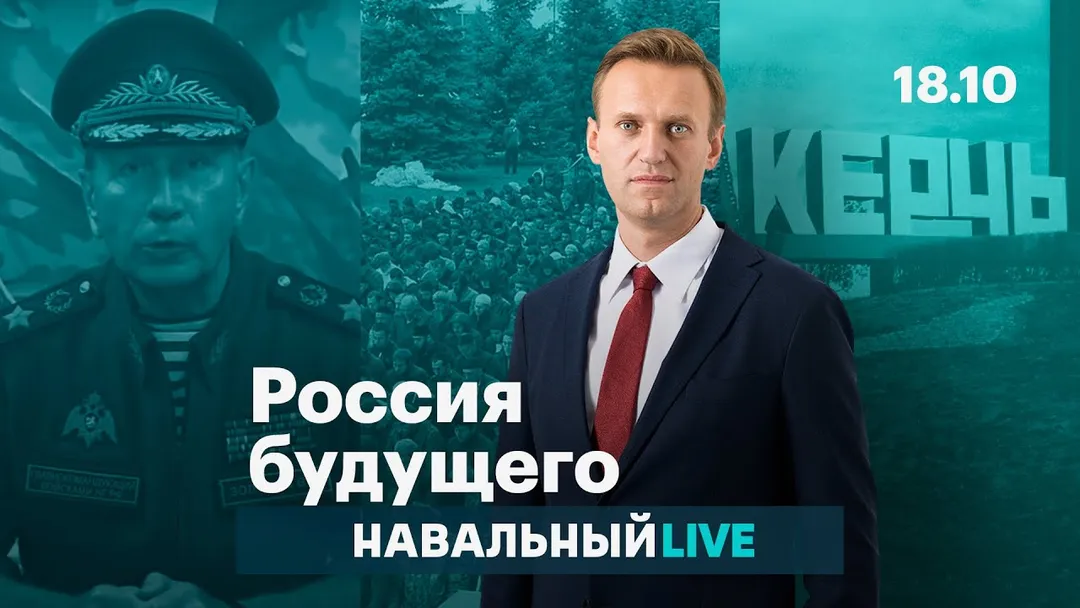
Hello, everyone. It is exactly 8:00 p.m. in Moscow. In
the studio is Alexei Navalny, or a product of an
American test tube, as General Zolotov called me,
General Zolotov, whom we will apparently
be discussing quite thoroughly today — our General Zolotov
is going to be hearing about it for a while. And I
have finally returned to you on my second
attempt, though. And on the channel, as
you may know — those who follow
our channel know — Lyubov Sobol is currently in charge.
So I have come back to a
somewhat revamped
version of the program. From now on, it will always
air at 8:00 p.m. And now it is called
*Russia of the Future*. Well, because there was
a logical argument: it was *Navalny 2018*,
and next year, in a couple of months,
it would have to become *Navalny 2019*,
or something like that. So, uh, the program is now
*Russia of the Future*. Welcome to it. And
every Thursday, I hope, it will once again be me,
Alexei Navalny, hosting these broadcasts.
A great many things have happened,
an enormous number of events. I don’t know — while
I was away for two months, things just kept
happening here all the time. It was actually
quite amusing for me, because, well, you
understand, in a certain sense I was
isolated from everything. Sometimes in the cell
the radio is on, but in the overwhelming
majority of cases it is just music, and
they kept bringing in new
detainees who would see me and say:
“Alexei, can you imagine — Zolotov?”
And I’d say, “No way.” Then: “Alexei, can you
imagine — Petrov and Boshirov?” And I’d
say, “No way, that can’t be.” And so
on and so forth. A lot happened.
We probably won’t discuss absolutely everything
that happened over those two months, but
we will talk about some interesting things, at
least the important ones. But we will begin,
of course, with the very sad,
tragic news of the Kerch shooting.
And once again, I want to express my condolences to all
the families of those who were killed and the families of the injured.
And to the injured themselves. This is truly
a terrible tragedy. And now,
besides the fact that, of course, everyone will
be analyzing why this happened, how
this could have happened — yes, this young man,
Vladislav
Roslyakov had a gun, and he killed 21
people there and wounded 40, but
the explosive device — where did he get all
that? Still, the main question is: what
do we do about this going forward? Because this kind
of attack, this kind of
terrorist act,
happens fairly often in
the modern world, above all in the United States.
They are called mass shootings.
And this is the first time we have had such a
mass shooting on such a
large and horrifying scale, with dozens
dead. And we, like the rest of the
world that has faced this before,
are now trying to understand what
to do about it. If you look at this
chart now, you will see that the majority
of these kinds of shootings
take place in the United States. It is a rich country, a
developed country, a country that, naturally,
is highly dependent on public
opinion and on politicians. And for years they have
been trying to figure out what to do about it.
And, broadly speaking, so far they have not
found an answer. In Russia right now there is
a fairly typical kind of
discussion going on. Naturally, everyone is saying:
“We need to ban everything.” Already
there have been statements that, uh, well, Vladimir
Solovyov, of course, rushed in and started
writing that the death penalty should be introduced.
Yes, which in itself sounds
idiotic to anyone who
understands the issue even a little, because
well, as I just showed you on the chart, this is
mostly happening in the United States, where the death penalty
does in fact exist. It is one of the
few — perhaps the only —
developed country where the death penalty is actively
used. Nevertheless, all these
murders of this kind are not
stopped by it. They are not stopped.
The FSB, naturally,
missed the making of the bomb. And here I
would like to make a qualification. It is almost impossible
to stop a lone attacker. He went and bought
a gun in a store — no one knows what
is going on in his head.
You cannot prevent that. We cannot
right now accuse the FSB — even if we do not like it. And
even if we think it is staffed entirely by
idlers — with a serious complaint:
“How could you miss the fact that a
person bought a gun?” But he made
a bomb. And, uh, presumably he somehow
— obviously — was looking for
ingredients; perhaps he searched for them on
the internet or bought them in a
fertilizer store or a chemical supply store
or somewhere else. The FSB missed a bomb — a bomb
that was quite powerful, as we can see from the
consequences. But now, of course,
they do not want to talk about
why they failed to notice the making of a
bomb in Crimea, in that region where everything is
swarming with FSB officers. Yes, they want
to talk about the internet — urgently,
hand the internet over to their control,
because, well, without being able to
read what you are writing there to your
girlfriend, mother, or grandmother on Telegram
or WhatsApp, the FSB, of course, cannot
possibly control terrorist attacks
The State Duma, naturally, tightened the sale
weapons, but
it doesn't work. It's pointless
to restrict gun sales. Well, in
the United States, the rules on gun sales are fairly liberal,
whereas in Russia they are not liberal at all.
Here, you can't buy
a legal handgun. Here, it's extremely
difficult to buy a rifled firearm. A
young man like, in fact,
this killer, could not have bought a rifled
weapon. Honestly, it's enough to drive you crazy.
I had two shotguns myself—speaking from personal
experience. And then, when I was first
jailed for 15 days, I received
a notice saying: "So, Navalny, you
have been stripped of the right to possess firearms." And I
sold those shotguns to my wife, who
went and got a license. They were kept in
a safe at home. Then she started receiving
some letters from the National Guard (Rosgvardiya). Then
"greetings to our Zolotov," saying that she had to
go and re-register something. It's some kind of
wild, utterly insane system that
ordinary hunters all across
the country, ordinary gun owners,
are sick of, because they're forced with this shotgun
to keep trudging off to the police on a regular basis.
Why does this poor shotgun need to be
registered and re-registered? We
already have very complicated rules for owning
firearms, and yet someone who really wants one
could still buy one. And most importantly,
let's remember now what
the
most significant mass shootings in Russia in
recent times were. And the first thing that will come to mind
is
Major Yevsyukov—remember him, the head of the Tsaritsyno police precinct
(a district in Moscow), a police major who, with
his service weapon, went into
a supermarket called Ostrov, I think, or Ostrovok,
something like that, and killed several
people. There you go. And he,
wasn't just an ordinary policeman, but the head of
a police station, someone who was also supposed to
undergo psychological tests of some kind,
who was being monitored, watched
closely. A station chief is a fairly
high-ranking officer; some internal security
service is supposed to keep an eye
on him. And yet he still
snapped and went out shooting. Let's remember the second mass shooting.
So who in the audience, so to speak,
can recall when a Russian citizen
was involved quite recently in
a horrific crime involving
this kind of senseless mass shooting?
Not on Russian territory—but a Russian
citizen. It was in Gyumri, in Armenia,
when a conscript soldier went and
shot several people,
including a six-month-old baby. By the way,
what an astonishing
coincidence: I was in jail with a guy from
Orenburg who had served at the Russian
base in Armenia together with this
killer at the same time. And he
told me that the guy really was being
bullied by the "grandfathers" (senior conscripts),
the older servicemen. They bullied him because
he himself was the kind of person who, well, in the army,
you know, you're expected to be very
quick and sharp. And he wasn't. On top of that,
he was caught a couple of times for some kind of
theft, and they bullied him over it. They
kept bullying him and bullying him.
And then he went and took an assault rifle. He was on
duty, they had given him the rifle, something
happened in his head, something snapped, and he
went off to kill people. As you can see,
neither internet controls,
nor tougher sales regulations, nor even
the death penalty in the name of Vladimir
Solovyov, no measures at all would have stopped
either of those two people.
And obviously they would not have stopped
this young man either. So, uh,
most likely
we need to stop discussing some kind of
simple solutions to this problem. They
do not exist. And more than that, we
are now seeing
the use of far more terrifying
weapons than an assault rifle, a rifle, or
so on. Do you remember, not long ago
there was a German pilot who decided
to commit suicide, and he
simply flew a passenger plane
into—crashed it, rather—into
the side of a mountain, I think. Because
he had some kind of personal
problems, he lost it, he went
mad, and he decided to end his life. And while he was at it,
he decided to kill all those little people he
hated as well. And
completely innocent people died. And it was impossible
to stop it in any way. A pilot—well,
a pilot is a pilot; he doesn't need
a pistol at all. There is supposedly some kind of psychological
screening, at least minimal, but it
didn't help. These days, the most
horrific terrorist attacks—
well, not the very most horrific, but among the most
horrific that we see in
modern society—what kind of attacks are they?
Someone gets into a car and drives into a crowd. So what,
starting tomorrow? Should we stop selling cars
to anyone? It's impossible to cont—by the way,
incidentally, you can see
this car attack in Moscow now, about which
people were also saying that it was a terrorist attack, that it was
something suspicious. But
quite recently there was a verdict, and it all
ended with just one and a half
years of forced labor. One and a half
years of forced labor. Compare that with
the sentences given to, uh, participants in
rallies who
they gave the police a funny look,
and they decided to haul them in just like that. I
was in court today at the hearing for Konstantin
Saltykov, where the prosecutor asked for 1
year in prison, even though he has already spent
8 months behind bars because, well,
he supposedly grabbed a police officer’s coat the wrong way
. Here, it’s a year and a half
of forced labor. I’m not saying that
this migrant taxi driver
should be shot. Maybe he had fallen asleep
plain and simple, and he had no
real, most likely no
intent at all. I’m simply saying
that none of this can be controlled 100%
completely. And there are no simple ways
to deal with it. What we will most likely
have to do, but what our state does not want
to do, is
make changes and put more money into the
education system. Classes need to be smaller.
Teachers need to work with each
student individually. And if a teacher
has a relatively small number of students and sees
that Petya is feeling down, that Petya
is saying strange things, that Petya
is drawing something odd somewhere,
glorifying the Columbine school shooting, or
something along those lines, then the teacher probably
needs to take some action. This is
very difficult work. Obviously, there are millions
of schoolchildren, and it seems impossible
to stand over every single one of them. You can’t
turn on Big Brother
and have teachers watching what they write
on the covers of their notebooks. Still,
parents and, above all,
teachers need to pay closer attention
to their students and
schoolchildren. If we see that one of
them is drifting into a kind of antisocial
path, going down an antisocial road, and has
some conflicts, then
we need to rush in and help, because God forbid
if he decides
to leave this life in such a dramatic way,
then no one will get off lightly. And the second thing
that needs to be done first and foremost
by the leader of our state
is to stop talking nonsense. Today I was simply
horrified when I heard Putin’s
statement at the Valdai Forum (a major Russian policy conference). So,
first he was asked, naturally, about
the Kerch tragedy. He said: "Well, this is
a consequence
of globalization."
And then, when he started being asked about
other important matters of life and
death, which naturally attract
anyone with an unstable psyche,
he was asked, in particular, about
nuclear weapons and the possible destruction of
humanity. Let’s just
listen to what Putin said. We do nothing, as it were.
Well yes, but then the aggressor
must still know that retribution
is inevitable, that he will be destroyed, and, well,
that we, as victims of aggression,
will go to heaven as martyrs, while they will simply
drop dead,
because they, because they won’t even
have time to repent."
Now take that as a written quote
and remove the signature "Vladimir Putin."
They are the aggressors, we are the victims. So,
we will all die, only we will end up in heaven,
and they will simply drop dead.
That could have been the suicide note
of that Kerch terrorist, murderer,
shooter—call him whatever you like. But this is
precisely the cultivation of this
dangerous nonsense: that, uh, we
will go to heaven, and here we need to take everyone
with us somewhere, and all the rest of it.
The head of state should not be saying
such things. It sounds insane, it sounds
unacceptable. When you are
asked about topics like this, you
should say only one thing: peace to the world. We are
for there being no war. Of course,
there is the doctrine of mutually assured
destruction, that’s understood. But you shouldn’t,
when you know perfectly well that on television
you are being heard simultaneously by
a million lunatics—or if not a million
lunatics, then a million people who have
serious problems in life and who
are thinking about how to leave
this life. Look at Russia’s rates
of suicide. We are
among the top countries in the world
for the number of suicides. So when
things in the country are already generally hard and
quite depressing, you should not say
things like: we will die,
drag someone down with us, we are martyrs
and victims and will go to heaven, while they
will just die and go to hell. Well,
that is, these are absolutely
unacceptable things, and they should not be
said. In general, over the last 2
months, a lot of
unacceptable, strange, and crazy things have been said.
Yes, you have probably already guessed that I am
moving on to the main topic of tonight’s
discussion: my, uh,
dearest, most beloved General
Zolotov. Ah, but in general, notice
what is happening. This is the question
I was asked most often.
What is happening at all? And this is connected
not only with Zolotov and his
completely insane address, but with
a whole series of strange things.
So first I want to say a few words
about why, in general, this
madness is happening. Take note,
I have this
this idea came to me.
This whole thing began very
clearly. With the
unpopular decision to raise the
retirement age. The authorities ran into
absolutely fierce resistance from the public
and intense pressure from
the population, which showed up, among other things, in
election losses in some
regions and, more broadly, in falling approval ratings for
United Russia. I’ll say a couple more words about that
in a moment. And under this pressure, the authorities
started doing strange things. Remember,
the sequence is very simple.
First, Putin makes a very strange
address about pension reform. The one
where he says, “try to understand our position,”
and says all sorts of odd things. Then
there were Petrov and Bashirov. First Putin says:
“We’ll show you Petrov and Bashirov now; they’re
not GRU officers.” Then there was some strange
interview. I mean, you all
saw it, and I was reading about it in the newspapers and simply
couldn’t understand what was happening at all. And
to this day, nobody buys it. Then,
naturally, they were exposed with some kind of
fantastic ease.
And not just them, but seemingly half of our
GRU agents around the world as well. It was
a colossal failure of Russian
intelligence. And then there was a whole string of the most
insane,
most self-defeating statements, the most self-defeating
moves from the authorities’ own point of view—just
completely baffling. Everyone asks why
he does it. And my version, since I don’t
believe in elaborate schemes, is this:
if you apply it to everyday life,
say you have a grandfather, a beloved grandfather,
and you love him. But he gets older, and
at first he gets a little odd, and then he gets
really odd. He says
strange things, loses his train of thought, and you
still say to each other affectionately:
“Well, Grandpa’s lost his mind.”
There’s nothing unusual about that. I mean, I’m not—I’m not
trying to insult elderly people. I
mean, one day all of us will lose our minds. Me, and
you, and everyone else. Someday
it will happen. And that’s why it’s very important
to understand what has happened to
them. They’ve been in power for 19 years, and sooner
or later this kind of degradation
was bound to lead to a point where we would plainly
see it. At first, with your
grandfather, something just seems a bit strange,
then you discuss some odd behavior,
and then it becomes obvious to everyone: he’s
lost his mind. And it’s the same not just with Putin
himself, but with this regime—and not only, and
not even primarily because of age. All these
people receive excellent medical
care, but power
degrades on its own; it
collectively loses its mind. And now,
at the end of 2018, we can finally
see that they’ve all lost their minds because
there is no competition,
no pressure, no serious
criticism in the major mass
media. In elections, you don’t
have to compete with anyone. You
appoint your own candidates. You
are swimming in money. Just look at
Zolotov himself.
“I live at Mikoyan’s dacha (country estate). An apartment there,
an apartment here. I do whatever I want. I’ve sewn
as many kilograms of
gold onto my cap as I like. Want to be
an Army General? Fine, Army General.
Want to award yourself, uh, some kind of
medals for something? Go ahead and
give yourself as many as you want, award yourself medals,
make yourself a Hero of Russia. Want to,
boost your image? Sure—you
can stage a PR stunt like the one
Zolotov did. After
his video address
was poorly received, there was this simply
utterly wild, staged
story with that G-Wagen (Mercedes G-Class SUV) on
Vasilyevsky Spusk (the square by the Kremlin). Yes, you see this
video where we’re told that a man arrived,
his car full of some kind of
explosives, and he summoned Zolotov.
Zolotov came immediately. Because he’s
a real man, as that
would-be terrorist later
said too: “Well, I knew Zolotov was
a real man. And a real man
came, and they talked. And,
naturally, this amazingly
ended with—or rather, it hasn’t ended, it’s still
going on—that this
super-terrorist, yes, the one for whose neutralization
Zolotov supposedly had to come personally, is now
being charged under the article for
hooliganism.
Not terrorism, not even a terrorist threat. Why, even
if you call somewhere and say on the phone,
“My school has been
bombed,” you’ll be charged
under a different article, not hooliganism. But
here, you see, with this supposedly
genuinely threatening act—
real explosives, fake explosives, a mock-up
of explosives, whatever it was—
it’s treated as hooliganism. So, I mean,
it’s obvious that all of this was
completely made up—I don’t doubt that
for a second—by some of Zolotov’s PR people,
but you can pull off a
PR stunt like that and they’ll show you on TV.
And it’s obvious that, well, under these
conditions, they degrade and lose
their minds, and
that’s how things like this
address happen. Yes, people asked me
several times, they wrote by email: "And
how did you even find out about
this address? I'm sitting in my cell, drinking tea".
Come on, what is there to do in there? You're always
just sitting and drinking tea. Either reading, or
drinking tea. And most often, you're reading and drinking
tea. And Russian Radio is playing, where there are also
periodic news updates. And then,
the radio cuts off and they say:
"News, uh,
Army General Zolotov has challenged
Navalny to a duel and promised to turn him into
mincemeat. And I was like, you know, just like in a movie, with
this person—so what on earth
is going on?" Ah, but then, ah, later I,
of course, heard about it on the news. And I
read a more or less detailed
version of the text in the newspapers—marvelous. Uh, I saw
funny photos, even doctored images (photo memes). I know
about the amazing flash mob when
people started challenging Zolotov to contests in
other sports—swimming and so on.
And, well, my lawyers were saying, say-
they came and said: "It's amazing." I
said: "Well, I can more or less imagine it."
I heard it on the radio, and they said: "No, you
can't imagine it, you have to see it." And
I really did—when I got out, uh, I got out on
Saturday, and on Monday I watched all of it,
and it really was, honestly,
something else. And once again I just want to
confirm what I said in the video. I am
very, well, glad that this happened,
because now I don't have to spend so much
time explaining
to people that the Kremlin is run by
madmen. You travel around everywhere, at
rallies, saying the same thing: as long as
these crazy people are in power, nothing
good awaits us. And then you hear the argument:
"Come on, Navalny, enough. They can't all
be crazy. After all, they're
generals and such, sitting in their
dachas (country houses). They have secure lines there,
they can start wars—they can't
really be as crazy as you
say." But now everyone is convinced: they really are
insane, senile
people. Ah—meaning, of course, undoubtedly,
there was some rational reason
why he did it. And here I agree with
Sobchak first and foremost—this I heard on
the radio—after all, she knows him fairly
well, right? For many years he
guarded her family. She says that, well,
this 100% could not have happened without
coordination with Putin. I, I also
believe it was coordinated with
Putin. And I saw a very funny
meme online, you know, where there was
uh, this photo that you can now
see on the screen over here, and
the caption said that when your
boss doesn't have a handle, doesn't have an account on
YouTube, and he asks, and it's like he's posting from
his avatar. Ah, well really, this is
more like a, uh, well, sublimation of
what Putin feels, and Zolotov
is just saying it all out loud. Why did they
do all this so demonstratively, so aggressively?
Well, because, uh—
there are two reasons. Reason number one.
If you want to hide a leaf, hide it
in a tree. They have a lot of media problems.
And first and foremost, these enormous
problems with pension reform, uh, with
raising the retirement age, with
the elections, and so on. They need to create
some kind of, uh, sensation in order
simply to shift attention.
Zolotov himself, naturally,
is more interested than anyone in making sure
that you and I are not discussing the price at which he
buys potatoes and cabbage, but are discussing
something else—some kind of fight. Like,
will it be, interestingly enough, on the tatami
or in the ring, and what color
shorts will each of them wear? That's
the important thing. They just want
to shift attention. They do this
all the time. This is the Kremlin's main
media strategy. They come up with
some news item or some sensation
so they don't have to talk about the topics
they don't like. Naturally,
the corruption in the National Guard (Rosgvardiya) is on such a scale that
it's not just Zolotov lining
his own pockets there, but also, I think, his
various superiors and friends. Medvedev
for sure, most likely, and Putin or
some people around Putin, people
inside the system. And of course they want
to shift
the focus of the conversation. To do that, they need something
stronger, more unexpected, more
insane. That's reason number one. And
reason number two? Well,
they want to scare people, of course,
plain and simple. Uh, everyone understands what
Zolotov is—the closest friend of Ramzan
Kadyrov. And so I think the idea there
was something like: come on, well, basically
he's not afraid—not he, not the FBK (Anti-Corruption Foundation), not
these people running around
at rallies—they somehow don't seem to be afraid of, uh,
the system, aren't afraid of the police, aren't afraid of
corrupt judges. So why don't you just go out there
and, basically, unambiguously
hint—practically say outright
say: "We'll kill you."
Or, say, we'll catch you and break your legs, or
do something else. After all, everyone knows.
Zolotov's role, including in the case of
Nemtsov. Now you will see a document,
yes, which you can also see there on
Vadim Prokhorov's Facebook, the lawyer
who represented Nemtsov's interests.
This is a submission by a general from the Investigative
to Zolotov from the Investigative Committee,
which states outright that improper
performance of official duties
was the reason for the commission and concealment
of the crime. In other words, they wrote this to Zolotov.
And Nemtsov was killed by officers of the
Internal Troops, which later became
the National Guard of Russia (Rosgvardiya). As I say in the video,
they were on duty,
they had service weapons, and later
Rosgvardiya covered for them; Rosgvardiya and
Zolotov personally obstructed
the investigation of this crime,
which is clear from the fact that even the Investigative
Committee was forced to issue a formal notice
addressed to him. And I don't know—I can't
know; that is what the investigation should
determine: what role Zolotov
did or did not play in organizing this
murder. But the fact that he played a role in
covering up for the criminals is a fact. He was
head of the FSB. Where are all the video recordings from
the Kremlin? That's one of the main questions. Why
did these men, Internal Troops fighters, spend two
months driving around Moscow?
What kind of assignment were they supposedly on?
Why was no one looking for them? I mean,
it is completely obvious that this man
is known for, let's put it this way,
being responsible for or involved in certain operations
useful to Putin, operations that lie far
beyond even the appearance
of legality.
And the idea was that if you said this now,
they would get scared,
leave you alone, and generally behave
more quietly. That has not worked for them
and never will. We know everything about
who these people are and what they are capable of
doing, but that fact does not frighten us;
it only makes us work even harder, even better.
Because the only thing I feel toward them is
toward them,
contempt and outrage that
they are in charge of my country, that
I, as a taxpayer, have to pay
their salaries. So
all this clowning around is, of course,
ridiculous, and my video is done in a
sort of satirical,
sarcastic tone. But even so,
this is a serious matter. I really do—
the clock is ticking—I demand from Zolotov:
he spoke so pompously about
an officer's honor and all the rest, so let's see
whether he backs away from giving satisfaction
or not. I really do demand
these debates. I really do demand
this conversation. And at these
debates I really intend to—how should I put it—
turn him into mincemeat, verbally speaking,
within the framework of a discussion, because they must
answer certain questions before us,
and they must answer to all of us. How did you
become an Army General and one of the heads
of a law enforcement,
damn it, agency? Rosgvardiya is now a
law enforcement body. They are
constantly demanding more powers for themselves,
operational-search powers, almost
investigative powers. How is it possible that
no one knows where your family's
real estate worth 3.5 billion rubles came from?
And no one asks you any questions,
except the Anti-Corruption Foundation.
So we will ask them. Explain where you got
this money. First of all,
take note: we published extracts
from the registry for each of these twelve
real estate properties, and from them you can
see that we stand by what we say.
And all of these real estate properties
belong to the Zolotov family. You can
verify that for yourselves. And by the way, let's
not watch the full sixteen-minute video,
but just to remind you,
let's watch one minute of it,
which deals primarily with the real estate.
And the dacha in Kolchuga, which personally
bothers me the most.
Here, among tall trees and dense
forest, we see your personal dacha.
Maybe from the air it does not look
particularly luxurious, but its value has nothing to do
with a glass roof or a swimming pool. On a
plot of more than one hectare (about 2.5 acres), there is
a main house, a guest house, and utility
buildings. And what you see here, throughout
the entire existence of the USSR (the Soviet Union),
was practically the main dacha
of the country's leadership. Mikoyan,
Dzerzhinsky, Voroshilov, Ordzhonikidze,
People's Commissar Mikoyan, lived there.
When my father
was removed and was no longer a member
of the Politburo, he was moved to another dacha,
also a respectable one, but of a different class,
so to speak, of a different rank.
General Zolotov, I could go on asking you
questions about your family's real estate for a long time.
A 180-square-meter apartment in Gelendzhik, a house and
a large plot of land in Valdai,
a 170-square-meter apartment in an elite residential
complex in Yakimanka.
All of that also belongs to you personally.
In total, we estimate your family's real estate holdings
at 3.5 billion rubles.
That Mikoyan dacha bothers me more than
anything else. And
not only as the person who founded the Anti-Corruption
Foundation, because this is
property he cannot
account for, but also as a citizen of Russia,
as a patriot of Russia, as someone
who values Russia's history. This is
simply something beyond description.
Let me say a little about that. So,
if you are watching the program right now,
Go to Google Maps and type in
Kolchuga. You’ll find
exactly that area on Rublyovka (the elite residential district west of Moscow).
It’s quite close to the residence
of Putin in Novo-Ogaryovo. I think it’s about
500 or 600 meters. That is, 500 or 600
meters — extremely close.
Right there are located
FSB units responsible for
Putin’s personal security. And
right there
there is the so-called Zubalovo. It is
Zubalovo. And there is a building complex
that people colloquially call the
Mikoyan Dacha. In fact, it is a communal
state dacha where, immediately after
the revolution, the people who had made
that very revolution moved in. Which is,
in itself, an interesting story.
Zubalov himself was, well, a
pre-revolutionary industrialist. And Stalin, back
in Georgia, at Zubalov’s factories,
was organizing some kind of schemes. Then
the revolution happened, and naturally they were
thrown out. They went off somewhere, to Paris,
I think. And the revolutionaries — and this was, in
part, a kind of symbolic
gesture — moved into Zubalov’s house.
Ah,
so, in other words, the rebellious
proletariat got
the house of its oppressors. In fact, this
house, this communal dacha, was first
discovered by Dzerzhinsky (founder of the Soviet secret police). Dzerzhinsky moved in there.
After that, Dzerzhinsky, Voroshilov, all
the others lived there. Mikoyan lived there
the longest. But it was always a communal
dacha. That is, even in those years,
when these people wielded simply
indescribable power, they still lived
as several families together. And in this complex
there are two main houses; there are many
memoirs by the children of these party bigwigs,
including Stalin’s children, who spent
virtually their entire childhood in Zubalovo.
So this really is
a crucial part of the country’s history. It is
the place where the leaders of the
revolution lived, the people’s commissars,
where Dzerzhinsky was, where
terrible things happened, where terrible things were conceived; it is
also, well, a hugely important part
of Russian history. And, well, the Soviet
regime, even at the stage of its, well,
when there was already, let’s say, a kind of
decline, in the
1970s and 1980s, still
always considered this, well,
a state dacha that could not
be given to anyone. How could it be? Even
Mikoyan — you just heard the recollections of his
son. He was the legendary figure of the saying, “from Ilyich
to Ilyich without a stroke or paralysis” (a Soviet joke about political longevity). One
of the best-known Soviet
sayings — sayings about Anastas Mikoyan,
who stayed at the top for so long. And
he was immensely decorated
and honored in every possible way. But
it was impossible to imagine a situation
in which, after leaving his leadership
post, he would remain at that dacha. In other words,
he was not even allowed simply to live there
until his death. There was no scenario where,
you know, the Politburo gathered and
said, “Well, we’ve removed Mikoyan,
but why throw the old man out of the dacha?”
“Let him stay there until he dies, and then
let his family stay on for a while.” No, that
was simply impossible. He was
told, “Sorry, my dear, this is such an
important site that you have to move to
another one.” As his son explained just now in the video,
and as you can hear in more detail in my video
if you want. And in the
1990s, this dacha was already considered so
important and so luxurious that
it was seriously considered appropriate to
settle the Russian imperial family there.
At some stage of his presidency, this was actively pursued by
President Yeltsin and,
incidentally, Boris Nemtsov; they actively
tried to bring the imperial family here,
and Zubalovo was intended for them,
because this is a property of such
prestige, equipped with, well,
everything from special communications and so
on to household staff and everything else.
In other words, the imperial family arrives with great pomp,
and here you have
a ready-made residence.
So this is an extraordinarily historic
building,
part of the heritage of the whole people. And somehow
Putin’s bodyguard
ends up owning it, registers
the land there in his name. How is that even
possible? And that brings us back to what
I was saying at the beginning about how they
degrade. This is how they degrade.
And are you sure they’re not over there in the
Armoury Chamber (the Kremlin museum treasury) getting
some crowns, I don’t know, so they can
put them on and take
selfies or family photos, or
hitch ponies to
imperial carriages and ride around
Zubalovo in them? Or, I don’t know, ask,
“Could you bring us some diamonds from the Diamond Fund
for us? We want
to play poker and use them,
I don’t know, as chips.” That’s the point. And these are not
strange comparisons, not
inappropriate comparisons — it is exactly the same thing.
There is a historic site, and
some guy just takes it and
privatizes it for himself, and it ends up in his
personal ownership. If you and I do not
remove these people from power, and when
We will remove them, of course, and we will overturn these
illegal decisions, and Zolotov will end up
in the dock, and one separate
count in his criminal case will be how
he managed to grab a Soviet-era
collective state dacha. That is,
not just one Politburo member
lived there — several of those party
bigwigs lived there. He took it into
his own ownership. So judge
everything through the prism of this
wonderful general of ours. These people
have no conscience; they are insane,
they imagine themselves to be God knows what.
And so, of course — well, today I
had several people write to me saying,
that my response was, like, pretty harsh.
But what else could it be? Not
harsh? Am I supposed to give a gentle response
to all this? How much further can this go?
They’ll privatize the Kremlin and register it
as their dacha,
and St. Basil’s Cathedral. Sure,
ha-ha, very funny. But that’s exactly
where we’re heading. I want people to talk
about this. I want the media
to report on it. I want Rosgvardiya (Russia’s National Guard) officers
to see and know who is
leading them. I want Zolotov to come
and answer all these
questions in a debate, and explain what is going on. Well,
maybe he has some
arguments. Maybe he’ll say: "Vladimir Putin and I,
as they like to
say, saved the country from falling into
the abyss in the 1990s — when the country was
basically collapsing into dust — but we
saved it. And therefore,
given the scale of our historical
importance, we award each other
historic state dachas. And
indeed, we believe" — and then Zolotov
will say: "I believe that I, Zolotov, am greater
than any Mikoyan, Dzerzhinsky, or
Voroshilov, and my role in Russian history
is more important." Well, that’s an argument too. Well,
let’s hear it. I very much hope that
you, General Zolotov, who will of course
watch this program, won’t dodge it by demanding
some kind of satisfaction, but will pick up the phone, call
Konstantin Ernst and say that you
are ready to take part in this debate
live on Channel One.
Well, if Ernst won’t show you that kind of
respect, then send over your
second. Who handles your PR?
Deputy Khinshtein, or whoever it is, and we’ll
arrange to hold the debate here
on the channel,
on Navalny’s main channel. I’m not
promising some luxurious studio, but we’ll
try to organize everything. In any
case, from a substantive point of view, it would be
very interesting. I’m waiting.
Let me say a couple of words about the governors,
because this is very important. It
has such long-term
consequences. And this is precisely one of the
reasons why they’ve gone so crazy.
And apparently they will never return to their senses
again. While I was locked up,
10 governors were removed. And those 10
governors —
well, the explanation for why they were suddenly
sent into resignation was what? Especially since some of them
had only recently been elected.
They said they were a burden for Putin.
Because they had very low approval ratings, and
because of them United Russia’s ratings were low.
And in the next elections,
next year, they most likely would not be
re-elected.
But then I look:
Poltavchenko in St. Petersburg
got 79%
in the election. Khamitov in Bashkortostan
got 82 percent. Kokorin in
Kurgan got 85. Zhilkin got 75. In Lipetsk, Korolyov
got 81. These are the most popular people in the
country. So why are you removing them?
Why, then, are they supposedly a burden
for you? The point, folks, is that you should not
pay attention to all these
results. They mean nothing. As
I’ve said many times, I’ll repeat again:
Putin’s percentage in elections means
nothing. It is simply a percentage of emptiness. It’s
something fabricated. Look,
the retirement age was changed, and
attitudes toward Putin changed
completely and radically. United Russia lost, on average,
15%. And all the authorities can do now
is
simply refuse to let those who actually won
the elections take up the governors’ offices.
And of course, the most
monstrous situation is in Vladivostok. Well,
you’ve discussed all this a million times already,
I understand, but let me talk about
it too. I want to — I had
no one to talk to about it for all, all those, uh, two
months. But this is absolutely monstrous.
And another thing — when I was reading
articles about it, Ella
Pamfilova, an old friend of mine, infuriated me.
And it’s all being presented as if:
we came to Primorye
and sorted it out.
Some election was flawed,
dirty, and so we called
a new election.
No — what this is called is: a person won.
Ishchenko won that election, and you
stole that victory from him. He became governor.
The people of Primorye elected him
governor. The people made their choice, and then you
came in and said: "No, no, no, no — he will not
become governor." And, uh, well, this is,
of course, it’s just that the situation fills me with
rage. It wasn’t for nothing that right there
in the special detention center I wrote a note, and it
was read out on Lyubov Sobol’s channel. I wrote a post
saying that I call on all
residents of Primorye to come out
for open-ended protests. That was at the very
hottest moment, when the Kremlin
was just about to hand victory to the United Russia candidate
Tarasenko. That didn’t happen. But
we will be dealing with
the Primorye elections as well. Well,
how will we deal with them? Very
simply. We will, of course, urge people
to vote for Ishchenko, because he was already
elected governor. And it doesn’t matter to us
whether it’s Kozhemyako or whatever else happens there. This is
a matter of principle. And I call on all residents
of Primorye to vote exactly
that way. Don’t even think anymore about
anything else — you elected a governor. Even if you
didn’t vote for him in the first round,
what they’re doing now, just taking and
wiping out the election results like this, is
simply an insult, a spit in the face of any
decent person. So it’s simply
a matter,
a matter of honor, a matter of satisfaction, as
Zolotov says — to simply come,
go to the polls, make sure that
Ishchenko is registered. I think now
they will try not to let him
run again, and to simply sweep aside this Kozhemyako and
all the other candidates and say that
no, we will not allow them to
mock us like this. This is very important. And our, our
headquarters is working on this, and I will
work on it too, as much as I can,
campaign for it, and I call on everyone else
as well,
I urge you
to take part in all of this too. As for
Ingushetia,
well, let me try to answer
a couple of questions before
talking about Ingushetia.
Sorry, I’m stumbling over my words, I’ve lost a bit of
the habit. So, Artyom Vartanyan, what do you
think about the latest events in Armenia?
The latest events in Armenia, as I
understand it, Nikol Pashinyan is stepping down
in order to call new
parliamentary elections. That is the right, uh,
course of action. And naturally, he needs
control of parliament in order to
pass normal laws, because
right now their local version of United
Russia is sitting there, and it won’t let him do
anything good. Uh, sorry that
for the second time I’m citing such a
powerful and authoritative source as my
cellmates during my latest arrests.
All the Armenians who were there were absolutely
delighted with Pashinyan. They praise him highly.
Let’s take another question. What do we have there?
Ah, Tyoma. So, Alexei, what is known
about the criminal case they’re
trying to pin on you? Tyoma Negativ is asking me. Well,
what is known? They called my lawyer
and said: "Tell him to come in, we’ll
formally charge him." I wrote a post about
that, and after that, somehow, when
we came to the investigator, it was written all over
his face that he had just
been chewed out, and he said: "Here,
sign here to confirm that you’ve been informed of
your rights." I signed, basically, and
that was it — now leave. So, they want to do something,
obviously. And some kind of
retaliation for my response to Zolotov
will definitely come. And of course it
will come one way or another in the form of some kind of
criminal case, in the form of some kind of
illegal actions. I have no
doubt about that, because they always
do this, and they’re doing it now. Well, uh,
so, Lila asks: "Zolotov won’t accept the
duel, that’s predictable. Your next
steps, though, are not so predictable."
Again, I can’t imagine how Zolotov,
after all this utterly wild grandstanding,
where he’s pretending to be some kind of
I don’t know, musketeer and, as I said,
a White Army officer (anti-Bolshevik officer from the Russian Civil War). And all the rest of that nonsense. And
with such incredible swagger, he
said all that — how he’s now going to back away from
this whole “satisfaction” business.
I don’t know, it’s hard to say. I mean, again,
who the hell knows what’s going on in his head.
They’re crazy. I’d be surprised. Well,
listen, why not? What if he
shows up and agrees to these debates? Why
not? We’ll see. What
are my next steps? I’ll wait until
this week is over, and then
we’ll see. They’ll say something. Ah, well,
the most obvious thing is that he’ll come out
and say: "I wanted to fight you on the
mat, but you, Navalny, proved that
you’re a coward. So I have nothing
to discuss with a coward. And as for talking,
debating with some, what was it, what was it,
ah yes, “debating”
with a product of an American test tube, I do not
wish to." Something like: you’re not
important enough, and I’m a general. Look how much
gold I’m wearing; you’re wearing no gold at all.
Well, that’s kind of the most
obvious move, but for some reason I even
think that he will probably
agree. So, Ingushetia is a very
important topic, because, well, the Kremlin
created a system in which, as they
believed,
the republics of the North Caucasus are
their political stronghold. 99%
turnout in elections, uh, 99% for Putin. Everything is very
good, everything has been thoroughly cleaned up, uh, and everything
Great. And then, bang,
the very popular Yevkurov can't
cope with anything. People take to the
streets. Everyone comes out. People of completely
different social backgrounds and ages
take to the streets in such numbers that, basically, they can't even be
dispersed. So what happened there?
Well, sort of,
sorry, for the third time I'm referring to
such a powerful insight, and such powerful
communication, from my, uh, cellmates
in the special detention center (a temporary detention facility in Russia) — whenever you're sitting there,
there will definitely be Ingush people in the cell,
Chechens. And so we discussed all this quite a lot.
But of course, there
was this rather banal view shared by everyone,
that, well, people are dividing something up, but
Ingush and Chechens are more or less the same
thing. And as one Chechen told me,
if you go up to someone,
you're not going to ask them
whether they're Chechen or Ingush — you'll ask them,
are you
from the wars or not? In other words, that's what
unites both groups. In that
sense, they really do see themselves as
absolutely
very close peoples, and there is no
confrontation between them. And what
is happening now is, well, some kind of
scheming by the authorities. But I want to say that
well, obviously, yes, it's scheming
by the authorities, but Yevkurov's mistake,
Yevkurov's crime, if you like,
the crime of those people who
started doing this, is that, well,
you cannot insult a people like this, and you cannot
not even try to explain anything. But
still, the Ingush
are a people for whom the territorial
issue, the territorial dispute, is
a conflict that has lasted for many years. It's something
they think about constantly. The confrontation with
their neighbors. And many, many families were involved in this.
That whole Prigorodny District (a disputed area in North Ossetia)
— in other words, the problem of territory,
the problem of land taken away, is something that
every Ingush person carries in their mind.
Naturally, any talk of
"let's now give something up here,"
well, right away — uh — they can't think about anything else
but that. And rightly so.
So what should the authorities have done?
Well, yes, let's imagine that there are
some rational reasons. Let's say there really is
oil there, as everyone believes,
that there's some kind of oil angle involved.
Yevkurov is handing Kadyrov some
territories where money can be made.
Well then, come out and say: dear
Ingush people, here's the situation: oil. We
think Kadyrov will handle this oil better,
but he will pay. Those who have
cemeteries there, ancestral villages, or
something else,
they will receive compensation. And everyone will receive
compensation. The population isn't that large. Or
they'll build us a hospital — let's
come up with something. We have an oil field, they
have the money to develop it.
Let's make a deal and
benefit from it — in other words, get something out of it.
It should have been said plainly. Everyone
understands — the people standing in the square in
Ingushetia aren't fools. They understand that
there is an interest here,
a financial interest, including for certain
people. If there were no financial
interest, nobody would
be bothering over some mountains out in the middle of nowhere
to move this border around and do all this
so strangely, so secretly, falsify
the results of the deputies' vote. Well,
nobody would be doing this
if there were no financial interest. So
share it.
This isn't just your land. This land belongs
to a great many people. It is
the land of those who have villages there.
Share it with them. Give them part
of the benefit you're getting. Since
you presumably understand that starting now to
resolve the territorial problem
between the Ossetians and the Ingush is impossible. There is
absolutely no solution to that problem. So
all we can do is damp down the
conflict so they don't kill each other.
But you can't just come in and easily solve this
problem. But between the Ingush and
the Chechens there is no tension at all.
So come and divide up that benefit.
The money — well, then,
divide the money more or less
fairly, and everyone will be satisfied, and
they'll draw this border, and together they'll
dance the dances they dance there, and
everyone will be happy. But here it's deception, here
it's obvious rigging. Everyone is standing there
understanding: "You're going to make
so many millions from this, and then you come here
and feed me a line of nonsense." That this is some
technical matter that should have been settled long ago? All you had to do was
simply put this border on paper. It's
deception. And of course, when an entire people
is confronted with such brazen deceit,
when they see that their
land is being sold, money is being made from it, and they
aren't given anything in return — well, of course that
drove them into a rage. And that is why I
certainly support those people; they hold
completely different political views,
who are going out there. And what finally
convinces me that something here is
absolutely not clean is this: there are financial
interests involved, and the transfer of these lands is
a kind of crime. And what
happened to Oleg Kozlovsky. You
you know, he is a political activist.
He is one of the staff members of the international
human rights organization Amnesty International. He went
there. Some rallies were taking place, and he
went to see what was happening there. And, you
know, Amnesty International also
takes part in deciding who is
a political prisoner and who is not
a political prisoner. And there
they opened criminal cases against
the organizers of the rallies. So what
happened to Kozlovsky? He was simply
abducted from his hotel
by local police officers. Let’s read
these tweets. They put him in a car and drove him out of
the city. They showed no documents
at all, just said they were officers. Well,
naturally, from the Center for Combating
Extremism. In a field they stripped him, took
photos, threatened to rape him, uh,
made demands, tried to recruit him, broke
his rib, beat him, pressed a gun to
the back of his head. Well, excuse me,
of course, we understand that the North
Caucasus is a region where rather
little happens within the bounds of the law.
But this is just such a completely
brazen outrage. But they understood
that he was a political activist, and while
a local person can be intimidated, this man would return
to Moscow and tell everyone everything. Even
so, they still did it all there—
beating him, threatening him, breaking his rib. And
that means these people are so
afraid that the rest of Russia
will learn the truth about what is happening in
Ingushetia, that they are ready to do such
things. Well, that means something is definitely
not right there. It means there are definitely
financial interests, corrupt
interests, and some kind of ties between
families. Well, there is big money involved,
obviously. But these police officers go
through with such crimes because
they receive very persuasive orders. And those
very persuasive orders are received by their
superiors from people who
will lose very persuasive sums of money if they do not
keep threatening everyone with a gun.
So once again, I believe that in this
situation, of course, the residents of Ingushetia
are absolutely right to be outraged. And, uh, I
hope there will be no violence there,
but they are right to come out. I wanted to talk about the Little Donkey and
Putin at the end of
our program.
What a thing has happened, after all. Quite
recently, Mount Athos and, uh, all sorts of
relics, monasteries on Mount Athos,
were presented as the very foundation of Orthodoxy.
Look at all our top officials. Chaika (Yury Chaika, former Prosecutor General),
my favorite. This whole gang
used to go to Athos once a year and, you know, there
they prayed and brought relics back from there. These
elders of Athos were treated as the very
most important thing. And then suddenly
all of a sudden this happened:
that’s it. You can no longer go there and
pray. There is an official ban on
taking communion and praying there
in institutions of the Constantinople
Patriarchate. We have severed
relations with it. And one of our ultra-
Orthodox figures, a man who very
keenly senses this state
policy, state ideology, and
the words that, uh,
are supposed to be said right now,
Ivan Okhlobystin, our rather fierce
priest, suddenly burst out with some kind of
post. It seems he wrote there
everything the hierarchs of the Russian Orthodox Church
would like to say but are still too embarrassed to say openly: that,
basically, we will force all these people, uh,
to believe what we want, that in general
they are servants of Satan, they have been stripped of
their bearings in some bloody way. In other words, we will take
everything away and force them to believe what is
convenient for us. This is absolutely
astonishing, because only quite
recently, you remember the story about Putin and
the Little Donkey.
I was simply in tears laughing when that happened. And every
time I hear that the Russian Orthodox Church
has declared that the Constantinople
Patriarchate is this bad and that bad, I
keep thinking: "But what about the Little Donkey? What about
Putin? It happened, it was shown on
all TV channels, that when
Putin arrived at the holy Mount Athos, with
which we supposedly have unbreakable ties, in front of
his car a little donkey was walking. And it was a miracle,
because this little donkey was, as it were, opening
the way for Putin on Athos and showing that
the Holy Mountain loves Vladimir
Vladimirovich. Let’s watch.
Ah, 41 seconds. Putin and the Little Donkey. Vladimir
Vladimirovich personally got behind the wheel and drove
to the Iveron Monastery. And right as he was
driving out, an Athonite mule was standing on the right. This
mule, for some reason, suddenly darted
onto the road and ran strictly down the middle
in front of the president. He seemed to try,
perhaps, to veer left, and the mule veered
left; right, right. That was the situation.
So as I understood it, the president
realized that something unusual was happening here and
was in fact moving along behind the donkey.
I can tell you, nothing like that had ever happened on
Athos. For a mule there, as we
call it—never mind—to run ahead
of any vehicle and, so to speak, not
let it pass—well, that had simply never
happened. But on the way back,
when we were already returning and, well, the
police car drove by, and then I
drove past and saw that the donkey was standing in the same
place and watching our meeting, and
will lead us away.
So what does that mean now? Where did
this little donkey come from? Who sent it? It’s frightening
to think about. Maybe it was a delusion
of Satan. A satanic little donkey was running along. But after all,
now they are our enemies. But it can’t be
that just recently, then,
there was the little donkey and practically a halo around it, and
Putin is riding along, and everyone is moved. But
now look at the things that have come to light.
As it turns out, those
Greeks have always hated us. They were plotting against us, and
we’ll soon make it believe in
whatever we want. That little donkey was dreadful.
That little donkey was leading Putin down the road of evil. Is that
really what it comes to? But it seems to me that all this
should lead us to a very important
thought. So here’s a toast. Let us too
not follow just any little donkeys, including
those found in the leadership of
Russia. Thank you very much. I’ll see you
next Thursday at 8:00 p.m. This was
Alexei Navalny.