A major new project: launching a fight for your salary
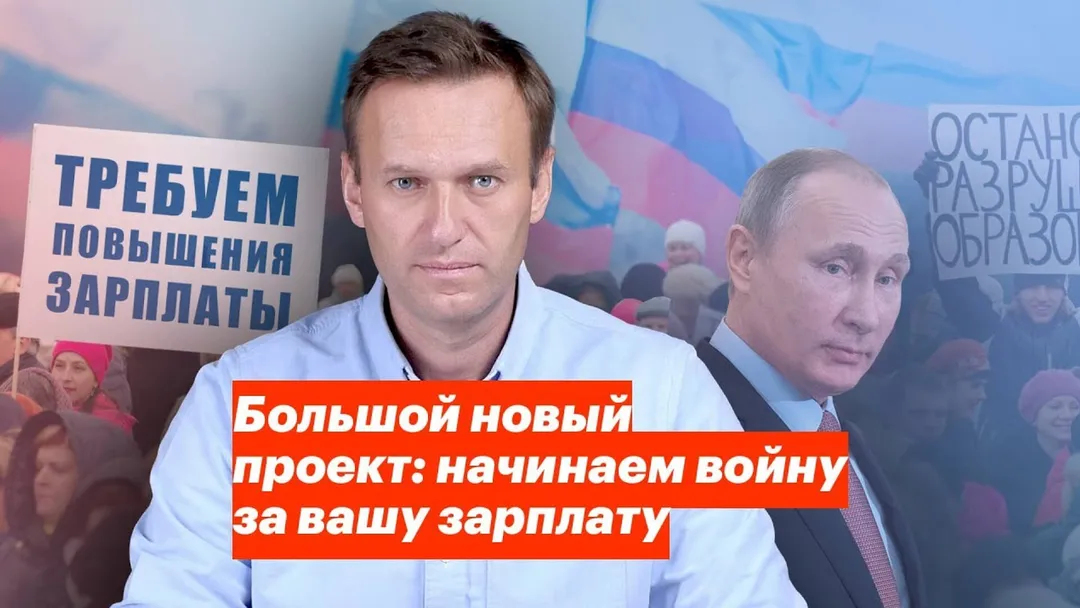
Hi, this is Navalny, and I’m announcing our
major new anti-corruption project.
Please watch until the end and
take part. I represent the Anti-Corruption Foundation
and we usually fight corruption
from the top down—that is, we show
you some crook, explain why he’s a crook, and
urge you to spread the information,
fight corrupt officials,
vote against them, and so on. But
corruption can also be fought from the bottom up.
To do that, we first need to answer
the question: what is the main harm corruption
does to our country? The answer is simple:
poverty. Russia is
a rich country with a poor population, and
to be even more specific, in
Russia wages are very low, and
corruption is one of the main reasons for that.
A Russian oligarch
is so rich because for years
workers have been underpaid.
His employees earn 10 times less
than at a similar factory abroad, and he
profits from that.
The oligarch makes fantastic sums of money. Part of that
money he hands over to officials as bribes, and
no one touches him. He doesn’t even pay
any taxes. That’s why I am
absolutely convinced
that Russia now badly needs
the emergence of a huge, mass grassroots
movement for higher wages.
Not that everyone should be paid
a million tomorrow, but a reasonable increase to the level
that people receive for the same
work in countries comparable in
their level of development to Russia—for example, in
Eastern Europe. It sounds nice, but
how do we do it? If you and I lived in
a normal country, and not in one where
the same person has been in power for 20 years,
destroying everything around him just to
stay in his place, then the answer would be
simple: trade unions. If working people
feel they are being underpaid,
they join together in a union, put forward
their demands, and negotiate with
their employer. If they can’t reach an agreement,
they go on strike, and then they do reach one.
That is, a normal process takes place
through which working people
defend their rights. But just yesterday
there was news that the union
of teachers in California
ended a six-day strike because
it had reached agreement on new working conditions:
their pay was raised by 6 percent and
class sizes in schools were reduced. But in
Russia, almost all trade unions
are completely under the authorities’ control. They
support United Russia, they
support oligarchs—good Lord, they
even supported raising the retirement
age. In other words, they’re just officials
calling themselves trade unions. You yourselves
know that perfectly well if you’ve ever
dealt with them.
So our task is to create a kind of
spontaneous trade union movement
with one simple goal. It’s not
political—we’re not going to say, love
Navalny or don’t love Putin, love
whoever you want. Just demand higher
wages.
Demand what you are entitled to. I know
that everything I’ve said sounds
right, but
abstract. The words are nice enough, but what do we do?
We have a completely concrete plan, and
we are starting our campaign with it
today. For now, this plan concerns 6
million people—representatives of
certain professions—and then we will
expand. So, in Russia there are 6
million people whose salary levels
were personally guaranteed by Putin when
he ran for election in 2012. He
signed the so-called May Decrees
regulating wages.
In them, he tied the level of their average
salary to the average salary in the region.
It’s simple: look, every region
has its own official average salary,
which is calculated by Rosstat (Russia’s federal statistics agency), and the average
salary of a doctor in that region now
is not just pulled out of thin air or made up,
but is set at 200 percent of that average. And
the average salary of a teacher, for example, should
be no less than 100 percent of
the regional average. Before the last
election in 2018, Putin reaffirmed
all of this and even signed new May
decrees. And the most remarkable thing is that officials
all across the country report that yes, yes, yes,
they are carrying out Putin’s May Decrees and
paying public-sector workers exactly the salaries
required by the formula.
For example, did you know that the salary
of a nurse in Moscow should be no less than
82,000 rubles a month (about US$900 at recent exchange rates)? If
you tell that to a nurse or paramedic
you know, they’ll laugh
in your face. But on paper, that is
exactly how things stand, and the mayor of Moscow proudly declares
that these are the salaries of Moscow
nurses, and that wage growth is real.
Why, just recently,
he said there had been an 8 percent increase—the biggest rise in
recent years. In the first nine months of 2018,
the salaries of doctors in Moscow rose by more
than a third, and no less than 70,000 rubles a month
is supposedly earned by rank-and-file metropolitan
medical workers.
Somewhere in the paperwork it says that
every nurse in Moscow receives 82,000
rubles a month, and the money for this has been allocated from the
budget. The only question is: where did it go?
An even more absurd example.
A university lecturer in Moscow, under
Putin's decree,
is supposed to earn an average of 165,000
rubles a month, and Moscow City Hall once again reports
that yes, they do earn that much. But that is
obviously a lie. The average
doctor in St. Petersburg is supposed to earn no less than
118,000 rubles — that is,
200 percent of 59,000 rubles, which
according to Rosstat (Russia's federal statistics agency), is the average
salary in St. Petersburg. But do they actually earn that? Well,
if you know a doctor in
St. Petersburg, ask them. You'll be lucky if they
just tap their temple like you're crazy.
Otherwise, they might even want to start a fight.
Some people don't seem to like this argument.
You often hear: well, of course,
that's how averages work — one person gets a million,
and 100 people get 15,000 each, and on
average everyone gets 25,000.
But that's not just faulty logic — it's
deception. The whole point of the May Decrees
was for everyone to receive a salary close to the average.
Yes, some people may earn much more
if they work more, but no one should
be earning drastically less. And the budget includes
funds so that all preschool teachers
in the Novosibirsk Region
for example, receive around thirty-
four and a half thousand rubles, and they
are supposed
to get that by law. And if they are not,
then prosecutors should already be running around, and
the Kremlin should be summoning governors for a dressing-down, and
so on and so forth. I could spend an hour listing
these examples for every city and
every region.
[music]
There are three biggest problems. First,
people are being deceived and
underpaid.
Second, people themselves have no idea
what salary they are entitled to and
guaranteed. And third, people are not
ready to stand up for their rights because
they're afraid, because it's unclear what to do.
Okay, so I want to demand
the salary I'm legally entitled to — where
do I start? Who will even listen to me? Where
do I find a lawyer who can give good advice?
How do I contact a union? I have no idea.
If you have no support behind you, the
only person who will hear you is your
director — and they'll just fire you.
That is exactly why, to solve these three problems,
we have assembled an army of lawyers, brought in our
fairly powerful media resources, and
are launching a section on our website — a kind of
grassroots independent trade union.
Now listen carefully: doctors,
nurses, medical staff, teachers,
preschool educators, staff in supplementary education,
social workers, employees of
cultural institutions, researchers,
university lecturers, teachers in the
system of primary and secondary
vocational education —
your salaries are regulated by the May
Decrees, and in every region
there is a threshold below which you
cannot be paid. If your salary
differs significantly from that benchmark,
then you are being deceived and robbed, and
we will defend you. Your first step is
to go to this website,
enter your profession, enter your region,
and find out what your
salary should be.
If it is lower, then leave us
your information, and we will begin legal
work in your interests.
We will file complaints that your salary does not
match Putin's promises and
the May Decrees.
You can file the complaint yourself, which
we will draft, and if you do not want to do it yourself, we
will file it for you. If you are afraid, for
some reason, and do not want
your details at all
to appear anywhere, then still
leave the information, and your complaint will be handled
by a friendly trade union
supporting our campaign. There are such unions in
Russia, and there are many of them — but there are honest unions among them.
That allied trade union will
demand that your institution be inspected as a
whole. In addition to legal work, we will
also use media, PR, political,
informational — whatever it takes — to go after
the heads of institutions and officials
who underpay salaries. It is important
to understand that politically and legally,
officials cannot admit that they are not
paying you what you are owed and are not carrying out
Putin's May Decrees, because these
May Decrees are a kind of sacred cow
of the regime. They are discussed endlessly at every
meeting, all governors claim that
they are implementing them, and Putin himself has repeated a million times
that for failure to implement the May
Decrees and for underpaying public-sector workers,
everyone will bear personal
political responsibility. This is, by the way,
the main indicator of the quality
of a governor's work for the Kremlin:
whether they are implementing the May Decrees and paying
the salaries that are required. Were the funds
allocated? They were.
Was there no cheating? No, of course not. The funds reached the regions,
they were transferred through the system to them,
but they did not reach the medical workers.
That is why no governor and no mayor
has any interest in doctors or
teachers in their territory stirring up
a fuss. And right now there is a system
of universal deception: in the regions, people are being massively
underpaid — teachers, nurses, and others.
Researchers know all this, but
regional bosses brazenly lie and
report that everything is fine. The Kremlin and
Putin, of course, know that all this
reporting is fake, but they accept it with
a smile because everyone stays silent. But
what is happening with them, and with
these decrees overall, is roughly this: 93 to 94
percent
of the stated goals have supposedly been met. Everyone in this
chain—public-sector employees, their bosses, the mayor, and
the governor, and the Kremlin—
all pretend that everything is fine and salaries
are rising, and they will keep doing so until
someone breaks this vicious circle,
stops staying silent, and finally
tells it like it is. Only then
will the authorities start moving and begin paying
what they are supposed to. That is exactly why
our people's trade union is needed.
Next, the first thing those in power will say is:
"So you've gotten involved with this Navalny (Alexei Navalny, Russian opposition politician). He
is stirring things up. He is pursuing political
goals. He is promoting himself. He is scoring points off
public-sector workers and their problems. We need to distinguish
those who genuinely want to do something and
really strengthen the state from
those who are trying to use this as
a tool in their own
political struggle, for self-promotion." And you
should answer them—be clever: "This
Navalny is very bad, he is terrible, and
so come on, dear mayor, dear governor,
we won't let him get publicity. He is a very bad
person—I have never seen anyone like him.
Raise our salaries to the proper
level, and then we will love you and not
love that awful Navalny.
As soon as he comes here shouting about
low wages, and boom—by then everyone here already has
high salaries,
then that Navalny will fall flat on his face."
Then some suspicious citizen immediately
asks me: "But why do you need this, Alexei?
Why are you doing this? You've launched a website, there will be
some huge amount of legal work,
so what's in it for you, and what goals are you
pursuing?" And I will admit quite
frankly: I am a politician. I need people's support.
I work for them. You will see:
Navalny and his team are working for us. Everyone
lies to us, everyone steals from us, but this man
is trying to protect us—as best he can,
and that is what he is doing. As a result of this
campaign, some people will support me, some will not.
But I know this is the right
thing to do, and together with my
team I am ready to work on it for as
long as necessary. Besides, I
truly believe—and this is not just my
belief, but an economic fact—that
there will be no growth in Russia,
no development at all, until people
start receiving decent pay for
their work. This project is possible only
through cooperation between you and me. As I
already said, there are 6 million people
whose salaries are regulated by the May
decrees. I need to make sure that
each of them watches this video, that
each of them goes to my website. And how
can I do that? I can do it only with
your help. Do you know any doctors
or researchers?
Send them a link and persuade them
to take part in our campaign. After
all, the person loses nothing. If their salary is raised—
excellent. In the worst case,
nothing will change. If you are a student or
a school student, send a link to your teacher.
Most likely, they will be
grateful to you at least for
caring about the size of their salary. Do your children
go to kindergarten? Great.
Send it to the caregivers, explain to them
and the aides that the impoverished existence
they are leading is the consequence
of not being given what they are
owed. This is the main point of our campaign: we
are demanding what is already guaranteed by
law, what money has already been allocated for, and what
they have already reported as supposedly being carried out.
93 to 94 percent
of the stated goals have been fulfilled. Well then,
if they have reported it, then let them actually do it.
So, in conclusion, let me emphasize once again:
to take part in this campaign, you do not need
to be in the opposition. I am not interested in
your political views.
If you support me later, fine. If you do not
support me, that is not a problem either. The main thing is that
this works for you. The sole purpose
of the project is to increase your salary. The
more money you receive, the less
will go to corrupt officials.
[music]
