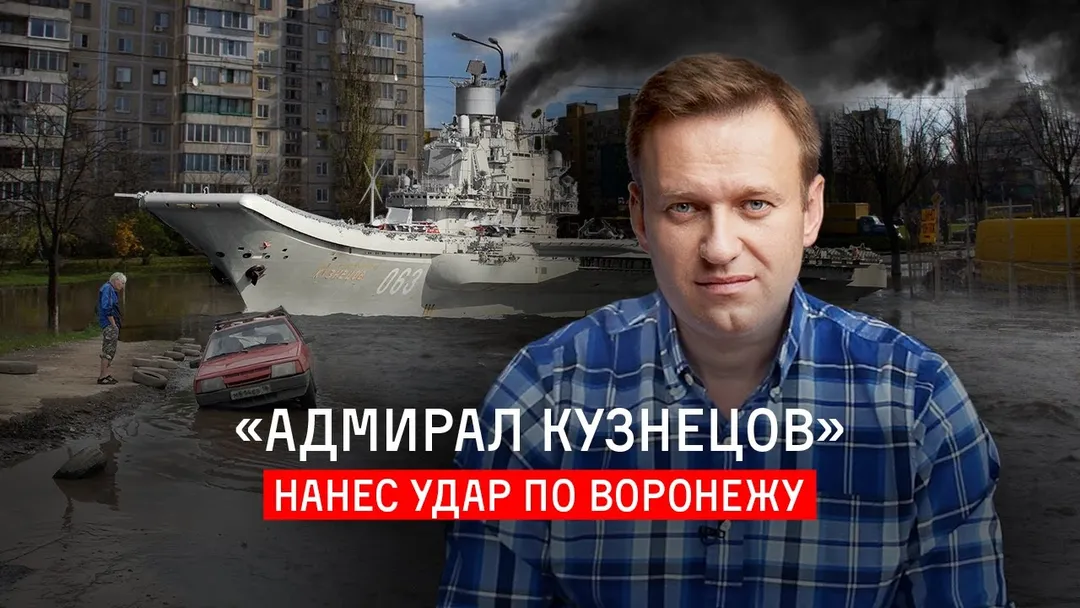
The Admiral Kuznetsov Struck Voronezh
[music]
Russian
the aircraft carrier has finally delivered a merciless
missile strike. Unfortunately, just as we feared,
the strike hit Voronezh and
other Russian cities. No, that is actually
exactly the case. Look:
at the same time, I see news about how
the Admiral Kuznetsov spent a month sailing from its
base in the Northern Fleet toward Syria,
where Russia is waging a rather strange and
very expensive war, for reasons that are unclear.
At the same time, I am reading responses
that the administrations of Russian cities
are sending me regarding our RosYama project
(a civic project about road potholes). Users of the site across the country
are demanding repairs to horribly damaged
roads—at least in the largest cities.
Especially since, by law, these potholes
must be filled within 10 days, according to
state standards (GOST). And lately, all the mayors
have started giving us surprisingly
direct answers: we have no money. Here is a perfect
example from that same Voronezh: on one and
the same road, several potholes were found. But
despite the fact that requests had repeatedly been sent
to the administration for
funding, the response was this:
there is only enough funding for
main thoroughfares.
And at this very same time, at the very moment when
motorists in Voronezh
are wrecking their suspension on potholes
that the administration supposedly has no money to repair,
the Admiral Kuznetsov, with its two black smokestacks,
is sailing to Syria. Let us just do the math.
The vessel has a fuel reserve of 10,000 tons
of fuel oil. The distance from Severomorsk to
the Syrian coast is
5,500 nautical miles. Fuel consumption at
a speed of 14 knots—which is a normal
speed for such a voyage—is
850 liters of fuel oil per nautical mile. At the same time,
we know the ship is very old; it was built in 1991,
and only three of its four main propulsion
units are working,
so there is a very large excess
of fuel that does not burn properly. That is
exactly why we see that remarkable
black smoke. Let us make a rough
estimate based on the data
published in the media. Let us assume the power output is
around 70% of the design capacity; in reality
it is less, but let us use that figure. Then we can
assume that at its current average
speed of 10 knots, the Admiral Kuznetsov
consumes those same 850 liters of fuel oil per
nautical mile. After that, the math is simple:
850 liters multiplied by 5,400 miles.
Thus, in order to reach
Syria, it needs at least
4,590 tons of naval fuel oil. It costs
about 14,000 rubles per ton, and
that means that fuel alone for
making this round trip to
Syria costs
128 million rubles. So it turns out that the money
that is badly needed for road repairs in
the country’s major cities has somehow been
simply burned up for a trip to Syria
and back. No—if we had
money to spare, enough to conduct military
operations around the world and keep our roads
in perfect condition, then there would be no questions.
But as things stand, this is a matter
of priorities, and in this battle of priorities,
Voronezh, Rostov, and Krasnodar, for some reason,
are clearly losing to Syria. Someone will, of course,
object and say that fighting in
Syria is necessary, that it is a matter of security:
terrorists could infiltrate Russia,
there could be casualties. And do you know what I would say to that?
We have plenty of terrorists much closer to home—for example,
in the North Caucasus. There is no need
to go looking for them in Syria. And as for casualties,
sorry, but roads are more important. In Russia,
every year, 25,000 to 30,000 people die on the roads,
and the terrible condition of the road
network is one of the main causes of traffic accidents. So
investing money in roads is, once again,
sorry, 100 times more important for
national security than either Syria or
Assad. And by the way, it is not only Syria that is beating
us in the fight over budget priorities.
One of the officials’ responses, in fact,
looks downright fantastic. Look:
the city administration of Volgograd informs us that
they have no money to fill a huge
pothole because of the holding of the
FIFA World Cup.
Well, that is just wonderful. Why the hell are we
bringing the World Cup here at all, then,
and why did we include Volgograd on the list of cities
where matches would be held if
there is so little money there? We are spending billions
to build stadiums
just to throw dust in foreigners’ eyes once
and pretend to impress them, yet we have no money
to repair a road on which every day
thousands of our people wreck their
cars. Volgograd is not, after all,
some little village; it is a city of over a million
people. Not to mention that it will be
a rather strange sight: to a new
gleaming stadium, fans will be
driving over monstrous potholes. All of this
is one of the huge problems of our country and
our government: we do everything
to make foreigners
pay attention to us. Let everything here go to hell,
let it all collapse and fall apart completely, but
everyone must see: our ship is sailing to
the shores of Syria, and we do not mind spending
billions on it; we will host the World Cup
and build the most expensive
stadiums—and they really are the most
expensive in the world—and we do not care that
for another five years we will have no money for anything.
to repair roads and buy medicine for the
hospital. That’s how our oil dollars are being burned through
— fighting wars over there, holding events here,
hosting the Olympics there, the FIFA World Cup here.
And then there’s this so-called aid to foreign
states — and in the end we’re left
with nothing, or rather, in today’s
reality, staring at a huge pothole in the road
that there’s no money to fix.
Subscribe to our channel — here
we tell the truth.
