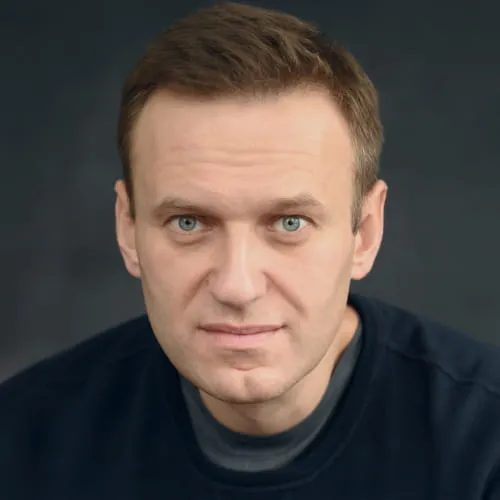
Navalny at 20:18. Broadcast #002, 27.04
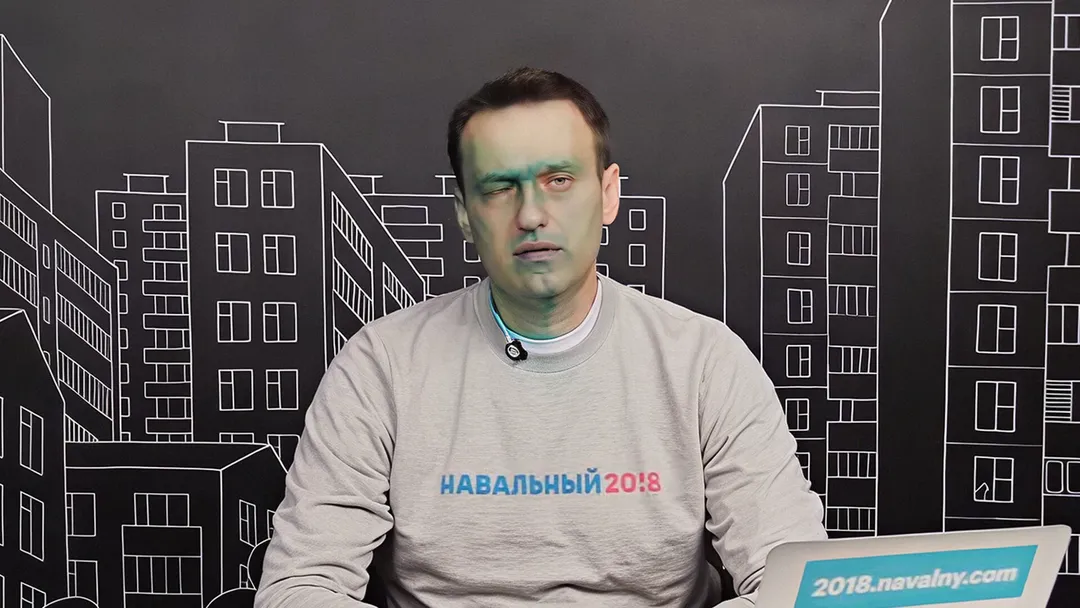
Hello everyone, Moscow time is 20:18, which means
that it's time for the program *Navalny*
on the Navalny Live channel.
This is *Navalny in 2018*, and you've probably
already noticed that today everything is
a little unusual, and that's true.
I really am not wearing a tie. We had
actually assumed that on this program
I would always appear only in
a tie, and preferably looking into
the camera with both eyes open. Today
I can't manage that. You've probably already
heard why. I'll explain briefly.
Today I was supposed to speak at
a major event called the Event
Forum.
A lot of different people invited me
to speak officially as a candidate for
president. I was supposed to talk about
the vision of the future in
Russia. I was on my way there, all dressed up,
looking very sharp, in a shirt and tie, and as I was leaving
our office, some thug splashed
brilliant green antiseptic on me. I didn't even understand what
was happening. It got into my right
eye, and unfortunately I couldn't go
to that Event Forum. Even though I had
plans for a great speech and to
convince the people gathered there to even
send us money for the election
campaign. Instead, I had to go to
City Hospital No. 1, where I was
given the
diagnosis of a chemical burn to the right eye, and
right now, well, I can open it by sheer
force of will, but you won't like what you
see, so I won't do that,
or else we'll get
some kind of warning from Roskomnadzor (Russia's media and internet regulator).
So what do I want to say about this? Well,
does it infuriate me? Absolutely, it does.
And on a separate note, I have long arms,
so it's hard for me to buy shirts. Today
I'm wearing a shirt with sleeves
made to order, and now I'll have to throw this shirt away
because it's covered in brilliant green. That
makes me even more furious. But
essentially, first of all, it changes
nothing. And second, it once again
proves that we are completely, absolutely
right. Just listen: I have a sheet of paper here
from which I was supposed to
tell you various bits of news, and the first
item was yachting news:
that the yacht Fotini,
belonging to Dmitry Anatolyevich
Medvedev,
has apparently
opened the sailing season, and right now we can
see in the yacht tracking system how
it is now traveling from the Finnish city of Kotka,
where it spends every winter, to
Plyos, and Dmitry Anatolyevich will once again be able
to enjoy wonderful trips along
the Volga. But here's the question. Fine, I might have
said this with a more or less pink face,
and now I'm saying it with a more or less green
face. But does that actually change anything?
It changes nothing. Medvedev stole
money from us.
With stolen money, he bought the yacht
Fotini. Okay, so what?
If because of what I say, and what we say, and what
the Anti-Corruption Foundation says, and everyone around
is talking about Medvedev's corruption, talking about
how we refuse to put up with it, and
fine, then instead of spitting at us,
they'll throw brilliant green at us every
day—will that change anything? No, it won't.
It won't. Good Lord, I have a monitor here
where I can see what I
look like. Honestly, I thought I
looked a bit more glamorous. I
assumed at least that I had some kind of
more even green complexion. But even
if this is what I look like—do you agree that
your money is being stolen and used to buy
the yacht Fotini? I don't think so. Do you agree that
that
Medvedev spent 70 billion rubles on his
yachts and palaces? No, you don't. Do you agree with
the fact that someone like Peskov wears a watch
worth $400,000? Of course not. Do you
want, because of all this
that's happening, to come, for example, to our
new anti-corruption rally on June 12? I
hope you do. So a lot of people ask me
about how I feel about this. Well, of course
it irritates me a lot. It irritates me
the way the police behave. It irritates me
that the police are participating in
all of this. In all of this, there is also involvement by
the security services, which provide these
brilliant-green throwers with precise information about
who went where, on what flights,
who is flying, and everything else. But will this
lead us to stop our
work, or speak more softly
about corrupt officials? Of course
not. It won't lead to that. On the contrary, I
think we will become angrier. I hope
you will become angrier too, and help us
even more. I have a billion, a billion
questions about
security. Let's talk about security.
"Navalny wants to be closer to the people, but
he needs security," and so on and so forth.
My friends, no security detail will
help us, because we hire security when
we go somewhere.
Naturally, when there are rallies or
something like that, we use those services. But
for a person who
just wants to splash brilliant green in your face
and run away—today, for example, I simply
really didn't feel anything. I
open the car door, bang—right in the
your eye is burning like fire and you can't understand anything, and
the person ran off literally in an instant
just vanished. For example, Mikhail Mikhailovich
Kasyanov
has a large security detail protecting him
officers from the FSO (Federal Protective Service), or former FSO officers
So these are super-professional
bodyguards, but even that doesn't help him. So
from the point of view of these kinds of creeps
who just want to splash you with something
no security detail, unfortunately especially, really
helps. The goal is obvious: to make it so
that we don't go anywhere. It's obvious.
If every time you go somewhere and
then come back all
green, as they see it, after that
after a while you'll get tired of traveling, you won't
go anywhere, you won't speak publicly
you'll keep quiet. And in the end
you'll say to yourself, damn, why am I
doing all this? I'm kind of sick of it
so let me just stop. No, that won't work with us
that won't work, and I'm sure it won't work
with all those they've splashed with brilliant green
either. That's exactly why they splash them in the first place
because those are the very people who
people who, well, who
have probably already demonstrated
some firmness in their intentions
An important thing in this connection that I want
to say: in my original
plan, I meant to say a few words about
Varlamov, who, as you know, was attacked in
Stavropol too — they threw brilliant green on him and also knocked him down
and covered him with some kind of flour
and he doesn't at all
engage in politics, but to the extent that he does
engage in politics, it's
politics that, let's be honest, is fairly
comfortable for
the authorities. But the important thing is that he was attacked
and absolutely nothing was done about it
He was attacked twice, and there, just like in the
1990s, there was an episode when
they chased his car, beat on it, and all that
sort of thing. Remember, one of the main
achievements of Putin's government, broadly speaking,
is considered to be that he got rid of lawlessness. Well,
yes, there's still illegality everywhere
and lots of problems, but this kind of
outright lawlessness like in the 1990s — when
you could run up to someone in an airport
douse them with brilliant green, knock them down, and walk away — supposedly
that was gone. But now it's back, and here's why
because you cannot allow
lawlessness against specific people
You can't call the police
from the Presidential Administration and call
the FSB or the local Interior Ministry office and say, "Navalny is coming to you there
Navalny — he's Hitler and an American agent
so go ahead and bring some guys in
let them splash him with brilliant green, and then
the police, please, should do nothing
let them just stand aside, and when they
see them, don't detain them." As soon as you do that
you are authorizing lawlessness against a broad
range of people, which is what we
saw with Varlamov, because, as I understand it,
he was attacked by some
property developers, and those developers
basically legalized this violence of theirs
this lawlessness, with one simple phrase. They
shouted at him, "Take your America and get out," and suddenly
it was politics again. And that's how it
works. You cannot
fire a police chief, you cannot
reprimand them for not
investigating crimes against
Varlamov or any other person
who was attacked in this lawless way
because a week earlier you
called that same police chief and
said, "Listen, Petrovich
do us a favor, carry this out, do this little
illegal thing." How are you going to
remove him if you were giving him equally illegal
orders yourself? This is just a kind of
corruption that is already destroying the entire
fabric of power, the whole system of government. People
understand that decisions are coming from the Kremlin
that are no longer just basic illegal ones
like rigging elections, but outright
criminal orders like "attack
someone." Well, today I saw a news report
that a female journalist was doused with brilliant green and had
a dead rat thrown at her house. That's how it
goes, one thing after another: if it's allowed against
someone, then it means it's allowed against
everyone else too, and the system will work
that way
And we can see that those efforts
there really were efforts to establish
a degree of order in
the law enforcement sphere, which were
undertaken roughly from 2001 to 2010, are now
now, within
months, being completely
wiped out, back to the state of the cursed
1990s. Today there was the usual
automatic payment, but I'll send some extra money too. Thank you
very much. To be honest, I'm not prepared, for the sake of
good fundraising, to keep putting myself through this constantly
The truth is, yes, that every
time incidents like this happen, we
get sent more money
No photos of that
goblin who was splashing the brilliant green were left, as far as I
understand, though there is some video out there
it's pretty low quality. But I have
not the slightest doubt that no
investigation will happen. Remember, a year
ago the whole FBK (Anti-Corruption Foundation) — there were lots of us there, kids too
a lot of people — we went on a trip, and at the
airport we were attacked. It was all recorded by
a million cameras right there in the airport. Artyom
Torchinsky
from Public Oversight, the head of the Public Chamber,
said, "We insist on a thorough investigation" — and still nothing
Let me repeat: it’s not just that the investigation there led nowhere.
It didn’t even result in a criminal case.
There was no case at all, that’s it. But nevertheless, our
this does not
stop with this. Alexei, we’re with you. Thank you for
your work, and our shared bright future is with us
ahead. Thank you very much, thank you for
your support. Together with you, we are fighting to make sure
that people with green faces should not
be appearing on television. An important thing
that the lawyers asked me to say:
an email address should appear next to me now, and
the email isn’t appearing. Well, it should appear now,
probably. And this email concerns
compensation of fines for those who were
fined over the rallies on the 26th.
You know that most people
were fined 10,000 or 20,000 rubles (about $110 or $220). We
raised money in order to, well,
pay these fines together so that
people would not have to pay this amount
out of their own pockets, and the money
has appeared, I can see it. We raised the money.
Please contact this address if you
have gone through two levels of review and the decision on
your fine has entered into legal force.
Send it to us, and we will then pay that fine for you,
reimbursing that money, and so on.
That is, none of those who were
detained either in Moscow or in another
city and fined should have to
pay their fine themselves. Let me remind you that
655 people have now turned to the FBK lawyers (Anti-Corruption Foundation)
for help.
From Moscow,
361—well, 369. We have prepared appeal
complaints; 418 people are currently being handled by us.
We had quite a lot of people who were
detained and then released, and in fact were neither
fined nor arrested, fortunately. But
even in such cases we are doing
certain work in order to take them
to the European Court of Human Rights.
And I
once again confirm that
indeed, yes, for
everyone who makes it to the appellate
instance, my colleagues and I will file
a complaint with the ECHR, and I think we will, in
fact, even try to win it.
Open Russia has been declared
an undesirable organization, and I also wanted
of course to say something about that. And while
all this green-faced nonsense was happening
to me, we learned that searches were underway right now
at their offices, and in general the obvious question is
why this is being done. The authorities really do not
like Open Russia, this government does not,
and they do not like Khodorkovsky. They do not like the fact
that Khodorkovsky has money,
that he can finance this activity.
They do not like that they call people
to rallies.
They decided to try to shut the organization down
and acted in this rather
curious new way: they
declared Open Russia undesirable.
An undesirable organization can only be
designated as such only if it is a foreign organization.
But this has
rather serious consequences.
You cannot receive money from such an undesirable
organization or cooperate with it.
And despite the fact that here
Open Russia is, legally speaking,
made up of Russian legal entities, which cannot be declared
undesirable organizations, the fact that
foreign organizations were declared undesirable
has opened up a wonderful field
for this kind of nonsense that is now
going on. They will constantly carry out
searches over whether they are cooperating
with them,
look for money, keep dragging people in for
questioning, and generally try in every possible way
to crush them. With regard to different
organizations, they apparently use different strategies. As
you saw with respect to the Anti-Corruption Foundation,
they were actually fairly
unsophisticated in what they tried to do: they simply
came in here and took away absolutely everything
that was here. With Open Russia, it’s a different
tactic, but I am sure that nevertheless
nothing will come of it. I am sure that
Open Russia will continue its
activities, and I simply wanted to express
my support to them.
Ah, the five-story apartment blocks—I of course spent a long time
preparing. This was my main topic, and
again, I’m annoyed that with such a
green face I have to talk about it
and distract attention
from truly important things. This really matters not
only for Moscow, but for all of Russia.
This is 2 trillion rubles (about $22 billion), 2 trillion rubles,
collected from all across Russia in order
to be spent here in Moscow, roughly speaking,
quite
quickly and
cunningly. And I had this thought that
I would go after them now, and then
they would explain something over the course of a week, and
the issue would sort of die down on its own because
there would be some more or less reasonable
approach. But I can say with surprise
that everything has only gotten worse, and
what has happened over the past few days shows us
that in fact the main
idea behind all this Sobyanin-led
five-story-block program is simply
to pump a lot of money into Moscow’s
construction sector. And right now, first of all, we need to watch
closely
where the Moscow city government will
buy housing to relocate residents from
these apartment blocks. After all, Moscow City Hall itself is building
millions of square meters of housing; they have built
all this high-rise junk of theirs and created
in effect, quite a large
construction bubble. This housing isn't
selling; developers are heavily in debt, they
are barely hanging on, and they need a constant flow of
money in order to keep building and
the Moscow city government has found this
great little trick. The law on demolishing
five-story apartment blocks hasn't even been passed yet, but the Moscow budget has already
allocated almost 100 billion rubles (about $1.7 billion at the time) for
the initial work. And those 100 billion rubles, as well as
the money that follows, will be poured into
Moscow's construction sector, into this
kind of black hole, so that it can swallow up that money
and go on building this
garbage that won't sell by any means
other than through administrative pressure. When
their housing starts being bought up with
budget
money, the main point is this unpleasant
stupid
and nasty thing:
for now, there really is no such single category in Moscow
as "five-story buildings" as a whole—they're all different. There are
five-story buildings that really do need
to be demolished, and the residents want them demolished;
there are Stalin-era brick five-story buildings
and, as they've announced, this renovation program
can include housing of any height, and
that has already led to a large number of
scandals. Here are the obvious signs
that this program is a complete mess. Two—
three—how can you launch a 2 trillion ruble program
that affects hundreds of thousands of
people by just suddenly announcing it like this,
as if demolition is starting practically tomorrow?
It is being announced that starting May 15, some kind of
vote will be held on the Active Citizen system
which, as we know, as we all know,
is absolute fraud. People are running around
in circles: my God, on May 15 some kind of
vote is supposed to decide our fate;
we don't know what kind of vote it is, we
don't understand anything at all, but we're being forced
to vote. Money is already being
allocated for demolition and the purchase of new
apartments; meetings are being held in
district administrations, and at all these meetings
there are huge scandals because they do not
let real activists in. All of these are
signs that in this chaos, at this
staggering speed, enormous sums will be embezzled
for the benefit of Moscow City Hall.
It's like the last days of Pompeii. Here they are, these 2
trillion rubles—this money exists in
the budget for several years ahead. Moscow now has
quite substantial revenues; there has been a sharp rise in budget income
because money is being collected from the whole
rest of the country, and so Sobyanin
Khusnullin, this whole Moscow mafia
intends, in this last day of Pompeii,
to make a very nice profit.
And they will make that profit if you and I
do not resist it. The Anti-Corruption Foundation
for its part
will
investigate this situation. I know that
the movement of residents of five-story buildings is preparing
to hold rallies—and that's right, they should hold
rallies. Today there was news that
this renovation program will not
apply to Arbat, Khamovniki, and
Yakimanka because residents there are very
unhappy. And in other districts people are very
unhappy too, but apparently—well—we'll demolish them anyway.
It's obvious that
in Arbat, Yakimanka, and Khamovniki, even in
five-story buildings, quite a lot of
high-ranking officials live there. Those high-ranking
officials can raise their voices loudly;
them
you can't
ignore, unlike the people who
live somewhere in the northwest
or in Izmailovo. So
the center is being taken out of the program,
while the other buildings remain. And the fact that
the announced demolition of five-story buildings
is changing on the fly—they first wanted to demolish
everything, then they remove some newer districts—
shows that absolutely nothing has been
thought through. How can you run
a 2 trillion ruble program if you
have no plan at all, no clear
list of buildings from the outset? You
didn't discuss anything with anyone, you
didn't tell residents anything. It's just—well, this
meeting between Sobyanin and Putin at which
all this was announced—when did it happen? Well,
less than a month ago, as I understand it,
and then suddenly
they abruptly started doing something.
And as I already said, this will end in simply
grand-scale
theft. To all residents of five-story buildings I want
to say this: Moscow City Hall is made up of people
who always lie.
Do not believe a single word they say; you need
to look only at the documents. The
document that has now passed its first
reading allows people to be relocated to other
districts, allows non-residential premises to be taken away,
allows buildings of any
height to be demolished, allows compensation not at
market value, and so on and so
forth. This is total lawlessness. In the
rest of the country, no one is even
thinking about demolishing five-story buildings.
The last campaign office I opened
was in the city of Cherepovets, and I was driving past
five-story buildings there too, and I thought: how
does this happen? Cherepovets is supposedly a wealthy
city—Severstal and PhosAgro are there—so, in other words,
it's an industrial city considered one of Russia's richer
cities, and yet here no one is even remotely
thinking about this. But apparently everything has been
taken to Moscow, and in Moscow they've created this
wild panic over five-story buildings. And of course
the main goal, once again, is to steal.
So please be attentive.
Keep following this and support it.
Be sure to come out to the rally.
Otherwise you will be
robbed, stripped, and they’ll even take your home away.
So I set my alarm for 3 a.m. to
watch from Vladivostok. Wear glasses.
Alexei, I hope your eye recovers. At the
hospital they told me that the eye
would recover, like from a chemical burn, but
they said it would take about a week.
Everything should more or less heal. Thanks for watching from
Vladivostok.
at 3 a.m.—that’s the beauty of YouTube, that
you can watch it
later, on another day or in the
morning. The main thing about the renovation program is
to distract Muscovites from the opposition
movement, writes Pavlina Stefanova.
Pavlina Stefanova, I don’t think so.
I think the Moscow city government
simply failed to realize that actions like this
—so brazen—would provoke some kind of
response. But there had been brazen things before, well,
for example,
the demolitions—what Navalny talked about, the demolition of kiosks. Yes, when
Sobyanin said, well, why are they shoving
fake ownership papers at us? But
they simply overestimated their capabilities,
and this movement
of residents of five-story apartment blocks means we’ll see them at rallies
including at the rally on the 12th.
Don’t be ashamed of your face. I’m not
ashamed of mine—what difference does it make?
What difference does it make?
It’s a bit crooked right now, as far as I can tell, but
you don’t care—the main thing is that I say
the right things. I’m sitting here and
trying not to lie, trying to tell
the truth, trying not to avoid difficult issues.
I say it as it is, as I see it, as
the documents show. So I think that
even with a green face, I can perfectly well
say this: on June 12
I feel people will come out into the streets with green
faces, writes Arina
Prokudina. On June 12, let’s come out first and foremost
with Russian flags. It’s
Russia Day, after all, so it really is
a good moment to, on Russia Day
—a public holiday—come out with a Russian
flag against the main problem that
is preventing Russia from developing: corruption. And
as for the green face—well, today they splash us with
brilliant green (a common antiseptic dye in Russia); tomorrow they’ll splash us with, I don’t
know, pink paint, and we’ll come out with pink
faces or something. That’s just how it is; there’s no need
to spend too much
time figuring it
out or paying too much attention to it. Will you
sue the police for inaction?
We will, but in the same
way
as in the case in Anapa—we’ve been trying for a year to sue
the police for inaction. And again,
nothing happens. The system, well, it has
completely degraded. This isn’t even
2010 or 2011 anymore, when, for example, I
used to win quite a lot of cases against
the police for inaction. Now absolutely
nothing happens. When they
stole all our equipment, they just walked in
—police officers, not even embarrassed by the cameras—and carried everything
out of here. We filed in every court, and
what did they tell us? They returned all our complaints
and said: well, you don’t know
the surnames of the police officers who, as you
say, stole your equipment. You don’t even know
what unit these people were from. Well, the FSB (Russia’s security service) and
the FSB—but tell us which FSB department,
which operative. You can’t? Well then
we’re returning your complaint. It sounds
wild, yes, but that’s what’s happening. To this day we still
can’t get either the local Danilovsky
court or the Basmanny Court, where the
Investigative Committee is, or any other court
to accept our complaint
regarding the outright theft of all the
equipment. And you ask whether we’ll complain.
Yes, we will complain, we’ll do everything
we can. We’re doing all this work because
we’re unhappy with what’s happening, but
to expect the system now to
help us with something
would, I think, be
very naive.
Let’s auction off the shirt—the opening bid is
2,000. Which shirt? My stained one?
The thing is, it’s not about
the money. The point is that that shirt
had long sleeves, and I have long arms,
so I simply need a shirt
that you can wear with a jacket and not
look like some kind of idiot because it’s
sticking out below. So it’s not about the money,
it’s that now I’ll have to spend two
months getting another shirt made
with extra-long sleeves or whatever.
I think my wife is very upset about this
and about what’s
happening. Please comment
on the expansion of the powers of
the National Guard (Rosgvardiya). Personally, this news
worries me. Why does it matter to you what
powers Rosgvardiya has? Rosgvardiya’s powers are
some kind of
intra-agency matter.
For some reason they gave it authority over
licensing and permit work, that is,
now, to register a weapon,
you have to go to Rosgvardiya. So what is that?
It means money. Plus they control
private security companies—that’s also
money. So these additional
powers they’re giving Rosgvardiya, these things
they’re writing in that say it can do
some extra things—this is
simply them taking budget money away from the Interior Ministry.
in order to make money from them. Well,
it's obvious that all private security firms in Russia, they
used to be in cahoots with the police in order to
in order to open one, you had to
pay bribes to the police, and now you
pay bribes to the National Guard (Rosgvardiya), and that's
basically the full extent of Rosgvardiya's powers.
Sorry.
It's awful that the state has sunk to this level of
settling scores, writes Ilya Zakharov.
It's kindergarten-level stuff: green antiseptic dye (zelyonka), flour, eggs,
a dead rat. But when it comes to answering the actual accusations,
they can't say anything. But that's the most
important thing. That's the most important thing. If, you know, I were
waiting here by the entrance and Ilya
Eliseev
were standing there with a cup of
zelyonka and said, "Alexei, right now I'm going to
prove to you with documents that you, well,
have slandered our wonderful foundation, that we have
a real charitable foundation, that
we didn't buy Medvedev's palaces, I'll
prove all of that to you"—and then splash
zelyonka in your face—I would say, "Go ahead, prove it." But
he can't do that, and nobody
can do that. And what we've been told
now, and oligarch Usmanov, who paid
bribes to Medvedev, and Medvedev's money man,
Ilya Eliseev—these are just, well, pathetic
excuses. On our channel, we will post videos
on this subject. They can't
offer any substantive rebuttal to us on
any point, from the important and
complicated ones involving Medvedev to the
simplest ones, like: why did Putin's son-in-law, Kirill
Shamalov, become the youngest billionaire in
Russia? Well, explain to us how that
happened. Dear Vladimir Putin, why did you
personally have a state loan issued to his company
for, what, a billion dollars at a
low interest rate? Tell us. No, they can't say
anything. So that's why they sit there
in some meeting—Kiriyenko is sitting there,
Putin, I don't even know who else, maybe
Anton Vaino—and they think, "So what are we supposed to do
with all these people who on June 12
want to go to the rally?" So they sit there and think,
and then some smart guy says, "Listen,
why don't we maybe start splashing them with zelyonka?
Well, at least
they approved that point, and they are
carrying it out. Beyond that, they can't do anything
substantive. In Nizhny Novgorod, and also
City Day will be on June 12 as well, writes to us
Natalya Baranova. "It'll be wonderful if
they start detaining people with Russian flags."
Well, I think
it won't be wonderful if they do
start detaining people. We will do everything
to make sure there are no detentions. We
will submit the applications; we'll do everything
absolutely correctly from a legal standpoint.
We'll file everything properly. Well,
yes, it would look pretty strange
if the police, or I don't know, the National Guard, or
someone else, start detaining people with
Russian flags on Russia Day
who are chanting slogans that, in
general, are no different from
official state ones. In every presidential address, Putin says,
"I support the fight against
corruption," and they applaud him there, they stand up—those
idiots stand there clapping: "Vladimir
Vladimirovich, we love you so much." And we'll
go out and say, "We are for the fight against
corruption," and they'll haul us off despite
the fact that everyone is carrying Russian flags. Well,
we'll see how that goes. In any
case, March 26 showed that they can't haul everyone
away. Alex from Moscow says, "My wife is a
seamstress. If you want, we'll sew a shirt personally for you."
I do, very much. Write to us, we'll send you
the measurements. Thank you very much. When will it be possible
to buy merch? As I understand it, that's a question
about all this stuff. Yes, I'm wearing this
sweater of ours because we tried
to quickly get all the clothing ready; it's unlikely to help much
for now. We're not selling it yet; all of this will be distributed through
the campaign headquarters. And over here Volkov
is sitting in the corner—Leonid, tell us,
when are we going to start selling all this?
At the end of May, at the end of May, Leonid Volkov prompts me.
Leonid Volkov. I hope we'll get all this
up and running, and basically we'll be
selling it, and part of your money will go toward
the production cost of this little shirt here, and
part of it will be your donation to the election
campaign. Som Ben asks me: the authorities are
actively preparing the ground for
fraud in the upcoming elections in order to
guarantee victory; a law has been passed on
abolishing absentee certificates. What
do you think about that? I think about it, of course.
They are preparing the ground. Well, listen,
they—they can't win honestly. Really, who
among those who
for example watched the film *He Is Not Dimon to You*
would vote for this government? There are 25 million such people—20 million on
YouTube and at least 5 million on
Odnoklassniki. Nobody is going to vote for this government.
There are people who
support Putin; that's a kind of approval rating in a
vacuum. But actually to go vote? Well,
you can herd state employees there, but truly committed
people who just can't wait to go to the
polling station to vote for Putin—well,
there are practically none of those in the country.
So
indeed, without
fraud, they haven't been able to
win elections for quite a long time. They may even
get some kind of relative majority
of votes, but we will fight.
It's clear how we will appeal to you: we
will recruit observers, real
observers. There will be many of them, no fewer than
100,000 people, and first we will
fight for the votes, and then we will
to fight to preserve them—there’s
nothing else that can be done here, and
of course, this whole issue with absentee
certificates is fraud
being carried out by the wonderful Ella
Pamfilova, the head of the Central Election Commission,
who until quite recently was so
beloved. Alexei, by what means are you
planning to raise salaries to 25,000
rubles, since, as we all know, “there is no money”?
In quotation marks. Dmitry
Romanov. Dmitry: Well, uh, that quote
you mentioned—“there is no money”—who is it from?
Well, it is in fact from that
guy who stole, for example, 70 billion rubles
It’s from the guy who heads
the government, which every year spends
on
public procurement something like 5 to 7 trillion rubles
and Medvedev himself says that every fifth
ruble is stolen. Well, if every fifth
ruble is stolen, then think about it—that’s
an enormous amount of money. Even bigger money is in
state corporation procurement. And most importantly,
we simply need to reduce the tax
burden on business, reduce the tax
burden on wages so that
right now, for an entrepreneur—or, I don’t know,
an employer—to pay you one ruble, they
need to have 1.47 rubles, because the taxes are huge.
That’s first. And second, we are not
proposing to simply go ahead and raise everyone’s
salary to 25,000 rubles
by just forcing that onto the current economy,
stretching our nice idea of a minimum wage
of 25,000 rubles onto it. We believe—there is no doubt in our minds—that
Russia, at its current level of
economic development, taking into account our
reforms and
the economic growth program
that we are proposing, can make it so
that in Russia, for a full working day,
no one earns less than 25,000 rubles. We
are obliged to do this. Countries poorer
than ours—I’ll record a separate video
comparing Russia and Argentina, I promise, right here
on air now—countries poorer
than we are pay higher
wages. I recently saw an enormous
demonstration in that very same
Argentina by teachers who were
outraged that their salary was
800
dollars. Russian teachers, by and large,
would be outraged over something like that—or not?
Or maybe it was 1,000 dollars—well,
I’m afraid of getting it wrong right now, actually.
I’ll record a separate video, but it is
simply a plain fact that in poorer
countries there is a higher
minimum wage, and we can
pay it. There is nothing special needed for that,
nothing extraordinary to invent—simply
saving on the corruption markup alone would give
the Russian budget enormous sums of money.
And I’m being asked—first of all, I’m
being told that 40,000 viewers
are watching us live online. Sorry,
I exaggerated. Second, I’m being
asked:
“Alexei, my name is Timur. Will you
carry out nationalization of
stolen property
taken from the state budget that has passed
into the hands of officials, in favor of
low-income citizens?” We simply have a law laid out
for this; it is called the law on
combating illicit enrichment. This is
Article 20,
which provides that if an
official
cannot explain where he got
the money—well, Medvedev cannot explain
where he got the Fotini yacht from, how he
uses the Fotini yacht, which costs
hundreds of millions of rubles, if he has no
such income—then if you cannot
explain it, a criminal case is automatically opened against you,
you are
put in the defendant’s cage, and your assets
are, of course, subject to confiscation, and that
confiscated property will go to
the state budget, and the state
budget will then do what it is supposed to do:
take care of the poor. That is how it works
in a normal state, in a just
state. A state that declares,
as it is written in Russia’s
Constitution, that it is supposedly a social state. We
generally support
fighting inequality. That is
the main objective of our program. If 84%
of the national wealth belongs to 1%
of the population, that is a catastrophe, and we say so
plainly—it is a catastrophe, and yes, we will fight it,
including through the confiscation of
corrupt, corruption-derived
income. Kash Bro asks: and then on
the federal TV channels they’ll say,
‘Look how many patriots came out on Russia Day,’
meaning our idea of calling
everyone to an anti-corruption rally on June 12.
Let them say it. We are patriots, and those
who come out on June 12 to rally against
corruption—they are the patriots. And you know
what I’ll tell you? Even if the authorities bus in
some people to the June 12 rally—some
state employees—well, those state employees
are also against corruption. Great—then
we’ll march together with them, and they
will be patriots too, and I am sure that
they will support our slogans as well. Yes,
patriots. The authorities on television will always
lie about something, but in essence, by
trying to lie—‘look how many
patriots came out’—implying that these
patriots support the authorities, in fact they
will only be saying that indeed
Patriotically minded people came out
on the twelfth to speak out
against corruption. The same question is how
on June 12 to distinguish people who are against corruption
from those who are
pro-Putin? Why do you care about these pro-Putin people, why
distinguish them? There are no real pro-Putin people; there are
just people who have been more deceived by propaganda
there are state employees whom they herd into
rallies; they are exactly the same normal
people. They are just as much against corruption
there is no need to separate them out; they need to be shown
our film about Dimon (a nickname for Dmitry Medvedev). They need to be a little
scolded; they need to be told why we came out
whether you support Putin or not, tell them: we
came out today, June 12, against corruption
— do you support that? He’ll tell you, well,
of course I do. Any normal
person would say that.
And
moving on, Krasnoyarsk doesn’t seem poor either
what demolition of five-story apartment blocks? We still have plenty of two-
story buildings. That’s exactly what I’m talking about
that’s exactly what I’m talking about: in any, even
the largest city — let’s take only
cities with over a million people, let’s take wealthy
cities like Yekaterinburg or Perm — there
everywhere there are five-story buildings, everywhere
there are still barracks left over, and all
of them — well, not every single one, but most
of them — are in much worse
condition than the worst Moscow
five-story building. But there, nothing is being demolished and
nothing is planned to be demolished in the foreseeable future
and no one is planning to relocate anyone
and that shows the monstrous problems
that exist today in
Russia, across the whole country — and across the country in such a way
that, as we can see, Muscovites are up in arms too
and are afraid of losing their
property.
And Armin van Burer says, Alexei,
tell people about Chile. It would be
a more interesting example than Argentina.
True, true — Chile, in fact,
is a country very similar to Russia if
we’re talking about GDP per capita, and
the minimum wage there is higher than in
Russia.
And
Alexei, after taking office as
President of the Russian Federation, is there any hope of
reviewing unlawfully handed-down court
verdicts issued under the current criminal regime?
asks Milana Sedanovo. Dear
Milana,
why are you even asking me this? Well, I
assume you support me, since you
watch the channel — support me for
president. Why am I running at all? Well, of course,
this is one of the main things. Through
the judicial system, Russia has been turned into
a state that works against
the people. This judicial system is
designed, like in the cartoon about
Cipollino, to protect a handful of brazen
villains and to torment all the
rest of the people, rob them, and make them
poor. So of course — I’m even surprised
by the question. Thank you for sending
questions. But of course yes, otherwise everything
loses meaning, otherwise everything loses meaning. We
saw this in the example of
Yeltsin himself: he was elected on a democratic
wave, gathered around himself some of those former
Komsomol members who said that, well,
they were now great democrats. But those
unlawful decisions that had been made in
Soviet times — he did not
revoke them. There was a dissident, Anatoly
Marchenko, one of the most steadfast
dissidents. He died in Chistopol prison
in 1986. What was stopping them
in 1991, in
1993, from overturning all those unlawful
decisions and conducting an investigation? Why was
Marchenko, and all the others, persecuted?
Why did he die there after a hunger strike? Why
was he killed? But none of that was done. And
that is one of the main reasons why in
Russia we suffered a fiasco in
building democracy, because
we simply, well, forgot all those
crimes that were committed in
1989, the 1980s, in
the 1990s, the 1970s, and
left the very same judges in place
left the very same prosecutors in
place, investigators who, back in
1987, had someone prosecuted
for speculation, and then in 1992
became great
champions of the market. So nothing worked out, and
of course our main task — well, not
the main task, but one of the main tasks — is to
change all of this.
And Anya from Moscow asks: today
a pollster called me. First they discussed our
five-story building, which is not unsafe, and then they looked
into online how I feel about the authorities
and whether I would go to rallies if they start demolishing our building.
There, you see — that’s exactly it. They’re
monitoring things, and their question is simple. Sobyanin is sitting there
discussing it with Khusnullin: my dear
Khusnullin, how do we steal everything from these people
but in such a way that they don’t go out to
protest? If you do go to a rally, then
at least they will have to, or at least want to,
do something — they’ll get a little scared.
If we keep saying, well, we’re outside
politics, why do we need all this, you won’t
achieve anything. Then they’ll write in their
questionnaire: in this apartment lives
a quiet one — you can do whatever you want
to him. And they’ll take your apartment, they’ll
relocate you somewhere
far away. That’s all. That’s how it works, and
we’ve been through this and seen that only
Rallies and mass protests help
people defend their rights right now, and another important
point about the five-story apartment blocks: well, now
someone will definitely write in the
comments, “You criticize everything, but where is your
constructive plan?” A constructive
approach is needed, because really, many
of these five-story buildings do need to be demolished. A constructive
plan? I have one. What I am proposing
is absolutely constructive, without question.
A significant share of these five-story buildings needs to
be resettled, but I want transparency. I want
it to be clear what this program actually involves.
You understand? If you say, “We will spend 2
trillion rubles,” I want you
to explain where these buildings are. Why is there no
list of them? The entire Moscow city government is sitting there,
the prefectures, the district administrations—well, give us
the list and publish it immediately.
When you
say people will be resettled from here—show us the buildings. There are no buildings.
Then at least name the districts. First they said everywhere,
now they have excluded three districts. Explain that.
Explain the eviction rules too—those rules
do not exist. The law passed at first
reading is insane and criminal, absolutely
contrary to the Constitution. And they say,
the Moscow city government says, “We’ll fix something by
the second reading.” Then why did you introduce this garbage
in the first reading in the first place? So my
constructive program consists in
this: I want it to be clear to me and
to absolutely everyone else
down to the specific building and
down to the specific apartment what the government,
what the Moscow city government is planning to do.
How exactly will compensation work? I
want it to be clear what happens to
non-residential premises that fall into
the so-called renovation zone. Will they simply
take them away from people and offer them something somewhere
unclear? Because it says there that it is not compensation at
market value, but just compensation.
But if they took your non-residential premises in
the city center and gave you non-residential premises in
Butovo, that does not work. I want it to be
announced at what price, and from whom, on the
secondary market, apartments will be purchased.
Because if they
are going to put people into housing built by the Moscow
construction complex, that does not suit me either.
First admit that
all these Khusnullin-style ideas (referring to Marat Khusnullin, a senior Moscow official) have failed, and
they built their millions of square meters of housing, and
no one is buying it, and now they simply
want to prop up their bubble in the real estate
market. I want everything to be very
clear. I think you want that too,
because it is your money.
Now let’s see what else people are asking.
Emil Regis writes that this demolition of five-story buildings
is like the fire in ancient Rome that Emperor
Nero set so that, on the ashes, he could
build a palace. Well, that is exactly why I
drew the analogy, yes, with the last day
of Pompeii. But they still have a large
amount of money, a great deal of money in the
budget, and they understand that, well, everything is going
downhill somewhere, and this money needs to be
spent. At the same time, the Moscow city government
cuts budgets every year for
education and
healthcare, and against that backdrop—well, because
in education and healthcare it is much
harder for them to siphon off money and steal it,
because there is decentralization there,
it is distributed in small portions—so
they sit there thinking, thinking: “My God, there are
trillions lying there, we need to do something with them.
How can we steal them in one big fat chunk?
Let’s put it here, into construction, into demolishing
five-story buildings, where nothing at all is clear.
We’ll quickly rig it, demolish, build, and pocket
all the money.” That is how it works. You are absolutely right.
Absolutely. I live in a two-story building built
under Stalin by German prisoners of war. Major repairs
are scheduled for around twenty-something twenty-five.
Volgograd, writes Michael Fox. Well, that is exactly right.
That is exactly right. And in Volgograd—what five-story buildings
are we even talking about there? No one can repair the roads.
Again, this brings us to the question
of why the system in Russia is absolutely
unjust. Syoma Dolgov asks:
Is the trip to Astrakhan being canceled because of
your health condition? We are all very
worried. If tomorrow morning my eye
opens, then I will go to Astrakhan
and open a campaign office there; at least,
those are the plans. If my eye really
does not open at all, then
Leonid Volkov will go and open the office. We are not
going to change our plans. And I
went on air today because
I understood that it would not look
very presentable and everything would be
rather chaotic, but for me it is important
to show that our plans cannot be changed by some crap
like zelyonka (a bright green antiseptic often used in attacks on activists), and our plans for
opening campaign offices will not be canceled. And when I
was in the special detention center, offices were still opening.
That is why our campaign relies on
people who want change, on people
who believe they need
political representation.
They do not want to be deprived of that
political representation. They are not
satisfied with either candidate Putin or candidate
Zyuganov.
They are against corruption, they support ratification of
Article 20 of the UN Convention against Corruption, and they support transparency on
the five-story housing issue. There are millions of these people—they exist.
They are, in essence, opening the campaign offices themselves, and I
just go there and speak. People welcome me,
for which I am very
grateful. I live in Magnitogorsk,
which is home to one of the largest
industrial plants in the world, but at the same time next door there
stands
As I understand it, the building is in an emergency condition.
which has basically been left in a ruined state for 20 years, yes.
That’s also an astonishing thing, yes.
Magnitogorsk is home to one of the largest
industrial plants in the world. A lot of money
that ought to stay in the city
of Magnitogorsk so that local residents could
live a little better, but it gets taken away to
Moscow, because in Moscow
and
that
this money is easier to steal.
Alexander Baulin writes: “I forcibly turned on
the film for my mother, a brainwashed vatnik (a derogatory Russian slang term for an aggressively pro-Kremlin patriot).” It’s not good to talk about
your mother like that. What’s good is not to force
anyone to watch films in the kitchen, but the film about
Dimon (a colloquial nickname for Dmitry Medvedev) — I hope that’s still just a metaphor
of some kind. You just turned on the film and planted
some doubts; then she looked it up on her smartphone and found a video
by comedian Shevchenko about Dimon. I doubt
she’ll be voting for Putin. And that’s exactly how it should be.
Of course, you shouldn’t force anyone
to watch anything, but you do need to show people
the film. Look, on my blog we
published today the results
of a sociological survey
that clearly shows that people who
have seen the film undergo a certain change in
their worldview. They already knew all about corruption,
they understood it perfectly well, they regularly
say the stupid phrase: “Those stole,
the new ones will steal too.” But when they
see this visualization of corruption — all
these yachts, palaces, and everything else — it
hits them. Tell us about
charity, by the way. One of
my latest videos on
the channel is about
comparing real charity
with what, under the guise of charity,
Medvedev and Medvedev’s circle steal.
Well, it’s a monstrous thing. All
the charity workers in Russia are wonderful people. We
adore them, we practically idolize them, we’re
constantly writing to them, saying what a great
thing they’re doing. They really do save thousands
of children. If not for them, those thousands of children
would die. They also treat adults, they
treat the most complex illnesses, and all
these people together raise less money
combined than Medvedev spends simply on
maintaining his palaces — not buying
the palaces, but maintaining them — that is, on
maids, decanters, on things like
polishing the yacht Fotinia, which sails from
the Finnish city of Kotka to Plyos (a small town on the Volga River) and
so on and so forth. We often
— well, I’ve seen it on social media — have this
debate between
charity workers and politicians, a debate
that seems to me a little
artificial. They’re constantly
discussing what’s better to do: is it better
to engage in politics and pursue
big goals there, to achieve
systemic change, or is it still better
to be a charity worker in order to
save a specific child?
Look at these numbers and it will become
clear to you that of course we need to save
a specific child — noble people do all
of that.
But if we achieve systemic change,
if we succeed in fighting corruption, then
right in front of us lies a source
where you can simply take that money and
double all charitable fundraising,
meaning twice as many
children could be treated. Yes, with the money
that Medvedev stole, we could
pay for surgery for absolutely every
child in Russia who needs it, I
think, over just a few years. So
yes, of course we need to solve certain
smaller problems, but without solving the big
ones, this is what we’ll have: we’ll be collecting
20 rubles by text message, while they’ll be
stealing in the billions
and trillions, continuing to destroy both our
education system and our healthcare.
And someone asks about the opening of six campaign offices.
We really did open over the weekend
offices in Vladimir, Ivanovo, Kostroma,
Vologda, and Cherepovets. I’m very grateful
to everyone who came to the opening of these offices.
Was it hard to speak at two offices in
one day? Hard, yes, but very
rewarding — and you get a lot of support, people ask
you many interesting questions. It’s very
important. In any city, you simply see
a very simple picture: if someone from
United Russia (the ruling political party) came and said,
“Come join me, United Russia volunteers
who want to take part for free in
United Russia’s campaign,” how many people would
show up? Zero. But hundreds come to us.
They interfere with us, they spray us with all kinds of
colored substances, confiscate our equipment,
spread stories online about Hitler, endlessly
lie, but even so, hundreds of people
come to us in order to work
for free, and thousands are joining us — we already have
90,000 registered volunteers across
the country. And they have nothing. Yes, they
still control the entire
state system, but in essence, they have no people
who are actually willing to support them.
Yesterday, United Russia members came to our school. How do you
feel about
that? We’re wholeheartedly with you, we’ll go
vote for you. St. Petersburg is writing to you,
Dmitry Levin. Well, how do I feel about the fact that
United Russia
came to a school? It’s illegal.
Political campaigning in schools is prohibited.
And these same United Russia people — they came into
a school, and in that school they’ll be saying that
Navalny is supposedly targeting schoolchildren and
they call schoolchildren out to rallies, but at the same time
they themselves come into these schools, they themselves
lie to schoolchildren and directly violate
the legislation of the Russian Federation
which prohibits political campaigning there.
Well, all I can say is: crooks and swindlers.
Even
using things like this to fight them,
to make them look ridiculous. And I’m very glad
and happy that we are seeing so many
examples both in Russian universities and in
Russian schools. Well, you remember what happened
with the Bryansk schoolchildren.
And when schoolchildren and students run into
this kind of blunt stupidity from the authorities
or pressure from
teachers, from some
hypocritical principals, they push back.
They do not stay silent; they say what they believe
is right, and that is very, very cool.
So, what else do we have? Bloomberg asks
and writes that Medvedev is more concerned than ever
about his political
future — his political future, seriously.
Zakhar Egorenko writes to us. Well, of course
they are worried. It’s obvious why Medvedev is worried.
We can see that his approval rating
is collapsing because of the incompetence of his
government, and we greatly helped
bring down Medvedev’s rating by showing
that it is, in fact, clear why
the government does nothing: because
the man is busy. Look, if you have
10 palaces, you simply won’t have enough
time for anything else. If you have
an apartment and a dacha (country house), for example, you already spend
a huge amount of time maintaining all that
real estate of yours. And if you have
eight palaces — even if you have 23
assistants or whatever — you still need
a tremendous amount of time to
manage all that corruption.
Naturally, when a person is involved in that, he
has to steal, he has to make deals with
oligarchs, and take bribes,
he has to somehow legalize all of it, and
at the same time run the government.
He simply cannot do that. He is
an absolutely incompetent person. He
must resign. Without a doubt, he
has become concerned about his political future
because his economic future, well,
as we can see, is very well secured at
our expense, at the expense of our
money. But I hope this will not last
forever, and the moment will come when Dmitry
Medvedev will have to give back everything he
stole from us. Let’s look at more questions.
What else am I being aske—
Alexei, how do we fight corruption at a more
local level? Alna Yakovleva writes: as
is well known, the corrupt system has spread through
not only the highest bodies of state
power. My answer may sound pessimistic,
but at the grassroots level, fighting corruption in
Russia is generally impossible. I mean,
you can file a complaint with
the Investigative Committee or with the police,
but it will not work.
To fight corruption,
you need free
m
you need honest elections at the local level.
None of that exists at all, especially free media.
There is none of it whatsoever. Therefore, to defeat
grassroots corruption, we
need victory over high-level corruption; we
need political signals that
are sent from the very
top. At our school, the history teacher, a member of
United Russia, Karina writes, gave us
top grades for going to United Russia rallies.
Well, excuse me, but she is a lying scumbag,
and that is how she should be treated. You might
want to say it to her in milder terms
or file a complaint with the principal,
but I believe this should not be
tolerated. No, you should not be afraid of such a
teacher — she should be afraid of you. You need
to come out and say it, because, in the end,
if we stay silent and put up with
this, then things will always be arranged this way,
and this teacher will always be giving
top grades for attending United Russia rallies. This
teacher harms Russian education. This
teacher makes her students worse, and
therefore such teachers must be
fought. Such a
teacher is dangerous and harmful, because this is
not just some lazy or cowardly
person whom United Russia
forces to do something and who complies. She
is, on her own initiative, engaged in
this kind of filth — making
other people’s children go out to rallies. We will fight these
people. We will fight these people,
including through our
election campaign. With these people
we will fight by uniting ourselves and addressing them,
by exposing them, by making them
feel ashamed, making them feel the disgrace
that society brings down upon them. We
will absolutely do this, I assure
you. They are very well aware of their
wrongdoing, and in fact they fear us
much more than we fear them. I see
that the time is already
9:17 p.m. I’ve spent a whole
hour on the air. I hope you
haven’t dropped off. How many people are watching us now?
Oksana, tell us — 30,7122
people, 30,7122 people. Thank you very much.
I was very glad that you
listened to me. I hope I answered
some of your questions. I hope I at least slightly
entertained you with my exotic appearance. We’ll
meet again in a week at
20:1 on the program Navalny 208. Thank you.
[music]
big
U