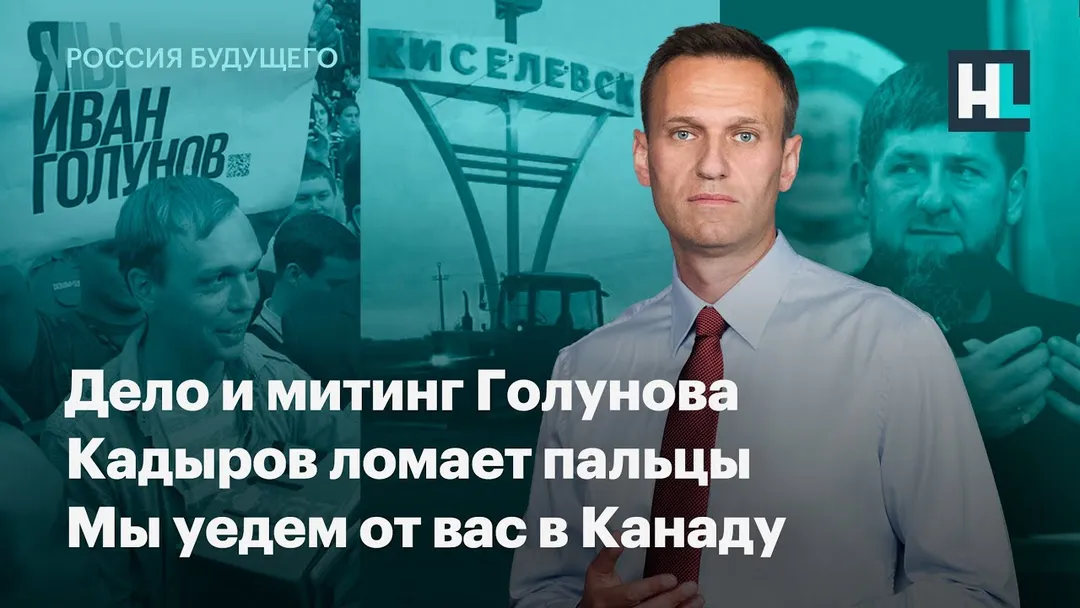
The Golunov case and the rally. Kadyrov breaks fingers. We’ll leave you and move to Canada
[music]
Hello everyone. It is exactly 8:00 p.m. in Moscow, which
means that the live program
**Russia of the Future** is on the air, and I am Alexei Navalny.
Or,
as political analyst Ruslan Ostashko from the DPR (self-proclaimed Donetsk People’s Republic) called me, "the fire of the opposition".
Please send me
your questions on Twitter with
the hashtag #RussiaOfTheFuture, and I will
try to answer them. Our main topic today is
everything connected with Golunov.
It has already become a kind of household name —
the Golunov case.
So much has happened there
that please ask me
questions about whichever specific
aspect you want clarified — there has simply
been a huge amount of interesting developments.
But I want to start with a passionate appeal,
because we really need your
help — and in a very practical sense.
A huge number of viewers of this
program are watching from Moscow. Guys,
we need your signatures. On September 8 there will be
elections, and in order to take part in
them, an independent
self-nominated candidate has to collect several
thousand signatures. You live in Moscow, you
know what Moscow is like.
For example, someone rings your doorbell — what
do you do? You do not open it. Getting into an apartment building
through the intercom in Moscow is
hard. People in Moscow are wary of
everyone else, so here it is very
difficult to collect signatures. The procedure is
effectively prohibitive, and the deadline is very
short. In practice, there are only about
a week or two left at most, so
choose an independent candidate and give
them your signature. There are several
candidates — our "super five" candidates —
whom we are supporting. The address of each campaign office
will be in the description of this video. Go there, do not
be lazy, give them your signature. More than that,
we understand why you are not going, because
you cannot be bothered, and you say, "I do not
want to go looking for some candidate’s office
in my district." We understand that, and
that is why we have specially set up a signature collection center
where you can sign not only for our super five
but also for other independent candidates,
even if we are not necessarily going to
support them in the election. But
we decided that it would be the right thing
to help them collect signatures — sorry,
that is what this is about. So, at
10/7 Rozhdestvensky Boulevard,
Building 1 — a convenient location in central
Moscow — there is a signature collection center.
You can also stop by and see which
candidates are already collecting
signatures there, come in and sign if it is more convenient for you
to do it in the center. And to the candidates, I am speaking
especially to Yabloko members (from the liberal Yabloko party) who are waiting
for approval from their leadership —
they really want to, but they do not
understand whether Yabloko is allowing them to or not.
Come — we can help you too.
At the very least, we can seat your signature collectors there
so that it is convenient for people to come there and
submit
their signatures for you. Naturally,
I especially ask you to help the candidates
whom we support from the FBK (Anti-Corruption Foundation): Lyubov
Sobol and Ivan Zhdanov, as well as those whom we
are promoting as part of the super five:
Vladimir Milov, Ilya Yashin, and Konstantin
Yankauskas.
Zhdanov asked me to say that he is out
at his pickets near the Sokol metro station,
as well as Aeroport and Voykovskaya, and is also collecting signatures there.
This is a real thing
that any candidate truly needs right now,
any candidate who is genuinely collecting
signatures. Here is how you can tell
a real candidate from one whom
the mayor’s office will register using fake
signatures: a real candidate right now is
running around like mad and begging everyone,
"Please give me your signature," because it is very
hard. But those who are just
taking it easy and then later say,
"Jesus, here are my six thousand
signatures" —
all of those are fabricated signatures, and the Moscow mayor’s office
will register them because they are
not real candidates.
Besides that, there will also be elections in St. Petersburg. I have been
very much asked by our St. Petersburg headquarters
to say that there is still time to register
as candidates — go to spb. And if
you are already registered, go into your personal
accounts and use them; it is quite
a convenient service. And one more thing that
occurred to me 20 minutes before this broadcast —
or rather, it was prompted by
Vasily Utkin. I was sitting there
getting ready and sort of scrolling through
my Facebook feed, looking at what topics
were current, what people were discussing, and I saw a post
by Vasily Utkin where he writes: here are the Moscow City Duma elections,
let us turn these elections
into an election for Golunov. It is a fantastic idea,
and Utkin is absolutely right that the deadlines are tight now,
but we would definitely collect the signatures
for Golunov. He would be guaranteed
to win now in any
district. We just need to approach it sensibly, choose
a proper district, coordinate it,
sort everything out so that nobody
gets in anyone else’s way. But Ivan,
if you watch this broadcast, you know me — I would not give you bad advice.
Right now, you can be both a journalist and a deputy there,
that is, serve as a deputy on a non-full-time basis.
We need that kind of deputy, we need a deputy
who has run into the system,
who has spent time inside it,
who has been through it.
It's bad with this lawlessness involving someone who...
was pulled out of jail by people whom we...
owe it to, because a journalist can...
represent the interests of journalists.
It's interesting: those who conduct investigations...
are acting in all our interests. I join in...
absolutely. A full day, well, and there were many...
some other people reposted it.
They simply said it was a great idea, and it...
really is a great idea. You lose nothing...
you lose nothing, you remain a journalist, and we...
gain an excellent deputy, yes, so...
agree as soon as possible, because...
the deadline for collecting signatures is pressing. If you...
also like this idea, then listen, and...
write on your Facebook or Twitter...
somewhere on social media that it's a good idea and...
that you would like to see Golunov as your...
deputy. Right now, it seems to me, City Hall won't...
dare refuse to register him, and he...
will definitely win. We need...
Deputy Golunov. Golunov, come on, please...
agree. Well, basically, they put Golunov on trial...
Golunov. Let's move on to discussing Golunov.
What was it that happened? What was this? It was...
huge.
Amazing. It really is, at the very least...
the main political event...
of the year. Quite possibly it hasn't yet...
ended and will continue.
The consequences will be discussed for a long time, endlessly...
just as we have long been discussing...
for many years now, endlessly, whether Bolotnaya (the 2011–2012 anti-government protest movement in Moscow) was betrayed...
whether that protest was not betrayed, what kind of protest it was...
what could have happened and how, and what in fact...
actually happened, and what kinds of...
complications there were. More and more new...
details and conspiracy theories will keep surfacing.
And it's important to discuss all this now, while...
the event is still alive, while we all still remember, so that...
later, when you rewatch the broadcast...
and...
you can recall some, some interesting...
things, interesting facts. But most importantly...
to draw conclusions from what happ...
happened and is happening, because this is...
an ongoing political event of a sort, and...
on the 16th there will already be, uh, this fake...
rally by these crooks too, just like...
in defense of Golunov. Everyone is asking...
the question: should we go or not, what is this...
even supposed to be, what happened at all? Well, I...
will try somehow, in sequence...
to lay all this out chronologically...
and try to interpret it. Ask me...
questions, because I may miss something...
or it may all come out rather jumbled...
as a speech.
But nevertheless, so, on Friday we're sitting there, and...
I'm sitting there reading Twitter at that very moment...
and I see a message from the Russian...
service of the BBC, I think, or maybe not, or...
some account had posted something like—it really was...
the first tweet: journalist Ivan...
Golunov detained with drugs. Then a second one, and...
of course I understood that, really, this was...
some kind of provocation against him, but it looked like...
they were going to kill him now. That really was my first...
thought, and many people won't let me lie about that...
people whom I immediately started frantically...
writing to: guys...
we need to send someone to him, anyone at all...
find all those journalists...
those fixers—Muratov, Venediktov, and so on...
so that they could there, with...
their various...
crooks from the Moscow city government, in...
the Kremlin, wherever, talk to them, because...
everything else can be dealt with later, but...
right now they'll simply kill Golunov in the pre-trial detention center.
Why? And in general, it seems to me the main...
reason this truly...
huge movement emerged—and people discuss it much...
less than they should, actually. Everyone says...
why not this one, damn it, and why not that one...
why did Golunov stir everyone up...
because he was this kind of...
person who could immediately trigger...
this enormous sympathy from the very first seconds.
I do know him, though I can't say that...
we're close friends, but I know him fairly well...
because, as an investigative journalist, I...
really follow very closely...
his work. Naturally, there aren't many...
real investigative journalists, and...
everyone knows everyone else, and we all...
keep an eye on each other. Golunov is a pleasant, modest guy...
really very modest, shy, always...
smiling modestly, never really...
drawing attention to himself, just carefully doing his job.
He published several, yes...
truly landmark, significant...
investigations that everyone read, and, well...
it was simply clear that...
really...
this was a defenseless person—not just harmless, but also...
a very useful person, someone who simply...
does his job and at the same time is completely...
unassuming—a nice, normal, modest...
person. And some bastards simply...
had obviously decided to kill him, because the idea that...
Vanya Golunov is the kind of guy...
that when you see him, he's just...
smiling, saying, 'Hi, Alexei,' and he...
could somehow have had a drug-production laboratory...
and been selling those drugs...
carrying them around in a backpack—you can see, that...
what they showed there in the first few minutes...
literally, and this whole stream of...
what the Interior Ministry started putting out—like, a lab at home...
drugs in the backpack, drugs at home, he...
was cooking them—it was immediately clear that this was...
a complete lie, and the sheer brazenness of this...
lie...
personally, it immediately seemed to me that...
they wanted to kill him, apparently, or...
do something to him in the pre-trial detention center...
right away—that is, something altogether sinister.
a plan, because this was some kind of over-the-top
lie.
A person who works on
investigations in Russia, in Moscow,
who had seriously gotten under the skin of the specific
Moscow mayor's office,
Golunov specialized in
the kinds of facts that we, that the
public paid attention to. Remember that
New Year's lighting in Moscow? I talked about
it, yes. Maybe in terms of money it wasn't
that much, but all of it
infuriated everyone. Those light bulbs
were bought for hundreds of millions; everyone wrote
about it. The curb procurement, of course, those
famous Biryukov penthouses and all that.
All of that was the standard ritual stuff, while there were also
investigations into gravediggers or whatever,
which drew much less attention. But his articles—overall—made it clear that
the guy had drunk
a lot of the Moscow government's blood,
and had made plenty of enemies there.
And of course, while doing that,
to keep a drug lab at home,
with flasks, cooking something somewhere—any
person who has at least seen a movie
about how drugs are made understands that
if you're making, say, mephedrone
at home, the smell will spread through the whole
stairwell so strongly that it would be obvious
to everyone that you're cooking mephedrone.
Or you'd need some kind of ventilation system,
but in any case, you can't be
a journalist who is obviously
being watched by Moscow government officials
because you're clearly their enemy, and you're being watched by
at the very least, by that whole
apparatus of attached FSB officers (Russia's security service),
security operatives,
police, and all the rest—a huge
support staff for this corrupt machine. It
keeps an eye on every person who
does anything against it, and we can see
that half the political activists there
are being followed by all sorts of operatives, and here you have
a journalist—obviously he's under
surveillance, they're watching him.
They're listening to his conversations, or at least
recording them, and to keep at home
a lab and carry drugs in your backpack
at the same time—
while also writing articles—it was
obvious that it was a lie. And I'll repeat:
the sheer brazenness of that lie showed that he
might be killed right then, so everyone was
completely on edge, myself included. Everyone started
writing frantically, and there really rose
this wave of outrage.
And of course, an enormous role—a key role—
was played here by
that very journalistic solidarity.
Everyone is discussing it now as a kind of guild-like
solidarity, and for many people it later caused, in light of
the events that followed, which we'll
talk about in a moment—well, even at that
stage already,
some irritation. To be honest, for
me too. But back then, this journalistic
'one for all' feeling—Golunov was just
someone who had worked at Meduza, at RBC, I think, and
at many other media outlets. So, well,
all these respectable editors-in-chief
of major media outlets
knew him personally and had worked with him.
So they really did stand up for him immediately.
And those journalists
who ran straight to Petrovka (Moscow police headquarters area)
to hold those pickets, and were detained,
back then—let's just look at
those very first pickets on Petrovka.
There wasn't yet all that stuff like,
'everyone is with us,'
Irada Zeynalova, Maria Zakharova, everyone under
the sun.
Back then it looked like they were throwing this guy in jail
completely lawlessly, and were about to lock up
everyone else who spoke up for him too.
So people went to Petrovka with signs.
Standing there with an understanding of what they were up against,
here is one minute from the very first stage
of the campaign for Golunov.
Here are the signs, so no one can say otherwise over there.
There, you're being detained; red background; Hong Kong—
faster.
We'll figure it out—won't like it.
The grounds found... we'll go with you.
Let's walk over there. This is a one-person picket.
3
[music]
Where, where did you choose from 150 places,
radio
what major law connects
[music]
be in Novgorod 3
yes
[music]
Well, you see, as usual, we have a bit of
the usual situation: one person stands in a picket, and 30 people
film him. But as I said about
Yekaterinburg, and I'll say it now: two
things decide it. First, you don't ask for any
approval—you just have people come out into the streets.
And second, persistence. Journalists—we know they're people who don't really like
being detained.
They'd rather just
show a press card and be done with it. They took everyone away—
well, not these ones, but still, here
they kept going.
They were detained, and they came out again, and they
showed persistence. That
persistence inspired everyone else.
That's why the handful of people, and then the hundreds, who
came in the first days—first to the pickets
on Petrovka, and then to—well, let's show 30
seconds from here—these were the people who
actually made all this happen, because
their persistence and their kind of
—well, they told everyone, they went to
Why the hell should we ask anyone for permission?
No, we won’t — we’ll be out on the street.
That was the key point, from 32 seconds earlier.
They just showed this video, and from it I
saw several guys from FBK (the Anti-Corruption Foundation) there,
and it was really nice that they were standing there too.
And those people who were there, they
were the ones who made everything that happened next possible.
There are all sorts of versions going around, like, well,
that these journalists went there, or Muratov
and Venediktov were there, and someone struck a deal,
and Borya had some meeting with all these
members of the Moscow nomenklatura (Soviet-style political elite), and
all the rest of it — but no,
I don’t think any deal was made there. I believe, I think that
the simplest explanation is actually the right one,
the most understandable and the most truthful
version.
How does the Kremlin make decisions? They
take public opinion into account. They have
people who basically just monitor
social media, and as I understand it, they also have
a technical system that crudely measures
things — so if they see that some
name is being mentioned in connection with some unjust case,
a certain number of times per second, and
everyone is writing about it,
well, Facebook is right here, right here,
it just explodes, and everyone there is writing
Golunov, Golunov, Golunov, Golunov, and everyone
is writing: to the rally, to the rally, it’s scheduled,
and it keeps growing, and opinion
leaders are mentioning it and posting about it, and
you could simply see it with your own
eyes — how the Twitter feed was flying by
three times faster than usual, how news
was coming out several times faster than usual,
how people — these technocratic types —
well, and generally inclined, let’s be honest,
toward rather cowardly behavior — they
see people writing in fury: we’ll take to
the streets, somebody announce a rally already.
And the Kremlin is smart enough
not to wait.
They understood perfectly well that
if they didn’t start resolving the issue now and didn’t
remove this discontent, then on the 12th
there would be a new Bolotnaya (a reference to the mass anti-government protests in Moscow in 2011–2012), again
100,000 people would come out, and the weather
was good outside — they would refuse to leave,
they would stay in the streets, and what
would they do then? Disperse them with water cannons?
Or would they again have to drag things out for a long time, like in
2011–2012? In other words,
it would become some major issue
they’d have to deal with afterward.
So apparently they looked at the whole thing and
saw that it really was — that this was
simply planted drugs, and that in
fact, just judging by
the case materials, because
it turned out that
there was no drug lab at all.
I think by Friday night into
Saturday already, thanks in part, by the way, to the
excellent work of the lawyers,
from Agora (a Russian human rights legal group), who were properly highlighting
every
mistake they made, who
pulled out every single detail and threw it
to the media — all of it spread everywhere,
and it became clear to everyone that this was a complete
fabrication, total nonsense.
And of course there was this question:
could the police officers, the police in general,
really just go that far, so lawlessly,
and simply plant drugs on someone? But
inside the police and inside the Kremlin, everyone
of course understood that yes, they could.
More than that — they do plant them. Right now
there’s a lot of discussion about how, technically,
this is done. Guys, just very
recently there was that businessman,
where was he from, Chelyabinsk or somewhere?
That businessman — they simply
planted drugs on him. A businessman in Omsk
made the same accusation against the FSB (Russia’s security service); we’re talking about the FSB now,
— that they planted drugs on him.
Let’s watch a short video of how
it’s done. It’s done very easily.
Let’s take a look.
See? The same thing happened not long ago.
That businessman was screaming, “My God, they’ve
planted drugs on me,” and people told him,
“Sure, who are you that the FSB would
take such a risk to plant drugs on you?
Of course no one would do that.”
“That’s nonsense, rubbish — you’re just trying to attract
attention.” But fortunately, there just
happened to be a camera there, and on the footage
you could see that the FSB guys really had
planted drugs on him, because that’s
what they always do. And, frankly speaking,
it’s perfectly clear. And if you like, they in
the Kremlin and in the police know perfectly well that
the practice of planting drugs is
something the police do every day. It’s not
necessarily that they plant drugs on
some honest person for money —
they also plant drugs on those same
drug dealers, drug traffickers,
so that there will be drugs on them, so it will be
easier to lock them up. Because in their
frame of reference, well, he really is
— and we know he sells drugs —
there he is bringing them from Tajikistan, and
around his house, his apartment, there seem to be
some kind of
drug-related dealings — so when he comes out now,
we’ll toss him 3 grams and that’s it, off he goes.
Or he comes out, they throw 3 grams on him,
and just like in the film *The Meeting Place Cannot Be Changed*,
they say to each other: “A thief
belongs in prison.” And remember how Gleb
Zheglov planted a wallet in Kirpich’s pocket?
It’s exactly the same thing. They plant evidence
every day, every single day, and everyone
understood that perfectly well. So of course they could.
plant it, and then people remembered who
he had conflicts with. And if we
had already managed to publish by Monday
even an investigation in which we proved
that in the Moscow branch of the FSB
the leadership of the Moscow FSB consists of
nothing but outrageous crooks and thieves who
had a conflict with him. Let's
watch a few seconds from that
investigation of ours. In other words, we
got it done by Monday. Obviously,
somewhere at a high level, where
decisions are made, it was simply
clear from the overall picture.
They understood that on the one hand
there was a threat of an absolutely wild uproar
from people who were about to, damn it, stage
a second Bolotnaya (a reference to the mass anti-government protests in Moscow in 2011–2012).
And on the other hand, they understood
that this second Bolotnaya would be quite serious,
because, yes, everything was falling into place:
there are some people sitting in the Moscow FSB who are
crooks;
with assets worth billions of rubles
and then there are cops
especially these ones who just, as a matter of
routine, every single day
plant drugs on someone. A few
seconds from our video about those FSB guys
who, I am convinced, are the very
people who ordered it.
In the Golunov case, here is an extract confirming
that senior FSB officer Medoev in 2016
bought a 200-square-meter apartment (about 2,150 sq ft) in one of
the most elite
and ostentatious residential complexes in Moscow,
Italian Quarter.
One square meter here costs 1
million rubles.
So his apartment was worth, accordingly, 200
million rubles. And then there are two more apartments like that—
not quite as elite, of course, but both
100 square meters each (about 1,076 sq ft), and in the city center.
We just need to walk down
Kazakova Street another 200 meters (about 220 yards), and we see
a building where the Medoev family owns a 180-
square-meter, two-story apartment (about 1,940 sq ft). One like that
costs 80 million rubles. And let me also
add to the picture: behind this building there is
this 1,000-square-meter annex (about 10,760 sq ft),
non-residential, and it also belongs to the family
of the security-service men, the Medoevs. Igor Medoev
bought this building in November 2016,
and two months later registered himself as a sole proprietor,
and immediately leased the building
to the Moscow road traffic inspectorate.
These are from the lease documents for the premises
on Kazakova Street. They explain that
they would actually be happy to rent
anything at all, but they simply have to rent
this specific Medoev property because
Sobyanin personally wrote a letter—here are
the number and date, all official—in which he
approved the lease of this exact property.
Cars? A whole fleet.
Three Mercedes of different classes,
two Audi Q7 SUVs,
a Lexus, a Porsche Cayenne, and six motorcycles—
Harley-Davidsons and BMWs.
Well, I'm not going to show you this whole
video in full, but there's also
a key point, which is that
this FSB officer Medoev sold
his own personal car to
the state enterprise Ritual—that is, the very funeral
mafia. When you sell a car to some
company, it's obvious they didn't buy it
just for appearances, which means you have
a fairly close connection. And here is simply
formal proof of the existence of this
close connection between the FSB officer with whom
Golunov had some kind of conflict, and who
demanded that his surname not be
mentioned anywhere,
and that same funeral mafia that
Golunov was investigating. And imagine that you are
Putin—or whatever passes for Putin's Politburo
there, Kiriyenko, whoever is responsible for
political matters. Before you is
the following picture: Facebook is raging, and
you understand that now all these people
are going to pour into the streets—journalists, but they are opinion
leaders. Even those who are
rather timid journalists are already
finding their voice and saying something, while
the brave journalists, meanwhile,
are swearing in blood, splattering that blood
all over Facebook, saying that they will
go after everyone every day, every day
call people to rallies, and go themselves
to the protests. And you think: damn, of course they will.
It's one thing to drag, say,
Navalny by the arms and legs
into a police van, but it's another thing entirely to drag Galina Timchenko
by the legs into a police van. We don't want to do that to her,
or to Osetinskaya, or to some—I don't
know—Alexei Venediktov. We don't want
to drag them into a police van because the image
would not look very good.
And what is all this over, if
Putin and Putin's Politburo are thinking:
if there were any justice on our side—
if Golunov really was
actually a drug addict—then we would, on an informal level,
still somehow understand it, and then, conditionally,
they could have thrown the book at him.
But by now it's obvious that it was all made up,
that there was no lab in his home, and the Interior Ministry
was lying, and everyone already knows it. Let's
look at the famous human robot
who later said that after all this
the Interior Ministry was lying
under the pressure of the evidence. Once again,
thanks to the people there who
did great work and dug all this up—
the police robot who
was forced to justify himself while
preparing the information.
posted on the official website
of the Main Directorate of the Russian Ministry of Internal Affairs for the city of
Moscow
in connection with this incident, there were published
photographs of the seized items; at the same time
as a result of an error made by employees of the main directorate
an error
a comment was posted stating that all these
photographs were taken during an inspection of the residence
of the detained citizen. In
reality, one photograph was taken
in the apartment where the
suspect lived
the others were taken at other addresses as part of
operational
measures and investigative actions aimed at
stopping the activities of a group of individuals
engaged in drug trafficking in the
Moscow region, to which the detained person’s connection
is being checked. In connection with this fact
an internal review has been ordered
at the same time, we express our disagreement with
the statements of certain representatives of the
media alleging deliberate falsifications
committed during the preliminary
investigation
the preliminary investigation of the criminal
case is ongoing; it has been taken under the personal
control of the head of the Main Directorate
of the Russian Ministry of Internal Affairs for the city of Moscow
Police Lieutenant General Oleg Baranov
when it became clear fairly quickly that
the laboratory photographs were not from
Golunov’s home, because all of Golunov’s acquaintances
wrote, “What the hell, this is not
his apartment,” and even people who did not know Golunov
could see that it was some kind of place where
the walls were paneled with wood; it is unlikely that
a person living in a Moscow
apartment
journalist Golunov would have finished his
apartment with wood paneling, and these are wooden platforms
on which a drug lab was set up, and
Pavlov said it was obvious that this was fake, and all of this
ended up with Putin or his
politburo sitting there and, again, thinking: if
there is at least some kind of
“underworld-style” truth on their side, they understand that it
doesn’t exist; is there now going to be Bolotnaya 2 (a reference to the 2011–2012 protest movement) over what?
Because in Moscow Sobyanin and his
crooks have some kind of funeral-business scheme, this scheme, you
know, a surname that is never mentioned, namely
Nemyryuk
who coordinates the consumer
market and also coordinates all
funeral services. Who there is going to
continue these investigations? I saw there
Meduza said a lot of loud words that they
would continue them, and I advise you to pay
close attention to this person
Nemyryuk, Biryukov, Kitov, the towers—they have
some kind of scheme there, making not a small amount
not exactly pennies for Putin and the
Putin politburo
the funeral mafia is not about such huge money
well, what are they making there, one
billion, say? I mean, that’s substantial
with that billion they bought real estate, but
still, for you they’re just some mice
scurrying around somewhere, and because of these mice there will now
be a second Bolotnaya (the protest movement); why the hell would you need that?
But I think that in fact before
all this happened, they summoned
all these Facebook people
and said, guys, somehow, like
it happened, and in their own underworld-style
language, I think, they basically
told this story, which I
for example, by virtue of understanding how these processes work
from my own understanding of the process, can
reconstruct; that is probably how it was there. So
all these Moscow crooks were sitting there, their
their boss with a crazy roof (criminal protection) was sitting there, and they told him
something like, “Marat,”
“Medev, Maratik, listen, we’ve
arranged premises for you and your family there,”
“you’re getting 2 million
rubles a month (about $22,000), and everyone’s housing is fine, and
your sister has an apartment there of 300
square meters (about 3,230 sq ft), and your beat-up
six-year-old car, we’re replacing it, and now somehow
solve the Golunov issue—he’s poking into our business, why
the hell do we need him, and what do we do with him?”
“Look, just look at him, show us
Golunov, look here—don’t
he look like a drug addict? He looks like a drug addict.”
Surely he’s a junkie, a narcotics case.”
“Well then, if he looks like he’s on
drugs, why hasn’t he been caught with drugs yet?”
“Caught with drugs? Fine, we’ll catch him with
drugs,” replied Marat Medoev—or
someone else. Then he took his
guys
from the Western District, who went to the
Central District
the first sign that something was wrong was that they
planted drugs on Golunov, then
broke into his apartment, into his apartment
and planted something there too, that’s all. And then you
Putin, you fool, we’re dealing with Putin’s
system here—why the hell do we need this
because of all this mess
to be dealing with a new Bolotnaya (protest movement). So by the
time when the question of
pretrial restraint was already being considered, of course
it was precisely the people outraged online, those
who were writing—in other words, the potential
rally would indeed have turned into an actual rally
that is, it just wasn’t yet physically in the street
but it was already on Facebook, on
Twitter, and so on, and it was already clear
that it would happen
the people who said, “To hell with you, we’re
going out into the street and we will demand his
release”—those were the people who frightened them, that is
the people who came out into the streets again, who
said that we are not going to wait for any
official approvals
And that’s why they let Golunov go.
After that, it was just a matter of the usual mechanics,
the kind that had been worked out back in 2011–2012.
They called Muratov and they called Venediktov,
they pulled strings, and wow, it was
a very interesting and truly
astonishing, almost fantastic process.
Not even a process, really—I don’t know,
maybe a precedent the likes of which we had
never seen before. Nothing like it had
happened during Bolotnaya (the 2011–2012 anti-government protests in Moscow), nothing
like this had happened in any other case either.
For example, remember there was recently that
women’s march over the New Greatness case,
there was a huge uproar on Facebook then too,
and precisely because of that noise,
even though the march itself wasn’t very large,
and there was a downpour, they left it alone.
No one was detained because it was
clear that this, too, could turn
into a new Bolotnaya. That’s how the authorities operate:
they keep an eye on people’s real
moods and try to avoid
a genuine public outburst. But this time
something astonishing happened, because
in order to defuse the tension,
they brought out and unleashed
their propagandists—or rather, not exactly unleashed them,
they gave the order.
As the Proekt publication wrote, if I’m not mistaken,
which, by the way, also did excellent work,
Muratov told a lot, and one
name, Medoev, was learned by Proekt’s journalists
from Alexei Gromov, the deputy
head of the Presidential Administration,
who oversees all of this
propaganda machine of lies. He
allowed them all to speak out on the Golunov case
.
and criticize the Moscow police.
And who didn’t we see?
Irada Zeynalova—good Lord, that’s
the very same person
who aired that infamous story about the “crucified boy” (a notorious piece of Russian TV disinformation),
the embodiment
of the vilest, nastiest lies—and she came out
in support of Golunov. And then Simonyan too—well,
there’s nowhere to put another mark on her, so to speak. But these
people—we were literally watching their Twitter feeds,
it was just astonishing. But
they had clearly already been told what to write.
They were writing: it would be right
to release him to house arrest, because
the decision to release him to
house arrest had already been approved in order to ease the tension.
They had already started saying it, and even—good Lord—
Maria Zakharova. It was very funny to see
Maria Zakharova’s posts in the context of
drugs, because that is always very, very
amusing. Even she came out and
wrote: let’s stop this—
this investigation, let’s stop
this persecution,
these awful things. More than that, they
criticized the police, they spoke up for
freedom of the press. And I’d like
to note separately that what happened
shows us how quickly this entire
Putin power vertical
will collapse, excuse my language, the moment
the tiniest little crack is opened,
the moment these people—even not when
they’re explicitly allowed something, but when they realize
that criticizing the authorities isn’t scary. Because
even the most hopeless of them,
like Irada Zeynalova and Simonyan,
people who basically never say
a truthful word—they too want
to be normal people, they too
want to write something
on Twitter someday so that in the
comments people will write, “How right you were,
Margarita,” instead of
calling her names. And Maria
Zakharova also wants some
decent people to say about her, “Now that
was a proper statement—did you see how well
Maria Zakharova spoke?”
So, in other words, there is still something human
left in them after all, at least some kind of
vanity, maybe—a desire
to be praised by decent people. And they
switched sides in an absolutely astonishing
and fantastic way. It was very, very
funny. By the time house arrest
was on the table, when all the propagandists started
writing that Golunov should be released,
when *Kommersant*, *Vedomosti*, and RBC
published that now-famous front page
saying “I/We Are Ivan Golunov,” it was clear that
these were newspapers that never
say an unnecessary word, and suddenly they came out with
something like that. It was a breakthrough, and
those journalists—they took it, and I’m
speaking completely seriously now,
without sarcasm and not trying to mock them—
it really was a great moment.
You can view it ironically in the context
of what happened afterward, of course,
but it shouldn’t be viewed ironically,
because it really was
something great: the moment the lid was lifted,
they turned into real journalists rather than
what they had been before. They even felt like
decent people, and many of us
looked at them and thought:
so after all, inside they are decent people,
they say good things. And that was very
cool. And as I already said, the most
amazing thing was watching everyone
flip in midair—those crooks
who had just been writing… show us, if we have
any screenshots, let’s take a look—
at what they were writing before that.
Armen Gasparyan, some obscure
guy who calls himself
a historian, one of the
main propagandists of that sort.
small-time talking heads, the iron, and Solovyov's force
Sergey, on the program—look, first of all,
he writes well, a decent person from
the Beautiful Russia of the Future
so they detained him with drugs, ha ha
drug addicts, archaeology, then a purge in
the Ministry of Internal Affairs (MVD) — that's good, I'll do my part and
there was a lot of that, and they literally instantly
changed, and they were simply ready
to go out to the barricades and start tearing
their throats out. Golunov was won over—that was
really a very great moment, well
yes, yes, yes, yes. For you, from the point
of view, was it some kind of cynical political-technological
moment, because Gramov called in these
journalists and said: guys, we need
to make sure this whole protest thing is not
monopolized by the opposition side of
Facebook, and you should also start
writing about it, because later we'll announce
some bogus, fake rally
the next stage will be—I also slightly
you speak—but still, they were saying
the right things, and after all, they all
know that drugs get planted. It wasn't
pleasant to do that, and it was really
such a great moment which, I'll repeat,
shows us how quickly
Putin's regime will end, how quickly
Putinist propaganda will end, as soon as the moment
comes. And all these chains—as soon as
the leash loosens, all these attack dogs, they
I'm not saying they'll
support us or shout 'Navalny for
president'—of course not. But they, like
any journalists, will start criticizing
the shortcomings of the authorities, and our current government
consists exclusively of nothing but
shortcomings. And it won't be Meduza or RBC, dishonest
journalists, but people like Vladimir Solovyov
and Margarita Simonyan
who will smash this whole government, this whole
ideology, in three—no
potion—when finally, when they either
with him, pleasure
or are given a little freedom, then
one way or another, here's what happened next
there was this huge, already quite unanimous
mass journalistic movement, and
the authorities' next task was that, well,
as for Golunov, they decided: we'll now
release him
in one or two stages, but we need
to make sure that no unauthorized protest
no new Bolotnaya (a reference to the 2011–2012 Moscow protest movement) happens
why? Because right now I'm being written to by
Timofey Platonov
Alexei, how is Volkov doing? Leonid Volkov
the head of our штаб (campaign headquarters), who is now
sitting—Inferno overkill—asking
it's wonderful that everything was resolved with Golunov
but how many more innocent people are in prison, and so
on. These are the kinds of questions you send me most often here
quite rightly, and by Saturday they had already
started discussing it: what the hell,
they locked up Golunov, but they only
focused on Golunov, and now of course we'll go with
a sign saying 'I am Golunov,' but we're for everyone, after all
and that became the scary thing—they had to
stop all this urgently
so they brought out a bottle of whiskey
and invited Alexei Venediktov and Dmitry
Muratov, and then the wonderful Galina
Timchenko and Ivan Kolpakov. Do I want to
condemn them for everything that happened afterward? Because
you yourselves know perfectly well what happened next
they suddenly came out with some
statements of varying degrees of
strangeness, saying that
the case against Golunov was now being dropped
it was clear that on the day before
this rally, before the rally, he would be released
they released him, dropped the case, but they needed
there to be no rally, and they put out this
strange statement saying that we are not
calling anyone to rally, let's cancel it, let's go
have a drink. Well, it all looked
super strange, and of course, well, Ivan Kolpakov,
whom I think well of, and when
all this happened, I wrote to him
and to Timchenko, a letter, and I still stand by
my offer: if you need anything
to investigate further, we will help you with
Meduza's investigation. But nevertheless, he
wrote some completely
fantastical post. I regret that I didn't
run into Timchenko and Kolpakov at the rally
yesterday so that I could simply, to their faces,
tell them: this is just some kind of
fantastic mixture, at once of
cowardice and sheer rudeness toward
everyone. Show that screenshot again
where it's like, well, we got our guy back, this is
our victory, activists are needed, but we kind of
look down on activism, we don't
do that, so, like, thanks everyone
freedom for all, we've got a ton of work, and that
was, of course, very sad. I condemn them
though
I understand that they were in a hopeless
situation. We're all adults here, we
understand perfectly well how it really was
they were summoned, and whoever it was there—Sergunina
the one who handles politics in
the city of Moscow, Sobyanin's deputy, the same
Gorbenko
well, some people there who decide things, they
know the Presidential Administration and said
the obvious thing to them: guys, we'll release Golunov
right now, nothing will happen to him
he'll be fine
and everyone will be safe, we'll now deal with some cops
we'll fire some of them, we'll admit all this
it will be justice, but we don't want
there to be a rally. It was a very difficult
compromise for them. Well, then they should have
come out afterward and said
'Please understand our position; it was important for us'
And right now, the important thing is to save him, Golunov, but not
just from this prosecution, from prison, from
all the terrible things that obviously would have
happened to him and were clearly being planned for
him. And in order to save him,
we also made a certain compromise there.
So honestly, we appeal to all of you, guys:
let's cancel tomorrow's rally, well,
and in two weeks we'll submit the application now
and hold a new rally for
Golunov,
and for Volkov, and for those imprisoned in the case of
the Network case, New Greatness, and all the other such
cases—hundreds across the country, and thousands, tens of thousands
of people who have had drugs planted on them.
Tens of thousands. You all know these stories.
Every one of us has acquaintances
who have had drugs planted on them; every one of us
has friends of friends
of friends who may well have been
sent to prison over drugs, for some utter nonsense. I
even told you a story that
shook me to the core: I was sitting in
a cell with a guy who was being held
under administrative arrest because
he had violated supervision rules. He was caught in
a club with 2 grams of hashish on him.
He got 5 years. Yes, you shouldn't smoke
hashish, and I condemn drugs, and all of that
is terrible.
It starts with hashish and continues with heroin,
but damn it, they gave him 5 years.
He was a very young guy. He had finished
school,
served in the army, and then went to prison. That's his whole
life—this monstrous mess. And there are
huge numbers of such cases. And of course Meduza
—Kolpakov and Osetinskaya, in general—there was no
It's very sad that Elizaveta Osetinskaya
is involved in all this. They should have
come out and told us everything plainly.
But you're not children here, and neither are they.
You know who you're dealing with.
You know what kind of people these are.
They released Golunov; we got him back
alive and well. But the trade-off was this:
let's not hold the rally
that the authorities so badly did not want to happen.
That would have been a—well, it would have been a scandal,
of course an indescribable one, but to a much lesser
degree, and to a much lesser degree we would have
ended up quarreling among ourselves and causing more damage
to everyone than what they did.
Because when they wrote, 'Guys, ha-ha,
we're going for a drink,'
don't come out to tomorrow's rally because
those kinds of rallies are for everyone, and we've gotten our guy
out,'
'we're not engaged in activism, we're
engaged in journalism'—they did
a terrible thing. And the main offense
was that they removed
the magical umbrella of safety. When there was
a rally planned, a general rally
that everyone was going to, journalists included, and it was
fearless and powerful, and the organizers—the very
same top journalists—were saying, 'Let's go
to the rally,' no one would have been detained there.
It really would have been a huge rally.
Even without official permission, the authorities wouldn't have
been able to do anything about it; they would have had to accept it.
But no one would have been detained there. When
they said, 'You know, as for those
rallies—it's the sort of place all kinds of
riffraff go,' when they removed that, in fact I
understood for the first time that something ugly was going to
happen. And when they pushed out the
Agora lawyers from the process,
and brought in a lawyer who
starts dealing with some kind of
'problem-solving,' little arrangements, and all
that sort of thing—I knew one thing about the Agora lawyers:
they would not engage in shady dealings.
Well, that's a matter for each
person; it was Golunov's personal decision.
It's his business; everyone handles the matters of their own life
for themselves. But when
things like this started happening, it became clear that there was
some kind of deal being made. You see,
these were arrangements. I'll repeat what I said at the
start of the program: I myself wrote to everyone,
'Get the people who specialize in negotiations—
Muratov and Venediktov—and send them
into every office, because the main thing is that
Golunov not be killed.' But there was no need to treat everyone with
such contempt,
and there was no need to remove that
magical umbrella, because the authorities
then acted in a very simple way.
A lot of people are asking why, why did they
beat everyone up?
It's very clear why they beat everyone up. They had
a simple setup. Basically, they
decided: they said, 'Look, we
released Golunov. And for those who
still want to protest, we've suddenly
approved a rally'
for which all sorts of crooks had submitted applications, including
Ekaterina Vinokurova,
that same woman known for her
famous video: 'Everything was going so well
until Navalny showed up.' Remember the
protest against renovation (the Moscow housing demolition program)? It was the exact
same thing with that anti-renovation rally—there was
massive outrage, after which City Hall
organized a rally against itself,
put all sorts of crooks in charge, and I came
there with my wife and child, and the police were
escorting me out.
And then they were crying about what a good
rally they had, how everything was fine until
Navalny came. And where did that protest movement
against renovation go? It dissolved because
the mayor's office took it over, and then it was
gradually crushed. The same thing is happening here.
Is it still worth going out and protesting? But
here we are being offered our own, well, of course slightly
prostituted little rally—but it's legal, and
We’re telling you: yes, you can hold a rally, but with our
hosts, from our stage, with our
organizers, under our slogans, and we
control everything. We’re giving you a whole lot here—
what difference does it make to you? You can go straight out into the
street chanting these slogans,
put on your T-shirt that says
"Golunov," and post this
photo on Instagram. Isn’t that enough for you?
Especially since the rally will also
be a celebration. Maria Zakharova will be there rejoicing
—Maria Zakharova, who was writing posts there
about how I would pay for this.
Everyone there will be saying, “I’m crying with happiness,” and
Margarita Simonyan will say, “This is the best
day of my life.”
They’ll come out on stage and say,
“I thank the wise position that was taken,”
by Moscow City Hall, and then Sergei Sobyanin
also wrote something like, “We corrected a mistake,”
blah blah blah. But it will be a celebratory rally,
a celebration of civil society’s victory
over certain police officers from
the Western Administrative District
who, for unclear reasons—we won’t
discuss certain FSB officers (Russia’s security service), no,
no Biryukov, no Nemyryuk, and the Moscow government
has nothing to do with it. There are just some unclear
police officers who, for some reason,
decided to plant drugs, but we
beat them, we threw them out, we fired them.
We gave you Kolokoltsev—what’s not
to like? We even gave you the mini-
minister himself; he recorded a video address.
Let’s watch. Kolokoltsev: “As a result
of comprehensive biological,
forensic, criminalistic, and
genetic examinations, a decision has been made
to terminate the criminal prosecution
of citizen Golunov and to drop the
charges against him
due to the failure to prove his involvement in
the commission of a crime. Today he will be
released from house arrest.
The materials from the investigation by the Internal Security
units of the Ministry of Internal Affairs have been sent
to the Investigative Committee of Russia
to review the lawfulness
of the actions of the officers directly involved in
the detention of this citizen. For the duration
of the investigation, they have been suspended from
their duties.
A decision has also been made to petition
the President of the Russian Federation
for the removal from office
of the head of the Internal Affairs Directorate of the Western
Administrative District of the city of Moscow,
General Puchkov, and the head of the Directorate
for Drug Control
of the Main Directorate of the Ministry of Internal Affairs for Moscow,
General Devyatkin, on the grounds that regardless
of a person’s profession,
the rights of every citizen must
always be protected.”
Do you think it was pleasant for Kolokoltsev
to record that video? No. Especially since
he personally didn’t plant anything on anyone. He
was basically just there,
and they told him, “Go fix this problem, because
otherwise it’ll be Bolotnaya” (a reference to the mass protest movement of 2011–2012). They recorded the video,
fired some of those, well,
police officers, and then said,
“Guys, but again, it’s clear.” And Putin’s
politburo is reasoning like this: we
gave them a rally and paid for the sound system,
suddenly a
sanctioned rally is being hosted by opposition
journalists,
Ekaterina Vinokurova and the well-known journalist
Pavel Gusev.
We put Kolokoltsev in front of them,
in front of everyone; he humiliated himself. Alexei, Andrei—
people are asking me about Peskov’s daughter.
They sent Peskov’s daughter to the rally,
ready to send in the whole invasion; she was there
walking around too with some kind of sign and all that.
So, in other words, we fulfilled our obligations.
Golunov has been released, we did a bit of
self-humiliation, we put on this whole show, but if
some of you are still dissatisfied and
want to run around shouting “Freedom for
Leonid Volkov,” “The New Greatness case” (a Russian political case involving young activists),
“We demand a review,”
of repressive legislation, or
to demand that the media be allowed to write all the time in
a genuinely free way—then sorry, we
are going to beat you down. And they did.
As for why yesterday at the rallies there was
real—this stupid, well, if you
really are that stupid—stupid
beatings, a stupid brutal pummeling of people: but I
was there at that rally. Why am I saying this
too? I’ll tell you honestly,
absolutely honestly: I was so upset
with Meduza (an independent Russian media outlet).
I don’t want to go to jail right now; I have a lot
to do. They deliberately jailed
Volkov once, then jailed Volkov another
time in order to isolate him from
the штаб (campaign headquarters). Everyone understands this. The candidates there
just bombarded me with frantic
text messages when the news came through
that I’d been dragged into a police van.
They were writing, “Why the hell did you go? We need
you to keep publishing investigations, we need
you to keep speaking out so that we can
collect signatures, we need to keep
Smart Voting going, and you’re going to sit there like an idiot
for 30 days. You can’t
allow yourself that.” And of course I can’t
allow myself that. But after, excuse me,
Kolpakov’s post, how could I not go when
they told everyone, “Thanks, everyone, that’s all,
you’re all free to go”? Well, I had to go, because
otherwise I’d be worth nothing as a politician.
So I went and got thrown into that idiotic
police van, sat there cursing, to a lesser
or greater extent, the whole regime.
and everything else, to a greater extent, all of it
this whole mess, but sorry that I'm speaking so incoherently
all I want to say is that this has only just
all passed through me personally. Just yesterday, at that
time, I was, well, preparing for
a 30-day arrest, but I still need
to be ready for it. I'm just trying
trying, so to speak, to describe the overall structure
that is, the complicated political situation
that has newly emerged, that now
has arisen, and in which we will be living
for quite some time. That's how it is.
So, they removed this umbrella of protection and started
cracking down. Let's watch the video.
of the detention. It's about a minute long. It looked
genuinely pretty awful.
[applause]
[music]
uh
people were being detained in a really completely stupid
meaningless, random way. I mean,
I was just standing there, that's all. Fine, I—I
was just standing there the whole time, and then
a police officer comes up and just starts dragging me
somewhere.
They were just grabbing random people, carrying them off,
dragging them away. Naturally, that especially
infuriated everyone, because we have the
opportunity to compare the behavior
of the police in different circumstances. Here,
people really came out to protest
for a just cause, and literally two days
earlier we all saw a completely
astonishing video of how the police behave
like little kittens
when they are dealing with a somewhat different kind of
public-order violators.
Let's watch for one minute.
I apologize in advance, there is a bit of
profanity there, but still.
So, you just saw how people were being dragged away
for no reason, and how the
Moscow police behave in other situations.
And why is that?
Well, you see, there's a police officer standing there
saying, 'Hey, idiot, get in the car, get out of here,'
'we'll sort it out there.' But here
people were genuinely just being grabbed and dragged away.
You saw many shots where they were simply
beating someone, and as far as I understand, even now
several people are still detained, and
I send them my best regards. I hope they
get out
as soon as possible. At the Central Administrative District police station, I think,
today they were issuing fines of 150,000 rubles (about $1,600).
Why are they herding people there? They are herding
everyone who does not want to go to this
[__] sanctioned rally, into it.
They are forcing them there. This is the authorities' clear position:
'Go ahead, protest, speak out,
but under our control. If some
socially important event happens, we do not
deny that the Golunov case is
an important public issue. Fine, we will
create protest infrastructure for you,
come up with the slogans ourselves, and arrange everything for you.
And if you don't want that, we'll crush you. That's what they
are doing—really squeezing out this group of people
who later wrote Facebook posts saying,
'You know, we did help free Golunov,
but people are still behind bars, so we are still
going to come out. We may not even feel like it, but out of
principle we'll go.' These people, to
me, are the most wonderful. They are, in principle,
the finest, the best people—the good
people, the best people in the country. They still
come out, and everything rests on them. They
still look for some kind of
solidarity; they try to show that
solidarity toward everyone—journalists and non-journalists alike.
Everyone deserves equal
rights, and people who say that
and come out to defend it are very dangerous to the authorities. They pressure them and
crush them because of that.
So that is where things stand. On the 16th,
there will be a rally organized by the very same people
who planted drugs on Golunov
—these pathetic people organized
a rally in defense of Golunov and dragged in
all sorts of their controlled clowns,
and of course we need to watch carefully
who will be calling people there, who will
be speaking there, and everything else,
because this is how they
are trying simply to divide all of us
and how they are trying, well,
to use the carrot-and-stick method. Let's see who
was silenced by the stick and who was bought off by the carrot.
It's very interesting. The funniest
moment of this rally, of course—and it is also
funny, and you have surely seen it, but I
will show it again for just a couple of seconds. It is very
funny, but at the same time, damn, how
humiliating it is—the bit where someone is basically saying, 'Let me go,
I'm American.' Let's watch 22 seconds.
After the check, that meant I could
go out for a walk.
[inaudible] Russians
[inaudible] brought me in as an American
Right, and I watched that moment together with
the cops at the police station, the ones who
had made the arrests and were writing up reports. They
naturally had nothing much to do there,
they were bored, sitting around, and just like
you, they watch all these little videos
about who hit whom, who got into it with whom,
'our guy was caught on camera there, haha,'
'now they'll write about him on the internet,' and
so naturally they were watching that video about
the 'I'm American' moment. Everyone is laughing, cracking up, and well,
naturally they said to me, 'Anatolich, why didn't you
say you were American too? They would have
let you go as well, haha, hee-hee.'
But what a humiliating moment that was,
you have to admit, really.
Well, to them, we are second-class people, all of
us, you understand. A person who simply
[fragment unclear] says 'America' and that's it.
Getting involved with him—he’s kind of... no, come on.
Let him go, but these ones—these are the ones we’ll...
...crush. These are the ones we’ll beat, along with him.
You can do whatever you want—pack in 26, even 36 people.
I think there were about that many people in the police van,
where Ruslan Shaveddinov was too, and he was also sitting there in
that hellish heat.
It was like a gas chamber in there—was it even possible at all
to get out of there without any health consequences?
Was it even easy to get out of there at all?
It’s just disgusting. A person says, well—
“A foreigner? A foreigner? Then get out.” That’s
of course just revolting. But there were also
some super inspiring moments. I want to show you
an absolutely furious speech by Sasha
Astakhova—1 minute 20 seconds. It’s really
something. She spoke brilliantly there. This was already
after I had been taken away, so I didn’t
see it live, but later I watched the video and just
thought: if only we had more people like that.
He stands there smiling, saying that his detention
is not the main issue here.
Forget the details for a second—what matters are these
key words he says. He says:
“Your colleague has been released, and I’m glad about that,”
and all the police officers who dragged me in
kept saying, basically, “Well, he’s been released already.”
But Astakhov says: “That’s not enough for me, because
the others are still sitting there.” That’s the key point.
Yes, and that’s the main complaint against Meduza (an independent Russian news outlet)
and against some other wonderful, decent people.
Really, despite how much I criticized
Meduza on this broadcast, of course they are
not enemies. They’re all on our side.
It’s just that I hope they somehow
realize that they behaved wrongly.
But all this division into activists and
journalists—how many people like that are sitting in jail?
How many unfortunates like Golunov (Russian journalist Ivan Golunov) simply
don’t know any editors-in-chief,
and that’s why Astakhov is right when he says:
“This is not enough.” And it shouldn’t be enough for us either.
I hope it’s not enough for you either, and that we need to keep coming out
to rallies like this, because for us
this is not enough. We want, in principle,
for this to become impossible.
Impossible for this to keep happening—impossible for
it to happen again. And it’s very interesting
what’s happening at rallies now:
the attitude toward
the police has, of course, changed completely.
And the police’s own actions are to blame for that.
The actions of the police are, of course, simply
pushing people to chant completely
different slogans. A few years ago,
a couple of years ago, you remember,
people were chanting:
“The police are with the people.” And now let’s hear what
people often chant now.
[music]
People are marching and chanting: “Cops are the shame
of Russia.” Before, that was something only
anarchists would chant. Now it’s being chanted by simply
ordinary people, including elderly people
who came out because of the very
actions of the police themselves.
Like, well, they detained me there, that is—
as for me, since I’m a well-known person
from YouTube, they always treat me very well there.
In that sense, I have no
complaints about the police department.
The Strogino police station was wonderful—clean,
the cell was much cleaner than the one at
Danilovsky. Everyone was polite: “What do you need there?
How are things? Do you want some water?”
“Would you like some water?” I say, “Thank you.” Well,
then you see why everyone out there is shouting
“Cops are the shame of Russia,” and they say to me, “Well, but
what are we supposed to say?” Well yes, of course, you’re
all different.
But you drag people away and then justify it
by saying, “It’s just my job,” “It’s not us, it’s
life that’s like this.” But you are the ones dragging people away,
planting drugs, protecting corrupt officials.
But inside the police there is also
a fairly large movement against all this.
This time especially, I
didn’t notice the slightest bit of joy
or gloating among the police officers
about these detentions. Sometimes that kind of thing
does happen—like, “So, what now? We’re going to
break this up, you’ve gathered here,”
“because of you we’ve got extra
duty shifts.” But this time it seemed to me that
even the police themselves were fairly
downcast.
I keep a close eye on the police union,
and we try to support
the police union, and there’s also this
public group, “Police Ombudsman,” where
the leader of that page writes huge
human-rights posts about
why the hell the police are involved in all this.
It’s obvious that drugs were being planted,
and all this planting of drugs—
they’re forced to do all of it
because the authorities pressure police officers
in exactly the same way. He posts
amazing documents Sasha found.
So, they caught some police officer
because he was moonlighting as a Yandex
Taxi driver, and they either fired him—or maybe they actually did fire him—
or gave him a severe reprimand because
“you are disgracing the honor of a police officer”
by working part-time for Yandex Taxi.
Then pay him properly! One officer
moonlights for Yandex Taxi, while others
plant drugs. And those who
plant drugs—until something like the Golunov case happened—
were doing just fine.
Everything’s fine if you plant drugs, but if you drive for Yandex Taxi
as a side job, they’ll throw you out of the force.
Well,
but still, that’s how it is. And this
sympathy
—we understand why it happens, but it
is, in a way, running out within society,
wearing thin, and of course we should expect...
What
when there are large rallies, sooner or
later, well, this could turn into
some kind of conflict with the authorities, and the authorities
actually understand that quite well
I’ve been talking more and more often about
Golunov, but it really is a
crucial issue, the most important thing
and through it we saw how
they are trying to divide us, by the way
speaking, it’s a funny thing, I just
saw today, you know what
at the same time as this rally, just like
with our rally that we
held over *He Is Not Dimon to You* (an anti-corruption investigation by Alexei Navalny), the authorities
also simultaneously organized several
meetups with various Instagram bloggers
some of these million-follower bloggers
I don’t really know them, but apparently they’re big
Karakare, Lazar Yans, David Mun, Okean
Dmitry Maslennikov, Subkhan Mamedov, they
each wrote on Instagram that
at exactly that time, some in Sokolniki, some
somewhere else, they were holding meetups with followers
come by, I’ll take pictures with you
sign autographs and all that, so
you can see how frightened they were
that by all sorts of different methods
here’s a fake rally for you, here’s something cool
to lure you in, and then, well,
the youth are immature, so come on in
take pictures with bloggers
you know, everyone needs to watch carefully
because this is exactly
the toolkit the authorities use; we need
to understand how it works, and we need once
again to clearly realize how
we can achieve something: not by
asking permission for anything
but simply by coming out. Second, by showing
solidarity with everyone, always—whether it’s a journalist
or a taxi driver, it doesn’t matter to us. And third,
by being persistent, the way those
journalists were in the first days: they lock them up
you throw him out the door, he comes back through the window; they lock them up
they come back out again, regroup, and bring in
new people. That happened in Yekaterinburg
and it worked in a case that was much less important politically there
though still very important
for the city, and highly precedent-setting
and it worked in an absolutely astonishing
way
and now, in the Golunov case, which
is ongoing and will continue, because
listen, we must keep
asking the question: who ordered it? On the 20th
there will be Putin’s call-in show, and Meduza is
preparing something there; obviously they should
ask these questions. The authorities must
explain it to us. But will they bring anyone
to criminal responsibility?
I assume that right now, of course, in
their scenario
they have no plan to bring anyone to criminal responsibility
if we look at the ruling on
the termination of the criminal prosecution
the termination of the criminal case against
Golunov, it says: due to his non-involvement
in the crime. But that means the crime did happen
it says, due to non-involvement
in the commission of the crime—that is, there was
a crime
there were drugs, someone detained someone
someone did something, but Golunov had nothing
to do with it. But that does not satisfy us
you’ll agree. As Stakhova said just now
in the video, that’s not enough for us; we want
those people to be held accountable
the people who planted the drugs
in the backpack
they committed an especially grave crime
and the people who ordered it
they are outright criminals, absolute
bandits. And the people they were protecting
and for whom they tried to imprison Golunov, all those
corrupt officials and, well,
frankly, they are the most dangerous
corrupt figures, protected by gangsters
who put people in prison. We would like
this entire chain to be exposed
but right now they’re just steering us
toward saying: come on, let’s celebrate
and have a drink. We can and should
celebrate and drink to
Golunov’s release, but
not for a single second should we forget those who
are still behind bars—not for one second
must we allow that to happen
listen, I have several
other important things I wanted to mention
first of all, of course, there is that shocking
video from Chechnya that we
all saw. It is especially important in
the context of what happened with Golunov, yes
well, drugs were planted on him, but in Chechnya
this happens all the time, and that is exactly
in a sense
a new practice that is now
being exported from Chechnya. I saw statements
at the first stage of the development of this
conflict, everyone was saying: my God, who would
plant drugs on a well-known
journalist? Ayub Titiev is a well-known
journalist
he is very well known in Chechnya. I think that
in Chechnya
among the population he was better known than
Golunov was in Moscow before all this. Nevertheless
they planted those drugs on him in a case of total lawlessness
and everyone saw it
this happens in Chechnya
but nevertheless the prosecutor’s office in Moscow
the Supreme Court in Moscow
the Investigative Committee in Moscow, all the supervisory
Moscow authorities, knowing that drugs had been
planted, said: okay
we checked the legality, everything is fine, they imprisoned
the man. They released him now, there will be a pause, but
And yet he was the one who ended up in jail, and we planted it.
The drugs — everyone knows that.
Ramzan Kadyrov knows all this, and Ramzan
Kadyrov put out a remarkable statement, because
the governor of one of Russia’s federal subjects (regions)
said that he would tear out people’s tongues there
and break their fingers. Let’s see how he
imagines it.
Then we’ll break them too, and tear out their tongues.
Keep in mind, we’ve not just
seen a single line — whether it was a comment or
a video posted — he would have gone after her.
Whatever he may be like.
You know me — Holyfield-style, I love my
talents.
What law on insulting the authorities are we even talking about here?
Here, a governor simply comes out — one of the
leaders of United Russia (the ruling political party), a governor,
a public official who is, after all,
supposed to follow all regulations,
a civil servant, and says: if you
call me names on Instagram, I’ll
tear out your tongue; if you write about cars in
the comments, I’ll break your fingers. And everyone
stays silent, and nothing happens. This is all
connected with the conflict that is now
flaring up. Maybe in the next
program I’ll talk about it in detail — right now, between
Chechnya and Dagestan over the border. It is
something similar, partly like what
used to happen earlier in Ingushetia
— Ingushetia needs to be discussed separately.
Of course, we all want
there to be no conflict there, for no one
to start fighting, on either side,
for no one to take up arms. And we need to,
let’s say, call on everyone to remain
calm online. A governor cannot
say, ‘I’ll tear out your tongue and break your
fingers.’ And if a governor says something like that,
well then, obviously, all across the country
police officers will plant drugs on
people, because the law does not exist.
They understand that as long as Ramzan Kadyrov
is saying all this on Instagram,
there is no law at all — there is only
an appearance of it, there is only a political situation.
If the political situation allows you
to plant drugs, then plant them.
If in one out of a hundred thousand cases, like with
Golunov, the political situation changed slightly
and he turned out to have powerful
connections — he was not a person standing alone,
there were people looking out for him — then in
that one case out of a hundred thousand, you can’t. But overall,
in general,
there is no law, there is no truth, and it is permitted
to tear out tongues and break fingers.
As long as this keeps happening, lawlessness will never
stop. And I’m not
even interested — it’s pointless
to wait for Ramzan Kadyrov to stop doing this.
He is constantly testing, constantly looking for
new boundaries — like children, fooling around,
acting up, and always escalating.
Because
that’s just how people are: they look for new
limits, they look for the boundaries of what is allowed.
And no one sets those boundaries of what is allowed for Kadyrov.
He no longer pays any attention
to the law enforcement agencies, to anything,
or to public opinion — to nothing. He
doesn’t care. And Putin either does not want to,
or cannot, or is deliberately allowing all this
because he needs people in
the country to understand that their tongues can be torn out
and their fingers broken. The most humiliating
video was this one.
And the humiliating video about the American
who was being released was almost cheerful by comparison.
This was a humiliating, sad, humiliating
video of the week, the month — I don’t even know how long.
This was, of course, a video from
Kemerovo Region, a video from the city of
Kiselevsk. I want to show one minute
and 20 seconds. People appealed to
the Prime Minister of Canada, asking him to
grant them Canadian citizenship and take
them to Canada. Let’s watch 1 minute
20 seconds.
[music]
We have repeatedly sent our appeals
to President Vladimir Putin, pleading for
rescue.
Our government forgives huge debts to other
countries, but its own
residents of Kuzbass (the Kuznetsk coal basin in Siberia) seem to have been forgotten. We
are tired of waiting for change, and if there is any,
it is only for the worse. It is dangerous to wait
any longer — every day things get worse.
In our city and region,
we are not betraying anyone — we simply
want to survive and have guarantees that we, as
people, as human beings, are worth more than
the mineral resources
in the earth’s depths. If the Russian Federation cannot
give us that, then we will
look for the opportunity to live in other countries.
And there were more people — over two minutes of footage.
The sound is very bad, but we made
special subtitles, because those unfortunate
residents of Kiselevsk do not even realize
that they cannot be heard in that wind, and they
are reading something in a hopeless tone. And this thing — I
saw this video spreading across
the internet, articles were written about it,
but in a satirical and comic
way. It really did seem funny: residents
of Kiselevsk — and where even is Kiselevsk? Who the hell
knows — appealed, of all things, to the
Prime Minister of Canada: take us
away from here and give us citizenship. They mine
coal there by open-pit mining, in order to
make money. They simply started digging
coal pits, blasting the ground, and simply
extracting it. It is very cheap.
It brings money to local crooks, this
monstrous, barbaric method of extraction, and it
is turning local residents' lives into hell
because everything there is covered in this coal
dust, and it's impossible to live a normal life, and they have already
been knocking on every door for many years, and nothing can be done
about it.
And now imagine this: in Kiselyovsk
they got together, whether in someone's apartment or in a club,
and said, "What are we supposed to do?" Someone
spoke up and said, "Why don't we just
appeal to the Prime Minister of Canada, and, well,
maybe then
Canadian newspapers will write about us. Russian
newspapers don't write about us." It's such a
absurd thing. Maybe everyone else in
Russia will pay attention, maybe
someone in the Kremlin will hear about us and
finally make it so that my
infant child, when lying
in a stroller, doesn't get coal dust settling on his face. This
is monstrous. It's monstrous that
residents have absolutely nowhere to turn.
There are all sorts of environmental inspections,
but they don't work. They should have shut all this down
immediately. The environmental protection
prosecutor's office,
it should have arrested all these
people. The regular prosecutor's office doesn't work either,
nor the police. In the Kemerovo region,
it's basically gangster rule there. Everyone takes
money from these coal pits.
The regional leadership takes bribes from them.
It's pointless to appeal to Moscow.
So they get down on their knees and appeal
to the Prime Minister of Canada. What could be
more humiliating for our strange country?
Good Lord, we claim global leadership,
we compete with the United States,
we have nuclear weapons, nuclear power plants,
we want to conquer space, and yet our people
have to resort to
the only way to draw
attention to themselves: making themselves look like fools
by appealing to the Prime Minister of Canada
so that some Muscovites or
officials, I don't know, scrolling through the jokes section,
might see how monstrous their lives are. This is
a nightmarish, unjust situation, but I also
just want to support all the residents
of the Kemerovo region, and of course those in
Kiselyovsk. That's why I also included in
the program—and, guys, smart voting: vote for
any party except United Russia.
I just ended the program with that very
party, United Russia, at the St. Petersburg
Economic Forum. The key words
that
were formulated more clearly than I did in my
program or in any of my videos by the head of
Dagestan, Viktor Vasilyev. You all
know him well: a gray-haired man
who served as a general in the Interior Ministry and was
a deputy minister. He became well known because during
the Dubrovka theater hostage crisis (the 2002 Moscow theater attack), he was constantly on television,
and then for many years he sat
with United Russia in the State Duma. He was even our
own
Deputy Speaker of the State Duma, one
of United Russia's leaders. That is, for
14 years
he personally passed laws and
coordinated the passage of those laws. At
the St. Petersburg forum, in 10 seconds he said
the most important words about all this work
done by him, United Russia, and Putin.
Vladimir Vladimirovich, let's listen to this
wonderful man. "What we're all saying now is
that the legislation needs to be changed.
Yes, as it stands, our legislation is written
for thieves and corrupt officials. Now it needs
to be written for honest business.
"Our legislation is written for
thieves and corrupt officials," says one
of the leaders
of United Russia, the head of the Republic of
Dagestan.
Thank you very much, Mr. Vasilyev. We
agree with you. So on September 8, vote against
United Russia—take part in Smart
Voting. If you live in Moscow,
44,000 people are watching this
program right now, and many more will watch it later.
Please spend an hour, go out and
give your signature
for candidates to the Moscow City Duma. They
will write proper laws,
not the kind that are written for thieves and
corrupt officials. Thank you very much to everyone who
watched. See you next Thursday.
[music]