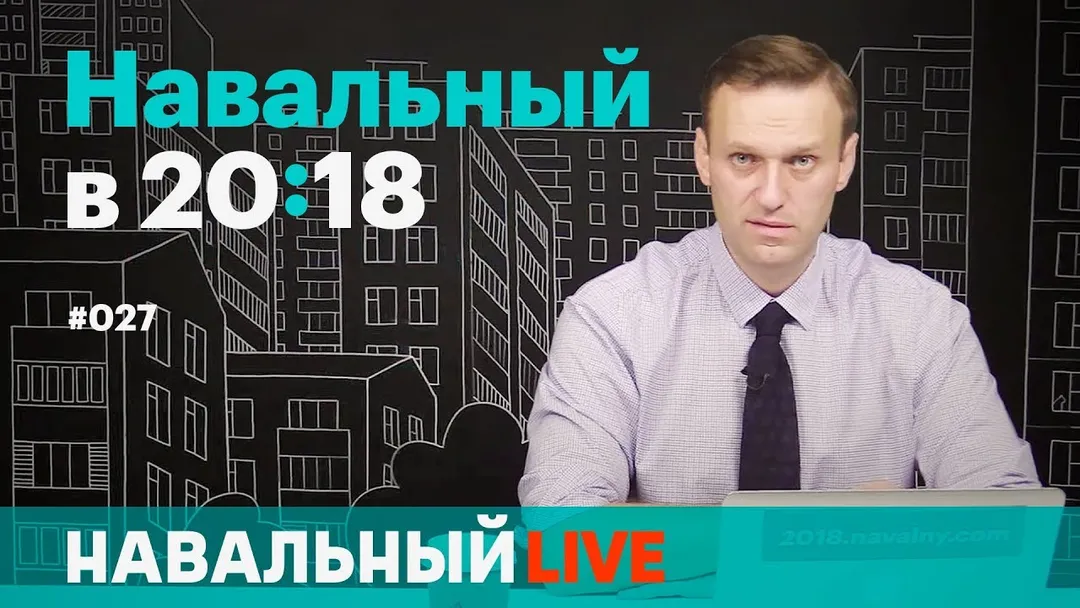
11/5/17, Putin Team, police organize attacks
[music]
Hello everyone. It's 8:18 p.m. in Moscow, which means that in
the Navalny LIVE studio, I'm Alexei
Navalny, here to discuss with you
what happened this week. Please write to me
using the hashtag #Navalny2018
on Twitter, and I'll be reading your questions
right from Twitter and trying
to answer them. Don't forget to like
this broadcast so that more people
see it, so that we can overcome
the Kremlin bots who are leaving their
dislikes.
Naturally, of course, I want to start with
Artpodgotovka and November 5, 2017.
Simply because this is truly
an important topic, a topic that will stay with
us, my friends, for months, for years,
it will remain in the news for
many, many more months, like the Bolotnaya case (the prosecution of protesters after the 2012 Bolotnaya Square rally in Moscow),
and perhaps even more than the Bolotnaya
case, because unfortunately, judging by
the way this is unfolding, there will be a whole
group of political prisoners in Russia
who will be known as the Artpodgotovka people,
just as there are labels invented for many others,
like the “Bolotnaya defendants” — and now there will be the “Artpodgotovka people.”
We are seeing completely unprecedented
repression unleashed against
Artpodgotovka, and the media coverage of this
repression is completely out of proportion to its
scale. I see Mediazona writing about it,
Meduza, and some other media outlets
that still
lean toward human rights coverage
and write a lot about it. But overall, unfortunately,
to my outrage, many media outlets
have ignored this huge, enormous
case, which will proceed in Moscow and
across all the other regions. I want
to say, first of all, that all these
people are political prisoners and deserve
our fullest sympathy and
support. Second, well, I probably
disagree with many commentators who,
including some who sat here in this studio, I do not
agree with. I've heard comments like:
“Ha-ha, Maltsev's revolution didn't
happen,” or Yulia Latynina on Echo
of Moscow says Maltsev is a provocateur, or
something like that. I don't understand why we
should talk about this that way, or why we
should treat these people that way. What
wrong did they do?
So what exactly did Maltsev call for? He created
his organization, Artpodgotovka. It is
a real, genuine organization.
Whatever city I go to, there are always
people at headquarters or at a rally — especially a big rally
like the ones I'm holding now —
a group of people comes up and says, we're from
Artpodgotovka, from Maltsev. So I know
for a fact that this is one of the
most extensive real regional
networks. And he said: guys, let's
hold acts of civil disobedience on 5/11/17
— you can call it
a revolution, you can call it something else,
but basically we understood that this
wasn't going to mean that actual
revolutionary sailors would be running around
shooting somewhere. I myself was once on Maltsev's broadcast
and asked him, because I also didn't understand:
is November 5, 2017 more of a metaphor, or
an actual date for a revolution? And he
told me that it was, of course, a metaphor. On November 5,
2017, we will go out into the streets in all cities
in order to express our
dissatisfaction.
They have every right to do that. We did exactly the same
thing
on March 26, June 12, November 7 — that is,
it's a normal thing in political practice
when people declare a certain day to be a day
of protest actions. The Communist Party of the Russian Federation does this,
for example, or some Left Front group, and
Artpodgotovka decided to do the same.
It called on people to go out into the streets
on a certain day, and they have every
right to do so. I don't understand why this makes Maltsev into
some kind of Father Gapon (the Russian Orthodox priest associated with the 1905 Bloody Sunday events). What exactly did Maltsev do wrong?
We're not discussing right now
the specifics of his ideology, the specifics
of his organization, what he said now
or what he said a hundred years ago, or whatever
bad words he may have used — that's a completely different matter.
That can be discussed; it's a topic
for substantive discussion. But in essence, he
was calling for something entirely legitimate.
Artpodgotovka did nothing
illegal, and the fact that the authorities came down on it so hard
shows that they were simply
terrified.
But there is a short video — you've probably
seen it, but I still want to show it again.
It's less than a minute long.
It's 56 seconds, and it
was released by Russia's FSB (Federal Security Service). So
here they are telling us
proudly
how great they are, how they supposedly defeated
the Artpodgotovka movement. Please show
this video,
about that.
Just look at these heroic actions —
they literally protected
the security of the Russian Federation.
They're breaking down doors, blowing out windows, rushing at someone,
bursting in, arresting a person — and he has
compact discs. Can you imagine?
They're just lying there on the table, on the floor — or rather on
the asphalt — these most dangerous compact discs, and
bandages.
Isn't that a crime? People have, for no reason at all,
some bandages and, well, of course, there are
some shocking shots of a pistol —
some kind of pistol, it's not very clear what kind
of pistol it is: gas-powered, traumatic, whatever.
even if it's a real firearm
Go to Umar Dzhabrailov, who had
a pistol that was fired at
the National Hotel and, I think, into the elevator there, into the
ceiling with that pistol. Why don't you go
break down his door?
Please go to Ramzan Kadyrov and
all the rest of his people who
are formally listed in some kind of unclear
armed formations. Look there — you'll find not
just a pistol, you'll find all sorts of things.
So what is happening now — well, this is
it is being presented as completely
repression. Even now, we still do not understand
the full scale of it. We have collected — please show
the slide — we have compiled statistics. As of
today, according to what we have on the website
tracking this, there are more than 400 people
detained, 8 criminal cases under various
articles, and administrative charges
are being filed — all of it completely absurd.
Every day, every hour, there are reports that
someone detained is a 10-year-old child.
On November 5 itself, you saw those
wild reports: Pokémon Go players were being detained,
Pokémon Go.
The Libertarian Party in its entirety
was detained — or large groups of people were detained wholesale
simply because they were walking
somewhere to have lunch, quite literally. At that
conference, they were simply grabbing people who
were walking down the street. And in all this
discussion, you know, one thing really rubs me the wrong way:
we have these
armchair anti-Putin fighters, and they love
to stick to one extreme or another.
They either criticize us and say, well,
Navalny
is standing there for some kind of elections,
or there are protests at Bolotnaya (Bolotnaya Square protests in Moscow),
some white ribbons, circling the Garden Ring,
it's all nonsense.
When there's a revolution, then we'll take part in
the revolution. And others say, no, this
revolution is nonsense, some kind of joke, a laughingstock.
We revolutionaries want to take part in some other kind of
activity. Well, here you go:
please, choose — there is a choice.
Volunteers, whatever you like, balloons, white ribbons,
come work in the campaign. But no, they do not
want that. They want revolution, revolution.
All right then, please join
Maltsev. Maltsev is proposing direct
action — go ahead. He has bandages, supplies,
and apparently even a pistol somewhere — and they don't like
that either. And then come these
ironic assessments: ha-ha-ha, what a
ridiculous revolution Maltsev's is.
Well, of course it was bound to fail — it
was crushed, this movement was smashed, and
all the forces of the FSB of Russia were thrown at it.
They were doing nothing else, and the entire
Russian police force was occupied only with this.
That is why these people were thrown in jail,
completely unlawfully arrested. I do not
know what is happening to them there, and I
certainly cannot rule out
torture, as there has been in many other cases.
Some of them emigrated, some are
in hiding, and so on and so forth. So
guys, let's stop
making snide jokes and treating this ironically. These people
were doing something they had every
right to do. They announced that they would take part
in an act of civil disobedience and in
actions where people simply gather in
the streets. They have every right to do that. Upon them
the machinery of the state came crashing down; they were
repressed. Therefore, regardless
of the many
differences in ideology or
organizational matters, these people are
political prisoners. These people should
receive active support
and our sympathy. And these sneering
comments everyone is tired of — 'Father
Gapon' (a reference to Georgy Gapon, often used in Russia to imply a provocateur) and all the rest of it —
they were acting for us, for
our freedom and yours, you know. They did it
and many of them are now in prison. And Maltsev is not
to blame for that. Putin is the one putting these people in jail, and
let's not fall victim to this
Stockholm syndrome: if someone
was imprisoned after following someone, then somehow
Maltsev brought them into the streets, so Maltsev
is to blame. No — Putin jailed them. Putin jailed them
completely unlawfully, and Putin bears
responsibility for that. These are adults,
brave people who took part in this.
They understood the risks they were taking, and they
are now bearing those risks. Maltsev
was forced to emigrate, but others were also forced
to leave the country.
And the fact that he is not now sitting in the
next cell does not mean that
we should start shouting 'Father Gapon.'
Because then no activity in
Russia would be possible at all. As things stand now, after
any action, after any mass
action, there are always two, or three, or four, or five
people who get imprisoned for nothing. This is
the authorities' tactic: they take
hostages. They simply seize random, accidental
people and put them in prison in order
to intimidate everyone else, in order
to sow in our ranks these kinds of
doubts, these conversations about how, well,
look, this person was jailed, but
one is sitting in Paris, and another
is hosting a Navalny Live broadcast — they are not
in prison, so this must be some kind of provocation.
It is not a provocation. The Kremlin is the one doing the jailing. The Kremlin
must bear, and will bear, full
responsibility for it. Why are you asking me
about the preparations? I'll ask now about
the preparations. No one is asking anything. What do you
think about the idea of legalizing
short-barreled firearms?
Someone is asking me about revolutions.
You can even find the video on YouTube.
For some reason, people very often
throw it in my face as a reproach and think that
it’s some kind of, you know, compromising material on me. I
am ashamed of that video? No, absolutely not.
There’s a video where I speak in favor of
legalizing handguns.
I believe that Russian citizens can
buy themselves a pistol, and nothing terrible
will happen. They won’t go running around
the streets shooting left and right.
United Bowie says: my computer science teacher
said that Putin is the most
honest politician-president in the world. She’s 27.
I said he’s a thief. She said,
“Were you there holding the candle?”
Do you really need to have held a candle?
A spotlight is shining on these people
and showing that they’re thieves. What candle are you talking about?
You should ask that teacher: you don’t need a candle.
Are you blind, a 27-year-old woman? Come on,
just look at how Putin’s
associate became the youngest billionaire in the world.
Isn’t that direct proof
of corruption in Putin’s system? That’s all. So,
5,117: ask me something about that.
I saw that there were simply a huge number of
people saying, “Vlad Nadeika, I’m outraged.”
Artpodgotovka is an extremely unstable
organization, and there really are
people there who are inclined toward unlawful actions.
Should we defend them? Well, yes, there are people
who are inclined toward unlawful
actions, and maybe everywhere—even in the Anti-Corruption Foundation
there may be people who are inclined
toward unlawful actions. And I, according to Putin, am a twice-convicted
repeat offender; according to
their version, I’m basically
a habitual hooligan who systematically disobeys
the police, constantly gets administrative
arrests, and so on. There are unpleasant people, yes,
but do they have civil rights?
People like me and people like you—does Vlad have them?
Yes, which means we must defend these people.
Anyone from Artpodgotovka
even if they are inclined toward instability
or unlawful actions, is a hundred times
better than those sitting in the Kremlin. That’s
all.
Ivan Shesterkin asks me:
why did I stop appearing on
regional TV during my trips?
Is it because they stopped inviting me, or to save time on
other things? Well, right now we’re holding big
rallies. Back when I was just opening campaign offices, we
would invite the press in, and I would appear
on regional
television wherever they let me on. Now,
of course, they let me on much less often—
practically not at all. And we also don’t have the time;
after all, a big rally requires different
preparation, and very often we simply have to
leave one city for another
right away—there’s just no time for it.
A bit off topic, but still: were you
surprised when you saw such a
huge number of people at the venue in
Irkutsk at the meeting?
asks Murik Chit—Murik or Murid4. I
wasn’t surprised. I knew that Irkutsk is
a very protest-minded city. We saw that in
Irkutsk—everyone saw it in Irkutsk—
they elected a Communist governor in a tough
standoff with United Russia, so
they chose an opposition governor there.
Another question is that now he’s not very
oppositional. I knew that Irkutsk is a
student city, a protest city.
It’s just that even more people came
than we expected. That was very
nice, really great, but I wasn’t surprised. I
know—a lot, if not everything—about the cities
I’m going to, so I can fairly
accurately predict how many people
will come or won’t come. The only place I
was wrong was Kemerovo. I’ll talk more about Kemerovo later.
Alexei, tell us about the new
batch of documents related to offshore holdings
of Russian politicians. Khaba asks. I’m not
going to explain it now, because we’re going to make
a short video about it next week,
an explanatory one. A whole bunch of
articles came out, as you can see, and nobody understood anything
about what happened. And I read those articles, even though
of course we knew these publications
were being prepared; we worked with some media outlets
that were preparing the publications, and they
asked us questions. But I can see that what
was written and explained still isn’t very
clear to Russian citizens, so we’ll make
a special video—maybe even two—
on this topic. Speaking of videos, today
we released
a video about “Putin’s Team.” And today as well
news appeared that “Putin’s Team,”
which is supposedly an association of various famous
athletes and, apparently, just
well-known people,
was created not by Alexander Ovechkin,
who announced it, but by some PR people
from the company Image Consulting. What’s interesting is
that they recently received a grant—well, not a grant,
whatever you want to call it—in short, they got money
from the Central Election Commission after winning
a tender for coverage of the election
campaign. In other words, they received budget
funds to cover the election
campaign—our money, yours and mine.
And with that money, they’re creating “Putin’s Team.”
But overall, we’re not surprised, and
it seemed important to us simply to place
the right emphasis on a few things. If you
haven’t seen the video yet, it’s 10 minutes long.
You can go watch it—it’s in first
place in YouTube’s trending right now, hooray.
Right now we literally have 45 seconds.
Let’s take a look specifically at America.
more specifically, in the suburbs of Washington
Ovechkin first bought this house for $1
and $1.6 million, and then this one here
this impressive mansion for $4
million, and relatively
recently, he reinforced his love for
Putin and Russia by buying a 200-square-meter (about 2,150 sq ft)
apartment in Miami for $2 million
Kovalchuk moved to the U.S. even earlier, in
2000
to vote for Putin in 2012
Kovalchuk urged us, from this
wonderful house in Atlanta
or perhaps from this apartment in Miami
here is the building where Kovalchuk has an apartment
we go exactly 150 meters (about 500 feet), and in this
building lives another member of the new team
of Putin: the legendary Pavel Bure
Why is it so important not to be afraid
to criticize these people, despite the fact
that, well, really, in fact,
they are respected athletes and celebrated
hockey players, and they earned all this money
honestly, and have every right to buy their
beautiful dachas (country homes) and mansions in Miami or wherever
they want
And yet these people, to our
great regret, have become servants
of corruption. They have great achievements,
but they defend Putin's regime, and my
prediction is that this
election campaign
will largely be built around people like these
because Putin has nothing to show
in terms of real achievements. Right now, in the
2018 election, we simply have nothing
to say about what he has done over the last
five years, four years — just a failure
a decline in people's real incomes
nothing at all. So it is extremely, extremely, extremely
hard for him to campaign for himself and make his case
to say, look guys, I did something, I made it so that
people's
salaries fell. So he will
focus on foreign policy, he
will focus on Crimea, and there will be this
support group and chorus of cheerleaders
athletes and performers, whoever — they
will dance around him in circles
telling us all how very
great and impressive he is, and it is very important for us not
to let ourselves be, so to speak, intimidated
Of course, Ilya
Kovalchuk
doesn't intimidate us, but we should not be afraid of these people's authority
Fine, yes, they skate well
and score goals, or perform well
in some theaters — so what?
What comes next? Why should we
listen to all of this, and why should we
place them beyond criticism? After all,
when it comes to this
Putin team, they all live in the U.S., and from the U.S.
they give us wonderful advice about how
we should once again vote here for
our terrible roads and vote for
all this filth and nastiness that
is going on. We should not be afraid to argue with them
and of course we should point out all sorts of
details like these. There will also be a small
poll — I have a question for our
vote, which will take place on VKontakte (a Russian social network)
in our game, in the Navalny LIVE group, on
Twitter, and on YouTube itself, and it goes like this:
So, Putin's team, made up
of famous people — do you think this
will work or not? Because
before, it generally always worked
you show these famous people, they
line up in rows, and people's jaws drop
and they say, well, if this
famous actor or this famous
footballer, this famous hockey player, then
I guess we should vote for Putin too
What do you think?
Will the authorities be able to fool us this time
with their stars and celebrities, or
or will it not work very well for them? Of course,
you may ask me, Alexei, but
going back to the run-up, after all
Maltsev could have, during this time, properly
prepared his supporters instead of just reading
the news
My dear princess, well then, what could
during his election
campaign, Alexei Navalny have done?
He could have opened not 80 campaign offices but 160, and also
flown to the moon. And Maltsev, too — what
could he have done? And you could have done something too
instead of just writing on Twitter, and I
and everyone around me. But he did some things, and some things
he couldn't do. So that means some
leaders he managed to train, and some he didn't
manage to train. Overall, we should ask
the question: did he do something bad to us? No
he didn't. Did he try to do something
good? He did try to do something good
and for that he has been unlawfully persecuted
So, of course, we would all like
there to be great
ideal politicians. I too would very much like
to do twice as much, and the fact that I
that the Kremlin is still saying now that
they will not allow me onto the ballot probably
proves that I am not working effectively enough
and that our team is not
working effectively enough — we could have done more
we could have brought a million people into the streets
Someone will write here: well, Navalny could have
brought one or two million people
into the streets, but he didn't. We are trying, and he
is trying — all of us together must keep trying
So yes, of course, people should be criticized
but you shouldn't just, you know,
pull things out of thin air and say, well, they could have
done everything differently. Maybe they could have, maybe not
they didn't do it, it didn't work out, they couldn't
they didn't have enough support, including from you
I haven't gotten many questions asking me about it.
Roman Berezovsky, it may seem that way.
Maybe it seems like the campaign is doing something wrong,
like it has stalled. So when will things pick up?
Roman Berezovsky, your impression is completely
mistaken, because
our campaign has not stalled—quite the opposite.
It is moving very actively in the regions.
That impression may arise simply because
you read news from Twitter, and
if I just spent all day posting
updates, making posts, or putting out
twice as many videos, then you
would think things were moving quite actively.
But we've simply moved into a phase of
practical, difficult, routine, but very
effective work. Right now I'm speaking here,
and early tomorrow morning I'll leave for Volgograd.
This week we have three cities:
Volgograd, Izhevsk, and Smolensk. Please come
to the meetings. And I am doing what
a candidate is supposed to do.
In that sense, I travel around cities.
Obviously, when I arrive in Volgograd,
Volgograd knows about it, but to everyone else
in other cities and to Twitter readers it seems
like none of this is very active, because I
can't be speaking in all cities at once.
But nevertheless, we deliberately shifted
the emphasis away from media work and onto
the hard work that actually needs to be done,
and which, unfortunately, in Russia
almost nobody ever does—holding these
kinds of meetings.
Alexei, why not challenge Putin—call him out?
Challenge him to a debate. He has never taken part in one.
People practically treat him like a tsar (an emperor).
Mikhail asks:
I have challenged Putin to debates many times, and
I want debates with Putin. This has been discussed many times.
But you are right to say that
he has never participated in debates, and
he is not going to debate you.
In that sense, people have been trying to call his bluff for many
years already, and it really is a weak spot for him.
He is afraid. All his "Direct Line" call-in shows
feature pre-prepared questions, and all his interviews with
journalists are always staged. When it comes
to Putin, it's important to understand that this is a man who
has never really taken part in genuine
election campaigns.
He took part in Anatoly Sobchak's campaign
and lost. He took part in
the campaign of that—remember?
—ridiculous party of Chernomyrdin's, "Our Home
Is Russia," and he was an active functionary in "Our
Home Is Russia"—and that lost too. So he
is afraid of election campaigns, he is afraid of
debates, he is afraid of real competition, and
of course, he will not go to any
debates, because he would simply
be scared, and he has repeatedly shown
that he is afraid.
So, returning to Roman's question: yes, I
actually wanted to say a little about what
we are doing. Right now, as a candidate, I
am primarily traveling to the regions and
holding meetings with voters. This is very
important. We can see, including through
polling data, that the level of
support in these cities is growing. Well,
it's not exactly rocket science.
There is a reason why, all over the world, candidates always
travel around the country and hold meetings with
voters: because that is what
an election campaign is. That is how you
win votes and support, not by
being shown on television.
Well, if you're not the incumbent president and
can't completely turn television
to your own advantage, then you won't get
any votes at all unless you do this
work—and that is exactly what we are doing. Please show
the slide with the current cities.
I also wanted to say something separately about
Izhevsk. All three of these cities are very
interesting. In Volgograd, for example, there are always
provocations. I think this time the local
authorities are some completely rotten
crooks, with other crooks working for them,
and they are constantly organizing
utterly lawless stunts. I think
this time won't be any different. But
there is, of course, a very interesting situation in
Izhevsk. Maybe you read my post
today, because as you know, we are not
being given permission for rallies, nor are we being given
a venue for holding a meeting. We put out
a call for help, and I talked about it on this program:
guys, give us private venues—
hangars, warehouses, anything. That's how it was in
Tambov and that's how it was in Irkutsk. And
an amazing person in Izhevsk did something
that had never even occurred to us. He
simply made arrangements with his homeowners' association,
held a vote, and now we are holding a rally on the
adjacent residential property. You live
in some apartment and don't even
think about the fact that, actually,
the surrounding land belongs to you too—
a fairly large plot of land. And you think,
wow, in what way are you even allowed
to use it, what can actually be done with it?
None of us ever really knows.
It had never even occurred to us. And now,
right now on your screen you can see part of the
minutes of the meeting
of all the homeowners in that building, and
you will see that with a 100 percent
vote they approved
letting us use their land for the event.
We will pay them 8,000 rubles under an
official contract, and now the authorities
can't do anything about it. It's an amazing thing,
because it turns out that, yes, the regime
may be powerful, Putin may be great and mighty,
the police may be scary and all that—but
you can still just do this—like that.
simply to exercise the right that we
had never even thought about — our right
to use the land around our own apartment building
in front of the building. It’s very interesting.
How it all goes — come to Izhevsk, for example.
Please come to the rally, and if you
happen to have a building that is friendly toward you
and if you’re ready to do
that much work with the residents, then let’s
repeat it. Let’s use our
rights. It’s really great and wonderful. But also,
in general, you encounter all kinds of, literally,
heroic acts
when you hold these meetings in the regions.
It is always extremely, extremely inspiring, and
but what happened in Tambov
when we were also holding a meeting on
private property — now they’ve jailed all of us.
The coordinator of our headquarters was released; she
got 7 days in jail.
But the others got 20 days, 25 days,
a 300,000-ruble fine (about 300,000 rubles), and they are not giving up.
People keep fighting. That is, that is very
cool. I said here that I would say a few
words about Kemerovo, because that was exactly
the meeting that made
a huge impression — one of the best
meetings we’ve had. And honestly, I’ll say
I apologize to the residents of Kemerovo
— I did not expect so many people
to come. I underestimated you, guys. The fact is,
Kemerovo, the Kemerovo Region,
is where Putin always supposedly gets 80
percent with 90 percent turnout. This
is the place where he always gets 93
percent with 90 percent turnout. In other words,
these are always completely rigged
elections. The opposition has been completely destroyed,
wiped out, and the political field
is such that no one can even dare hint at anything.
Maybe you saw it — I posted on Twitter
this funny picture from the airport
in the city of Kemerovo, which is very generally
illustrative: Alexei
Leonov Airport, named after the famous cosmonaut
who, in his time,
was the first person to walk in outer space,
and it says there, basically: the airport named after
Alexei Leonov
named in honor of Alexei Leonov, the first
person to walk in outer space,
on the initiative of the governor of the Kemerovo
Region, Aman Tuleyev. Obviously, the idea
was that the airport was named in honor of
Leonov on Aman Tuleyev’s initiative, but
the way it reads — and it was done this way
on purpose — is that he walked in
outer space on Aman Tuleyev’s initiative. There,
on every bench it says that it was
installed on Aman Tuleyev’s initiative.
In other words, everything there has been completely scrubbed clean.
They told me that from the hotel, you need to leave
30 minutes early to get to the rally site.
I thought, 30 minutes? So we all figured
there was no way — 30 minutes from the city center
of a relatively small city like Kemerovo
means we’re going into the woods. And in fact,
we drove through a forest, then through
a private housing area, some villages, and
ended up in some remote district.
And there was a rally there — the biggest rally in
the city of Kemerovo in the past 20 years.
Probably only the miners’ rallies of the 1990s
or 1980s were bigger.
And it really takes courage there
to come, because in Kemerovo
people were intimidated, people were fired, people were
threatened.
[music]
They threatened students with expulsion from university; they expelled
one person, a young man, our
coordinator — our coordinator Ksenia
Pakhomova. Though later they reinstated him. Her mother
was fired, and as far as I know, she has not yet
been reinstated. So going to a rally there
is an act of civic courage. And on top of that,
you have to travel 30 minutes, and on top of that
the minibuses there were effectively banned that
day.
They canceled routes, and on top of that
taxi drivers, as we reliably established,
were forbidden to bring people there. So you
also had to find a way to get there — and still such a
huge number of people came. This shows
that Russia needs a new position,
and new approaches are needed. All this
opposition that sat in Moscow thought,
well, in regions like Kemerovo
there’s no need to go poking around,
there’s nothing to do there, no point, because
it’s been completely cleaned out. That approach
must die.
We must work in every region. More than that,
in regions like Kemerovo, I
am sure that in the North Caucasus,
for example in Dagestan and even in Chechnya, there is
enormous support. People write to us from there too.
There really would be a lot
of support there — people were just always afraid
to work there. But we are not afraid, because we are running
a real election campaign. That is
really great. And I can tell you that
this is a constant source of my inspiration
and encouragement. People often say, well,
how is it, aren’t you tired, what keeps you going?
Well, this is what keeps me going. And when
you arrive and see people
standing out in the freezing cold — it was very
cold — who came on foot or made it there with
great difficulty in order to
support you, ask a question — absolutely
all kinds of people, young and old,
from completely different social backgrounds —
they all support us, and that is really amazing. We
understand, by holding these meetings, that we
can win this election, and we definitely will
win it in a system where
the elections are free. But even under the current one
in free elections, we’ll give
that government a real fight. So, guys, on Friday
evening — Volgograd, 5:00 p.m.; in Izhevsk, we have
Saturday. And seriously, today a terrible
tragedy happened — four people have already
died by now. It’s a nightmare. There will be
a meeting in Izhevsk on Saturday at 2:00 p.m., and in
Smolensk on Sunday at 4:00 p.m. Please come
for sure. Let’s see what I was asked there.
A lot of questions: when [unclear], when
there, when here. Two things have to
happen for me to come. I want
to come, of course, everywhere — first and
foremost to the biggest cities.
We either get a rally approved there, or we
look for a private venue where we
can speak, as happened in
Izhevsk.
Until we find that, we
simply can’t properly hold
the event. I mean, I have no problem
with organizing an unauthorized
rally. I understand that a lot of
people would come to it.
But there we wouldn’t be able to use
a stage or a microphone — I mean, it would just be
some pushing around, photos, but I wouldn’t even
be able to say anything — you wouldn’t hear me.
That’s why we don’t want to do that kind of format.
We’re holding proper meetings after all,
and we’ll keep holding them, and we will
continue. Strange Ts writes about Kemerovo:
if everything there is on Tuleyev’s initiative
the opposition mood there is
because of Tuleyev’s initiatives, absolutely one hundred
percent — you’re right. In regions like that, where
everyone is being squeezed,
well, Tambov is also a typical example. There
there is constant election fraud there,
a real bandit is in power there. And at the rally,
so many people came, because this
endless pressure leads to the fact
that in such regions
the opposition movement grows even stronger. So,
Nils writes to me here.
Pyotr sent in this rather colorful photo
where he has a beard made out of a parachute.
Are you verified? [unclear] from Rostov-on-Don.
By the way, I myself am not yet verified either.
But I urge all of you to get verified — this is
the second thing we’re going to do now.
As a candidate, I travel around the country first and
foremost,
while the headquarters — our headquarters — are focused on
the verification procedure, which for us
is very important. It consists of the following:
if you’ve registered and want
to sign for me, you need
to come to a headquarters office — any office, not necessarily
the one where you live according to
your passport registration. You can come to any office
in order to verify — basically,
to say: I’m a real person, and I’m ready
to sign, so that we can compare what
is written in your passport with the data on
your passport that is stored in
state databases, because that is exactly
the method used to remove
candidates from elections. Your passport
says one thing, and when we take
your signature, we copy it from the passport, but
then it turns out that in the database
your surname is written with an error, the passport
number is written with an error, your birth year is written
with an error — and the Central Election Commission checks against the database, not
the passport. That’s why we’re checking all of this now.
We compare it, record it, and verify it.
It’s a fairly quick procedure. You come to
any headquarters office; you can go to the website
and choose a convenient time to come. It’s
very fast, and it’s very important, because
right now, having carried out this
colossal amount of work —
80 headquarters offices, 600,000 people registered with
us — I can say with complete certainty that
this is an absolutely overwhelming task:
to collect 300,000 signatures if by this point you
do not already have in place
the necessary structure. Even 100,000 signatures — I
state responsibly that candidates who
do not already have a structure like ours
up and running, working, and doing this
right now — I’ll tell you a secret:
they will not be able to collect either 300,000
signatures or 100,000 signatures. Everything
they bring to the Central Election Commission will be
fake, one hundred percent, because
this work cannot be set up and done
at the very last minute. It’s simply
impossible. Just on notaries alone, it would take
many, many millions of rubles.
You can collect only 7,500
signatures in a single region.
I can’t just go and collect 300,000 signatures in Moscow
— that would be easy, but it
isn’t allowed. In huge regions like
Krasnoyarsk Krai, it’s still only 7,000
500 signatures. So you
need a structure across the whole
country, and it has to be well organized. People
must be registered. In each of our
headquarters offices, we have a special scanner and a special
computer program.
We built all of this over a long time, and it all cost
a lot, and now we know that we can
do it. Apart from us, no one else will be able
to do it, and all the other signatures
they bring in —
I’m telling you, and in fact you yourselves
will see when the signature collection begins. You
will see that all of those signatures
will be fake. Alexei Anatolyevich, will you
support in your politics
the development of villages? Sincere thanks,
asks A.P. Pankrukhin.
Well, of course I will support
the development of villages in general, and of any
settlements, because that is
You know, there’s one strange thing people often say.
They ask Alexei why he supports
the development of the regions. But regional development and
the country’s development are really one and the same, because a country
is made up of regions. In exactly the same way, a country
consists of
villages and cities. In our villages
20 percent of the population still lives,
which is quite a lot. But if they do not
develop, that means the country
will not develop either. Either everything develops
from the village to Moscow, and from Kamchatka
to Kaliningrad,
or nothing develops at all. That is what
the development of a country means. The same applies
to Stavropol: when there is a venue there,
all the southern regions—which are very
difficult—can be reached. Right now, with great difficulty,
we have finally managed to push through approval.
We got Volgograd, Rostov-on-Don,
Krasnodar, and Stavropol. We very much want to go there,
but the local authorities there are completely
blocking us and not letting us do anything at all.
There are a lot of questions about the lawsuit against Putin,
so let me tell you about the lawsuit against Putin.
Today we received a rejection.
It’s a very absurd one. They falsely claim
that Putin is beyond the court’s jurisdiction, that you have no
right to sue Putin. Besides that,
of course, they also say
that permits are issued
by local authorities, and Putin has nothing
to do with it.
Therefore, he is not
a proper subject of the case—which is, of course,
an absolute and complete lie. We had grounds—
we had two grounds for the suit.
We listed the full number of refusals,
and documented the fact that we were being
denied permission to hold rallies. In
some city—I saw a funny
statistic today.
I’m afraid of getting it wrong, so I won’t say
which city it was, but our campaign staff there
submitted 18 applications to hold a rally, and there was
a refusal for every single one of them. That means
the total has already run into the hundreds.
As you can see, nowhere at all—absolutely nowhere—
are we being allowed to hold these rallies.
So we brought a huge amount of
documentary evidence—about 1,500 pages
showing that we are being denied permission—and
we say that this could not have
happened without coordination with
the Presidential Administration. That is ground
number one. Ground number two is ironclad:
he is the guarantor of the Constitution, and as
the guarantor of the Constitution, he is obliged to guarantee
my rights as a candidate, and the rights of any
person who has them.
That includes the right to hold rallies
in accordance with the procedure established by law. And his
failure to act as guarantor of the Constitution is something we
are also challenging—his unlawful inaction.
He is supposed to do this. But anyway,
they rejected it. Naturally, we all understand how
Russian courts work, but I want to tell you
that after we filed suit and after
I released a video saying that we were not being given
any permits, they started
issuing permits in some places—very bad
locations, but still. For example, in Volgograd it had been
completely impossible to hold anything at all. We
didn’t even dream of coming to Volgograd.
We really wanted to, but the local authorities there, as I
already said, are a pretty hopeless bunch,
and it was simply impossible.
After we filed the lawsuit, and after that
video, they started arguing back with us.
Through all sorts of their
prepped-up pet journalists,
they began lying, saying, “No, no, no, we
did give you permits, you’re just
lying.” And to back up
their story, they really did, in a few places,
very rarely and in very inconvenient ways,
start giving us approvals. That is why
we now have such a strange travel schedule.
This week, I mean, it’s this kind of
logistical idiocy: Smolensk,
then Volgograd, from Volgograd
to Izhevsk, and then Smolensk again. I mean, who
could come up with such nonsense? Every time
it’s through Moscow, very inconvenient. But it’s
the only way, because only now
sporadically, in some cities,
they have started
to issue at least a few
approvals. It is entirely possible—indeed likely—that they
will shut that down again; I am practically certain they
will. But still, they have started giving us something.
So, answering questions.
Tatyana, hello. Please answer me:
I’m answering you, Tatyana. How can you
comment on the video by some
little-known blogger, “Navalny
is a Kremlin project”? I watched it with indignation, but
then again, who knows? Who knows?
Some little-known blogger released a video,
“Navalny is a Kremlin project,” and you, Tatyana,
started wondering, “Who knows?” Listen, on YouTube
—I won’t lie, Tatyana—if you
type in “Navalny pro-”
and “Kremlin,” you’ll see years’ worth of
some hellish pile of videos,
discussions, pointless political commentators, and
everything else, all of whom simply
chew over the idea of whether I am a Kremlin project
or someone else’s project. The answer is simple. First:
these people do not believe in politics. They do not
believe that you can come to Kemerovo
and hold a rally there. They think there must
be some kind of Kremlin approval, that the Kremlin must give me
permission, and that all those residents of the city of
Kemerovo who came must have needed
special permission from Kiriyenko
in order to attend the rally.
Stop believing that, and
nonsense and conspiracy theories
there generally are no complicated combinations in politics
at all
look at what people do, and don’t read or
watch videos by little-known bloggers
Lately there have been discussions about
burying Lenin—what will happen to him when
you become president, asks by
track 1. I think these discussions
well, on the one hand, the discussion is important
but of course it was obviously invented
to distract attention from what
is happening. These kinds of public
spats come up regularly
this topic is regularly thrown into the mix
everyone discusses it—should we hold
a referendum? In general, the Moscow community
and Russians would vote to do exactly that
and close this issue. I assume that right now
most people probably would. I, for one, would vote
of course, for Lenin to be buried in full
accordance with his wishes. The man
wanted to be buried; instead they turned him into
a mummy and placed him in
Red Square. Yes, thank you.
Oksana, by the way, have you been to the mausoleum?
As a little Pioneer (member of the Soviet youth organization), I, Alexei Navalny,
went to the mausoleum twice, by the way
Oksana Baulina, the channel’s producer, says
once maybe, but twice?
I stood in a gigantic line, and it was really like this:
you know, you just stand there and stand there
outside, and then you go in, and there’s this
oppressive silence, you walk through some dark
rooms, and then some people say
‘quiet, quiet, quiet,’ and you walk past, and that’s it
and of course you think, he’s so small
somehow so strange, and you can tell that
this was, after all, a dead person. Well, yes,
it was an interesting experience from my
childhood
A viewer asks:
Did Palpatine see you off today? There were terrible
traffic jams, and people were standing at bus stops
waiting—they’ll still vote for
Putin anyway. Why do you think
that? What makes you think they’ll still
vote for Putin? That’s a very
wrong idea—that, well, my God,
someone from Chelyabinsk says people were standing
at bus stops, and because of the traffic jams there were no
buses; they were soaked from snow and
rain, but they’ll still vote for
Putin. No, they won’t vote for Putin
They vote for Putin now because
there is no alternative, because no one
is running an election campaign. In
Chelyabinsk, does Zyuganov or Mironov
or Yavlinsky—does anyone do anything
at all? If I come to Chelyabinsk—I’ve already
been there to open a campaign office; now they won’t
give us permission for a rally, but if I come somehow, they
will change and vote because I’ll talk
to them about something, and they’ll say, well,
at least Navalny is fighting for our votes
so we’ll vote for him. But if since 1996
we haven’t had any real campaigns, if since
1999 we haven’t had elections in which
there wasn’t Putin—or Putin or
Medvedev, which is basically the same—then for now they
are voting for the same thing. That’s why this
current campaign is once again
structured this way: there’s Putin, and a bunch of
what look like strange clowns
some strange people
making odd statements and
at the same time not
running any normal election
campaign. And then there’s Putin, with
athletes around him—Ovechkin, Kovalchuk
skating around him, blood on their skates, as it were
that looks serious, that looks respectable, and that’s what people are supposed to
vote for
People need to be shown an alternative
to be told that there are politicians and political
forces that are fighting for them. Unfortunately
to our great regret, that is not
happening. On the one hand, this is my
advantage—that I’m the only one running a
campaign—but on the other hand it
weakens the entire political
situation. Of course, I would prefer it if
everyone who has declared that they are taking part in
the election traveled around the country, and we
competed with each other over who could gather more
people or hold more rallies
that they were actually doing something
building this signature-collection system. But
they are not doing that, and of course this
reduces people’s interest in politics overall
and I suffer from that too
So what about the idea of moving the capital of Russia
from Moscow to Siberia? I’m against it
that would be—well, it’s impossible to do. We
all love Siberia, it’s great there, although
cold, but most of the country’s population
lives in the European part. Do you
want to condemn all those people so that they
still—in the beautiful Russia of the future—
the country will not be so Moscow-
centric, and people won’t have to go to Moscow over every
little thing. But we cannot
move the capital from a more populated
region to a less populated one. We simply
need to give opportunities to Siberia and the Far
East to develop, instead of strangling them as
is happening now
Artur Shaimardanov asks: is it true that the authorities in
Kazan changed their mind after
the video? Today I saw, in my opinion,
a message from our team that in Kazan
and this was even reported by Kazan media
which also cited the figure—hundreds
of applications, literally hundreds
of requests we submitted for a rally. We can’t
hold anything there. Please tell me
what our key dates are
for voting under Putin’s orders, how do you
Do you think it works for Putin’s team in
On Twitter, 28 percent of people think that
yes, it will work, and 72 percent think that
no, it won’t. On YouTube, it’s similar: 27 percent say
it will work, 72 percent say it won’t. Well, listen,
the guys are feeling optimistic, of course.
So, it seems to you that all these
wonderful artists and athletes won’t be able
to fool Russians this time? I don’t know.
We’ll see. They’ll be able to fool them if we don’t
push back. We need to
push back, including by
sharing today’s video and
talking about it constantly. And I will keep
talking about it, and you support me
with likes. And by the way, subscribe
to the Navalny LIVE mailing list. We’ve also launched
a newsletter, and once a week you’ll receive
an email that simply lists
links to all the most interesting things that
were on air during the week. You’ll be able
to choose and watch whatever interests you.
You promised the contest results
this week—when will you announce them?
someone asks me. By the way—sorry,
we’ve almost finalized them already. I just need
to record a video on the subject. Probably
next week. I’m covering my head
with ashes—everything will happen, I apologize to
all the contest participants, and in general
to everyone who’s been following this. I’m a
bad, bad candidate, a bad
contest organizer. So, about
bloggers—I answered that. A couple of bloggers...
Please tell me, if you become
president, will you change the punishment
for animal abusers, for domestic violence...
In civilized countries, there is an animal
police force—if you don’t believe it, it’s called animal
police, asks Yulia.
Oh, this is a very important topic. As I understand it,
today or yesterday, finally, a bill was introduced
on cruelty
to animals, on combating cruelty
toward animals. At last. It had been sitting there for many years.
I really don’t understand why they weren’t
passing it. Everyone supports the bill, and
of course I support it too. We need
this law, and of course we need criminal
penalties for people who
treat animals cruelly. But these
animal abusers—well, these criminals, these
people are criminals, absolutely.
These kinds of bills are necessary. We also, of course, need
a separate public awareness campaign.
On another note, you read a lot—what can you
recommend we read? We’d be interested
to know your tastes and interests. Evgeny,
I’ll write a special post about
what I read while I was sitting in
the special detention center (a short-term detention facility in Russia). There were some good books there,
some excellent books, and some not so good ones. I’ll write
a post and recommend what to read. Reading
is useful—read, citizens! What else did I
want to talk about today? I wanted
to talk about billions. Not exactly an original
topic for me, admittedly, but I wanted
to talk about billions.
Because once again, you and I have poured
billions into Kurdistan and Venezuela.
And an absolutely astonishing
situation, of course, has unfolded in Kurdistan,
with which Rosneft signed a contract for
oil supplies and said that it would
buy all your Kurdish oil from
certain fields. Those
fields, before the fighting,
were under the control of this
unrecognized Kurdish state.
Rosneft paid them an advance
of $1 billion, and now it has turned out
that Iraq has taken control of this part
of Kurdistan and told Rosneft: we still don’t
understand who you paid that billion to,
or why you paid a billion. And Rosneft
sort of turned to Iraq and said, well,
goodbye.
No billion? God knows where it went.
A billion—we don’t know. Then they
went back to the Kurdistan government,
and it said: what billion?
We don’t know anything about it.
Talk to the people in charge. As for that
billion—we’ve already spent it.
But if you want oil from those fields,
then talk to Iraq. And that’s that.
And there goes our billion. This shows
what a brilliant manager we have,
what a great international politician Igor
Ivanovich Sechin is. And all this Putin-era
Sechin-style and propagandistic nonsense about how
we’re now going to enter all sorts of countries
around the world and run everything there,
making money—it’s once again a soap bubble, a sham,
and a deception. They send enormous sums of money, and that
money never comes back here. The Soviet
Union already did this for many years. They
did it, and nothing came of it. And now we
haven’t just stepped on the same rake again—we
are standing on it, stepping on it over and over,
letting it smack us in the forehead constantly.
But we keep doing it. And as for
Venezuela—what happened there after all?
Remember, about a month ago, probably,
I released an angry video about Rosneft,
which, in effect, the Russian government
used through Rosneft to extend credit to
Venezuela. I released that video and said
that we would never get that money back. There’s even a clip
in the video as proof, confirming
it—let’s watch it, 19 seconds, okay, about
how I predicted the loss of $6 billion.
Just the other day,
our state-owned company—ours and yours—
Rosneft, by decision of Igor Sechin,
allocated $2.8 billion. Even earlier, by
Putin’s decision, more was allocated—and that money can already
be safely written off, because
Venezuela said it could not
pay them back.
And when I said that, later there were all sorts of
special videos from all those Kremlin-linked
hacks and various political commentators
saying, “Come on, Navalny is
a complete amateur, he doesn’t understand
anything, he’s just
picking on Putin and Rosneft, while
Russia
is going to make a killing on these Venezuelan
contracts.” Well, as you can see, nobody made anything.
The country there is in collapse, but Russia was supposedly going to profit
because Igor Ivanovich Sechin knows
everything, Maduro is his friend. And what do we hear
this week? That Rosneft—well, Venezuela
has once again defaulted on its debts.
It is once again asking for restructuring, and
we haven’t seen and won’t see our money again.
There will just be endless
restructuring, the debt will keep hanging there, and
then, just as happened with Cuba, with
Mozambique, and with all the other countless
countries, we’ll have to forgive those debts.
If Putin stays in power, that’s
an enormous amount of money. Those
billions of dollars would have been enough
to solve major problems.
For example, not a single Russian citizen—and certainly
not a single child—should have to
pay for surgery, because all
those operations could have been funded
with that money, and there still would have been some left over
from what we sent to Venezuela, from what
we lost in Kurdistan.
But that isn’t happening, and Russia is still
operating as if it were some kind of
festival of unheard-of generosity, sending money
here, sending money there.
Some United Russia member in the Federation Council, I don’t remember
his name, said that Russia should
restore its bases
in Lourdes, Cuba, and Cam Ranh, Vietnam.
Putin, by the way, was the one who closed those bases.
And now they’re saying: let’s invest
another X number of billions
of dollars to reopen those bases.
Do we really have nowhere at home to invest that money?
Look at the roads—look at what’s going on with them.
Even in major cities—take, for example,
Volgograd. I’m going there; it’s notorious
for its unbelievably
broken roads.
In all sorts of rankings of the worst roads, it’s in one of
the top spots. It’s a city of over a million people, and yet
it was hosting World Cup
football matches, and of course we’re all supposed to be proud—
Volgograd, the Volga, everything is wonderful—but there are
no proper roads. What base in Cuba? What
base in Cam Ranh? Let’s maybe do that
a little later. Maybe there is some
geopolitical or military logic in building
such a base,
but first let’s fix the roads, and only then
build the base. It’s simply
ridiculous. Rus writes an angry
message: “What about after introducing a visa regime with the countries of
Central Asia,
what will you do with Russians
living in Central Asia? Will you also
abandon them? Millions of Russians
don’t just cease to exist. Will you forget us the way
Putin did?” Well, as I understand it, you live
probably in Uzbekistan—there are the most there,
or maybe in Turkmenistan, I’m not sure.
No, dear Rus,
unlike Putin and Yeltsin, I will not abandon you.
Because many years ago I
—you can easily find it online—
wrote a special draft law
similar to those that exist, for example, in
Israel or Georgia, under which every
person whose passport or
birth certificate—his or his
parents’—states that they are
Russian, Tatar, or Udmurt—that is,
a representative of those peoples who
have no other state besides
Russia—would have the right, automatically,
to receive a passport of the Russian
Federation. Under President Navalny,
you would come from your Uzbekistan
and say, ‘Hello, here is my father’s, my mother’s, or
my grandfather’s birth certificate,
and here it says “Russian.”’
And they would say, ‘Welcome, we embrace you,’ and you would receive
your
Russian passport automatically, because
you, dear Rus, have no other
state, and the Russian state was created
for you. You should live here. And with the countries of
Central Asia, of course, we will introduce
a visa regime, which is a normal
and civilized measure. They live there, we live here; visas
exist—everyone gets visas if they want to travel.
All right, all right, all right. What do you think about
Russia being barred from the Olympics? Isn’t it Putin who
forces people to use doping? Dima, age 6. Well,
I still hope that Russia’s exclusion from
the Olympics won’t happen. Today
Putin said something absurd: that these
doping scandals are connected to the elections in
Russia. In other words, a year and a half ago
this scandal happened, and it turns out it was
connected to the elections in Russia. Then we should
say: dear Putin, the fact that you
together with the FSB (Russia’s security service) falsified
athletes’ doping tests in the urine sample scheme
means you wanted to influence Russia’s elections. The whole
problem with the doping scandals
was that it was the Russian state itself
—through its security services—engaged in
a massive cover-up. There is, of course, a broader
problem of doping in sports: coaches,
athletes, pharmacological clinics,
I mean, there are lots of shady
and semi-mafia-like schemes in every country
in the world. Naturally, this exists everywhere, and dealing with it
Russia is also trying, in its own way, to fight back.
It is the only country that, directly at the
state level, decided there, through a
hole in the wall—as you may remember, in that
report it was written that they stole
urine samples and swapped them for other
urine samples. That is what caused the
doping scandal.
This puts Russian
athletes and Russia’s participation in the Olympics at risk.
The person personally and directly responsible for this is
Vladimir Putin.
An interesting thing happened today, literally
this evening—an interesting story
was reported in full by the TV Rain channel (Dozhd, an independent Russian TV channel).
There is actually a similar channel,
Sotnik.TV. As it turns out, I only found out today
—people were talking about it back in the summer, but I
hadn’t heard. But TV Rain did a very
clear report showing that, as it turns out,
well, no one really had much doubt about it,
I had assumed it too, and I spoke about
it on this program: at the Center for
Countering Extremism in the Russian Interior Ministry,
there are special people who supervise
these rather odd people from the movement
SERB, who carry out attacks on
opposition activists—most notably by splashing
them with brilliant green antiseptic dye, and TV Rain released an interview with
one of the movement’s participants, who
directly names that famous
big guy—I don’t know, we have a photo of him
here, you can see him in Moscow.
He can be seen at almost every
protest action. It’s actually pretty funny:
when I, by the way, start filming him with my phone,
or point it at him,
he turns away and pretends I’m not filming him.
But he is quite well known to all
opposition activists, and it turned out
that he is directly involved in
organizing the movement’s activities,
even paying them fees of some kind and
supplying them with information. So now we have
a documented answer to a question I am often
asked: why is it that, in particular,
attacks on you are never
investigated? Because the police organized them.
That man in the
photograph, together with his paid
provocateurs, did it.
As TV Rain tells us, apparently
he also organized that attack. And that answers
the question of why they know where I’m going,
what routes I take, and where I’m coming out from.
Why does the police claim it cannot
find their whereabouts despite the fact
that they seem to be everywhere? Because these are people
working directly for the police,
for the police. And this is exactly what the
tsarist Okhrana (the secret police of imperial Russia) did 105 years ago,
when it simply hired provocateurs.
But as we know very well from history—and
as we have been actively remembering and discussing
over the last few days—nothing good
ever came of it.
When the security apparatus
engages in shadow operations of this
kind, it corrupts itself and
degrades, and it becomes impossible to distinguish
where the thug, the bandit, and the murderer are, and where
the police officer is. And at some point
it turns out that this police officer is
the thug, the bandit, and the murderer—he is the one ordering
these crimes. All of this will lead
to extremely negative consequences, not to
mention the fact that
it simply, simply destroys
the law enforcement system.
A law enforcement system cannot
do what it is supposed to do.
That is why we have such a huge number of
premeditated murders in Russia. Why is
public safety in Russia so poor? Because
how could it possibly be good when, in one
office, they are supposed to
investigate crimes, while in another
office they are busy organizing
the commission of crimes—and all the while they all
know each other, and it is obvious that
there is really nothing to investigate when
the bandits and the police are one and the same. That is not how a system
works. I am running in this election, and we are doing this,
in order to change this system, in order
to eliminate things like this. I am sure
that together with you we will achieve it. Guys, this
weekend I will be in Volgograd,
I will be in Izhevsk, and I will be in Smolensk.
Come to the meetings, sign up,
leave your signatures, and please come
to our campaign offices to get verified—don’t
put it off. Bring new people
who are ready to leave their signatures.
Leave likes under these videos,
subscribe to the Navalny
Live mailing list, and let’s work together, because
water does not flow under a lying stone (nothing happens unless you act).
See you on Navalny Live on the 28th
this week. Bye, everyone.
[music]