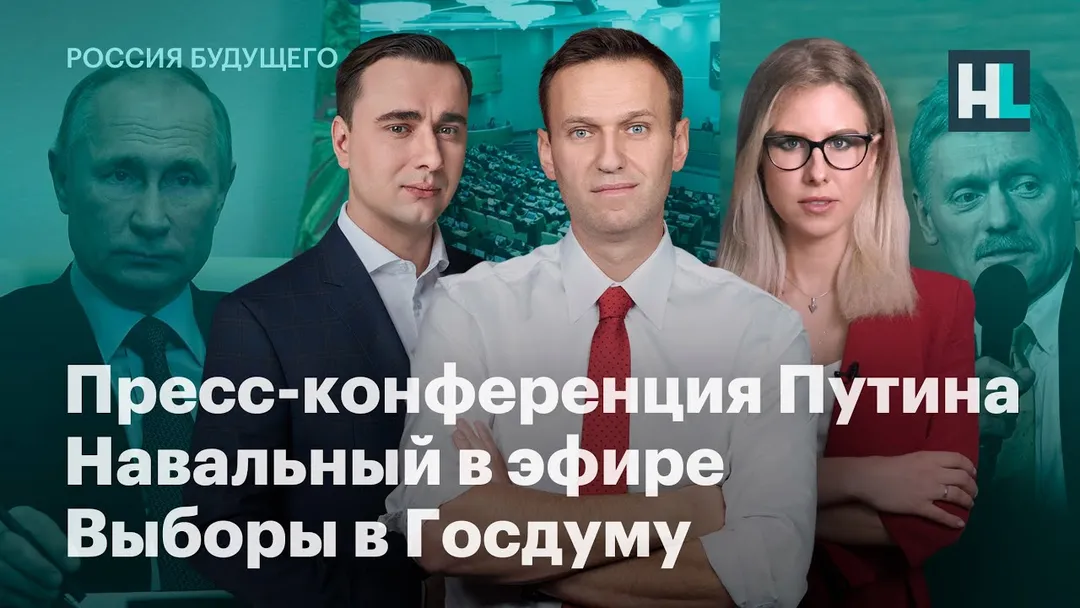
Putin’s press conference, Navalny on air, State Duma elections
[music]
Good evening, everyone, hello, this is
the Navalny Live channel, and we're live on Thursday
20:00. That means we're discussing the main
political and social news
of the past week, and with you are Lyubov Sobol
and Ivan Zhdanov. But of course today
we'll also discuss Vladimir
Putin's press conference and the major investigation
by Navalny that came out this week,
which has already been watched by more than 13 million
people. In just a few
minutes, joining us live will be
Alexei Navalny, who will discuss with us both
the investigation and the press conference
of Vladimir Putin.
While we're waiting for him to join, I'd like
to remind viewers of our today's
broadcast.
Of course, don't forget to subscribe to our
YouTube channel, Navalny Live, and become
sponsors of our YouTube channel, because
we live, work, and produce videos and
we put out livestreams only
thanks to your support. You can also
as always, send stickers with
your own unique content, with your
text appearing on the screen during our live
broadcast. To do that, go to
the description under today's stream and
look there — there's a link for sponsorship
and also a link to launch, I don't know, on air
a Medvedev sneaker or duck, or
a Khabarovsk flag — you can do all that
by sending a small donation and
writing your own original text there.
Yes, but actually today we're going to
be asking you repeatedly,
to chip in, because there's another reason
why we need donations. The thing is that
yesterday, in the Moscow City Court,
a ruling came into force — the decision of the
court of first instance on a lawsuit by the Ministry
of Internal Affairs, and you surely all
remember that large number of lawsuits against
all the candidates who in 2019
came out demanding that candidates be
registered for the Moscow City Duma
elections. Those were major protests
that culminated on July 27 in a
large rally in 2019, after which
many people suffered — to this day, there are still eight
people who are in penal colonies and
prisons, many received sentences,
administrative arrests, and the candidates
received fairly large fines,
which
well, we simply cannot pay on our own.
And yesterday, a lawsuit for
3.5 million rubles (about $47,000 at the time) came into force.
This is a lawsuit claiming that we distracted
Ministry of Internal Affairs officers
and OMON riot police, that they supposedly spent their
extra time — even though this is exactly the
work we already pay them for through taxes — for
the fact that they allegedly used more
fuel and lubricants, for the fact that
the lawn was trampled there, and many, many other
absurd things they wrote in
completely out of thin air. My lawyer,
Alexander Pomazuyev, a lawyer for the Anti-Corruption Foundation,
is still amazed
at how it was even possible to present to the court
evidence in which
the figures had been blacked out by them, and in the proceedings
they didn't even allow the main
injured party there — the directorate of the
Ministry of Internal Affairs.
We were sued by the federal Ministry
of Internal Affairs, while they were dealing with the directorate, and so
for this insane lawsuit, we now need
to pay 3 million rubles. Fortunately,
a good person was found who
opened a Sberbank card in their own name;
the number can be seen
on the screen, and we are announcing a major fundraiser.
Previously, Vladimir Milov
raised money for these fines;
now we are announcing a fundraiser
using this image that you
see on the screen. The money from the account will
later be transferred to pay off
these lawsuits. It's a long story, and only together can we
solve this problem.
And these 3 million are not the end of it,
this is not the final amount — there are fairly
large sums still ahead. We will write a lot
about this, but in this
specific case, we need your support. And
most importantly, it must be said that these lawsuits,
which were brought against us as candidates,
as independent candidates in the
Moscow City Duma elections, are absolutely political,
and really, it's not just
Alexander Pomazuyev — any lawyer would simply
grab their head after looking at the so-called
evidence they dragged in
from all sides. It's obvious that the court
was just rubber-stamping
the documents without even looking, because it's clear that this
was all initiated by
the Presidential Administration and by
Moscow City Hall, which did everything
possible first to
provoke these rallies themselves by not
allowing independent candidates onto the ballot,
and then to take revenge on Muscovites for the fact that
they demanded that their independent
representatives be allowed into the elections — they were only
demanding that simply candidates
who were popular could appear on the ballot, which
would be unthinkable to deny in any normal
civilized country. But in Russia, such
lawsuits are possible, and courts grant them.
So now we are asking for your help so that
you can help us. I think by now I probably
also have my bank card
somewhere on the screen too, especially in stories, so that...
My account is still at minus 34
million rubles there, yes, and entered into
the negative balance there, so the account, therefore to the woman according to
my case, 5 million to another one there, lawsuits, yes
In fact, I am involved in these lawsuits
They were filed against Yashin and against Udaltsov
against Navalny, against Stepanov
Oleg Stepanov, who heads
the Moscow staff headquarters
So there are many defendants involved there
because of people who were actively involved
Often this is an important part of the story: that we
I am absolutely sure that in the European
court we will manage to get this money back
Then, after some time, and I don't know, we
when we receive this money, we will donate it to
some good foundation when we win
in the European court, because that will be
very, very far off—maybe in five years
or even more than that, yes. All right, and now
of course, we will comment on
Putin's press conference, probably in a bit
more detail. Let's bring in Navalny
to join us live, and I
personally have the impression
one main feeling that I
was left with after the press conference
of Putin is the feeling that Putin is completely
detached from reality, living in some
other dimension, probably. He does not understand
what is actually happening in
Russia, does not understand the lives of ordinary
Russians, as they say, and he exists in
his own little world where there are conspiracies
against Russia that must be countered
all the time, where the West is constantly to blame
and where it is necessary
somehow to consult with the leadership
and run the security services, because
Russia is supposedly in this kind of ring of fire and
surrounded by hostile Western
countries
and he thinks only about that, that is
why probably any other
comments we will leave for later, and now
we should play Putin's main answer
the one all the journalists were waiting for
his answer to the question about the poisoning
of Navalny and the investigation published this
week. Let's watch it, and at
this moment Navalny is joining us live
As for the patient in the Berlin
clinic
well, I have already spoken about this
more than once; I can only repeat
a few things. But I know Peskov brought me
what they, yesterday—only yesterday—told me
about the latest speculations on this matter
regarding the data from our security services
and so on. Listen, we understand perfectly well
what this is. First of all, in
this case it is legalization, not
some kind of investigation—it is the legalization
of materials from the American intelligence services, about which
we do not know whether they are using geolocation or wiretaps
or bugs. Our security services understand this well
and know it, they know
that officers of the FSB (Russia's Federal Security Service) and other special
agencies use telephones there for
what they consider necessary and do not hide
their whereabouts there
If this is connected to him, then that means
that this patient of the Berlin
clinic is enjoying
the support of intelligence services in this
case. And if—if that is true—well
then that is interesting; then the security services
of course should keep an eye on him, but
that does not at all mean that he needed to be poisoned
Who would need that? And probably, yes
To finish this point: his wife appealed to me
and I immediately gave the order to let him go for
treatment in Germany
Now, at the same time, there is one
thing that the general public does not
pay much attention to, but it matters
namely, this trick consists in
attacking the top leadership and thereby
for those who do it, in that way
raising themselves to a certain
level—look, pay attention, my
counterpart is this person, and so I am a person
of the same caliber; treat me as
someone of nationwide
importance. This is a well-known
trick used around the world
in political struggle
But in my view, these are not the tricks one should use
in order to achieve
respect and recognition from
people. One must prove one's worth
either through concrete actions
or through a concrete program that can
be realistic
so that it can be implemented in
a specific country—in this case, ours
So I call on all our opponents
of the current government, indeed all political
forces in the country, to be guided precisely by
not their own ambitions or personal interests
but the interests of the citizens of the Russian Federation
and to propose a positive agenda in order
to address the issues facing
the country, of which we have many
Alexei has now joined us on air
Welcome, Alexei. I wanted to ask
first: how are you feeling and
how is your health? And the second question
of course: did you watch today's
press conference by Vladimir Putin
Hi, Lyubov, hi, Ivan, hello to everyone
on YouTube and to the viewers. I'm very glad to be
back on the air. Everything with me is
much better health-wise, and right now
I'm sitting here worrying that I don't have
a positive program, as President
Putin says—I really took that to heart
Unfortunately, I didn't watch
I usually always watch the press conference.
A lot of people write, saying they're sick of watching it all.
But I still try to watch it all,
because, of course, it's important
to realize that at literally every
press conference you can see how everything
keeps getting worse and worse with Putin, and how
the entire government is, of course, sinking deeper into absurdity.
And unfortunately, the country's entire leadership
is undergoing the kind of degradation we've been witnessing
twice a year, and today was, of course,
a perfect example of that.
But I couldn't watch it because, at the request
of Russia's Prosecutor General's Office,
I was questioned by the German prosecutor's office. And not only me—
Yulia was questioned as well. In that sense,
I later, of course, watched those
clips that were published today
on the live stream.
And, you know, it was funny to hear
Putin saying that Germany doesn't
want to cooperate with us, when I had just
walked out of the German prosecutor's office,
which had been questioning me
at the request of the Russian prosecutor's office. Alexei,
could you tell us a bit more about
the questioning—what they asked, or are you not allowed
to disclose that information? Is it a big secret?
Well, of course—I'll tell it
in strict confidence to all viewers of the Navalny
Live channel.
It was a fairly standard interview.
It was conducted במסגרת a program of
international cooperation—I don't know
exactly how to phrase it or what it's officially called,
but basically Russia's Prosecutor General's Office
writes a letter to the German prosecutor's office:
you have this patient over there,
as Putin said today, and we believe that
he needs to be questioned.
It looks rather strange, because
you can question a person only within the framework
of a criminal case. No criminal case
exists, so the Germans spent a long time
not really understanding what was going on.
Because,
what kind of questioning is this, if you're questioning someone
and there is no criminal case? Well, all right.
They didn't say, "Do you want to?"
They said, "We have to question you," and
there was simply a questionnaire
sent directly from Russia, so
they went through that questionnaire. In that sense,
I was effectively being questioned
by the Russian prosecutor's office, with standard
questions like: what's your full name, where do you live,
what did you eat in Tomsk, where did you go, who
decided when you would travel,
and, interestingly enough, whether you suffer
from diabetes—questions like that.
Whether you had taken any
medications during your
trip. In fact, I think tomorrow
I'll just publish the whole thing—
the full questions and answers. They asked
questions, but what interested them most
was the FBK staff and how the bottle
made its way to Germany. Did they ask Yulia
about that? No, nothing at all about the bottle.
Asking me questions about
the bottle is pointless, because I was unconscious
that whole time.
If you can call it sleep, when you're having
such exciting adventures in Omsk.
So there was no point asking me. But as far as
I remember, Yulia told me they asked her
as well. They were questioned separately; I wasn't
present during her questioning, and she wasn't at mine.
They didn't ask her anything like that either.
Was questioning in Germany in any way different
from questioning in Russia? You know, in Russia—well, if
you were, for example, to film how
we walked into the building and went through it,
you would never in your life think this was
Germany, because it took place in
a building that used to be a well-known prison.
It's a former prison called Moabit (a historic prison in Berlin), and it's this kind of
courthouse-prison complex that looks like something straight out of
Butyrka or Matrosskaya Tishina (well-known Moscow detention centers).
Huge walls, confusing corridors—it's a former
prison, and it was specifically designed
to make escaping difficult. If
you ran out into a corridor,
you'd definitely get lost. And the walls are shabby—so
it absolutely looks like
a pretrial detention center or some large
government building, not even in Moscow
but somewhere out in the regions.
But the difference, of course, is that everyone
is just very friendly. Back home, usually all
prosecutors and investigators
try to put on an intimidating air,
a kind of sternness. Here, everything was—well, not
casual or affectionate or anything—but
very formal, yet very polite and welcoming.
It was like, "Please sit down, we're going to question you now.
Do you understand what this is for?" "I do." "Do you
have a lawyer?" "I do." "And here is your
interpreter." So everything was simply
done without any of the extra theatrics
that they love in our prosecutor's offices
to stage. Still,
it was a formal procedure, so it took a long time
with the interpreter and all the formalities
and paperwork. So, basically, I
missed all the fun of Putin's
press conference. Alexei, was that their main
point, really—that without your testimony there are no grounds
to open
a criminal case?
That has come up in court and
with investigators. What do you think—
might they open
a criminal case now, or even after
this questioning in Germany, even after
the press conference? Or will there still be no criminal
case? Well, first of all, of course not.
They were lying.
And as a lawyer, you understand perfectly well that they do.
As a lawyer, I understand that all of this around it is unnecessary somehow.
Well, all right, but what if I had died in
the plane? Then what—without my testimony, they wouldn't have
opened a criminal case, and then how would you
say the situation is any different if they
say there was no poisoning, no—rather, there was
a metabolic disorder, meaning I fell
into a coma because of a metabolic disorder, or
died because of a metabolic disorder? In either
case, according to them, that wouldn't require any
criminal case, apparently, in their logic.
But it seems to me that all the facts, you know,
point to poisoning, especially now
after the Bellingcat investigation, in which
we also took part.
But especially now, of course, they cannot
open a criminal case, Nikolai,
because it would become a criminal case against
Putin, and certainly against FSB officers (Russia's Federal Security Service), and
after what was confirmed today, of course,
everything has been confirmed, and I am absolutely
delighted, of course, by Putin's answers,
which simply—well, simply confirmed everything.
Everything was confirmed. So let's move on
to Russia, actually.
About the strategy they will pursue.
In more detail, because just now you answered
their questions, essentially—the ones that had been
sent to the German prosecutor's office, right? So what next?
What strategy will the Kremlin adopt?
Will they try to bury it, as they did
this week? Will they mock it, will they
ignore it, will they say
that there isn't enough data?
Well, look, broadly speaking, their strategy
used to consist simply of
lying all the time and constantly adding
something like: the Germans—we'd be glad to wrap up
the investigation, but no, they aren't giving us anything.
Actually, the Germans poisoned him; it's all the Germans' fault.
And meanwhile, those poor, miserable Germans
no longer know what to do to comply with
yet another request. And this questioning
that took place today was fairly
formal—there were about ten questions, and
all of them were kind of, you know, like
without any particular trick to them.
So yes, it was a very formal
interview, and it was clearly needed simply
so they could endlessly keep saying that, well,
there is insufficient—insufficient
evidence to open a case, although in fact
there is enough evidence to open a case.
There is enough. It's just that now we've seen
a fundamental shift in strategy. Before,
they said that nothing at all had happened,
or that something had happened, but then it turned into
throwing out a million different versions.
Now, after the Bellingcat investigation,
the situation has, of course, changed completely,
because some facts are impossible
to deny, and I am very glad that the evidentiary
base—which we also worked on for a very long time,
and in which we took part for
more than a month as well—is so
rock-solid that even Putin, who is of course
the king of lies,
and for whom lying about anything is no
problem at all—even he, in this situation, cannot
deny that there were FSB officers
who were following me around. It's just that now
their lie that they were either
keeping an eye on me—as Peskov later said—or
that they were perhaps not even following me, but rather
traveling in order to somehow save me, or something else—
for some reason, though, they of course do not
discuss the idea of self-poisoning.
I think their strategy going forward
will simply be to repeat like a parrot
what Putin repeated
twice.
They'll say to Reuters: why did you
poison Navalny?
It's no accident that even here, in response to Reuters,
there was this long answer to a question
from a LifeNews journalist, which consisted
of two questions about Putin's son-in-law,
his daughters, and business dealings—and then he started
talking about the CIA. They ask him:
Man, explain how your son-in-law became
a billionaire. And he says: well, we know this
information was prepared by the CIA.
Explain how, for $100,
someone could get shares worth several hundred
million dollars. Yes, of course—the CIA and our
Western partners are trying to deal with us
in this strange way. And then
we saw exactly the same thing—yes, he
was answering questions about me, and at the same time
of course it was just some kind of
strange and ridiculous breakdown in logic: we
know that the CIA
tracks the location of the phones
of FSB officers, therefore they were following
Navalny.
What exactly that is supposed to mean is unclear. But here
it is
just any random set of words. But the main thing
here is really the idea of saying that
some CIA force is behind it, because in
Putin's view, people in Russia are not
so foolish that if you just
say those magical three letters again—
CIA—
they immediately stop thinking about everything else, they
stop thinking about the essence of the problem and
start thinking that, well, this must all be
the CIA.
But that wasn't really it, was it? No, it's just that we
know that they—that the CIA is monitoring
our FSB officers' phones,
and they even switch them on deliberately
—the phones.
So there was this hint that
the phone—and that supposedly it was no accident that they
turned it on then, as if they had somehow given themselves away.
It's unclear why. Listen, tell me please.
But really, if I were in the shoes of these
FSB poisoners and killers, of course their
fate wouldn’t concern me all that much, but
still, you can’t help wondering whether they
should fear for their lives at all, or whether
the system is set up in such a way that they’ll now be
protected, hidden away, and they’ll end up like
Lugovoi, as State Duma deputies.
It’s hard to say, really.
Here, of course, I’m thinking that someone like
Nikita Alexandrov—this wonderful
mustached man—could quite easily
suddenly die somewhere of type 2 diabetes,
like some of the others. But judging by
what we’re seeing, this is of course an absolute
failure from the standpoint of the system’s logic, and
they ought to eliminate operatives of this lower
level at the hands of operatives from a higher
level, just to make something like this go away. But
this isn’t just an FSB failure, of course—it’s
Putin’s failure. First of all, he quite clearly, 100
percent, gave the direct order, and
judging by everything, he was somehow involved—maybe
in the operation itself, or at least it was reported to him.
He knew about the operation, he knew its details, so
this is also his personal failure,
and that’s why the whole system, and Putin himself,
are protecting themselves. And of course I don’t think
they’re going to turn these people into some kind of
State Duma deputies. They didn’t make Mishkin one,
after all, or any of the others.
They’re still hiding them somewhere. They were brought out once
by Margarita Simonyan,
which was also personally Putin’s idea, and we remember
what a colossal failure that was. But
basically, they’ll just keep hiding them somewhere,
because, I mean, can you imagine this
little guy—someone you wouldn’t dream of seeing
anywhere public—well, where could they even put him?
Sure, they could stick him in the State Duma later, but that
would be even more confirmation of what
happened. If they promoted him
like they promoted the chief doctor of the children’s hospital—
they essentially promoted him, yes, they thanked him
in that way—so here too, it seems to me,
I wouldn’t be surprised at all.
I’d like to say that I think
they really do now have this kind of
strategy: they’re feeling things out,
sort of half-confirming the surveillance,
but at the same time, go ahead and explain
this point: if it was surveillance,
why were there chemists and doctors involved? And to that question,
as I understand it, Peskov has no
answer.
Well, yes, they really did
promote that chief doctor,
but still, the chief doctor held a
public position. From the very beginning he was
in the public eye, he lied a great deal, and
it was obvious to everyone—to all the doctors, both in
Omsk and outside Omsk—that he was lying,
and so it was important for them to
support him publicly in that way.
But these people are of a different order altogether.
They’re secret operatives of a sort, and
who knows who else they may have killed, really.
Just putting them on television,
you know, is rather dangerous,
because they weren’t only following me, and
who knows what other
crimes they’re implicated in. So I
think that even from the standpoint that
more details could still come out,
I doubt they’ll be made very public.
But one thing I would say is that
the Kremlin is only just trying to formulate
its strategy. They said something
because they were forced to say something
right there at the press conference, but
of course it looks very weak, because
the obvious response is: all right, if you’re saying
it’s confirmed they were following him, then
why were there chemists and doctors? No answer.
And why, if they were following me, were they flying on
different planes on different days? No answer.
And most importantly: was there a poisoning or not?
Who did the poisoning? And if they traveled
in order to save me, then why did they
go to Gorno-Altaysk instead of saving me?
All these questions
that Putin thinks
nobody is asking—but after our
investigation, which by now has been watched by
more than 13 million people,
well, of course, you can’t just brush these questions aside anymore, and
people shouldn’t be treated like idiots. Even
those who may not be
big fans of mine still
understand just how untenable this version is.
It simply doesn’t hold up. Tell me,
if we approach it from the other side,
the threat to the lives of these FSB operatives
is obvious. But today I saw on
Twitter that journalists who
ask Putin questions are also at risk,
that they could be killed too. And that struck me as
somewhat absurd. Journalists
who ask these kind of
sharp questions—are they really risking their
lives by asking them? Starting from that,
after this
investigation, we really are living in a somewhat different
reality—a reality in which there are groups of
actual killers who can murder
public figures. So tell me, what
should be done in this situation? First of all,
what should activists do,
people in the regions, and third, what about ordinary
people who go to rallies?
Has reality changed for them?
Because again, this FSB attempt
to kill you—clearly this is at the FSB level,
but other, smaller predators
in every region are going to take their cue from it,
those little predators in each region
who will think: if Navalny can be targeted,
then why not go after some local activist too?
they’re organizing something in their region too
something similar. What do you think about this
situation? Well, first of all, I don’t think that the
life or health of the LifeNews journalists
is under threat after this
question. On the contrary, it’s absolutely clear
that they wrote this question for him together with Peskov
and that’s exactly why they packed all the most
problematic parts of Putin’s answer, and this
question about me, into a single
question so they could blur everything together
and spread it all around the plate, so to speak. That’s the first point. Second,
well, of course, in principle, in any
authoritarian country—and Russia is no
exception—people who do
something independently, freely, and honestly
are, to one degree or another, under
threat. But I’ll repeat: I think I’ve said this many
times, and my opinion has not
changed after there was
an attempt on my life. I
believe you can’t kill everyone, and the threat to
each individual person is fairly
small. One of Putin’s goals is to make
people start thinking in exactly
those terms: if
they wanted to kill Navalny, then they’ll
kill me too, in my Chelyabinsk or in
Kostroma or Kazan.
In other words, by means of one
demonstrative assassination attempt or
a demonstrative murder, they want to
intimidate millions. So everyone’s task
is simply not to be afraid. Well, to be a little afraid
is natural—that’s how it really works.
Just imagine: millions of dissatisfied
people, and a little bunch of these
people in the Kremlin
who seem to us to be very
powerful, but in fact they sit there and
are dying of fear that people might suddenly
realize how naked the king is, how
they themselves don’t have the slightest ability
to hold all this back. I mean, in the country
absolutely everything has failed, and they sit there
thinking, damn,
if tomorrow even
10 million people
take to the streets and say, what the hell—why are our
wages falling for the seventh year in a row?
Why the hell are we living in poverty while at the same time
we sell trillions of dollars’ worth
of oil and gas?
They’d be finished in a second. So
all their power rests simply
on the fact that they seem to us very
powerful. It’s like that puffed-up toad,
the Surinam toad, sitting in the jungle, and
when it sees someone it’s afraid of,
it puffs itself up to enormous
size. That’s all. We just don’t need
to be afraid of this toad puffing itself up.
During Putin’s press conference on the
YouTube channels of Channel One, Russia 24,
and Solovyov Live, we saw that the
live-stream chats had been disabled so that
people wouldn’t write their true
attitudes toward Vladimir Putin. As for
our chat, it is on, so send us your questions
that we can address to Navalny
or that we can answer together with you
later on air. And I can see the questions that
people were asking just now when you announced your
live broadcast with you, Alexei. One
of the questions asked was this:
Will attitudes toward Putin in Europe
and the United States change after this investigation
that came out on your channel? Well, of course
they have changed—there’s nothing even to discuss here.
Of course they’ve already changed very significantly.
The other thing is that for us, you understand, this does not
have any huge
consequences. I mean, just because it
has changed, what do we get from that? We shouldn’t
expect Europe and the U.S., or anyone else,
to solve our problem for us, because
before, it seemed to them that Putin was
a suspicious thief who was constantly
lying. That was the attitude: well, in Russia
for some reason this suspicious thief who lies all the time is sitting there as president.
A suspicious thief who is constantly
lying, whose daughters buy homes here
in France, and
who has huge accounts in places like Switzerland. Well,
apparently the Russians keep him there for some reason.
All right then, that’s a question for
the Russians. Now they understand that he’s not just
a suspicious thief who
lies all the time, but also the kind of thief who
in order to make it easier for himself to steal
has also assembled a team of killers
who use chemical weapons.
So of course attitudes toward him are very
negative, and everyone understands that he is an extremely
dangerous, deranged man obsessed with
money and, again, constantly
lying. But their reasoning is something like this:
well, the Russians are still keeping him
as their president anyway.
So, damn, of course we don’t
like it, it’s unpleasant for us to sit
at the same table with him, but he’s a murderer, and again he
lies in every word he says—he just lies,
which is also very unpleasant—but still,
somehow he still retains his
position, so one way or another we’ll
still have to talk to him. We shouldn’t
expect that tomorrow the president or
prime minister of some European country
will jump up from the negotiating table
and grab Putin by the throat.
That’s not going to happen, of course. I mean,
yes, people have started treating him much worse;
they simply consider him a rather
utterly rotten person, but
diplomacy is diplomacy, and they will still sit there
all the same. Another question that
was also being discussed: the BBC wrote that
Zakhar
responded to Russia's proposal to send
a mission to Russia, and the response says that
for this, your consent is required
in advance for access to medical records and
medical samples. Was this discussed with
you, and will you give consent for
the OPCW to gain access to the samples
that are in Omsk? Honestly, I really don't
to be honest, even really understand
the idea of the OPCW obtaining consent
so that they can get access to
the samples in Omsk.
They are asking for your consent to access your
samples that are located in
St. Petersburg and Omsk, and they simply want
to discuss the whole situation in Moscow, but it is necessary
to listen, and first of all, this is also some kind of
very strange diplomatic game. Russia
is a full member of the OPCW
(Organisation for the Prohibition of Chemical
Weapons). Moreover, Russia was one of the
founders of it, such a leading
country. For many years, Russia pushed for the
destruction of chemical weapons.
That sounds very ironic now, of course, so
Russia, as an OPCW member, already has full
access to everything. And my blood has already—
I don't know, it's been splashed around so many times—
in Omsk, in St. Petersburg, its drops ended up
there.
They tested this blood here many times, but there is no
problem. Honestly, I simply have not
received any formal request from anyone,
so I don't really understand very well even what
is being discussed. But of course, if they want
to obtain my blood samples from
Omsk,
let them take them. But there was a funny
situation when they were transporting me here to
Germany. Even the doctors there who
were drawing up the transfer paperwork for the body, they
very amusingly wrote in that document that
the blood biochemistry tests and so on were
in parentheses, 'if they are, of course, attached to the patient,'
or something like that. So I don't know whose
blood
they will show the OPCW. But if they ask me,
I will give any consent—they can have it.
I have nothing to hide, I think. And there, Ivan
Ivanovich, Alexei, why are they afraid to say
your surname and instead call you 'the individual'
'the patient'? Is this some kind of madness?
asks Ivan Ivanov. Well, of course it is.
It's madness.
It's this bizarre Putin superstition, but
really, people already laugh about it at every
press conference: what kind of
nonsense is this, inventing substitute words for him.
This is, of course, something deeply
psychological, almost primitive, but I
have put forward my own version of this many
times: wild ancient people, shaggy and
unwashed, sat around a fire and were afraid
to say the real name of a bear or
a wolf or a saber-toothed tiger, because at night
it would come and eat them.
Putin is the same kind of person. We know that he
is obsessed with all sorts of
mysticism,
esotericism, and the red string on his wrist
—in the evenings he beats a tambourine, he has
astrologers, he weighs some kind of
ribbons, tells fortunes with tarot cards, and
hangs a piece of candy over the bed at night
so that little gnomes will come and eat it.
So apparently some such gnome
came to him one day and said: if you
say the word 'Navalny,' then all these schemes...
And Putin is obeying the gnome's order.
I also have this question, which I
saw: did you yourself actually expect that
within such a short time
we would learn the names of all the killers, the poisoners, and
the entire chain, because it seemed
like maybe someday, in
five or ten years, we might learn something.
The same, the same. But you and I
did discuss this, that we were conducting this
investigation from a somewhat different angle,
gradually. But of course, such a
complete exposure, that we would directly learn
people's names—I did not expect that, first of all
because I did not believe the FSB could act
so stupidly. I never had
any illusions about this
structure, but I believed that what had completely
degenerated were the local
committees, the police, the courts. I see these judges
who, my God, are the stupidest people on
earth—they are incapable of
formulating a sentence. I see how far
the police there have sunk, along with the whole
rest of the state system.
So of course I had no
illusions about the FSB either. Those who do not want
to take bribes just drink themselves senseless,
and everyone else is busy with some kind of
nonsense. These are not some
super-professionals. But to fail so badly
to observe the most basic rules
of operational work—I honestly could not
imagine that it would happen
like this. And honestly, of course I also could not
imagine that for four years they had been
following me—almost four years. That is,
four years ago he told them,
'Start preparing the murder.' If anyone had
suggested that to me, I would have
twirled my finger at my temple.
Alexei, please tell me—another question:
what do you actually expect
after your return? They are opening
criminal cases—will they continue
trying to kill you?
I don't know. I don't know what they will
do at all, because they do not act by any rules, and
I cannot predict it. I am counting on...
Still, Ivan, that they somehow won't...
...try especially hard to kill Bellingcat.
I'm counting on that, but...
It's hard to say—I don't even want to...
...make predictions. One thing is clear:
they're offended, they're squealing like piglets, and...
Putin personally feels another...
...additional personal grievance, because...
he had been puffing up his beloved FSB (Russia's Federal Security Service) for so long, and...
there he was, planning the operation, giving orders...
and it turned out that these idiots, damn it...
you know, just switched on their phones...
their personal phones while carrying out a murder, and...
but of course this is simply a total failure. It...
shows just how much the system...
has degraded, and Putin's favorite FSB...
has degraded perhaps even...
more severely, because it's secretive, and...
the degradation of the Ministry of Education or...
the healthcare system—we see that every...
day. We just don't see the degradation of the FSB...
because we can't see what's going on inside it.
And it also became clear that Putin cannot...
do absolutely anything—he's simply not...
capable of accomplishing anything in any...
direction. Russia hasn't moved forward anywhere; we...
have failures everywhere, including here.
So of course he feels terribly...
wounded and is probably coming up with some...
terrible revenge. But let him come up with it—I haven't...
changed my views regarding...
what is happening. More than that, I am now...
much more confident in them, I think, just like...
many others. And so I intend to return in order...
to continue doing what I was doing:
working with you, going to the office, and...
carrying on, and in particular trying...
to make sure that there are as few...
United Russia deputies as possible in the State Duma, promoting...
Smart Voting. So the only...
thing I really expect is that...
the two of you will be there waiting for me at the airport.
We'll definitely meet. Alexei, thank...
you very much. In fact, the chat...
really is worried.
The people watching our live stream...
are worried. Alexei, let me ask you:
didn't it seem to you that in Putin's answer...
there was a threat directed at you—that...
Putin hinted that you could face charges of...
espionage or something of that sort?
People are asking about this because everyone...
assumes there will be criminal...
cases, some new lawsuits...
of a civil nature, and everyone will...
try to make sure you cannot...
take part in and influence the elections to the...
State Duma. There are also many questions about that.
So I'll summarize all these...
questions gathered from Twitter and social...
media and ask more broadly: what is our strategy...
for the Duma? Smart Voting is clear enough...
but whatever strategy the authorities choose, and...
right now, through Vyatkin of United Russia...
they are passing a great many restrictive...
laws—for example, saying that if people line up...
for a one-person picket...
that counts as a rally, and criminal cases for...
blocking streets, blocking people, and so...
on. So whatever the authorities' strategy...
may be, as for our strategy, people...
are asking me to clarify it with you so that you...
state it publicly regarding the party...
side of Smart Voting—what exactly...
will Smart Voting's...
recommendation be for party lists?
Because it's clear that if you're trying to...
understand the Duma, half of it is made up through...
that's the problem.
candidates from single-member districts—there...
will be a recommendation for each...
single-member district. As for...
the party vote, which party will Smart Voting...
urge people to support?
Look, it's all very simple. Our task...
is to make sure there are as few vile deputies like...
Vyatkin there as possible, and as many deputies like...
you, like Sobol, and...
like Zhdanov, or people like...
those in Tomsk, or like Reznik in...
St. Petersburg, or Baikov in Novosibirsk...
so that there are many more of them. Therefore, Smart...
Voting means that we...
all vote for some decent...
candidate in order to defeat...
the United Russia candidate. Where there is no decent candidate...
—and that is absolutely possible—we will...
vote for a not-so-great...
or even unpleasant candidate, but the main thing is...
to defeat the United Russia candidate. As for the party vote...
here too, what matters most is that United...
Russia gets as small a percentage as possible.
So whichever party you...
like best, vote for that one. That's all.
But we should remember that it is entirely...
possible that the Kremlin will use a new...
strategy that has been widely discussed:
they will create lots and lots of small...
parties so that they each get 3 or 4...
percent, and as a result...
thanks to a complicated mathematical formula...
United Russia will still end up with more...
votes. And in that case, if we see...
such a strategy, we will slightly...
modify our approach and will...
of course recommend voting for those...
parties that have a chance of clearing the...
threshold. But for now it's a little too early to talk about that.
For now, we need to focus on...
single-member races—there are 225...
election campaigns across the country.
So anyone who wants to take part now...
I urge everyone to sign up as...
volunteers—for people like Zhdanov, for everyone...
else around the country, for normal...
people who want to run for office, because...
everyone will need signatures,
and everyone will need door-to-door canvassing.
Everyone will need money, and this is the most
important work one can do.
Alexei, please tell me: Putin
said today that he still doesn't know
whether he will run in 2024.
You know, come on, enough listening to
Putin—but we all understand that this is
really one huge marathon. Of course,
he will run—in fact, he won't be going anywhere. Putin
understands that for him it is mortally dangerous
to stop being president, especially
after everything he has done. Just
imagine it: he picks some kind of
successor—say, Shoigu—and tomorrow Shoigu
gets elected even faster than Putin, and even
if Shoigu and Putin both ran in an election,
of course they would choose Shoigu, not Putin. And
Sobyanin, who has tons of money and huge
media resources—fine, so they
elect him, re-elect him, and then send
the former president Putin into retirement,
to his dacha in Gelendzhik (a Black Sea resort city), and
let him mind his own business. But still,
in a year or two a situation will arise
in which the new president—
whether Shoigu or Sobyanin—will need more
money, or his friends will want more
money, and to get it they will have to squeeze
the Rotenbergs (wealthy businessmen close to the Kremlin). And to squeeze the Rotenbergs,
they'll have to squeeze Putin too, and
suddenly—whoops—the new prosecutor general
says, taking into account
that Navalny was apparently poisoned, why don't we
actually investigate all of this, and
one, two, three, four—and Putin is already sitting in the
defendant's dock. Of course he is terribly
afraid of that, absolutely terrified. That's why I
suggest we not even discuss this whole
"will he run or won't he" question. Of course he will run.
People who say, "How could he not run?"—
it seems to me they're simply out of touch
with reality.
Understood. Alexei, thank you very much. I
actually think it's quite obvious.
There is no doubt. It seems to me we simply
need to get it out of our heads that Putin
will ever leave on his own. The point is
that we shouldn't wait for 2024. I
am not prepared to put up with Putin even until
then, so let's get to work
right now. We have elections to the
State Duma ahead of us, and the Smart Voting strategy
can cut off this
tentacle in the form of United Russia from Putin and
make it so that the State Duma
works in our interests and at the very least
can initiate a parliamentary
investigation into the poisoning of Putin's main
opponent. Because what outrages me right now
is that those State Duma deputies
are staying silent while the whole country is discussing it.
Thirteen million views in less than
a week—and all the deputies
in the State Duma are silent, afraid
to initiate—not even impeachment,
let alone that—but even a simple parliamentary
investigation, to ask questions about
these poisonings, which really are
on everyone's lips and are literally being discussed
by the entire country right now. So let's work
and not give them a pass.
Don't cut me off for saying this, I just think it's
an important thing to say right now.
But at the same time I want to point out: look
how great this is, on the one hand.
Indeed, all these cowardly State Duma deputies
—
are afraid, and there are even some there who
want to support me and wrote to me in
support—but are afraid to say so publicly. But
look: regional deputies in Tomsk—seven
people—
came out against it...
Let me tell you, not
just about Tomsk: this is the same
story—this is Smart Voting, yes, but also
there are simply decent people. We understand that
there are absolutely amazing, brave people
who are demanding this investigation, and
these people genuinely need our support.
So of course you are absolutely right: in other words,
there is no need to wait for 2024. Right
now we can dramatically change the whole
situation. There in Tomsk, they turned the city upside down—
they really did. Who could have imagined
that?
In the previous Tomsk city duma (city council), seven
people out of a small group of 25 people—
or 30 people in the duma overall—of those, seven
people would sign such a letter? It seemed impossible
to imagine, and yet
it is happening, and that is very cool. And
we did this together, and we will do much
more. Yes, you were just being asked questions here,
and now there are no more questions here.
We just wanted to go on air and talk further
about the Moscow City Duma
and the deputies of the St. Petersburg Legislative Assembly, and
about Tomsk, where there are representatives who
were supported by Smart Voting and are now
speaking out and serving as
political representatives of their
voters, which is really very cool, and
it happened thanks to the support of Smart
Voting. So thank you very much.
Alexei, we are waiting for you—well, that's all I have.
Go ahead and cut me off too; somehow I still think
we still have more we can say.
I'm going—just kidding, just kidding. The first time, that is already
a big achievement, because the first time
I went on air, Lyubov drove me off
after 11 minutes.
She cut me off. Well, that's normal, I
like it.
That's how it all happens, really. Jokes aside,
I wanted to say one important thing: I am
very grateful to everyone who is helping
spread this video, and of course
We must not stop; we need to keep this going.
We need to keep doing it, because, basically, we can see
the reaction of the people who are watching this.
These facts speak for themselves quite clearly as well.
They simply cannot be denied.
Look at how big a breach we've already made, from
the point where they were denying
absolutely everything, to now, when they say: yes,
this did happen, but there is still,
basically, just one single
unconfirmed point they keep making:
that there was no motive for us — who is he,
that he needed
to be killed, and there is no proof of that.
Well, that proof may yet
turn up, and I am very grateful to everyone.
Right now, it is super important that
as many citizens of the country as possible
see this investigation. So
thank you all very much, and keep it up.
Thank you, Alexei. So, actually,
we are in a slightly strange situation.
Alexei and I have discussed these issues
quite a lot, and we need
to recall the questions we have discussed many
times. So, chat, thank you
very much for helping us with questions
that can be asked of Alexei Navalny.
I was looking through the questions — they are really
good. Alexei, here is a question:
Has he really gone insane?
You mentioned this already — could you talk about it
in more detail?
But in fact, everything is really
clear: we know what needs to be done. We need
to continue fighting for our rights,
because this is our country, and we want
to live in it safely. We want
to live in a country where
law enforcement and the courts actually work,
where the president is not a senile, bunker-dwelling
old man everyone is already laughing at,
because after what he said today — once again —
at the press conference, there were again so many
jokes about it on social media that
sometimes it is simply impossible to take his words
seriously. And for this country, for
this beautiful Russia of the future, we will
keep fighting — in the elections
to the State Duma and beyond.
So thank you very much to everyone who
supports us. And I also wanted to say
a bit more about the deputies backed by Smart Voting
who were supported through that voting
and who are now working. It seems that
the deputies there, in their elected positions,
really did come forward with
a demand — they submitted an appeal to the
head of the Investigative Committee
Alexander Bastrykin, demanding that
a criminal case be opened over the poisoning of
Alexei Navalny. This document was signed by
deputies of the Tomsk City Duma,
and it said the following: "We, as
deputies of the Tomsk City Duma,
are concerned that in our city,
chemical weapons were used against a citizen of Russia,
and that this was done
with the direct participation of
the state." This is a very brave, very
important statement. Many thanks to everyone
who took part. And it really seems that
people there did send this appeal. But
still, you may ask: what is the point?
With Bastrykin, it is obvious what the answer will be.
And here, someone very rightly wrote
recently, in fact, on the Navalny LIVE channel,
that we must not cultivate this learned
helplessness in ourselves. We must not
sit idly by. We need
to act. If you are
a journalist, ask questions. If you are
a deputy, submit an official appeal.
If you are a citizen, support
the candidates backed by Smart Voting, go out to
the streets, go to rallies,
and so on. Every person's
contribution is literally important.
Share this investigation,
tell your friends about it,
your colleagues and relatives. So simply
let's keep fighting. Less
apathy, less New Year fuss — come on,
let's be more upbeat. In fact,
everything is fine, and we will definitely
crush them in the 2021 elections to the
State Duma, and we will keep beating them
with our investigations, our projects,
our political actions,
our rallies, and everything, everything, everything that we
have done before and will keep doing with
even greater force. It is truly remarkable
that, in fact — look — in
Tomsk, this appeal to the
Investigative Committee was supported not only by deputies
who were directly nominated by
our штаб (campaign office), like Ksenia Fadeeva and Andrei
Fateev — wonderful people — but also by
five other deputies who had been
supported by Smart Voting. That is,
you cannot say that these were simply
"Navalny's deputies" making such an appeal;
other deputies are making such appeals too.
And today there was a strong statement —
yesterday there was a strong statement from the Yabloko faction (a liberal Russian political party),
there was a statement by Maxim Reznik in the
St. Petersburg legislature,
there was a statement by Darya Besedina in the
Moscow City Duma regarding the poisoning of
Navalny. Today Lev
Shlosberg — I saw it — asked Putin three
fairly tough questions. And there are more and more
deputies like that.
This is happening, among other things, thanks to
Smart Voting, and we urge all of you
to register for it. We have
a video of Maxim Reznik's speech in St. Petersburg —
watch it.
It's simply a pleasure to watch
deputies like this. Look, look at what's
happening right now. This is what
public opinion in our
country is discussing—it’s easy to find out.
Number one on the trending tab of
Russian YouTube for two days now
is a journalistic investigation into new facts
about the attempted murder of Alexei
Navalny.
And in response to 10 million views in
two days, the authorities—for example, federal
officials—are simply silent about the attempted
murder of Navalny, and that kind of silence,
excuse me, is worse than an admission of guilt. Or is everyone
waiting to hear what the tsar (a sarcastic reference to the supreme ruler) says tomorrow?
Gravity.
Sadists. So, dear colleagues, if
you don’t like my line of reasoning or
you disagree with what I’m saying, that is your
absolute right. You can come up to the podium,
use it, and say so.
Explain why I’m wrong. But allow
me to say what I believe needs to be said. I’ll
repeat once again: I believe that the current
government is built on lies.
Your time is up, accordingly.
[music]
I’ve watched this video over and over again.
I first saw it on social media, and it
just makes me furious when I watch
Reznik speaking and raising an important issue
that really concerns not
just St. Petersburg, but the whole country, and
as a deputy, he has the right to ask these
questions and state his position from
the podium, because voters elected him
precisely so that he
would represent their interests, voice their
opinion, and seek protection there, including
their rights. And then the speaker of the
Legislative Assembly, Makarov, sits there and whispers to him, “Sit down,”
“Sit down, take your seat.” I mean,
given their status—yes, they are both
deputies of the St. Petersburg Legislative Assembly.
St. Petersburg.
One is not the other’s boss, and this deputy,
Reznik,
has absolutely no right to silence him,
tell him to sit down, or do anything else like that.
It’s clear why they act this way: they
are very afraid of public discussion of these
issues from an official podium, and all
United Russia members are very afraid to answer
questions publicly. When it comes time for them to answer,
there’s simply—literally—nothing.
Please tell us about the appeals—they
concern the refusal to open criminal cases, because
there has also been a lot of speculation from
propagandists on this subject. But in fact,
a great deal of work is being done on this
issue—a lot of work—which may not be
something we publish about very often,
because these are complex legal documents.
But yesterday after—well, was it yesterday?
Yesterday or even the day before, on Tuesday—
Tuesday, that was the day before yesterday, thank you—we immediately
sent an appeal to the military
investigators, who specifically investigate such
crimes. The thing is that FSB officers
FSB
are military personnel, and cases against them
can only be opened by the special
Military Investigative Committee.
We also sent an appeal to
the Tomsk regional department, which has
all the case materials
from the inquiry. There is an investigator there,
Pevneva, who is supposedly deciding on her own
what procedural decision to make—
whether to open a criminal case or not. We
filed a motion with her saying: transfer the case
to military investigators, because you
are not even authorized to conduct an inquiry into
such a crime report.
We filed a complaint with the FSB against FSB officers.
As funny as that may sound and seem,
yes, it may seem fairly absurd, and
you might say, “File a complaint with the FSB against FSB officers? They
won’t investigate.” They will—but it will happen
after some time, when we, after
some time, succeed in making sure that we have
not 7 deputies, for example, in Tomsk
signing such appeals, but all
40 or 45 deputies sitting in the
Tomsk City Duma, and that we have a
majority in the State Duma. Then
we will set all these appeals in motion,
which, for now, I predict, will of course
go unanswered.
Besides that, everything can be documented
in fact, because they love to tell us
the same thing Peskov (Putin’s press secretary) says:
that all these are baseless accusations and
so on. It is very important that we record all
the evidence on paper, and we are doing all of that
diligently. And it is also important to receive these
amusing replies. I mean, we all
see it—we are reasonable people, as the
well-known lawyer and respected authority Benzinka said,
though not everyone is.
There is no reasonable doubt that this
was done by them. After watching the film,
he wrote something like this: “Beyond any
reasonable doubt, this was done by FSB
officers.”
But we will get some amusing replies,
I don’t know, something like:
“just surveillance officers,” for example.
By the way, it’s interesting—after Putin’s words, what
will they write now in their official
responses? Will they say it was operational
information, or what? What will they say at all?
Nevertheless, this work is ongoing. There have already been 333 court cases
appealing
the refusal to open a criminal case.
We’ve already had them, and I predict there will be about
3 or 4 more in the European Court of
A complaint has already been filed there as well, with the human rights body.
And all the materials have been submitted there along with the complaint.
We are constantly supplementing it with new
refusals and new materials, so this
legal work is ongoing, and sooner or
later it will become the basis for
opening a real criminal case against
the actual people who attempted to kill
Alexei Navalny.
Let me talk about
the reaction of the propagandists, because we
when Navalny released it—well, I mean, when it all came out—
we can also discuss the propagandists' reaction, and also this
related legal issue, which concerns
the correspondence with the OPCW (Organisation for the Prohibition of Chemical Weapons); I asked a question
to Navalny. It's quite an amusing exchange,
56 pages long,
which is interesting to read afterward
and to examine how, in fact, the Russian
Federation is inviting OPCW staff here
so that, together with these
staff members, they can examine Navalny's biological samples.
Not exactly—they are inviting them
first to Moscow simply to talk
and consult on the issue of
this entire situation that has developed,
and then they invite OPCW staff
with their equipment
to examine these samples together with our staff,
or they propose another option:
that staff from the Russian Federation—
it doesn't say which staff, maybe
it's the same FSB officers (Russia's security service)—would come to
the OPCW laboratories, and together with
OPCW staff, they would conduct these
tests. In fact, after reading this
correspondence, I got the complete
impression that they are still sitting there
somewhere in Gorno-Altaysk and are still stunned by
the fact
of how the Germans managed it—what kind of device do they have
that's so advanced that they were able to detect
Novichok? How did that even happen?
What kind of mass spectrometer or some other
instrument do they have? They're still
trying to figure it out.
This whole correspondence with the OPCW, their
invitation—all of it is aimed at
finding out by what method Novichok was identified,
not at somehow
establishing the truth. That is absolutely clear
from these 56 pages of correspondence,
which I recommend reading if you want
to learn more about this case. And I just want
to say to the FSB officers
that you shouldn't make poisons using textbooks from the 1980s,
and then you won't be so shocked by
how well the Germans can detect residual
traces of these substances. Let's move on to
the propagandists. In fact, the propagandists
for the most part kept silent
and waited things out until Putin's press conference.
Meduza even put together a roundup
of state media outlets that, a day later,
after the investigation was released, had not
said anything—literally had not published
any materials about
the investigation into the involvement of FSB officers
in Navalny's poisoning.
Let's put it on screen, if we have it,
this image, this screenshot—well, maybe
they'll show it later. A day after
the investigation came out: TASS—nothing,
Channel One—nothing, Rossiya—nothing, NTV—nothing.
Nothing. They all sat there with their tails tucked,
so to speak, mouths shut, waiting to see
what Putin would say, because
it was obvious there wasn't much they could
really say in response. Yes, now, as
Navalny said, they'll wriggle and evade,
but in essence everything is quite simple:
you really do watch it and you don't
have a single doubt that what you're being
told is truthful information,
that this is exactly how it happened,
as presented in the investigation. This
investigation was not done by one media outlet; it was investigated by
The Insider, Bellingcat,
the Anti-Corruption Foundation team, and
CNN participated in fact-checking, and
Der Spiegel, and so on. These are the world's largest
media outlets; they conducted this investigation and
confirmed that the conclusions of this
investigation, and what was described on Navalny's channel,
are absolutely true.
Responding to this really was very
difficult, so Putin had to
take this position, which is unfavorable for him,
and somehow comment on it today,
in effect
thereby confirming this investigation and that
it really was officers
of the FSB who for a long time
followed Navalny—for four years.
But we also have a separate video
of Solovyov from Sunday Evening, because
he did decide to comment on it
in some way, and
traditionally referred to Western
intelligence. Let's watch this video.
More on that in a moment. Usually we ask
that children, pets, and people
with weak cardiovascular systems
be kept away from YouTube screens, because
this is about to explode.
Here we have the very honest journalist
who, after looking at this so-called
investigation of the 'Berlin patient' (a reference to Navalny while he was treated in Berlin), said:
"This petty Kirov
bureaucratic thief, repeatedly convicted,
who is now serving
as Germany's opposition mascot, decided
to claim someone else's glory for himself. It's no coincidence
that many Telegram channels started calling this
'the resident agent's mistake.'
So what happened? The Americans are working,
and working well, and a New York
Times journalist writes that what was published under
disguised as a Bellingcat investigation
Navalny naturally joined in as well, and
Dobrokhotov’s organization had, several
months earlier, presented
and journalist Martens mention
the intelligence services of the United States
and Britain to their German counterparts
the fact that Navalny simply takes and
voices this operation
by foreign intelligence services reveals his
true nature. What is interesting, meanwhile,
is how this is spun: we are told that, well,
listen, here’s Bellingcat, here’s
the location of this or that point, this
is supposedly so easy to buy on the black market. But
that embezzling Kirov official
understands that this is not about some cat under Garrido
— it is against the law, but Bellingcat did it
No, of course only
intelligence services can do such things, and we know how
A.N. was successfully engaged in this.
But the Americans are not fools, and realizing that
this evidence, obtained in such a
way, cannot be presented to a court, and having no
ability to pressure the OPCW (Organisation for the Prohibition of Chemical Weapons)
which did not make a deal against its own
conscience and did not confirm all the claims
that Navalny was poisoned with Novichok, supposedly
three or four times.
In other words, just as Leonid Ilyich (Brezhnev) was decorated with stars,
Navalny is being decorated with poisonings.
Zakharov said that if you read
the actual text, there is not a word there about
Novichok; it says these inhibitors
but it says they are not included on the list
of prohibited substances.
But we watched only a fragment, and the video with
Solovyov that aired on Sunday on
Evening, you actually commented on it.
You spared our viewers, because I
thought we would show a clip of Solovyov
that was broadcast on air, but on his YouTube
it is simply even harsher there, though the same
basic point, just expressed in a completely
different form. Our viewers on the Navalny channel
actually, let’s say this:
Solovyov is trying to diminish the role
of Navalny and Navalny’s status in general,
calling him a petty corrupt
Kirov crook, although everyone understands that
he is one of the political leaders of our
country, a person who is supported by
millions of our citizens, a person
who won 27 percent in the
2013 mayoral election, after which he
was no longer allowed to run in elections and was barred
— he was illegally prevented from taking part in the
2018 presidential election.
He got 27 percent, second place, with a
huge lead. This is a person who
There was recently a Levada Center poll
just a couple of months ago, where
Russians were asked: who inspires you
most?
Among political leaders, the answer was
Navalny, in second place by a wide margin.
And in the category of citizens aged, I think,
40 to 50,
Navalny was even more inspiring than
Putin. And yet Navalny is also not
allowed on television; constantly, Solovyov
and people like him drag his name through the mud,
accuse Navalny, invent
various crimes for him, tell all sorts of
stories, and so on and so forth. The entire
state propaganda machine, the security services, the FSB (Federal Security Service),
the Investigative Committee, the prosecutor’s office — all are working
against the Anti-Corruption Foundation
of Navalny, and Navalny still
remains a politician with enormous
popularity and a very high
trust rating. So Solovyov can
try as much as he likes to diminish
Navalny’s role and significance, but of course
the numbers — including views, and also
citizens’ support in elections —
show exactly the opposite. Secondly,
of course, as for the honest
journalists from *The New York Times*, what
they wrote was not that Navalny took data from
some intelligence services and published
it disguised as something else, as Solovyov says. That is
literally a lie, because what was written there was
something different: a source said that
the data from the investigation is consistent with what
the German authorities’ intelligence services know at
this moment. That is an absolutely, completely
different meaning and entirely different facts
from what was published there and
reported. And of course the part about
the OPCW is astonishing, because Solovyov said that the
OPCW did not recognize Navalny’s poisoning
as Novichok poisoning, whereas in fact in the OPCW report
that we quoted in a previous broadcast
something completely different was written. It said
that the results of the analysis
carried out by laboratories designated by the OPCW
confirm that
the cholinesterase inhibitor biomarkers
found in blood and urine samples
from Mr. Navalny have structural
characteristics similar
to those of toxic chemicals from
Schedules 1.A.14 and 1.A.15, which
were added to the Annex on Chemicals
of the Convention. The specific
cholinesterase inhibitor detected is not
included in the list in the Annex on Chemicals
to the Convention. In other words, the substance
is not listed in the annex to the Chemical Weapons
Convention, but that does not
mean it is permitted.
No, all chemical weapons are prohibited.
Solovyov is aware of this, because if you
open the Convention and its annex, you will understand.
Yes, it is enough simply to look.
There was also an Interfax item; if we have it,
let’s put it on the screen, because
The Interfax headline agrees that
Zakharova confirmed Germany's findings on
Navalny's poisoning with Novichok. Yes,
even Interfax wrote that. It's clear
that Solovyov knows this, and Solovyov
is deliberately lying to his TV audience
in order to tell them there was no Novichok,
that no one was poisoned, everything is fine, that this is some kind of
petty thief and nobody of consequence.
For some reason, he does not ask his viewers
the question of what kind of shady people these were
who were monitoring Navalny for four years
— why they were doing it, why there was
surveillance of Navalny at all. Because
for any surveillance of a political
opponent of the sitting president, in any
decent system, the president should face
impeachment.
That is what happens in normal,
civilized countries. But for some reason, such questions
are never raised by Solovyov on air.
Well, yes, let's make sure there is
no doubt. This annex
to the Chemical Weapons Convention
contains a list of warfare
chemical agents.
It was created specifically for verification purposes. Those
substances that the whole world already knows about,
that are known to be military-grade chemical
poisoning agents, are included
in this annex.
And then OPCW experts can travel
and check for the presence of these chemical
substances. But here it turned out that a military-grade
chemical agent, which is also
banned because under the Convention the whole
world agreed that military chemical
agents must be destroyed, and Russia
said it had destroyed them in 2017,
turned out to be a completely new type
of this substance. So this is not just
a violation.
This is what lawyers would call
an aggravated offense, and
of course in Russia there is even
a criminal statute covering the illegal
storage and production of military-grade chemical
poisoning agents, and that is a serious
criminal offense. But as you know, no case
has of course been opened under that statute.
So if you happen to encounter
some uninformed person on the street
or really
some little propagandist like Solovyov,
you can explain to him why he is being foolish
— in the sense that he does not know that this
chemical substance is in fact banned.
Actually, in the Beautiful Russia of the Future (Navalny's slogan), and not only there,
this is absolutely normal.
In all civilized countries. I really like this
Convention because all countries
agreed to observe it — the whole world. Just
imagine: a kind of global
legal framework that operates across
borders. There is this overarching, main
rule, and everyone recognizes that this is how it should be.
Russia became a violator precisely under
that rule. So it is interesting, of course,
that the tactic Solovyov has chosen is
to belittle him, and Putin used it today too,
saying that
he has some kind of patient, not...
a patient, not some blogger who jumps up to
my level. In fact, it is as if
he is pretending not to see that there is real Russian
support for him — and that is
apparently quite frightening for them to admit.
Alexei
Navalny
does enjoy nationwide support. And they themselves admit it
by not allowing him to run in the presidential election.
Because again, if you think that
this is a person who is not supported
by the majority of Russian citizens, then let him
on television, give him live airtime,
give him the opportunity to appear in
the election, to campaign,
to run his campaign. Instead, they slap criminal
cases on him — fabricated criminal cases — and keep
his brother in prison on a fabricated case
in solitary confinement for three and a half
years. So why, then, are you
fighting him, sending operatives from the security services
to poison him,
if you really believe this is just
some petty thief who is not
supported by the citizens
of our country? With your actions,
with your opposition to him, you are absolutely
refuting your own words,
the very words you like to repeat at press conferences.
And as for the claim that there is no positive agenda — there is.
There is, of course.
Even now, on the website, on the internet,
Navalny's political
program on which he ran in
the 2018 election is still published.
Our party's program is published too.
We have specific draft laws,
specific proposals. Moreover, many
of the bills proposed by Navalny and the
Anti-Corruption Foundation gathered online
support on the government platform, where
100,000 verified users
of Gosuslugi (Russia's state services portal), that is, citizens
of the Russian Federation — in other words, the majority
of the bills that we
put forward were supported by verified
users, who voted and said
that yes, they supported these draft laws exactly.
Did the State Duma adopt them? No, I think not.
That is why we need to elect, to the tired-out
Duma,
honest, decent deputies through
the Smart Voting strategy, who
will pass useful laws
and initiatives. And as for
the press conference, let's still talk about it.
The poisoning case is itself a terrible example.
An example of journalism—or not even journalism, really.
Vladimir Solovyov has some excellent
examples that show us truly outstanding
journalistic work. I was simply stunned.
We can’t show it on air once again,
because CNN could block our video over it.
As a piece of journalism, our video on this
CNN’s Clarissa Ward comes to visit
this poisoner, with her American
accent: “Was it your team that poisoned Navalny?”
It’s just an absolutely spectacular shot,
one that, I think, will go down in history.
On Twitter alone, 1.5 million
people watched that segment. I don’t know
how many saw it on CNN—probably
millions. People watched the segment in huge numbers. I highly
recommend it. And before we move on to
the press conference itself, let me remind you
that today we launched a fundraiser to pay
the lawsuits being brought against us by the Interior Ministry.
We showed the bank card number. Friends, thank you
so much for your support—85,000
has already been raised in just the first 40
or 45 minutes. We’ve raised 85,000; we need to raise
3 million. We’ll be writing a lot about this
and talking about it. Most likely, we’ll have to pay
on this lawsuit in about two weeks,
so, friends, we’re asking for your help.
On that
lawsuit over the 2019 protests.
The press conference—what are your
overall impressions? I’ll be honest,
I had actually never watched
the full press conference—all four hours.
I usually just watch the clips that
get pulled out afterward—the most interesting parts
are always shown anyway. But this time,
I knew we were going on air today, and
I needed to watch it that same day.
It just becomes unbearable—the numbers,
which he simply makes up on the spot.
Right at the beginning, he just
started getting confused by the numbers,
grunting, struggling, coughing, making some kind of
old-man facial expressions, and it just made me
physically ill.
I was lying there watching it, and it was
just textbook propaganda.
It’s really very hard for me too
to watch Putin after all these
20 years of him repeating his
promises, spinning stories,
saying that we have the best healthcare
in the world, that we handled
the coronavirus better than anyone else, because, well, that’s
absolutely not in line
with reality. As I said at the start,
Putin lives in some kind of
information cocoon where there are only
spies, plots against Russia,
Western schemes, and so on—but dealing with the real
problems of ordinary citizens is not something he
has any intention of doing. So once
a year at a press conference he’ll recite
some figures that his aides have brought him
in their reports about how everything here is
just wonderful, the rye is ripening in the fields,
everything is growing twofold—and none of that has anything
to do with reality. So when you
watch the press conference,
it really feels like what they’re pouring into your ears is
completely empty—just, you know,
feeding you nonsense, hanging noodles on your ears (a Russian idiom meaning “telling lies”), and what do you get
out of it?
Nothing. You understand that tomorrow you’ll go out,
you’ll turn to
Russian healthcare and ask to be
treated, and you’ll realize that there simply aren’t
enough doctors there.
You may have to wait several days.
And if your relative is hospitalized
with coronavirus, they may simply not have
enough cheap oxygen for them, as
happened in the regions.
We talked about that in previous
broadcasts. You understand that everything he
says has nothing to do with your
personal life. For Putin, everything
really is fine—he’s arranged everything there
in his bunker, with two identical rooms,
all perfectly organized. He sits there, and for him
everything is wonderful. All the people who come
to his press conference
and speak to him in person have already sat through
quarantine.
Everything is fine for him. Coronavirus doesn’t
touch him. Your problems—whatever they are—
say, I don’t know, that you were fired
during the coronavirus crisis,
because businesses were given no
support—that has nothing to do with Putin.
For him, everything is just great.
For the rest of Russia, things are very bad and
very sad. People really are getting poorer
year after year, more and more. And when
you watch the press conference,
it really leaves a fairly depressing
impression: that, well,
somewhere in Putin’s world everything really is
fine, but for the whole country, unfortunately,
it is not, not fine at all. Another terrible
impression, actually, was made on me by
the journalists. That was astonishing.
People who work at VGTRK (Russia’s state broadcasting company), Channel One,
and elsewhere, in some tiny
little newspapers—they ask their pre-written questions
with such fear, stumbling over their words. But
seriously, guys,
how far
have you been humiliated? How completely have you stopped being
journalists, if you can only, with a
trembling voice, ask a question about
what toast he’ll make on New Year’s?
Who are you? Are you journalists or what?
When they were asking questions about toasts,
it was honestly hard to call them
journalists at all, because that kind of work...
At Prigozhin's—Camry, aphonia, and whatever that was.
taking photos with Maria Zakharova from the Foreign Ministry.
And that’s why there were so, so many people there from
various regional outlets who
were asking completely bizarre questions, but
they were unbelievably nervous. Honestly, I just
didn’t really like the question
from the BBC journalist, because he was
— everyone on Twitter seemed thrilled
that he asked a question about
the poisoning, but it seemed to me that he wasn’t
really prepared when Putin turned on him
with a counter-question: had the data been handed over
to the authorities? And at that point you could have simply
kept pressing him and
kept talking about it. But I understand, in
another language it’s probably hard; it’s not
his native language. Though maybe they
did it deliberately. The question could have been asked
better. That’s why the press conference itself
— I even wrote on
Twitter — is exactly the kind of format where
it’s impossible to ask those follow-up
questions. That’s why Putin likes it.
He doesn’t like giving press conferences where
he has to answer questions from
independent media.
In Russia, he doesn’t like sitting there
answering follow-up questions in detail and giving
a real response. Instead, he just skims over the surface,
says something vague, and that’s it.
Next year I’m free to do
whatever I want. I’m absolutely sure that
most of the people who watched and
suffered through that press conference watched it
not because they’re masochists. They were simply watching
for one single question, because they
wanted to see how he would
squirm when
he was asked a question about Navalny
— a question they simply couldn’t avoid
asking, naturally, at least in some
form. And he really did squirm, and in
that sense, there was still something
satisfying about watching them have to
admit that in fact the FSB officers
had been identified.
The perpetrators were exposed; the crime was solved, basically.
Well, since you started talking about journalists
and their questions, we even have
a roundup: the top three sharpest
questions at Putin’s press conference.
Today, thank you so much for this all-Union
— I mean, all-Russian — meeting.
Because it’s just wonderful that at a time like this
you gathered all of us together and gave us
the chance to tell you the truth. But the fact that
this year has not been an easy one — we all
know that perfectly well, and it’s even hard to define it.
Still, was it a bad year,
or was there something good about it too, in your view?
But of course the most important trump-card question
was asked by singer Sergey Shnurov (frontman of the Russian band Leningrad).
Let’s take a look at his question: why
weren’t Russian hackers able this time
to help Trump get elected?
Have they all already emigrated to
Silicon Valley and stopped abandoning their own,
as you like to say? What position
can Trump count on now?
And if he asks for political asylum here,
like
Snowden,
I don’t know, I was sitting there laughing, because if
you don’t fully understand what’s going on, because
Putin was writing something down while Shnurov started
talking about Trump, Russian
hackers, why they didn’t help
Trump,
he suddenly started writing furiously. What exactly he
wrote is completely unclear.
And with Shnurov, of course, all of this is rather sad now,
because from what I can tell from my acquaintances and
comments on social media, a lot of
people who used to like Sergey Shnurov as
a performer — this rough, edgy,
high-energy kind of act —
this sort of man-of-the-people performer,
you could say — now they’re
becoming disappointed. A huge number of people
who used to love Shnur and considered him
some kind of authority,
someone influential, an opinion-maker,
someone worth listening to,
now understand that they can’t trust him either.
His words carry no weight at all.
And that is actually quite sad.
And when they were trying to pull Shnurov into
politics, it seemed to me that now
there really would be some kind of
fairly serious asset for the authorities.
I understand that over this period now,
which has passed since the moment of
the first publication — Vedomosti reported it first —
the media wrote that Sergey Shnurov would be
brought into the State Duma elections,
that they would now either let him
register something or place him in an existing
party somewhere, invite him into a party structure.
Not that much time has passed since then,
but trust in him really has
been badly undermined by this
question. It seems to me he has driven trust in himself
straight into the negative now, because
he could have — but he got scared then —
asked a real question. Instead, there he was, all fidgety,
with those frightened little eyes,
too afraid to ask a question about Navalny.
He could have asked about who ordered
Nemtsov’s murder, for example, or at least
done what he had promised. Let’s
look at what he promised when faced with
Putin. “What will you say to him?” — “I’ll tell him
that
enough is enough.” So he was afraid to say it.
He didn’t stand by his own words.
How to feel about that is for you to decide,
dear viewers. Let’s move on to
a more important and serious topic from this
press conference, because there was a
major question not only about Navalny
but there was also an important question
an important, important, important one, and it really was
important, because Important Stories told us about it
Important Stories is a publication, and they
told us how Shamalov, the son-in-law,
for $100 acquired 3 whole
and eight-tenths
percent of the petrochemical company Sibur
which is involved in—well, it's a
fairly large company
and so, through an offshore firm, for $100
he bought shares whose value
is estimated at roughly 3.8
—$380 million. This is
simply astonishing. Putin starts
squirming and somehow dodging this
question. Well, look: in this
investigation it says that he is now
no longer my son-in-law. He really is
no longer Vladimir Putin's son-in-law; around
2017 or 2018, Katerina
Tikhonova and Shamalov divorced, but the
events that Important
Stories describes took place during the period
when he was Putin's son-in-law, and he
was getting this for $100. Putin
continues:
well, you know, this is— we have
this answer, actually I myself have read it many times
I have the text version on the website
of Important Stories, and on YouTube there is a video, a video
telling the story. Let's watch a piece of it
so everyone understands what this is
about.
When Vladimir Putin was asked about his
daughters, he would avoid answering. At the beginning
of this year
an anonymous source gave us an archive
of emails belonging to a businessman from
St. Petersburg who, at age 34, became the youngest
dollar billionaire in Russia
Now we can say with confidence: in
our hands we have
real documents and correspondence of
the relatives of the President of Russia. Right
after graduating from university, Kirill Shamalov
managed to work at Gazprom, Rosoboron
export, and the Russian government, and at 27
became vice president for
administrative business support
at the largest petrochemical company
in Russia, Sibur. But the most important stage of his
career came in 2013
As the international news agency
Reuters reported, Kirill Shamalov married the younger
daughter of Vladimir Putin, Katerina
Tikhonova. The Kremlin
refused to confirm rumors of the wedding of
the Russian president's daughter, but now
there can be no doubt about it
because photographs from this wedding
were found in the hacked email
of Kirill Shamalov. His marriage to
Tikhonova opened for Shamalov
the door not only to a happy family
life, but also to riches available only
to the chosen few. Shamalov acquired a stake in
the largest petrochemical enterprise
in Russia, Sibur. Shamalov paid $100
for it. Shamalov himself, in an interview with the newspaper
*Kommersant*, valued all of
Sibur at $10 billion. Thus
his stake in the company should
have been worth at least $380 million
—that is, almost 4 million times
more than what the son-in-law
of the President of Russia paid for it
We know how much was paid for Sibur
shares at the same time as Shamalov
by other top managers of the company
For example, Sibur deputy chairman of the management board
Vladimir Razumov, according to the contract,
bought his stake, whose size was
less than one-tenth of one percent, for nearly
$6 million. The laws of the market
do not apply to the son-in-law of the President of Russia, and
he was able, for $100, to buy what
was worth $380 million. These deals turned
Shamalov
and his wife, Vladimir Putin's daughter Katerina
Tikhonova, into some of the richest
newlyweds in our country
That is the most important part of this
investigation. Again, take a look
and read it if you still haven't, in order
to understand how everything works in
our country: right after the wedding
Shamalov, for just $100—$100!
What can you buy for $100?
Well, maybe around
some people live on $100 for quite a while
in Moscow, right? That is, with $100
there's very little you can buy. For $100
he acquired 3.8 percent
of the shares of the petrochemical company Sibur
that is, for essentially pennies he acquired
a block of shares in
one of the largest petrochemical
companies, and he did it through
an offshore firm. What is especially noteworthy
is how Putin often likes to
tell us, well, let's say
that no one should look to the West anymore, that de-offshorization is underway
and so on—yet at that time his son-in-law
acquired shares in a petrochemical company
in Russia through offshore entities. Let's
look at Putin's answer at the
press conference—what he was asked there
about this and what he said. Here
it concerns
let's say, my relatives. Yes, yes, I—read
this material—it's impossible to
go through it just from a sheet of paper. Since it supposedly
concerns me, but it's such a compilation, everything is
piled into one heap, so I haven't fully
I haven’t finished reading it, but what I wanted to point out is this:
right away, he keeps saying to take into account that
the president’s son-in-law—they write at the end that he is the president’s former son-in-law.
They still emphasize that he is former—and that’s the first of these
points.
As the story goes on, they keep drilling into
the readers’ minds that this is somehow just
about how he happened to receive some shares in this
company. But it turns out the company
published
its own data on the matter and its position
on the issue. It turns out there were programs
to reward senior management, and so
of course he, like other
top managers, received shares under the same
scheme. There were also other programs for other
management levels, and they received them under different
rules.
That’s the line they’re pushing. And now
let me show, very simply, with three examples,
that Putin is almost certainly lying. So, first:
yes, it really is about Shamalov—
he was the son-in-law
during the period under discussion
that they are talking about.
In Important Stories’ investigation, that is, among affiliated
persons, he clearly was one at that time.
That part is all true. Second: Sibur is a private
company.
It is indeed a private
company now, but let’s go back a little
in history and remember that in 1995
this company was created by a government
decision. Then the company later
became a holding company, which later came to
belong to Gazprom, and it was from Gazprom that
this company began passing into private
hands—again, among people in Putin’s circle. That is,
starting in 2000, this company went from
state ownership into private hands during
the period of Putin’s rule, with his unquestioned
control over Gazprom and
its management. So of course he has
some connection to the fact that it
ceased to be a state-owned company
—absolutely. And third:
the most interesting point to me is that he says
that it’s a private company, and therefore, well,
the money there belongs to private
individuals, so why should anyone care?
But that’s another lie, because Putin,
by direct instruction to the government, ordered that from
the National Wealth Fund
projects be co-financed to the tune of 175
point 1
billion rubles—750 million rubles.
So yes, supposedly it’s a private company,
the kind Putin is talking about, but let’s
put it this way: here you have one of the billions—
not rubles, but dollars, in my view—of dollars in
co-financing for this company. Over this issue,
Navalny even filed a lawsuit against
Putin. But of course, here there is
a clear family affiliation,
and clearly there is an interest in
doing a favor for his relative, so that
his company’s capitalization would increase. And
then he tells us, well, you know, this is
some private company, the money there is
from the National Wealth Fund. That is
especially rich to say at a time
when your pension savings were once again
frozen—or rather,
there’s really no softer word for it—
not frozen, but stolen. Your pension
savings were confiscated. So just like that,
even without much preparation,
you can say that Putin is lying.
And then this whole story begins
about some Western intelligence services. Guys,
I know them—I don’t know whether the staff should be glad
that Putin knows
who they are or not.
I just wanted to say that Roman Anin (Russian investigative journalist) is an excellent
and very smart
investigative journalist who for a long
time worked at a major newspaper, and now he
works at Important Stories, and they publish
truly outstanding investigations.
They’ve published investigations—I remember one,
I think, about procurement and government purchases.
They covered that whole story with
how those procurements were carried out,
so they are people who
dig through documents and uncover
genuinely important, socially
significant issues.
So when Putin, as always, says
it’s all just some compilation,
that they just stuffed in various facts—well, are those facts
true or not? Putin himself is confirming
that yes, he is now a former
son-in-law, but at the time he was indeed the son-in-law.
Back then he really was the son-in-law, yes.
People don’t like confirming it, but
it was with his daughter Katerina Tikhonova.
But in essence, in answering the question now,
he once again confirms that it really was
his former son-in-law, and that there really was
a sale of shares at an undervalued price.
In any normal
state, this would be yet another
ground for impeaching the president, because
he is using his official
position for personal
enrichment and for the enrichment of members of his family.
So this is simply one more criminal case
to add to Putin’s tally. And it’s just
astonishing, because for hundreds of millions of dollars
Putin says this was a senior management incentive system.
It’s interesting: what exactly did
Kirill Shamalov do, as a top manager,
that the company could
suddenly hand him 380 million
dollars? What kind of incentive system is that?
What did he do to earn that kind of money? And
if this really were such a private company
that could just hand out that kind of money?
So then why does she take that period?
of Putin's rule, which continues to
this day. One of the $7 billion from
the National Wealth Fund was
not a loan from our money, not a credit,
it was co-financing — in other words, money
that does not have to be repaid at all, but
yes, it's just astonishing. At first
I said 1.7 billion rubles, but
these people don't think in sums like that. What
do rubles matter here? The ruble is plunging, just flying
down very fast. One of the $75 billion
the company received, and then for $100
Kirill Shamalov buys Sibur shares. I
see. Let's move on, because we've
been on air for an hour and a half already, and we still have
a lot of topics left. I can see that viewers
in the live chat are asking
about Smart Voting, about the elections to the
State Duma, and about the tightening laws
that are now being passed in batches.
United Russia members really are very afraid
of losing the State Duma elections. They
understand, even from the official polls,
That's why, as I said on previous broadcasts,
and as Vladimir Milov explained in detail, even
even according to official polling, they do not have
even a third of the votes or a third of the support
of the citizens of our country. They want to secure
a majority, so they have switched on
the 'mad printer' (a Russian term for a parliament rapidly churning out repressive laws) at full speed, and now
they have already passed and initiated a whole bunch of
major laws. I can briefly
list them, probably, for those who are not following
the news, because there really are
a lot of them. We could start with November 17:
a bill to ban
rallies and lines for single-person pickets.
It proposes banning
mass events near buildings of
emergency and operational services, the Interior Ministry, and the FSB (Federal Security Service).
The idea is supposedly not to interfere with their work.
It also says that the authorities may
reschedule or cancel demonstrations.
A bill on the financing of rallies.
November 17 — I'm continuing.
United Russia deputies proposed
that organizers should be banned from
receiving funding for rallies through
anonymous transfers or through legal entities
registered less than a year before
the event. So this is another such
tightening of the law on holding
rallies. A bill on fines for
violating the rules for financing a rally —
November 23, 2020. A bill on
fines for the unlawful
use of a journalist's badge at a
rally — that too was introduced on November 23.
A bill on imprisonment for
libel on the internet — this was Dmitry Vyatkin.
He submitted to parliament a bill
that предусматривает up to two years of
imprisonment — that is, it makes it a criminal
offense to spread libel
on the internet. A bill on imprisonment
for blocking streets — December 16.
A fresh initiative appeared there, that from
December of this year there will be
criminal liability for
blocking streets. And there are very, very many
of these initiatives there. It is evidence that
in essence they are now trying
through deputy Vyatkin. It seems to me that
deputy Vyatkin has become a kind of
new Yarovaya
— Yarovaya number two. Earlier, through Yarovaya,
the security services and the Kremlin pushed bills
that were then passed by the State Duma. Now
it is clear that the name of Irina Yarovaya
is immediately associated with this, and if
you see her signature on one of these
bills, you understand that it was adopted not in the
interests of Russians, but in the interests of the Kremlin,
and that most likely the situation of Russians because of
this law will only worsen, and for
businesses and ordinary Russians everything will
only get much worse. Therefore,
apparently they have now found a new
United Russia deputy, Vyatkin, who
now introduces initiatives in his own name
that are obviously being advanced in the
interests of the security services and the Kremlin, who
are very afraid of the coming year,
the pre-election period before the vote for
our country's parliament. And now the name of
Irina Yarovaya is also firmly associated
with our investigation, because she
was, in a way, a co-author of the investigation:
she provided the data through her
legislation — thanks to those laws, the data
for this investigation exists. Because any
cop, any district police officer, any
operative officer in the service of the
Interior Ministry has access to a huge amount of
Russians' data: wiretaps,
billing records,
flight records — and any of that can be sold
by any police officer.
It's actually horrifying, because all
your data — where you live, what you
pay for, how you pay,
which stores you use your bank card in, where you
switch on your phone, where you travel —
can be bought for relatively small
amounts of money. You mentioned the bill about
rallies, and indeed the situation there is fairly
strange: now a person either
agrees to hold a rally
in the place proposed to him — which could be
a cemetery, for example — or refuses, and
what is a person supposed to do then? Go
protest in a cemetery?
Well, of course not. Of course these
bans, these attempts to ban even lines
for single-person pickets, do not work. Just
look at Khabarovsk, where people
come out every single week in support.
their governor, and every week there
no one applies for approval; they
go out calmly every week and don't care
about any of the approvals, because when
there are a lot of people, they can calmly and peacefully
take part in public demonstrations.
Look at Belarus — people there too, well,
they've been crushing everyone there for a long time already.
It's impossible to get any rally approved.
They just jail people indiscriminately, and people still come out.
People protest anyway.
It's impossible to ban
rallies with some laws. But an even more
astonishing bill was introduced by
Senator— not Vyatkin, Senator
Klimov. It's a law on foreign agents.
You know that the FBK (Anti-Corruption Foundation) never
received foreign funding.
It only received two planted payments,
yet it was declared a foreign agent. And now, under
Senator Klimov's bill,
now any person connected in any way
to a foreign agent — and we are, lovingly,
connected with the Anti-Corruption Foundation,
of course — is now supposed, during election campaigning,
to campaign
and begin every public statement with the words:
"Hello, I am a foreign agent."
On signature sheets,
it will be necessary to write: "Collecting signatures for
a foreign agent," for example, for Zhdanov's
nomination in an election. It's a fairly
absurd bill. But the funniest part
is that Senator Klimov himself
got caught out for having a stake in
a Cypriot offshore company, and during that period
— something he was forbidden to do — journalists and the media
caught him at it. Deputies are prohibited
from owning stakes in foreign
legal entities.
He did it, and he got caught.
Now, let's say that was a long time ago,
when he was still a deputy, in 2004, okay.
But to this day he remains a co-founder
of a foundation.
What's it called again — the foundation for
international cooperation, something like that.
I can't guarantee the exact name,
but even the words "foreign" and "foundation"
and "international cooperation" are in there.
To this day, Senator Klimov remains
a co-founder
of that foundation. It's astonishing.
Apparently, it bothers him, and he
is somehow trying to sublimate
his fears about foreign
agents, sublimating the fact that he
is the owner,
or co-founder, of such foundations that clearly
advocate international cooperation.
But he cannot publicly admit that.
It's hard to find a person there
who, while being a deputy
from United Russia or from the Federation Council,
isn't somehow connected — really, wherever you look,
the propagandists, the officials,
Putin's deputies — they're all tied up in this,
with foreign assets. Again,
when these people have houses
in France, when Putin's
circle talks about how terrible the West is,
his daughter, with her husband at the time,
was investing in foreign
assets and building herself an estate in
France. Then there's Solovyov, whom we
mentioned on this broadcast,
with his Lake Como villas, and then
and then, and then...
there's British citizenship,
citizenship of the United Kingdom, and note this too:
hotels in Austria, and so on, and so on.
The list really could go on
for a long time. But Vanya and I have all our interests
firmly in Russia. Neither I nor Vanya
have anything abroad — no
real estate. We live in Russia, we live
in Moscow, and we care deeply about our country because
all our interests are clearly
right here. That's exactly where they remain.
And of course, from deputies you get this stench —
my favorite Senator Klimov, who introduced
this bill, talked a lot about how
we need to promote our own Ded Moroz (the Russian equivalent of Santa Claus)
instead of Santa Claus a few years ago. And this
absolute madness is showing itself in
the State Duma's final year,
because they understand that in twenty-
one they won't be there anymore. With all four paws,
they're trying to show:
look how vicious and terrible we are toward
the opposition, and what vicious, terrible
laws we pass — take us into the new
State Duma lineup. It's obvious
that's what they're asking for.
And it's still unclear which bills, in fact,
actually
will be passed. Many are scheduled for readings
next week, and it will be more or less
clear which bills will
move forward and which will not. Look
at all of this like a fire that
certainly cannot scare us. We
don't give a damn about all these bills. We,
first of all, have gone to rallies and will
keep going to rallies.
Just as we were going to take part in elections, so
we will keep taking part in elections, and we will
win. And if they don't let us in there,
the Smart Voting strategy
will always work. Everything will be fine. There is no need
to despair — we will definitely
win.
Through these laws, in fact,
they are trying to squeeze out and make
any participation in politics in Russia
not just illegal but criminal. They might simply
reach the stage where, I don't know,
they write that simply by participating,
having chosen without the client's approval
the presidential administration — up to two years
of imprisonment. It seems to me that all of you
these laws are needed in this context
to interpret, but again, like that — Vanya, yes
this will not frighten us in any way; we
will still conduct our election
campaigns because we have
the full moral and legal right to do so, and
our voters have that right as well; they
have the right to see their candidate on the
ballot, and today at the
press conference, Vladimir Putin
was saying, yes, that the choice should be
open, that voters should make the decision themselves
and so on. That was exactly where it was
quite amusing to listen to. Almost all of
us know perfectly well that in elections
unfortunately, they often allow only
those approved by the Kremlin, or if it is
an election at a lower level
then by the governor's preferred candidate, because
United Russia really understands
that they have no real majority, and they
love broadcasting on television
everywhere, spreading this
myth that United Russia and Putin
are supported by the majority. They understand
that if strong candidates are allowed onto the ballot
and given access to media platforms, then
yes, and the opportunity to campaign for themselves,
they would simply be digging a hole for themselves
and would show that this myth of
support from the majority of our country's
population for United Russia is not worth
a damn thing, literally. But on the other
hand, United Russia members will try
to put on a show, and they will also try to crush
everyone — the kind of thing politicians are now
doing from the other side: throw people a kind of bone
and say: look, we — Putin and United
Russia — care so much about our citizens
look, with just a stroke of the pen
by our own decree, with a wave of the hand,
we lowered pasta prices. It's quite
funny. Vanya, I understand you missed this
whole saga — yes, you missed that story
it was just when the great fuss about
public discussion of the percentage
was going on — I was following all of it closely, but
perhaps because I like
them; I buy them and cook them myself
from time to time. But perhaps also because
it really was quite amusing how
Putin was playing at being
and portraying himself as a kind tsar
and then there was Putin and the pasta
yes, it was like a play in several acts. It all
began with the president in December
criticizing price increases for such basic
products as sugar, flour, and pasta, and
soon Prime Minister Mishustin
as they say, snapped to attention
over the pasta issue and said — and accused
publicly accused three deputy prime ministers and
several ministers of
having let the situation with rising prices get out of hand. That is,
there is something rather funny about how they
on the one hand tell us through
Russian television that our
country got back on its feet under Putin and that
we are a great power, that just look at our
military might, that everything here is
great, that pensioners are happy with their
large pensions
that all Russians have the best healthcare in
the world, and so on — and then make it so that
the president of our country has to resolve
questions about pasta prices. I mean, I still
can't quite wrap my head around it
even now, but here Putin decided
to play the role of the good tsar
Mishustin, too, also called for
that same kind of politics, acting as though
people should not be profiteered off, and then
the Prosecutor General's Office immediately launched an inquiry into
the price increases, and the Ministry of Economic Development announced
the preparation of a law that would allow
the government to regulate prices, and so
on and so forth. Well, it seems to me that this
will be one of the standard themes, generally speaking,
for United Russia, Putin, and the Kremlin in the coming
year, leading up to
the State Duma elections, when they will
first promise things, and second throw
such little bones to the population and say
that Putin will open his eyes wide and
say: how can these prices be so high?
Just look at this — we must urgently
bring them down. That is why there were quite a lot of
funny comments in social
media, where people wrote: if Putin couldn't
do this earlier, then if prices
are regulated by them in this way
by presidential decree and a stroke of the pen,
why didn't he do it earlier then? Well,
actually, what strikes me is how much
the very term 'basic products' — and it
doesn't even exist in legislation. And look, you
can get a little sense of Vladimir Putin's
way of thinking here — this is something from
straight out of Soviet times: there are basic
products, there is pasta,
sunflower oil, I don't know, salt, matches,
sugar — and that is what we must
regulate because prices have risen
people are worried. Just look at the level of
the conversation — he understands that for
people, the prices of these products matter
and that speaks to the total poverty in the
country, that this is what matters. People actually want
to think about education,
about phones and computers; they want to understand,
they want to live a normal life, a normal
European life, and then out comes this
president and says — and people understand this —
that they cannot buy these
normal goods, cannot make use of them
They go in there and see the full range of goods.
They walk into a store, see sausage, see raw products,
perfectly normal products, but they can't afford to buy them.
We're really talking about basic food staples.
They hit people's wallets so hard that it just doesn't work out.
And then the president says, "Well, we'll start"
"regulating prices for these basic products."
It's like we've gone back to Soviet times.
Any economist understands that
once you start regulating prices from the stage,
once you start artificially restricting them,
you'll start holding back the release of these
goods onto the market, and prices will start rising.
And then, God forbid, there may begin that very
shortage, and these goods will be sold under the counter.
So now sunflower oil and sugar
Sugar—this is starting to look absurd, honestly, it seems to me.
It would be much simpler if, from the stage, they just
said they would lower prices on these goods. But we need to understand
that the money has to come from somewhere.
They have to pay their staff salaries,
at the very least they have to cover transporting the food,
they have to provide for all that. They can't just
say, "Well, let's make the price
lower," because then other goods will start
going up in price instead. So this is, well,
just PR. He said it, they snapped to attention,
saluted, and that's it—they lowered pasta prices.
Why—why is pasta even being discussed,
really? Because, because
that's what Russians can afford.
For the most part, people living in the regions
can't afford other, better-quality
more expensive products.
I wrote about this on my social media too.
There is, in fact, even sociological
research on what kinds of food people eat
in the regions, simply speaking.
I mean, statistically it's even documented there
that people in the regions cannot
afford it.
A meat steak—when payday comes,
when they get their salary, that money goes
to shopping at the nearest Pyaterochka (a Russian discount supermarket chain), I don't know,
or some inexpensive store, buying processed foods,
something like a pack of dumplings or
some sausages. That's what people live on.
Not because life is good—far from it.
Cheap fruit, and they can't afford, excuse me,
to go out and buy a good meat steak,
it's simply impossible. That's why Putin—
you see, we're talking about pasta here—but already
Russians can no longer even properly afford pasta,
because the price is already rising, the price
is high, and the country's president has to
talk about it, I don't know, issue
orders about the price of pasta. This is
exactly right to say that these
handouts will continue. Just look:
today he, with a grand gesture,
allocated 5,000 rubles (about $55) to every family with a child.
But that is completely insufficient.
Look at developed countries—their
social safety nets, guarantees, rights,
including food support, including
direct payments received by residents
of European countries and the United States
during the coronavirus period. And here it's like,
"You know, I spoke with the government and
decided to make this kind of gift." He literally
seriously used the word "gift"—a gift for
But do you know how that sounds?
It's like saying, "Let me come up right now
to Lyuba at the club and say, 'Lyuba, for New Year,'
'I'll give you a present.'
Using your own money. That's exactly what he did.
Putin simply said live on air:
"Let me give you this gift"—and that 5,000 rubles
came after he had "agreed" with
the government. But that's from your
pocket, from your taxes. The president
speaks directly about the budget as if it were a gift,
as if it were his property. He really does think
the whole country is his property,
he thinks the entire treasury and budget
are all personally his. In other words, with that
he can do whatever he wants: if he wants, he'll give
Lukashenko (the Belarusian ruler) a loan; if he wants, he'll renew some
loan to an African country;
if he wants, he'll gift away a piece of an oil and gas
company, of the oil and gas sector, to his
son-in-law; if he wants, he'll take something else here and
give away 4 percent of the shares
in an oil and gas company. But to Russians—
Here's a great comparison, right now.
Live on air, let's just compare:
he gave $1.75 billion to his
son-in-law, while to the citizens of Russia, to all families, he
is now giving 5,000 rubles, and this will affect
16 million families.
Multiply 5,000 by 16 million—that's 80
billion rubles. He's giving Russians
that amount, while $1.75 billion is currently
around, if I'm not mistaken, 150 billion
rubles. So: 150 billion rubles to his son-in-law,
and to all Russians
he gave 80 billion rubles. That's just
completely insane—it's basic
math. I think even here he may
be deceiving people, because he said
it was for families with children aged 0 to 7, but
per family overall. Why not for each
child? And with the way he phrased it, we'll still
have to see how it's implemented. Like with hot
meals for children: he said that
there would be hot meals, but then it turned out that it wasn't
hot meals for all schoolchildren,
it was only hot breakfasts, and then
it turned out that not all schools in
Russia are even equipped
to feed children at all, so not all schoolchildren
even receive hot breakfasts, and so on
and so forth. Then there will be some exceptions.
But let's move on—what else, yes?
That's how it is, because this is their pattern
of behavior.
And for the coming years, what they will be doing
is indeed telling everyone that they are this kind of...
socially responsible, that they are very
that all United Russia members stand up for ordinary
citizens, that they will be these, well,
I don't know, knights in armor who protect
ordinary people. And this week we will have
Alexander Khinshtein, who
commented on the bill concerning
the law passed by the State Duma (lower house of Russia's parliament) in Kazan
on punishing officials for insulting citizens.
Yes, how nice he sounds, and he
goes on to say that every official
must understand that by going into government, by working
in state structures, he bears
additional responsibility toward
our citizens.
This responsibility, Khinshtein tells us,
will be written into law.
Through the courts, any citizen can
defend their rights.
Now let's look at how all these
high-minded words are actually carried out,
that an official must be held accountable for
their words, and that for insulting
citizens... We all remember how
Peskov said that Navalny was working
with CIA specialists.
And everything he voices, Peskov said,
is what this organization puts into his mouth.
And when Navalny immediately
literally just a few minutes
after Dmitry Peskov's statement
wrote publicly and said he would
sue Peskov, filed suit, and after
some time a statement of claim was prepared
and submitted by us.
Indeed, in court he demanded that
Peskov provide at least one
even minimally credible
piece of evidence for his words that
Navalny really was working with
CIA specialists. Peskov simply
got scared of that trial, Peskov was afraid
of that trial, and the trial did not happen because
under the law, a person who spreads
false information must answer for it
and provide evidence for those claims.
So Peskov should have answered in court
for his words and for accusing Navalny of
working for the CIA and with CIA specialists, but
he was afraid of that trial, and the trial essentially
never took place. I should note that the court indeed
left the claim without movement; we cannot
obtain this ruling explaining why
it was left without movement. Most likely there is,
as usual, some absurdity from the Presnensky Court (a Moscow district court)
in it. We can't get it
because of the coronavirus: the court registry
is not working. They say, you'll get it
by mail. So we don't even know yet
what the grounds were for not accepting
the claim. But of course we will look at it, refile
this lawsuit; maybe they quibbled over
the address, that Peskov doesn't live there, or
some such nonsense the Presnensky Court usually writes.
Nevertheless, the claim will definitely be
filed. There's no tragedy in this, in the fact that
that
Peskov is dodging responsibility for his words.
I just want to remind everyone
who loves spreading beautiful,
grand words through the mass
media—well, I don't know, let's
bring in—because we have a rather
well, yes, but, but, but, but I say
this is again part of that agony over
introducing completely idiotic
bills. We've come to yet another
idiotic bill, another
bill that the State Duma discussed
this week. You can see how they
have really become active; part of it
is spilling over into this bill,
which would allow personal data to be hidden,
including information about the property of judges,
law enforcement and security officials, employees of oversight
agencies, as well as members of their families. So far
the bill has only been passed at the first
reading, but of course I have no doubt that it
will be adopted.
They really do not want opposition figures
and public activists to know anything
at all about their property, because
previously there was a restriction that data could not be released
only in the presence of
a direct threat. But now, if the
bill
is finally adopted, this data can be hidden
not only in the absence of
a direct threat, but simply just because, yes.
That is, these decisions will be made at
the request of the body responsible for
providing security. That's
wonderful, because they can't even
manage
to put two and two together, because
it is precisely through closed data that now all
security officials, FSB officers, GRU officers
will be found so easily in these databases that
they will simply make the job easier for any
journalist or investigator who will be
digging through these databases. And again, this was
presented by deputies in bright speeches only
in the role of another Yarovaya (Irina Yarovaya, a Russian lawmaker associated with restrictive laws). And how funny, how it
coincided with the release of our investigation.
Obviously, maybe they had already
known that some kind of similar
investigation was being prepared and gave the order
to prepare a bill to conceal this
data, but it came out literally the
next day, this bill, after
the release of our investigation. We somehow
were a little late, guys. Of course this
bill will not work like that;
it will only help all journalists
doing investigations. Another important thing I wanted to say
about this bill is how
Dmitry Medvedev, after all—you've probably
forgotten that such a person exists, and
He may still be heading United
Russia party and still remains the leader of this
faction. So, in July
2019, he spoke about how
it was necessary and urged United Russia members
to support journalistic investigations.
And this same week in May there,
Dinara Svyatkina responded in the State Duma (the lower house of Russia’s parliament)
when CPRF (Communist Party of the Russian Federation) deputy Nikolai Kolomeitsev
asked the authors of the bill whether it did not seem
to them that with their initiative they were shutting
the mouths
of the remaining brave journalists who
expose high-ranking
corrupt officials. To this, Dinar Svyatkin
the author of this initiative, said that
checks on compliance with anti-corruption
legislation are not carried out by journalists, but in
the manner established by law. In other words,
Dmitry Medvedev, the faction leader, first
declares that it is necessary to support
journalistic investigations,
and then members of his party calmly say that
journalists actually have nothing
to do with these investigations.
And then apparently no security services
are needed at all—one simply cannot delay. I can’t
help but mention that Medvedev this week acknowledged
that corruption is such a chronic problem
in Russia. Quite seriously, a former
one of Russia’s leaders, a former
president, said
that corruption is a chronic problem.
And I have seen many articles
trying to figure out what exactly
this split is and what this chronic problem is.
Well, at the very least, Dmitry Anatolyevich (Medvedev’s patronymic)
must know, since he is talking about it so seriously.
After all, this is a person who
really was President of the Russian
Federation for four years, a person
who was Prime Minister of Russia
for a very long time, and a person
who now heads the so-called party
of power in our country. He heads
United Russia, which holds
the majority of seats in our parliament.
So jokes aside, in reality
it is a very, very sad situation. But
there is another piece of news that we also cannot
avoid discussing. In every broadcast we devote time
to the coronavirus, including
vaccination in Russia, although this week there were also setbacks on this
topic, and I will
say a few words about it, if only because
the news is very sad: mortality in
Russia amid the pandemic has reached a record high
for the past 10 years, RBC reports. And in
St. Petersburg, only
4 percent of beds remain available for patients
with coronavirus and pneumonia. In the regions, there is a shortage
of ambulances. Recently, in
November, Health Minister Mikhail Murashko
said that there was a shortage of nearly 3,000
ambulances. At the same time, today at a
press conference, Vladimir Putin said
that our healthcare system was better prepared
than anyone else’s, that our medicine is
simply excellent—just an incredible
disconnect between the president and the reality
that exists now. I already have a friend
who has fallen ill with coronavirus
infection for a second time.
With coronavirus—and it is very, very sad.
In general, the data coming in every
week from the regions—about shortages of
even basic oxygen, about doctors not being
provided with protective equipment, about
doctors not receiving the
presidential bonus payments they are owed—and yet for Putin everything is
fine. And I also wanted to say something about
vaccination.
Because yesterday the Moscow operational штаб channel
for monitoring the coronavirus situation
reported that in Moscow there were more than
12,000 people vaccinated, although vaccination
began on December 5—that is, in 11 days.
It is clear that at this pace we will be
vaccinating for a very long time, and it seems to me
there are two reasons why people do not
want to get vaccinated. The first is, of course,
distrust of the vaccine, which to a large extent
arose thanks to statements by Vladimir
Putin and this kind of boastful
bravado, this hat-throwing triumphalism, when not all
the testing had yet been completed, but Putin was already
telling everyone that they were the most effective,
the most wonderful Russian vaccines, and
I quote: before November 20, Putin said that
Russia’s vaccines
are absolutely safe and effective.
You can see his quote on your screens now, and
he said this before all the
trials that vaccines are supposed to undergo
had been completed. It is clear that people simply do not trust
such statements; they are wary
and think: let’s wait a little longer,
let others get vaccinated now, and we’ll see how it
works on other people. So
this is entirely man-made distrust
toward our Russian vaccine, created
by the president of our country himself with his talk of
absolute safety. In fact,
feeds on Twitter and other social networks
are sharply divided: a large share wants
to get this vaccine, while another part is afraid. But
it is obvious that 12,000 people is very
few for all of Moscow, and the example of
Mediazona editor-in-chief Sergei
Smirnov, who got vaccinated this week,
is telling: he specifically went
to get the vaccine because right now
there are no lines for it. For the most
part, people are treating
this vaccine with distrust, because clearly not all
stages of testing have been completed, in my view, and
even now the third phase still has not
been completed.
People understand that a vaccine is, of course,
a good thing: it protects against most
diseases, and any use of a vaccine
is right. But vaccines need to be used
wisely, with an understanding of the medical
indications for the person who, who is
being vaccinated, and with full testing
of that vaccine. And now, basically, every
person deciding for themselves—I, for one,
also keep wondering whether to get
vaccinated or not—has to decide for themselves whether
the risk from this insufficiently verified, insufficiently
studied vaccine is actually higher
than the disease itself, or whether
the disease may in fact
really be more dangerous, and it would be worth getting
even this not fully tested one.
Even among our specialists, in such
small numbers, very many have not
made up their minds, have not answered this
question for themselves. And I, too, have not answered
this question for myself. But the situation is, of course,
absolutely
dire, because this atmosphere of distrust
exists because of those doctors
like Myasnikov (Alexander Myasnikov, a Russian TV doctor), and then doctor—if I’ve
wanted to mention someone.
Myasnikov, because to me one
reason is this whole barrage of
boastfulness and lies: “the very best,”
“the safest,” “the first in the world,”
and so on.
Why did that have to be done? Why was it necessary
to launch this PR campaign
prematurely, that is, while undermining
trust in general in
the information coming from
the official authorities? And second, people
really—not all people, and despite the fact that
the epidemic has been going on for quite
a long time, many months—
still distrust the very idea of
coronavirus itself. Even now, not everyone
believes that coronavirus exists, that it isn’t
something made up by Americans or someone else.
So there were a great many statements.
I know this from Andreeva and Channel One
(Russia’s main state TV channel), which said people were being fooled
into staying home and wearing masks.
Myasnikov, whom I just mentioned,
was saying that, in his opinion, the epidemic
would die down by mid-April.
You have the quote on screen; this was in
March, when he said it was no more dangerous than
ordinary flu, and was telling all sorts of
miracle stories and so on, yes.
And why did this need to be broadcast on
official Russian television channels if
it was downplaying the danger
of this virus? So it is clear why now
we are seeing such dismal results in terms of the
number of people who have been vaccinated.
Well, this is a predictable
result of the actions of the authorities and
propagandists who undermine trust
in the vaccine, who were saying that
coronavirus is not a dangerous virus at all.
Again, it is very easy to check whether they are lying to you or not.
There is one person
who praises the vaccine and says that it
should be taken, and that it is a very good
vaccine, the best one—but he does not take it himself.
That person is Vladimir Vladimirovich Putin.
That, more clearly than any of his words, speaks to
whether this vaccine should be taken
or not. Everything must be done thoughtfully, above all
when it concerns
medicine. Since we have started on the subject of medicine,
I would like to briefly talk
about “Potemkin doctors” (a reference to fake appearances or window dressing) in central Moscow.
It seems to me this is an important topic and a very
revealing case involving this
medical problem. It happened at
Moscow Polyclinic No. 3. I made
a video about it on our
YouTube channel, because it is indicative
of what is happening in the very center
of Moscow. There is Polyclinic No. 3, and it
has several branches. Two weeks ago,
I released a video in which residents
of central Moscow districts, where
you would think everything should be
fine in terms of healthcare and
staffing with doctors,
and medical care—in this situation,
during the coronavirus pandemic—have major
problems, because it is hard to get an appointment with
specialist doctors; there are not enough of them. This is what
the residents themselves say.
They also say that doctors’ bonuses have been cut. I think
this situation is not limited to
Moscow Polyclinic No. 3, but exists across
Russia in general, where doctors are now not being paid
or are having their bonuses reduced, and are not receiving
the presidential bonus payments for working with
coronavirus patients. In that polyclinic
there is a
chief physician there, surname Somina,
who is also a deputy of the
Moscow City Duma and belongs to the
United Russia faction. She fairly
recently came to this polyclinic and, according to
residents of the city center, has created
real chaos and a purge of experienced
doctors. Because, according to the
residents themselves, experienced medical specialists
were fired and replaced with migrant workers, and
the chief physician is inaccessible, because during the office hours she is supposed
to hold,
which the chief physician is supposed to conduct regularly,
she is not present—and I
personally confirmed that.
When I came to one of Somina’s office hours—she is
a deputy of the Moscow City Duma and
the chief physician of Polyclinic No. 3—and did not
find her there, I waited for an hour and a half
but she never appeared; supposedly she
was at some kind of meeting, although
We officially arrived during office hours, so let's proceed.
Let's show a short excerpt from the video
that I posted on the channel, and
then I'll comment on how
this situation developed. We tried to make an appointment,
but the front desk simply doesn't answer the phones.
And you can see for yourself: these are currently the reception hours for
the chief physician, but she's not here, correct?
Am I right in understanding that it's a workday? Then where is she?
Isn't she supposed to be at her workplace right now?
Is she at the Moscow City Duma, or somewhere with United Russia (the ruling political party),
at the party, at some department? Well then why is she—and why is there
no information anywhere on the website
saying that she won't be seeing patients at all?
and about her duties? Then could you
explain something to me: is it true that right now
residents are filing complaints en masse, and in general
I'm trying to understand something from you—
No, well, it's not exactly en masse. Why all this?
Will you explain? Please, let me speak.
Right now, both the media and local residents
are going through all these problems with
a shortage of doctors and specialist physicians,
with long waits for appointments. And before the arrival of
this United Russia member as head of the clinic, as I understand it,
again, according to residents, these problems
simply did not exist before
she took this post. And when I made
that video—the clip we just
showed on screen—there was immediately
an absolute circus. They started
unleashing Telegram channels that
were writing that Sobol was lying, that Sobol was somehow harmful,
that I was just making up problems.
Moscow's official health department account
denied the information and wrote that there were enough doctors,
and that their average salaries were high.
Then on Echo of Moscow (an independent radio station), they brought out the chief physician herself,
and she started saying that
no, Sobol was wrong, everything was fine,
everything was wonderful. But in fact,
she confirmed that there were migrant doctors,
and it turned out that there really had been an exodus
of experienced specialists. She confirmed that too.
And in the video you can see that
in the video I released, people are talking
about the problem—quite a lot of residents themselves are speaking up.
Independent municipal
deputies from the district are speaking too, and I don't quite understand
who all these Telegram channels and
those who kept attacking me
and saying I was wrong thought they were fooling,
because literally all of central Moscow
knows about this problem, and people are constantly
running into it. And they even went so far that
they apparently pressured the doctors themselves
who had left this clinic
and had been hired elsewhere,
so that they wouldn't be fired from their new jobs,
into writing identical posts,
posts on Facebook saying, no, they hadn't left because of dismissals,
everything was fine, that is,
they really did stage a whole circus
in order to somehow silence
and take a jab at Sobol. But this problem
still has not been solved, and I was told that
people are still reaching out in large numbers—
residents.
People from the center are saying that
the problem hasn't been solved. And do you know what they did?
They literally took the branch clinic that
we had been talking about—the branch on
Arbat, which was the most problematic at
that moment—and they took specialists from other branches
and reassigned them
to the branch I mentioned in the video.
So they created a kind of Potemkin village (a fake showpiece) of a
hospital and clinic branch in order to say
that now everything was fine there. But in reality,
the problem remained, and large numbers of residents
continue to complain. Let's watch
a short video with comments from one of the
patients who contacted me
and said that it's now difficult to get
an appointment. So, right now we are in
one of the branches of the outpatient clinic in our
district, at the address
Building 3.
Bolshaya Bronnaya, Building 3. This is my mother; she is 81 years old.
In September she suffered
COVID and a stroke, and she received treatment for
the stroke. We live at the address and are
assigned to Branch No. 3,
at Gorlov Lane.
It's convenient for us to get there; it's not far
from our home. In general, even under favorable conditions,
she can get there on foot.
She is registered there with the doctors, with the neurologist
Lagutina, and that's where we used to see her
at that address, and also the cardiologist. Unfortunately, there has been no cardiologist
at Gorlov Lane for a long time,
so we went to see a cardiologist at
Yermolayevsky Lane. And recently
our neurologist, Lagutina,
was transferred to a COVID treatment center
organized in Yermolayevsky Lane,
and now we cannot get to either the cardiologist
or the neurologist at the branch
closest to our home, in Gorlov Lane.
Accordingly, we were forced
to come here for an appointment with the
neurologist. From our home, the trip took us
about an hour. My mother, as I said,
has had a stroke, and it is difficult for her to walk.
Her coordination is poor.
As an alternative, we were offered the branch on
Arbat, but getting there is even more
difficult by public transport; it's not even clear
how to get there, how many transfers
you need to make, or what transport to take.
What's more, even for residents of our district who
have cars, our residential parking permit
doesn't apply there, and that is
also strange. That is, we are residents
of this district, we were transferred there to be treated by
those doctors,
so then the residential parking permit zone should be expanded.
Why should we have to pay?
On top of everything else, pensioners have had things taken away from them.
Their free travel benefits have been taken away, and now we have to pay for
their transportation to doctors out of our own
money. And on top of that, even those who have
cars
people are forced to pay 380 rubles an hour
for this, which is no small amount of money.
Well, and
here’s a small excerpt because of
a real-life comment about how things stand
in the very heart of Moscow, on Arbat (a famous central street in Moscow).
Literally there—and this is about healthcare, despite the fact that
according to Putin, our healthcare system is supposedly
one of the best, everything is fine, doctors
are getting what they’re owed, including bonuses. Yet even in
a central outpatient clinic there,
with Moscow’s 3 trillion-ruble budget, they still can’t
find specialist doctors—not to mention that
there’s no X-ray, so it’s impossible to get one done.
A surgeon has only just appeared and sees patients two days
a week. There is no dermatologist; for that you have to
book an appointment yourself. In general,
appointments aren’t even held at the branch, and there are plenty of other problems
that could be listed.
And then this United Russia member says—well, what does she
say? “Just look at the average
salary of all doctors, look how high it is.”
This is like that saying about
the average across the hospital: they tell her, “You’ve
fired the experienced doctors.”
Yes, I mean, what is even going on? And then you
say, “Look at the average salary of
the doctors who are left,” so to speak.
It’s like saying, “Look, some of your patients died, but
look at what the average temperature is among the remaining patients.”
But what kind of
nonsense is that? Who is this even supposed to convince?
And she says nothing about the average years of experience
or about the new specialists, because it’s clear
that she drove out the experienced ones. Experienced doctors
can’t work under the management of some
fool, because they start asking questions.
They were being forced
to get vaccinated, even though this deputy constantly
denies it. In reality,
doctors in Moscow really were pressured,
being made to carry out vaccination
on a compulsory basis rather than voluntarily,
as had originally been intended. But
now it’s all just being done for appearances,
to create this Potemkin-style showcase
branch clinic, from which they pulled in specialists from other places.
There really are a lot of problems.
And after all this, I have only one simple question:
why? What for?
And how can this even be done at all?
That question should be addressed to Sabina
Rakova, his right-hand person on
social issues, who has made it so that
I’m being dragged through Telegram channels
and portrayed as some especially bad person, while in
reality, the problems with healthcare in the very center of Moscow
are still there. I managed
to get them to pay attention to this.
That United Russia woman came to Facebook herself and started
replying to residents. At least some kind of
feedback appeared. But of course, what’s needed
is constant, normal
interaction with patients. What’s needed are
experienced, qualified doctors.
You mustn’t turn a blind eye to people’s problems;
you need to open your eyes to them and try to
solve them, especially if you’re receiving enormous
salaries as a chief physician in a Moscow
clinic. So unfortunately, there are many, many problems,
and people are running
to me—residents are literally coming to me—because
they understand that not a single official
can solve their problems, unfortunately.
They can only multiply those problems.
The situation is quite outrageous in the very
center of Moscow, and I will continue
to deal with it, just as with the other problems
that people bring to me.
It’s so satisfying how you keep poking Sobyanin and Rakova
with this sharp stick—it’s an absolute
pleasure to listen to on air. Absolutely
right. But really, friends,
especially those of you watching us from the regions (outside Moscow), don’t
think that everything is perfect in Moscow when it comes to
healthcare. Moscow has a huge number of
problems—cockroaches in many hospitals, and
problems with doctors and with healthcare in general. There are very
many of them. There’s no need to look at Moscow
with some kind of envy.
It really has been flooded with money, but
far from everything here is good. And I really
like how journalists keep
poking with their sharp, sharp sticks.
I also want to tell you about one more
investigation that came out this
week—an investigation about why, why
it is especially satisfying to talk about this.
Because there is this man, Sergei Naryshkin, and he is
the head of the Foreign Intelligence Service, and at the
time of Navalny’s poisoning he was telling
everyone that actually
there had been no poisoning at all, that it was all
the work of Western intelligence services, that maybe he was poisoned
in Germany, for all we know. And now there has been an investigation about
this Naryshkin—an excellent investigation
by the Project investigative outlet—about how, in general,
the interests of the Russian Federation are being sold out.
The Foreign Intelligence Service is one of the most
secretive
agencies, and during the Nagorno-Karabakh conflict
between Armenians and
Azerbaijanis, at a time when
you would think our intelligence services should have been
especially alert, should have been
carefully weighing decisions, intelligence should have been
working,
it turns out that during this period Sergei Naryshkin was
enjoying the perks, enjoying
the swimming pool and all the privileges.
And Sergei Naryshkin’s daughter—his daughter
Veronika—was flying on a private jet
to where, do you think? To Azerbaijan, to
a private jet that belongs
to one of Moscow’s businessmen. There is
such a group
of Mountain Jews (a Jewish ethnocultural group from the Caucasus), in which there are many
all sorts of things—or rather, there are
perfectly normal people there. I myself, among others,
have Mountain Jewish friends who
do business in Moscow.
But there is also this group that
owns
a great deal of property in the city of
Moscow, including people who are very closely
connected with our top officials.
For example, it owns Sadovod,
a market that replaced Cherkizon (the Cherkizovsky Market),
which also used to belong to Telman
Ismailov, one of those major, major
businessmen. Cherkizon was a kind of
special zone
of lawlessness—"businessmen," I’ll call them only
in quotation marks, of course, because it was
a territory of lawlessness. And this
God Nisanov—there is such a
businessman.
Sergei Naryshkin, in relation to this businessman,
throughout the entire period
of the Armenian-Azerbaijani conflict, was going
to his swimming pool, going to his personal office,
and journalists from Proekt simply
investigated step by step
Sergei Naryshkin’s ties to God Nisanov.
They described his use of
the plane, the purchase of apartments for Naryshkin’s daughter,
and various trips abroad.
They simply did an absolutely
incredible
job—they went so far as to
photograph the head of the Foreign
Intelligence Service, who, as it turns out,
you would think,
the head of the Foreign Intelligence Service should have
people all around him—you’d expect
snipers probably sitting in
watchtowers, just making sure that not even a fly
could get near him, because he is such an important figure.
And yet they simply photographed him coming out of this
pool. Sergei Naryshkin turned out to be
a fan of swimming, like many employees
of the Anti-Corruption Foundation.
So it’s astonishing how, for
something like use of a swimming pool,
use of a plane, and not only that—
they were not just doing that, they were also discussing
the Armenian-Azerbaijani conflict itself,
when, it would seem, under the treaties,
under the agreements, Armenia was our ally,
and we were supposed to be conducting
some kind of negotiations with it. It is very
strange. I’m not taking any particular
side—Azerbaijan or Armenia.
It is simply astonishing that the head of a service is involved in
this. In China, this kind of thing
is called a type of corruption
known as guanxi—well, maybe I’m
not getting the term exactly right—but it means when
corruption takes the form of
having to grease an official somehow,
to curry favor with him,
to provide him with special perks, a yacht,
That is what happens with our officials: they are
simply bought off with cheap
trinkets—with pools, planes, and
other services, transportation, whatever else,
in exchange for favorable treatment for one another.
But when it concerns the head of the
Foreign Intelligence Service, it is astonishing how
rotten our system of special services has become.
And after that, of course, it is no wonder
that you think: how could it be that the FSB people
failed to poison
Navalny over four years? Because everything has rotted through.
They have sold everything off.
And after 20 years of Putin’s rule, with this
police and special services apparatus,
we have reached the point where people have to
regulate prices for the most
basic goods, as Putin calls them,
and think in exactly those
terms. It’s awful. Friends, let’s
put an end to this. Take part, again, in Smart Voting
and help the candidates, and
remember: the people who are now
in leadership positions
think only about their personal well-being, about
how to take a swim in a pool, how to
fly their daughter somewhere on a plane,
what luxury bag to buy, what yacht to take for a ride.
They are not thinking about our interests, yours and mine.
So our interests are something we must
take care of ourselves. Read about
Proekt’s goal—it is wonderful.
Support Proekt. They recently announced
a fundraising campaign, because
indeed, right now both our Anti-Corruption Foundation
and our top YouTube channel,
Dozhd and others,
online outlets, and great journalistic projects
and publications such as Proekt and Vazhnye Istorii (Important Stories)
live on your
support, essentially. In fact, there is
some good news this week, for example:
one of the clearest such political
prisoners and
—in the best sense of the word, of course—sufferers
including over the 2019 protests, this was
Konstantin Kotov, who was jailed
in a pre-trial detention center and then transferred to a penal colony under
the so-called Dadin Article, Article 212.1, for
repeated violation of the rules
for holding public events.
There was a fairly long court
process; he went to the Constitutional
Court, and the cassation court even said that
Konstantin Kotov’s case should long ago have been
reviewed; there is no corpus delicti in his case,
no crime in it. Nevertheless, he
spent this entire year, since last autumn,
sitting in detention centers and penal colonies, and only now
He was literally released just yesterday.
We’re incredibly happy, actually, that
Konstantin Kotov has been released, and eight more
political prisoners jailed over last year’s
rallies, over last year’s protests,
still remain there. We need
to keep talking about this constantly, but these are not the kinds of topics that
enjoy unconditional popularity.
It’s hard to talk about political prisoners, but, but
this
it’s important. Anyone can end up in this
situation. We have to keep
telling people about it. We welcome Kostya
Kotov back to freedom, and cases like this simply should not
exist. And right now, meanwhile, the case
under Article 212 is being used to try Yulia Galyamina; she has
her final statement in court tomorrow. The point of this trial
is obviously to prevent her from
running for the State Duma (the lower house of Russia’s parliament).
Incidentally, in the very same district where
they are planning a State Duma campaign
in the Leningrad district. So tomorrow she has
her final statement in this awful,
disgusting Article 212.1 case
that should not exist at all—for peaceful rallies.
Under the Convention for the Protection of Human Rights
and under the Constitution, you cannot simply send
a person to a penal colony for attending rallies. Nevertheless,
that is exactly what is happening now, and still happening.
Another piece of good news that we can
share is that in just a few
days, Ruslan Shaveddinov, our colleague,
an employee of the Anti-Corruption Foundation,
is supposed to be released from the army, where he was
forcibly taken, in violation of the law,
in December of last year. You probably remember
those events as they unfolded,
when they broke down his door, when they
cut off every possible way for him to contact
his lawyer, when they simply
cut off the internet there,
his mobile phone, and dragged him out of
his apartment. This is from Novaya Zemlya (a remote Arctic archipelago in Russia), where he
has in effect spent a whole year already.
On the 23rd, his term ends.
But in reality, of course, it was
more like imprisonment, because
he was on Novaya Zemlya without
proper food supplies and
without— and this really was the subject of
court proceedings — the fact that they did not have
water that met all sanitary
requirements.
They brought Ruslan to court; we filed
many lawsuits, and only
yesterday, yesterday, there was a court
hearing at which, once again,
the claims were denied. But that’s not the point — we
at least got to speak with Ruslan. He is very
wise.
We recorded his entire court hearing.
Well, just between us, he asked us not
to publish it, because he has
a huge number of stories prepared
and he wants to tell all of you about those
stories himself.
On the 23rd, when his term ends there, of course
there may be some dirty tricks from
the Defense Ministry — that
they won’t bring him back on the 23rd, that they’ll say, they’ll cite
the weather. But in any case, we hope
that next week he should already
be somewhere near us, near you. I
think it’s very important to say, based on what we’ve seen,
that the Russian authorities really do
use the army as a form of punishment
for people who are involved in opposition
politics in our country — specifically as a punitive
measure. The Russian authorities have used
it illegally.
They used the army against Shaveddinov there,
and against Konovalov, our
colleague, and
Artyom Ionov, who is still
in the army now. They are literally trying
to punish
opposition activists with the army, treating the army as,
essentially, nothing less than something akin to prison.
And
the fact that Shaveddinov is coming back is, of course,
excellent news. Many of his friends,
colleagues, and supporters of the Anti-Corruption Foundation have been
eagerly awaiting it lately. And
there is one more piece of news, which is probably not
very good, but with which I’d like
to end our live broadcast today. It concerns
the decision of the Court of Arbitration for Sport.
Restrictions were imposed on Russia
regarding the participation of Russian athletes in the Olympics
and World Championships.
In 2021 and 2022, clean Russian
athletes, which is good, are allowed
to compete on the usual
terms, but under a neutral flag, and
the use of the Russian anthem is prohibited, and
Russian sports officials
are prohibited from taking part in social
events.
But they may attend as honorary guests
at the sporting events themselves.
I’ve already seen comments on social
media saying that people were glad that
honest athletes will, after all,
be allowed to take part in
international competitions, and at the same time
there was disappointment that Russian
officials would still be able to attend
events, yes, they would be able to do so
unofficially. Russian sports
officials, still, will be able
to be present as honorary guests.
In essence, these are the people who are killing
Russian sport, who made all these
restrictions against our
country possible, so that our
anthem and flag would not be there. Of course, Russian
sports officials should be barred from
appearing there at all, I don’t know, at
a mile away from any international competition
dragged the event into this because, well,
athletes suffered because of their decisions
so that is why it was such a controversial decision
but of course it is quite sad that
we need to remind people where this really comes from
and it comes from the same failure, from the same
from those same actions by the special services
who surely were not acting without orders
from Putin in swapping the doping samples, about that, about
that same story — the FSB (Russia’s security service) agents
the same four people there who tried to replace
the urine samples for doping tests, they simply
failed in exactly the same way, and not
got away with it — it is good that they were exposed, good
that this whole fraudulent system was uncovered
of doping involving our not always
honest athletes who
used doping
and in this rotten system, Putin and his
special services failed just as they
failed when they tried to poison
Navalny, and thank God they did not succeed
because we have sitting in power
an absolutely insane man who is in
power and who thinks that since he has
such an all-powerful security service, then
he can just, here and there, a little bit
fix things up, bribe someone here
replace the doping samples, and that is it, everything will be fine
we will be Olympic champions
we will come out on top, we will be the
best athletes by such dishonest
means. A huge number of athletes
honest ones, who trained for all four years
before the Olympics, before these championships, every
year
strive for the chance to compete, and simply because of
this dirty game by Putin, they were deprived
of the opportunity to compete normally under
their own flag and to stand during the playing of
the national anthem. A huge
number of decent, honest young people
who could have had that — they prepare for it
but just imagine what it means to prepare
for the Olympics — it is an enormous
effort, and they were simply deprived of that joy
of standing under their own anthem and being proud
of their country, and Putin decided that this was acceptable
Yes, I would like to say that
responsibility for all these doping
scandals of course lies with the Russian
sports officials
and, personally, with Vladimir
Putin, who I am sure not only
was aware of what was happening, but also
directly gave orders to do it. I do not
think the athletes knew at all
what was happening with their
samples, and I think this was a
centralized operation. The sports officials
the Russian sports officials, of course,
knew that this was happening. This
was carried out precisely with their
consent and assistance, so I think they
should be punished. It is the people of our country
who were deprived in part
of the chance to hear the anthem during
international
competitions, and it was not the athletes who
were simply being used here as
bargaining chips in Putin’s game
as he sought to achieve some kind of victories
by dishonest means. Friends, on a completely
I remind you that today we announced a fundraiser
to raise money for compensation related to lawsuits
from the Interior Ministry against candidates for the Moscow City Duma (Moscow parliament) in 2019
You are helping us a great deal — we truly
need your support, and during this broadcast
some money has already been raised there, thank you
very much. We will write a lot more about this
Thank you very much to everyone who watched our broadcast
Many thanks to Alexei Navalny
who joined our live broadcast today and
answered our questions. We were playing
something like the role of journalists, though we are not journalists
we are professional
lawyers and candidates for the State Duma (the lower house of Russia’s parliament)
and in the description of this broadcast there is
a link to my website, where you can go and
read my detailed
political platform with which I am running in
the election. I hope the website will be fully launched soon
and we have already begun our
political campaigns in the interests of the people
of our country as candidates for
the State Duma
Support the other candidates as well
who will be nominated in the near future
I think in the near future we will see many new
announcements about Yabloko’s participation in the elections
to the State Duma
Take part in Smart Voting. Many
thanks to everyone who is watching and sharing
our broadcast and the investigative video
by Alexei Navalny about the poisoners and the FSB (Russia’s security service)
People who support us at the Anti-Corruption Foundation
can do so at {URL_1}
which is also where the sponsors of our
YouTube channel can contribute as well; the link
is in the description below our broadcast. Every person’s contribution
is literally important. Let us
truly not be afraid. This is
a growing movement, as my colleague
Alexei Navalny says. Let us believe in ourselves, in
our own strength, and keep working for the good of our
country. Do not be afraid of anything. See you in
the next broadcast. Goodbye, have a
good evening, everyone. Bye
[music]