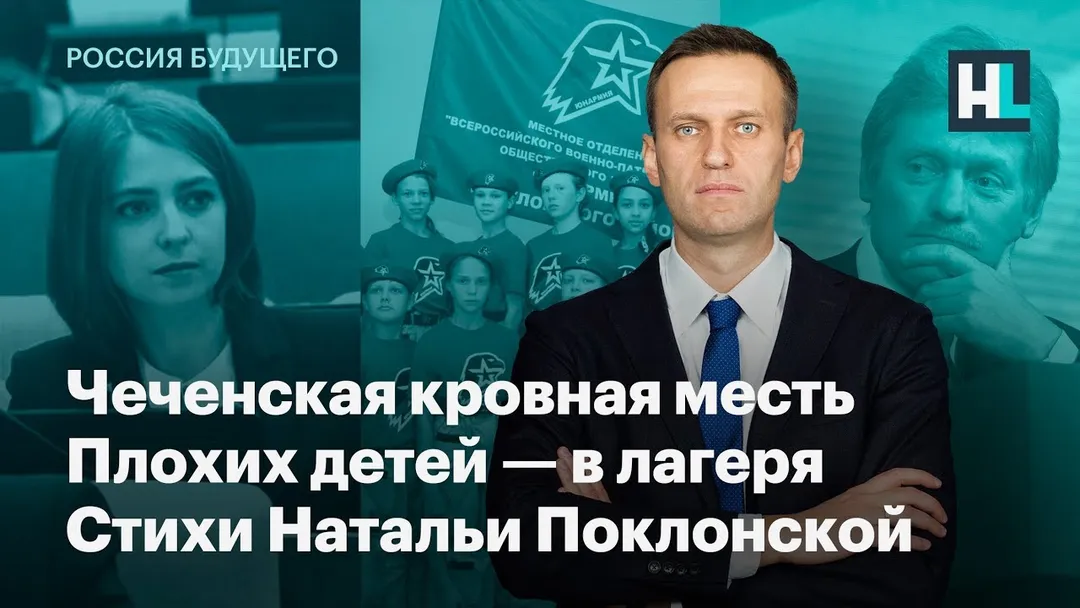
Chechen blood feuds, bad children sent to camps, and Natalia Poklonskaya’s poetry
[music]
Hello everyone, good evening. It's 8:00 p.m. in Moscow.
You're watching the live broadcast of *Russia of the Future*.
And I'm Alexei Navalny, or
the citizen who supposedly proposed poisoning
migrants with insecticide powder, as I was called by
the magnificent Vladimir Solovyov. Let's
start by enjoying this moment right away. Notice
how much Americans love a man
who built his election campaign
in Russia, at the beginning, on the fact that he was
a certified nationalist and proposed
poisoning migrants with insecticide powder. Who is that? That is...
They fought, but it was all so new. I don't consider
myself... whoever can't be shot through...
But amazingly, he has nothing
No, well, he was a fervent supporter of the Russian March
(an annual Russian nationalist rally), while those who have no journalistic integrity...
This is not journalism—it's a disgrace.
Well, isn't it wonderful? And people are just
clucking away: Navalny, Navalny,
Navalny. By the way, it's very funny—
today on his radio show, Vladimir
Solovyov, answering the question of why he needs
so many of those Italian villas, said an
absolutely astonishing thing. He explained
it by saying that his family is large, and it's cheaper
to buy houses in Italy than to buy
tickets, because with tickets and hotels
you'd spend a lot of money. I'm not joking—
he really said that, and it's
astonishing. What marvelous people—how much
they must think everyone is an idiot. But he thought,
well, these [__] have never traveled anywhere, they
have never stayed in hotels, they don't understand, and
you can tell them anything. Sure,
of course I bought one villa, then a second villa,
but you know—I saved on hotels.
Wonderful, wonderful Vladimir Solovyov.
I'll start with something completely concrete.
I like concrete things, concrete matters,
specific people.
One of those specific people is my broadcast neighbor,
who was already on air today—
Vladimir Milov announced that he is
running for the Moscow City Duma, and I
strongly support that, because
we've had this somewhat theoretical
conversation about the elections that will take place in
September in nearly 20 regions, including
the biggest ones—in Moscow and St. Petersburg—and this is
something completely concrete, because
Smart Voting—yes, we want to inflict
damage on United Russia,
we will damage United Russia, but we'd like
it not to be just emotions. Of course, we're going after
United Russia, but we're supporting some
decent people too. So I very much
welcome the fact that nominations have finally
started. Milov has put himself forward; he
will run in the Konkovo and Tyoply Stan districts
(districts in Moscow). I urge everyone to take part in the campaign,
because, because I know him. You
watch his broadcasts—he has many viewers,
more than 100,000 views now on
each stream. He helped a lot during the time of the
election campaign. Here you can see his
website, and as a rule we know for sure that
this is a person who will go there and, on our behalf, in the end
—this is a kind of shared
public agreement between us—we will support him.
We're saying to Volodya: come on, we'll
support you, yes, please—go ahead and hit United
Russia hard. And he will. And if we
elect him, if we make the effort, then he will continue
to hit back. He won't peck timidly, he won't
be one of those quiet deputies. He will
fight the Moscow mafia, he will
fight the bureaucrats. He understands
finance extremely well. So, just a little
promotion for Milov—go and
watch any of his broadcasts. So I very much
support him, and I'm waiting for other candidates too. And all
of us are waiting, right? We want
them to be serious, strong people,
to run seriously, the way Milov is running.
Support him. On Sunday there was a rally.
Thank you very much to everyone who was there. You
know that I wasn't there, but it seems to me that I
still made a fairly significant contribution
to making it successful. Well, maybe not huge,
but some contribution, large or small, I did make.
I am very happy that this rally
drew more than 15,000 people.
I am very happy that all of us together
managed to outplay the Kremlin, which had clearly
been counting on this being a
small rally, or some kind of
failure. And they were even forced
to resort to one of their cheap tricks:
they flew a drone about an hour
before the rally started and showed everyone
when there were still few people there—ha-ha—writing,
look, nobody's here. Even though everyone perfectly
well knew that this really was
the biggest rally in recent years.
Thank you to everyone who took part, thank you.
Well done to the Libertarian Party, which
organized all of this. And separately,
many thanks to the Libertarian Party
for not letting those vile, disgusting
crooks who, by some misunderstanding, call themselves
journalists into
the area behind the stage. Right now RT (Russia Today),
Margarita Simonyan, is going on about it. But my favorite
part—the one I talk about a lot—is that they lie a lot
about how they were supposedly not allowed into
the rally at all. Those of you who have been to
rallies and came closer to the stage
know perfectly well that there is, so to speak,
the general rally area, and everyone is allowed in there.
Any journalists are allowed in there;
it's impossible not to let them in—the police handle access.
And then there is the area around the stage,
and there the organizers decide whom they want
to let in. They didn't let them in there, and
they were right not to. And now they're losing their minds
over it, writing tweets and saying, look...
Look, these people claim to stand for freedom.
Internet freedom, yet they barred all of us.
It’s all lies, absolutely all of it.
And even the libertarians are trying, just a little,
to justify themselves, saying, “Well, we let them in there,”
or “not there,” or “we were right,” or “we were wrong.”
RT (Russia Today) needs to be driven out from everywhere, to hell with it,
because these are not
journalists.
These are people who lie deliberately and intentionally.
Why should we have to see these people at rallies?
Just go to RT’s website
and try to find any socially
significant news from Russia — you won’t
find it there. What you’ll find is endless
lying. And that lying is paid for with our
16 billion rubles from the state budget (about $250 million at historical rates). If we’re
feeding this whole gang, it would be even
more disgusting to see them in the
rally area, wandering around there and
snooping about. That does not in any way infringe
on freedom of speech. Staying on the topic
of the rally, it’s interesting how officials are reacting to this.
They’re joking, they understand
that these laws are completely absurd,
idiotic laws. They understand that
they’ll be very hard to enforce, and that
the whole country is now turning against
them. Let’s watch for 51 seconds how
Valentina Matviyenko explains
the problems that arose after these laws
were passed. Yes, they joke and joke — they passed
vile laws and now they joke and laugh. 51
seconds of Valentina Matviyenko: “Just yesterday
the Klishas laws were passed, and today already
we’ve got not only smart scientists and
experts,
but an immensely talented, brilliant, creative people.”
“Just yesterday the Klishas laws were passed, and
today already — if you scold the authorities to your heart’s content,”
“you fall under the law on insulting the authorities.”
“Or rather, if you praise — if you scold the authorities,”
“you fall under the law on”
“criti— rather, if you criticize, excuse me, if you”
“criticize the authorities, you fall under the law on
insulting the authorities. If you praise the authorities,”
“you fall under the fake news law.”
And so on and so forth.
The people aren’t asleep.
So if you speak badly, you fall under
one law — and there’s your punishment.
Well, isn’t that adorable, right? I mean, we’re sitting here
furious — and we really are furious, because
ha-ha-ha, someone gets fined up to 300,000 rubles (about $4,500),
or 30,000 rubles (about $450), excuse me.
They’ll fine some person in some region,
whether in a region, in Moscow, or anywhere else,
simply because he wrote, “The mayor of our
city is a scoundrel, a bastard, and a thief” — which is the plain
truth. And they joke: ha-ha-ha.
Just look at this attitude: “We have such
talented people, listen, we have scientists,
teachers, doctors — and so many jokers
on the internet, making up jokes about us.”
“They came up with a funny joke, and now
let’s go ahead and punish all these
people — we’ll fine them,”
“we’ll jail them, we’ll lock them up for 15
days for insulting the authorities.” They will
of course snap back and joke, and we will
retell their jokes here and laugh our heads off,
glancing at our watches worth hundreds of thousands,
millions, billions of rubles or dollars,
whatever you like.
Disgusting people. Even in these, actually,
what seems like a human moment,
they laughed — but if you really think
about what’s happening there, how they
cackle, understanding that they are some kind of super-
elite, and that they can impose whatever
laws they want on the rabble, and then
receive feedback in the form of memes.
It’s very, very nasty and revolting.
Speaking of idlers, alcoholics, and the elite,
I hope many of you have already
seen our report today.
If you haven’t watched it yet,
you should. Though it’s not even really an investigation,
I don’t even know what to call it — really,
it’s more of a comparison. In the previous program I showed you
that very same Gasan Nabiyev
from United Russia,
a deputy from Volgograd who said that
a pension
of around 8,000 rubles (about $120) is received only by
idlers and alcoholics. Let’s take 15 seconds
to refresh our memory: “Those who worked properly,”
“earned a decent salary, or who created”
“something over the years, receive this…”
“The rest are drunks.”
That outraged the whole country, outraged it
so much that he was expelled. I already
saw the news this evening: he was
expelled from the party, despite his
position at Gazprom, despite the fact that
what he said is, essentially,
the official position of United Russia. They
were saying exactly the same thing for half a year before
the retirement age was raised.
They kept saying that, well, if a person
worked hard, then their pension would be good; we
would raise everyone’s now, but those who
complain just don’t want to work themselves.
Drunks, idlers — that’s basically what
they said, in different ways, many, many times,
and different speakers repeated it. But then
Gasan Nabiyev ended up taking the heat.
Maybe he expressed it in the most
aggressive way, and maybe, I don’t know,
perhaps those sociologists
who endlessly talk about secret
pollsters in the Kremlin monitoring
public opinion all the time, and that
Putin makes decisions in line
with public opinion — well, perhaps
somehow they really did pick up on the fact
that Gasan Nabiyev in particular infuriated everyone
a little more than usual.
What’s happening is that he was expelled from United
Russia, but nevertheless, here we are, on the subject of
what prompted this video was actually a very
interesting and instructive comparison we made.
We compared an ordinary pensioner
whom Gasan Nabiev should supposedly love
with someone who came out of Gazprom itself.
This Valery Golubev himself, well,
nobody knows him. You don’t know him.
Most likely, you’ve never even heard
his name, unless you’ve taken an interest in Gazprom
or regularly watch the program
by Milov. But this, it seems to me,
is the main point of what we
should be thinking about: that some
frankly, total nobodies came out of nowhere and devoured everything around them,
and not just became fabulously rich, but
super-fabulously rich. Let’s
watch 46 seconds from this fairly long
16-minute video. We’ll
just take a look at the dacha. Golubev
once allocated an apartment to a not particularly
important
St. Petersburg official named Putin,
Vladimir Vladimirovich.
Well, of course, we’re on Rublyovka (an elite residential area outside Moscow) right now.
Right now, we’re looking at the main house,
with 3,000 square meters in the main section
and along a curved gallery you can walk to
the bathhouse complex on the right. The total
area of these buildings is 3,800 square meters.
All of this—the land and the houses—with a total value of
more than 3 billion rubles belong to
Golubev, Vyacheslav Valeryevich,
the 23-year-old son of Gazprom’s deputy chairman. He
bought and built all of this when he was
nineteen years old.
Can people own houses worth three
billion rubles? They can. Even houses worth 33 billion
rubles, houses, I don’t know, steamships, yachts—
they can own them. What’s the issue? But
we would at least like these people to have somehow
actually earned that money, so that there would be
some correspondence between this person’s contribution
and the benefit he brought
to society, his, I don’t know, intellectual
potential,
and so on and so forth.
So that it would match up, however crudely
you break it down—sorry for such a primitive
approach—but what we are seeing in Russia
is literally some kind of hellish
orgy of excess.
Just random people,
utterly worthless, literally neighbors
of Putin, Putin’s former colleagues, and some
pitiful clerks who sat
in the office next to him in the St. Petersburg
mayor’s office—they were absolute nobodies,
complete nonentities. And that is precisely why, in our
case, nothing works out for us,
nothing develops; on the contrary,
everything falls apart, because Putin’s кадровый ресурс (personnel pool),
his key people who took
all this for themselves, are just, well,
neighbors, you understand? If I came to
power and took my apartment neighbors or, say,
I don’t know, went around and found
the neighbors from my parents’ dacha, like,
“these are reliable people, I’ve had shashlik (barbecue) with them,”
so I’ll bring them in and appoint one of them
—the neighbor on the right—to Gazprom, then
I’d find some former classmate of mine
from university who, back in
the dorm, slept in the bunk next to mine,
and I’d appoint him to Rosneft just like that,
and so on—let’s be honest, that would end
in nothing good. Most likely, everything
would collapse. And you’ll say: well, that’s exactly what happened here—
everything collapsed.
Now look at this Golubev, and of course the question arises:
well,
“Come on, why are you harping on about his billion-ruble house?”
After all, he was on the
Gazprom management board—he’s supposed to be
rich, right?” Fine, then let’s
assess it objectively. Let’s forget about
Putin and imagine that we know absolutely nothing
about anyone. We’ve never heard of Golubev,
or of Gasan Nabiev, and nobody has
insulted us over
the retirement age. There was Gazprom,
it was worth $350 billion in 2008,
and in 2008 Miller said that
Gazprom would be worth a trillion. Please tell me,
then: to what figure, by how much,
did Gazprom grow? It was
worth $350 billion, and these guys
got yachts and planes out of it. This
Golubev got several billion
rubles, earned them—but that would make sense if
Gazprom had grown and become something bigger. Logical,
right? But since then Gazprom has fallen;
now it is worth $60 billion.
In other words, its value has collapsed.
They simply wrecked everything there,
dragged everything away—just objectively speaking.
Even if you don’t take into account my
dislike of Gazprom and its officials, or my
desire to accuse everyone there of
stealing everything—fine, let’s say they didn’t
steal everything. But in any case, they
managed it so badly, at the very least,
that it shrank and became several times
cheaper. They ruined Gazprom for us,
they broke it. They were given Gazprom for 20 years,
and they turned it into a much worse
company than it was before it fell into their
hands. So why the hell should we
be looking at houses worth billions, and why should we
calmly look at these houses now while
for some reason OMON and SOBR (Russian riot police and special rapid-response units) aren’t storming in there
shouting, “Explain yourselves—where did you get
the money for all of this?” But meanwhile,
at the same time,
companies like Amazon and Samsung used to be
smaller than Gazprom,
but now all of these companies
They are worth exactly that same trillion dollars.
dollars, while Gazprom is not. Well, let’s
just, then, based on the results of this
performance, based on the results of actual
work, pay these people money—meaning
Golubev, apparently, should not receive
anything.
Or he should be paid, but only some kind of
ordinary salary. Let him get 150,000
rubles a month, or let him
get 500,000 rubles a month, but
let’s not pay
them—after all, they keep going there, that whole team,
Miller and all the rest, we pay them
billions for the company to become
worse and worse and worse. That’s what the video was about.
Besides all these things, professions, everything
else—against the backdrop of sheer poverty, against the backdrop
of collapse—we officially keep handing out
and handing out more, and nobody is outraged, and
even deputies there, the communists in the
State Duma (the lower house of Russia’s parliament), aren’t especially
outraged, which separately really
annoys me a lot. Fine, LDPR (Liberal Democratic Party of Russia), and at least
A Just Russia—but they are formally
the opposition. Introduce a bill saying that
they should strip the hell out of them of their money—all those whose
market capitalization is falling, and it was falling even
back in the days when oil was doing just fine
and rising. That, that, that is what needs to be done. What really
gets to me—and not just me—is this
situation, because, well, time is passing
and Gazprom is getting smaller and smaller. It’s not as if
things have stopped there.
They keep tearing everything apart and
looting it.
And someday they will leave, of course,
but what exactly will be left after them
for us, or even for our children? There will be nothing left.
Absolutely nothing. Gazprom used to be worth 350,
now it’s worth 60, and how much will it be worth next—6?
That is the thing that hits a nerve and that
needs to be discussed. Chechen officials
are astonishing and continue simply to
amaze us, really.
Amaze us—I personally watched with amazement
the incident that happened
this week with the speaker of Chechnya’s parliament,
Magomed Daudov, nicknamed “Lord.”
In Chechnya, everyone knows him as Lord, and he is one of
Ramzan
Kadyrov’s closest associates—this is all well known—but
he publicly declared a blood feud
via Instagram. He declared a blood feud
against the video blogger Tumso Abdurakhmanov.
Abdurakhmanov.
Tumso Abdurakhmanov—I know him a little indirectly.
He took part in my
contest
for video clips, video blogs, which I
once announced on my birthday.
Lately I’ve been following him fairly closely.
By the way, I recommend that all of you watch him.
I recommend watching him—he is quite an
interesting person. He is a Chechen who
is currently living in forced exile.
I disagree with quite a large
range of his views, but everyone
in Chechnya watches him. No matter whom
among Chechens I have spoken with, mostly
in detention centers, everyone knows him.
Everyone watches him. Go to his channel and
you’ll see that he doesn’t have that many subscribers.
It’s scary to subscribe too—someone might see it
and punish you. But everyone watches him. If you
want to understand what is happening in Chechnya,
you absolutely have to watch him. And he
speaks Russian, and in good
Russian too. Everything is very clear; he is very
good at explaining things clearly.
And in fact, this confrontation
between Abdurakhmanov, on the one hand,
and Daudov and Kadyrov, on the other,
this kind of public
confrontation, is the most interesting thing
happening in Chechnya right now, and therefore
through this confrontation
you can see the main political
process taking place in the republic.
Well, that is, it’s clear that in this confrontation
Abdurakhmanov is, of course, in favor of
Chechnya leaving the
Russian Federation altogether. Those arguing with him
have to argue with him—they are Russian
officials, despite the fact that they are Chechens,
despite the fact that they are all there with
gold-plated pistols hanging off them,
formally they are Russian officials. They have
Russian official IDs, they
sign the payroll sheets and receive
a salary. In other words, these are people who are
supported by—well, by the money
of taxpayers. But at the same time, from within
this formal structure,
they go off to various ministries, to
some state councils and who knows where else, and then a person
simply
comes out and declares a blood feud.
Let’s take a look at the Chechen-language clip, but we
have subtitles—35 seconds of Daudov.
Officially, after your words about Akhmat-Haji (Akhmat Kadyrov, Ramzan Kadyrov’s father),
we declare a blood feud against you.
You are my enemy,
you are the enemy of my brothers, and we
will look for you.
We are not going to kill you tomorrow—don’t
say that we want to kill you. We will
deal with you in our own way. I fear
no one but God. If I do what
I promised to do to you, it makes no difference to me
even if I die.
And
my brothers and I will be looking for you.
So there you have it. Well, every one of us
has heard things like this many times. It is some kind of
talk—whether real or just
bragging—that happens constantly,
but in general we expect to see this—but
somewhere in an alleyway, and
or at a market, or in that same
detention center, or some conversation
between people with a criminal past, with
a criminal present, or simply
you know, some people had a drink
or some recently discharged conscripts got into a fight with each other, and they
say to each other, "Oh yeah? I'll
find you with my brothers, we'll deal with you,"
"so watch your back now, walk carefully."
The speaker of parliament. That's why I'm
so astonished. I was watching and thinking, well,
now it's going to start, because surely they have to
react somehow, the officials, to
this. I mean, what the hell — a guy is declaring
a blood feud.
We understand perfectly well that Ramzan Kadyrov
is feeling a whole range of emotions because
Abdurakhmanov is saying something
bad about him, about his father, and Daudov
is feeling a lot of emotions too. Well, they all are.
They're all feeling a lot of emotions. In Russia there are
hundreds of thousands of people who have said, or
still say, bad things about the father
of Ramzan Kadyrov, Akhmad-Hadji Kadyrov
because at one point in his
life he fought against federal troops.
That is part of Russian history.
Obviously it's very unpleasant for them, but
so what if it's unpleasant for an official?
Tell your friends something like that,
or the other one — if he really has time
to watch a video blogger — instead
he just goes on Instagram, on a live stream,
and declares a blood feud. And this
is seen by all Chechens, and they understand: well, if they
can do that, then what can we do? And this is seen by
all Russians, all of the North
Caucasus sees it, officials in the Kremlin see it,
Dmitry Peskov sees it, and he then
refuses to comment on this
statement. He says, quote:
"I don't know, I haven't seen it myself, so I won't
undertake to comment. In general, as you
know, in the legal field there is no such concept
as the tradition of blood feud,
and it's not even very clear what that
means." Peskov is telling us that
since there is no such thing as a blood feud,
then let them declare it — they're declaring
something nonexistent — or
maybe, on the contrary, he is condemning it.
It's not very clear. But I want to say to
Peskov
and to the astonishingly inactive
Investigative Committee, the police, everyone
else, that this concept absolutely does
exist in our law. There is an article on murder, and there
are aggravating circumstances for murder
committed on the grounds of blood feud.
This has always existed. It was in the criminal
code
of the USSR, the RSFSR, and the various Soviet republics,
which Chechnya was always part of. I remember perfectly well
when I was still preparing for exams, it was
in the RSFSR criminal code — blood feud
was there, and it is still there now. And there is also
the offense of, excuse me, making a death threat. This is
an explicit, obvious death threat
made by an official, and it just
floors me. Just imagine:
the speaker of parliament — there he is at the same
address by Putin, sitting at those
other events, you know, right there,
here the prosecutor general is having a discussion about
investigations and clearance rates,
over here the human rights ombudsman
is discussing with a representative
something about the situation in prisons,
what needs to be done there — and here this guy
is talking about blood feud and the murder
of a video blogger. This cannot be happening.
Not to mention that I often say on my
program that this is
absolutely disastrous for the North
Caucasus,
for Chechens themselves, for Chechnya. This once again
reinforces the image of some kind of wild
republic where a high-ranking
official, the second most important person in the republic,
declares a blood feud. Good grief.
Wild people, wild people with beards running around,
waving pistols, declaring
blood feuds to each other, with brothers, like they're
hunting someone down.
It should not be like this. And against the backdrop of
all this, they're saying to tourists today:
"Come to Chechnya, we'll be
very glad to welcome you to our wonderful,
our wonderful, hospitable
republic." Wait a second, just hold on there,
we're just going to kill this man's soul with
our brothers — we've found him,
we want to "entertain" him our way, the
Chechen way — and then come on over and check into
our cozy hotel. It's a complete mess,
absolute nonsense. I
am simply watching very closely
the Interior Ministry, the Investigative Committee, all
the rest, because they have to do
something. We called
Tumso Abdurakhmanov and asked him
to speak specifically for the viewers
of the program about what he thinks
about all this. He responded and recorded
a short video for us. Many thanks to him for that.
Let's listen to Tumso
Abdurakhmanov, against whom a blood
feud has been declared. One minute and a few seconds. As for
the blood feud declared against me
by the chairman of the Chechen parliament,
Daudov, I have long since stopped being surprised
by anything that representatives of
the Kadyrov authorities say or do. If
even tomorrow, on the central square
in Grozny, a person were publicly executed,
even that would not surprise me. But what does surprise me
is the absence of any adequate response.
from the highest echelons of the Russian
authorities toward the blatant disregard
for Russian laws by their vassals in
Chechnya. How can the speaker of parliament
openly threaten a person, declare
a blood feud, thereby violating
Russian law, and yet there is absolutely no
reaction from either the Investigative Committee
or any other bodies? Although if, say, you
take Navalny, for example—if he merely hinted
somewhere on Twitter that somewhere
an unauthorized rally would take place, he would
be locked up for 30 days. We know perfectly well
how this works. Or how can, for example,
another representative of this same
parliament, Andreev, openly say that
he basically, in our country,
does not like Russians—and again, there is
no reaction at all. This person remains
in his post. Yes, of course, we
respect human rights, and
he is entitled to his opinion—he may dislike Russians,
Chechens, the whole world, anyone he wants—but
a Russian official, a sitting
member of parliament, cannot allow himself such
public statements. I think the
Russian authorities should long ago have
pay attention to this.
The Russian authorities really should
pay attention to this.
But if you noticed, in the second
part of his speech, Dud
also mentioned another deputy who
said that he does not like Russians.
I got curious and went to look it up.
It was a statement in Chechen,
in the Chechen language, and when we translated it, I
was once again genuinely astonished.
Now, we understand very well that people
can say whatever they want in their own kitchens.
Chechens say all sorts of things about
Russians; Russians say things about Chechens too,
and not only in their apartments but also in
various conversations elsewhere. But it is assumed
that officials have certain restraints.
And yet another member of United
Russia, Magomed Khanbiyev, also a deputy
in that very same parliament, simply
made an astonishing statement.
There he was, live on his Instagram, and
considering that this man has such an
interesting biography—during the war
he also fought against federal troops, and he
was even the defense minister of Ichkeria (the self-proclaimed Chechen Republic of Ichkeria), that is,
if you were defense minister and then
switched to Russia’s side, joined
United Russia, and became an official
Russian official, your leader is Dmitry
Medvedev.
You simply should not be saying things like
the things he said. Let’s watch 21
seconds of it now; then it will be easier for you
[unintelligible speech]
[unintelligible speech]
[unintelligible speech]
[unintelligible speech]
[unintelligible speech]
[unintelligible speech]
Fine, no problem—if you don’t like Russians, then don’t
talk to them, if you don’t want to.
Don’t talk to them. Good Lord, there are plenty of
Russians
who do not want to talk to Chechens either.
But then don’t go into
United Russia. Then you shouldn’t
become an official. Then you shouldn’t
go around saying, ‘Vladimir Vladimirovich
Putin, you are our president,’ and all the rest of it.
This is the ruling party. How do these people
manage
to be part of the ruling party and
for that same government to keep talking endlessly about Russophobia:
look, there’s Russophobia in America,
there’s Russophobia in Poland, where
that Tumso lives, there are Russophobes in the Netherlands,
Russophobes there, and of course on
Ukraine—an entire nest of Russophobia.
And then this very same representative of the authorities,
a deputy of the Chechen parliament and a member of United Russia,
says: well yes, Russians—I don’t like Russians.
I mean, my—how did he put it—my
padishah is Chechen, I am a son of Ichkeria,
I don’t shake hands with them, I don’t speak to them.
And United Russia stays silent.
Silent about this.
That other gentleman who spoke about pensioners
and ‘a few thousand rubles’—they have already
expelled him. I am very curious what they
will do with our wonderful Magomed
Khanbiyev. I am publicly appealing to the party
United Russia and its leadership:
please, my dear friends,
either express solidarity with his words
or expel him, or at least
do something—somehow make your
position clear in connection with this,
well, with this strange position
of a member of your party. Separately, by the way,
it is simply very, very funny. I started
looking into who this person is. I do not
know very well—perhaps to my shame—the
history
and the key figures of the First Chechen
War. I went to Magomed Khanbiyev’s
biography on the Chechen parliament’s
page, and we know that Khanbiyev
from 1998 to 2004
fought against federal troops and
was defense minister. And there is an entry there, but
it is worded in such a way that from
1994 to 2005, during that time he worked in
various positions.
That, taken separately, is Homerically funny.
Well, ‘worked in various positions’—does that
mean first he shot at federal
soldiers with an assault rifle, then got promoted to shooting with a
grenade launcher, and then became defense minister
in the end? They might as well have just written that.
We know everything about Chechnya’s history.
A lot of the current police officers there were, back when...
...they were fighting against the federal troops, and then later...
So, all of that changed, well, and...
write that
at such-and-such a time, he took part in
combat operations—no, rather, worked in
various positions and continues
to work now in various positions.
United Russia still simply doesn’t
like Russians and doesn’t want to speak with
Russians, doesn’t want to talk to Russians, and this isn’t even
happening only in Chechnya—it’s a completely
wild story; today, actually, somehow
I don’t know why, but all at once online
they decided to make so many
statements. In Ingushetia, there was perhaps
an even more absurd story there.
The head—the mayor of Magas, Beslan Sataev. Magas is
the capital of Ingushetia, for those who don’t know. He, well,
seemed to take offense not even at Russians; he decided
to threaten not Russians, but an anonymous
Telegram channel. It had published his
post that he had made on VKontakte.
So, some Telegram channel wrote something
bad about him—a small St. Petersburg
pathetic little Telegram channel. Later I
tried—I got curious about how, exactly,
a small Telegram channel
had insulted the mayor of Magas.
So he declared—I’m explaining here—
“And I promise that I will find out the personal data
of this channel’s author and
the punishment will be harsh. To find and punish
you—that’s the meaning of life.” Good grief, man,
seriously? Your meaning of life is
to find and punish some guy
who writes on a Telegram channel? So I
tried to find it—I got curious how exactly
he had been so offended. I couldn’t even find that
Telegram channel—it’s impossible to find. And
basically, probably no one except
the channel’s five readers would ever have
known about it. But this has become a habit
among our officials from the Caucasus, and this
whole business of trading messages through
Instagram demanding apologies—it
keeps spreading further and further. Well,
you see, he has already declared that the meaning
of his life is to find someone and
punish them. So now he’ll be muttering all the time,
saying something like,
“Beslan, have you found him? Punished him? Have you
fulfilled your life’s purpose somehow?” And this will
just keep building up.
He’ll get worked up, and then, foolishly,
he’ll actually go and find
the author of the Telegram channel, and then what will he
do to him in some back alley? Why do these people
engage in such nonsense? Why do they
disgrace their own people, and why do they disgrace
their own republics by digging up something somewhere and
making these idiotic appeals while being
Russian officials? Look, you’re an official.
By definition, you understand that officials
are not liked by people. If I become an official, then
they’ll write that kind of stuff about me too, and
they already do. It’s an inevitable part
of public politics: you always have
enemies, and they insult you in various
ways—funny ones, nasty ones,
stupid ones, or sometimes genuinely quite
offensive ones. That’s just part of it. If
you don’t want anyone to insult you,
then don’t become
a Russian official, and no one
will insult you. Since we’ve started talking
about Russophobia, I see people are asking on the topic.
Pavel asks me:
“Hello, Alexei, tell me what the U.S. investigation
into Putin’s assets will be like.
Will it be similar to yours, or completely different? Aren’t they
taking away your so-called
bread and butter? Thank you.” And indeed,
the U.S. Congress passed a resolution
saying that they will look for
Vladimir Putin’s assets. Dmitry
Peskov immediately called it Russophobia. Before
we discuss that a little, just for
a second, so you understand better what
is going on—one second—the Americans’ statement
that they are going to do something there
regarding Vladimir Putin.
[music]
And Dmitry Peskov says that these are,
I quote,
“Russophobic attempts.” But why Russophobic?
Anti-Putin—sure. But what exactly is Russophobic
about it, really? If you set aside the fact that
they’re speaking English and
are in another country, what they’re saying is
basically this: Vladimir Putin
is corrupt; he stole a lot of money
from the citizens of Russia, and we are instructing our
national intelligence
to find Vladimir Putin’s money and
provide information about that money.
That seems to me like a pretty pro-Russian
gesture. After all, if Vladimir
Putin didn’t steal anything and didn’t hide anything, then
they won’t find anything.
And if he did steal and hide it, then they will find it,
and that will be good for us. Probably sooner or
later that money will come back to us. Why
does Dmitry Peskov call this Russophobia, while
a statement by a Chechen deputy saying that
with Russians
there is no need to speak is not considered
Russophobia? That’s no mystery at all,
because Dmitry Peskov is the same kind of
thief, and he is afraid that his money, his
Swiss—whatever—Liechtenstein
accounts, and his wife’s accounts,
will be found. So it’s obvious that
all these people are worried. However, answering
Pavel’s question about what
the Americans’ investigation will be like, I assume
it will be nothing of the sort. I assume that I have nothing...
They won’t find it, because no such thing exists
as a secret Swiss bank where
there’s supposedly a safe-deposit box with a label saying
“V. V. Putin,” and he comes there secretly, wearing a mask, and
opens it with some kind of diamond key, and inside
there’s cash, or diamonds, or I don’t know
the relics of Seraphim of Sarov (a revered Russian Orthodox saint), or whatever
like that.
There’s nothing like that. Putin and his friends
really did steal an enormous amount
of money, and that money is very much in plain sight. Well,
take Rotenberg’s money,
that’s Putin’s money. The money of various Shama-
lovs and everyone else—that’s all bribery money,
Putin’s money. Billionaire Kirill Shamalov,
a billionaire.
It’s still unclear whether he divorced Putin’s daughter
or not, but either way, that is
Putin’s money. And the money of Timchenko and
Shamalov—that is, the money sitting in
Surgutneftegas: billions of dollars
sitting in accounts—that’s all Putin’s money,
which he can use
at any moment, and do whatever he wants with it.
The other question is that with that much
money, there’s not really much special you can do,
and besides, what is he supposed to do
with money? Go to McDonald’s
and buy himself a double cheeseburger, or I don’t
know, a yacht? He already has a yacht for free.
A plane too—well, not exactly free, but he doesn’t need money for a plane either.
He doesn’t need any money, so he doesn’t need any
Swiss account either, and
since he wants to be president for life,
he doesn’t need any rainy-day stash
for hard times.
Well, I mean, he does need one, and he has one.
When, excuse me,
those very same billions belonging to the cellist
Roldugin—billions of dollars sitting in
a friend’s accounts—that is his rainy-day stash.
But again, it’s registered in a friend’s name, in the name of
a cellist. They won’t find any money specifically
belonging to Putin. And I think
U.S. intelligence will publish a report
that will simply contain a bunch of facts from
our own investigations. They’ll tell us
that Vladimir Putin and his friends stole
a lot of money, and that this money sits in the accounts
of Putin’s friends. And really,
we already know that perfectly well. Let me
take a look.
Sora V. asks me where to check
the promised salary in your field under the May decrees
relative to the subsistence minimum in your region.
How do you calculate it? You don’t need to calculate anything.
Just type in “Navalny Trade Union”
(Profsoyuz Navalnogo).
Click the first link, enter your region,
enter your profession, and you’ll have
there—you can see the link on the screen right now—
a convenient interface that
will tell you: this is what your salary should be
if you work full-time,
at a minimum, and you’ll be able
to file a complaint right there. “Northern Reindeer” asks me
why the outrage over
Klishas’s bill on illegally acquired property
died down so quickly, and what needs to be done to get
a meaningful response to this kind of law.
But the outrage hasn’t died down,
has it?
Northern Reindeer, no, it hasn’t died down for me.
Inside, I’m still boiling, I assure you.
Millions of people are boiling inside too, but
it’s not that the outrage died down—it never even
arose where it should have arisen:
in the State Duma.
So our task is simply to make sure that it doesn’t
go out inside us, and when there are
rallies, public speeches,
and elections,
and Smart Voting in 20 regions, to go out and
you, my dear Northern Reindeer, should take your
indignation to the polling station
and vote in accordance with
the Smart Voting recommendation. Right now,
the link has appeared—go there,
register right now, don’t wait,
damage United Russia. But the authorities—
I mean, what, is Klishas going to condemn himself?
No. As long as they are in power,
they won’t show any dissatisfaction
at all. When we remove them, then
that will be a different matter. When that happens, when
events start unfolding, we will remind them of all
of this. So: bad children, we’ll
send to camps, and good children
we’ll send to Yunarmiya (the Young Army youth movement).
A very interesting process is happening right now.
It seems to me that many people have treated it
as a joke, and it’s hard not to,
because it is
very funny. But generally speaking, this is
a strategy already being adopted
by the authorities toward young people, schoolchildren, and
students. You’ve seen that they’ve used lots
of different tricks: rapper Ptakha was paid
to record songs, and
to rap about how protesting is bad.
Then Alisa Vox sang, and after that they spent a long time
doing all sorts of ridiculous things, inviting
blogger Sasha Spielberg to speak in
the State Duma. And now they
are allocating money and trying, basically,
to split young people into two groups:
the good group will be
in Yunarmiya, a movement
which already claims that
it has 170,000 members, but they simply
automatically enrolled
all
students of military schools and so on,
various cadet schools. But it has been announced that
the size of this Yunarmiya
will be increased to one million people, and
quite concrete steps are being taken,
by the way, to make that happen.
for example, at every Rostec enterprise
there is a directive to set one up there
a Yunarmiya branch, and
all employees' children, all employees' children
need to be enrolled in this Yunarmiya, well,
so that way, after all, in our
Rostec, which brings together the entire defense industry,
a huge number of people work there
they'll shove a lot of people into this Yun
Army. What does Yunarmiya look like? It's very
funny, even cooler than the Young
Pioneers, which I was a member of in Soviet
times, and I tied my neckerchief myself. Even now
if you wake me up, with my eyes closed
I'll still be able to tie that red
but let's look at the Yunarmiya website
where they've posted the anthem and all that sort of thing
39 seconds of what
good children who see and love
Vladimir Vladimirovich Putin
[music]
with
don't whine
they keep formation
[music]
and
and the banners rustle. It looks very funny
and amusing, but we shouldn't forget that
the clichés of the Pioneer organization—good Lord, in
an instant you remember what we had there
"Bonfires blazed up"—children, not children, blaze up
like bonfires. God, I forgot Pioneer Day
why I forgot: because every time we would
sit around and drink and sing, "Blaze up like bonfires
in the blue night, we are Pioneers, children of workers," and
naturally all children, all children who
are my age remember perfectly well that we sang
"Blaze up like bonfires, barrels of gasoline, we are
Pioneers, children of Georgians, in dry cleaners"—what
Georgians have to do with it, that got lodged in
my head too. The media laughed at all this
but this was, after all, the Pioneer
organization. It was impossible not to
join it. A person without a red neckerchief
was an absolute outcast, simply in their own
class. And here too, gradually, step
by step, they'll herd people into this Yunarmiya, and I
think we'll see, especially in small
towns where Rostec enterprises
are the town-forming employers, in so-called
single-industry towns, that children will be driven there
because the money has already been allocated, and for
that money they have to report results. And what are we
going to do with the bad children?
Well, Nikolai Patrushev told us about that
the Secretary of the Security Council, former
FSB director. Speaking at this very
Security Council meeting in
Izhevsk, he said that the Ministry of Internal Affairs has a working
group for preventing and solving
crimes connected with
manipulating the minds of
minors through social media
so this working group
has stepped up its activity. But when
we talk about who is manipulating
the minds of minors through
social media, your humble servant
always, in such cases,
is obviously what they mean—me and people like me
I won't name names. Their children should be read to
those who fell for the sweet talk
of certain destructive video bloggers
they will be sent, as Patrushev said,
to military-patriotic camps, well
that is, apparently the good Yunarmiya kids, they
apparently stand guard over something, while the bad ones
where
and there, under the supervision of Yunarmiya members, they
are re-educated, using, who knows,
peeling potatoes or being forced to crawl
or
being locked in cells until you
go through re-forging (ideological re-education) and become a
normal Yunarmiya member and start
marching in formation
singing a little song about rustling banners, and
in that sense, something else quite close to this topic
is also rather interesting, something that
happened: Putin met with the head of Ros
finmonitoring—Rosfinmonitoring, so that you
understand, this is a very powerful
organization because it sees all
bank transfers, all payments, everything, everything
everything, everything, everything. In that sense,
Rosfinmonitoring can see perfectly well how much
everyone steals, because all the cash-out schemes are there,
you can see it all there. And it's a disgusting
organization entirely in the sense that
it does nothing. According to official data, from Russia
billions are being taken out
tens of billions of dollars. A large
part of it, a large part of that money,
is connected one way or another with officials
with corruption and with tax
evasion, and they just cover their faces like this and
pretend not to see any of it. But they did see 80
billion rubles that, they say, are being directed
toward goals of a certain
destructive nature. Let's listen to what
this Yuri Chikhanchin, the head of
Rosfinmonitoring, said to Putin. 22
seconds—go ahead
and today, for good causes, we have
something on the order of 80 billion that we're tracking
let's try to understand—this is where I got completely lost
ladies
from foreign countries, and also from
within the country, including those that go toward
certain somewhat destructive things
What a disgusting, lying crook. What I
want to say—listen, this is phrased rather
cunningly: 80 billion rubles
came from abroad to Russian NPOs (non-profit organizations)
and an ordinary person listening at home
thinks, holy hell, I listened and thought, damn, where
do such rich NGOs come from, where
is that 80 billion rubles going, and then
When you start looking into it, you see that
the picture is nothing like it seems.
It’s presented as if
things are moving toward a certain level
of destructiveness; it makes it look as though
there’s some story in Russia that somehow
the Americans, the State Department, are pumping in a huge amount of money—80
billion—and that they’re doing something here. But in
reality, if we take the organizations
designated as “foreign agents” out of those
80 billion, they received only
600 million.
And most of the money, most of those
80 billion—do you know what it is? It’s the ROC (Russian Orthodox Church).
A nonprofit organization that
receives money from the Russian Orthodox Church Outside Russia
which gets donations from abroad.
Then, you know what else it is?
A nonprofit organization that
deals with the destruction of chemical
weapons—that’s a state partnership.
It’s all sorts of United Russia (the ruling party) foundations, because
the overwhelming majority of this money,
of these 80 billion, does not come from
the United States.
It comes from Cyprus. And from Cyprus, what kind of money comes?
That’s right—our own money.
It was taken out, laundered, and then various
people like Yakunin, the former head of Russian Railways, they funnel the money
back here into their own charitable
foundations.
The St. Andrew the First-Called Foundation, for example.
In our investigations, we talked about such
foundations—oligarchic ones, or some kind of
bureaucratic setup where the official’s wife has to be occupied with something.
So the wife sets up
a charity to help children, or
some other kind of
Orthodox cause, or whatever, I don’t know—or she
just sings songs. Every wife of every
respectable official or oligarch is supposed to have
a charitable foundation. And for those
charitable foundations, where do you get the money?
People aren’t exactly going to donate, so you
send money there from your Cypriot offshore account,
and then she spends it here on something,
makes donations, and so on. That’s what this is.
In other words, it’s the same bureaucratic
money, interstate money. And then there’s
also a large amount of completely
normal funding: educational institutions
take part in international scientific grant programs,
win them, receive this money, and with it
scientists do their work, carry out
research—and that also gets counted within
those 80 billion. It sounds better that way,
you have to admit—more ominous, as if it were for some
destructive purpose. In reality, there’s nothing
of the sort there. So it’s simply
an outright lie.
But as the elections get closer, you’ll hear about these 80
billion many, many more times.
And every time it will be framed in a context
as if it means: look, the Americans
have allocated 80 billion,
they’re giving it to Russian NGOs, so we must
give even more to people like Vladimir Solovyov
—800 billion—so that they can
take part in this information war.
German Rey asks me what’s going on with
Brilyov. He writes that Brilyov was removed from
the public council. Is that true?
Yes, he was removed, and our little campaign
against this Briton in Russia—our wonderful
Brilyov—unfortunately continues to remain
a state propagandist living off
our money. But we really spent a huge amount
of effort on it: correspondence with the Defense Ministry,
the prosecutor’s office, and everyone else. We
forced them, at least in a ritual,
symbolic sense, to remove Brilyov from
the Public Council of the Ministry
of Defense. It’s just ridiculous: here is a man
who swore allegiance to the British monarch
and the British state, sitting on the council
of Russia’s Ministry of Defense, which
regards Britain as one of its main
potential
adversaries.
At first, Shoigu and all the others
replied to us: we are not going to
remove him, even though the law directly
states that a person with dual
citizenship cannot serve on a public council.
They said, well, his term will expire and
that will be the end of Brilyov. But we
got genuinely angry and simply
bombarded them, bombarded them, and now
the deadline for the prosecutor’s office response was approaching.
The prosecutor’s office would have been forced to acknowledge
a violation of the law, so they simply moved
preemptively, and Shoigu personally struck
Brilyov from the ministry’s Public
Council. So congratulations to everyone.
Congratulations to our lawyers. We still
remain annoyed by the fact that
Brilyov is maintained on
taxpayers’ money, but at least this is something—
a small but pleasant victory. Doctors—
greedy, terrible doctors—you know, that’s how
people in white coats are portrayed.
They’re supposedly greedy, and that is exactly how
our authorities treat them. And right now it’s
extremely interesting—I strongly advise everyone
to watch how the confrontation is developing
in one small
little town in Novgorod Oblast (a region in northwestern Russia),
.
In fact, several towns in Novgorod Oblast.
.
Not Nizhny Novgorod Oblast—specifically in
Novgorod Oblast. There, doctors
have actually even announced that they
will go on strike, and it’s very interesting.
It really is a tiny hospital,
poor and very small, and they simply
said this out of desperation, even though for many
many years there have been no strikes at all.
Naturally, everyone came down on the doctors over this.
All the local newspapers are writing that no
strike is going to happen; they published a letter
from the doctors of this hospital saying that there is no
strike. But on closer
inspection, it’s clear that this letter
was signed by some economist there, that is,
not by the doctors, but by the chief physician, his
deputies,
the hospital economist, and various other
people like that. It’s an extremely interesting confrontation.
Let’s first watch 42 seconds of this
statement.
from the Doctors’ Alliance trade union saying that
there will be a strike if by March 16, in
Okulovka, an additional
ambulance is not provided,
the number of hospital beds is not restored to
last year’s level, and the salaries
of medical workers do not
comply with the president’s May decrees (a set of Russian social spending and wage targets announced in May 2012).
On March 18, medical workers will begin
a strike and will not work until
the promises are fulfilled. I am sure
that the region’s residents will support them and will
come out and demand decent wages
for those who treat them and bring them
health. The rally has been officially authorized, but we
won’t stop there; next we will
block federal highways. Together we
must make sure that medical workers can
work for the good of the people, rather than thinking about
how to buy a piece of bread.
Guys, it’s really important here to listen carefully to
the doctors’ demands, and it’s astonishing that
they are demanding this, and the authorities are saying
no, we won’t do it. They’re not asking for
some huge salaries for themselves. When I
heard about the strike, I thought: now I’ll
look at the demands and see, well,
the usual bargaining — they announce
a strike and come out with a whole list of
demands so that later
some of them get partially satisfied and something
gets granted. But what are they actually demanding? I thought they were demanding
just this: buy us one ambulance.
They’re not asking for, I don’t know, golden chairs
or Mercedes cars. They’re asking for
an ambulance to be bought. My question
to Novgorod Region Governor Nikitin is:
why the hell can’t you buy them
an ambulance? We’re an oil-and-gas
state, we have a budget surplus,
a huge one. If you don’t have enough, then go to
the Health Ministry and say: we have doctors here,
buy an ambulance for them. They are asking for
a salary increase
up to the level guaranteed by the May decrees. That
means that a nurse should be earning
31,000 rubles (about 31,000 RUB)
— not 60,000, not 90,000, not 150,000. They’re saying:
we’re not demanding salaries like in Germany, or even
like in Estonia, or Poland, or
Moscow. They’re not saying that. They’re saying:
guys, could you please
finally stop paying us 15,000 and instead pay us
the 31,000 you promised?
And also buy an ambulance
so that we can transport patients. And they’re told:
no, your demands are unacceptable.
Well, that’s exactly why I’m saying that
we need to watch this
confrontation closely, in this town — or maybe not even a town,
I don’t know, a town, an urban-type settlement, a village —
it’s called Okulovka.
And nearby there’s also Borovichi, Okulovka and
Borovichi too — hospitals there are now in revolt
because they’re being shut down or reorganized.
People have nowhere to get treatment, there are no ambulances,
so accordingly, there’s simply no one
who can even get you to the hospital. Everyone is
furious — local residents and doctors alike. And
it’s very interesting to watch how doctors
are demanding what they need: they should be bought
an ambulance. How else are they supposed to transport
patients? And the governor says no.
You can’t. You scoundrels, your strike is
some kind of political action. We’ll see — if
this strike happens, we will also
cover it in some way. It will be the first
doctors’ strike in many, many years. And again,
since we’ve started talking about the union,
let me show you 43 seconds. This story just
really got to me too; maybe it will
affect you as well.
We get sent a lot of things like this,
about miserably low wages, yes, but this one
caught my attention: nurse
Galina Naumenko. She
is from Rostov Region,
though not from Rostov-on-Don, but from the town of Bataysk. She
works there in a tuberculosis clinic.
Just imagine — a tuberculosis clinic.
That’s the kind of place we’re talking about. Let’s watch her
short video, 43 seconds.
Hello, my name is Naumenko Galina.
I work as a nurse
at the anti-tuberculosis clinic in the city
of Bataysk.
The authorities of Rostov Region report that
that
the president’s May decrees are being successfully
implemented — that is, the salary of junior
medical staff is more than 29,000 rubles.
I honestly try to do my job well,
but my salary
is 7,500 rubles, and with extra payments
it comes to 10,500.
So it turns out that for my work I receive
less than the subsistence minimum.
Please support me and the other hospital employees
in our fight for the salary that
we are entitled to by law.
Thank you. Well, you can see that this is
a real nurse. She really is one.
Not just in name — anyone who has been to a
regional hospital knows: that’s what a nurse looks like.
She’s a nurse, not some planted person or anything like that.
But I didn’t just show you some person there.
With that tiny salary, you know what really got to me?
What finished me off was that she earns less than the subsistence minimum.
Less than the subsistence minimum, and for a long time they were paying her that way.
Only when she started complaining and writing letters
to the relevant authorities did it become clear this was completely illegal.
You cannot pay less than the subsistence minimum,
especially considering that
she was actually supposed to be paid 29,000 rubles,
but instead she was getting 10,600.
And do you know what they replied? They said, well, you see,
once she had already complained everywhere,
now our bureaucracy has gotten involved,
and it turns out it was just a mistake,
in 1C Accounting (a popular Russian accounting software program).
The software made an error, and that’s why
you were paid less. But now we’ll
add another 1,500 rubles so that you cross this
poverty threshold, you see. I mean, come on.
It was obviously clear that they were deliberately paying
these people starvation wages because
they needed to spend the money on something else,
I don’t know, maybe on media coverage
of the governor’s work and
buying him yet another Mercedes,
because the old ones apparently don’t drive
fast enough. And when they get caught doing this,
they just say, here, take this.
Keeping a person below the subsistence minimum? A mistake.
A 1C Accounting error. Okay, here’s 1,500 rubles
added on. There it is, there it is—
that’s the real Russophobia. This is done by people who
hate everyone, and in particular a nurse
from the city of Bataysk. And Russia has
one main problem.
German Gref, today—literally today—
gave an astonishing answer at some forum,
at yet another forum. What was it? It was the
forum
“Leaders of Russia,” where people gathered who are
supposedly Russia’s leaders. Meaning, we’re loafers,
alcoholics, while they are the leaders of Russia. So, the leaders
of Russia gathered, and German Gref
was asked:
“Please tell us, what are the main, key
problems of our country?” And Gref said something
rather dangerous. He began: “I won’t name
several; I’ll tell you one main
problem that exists in Russia.” And everyone
held their breath.
And of course it seems like
he’s about to say: Putin.
But rationally, you understand that he’s not
going to say Putin. He’ll say something very
vague, like a lack of
economic growth,
as well as low population mobility combined
with low
labor productivity. But German Gref
went surprisingly hard on this one and
really surprised us. Let’s listen to his 36 seconds.
My name is Andrei Knysh, and I have the following
question: what are the three most important
root problems that currently
exist in Russia?
“All right, let’s do one.”
“The absence of a system—
an effective system of state
governance. That is the main thing. If this problem
is solved, all the others will be
overcome automatically. That is why I
am deeply convinced of this.”
That was it.
Did you hear how everyone in the hall laughed?
As if to say, sure, there’s one problem, got it.
If you read between the lines, Gref was plainly
saying exactly this: the absence of
an effective enough system of
governance.
And who has been in power here for twenty years?
Excuse me, who are the very people
who built this system of state
governance? Built it and built it and built it
for 20 years—and this is what they built.
They made billions, built their dachas (country houses), and then—
bam.
After 20 years, the country’s top banker,
the country’s
the head of the bank that underpins practically the entire
Russian economy, the whole banking system of Russia—
and that’s Sberbank—says that in Russia
there is one problem: the absence of a system
of effective state governance. Translated
into plain Russian, that means:
Putin is a bad president.
And when this problem is resolved,
then everything here will be just fine.
So, essentially, German Gref—
when he was a minister, he was part of
this ineffective system.
He publicly supports Putin, and
therefore he continues to support this
system. But these astonishing
moments, these flashes of candor,
are amazing even at an official forum.
Even official bankers are basically saying to each other:
“The camera isn’t really catching this, right?
What’s the problem? These officials of ours—
they’re just bad officials. Our state is being
poorly governed.” We got it.
We understood who you were talking about, dear
German Gref. And to finish, some poetry.
Though I won’t be the one reciting it. I’m no poet,
I can’t write verse. But someone who can
is
Natalia Poklonskaya’s husband. It turns out
Natalia Poklonskaya has a husband, and he
was offended that on the previous program I
called Natalia Poklonskaya “Natusik” (a cutesy diminutive of Natalia) and mocked her.
And they held a press conference
dedicated to Natalia Poklonskaya’s book, but
it turned out that the press conference was
effectively dedicated to me, because
he just couldn’t let it go.
So Ivan Solovyov, Poklonskaya’s husband,
couldn’t take it and wrote
poems about me: “Lyokha has a crush on Natusik…”
But never mind that—on to the fight against corruption.
He’s always ready. I—I just won’t be able to...
read this with proper expression because
I’ll start laughing like crazy and keep stumbling over the words.
Let’s just listen. Natalia
Poklonskaya and her husband wrote poems about Alexei
which somehow, completely unintentionally, produced this masterpiece.
It was born.
A poem was born. I’ll read it out. It’s called
It’s called: “Evidence, map, little mutt, people...”
“...collapse, hanging out”—but that’s not the point. In the fight against
corruption, he’s always ready there,
and nobody needs some enormous junk.
Personal information, who has how much...
By the end of the program, basically, about himself...
As for the actual matter, some full list—he
should announce it publicly. How devastating.
Master of Poland on the shore... you really didn’t think this through.
All the way to the very end.
Don’t think too much about the x’s.
Their day is full; from him, just slop, but also...
thrown together against it, without yeast.
Charlie, splash it around, that’ll do.
I agree—what an honest guy you are.
to demonstrate once per regiment on the second...
little ball.
Great. Take all of that, a little bit there...
someone willing to pat him on the head for it. But if
little Alexei keeps mocking my wife, then he may
lose his manly dignity too.
Investigating corruption is not the same as plowing a field.
Love, high ratings...
be proud, let it drop—but God forbid Alexei’s
...whatever she was doing—if they come by their own
territory. Hello everyone. That will surpass this.
Hello, Alexei Navalny, wave...
God forbid, Alexei, that your people come to power.
I don’t even know. Isn’t this, like...
isn’t it flattering, I mean, that Natalia Poklonskaya
and her husband sit there reading poetry and
discussing it, thinking about beauty in the sequel?
“Enormous thingamajig”—yes, I suppose I find
this situation, you know, kind of... well, yes, it’s
very strange. I’d like to stay
as far away as possible from this couple’s fantasies.
However, I am prepared, and I will by no means
under any circumstances call Natalia
Poklonskaya some kind of “collapse-mutt”; I will
refer to her exclusively as the respected
Deputy Poklonskaya—well, if she
finally does announce the whole
list—that is, comes out and says:
“Just as I wrote in my book, I have
compromising material on deputies. They have
real estate in France and elsewhere.
These deputies—I am initiating
proceedings to remove them. Get out of here,
out of my State Duma (the lower house of Russia’s parliament).”
“I am Natalia Poklonskaya,
a real deputy, not some kind of
‘collapse-party girl.’” That’s what I’m waiting for. I’d like
the next brilliant poem from this
married couple to lash not only
me—you can target me too, okay—but also those
very deputies on whom there is
compromising material. We’re ending our program with a 22-
second amazing clip from the series
“How Moscow Has Improved”
under Sergei Semyonovich Sobyanin. You know how
Sergei Semyonovich works, right? Well,
Moscow has a gigantic budget—just imagine,
a trillion rubles, a sea of money. We can
just throw this money around like this, and still
it won’t run out. All the country’s money is in Moscow.
Moscow has purchased an enormous amount of
various equipment. Sergei Semyonovich introduced
a system so that in every—down there—in
every KamAZ truck, every snowplow,
every bus, there is a
GLONASS system, and this GLONASS system
shows that the equipment is moving, and if
some KamAZ driver suddenly
decides to slack off,
then the GLONASS system will see that he’s being lazy,
and then the dispatcher will punish him.
That way, Sergei Semyonovich Sobyanin
doesn’t let himself be deceived and uses
taxpayers’ money efficiently.
He organized such a great, effective system.
Let’s take a look at how it
works.
Well, everything is just great: the vehicle is moving, GLONASS
is tracking it, the fuel is burning, wages are
being paid out—high technology, everything
is excellent. To make sure this stops happening,
take part, folks, in Smart Voting
in the September elections to the Moscow
City Duma. Let’s at least try
to push as many United Russia members as possible
out of the Moscow City Duma.
Because otherwise—otherwise they’ll just keep driving
and driving and driving. See you
next Thursday.
[music]