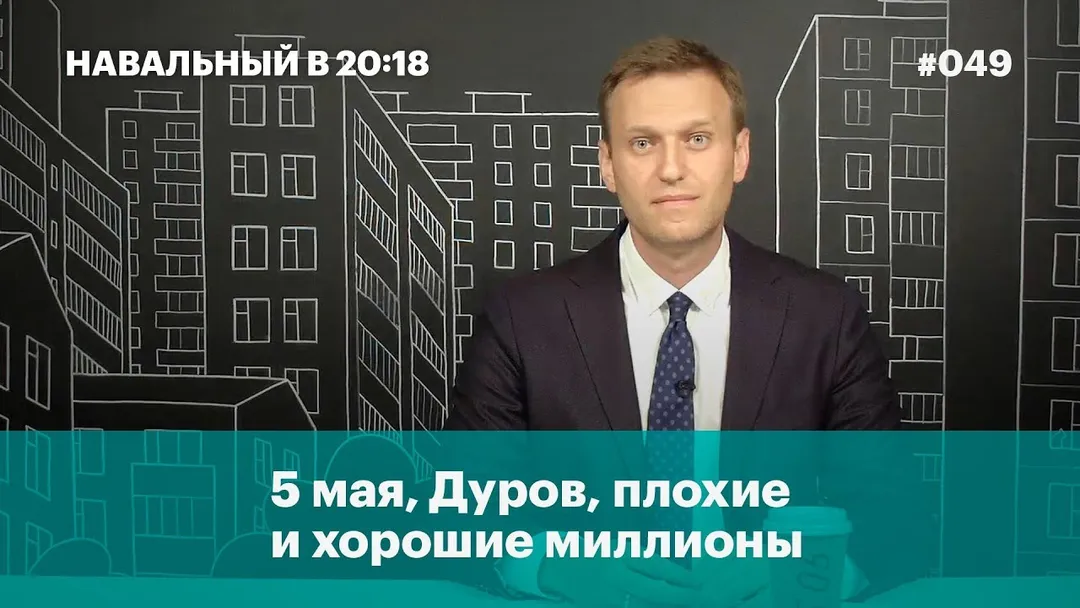
May 5, Durov, bad and good millions
[music]
Well,
hello everyone, it's 8:18 p.m. in Moscow, which means
that I'm here in the studio, Alexei Navalny
or, as NTV so wonderfully called me, a twice-convicted blogger
in its wonderful
sensational report, "Sun-Tanned Navalny"
returns from vacation in Egypt.
I really was on vacation in Egypt,
which is why I missed the last broadcast.
At the airport, I was met by several
cameras from all sorts of hack propaganda TV channels
that ran after me all the way to the car, shouting,
"Why were you vacationing in Egypt?
And how dare you hold a protest on May 5?"
Yes, I vacationed in Egypt—don't try to read anything into it.
I was very pleased with the trip, by the way.
And despite the fact that getting to Egypt these days
is rather difficult—there are resorts there, but
planes don't fly directly, so you have to go through
Cairo or some other country—I
wanted to go specifically to Egypt in order
to finally try scuba diving.
I tried it—it was great. I
saw a turtle. You can't imagine what
a joy it is to see a turtle. I never thought
that
it could bring me so much happiness. It was
huge, beautiful, and, well, it didn't look
like it could bite off half of
your arm.
So I'll admit honestly:
I didn't dare tap it on the shell, although
I really wanted to. I recommend diving to everyone—
it's a wonderful sport, and Egypt is a wonderful
country. There are almost no Russians there, unfortunately, and all
the Egyptians are very upset about it. There are quite a lot of
Ukrainians there.
The entire staff speaks Russian
for those very Ukrainians, and everyone is really
looking forward to the Russians coming back,
because their income dropped after
flights to Egypt were banned. Anyway,
it was wonderful.
Vacationing is better than working, the weather was sunny,
everything was great. Thank you very much for
being patient and waiting for me here on
the air. But Egypt is Egypt—let's talk
about where we'll be on May 5.
On May 5, my dear friends, we
must, of course, be at the nationwide
protest action that we are holding on the eve of
the inauguration that Vladimir
Putin will hold on May 7. I've gotten quite a lot of questions:
why the 5th? Why
not later? Because May 7 is
a working day, while May 5 is a day off, Saturday.
It's a good time, after the May holidays, and
new regulations are coming into force under which
all mass events
must be coordinated with the FSB (Russia's security service) because of
the World Cup. I think that's a minor
obstacle for us, because it's just one of those
forced measures, but it seems to me—and not only to me,
I've received quite a lot of
letters and appeals on this subject—that we need
to hold this action for a very simple
reason.
Putin is beginning another term—already
his fifth. He will rule for six years, and many
people thought there might be some kind of
changes, some improvements, in connection with
this new term. But we can already see that any changes
will not be for the better—there will be none at all.
Just this past month alone,
the authorities have shown us that Putin and his people
intend to govern the country as if
53 million people simply do not exist here.
That is the most important number for the next
six years: 53 million people did not
vote for Putin, for various reasons.
But he has no right to behave as
if they don't exist at all. Let's take those 53 million
and divide them in half, divide them into three parts,
into four parts—either way, you still get
millions of people who disagree with what
this government is doing. And these are full-fledged
citizens. There are a great many of them, and
their voice matters. It must be heard.
For various reasons, these people are not yet all
ready to come out into the streets together. So
on May 5, we must come out and say that we
represent all those who say: Putin, dear man,
you are not our president. We did not vote for you,
we do not agree with your policies, and we are not prepared
to put up with this daily rudeness,
not prepared to endure this humiliation, not prepared to endure
this corruption. That is why we are
coming out before the inauguration
to say: in the Russian Federation, there are
huge numbers of people who want
to live differently. Until we start
showing up,
we will achieve nothing, nothing
will change. Naturally, they really
don't like our actions. We have filed applications
in 87 cities across Russia. And not only us—
right now we have headquarters in 45 cities,
and in the other places it's simply
former headquarters staff or just
wonderful, enthusiastic people submitting them.
So far, the statistics are as follows: out of these
87 applications, 22 have been approved, 10 of them
in designated free-speech areas, and 19 have been denied.
In one case, the rally was approved, but
the march was not. And in 38 cities,
it's still unclear, because there's been neither a yes nor a no.
It's obvious that the authorities, on the one hand,
do not really want, on the eve of the inauguration,
to stage mass arrests, but on the
other hand, it is extremely important for them to show
themselves and everyone else that there are, well, no
protests, everyone is happy, everyone wants
Putin to do whatever he wants and behave like
an emperor, like a tsar, in this country. But we
will not allow it. And strange as it may seem,
paradoxical as it may be, the slogan "Down with autocracy"
is once again moving right to the forefront.
becomes one of the most important things
because what they are doing is the very essence
of true autocracy
They absolutely do not care about us, and until
we start coming out into the streets
there is no way we will persuade these people
to listen to our opinion—not
with op-eds, not with reposts, not with any
other actions. All of that is important to do.
It is important to write op-eds, it is important to make
reposts, it is important to spread information
—all of it matters. But in a situation where
neither the judicial system works, nor does
parliament, and there are no other
ways for you and me to influence
the authorities, we have to take to the streets. That is
the only way, and no one
will go out there in your place. There is no such
system—do not fool yourself into thinking, well, if I do not
go, for whatever reason, other people
will come out for me. Those people will come out, they
are great—but until you come out too,
our country will have no prospects
whatsoever. In any case, we are facing six years of degradation
if Putin remains
in power for six more years.
The extent of that degradation depends very heavily
on our activity. So, in the
description to this video, please go
right now—there is a link to
the VKontakte (Russian social network) group. Find your city
and be sure to take part. Now, separately,
some information about Moscow and St. Petersburg:
in St. Petersburg, things are still unclear; the
approval process is ongoing. In Moscow,
the situation is roughly the same. For now, we are
proceeding on the assumption that it will be Tverskaya Street at
2:00 p.m. on May 5—Tverskaya Street at 2:00 p.m.
We told the Moscow city authorities, without
all this endless bargaining,
one very simple thing: give us a street in the city center
and we will consider the options. We are not going to
dig in our heels. After all, there have not been
any large authorized
events for a long time. We are ready to consider any
other street in the center, as long as it is within
the Garden Ring (central Moscow ring road), where people can march
and where a rally can be held. They first offered us
Maryino and Tushino (outlying Moscow districts),
then they even suggested the Three Stations Square area
somewhere with a stage. We are going to a rally, to an
action against
the humiliations to which this government
subjects its citizens, and to hold our
rally in the format of yet another humiliation—we are
absolutely not prepared for that, and we are not going to do it.
Do I want
to be jailed again for 30 days?
To be detained? No, I do not. Am I prepared for the possibility that
I will be jailed for 30 days? I am. This too is
a matter of dignity, simply a matter
of basic self-respect. And I very much
hope that quite a lot of people, together
with me, will go, including with that in mind. But I
am not going to call this unauthorized
or unapproved. It is authorized by the Constitution;
it is their actions that are illegal,
and we are going there to defend
our rights. If there are many of us, good; if fewer of
us come, not so good—but all the same
we still have to go. Personally, and I advise everyone to do the same, I
conduct this kind of mental
experiment for myself. When I leave
the house—assuming I am not
grabbed in the stairwell and jailed—I walk and think:
what if I am completely alone there? What if I come out onto
Pushkin Square or Mayakovskaya
and there is no one there except curious
passersby and police officers running
toward me, and I am standing there alone with a placard?
I might even feel a little foolish, and
it might seem to me that I am the only one in the whole
country, and it would be a little awkward, of course.
Of course, I would prefer to be in a huge,
wonderful crowd of people. But if I am alone, am I ready
for that? I am ready. And everyone should
approach this in exactly that way.
But fortunately, all these
mental exercises are important, they
are useful simply for cultivating the citizen
within yourself.
There are a lot of us, a great many of us. We
understand that in any case there will be many
people at this action, so come.
There is no need to clash with the police. If
it does end up being on Tverskaya, and we see
that the likelihood of detention there is not so
high—but in any case, there is no alternative.
People achieve their goals only if they
come out. Nothing else works. Do not
deceive yourselves. So if you
want a future for yourselves and for your
children, come out into the streets on May 5. As things stand,
what we are seeing now—if this month,
the first month of Putin’s new term,
is extrapolated over all six years, well, I
do not know—this will not be rock bottom, but some kind of
we will punch through the ground and end up somewhere in
Australia or New Zealand, because
it is an absolute nightmare.
450 rubles—so, 450 rubles.
450 rubles is your contribution to these tricks
that Roskomnadzor (Russia’s communications regulator) is pulling right now.
The first month of Putin’s term will, of course,
be remembered for this hellish war on
the internet, and today there already appeared
a first estimate saying
that it amounts to almost $1 billion—that is,
how much would that be, around 62 billion
rubles in damage inflicted on
the Russian economy
by Roskomnadzor’s actions. In other words, you were
charged for it.
That is, of course, you did not literally take
450 rubles out of your pocket and hand it over to some
guy—that is not how it looked—but
in some other way, you did pay those 450
rubles: your tax money went somewhere.
An indirect payment: you paid for a VPN.
Some company earned less.
It paid out less money, and therefore less in taxes, and so—
those 450 rubles (about $5) never made it to your
local clinic, or to your—didn’t make it to your
school, where that money was supposed to go.
This damage to the economy is not some abstract
thing—it’s something completely concrete.
In the first month of his new
term, Putin has already stolen from you
450 rubles (about $5), and he’ll steal much more—but
that’s not even counting how much inconvenience he’s caused.
Just look at how many
websites have been blocked.
YouTube has problems, Google has problems,
various messaging apps aren’t working—
because of whom? Well, well, well—actually,
simply put,
even if you try, irrationally, to somehow
justify going after Telegram,
there are plenty of other
messengers that offer the same
encryption, and no one is chasing them—and that’s good.
They banned Telegram, but why all these
idiotic, maniacal
blocks, which, as is obvious,
cause harm and take money away from people?
But they do it because they think
they’re so powerful, that they can
do this because in Russia there are no
organized groups of people, you see,
who will stand up and resist this.
That’s why on May 5
people need to come out and show that such groups do exist.
By the way, on April 30
there will be a special rally on Sakharov Avenue (in Moscow)
in defense of Telegram, specifically over this issue.
I absolutely support this
rally, I’ll be there, and honestly it’s even
strange to hear things like this. I
read
on Twitter that people were saying: they announced a Telegram defense protest
for the 30th, right before the 5th, and so
the action on the 5th will suffer. And my question to
the people saying that is: guys, are you
citizens, or are you lithium batteries
in a mobile phone? You know, you
charge up to 5 percent, then 35 percent,
and that’s all the life energy,
energy,
political will, and civic
awareness you have—enough for one rally, on the 30th, and
once you’ve gone on the 30th, that’s it, you’re done,
you’ve exhausted yourself, and on the 5th you already can’t
go anymore—you need to wait half a year
before going to the next protest? But if you’re
not human batteries, then that means people will
treat you accordingly. As for me,
I have enough energy to go both on the 30th and on the 5th, and if
necessary, I’m ready to go every day and every other day,
because only this way, as I’ve
said a million times on this program,
do people achieve change. So people need
to keep showing up and keep fighting for what’s theirs, because
otherwise these guys will, so to speak,
trample all the good things
and destroy them. Let’s listen.
After all, Putin was only just recently
talking about how great things would be
for the internet here. Forty-five seconds of Vladimir Putin’s promise:
Vladimir Putin’s promise, forty-five seconds.
How effectively we will be able
to use the colossal opportunities
of the technological revolution, how we respond to
its challenges, depends only on us. And in that
sense, the coming years will be decisive
for the future of the country.
I emphasize: truly decisive. The point
is that the pace of technological
change is accelerating.
It is rising sharply. Whoever
rides this technological wave
will surge far ahead.
Those who cannot do so, this—this
wave will simply, simply overwhelm.
Just look: a decisive year,
a technological wave is crashing over us,
coming straight at us—and this technological wave is here
because Vladimir Putin opened the floodgates.
And it would seem—this too is basically
obvious—the man understands that he is
quite unpopular among educated urbanites,
and completely unpopular especially
among technical professionals; he is not popular at all
among programmers, among IT people—they
absolutely hate him. And there is one simple thing
that really could
make it easier to run
an IT business, could truly make
Russia a country where it is easy
to work on all these trendy things—
blockchain, bitcoin, and all the
other buzzwords that
German Gref and other Russian corporate executives
love to use in their speeches.
But instead of doing that—free it up—
in just one month they have inflicted
more damage on the internet than it
suffers over years in other countries. Besides
the fact that we have lost this money,
companies and people can see that—well, how—
why invest in Russia? It’s foolish
to invest in Russia now.
It’s foolish to create startups, foolish to
register companies here—simply foolish.
If you do online business in Russia,
you’d be a fool to keep doing it,
because at any moment, at any
second, your website can be blocked, and
then you’ll be running around, knocking on doors everywhere,
saying, ‘Hello, Roskomnadzor (Russia’s state communications regulator), how
could you block me? I was just—’
all in this supposed fight against Telegram, and no one is even
discussing at the state level
that this is, in fact, a crime.
You cannot just block someone else’s website—it’s like
walking into someone else’s apartment.
It’s like taking away someone else’s business, taking away someone else’s—
a car, to take something off someone, a jacket, in a
back alley—because websites, this business,
these are entirely tangible things, aren't they?
It may seem like some kind of nonsense, just an image on
the internet—not real, like, what is it really?
You can't eat it or take a bite out of it,
or carry it away. It exists somewhere
out there in the wires, you know, some kind of
ephemeral thing, an electrical
signal running around, and these things, these images,
layers—it all seems unreal, so people think
you can smash it. But they smash it, and by doing that
they take money from us; through this
they simply destroy everything. So
of course this has to be resisted, because
tens of millions of people are absolutely
against it—even some pro-Putin people, and
just ordinary reasonable people, any more or
less normal people who aren't crazy,
they will oppose this, and no one
except us
can represent their interests right now.
And by the way, notice what a
particularly infuriating kind of cynicism
there is in the officials' statements. These people, for the sake of
fighting Telegram, blocked 18,000
IP addresses in Russia—or every 200th
IP address in the world. I mean, they are
literally just trying to break the
internet so that
Telegram won't work. They're chasing after it, and by the way,
a lot of people are happy that
Telegram has supposedly been blocked—and yes, they
rejoice over that—but think about
the fact that they can block you too,
very easily, and they'll block us too. I mean,
Telegram, with its enormous resources,
with all its capacity, talent,
and programmers, can run from them and
by buying
space in various, I don't know, cloud
services or whatever—anyway, Telegram can keep dodging them
because they're smart and rich.
But we won't be able to run from them like that, so
think about that. So, they
blocked a huge number of addresses
in order to bring down Telegram, while they themselves
keep using it—and they do it
quite openly. And today Dmitry Peskov
said that, well,
we shouldn't treat this ironically,
he said, and then added: as for me,
Telegram works. You see, that shows a decidedly
non-ironic attitude—and an absolutely
quite
astonishing quote.
Today Arkady Dvorkovich came out with another one;
he was asked about Telegram. But this
official, who receives a huge salary
and works in the government—the very same
government that just
blocked 18 million IP addresses
in order to destroy Telegram—
Dvorkovich says: it works for me.
Great approach, Arkady Dvorkovich.
Great approach from the Russian government. So
if you've brought everything crashing down on all of us,
you yourselves are, of course, in some kind of
cloud of cynicism and arrogance. Well then,
let's keep going—let all officials say things like
that.
This could basically be the
great slogan for the next six Putin years:
a neat formula, so to speak. Dvorkovich said,
"Everything works for me." And Veronika
Skvortsova
the health minister, could then
say, "Nothing hurts for me," in response to
any questions about the disastrous state of
Russian healthcare. And our
wonderful Puchkov, head of the Emergency Situations Ministry,
when asked why there is such a
horror show in that ministry and why Zimnyaya Vishnya (the Winter Cherry mall) burned down,
would say: you know, nothing is burning for me.
Right. And Alexander Bastrykin, head of the Investigative Committee,
would then say:
you know, when asked why there is so much
corruption, why everything is so rotten, he'd say:
"I don't know what you're talking about—no one steals around me these days." And the mayor
of Moscow, when he is
asked, "Dear Sergei Semyonovich,
you spent billions solving
transport problems, but traffic jams in Moscow
are still insane, a full ten out of ten," he would say:
"You know, I don't sit in traffic." That's
all a joke, of course—but that's exactly why
we need to go out to rallies on 1, 2, 3, 33—
because it's impossible to tolerate this humiliation any longer.
And really, this is no joke. We
twist these little quotes around ourselves on
Twitter, but in essence they're simply
telling us to our faces that we're cattle, nobodies,
that we're nothing. People who are paid
with our money think it's acceptable to
say things like that straight to our faces. They say:
we use Telegram; you
don't worry about it—we just want you not to
use it, while everything works for us.
That's what Dvorkovich says. That's why we need to
go out. A lot of people are discussing
Armenia right now, and you know, the kind of comments that personally always
really irritate me are these:
"The Armenians are great, but all
Russians are hopeless, and nothing will
work out for us. We have this kind of
terrible, nightmarish country, whereas
over there they have these wonderful citizens
and everything worked out for them." The difference is one thing:
people are the same everywhere. The difference is this:
the situation in Armenia—I wanted to say a little about it—
perfectly demonstrates
the only thing we lack:
persistence, determination. This is exactly
the point.
It's an illustration of when people say,
"Well, if we've gone to a rally 30 times, we won't go a 31st,"
and it shows perfectly that what we need
is precisely persistence.
It all happened in Armenia.
It wasn’t just a single rally there, and
the country’s prime minister resigned.
No, there was a president who, oddly enough,
had served two terms and wanted to stay in
power, saying, “I’ll become prime minister,” and
he was supposed to become prime minister.
After that, the opposition had already announced in advance, even before
it happened, that on April 11 they would begin
protest actions. They started coming out into the
streets, they started sitting there in the street, and there
weren’t many of them. It must have seemed to them too, well,
damn, we’re sitting here and this isn’t deciding
anything. They sat there on the 11th, then on the 12th,
then they sat there on the 13th, and probably they were also saying something like
“Come on, we’ve already spent a full three days
here and achieved nothing.”
“Let’s go home, this is all pointless.”
Just like people here are always saying: “We came out three
times to protest, and Putin is still
still there, so we’re not going anymore.” But then on the 17th,
despite the fact that they had been sitting there since the 11th
—a week had passed—and Sargsyan was elected
prime minister. They were basically told,
“You can sit in your streets all you want, but we
are going to elect him anyway, because we’re
the ones in charge.”
“We’re the majority, and you’re nobody.” After that,
the protests continued, and
many more people came out. And this huge
number of people who took to the streets forced
President Sargsyan
to meet with the opposition leader, Ni-
kol Pashinyan. There was a meeting, and people there
were standing and saying, “We demand a meeting,” and
the prime minister said, “All right, a meeting.”
Do you know how long that meeting lasted?
Three minutes. And during those three minutes,
the prime minister, who was confident in his own
invincibility, despite the fact that people were standing there,
said, “Well, you know,”
“Dear Nikol, the last time your party
won only eight percent,”
“so you don’t represent anyone.”
“Get out of here.” But the people kept standing there.
Even though, probably, many people also wanted to say
at night, “So, we’ve been standing here
for several days, and they still got
elected. We forced them to receive the opposition leader,
and they still told us to get lost.”
“Let’s go home.” But no—the people showed persistence.
The people showed solidarity, and there
they had already started dispersing them by that point, and
they used water cannons, detained 100 people,
and even detained some schoolchildren.
They had a rather “interesting”
way of detaining minors in
Armenia: they would grab them, put them into cars,
drive them somewhere far outside
the city, out into an open field, and let them go there.
Basically: “Now get back on your own
two feet.” Back for 40 kilometers (about 25 miles).
That’s the kind of thing they did. Even so, people
stayed.
People stood in the square, and only on April 23
did some of the internal troops begin
to go over to
the side of the protesters, and only after
that did Sargsyan resign. So what
has happened now?
Did people leave the streets? No, they didn’t. They
continue to show persistence, because
it’s one thing for him to ritually announce
that he is resigning, but it’s another thing
to secure new parliamentary elections,
to create a new coalition. That is what people
are trying to achieve, and they are not leaving the streets now
because they understand that they will be
deceived in parliament. The same people are still
sitting there now with bogus and
stolen mandates, and they will arrange
elections and a system in which
Sargsyan and his oligarchs will still continue
to control power. Besides that, they
really do have some degree of
public support, so there is partial
support. There are citizens of Armenia who
support Sargsyan,
naturally. Partial support plus
their de facto control of power will lead
to them seizing it again. That is why
people are not dispersing, and they did not disperse there either.
By the way, there were also
criminal cases opened under the article on
mass unrest, and all the rest of it was there too,
but people did not disperse, and
these rallies are still continuing now, despite
the fact that now the country’s second-largest party
—it is called Prosperous Armenia—has
gone over to the side of the protesters, despite
the fact that, by the way,
quite recently this very party,
Prosperous Armenia, had voted
for Sargsyan as prime minister,
fully supported him, and was part of
the ruling coalition. Why did they
do that? Well, there are also some cunning
deputies there who look around to see
which way the wind is blowing, and they joined
the people. Why? Because the people showed
determination. They came once,
they came twice, and they said, “That’s it, we’ll
come on the 22nd and the 32nd too,” because only in that
way can change be achieved. But
these people in power, whether in America
or in Russia, make billions.
How can you make them give up
those billions?
Just like that, with a single rally?
Of course not. It’s a big, routine job.
Just as they have a big, routine job
deceiving us, robbing us,
constantly staging rigged
elections, producing this idiotic propaganda,
organizing TV shows—it’s the same kind of
work, and they do that work. So we, on
our side, have to do even more
work—the work needed to force them.
They can be made to step down peacefully.
They can be compelled to do it peacefully, just as
happened in Armenia, when they saw that
people had come out, they thought differently: they needed
to leave, step aside, and then try to
deceive them afterward. Now, if people succeed and
it becomes clear that they will not be able to
deceive them, then those who are now
in power in Armenia will remain there
and fit themselves into some broader, more
democratic conditions, and gradually
lose power. Someone from Nikol
Pashinyan's side will come to power, then lose an election, and there will be
a normal democratic process. And I
hope this democratic process
will be launched, and there will be specific people—
specifically Armenian national heroes—
those who came out into the streets, who
stood their ground and made this
possible. If we all hope that Armenia
will become a prosperous, wealthy country,
whereas right now it is a poor and very
corrupt country, then these specific people
were the very heroes who
made it possible. And you and we must
become such people for modern
Russia.
Otherwise, we will constantly be ruled by
crooks and oligarchs who, in particular,
have just filed a lawsuit—Mikhail
Prokhorov, whom we released an investigation about today.
Literally as I
was walking here to the studio, news came in that
he was suing over T-shirts—
well, not over T-shirts, strangely enough; they say they are suing
the FBK (Anti-Corruption Foundation) because I posted the
investigation.
In that sense, we pay fairly close
attention to all sorts of legal matters,
because for me personally it is easier to be sued
than for a legal entity. I hope that
you've already seen this investigation; if not,
we'll show it to you now—
literally one minute and 30 seconds. The full thing is
13 minutes long, please watch it, but
for now, here's a brief summary—one minute and 31 seconds—
so you understand
what exactly Mikhail Prokhorov, the Russian
oligarch, is planning to sue us over: how
our oligarchs bribe our own
officials. It turned out that his
Italian villa was sold by official Khloponin
to oligarch Prokhorov. Right in front of us is
an entirely unremarkable house with a pool;
there are plenty like it in the area.
The house has an area of 429 square meters.
It has only three bedrooms, three bathrooms, and
a living room and an attic space.
Well, that's about it.
All of this used to belong to Khloponin.
We move a little to the left and see the guest house,
with an area of 209 square meters. It has two
bedrooms with en-suite bathrooms and a small
kitchen for guests. And to the right is
a garage combined with the servants' quarters.
It has just one bedroom and one bathroom.
The whole building is about 140 square meters. More than
2 billion rubles—35
and a half million euros.
That's a lot of money, so let's simply
look at what 35.5
million euros can buy in this
area, in Forte dei Marmi.
The short answer: nothing. But Prokhorov
paid 35.5 million—three and a half times
more. Why? Because Prokhorov was buying
not some mediocre
villa that he definitely did not need, but one belonging to
one of the top officials in the Russian government.
And this is the perfect time to remember that
Khloponin oversees subsoil use and natural resource licensing, while
Prokhorov's interests are tied precisely to this
sector.
Send your questions on Twitter with the hashtag
#Navalny2018, and I'll answer them.
Let's suppose I'm an official. I need money, I
want to make money, and over there I have sitting
directors—well, let's suppose they're not
directors, they're oligarchs—and I oversee
natural resource licensing. The oligarchs badly need
licenses. There's oligarch Oksana sitting there; she
needs a gold deposit, and over there is
another oligarch; she needs
to make sure there's a railway to
her deposit, or to get some other
paper from the government. So we have
a mutual interest, and there is
a format in which I simply say: guys,
please prepare cash
and bring it to me. But how are they going to bring me
30 million euros? That's
several suitcases' worth—where would I even put it?
Just bring it to apartment number...?
People do that, we've seen that many do it that way,
many officials do. But again, how on earth
am I supposed to spend it?
If I want to go to Europe and buy
my wife some necklace,
well, paying 20,000, 50,000, or 100,000 euros in cash
probably hand to hand somewhere
is eventually going to create problems crossing the border
and worrying over that money.
That doesn't work for me. I want this
money to be cashless, but cashless
money can't just appear from
nowhere—I have to file disclosures. So together
with my oligarchs, we've come up with
a great scheme. Here's a cup. The market price
of this cup is 5 rubles.
They come to me and say, 'Alexei, what a
great cup—nice and red, and it says
those very proper numbers on it: May 5.
We'll buy it from you for 1 million
rubles.' Deal. But hey, it's the market—
market economics. Here is the product, here are
the buyers who came. Look, look—
this is what Prokhorov tells us now, and what
Khloponin tells us: it's a contract, we've done nothing
were hiding it
On paper, it says that this specific
villa was supposedly one Prokhorov wanted—he came, he saw
the villa, and decided to buy it for 35
and a half million euros. All perfectly above board.
Just like with our little cup—it really does exist.
The people are real, alive; they signed a contract.
They bought my little cup for a million and transferred
that million into my account, and I showed it
in my declaration.
I’m an honest, open official like that.
Look, I even included
that million rubles in my declaration. But we all understand
that all this nonsense
we all understand that all of this
is a mockery, and we all understand that this is
a bribe. If someone buys from me, a government official,
a little cup worth 5 rubles
for a million, that means he wants
to give a bribe of a million rubles. And the same goes here.
Here there is a specific villa—yes, an expensive one,
a nice villa, in a very fancy
place, something like a Russian Courchevel (the luxury French ski resort), if
you like. By the way, if you want a laugh, look up
it—it’s easy to find on Google.
the society-column reports by Bozhena Rynska
that described this very
place—Forte dei Marmi in Italy
which has been almost entirely bought up there by Russian
oligarchs, businessmen, and various
gangsters who have flooded the whole area,
driving prices through the roof—like a beach lounger
costing €200 a day, something like that. But anyway,
in that very Forte
dei Marmi, there was Khloponin’s house,
an expensive, respectable one—€5 million there
is the kind of range expensive houses go for there,
from €5 million to €10 million. There isn’t a single house above that.
Even if we imagine that Khloponin’s house
was worth €10 million—the most expensive house in that
area—and we can see, just from the footage,
that it cannot be that—then if this
house was bought for €35 million, then we
should call things by their proper names. Dear
Mikhail Prokhorov, if you happen to watch this
video, then please try to fool someone else,
not us.
It is impossible to buy a villa worth
€4 or €5 million for €35 million.
Even if you feel like just
throwing money around like this, like that,
then throw it around on your
basketball players or on girls in Courchevel (the luxury French ski resort),
or on someone else—but if you’re
throwing it at Russian
officials,
and Deputy Prime Minister Khloponin is
a high-ranking official overseeing
subsoil use—the very sector that
interests you, Mikhail Prokhorov.
When you do something like this for him,
that means you are paying him
a bribe, because he is not supposed to
receive, for a house with a market value of
€5, €6, €4, or even €10 million,
€35 million. That is called a bribe. That is called
abuse of office.
These facts must be investigated, and
Khloponin’s duty in this situation
is to explain in detail what happened.
Prokhorov’s duty in this situation
even though he is not an official, since he entered into
a financial relationship with an official, is also
a matter of public interest—to explain in detail
what happened.
And it is the duty of our authorities
to take an interest, because we and the
BBC journalists looked into this
and did an excellent investigation, well done—but
we already saw that, bang, a person has two
billion rubles. A public official who has already been an official for 18 years,
Khloponin—yes, he was once
a businessman, but he is now an official. And 2
billion rubles in income appears in
his declaration—well, surely that ought to
raise some red flags. Someone should
be going through declarations, you know,
scrutinizing them. They see something like that—wow,
two billion—and off they run to financial monitoring
to find out: let’s take a look. Or at least
someone should call Khloponin and say: Oleg—Khloponin—
where did the 2 billion come from? That is how things should
work in a normal country, because
2 billion doesn’t just somehow
fall into the lap of a deputy prime minister, I mean,
if it does, it’s obvious someone sent it.
It certainly wasn’t Allah—some person did,
someone who wants to buy or obtain something
in exchange for those 2 billion. But that did not
happen. Why? We are the ones who did it now.
Now lawsuits are raining down on us—go ahead, sue us, and so on.
But please explain this to us:
does anyone really want to say this shack is worth 35 million?
No, it’s not a shack, of course—it’s an expensive
Italian villa, but it is not worth 35
million. We have the contract; we obtained it
officially. You won’t fool us by saying that
inside the villa there are paintings or something
made of gold, or that there’s some
football, hockey, or basketball
team sitting inside, and that Prokhorov, together with the
villa, also bought it for his—whatever it was—
what’s it called, that team of his,
forgive me please, so basketball fans don’t peck me to death,
I don’t really follow it very closely,
some great team, and inside it there’s
a player worth €35 million,
and that he bought the player too. No—there is
an inventory of all the property, and in that inventory
it does not say, in small letters
or fine print, ‘and also
basketball player so-and-so, 3 meters tall (about 9 feet 10 inches), and
therefore one of the greatest basketball players
who will play brilliantly.’ None of that
is there. Everything is listed, and we have only
one explanation: that Mikhail Prokhorov
in this way gave a bribe to Mr.
Khloponin.
to our government's deputy prime minister, and we
are going to speak about this plainly
whether they all like it or not, I
understand that not everyone is worried, and Usmanov
was worried, and Medvedev was worried, and
Prokhorov has probably spoken by now, or
Paska was certainly worried, and Prokhorov too
has probably gotten in touch with Khloponin by now
and they discussed what to do now that we
have caught them, exposed them, and laid out the documents
"Sue them" too — that's how it works for us
you know how the judicial system works
any person who files a case in Russia
against Navalny gets stitched up that way, because that's how it is
the judicial system is set up — there is
a special rule when it comes to me
you file a suit, you win, and then you go around everywhere
saying, well, Navalny lost in court
so then let's go to court with each other
we'll show our documents, and you, please,
show yours. But first and foremost, we work
with the citizens of the Russian Federation
and present all these things for their judgment
and I am sure that any person
is capable of visually telling apart a villa
worth 4 million euros from a villa
worth 35 million; and if they can't
tell visually, then they'll go to a real estate website
— fortunately, everything there is
in Russian — and they'll compare and understand
how it works. So
Mikhail, we will gladly see you in court
we would prefer it if Mr.
citizen Khloponin also filed a lawsuit so that
we could see him in court, preferably in person
rather than through lawyers, and so he could explain to us how
exactly this house became the most
expensive — the most expensive house in Forte dei
Marmi
and one of the most expensive houses in Italy
even though it obviously is no such thing. But
in general, when we talk about courts,
let's move on to the courts topic more often — answer the
question. But before that, I'll show you a hoodie
that is sold in our store. I'll
say that we're giving away this hoodie
we need calls to come to the May 5 rally, and whoever
writes the best tweet urging people
to come on May 5 during this
week — well, in the
next broadcast I will sum it up, and this
cool hoodie will go
to that person. So take part in the
contest, not only in order to
get the hoodie, but so that
more people simply come. Go ahead,
send me your tweets, please, and I'll
respond to them. Alexander Sukhov: Alexei, tomorrow
will it be the anniversary of when they splashed
brilliant green (zelyonka, a common antiseptic dye) in your face? By the way, how is your eye
and what is happening with the investigation in that case? Well,
if you look not at this broadcast of mine
but at my Instagram live streams, where I film myself
a bit closer, you'll see that one of my
eyes doesn't look like that anymore. Of course, one eye
is a little smaller than the other, but that is far,
far better than what the doctors
told me at the very beginning. They told me
that either I would not see anything
with my right eye, or there would be a cataract-like scar on
the eye. So I am very happy, I am very
grateful to all the doctors, both Russian and
Spanish, who made sure that there is
no scar on the eye
and I don't look like an old witch from a fairy tale
there is no investigation there at all
none whatsoever. To this day, I haven't even been
questioned in this case, even though there is supposedly
some kind of criminal
case somewhere
nothing is happening. The people who
splashed the brilliant green — I see them at every
rally
they work for the police, for the Center
and apparently they're just crooks of that sort
basically half-bandits, hooligans, con artists — they
they stand at every rally, they
keep doing this kind of crap, they
constantly vandalize the Nemtsov memorial (for opposition politician Boris Nemtsov)
everyone knows them, everyone sees them, but for the police
it's supposedly impossible to find them, and well
the police work with them — they can't very well
catch themselves
Arkady Khudyakov asks: why not
agree to Sakharov Avenue in order to hold
an authorized rally?
Obviously that would be a larger-scale and
more effective action. Arkady, of course, yes, and we
told Moscow City Hall: dear Moscow City Hall,
we demand Tverskaya; we have
the right to it. But if you think that Tverskaya itself
is impossible because there will be
a parade rehearsal and so on, then at the very least
there is the traditional march route
used every year for the Nemtsov march (in memory of Boris Nemtsov)
— along the Boulevard Ring, and then a rally
lately there have been no rallies, but a rally
inside the Garden Ring, on that same
Sakharov Avenue, would be an acceptable
option in the city center — we would agree
for us, what matters is holding the rally. But when
they make us an offer, they say it is
called Sakharov in the press releases
but in reality they are offering a stage somewhere
in the area of Kursky railway station — no, not Kursky
station, but Komsomolskaya Square (the "Square of Three Stations"). No, as
I already said, we will never agree to
a rally whose organization is part of
the humiliation of all the people in Russia, of those
who come to this action. No, and
you know, I have held rallies there
before as well — we've had different experiences. But we
now see and understand that in this
situation, here in 2018, there are things where
you can make some small
compromise, and there are things after which
you cannot retreat, because all our
activity would become meaningless. Therefore
Of course, an acceptable place in the city center.
We would agree, not out of stubbornness, but if it's on
the square by the Three Stations area (Komsomolskaya Square in Moscow), I personally
will go to Tverskaya, in general.
In this situation, I will only feel like a human being
only when I go
to the place where the Constitution allows me to go,
where my civil rights allow me. Alexei's girlfriend—
Navalny's—well, well, well, you've got it wrong there.
That's incorrect, he doesn't have any girlfriend.
A question for Alexei Navalny: how is Kostya Saltykov doing?
Does he need any help?
Konstantin Saltykov, who was at the
last protest, was detained; a case was opened against him,
it has been publicized, and you can watch
the video of how he was detained there, already on the spot.
They made up some pretext about a significant code and
about assaulting a police officer; his detention period was extended.
So, in other words, he
Konstantin Saltykov has now become one
of the political prisoners
in modern Russia.
Unfortunately, this is part of this
deformation, this degradation of the regime.
There are becoming
many, many more political prisoners every year.
The overwhelming majority of them, by the way,
are not connected with any rallies or protests.
Writing posts on the internet is a much more
dangerous thing. Well, we are providing
Saltykov
with legal assistance. We have quite a large
group of supporters, including people from the protest movement,
from Moscow, from the Moscow штаб (campaign office/headquarters). In any
case, of course, for his family and for him
personally, this is little consolation, but nevertheless
we are trying. So, Anton Monster
Card asks: what's happening with the party registration?
The working title remains, but on May 19 there will be a party congress.
We will continue to seek
its registration. This is the most important thing
we will be working on.
Since you're talking about courts and parties, I started
speaking about it, and there were a lot of questions
about yesterday's Supreme Court hearing.
The Presidium, the Presidium of the Supreme Court,
is the highest judicial instance of that kind.
Most lawyers in Russia
who work on court cases
have in fact never had the chance
to attend a session of the Presidium
of the Supreme Court of the Russian Federation, and
if you've been there, it's not really something to boast about.
There's nothing good about it, because
I end up there because we
win cases in the ECHR (European Court of Human Rights): we
prove that the cases brought
against me and against my relatives
are fabricated.
And yesterday, something actually quite
sad happened for all lawyers in Russia,
because the Supreme Court refused
to comply with the ECHR ruling under which it
was supposed to review, in some form,
review—well, actually, it was supposed to overturn
and send for a new investigation, for a new
trial, the verdict in the Yves Rocher case. It should have
unconditionally released my brother yesterday,
Oleg Navalny, who has already spent 3 years and 4
months in prison as
a hostage. For most of that
time he has been kept in solitary confinement; he
is still being held under strict conditions
of detention, so-called. They should
have released him, and we understood that this
judicial system is so vile,
so disgusting, that they might come up with something.
But honestly, I went there
with the feeling that there would be some kind of
catch, but overall they would let him go.
And as far as I understood, he still
expected that they would release him after
some time, maybe then make him
serve the rest later—there were only two months left anyway.
But that did not happen. We had hoped and
counted on them complying with
the ECHR ruling in some deceptive, formal way,
because such a direct
failure to execute a ruling is still a very
scandalous thing, a direct violation
of the Constitution. The European Court is
part of the Russian judicial system. In
the Kirovles case, they did it differently:
they overturned the verdict and sent it for a new trial,
and the court issued exactly the same verdict,
down to the spelling mistakes in
the text of the judgment. We thought there would be something
like that this time. They did something much simpler.
A mustached man came out there, and literally
the whole thing took about 15 seconds. He said:
"Resume proceedings in the case." We
were waiting for the next phrase to be
"overturn the verdict,"
but instead he said, "leave the verdict
unchanged." And there really was this
silent scene—us, the journalists, everyone
just standing there in silence, asking, "Is that it? Is that all?"
That was all.
"Leave the courtroom, there's another hearing here now."
For lawyers, for those who understand
the process, it is clear how
important and very sad this is: a
literal refusal to comply with rulings. And this
is not about me, not about
political cases, but a great deal depends on it
for a great many people.
Tens of thousands of people in Russia appeal
to the ECHR, and many win. Russia
has once again now come out on top in terms of
the number of complaints filed—the highest number;
Turkey or Ukraine is in second place. Russia has again
taken first place. This is very important, and
once again it shows us that in just
the first month—just one month—
with Putin in power, we are quite literally
plunging rapidly, just falling straight down,
down, down, down. And the country's degradation, if
we do not stop it, will be very severe.
very quickly, and it will be felt not only in
certain political matters — the courts and
freedom of the press
the internet — but it will also hit simply in
money, in incomes, in the fact that businesses
will collapse, there will be fewer jobs,
salaries will be lower, and food will become
more expensive — we will all simply become poorer.
Not all money in Russia is bad, and on
our program I mostly talk about
bad money of one kind or another, because
that’s the nature of our work. But now I want
to tell you about some very, very
good money: 372 million rubles (about 3.72 million rubles? no, 372 million rubles) — that’s wonderful,
magnificent 372 million rubles,
because those 372 million rubles are yours.
Literally — this is the money
that you sent us for running
the campaign.
Yesterday, Leonid Volkov, the head of
my campaign headquarters, published the full
financial report. It took us some time
to reconcile all the money, but we are a
transparent campaign: we said there would
be a report, and we published it. So, we
raised
once again set a record for independent
fundraising. Before this, the record was in 2013,
when we raised, for the campaign in the
Moscow mayoral election, 103 million rubles. Now we
have far exceeded that amount.
Despite the fact that — you remember
what it was like — Yandex.Kassa (a Russian online payment service) was
shut off for us,
there were arrests, there were constant problems, and we
still managed to raise this amount. More than
100,000 people took part
in the fundraising and sent their money.
Out of this amount, we
spent 368
million rubles, and some amount of money —
several million — got stuck in an
frozen account, and to this day we still
cannot access it. But the overwhelming majority of
that sum we successfully received from you,
spent it, and spent it honestly.
We spent it well. I think everyone
has seen that we ran a campaign on
this kind of people’s money and, effectively, under
guerrilla conditions, accomplished far
more than any candidate who
officially took part in the presidential
election and spent the same amount of money
officially from their account — and twice
as much again unofficially off the books. We
did this together, guys, and once again I
want to thank everyone who transferred
money, and thank everyone inside
the headquarters who
processed these tens of thousands of payments,
because that was also a colossal
accounting job — all these
micropayments had to be properly
allocated. With this money, we financed
the work of 84 campaign offices, and now
we have 45 left. By the way, money is still
coming in, and we will
continue financing this political network
in exactly this way. And thanks to that,
you and I are strong.
We do not depend on oligarchs. I don’t need
Mikhail Prokhorov, and on this program
or any other program, I can criticize any
oligarch and say everything I believe
is right — everything we believe is right —
about any villain, because we do not
depend on any villain. We don’t need
to go around
thinking, well, maybe we shouldn’t say
anything bad about Mikhail Prokhorov — he’s already
supposedly considered a kind of democratic
oligarch, he sort of finances
certain people, so if we
catch him taking a bribe and then go to him
asking for money, he won’t give it to us. But we won’t
go to him asking for money, because
I will ask you for money on this broadcast, and
if I conduct myself properly
and work honestly, you will give it to me. That is
very important, and a very great
achievement of ours. So thank you very much
to everyone who contributed even a single ruble to these
wonderful, very good 372 million
rubles. As long as Russia has people like this,
it has a future. But that future, of course, they want
to suppress completely, and
this week there was an absolutely
monstrous case.
But what honestly shocked me was the way
this case shows exactly
how the authorities relate to that future.
And who are the future of Russia? These are
talented people, first and foremost — people
who will be able to work properly, to
contribute something to the economy, to science, who will
lead other people forward. They are simply
— well, forgive the somewhat
high-flown
expression — advanced minds,
people who are interested in things. And this
week we heard the story of how, in
the Moscow region, a young chemistry student,
a multiple winner of academic Olympiads (subject competitions),
took his own life because he had come under
investigation by the FSB (Russia’s security service). He was a chemist, a talented
person, he wanted to be a chemist, he
was interested in chemistry, and among other things
he conducted some experiments at home, and the FSB began
checking up on him because if a chemist
makes something in some molds or containers,
then that must already mean he’s making a bomb.
Of course, somewhere there is some
thug sitting in the local office
of the FSB in the Moscow region, thinking:
he has to write some kind of report,
to write that they carried out
preventive work and stopped the
activities of a chemist who might have
make a bomb and
and may have told someone about it on Telegram
about this bomb. Anyway, they went to the boy's apartment
for an inspection; they came once to check on him
another time. He was 16 years old—you have to
understand that when a 16-year-old is approached
by people from the towers (i.e., the authorities) and they start their
talk: "Please stop what you're doing there,
or you'll have problems, your
parents will have problems. Your whole life is still
ahead of you, you're young, and we'll make sure
you won't be able to go abroad to study,
and we'll make it so that someone just happens to beat up
your mother by the entrance to your building, someone
will beat her up there, and we'll do something else too."
Not every adult could endure
that—I can tell you that much.
Goodbye. No, really, not every adult could
handle it. People come to you, and they
have official IDs, they have power, they can
simply lock you up, throw you into a police van
and take you to jail, without trial or investigation, and
by the time you get any higher court to hear it,
you'll lose. When they came to that
teenage boy, he ended up jumping
out of a window. He left a note, absolutely
horrific. Here you can see
the handwritten text, and I can't fully
read it because it is, of course, heavily
profane—which is understandable in that situation.
But it was addressed—he writes—
"To the police, the FSB (Russia's security service), and other
agencies: your government,
to paraphrase, I couldn't care less about it; all it wants
is to ban things. You don't need
the people—you need a crowd of zombies who follow
your orders." And separately, and this is
a quote, "I hate Yarovaya (Irina Yarovaya, Russian politician). You can all go to
you know where."
So, the boy jumped onto the asphalt, and
that person is gone, and there is no longer
a talented schoolboy, no longer
a winner of chemistry Olympiads, and so
we will not have
some talented chemist-scientist
who might have made some kind of
breakthrough
or at the very least supported a family, earned
a good salary, paid taxes,
did important work. He would have had
children whom he would have taken to school and also
taught something, bought them things,
backpacks, taken them places. He would have had a wife,
a home, and he would have been creating something,
contributing something to the economy, and everyone would have
been better off for it. Instead,
we got a dead schoolboy, parents
destroyed by grief, and unrealized
discoveries, or simply
an unrealized
but never-realized good career in
the field of chemistry. What is happening is simply monstrous,
and the main thing is that for this
no one is being held responsible.
Do you see a huge scandal in the media over
this?
Someone's resignation? The arrest of those
FSB officers who drove him to suicide?
There is a criminal statute for
incitement to suicide.
Well, maybe they didn't literally tell him, "Jump out the
window," but he was a minor; there should have been
a juvenile commission involved,
and he should only have been spoken to
in the presence of his parents. They could have
talked to him, they could have provided some
help.
Because he was a child, a teenager. Nevertheless,
he jumped out the window because of them, and no one
is being held responsible for it. And they
tell us about some kind of
Blue Whale, these so-called "death groups" for teenagers,
and all of Russia gets worked up about it,
children's TV shows are all in an uproar,
showing that there is this Blue Whale
group,
teenagers jump out of windows—and meanwhile the FSB goes around and
drove an honor student to jump out of a window.
Who is responsible for that? No one. And all right,
this is an extreme case, a horrific
situation involving
a schoolboy who took his own life,
but at a lower level there is simply
constant pressure. I want
to tell you about our Yegor Chernik, our
coordinator of our headquarters in Kaliningrad.
I don't know him that well; I came to
Kaliningrad for a rally, and that's where I
met him. But actually, the first time I heard about him
was when our regional manager
came up to me and said, "Listen,
we have this one guy there, very
talented—he's applying to Harvard.
He applied last year and didn't get in,
and he wants a recommendation from you." And I thought,
wow, someone is applying to Harvard,
considering that getting into the best
university in the world
means enormous competition—tens of thousands
of people per spot—and
for him to think he could get in there,
he must have worked brilliantly. I said that I
couldn't write a recommendation for someone I didn't know;
that's not how it works. He
worked excellently, and by the end of
the campaign I said I would give him any
recommendations at all, because he was one of the
best people in the Kaliningrad headquarters. And they
simply started harassing him there. And in fact he really is a
very talented guy. He
finished school with honors, with a medal,
graduated from music school,
let me check now
yes, so I don't mislead you—music
school he finished with honors, art school
he finished with honors, and he was preparing
to apply to Harvard. A gold medal—well,
just exactly the kind of person any government and society should value.
should cherish someone like that
We spent money on this boy,
his parents raised him, society raised him,
we ended up with a great young man, and he
will graduate from Harvard, come back here, and we
will have a very good, outstanding
specialist, covered in gold
medals, who will be of great use
to the country. What happened? They started
chasing after him and saying, basically, “So, Egor,”
the police and the Center for Combating Extremism (a Russian police unit) literally came and said,
“You’ll report to us on what’s going on
with you, and if you don’t report,
we’ll send you into the army.” A very clear
message for everyone. For some people—well, for me,
I turned 27,
you understand, the army is used as a threat. They’re saying,
“We don’t care how many gold
medals you have,”
“or that you graduated from Harvard, and
if we want, we’ll send you into the army if you
don’t inform on your comrades.”
And that led to this. Let’s just watch a short
clip—44 seconds. Andrei Loshak,
a well-known journalist, made films about
people in our movement, and he filmed Egor
separately, before all these
events. Forty-four seconds. Who is Egor
Chernyuk?
Besides working at headquarters, I try to regularly go
to the library, study mathematics and
physics, and prepare for exams.
So in that sense, it’s actually
very strange: one moment you’re being dragged along
the asphalt by the police, and an hour and a half later
I’m sitting in the library, flipping through
pages. Really. But you get used to it. It
really helps you relax, and talking with
people keeps you from losing your mind over everything that’s happening.
I love the headquarters, and I respect it all, but
if I go study abroad, I’ll do more for
Russia than if I stay studying here. I was
at an interrogation at the Center for Combating Extremism, and they
told me directly: if you don’t give
us information, we’ll have you drafted into
the army.”
Is this young man an enemy
of our country? Is he a problem
for our country? Is he something that
the police should be paying attention to? And yet
the police, the FSB (Russia’s security service)—they were all after him,
forced him to leave the country, and at
least for now. But I very much
hope that Egor will return.
What we’ve seen so far is that the state has once again
done great harm to our country
by driving out a talented young
man, driving out
a piece of the future. But I hope that
Chernyuk will be doing very well. Today
I asked him to record a few
seconds about what’s happening with him now.
Forty-nine seconds, and Egor Chernyuk talks about
his situation: “My name is Igor Cherny,
I worked as a coordinator at the headquarters in
Kaliningrad. Over the course of a year, officers from the Center
tried in every possible way to
put pressure on me through threats, attacks, raids
on the headquarters, and so on. The easiest way for
them, it seemed, was to open a criminal
case against me for draft evasion, and on April 12
they brought me to the military enlistment office.
They told me, “Igor,
either you check yourself into a psychiatric
hospital, or right now we’ll send you
off.” I signed papers
saying I would go to the hospital, and instead I left the country
without waiting for a travel ban or
other legal complications, because
in July I was planning to go study for four
years. So it’s all fine: I’ll study,
gain experience, and then together with you
build a wonderful future. Don’t
worry, everything will be great. That’s
how we’ll win.” You see, these are two opposite poles:
the pole of normality—a person saying, “I’m going to
leave,
study, and definitely come back to my country,”
“and I’ll do something good”—and the pole
of idiocy and criminality: police officers
running after a young man and saying
to him, “Either the psych ward or the army.”
Who gave you that right? Who are you even
working for? Does this country belong to you
that you would even dare
to say such a thing to a citizen?
They are the enemies—they are the real
enemies. And we must go out to rallies
to show that the country does not
belong to them. It belongs to people like
Egor Chernyuk, because they are the future
of the country. Aman Tuleyev (former governor of Kemerovo Region) is our last topic.
He took offense, and it turned out that this
apparently was why he, well, said that we—the Anti-Corruption Foundation
(FBK)—drove him into resignation because
he suffered moral humiliation from
our video. We released
an investigation, and Tuleyev gave an interview to Klav...
He said he suffered such humiliation
that he simply could not remain in his
post. And in general, we showed everything—not just
some villages. If you
watch our video again, you’ll see that
Aman Tuleyev, of course... well, either he misspoke or
he is lying. But it was simply
interesting how he says,
“I have nowhere to go, they humiliated me, and I
resigned,” as if he were not
the all-powerful governor who
controlled the entire region,
but some kind of opposition figure.
Let’s listen—one minute and three
seconds of Aman Tuleyev talking about his
humiliation: “They took drones, filmed from above, 100 grams...”
They showed two villages, Mazurovo and Kamysh...
As an example, in a village there is usually...
there’s a small lake in the middle, and it runs...
all of this was presented as if it were the whole picture.”
the governor or maybe you—well, basically, for me
there was only one end to it, somehow, jam in
lease
and this is in a village, an ordinary village
the administrative utility complex there
and the inability to get a word in—I appealed
to the official prosecutor's office, well, you check
so in the end, give an answer, after all
all the same, I am a human being—don't you recognize me as
a governor, a person? Otherwise it's all pointless
I would have stayed silent, but that's why the first thing that
made me go
was this, this—simply, that is
this moral humiliation, this insult
cynical lies, disinformation of the public
you could practically seat Aman Tuleyev (former governor of Kemerovo Region) right here in this studio
sit him down, and the man says: well, I'm, I'm an important
governor, but I'm also a person—that's exactly what
I've been repeating throughout this entire program, in every
video of mine, throughout all my political
activity: we appeal to this government
and say: but we're people too, we're just like
you. Why are you so rude and boorish with us?
Why do you treat us this way, why do you humiliate us and
and then suddenly Aman Tuleyev, having seen our video, also
suddenly undergoes some kind of
rebirth, transformation, and he says: but
I'm a person too—why do you treat me like this?
Why are you morally
humiliating me? Dear Aman, dear Aman Gumirovich, I
know that you watch this program
closely and care very much about how
people discuss you. I'll help you now, you know
so that it will help you overcome this
moral humiliation and get out of this
situation, I'm now going to show you one great
man. Listen to what he says and
do it together—let's do
as he does. Forty-four seconds of the man
who will save Aman Tuleyev from
moral humiliation
Therefore, I believe there must be a system
if I am dissatisfied
I should be able to go to the judiciary, but it
must be independent, and say: there, he
insulted me
he violated my dignity, he did not
pay me my wages, or for example he
did something else there. But now—who are you going to go to?
No one. Right now everything runs on bribes. If you have
money, they'll issue a ruling in your
favor. No money—you are nobody.
Now, when the constitution is being adopted
you cannot hand everything over into the hands of one
person. And he already has parliament in his pocket
the judges—he appoints them; the army, the bankers—he
so if something goes wrong for me, who
do I complain to about him? It's ridiculous—the court? He
appoints it. He'll say it, and the judge will do it that way
Dear Aman Tuleyev, I sympathize with you
it really is like that. And if you
feel morally humiliated, you should
go to court—but the court must be
independent. But as things stand now, the judges are
in one man's pocket, and parli-
parliament—how is it independent now?
No, it's in someone's pocket too. And of course we must not
hand power over to one person
Right, Aman Gumirovich?
Therefore I urge you, having heard how
brilliantly that man we just showed said it all
how absolutely correctly he
speaks about the judiciary: if in
the city of Kemerovo
we are not allowed to hold a rally, then we
must go to court and win that case
but the court must be independent, and it is not
independent. If people stand behind us, and they do
stand behind us, then they should go to parliament
and be elected to parliament. But can we do that?
We cannot be elected, because
parliament is in one man's pocket
all power is in the hands of one person
who has been sitting there for 18 years. Therefore, in order
to stop this, on May 5—whether in
Moscow, or in Kemerovo
or in Novokuznetsk—join
us, come out to the square and say these
wonderful words. See you next
Thursday. Bye, everyone
[music]