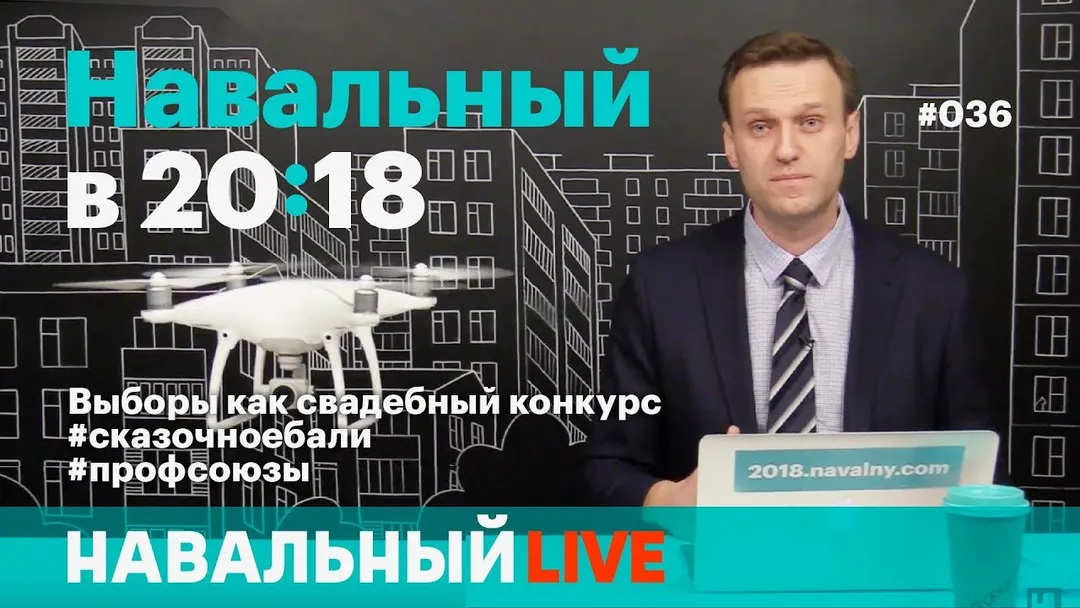
Elections like a wedding contest, #fairytaleBali, trade union dissolved
[music]
[music]
[music]
[music]
Hello everyone. It's 8:18 p.m. in Moscow, which means
that we're live in the Navalny LIVE studio. I'm Alexei
Navalny, here to discuss with you
the latest news of the day.
My nickname today is Alexei
Navalny, or "a serious man," as
Alexander Rumyantsev called me,
the co-chair of Vladimir Putin's campaign.
You see, sometimes you can even get a bit of
praise from these people.
Let me remind you that you can ask questions
on Twitter. Please send them
using the hashtag #Navalny2018, and I
will read them and answer them. And I
also remind you that today's broadcast—
today's broadcast—
we're continuing to raise money.
I thun—
Well, that was a tense moment in
today's broadcast. We're continuing to raise funds
for a new drone, one that will replace
our Volodya, this very one
that brought a lot of joy to all
Russian citizens and a lot of frustration
to various officials, because we filmed
all of them with Volodya. But now it's become obsolete,
so we need a new drone
that can fly farther in order
to overcome all sorts of
barriers and obstacles that they keep putting up
farther and farther out around the perimeter
of the properties they guard, which for us are simply
of course just sites
where crooks have invested their money. Let me
remind you that the grand prize goes to the person
who donates the largest amount
toward our new drone. We need to raise
a total of 450,000 rubles (about $7,700 at the time).
The grand prize is that the drone will be named after
that person. And right now the standings are as follows:
In third place we have user
dimon, who donated 8,500 rubles, and for now
is in line to receive our branded hat from
our store.
In second place is Kirill Yudin with 10,000; he'll get
a hoodie.
And in first place, with 18,200
rubles, is the user named Trump.
So based on the current standings,
most likely the new drone we're raising money for
will be named Trump. But then,
what is, in fact, the main
political news? What's happening in
the country? And the answer, of course,
is that in the country
there are these frantic
truly frantic attempts
to come up with something to boost voter turnout,
because the election itself isn't visible
in the form of debates, or political discussion,
or really in any form at all—nothing
shows up in the media or anywhere else. And all
week we've seen only news about how
the Kremlin decided to lure us to
the polls. And a very funny article came out in
the publication RBC, where they fairly
thoroughly described the mechanisms
Kiriyenko came up with in order to
draw people to the election. They include
actual contests, actual
some kind of
entertainment—really, it's very funny. Among
the things mentioned is one
called "Big Family Games."
"Photo at the Election" is actually
a selfie contest: we're supposed to come vote,
take pictures, and through a fairly
large and complicated selection system, there will be
winners. There will also be school referendums.
I have no idea what schoolchildren will be
deciding in those referendums—what decisions they'll make.
Maybe they'll pretend to remove principals and appoint
someone else in their place: "Let's appoint
the gym teacher instead." But I think the Kremlin is ready
to go that far in order to solve the turnout
problem. There's even some contest
called "Star Voters"—I don't really
understand it. Besides that, yesterday the outlet Mediazona
reported that referendums
really will happen, and they published
information saying that in
the Maryino district, my home district,
a decision has been made that there will be
a referendum held simultaneously with
the presidential election on merging
the Lyublino and Maryino districts. It all sounds
very strange, but it basically
confirms everything that, quite recently,
Yevgeny Roizman, the mayor of Yekaterinburg,
told us when he said that the authorities care about nothing
except turnout, turnout alone. And to boost
turnout they'll resort to all kinds of
exotic methods, including
referendums.
Some people doubted it, but it's obvious
that Roizman was telling the truth. Let's listen to 40 seconds
of him to remind ourselves
what he told us: direct instructions
have been given to ensure the maximum possible
participation in President Putin's election and
to guarantee maximum turnout.
As of today,
the main task is turnout. Here, as I understand it,
they are planning to hold
a referendum—that is, they'll launch, they'll start pushing
a referendum on whether to remove
the Lenin monument from 1905 Square (a central square in Yekaterinburg). Let me tell
you one more serious thing: all
financial-industrial groups have been given
well, let's say, instructions—wishes
that are more serious than instructions—
to collect signatures. They will be collecting signatures
here in the region
for Putin and Sobchak.
They will be collecting signatures for two candidates.
Signatures. I think all of this
is not enough. But it's not enough simply to have
referendums and some kind of flashy contest.
Electoral, in fact—here's what I want to say.
While I have the chance, since I'm sure
the Presidential Administration is watching our
wonderful program—maybe they'll even
show a clip of it to Putin—guys, I'll
tell you how to solve your problems. I
know: you're just out of touch with ordinary people and don't
remember what kinds of contests actually
get people going—get the whole country going. So,
a selfie contest? That's ridiculous.
Let's think about it together: every one of us
has been to a contest, and it's the kind of contest that
you remember for years. It's
of course not some selfie contest—it's
wedding games.
That's the country's main entertainment genre.
I'm more than sure that
the overwhelming majority of viewers
have been to weddings, and when the tamada (wedding host) there
announces a game, everyone just
tenses up like this and thinks, "Dear God,
dear God, please, anything but
me—just don't drag me out there right now
to take part in this game." That's
what we need. I think that at every
polling station, Putin personally,
Kiriyenko, and all the others should
organize games like that, and the entire
election process—the whole election process—
should be organized exactly
like those games are run.
Then turnout would rise. For example, why drop
your ballot in like this—pull out a boring
piece of paper and put it in the ballot box—when, like in a game,
this is how we ought to
vote.
[applause]
[music]
Come on, admit it—that looks much
cooler. And how much more interesting it would be for observers
to count. They can count it, but if it's done this
way...
Still, holding a piece of paper like that isn't very
convenient. There's another well-known method of
voting that we can borrow from a
wedding.
[applause]
[music]
The pencil-in-the-bottle game—it's just
a classic. Every one of us has seen it, every
one of us still breaks out in red blotches
from sheer, horrible embarrassment
that we saw it and can never
unsee it. And at polling stations, that's exactly what we should see,
precisely that, because these
games
that we all feel ashamed of in front of each other
are very close in spirit to these elections,
because these elections are themselves a shameful spectacle.
This whole inflating of turnout—what
the Presidential Administration is doing—is
turnout inflation.
And weddings—weddings in particular—best of all
show us how they manufacture turnout.
[music]
[music]
[music]
[applause]
See? That's exactly what's
happening: on one chair, Putin,
on the other, Medvedev—they jump, jump,
jump, inflating turnout, and then—bang—
the climax, it explodes, and Putin once again
becomes president. Great, right? That
would attract people to the election, it would attract them.
And in general, the whole election process—
why is it so boring if we have such
great weddings?
If we're talking about debates, then let's
remember the famous game that I'm sure everyone
knows—the famous contest of who can
do it faster, or rather, how the debaters can pop
a balloon. That's what I think
the debates between Sobchak and Grudinin should
look like.
And
prize.
You admit that I'm right—just
admit that no selfie contests,
none of those little gimmicks they've
come up with, can replace this.
That's all. Listen, just now it was
announced last week that the Moscow
Regional Election Commission
had purchased some keychains, pencils, and
notebooks for 236 million
rubles (about 2.6 million USD).
Why? Why is any of this necessary? We're throwing away
huge amounts of money, hoping that
people will come not for a notebook,
but for a balloon, and for candidates
who, like at a wedding, enter into debate using
a balloon—and then people will go
to the polling stations, and those will be real elections
for Vladimir Putin. Beautiful—and, by the way,
as you've probably heard or read
in the newspapers, this is an official instruction
from the Presidential Administration:
to make sure there is
a festive atmosphere at polling stations. I think our
wedding traditions would create exactly that kind of
atmosphere. Besides all that, the referendum
I already mentioned—I personally
am baffled, because
it has been announced that in Maryino
there will be, in Maryino and Lyublino, a
referendum on merging these districts.
Well, apart from the fact that substantively it's
meaningless even to discuss this—it would create some kind of
super-district with a population of 500,000
people—
the question arises: how are they going to lure people
with the idea of such a referendum?
I don't really understand what the residents of Maryino
Sure, but they have to rush in order
to vote for the merger
of the districts, or conversely to vote against
the merger of the districts. And probably
the only thing one can assume is that
they’ll simply start intimidating election officials.
So Zinaida Petrovna will be saying in
her news feed, can you imagine:
“Those bastards have called a referendum — the liberals
have called a referendum, they want to merge
our districts, and our local clinic
and move Mariinskaya somewhere else, or vice versa.”
And so we have to go out and vote,
because otherwise, can you imagine,
we’ll have to take the bus just to get to the clinic.
Right, that’s true. And as far as we understand,
at the moment, based on whatever
inside information there is from government
agencies, such referendums are being planned
across the country and all over Moscow.
They just want to announce them and
present it to us as, “Folks, you’re going to have
a referendum directly in March.”
Which, by the way, is very interesting, because
a referendum is practically such a
prohibitive procedure — to hold one,
you have to collect votes,
signatures from 5 percent of the residents of that
locality — here, of the districts — and that’s
simply unrealistic, can you imagine?
There, within some compressed time frame, in a month,
to collect signatures from 5 percent of residents
and to do it secretly from us as well, so that
then directly in March they can say, “Oh, there will be
a referendum, they collected the signatures.”
Well, it’s obvious that this will be a gigantic
fraud, a massive forgery of those very
signatures. So anyone who knows how
this is being prepared, please send us tips,
and we will do our best
to catch these crooks. But apparently, yes,
come on, he’s right — this will happen all over the country,
and they’ll try to deceive us.
The idea of, “Well then, let’s
take part in referendums,” has produced a lot
of amusement. I saw on social media — after
that article in Mediazona (an independent Russian outlet), several
tweets really drew attention to genuinely
great ideas.
For example, people think that, well, if we’re going
to hold a referendum, then let’s hold
a referendum on real issues,
not on merging districts. For example,
Samara and Saratov — let’s hold
a referendum on renaming and
merging Samara, Saratov, and Saransk
so that
first, we change the name, and second,
we combine them into one region. For example, you could
merge Marino and Maryina Roshcha (Moscow districts with similar-sounding names).
Okay, okay, I see the progress bar on my jokes
has stopped because we just held — let me
clarify — am I right in understanding that we
raised the money for our drone? Apparently the fact
that it flew into the frame here made
such a huge impression. Am I understanding
that correctly?
We got a donation of 30,000 rubles (about 300 euros / 325 US dollars). What’s the name of this
person? There wasn’t one? Well okay, our new drone
will be — hooray. I mean, I’m incredibly happy. It’s a
strange name for a drone: Nebula.
But the thing is that some person just
made a one-time donation of 30,000
rubles (about 300 euros / 325 US dollars), if I understand correctly.
The investors are proposing to name the drone
in honor of the newest blac chyna oblacheno — I don’t
know what that means.
I assume that somewhere some crafty people
decided to advertise themselves this way,
but one way or another, we raised the money.
In accordance, in full accordance with
our promise, the new drone will be
named Nebula.
Maybe in some strange
language it’s a terrible swear word, or if you
read it backwards it turns into
“Glory to Putin,”
or some kind of abbreviation, but in any
case, the successor to our Volodya will be Nebula.
So, I congratulate the winner — get in touch
with us then.
Accordingly, Trump gets
our signature hoodie, and Kirill Yudin gets
a branded hat. Guys, thank you
so much to everyone who took part in raising money
for the drone. It’s not about the prizes — it’s about
the fact that this is our solidarity, this is our response
to the authorities. Together we’ll raise money for new drones
and keep filming.
Alborov is sitting right here. It’s a pity that you
can’t see how happy — happy, very
very joyful — he is that there’s money for
a super-drone. Which exact drone it is, you can
read about on his Twitter — he explains it there in detail.
He writes about it there. Let’s get back to the referendums.
So yes, you could merge Samara and Saratov,
you could, for example, merge Marino and Maryina
Roshcha so that no one gets confused. Well,
in the end, one of the
users on Twitter also pointed
out that you could hold a referendum on
moving
Kotelnicheskaya Embankment and the high-rise on
Kotelnicheskaya to the Kotelniki district.
The joke is only clear to Muscovites (residents of Moscow), but
it actually shows very well
what these referendums really are.
But I’d suggest taking a really hard-line approach altogether:
if we want a referendum and we want everyone
to show up, let’s announce a referendum on
mandatory same-sex marriage, and then people
will come out, and you can also say, can you
imagine:
“The liberals secretly collected signatures with the
help of the U.S. State Department and want to hold
a referendum, and there will be mandatory
same-sex marriages — all the men will be
counted up and married off to other men.”
And the only way to stop this
is that all across the country there will be a rallying cry, and Putin will
be shouting, "Vote for me"
and also, go to the polling stations and make sure
that we don't end up marrying men off to other men anymore
and then men will go, and
men and women and everyone else will go
And honestly, jokes aside, I
have no doubt that something like this
some hellish thing, like "you want to take Lenin out of
the Mausoleum" (Lenin's tomb on Red Square)
or something along those lines, they will definitely
use it, because they have no
other way, simply no other
way to lure people to these elections
because the elections are a complete sham. By the way,
have you noticed that almost
nowhere are there any opinion polls? Usually
before elections we're flooded with
ratings, this rating, that rating, look
at the ratings
Why are they doing this? Because, well,
obviously fake, fake
ratings—no one would believe them, while publishing
the real ratings would show people
the lay of the land in advance
After all, the Presidential Administration
put together this lineup of candidates
and created a situation in which Putin
is guaranteed to get his 70-plus
percent, because the other candidates
aren't doing anything and aren't capable
of gaining any votes. So we—I
just want to announce to you that the Anti-Corruption Foundation
(FBK)
and our voter strike штаб are starting
to conduct weekly nationwide
opinion polls. You remember that
experience has repeatedly confirmed that
our opinion polls are the most accurate
We have a methodology, and we absolutely
do not lie about the results, and we
will be doing this every week—
a nationwide poll, and I will publish its results
right here in this program
So every week, through this program, you
will get the best-quality
polling data. We need volunteers who
will take part in this. We already have quite
a lot of people who are ready to conduct surveys in the
evenings, but since we also need to survey
the country's Far East, we need people
who are ready to work
and help us. We'll teach you everything, and
we especially need help in the first half of the day. And if anyone in
Moscow wants to take part in this very
important work, please come by if you have questions
to our штаб at 13 Vostochnaya Street
It's open daily from 11:00 a.m. to 8:00 p.m.
18 minutes
Come by, they'll talk with you there, and we
will figure out when it's more convenient for you to work. We will
teach you everything and send you to the call center
where, in good company, you will
take part in conducting surveys. I also
go there quite often and also
take part in these surveys, and we will
tell you about the candidates' ratings
By the way, we keep talking about the elections, the elections,
the choice, the candidates—what has been happening with the
candidates over the last
week, over the last two weeks? Because
during an election campaign, and during its
official phase, there are two especially
intense moments. The last super-
intense moment is those two or
three weeks before the end of the election
campaign—there should be debates, there should
be heavy advertising, and in general the candidates
should be working themselves to exhaustion
But in a sense, an even more
important moment is now, when candidates
have to collect signatures. Exempt from collecting signatures
are, in our case—who is it?
Grudinin, as the candidate of a parliamentary party, and
Zhirinovsky—they do not have to collect
signatures. All the other candidates, including
Putin, and first and foremost Putin, they
are actually supposed to
collect signatures. Some need 100,000
—Yavlinsky, Sobchak, Titov
some need 300,000—Putin, and then there
will apparently also be a couple of self-nominated candidates
I look at this and I'm amazed. In our case,
starting from January 2,
I and my entire штаб would have gone into
you know,
a mode like a hysterical squirrel—you've probably seen those
pictures on the internet, those squirrels
jumping around a tree screaming, "Oh my God,
this is a disaster, it's a tree, a leaf, a leaf,
it's a leaf, we have to do something!" Because
collecting signatures is very hard. We
spent a year building the system
for a year; we have штабы in 84 regions. We
understood that as soon as the official
signature collection began, we would
be catastrophically short on time. It's very
expensive, very difficult, and during
this program I wouldn't be fooling around with a drone
named Vova or whatever they were going to call
our next drone. I would simply, every
second, be saying: guys, come
and give signatures, we need them. In Moscow we've
already collected them, in St. Petersburg we've collected them, come in
Lipetsk, come in Oryol
It would be super-intensive work
—the very reason we built this whole network. And
just look at how these guys
are collecting signatures. It gives the impression
that, I don't know, kind little gnomes are
doing it for them. These candidates, you know, they
sit there with cigars
and basically do nothing. They don't write
these appeals on social media, they
don't travel around, they don't hold any rallies. As for
Putin,
an astonishing thing has happened with him
In various shopping malls, some kind of
booths have appeared, set up at different spots.
There are some boys and girls standing there, and the entire
internet is full of accounts showing that
if you stand in front of one of these booths, you
will see that over the course of an hour, two or three
people come up to it. So, signatures are not exactly being
collected
in any serious numbers. The others are not really doing it at all.
From that point of view, they are doing nothing. And yet,
this is an enormous, extremely intensive job. I
do not understand how this is happening, and I want
to tell you once again: I know that
the candidates get offended by what I say, but I want
to say that, of course, all the signatures they
take to the Central Election Commission
(Russia’s federal election authority) will, of course, be fake, and
we can see that this is exactly what is happening.
It is impossible to collect them, have them notarized,
have the signature gatherers certified, get all these
papers properly filled out,
distribute them across the country, fill them in,
sort through them, stitch them together, check every
signature, cross out the invalid ones, and send them off
here. We have done this many times. It is a very, very
complicated job. But nobody is really
doing it at all. Where are all these candidates? When I
hear that Yabloko (a Russian liberal political party) has already said that
they have supposedly collected 70 percent or
60 percent of the signatures—how did you
manage to do that in such a way that
literally no one in the country even noticed?
Without any real launch, without any visible campaign
effort. And of course, from the standpoint of
active participation in collecting signatures,
the person who probably surprised us most this week was, of course,
Ksenia Sobchak.
This made an impression on our campaign headquarters,
in particular because Ksenia is supposed to be
actively collecting signatures right now, and instead she
went off—I do not know to collect signatures or to
do whatever it is people do in Bali—and
here you can see photos from Instagram:
some hotel marked in red,
some corporate event there, maybe Anatoly is hosting it,
or maybe he is not hosting it,
but in any case, a candidate who
says, “Guys, I am
an opposition representative, I am running in these
elections,” during the most crucial and
very short period allotted for collecting
signatures, went off to Bali. But in fact,
the issue is not really Ksenia. After all, these
seriously—did we really expect
some different vision or format
for an election campaign? It is just that
her trip to Bali specifically made me think of
something. Do you remember that
hashtag—I cannot quite say it outright here—“fairytale Bali,”
I will not pronounce it as one word. It was a well-known
internet meme; everyone remembers it.
Some girl went to Bali and posted
beautiful photos of herself there, on the waves,
with her hair flowing and all that, and she
decided to use the hashtag “fairytale Bali,” but
the girl made a rather unfortunate mistake—she did not think it through—and
put the two words together, and I
thought: you know, this is actually
the universal hashtag for what is happening
in these elections. You only need to add
a little something to it: a fairytale
screw-over of all Russian voters—and I apologize, but I
could not resist. It was just sitting there
in my head, and I thought I had to
say it to all of you. That is exactly what is connected with
elections in Russia. So there is no need to
go to them if you do not want to be treated the way
that Bali meme implied.
There is no need to go there—it is shameful and disgraceful.
Why do it? Why take part in this
campaign, where Putin is guaranteed 70
percent, and all the other candidates are, well,
busy with things like this? Do we want
to be part of all this? No, we do not.
That is why I urge you to continue
demanding real elections, to continue
demanding that your voting rights be returned to you.
That means you need to take part
in our
voters’ strike by every means possible.
Simply—just encourage people not to
go.
Do whatever you can, whatever is possible,
to make sure that no one goes to
the elections. Take part in our rally
on January 28. In the description to this video there is
a link—go there, find your city, and
come to the demonstration. This is not a rally for
Navalny’s registration anymore; that is no longer the point.
This is a rally to demand that our
political rights be returned to us. It is a rally for the idea
that we must be reckoned with. It is a rally for the idea
that we are not prepared to call this
a presidential election, and that we are fully
ready for there to be real
elections, real candidates, real
debates that would take place over
a substantial period of time, and for there to be
candidates who would fight for our
votes. We refuse to take part in this,
and every single person can
make their contribution to this voters’ strike.
And listen, if they
are hanging all this nonsense up in
every apartment building entrance—you have seen those
logos,
the Central Election Commission (CEC) leaflets and papers saying
“everyone, come vote”—they are going to do repeated door-to-door canvassing,
they are going to go apartment by apartment twice over,
and your building entrance,
your school, your university, your
institution—everything will be plastered with this
filth. Of course they will spend billions of rubles
on it: “come vote, come to
the elections.” Well, if they are sticking it up in your building,
take a marker and write over it
whatever you want. If it is hanging there, or if it is in
your school or university, then take out a pen and
Write that too—tear it down, we need to fight against
them. Water doesn’t flow under a lying stone (meaning: nothing happens unless you take action).
I can’t directly call on you, I don’t know,
to damage any large structures,
because someone could already
interpret that as causing damage to property.
There are billboards up, though—for example, in the city of
St. Petersburg,
the Central Election
Commission put up this thing at
the entrance to the city of St. Petersburg, and then,
a couple of days later, someone wrote on it:
"Strike on January 28." Well done.
Well done, people of St. Petersburg—whoever did that.
That’s exactly how this should be fought, and there’s no need
to consider it vandalism. These crooks take
our money in order to advertise
this fake thing they call
elections. This cannot be tolerated; this
must be fought with all our strength.
Everyone, please take part. So, I’ve
gotten carried away and haven’t been answering your questions.
Sorry. I’m opening the feed with the hashtag
#Normal2018. I’ve received a huge number of
messages about some kind of campaign
called Flowers for the Police. Everyone is asking me about
it, and I don’t know what it is.
But after this broadcast I’ll look into it, and on
the next program I’ll tell you what
Flowers for the Police is. For now, I don’t know.
Alexander Lyapin, alright, I see it—I’ll say it.
Use the hashtag #FairytalePain.
Tell us about the preparation of lawsuits
to the district court and, above all, to the
Constitutional Court. We are preparing them, yes.
These are almost unrelated processes. I am supposed
to be in Strasbourg on January 24, and I will be there
speaking before the Grand Chamber on my
case concerning administrative detentions. There
the question will be decided whether they should be recognized as
political or non-political, but
this is not connected with the elections and not connected with
my being barred from them, actually.
Really, let’s close this topic: no
European Court or European Union is going to help
us achieve normal elections. Only
we ourselves can do that. We will go through all these legal
steps, but there’s no need to
[music]
pay too much attention to it. Here, Yozhkin
writes angrily: are you going to answer questions today
or not? Well, I am answering. So—Flowers
for the Police, Flowers for the Police—everyone is
asking about it nonstop.
And how do we fight fraud if one
person can go around 10 polling stations and
cast votes, and what if there are 250 such people?
How do we fight turnout falsification? We won’t
be able to remember each and every one. Thank you.
Jeffrey, that’s exactly what distinguishes our
strike from a simple boycott. It’s not just
about not going to the elections—we will try to deploy
a huge number of
observers. And when I say huge,
I really mean
tens of thousands. Our election-monitoring
movements, various parties, and candidates
have done this many times, but honestly,
let’s be clear: no one has ever
simultaneously deployed an effective,
coordinated force of more than, say, 7,000
observers—8,000 at most, maybe 10,000. And if they were deployed,
it was mainly in Moscow and
St. Petersburg, first and foremost Moscow.
In the city center, we know there were as many as 8
observers at a polling station, while on the
outskirts there were far fewer. We will be
covering Bashkortostan (a republic in Russia) with observers,
Tatarstan (a republic in Russia),
Dagestan (a republic in Russia), Mordovia (a republic in Russia)—the regions where
lawlessness is happening. So that is exactly how
we will resist. We are
boycotting the election, and we are taking part in
the strike, but that does not mean that we
have shut our eyes and are doing nothing. We
are monitoring this process, we are watching
it, we are commenting on how it unfolds, we
are mocking it, and we are deploying
observers in order to
control it. That is absolutely essential. So,
Flowers for the Police—well, I don’t know what
the Flowers for the Police campaign is, but its
organizers can definitely
mobilize a fairly large
number of people.
Because everything here is simply flooded with
questions about Flowers for the Police. Trooper Harley
asks me: how do you
comment on the rumors that
Putin has long been dead and the country
is being ruled by his clones?
Well, I’ve seen the same very funny
compilations about there being different Putins, but
of course he’s not any kind of clone—that’s the real
Putin, actually. It’s just that he seems to me
to have gotten a little too carried away
with plastic surgery, and it may not
have gone especially well for him,
but there are no clones there. It’s really
the actual Putin himself.
Islam Yusupov: my mom at work—she’s
a teacher—at a staff meeting they were handing out
leaflets that said, ‘We are for
Putin.’ The principal said, ‘You must
sign this.’ They replied, ‘What if we don’t want
to sign it?’ He answered, ‘It’s already all been
decided for you.’ Khasavyurt, Republic of Dagestan.
Islam, well, the boss has decided that
everything has been decided for you—you’re for Putin. But
if the teachers say, ‘We don’t want
to sign this,’ and the answer they get is, ‘It’s been decided
for you,’
well then, if it’s decided, it’s decided—take your leaflet back.
Hand the leaflet back.
There’s no need to argue with the boss. Just
tell the other teachers—let your mother simply
say:
‘Oh, if that’s how it is, then we won’t go, then we…’
We'll tell our neighbors that we won't go.
Then I'll ask my son Islam
to come to the polling station and observe how many
people showed up. But we've seen this happen in Dagestan (a republic in southern Russia), too.
It happened there, and we did the same thing quite
recently in Tatarstan (a republic in Russia), when there were
referendums there. I talked about this
on the program. At the polling stations where we
placed observers, turnout was 20
percent, 15 percent, 10 percent, while
where there were no observers, it was again 85
or 95. So there's no need—well, not always a need—
to enter into direct confrontation unnecessarily.
You don't need to grab a boss, take away leaflets, or throw them
in his face. He's exactly the same; he's not for
Putin either. You just need to quietly and persistently
do your job: don't go, campaign,
observe. Well, and maybe flowers for
the police. Sergey writes, clarifying that it is not
the rally participants on January 28 who want
to give flowers to police officers
to show their peaceful intentions.
What do you think, Alexei?
Well, I think that's normal, and
these kinds of actions have taken place everywhere.
They've happened in many countries; it's one
of the more common flash mobs
during peaceful demonstrations, when
the authorities are trying to prove that
the demonstrators are villains from the outset, while
we, on the contrary, give flowers to the police. You just
have to be prepared for the fact that, of course,
the authorities—as on the Maidan (the 2013–2014 protest movement in Ukraine)—
did the same thing, and Ukrainians did the same, and
Serbs did the same, and in Egypt the same
thing was done too.
But in any case, you'll say, well,
overall it's not a bad action. Right now more than a hundred
cities are taking part in the January 28 action.
Once again, you can find the link in the description
and check it out. If in some cities this
can still be organized, it's still a good
idea. It's peaceful, it's a good idea, kind and
sweet. What do you think about the gambling
business in Moscow? Well, I think the gambling
business exists, despite claims that it was shut down.
We were told that it
had been eliminated; there is much less of it now,
but illegally it still exists in fairly
large numbers. The last time I was
in a special detention center, there was a guy there who
worked as a security guard at an illegal casino.
He told me quite a lot, and very interestingly,
about how it all works. But the main thing is
that, of course, all of it is
covered by the police. Everyone knows it; the
police bosses themselves go there and gamble,
and money gets kicked up to them. In other words, it's all
arranged exactly that way. There's one topic
that
the press has talked about very little, but it seems to me
that it's really very important,
especially in the liberal press,
especially among supposedly advanced people on
the internet. For some reason, they think that questions
of the trade union movement are somehow
strange and not in the least
worthy of attention. By the way, yesterday
something happened that is fundamentally
important and very clearly
shows the transformation and
mutability of this political regime.
By the way, this year, on February 1, I think,
it will be 100 years since the beginning of the real
trade union movement in Russia, when the first
trade unions were registered.
Yes, the anniversary. And now, in this anniversary year,
the Ministry of Justice has moved to liquidate one.
At the same time, the Ministry of Justice
and a court in St. Petersburg satisfied the claim
of the city prosecutor to dissolve the trade union
of workers at auto industry enterprises in
Russia—the interregional trade union Workers'
Association. This is the first time a court has
dissolved a trade union through judicial proceedings.
Why was this done? We know what a trade union in Russia
officially is, and what the trade union movement
officially consists of—the so-called
Federation of Independent Trade Unions.
It is, of course, a gathering of utterly corrupt
people and collaborators—
Putin's lackeys, who received
a huge amount of real estate from the
Soviet Union era—trade union property—
and now in front of Putin
they're ready to stand on their hind legs.
They vote to support all
bills, including those
aimed against workers. They have repeatedly nominated
Putin for president, for all 18
years. So, in other words, this is an absolutely
collaborationist organization. But in
Russia there are a few—very few—independent
trade unions, and there is one union that
really organized work stoppages and
strikes in order to win
higher wages for workers—working people,
which is what a trade union is supposed to do. And
it was they who organized strikes
in the Leningrad Region, in Vsevolozhsk,
that is, the very same people at the factory
at Volkswagen in Kaluga Region, and everywhere
where these foreign
cars are assembled, where at least some
sort of, you know, at least
formal measures are in place to pay
workers somewhat higher wages, where there is some kind of
foreign management—there, people
came together and began, quite
reasonably, in fact. They did not demand
enormous salaries; they demanded
reasonable, normal wages, organized
work stoppages, and achieved all of this. There were
attacks on union leaders there,
beatings,
and one of their leaders, Tumanov,
was beaten—he was even
nearly killed several times, and now
The authorities dissolved this trade union.
Through the courts. This goes to the point that
our struggle against Putin and against
this regime is not some kind of struggle by
you know, hipsters
or freelancers, journalists, people
in creative professions, and so on. They are all
with us, but this regime is a gang
of thieves. There you go: they are oppressing workers,
they dissolved a trade union.
It may have seemed, God, that we were just
these trendy city dwellers,
walking around with cups of coffee, and like this,
here we are, all bearded, while the real
workers demanded a pay raise. No,
you will not get a pay raise.
We'll shut the union down — and they did.
Do you know why? Because this trade union
was a real, proper one: it joined
an international trade union movement,
that's how it is organized, and they
sent them some money, because, again,
that is how the international trade union
movement works: wealthier unions and those same
auto industry workers there
were helping their fellow workers and colleagues here
in Russia, and because of that they were declared
"foreign agents," and because of that
they were dissolved. So the only
trade union — or probably the only one that
organized strikes — has been dissolved. This
actually shows how broad
our movement must be, can be, and will be,
because everyone will join us on this issue:
all the people who do not like
political prisoners, people who do not like
censorship, people who do not like
obscurantism, and people who do not like
having their labor rights violated,
who are denied decent pay,
Where else are they supposed to go — to court, to
United Russia (the ruling political party), which supports
liquidating it? The Communists, who in fact
should be the first to stand up for
workers' rights, are silent, keeping quiet.
They say nothing about it at all. Who is
speaking about it? I am. We are.
We are speaking about it. This is actually very important. I
urge everyone, first of all, to study this
situation. Second, I urge all
journalists to write about it actively,
and human rights defenders to help. By the way,
today Agora (a Russian legal and human rights group), one of the few
real, significant
human rights organizations, wrote a lot about this,
and of course I want to express
my gratitude to all the workers who were
members of this trade union.
All right, let's see what else
you are asking me. You can find out about the action on
the Zhukov Blog channel, as I understand it — that's about
flowers for police officers. Go there. Alexei,
it is very important to know the title in the Great
Punic War — I am not ready to answer
that question. Hello, Alexei
Anatolyevich, listen to the song "Russia for the Sad"
by the band Ploho. Actually,
it has often been played at my rallies. You know
that I have often spoken about this slogan:
"Russia for the Sad." Inferno overkill.
Where did the dislikes go? Did they ban everyone, or what?
Let me check. So, we have
2,394 people — sorry, 20,000
20,000 watching us.
8,000 likes. Come on, guys, use your
mouse there, click like, and then
the video will get boosted and more people
will see this broadcast. Where did the dislikes go? I do not
know, but maybe YouTube finally
banned those things that
exist — there was some news this morning
that YouTube had in fact
banned some of those Kremlin-linked
channels that were engaged in artificial boosting,
but possibly — I hope — some, some
steps will be taken. Bulat
asks: Good evening, why don't you
buy TV ads so that older people
would know who Alexei Navalny is? Bulat,
are you joking? What TV advertising?
The social network VKontakte and even Yandex
refuse to sell us advertising.
They say that they do not accept
political advertising. It is an interesting
thing, because literally
last week VKontakte ran
an ad for Sobyanin, and everyone asked them
a reasonable question: how is it that Navalny
was demonstratively refused many times over, while
Sobyanin's ad is somehow not political advertising?
And VKontakte sort of squirmed around,
mumbling vague things like,
well, Sobyanin is the mayor, so his advertising is
not political advertising.
But Navalny, since he is not the mayor and not
the president, his advertising is political.
Well, in fact, it is obvious.
They are hypocrites and cowards. For all my
love for the social network VKontakte,
its managers are now, without a doubt,
people who serve the interests
of the authorities. So, sadly, that is the reality. We have many times
wanted to buy advertising
everywhere; I think in some places we actually do,
but TV is absolutely closed to us. Maybe
you remember, Bulat — and if you do remember,
you will find an interesting
and funny story on my blog. In 2015 we
took part in elections in Kostroma (a Russian city),
Ilya Yashin took part there, and PARNAS (an opposition party); we
supported and organized that campaign, and
I went there and took part in local debates,
and we just sort of
decided, rather brazenly, to go ahead and buy
several billboards there. And one
fine day people went out
into the street and saw a billboard, and on it there was
Navalny sitting there — his photograph, if I remember correctly.
It was there, and in the end we put it up in
Twitter after all—pretty impressive, right?
People were already celebrating, joking, and
laughing. The following night, they arrived—
some guys just took those billboards
down. I mean, not just tore them down, you know,
not just ripped off the paper—they actually
told the company that had sold us the ad space
that their billboards,
their structures, were illegal, and literally cut them down
with an angle grinder. So that's how it was. Bulat, so—
someone suggests
I don't have 331,000 rubles
but we need to name the drone Sauron.
A beautiful name—Sauron, yes, a beautiful name.
Listen, we promised that we would name it
after whoever donates the most,
in honor of the biggest donor.
Alexei, how do you feel about the idea that in
elections only actual
taxpayers should take part? asks
"American Spy." That's the question from
American Spy. No, I'm against that.
There are many different theories that
there should be a property qualification,
an educational qualification, so that
only these advanced people, like,
"we're smart, we pay taxes,
we're savvy, let's not let
those louts in"—or pensioners,
"they don't pay taxes, so let's have only
us vote." In fact, that's
a flawed system. It leads nowhere good.
There must be universal
suffrage. We simply don't need
all these tricks like "only
taxpayers." When all candidates
are allowed onto the ballot, then this
simply won't be necessary. So, Zhukov's bloc—
Zhukovka—we need to figure out who this Zhukov is,
because he's flooded absolutely all the
questions. Nadezhda Baranova: "Yesterday I almost
persuaded a Grudinin supporter, and today I
successfully called the audience of the
website to strike (boycott)."
So that means I'm great, I'm great, I
did well. Nadezhda, of course you did well.
Of course you did. Each of us should spend 5 minutes a day
on this, and then there won't be
any turnout, and Putin will personally
be dancing with a pencil, dropping it,
a bottle of champagne, or taking part in
those debates with Zhirik (Vladimir Zhirinovsky) just to
attract someone, of course, with huge—well,
this program, the previous program,
has so far been watched by 380,000
people. Let's say 80,000 of them
disagree and watched it only so they could
say, "What a scoundrel that Navalny is,"
what a scoundrel.
But just imagine—even 300,000, just 300,000
people, that's far more for us
than signatures. We can actually, in principle,
get everyone to do something for 5 minutes a day,
and that's it. Leonid writes: graffiti.
Draw graffiti, absolutely right.
Draw graffiti—just don't get caught,
please. And please don't paint
graffiti on any cultural or
historical sites, or anything of value.
What do you think about the YouTube channel
Anti-Kadyrov? I don't think anything about it—I don't know it.
So, Jeffrey comes back to me with
a question and scolds me:
"You didn't answer my question. At each
polling station there will be different observers; a person
who casts 5 to 10 identical votes
will still be the same person." But Jeffrey means the so-
called carousel voting, when
people vote in different places.
Organized transport—right, this is when
a car or minibus drives ten
guys around to all the polling stations, and everywhere
they vote. We'll fight that too.
Observers are not only at polling stations; there are also
mobile observers, observers
from the Russian movement who have worked in Russia for many years, and
we know all about mobile groups there.
We know the methods for fighting
electoral fraud, so
in any case, at the very least we will be able
to document all of it. So, Viktor writes
that by training he's an environmental scientist, and what kills him
is the lack of competence of politicians, including
yours and mine, on environmental issues. Everything
gets reduced to garbage, smokestacks, and deforestation,
so when are you going to educate yourselves on
environmental issues? Well, Viktor, if you
help educate politicians on this,
at least I'm ready to learn
about this issue. It's a politician's job
to keep learning constantly, and that would be
good. But I just want to say why
politicians so often talk about garbage,
smokestacks, and deforestation: because voters
are most concerned about those things. When they
talk about the environment, they mean
the quality of food, the quality of drinking
water,
the little park near their home, an incineration
plant they want to build, and the cutting down
of forests. So politicians, after all,
are responding to the questions voters ask them.
There are a lot of questions. I have
a separate topic about registering the Party of
Progress.
Today on my blog I wrote that we are
starting for the sixth time. Can you imagine?
For the sixth time. I think that even our
opponents have no doubt
that we have real support across
the whole country. In Russia, under the law,
you only need 500 people to establish a party.
Our movement alone had them in
20 cities, each of which had
far more than 500 people, and we've been doing
all this since 2012,
since 2012, and of course we have much more
More people support us in every—
in every city, in every town and settlement.
But now, for the sixth time, we’ve gone through
absolute hell: a congress, regional
conferences, an initiative group,
separate registration for each branch,
and it’s not enough just to gather the documents.
It’s not enough to submit them to the Ministry of Justice in Moscow; in every region
you also have to register everything separately there, and
then register the branch, then collect it all, then
submit it all—it's an absolutely hellish
procedure. We’ve done it six times. Twice
with the People’s Alliance party,
then the Kremlin, through its spoiler party, stole
our name and renamed one of
the parties under its control the People’s Alliance,
taking all our symbols. You probably
remember that absurd episode.
Then we started registering the Party of
Progress, and we even got it registered, and at
one point everything was in order for us
on paper. We prepared to
take part in elections, after which the Kremlin
decided, no, that’s too scary after all—they
might actually get in and win seats in
the legislative assembly. And we would have gotten in,
of course we would have. They were right to be afraid.
They had it dissolved through the courts—not
suspended, but outright liquidated immediately.
Nevertheless, we are starting this
for the sixth or seventh time now. Why? Because we
want to take part in elections. Yes, right now
we are organizing a strike; we are calling on people not
to go to these so-called “elections,” but
without a doubt, we want to, and we can,
and we know that we are ready to win in
a legal political struggle, because
there is no party, no political force, that
represents normal people in Russia.
There is United Russia, which is a pack of ghouls, and
then there are the other parties, but at best they are
just weak and
cowardly people who do not want
to work and are afraid to say anything.
So we understand perfectly well that such a
party would have enormous potential.
That’s the first point. The second is that we really do have
a huge number of
supporters. And yes, not everyone
is comfortable with the party form of
organization. Of course, many people
say: well, Navalny, I would vote for you,
but a party—a party is always
something crooked, and any
sociological survey shows
that among all public
institutions, parties are the least
respected. People do not trust parties, and
for historical reasons: no one has ever
seen a normal, honest party.
So how can they believe in parties
if a person has lived 40 or 50 years and
all they have seen is that parties are, after all,
crooks? So in principle people are not
inclined to trust them, and we understand perfectly well
that this is not for everyone in our
huge movement of hundreds of thousands of people. But
within it there are quite a lot of people
who want a party, especially in the regions,
because they need what you might call
a legal umbrella, so that they can
join properly and be able to take part
in local elections there, in their own small
city, town, settlement, or in a
big city.
They are ready to win elections; at the very least
they are ready to fight. But if there is no party,
you can go to some
registered one, but then you have to get down on one
knee,
kiss the chairman’s ring, so to speak,
sign some paper saying you must
support someone in the presidential election,
and so on and so forth.
Well, first of all, not everyone enjoys that, and
second, I would say that almost always, and
almost certainly, a person who can
successfully take part in elections and is ready
to win them will not do that. He will not
want to bow to some people there. We are
creating a party in which you do not have to bow
to anyone. From the very beginning, everything was
built on the principles of electronic
democracy, with voting throughout. It’s not
a matter of me appointing, for example, who
goes to the State Duma—all party members
vote on that. The political council
is also elected by all party members, not
by a conference, not by the heads of regional
branches. All party members can
vote. Why does this need to be done? So that
people who want to break through
have the chance to do so. If you get into
a conflict with the head
of your regional branch, then in the parties that currently
exist, no one will
let you rise any higher.
You won’t get to, I don’t know, the party chairman
so that he gets to know you. With us,
it works completely differently.
Campaign, talk about yourself, and people will
vote for you. And even party representatives—
whoever they may be, whether it’s me or
someone else—you do not need them at all, because
you can do everything effectively on your own
if you are a good politician. So
we are beginning this registration now. We estimate that
in the first days of January
we will be able to hold the founding congress.
It is very important. Right now we are submitting
documents to the Ministry of Justice, a notice to
the Ministry of Justice, and beginning to register
the initiative group. And we have calculated everything so that
if we are registered by then,
in the next elections, which will take place on
the Single Voting Day in September (Russia’s nationwide election day), we
will be able to take part in elections in some places—I’m not
saying in all of them; there are dozens.
elections, big and small, but somewhere
we will be able to take part
we understand perfectly well that the Kremlin won't
want to register us, and there is a high
probability that they will once again
shut it down, but probably from a political point
of view, it is harder for them to do that now
because, well, everyone can see it; it's impossible
to say, you know, what kind of party that is in
Navalny's case and his headquarters there, because, well,
they don't have 500 supporters across Russia—that
would obviously make anyone laugh
even someone who is critical of us
so yes, we are doing this and will keep doing it
I'm not calling on everyone to join right now
because for the purpose of, from the standpoint of
registration, but I need a great many
people; the more people there are, the more
paperwork has to be prepared, so for now
we are proceeding on the principle of minimum numbers
so that everything can be done quickly. So again, Zhukov
Zhukov, Zhukov, Virtual Auto asks me
why not nominate as a presidential candidate
one of your own people, for example Volkov
from among your people? That's not how it works, well,
just think about it yourselves: for us, for
all of us, it sounds humiliating—someone from
our own circle, like, okay, just point
your finger at someone and we'll run off
to vote for him because you pointed
your finger at him. That's not how choosing one of our own works
that way. Volkov can
take part; he is a very effective, honest
good politician, but if you want
to take part in
it, you should not be, you should not be there
taking part just because Navalny
showed you
or because you are his wife or a relative or
his chief of staff. You have to run
a campaign, travel around the regions
talk to people—that is what
real politics is. But fiddling with this
substitution—first of all, it's ineffective
and second, it simply won't work because
well, it won't come together that way; that's not
how it works. Ivan Ivanov asks me the following
question: are you morally ready to press the
nuclear button if it comes to that? Well, if
it really comes to that, then of course I am, but the task of any
president, of any normal person, is to
think about it with horror. I think with horror, in general,
even about the theoretical possibility that
someone might be pressing some kind of buttons
but this is exactly
it—and nuclear weapons are a weapon of deterrence
they are meant so that wars
never happen at all; in principle, so far
they have fulfilled that role. I mean, again,
if aliens were to arrive tomorrow
and, I don't know, we needed to shoot down their flying
saucer with a nuclear bomb, I would press it—well, if
if they suddenly started doing some bad things
only if they were bad aliens
Navalny, are you promising to introduce visas with
Kazakhstan? And what will you do if the Kazakhs, in
response, take away Baikonur? How is that any better than
Putin?
If instead of integration with our neighbors
you are proposing conflict with them. Andrei
Ivanov, Andrei Ivanov, I am not proposing conflict with
anyone. There is a visa regime
between Russia and Germany—are we
in conflict with them? There is a visa regime
between Russia and, well, with
a lot of countries that are friendly to us
a lot of friendly or relatively friendly countries in
Europe or Asia or elsewhere, and
believe it or not, Andrei, there is still
a visa regime with them. So I propose that with
Kazakhstan we cooperate perfectly well. No one
can take Baikonur away; the status of
Baikonur is regulated differently
by agreement; we pay money for it
separately. Cooperation on this with the Kazakhs
come on, that's nonsense. They are normal people
no one is going to take anything away, and they
also look to their own interests. But a visa
regime is needed so that we can
bring migration into order. There is no major problem
with migration from Kazakhstan to Russia
because in Kazakhstan now salaries are
even somewhat higher than in Russia, but any
effort to establish order begins with introducing
a visa regime
After all, no one in Europe is abolishing the visa
regime with us, and we are not trying to abolish it either
And now Alexei asks me
about Alexander Pochinok: what do you think about
the tax amnesty before the elections? Well,
what Putin announced is of course not
a tax amnesty at all—it's some kind of nonsense. They
are effectively amnestying those who already
were not going to pay anything anyway—things like
overdue debts, closed
legal entities, abandoned sole proprietorships, and so on. No,
of course there is no real tax
amnesty there, no genuine tax amnesty at all
Grigory Savich asks:
have you been in contact with Chichvarkin? He
often mentions you and comments, including on
the weaknesses of Navalny's presidential program
We are often in contact with
Chichvarkin; I am very grateful for his
support. He sends us money and he
raises money for us in order to
transfer it to us in the end. And as for the fact that he
criticizes us—well, he isn't Navalny
Chichvarkin has a coherent
well-developed system of his own political
views. He is a libertarian, and from
libertarian positions he criticizes
our program. That is how it should work
Chichvarkin criticizes us from the right
the communists criticize us from the left; our
program is, by and large, fairly centrist
That is normal. But in the course of this
criticism, he still says that
He would vote for me, and he
identifies with it; he is part
of this movement. That is the most important thing. And
policy debates should always
exist. Even within a single party there will always
be debates between me and you,
Grigory, on some issue. We will start
discussing what we like and what we do not like,
and somewhere we will inevitably find disagreements.
We will debate them, but that does not
mean that we cannot be part
of one and the same political movement. So,
can you be called the Russian Che
Guevara? They ask. No, you should not call me that under
any circumstances, the Russian Che
Guevara. There is really nothing
close about it, not in a complimentary sense
or a negative one. In general, all these comparisons
are rather meaningless, and
there is no need to resort to them. Oleg
Vaitman asks: how will you
develop small oil towns,
for example Langepas, with a population of 45,000? I
will develop them very well, because
they are oil towns. We will leave them a little more
of the tax revenue, and they will
prosper, as happens in Norway
and as happens in the United States, where there are
oil settlements in Alaska,
for example, and they prosper. They have a great
deal of money. But why else live in
Langepas and suffer from terrible
climatic conditions if your town is not
a town that is richer than all
the others?
Well, that is often the case to some extent.
Surgut and Nefteyugansk are a little richer,
better maintained, more decent than the average
Russian city, but not as much as they should be.
Not long ago, for example, Tyumen
— but you cannot say that it is truly flourishing.
You really cannot say that it
is flourishing.
But these towns should flourish in the
literal sense. There should be
a ton of money there. That is how it should be, because
these people live there, and of course the
oil they extract from the ground
belongs to everyone, and all of us
receive some share from it.
But they should get a little more, because they
have much colder winters, because they
hardly have a summer, because they...
because their children do not see the sun. Well, this
does not apply only to oil; it also applies to Karelian
nickel and everything else. But I have already gone over
my time. Let us take one last question.
With minimal turnout, the election will still be recognized
as legitimate, and Putin will become president.
The strike only shows the low
level of support for the current government. What is the plan?
With a strike, without a strike, with whatever, with
candidates or without candidates, Putin
will reappoint himself president. Now
understand this main point: there is no such thing as
an electoral strategy here. There is nothing you can
do at a polling station to
prevent him from becoming “president,”
in quotation marks. He has usurped this power and
seized it, and at the moment when they did not
allow me onto the ballot, they kept all of us — all of us, including you — out of
the election. They made it so that
there is no suspense at all, not even
a political process, not even debates.
There is nothing. No one can go on television and
say the right things. None
of this exists. So stop calling
this an election. It is a reappointment, and our
task over these next three months
is to demand real elections. Therefore,
take part in the strike.
Do not go there, and if you do go, go only
as observers.
Persuade everyone around you. Take part in the rally
on January 28.
There is a link in the description below. Choose your
city, register, and come
to declare: guys, hey, those in power,
Putin and everyone else, you are obliged to reckon with me.
You must take me into account.
Thank you very much. See you next Thursday.
[music]