The FSB bombing, rappers in service, and a lawsuit against VK
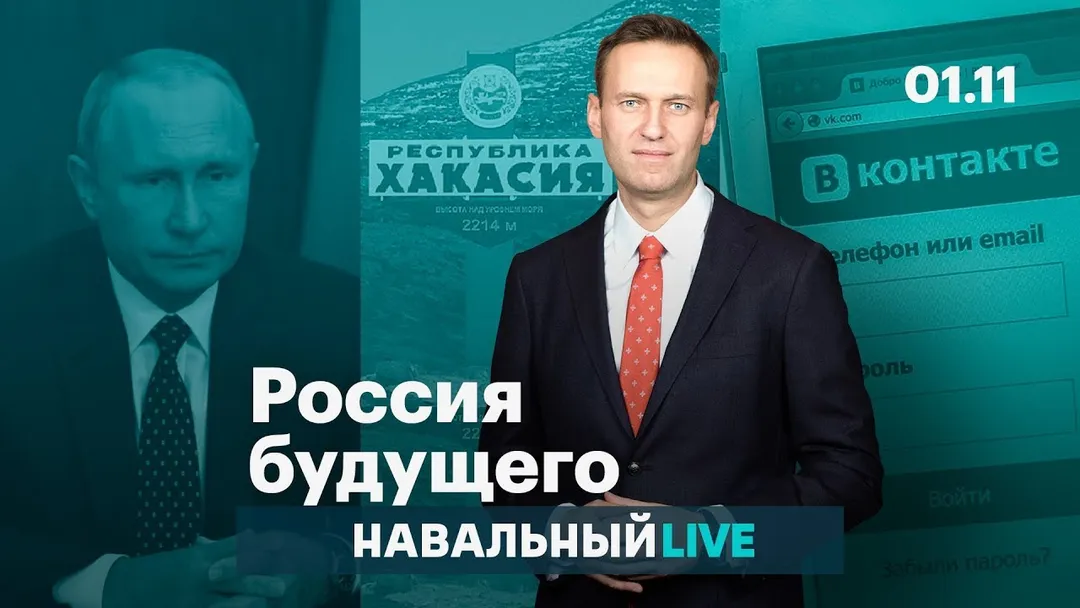
[music]
Hello, everyone. It’s 8:00 p.m. in Moscow, and that
means Alexei Navalny is in the studio
— either a seasoned PR man or a manipulator.
A seasoned PR man and manipulator, as
the newspaper *Argumenty Nedeli* called me. And
you’re watching the live program *Russia of the
Future*. Now let’s do a little PR and
manipulating together.
And while I’m doing that, please send me
your questions with the hashtag
#RussiaOfTheFuture, and I’ll be answering
them. A terrorist attack has taken place in Russia.
Yes, that is quite a significant event. It seems to me
it received less attention
than it should have, because, well,
there was one death — the terrorist
himself, in fact. Three FSB officers
were seriously injured. But what matters is that this was
a very real, genuine
terrorist attack — absolutely classic,
straight out of a textbook. This young man
made a bomb and wrote
under the pseudonym Valeryan Panov
a special message in a VKontakte group
saying that there would shortly be an explosion at the
FSB. He went there and, in fact,
carried out the explosion, died himself, and injured
several FSB officers. He left behind
a manifesto in which he wrote that
the reasons were perfectly clear: the FSB fabricates cases
and tortures people. That is why he decided to
carry out, uh, this kind of terrorist
act in order to draw attention to
his ideology, to draw attention to
this problem. And it later emerged that
this young man had previously, online as well,
left messages saying that he
was planning to blow up the FSB and hated this
organization. Well, many people hate this
organization, and there are reasons to view it
negatively. But when someone writes
that he wants to blow something up, then surely
within the framework of normal
operational and investigative work, not
in the framework of monitoring who insulted Putin,
but in the framework of what security agencies
are actually supposed to do — if
someone writes that they are planning to
blow something up, that person should attract
attention. And
if that person is making an explosive
device, then in theory he should
be caught by that very security
system. That is what sharply distinguishes
this terrorist attack from that
horrific school shooting in Kerch (Crimea). There
it was impossible to understand anything. A person
bought a shotgun legally, then lost his mind and
went out and started shooting with it. Here, by contrast,
the young man left messages saying that
he wanted to blow something up. He did blow it up. The FSB missed
a real, classic terrorist attack complete with
a warning and a note.
But the worst thing happening
around this right now is that,
naturally, we begin discussing
why this terrorist attack happened. What
the young man wrote is, well, extremely
painful for the authorities. And, well, there is
a specific criminal statute called
“justifying terrorism.” So
one has to choose one’s words
carefully, so to speak. But let’s be honest:
he wrote — and repeatedly said —
that he did not want to serve in the
army because he did not want to defend
the rich, who keep their money offshore
and privatize the nation’s
wealth. But I think quite a
large number of Russian citizens
would agree with that statement. They,
of course — like any normal people — would be
against terrorist acts.
But the fact that this teenager, 17 years old,
this young man, was, frankly speaking,
disillusioned with life and focused on
such things should, it seems to me, be
front and center. That is, there are two questions
that should be front and center. First: why do people
resort to terrorist acts
instead of
participating in some way in
political struggle, simply stating
their goals or taking part? If you’re
unhappy about something, then participate
in public life in some way so that
you can turn your dissatisfaction into action, rather
than blowing things up. That’s the first point. And second: what is
the cause of all this? And our authorities’ response is, of course,
quite astonishing.
First of all, uh, the governor of
Arkhangelsk Region, Igor Orlov, made an absolutely
disgusting statement.
He, naturally, was the first to
rush out and start talking about what?
About rallies, of course, of course,
naturally. Someone blew himself up in the reception area of the
FSB and said he did it
because the FSB tortures people. And then out comes
the governor saying: “Well, it’s no surprise
that people are blowing themselves up. After all, at a number of
protest rallies, participants include
schoolchildren.” Of course, a direct link between
terrorists and protest rallies of
schoolchildren. Not university students — schoolchildren.
This is done not for the sake of substance, but for the crowd,
so as to look good afterward in front of
the people who commissioned this kind of event. So
apparently I am the one who commissioned this kind of
event, and the governor sees no
other causes of this terrorist attack. And
the governor is not interested in why the FSB
missed this terrorist attack. They have long been
reading through everything on VKontakte. VKontakte
provides them with any, absolutely any,
information. A person writes on that very
VKontakte: “I’m going to blow up the FSB.”
There’s someone sitting there thinking, "Right,
I’m going to blow up the FSB (Russia’s Federal Security Service), no big deal." But if it’s Putin,
is a bad, corrupt official, then immediately press
the red button and send people to this
address, because this is where the danger is. Not
where someone writes, "I’m going to blow something up," but where they criticize
Putin. The governor isn’t interested in that.
The governor says the cause of everything is
protests.
But even more impressively,
my favorite weighed in — a man who,
well, is probably more sophisticated than
the governor of Arkhangelsk Region,
who, well, is not a very smart man,
when it comes to explaining
the real reasons why
this terrorist attack happened. And it’s absolutely astonishing
that one of the main participants in this
attack, one of the main people to blame,
excuse me, for this attack, was named as — you
would never guess — journalist Aleksandr Plyushchev of Echo
of Moscow (a Russian radio station), who,
apparently says the wrong things,
comments the wrong way, and wrongly
covers various events. I don’t mind giving Vladimir Solovyov
a little airtime at all.
Let me give 51 seconds of my live
broadcast so that you can
hear Vladimir Rudolfovich
Solovyov’s version — the owner of elite
real estate on Lake Como in Italy — of
why the terrorist attack on the FSB reception office in Arkhangelsk
Region
happened.
Wait, let me read you another one
right now. You’ll like it. You and I
both love this stupid man,
right?
This is a consumer of Gazprom money and
German taxpayers’ money,
a citizen by the name of Plyushchev. After
it became clear that the explosion in Arkhangelsk
was carried out by a 17-year-old schoolboy, it became
even clearer that in our country they successfully fight only
those radicals whom they themselves
created.
So that’s astonishing
— no, really. This scoundrel doesn’t even
understand
his own guilt. Vinokurova doesn’t understand her
guilt. Godkov doesn’t understand his guilt. You
held an unauthorized protest by mothers
outside which building? And at which
building did this
anarchist scumbag blow himself up inside?
Don’t know? I’ll tell you:
it happened not just anywhere, but at the building of the
FSB.
Do you understand? Yes. What a lying,
hypocritical scumbag.
You were the ones calling for some kind of
rallies outside the FSB building. So then this
terrorist went and blew up the FSB building. And
the fact that those rallies were because
the FSB tortures people, because they
fabricate criminal cases there — that
Rudolfovich somehow skipped over in
his wonderful radio broadcast. So it’s
Plyushchev who is somehow to blame. Not poverty,
not those offshore accounts this young man talks
about. Not the same
unjust state that is to blame, but rather
Plyushchev and the parents of those children are to blame,
who held a rally outside the FSB because
the FSB fabricated criminal cases
against children. And because the FSB
tortures people — excuse me, over the
past year, if you read
Mediazona (an independent Russian outlet) or whatever remains of the free
media in Russia, then you will absolutely, at the very
least, a couple of times a month
be reading articles about how FSB officers
torture people, because it has become
an entirely accepted practice. Right now,
it is their standard interrogation method:
to tie someone to one of those
cable reels and shock them
with electric current until they
confess. So maybe they shouldn’t
do that. Maybe then people in a
fragile mental state wouldn’t
be making improvised explosive
devices and running there to blow you up.
Again, of course, this cannot even remotely
be considered a normal method of
political struggle. This was a real
terrorist attack. The person who carried it out
is a terrorist, a murderer. But let’s
think about what the preconditions were,
what the causes were, and how our society views the FSB
and the people who torture others,
in general. How are they supposed
to react to all of this?
They have to react somehow to these reports.
And I think this was in
St. Petersburg,
when they first described how FSB officers
tortured people with electric current. They
ended up with these electrical burn marks
all over their bodies. And then the Investigative
Committee conducted a review of the
matter and said, "Mm,
these marks, these traces on the body." Well,
no, no, no, that’s not torture, those aren’t
electrical burns — you know what they are?
Insects in the cell bit these people,
that’s why they have marks all over their bodies, and
so there was no torture. And the courts stay silent,
the Investigative Committee stays silent, and everyone
stays silent, as if that’s how it should be. But it’s obvious
where this leads, isn’t it? To the radicalization
of radicals. Where a person was already
inclined that way — and, as we can see, quite
aggressively so — well, then he went off and
made a bomb. And the FSB even managed to miss that bomb,
showing its complete
inability to deal with real threats.
operational work. There you go.
By the way, I have
my own version of who is to blame for the fact
that in Arkhangelsk Region
there was a terrorist attack and this explosion happened. And I believe that
the one to blame is Governor Igor
Orlov. And I have
an explanation for why he is to blame. I
traveled through many regions during my
election campaign, but the Arkhangelsk
story of mine, yes, is the one I tell
and retell most often, because
nowhere else. I have been to fairly poor cities,
I have been to very poor cities, and almost
everywhere I saw ruined roads, some kind of
collapsed infrastructure, and very poor
people. But in Arkhangelsk I even specifically
wrote a post about it; I'll show
you a few photos now.
What struck me was Sovetskikh Kosmonavtov
Street; I think I may even have talked about it
on this program several
times, but I'll tell it again anyway—it's my
favorite story. Sovetskikh
Kosmonavtov Street.
People carry
water home in buckets. The city center, the center
of a regional capital. And there was this
Valeryan Panov.
He lived in Arkhangelsk and thought to himself: "Well,
I do live in a major city somehow."
There's a cosmodrome nearby.
In my city they hold meetings on
developing the Arctic. And officials of every
rank keep pulling the wool over people's eyes, throwing
dust in their eyes about how we
are conquering space, we are conquering the Arctic,
we're so great." But then this Valeryan
Panov, in order to have water
in his kitchen, takes buckets and with those
buckets goes out into the street in the 21st century and
fills them up. "Well of course, excuse me,
he's going to lose his mind, and in the end he'll go
blow something up." Because on top of all that
he sees the lying face of Igor
Orlov, who has been sitting there as governor since 2012.
He is incapable of
repairing this Sovetskikh
Kosmonavtov Street, which, well, I'm
telling you, I'm not lying, looks as if it had been
bombed. There is no asphalt there, there are these
houses there—this is the city center—and the street, or
avenue of Soviet cosmonauts, has houses without
windows, without frames, and people live in them. It
all looks like slums, some kind of
monstrous early-19th-century slums described in
books. This is the main city. And
that means this is the governor's true face.
And they tell us that rallies are
somehow to blame, that schoolkids are coming out,
that there are masterminds behind such events. Go
fix the roads in your region, go
build a water supply system in the 21st century. Then
maybe fewer people will go and
blow things up. And frankly, really,
someone ought to look into this Governor Igor Orlov, his
money, and whatever property he has.
If you live in Arkhangelsk Region and
know something about this crook, please send it
to us, because, well, in
reality, you are keeping your region in
poverty. Arkhangelsk Region is an impoverished
region. And on top of that, you even have the
nerve to reproach those who come out to
protest rallies against your
policies. Just utterly disgusting,
revolting people like this
Orlov, like Solovyov (a prominent pro-Kremlin TV host), with their
lies and hypocrisy. Just
imagine another person sitting there in a
fragile mental state, listening to
Solovyov talk about the causes of terrorist attacks.
Well, obviously he might
tip over from that fragile
state and also go blow something up.
That is exactly how it works. People
driven to despair, who are not entirely
well mentally, who have
read too many books of one kind or another and become obsessed
with an idea—left-wing, right-wing,
whatever kind—and they run into this
wall of injustice,
and then they commit their monstrous
crimes. Therefore the authorities, specifically
the governor, bear direct
responsibility for this terrorist attack. The FSB (Russia's security service) also bears
the same responsibility for it,
because they missed it. On the one
hand, they want more and more
powers. They want to read our letters,
read our emails, read your
Telegram; they want access to VKontakte (Russia's largest social network),
which gives them all the data. We'll talk
about that some more. Nevertheless,
the person was making announcements, and still they did not
stop him. And our next topic, oddly
enough,
I would like to defend Putin's team. Or rather,
not Putin, but specifically hockey player
Kulemin, who was simply
torn apart and crucified over the past
week, because this hockey player
decided to obtain Canadian citizenship. And he
went to a Canadian court, and they
asked him: "Hey man, so you want to join
our country? But why? You have such a
wonderful, beautiful Russia, and
everything is so good there, so
wonderful. So why are you running off to our
Canada? Especially since just recently you
were taking pictures with Putin, standing there like this
and looking very happy?" To which hockey player
Kulyomin said in court: "Well, I want to, uh,
because human rights are not respected in Russia,
because I consider Canada
my home, and my children deserve
the opportunity to live in a free
democratic country." Ah, we all would
wanted our children to live in a free
democratic country, preferably in
Russia, not Canada. And we all wanted
human rights to be respected in Russia.
But, really,
the complaint was that this
Kulyomin was a member of Putin Team and, at the same time,
was saying things like that. Honestly,
when I read it,
I thought I’d go and find out everything about
this Kulyomin, dig into
his real estate too, and just give him
an absolutely massive, massive dressing-down on
this program. But, guys, the truth
is, I don’t know why
no one checked this, but Kulyomin was never
a member of Putin Team, so I want
to defend hockey player Kulyomin. I don’t
know how he feels about Putin or
anything else. But let’s be honest: he
was never a member of Putin Team, at least
I found no real trace
of that. He’s not on their website,
not in any archived versions of the site,
not in any historical records. He was not
a member of Putin Team. And he moved to
Canada.
As I understand it, he plays in Canada, and
there can really be no complaints against him. He
is not renouncing his Russian
citizenship, as I understand it. He
continues to play for the Russian national team. And,
well, he’s just looking for a better life. He
wants his children to live in a
free, democratic country. He’s
just,
well, what complaint could there be against Kulyomin?
That he doesn’t want to make our country
free and democratic. He
stands next to Putin. Even if he isn’t in
Putin Team, he’s supposedly with Putin Team, he
keeps silent, and through that silence makes Russia
a little less free,
less democratic. But, really,
not everyone is obliged to run to the barricades.
Ah, they probably invited him into Putin Team. He
honestly didn’t join it, and now has honestly
received Canadian citizenship. In that
sense, well, it’s fairly hard
to make accusations against him. Although in fact, among
our Russian athletes, if we start going through them,
there are many, many
situations where you’d really want
the sporting community
including hockey player Kulyomin, or maybe even
members of Putin Team—Ovechkin and
all the others—to pay attention and
say that obvious
injustices are happening. For example,
there’s the well-known Olympic
champion who, by the way, joined
Putin Team—Anton Shipulin. He has a
sister, Anastasia Kuzmina, and she was not
taken onto the Russian national team. And she spent a long time
upset about it. And
there was some kind of scandal. She wasn’t selected for the
Russian team. She left for
Slovakia and after that became a three-time
Olympic champion. So, in other words,
here was a person who wasn’t allowed through, who was
pressured, not given the chance
to fulfill herself. She escaped, she left,
went to Slovakia and proved there that she
had every right to be on the Russian
Olympic team, and yet she really
was not allowed in, even though she was
the best—she became a champion. So,
perhaps Shipulin, as a member of
Putin Team, could have spoken about such
an injustice, appealed to
Putin or done something—but he didn’t
do that. And then there’s the well-known snowboarder
Yuri Podladchikov—he also was not
taken onto the Russian team. The man was
forced to leave for Switzerland, and
then in 2014 he won the
Olympic Games. And these are exactly the issues
you’d really want Russian athletes
to raise, because we understand
of course, how completely dependent
their position is. As they say—and they’ve said this to me too—
it’s like: “Alexei, what do you
want from us? I say two words and that’s it.”
“I’ll never be taken onto the national team again. I
spent my whole life preparing to do this,
to devote myself to this sport. All my life I dreamed
of my Olympics. And then I say
something truthful and honest, and that’s it. And they won’t
let me go anywhere.” But, guys, no one
can guarantee that tomorrow you won’t end up
like Podladchikov
or Kuzmina. You may have spent your whole life
preparing, and still not be selected.
So we will never end up in that
free, democratic country
as long as you keep silent. Dear
Russian athletes, this matters.
We understand how difficult your situation
is, but if you keep
silent, in the end you will lose. In the end
you’ll lose, and then you’ll go to Canada,
and there in court you’ll be begging for
citizenship, while people will mock you—all of you—
on social media. The only
person who might defend you
will be Alexei Navalny.
Let me take a couple of questions. Write with the
hashtag Russia of the Future. Unicorn
Herald. Unicornald asks me
how things stand with the registration of the party
Russia of the Future. How do things stand? We
are demanding registration, but they are not
registering us. In that sense, the law
is on our side. We are litigating,
and litigating, and litigating, and we will keep doing it
for a long time. Obviously, the decision
on whether to register the party is made by Putin. He
will say: “Well, register it or don’t
"register it." And we know that, so
we are handling all the legal work,
but we are demanding that Putin register our
party, and we are continuing this effort. Let's
move on to the next question. What do we have here?
So, what five steps in a future judicial
reform do you consider the most important?
Lurker asks me. Ah, well, first of all,
I believe that what we need is, of course,
independence in the appointment of judges.
who are now de facto appointed by
a special personnel commission of the FSB (Russia’s security service),
and the presidential administration. That should not
be the case. And we must change the system of—uh—
the courts’ dependence on the chief judge.
Because what is a judge now?
An ordinary federal judge—when you
meet one, he’s this pompous
man or woman in a robe. He seems
very important, but in reality he is a pitiful
slave of the chief judge. The chief judge assigns
cases, and an ordinary judge is simply
in a servile position with respect to his
boss. And this is exactly what we must
change so that judges
actually have some real
independence. And we must introduce, uh,
electability at least for justices of the peace. There are
many different measures; there is a whole roadmap,
but these three are the first ones. Akbar
Kadyrov asks me: 80 university rectors,
almost $28 billion, all the ministers.
What do you think that was? Putin’s visit
to Uzbekistan. Indeed, Putin’s recent
visit to Uzbekistan, which
all of us may perhaps remember
because that was where they caught
Zolotov in the corridors and asked him my
question about debates and satisfaction. And he
dodged the issue of that satisfaction. And it was
a very large-scale visit. A huge
number of people went to Uzbekistan.
And, well, there is really nothing
extraordinary about that. Uzbekistan is
a large country with a very large
population, located
in immediate
close proximity to Russia’s
borders. There are traditional ties. And
Uzbekistan depends heavily on Russia.
Russia, to a considerable extent, depends on
Uzbekistan as well, including politically.
By the way, notice this:
sometimes you open YouTube’s trending page and see
some videos at the top that are
completely incomprehensible, written in some kind of
strange script. Those are Uzbek
videos, and sometimes Kyrgyz ones too.
The number of ethnic Uzbeks
living in Russia
thanks to the visa-free regime
is so large that the Uzbek diaspora
and Uzbeks living in Russia, uh,
will in the near future have a fairly strong
impact on the political balance. And we
will quite soon see that
politicians will specifically appeal to
Russian Uzbeks, Uzbeks in Russia. There are
a great many of them here. They vote.
Right now they are still in a kind of
position where they are seen as,
you know, everyone thinks: "Oh, they’re migrants, uh,
just some people working
as plumbers or sweeping the streets." That
is already not quite true. That is not the only
reality. And they are all having children too. And
in that sense, we will fairly soon see
how politicians, and the authorities as well,
will start courting, among others,
Uzbeks living in Russia,
because there are clearly more than a million
of them here. Frankly, I think
there are even more than two million.
And so it is completely—well, it is entirely
normal that Putin goes there with such a
huge delegation and tries
to get on friendly terms with Uzbekistan’s authorities.
Why? Because, as I said, that was
the first reason—or rather, that was
the second reason. The first reason, of course,
is that the United
States, in various ways,
is courting Uzbekistan, and China
is courting Uzbekistan too, and everyone is
trying to draw it into some orbit
of their influence. I mean, I don’t want to—I
don’t like geopolitics. I consider
geopolitics a false science, but there is no
geopolitics here. This is simply
normal politics. There is a neighboring country, uh, with
a large population and a large market;
different countries are trying to establish themselves and
work with that neighbor. In that sense,
well, Putin did the right thing by, uh,
staging such a large-scale visit. He is
handling migration policy incorrectly
with regard to Uzbekistan, leaving
the borders completely open. But, in
general, substantial working relations with
this country are necessary.
And
from Uzbekistan, let’s move on
to rappers.
I was defending athletes today, but
rappers—well, not rappers in general, let me
criticize one rapper, because, well, I’ve noticed
this. Remember how once
the rapper Ptakha and Alisa Vox, after
the first anti-corruption rallies,
were used—they recorded
some kind of rap tracks where they
said that people shouldn’t
go out and protest, that some fools sit on
lampposts, and, you know, "sit down, kid, at your
desk, study, and don’t think about any
politics." A very interesting situation
is now developing in this respect in
Khakassia. You know that the governor there
he lost badly and was then forced
after the first round to withdraw altogether, to resign
from the race. And, well, the authorities are naturally
upset and furious about what is happening. And
they are, uh, against this young
man, Valentin Konovalov of the Communist Party (KPRF),
who even took first place in the first round,
and they are waging a pretty vile
campaign against him. They simply made all of their
token candidates withdraw.
And now Konovalov is alone in the election.
Alone.
Just completely alone. And here’s the strange thing.
He is the only name on the ballot, and he will become
governor if any number of
people show up and vote for him.
Accordingly, the authorities are now trying
to persuade all of Khakassia to come out, but
to vote against Konovalov. And
after my first broadcast,
when I urged people to vote
in Vladivostok for the Communist candidate, in
Primorye for the Communist candidate Ishchenko, several
people wrote to me: "Alexei, how can that be? You’re
openly campaigning for a Communist." Yes,
absolutely. And that is exactly what I am going to
do now. I am openly campaigning. I urge
everyone who lives in Khakassia—and if you have
relatives or acquaintances in Khakassia,
write to them. Come to the polls and
vote for the Communist candidate Valentin
Konovalov, because this is a vote against
the monopoly of United Russia. It is also, among
other things, a vote against this disgusting
setup. And now let’s move on to the rapper
and to the disgusting scheme that
the Kremlin created when it removed all the
candidates.
A short video. Let’s give Konovalov
44 seconds of my program. He
posted a short clip on Facebook.
Why should people come out and vote?
Valentin Konovalov, candidate for
governor of Khakassia, the one you should
vote for.
Dear fellow residents, United Russia has driven
Khakassia to bankruptcy. Now
temporary appointees continue to drive
the republic deeper into debt. But we know where
to find the funds to solve our urgent
problems. First, we must cut unnecessary
spending on the state bureaucracy, propaganda,
and the purchase of expensive cars. Second,
we must radically change the way
the regional authorities work with aluminum and
coal corporations. Our shared choice
is to change this situation together with you.
We made that choice on September 9, but for 2
months now the authorities have been trying to delay
just change. But we will not
give up. On November 11, come to the polls
and vote for a new page in the history of
Khakassia.
There you see him: a young man, an excellent
candidate, saying absolutely the right
things. We don’t care whether he is a Communist or not
a Communist. Come out and vote. So what
did the authorities do? Well, you probably read
there were many articles saying that the Kremlin
was sending in special teams of its best
political strategists, and the best of the best
political strategists went to Khakassia, and they
would now come up with something that would
convince everyone to vote against him in this
election. And the strategists found their solution.
It was rap. Rap, I would even
say. They found some MC HD or ND
or whatever, some MC—let’s just call him
for simplicity MC sellout [ __ ]
who released an absolutely astonishing
video against the backdrop of Khakassia’s beauty—real
beauty, in fact. He tells all of us
that, well, you guys, without thinking,
we all voted thoughtlessly
in the first round for the Communist instead of
the United Russia candidate. So now we must not
believe the sweet words of all sorts of
opportunists. Instead, let’s come out and
vote against him. Enjoy this
together with me. 0:51 seconds. MC
sellout [ __ ]
And they tell us there was no point in trying,
that now upheaval is unavoidable.
That everything must be torn down to the ground? Whoever
shouts louder is right—that’s the motto of the brazen.
They say I like just sitting there on
the couch while we rock this boat
for real. They say the risks are not
that great. We’ll build a new world now. Close your eyes,
but we see the truth. Winter
is coming. And this is the moment when we are all
against it—against those who supposedly care
about the people, who shake the air with flashy slogans
but in reality stir up
hatred, plainly, and apparently something even more.
Our voices merge into a current.
Together we are like the Yenisei River—you cannot stop us,
we will sweep through. Join in, make your voice heard, don’t give up.
We are flesh of the flesh of our land. Khakassia
is against it.
Well, clowns—disgusting clowns,
you understand? Recording some kind of rap, some kind of
completely idiotic rap. Well,
Khakassia. Do you know why the United Russia candidate
lost in Khakassia, while the Communist candidate in the first
round came in first? Do you know why
the entire population now hates United
Russia? Because of the pension age reform,
the average life expectancy of a man
in Khakassia is 63
years. There you have it. That means men in Khakassia
know for certain that they will not live to reach
retirement, because there is poverty in Khakassia,
because Khakassia is falling apart, because
every issue has to be resolved only from
Moscow. And getting to Moscow—go there, fly there—
ticket prices are unimaginable. Because
people in Siberia live in difficult
in those climatic conditions, life there is hard for them
to live, and the authorities only make their lives worse
with their theft. Because for Putin
they are building palaces in Khakassia (a republic in Siberia). Because
they organize some kind of elite
tourist trips for him, where he goes galloping around
on horseback. And all of Khakassia is occupied with this, the entire
leadership is focused only on that. And this
infuriates the poor residents of Khakassia. That is why
they voted against United Russia,
and in response they played them rap. And in that rap,
in trendy youth-style beats and
rhythms, they tell people that they need to
come out and vote against
the communist. So, come out and vote
for the communist, if only to
tell those outstanding political strategists
from Moscow: "Don't take us for
idiots. Cancel your pension
reform, and then we'll talk to you about
something." Start fighting corruption,
and then we'll have something to discuss with you.
Put forward a decent candidate, not
a United Russia one, and then we'll talk. But
you won't persuade us with rap. I very much hope
that when the election is held there on November 11
Khakassia will turn out and vote for
Konovalov, just to rub the Kremlin's nose in it
with all its political strategists and their
idiotic schemes. Since I've started talking
about Khakassia, I'll say a few words about Primorye (Russia's Maritime Province).
Well, the clown show is continuing there too.
Ishchenko,
the man who, really, should have
been governor for a month already, who
won that election—it is not even clear
whether he will be allowed to run or not.
Naturally, the Kremlin, as usual,
has brought in its usual freaks
to derail this election. They have already
announced that one
Maksim Suraykin is taking part. You probably remember him,
that hellish devil who, in those
presidential
elections, was putting on all sorts of
performances and causing scandals at the debates. And,
good Lord, they have hauled Oleg
Mitvol out of mothballs. They use him as a spoiler,
someone who prevents opposition candidates
from getting elected—they have been using him since the days of
the municipal elections in the city of Khimki,
where in 2012 he got in the way of
Chirikova. Then he tried to insert himself into elections
in the Moscow region. In other words, everywhere
the authorities feel there may be some kind of
problem, they pull out Mitvol,
dust him off, give him money, and
tell him: "Go on, Mitvol, and
pretend to be something over there." So that's Mitvol,
and, well, all sorts of other
utterly nasty tricks are being used in order to
stop Ishchenko from reclaiming his rightful
victory. What's interesting is that
today—literally today—
it was announced that the court had denied Ishchenko's
appeal of the election results
for those polling stations where
fraud had taken place. The Central Election Commission
acknowledged that there had been falsifications there.
So Ishchenko went to court and said: "Well, if
you admitted it, then overturn it." And the court told him:
"You know, there is actually no subject here
for appeal, because, well, the CEC
canceled it, the CEC said: 'You won.' Well, the
election was canceled, so there is nothing to litigate
over. It's as if the election never happened." Well,
I mean, it's just a wild situation. And
today I saw a truly astonishing quote
from a man whom I also
never liked, and certainly never
expected to hear something like this from. The former
head of the Central Election Commission, Alexander Veshnyakov. Even he
was outraged. There was a conference there
dedicated
to the 25th anniversary of the CEC. He came there and
said these were outrageous violations. I mean,
he stated the obvious: guys,
if you acknowledged a violation, then
open a criminal case.
You have to choose one thing or the other:
either a criminal case, or recognize
Ishchenko as governor. I mean,
you cannot just go ahead and cancel
an election whose results you did not
like. But that is exactly what they did. And
this same Veshnyakov—I took part in elections
back when he was still in charge; that shows how old I am—when he
was head of the Central Election
Commission, he was quite a character too; he also
pulled his tricks, and candidates were removed from
the ballot, and there was fraud. So
the first Putin-era wave
of election falsification was carried out
precisely by Veshnyakov. But what
Pamfilova is doing has outraged even him, and he
comes out and says: "At least
try to do it a bit more elegantly, guys,
make an effort."
Alexei, regarding the incident involving Novaya
Gazeta and Putin's chef. Dan Martin
is asking me. Well, I spoke about this in quite some detail
on the previous program.
Watch my last broadcast. Well, we
are demanding that a criminal case be opened,
of course. There is already
evidence from Novaya Gazeta, and we
believe this evidence that Putin's chef
was involved in the attack, in
particular the attack on the husband of our lawyer Lyubov
Sobol. But nothing is happening, and yet we
keep pressing the issue. And the fact that nothing
is happening, of course, shows that
our law enforcement system
is complicit in the attacks carried out
by Putin's chef. VKontakte.
I think most viewers of this
program use the social network VKontakte
and it continues: "I use the social network
VK, yes, our campaign offices use it.
The social network VK. That's a whole problem,
because on the one hand, VK is
the largest social network in
Russia, and a lot can be coordinated
through it. It's fairly convenient,
good, really. But on the other hand, this social network
sells you out —
all of us, completely. It
hands over everything the FSB (Russia’s security service) asks for
at the first request. And this week,
a very appropriate court case began. The head
of our election—our campaign headquarters,
and simply the head of our
current office in Ufa, in Bashkortostan,
Lilia Chanysheva. Her interests are being represented by
the human rights
group Agora Human Rights Center.
A wonderful organization — probably the best
human rights organization in
Russia right now. They filed a lawsuit against VK on,
basically, very simple grounds. Guys,
you do not have the right to hand over
any personal data to the FSB or the MVD (Ministry of Internal Affairs),
or the Center for Combating Extremism,
without a court order. What was VK doing?
These so-called extremism fighters sit there
and write to them: "There's some group there,
they criticize Putin in it, so
give us the IP addresses, emails, and
the names of the people who created it." And VK
says: "Sure, we provide that information
when asked." They have no right
to do that. We know all about Russian
courts. And without a doubt, those same
police officers could have obtained a court
order and then requested it from VK. And
VK would have provided it then. At least there would have been
a procedure. That court order could have
been appealed, and it would have been possible
to get some information. On what
grounds is any of this happening? You ask, and
that's enough? Nothing better to do? There would at least have been
some kind of paper trail. But it turned out they
were just writing by email. Like how you
write to your colleague: "Hey, Vasya,
what are you doing for lunch? Let's go
grab some shawarma."
That's how the operatives were corresponding with VK.
"Hey, VK, give us the data." And
VK gave it to them. I asked Lilia
Chanysheva to record a message and simply explain
to the program's viewers exactly what
information, as has already been legally
established, VK provided about her
and about the staff of our office. Forty seconds.
Lilia Chanysheva, coordinator of our office
in Ufa.
On January 18 of this year, officers from the
anti-extremism unit in Bashkortostan
requested by email from
VK information about my page,
the pages of our office staff, and also
our office's public page on VK. Specifically,
they were interested in the date and time the
pages were created, phone numbers and email addresses, as well
as the IP addresses from which
those pages were administered.
The police did not cite a single article of the
Criminal Code or the Code of
Administrative Offenses under
which this request was being
made. They merely referred to an inspection within the framework of
operational-search
activity, and 12 days later VK
provided them with all the requested data.
The case Chanysheva is bringing is absolutely
appropriate. It is very important for us, for
everyone, and it is important for VK itself.
But we hope that this social network,
well, at the very least, will stop
doing this kind of thing. They — well, well —
let them hand things over, we understand, they're in Russia,
they belong to Usmanov. They are going to
sell out and hand over some of our information,
fine — but at least on the basis of a court order, not
just on request.
What is Chanysheva, some kind of terrorist?
Why does the Bashkir police actually
want to get
her data? Is it because Chanysheva somehow
poses a threat to the city of Ufa? No,
quite the opposite: it's because Chanysheva is trying
to help the city of Ufa. In particular, they
abolished direct mayoral elections there. She
applied to become
the city manager of that city. You'll
laugh — she was rejected because she
supposedly lacked sufficient qualifications, despite
the fact that she had worked for several years at
one of the world's largest
companies, Deloitte, in its Ufa office,
where she headed the tax department. So
this is a highly qualified person
for that job. She was rejected precisely
because she keeps after the Bashkir authorities
and points out: "You did this wrong here.
You stole here,
you did this wrong here." So they
consider her an extremist. And on that
basis
they demand that VK hand over the data, and
VK does. And, well, we understand what
Russian courts are like, but it will be very
interesting to hear the arguments from these
VK people. They'll come to court, and
they will have to answer the question: "Why the hell
were you handing this data over to just about anyone
simply on the basis of an
email request?" That is absolutely illegal.
And I would simply draw your attention
to this — I would like all VK
users, right now,
to focus on this,
on the answer to this question. And, well,
to say to VK: "Guys, we're watching,
we all want to know what your
policy is regarding our data, our...
our correspondence, what we have stored there,
what phone numbers we exchange. Well,
you never know what one person might, uh, write to
another, or for whom, uh, you might be
posting some private, friends-only posts or
something else. And VKontakte should at least
care a little about our personal
data. And I really hope that in court
they will show up and say so. In Bashkiria (the Republic of Bashkortostan),
meanwhile, there are
uh,
monstrous things happening. And to be honest,
I was appalled that this was being perceived—here,
today this awful news, uh, seemed to me
to be treated in some kind of
comic, or rather ironic
context. There, at a police station, uh,
a female police officer, a
23-year-old police employee,
was raped by three of her, uh,
colleagues. Well, "colleagues," if you can call them that. And everyone,
of course, is sort of joking about it, saying the police
are raping each other. I saw
a huge number of completely inappropriate,
in my view, jokes. But
this is a huge problem. First of all, in
the police there are a huge number of
women working. Go in and look—who's
sitting there as inquiry officers, who's in the investigative
department of the police, yes, in the Investigative
Committee, and in the prosecutor's office—everywhere
there are huge numbers of women working. And
this is a whole issue
for their very existence there. No, well, not necessarily
a problem, but let's say there are
certain
uh, difficulties with their place in such a
predominantly male environment. I mean,
this should be discussed, and there should
be some special measures taken
to make it more comfortable for them
to work in this mostly male
workforce. And here we have, well,
this monstrous crime, namely
the gang rape of a colleague in a police
station. The whole country is watching this.
And naturally, quite a large number of
women are watching this—women who have
faced this or may face it.
And they think: "Well, wow—what if
this happens to me?" And, yes, a
man thinks: "And what if this happens to my
relative—to my female relative—
how am I supposed to go to this police
station where this kind of thing happens?" And, uh, well,
at first they said that those responsible
would be severely punished, up to and including
dismissal.
Fortunately, later, well, they at least opened
a criminal case. But in my view,
this absolutely deserves,
the resignation of the republic-level leadership of the
Interior Ministry, a comprehensive review, and explanations from
Kolokoltsev. Come on, guys,
seriously, let's just say it: this is
truly
a monstrous scandal for the entire Interior Ministry system.
the commission of a serious crime with vio-
there, with abuse of official
authority. A group of people, and drunk on top of that,
as it turned out. Of course, now they
will be telling themselves
and the public: well, yes, that, that
these things happen. Well, they got wasted and raped
some woman from the next
office. Sure, police. What's the big deal?
We're just here, uh, at the Ufa police
department, getting blind drunk, to the point
where we're running around,
dragging someone into offices and, and
raping her, uh, as a group of three.
I would like, and I think all of us
should demand that Kolokoltsev
come out and explain what is supposed to
happen now with the Ufa police, what
leadership there is being sent into
resignation, what kind of training there will be for
everyone, that people will be clearly told what
the policy will be regarding
the way they drink themselves into delirium tremens
at their workplaces. This
is happening everywhere in the Russian
police. Today I saw in the Russian
police news—today or yesterday there was a report
that somewhere in Yakutsk, a local police officer
left a man handcuffed to a radiator,
and then the radiator burst during the night, and he
died—the man who was chained there. And somehow,
you know, all of this, all of this is just the kind of news you get in
Russia: here someone was chained up,
there a gang rape. What
nonsense—nothing about it gets shown on TV.
And then we wonder
why someone comes along and blows up an
FSB building.
All of this is monstrous, but even more
monstrous is what I saw today in
Komsomolskaya Pravda, which is a kind of favorite
newspaper of Putin's,
and the main sort of political newspaper of the
Kremlin. They use it to push their
line. So today they came out with an
article saying that this young woman is
"Shurygina"
in uniform.
And in general it's this astonishing article about how
this female inquiry officer is supposedly
a "Shurygina in uniform." And then lower down in the same
article—go find it, read it—there's a
character reference for these
rapists. One is described as a good
comrade, another as an exemplary officer of the
Bashkir police, then a fair-minded
manager. That's what they were saying about
these men. And as for her, of course, they posted some
photos from her Instagram,
showing her in some short,
tight-fitting dress. Well, of course, well,
photographed in a short dress,
deserves to be gang-raped.
Then let's say Russian
police officers should have the right to rape
all women on Instagram who are wearing
short dresses. That would be 98% of
them. I mean, this is the country's main newspaper.
And this is the kind of position that is already
close to the state: it's her own fault,
she provoked it. I mean, what do you expect—you see
drunk men, a short dress, and you're
some local Shurygina (a reference to Diana Shurygina, a widely publicized Russian rape case victim). Well, sorry then. This is how
in this harsh way, in the Bashkir police
they deal with people who
post photos on Instagram, uh,
where you're in dresses, in sequins. This is
just, in my view, absolutely
unacceptable, right? This isn't even
a discussion about some kind of, uh, important
debate on sexual harassment
or anything else. Come on, this is rape—
gang rape. This isn't even a case of private
prosecution. As you know, under the criminal
code,
a rape case is opened only
if the victim comes forward and files a complaint herself. And
if she withdraws the complaint, the case
is dropped. But gang rape under
such, in these circumstances, cannot even
be terminated at the victim's
request. It is an especially grave crime.
Once again, the fact that there are these
little snickers about it—calling her Shurygina in
epaulettes, while the responsible managers
say it's her own fault.
There should be tough measures, an internal departmental review,
and the dismissal of those responsible. No, we should
fire everyone there. This is not the first time in Bashkiria (Bashkortostan, a republic in Russia)
this has happened. Back in
2010, police officers, operatives from
the anti-economic-crimes unit, formed a gang of three people.
Police officers—well, 14 people. Go ahead,
try putting together a gang of 14
people. You probably don't even know 14 people, and
there they had already involved 14 people in
a gang that was going to carry out
murders. That's some level of
secrecy. Well then, if there were 14
people in the gang, another 114 probably knew about
it, because things like that don't just
happen on their own. So in that sense, in
the Bashkir police, just like in the Tatarstan
police, where we knew—and know—there was
torture at the Dalny police station (a notorious police torture case in Kazan), and as in the Russian police in general,
something is seriously wrong
if things like this are happening. And most
importantly, the leadership is not sounding the alarm
about it and is not announcing any kind of
comprehensive review. Meanwhile, federal
newspapers, Putin's favorite newspapers, are writing
to us about Shurygina in epaulettes.
Governors—you know, it turns out some
governors are very bad,
very, very, very bad governors.
And Putin dismissed about 15 of these governors.
They were very bad.
They would have lost the upcoming
elections, so they were told: "Well, guys, you
didn't manage it, you're bad governors."
Despite the fact that each of them was getting
70%, we dismissed them." So,
what do we expect from how the authorities
will deal with bad governors?
Well, you'd think he'd say: "You're bad, get out. Here's
the minimum pension, 13,000 rubles. Or
fine, here's an increased pension of
25,000 rubles, now leave. You're bad governors,
officially you're bad governors." But then
Putin meets with them,
with these bad governors. And they just
lick each other all over. It's just an act
of mutual boot-licking.
Now let's watch 33 seconds of
this disgusting spectacle.
This is an enormous responsibility to the
region, and indeed to the country as a whole. I
want to wish you success and express words of
gratitude for your work.
I am sure that you will be able, at any
rate, and I will strive for this,
to make use of the skills you have,
your experience, both personal and professional, so
that they can be used in other
areas of work as well. And I suggest that now
we talk precisely about that. Once again,
thank you very much for developing the country.
So, to gather around yourself a bunch of
failed politicians, so
bad that you understand that even under
conditions of fully controlled
elections, under conditions of fraud, these
people you've gathered around you are
so bad that they would still
lose, and then gather them and say:
"I express my gratitude to you,
we want to make use of your life experience"
I mean, they failed, and he wants
to use their life experience. And then, of course,
at our expense, the handout of
rewards begins. Failed governor
of Zabaykalsky Krai, Natalya Zhdanova,
becomes a senator. Would you like a salary of
450,000 rubles? You failed, you're a very
bad governor. And yet we offer you
immunity, a personal
car, an apartment in Moscow, and a salary
of 450,000 rubles. Are you satisfied? Thank you
very much, Vladimir Vladimirovich, for
rewarding my failure. The governor
of Altai Krai, completely hopeless,
just awful—Alexander Karlin.
We've crossed paths with him several times, and
our штаб (campaign headquarters) dealt with him too, uh, during
our work—just a scoundrel and a bastard,
a failure, and he's already become a senator, already
driving past us in a black car and
counting his 450,000 rubles. And this
guy over in Khakassia,
who lost in the first round by some...
a 29-year-old Communist. So,
sorry, let me scroll back here. So, we have
Konovalov
it doesn’t say how old he is, very young indeed, he was
only about 30, I think.
So, he lost to a 30-year-old
Communist because he failed so badly
that everyone in Khakassia hated him that much.
So what does he get? After he
earned the unanimous hatred of the region?
He gets—31 years old, I’m being told here—
he lost to a 31-year-old
Communist, and then you get
a position at Russian Railways and will oversee
the Trans-Siberian Railway. Well, obviously,
with a salary of several million rubles a year
per year. We are supposed to pay all these
people, these failed clowns,
corrupt figures, bad officials,
whom the public rated so poorly,
so poorly that the Kremlin removed them.
But for some reason we are supposed to
put them all on the payroll, put them into
cars, dump them on our backs and
keep feeding them, these idlers, for
many, many more years. So this is the punishment,
apparently, for doing a bad job. But the most
striking thing I’ve seen on this subject
happened in Dagestan. It’s
amazing. I’ve even got it written down here on
my cup. There, you know,
there came
as governor this former deputy interior minister,
Vasilyev, who, in order to
bring Dagestan to heel, started
locking everyone up there. Basically, like, getting rid of the old
corrupt officials and appointing new
corrupt officials. And there they
locked some people up. No one really
understands by what principle he is
jailing them. Basically, he is clearing out some
clans and making way for other
clans. And an absolutely astonishing thing—
yesterday or today, Vasilyev said
this: he came out—well, he wants
to be loved in Dagestan. And
he says:
"We have a compulsory medical insurance fund
and just imagine, the whole thing
was looted. Let’s do 20 seconds. The head
of Dagestan, Vladimir Vasilyev, on how
everything was stolen."
Now I’ll explain using the example of the compulsory medical insurance fund.
Our fund was financed quite well,
quite well,
but you know that its head
has been arrested,
and very serious charges have been brought
against him.
As of today, the fund has, well, I would say,
been looted—simply looted.
They sent a special person from Moscow
to Dagestan. He studied the cases, figured
everything out, came out to us and said: "Everything
was stolen." He wants to say it like this:
"Really? No kidding? We didn’t know that about
Dagestan. You didn’t need to send
a special person from Moscow; you could have just
come to Makhachkala, found a random person
on the street, walked up to him and asked:
"Hey, friend, why are wages in Dagestan so
low, and why is life so hard?"
And he would tell you: "Everything was stolen. You
didn’t need to send
a deputy interior minister there to understand
this shocking truth." And what interests me most
is this: how is it that now everything
has been looted, so what was it before then?
So then, we’ve watched 20
seconds of Vasilyev; let’s play 38 seconds of
the previous head of Dagestan, who only
recently was hugging and
kissing Putin, just like
Vasilyev is doing now. Ramazan
Abdulatipov—38 seconds.
Ivanovich, of course we’ll talk about
the republic, the situation, how you
assess it,
what prospects you see, what has been
achieved in the short time since you
have been leading the republic.
The republic is undergoing transformation,
the republic is being cleansed and renewed in
all spheres. We have developed 10
priority areas for the republic’s development.
And accordingly, if these
priority programs are carried out,
then within 7–8 years we can effectively
triple the size
of the economy of the Republic of Dagestan.
There you go, there you go—that’s how good
everything was. Cleansing, renewal
of the republic, 10 priority programs underway.
And he says: "Vladimir
Vladimirovich, cleansing is underway." Yes, yes,
yes, yes. Cleansing is underway, Putin
replies to them. Vladimir Vladimirovich. The
republic is being renewed. Well done. Many
thanks. Keep up the renewal
of the republic. And then—bang—everything was looted.
So this was the renewal that Putin
was nodding along to. In Dagestan, the same
FSB officers, the chief federal inspector,
the presidential envoy, a huge number of
federal officials, Interior Ministry people,
all of them. And besides, the
medical insurance fund—you can’t, excuse me,
just loot it that easily. It’s not
a room with cash lying around. It’s not like
Ramazan Abdulatipov came in, opened it
with a key, and there was gold and diamonds inside. He
put them in a bag and carried them off. To
steal money from the medical insurance
fund, hundreds of people have to be involved
in it, including at the very highest
levels of leadership. And everyone must have known about it,
and everyone did know about it, but stayed silent. And
Now they’re telling us, as if it were some great revelation:
"People of Dagestan, rejoice, at last
it has been established that everything was stolen. Well then,
if it was all looted, don’t just jail the head
of the fund—jail everyone. Throw out
all the security and law-enforcement officials, all those who claimed
they were fighting corruption—then
throw them out. If everything was being stolen under the guise
of ‘renewal.’" And most importantly,
we probably need to throw Putin out too.
Putin just sits there and nods. Right in front of him
he sits in the same place. You know how
they show it in movies, in America,
when people are on a date and
keep changing seats. So a new
governor comes to him and says: "We’re
going through renewal and, uh, what was it,
purification." And he says: "Yes, yes, yes." Then
the next head of Dagestan comes: we’re undergoing
renewal, purification. And everything there too
was stolen. Yes, yes, well done. Then
the next one comes and says: "Everything
was stolen, renewal is underway." Well then
it turns out that apart from stealing everything
nothing else is happening—there has been no
renewal at all. There’ll be another one after
Vasilyev. He’ll be the same, you understand,
and some herald of revelation will come out and say: "Everything
was st—, ужас, everything in Dagestan
was stolen." And again, out on the streets, people there
will loudly say to him: "Really?
No way. If you’d just listened to us, we would have
told you anyway that everything
had been stolen." Since I started talking about
Dagestan, let me say a few words about Ingushetia,
since there are many questions. So, the Constitutional
Court has finally proved useful for something. For now,
the Constitutional Court of Ingushetia has issued
a ruling
that this law should be reviewed—the one
because of which protests and conflicts are now taking place there
over the transfer, uh,
what is being called a land swap between
Chechnya and Ingushetia, which in reality
is mostly the transfer of Ingush
land to Chechnya, because this is what
Ramzan Kadyrov very much wants, and he
worked it out with someone else there. And now
all of them together are feeding people a line
of nonsense. And suddenly the regional
constitutional court said that this cannot
all be done this way and that there must be
a referendum. That’s quite a bold and
unexpected decision. We’ll see what
happens next, because, well, Kadyrov is not
going to back down, Yevkurov is insisting
on his decision, and they’ll now run to the
Federal Constitutional Court. Well,
we’ll see what they decide. But unquestionably,
this is an extremely unpleasant situation for the authorities.
And we are seeing complete unity among
the people of Ingushetia, because Kadyrov has already gone there
twice. Well, in his usual
style—someone there insulted him on Instagram
or somewhere else, and he heads off there in his
motorcades. And in those
villages, uh, people immediately gather—both
the elders and a significant number of
people, uh, from nearby villages
in Ingushetia. In that sense, they do not
let their own people be pushed around. And fortunately, there
don’t seem to be any conflicts there. All of this
is unfolding, well, with this sort of, uh,
for now, with traditional
courtesy, the traditional code-based
courtesy that is customary in
the Caucasus. But, broadly speaking, it is
still happening in raised voices, and we hope that,
all in all, this decision will be reversed. And if
someone wants to exchange one piece of land for
another, the people of Ingushetia and Chechnya should be
clearly told why this is being done. It shouldn’t just be
some vague interests of
Ramzan Kadyrov. I’ve already gone a minute over
the program. 21,500 people are watching
us. For those who watched the program all the way
to the end, I want to cheer you up with a piece of news
that is just fantastic. This was
the best news of the week, because
it perfectly shows the very essence of
what is happening in Russia. The news was
that a Russian, uh,
a Russian businessman of American
origin turned out to be the owner
of an American company engaged in
the sale of marijuana. You know that in
some states, in some states
of the United States, it is now
fully legalized, and in some places
partially legalized. In other words, there
large companies are involved in the
production of marijuana. In Russia, this
is still an illegal business. It is
condemned. If you write on
your page, uh, on VKontakte about
marijuana, it will be blocked. You can also be
held administratively
liable if you use it
or sell it. And of course you’ll
be jailed for that. But here we have a Russian businessman
investing in it perfectly legally. They
raised $400 million in investment
for marijuana production. And who
is this businessman? It’s Boris Jordan. When I
read that,
that it was him, I was genuinely shocked. You,
probably—the younger audience, at least—don’t
remember how, in 2003, Putin
was destroying NTV. He actively
used Boris, Boris Jordan for this,
this sort of American businessman
who came here and spoke with this
accent, saying, ‘Helloo: “I am an American
businessman,”’ but what was distinctive about him was
that he was this kind of chief
super-Orthodox guy. Over here he was promoting
some kind of cadet corps
and organizing them, talking about how
He’s supposedly this great Orthodox believer and all that.
Moving on. We probably weren’t too lazy and
found a short video for you about this
most Orthodox-in-the-world Putin-era
figure, who was, back in
2003–2005
one of the embodiments of Putin’s
power. And they were constantly shoving him in our faces
and saying, "Look what a good
man he is, a true
champion of traditional values."
Family, cadet corps, and Orthodoxy."
A few seconds of Boris Jordan.
"It’s well known that you’re a religious man.
Why did you come to NTV on Good
Friday?" Marina asks.
You know, for me it was a very
difficult decision, because that
evening I was preparing to go to the service. I
had already attended the bringing out of the shroud (an Orthodox Good Friday rite), and,
which took place during the day, and, and
then I naturally wanted to go to
the evening Good Friday service. But the decision was
made because I received
information that evening that they had started
to switch our channel over to TNT, to
TV-6.
Did you pray before going to the channel on Good
Friday? I pray every
evening. I can’t tell you whether I
remember if I prayed immediately before
going to the channel, but I can
say that on Saturday morning, already at
5:00, when I personally came to the channel, I
worked until 10:00 p.m. And at 10:00
p.m. I went to matins with my
children and my wife.
That’s all there is to them. You see, they sit around in
back rooms, roll a joint,
smoke it, and then go out and tell
Russians about conservative values,
family, about how they pray 17 times a day
and all the rest of it. So basically,
there’s no
huge contradiction between being
a Christian and investing money in
marijuana production, really speaking.
And we can see that, broadly speaking, all
developed countries are moving toward
legalizing this kind of drug. It’s just that
there’s no need, once again, to be hypocritical.
Don’t come here telling us about how
you’re supposedly some great
supporter of cadet schools and a great
family man, while at the same time investing
money in something that Russia officially
considers an illegal business, something that
the Church considers a sin—the Russian
Orthodox Church—and something society regards as
a vice industry. You just can’t
do that. You can’t behave in such a disgusting,
hypocritical way. And Boris Jordan has once again
shown us what
Russian power really is. It’s crooks, hypocrites,
drug users, and liars. Thank you all very much.
See you next Thursday.
