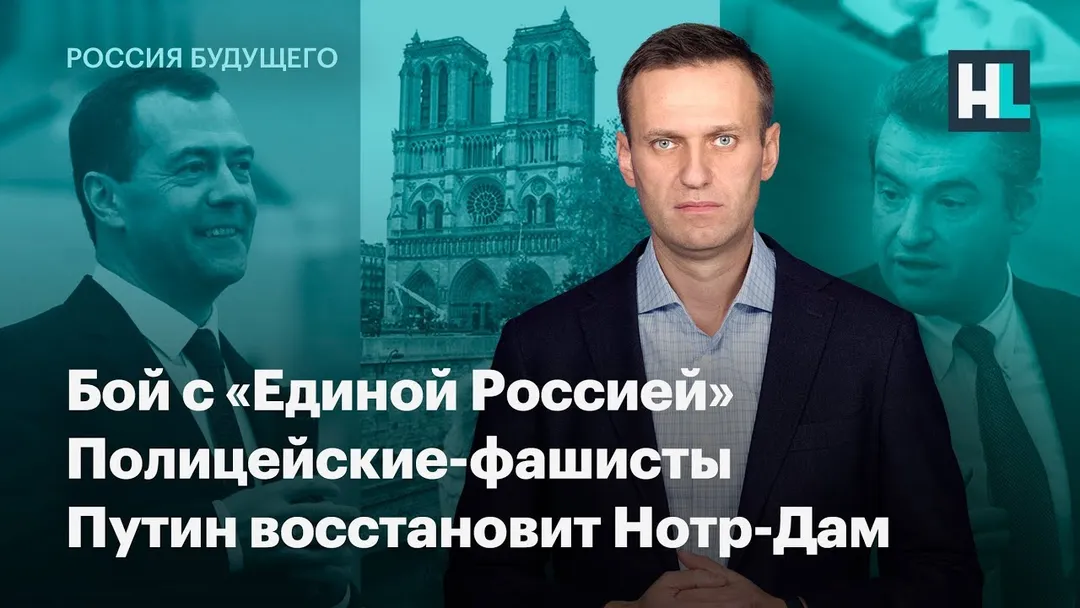
A fight against United Russia, fascist police, Putin will restore Notre-Dame
[music]
Good evening, everyone. It’s 8:00 p.m. in Moscow, which
means the live broadcast of the program
Russia of the Future
is on the air. Its host, the permanent host, is Alexei
Navalny.
Or a cocaine addict—I read in
one of the Kremlin media outlets a whole
investigation with a video claiming
to prove that because at some
meeting on the street I quite often did
this, and sort of this, it
means I’m a cocaine addict.
Energetic gesturing and emotional speech
are something of a trademark style of the blogger,
which is also being adopted by his
associates. But his slimmer face and
glassy,
motionless stare raise questions.
So when you’re overweight, they mock you for being
fat; when you lose weight, suddenly you’re
a cocaine addict. Very interesting.
It was very interesting to get acquainted with that.
Please send me your questions with the
hashtag #RussiaOfTheFuture on
Twitter, and I’ll answer them as
the program goes on. But I’ll start by
urging you: if you live in Moscow and
you’d like to come to a meeting with me
and other wonderful people,
please come on Monday
evening. Registration runs from 6:00 to 7:00 p.m.
Please come to this meeting. It’s
important. It’s not just some kind of
well, just cool candidates for the
Moscow City Duma, some kind of
institution you don’t really understand. In fact,
no, that’s not the case. And I want to begin the program
with this: so far I haven’t really managed
to get across this important idea that these
elections in September, which will take place in 22
regions, could be quite
important, because the political
structure of society is changing. And at this
meeting on Monday, we won’t just
talk with you—and I’ll be very happy to speak;
I’d very much like to speak in Moscow,
I haven’t done that here in a long time.
But I haven’t been able to, because Sobyanin (Moscow mayor) is somehow
very sensitive about making sure that in any
hall we rent,
some FSB goons immediately show up and say
no, you can’t do it here, immediately
terminate the rental agreement. But so far the venue
is holding out. In the description to this video there is a
link.
If you follow that link, you’ll
be able to register. If you don’t
register, you unfortunately won’t get into the meeting,
because there is a limited number of
places. So, this won’t just be
a meeting with great people, although
the people coming with me are indeed great.
This is the start—the practical start—of our
new strategy, which will lead to the fact that
you and I will really take the fight to United
Russia. And right now you’re waving your hand and saying,
“Oh, come on, he’s been fighting United Russia
three times a day for many years.”
But now we’re going to do it a little
differently, and the overall situation is very much
working in our favor. Right now, in local
elections—and of course you’re not
following them, because naturally you couldn’t care less
about, say, the fact that in Nizhny Novgorod
Region there were recently
elections for city duma deputies.
Of course you’re not following that, but I do follow
such things, because in these kinds of
elections, United Russia always and everywhere
used to win. Always and everywhere.
Single-member districts; on party lists
they might give something to the Communists, the LDPR,
or someone else, but in single-member
districts, where you vote for a specific name,
it was always a United Russia candidate, because there was this
Putin majority there—35 to 45
percent—and it was always their candidate,
big and fat, while all the others were
small. But now that’s no longer the case. And just
half an hour before going on air, I
read a report by a certain well-known
representative of the Golos movement (an independent election-monitoring group), whose name is
Roman Udot. He writes there precisely about
the elections in Nizhny Novgorod, saying that
United Russia lost them completely. And the conclusion
he draws is that Smart Voting
works. At the same time, strictly speaking,
in these elections there wasn’t any
direct organization of that Smart
Voting in the sense that we didn’t
send out a list of names.
There, people basically see: aha,
a United Russia candidate—so we need to vote against him, for
some other candidate, and they shut out all
the United Russia candidates. Moscow and St. Petersburg first and foremost,
but other regions too—
Khabarovsk, Irkutsk—
there will be elections there. Our task is to
hit them hard. At a minimum,
well, or deprive them of their majority in Moscow.
We must deprive
United Russia of its majority, and at this
meeting on Monday we’ll talk
about how we’re going to do that. And we can
do it. And maybe some of you
noticed a chart, a kind of
electoral polling, which is actually
the main—the most important—political news
of this week. But simply because
because
the Russian media don’t really understand
what counts as the main news and what doesn’t,
they didn’t pay much attention
to it. A Kremlin-aligned
outfit called Russian Field (Rassel/RC Comment in the original speech) released
some polling of its own, also Kremlin-friendly,
about how exactly
People in Moscow want to vote for whom?
Which candidates will Muscovites vote for? I’m
talking about Moscow, but this concerns
absolutely all of Russia, so guys,
listen to me carefully on this.
Let’s look at this chart. Here in
Moscow there are 45 deputies now, and
45 deputies will be elected.
Right now, 38 United Russia members are sitting there, so
that is, United Russia has an absolute
majority
and controls everything there. But this year
look at what Muscovites are saying their
preferences are: an independent candidate —
37 percent of the vote, United Russia only
22,
the Communist Party of the Russian Federation (KPRF) — 20, and non-parliamentary parties — 20.
What conclusions do we draw from this chart?
Conclusion number one — it’s kind of unrealistic,
but conclusion number one is that if we and
the so-called non-systemic opposition joined forces with
the communists and divided up the districts, then we would
win 100 percent
of the districts. Out of 45 seats, all 45 seats would belong
either to the communists or to representatives
of various systemic parties, and I
of course understand that for the Communist
Party it’s rather complicated; it has some
kind of relationship with the Kremlin. Nevertheless,
I want once again to clearly call on
dear Uncle Andrei and all
the KPRF leadership and rank-and-file KPRF activists:
guys, look at this chart and
understand that in September there is a chance not
just to deprive the majority of its majority,
not just to take away from United Russia its 100
percent of mandates. To our
anxious liberal
public, I want to make this appeal:
guys, please don’t
once again shift this into some kind of
discussion about Stalin — whether they’re Stalinists or whatever.
The communists are what they are, running around with their
Stalin, but our tactical
task in our strategic struggle
is that we need to knock out
United Russia, so we will have to
vote for the communists. We will
vote for the communists — that’s smart
voting. Think about it. Show that
chart again, please. Conclusion number
two that we should draw from this
actually is this: you remember that it was
a Kremlin outfit
that spread this information, so
I think that in reality the numbers are even more
in our favor.
All this means that this time
United Russia will not run openly as United
Russia. They will nominate various
vice-rectors of universities, representatives
of charitable organizations, school principals,
chief doctors of hospitals, and so on — that is,
people who will say, well,
no, no, we’re not from United Russia,
we just, you know, love Sergei Sobyanin
and for some reason here we’re
being supported by administrative resources — I don’t know why. For some reason
janitors are putting up leaflets for us, we don’t know why.
We don’t know why the housing office is working for us and
spreading our information, we don’t know why.
We don’t know why parents at kindergartens are being forced
to meet with us — it’s just some kind of
coincidence. We’re not from United Russia, we’re just
very respectable people here, vice-rectors
of universities, and in some ways we even agree with
the party of power, United Russia. That’s why this
is called smart voting. Our
task is not to let ourselves be played, not to let
ourselves be deceived, because Sobyanin can see that
United Russia itself won’t get through,
and he will put forward relatively respectable
people whom it won’t be all that easy for us to
criticize harshly.
And we have to do one simple thing:
understand who the viable
candidate is. This Monday I will be
appearing with the most promising
candidates.
But it won’t be 45 people; it will be the core,
the key candidates who, if
they get through, if you and I engage in smart
voting, then they will form
some kind of core of an opposition
movement in the Moscow City Duma, or the core
of a majority, a new ruling majority
in the Moscow City Duma
if it’s possible to reach some kind of agreement with
the communists. But in all the other forty-
five districts, in all the other 40-odd
districts, we will act
smartly. We will support Yabloko candidates
where Yabloko candidates need support; we
will support communists where
communists need support, even
despite the fact that they may not
enter into a coalition with us — we ourselves will enter
into a coalition with them, because we are ready to hold back
our own interests, some of our
grievances, and our personal relationships, because
we need to smash the hell out of
United Russia. I really want this because
in fact, just the viewers of this program,
given the very low turnout that there will be
across the country, the viewers of this program
if all of us work hard enough,
are enough to take away from United Russia, overall
across the whole country, 15 percent
of the mandates.
And if we bring in even more people, then at least in
the big cities we will deprive them of
their majority. So once again,
sign up for this meeting, which
will take place on Monday. There is a
link in the description. Unfortunately, without registering you will not
be allowed in. And come talk with me
and with the most wonderful people whom we
will put forward as our, as our battering ram.
to ram into it rather than get blocked
No, I’ll stand behind them.
and say, “Come on, guys, push harder, Adam.”
Ilya Yashin, come on; Volodya Milov there too.
Forward.
Well, and I’ll tell you about this
program of mine, and let them work—they are, after all,
our candidates, after all. And what
United Russia is doing, by the way, is important.
What matters is that United Russia is no longer just sitting
still, and they’re doing some supposedly very important
good deeds so as, well, not to
lose all those votes. That’s very important.
I’m also following all these supposedly very important
good deeds. We need to understand how to relate
to them. So, Dmitry Medvedev here
has, you could say, made a breakthrough. He
announced that there would be a substantial
increase in child-care benefits.
Let’s watch 40 seconds. The party leader
of United Russia, the official leader,
is promising voters a breakthrough. United Russia
will help. We are once again putting this question to
the government.
You also said that it is necessary to have
a new decision. What decisions should we expect from
the government so that the amount of the
compensation payment
is no longer just 50 rubles a month (about $0.80). This
payment was established
by decree of the President of the Russian Federation in
1994. A great deal has changed since then.
We believe it is right to consider the issue
of a substantial increase
in the amount of this benefit, and to do so starting
next year.
We heard “substantial increase,” yes, but
how much is that—30 percent, 40 percent? Will that help?
Even if they raise it by 100 percent—but before that,
the most important thing was actually already said in the question:
the child-care benefit
is 50 rubles—that is,
about 1.5 rubles a day. That’s what they pay.
And now they’ll say, “But we
raised it by 20 percent, by 15
percent.” But on this issue, we are going to tear United
Russia apart, as the saying goes, like Tuzik tearing up a hot-water bottle (a Russian idiom meaning to rip something to shreds).
And they need to be torn apart, because they’re sitting on
trillions of rubles, while their promises in
practice really look like a mockery.
Just like the regular pension indexations, which
when translated into absolute figures mean, say,
an increase of 20 rubles, 30 rubles,
150 rubles—and yet they say they have substantially
increased child benefits.
Well, formally speaking, right now it’s
1 ruble 66 kopecks a day. They’ll raise it
substantially, and it’ll become 2 rubles 66
kopecks a day. Well, go on—if your child is a little short,
there you go, 2.66 a day—buy the child
some buns with it, and while you’re at it,
some diapers too. That’s an important thing. This is
social policy? It’s daily robbery, and
its social significance cannot be overstated, even in
the richest cities, such as Moscow.
Even if a person has enough
money and doesn’t need any
child benefit, we will still simply
talk about it. We will say to you:
you may not need it, but others who were not
as lucky in life as you are—they
receive 1.66 a day, or 2.66 a day
after the increase, after the
colossal, super increase. They do not
even get 5 rubles a day. Do you want
to vote for United Russia? If you don’t,
then take part in Smart
Voting. I see I’m being asked, and in
86, please tell me:
is the new electronic voting from the Central Election Commission
not a response to your Smart Voting?
Very clever question—I don’t know whether it’s from a man or a woman
asking me, but of course yes. What are
Mayor Sobyanin and the Central
Election Commission doing here? They
introduced electronic voting. This thing
looks absolutely unprecedented.
You can hardly vote in real elections over
the internet almost anywhere, even in the most
advanced countries. Only in Estonia does this
exist in full form. Nevertheless,
in Russia, where the authorities hate the internet,
they suddenly introduce this very electronic
voting, and I have no doubt that it
will be introduced precisely in those districts where the authorities
have the biggest problems and where the most
hardline opposition figures are running—the kind
like the ones I just
showed you in the picture, the kind who
will be meeting with voters on
Monday. Let’s recall how events unfolded.
Sobyanin said, and
the Moscow City Election Commission
said, “You know, in Moscow we need to introduce
electronic voting.” The CEC said no,
it’s impossible, it contradicts
federal law—and yes,
it does contradict federal law. And they
had been against it their whole lives, and then suddenly, after
a week—well, apparently someone went there,
Sobyanin went to the Presidential
Administration and said, “Guys, they’ve got
Smart Voting there, and they’ll wipe everyone out. We’ll
remove candidates, we’ll do something strange, we’ll
falsify things a little here and there, but they’ll
still wipe everyone out. So we need some kind of
mechanism.”
The main solution would be—well, as far as I understand,
the main solution
is that they will hook up
electronic voting, which
cannot be fully monitored at all.
Does this mean that we, well,
that Smart Voting is useless?
Of course not. After all, first of all,
it will only be introduced in certain districts,
not across Moscow as a whole. Second, well,
all the same.
The scale of the fraud has certain limits.
You can tack on maybe five
percent. You can’t tack on 25 percent.
In any case, we have to
make life harder for them, because if we don’t
do anything, then they’ll just get away with it
without any problems, and we
— you have to admit — won’t work ourselves to death
by spending the day before the vote
calling on everyone: come on,
register through our link, and
here’s the candidate’s name — let’s all vote
only for him, and then on
election day, go and vote.
You have to admit, it’s not exactly some huge
amount of work, but it absolutely needs to be done.
Something very interesting is also happening in St. Petersburg,
where there are municipal elections as well,
elections.
For governor too — not like in Moscow, where there is no
gubernatorial election. In St. Petersburg, that same
rating I showed you
— the Kremlin rating — also showed
the possible ratings of the governors. Let’s
take a look — it’s very interesting. You can see
— let’s just not look at
those guys at the top, because obviously
Kalmykia, obviously Bashkortostan — well,
I mean, there are basically never any real elections
there. And Beglov, who is running in
St. Petersburg, is in second-to-last place
with 43 percent. That means if the election
were held now, there would be a second round in St. Petersburg, and in
the second round, we understand that Beglov
would most likely lose, because he’s
some kind of clown, a bizarre creep,
who talks all kinds of nonsense and, well, basically
engages in very ridiculous, purely
PR. I’ve told lots of stories here about
Beglov and his little shovel antics, but now it’s just
the sheer number of examples of how, well, how they
are running this campaign in general, what kind of
people these are,
it’s just off the charts. Look,
it’s very funny. I saw this on the Telegram
channel Rotonda, which covers
the St. Petersburg elections.
So, Beglov’s standard system is this: he needs
to boost his mentions on Yandex
to get to the top of Yandex, so he has to create
a whole bunch of
fake media outlets, and in those fake media outlets
praise himself.
Sobyanin did this too. So for Sobyanin, in order to make it look like
“Sergei Semyonovich looked
to the left” rank first on Yandex,
“Sergei Semyonovich”
and “ate some porridge” rank second on Yandex,
why? Because there are hundreds — without
exaggeration, hundreds, maybe even thousands — of
media outlets,
supposed media outlets that belong to
Moscow City Hall, and all day long they
churn out these formulaic articles:
“ate some porridge, looked left, looked
right, how Moscow has improved under Sergei
Semyonovich.” But Beglov is even dumber
— much dumber than Sobyanin’s PR people —
and apparently he simply doesn’t have enough
people to write these articles, and so
something hilarious is happening there, because
they got caught doing this. I mean, if you
just copy-paste the exact same article
over and over, Yandex isn’t stupid — it
will take one article for its algorithm
and ignore the rest. So
Beglov’s people brought in a robot.
Everyone loves robots these days, so they
brought in a robot that rewrites
the text of the article so that it wouldn’t be
the exact same thing. And there we see
expressions appearing like “Pert,”
“the Petrodvorets region,” “the present little day,”
“copied creation” — that is,
meaningless articles written by some kind of
nonsense words. It’s simply
a text generator. That’s what Beglov is doing
in St. Petersburg right now.
It’s
basically just these trips, ribbon-cutting
ceremonies, and a PR machine that simply
with the help of a text generator
drags all of it into the top Yandex results. That’s
elections in the Russian Federation for you. So of course,
of course, we just need to go out and wipe the floor with
him. And for that too, you have to admit, we need
Smart Voting, and we must
take part in it — especially in St. Petersburg,
because
when it comes specifically to the
gubernatorial election there, it’s very simple: vote
for anyone except Beglov. There will be other
candidates there — they may not be especially
good, some of them may be decent, some may
of course be pretty awful guys,
but it doesn’t matter: anyone except Beglov. And one
more funny thing happened with him.
As part of these trips of his with
ribbon-cuttings,
again, he’s dumb, his PR people are dumb, and they
do dumb things. When they arrive at
meetings with people or for ribbon-cutting
events,
there are journalists there, of course, and to the journalists they
in advance
hand out a sheet of paper where it’s not just
the main points of his speech that are written down, but also, like,
the “tough questions” that people are going to ask
him, along with his answers. In other words,
someone has simply written a script.
There are already prepared people who
will ask these questions, and they, well,
they just printed it all out — that kind of
simplicity is worse than stealing — and handed it
all out, and told the journalists, “So,
a man of such-and-such age will ask you
there
this question,” and they’re all dutifully asking it.
why, in some kind of state or whatever
Beglov replies to him, saying it's unsatisfactory
and you, specifically regarding this script
our mustached guy
hero who wants to lead the second-largest
city in the country by population
just keeps rambling on and on about this thing, well
let's take him on; as for
the municipal elections, I see there are
questions. Go to SPB. Here we have
several thousand people who are actively
participating
sign up, come to the meetings
come to the training so that in
St. Petersburg we can also clear out
United Russia. We understand that there will be
they'll remove candidates from the ballot, but not all of them
they won't remove everyone; we have to win there, and already
we are working very actively through
an introductory meeting has already been attended by 800 people
307 candidates for deputy positions
have gone through the training, and we have held 52 events
in total. So if you want to be
a candidate, register as a candidate. If you want
to be a voter, register as a
voter. Why have I been talking about this for 23 minutes already?
I've been talking about this topic because this isn't just
some small election; this is a real
situation that has become very favorable
right now, and in these September elections
despite the fact that all of us have long
felt like there are no real elections left
we really can land a blow against Uni-
ted Russia if we stop being stupid and
act
smartly. That's why I'll keep talking about this constantly
Also, since I have taken on
this obligation, and I will
fulfill it
to cover all labor-union
activity and strikes. So, I was sent a note about
a hospital
that very hospital where there had been a strike
where the doctors' demands had supposedly been met
they were deceived in the classic way: they were
given a pay raise of 10,000 rubles (about 100 euros) at first, for everyone, and then
once things died down, the local authorities
the local crooks looked around and said, well
since they've called off the strike, we'll
cut their pay back again. Classic. Well
good for these doctors in Nizhny Novgorod
region—Novgorod region, sorry
they're genuinely great. Let's just take a few
seconds—they sent a video, 28 seconds, saying that
they are resuming the strike. Just look
at them and ask yourself
why
the authorities can't, damn it, buy them this ambulance
service equipment and raise salaries to at least some
minimum level. Quite simply. 20
seconds. Medical workers in Okulovka
due to the failure to meet demands for
higher wages for the workers
of the Okulovka ambulance service and the workers
of the local central district hospital, a decision was made
to begin an Italian strike (work-to-rule action) on April 22
The strike will continue
until the workers' demands are met
at these medical institutions, in accordance with
participating in the strike. Good for them, really
like pioneers, all properly taking part
in the strike. People sometimes write to me, saying, well, you
are dealing with boring nonsense, covering trivial
topics
I don't think this is a trivial topic, I don't
think it's some isolated case. I know for sure
that this kind of strike movement
is the most effective. First of all, there is
simply statistics on strikes and
the fulfillment of strikers' demands
and Russian, pre-revolutionary, and global
strike statistics, and I think in 75 percent
of cases it ends with people
getting what they want. So don't be cowards
my dears. These people aren't afraid, in
that very Okulovka in Novgorod Region
good for them, and let them grab that governor
who deceived them and cheated them—but this time
they'll take him by the throat. So if you're doing something
write to me. Even if
it may seem like a small issue to someone, I will
cover it. I see I'm being asked an excellent
question: how do you tell a genuine
independent candidate from a sneaky
United Russia one? That's the whole point of Smart
Voting: we'll tell them apart for you. You won't
be able to sort it out yourselves. Even in Moscow there are 45
districts, and in each district
there are a bunch of candidates, maybe 10
candidates: a United Russia member, a half-United Russia type
a spoiler candidate, some fake democrat, one claims
to be opposition, another also claims
to be opposition. We will analyze all of this carefully
and honestly tell you: this is
the independent candidate for whom
it makes sense to vote, or this independent
candidate, or maybe a Communist—because over there
they clearly came in second. We won't just
name a person; we will explain
why we chose them. But the idea is
that you have to trust someone
Trust us. We will analyze all of this
and tell you whom to vote for, because
everything else, everything that came before
just doesn't work, this whole idea
that democrats should unite—they don't
unite. No democrats ever
unite with anyone, so there's nothing else
left. Trust us, the guys from the team, and
we'll choose decent candidates, and you
know that we won't back any
clowns or fakes; we won't choose them where
there are candidates from the systemic opposition
We'll say honestly: they are from the systemic opposition
different things can happen with them, but in
any case that's better than a United Russia candidate. So
Sasha Nogin from Nagorny also asks
Alexei, tell us how one can do it on one's own
To promote the voting campaign, if your acquaintances
have already run out and the campaign has no flyers,
no, Sasha, your acquaintances have not run out.
Keep explaining to them anyway that they must
take part in this. Let your acquaintances
campaign among their other acquaintances. Flyers, we
might make them toward the end of the campaign, because
you see, here’s the thing: this is also how everything
is set up. The candidates will be nominated, and then
city hall will take a look, and some of them—we
if we make
flyers with you now saying, “Vote for these
candidates,” not all of them will even be allowed onto the ballot.
So the specific names will
only become known much closer to the end, and
we simply won’t have time to make flyers with you then
in time.
+ Sasha, the point is that for us
the internet is enough this time; it’s just that
we have to persuade people. Here, in this
program—yes, right, people are tired of hearing about it, but
about the right to vote—but
I’m still going to keep talking about it. You see,
in the mass media somewhere
you won’t read much about it, because
they need a prompt; they don’t understand that this is
something important. But when
there are three weeks left until the election, they
will start writing: well, there’s an election, some kind of
this and that, something unclear is happening. But
you and I are not observers of this
process—we are participants in it. You’re not
blocking anything, there’s nowhere to retreat, but still you’re
fighting against United Russia, and I’m fighting
alongside you, so
we simply have to keep pushing this issue
and imposing it on the agenda, because for now, unfortunately,
it still isn’t really resonating that well with society as a whole.
Society... 24, 1,800 people are watching us. I
still want to say a few words
about Notre-Dame. It was the main world news story
of the past week, and
it is terribly sad, naturally.
A monstrous fire. But in Russia, these
reflections of the fire over Notre-Dame really
seemed to awaken an enormous
number of crazy people here.
What happened in itself is
a universal human tragedy. It’s as if
the Colosseum were blown away by the wind tomorrow, and some
lunatic in a bulldozer—a very
large bulldozer—or someone came and
blew up the Colosseum. Would that be only a problem
for Italy and Rome? Of course not. It would be a problem for all of us,
for our children, who otherwise would never
get to see it. And really,
when I said that the image of Notre-Dame
had awakened the crazies, there really were
several types of them. One type of crazy person
was, first of all, these sort of
pro-Putin idiots. I see them
writing, “To hell with the French,” and so on.
What do the French have to do with it?
This is something that was built 800
years ago, and it is beautiful. It belongs just as much
to you as it does to the French. The French living today
themselves
have, broadly speaking, the same connection to
the builders
of Notre-Dame as you and I do. It is
a universal human treasure. So a person
who says something like,
“Screw the French, who cares,” is
simply a fool. If you haven’t managed
to go to France and see it, then at least
your children or grandchildren might go
and see it—and you’d want them not to
miss that chance. The second group of strange people
that I wanted to say a bit more
about are, on the contrary, those
who were so affected—well, not inspired,
but horrified—by the sight of the burning
Notre-Dame that they seriously started
here in Russia
collecting money. For example, German Gref
announced that Sberbank would create
a relief fund for Notre-Dame, and even
the Ministry of Culture of the Russian
Federation said that they would
start collecting some money and
send money to Notre-Dame. Then they
said that apparently they would not be collecting
budget funds. And here there are
two things. First, I wonder whether German Gref
and the Ministry of Culture have seen
the condition Russia’s own monuments are in.
They’re horrific ruins, every other one of them.
Maybe not all of them are that ancient
or of such great cultural
importance, but come on, let’s be honest:
Notre-Dame matters to us deeply on a human level,
but it is located in a very rich
country called France.
How much money was raised in the first three days
for the restoration of Notre-Dame?
1 billion euros.
Is 1 billion euros a lot or a little?
Well, I’ll tell you this: the entire targeted
federal Culture program—in other words,
basically the whole culture budget, this entire
multi-year federal targeted program—
is 100 billion rubles,
which is roughly the same amount as was raised for
Notre-Dame in a week. Thank God they
raised it; good for them, and good for everyone who donated.
We love you, we embrace you—but what business do we have butting in?
We shouldn’t be butting in anywhere. We are not
a country like France; compared with France, our own
cultural monuments are in terrible, terrible
shape—ruins. Let’s just be glad for
the French that they have businesspeople
who are not like ours—these
half-baked oligarchs who think all money
must of course be invested in a football
club.
They have two options: they have a billion, and they’re itching
to spend it, so it’s either
a football club or a yacht.
That’s all—they have no other options.
Idiots—I’ve already said it twice.
Idiots—let’s call these people what they are: crooks.
No, this is a former Russian oligarch.
A party official of the great...
A former Komsomol functionary (official in the Soviet youth organization), and now she has...
...money, a yacht, and a football club.
A football club, a yacht.
In France, there are decent wealthy people.
They step in to save Notre-Dame, and from that...
...they get publicity out of it, everyone is happy. We don’t have that here.
We don’t have anything like that. It would be nice if German Gref...
...just reached into his own pocket...
...and sent his $500 to Notre-Dame.
After that, he could have Sberbank set up a fund...
...to help Russian cultural heritage sites.
Because for us, things are very, very, very bad.
You can see it yourselves—these cathedrals, churches...
...museums, everything imaginable.
A huge number of their storage facilities are in...
...terrible condition, and the books are rotting.
Exhibits are being kept in conditions...
...that are not the conditions they’re supposed to be kept in here.
We have a couple of showcase museums...
...that are mostly well funded.
But everything else is in a monstrous state.
Let’s give money to that instead.
What Notre-Dame? Notre-Dame is in wealthy France.
In France. And third, of course...
...there’s a category of people who were...
...all worked up by it.
The glow...
...of Paris—these are the people who, right from the start, on...
...our television, said this meant the death...
...of French civilization. Ksenia Sobchak writes...
...that trade unions and leftists...
...have brought my beloved Paris to the point where...
...Notre-Dame burned down, imagine that. Let Manya (a colloquial, slightly mocking female name) into Europe...
...so Manya arrives there...
...and says, “Well, my Paris...”
...my beloved...” and starts lecturing those heartless...
...trade unions.
“You’ve done everything badly here, and...”
“...that’s why Notre-Dame burned down. Now I’m going to...”
...teach you how to live.” I just want...
...to say that in fact France...
...is good, and...
...Paris is good because there aren’t many people there with...
...such cannibalistic views as...
...Ksenia Sobchak’s in particular. Though really, it’s not so much about Sobchak...
...as about this whole...
...giant crowd of strange...
...wealthy Russians who...
...go to Paris and think that...
...it ought to live by some...
...rules they cobbled together from reading...
...the only book they’ve ever read, *Atlas Shrugged*...
...which is the one book they’ve read in...
...their lives. Fortunately, in France there are...
...a huge number of people who...
...believe that trade unions have rights, that people...
...can go on strike. In France there are huge numbers...
...of people who believe that...
...people shouldn’t be fired easily. I just...
...read her post carefully—she complains that...
...it’s impossible to live there...
...and impossible to fire anyone. Well, that’s exactly why...
...that’s how things work there. You all...
...change with every shift of the wind. In any...
...French café, if you walk in, you’ll see...
...a gray-haired old man and a gray-haired old woman sitting there.
Everyone says, “How lovely.”
But a Russian pensioner—that’s just poverty, apparently.
Look at French pensioners.
That’s considered charming—they’re sipping coffee there...
...they’re eating tartare, drinking coffee...
...they eat tartare because they were paid...
...a decent salary, because that salary was defended...
...by trade unions, because...
...there is a fair system there.
France doesn’t have a small number of problems...
...it has a very large number of problems, but...
...still, those hellish social-darwinist types who...
...say, “Let’s ban everything for everyone here...”},{
...and whoever is rich is right”—they are in...
...the minority there. People care about one...
...another, and that’s why things are better there. And those who...
...want that kind of social Darwinism—well...
...let them stay here with Putin. And so...
...in this group, of course, the most hardcore...
...guys are the ones predicting doom for everyone.
These are also the ones looking for a conspiracy, and of course...
...the best video on this subject is the one I...
...want to show you—40 seconds, 40 seconds in which...
...a Russian researcher...
...has discovered what really caused Notre-Dame to burn.
Honestly, the event itself isn’t all that remarkable, and...
...now France has added this...
...arson attack on the most famous Christian cathedral.
It’s all supposedly the work of Masonic conspirators too.
Let’s break down what supposedly happened in the end.
So, originally Notre-Dame de...
...Paris...
...was a temple to the pagan god Jupiter; Christianity had absolutely nothing to do with it...
...there wasn’t even a trace of Christianity there before...
...the “Jewish Great Revolution.”
On the pediment of the temple there stood...
...images of pagan gods, which...
...the revolutionaries destroyed, and in their place...
...they installed their own Jewish patriarchs.
The pagan... then came...
...the revolutionaries changed it, but of course...
...now it’s obviously a Masonic conspiracy...
...that arranged such terrible things, burned everything down...
...to cover its tracks. This is from the category of videos...
...that absolutely enraged us over the past week.
It drove us mad.
It really is infuriating—not even the video itself so much as...
...the consequences of it all are awful...
...My beloved Kuban (a region in southern Russia)...
...is a zone of absolute lawlessness, and Sochi, which...
...well, basically even...
...is territorially part of Kuban, though they always...
...like to think of themselves as separate. Nevertheless...
...it’s the same kind of lawlessness. A man sees...
...a man named Stanislav Andreev.
He is filming police officers who are loudly...
...swearing profusely, and he calls them out on it.
They say, but you're police officers on duty,
on duty, shouting loudly all around there.
What's going on, after which they start talking about him and
say, "We're in charge here, and you shut up."
They grab him by the arms and accuse him of
the most absurd thing—you barely even
make a remark to us, and for that alone
it means you're planting drugs, and
now we're taking you to the station."
But
this man, whose phone they were trying to take away,
they didn't
turn it off. That is, they started pressing
the buttons, but it stayed on, and
now we can watch 53
seconds
of what a police officer in Krasnodar Krai (a region in southern Russia)
is,
what a police officer in Kuban (the Krasnodar region) is like, and how
people who say, "We're
the ones in charge here," behave.
[music]
"Quickly, your documents—what are you doing here?
Leave your bag."
Journalists,
a gang of bandits in uniform—they
beat him. They started beating him—note
carefully: when they led him onto the
police department grounds,
that is, they didn't just drag him off into some bushes
somewhere—they grabbed him and thought,
"So where can we beat him, where's
a safe place to beat a person?
Of course, on police department property.
In the yard or somewhere else on the premises,
with cameras everywhere. I mean, if you've been to a police station,
every square meter is under video surveillance,
and they're kicking him with their feet.
They drag him into the corridor for detainees.
"Get on your knees. We're in charge here," and
so on. Well, a criminal case has already been opened there,
a criminal case has been opened against these
people, simply because one of
them, as I understand it, after taking the phone,
didn't turn it off, and then for several days
didn't check whether there was a recording or not—and that became
the only reason.
If it weren't for this recording, in Kuban
this man would never in his life have obtained
justice. And the subsequent actions, by the way,
personally confirm this, because
the lawyer for these
rank-and-file police officers—these brutes—
who beat an innocent
man—proposed closing
the case through reconciliation between the parties and told
the press that the police officers are ready
to apologize, but only so that the case
will be closed. I mean, they just beat you
while on duty, kicking you, and now they're ready
to apologize—but not publicly.
Publicly? Come on, who are you? We only
just
kicked you.
But apologize publicly? No, that would be too much.
In private, sure, we'll
say, "Sorry, brother, it's not us,
that's just life, that's how everything works here in
our beautiful Russia of the future." The police station chief
will be fired in
the beautiful Russia of the future. What is needed during the transition period
is to thoroughly purge the entire
Krasnodar police force. But in general, in
principle, the Krasnodar police
need to be subjected to total
inspections and a purge, because they are a gathering
of bandits, just like the prosecutor's office, just like the local
FSB (Russia's security service). Yes, they are simply real
bandits and lawless thugs. If there are
decent guys there, probably, then on the whole,
overall,
especially the leadership, they are genuine
monsters.
They terrorize people there, they kill
people, and it's impossible to find any way to stop them.
What is really needed there
is some kind of real special operation.
You can't solve anything there with small reforms
alone. As for the country as a whole,
we need police reform, but in
Krasnodar Krai, what is needed is a truly harsh,
harsh purge. He took money, but he was
very honest. Something that made a huge
impression on me
this week was the speech, the final words,
of the former governor of the Komi Republic (a federal subject of Russia),
who was imprisoned in that very
Gayzer case.
There they constructed some whole
criminal group around it, and eventually it reached him, and
his final words were this. And since
our FSB and now the Investigative
Committee have adopted this new habit of
charging everyone not just with some
offense, but with participation in an organized criminal group, that
effectively means they can be sentenced to up to 20 years,
and this is the new
trick of our law enforcement
agencies. They prove nothing; it's
complete nonsense. Of course there are bribe-takers
and crooks sitting in the dock, but the very
way the case is built has this particular feature:
the "criminal group" is attached in a completely arbitrary
way. But these officials, they
understand that they'll get, get, get—sorry—
up to 20 years. And his speech was simply
something else.
"Comrade Stalin, a monstrous
mistake has occurred." I'm telling you now,
I'll play it—it's 1 minute 40 seconds, but it's worth
it. It's pure drama. And this same
governor was one of the most brazen
people around; over there in Komi he pressured
everyone indiscriminately. Yes, they were just
real bandits, basically,
"restoring order" in their own way, and now
people just like that have chewed you up a little,
and for years they were shaking people down for all sorts of things.
money and positions, and just look, he
there are such absolutely priceless gems there
astonishing ones
They gave me money, but I didn’t want it.
The money I received was of no use to me,
I didn’t need it, so I gave it away to people...
Let’s listen to how the former governor
the once all-powerful Putin-appointed governor, when
those very same people he backed, the ones he
falsified elections for,
he shouted for them, campaigned for them,
are now devouring him.
Let’s listen to the words he’s using now.
How he’s speaking now.
Before being elected to the post of head
of the republic,
I had no practical work experience in
economics, so I chose to trust my
acquaintance, businessman Alexander Zovut
Lin, who took the initiative in
selecting candidates for the posts of my deputies,
ministers, competent specialists
capable of
putting the budget process in order over time.
...whatever it took.
Information that the people recommended by him
were using this position and public service
for their own interests—in 2009, I
made an attempt to correct the situation.
I appointed as my deputy
a retired FSB general—Ty Upala Detali
Mikhailych.
For that, Grubin, in rather harsh terms, gave me
a dressing-down over the phone.
In 2010, the head of the Komi Republic became
one of Zarubin’s associates, according to the newspaper.
Chislo Makha.
As for the money, I still want to mention one
fact.
You may doubt it—or maybe not—but this is
actually true, and I said so later.
The money I received later
was given away to people very generously,
because I practically had no need for it whatsoever.
30,000 people are watching us
live, and it seemed important to me
to play this recording, and I hope everything was
clearly audible. But just so you
understand once again, first of all, how things work there,
and also what ridiculous excuses these are—here he is,
taking money from some local
businessman, and saying, “I understood that
taking this money was wrong, but I was afraid
that refusing would offend him.”
So, of course, he didn’t want to, but
they were giving him money, and it would have been awkward to refuse,
so he took it. Then he goes on
to say that he didn’t need the money, so he
gave it away to people, but...
How did it come to this? And the most astonishing thing...
I won’t torture you with all of his final
words at the end—what this
man says.
A United Russia member, an ardent Putin supporter—he confesses
to everything, and, well, sort of
repents. And when a person
repents, you’d expect him to say, “Forgive me, people,
forgive me, good people, forgive me, residents of Komi,” but instead
he says the following: “For all the time
that I have been in this terrible situation for
me, every day has been for me
a huge pain and shame—shame before
the President of the Russian Federation,
Vladimir Vladimirovich Putin, who believed in me
and supported me, and it turns out I did not live up to his trust.”
So he was robbing, together with
all of his United Russia crowd,
the people of Komi for many years, and now he’s ashamed
before Vladimir Vladimirovich
Putin, who, by the way, while
this program is on air right now...
While you were watching the video with this governor,
this former one, I already managed to read the news that
Vladimir Putin, meeting with
a representative of French business, said
that Russia would
be ready to take part in restoring
Notre-Dame. Thank you, Vladimir Vladimirovich Putin.
We’re so happy to hear that.
Especially happy are those people who, as I said
at the beginning of the program, receive
child benefits amounting to
1 ruble 66 kopecks a day (about $0.02). Very happy,
too, are the directors and staff of crumbling
museums. Happy too are the nurses earning
14,000 rubles a month (about $150). Everyone in the country is happy. We’ll be
restoring Notre-Dame. They’ve already raised
a billion euros there—come on, really, good grief.
Russia is a generous soul; there’s enough for everyone.
What was it—$100 million to Kyrgyzstan
we gave the other day? A spectacle of unheard-of
generosity. We’re handing things out to everyone in the world, and now
we’ll throw more money at Notre-Dame too. But if
Vladimir Vladimirovich Putin, at
his meeting with French businessmen,
had said, “You know, I have this
acquaintance, the cellist Sergei Roldugin,
and by some completely accidental
set of circumstances, he ended up with an account somewhere
in the British Virgin Islands
or in Panama—in Panama, yes, from the Panama Papers—
with $2 billion in it. Don’t
think that it’s my money; it’s not
my wallet, it’s just money, and I’ll ask him
to transfer it.” But no, he doesn’t want to transfer his own money.
Instead, it’s once again coming out of
the budget to help Notre-Dame. When are we
finally going to help ourselves, for heaven’s sake?
It’s simply unbearable to listen to this. A noble
cause, restoring Notre-Dame—the wealthy
French Republic will restore it.
Presumably some wealthy Russian
citizens can donate too. But the impoverished
Russian people should not be donating
anything—not a single kopeck. That’s
my position. Perhaps it
may seem to some people not entirely
right, but this is not the time—we have to
To show moral support, let's
light it up in the colors of the French flag, I don't know,
shine beams on it, and make all Russian buildings
in those colors, or something like that.
We don't have the money to stop
Notre-Dame from burning down, except, well, except for those who
are rich themselves — the oligarchs,
some Russian ones. Let the Forbes list
give, if they want to, give to
Notre-Dame. By the way, on the Forbes list
my favorite deputy — I'll be talking more
today about the most disgusting deputy
my absolute favorite United Russia deputy
is, of course, Yevgeny Fyodorov, who
gave us all the phrase
"United Russia is the party of crooks and thieves." Well,
or rather, he prompted it — it was during
a debate with Fyodorov, so I will always
be immensely grateful to him for his contribution to
the fight against United Russia. He's the most
fervent supporter of Vladimir Putin. He
heads the NOD movement,
which argues that Putin really needs
to be given extraordinary powers,
apparently so that he can simply, by his own
decision, send any amount of
money for the restoration of Notre-Dame. He explained
in a recent appearance that
Putin is not fighting the oligarchs because
we're not ready yet. We've been waiting for 20
years already, but
the oligarchs are such a toxic force that Putin just can't deal with them.
Let's listen.
A United Russia member explains why Putin doesn't
fight the oligarchs.
As for the oligarchs, a decision has been made for now
not to touch them until we're ready,
because it's a very powerful group, it is
very tightly knit, and working with them
requires... well, it can't be done
all at once, in a civilized way, but it
doesn't work. They stay in place because
they are a major force, and quietly like this
you can't deal with them. And besides, they're not
within the country's borders.
[music]
There's nothing you can do with them.
It says there that they are not subject to
... oligarchs.
Of course, if someone really gets on their nerves, they get removed.
What an amazing exchange. I mean, just how much
do they take everyone for idiots — even their own
supporters? He says: well, Putin doesn't fight
the oligarchs, but how is he supposed to
fight them?
Indeed, how can he fight them? But look at how he fights
those who hold
one-person pickets, how he fights those who
came out to protest in Ingushetia,
and everyone else. Somehow that works just fine.
But with the oligarchs, no — Putin just can't manage it.
Not at all. Too weak for that, apparently. So
just forget that oligarchs exist,
and live with them. That's United Russia's position.
Here's a great figure, a figure that I really
liked this week,
which actually shows that
it's not only the oligarchs so beloved by
deputy Fyodorov who are really
driving Russia forward anymore.
Recently, the media published data. They
calculated the contribution of the Runet economy — the contribution
of Runet to Russia's economy came to
almost 4 trillion rubles a year (about $43 billion USD). That
is equal to the contribution of the
largest company, the main
state-owned company in Russia, Ros
neft, which has swallowed everything up.
And it's very important for us to understand, guys,
that usually people assume that
there are some main oligarchs, the main
economy is in oil, some
big-faced, gray-haired, stern
men, and then there are even oligarchs of the
internet, all sorts of nerdy types,
sitting on designer chairs.
Because nobody ever thinks of it as
the real thing — YouTube, some games,
that's all trivial. But no, it isn't.
Now Runet is already comparable in scale to
oil. I think that in terms of real contribution, considering that
all that oil money
is to a large extent taken abroad, the real
contribution of Runet to the country's economy
is much greater than that of the oil industry.
And our state, and Putin, are making us
poorer because they are not allowing Runet
to develop. And there was an absolutely fantastic
performance this week by
our favorite, Mr. Zharov from
Roskomnadzor,
who, speaking at a conference, talked about how
he blocks Telegram, and he said there
the following thing, well:
"We're blocking all of this, and now I'll give the exact
quote: we are still identifying IP
addresses on which Telegram exists,
and blocking them periodically. You've probably
noticed on your smartphone
that it loads more slowly."
I like that, you know — it's such a
conversation among close friends, like: guys,
you're all sitting here, every one of you has Telegram
installed on your phone, and you can see that sometimes it's
faster, sometimes slower — that's because we're working on it.
Even though it's supposedly banned.
If you've banned it, then presumably
your government officials
shouldn't have it,
should they? But he openly
admits it: Putin is doing some kind of nonsense there,
we're banning it, we're spending
millions of dollars on it, but of course
everyone still has it installed. And he says it
without any embarrassment: all of us, guys,
communicate via Telegram, and we're blocking it,
and we coordinate the blocking of Telegram
by communicating with each other through Telegram, well.
This is, of course, the absolute height of hypocrisy, and I
really liked Deputy Levin, who
while speaking when they passed, passed in the third
reading the law on isolating the Runet (the Russian-language internet), which
will cause enormous, truly enormous damage to all
of the Runet.
He amazingly said that this is
basically a contribution to security. Let's
listen to 43 seconds of this scoundrel.
Absolutely independent
sociological companies that
monitor the internet have estimated the losses
our economy would suffer from the fact
that the internet would be down for one day.
So, colleagues, that estimate
puts the losses to the Russian
economy from the lack of functioning
high-quality internet in Russia at simply
20 billion rubles in just one day
(about $220 million USD today), while the funds being
allocated today
amount to around 20 to 30 billion rubles
in total to ensure stable operation
in the event of such threats overall.
So all the expenses that this bill will entail
are not expenses, but investments in the future.
You see, he declared, he explains that
they are putting into this isolation of the Runet
20 to 30 billion rubles, and that's good.
It will be an investment in the future because
if suddenly
Martians or reptilians block our
internet, we'll wake up in the morning and
open the tap, and there's no water in the tap, and in the
laptop
there's no internet, and then the damage will be even greater.
As if Zharov or, you know,
Deputy Levin would help us if a reptilian
from the planet Nibiru switched off our internet.
I mean,
they're stealing 30 billion from us, and for those 30
billion
they will make the internet in Russia
slower, they will damage
internet companies, they will pay less
in taxes, they will pay lower salaries, and we
will all become a little poorer. For what?
Who the hell knows what for. So that, so that
they can block a YouTube
channel? Good luck with that. Let's be honest: all of this
is needed so they can block
certain specific things that they
still can't block. They can't
block Facebook entirely; they want
to block YouTube accounts entirely, but they can't.
They want to block several
channels, so everyone has to become poorer.
Everyone has to pay
because, well, Putin doesn't like what is being said
about them.
One of the people who very clearly did not
like what we said today
is our deputy Slutsky, the most disgusting
member of the State Duma (the lower house of Russia's parliament), truly
one of the vilest, and we simply
think he has thrown down a challenge to us, because
I've already made so much about this Slutsky.
After he harassed
journalists, he became one of the best-known
State Duma deputies who receives
only a deputy's salary, and yet
he practically bathes in penthouses
and Maybachs.
It seemed like he should have been a bit more modest, but
at least now, after
all the spotlights are on you,
well, come on, Slutsky, at least be
a little smarter. No, the man went and bought 3
Maybachs, after which we decided
to publish his expanded
declaration,
from which we saw how he gets
this money. I think you've seen
that video, so to remind you,
here's a one-minute-nine-second excerpt about
Slutsky.
Lidiya Dmitrievna, a pensioner,
Slutsky's wife,
owner of 3 Bentleys and a 600-square-meter
penthouse in central Moscow, really gets this pension.
So where did the
Bentley come from?
Here's where: the Bentley was bought for 28
million 200 thousand rubles
(about $310,000 USD), of which the pensioner paid 3 million 200 thousand
herself,
and borrowed 25 million.
A 25-million-ruble loan for a Bentley, and it was
given to a pensioner with an income of 18,000 rubles a month
(about $200 USD). How is that possible? That money was
received by Slutsky's wife as a loan from
a certain M. Yu. Yuskevich.
And he did it just like that: a
10-year interest-free loan. Yuskevich,
a 34-year-old gentleman from
Baku. And now let's see what this
mysterious man does, and right away
we see his company, LLC Akkord Spets Stroy,
which in 2018 alone, in the very year
it generously loaned money to the deputy's wife,
won a tender worth 33
billion rubles (about $510 million USD).
This is just staggering, shocking, but
in some way even impressive. They talk so much
about fighting corruption,
cleaning house, and so on. But damn, they
actually write all of this down in official documents.
Just imagine if you
were some official, and you were given a bribe of
25 million rubles, and then you took a sheet of paper and
wrote: yes, a builder—his surname is right there—
a major Moscow developer gave
my wife an interest-free loan of 25
million rubles, and I bought a Bentley with it.
And there in the State Duma, Volodin (Vyacheslav Volodin, the Duma speaker)
looks at it and says: right, so he received 25
million and bought a Bentley.
Fine, everything is legal. How is that possible?
There is one—they came up with something a bit more elegant.
A scheme, but everyone knows Slutsky is a crook.
And there’s his old man, Resin, sitting there,
still one of the chief mafia bosses,
one of the main mafia bosses in the construction sector.
They were pulling the same tricks together with Luzhkov (former mayor of Moscow),
and now they’re stealing in exactly the same way together with
Sobyanin, Khusnullin, and that whole
gang.
This guy gives 25 million rubles
for a Bentley, and bang—gets a contract worth 3
billion rubles in return. I mean, it’s just so
blatantly obvious. They literally
wrote it into their own disclosure. I just don’t
know what would have to happen. That’s why,
when people ask me whether it will be hard
Alexei,
to fight corruption in the future—the answer is:
very easy. Very, very easy for me
to fight corruption, because based on
this disclosure alone,
I’ll put away both Resin and Slutsky right away,
and this Yeshua guy, and all the others who
wrote up the contract. They spelled all of this out.
This is exactly
what an organized criminal group looks like.
If someone gives you an interest-free loan
of 25 million rubles for 10 years,
tax inspectors will be all over you,
because that’s income
in kind: if someone gives you money
interest-free, then basically
that means you’ve effectively been
given income, because money
has value—they lend it at interest in
banks. It’s obvious that this is
a disguised bribe. It’s not even that
well disguised, and yet they still wrote it down,
and everything is fine for them. Now let’s see how
the State Duma (lower house of Russia’s parliament) will
wriggle out of this—Volodin in particular, and
Zhirinovsky, and everyone else—because,
it’s all written down right here. It’s not just
some ordinary document handed to us from
Rosreestr (Russia’s property registry) and so on, and the Duma tells us
it doesn’t know what this is. But now the whole thing,
strictly speaking,
is based on a disclosure form
that is sitting right there in the State
Duma. So keep an eye on what
happens.
Novaya Gazeta (independent Russian newspaper) published something great today.
Gazeta.
It’s basically scenes from the life of the new
aristocracy. Medvedev, our favorite,
has a head of security. You all know about
Putin’s head of security, all those golden
palaces and so on. Well, Medvedev has one too,
—our head of security is
this kind of
general, Mikhail—General Mikhail Mikheev.
And Novaya Gazeta filmed his house.
Let’s take a look at what the house of this
general from the security services looks like.
In theory, as a general, he should be under scrutiny from the FSB and the Interior Ministry,
and Medvedev himself, of course, and all the various agencies
tasked with fighting corruption.
They know that this general has
a dacha of this size. Novaya Gazeta
first filmed it from above.
How did they know it was his
dacha? They brought him a letter,
like a postman delivering mail from Novaya Gazeta.
Let’s watch. Sources told us that
the head of security for the country’s number two official, General
Mikhail Mikheev,
has settled in an elite village outside Moscow.
After reviewing documents from
Rosreestr,
we found no property registered directly to General Mikheev, but next to
FSO (Federal Protective Service) land in Razdory,
we found a plot belonging to Natalia Mikheeva,
measuring 1 hectare (10,000 square meters), and we also found
a sizable mansion in the classical
style, with two wings and columns,
with an area of nearly 1,500 square
meters. A house of similar size in this
area costs more than 1 billion
rubles. To determine whether the general has anything
to do with this estate, we decided
to deliver a letter in his name
right to the gates of the gated community.
Hello, delivery for Mikha—
Mikheev. Hello, guys, there’s a delivery here right now
for Mr. Mikheev.
Delivery. Could you come to the gate?
Please sort this out—someone will come to you now.
He’ll come over to us. Be so kind, driver,
to hand over the correspondence—the delivery.
[inaudible]
That’s right, boss.
[applause]
The man built an enormous
palace—a gigantic palace on
Rublyovka (an elite area outside Moscow). It’s all right there,
all nearby. All these FSB generals live there.
Here’s the guy responsible for fighting
corruption—he has a palace like that. And here’s
the guy responsible for security—he has
a palace like this. And they all
go over to each other’s places for shashlik (barbecue), and they’re trying
to form this so-called new aristocracy,
whose foundation is
illegal enrichment.
Naturally, can we really expect an anti-corruption drive
from people lower down—from the subordinates,
from, say, this general’s underlings,
from Medvedev’s ordinary security guards, from
some police officer riding around in
a patrol car? They look and say:
what’s this, these huge chambers with columns?
Oh, that belongs to a top general. Where did he get the
money? It’s obvious it’s bribes, obvious
that it’s corruption—and open corruption at that.
By the way, we will demand
that at the very least they answer
the question. I think Novaya will demand an answer too:
where did he get the money for all this?
About the money—let him answer, or let him say so.
I don’t want to answer that question, and in
closing, I wanted to talk a little about
politicians and going abroad, and I kind of
have a personal reason to
discuss it, because there has been a fairly
pleasant
event in our family: my daughter
who is in 11th grade, was admitted to
Stanford University. The admissions process
is a stressful period, and I remember my own
admission—it was all fairly
painful. Back then it was still Soviet times
(the USSR era).
But now, as I’ve seen, it has become
absolutely no less painful—if anything,
even more so: a ton of exams, a ton
an unbearable number of tests, all sorts of
papers, and everything else.
Nevertheless, she got in. I recorded a short
video—let’s listen.
Hi everyone, Dasha Navalnaya here.
And today I have a small
announcement—small, but quite important
and joyful. For the past few months,
all I’ve been doing is sending applications to
admissions offices and, with my heart in my throat,
waiting for replies.
And today I want to share with you
some very happy news—my own
joy. I did it—yes, yes, I got into
Stanford University. I’m incredibly
happy about it, and it’s an enormous honor for me. I
will try to be a good student,
to learn a lot of new things, and when I return
back to Moscow,
to become a useful member of society. This is actually
a good reason to
discuss the overall situation in Russia
with Russian education, and in general
to discuss whether politicians’ children can
study where they want, where they cannot study, and I’ve
received quite a lot of questions.
Questions came in asking why your Dasha went
to Stanford University rather than somewhere else.
And the answer is very simple:
she went there because—let’s
look at the rankings, the global university rankings.
I would be very happy
if, among the first—if in the top
five, there were Russian universities. But we see
that Stanford is here in
second place in the global
world ranking.
Let’s look for where the, mm-hmm, best
Russian university is—it’s in 95th place. That’s a very
sad story. But Dasha applied to
a large number of
universities and sent her
documents there. If she hadn’t gotten into Stanford,
she would have gone somewhere worse, then maybe
somewhere even worse, applying here and there, and then
well, maybe she would have gotten into somewhere in
Russia. But you must admit, it would be rather
stupid if you got into a university
ranked number two
and then chose not to go there, and instead enrolled at a university
ranked 122nd.
The point is that, in fact, by now
there is no such thing as
American universities, European universities, and
Russian universities—there are global universities, and
we can see that for us things are very, very
grim in this respect. But if the best Russian
university is in 95th place, and beyond that in the
top 100 there is nothing else—though in the
top 200 there are a few decent
Russian universities—three in the world’s top 200, and
whether it’s two or three Russian universities,
it’s a fairly catastrophic situation.
It simply shows how badly
we are spending our money in the wrong place, because
a university is not just about students, right?
It is a research center, a center
of progress. And it turns out that in Russia we
currently have no centers of progress. Why not?
Because United Russia members (the ruling pro-Kremlin party) are sitting there.
Take any Russian university—pick any one.
Take Sadovnichy, for example, same story—United Russia. What
is he doing? Developing his university? No, he is
with Putin’s daughter
developing some kind of
project where they will build
real estate and make money from
that real estate.
That is what, unfortunately,
Russian higher education has degenerated into. By the
way, Medvedev, my favorite, had
a very sound idea several years ago: why not
select Russian students and
if they can get into
the world’s leading universities, no matter
where they are located, Russia would
pay for them and send them there. When I myself
was at Yale University, I saw
a huge number of, for example, Chinese students. The thing is
that the Chinese
send students abroad by the tens of thousands. They have
flooded American universities,
Swiss ones, universities around the world—wherever you like—because
that is how they scoop up knowledge.
But for some reason Medvedev did not
develop that program. Instead, they started pouring money into
these strange
funds and strange projects at Russian
universities, which unfortunately do not work for
education—they simply work for
siphoning off that money. It is very
sad. One separate thing I wanted
to say—it shocked me, really, it’s just
a curious fact that will
again be about Putin. Back when I was still
at Yale, a woman from the
admissions office came up to me and said, “Alexei,
why is it that so few people apply from Russia?”
I said, “Well, isn’t it obvious why?” She
said, “No, it isn’t.” I said, “Because you are
very expensive, and in Russia simply no one
won’t be able to pay, and over there it’s $50,000, $70,000, or even $80,000
a year just for tuition.
your wonderful universities. And she looked at me
with these wide, bulging
eyes and said, “You have this idea
as if you were living back in 1950.”
Eighty percent of the students at our
university don’t pay a single
kopeck for tuition. I mean, yes, if you go to the
website, you’ll see tuition listed at $50,000
or, at Stanford, $80,000.
But they don’t actually pay it, because
the university
pays for those students itself. Right now, the way
these major centers are financed
works like this:
wealthy people—like our oligarchs (ultra-rich businessmen with political ties), except they don’t
buy, as I said earlier today,
football clubs; over there, they
consider it prestigious to donate to
universities. Universities have oceans of money, and
I was curious to see how all this
actually works in practice. So she got in, and of course
there was no way I could pay $80,000
for tuition. I thought there would be some
fairly complicated system—that you’d
have to apply for some kind of scholarship,
submit piles of documents, or ask for a tuition grant.
But over there it’s all super simple now.
You just send the university directly
your documents. So I went to the bank and got my
account statements showing three years of transactions,
and my wife got the same
statements.
We sent them over, and the university replied:
“Yes, you’re basically poor, and your family income
is less than $120,000 a year,
so tuition is free for you.” In other words,
even with what is actually a fairly
decent income by my standards in
Russia, for an American university
that income is considered low. And if you earn
less than $60,000 a year, your
family’s student will even
be fed, housed,
given free accommodation and free tuition. And we keep
calling this terrible capitalism.
The main thing is to get in, and then the university
will pay for you. And this is the kind of
system
we should absolutely be striving for. We should
be striving to make our education system
structured
on a global scale, so that foreigners would come here too,
and so that we ourselves might even
pay for their studies
because what matters to us is that talented
young people simply come here,
talented kids.
So, honestly, I’ve said many times
that I don’t see any problem
with the children of officials, United Russia members (the Kremlin-backed ruling party),
and so on studying abroad or anything
like that. Education is wonderful. What I
do see as a problem is hypocrisy: when you
run around shouting, “Our education
is the best in the world,” but then send your own children
abroad. Or when you run around shouting that this
godless West—this “Gayrope” (a derogatory Russian propaganda term for Europe)
—is full of who knows what, assaults, just
I don’t know, a child is born and immediately
they force them into entering a homosexual
marriage.
Horror! Notre-Dame Cathedral in Paris is burning,
which means
the decline of Europe. But at the same time, you
send your own family to live in Paris.
That’s the hypocrisy. And our Khabarovsk штаб (regional campaign office) this week released what I think is a perfect
investigation this week,
one that, it seems to me,
illustrates not just corruption, but also
monstrous hypocrisy. Please watch it.
I’m not just promoting it
because our Khabarovsk office released it,
but because it’s genuinely an incredible story.
The former mayor of Khabarovsk sat for nine years,
basically, in Khabarovsk itself,
and it turns out that all that time he was stealing money.
He invested that stolen money in
the United States and bought six houses in California there.
At the same time, in order to
keep his green card,
it turns out that in Khabarovsk he
was living only 160 days a year; he needed
to spend 190 days a year
in the States so as not to lose his green card.
He lived there, while at the same time being a member of
United Russia, serving as mayor of Khabarovsk, and
making statements that America
would destroy us. Let’s listen—it’s very
interesting and funny—how this
crook calls on people to rally around Putin.
The whole world is more
—to emphasize, the entire so-called leader of the world
community—is unhappy that Russia
has become, in almost every respect,
Huge sums go into the budget of the United
States—out of four trillion,
800 billion, correctly, goes to the Defense Ministry.
Or they don’t like the fact that today already
—[unclear fragment]—
and the president can decide, who is
the most strong-willed
for our country.”
A man who—well, you just look at this in
amazement and think, damn,
what a guy. Over his entire time in public service,
if you add up his income, it comes to about $1
million. And during that same time, while he
was telling these fairy tales about how
the Pentagon,
America wants to seize us, and only
Putin will protect us, he invested $6 million
—which we understand perfectly well where he got from—
in America. He would give speeches and
talk about how awful Americans are,
after which he would get on a plane and fly back to
his own place there.
He had a house in California, in San Jose, for his son.
In Washington State, he would fly to America and live there.
for 190 days a year, and then
he would come back here so that, with United Russia,
he could steal and tell us about the terrible
America. Let's watch a small excerpt from our
investigation by our штаб (campaign office) in Khabarovsk.
Let's watch it. The full version is about 40 minutes long.
Find it and watch the whole thing — it's great.
For now, here's a minute of it. In 2004, the mayor's wife,
Leonora Maksimovna Sokolova, bought
in Irvine,
a house for 623,000
U.S. dollars. In 2005, she bought another
house in Irvine for $680,000.
The deal was done using the same scheme:
$200,000 was paid upfront, and for the rest
they took out a 30-year mortgage, but a year later
the loan was paid off in full. And in 2007,
Leonora Maksimovna and her younger daughter
Elena bought a third house in Irvine for
$750,000. In 2014,
Elena needed a home of her own
in a suburb of San Francisco. The house, 153
square meters (about 1,647 sq ft), cost Elena
Sokolova
more than $1 million, and now
realtors estimate the house at nearly
$1.5 million. Probably because
the family was growing, they bought
a second house in San Jose in April 2018.
The house, with an area of 108 square meters (about 1,163 sq ft),
cost nearly $1.2 million.
The mayor's son, Alexei, also
needed somewhere to live, and in March 2018
he bought a house in the U.S., in Washington State: 180
square meters (about 1,938 sq ft), 3 bedrooms, 3 bathrooms, for
$660,000. While studying documents from
Khabarovsk City Hall, we noticed
that Alexander Nikolaevich Sokolov
to put it mildly, rarely showed up at his
workplace. We decided to calculate how much
time per year the mayor of Khabarovsk was away.
Every year, Sokolov consistently
was absent from work for approximately
six months.
One of the conditions for renewing an American green
card is that its holder must reside
in the United States for at least 180 days
per year. I'm genuinely curious how this
was arranged. He's the mayor of a major
city, and the leader of the local United Russia party,
and they'd say something like, well, what's his name,
some Nikolai Palanych or whoever,
"Come on, we've got a United Russia
political council meeting here." And he'd say, "Guys, I can't,
I need to stay here until the end of the week
here in the States, in San Jose,
and then I'll come." "Fine, we'll move the meeting,
but first
come speak at a rally in support of
Putin, then back to America, then to the
United Russia political council,
then for half an hour to Khabarovsk City Hall
to do a bit of governing, and then off again for a month,
disappearing into San Jose. And
this went on for years. Well, if the head of
our штаб (campaign office), Vorsin, found all this and
released a film about it, then surely the
Khabarovsk branch of the FSB (Russia's security service) couldn't have failed to
know. The man was simply
crossing the border — they would obviously see
that he was crossing it constantly, that while
serving as mayor of the city and as a United Russia man, he spent most
of his time living in America, that he had a
green card. Of course they knew.
United Russia knew all of this, but they
went to rallies
and to their meetings and told everyone
how terrible it all was. And when there were
the "He Is Not Dimon to You" rallies, those same people
in Khabarovsk — those crooks — were arresting people and
saying that your rallies
— I remember Khabarovsk very well, it's a protest-minded
city — that your rallies
were paid for by the United States.
That was being said by that very Sokolov, a fraudster,
who at the same time
was pulling out money, sending it to San Jose, and
flying there himself to live. I can imagine how
he laughed about it with his wife and his
children, retelling those
stories about how the State Department and the CIA
were financing protests in Russia. Watch the
investigation.
Subscribe to Smart Voting.
So you can vote against United Russia. I'll finish
— yes, I'll wrap up with
an absolutely astonishing story. So, in the
Yamalo-Nenets Autonomous Okrug (a region in northern Russia),
you know, that Yamalo-Nenets Autonomous Okrug —
swamps and tundra, and basically nobody
lives there, just a tiny number of people.
Practically no one. And there's a local
resident there named Eiko Serot, and he's a
local activist with a protest mindset.
And not long ago there was some kind of
brutal murder of a man named
Nikolai Krotov, or something like that.
And really, it's lawlessness there. The indigenous
population is tiny — damn it, it's just
a few hundred people, this indigenous
population.
And they are demanding fishing quotas be granted to them
and that employment be provided.
In short, they are demanding that the murder of this
reindeer herder be investigated.
So he decided to gather people in the tundra and
discuss it, and on March 27 he gathered 36
reindeer herders and fishermen — note, in the tundra.
I mean, it's quite a funny
picture, like something out of a joke: there in the tundra,
36 fishermen gathered. And what does our
government do? Nobody was bothering anyone, but they
were just standing there in the tundra.
They opened a case over an illegal
rally — that is, an illegal gathering in the
tundra.
The reindeer herders and fishermen—I wonder what exactly
they wrote there: "obstructing citizens' passage"?
That ambulances can't get through, that they blocked
traffic for reindeer, or what?
That they insulted the memory of Marzhi's mother, or...
Who could you 36 reindeer herders possibly have inconvenienced in
the tundra? Did they get in Putin's way, Vladimir
Vladimirovich's?
United Russia's, and this whole government
that simply can no longer leave anyone
alone?
Including reindeer herders and fishermen, whom it will
cover with this wave of abuse, and which will keep
coming after you. You can run from it to the tundra, and
even there they will come to you and say: "You are
obstructing citizens' passage."
So there's no need to run from them; we need to
meet them here in Moscow and in St. Petersburg
wherever you live, meet them there.
Register and take part in Smart Voting.
Let's give them a fight. We have an anniversary this
coming Saturday.
Well, actually, today.
This is our anniversary program—it's been exactly two years
since the program first aired. It used to be called "Navalny
2018," and now it's called
"Russia of the Future." I think it's a great
thing we've created, even though the outcome wasn't
obvious. I am tremendously grateful
to all of you who watch this program.
I'm tremendously grateful to our entire close-knit
team that makes this program.
It seems to me that with its help, we are breaking through
censorship a little, and we will continue
to do so. Thank you all very much. Until next
time.
[music]