Putin’s scripted response about Navalny, the campaign year, and the “Day of Free Elections” on December 24
[music]
[music]
[music]
[music]
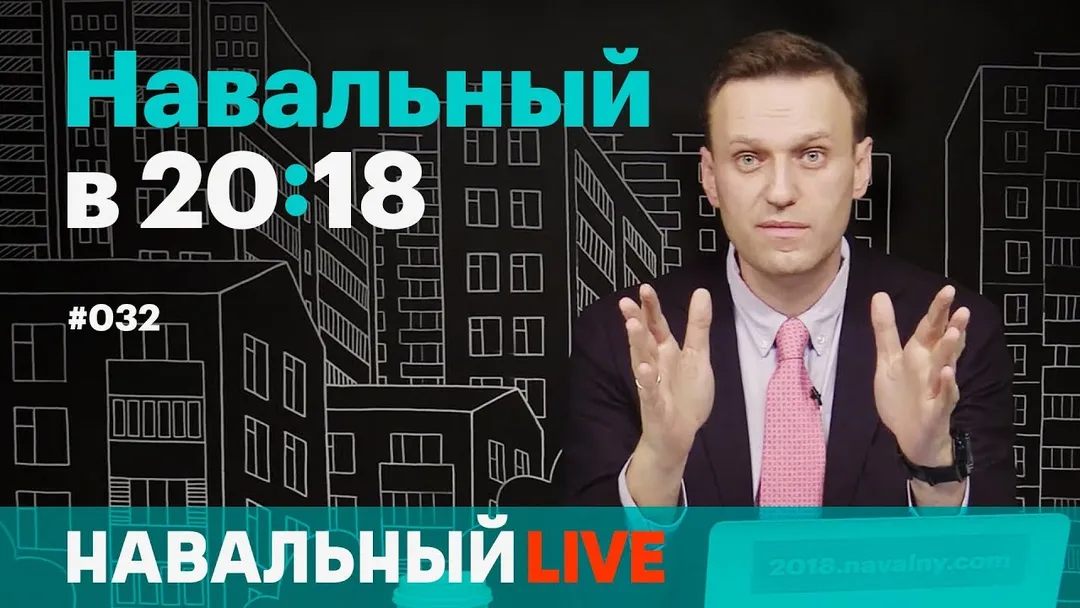
Hello everyone. It's 8:18 p.m. in Moscow, and in the studio—
Navalny Live, Mikhail Saakashvili.
Or I don't even know what to call myself anymore.
All those names you mentioned—maybe that could actually
become the trademark of my show, because
every time they come up with
wonderful new names for me. In
recent episodes, as you may remember, I was
a bungler, then I was a visiting
ticket inspector, and today I'm Mikhail Saakashvili.
And obviously that's because this is
the main thing—the most, I think,
quoted piece of news from today's
press conference by President Putin,
which, generally speaking, was supposed to be
something momentous. After all,
the man is running for a fourth term. He's been in power for 18
years, he had just announced before
workers that he was running in the election, and
then held a press conference. We were all waiting.
I'll be honest: I watched all three
hours—well, with breaks. I went
to lunch, attended one meeting, but
overall I watched almost all of it, because
I was expecting something interesting. What exactly
would Putin's answer be to
today's challenges, to the obvious
public fatigue with him, to the obvious
economic downturn, the lack of
economic growth, and finally to
the rallies that took place across the whole—well, all
the things happening in the country. He
was supposed to give some kind of
powerful response at least—one that he himself
would consider powerful.
After all, last time there were the May decrees
and various other interesting little things,
statements that were meaningless but loud,
foreign-policy ones. But this time all we heard was
a double serving of coughing,
and overall, of all the press conferences,
this was of course the most
uninteresting and unconvincing one.
Nothing at all was really said. But we
were expecting something new on
the economic program, at least some
promises.
Something like last time—remember, when it was like,
"We'll create 25 million
high-tech jobs." Well,
it was terrible nonsense, and everyone understood that
you couldn't actually do that, but at least
it sounded like something. You may remember that some
time ago all the newspapers were writing that
the presidential administration was busy searching for
an "image of the future." Those people sit there earning
big salaries, and we all hoped that they would
somehow formulate this image of the future
and present it. Our fingers were already poised
over the keyboard so we could joke about
this image of the future and mock everything
Putin would say. But he said absolutely
nothing. He just came and said
nothing, except that
the opposition has no program—whereas he does.
He doesn't have one, in fact. And besides,
there was the whole "I'm Mikhail Saakashvili" thing. Let's
take a look. We have two minutes; we've
trimmed it a bit. Ksenia Sobchak
asked Vladimir Putin a question, and he
answered it. Let's watch it and discuss.
My question concerns competition in elections.
Your press secretary, Dmitry Peskov,
has already said that our opposition has not
matured yet.
Today we were saying that, well,
it's not for me to cultivate it, because there are no
people. But it seems to me that everyone matured long ago,
and no one needs to be cultivated—everyone has
grown up on their own. But the problem is
something else: today either
opposition candidates are not allowed onto
the ballot,
or obstacles are created for them. I feel this
myself. For example, there is a candidate, Alexei
Navalny, who has been campaigning for a year.
Against him,
fabricated criminal cases were deliberately
created. Their falsity was
proven by Alexei Navalny in the
European Court. The European Court's ruling,
as you know, is recognized by the Russian
Federation.
And yet he is still not being allowed to run
in the election, even though it is known that there is also
a separate opinion from the Constitutional Court on
this matter, and so on. The same thing
is happening in connection with my own activities after
my announcement.
It's very difficult to rent any hall in the country; people
refuse, even on normal commercial
terms, to cooperate. It's hard to place
any campaign materials at all, and all of this
is simply connected with fear. People understand
that being an opposition politician in Russia means
either you'll be killed, or you'll be
jailed,
or something else of that sort will happen.
My question is: why is this happening?
Is the government really afraid of real competition?
As for competition, as for
where we have a viable opposition—I have
already answered that at some length, and
the point of that answer is not that
someone hasn't matured enough for something, but
rather that
the opposition must come forward with clear, understandable
programs for people—programs of positive
action. You are running under the slogan
"Against Everyone"—is that a positive program
of action? And what do you propose to
solve those
to solve those problems that
we are discussing today, specifically regarding—
As for the figures you mentioned,
that question has already been raised here.
About Ukraine—you want our
public squares to be filled with dozens of such, excuse me,
Saakashvilis? Those you named are
Saakashvili.
Only in the Russian version, and you
want
such Saakashvilis to
destabilize the situation in the country?
Do you want us to go through one
Maidan (the 2013–2014 Ukrainian protest movement) after another, so that we have
attempted coups? We
have already been through all of that.
Do you really want to bring all that back? Saakashvili,
Maidan, running around the squares, Maidan,
Maidan, Maidan, Saakashvili—what are you even
talking about? Why isn’t Navalny
allowed to run in the election? Saakashvili, Maidan, not
allowed to run—what does all of this even
mean? And what do your
speculations about a program have to do with it?
We actually do have a program; we
just presented it. In general, we have
always had one. By the way, on the subject of me spending a year traveling around,
“running around the squares”—yes, I do go to public squares,
because I speak in front of people. That is
my job as a candidate. It is very strange
that Putin is not out in the squares now and
is not meeting with anyone and not
talking to people and not trying
to tell them about his program. But I
want to point out something that
so far no one has paid attention to. I
followed the media reaction—everyone is laughing:
ha-ha, Saakashvili, he basically didn’t name
Navalny by surname. It’s a strange
thing. Honestly, this time I was
sure he would finally say “Navalny,”
as if to prove to everyone that he
could do it. He couldn’t. But all that is
nonsense. In fact, Putin once gave
a very simple answer. We all forgot it. It was in
December 2013, and back then he
was asked during his annual call-in show about this—well,
Navalny had taken part in the election; did you
approve of that? I don’t want to misquote him,
so let me not get it wrong—I’ll
even show you the headline from the newspaper
*Vedomosti*.
What did Putin say in response to the question: under what circumstances
would Navalny be allowed to run in the election?
“They will not bar Navalny from the election
if he did not pose a threat; if he posed a threat, he would not have been allowed
to run.” That is a direct quote
from Putin, straight out of 2013. It is as if
from there, from the past, he is answering us here
in modern Russia, not letting us move forward
into our beautiful Russia of the future:
“Guys, Navalny poses a threat,”
and that is why we are not allowing him into the election.
What happened at that
press conference is very important, because he did not,
of course, phrase it that way directly; on the contrary,
he lied.
He said that he is afraid of no one. But for the first
time, he did not resort to his usual pseudo-
legal nonsense. He said quite plainly
that we are not allowing this candidate to run
because we do not like him. Yes, there was an added
bit about Saakashvili and because
he will be running around, but this candidate will
do certain bad, unpleasant things
to me, Vladimir Putin, and to my friends—
Dmitry Medvedev, Gennady Timchenko, or
Arkady Rotenberg. We do not like these people.
They will do something bad to us.
Maidan, blah blah blah blah blah—therefore, in the
election, we will not allow him in, because
the state is not some bearded peasant, as
was put so vividly, who
pulls cabbages out of the ground. Rather, it is—well, I don’t
know—we are these cool technocrats
who can solve problems, and we are eliminating this
threat and not allowing the person into the election.
That is the most important thing that
was said, and I urge everyone to pay
attention to it. And what Putin said
only strengthens my conviction that we
must all together demand my
registration. This is not specifically a question of my
registration; it is a question of our right
to put forward our own candidate.
We need to draw attention to this and
say that an election without a candidate
is not an election—especially when you are directly
saying that he poses a threat, so we
are not letting him run. But as for all this
funny stuff about Maidan and Saakashvili,
there is simply no need to pay attention to it.
It has, in principle, turned into
a kind of running joke: in response to every
question, to every uncomfortable question, Putin
for some reason keeps bringing up Maidan,
Ukraine. He has been doing this since 2014, and
right after the press conference there even appeared
a funny edited video.
I talked about it at one of the
rallies, and now we will show you—there is
literally one
where you can see that Putin is simply speaking from a
prepared talking-points sheet. “Alexei Navalny, regarding
the figures you mentioned—this has already
been asked a hundred times—or there is the question of Ukraine.” As soon as you
say something about corruption, the response is immediately:
“He wants what happened in Ukraine.”
“Do you want our squares to be filled with people running around,”
“dozens of such—excuse me—Saakashvilis?”
What does Ukraine have to do with it?
I was telling you that Medvedev has a palace,
damn it—and the answer is: “He wants to stage a Maidan.” You
“want us to go through”
“one Maidan after another.” Damn, well, there you go.
You see, it is a real joke: in response to
absolutely anything you say to him, yes, something like
a question about the U.S. national debt—and he somehow did not bring it up there.
Actually, it would be more accurate to put it this way:
“But these gentlemen whom you mention...”
Of course we won’t let them in, because they’ll
stage a Maidan (an uprising like Ukraine’s 2013–2014 Euromaidan), and as a result of that
terrible Maidan, we’ll end up in as
dire a situation as the United States is in now, by the way.
Just look at their enormous national debt — that’s
the last thing we need. Everything else that was said
was, of course, well, not even
sad to watch.
I mean, the man has the entire
presidential administration working for him there. They could
have come up with something better. They could have, well,
at least simply lied about something at
that press conference, and the sheer audacity
of that lie would have taken everyone’s breath away.
But they can do nothing except
endlessly, endlessly drone on about
Maidan.
I’d like to draw your attention to the fact that, first of all, we have
an app for the program
Navalny Live, and you can download it. We already have
quite a few thousand downloads.
It works, so go ahead and get it. We had an app
for iPhones before, and now we also have
an app for Android. I know that
many people were offended when last time
I said that Android owners are used
to suffering. Well, you don’t have to suffer anymore.
End your suffering, Android owners.
Come on in and
download the app, and you’ll be able to
watch the broadcasts, listen to them like
radio, and read transcripts. Besides, I
noticed something remarkable:
viewers like it when we raise money live on air.
We were terribly uneasy before
starting to do it, because we
thought it would really annoy all of you.
But it turned out to be quite
an entertaining thing, so in this
broadcast we’ll continue fundraising. I want
to say that over several
programs we collected
850,000 rubles (about 8,500 USD), and we need only another 150,000
rubles (about 1,500 USD) to reach a million. So I’m curious:
in this broadcast, will I be able to make it
to a million in total? The money we
raise today will go to the project that pays
fines for everyone who was detained or fined for
attending rallies. So basically, everything
you donate will go toward that.
If you were fined for
a lawful rally that you took
part in, then you can send those
funniest GIFs that will
appear in the background over my face, and
various messages. Another decent
question that came up was asked by Tatyana
Felgengauer. She was talking about something very important:
in effect, two legal systems. That is
absolutely true. One system is the one in which
we all live, where criminal cases are fabricated
and there is complete
lawlessness. And then there is a second system where
there exist these people with
“special status,” as Prosecutor General
Chaika called them when defending Suleiman Kerimov. He
said: how can it be that a senator,
a person with special status, can simply be
detained on suspicion of a serious
crime? But what else would you detain him for,
if not on suspicion
of a serious crime? But they were
completely serious about it. He simply
he was genuinely astonished: how could this be?
Imagine that — some police force detains
a person with special status. And that’s exactly what
Felgengauer was talking about, using
these people with special status as an example.
Let’s watch it very briefly. We have clip 220.
Q&A. My question is about the situation with
the rule of law in the Russian Federation.
We see two different legal realities.
In one of them, a real
repressive machine is actively at work, when criminal cases are opened
over reposts on social media,
when people are sitting in prison on
completely unfounded charges, and
this has been proven in many cases — Oleg Navalny, for example,
when the case against Kirill Serebrennikov is underway,
and Alexei Malobrodsky is being held in pretrial detention.
We see another legal
reality: in it, Boris Nemtsov has been murdered,
and Ruslan Geremeyev is not questioned
because, well, investigators were simply not
let in.
Andrei Turchak has not been questioned in the case of the
attack on journalist Oleg Kashin.
Igor Sechin, the head of Rosneft, does not appear in
court for the crucial trial in the case of Alexei
Ulyukayev, ignoring all summonses, and any
other citizen would almost certainly
be brought in by force, because
that is contempt of court. However,
Igor Sechin gets away with all of it.
So the question is: what rule of
law can we even talk about if in our
state there are different legal
realities?
I agree with you that there are
plenty of problems, but I cannot agree that
there are different legal
realities. As for Sechin and his failure to appear in court,
if there is any violation of
the law here, then the law must respond
accordingly. But
as far as I understand — I may be mistaken,
I have seen the public reaction
on this matter —
the law has not been violated in any way here, and as
the investigation believes, enough material has been collected,
including testimony from
Sechin himself. But I also cannot but
agree with you that Sechin could have
come in — there would have been nothing difficult about it —
and repeated everything he had said during
the preliminary investigation and questioning. Well,
as for someone being in prison and you
considering it unjustified — that is your view.
unfounded, while the investigative authorities consider it
well-founded. In such cases, only the court can resolve the dispute.
Only a court of first instance can do that. We will need to
continue strengthening the judicial and legal
system. 22,000 people are watching us
live, while Putin’s broadcast peaked at
mostly around 32,000 viewers at its peak.
32,000 people — we’re falling a little short.
But then again, I’m Mikhail Saakashvili,
and he’s Vladimir Putin, so
I’m supposed to have slightly fewer
views.
The answer to that question was quite interesting,
because in situations like this, Putin usually
speaks more evasively. I
expected him to say something like,
“Well, yes, of course, Igor Ivanovich should
pay close attention to the requirements of
the judicial system, and if there are any
violations there, then of course
the authorities will look into it. But I’m sure, I
will draw his attention to the fact that he must
treat the courts with particular respect.”
And he would say roughly the same thing
regarding political
prisoners — that their cases are under review, there are
appeals, we are watching all of this closely,
we are not violating anything, after all.”
Tatyana Felgenhauer, thank you. And what
she said about Oleg Navalny as well,
and about the ruling of the European Court,
somehow ended up
showing that Putin still tries not to present himself as
a complete villain when answering these
questions. But today, here, he
fully switched into what you might call
a brazenly indifferent mode.
Meaning: he was right about everything, he did
everything correctly, everything according to the law — although he
obviously broke the law, obviously
disregarded the judicial system, obviously.
What cool things are changing around me — I
started talking and then suddenly
there were fireworks all around. Obviously, he disregarded
the court — just like that, plainly enough.
It was demonstratively
and brazenly dismissive. Nevertheless, everything
is supposedly fine. So this time, in
answering that question, it was stated very clearly
that basically, “we’re the tough guys, and
indeed, Tatyana Felgenhauer, you
are right: there are two legal systems.
In one legal system, we are absolutely
right. The other legal system is for you.
If you’re unhappy, then go to
our legal system — it will
explain to you which part of it you belong to.”
That was quite a cynical answer, and it seems to me
that it shows us how the rest of the
election campaign will go as well.
The same thing will happen again,
all over again.
They will treat you with complete lawlessness; in everything
they will refuse us, they will keep refusing, they will
do absolutely whatever they want.
And he will say, “But we are absolutely
right.” In that sense, there won’t even be
any of those ritual phrases like,
“Let the Central Election Commission
look into what exactly went wrong there.”
I don’t think even that will happen. They
will simply put on stony faces and
keep insisting how they are one hundred
percent completely right. Anton Lesovoy
reminds me — corrects me — that it was time to mention
America, though not “long ago,” but Occupy Wall
Street. That’s right — in fact, he
did say at the end, correctly, that
“Just look at what happened in America.
There was this movement, Occupy — where is it now?
Where is it? It’s gone home, that’s where,”
he said. “Where is the Wall Street movement?” As if,
you know, they had all been shot or
thrown in prison, and that was that.
And this is called democracy? As if they had
been rounded up onto barges and the whole movement drowned.
That’s what he calls democracy.
There was an Occupy Wall Street movement; it
did exist.
It was more or less active for several months, and
then it simply, gradually, fell apart
like any political movement — it lost
its relevance.
The participants in that movement, the leaders of that
movement, are perfectly free.
They are engaged in political
activity, they continue doing it, and
most certainly
no one has banned them, no one forbids them
from taking part in elections, and no one forbids them
from continuing this activity.
They can still get approval for their
actions,
rallies, and everything else. So when Putin
brought up America again, he nevertheless
lied again.
This election campaign, right now,
in my deep conviction — and I think that in the
very near future you will also become
convinced of this —
will of course be focused on turnout. He
didn’t even try
during his main first
press conference to say anything
that would inspire people, win some
votes. They are convinced that everything has already been
decided.
Since Navalny is not being allowed in — although we
will of course continue fighting for
registration — it very much looks like
they will try to issue a decision saying
that I am not being admitted to the election. Because of that, they
believe that
their direct electoral problems
have been solved. They have only one problem left:
voter turnout.
Whatever they may say, of course they do not
want fewer than half of voters to show up.
voters, or so that turnout is much
lower than last time, so
they’ll drag people in by the ears if they have to, using every means possible.
You probably read it—newspapers wrote this week
that the Presidential Administration gave
instructions to all governors to turn
the election into a celebration, both literally and
figuratively. So at every
polling station there will be cheerful clowns,
giveaways of detergent powder, an accordion player—
everything will be there. Plus there will be
—you’ll see—I’m sure that in the near
future such plans will be published:
blanket door-to-door canvassing in order
to drag everyone to the polls.
Workforces will be pressured into going to
vote, some kind of ward captains and block captains,
lotteries—we’ll see it all. They’re terribly afraid
of what’s happening—how should we even call it properly?
It’s not even really a boycott; probably it shouldn’t be called a boycott
at all, because the word itself
“boycott,” of course, implies that you’re
doing something to our
electoral strike—that’s exactly what it is.
That should be the attitude. In other words, this
is a strike: we refuse to participate in
this disgusting farce. That is, we want
to take part in elections, just as strikers
actually want to work, want to receive
their wages—so do we, we want to participate in
elections. But if you won’t let us have a real
choice, if you think you should decide for
us who is supposed to be our
candidate, then we will strike. And that’s
what they’re terribly afraid of—the very idea of this strike.
They will fight it with all their might. In
the last State Duma elections, you
remember, they blocked websites
that called for a boycott. I think that
this time they will try even
harder to do that. And so our
task is to wage a very active
guerrilla campaign in order
to convince everyone around us that you cannot
and must not take part in this.
So, how much money have we raised? I can already
see the bar moving, moving, moving.
Let me remind you that today we want to reach
one million.
And the money we raise during this broadcast
will be directed toward
paying fines for those who, those who
have been fined.
Will Navalny be nominated through a call
from PARNAS (the Russian opposition party) or by an initiative group? We
were asked—Dmitry Anufriev asks:
how do you view Katz’s forecast about
the prospects of both options? Well,
these forecasts have neither
legal nor political meaning. From the very beginning, we
have said that I would
run as the nominee of a group of voters. That
will be the movement itself; a nomination from
PARNAS is impossible, unnecessary, and has
no legal significance whatsoever. That is, I
consider myself a candidate who
truly represents large
groups of people that are much broader than
the PARNAS party.
With all due respect for it,
that’s why I want to be nominated by
the voters; that’s how I’ll run. And in the near
future we plan to hold, we plan to hold
a meeting of such an initiative
group.
Artyom asks me what will happen to those
people who have already taken out a mortgage at 10
percent annual interest for 15 years. He
is apparently asking me in connection
obviously, with
the publication of the program provisions stating
that I believe mortgage rates should be reduced
to 2 percent—they should be below two percent.
And so Artyom asks the question:
“Alexei Navalny, you’ll most likely become
president in 2018, so what
am I supposed to do? I’ve already taken one out at 10 percent.”
Artyom, in that case the obvious thing
should happen: banks will revise those
contracts, which in fact happens
all the time.
In developed countries—Leonid Volkov, who
is still being held in a special detention facility
in Nizhny Novgorod, told me that when
he took out a mortgage for a home in Luxembourg
—yes, he was working in Luxembourg—he initially
got a mortgage at 1.75 percent
annual interest, and then the bank sent a notice
saying, as you know, the central bank’s key rate has been lowered,
so we will revise it
unilaterally, and now the rate
will be 1.5—that is, they lowered it. And here
the same thing should happen. Alexei,
please comment on Meduza’s article
about your program. First of all,
today on Vladimir
Milov’s program, he and I discussed
the program in quite some detail. We will continue
to talk about it for another hour; I’ll say more about
that a bit later. As I understand it, Milov
is preparing a point-by-point response
to Meduza’s criticism of our program,
the criticism and the questions they raised. We
are grateful for all the questions; we are grateful
to everyone who criticizes or praises us.
The main thing is: discuss it. We’re happy that
people are discussing it. Look at the other would-be
presidential candidates—have you ever seen an article
in
Meduza about Yavlinsky’s program,
or Titov’s, or Sobchak’s, or Katya Gordon’s? I
hope there will be—it would be
interesting to compare. But I looked at this
critique that Meduza has just
published, and it seems rather weak to me.
It doesn’t stand up to any serious
analysis. For example, it begins by saying
that Alexei Navalny did not explain to us
happy holidays, and someone writes to us
Alexei Navalny did not explain at what
prices he was using, or where he got these figures
that he uses in his video, although in
that video it says that these figures
were taken from the consolidated budget for 2016
the last budget for which
full execution data has been published. I
say there that I am a real
candidate, and I am working now with specific
figures. These specific figures I took
from the actual 2016 budget because
I want to discuss not a hypothetical
situation in the economy, but a completely
specific one. But we are grateful for all these
questions, and we will answer them one by one there
Volodimir Lov, I hope, will publish tomorrow
such a
[music]
will publish such an answer. An important
question is written to me by Arrakhat: the spiritual leader
of Russian Buddhists, the Dalai Lama, under
Putin's rule, has almost never
been to Russia. As a result, pilgrims
have to spend tens of thousands of rubles on
travel. Under your presidency, will it
be permitted for the Dalai Lama to come? You can
find some very funny photos on the
internet if you google "Navalny and
the Dalai Lama." That is, no, unfortunately I have not
met the Dalai Lama, I have never seen him
but once I was one of the organizers
of a picket, you'll laugh, in front of the Ministry
of Foreign Affairs, demanding that the Dalai Lama
be allowed into Russia. A whole
delegation of Buddhists from Kalmykia
and Buryatia came. I filed the application, we helped, so
you will definitely find photos where
I am standing there, surrounded by a bunch of people
in some kind of orange outfits and such
robes, with signs, and they, they were still
chanting: "We demand that
the Dalai Lama be allowed to visit Russia." You
understand, it's hard to chant that, but they
really were chanting it right in front of
the Foreign Ministry building. Those were the blessed
days when you could file an application for a picket
in front of the Foreign Ministry and get approval for
a picket there. I know the Chinese will
be very angry with me, but I do not
see any problem with the Dalai Lama
visiting Russia, especially considering that
Russia has traditional
Buddhist populations: the Kalmyks and Buryats
who practice Buddhism. He is their
religious leader, so why not
let him in? By all means, let him come. He
has visited Russia before, it's just that
under Putin he is not allowed in
One year and one day ago, I announced
that I was running for president, and
this time, for me and for many
people working here at the FBK headquarters (Anti-Corruption Foundation),
has of course been very compressed; it feels
like it was just recently, yet a whole year
has passed, because we have worked very, very
hard. And guys, everyone who is watching this broadcast
now or who will watch it later,
the main thing I want to say, of course,
is that I am tremendously grateful to all of you for
taking part in the campaign. In fact,
we often write about how, I don't know,
they squeeze us, illegally obstruct us,
interfere with us, open cases, and
arrest people. All of that is real, I repeat
the campaign manager is in jail right now, but
the main thing we have encountered, the main thing I
have encountered, is of course help and
support. That has made up 90, 99
percent of what we have been doing, and the atmosphere
we have been in has been one of support and
help. One percent has been obstacles
it's just that we write about that constantly because it
hits hard when people end up somewhere under
arrest or under pressure. But mainly
of course, this, this, this campaign is moving forward. I
am not summing it up
but it is going on, developing, and it's really great
just last week
I came back from another tour, and there were
wonderful, absolutely amazing
rallies
and even marches in the city of Kaliningrad. We
pulled it off, it was really great, and I am proud
that I have received your support. I am
proud that we have truly created
a political system of 83 campaign offices across
the whole country, 13 of them are so-called
people's offices, where we do not even provide any money
people do it entirely on their own
We now have almost 700,000
signatures, and signatures are not just email addresses
these are people who left their phone numbers and
verified themselves fully, or rather, not
fully verified by coming to the office, but
confirmed themselves through their mobile phones
We have recruited 190,000 volunteers, and
raised and spent 241 million rubles, and held an
uncountable number of pickets and
meetings. We held two major
nationwide rallies that
took place in dozens and even hundreds
of cities across Russia on March 26 and June 12
Since September 15 alone, I have held 27 major
rallies, really large ones
in cities across Russia, despite the fact that
we are simply forbidden everywhere from holding them
everywhere there are problems, and it has to be
done in spite of that. So this is a very
cool, real election campaign, and
most importantly, I would not for a second
be disingenuous if I told you now:
I traveled around cities, held these
meetings, some were good, some were different
somewhere in Volgograd, remember, they grabbed me by the arms and
by the legs
provocateurs with badges tried to drag me out of
the office, or rather, they were dragging the provocateur by the legs
Our volunteers were practically carrying me along, and
then somehow all of this was happening without any obstruction,
but I know one thing: this government can be beaten
at the polls. All this talk
that they’re so powerful and enjoy
massive support—if you work, if
you travel from city to city like this, put out
a platform, talk about it—you can
win elections against them. But that’s exactly why they
won’t let me in, won’t allow it, because they
understand that perfectly well. All these
approval ratings exist when there’s nothing else,
when a Russian citizen looks at the TV
and says, “Damn, I’m sick of everyone,”
“I don’t like Putin, he doesn’t pay my salary,”
“but who am I supposed to vote for? Vote
for someone else? Fine, I voted for Putin.” That’s
the only thing this system is standing on: the fact that
the other candidates do nothing. Right now they’ve
woken up from hibernation and gone out there
hoping they’ll get more than three
percent and qualify for
state funding, and then they’ll be given
a pile of money from the budget. They’re not really
interested in anything else.
Going somewhere and campaigning to people doesn’t
interest them. But I travel and campaign, and I see
that people’s opinions change. You come to
the city of Kaliningrad, and everyone knows
who you are. Whether they support you or not,
at the very least, in Kaliningrad or in
Novokuznetsk or somewhere else, everyone definitely
says: “Right, Navalny came to us,”
“he campaigned here, he paid attention to us,”
“he came, he answered questions while standing
out in the cold, like a candidate should.” So
that makes him stand out from the other candidates, and we
can support him simply because he
came to our city. Moscow is
more or less spoiled in that respect, but here
there are at least some political events.
In Russia’s regions, especially in cities
with fewer than a million people, basically no one
ever comes, nothing happens there. These
people don’t even remotely feel that they
have any influence on politics
in the country, let alone on presidential
elections. So go to them, and you’ll get
support. I got that kind of support, and I’m
proud of it. It’s really great, what
we’re doing, and we need to keep
doing it. You can see Kaliningrad now—
we were there,
the photos show a pretty powerful,
inspiring rally. On my cup it says:
“I have a platform. You don’t.”
And that’s the plain truth, because today
we still haven’t heard what Vladimir Putin’s
platform is. I do have a platform, and we’ve
published it. I just wanted to draw attention
to the fact that this isn’t something Navalny
published yesterday. The platform
has been there from the very beginning. I’ve been involved
in politics for a long time.
I’ve had a whole system of views and policy positions, and
almost all of you are fairly well
aware of them.
I ran with a platform in the
2013 mayoral election.
For a long time I’ve been involved with various parties and have constantly written
all kinds of articles. I think that
when it comes to political and journalistic
texts, I’ve probably written
more than all the other politicians put
together—simply because I was forced to.
I don’t have television access, so I wrote in my blog.
I write about this, I write about my system of
views, so yes, I do have a platform. But
this time we also packaged it, as it seems to me,
quite successfully, because we
decided, as Putin said today,
to put it in language people can understand.
So that’s exactly the kind of language we used for everything. I’m
very proud that we came up with these
case studies for Russia—that is,
translating policy points into the lives of
specific people. And I’ve received a whole lot of letters
saying it’s impossible to watch
the story of the teacher who
earns 14,800 rubles a month (about US$250 at the time), or the doctor’s story,
or all the other stories, without tears. And if you had seen
the full video about Nikolai
Kudryavtsev, then you definitely would have
broken down in tears. He’s a wonderful man,
a teacher from Yaroslavl.
Yaroslavl is actually considered one of the wealthier regions
of Russia, and he gets 14,800 rubles a month (about US$250 at the time) for one and a half
full-time positions, including extra pay for difficult working conditions,
because he works at a boarding school for hearing-impaired
children. It’s just impossible. What we wanted
was to show all this through the example of specific people
and explain to many of those who haven’t
been touched by it that this is actually
the reality for most of Russia. Nikolai
Kudryavtsev is not some kind of, you know,
isolated case from an otherwise prosperous society,
some extreme situation where we all have to rush out and
save him. No—the greater part of the country is made up of people like
Nikolai Kudryavtsev.
And we need to do something so that
this stops being the case, because it’s impossible—
everything simply becomes meaningless if
a teacher earns 14,800 rubles a month (about US$250 at the time).
I got several letters saying that
we should invite him onto Navalny
Live. In fact, all the people we’re doing
these case studies with should be invited here and given
more time to speak.
I think we’ll do that.
That’s a good idea. I’ve received 148 new questions.
Let’s take a look. “Did Vladimir
Vladimirovich (a familiar form of patronymic for Putin) misspeak when he said that fair
and honest political competition will exist,
thereby admitting that it doesn’t exist now?” one viewer writes.
But I’ll repeat: this time he spoke quite cynically,
and said quite clearly that
there is no political competition. Why?
Because we do not want political competition.”
competition, and we do not believe it is right.
So Gennady Nes... says to us that
Navalny and Sobchak are a Kremlin project aimed at
replacing personnel while genuinely
banning truly opposition parties from printing
their own press—for example, *Kurs Pravdy* and
*Yedineniye* in the Lipetsk region. As I understand it,
those are the only newspapers
representing an honest position—*Kurs Pravdy*, *Yedineniye*—in
the Lipetsk region.
So does that mean I’m a Kremlin project too, Denis? Well,
we are also being forbidden to print newspapers in
the Lipetsk region as well, so believe me, I am not
a Kremlin project, and
judge us by our actions—look at what we do.
Look at our campaign, how the authorities treat us,
that is the main thing. Look
at whether we suddenly popped up and are helping
the Kremlin solve certain problems, or whether
we are creating those problems. Then you will see
that for the past year we have been working and creating
very serious problems for those guys.
We are definitely not solving anything for them. Starting tomorrow,
will it already be forbidden to donate or campaign? writes
Baranov Alex. Tomorrow there will likely
be an announcement of the election. Most likely,
the Central Election Commission
will officially launch the start of the election
campaign.
That will mean that from that moment on I
will have to specially
label campaign materials and things like that.
But until that moment, and until
I receive registration or at least
enter the formal procedure and submit
the documents, of course we can
raise money, and we can do everything else
as well—there will be no restrictions. Well,
we’ll see. Tomorrow the Central Election
Commission is supposed to
publish it. So, Inferno Overkill,
wow, what a username you have.
The Kremlin bots are disliking again, well,
listen, they’re disliking—so what? It’s nothing
to worry about. If 22,000 people are watching
the livestream right now, then all of you should
hit like right now at the same time.
Let’s get all 26 thousand—twenty-six,
twenty-six thousand likes. And what a cute GIF.
Who smells so bad? Ah, the scurvy ones. There are 26 thousand
people watching.
Hit like, and then no Kremlin bots
will be scary. We just need to stop, even a little,
paying attention to it. They
have created a structure and pumped money into it.
Putin’s cook (a reference to Yevgeny Prigozhin) is most likely behind it.
They will push their videos to the top of
YouTube, and they will bury
all the other videos in dislikes.
This will go on for months, and possibly even years.
As long as Putin remains in power, they will be there
disliking every video. It’s nothing страшного.
The way to fight it is, in response,
to like the videos. In any case, there are far more of us—real people—
than all of these Kremlin bots.
It’s a huge mistake not to respond to donations and
many people want to ask a question and are ready
to donate money for that. Writes
Ivan. That’s absolutely right, Ivan. As I already
said, I have one problem, and it is entirely
technical. We’ll try to solve it. Right now
I’m looking into the camera and at the same time
looking at the screen where I can see myself. I
see GIFs,
I see messages, but if you write
a question yourselves and pay for it
so that it appears in that corner behind me,
it appears there, but I simply won’t see it. I’ll
have to do this like this. You don’t want
that, do you? We’ll figure something out later.
After they splashed me with brilliant green antiseptic dye (zelyonka) (a common attack on Russian opposition figures), my
vision got a little worse.
It’s not sharp enough for me to
read those questions off the screen. That’s our
problem, and we’ll solve it. We do not want to make money from this.
It’s a pity that I
am a citizen of Kazakhstan and cannot
vote for Navalny, writes Ramis
Sadygov. In any case,
you can still support us or say a few
kind words. I remember all of Kazakhstan came down
on me because somewhere in
some interview I said that I did not know
the poet Abai (Abai Qunanbaiuly, a foundational Kazakh poet). After that, by the way,
while I was in the special detention center, they handed me three
volumes of Abai, and I became very well acquainted with his
work. But in any case, I’m glad
that someone is watching us from Kazakhstan, and I
have atoned for my guilt before the Kazakh
people for having once said
that I did not know Abai. This is an extremely
important story that is happening right now.
Wait, Dendera asks: Alexei,
please briefly explain—when is candidate registration,
and when does signature collection begin? Look,
if the election is announced tomorrow, then before
the New Year there must be a meeting of
voters.
Putin will hold his own voters’ meeting
on December 24, most likely.
They say it will be at VDNKh (a major exhibition complex in Moscow); they’re preparing whole pavilions there.
And around those same days, we will also
hold our own voters’ meeting. We
have it harder than Putin does, and
let me get out from behind this GIF.
We have it harder than Putin does. It is
difficult for us to find a venue. It has to be
fairly large—big enough for 1,000 people—because
500 people take part there just in
the voters’ group, plus journalists.
So, in other words, we need to find a venue for about a thousand people.
They are not giving us a venue, and we are dealing with that
issue right now. After that, we take the
documents to the Central
Election Commission.
The Election Commission registers me as a candidate, and
then we collect signatures.
And that must happen after the New Year.
And precisely because Putin has
a meeting scheduled
with his voter initiative group on December 24, there is now
an extremely, extremely interesting
story unfolding. You remember, we got elected
municipal deputies in Moscow and
loudly discussed how this was a victory, and many
municipal councils, that is,
had been taken over politically — there was a majority there.
I wasn’t all that actively involved in this
process, but there was one municipal
council where we very actively
supported the candidates, and Ilya
Yashin was running there, and he got his whole team elected
and became the head of the municipal
council in the Krasnoselsky District of Moscow.
He has a majority there, and they
started working quite actively.
They’re doing all sorts of good things,
including demonstrative, principled political
things. For example, Yashin refused
the official car that he
was entitled to, because why would the head of a
municipal council of deputies need an official
car, when he can use
public transportation or
drive his own car? Why on earth should
Moscow taxpayers
have to pay for an official car? So he
said, quite rightly: I’m refusing it, and this
money should be redirected to social taxi services
so wheelchair users can be transported
for free.
So, besides these proper
social initiatives, they’re also doing the right
political things. In particular,
when they had just been elected, many people
laughed at the fact that among their
powers — which are fairly limited —
there is such a thing as organizing local
holidays, organizing and holding
local celebrations. There’s also
the organization of patriotic activities,
work with the military commissariat, and things like that. But organizing
local holidays — those who live in Moscow
have seen these holidays a million times. It’s
some event, I don’t know, in some park
somewhere,
a celebration called something like “We Are Cheerful”
and
“We Bake Mari Pancakes,” or whatever
“Happy Kapotnya” or “Joyful Lianozovo” is called.
These kinds of events happen all the time:
some middle-aged ladies stand in the square,
doing something, schoolchildren dance, all sorts of
things like that. In other words, it always
has no political
context. But this municipal council
in Krasnoselsky got together there,
heard the matter, passed a resolution, voted,
by majority vote, and established a holiday
called the Day of Free
Elections, and it will take place on December 24 on their
territory. In Krasnoselsky there is
Lermontov Square
— Lermontovsky Square, to be precise —
located right next to
the Krasnye Vorota metro station. They said: Muscovites,
we invite all of you to the Day of Free
Elections. This is one hundred percent
in line with the charter of this
municipality and with Moscow law.
But City Hall immediately
went into full panic. And not just City Hall — it was
clear that some
federal-level
forces were involved here, because yesterday on Rossiya-2 (a Russian state TV channel)
there was an absolutely hellish TV segment aired.
I’ll show you a small excerpt from this
segment now, but really,
we haven’t seen anything like this since 2012.
Let’s watch a little piece of it.
I read with bewilderment in the media a statement by
some clerk from Moscow City Hall.
Ilya Yashin, on his Facebook page, is outraged over
the ban on the so-called Day
of Free Elections on December 24.
Back when they worked together in Yabloko (a Russian liberal political party),
Navalny and Yashin had close
contacts with representatives of American
international institutions. However, it’s not only
with Navalny’s circle that they have someone to cooperate with.
There are partners in the “near abroad” (former Soviet states) as well. They say that last
week, the Krasnoselsky municipal deputy was visited by none other than
none other than
Heinrich, a citizen of Ukraine, who spoke personally with
Yashin
and proposed establishing an exchange of experience
in municipal governance with the people’s
representatives of “Nezalezhnaya” (a sarcastic reference to independent Ukraine). What a joke.
So, as you can see, this is just completely insane.
Some Ukrainian named Heinrich — I
call Yashin. We’ve raised a million rubles on air (about 10,000 USD at the time), everyone.
Congratulations, we’ve raised one million rubles
live on Navalny LIVE. I applaud all of you.
The money raised today will go to those who
were detained and those against whom
fines were imposed. We are continuing to raise money.
Let me continue talking about Yashin and about
this segment. I call Yashin and say:
“So, did this Ukrainian Heinrich come to see you, or did they
just make up some Ukrainian?”
And what a name they came up with — really,
they might as well have said, “A man came in,”
“to the administration of the Krasnoselsky District,”
“he spoke with a German
accent,”
“and his name was Adolf.” That’s the only thing
missing here. It’s just
utter madness. And we really didn’t understand
why they were so worked up. A rally — or not even a rally,
but a holiday event — people will come
to this celebration, so what’s the big deal? And then
it turns out that on that very same day Putin
scheduled the nomination meeting of his
voter initiative group, so he really does not want
two events to be taking place
simultaneously: the Day of Free Elections, where
Many people, obviously, will point to
the fact that elections in Russia are not at all
free, and that this event is one where they
will keep feeding people nonsense
through the state apparatus: everything is fair, everything is wonderful,
and we will defeat everyone, and all that.
This confrontation between the Kremlin and, clearly,
a group of brave deputies from Moscow's
district councils is one of the most interesting
political stories right now, because
other deputies have already started supporting them.
The council of the Konkovo district
has adopted a decision in their support. Just now,
I saw that Dmitry Gudkov published
a letter in which nearly 100 municipal
deputies
spoke out in support of Yashin, and
really, in no uncertain terms, declared:
we call on everyone to come to this
festival. This is very important because, well,
many of these people are, how to put it
without offending anyone, cautious. So,
when it comes to an unauthorized event, will we go to an
unauthorized rally or not? We won't. But here,
even though in general they ban them, here
the prosecutor's office literally brought over today
this evening some kind of order that is absolutely
illegal. Do we have the video? If we do,
let's show it. The prosecutor's office came to
Yashin.
They recorded the text—let's show
the receipt of this document.
So, in the official log, personally...
in the presence of citizen
Boris Lisovich,
born on May 1, 1963, residing at
the address: Moscow, Akademika
Volgina Street, building 23, apartment 131. His
passport details... and that's it. So,
you see how interesting this is.
City Hall, the Kremlin, the prosecutor's office—they have very clearly
stated, essentially,
that they understand this is illegal, because
one hundred percent
municipal deputies have the right to
do this. Please show the screenshot. There is
Article 8, Clause 8 of the law on the organization of
local self-government, which states in black and white
that they have the right to organize
local festive
and other public entertainment events. That is,
there is simply no way to argue with that at all.
You just can't argue with it. But nevertheless,
they are now, across all channels and
through the media and the prosecutor's office, declaring that it is completely
impossible and that they will ban it. But despite
this, even fairly cautious people
are saying: we are going anyway. One hundred
deputies signed in support of Yashin.
They didn't just sign—they appealed to
all the other deputies and to Muscovites, saying:
friends, we are all coming to Lermontovsky
Square on the 24th for the Day of Free Elections. This is
a festival organized by deputies.
They have the right to organize it. This is not
a situation where, as usual, Alexei
Navalny filed an application for a rally and City Hall
says, well, Navalny is there
running around the streets like Saakashvili (former Georgian president often invoked in Russian political rhetoric),
so they won't allow it because it obstructs
pedestrians. These are the authorities—municipal
deputies.
This is the government, and the government has made a decision to
hold a festival. In other words, this is not
an application for a rally that can be rejected
or where they can say that some other people managed
to file earlier than you. They literally had
some commission on social issues
meeting, a vote, all the paperwork, the whole
process. These are actual officials—well,
municipal officials, in fact—
who made the decision, and now federal
officials are trying to stop them, while other
municipal officials, meanwhile,
are backing them up. Very interesting.
Let's watch how all this unfolds. And of course,
all of us should take advantage of this and
accept the invitation
to take part in this festival, the Day of Free
Elections. So I will try
to definitely come. Twenty-six thousand people
are watching right now—well, if you are watching,
can you send money using the new cards too?
Send it?
How much have we raised already? More than
1,015,000 rubles (about 11,000 USD), so we have already beaten
our, our
our target. But remember, we are raising this money
for those who were fined for
taking part in rallies. Tomorrow, if you are fined,
we will raise money for you too.
So, there is still no proper
law that would truly protect
homeless animals. We are being asked by animal rights
activists who are pushing for the adoption of this
document.
Animal rights defenders are doing great work. At almost
every rally I go to, I am
asked about this law. I am constantly
asked about it on air. This is actually
the right kind of work: forcing
presidential candidates to speak about their
position. I said on the previous program,
and I will say again that I absolutely
support the adoption of this law and do not
understand why it is not being passed in the
State Duma (Russia's lower house of parliament). Yes, of course, there is
a certain hunting lobby
connected with hunting dogs.
There is also a lobby of those who believe that
animal shelters for stray animals
should not have to be maintained by municipalities. But
overall,
it is possible to come to an agreement with hunters.
Hunters, in the overwhelming majority of cases,
are actually great lovers of animals.
And as for the municipalities, it is simply
sheer stupidity on the part of the authorities that this is not being adopted.
The law—Alexei, will you seek to organize
Putin's impeachment in the event of his victory in the
election?
Denis Denis asks me: in accordance
with Russian law, to carry out an
impeachment—first of all, we citizens simply
cannot do that. Deputies can, but
in practice it is impossible. The thing is,
the impeachment law is written in such a way that it
cannot be implemented. But of course, if he
doesn't allow anyone onto the ballot and then
stages a victory, then we will not
accept his rule. We will work
to ensure that no one recognizes
his authority. What will you do with Putin's squad?
Andryukha asks me: Putin's squad—
these are just some athletes,
performers. These people will always swear loyalty
to whatever power exists. Do you know what I'll do with them?
I won't force them to create
a Navalny squad. I won't force
them to humiliate themselves the way they are humiliating themselves now.
Why are they lining up behind Putin? Because
their sports careers, their money, their
shows and productions depend very heavily
on Putin, on the authorities, and so they
crawl over there like lackeys and kiss his
little boots, creating Putin squads. But I will not
do that. I have no use for it.
I just want to give all these Dobbys back their
socks so they can go off and mind
their own business. Alexei, do you have
a pet? Victoria asks me.
I used to have a dog, a French
bulldog named Snoopy.
Dasha had a guinea pig—
no, I remember, a Djungarian hamster.
A Djungarian hamster. Her name was Zoya, but she
unfortunately died too. They really don't
live very long. We have five minutes
left, and in those five minutes I'll show you
two disgusting videos—truly
disgusting videos. Let's start with
the son of the head of the Investigative Committee
in Volgograd Region.
This man works as an investigator. He
also works for the Investigative Committee, but in
Moscow. And he got involved in some drunken
brawl, and today the police tried
to detain him.
And they weren't having much success.
We have the video—let's watch it.
[inaudible]
[inaudible]
[inaudible]
Please, you need to keep your hands—
tell us if you're recording, let us know.
Investigative Committee... brother. [inaudible]
I am the subject's... [inaudible] You saw in that
picture, in that video—usually
these are, you know, funny little sketches from the lives
of alcoholics, homeless people, or someone else. But this
is power. This is real power.
It's not just some investigator—it's the son
of the head of the Investigative Committee in
one of the largest federal subjects (regions) in Russia—
Volgograd Region.
There's a city of over a million people there, plus the whole region.
And by the way, why this especially
struck me: the father of this
gentleman is the one who fabricated the criminal
case against Alexei Volkov, our chief
in Volgograd.
That same ridiculous case over
a Photoshop image on the internet—they opened a case
against him for, what was the formal charge again,
let me put it correctly, desecration of
symbols—no, justification of Nazism. In other words,
complete nonsense, absolutely. But those brazen scumbags
kept him under house arrest, then
transported him from St. Petersburg, and put out
various press releases saying that
this Volkov, with his picture on the
internet, where he had photoshopped something,
was therefore an enemy of the state. And these
same people—these drunk mugs, this 'subject' crowd—
who don't even—well, fine, not to us,
they say all this—they don't even treat the police officers
who come and film them there
with any respect. He's not so drunk that he can't see
he's being filmed. He genuinely
thinks he's in the right. His father will
protect him—and his father will indeed protect him.
Just watch.
Probably after a video like this, this
fellow will be fired, but nothing will happen in the Investigative Committee
to his father, because
his father opens these kinds of
criminal cases for Putin, fabricates criminal cases
like the one they brought against our guy.
And as long as he keeps doing these things
for this regime, these people remain
completely unpunished.
That's why we need to go to the polls
to drive them all the hell out.
This whole gang of boors—
who put on blue suits
and shoulder boards and tell all of us to our faces:
'We are the masters here.' And not just to us—
they say it to the police too.
Come on, brother. Next one.
The second disgusting video is perhaps even
more disgusting. I want to show you
the apology that TNT (a Russian TV channel) made
to the Ingush people. It seems to me this is
even more insulting to the Ingush people
than the original offense. The background is this: TNT
had a comedy show with some kind of sketch.
The sketch was rather odd, not
very funny, and it was supposedly from the life
of prostitutes. So, the madam—
their pimp—reads something out and says,
they answer, and one of the prostitutes
starts saying something they don't
understand, and someone says, 'Oh, I know—'
'that's the Ingush language,' and that's where the girl was from—
from Ingushetia (a republic in Russia's North Caucasus).
Okay, it wasn't a funny sketch, yes, it was just all...
The others were speaking Russian.
Without an accent, which made it obvious that they were
Russian. One of them was from Ingushetia (a republic in Russia), and
there were some signs they were bandits
or some kind of strange armed men.
They just showed up at TNT and
demanded an apology in front of the whole honest
public, and to our great surprise and amazement
they were not taken away by the police, and nothing
happened. And TNT first
apologized there, so to speak, to the Ingush
people in one format, then in another
format, and now they have recorded an entire video
which we are about to watch now. Just try not to
throw up. Where are they all there,
seriously, where are they performing, and
they come across as completely disgusting, just
utter nonentities, and
and... well.
Let's watch it.
[music]
For 20 years, the TNT channel has been broadcasting across the entire
territory of Russia and the world, and over these 20 years the channel has
created hundreds of projects
in many multinational and diverse settings,
projects that bring people together. The TNT television channel
has always promoted love and
mutual understanding among people and nations, and throughout all
these years we have entertained and united
people and have never called for hostility or
hatred. And now we want to offer
an apology to our Ingush viewers for
the joke.
For hurting their feelings, we apologize
for the words and actions that offended
the great Ingush people.
And we, the entire multinational staff
of the channel, call on everyone who watches us
and loves us to be more tolerant
more respectful, and kinder to one another.
You know, I want to address the
Russian people: please look at
me, Ingush people, I... I want to
apologize to you for TNT's behavior, because
well, this is simply disgusting for the Ingush
people to watch.
What people? I don't know—any Ingush person whatsoever—and what does
some joke on TNT have to do with it?
They made a joke, whether successfully or unsuccessfully, and out of that
first some incomprehensible officials
or simply—God, I'm tired of this—bandits, or
I don't know, some strange illegal
groups decided to use this to
score political points and staged
a rampage at TNT.
And now this apology, because of which
ten times more people will watch that sketch.
Most importantly, it is impossible to insult
an entire people with a joke, whether successful or
unsuccessful. Okay, TNT,
I have a message for you then:
aren't you disgusted with yourselves? Then please,
apologize for Ravshan and
Jamshut to the Tajik people, and
I also remember you had those homeless characters, Siphon and
Boroda.
Please apologize to the Russian
people too. From now on, every time
you mock someone in some sketch—
which is the whole point of a sketch, the whole point
of humor is to laugh at something, including
laughing at such vicious
phenomena as prostitution—you yourselves
have mocked it. It is obvious that the general
context of the jokes is that we are discussing
what prostitution is; we are laughing at
certain sketches, slices of life, and
every time you show
well,
a Russian drunk or a Russian prostitute,
will you apologize to the Russian
people? You won't. And who are you after
that? This is disgusting, and it's servility. Well, I
can understand it: some
bearded bandits with Stechkin pistols
came to you and started saying, 'Come on, Vasya, apologize right now,'
and if you are going to apologize, then
you shouldn't
start joking in the first place; you shouldn't be doing
this if you are such cowards and
bootlickers.
It's revolting for all of us to watch this.
In the Beautiful Russia of the Future (an opposition slogan referring to a hoped-for democratic future for Russia),
this definitely will not happen. In the Beautiful
Russia of the Future, the Ingush people will say,
'We don't care about you,' as Alisher Usmanov once said,
'we don't even notice your jokes at all.'
Well, this is just complete nonsense. And in the
Beautiful Russia of the Future, people who
host comedy shows—okay, they may
apologize for a bad joke, maybe
saying it wasn't funny, and they will
try to joke better—but they will not
take part in this shameful spectacle
that has simply humiliated the whole country, because
we have seen that the police, it turns out, in
Russia do not work, that you can just show up and
intimidate these miserable, cowardly
TV hosts to such an extent that they
will record ten different apologies
and all the other viewers
will be forced to become part of it too.
Once again, we have become convinced that
there is no state, there is no law-enforcement
system; there is only
some kind of order in which you show up,
bearded
guys with pistols, and people apologize to them.
Which means that for those on whose behalf
bearded guys with pistols do not show up,
you can do whatever you want to them. That is
not the kind of country we need. And in the Beautiful
Russia of the Future, we will get rid of these shameful
phenomena. Thank you very much to everyone
who watched this broadcast, and to those who will watch
it later in the recording. Thank you very much to everyone
who donated money to us. We have raised
—someone tell me now—1,059,000, we...
So, Zephyr raised the full 200,000, and
we’ll send this money to those who were fined.
Well, see you next Thursday.
Bye.
[music]