Putin Did Worse Than Expected, the Journalists’ Strike, and the Battle for Volokolamsk
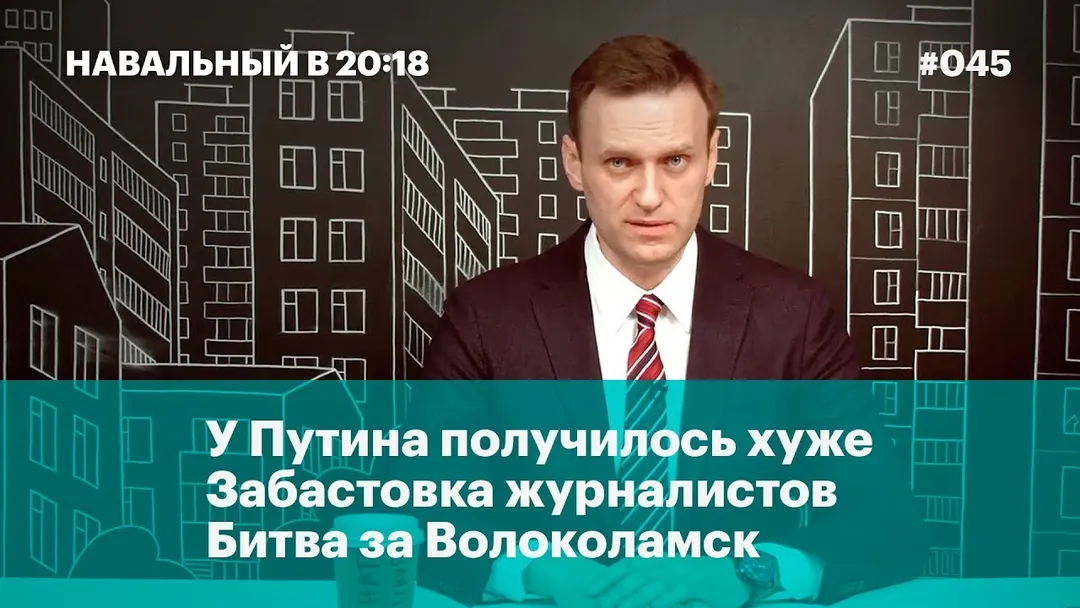
[music]
Hello everyone, it's 8:18 p.m. in Moscow, and in the studio
is Alexei Navalny, or, as one opposition
politician called me at today's
meeting of the Central Election
Commission, excuse me please. This
week we didn't come up with a funnier
name, so we'll have to
make do with what we have. It's good that
they're over, though honestly, I was already tired of it.
We liked leading this strike
— it was real political struggle.
But by March 18, we were really waiting for all of this
to end, and it has ended. And today I
am, basically, giving a session — a session
of joy, a psychotherapy session, because
actually it's even a little
strange to watch how much
this has a magical effect on people —
these numbers they showed on
television, they showed them,
and everyone got upset. Everywhere I look,
everyone is upset, worried, and
I said in the previous broadcast that
on March 19 you would feel this,
because the Kremlin wants you
to feel it. They staged the election in such a way
specifically so that on March 19 you
would all read that immediate emigration was needed,
and, my God, nothing
worked out. And they did it. And in
my last video, and now, and apparently for
the next month, I'll be doing these
psychotherapy sessions, explaining whatever
needs explaining, because, guys, overall
everything went according to a normal script, and
our strike was quite successful,
because let's once again reconstruct the whole
chain of events. Look:
a year and a half ago, we said — we said
to this government: despite Crimea (the annexed Ukrainian peninsula), despite
all your wars, despite
the fact that you say you're very tough and
daring, we will challenge you in these
elections, because you can't do anything
because you cannot govern
the country, because the population has been getting poorer
for five years in a row, and I intend to
beat you. I entered the race with those words and
ran an honest campaign. In response,
from the very first months of my
campaign, the Kremlin said: we will not register you,
we will not let you run. And from the very beginning
we said — this was completely our
open position — that if you don't let us in, well,
then you won't get what you
want, because we will
boycott, and we will force you either
to show a very low result,
worse than in the 2012 election,
that is, we will show that since 2012
Putin has lost support and now enjoys
lower backing — which is simply
the truth — or we will force you
to falsify the results. This was a very important,
a very important approach, because since
the street protests
of 2012,
the Kremlin has based much of its domestic
policy on the idea that it can
win without any obvious
falsification, because
falsification agitates people. And that's why
they installed their own Ella Pamfilova (head of Russia's Central Election Commission).
They kept saying endlessly that
they were working on a legitimate system without
and kept saying: why would we need
falsification? We can easily, without
falsification, win everything, and everything will
be just fine. And on this they
spent colossal effort, and they needed
to achieve a very clear result: here
our turnout in 2012 was 65
percent, and Putin then received
63 — 63 percent
of the vote.
They wanted better. Where do you think
this came from? It has been described many times in
newspapers: the goal was 70 percent turnout and 70
percent for Putin. It's very clear where
it came from: it came from the result of
Dmitry Medvedev, because Dmitry
Medvedev in the 2008 election got
70 percent, and turnout there was
also 70 percent. And of course it was important for Putin
to show that he was stronger than Medvedev,
because if you're supposedly so powerful, so
tough, and you're talking about
some fiery missiles in your addresses, or that you
run the whole world and got Trump elected,
then at least in your own country
you should at least be stronger than
Medvedev, right? And so the goal was 70 and
70 percent. So what did they get in the end?
Formally, they achieved it, but to do so
they had to resort to colossal
falsification, colossal deceit, and in
that sense, the strike worked. And they were unable
simply to take, by sheer force
of persuasion on television, by the force
well, of Putin's power alone, just with bare
Putin and propaganda, with his supposed
imaginary successes or real successes,
to show that he enjoys such
support, has such a level of
legitimacy, that he could achieve the
same results Medvedev achieved in
2008. In this election, Putin got
lower turnout than Medvedev, and lower than he himself got
in 2012. In this election, fewer people voted for
Putin than in
2012, and fewer people than voted for
Medvedev.
And this is very simple. Once again, don't let
these numbers hypnotize you — the ones
now in the little box here, here next to
me. Let me list a few of the most important things
again, and you
Please, in your discussions and arguments,
and most importantly, understand them yourselves and
stop worrying about it.
So, what made possible this
massive fraud? Because ten
million votes, at a minimum, we believe
between ten and twelve million, were simply
stuffed in, and there is a huge
amount of mathematical
proof for this.
You have, of course, seen those endless
videos of ballot stuffing, but the three main
things they did not do—first, it was
the number of voters, you understand,
the number of voters.
Because before the election,
literally a week beforehand, nobody knew the
number of voters.
The Central Election Commission did not publish these figures, and five days before, on
the air of Echo of Moscow (a Russian radio station), in response to a direct question,
Ella Pamfilova, when asked, “How many
voters are there in Russia?” by Alexei
Venediktov, said, “Well, I don’t know exactly,
something around 107 million.”
Let’s watch it—just 37 seconds.
Ella Pamfilova on Echo of Moscow.
At a minimum, all together, if you take into account
Look, if we take
duplicates, “dead souls” (a Russian expression for fictitious or deceased people kept on official lists), the poor,
those who are beyond the border, those registered at
various addresses in general, and also including by
various other parameters, yes, right now
I won’t list them all, but it’s already more than two million.
And then another one and a half million voters
in Crimea,
with all the new additions before the presidential election, I’m simply drawing attention to this.
So we are left with 100-something million,
where there is not a single clear answer—right now I
think, right now, moreover, we have now
cross-checked all the data, for example, the tax service
data.
But they were saying, “We have all these technologies, guaranteed,”
and by voting day we would still
significantly refine it—the total database was 109
million, maybe 108, and I think even without rounding.
Even further. So you see, four
days before voting day,
the representative of the Central Election
Commission says, “Well, we have such
secret technologies; we don’t know exactly,”
“give or take a million,”
“we’ll clean it up some more, maybe it will be 107 in the end.”
But in the end, the number of voters was 109 million.
And that raises the question, because
in 2012 there were 110 million, plus
Crimea was added, plus migrants were added,
plus natural population growth was added.
I saw that the Kremlin talking points
were spinning it in such a way that
Putin’s population growth, which he
talked about, could not be included here because
those people had not yet reached
adulthood.
But Putin’s demographic “successes” are not
only in the increase of
newborns, but also in longer
life expectancy and lower mortality, so
there should be a larger number of adults.
But fine, let’s just forget about that.
Let’s forget it: there were 110 million before,
then Crimea was added, immigrants were added—112
million. So how did it end up
being 109 million voters in the end?
How? Fine, let’s forget that too.
Let’s just forget the 2012 figure. Take 2016:
in the last State Duma election there were 110
million voters, and now there are
109. Where did that million people go?
Where did they go? And this is actually
an absolutely key figure, and I
am calling on everyone—I called on journalists
to press Pamfilova and the Central
Election Commission on this, because all
the rest—even these astonishing
videos of stacks of ballots being stuffed in—are already
small things compared with the fact that they have
three million voters floating back and forth—three million
voters. You cut the list there, and
your turnout immediately rose by
3 percent. Quite a trick they pulled.
If in 2012 it was 65
and now it is 69, then that is roughly
how it happened.
Despite the fact that they were driving people out to vote, despite
the fact that we were not forcing state employees (public-sector workers) to vote,
nothing actually increased; only because of these
manipulations did they raise turnout. This
means the boycott worked, and this
is visible not only at the federal
level.
Let’s take the city of St. Petersburg.
It is the third-largest federal subject of the Russian
Federation.
Let’s look at the number of voters.
In St. Petersburg, in the election year
of the gubernatorial election in 2014,
there were 3.7 million people; in 2016,
for the State Duma election, 3.8 million
people; and now 3.62 million people. For
St. Petersburg,
that is, excuse me, 5 percent
of voters. Where did they go? And in this
election, if you are from St. Petersburg, you
watching this program, I am more than
sure you know examples of how people
came to polling stations and did not find themselves on
the voter lists, because they
reduced the database so that the
turnout would be higher.
Five percent of voters were simply
thrown off the list. That was method number one
by which they cheated on a massive scale.
And the whole country saw it; you just need to
understand it very clearly. Method number two
was those famous 6 million
absentee certificates—what this time was called
voting at one’s current location
instead of one’s registered address. Six million people is a lot.
or too few? Well, let’s compare it with what
we had in previous elections. There are always some
or a number of people who live somewhere other than
where they are officially registered, and they want
to vote. Sometimes that’s normal—they
come and vote, and there are always
some issues surrounding absentee certificates,
some problems there. But let’s look at
how many there were in the 2016 elections.
Those were federal elections to the State
Duma (the lower house of Russia’s parliament): 809,000 people, which is seven and a
half times fewer—7.5 times fewer.
All right, this time, taking into account
the administrative pressure of the year, let’s say it was
twice as much, even three times as much as in the
State Duma elections. But when it’s seven and a half times
higher, we understand perfectly well that out of
those six million people,
a significant number were simply
completely fabricated, or it was outright ballot stuffing.
That doesn’t hold up. And the third big figure
you need to understand is voting
outside polling stations,
you know, with those portable ballot boxes, and
people go around carrying portable ballot boxes,
and
then all of that is counted separately.
For example, portable ballot boxes were the main
method of falsification in the elections
in Moscow—in the Moscow mayoral election.
Thanks to them, Sobyanin managed to,
essentially, falsify his first-round
victory. If there had been no
out-of-station voting,
he wouldn’t have been able to steal 2 percent of the vote from us,
and that was enough for his so-called
victory with 51 percent. Let’s also
look at the 2012 presidential
election: outside polling stations,
3.4 million people voted, and in
2018 it was already 5.9 million—that is, 1.7
times more, nearly twice as many, counting people who
suddenly, out of nowhere, decided they were ill and
submitted applications to vote outside
polling stations. That too is an artificial addition of
one and a half million people. That’s it.
And that’s how, little by little, you get 10
million votes that were thrown in—
or rather, not even literally thrown in,
technically speaking, again, it wasn’t necessarily that those
middle-aged women, the teachers at polling stations, were stuffing
all of it into the voting machine or into
the ballot box—no. It’s just that, at the level of
the math, all of this was dumped in,
falsified. And when now
Pamfilova tells us, ‘No, that’s not
how it was. You know, guys, back then
we had a bad voter database, but now
a new life has begun and the database has been cleaned up,
everything is much better’—well then,
excuse me, how were we voting with a bad
database in 2016 and 2012? That means all
those elections were falsified. You were
calculating Putin’s victory in 2012
based on some specific number of
voters. Now you’re saying it was
a bad database, and several million
people were listed twice. So that means
back then, in 2012, we had an absolutely illegitimate
president.
So, guys, I urge you to understand very
clearly that the strike worked.
We reduced so drastically the number
of people willing to go to
polling stations that even despite
the colossal
administrative pressure, they had to resort to
methods like these—
adding millions of votes, millions.
Again, not literally stuffing them in, but simply
drawing them in on paper. That’s very important, and it needs to be
understood. As for the actual
ballot stuffing and falsified additions, again, I’m not going to
show you a huge number of videos.
Instead, let me show you two absolutely
astonishing tally sheets from Kemerovo
Region, my favorite. Please take a look.
This is the tally sheet that the observer at the polling
station received. Look at it and you’ll see—
well, it’s clearly a tally sheet, it looks like an ordinary,
normal tally sheet. There are votes here
for Grudinin, for Zhirinovsky, for
Yavlinsky, for Suraykin,
yes, Putin has the most. This is the
tally sheet our observer received, signed and certified.
Now we open the GAS
Vybory system and see what it shows.
What does the GAS Vybory system show for that same tally sheet?
Something’s off here. It doesn’t really look like
what was written in the tally sheet that
the observer was given. Let me just
show you a simple comparison I prepared specially for you.
The next image shows what exactly
the difference is. You can see it plainly:
on the left is the real tally sheet, on the right
is the table that was entered into the system
GAS Vybory. So you can see: they simply
took votes away from everyone and reassigned them
to Putin. And the funniest part is that one vote
for Baburin—honestly, that was some kind of
joke or irony. I mean,
people just bluntly took the tally sheets and
rewrote all the votes for Putin. And thanks to
the North Caucasus, Kemerovo Region,
and Krasnodar Krai (a federal region in southern Russia), in Krasnodar
Krai,
one of our coordinators there, who
was involved in election monitoring, held
a press conference about the violations. David
Kankiya went outside and was detained.
He was jailed for five days—the second time that month—
just so you understand the nature
of these violations. And in that sense, these three
regions at least—Kemerovo Region,
the North Caucasus as a region, and
Krasnodar Krai—were already the
cherry on top: an additional
million or couple of million votes.
not hundreds of thousands of votes for him to
just to polish it off, so to speak. But these
basic things — ballot stuffing, basically,
manipulation of the voter rolls — that
was already enough to make all of this
happen. And you know, we had
an absolutely astonishing story, of course,
with the North Caucasus. We sent
observers. We created what we called
the “Wild Division” — that was our internal
name for it — and sent observers to
the North Caucasus. We sent
observers to Mordovia as well, and called it the Wild
Division, and also to some other problematic
regions. We sent a few to other
areas too — Tambov, the same
Kuzbass — but our main problem
was specifically with Mordovia and the North
Caucasus, where we sent observers.
Thanks to everyone who, during the previous similar
broadcast, helped fund this entire trip.
And some absolutely incredible things
came to light, to put it plainly.
The “voters’ strike” won in
the North Caucasus.
Let’s just look at the picture.
The difference between places where there were observers
at our polling stations — this is Chechnya —
and places without observers: we can see
that it’s 55 percent, and at some polling stations, well,
there’s already quite a lot about this on the internet,
and we’ll be talking much more about it,
you’ll see that 30 percent
of the vote was there, but often
it was 40 percent of the vote. In other words, people did not
go to the polls; it was only through methods of
massive falsification that this was
made to happen. I’ve already met
with observers who returned from there,
and they told us a whole lot of completely
absurdly funny stories. We’ll try
to make several videos,
and we’ll even specifically target them
at the Caucasus republics, because we’re
actually very grateful to the local
residents — they helped our observers, and
the stories go something like this: people would simply
come up to our people and say,
“Listen, you’re standing here observing,
this is some kind of Grudinin hell, we need
to add 500 votes for Putin — that’s what the bosses told us.
“Come on, so you won’t feel bad,
we’ll throw Grudinin a hundred too,”
“we’ll add them in right now, just don’t
make a fuss that we’re about to
credit Putin with 500 more votes.” And this was everywhere,
literally everywhere. Everywhere there were
observers, the level of
voting for Putin was much lower,
turnout was much lower — there was no triumphant
victory at all. We made one mistake,
a serious mistake,
we focused so heavily on Chechnya.
That was the right thing to do there, but we were so
concerned with ensuring the safety
of our observers that we sent two
people to each polling station on purpose.
We coordinated with the Central Election Commission a bit and
somewhat ignored other, in this respect
seemingly less problematic republics
of the North Caucasus. In fact, the most problematic
turned out to be North Ossetia — there
they simply threw everyone out of the polling stations,
detained them, took them to the police,
brought in the Investigative Committee, threatened them with criminal
charges. Karachay-Cherkessia also turned out to be
quite problematic, and I’m just
thinking of our absolutely remarkable
observer, Yekaterina, who went there for the first time.
She went to a polling station, and I think we have three
minutes — we have two videos, or actually
something like a three-part sequence. I think it’s worth
watching — you can even see this kind of evolution
of an observer. First, a minute and 40 seconds of what
Yekaterina said immediately after
returning from her trip. Let’s watch. Hi everyone,
I need to tell you, while it’s still fresh,
about how today’s
election went in the city of Cherkessk. I went there
as an observer for candidate Grudinin.
Please forgive how I look, and
the fact that I’ve been crying out of sheer helplessness.
Then there was another one. I said,
“Fine, let’s assume that.” Then they themselves
just started
They simply took all those ballots,
which had just been laid out, and started putting everything together.
First of all, all of this was recorded
on video, and then they just started writing this down
and stuffing it into bags. I asked, “Why are you doing this?”
I still didn’t know the turnout — you hadn’t announced
anything. They said nothing, they did not
say
how many votes they had counted, they did not say
how many votes had been cast for this or that
candidate. I went to the chair of the commission
to demand a copy of the official protocol, and she
said she would give me that copy only, well,
once we drove to city hall. That too is
illegal, because they are supposed to issue
the protocol after everything is counted right there at the
polling station itself.
Miss, please give me a copy
of the election protocol.
Where are you taking the ballots? Why did you
put them in the car when I still haven’t
received a copy? Please give me
a copy of the election protocol. No, I
must receive it before you leave. I
must get a copy before you drive off
to city hall, Svetlana.
Then I’m going with you. I need a copy
of the protocol. I need a copy of the protocol.
84 Krupskaya Street.
I’ve decided to leave Russia
because this is total lawlessness. Well,
you can imagine it, right — you can see the despair
of a person. She came to the polling station, she
He understands that the strike worked.
He came to monitor turnout, and he sees that
there is no 90 percent or 70 percent turnout at all.
No such percentages. Instead, there are ballots laid out on a tray,
simply dumped out and stuffed into bags.
They take them away somewhere, and they pay no attention at all to the shouting and
the commotion—just real thugs, actual bandits.
Bandits. Katya then said rather dramatically
at the end that
she was leaving the country, that it was useless
to keep fighting. But then we saw another of her
videos, and we literally have just 1 minute here.
Let's watch: a person pulled herself together and
decided to do the right thing. And what is interesting
is the evolution of this observer, and also the answer
the crooks gave her when she decided not
to go along with the rest and instead to fight. 1 minute 2
seconds.
Ekaterina: Hi everyone, guys, it's me again, and
I’m not going to cry, because I’m
actually in fighting spirits, ready
to fight all the injustices
that came my way during this trip. So,
basically, I wanted to talk about a few things
that I didn’t mention in the last video. I
went there on behalf of Navalny. I traveled to the city of
Cherkessk, even though I’m from Moscow. I went
specifically to a difficult region there, because
Moscow is boring in comparison; in the regions, even
more observers are needed there—people are needed there.
So I decided to go, and in three days I managed to
get in touch with lawyers,
file a complaint with the prosecutor’s office, file
a complaint with the Central Election Commission, file a complaint on the violations map,
file a complaint with the election
commission of the city of Cherkessk. So far, only the latter
has replied to me. And do you know what
they told me? I wanted to make some kind of
interesting video with a catchy
headline, but actually I don’t even
need to come up with anything, because they have opened
an investigation against me. I believe that everything there
was done honestly, and if something there
was dishonest, then the commission probably
also acted dishonestly by not telling me
about it. So the possible developments now are
threefold: either I emigrate and seek
political asylum, or I end up in
prison, or I win.
That last one is the least likely, but it’s the one I like most, and
it’s the option we like best too.
Of course, we understand what this
system is. But here is a person who saw it all with her own
eyes, who felt all of it firsthand, and
she decided to keep fighting. The system
responds by saying:
we’ll open a criminal case against you personally.
But she understands—and you should understand too—
what a sham all this is. Reuters journalists
also conducted an experiment, a rather
interesting one. They took under their
control 12 polling stations, and at those
12 polling stations they sat down and
carefully counted the entire voter turnout.
Let’s look at
the table they compiled based on
all of this. So, there’s no table—no,
they say there’s no table, we forgot to
show you the table. But this simply
shows that at some polling stations,
for example in Simferopol, 60
percent of the votes were stuffed in—that is, the ballot stuffing there
was enormous. In all the regions they observed—
in Crimea, in the North
Caucasus, in the Urals, in various places—
the result of those observations was the same:
colossal, massive ballot stuffing
measured in the tens of percentage points. Therefore,
I ask you once again: stop looking at
these election commission figures and believing them.
Why did you suddenly decide to worry about
something that is completely fake? In fact, the very fact that
it is fake shows how successfully
we acted, because
without fraud they simply could not have achieved this,
and
we will continue exposing them. And right now it is very
important—I was just asked
by our headquarters in Novokuznetsk, in this most
problematic region,
to state clearly that we are officially
appealing to the candidates—to all presidential candidates,
except Putin, who is not interested in this—
especially to those candidates
for president who at least occasionally
say something about election fraud:
Grudinin, Yavlinsky, and Sobchak,
asking them to officially demand
the video recordings from all polling stations
located in southern
Kuzbass and in the Kemerovo region as a whole.
We will prove it documentarily. Why am I
forced to appeal to them? Because we have
no rights at all. People very often ask:
will you go to court? How can I go to court?
I’m not a candidate. Right now the system is set up so
that Yavlinsky has to go to court,
Sobchak has to go to court, Grudinin has to
go to court. Even though we
deployed more observers than anyone else
and in fact were practically the only ones
who were dealing with these
observers, we have no rights at all.
We can’t even obtain the video recordings. So I
hope the candidates will help make that happen.
Once again, using these video recordings we will prove
it. Our lawyers are even promising to shave off my beard
—that will probably be a more
careful promise than
Grudinin’s—if he doesn’t follow through, if he cannot
document exactly how massive the
ballot stuffing was on the territory of
the Kemerovo region. Why do I talk about it so
often? Because these are precisely the
votes that made all of this happen.
And we achieved this: now half the country,
including people who do not use the internet, knows
that everyone was being pressured to go to the polling stations and vote.
to vote, because they are exactly the people
who were coerced — they are exactly the ones
state employees who were forced at 9 a.m.
to come and vote for someone, while half the
country saw it — those who use the
internet saw all these
falsifications. Everyone knows perfectly well that there is no
colossal level of support there
for Putin, at least not on the scale
they talk about, on the scale they claim
and all this, I don’t know — around the world, these
elections
have simply turned into a comedy, which
to be honest, isn’t even funny anymore — it’s unpleasant
when they discuss all this, it’s unpleasant
that feeling — after all, this is Putin, this is
Putin’s fault, and the whole world and the whole country
saw that once again, just like in 2011
as always, everything rests on
falsification, everything rests on
rigging.
This is a direct consequence of our strike.
We carried out our threat, and we forced
them to falsify. For now, we cannot
make them give up
falsification; we are not yet in a position
to force them not to rig things.
But at the very least, we dragged all of this
out into the open, and Ella Pamfilova and Putin
and all the others will say that
the elections were fair, but even their supporters
will be smirking as they say it.
So let me answer some Twitter
questions — people are writing something to me here.
Someone asks Navalny: the election is over,
what comes next? Will there be rallies, other actions?
So the fight for the presidency
is over. We’d like more information
about your plans for the future... I don’t
know what exactly that ellipsis is supposed to imply,
I don’t know how that word fits into this
context. Look,
our plans — we’ve come out of this whole
very exhausting 15-month campaign
that was difficult, expensive, and hard, with
arrests, searches, and so on. We are much
stronger now — in fact, much stronger. What
our organization represents now,
our structure, your structure, is night and day compared
with what it was 15 months
ago.
It is a huge, real political network, and
our task now, our plan for the future,
is this: we continue our struggle.
It consists in making this regional
network create politics; it will
engage in political struggle. I
of course understand that maybe this
sounds a bit grandiose, or maybe not
very clear, but in fact, someone
somewhere — I saw it on Facebook —
wrote a very smart thing:
a politician is a person who creates politics
around themselves, and a political
party, even if it is not officially registered, is
the party that creates
politics around itself. Unfortunately, all attempts over
the many, many recent years by all parties,
both systemic and non-systemic, to create
a regional network that creates
politics around itself have failed. Any
political party is basically just
some nomenklatura in Moscow and people in
the regions who, by and large, don’t really
understand what to do and simply wait until
once every four years a budget falls
into their laps, and they carve that budget up
or spend it — usually carve it up — but for the
most part they do nothing, and no one
understands why they exist. Now, together with you, we
are going to invent
we are going to create new methods
of political struggle, new methods
of political pressure in order to
fight, including through elections. Will we
take part in regional elections? Yes, we
will take part in regional elections.
Will we organize protest
actions, including nationwide protest
actions? We will, and we can. Fifteen
months ago, they said to me, “Alexei,
what about organizing a nationwide Russian
protest action?” I said, “Well, of course
we’ll be able to do it, but it’s not clear how.”
Now we understand how to do it. We have
a genuinely alive, powerful network: 700,000
supporters, 200,000 volunteers,
observers — they tried to shut us down, they stole,
30,000 to 35,000 people across 84 regions — and it still
exists to this day.
We can do all sorts of things. We will
create information channels, a YouTube
channel, and regional ones. All of this will have to
be invented anew; we’ll have to learn how to do it,
because no one in Russia has ever
done this before, and there has never been an independent
political organization that, even under
intense pressure, continues to exist and is capable
of doing this. But we will do it. We will
fight with all our strength, and we know for certain
that support exists. If people from
Chechnya come — observers say that
everyone came up to us there, Chechens and
others, saying, “Well done, you came here
to stand up to our bosses somehow,”
and in Dagestan it was the same. Everywhere,
absolutely everywhere, people want some kind of struggle,
some kind of resistance, and they see nothing — nothing
is happening, there is no opposition, no politics.
So of course a person shrugs and votes for
Putin — who else are they supposed to vote for?
They’re told they need to vote, so they vote
for Putin. So that is the system we will use.
Naturally, we are now thinking
about how to scale this down properly. We
cannot maintain all 84 regional
branches, and in such a huge, fully expanded
form, we simply cannot exist.
We can't keep raising money for all of this.
We've basically decided not to live all the time in this kind of
hysterical fundraising mode — it's
simply impossible. So right now we're thinking
about how to scale it back properly, competently, intelligently,
how to reduce all of this.
Without falling out with anyone,
to part on good terms with everyone, and
to continue our political
cooperation. After all, people didn't come for
money. They didn't come so that you could
sit in an office — they came to fight
for their country. And that's what we're doing now.
But again, we're reinventing things from scratch. If
someone asks, "Do you know how to do this?"
I'd say: my answer is, I understand in general how
to do it. But exactly how we'll organize it —
we're going to figure that out now: sit down, think it through, and decide.
Right now, together with our
regional
coordinators, we're sitting down and thinking
about how to wind this structure down so that it
becomes a bit cheaper in terms of
maintenance, while citizens can continue
to send in messages — "Good will prevail," Sergey writes.
Although it seems we shouldn't, on this broadcast, be
collecting data — good job, you're thinking ahead.
So we'll do everything. We will organize protest actions
directly based on the results
of the election — well, on the voting results.
But it's impossible to organize a protest action
just on that basis, because, well, nobody is interested
in all that. I've predicted these voting results to you
on this broadcast a million times, and
they don't bring anyone out into the streets. We're not
going to hold, you know, a rally just for the sake of
a rally. But clearly, there have emerged
two political Russias. One is ideologically in favor of
— there are these stubborn people
who believe that we must
give up everything, that we must give up
development and simply keep supporting this
colossus with feet of clay — Putin's system —
which supposedly threatens the whole world with
who-knows-what. And then there are millions of normal
people who, for the first time,
and perhaps this was the main thing about this
strike: for the first time, millions of people
took part in a collective political
action, a unified one. And these people — 35
million people — did not take part in
the election. We can't — well, I can't say
that all 35 million
took part in the strike, but obviously
many, many millions did participate
in the strike consciously. And relying on these
people, we will fight against Putin's
Russia. We will fight for people, for
influence — organizationally, politically,
in the media, informationally, however necessary. We
will do it, and that is our
plan. So my appeal to you is: don't
go anywhere.
Stay with us. We have nowhere else to go —
we only have one country. Like Katya,
who appeared a moment ago — she decided that I
am not going anywhere.
You are not going anywhere either; you'll stay here, and
the only question is whether we are ready to let these
people devour us, or whether, as we said,
we will fight for our interests.
Let me take a couple more questions.
What are you asking me? Okay, I see one from
Kolomna: "They want to turn it into a second Volokolamsk.
We started protesting earlier. Please talk about
it on air." I will talk about
Volokolamsk a bit later. What should be done about
Slutsky? All right, then let's
indeed say that right now there are two main
topics, the two main political topics in
Russia, and it seems to me — though I may
be mistaken — that they will have
long-term political consequences.
They are
Volokolamsk and Slutsky. What happened
in Volokolamsk — or really, not only
in Volokolamsk, but in the Moscow Region
as a whole — is the so-called garbage
crisis, when the regional authorities around Moscow
together with the Moscow city authorities, together with
— they've effectively created a kind of
mafia group there.
There are ties to Prosecutor General Chaika (Yury Chaika, Russia's former prosecutor general), that whole
Moscow Region mafia that's connected to
Shoigu (Sergei Shoigu, Russia's longtime defense minister) — they're making colossal
amounts of money from landfills, and
they're making it in a pretty barbaric
way, because they simply create
giant dump sites, just open-air ones, and all
this garbage is dumped there so that it can
just sit there. People are writing: do an investigation
into the landfill sites. Please look at
Lyubov Sobol's investigation
from 2015 — the investigation
"Who Makes Billions from Landfills?"
It describes exactly all these people, all
Putin's friends, the friends of the Prosecutor General's Office, and
the Sobyanin mafia (allies of Moscow Mayor Sergei Sobyanin) — they make billions from this.
But all these profits
have run up against a finite resource — simply
plots of land located near populated
areas. And sooner or later, the people living
in those towns — in Klin,
Volokolamsk, in Kolomna —
they understood, they felt it, they
smelled that they were simply being
poisoned. You have to understand:
the Moscow Region is the second most populous
federal subject of the Russian Federation,
it's an enormous
number of people. Naturally, they are in
a completely justified fury when
people — when people simply can no longer
breathe.
They start relating completely differently to
everything. In Volokolamsk,
it exploded the fastest. They held
huge rallies, and at those rallies...
them, just like in the pictures, because they were walking around in
gas masks, and overall even
people who sympathized with them were saying, well, somehow
it all seemed more like some kind of metaphor.
A gas mask is a metaphor, because it can’t
really be that bad. They just don’t
like the landfill. Of course they don’t like the landfill.
Obviously, no one would like it, but a bad
smell when the wind occasionally blows from there
— a bad smell, and before that they tried
to convince everyone that that was all it was, and that’s what they said.
They even said that the organizers of the rally
in Volokolamsk — and many of them, well,
some of them we know quite well
for many years — were somehow State Department agents.
TV host
Karaulov, a well-known crook, came there specially and showed footage of tanks.
He said: these are my photos with the organizers of these
rallies — look, look, here they are with
Navalny, the well-known extremist. Then
it turned out, literally just a couple of days ago,
we all found out, we found out that the residents of
Volokolamsk were not exaggerating when
they were walking around in their
gas masks: 100 children were affected, and 60
were hospitalized because of a release of this
so-called landfill gas.
You can google it, look it up on
Wikipedia — it really is a poisonous
gas. And if children there were fainting, if they
were dizzy, nauseous — you can
judge the scale of the problem. How can people live like that?
How can anyone live in conditions
where things like this are happening? And here
of course we just need to draw a simple
parallel.
A lot of people say that Volokolamsk is just
some small episode, some kind of local story,
a small town outside Moscow (in the Moscow region),
and in the entire Volokolamsk district
50,000 people live there; in the town of
Volokolamsk itself, 20,000. But not long
ago there was an American city,
Flint, where the water was contaminated with lead.
And that small city,
that small city became the center of
American politics during the election,
by the way. It became
a dedicated topic in the debates between
Clinton and Sanders back when the
primaries were still going on. In other words, it was a huge,
major political event. So
Volokolamsk too,
just like Kolomna and Klin, by the way,
should likewise be at the center of
nationwide debate, because this is
not really about Klin and Volokolamsk and all
the rest of them specifically — it’s about all of this, it’s about
Chelyabinsk,
it’s about Krasnoyarsk, where the situation is even worse.
In Krasnoyarsk, by the way, there’s that
famous cloud that covers the city, and in
Chelyabinsk the environmental situation is monstrous,
with horrific rates of cancer
and respiratory disease.
Look at what’s happening in Norilsk — we have
a whole lot of cities where people are simply being poisoned. But
in Volokolamsk, because children were involved, this
is what made everything explode. And it’s very interesting that
Volokolamsk approached this politically.
Volokolamsk really did take part in
the “voters’ strike” (an opposition boycott campaign), and it had one of the
lowest turnout rates in the country. In the
district it was only 44 percent. At those
rallies that took place before the election, those
rallies featured perfectly explicit,
openly opposition slogans.
Let’s watch 36 seconds from a pre-
election
rally in Volokolamsk.
[music]
[music]
As you can tell from the rhetoric, this
was very much an opposition rally, because
anyone who has been to rallies about development
or environmental issues knows that very often
there’s this line: we’re outside politics, we
just want to speak up here for clean water,
but we won’t allow
politicians to speak, and we will
avoid topics that criticize the authorities. In
Volokolamsk, everything was completely different. These are
quite brave people, and all of them
speak bluntly, telling the plain truth. They directly
connect all of this with politics, and that
is absolutely right. And, by the way, it
shows that when protests take on
a political form, they look completely
different and work much more effectively. But
probably it couldn’t have happened any
other way, because when it comes
to children’s health,
you want to say everything directly
to the head of the district. I think you’ve already seen this footage,
but it seems to me so instructive
that it’s worth watching it
again. This is a one-minute, thirty-second meeting
between the head of the Volokolamsk district and residents
who, until very recently, were his
constituents. He is a member of United Russia (the ruling party), he is
part of the authorities, and
on television they tell us how
this party and these officials enjoy excellent public support.
1 minute 30 seconds.
I’m going to ask you one question: why did you
even come here?
Ah.
[applause]
Ah.
[applause]
So you can see, it was only this little bit short of
turning into a lynching.
This is in the era of “stability,” in the era of
everything else they talk about. And, overall, you can
understand these people, because the problem had been there
for years, for years. In recent months these
rallies had been going on for a long time. They kept coming, kept saying:
you can’t live like this. But there was money in it for them there.
Vorobyov makes money from this, after all.
the whole Vorobyov mafia
the Moscow Region crowd—they make money from it
they make very real money,
billions of rubles, and in that sense, when
Governor Vorobyov finally arrived there,
the governor of the Moscow Region, a very
firmly entrenched governor, a powerful
man, and it would seem that by coming
there he should have gotten the classic
situation where a governor shows up at a
protest rally, people listen to him, and he
nods and says, “We’ll sort it out,” and they’re
told, “All right then, wait a bit,”
and they say, “Fine, we’ll wait.” And 31
seconds later, this is how Governor Vorobyov
felt at that rally. Let’s
take a look. He got 88 percent in
the last election—that is, supposedly
beloved by the whole people, even more than Putin, by the way.
[applause]
uh,
uh,
[applause]
I
with all their percentages, with all their
National Guard, with television, with the armored vehicles
they buy, with all the
billions they’ve spent on PR
and keep spending on federal television,
this little guy comes running, hanging his head in shame,
just like when I used to go to some
regions and people there would throw eggs at me,
people like the ones who were hired
by governors like Vorobyov. Only here
no one hired anybody—they’re just actually
throwing things at you because you
instantly went from this huge,
bloated toad into a small,
pathetic man, a crook and a thief,
whom the people living in your own
territory are driving away in disgrace. It’s very important
what happens next in Volokolamsk
and in all the other
and, secondly, in other regions they will of course
lie and try to drive a wedge between people,
because that’s their main
tactic in the authorities right now—they’ll
say, “Well, if we close the landfill in
Volokolamsk,”
we’ll have to haul the garbage to Kolomna, and the residents
of Kolomna will say, “No, let it stay in Volokolamsk,”
and they’ll tell the residents of Klin that we’re
probably going to bring it to Klin, to your
landfill.” I’ve already seen comments like that online,
I’ve read similar comments. Right now they’re
simply going to try to exploit
these contradictions and prove to us that, guys,
nothing can be done. Yes, everything can be done.
Why the hell is the Moscow Region,
which is larger than Belgium in area,
unable to solve the issue in some way?
European countries somehow manage waste processing,
and only in Russia do we have these gigantic
landfills—like in Volokolamsk, where they’re
literally taller than nine-story
apartment buildings, these mountains of trash. There’s nothing like that anywhere else.
This is the 21st century. Waste processing is
a major problem, a very serious problem
for humanity, but children being poisoned
by an open landfill—
that doesn’t happen anywhere else in the world, and it shouldn’t
be happening in Russia either. And there is enough money
for this. So of course they will
lie, they’ll say that nothing
can be done, they’ll try
to discredit people, they’ll
try somehow to gradually split
the initiative groups and try to
prosecute someone, intimidate them—
it’s the standard tactic. But I simply
care about this, and I call on residents of all
towns around Moscow who are concerned
about this issue—and it is concerning, because I
myself am a former resident of the Moscow Region, and my
parents live in the Moscow Region—not
to give in to this. We need to show
solidarity and not give them a moment’s peace.
We need to keep this going. As I understand it, in
Volokolamsk this weekend as well
there are officially approved rallies,
near the administration building and over the landfill, so
people need to keep taking part in this,
because they’ll take away the water, they’ll take away the air.
What happens around this
confrontation, where on one side are
the interests of the residents and on the other side
enormous money,
is whether the residents will be able to force these
even
people to give up some of their money
in order to reduce social tension.
That is an extremely important and extremely interesting
question. Danil Logachev asks me
what time my Instagram live streams happen.
On naval 2017, I really do hold those
Instagram live streams, usually on Wednesdays, and
I bring people on—Instagram gives you the option
to simply connect some
random person and chat with them—but
I don’t do it at any specific
time. It’s more of a
fun thing. I try to do it all
on Wednesdays. If there are any other
questions on Twitter, I’ll answer them.
It seems to me people are asking:
why did pro-Putin journalists stage
this kind of boycott of the State Duma (the lower house of Russia’s parliament)? Well,
it all came down to Slutsky.
Slutsky—and what happened with Slutsky is
the second very important political
story that will have major
consequences depending on how it
develops. You know the whole
story, and deputy Slutsky is not just
a deputy, not an ordinary deputy—he
heads the committee on foreign
policy, so in that sense he is quite a
a trusted person in this system
an important person for this system because
he is someone whose role carries real weight
as head of the Committee on International
Affairs
he travels all over the place and officially
acts on behalf of the state
speaks on behalf of the state, and he is a
powerful deputy, so the system does not
give him up. And now it turns out he was simply
sexually harassing female journalists
quite openly and quite aggressively
several journalists accused him of this
of sexual harassment, but by now
the story has become much bigger than that
because the question was precisely why
even such pro-Putin media outlets declared a
boycott of the State Duma (the lower house of Russia’s parliament). This is already a situation in which
the discussion was taking place around it
The journalists did everything by the book and took the legal
route when they said they would not
publicly disclose information about the harassment
They went to the Duma leadership and were told, well, write a
letter and we’ll consider it all. They wrote the letter
and, generally speaking, you have to understand that for
them this was also a fairly
humiliating situation. One of the
journalists,
BBC journalist Frida Rustamova,
even recorded clear evidence
of this harassment on a voice recorder and
provided the recording. Which, frankly,
is not the most comfortable thing for a person
to do. Nevertheless, they
did it. And what did they
run into when they got there? Let’s
just look at 21 seconds of how
this meeting went, with
State Duma deputies sitting there on one side—people
who work on our money, receiving
their salaries from us, who are supposed to protect
these very journalists, who are supposed to be
an example of morality—well, supposedly
these are the best citizens sitting in the Duma, right? So how
did it all happen? Twenty-one seconds, I said.
That this kind of
documents and audio recordings
which were made without permission
—you journalists know that when you
come in to conduct an interview, you ask
for permission: excuse me, may I record you
or not? Can one touch, God forbid—I don’t
know.
You understand, there he is sitting in front of you,
this man this wide,
the man whose salary you pay, and you
bring him an audio recording
where a State Duma deputy is harassing a
female journalist. Well, it is obvious, at the very
least it is an ethical violation, and presumably we
understand that they are all one mafia there, but they are not going to
shoot him over it. But they could at least
have produced some vague wording
to show they would not cover for
their own man. But looking everyone in the eye,
when asked, here is the audio recording, he is
harassing her—they said: the recording
is illegal. What are you doing? You recorded him
without a deputy’s permission on an
audio device.
What outrageous conduct, dear journalist
Frida Rustamova. We are not interested in what
was done to you there—you turned on a recorder and
recorded a public official
while being a journalist. Outrageous. When
they are asked, is it not allowed, is it allowed to grab
someone—God knows, I don’t know. This is just, if
you made a Wikipedia article called “boorishness,” this
would be the illustration. That is why even
pro-Putin journalists declared a boycott, and
they were right to do so
And this is a very important story because
as you can see now, information has appeared
before the start of the broadcast about which
media outlets have
joined this boycott. Some
are boycotting the Duma as a whole,
some are boycotting only the Committee on
International Affairs and Slutsky himself, but
this is an extremely important thing that in Russia
basically never happens
In recent years, we have simply had a peak
of a classic situation, a classic
situation of two sides:
the side of good and the side of evil. There it is,
playing out according to all the rules of a trade-union
—not revolutionary, probably, but
more like this kind of labor-union struggle
Here is a professional community; it has been insulted
and they want to get their way, and they have every
right to do so. They declared a
boycott. There will be
strikebreakers, and for example deputy and
editor
in-chief of the newspaper *Moskovsky Komsomolets*
has already said that he
will send even more journalists
to the State Duma
to the State Duma, and in general, while being
the head of the Union of Journalists, he is making
some completely
I don’t know, utterly vile
statements to the effect that the
female journalists brought it on themselves, that they are to blame for everything
I mean, this is the very definition of a
true strikebreaker in the midst of a
strike, someone working for such an
unjust employer
There is also a lockout, just as in labor
struggles: people came out and declared a
strike, and the employer said: all of you are
fired. And here Volodin said that
everyone who boycotts will be stripped of
their accreditation, and we are going to see a very
quite
dramatic story. I do not know
how exactly it will develop, but to me
it seems this will be very interesting
to see which of those who announced the boycott will also
turn into a strikebreaker and betray
their own, and who else will join in
whether these efforts will continue, these
wonderful people who go to
single-person pickets outside the State Duma (the lower house of Russia’s parliament), and how
people react to them
other journalists who are watching—well, is there
mostly support, or more of a “ho-ho,”
“look at these idiots standing there with their
pathetic, miserable one-person pickets”
meaning, you can’t beat a whip through a butt end—nothing
can be done, it’s all impossible, this is
really a very interesting case
the journalistic community
which, as you know, is very much
concerned with itself—but that’s normal; in
any country, that’s how the media work: they
push for what they want, and they have every right to do so
they
are personally offended there, they are offended in
these kinds of matters where, so to speak,
they are entitled to feel offended, and they are
filled with righteous, visible anger at
Popova, in a situation where they ought to be
filled with righteous anger, and it is very
important what is happening, and
of course, absolutely, I wanted to support
all these journalists, but we—perhaps you
saw our March 8 issue that we
put out as a sign of solidarity with these
with these people—we carried out our
investigation, a package that
concerns Slutsky’s property, and we found
information that is sufficient
to, as it says here, drive
Slutsky
out of the State Duma even without any
harassment allegations, although first and foremost he
should be expelled for harassment
let’s watch a few seconds from
our investigation—about a minute and 30 seconds
about who deputy Slutsky is and why
he has no place in the State Duma
another of Slutsky’s cars: a Mercedes
S-Class
and here it’s not even about the price, although
of course it is also very expensive, but rather
the fact that we managed to find the specific
Mercedes belonging to the specific Slutsky, and
thereby crack open a portal into the life of
the people’s elected representative. This car
is unquestionably his, since there is
a photograph of Slutsky personally getting out of it
and now watch this trick: you can
scroll through the list, to cheerful music,
of fines issued to the car
of the deputy, just since June 2017
in a little over half a year: 59 pages
59 pages of fines, the total number of
violations
drumroll: 825. And now we move
to Rublyovka (an elite suburban area west of Moscow), let’s
take a look at the deputy’s 800-square-meter house
he has owned it since 1999, so I’m not even going to
raise the question of where the money came from—the prices
were different back then, so let’s
assume he had the money. But the issue
here is not the cost, but the size of the plot
Slutsky declares a plot of 1,200
square meters
but if we carefully examine the boundaries
of the actual plot
we will see that they differ greatly
from what is on paper
which suggests the thought: did
Slutsky illegally grab himself some extra land? But
no—Slutsky did not illegally seize extra land
in 2008 he leased
the neighboring forest plot with an area of 1
hectare
and never once declared it. I’ve already
run a little over time—there are 32
thousand people watching, so for another five minutes
with your permission, I’ll keep talking
it’s just [__] with Slutsky—this is a very important
situation, and it seems to me very important
to support the path of the media outlets that declared
a boycott of the Duma; there are media outlets there
it’s just disgusting—Lenta.ru in
its current state is simply
utterly nauseating—but the fact
that they joined in is an excellent
move, good for them. I know
some people criticize this and say, well,
why did you only start declaring a boycott now, while
before you didn’t declare this boycott
in all those earlier cases
and of course there is a certain logic to those words, but
nevertheless this should be supported, because
this is a genuinely righteous story, and in it
there will be deceit, there will be cowardice, there will be
courage, and of course one must
support the side of good. By the way, they say
the story is starting to bring out some
very unexpected things—for example,
today one of the journalists
accused Vladimir Zhirinovsky of no less
than sexual harassment, and
indeed quite severe sexual harassment
I can’t read the whole text aloud
it would be too awkward to read some things
out loud, but nevertheless this journalist
writes that
Zhirinovsky, in the company of his entourage,
while I’m speaking now—you can manage to
read it all on the screen—dragged him to a sauna
and grabbed him and groped him, that is,
this is really
important testimony, especially in
light of the fact that these are the people—you read
this text and understand that it is written
about the very person who keeps telling us about
“traditional values” (a common Russian political slogan about moral and social cohesion), who sits in
the State Duma and presents himself as a model of morality and
virtue
teaching us
how to live, telling us what is good and what is bad
what we’re allowed to watch on the internet and what
we’re not. First they pass laws
about banned websites, and then they grab someone there on
a male journalist and drag him off with them to a bathhouse
trying to take him away by force. This, this is
what is happening right now.
With journalists, the story with Slutsky, and now in this
expanding story, this is a story
of decent people against thieves,
debauchees, crooks, and perverts
who are trying to teach us how to live.
So this is a very big story. Two
very short things at the end. You keep asking me,
Sergey Kalinov asks: tell us
the story about saying goodbye to the grandmother, or—
about Yashin. LifeNews has hit a new low, but
really,
it’s a disgusting story. I mean, we’ve seen
all kinds of vile things, but Yashin has
an elderly grandmother, a very old grandmother. She fell ill.
She doesn’t have dementia—well, in any case it’s quite difficult
in an apartment setting when everyone is working
to provide proper care for her, so they placed her in
a special facility where people are cared for,
a special boarding home, a care home where they look after
her. And of course they decided to turn this into
a big scandal right away, claiming that Yashin
dumped his grandmother in a nursing home while he himself
took her apartment. The usual kind of
filth. And what really, really made an
impression was this: LifeNews was pounding on the door of
the apartment where Yashin lives, filming his parents there,
then they tried to force their way into this care home
where his grandmother is staying. Naturally, they were not
let in. Then a local police officer went in there,
this policeman secretly
filmed the grandmother on his phone and took that
recording out and handed it over to LifeNews. What
is going on, damn it? I mean,
they really have hit rock bottom, you understand? Some kind of
tenfold, triple, absolute swinishness, and
I’ve probably said “swinishness” on this broadcast
a million times, but what else can you call it?
A policeman goes in and secretly films an old woman,
sorry, Yashin’s grandmother,
a pensioner, you understand, as she says something,
records it on his phone so he can give it to those
disgusting people at LifeNews so they can
put out their latest piece of trash. And look:
when Putin is asked something
about his personal life, he practically
shudders all over. They’ve sealed off his personal life
completely, but engaging in
this kind of filth—they can do that, no problem. It’s just
awful. Best wishes and support to Ilya Yashin and his entire
family. The last thing I want
to say, because you remember I started
by saying that my program is a program of joy,
a program about what is good, and I
talk about it through what is bad.
It is very bad that in the last major
city in Russia, Yekaterinburg,
they abolished the mayoral election, and now it will no longer be possible
to elect Yevgeny Roizman again, because
there are no more elections. But what is good is that
once again we saw that they can do nothing. Here
they are again telling us that they have everything:
they have television, they have swagger,
the Sarmat missile, and some kind of
huge approval ratings, support, and so on.
And there sits Roizman, and all he has is that
red T-shirt, his famous museum
of Nevyansk icons, and a video blog
that he records.
And they can do nothing to Roizman. And
this is just a man in a red
T-shirt—here in the photo it looks blue,
but he does have that famous red one—who spends all his time
kicking United Russia (the ruling political party) all over
Yekaterinburg, and they can do nothing
to him, in one of Russia’s biggest cities. That
is the most significant
political fact of what is happening: that
they rigged these elections—well, abolished them—because they could not
cope with the strike that was being
coordinated, damn it, from this very broadcast
where there is nothing except a camera, a white
table, and a red cup with an inscription on it.
In Yekaterinburg, they had to
cancel the mayoral election because they could do nothing
about one private
individual who relies on other
honest people. Therefore, honest people
will always win.
Thank you very much to everyone who watched.
See you next Thursday.
[music]