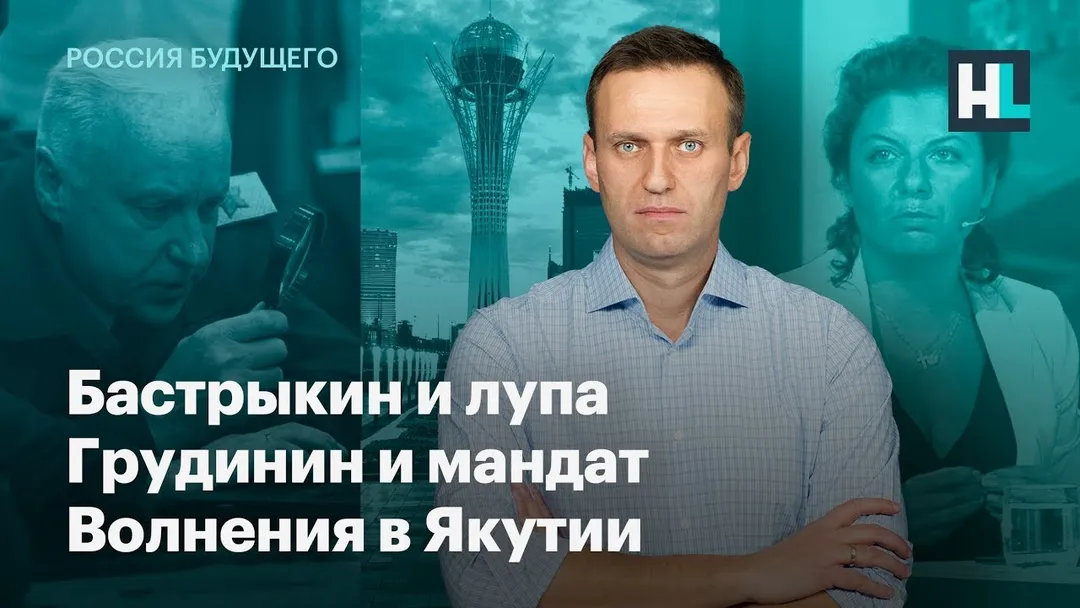
Bastrykin and the Magnifying Glass, Grudinin and the Mandate, Unrest in Yakutia
[music]
Hello everyone. It's 8:00 p.m. in Moscow, which means
that we're live with the program *Russia*
of the Future, and I'm Alexei Navalny
or rather, a politically extremist
slogan—that's exactly what they called me,
they called the word "Navalny"
"Navalny." Security guards at the Lokomotiv basketball club
in Krasnodar did that because at a
match of that club, a man was not allowed
inside because he came wearing a T-shirt
that said "Navalny." They told him, "Come on, man, you've got
it on your back—or on your chest and back, most likely—
a politically extremist
slogan. That's not allowed." When he asked, "What if
it were a T-shirt with Putin on it?" they said, "Well, with
Putin it's allowed, because apparently that's
a political slogan,
but not an extremist one. I have
a magnifying glass, my friends, and you
people of the internet have spent the whole week
snickering and laughing at Alexander
Ivanovich Bastrykin (head of Russia's Investigative Committee), because he was sitting there with
a magnifying glass like this, examining a monitor.
You called him every name under the sun—
a fool, an idiot—and probably many
of you, those watching right now, are either at
a computer or on your phone, though
probably most are at a computer, and you can
press Ctrl and plus right now
and see how the image gets bigger, and then
Ctrl and minus and see how it
gets smaller. If you know anything about
monitors, pixels, and so on, then
you understand that probably the people there—and Bastrykin himself—
who was examining the computer screen with a magnifying glass,
or the people around him,
were not very
qualified, and clearly cannot
be investigating crimes,
because they fundamentally do not understand
even something as basic as
how a computer monitor works. In general, they don't
understand the basics of physics, optics, or
anything else. But today I will appear as
a defender of Alexander Bastrykin,
whom, as you know, I dislike very much—a man who
personally
has fabricated criminal cases against me,
against Volkov, against Alborov, against
the head of our city headquarters,
and he personally is involved in fabricating
criminal cases. He's an absolutely
brazen hypocrite and scoundrel, but today
I am going to defend him, and a little later in
our program I will prove, 100 percent, that with
the help of a magnifying glass and by studying
carefully what
is happening on a monitor screen, you can
find all sorts of interesting things. We'll get
to that. But to begin with, I want
of course to start with Nazarbayev. Everyone was discussing it;
it was unquestionably the main story of the week.
After all, Nursultan Nazarbayev had been president of
Kazakhstan since 1990.
A Soviet-era figure, really—
we all remember him, he was there with Gorbachev,
arguing for preserving the Soviet Union,
then he became the first president and kept
his power, and for as long as he sat
there, no one ever really put it
in doubt. Kazakhstan is, of course, not
a democratic country, not even close, so
naturally it was a shock for everyone, including
me, when Nazarbayev announced
that he was stepping down from the post. Let's
watch 25 seconds of him telling us
that he is leaving.
Dear people of Kazakhstan, compatriots,
friends and colleagues, today I address you as
I always have at the most important moments
in the history of our state, which we
are building together. But today's address
is a special one. I have made the difficult
decision to relinquish the powers
of the President of the Republic of Kazakhstan.
From the very beginning, there were, broadly speaking,
doubts that he was really
leaving. They did not call new elections; of course
that's not how things are done in countries
where some person has sat as president for decades.
We understand perfectly well that this is not
how things are done in authoritarian
countries.
Authoritarian leaders do not leave
voluntarily. And indeed, it quickly became clear
that the daughter of Kazakhstan's president
would become the speaker of the local
parliament, while Nursultan Nazarbayev himself
would retain for himself the chairmanship
of the Security Council
and some other posts. Nevertheless, I want
to say this, because I received many, many
questions about it. By the way, use the hashtag
#RussiaOfTheFuture and write to me on
Twitter—I will answer your questions
during the program.
Quite a few questions came in asking whether I consider this
pure deception, or whether there is still something
positive in it. Of course, we will see
what happens next, but I think there is
something positive here, because, you see,
a complex system is always better than a simple
system.
A complex system—with democracy,
parliament, independent courts, independent
mass media, local
self-government—is always
far better, and we know that countries with
a complex system
always live better and are wealthier. But for us, it's not even about that—
forget independent
courts; at least, at least some separation
of powers, at least not 100 percent of power in one
set of hands, as is happening now in Russia
and until the very last moment was happening in Kazakhstan. We
understand that power still, one way or
another, remains mostly with Nazarbayev.
in the hands of his family, well, some kind of...
people appeared; the speaker of parliament was appointed
Tokayev became the new president, and
he was appointed and will be elected; we can see it has become a little
the system has become more complicated; some new
players have appeared inside it, and that is always better
than when there is just one person sitting there
and one person remains in charge, so
well, we have to admit that at least
right now, perhaps sensing the spirit
of the times, Nazarbayev, in a certain sense,
outpaced Putin and got the better of Putin, and
by the way, I want to draw everyone's attention
to the fact that he outdid him not only in this. We
in Russia sit around and think that, well, we
of course do not really think so; we understand that Putin
has, essentially, wrecked the country's economy
but for all these 20 years, the talk has been that Putin
has been in power, and especially over the last 10 years
there has been talk of a brilliant politician who
lifted Russia off its knees, so to speak
the 1990s were cursed, and everything was falling apart
people's salaries were, you know,
so tiny you could hardly see them even through a magnifying glass, and everything was
an absolute nightmare
and Putin supposedly lifted Russia off its knees,
held it together, scraped together and paid some
salaries, and people started living a little
better. This is presented as a unique breakthrough. Let's
look at
the chart of GDP per capita for Russia and
Kazakhstan
it is all the same there too; quite quietly and steadily
Nazarbayev did it as well, I mean he did it, and
now GDP per capita in
Kazakhstan
is higher than in Russia. So if we
say that Putin achieved a unique
breakthrough, that he is a unique
leader, then should we not also say that
Nazarbayev, who
did even better? Kazakhstan also did not
fall apart; Kazakhstan experienced, and still experiences,
many internal contradictions
including ethnic tensions
there were originally more Russians there than
Kazakhs; now there are more Kazakhs than
Russians, but Russians still make up, I think,
33 percent. Interestingly, Nazarbayev
recorded this address in two languages
in Kazakh and in Russian. So the country
has a huge number of internal problems
a sea of them. And in economic terms, the same thing applies:
he used them in exactly the same way, even better
Nazarbayev used the oil money, and
in that sense, his example
actually shows one thing: without all this
pomp, you can do all
the same things, achieve the same results, and there is nothing
particularly special about it
he did not do anything extraordinary. Well, at least GDP
per capita in Kazakhstan is higher
than in Russia. As for the fact that there is a lot
of talk about this now, naturally everyone
is joking, endlessly joking, about the
renaming of Astana to Nur-Sultan, but
it really is a strange thing. I recently
noticed that, in general,
the history of renamings is interesting
the endless renamings of this city
it is always a city that simply
keeps being renamed. It was founded in 1830
and was called Akmolinsk, and before that, on
its site there was simply a settlement
called Akmola, and so the Cossacks
called it Akmolinsk. Then later
it was renamed Tselinograd
then in 1992 back to Akmola, then
to Astana
and now this city has, once again,
been renamed to
Nur-Sultan. There have been a huge number of jokes on
this subject
well yes, it is a somewhat controversial decision, but on the other
hand, good grief, all leaders of this kind
do this constantly. It is probably
more unusual that a capital city is
renamed after a living person, but
if you remember, we had a city called Brezhnev
Naberezhnye Chelny (a Russian city temporarily renamed after Leonid Brezhnev), and yes, in every
city we still have some Lenin Streets and
Krzhizhanovsky Street
and so on, more than streets with normal
names. This situation really is amusing
Let's see how the situation develops
in Kazakhstan, but I repeat: the more
complex the system, the better. They have taken
a small, very small step. It is not that I
want to praise Nazarbayev now
he is definitely not the hero of my story
but I am certainly very curious to go
to Astana and see it. I even wrote on
Instagram recently that lately
we have been seeing a lot of these cool and
modern Kazakhs; they keep appearing
here and there. It would be very interesting to
see it. Flying there is
quite a long trip, so I still have not
made it there, but I definitely will someday
go. Still, some small
step toward making this
authoritarian system a little more complex
has been taken, and that is already good. But by the way,
we joke and joke, ha-ha-ha, look
at this Asian
autocracy where people rename
the capital to Nur-Sultan, and especially now
it is interesting how our various Kremlin guys
are reacting this way; they kind of
feel a little stung that
Nazarbayev's economic successes are
even better than Putin's, and yet he still
left power voluntarily, and so they
are therefore emphasizing precisely that
but look, it seems not
really proper government there, just this 'Asiatic' backwardness
and all that. No, what I want to say is
that at this rate, we are heading in the same direction already
Very soon, someone will propose renaming Moscow to
Putinogorsk.
Or they’ll suggest renaming physics
to “Putinics” — because, judging by the kind of
statements people are making, they’re just genuinely
insane statements, considering that before this
they spent so long earning the unquestioned title of [__]
of the week goes to
Mikhail Kovalchuk. You very often
hear the surname Kovalchuk. Most likely,
the Kovalchuk brothers — including on
this program — really are
two disgusting, vile crooks.
They’re old friends of Putin, and with the elder
Kovalchuk,
Ilya Kovalchuk, the banker, Putin together
founded the Ozero dacha cooperative, and Putin
kept a bank account at Bank Rossiya.
Yuri Kovalchuk — sorry, with the older
brother. And the younger brother, meanwhile,
pretends to be a great physicist, despite
the fact that, strictly speaking, the scientific community
does not recognize him as a great physicist. And this
same Mikhail Kovalchuk,
who is our [__] of the week — he
was not admitted for several years in a row to
the Academy of Sciences as a full member,
because everyone said, well, he’s some kind of
not-quite-real scientist. He’s a physicist, but he doesn’t
reach the required level. And, so to speak,
he got his revenge, using
the fact that he has this kind of resource — that
he loves Putin and fawns over him.
That’s why he was one of the
ideologues
of the reform of the Russian Academy of Sciences. And
basically, they wouldn’t accept him, wouldn’t
accept him, so he bared his teeth: fine, then I’ll dismantle you.
So then, this Mikhail Kovalchuk,
speaking at a
meeting, literally declared that
Vladimir Putin
initiated, and personally took part in,
all
the grand scientific breakthroughs
that Russian science has achieved over
the past 20 years. Let’s watch this
one minute. Be careful — it may
make you sick.
He has been engaged with science throughout his entire
time in power. I can say this:
the grand steps that have been taken over
the last one and a half, practically
two decades since 2000 — not one of
the major landmark steps in the development
of science was made without the participation
of Putin. Moreover, they were mainly
done on his initiative.
You know, Vladimir Vladimirovich is actually, I hope,
of course, a unique personality. I want
to say that when the conversation turns to
a person — I meet a great many
people — but when you explain some
complex things, I’ll tell you frankly that
there is no better
listener. That is, a person who
grasps everything, seemingly in a field
that is very far from him — I don’t know,
absolutely.
That is, a person who instantly
grasps the essence of things that are
completely alien to him. That’s first. So
a conversation with him is simply
a colossal, let’s put it this way,
intellectual pleasure. Well,
you must admit.
You must admit, the title of [__] of the week goes to
a man who fully deserves it.
Fully deserved. I said that at some
meeting, live on television,
he said — seriously — that the grand
breakthroughs in Russian science over
the past 20 years...
What breakthroughs exactly? I’ve got a magnifying glass,
please give me the list and I’ll examine it.
First of all, there have been no breakthroughs.
Russian science has become a ruin over the last
20 years. Putin has systematically crushed
the Russian Academy of Sciences, with the participation of that
same Kovalchuk. Funding
is being cut. In other words, things are very bad in
Russian science, and you’ll hear this man
— someone who is at least somehow connected to it —
and yet this person comes onto
a TV show and says: this is the kind of man
Vladimir Vladimirovich is — he
was involved in all breakthroughs,
personally participated in them, initiated everything,
grasps everything instantly,
takes part in everything. I mean, it’s some kind of
unceasing stream of syrupy praise, just — and he
says it, and he says it on
Solovyov’s show, while Solovyov just nods and nods.
What disgusting liars and
scoundrels they really are. And again, I return to why
I’m showing this: it’s really not far from here to
renaming Moscow to Putinogorsk.
It’s very close — closer than ever. Soon
some similar old hack will appear on TV
and say: I am Mikhail Kovalchuk from
the Kurchatov Institute, I am a great scientist,
and on behalf of all scientists I believe that Vladimir Vladimirovich’s contribution
to science is so
great that let us
rename physics to Putinics,
and to applause, to applause,
our children will study from textbooks
that say “Putinics, Grade 8” on the cover.
And cities will be renamed, and everything else too.
This is very close. This whole gang
of United Russia members, disgusting bootlickers and
similarly servile lackeys, are all just poised at the starting line.
They’re waiting for someone to be the first to start
pushing this kind of initiative,
and then, once they get as far as
such absurdity as renaming
cities,
then the real spectacle will begin.
We need to do something about these
vile people: insult them. And everyone expected
that we would start insulting officials
right on today's program. This needs
to be done always and constantly, because in
today's Russian reality
to insult an official simply means to tell
the truth about him. But that Kovalchuk isn't
exactly an official, but still, he is a
lackey and a scoundrel; his brother is a crook and a thief, and together with
the same thief Putin, they together
carry out their shady dealings. Is that an insult to them?
No, it's the plain truth. But as far as I know,
so far no one will try to bring me to
administrative liability, because
this law too—I've been asked a lot
about it—comes into force, this law
by Klishas only on March 29, and we
today had—well, there was some confusion, and so
Ruslan Shaveddinov's channel *Living in Russia*
—subscribe to it, by the way. He
put out a video there, a funny video where he called
various officials and insulted them over
the phone. He was like, "I'll be the first to insult
all of them." And I said, "Come on, I'll
be the first, because I'll go ahead and curse
them all out on the program." But the lawyers say that
none of you will be first, because
the law hasn't entered into force yet—it starts on the 29th.
Let's cut loose. I just want
to draw your attention to something. By the way, this is
quite interesting: the law on insulting
them is a kind of sign
that everything really is collapsing for them.
I mean, it's genuinely falling apart. In one
of my previous programs I showed that
there was a very similar censorship statute
adopted under Nicholas the Hangman (Tsar Nicholas I)
in 1828. Let's just take another
look—I'll quote it again:
"Any work
of literature
is prohibited not only if it is outrageous against
the government, but also if it weakens the
respect due to it." And now they have adopted almost
the same thing. I'm reading from the Klishas law
—quote—which enters into force on March 29:
"The dissemination of information expressed
in an indecent form that insults
public morality and clearly
shows obvious disrespect toward
society, the state, official state
symbols, or bodies exercising
state power in the Russian
Federation..." That is, if you say that
the head of the Investigative Committee
is a [__] because they use a magnifying glass
to examine pixels on
a screen,
then in theory you fall under this provision. But
there is an even more interesting parallel to
this Klishas law, and it's not nearly as
ancient as that censorship statute
under Nicholas the Hangman (Tsar Nicholas I).
It turns out that on March 14, nineteen
ninety, there was adopted
a special decree banning public
insults against the President of the USSR and slander against him.
Let's take a look. So,
it's very, very short, a kind of
brief decree—you can very easily
find it: "Public insult of the President and
of the USSR, or slander, is punishable by a fine or
corrective labor and/or deprivation
of liberty. The same actions committed
using the mass media are punishable by corrective labor
or imprisonment for up to six years."
So in fact, there it is—almost
the same Klishas law, you see; the law
may bear Klishas's name, but its real
initiator is, of course, Putin personally,
because Putin personally is terribly
upset that tens of millions of people in
Russia see him as a crook and a thief,
not some great national leader.
And accordingly, he wants to shut
them all up. The same thing was wanted by President
Gorbachev, who in 1990, well,
wasn't exactly popular, as
those of you who were already
of a conscious age at the time probably remember.
And he adopted this decree, and I just want
to ask: well, Mikhail Sergeyevich, did it help you
and the Soviet Union?
This law didn't help much either. Other
things needed to be done then. Instead of
adopting this law, they should have
been working to fix the reasons
why people didn't like them and insulted them. And the same
can be said to Putin in exactly
the same way: it didn't help Gorbachev,
it didn't help the tsarist regime, and it won't
help you either. Once again, I urge you all
to fight this law
and, in effect, this censorship, by simply not
being afraid of it and continuing to tell the whole
truth about officials in completely plain
language. Before, maybe you
wondered whether to say something, whether to express
on your Facebook page
everything you feel about
the authorities—well, it reaches them, but
you couldn't be bothered, or didn't feel like it. But now
make sure to write it, simply so that
they can see that this law is being massively
ignored, that people are demonstratively
refusing to comply with it. This is extremely important.
Let me answer some questions. Pechenka asks me:
"Hi, Alexei, I wanted
to ask: is Nazarbayev highly
corrupt or not?"
"I specifically registered on Twitter
for this question." Well, listen, I
think that any leader of that kind—
Nazarbayev and all the rest—well, it's as if
the whole country belongs to him, in that sense.
So the question of corruption doesn't even
make much sense. I won't lie, I
I don’t follow any particular
Kazakh politics that closely, or what’s going on there.
If you ask him, for example, even about
Uzbekistan,
I could tell you more about Kazakhstan.
I don’t know much, but this question is,
in principle, about as relevant as
asking about Putin’s money: how many
people, how much money, whether the entire central bank
belongs to him. If tomorrow Putin needs to, or
Nazarbayev needs to transfer someone a billion
dollars, he picks up the phone and says,
“Transfer a billion dollars to my wife”
or daughter.” That’s how it
works. So when people ask me
to comment on the mass resignation
of a governor and a kickboxer-turned-
something—I’ll talk about that. Sergey Nikolaevich
asks me: “Alexei Anatolyevich,
what should we think about the fact that in Ulyanovsk
they’ve started jailing deputies from the Communist Party of the Russian Federation?” I’ll
talk a little today about Grudinin, but not
answer that question either.
Petr Zavyalov asks:
“Please comment on the possibility of refusing
in Russia to recognize ECHR decisions
(European Court of Human Rights). Is this possible?” Russia is constantly
threatening to leave the Council of Europe,
and that
the consequence of that would be a refusal to
recognize the jurisdiction of the European Court.
Frankly, I think that’s unlikely.
At the very least, it’s unlikely to happen in the
near future. Flight Termin asks me
what is happening with the case around the film
*He Is Not Dimon to You* and what happened to Zolotov. Well,
regarding *He Is Not Dimon to You*, we filed a million
complaints on every single episode.
Naturally, there have been no investigations anywhere
close to real ones, because
the real consequences, the genuine
consequences of the film *He Is Not Dimon to You*,
of our investigation, should be this: there should
be the arrest of Dmitry Medvedev, an investigation, and
a trial concerning him, members of his family, and
a large group of his friends,
oligarchs, Usmanov, and many others.
But as you can see, there are no proceedings
where you can see Usmanov and
Medvedev sitting together behind bars
or in a glass cage. What happened
to Zolotov? Nothing happened.
He still commands the National Guard (Rosgvardiya).
He’s probably watching this broadcast right now, wearing
his famous gold cap to
intimidate people. And Yakutia is an extremely
interesting and extremely important topic.
Especially since we saw that at the first stage
it was completely boycotted—
boycotted one hundred percent, censored
by the federal media. But later on,
the scale and significance of the events became
so great that it was simply impossible
even for federal TV channels
to ignore it, and we started seeing some
reports. Let’s talk
a little about what actually happened.
In Yakutsk, on March 17, there was a
crime, and
the perpetrator—let’s say right away, the perpetrator—
was a migrant worker
who had come from Kyrgyzstan; he was Kyrgyz.
He forcibly dragged a local young woman
who was ethnically Yakut
into a car, apparently into the passenger compartment,
or a garage.
He raped her, then left and instructed
two of his friends, also
Kyrgyz, to guard her. At some point
they fell asleep,
and she escaped and went to
law enforcement with a report
of rape. And she did the right thing by
not hiding it. After that,
well, in Yakutia there were very real
riots, mass unrest—without any
exaggeration, one can say
that this happened because we saw
a genuine uprising of Yakuts against
migrant workers, and Kyrgyz people in the first
place. At first there were some
gatherings of people at night, literally at night, when
as far as is known, on the main square
someone persuaded them to disperse, and
nothing especially significant happened there.
Then, realizing that it was impossible
to ignore it—people were simply going to pour out
into the streets en masse and smash everything up—
they invited people to the local stadium, and there
most of the speeches were in
the Yakut language. Let’s just look
at what it looked like for 15 seconds, so you understand
the intensity of the emotions.
Ah
[applause]
Ah
[applause]
And those gathered were all young men, and
you understand yourself: when
several—clearly tens of thousands, or
a couple of tens of thousands of young men—gather,
they can do many things, especially
when they have gathered over facts like these,
facts that genuinely affect every
normal person, truly.
Across the republic, a number of
incidents swept through. Besides all that,
there is also a rather unpleasant aspect.
Of course, migrants raped a local
resident, and they committed a horrific
crime. But the response to this, in
some places, also looked, let’s say,
quite ugly. At the same time, I
completely share the level of outrage
of those who come and say that, well,
migrants committed this crime
because there is no migration policy,
because there is no normal judicial
the system, but this is, in a way, the response of many people
it looked pretty disgusting, though
let's watch 29 seconds
this is basically how locals shut down a food outlet
a public catering place where
Kyrgyz people work
shut it down now, it's closed
guys, there are like 50 of them—you can tell right away
come on, shut it down
[music]
today nobody should be working, got it?
then close it, come on
the video that shocked me even more
some of you probably haven't seen this
maybe some have seen it, maybe not, but just
a video of some man with a
gun leading away some unfortunate Kyrgyz man
or maybe a Tajik migrant somewhere, and
he is literally saved by people passing by
let's watch three seconds of it
they roughed him up here, and, bro, they
let him go
I'll punish those guys, you know how things work here in our
camps—he has nothing to do with it, don't touch him
leave him alone, man
this incident took place in one of the
towns in Yakutia (a region in northeastern Russia), not in Yakutsk itself, as I understand it
as I understand it, the man with the gun has already been
detained, so you can't say that
it was completely ignored, absolutely not, but what I
want to say is this: why is this happening?
You can't justify
those people who break into
various food outlets and
just go, "oh, there's a Kyrgyz guy, let's
beat him up"—I mean, that's just
absolutely vile. But why, exactly,
did people actually pour into the
streets, outraged and believing in nothing?
Because they know that in Russia there is no migration
policy, there is no real police in Russia,
there is no judicial system in Russia, and
a high-profile crime will be
truly investigated only if
you run around with eyes like this
across the square shouting, "Do something,
investigate it, or we'll burn everything down here"
And for that to happen, apparently there had to be
a rape, there had to be
not exactly deaths, but some
extremely disturbing, disgusting incidents
for the authorities to even
start moving. And there are quite a lot of
videos—I won't show them to you
because it would take too much time. Officials and
various talking heads are speaking out now, and
federal figures are saying, "My God, migration—
we need to restrict migration
indeed, migrant criminals
commit many crimes," and so on
But what were you doing before? Why do we still
not even have a visa regime at least?
Of course, a visa regime will not save us
from some
visiting idiot raping one of our citizens—we
understand perfectly well that the majority of
migrants who come here do not commit any
crimes. But if we
want to control this situation in any way at all,
then we should start by
establishing some kind of visa regime
for starters
and counting how many there are. After all, this is
Yakutia (a region in northeastern Russia)
This is not, you know, a situation like Texas and
Mexico, where people run across the
border and it's impossible to count them
You can only really get there by plane
or by a very long trip, and you'd think
that at least at the border they would count
people, that a visa would be required
But none of that exists at all, and every time
our officials begin to think even a little
about this issue and speak out
only specifically after rapes and
murders. Look at every single case
when officials come out and start saying
or mumbling something like, "well yes, yes, yes,
yes, it's time to introduce a visa regime," and that's when
someone has already been stabbed or killed
in the meantime. And as for migrants,
again, you are the ones bringing these migrants in
you opened the borders
they come, they work, most of them
work honestly, they are normal people. But if
our concept—the Putin-era concept—is already
that Russia needs to bring in
hundreds of thousands of people so that they can
replace
the dying-out population, then you should
also think about their socialization
What are they supposed to do? What kind of
leisure do they have? How will they learn Russian?
How are they going to integrate into
the community? What are migrants doing now?
Nothing—they sit around in shopping
malls
in summer, where do they sit? On the riverbank
drinking. They have no
socialization at all, basically
And who are migrants, most often?
They are young people who came from
Kyrgyzstan or Uzbekistan—they are young
people, and many of them are from
villages; they have little experience of life in big
cities. Some of them are fairly
religious, and that creates a certain
lack of understanding in large Russian
secular cities. So then let's
actually think through a plan: if people come here
from villages, for example,
then we should try somehow to
integrate them here, we should find
some kind of leisure activities so that they
I don't know, have something to do in the evenings
so that they do not isolate themselves in their own
communities, so that they learn Russian
so that among themselves they
They spoke Russian and tried
to communicate in Russian because
otherwise it turns out like this. But we brought them here
and said, well, here you go, people like this work as
janitors.
And some people want to work, while others seem not to
want to, and some started working and
felt that life is very hard and
decided to make extra money by bringing in
drugs, or amusing themselves by, I don’t know,
snatching bags. Of course, not everyone does this.
Only a small number of people do it.
Guys, we already have plenty of crime as it is.
Why should we import additional
crime here? In that sense, the terrible
events in Yakutia (a republic in northeastern Russia) are connected to this
rape case, and the unpleasant events that followed
were tied to the unrest. This is, of course,
a direct consequence of the authorities doing absolutely
nothing and having no
strategy at all
for what to do. People often say to me,
so, you’re in favor of not letting migrants in?
Yes, I’m in favor of
restricting the entry of migrants from Central
Asia.
But at the same time, I support their
labor rights. They simultaneously want to bring them in
while also wanting to ignore their labor
rights and keep these migrants in a
slave-like position. Make up your minds: if
you’re bringing them here,
then figure out how they are supposed to live here.
If you’re not bringing them, then introduce a visa
regime. But as usual,
the Putin state doesn’t do a damn thing.
It wants to bring in several
million people so they can wander around
in unclear circumstances, while police collect money from each of
them, and passport offices
make money by selling
documents and so on and so forth.
It’s a huge, enormous business from which
a huge number of
officials profit, and this completely runs counter to
our interests. So let’s—
you’re asking me whether people in Yakutsk can
hold rallies. No one is stopping them, while others
elsewhere in Russia are treated differently.
Or is it simply that the security forces are with the people?
I’ve seen quite a lot of this.
Mikhail Pozharsky wrote a similar post on
Facebook when
some similar events happened in
Kondopoga (a town in Karelia, Russia). He used much harsher
words there. But what happens in Moscow? We see
an extremely painful reaction
from the security services, who simply start
locking everyone up, rounding them up, arresting them, imprisoning them
because, well, they’re Russians. In Yakutia,
that can’t be done, because the Yakuts in
this sense
acted much more cohesively, and everyone
looked at that and said, well, you can’t
mess with them. Let’s
come to an agreement with them and somehow resolve
the issue. With Russians, that doesn’t
happen, especially where there are
similar kinds of
conflicts.
They just start imprisoning them, because all
Russian nationalists are seen by the system
as enemies who need to be crushed
and
persecuted, jailed, and so on and so forth.
There are different kinds of nationalists; there are
people who call themselves nationalists
but in reality they are simply downright
fascists. But yes, of course, this is
a complicated issue, and of course very few
politicians are prepared to discuss these
topics at all. But I do discuss them because I
am trying to speak with you honestly.
Obviously, you simply saw that in
Yakutia, the locals acted in solidarity, and
the authorities said, okay, okay,
we’ll deal with this issue. But then
Russians, in that sense, do not act according to the principle of
one for all and all for one,
so they can be jailed. I am not
calling for that, of course.
Of course, every time such a dangerous
incident happens on ethnic
grounds,
the authorities must do everything possible to prevent
any pogroms from happening.
There will be emotional unrest, but that is
something impossible to control completely.
There must be no violence or threats of violence.
That must not happen.
But of course, of course, here we see
completely
double standards. As for the governors—
what is going on? I see a lot of questions
being asked right here, asking about
the governors. How should this be understood? Guys, how
should it be understood? It’s the same old deck of Soviet-style crooks,
and a demonstration that Putin
himself does not know what to do about it. I see here
Roman Virolainen writing: “Alexei, my
teacher works in schools and also gives
private lessons at home, and makes 22,000 rubles a month (about $240).”
Then he asks how to persuade her
to join a trade union.
I’ll say more about that later, but anyway,
you see, Putin is frantically trying
to respond to public discontent by
first shifting the population’s dissatisfaction
onto the local level, and then removing those
governors. Let’s take a look:
five or six people have been dismissed:
Marina Kovtun in Murmansk, Boris
Dubrovsky in Chelyabinsk,
Alexei Orlov in Kalmykia, Yury Berg in
Orenburg, Alexander Berdnikov in Altai, and
now they’ve been removed. I’m very interested
to read the Kremlin Telegram channels
that are now writing about what they used to be like.
Kovtun was awful, Boris was a nightmare.
Dubrovsky in Chelyabinsk.
He was a terrible governor.
Good grief.
Our headquarters in Murmansk and our top team.
in Chelyabinsk.
They fought Kovtun and Dubrovskiy as best they could.
They were jailed, and in response they were dispersed there.
They were persecuted, and we shouted for months and
years
that these were crooks and thieves and should be sent into
resignation, and nothing happened. She
now, having sort of realized that, well, they need to
give the public at least some kind of answer to
why this trash involving these
meaningless crooks being replaced by other
crooks is happening. Let’s just look at
who was removed and what results they had.
With results like that, they were elected—what, were those
some kind of, again, by
by Kremlin standards,
unpopular people? No, no, look at
the results.
Kovtun got 65 percent, Dubrovskiy
86 percent.
Orlov 83, Berg 8—though Berdnikov
is a bit of a special case, but come on.
Most of them are more popular than
Putin. I mean, if that idiot Dubrovskiy not so long ago
was elected and got 86 percent,
then you’re a great politician—how can you even
want to remove him? After all, he’s adored by
the Chelyabinsk Region.
Eighty-six percent of people are ready to carry him around on
their hands. Putin, yes, got 76 percent across
the country,
and this one got 86 percent across the whole region. Again,
it turns out it’s all fake, it’s
something nobody needs, and they simply removed them
because they understand that the population
hates these governors and hates
the federal authorities, and for a while
they’ll remove these disgusting people. The same goes for
Kovtun—good Lord, people were literally giving testimony about her.
Right now, in a Moscow pre-trial detention center (SIZO),
there’s a man named Igor Babchenko sitting there.
He said outright that
Kovtun—he testified during the investigation that
she gave orders to collect bribes, and the money
was spent on gifts for federal
officials. In other words, one side was itself taking bribes—
I mean, there was just a pile of compromising material.
We talked about it, we wrote about it,
and nothing happened. Now they’ve been replaced
by some people who now
in September
will be elected again with a result of 86 percent,
and then after some time they’ll be
removed again. And who are all these people? More often than not,
they’re just brought in from other cities—to Chelyabinsk,
they drag in some Alexei Texler,
he may be originally from Chelyabinsk, but he worked in
Norilsk. In Murmansk—Chibis, by the way,
is the ideologue behind this whole capital repairs system.
Because he came out of the housing and utilities sector, from
the Construction Ministry, and he came up with all these things
about how we’re supposed to pay more and more
for major building repairs. He actually—he
worked in Chuvashia and in Ryazan Region.
And now he’s appointed to Murmansk. How do you
think—are Murmansk residents happy about that connection?
Obviously not. Pasler was appointed to
Orenburg; everywhere he’s considered a man
of Vekselberg (Russian billionaire Viktor Vekselberg), from Sverdlovsk Region.
It’s very funny—remember how everyone
was joking when there was the previous round of
replacements?
They were appointing the same kind of little guys everywhere, at these
blank squares, and they were all exactly alike,
and everyone said that meant the system of
artificial intelligence had simply
designed roughly the same governor every time.
Now everyone is joking that
they appointed Texler and Pasler as if
it’s just a hangout of pointless guys who
nobody needs. And our task here
is very simple: go after all of them.
Why are they being removed? Well, because in particular
in Chelyabinsk our headquarters made a very, very
big contribution to that, because we were waging
a war against Dubrovskiy, and our Murmansk headquarters
was waging a war against Kovtun. Everyone kept telling us
they wouldn’t be removed, and yet
who would remove Dubrovskiy? After all, he got
86 percent. Go after all these people, and
in the elections now, these new ones
they’ve dragged in and put there as some kind of placeholders,
with weak opponents—vote against them.
Go after them on social media, humiliate them, insult
this government, because any humiliation and
insult directed at this government
is fully deserved. Go after them, and let them keep
replacing them so that the public becomes more and more
convinced that really these are
pointless guys who can’t do anything,
that only one person here can do anything—
Putin, and Putin must bear
responsibility for it—not Kovtun being swapped for some
Pasler or whoever. What needs changing is
Putin, through real elections. Please show
the link to Smart Voting once again,
register in order
to
fight all these so-called
strong guys. Uh-huh, sure. The best
example of what happened is, of course,
the appointment in Kalmykia—it’s just, simply
masterful, you see. They removed someone
unpopular from the head of Kalmykia, with the surname
Orlov—Orlov, that’s right, isn’t it?
For us,
Orlov got 83 percent, and they appointed
in his place a kickboxer, Batu.
I’m not trying to say, you know, that a
boxer must necessarily be stupid
or something like that, but really, some kind of
random boxer—a very good kickboxer,
who won some matches here and there, and so on.
Fine, then he could have become a coach.
He could have worked
teaching children in Kalmykia kickboxing, or, well,
I don’t know, earning money, organizing matches himself,
or something. But why, somehow, this?
Of course, all professions are important, all
professions are needed, but if a guy was just yesterday
walking around the ring half-naked in shorts and hitting
another guy in the head, that doesn’t mean he’s
bad.
It means he probably shouldn’t be
a governor.
Especially since I wouldn’t even have brought up the subject of
this wonderful Batu
if, if I
— Batu Khasikov is his name — hadn’t also read
that in 2016 he was stripped of
his academic degree because he had
a completely plagiarized dissertation. And back then
he was in the Federation Council (the upper house of Russia’s parliament), and even then everyone
was saying, basically, that he should be kicked out of
the Federation Council because the man’s
dissertation was entirely stolen. If you’re
that kind of person who, for some reason,
decided to get an academic degree and
completely stole everything — and Khasikov did
something truly astonishing: he took
a dissertation about Karachay-Cherkessia (a republic in southern Russia) and
then, throughout that dissertation,
he clumsily replaced “Karachay-Cherkessia” with
the word “Kalmykia.” You see, these are the kind of
people
they appoint as governors. So this man
— if you now brought him not to Kalmykia
but put him in an office in Karachay-Cherkessia,
a wonderful republic — have you seen what things are like there
from our investigations?
He probably wouldn’t notice either. And that shows
the quality of the human material. Very
A very, very funny video — I watched a long
video of how the hearing went, and at the request of these
wonderful
wonderful people here — Dissernet (a Russian volunteer network that exposes plagiarism),
which finds plagiarism — I consider them
absolutely our colleagues. They are definitely
also fighting corruption and theft.
The way they defended Khasikov with his
stolen dissertation, where he replaced
Karachay-Cherkessia with Kalmykia — they literally
compared him to a victim of the Inquisition. Let’s
watch 56 seconds.
There are certain things spelled out there
which may, perhaps, be personally
— I’m sure the internet says something about this —
some passages in a previous
dissertation.
But that does not necessarily mean they belong
to this dissertation, and every repetition
is somehow suspicious. Well, I don’t think so.
If we go that far, you know,
back in the Middle Ages there was that famous treatise, *The Hammer of Witches* (*Malleus Maleficarum*),
a manual on witch-hunting, where it said
quite plainly that if, during
questioning under torture, a witch moves
her eyes from side to side, that is
proof that she is with the devil.
And if she stares at one point, that
is even greater proof
for the case. So, in other words, a mere
coincidence is plagiarism,
and if the coincidence is preceded by some
phrase like “thus” or
something similar, then it is plagiarism twice over. The devil
really does find work — the nerve some people have. But he
took Karachay-Cherkessia and swapped it for Kalmykia,
and by doing so, it seems to me, he even
slightly insulted
the Republic of Kalmykia itself. I also
want to address, in this program,
the wonderful kickboxer
and acting vice president
Batu Khasikov. What the hell, really?
Why was this necessary? I mean, obviously,
you were too lazy to write your dissertation yourself,
but why at all? Why is there this need
to become president? Why can’t you
just be an honored retired boxer
and mind your own business? Why does Putin do this?
Actually, that question is pointless, because
he simply has no one else left to appoint. He’s
already appointed all his bodyguards to
various regions; now they’ve moved on to
kickboxers, and after that there’ll be someone else. He’s just
frantically trying to reshuffle the deck.
But again, I simply don’t understand
why.
Why do the people of Kalmykia need any of this?
Why do we need Khasikov at all?
Nobody needs this. Register for
Smart Voting so that we can fight this
on principle. Against any
person Putin appoints
as governor, you need to vote — not for just anyone, but against
that person, for any other candidate.
Register with us now. We will be
organizing and coordinating this
voting in order to fight these
people.
There are 33,600 people watching me live right now,
asking about informing people about
Smart Voting. So, look,
guys, here’s how this system works. I
keep urging you in my videos
to join. Right now we have
about 130,000 people registered there.
Closer to the election,
when the candidates have already been
registered, once they are registered, we
will know the lists of candidates, and I will
ask each of you to become a campaigner for
Smart Voting. Those 130,000 people can, within
two days, inform 10
million people. Then we’ll bring in more
people and may be able to inform 50 million
people. That’s how we will
operate.
So that on the Single Voting Day (Russia’s nationwide election day) in
September, every resident of Russia in those
in regions where there is a choice, and it came via
phone calls, messages, and so on
with a link explaining how to choose
a candidate. I see a lot of questions about our
confrontation with that disgusting
Prigozhin, who is Putin’s chef, and in fact
this confrontation has already become a real
direct clash — we’ve really locked horns with
this thug who is poisoning children in
Moscow.
And it’s very interesting right now
to watch how he simply doesn’t
spare any money trying somehow to
pressure us, though in general we’re not
very timid people, as you know. Still, he’s trying
to exert psychological pressure on us.
For example, Lyubov Sobol is literally
constantly being followed by people filming her
on their phones, and by now it has already
spread to me too. It looks very
ridiculous. Here at our office,
on the ground floor, there are always
several people hanging around, and every time
I go downstairs to buy lunch,
they follow me and film me
with their phones. When I go home, behind me at
a distance of about two meters (about 6.5 feet), there walk
two creeps who simply
follow me, film me on their phones, and
trail us everywhere, filming us.
In some way they’re trying to
apply this kind of
psychological pressure. But we are not going to leave this bastard
alone, because in fact he
is supplying rotten food to Moscow
schools. And today Lyubov Sobol released
a video saying that she is beginning
to work on this case. And not just because of
a huge number of mothers who came forward and said
that, as it turns out, at the end of
2018 there was an outbreak of mass
dysentery.
Caused by Putin’s chef, it was not
the only one — there had been another similar
outbreak before that. Let’s listen briefly to 46 seconds
of Lyubov Sobol and her trademark
dramatic voice. As it turned out, this was
not the first case of a dysentery outbreak among
preschool children.
Parents of children from the
Delfinyonok kindergarten came to me.
This kindergarten is located in another
southern district of Moscow. According to the parents,
a year ago more than 50
children there were poisoned. He had such attacks of pain,
he turned pale, bluish, he was burning up —
he was screaming through the night, just
bleeding. He was skin and bones. I
simply couldn’t look at all of this
without tears. For two months he simply didn’t eat, didn’t
drink; we had to run around and prove things to
someone.
The information we were given was that
everything was fine. A four-year-old child
went through something I wouldn’t wish on my worst enemy.
For two or three months, some are still
undergoing treatment.
In fact, this is 2018: a city with a budget
of 2.5 trillion rubles is poisoning
children, and the Moscow authorities are covering it up
with all their might. The departments —
the Department of Health and
the Department of Education — are hiding it with all their might
so that it does not come to light. We
are going to bring it out into the open, because
the issue here is, naturally, first and
foremost,
children’s health. My own children go to
a Moscow school, and of course for us
the corruption angle here is tens of
billions of rubles that this Prigozhin
together with Sobyanin are siphoning off.
Can you imagine that kind of money in
Europe’s largest city?
To control the supply of all food products
to all schools and all kindergartens — and now
they’re also planning to grab all sorts of
hospital contracts. So of course we are not going to leave
this alone. As for Chechnya,
it really ought to become a permanent segment
in our program — constantly
discussing Chechnya lately. We
certainly, first of all, I want
to talk about this situation with Oyub Titiev
who was sentenced to
four years for allegedly possessing
drugs. There cannot be two positions here:
an absolutely innocent man
had a packet simply planted
in his car with marijuana in it. You can read about it —
Novaya Gazeta wrote a lot about it. It’s just
an outright frame-up. This man is a
human rights activist; he provides legal
assistance to Chechens — he is Chechen himself —
he provides legal help to those whose
relatives have been abducted, to those who are, well,
being persecuted there — he helps them.
Kadyrov doesn’t like that. Kadyrov said
he should be jailed for drugs, and they
planted a packet of marijuana on him.
There is a sufficient amount
of evidence for that. And now, despite
the intervention of the Human Rights Council
and even some of those
human rights defenders — real
human rights defenders, even some half-loyalist ones —
who, well, thought that this was already
too much, such blatant lawlessness,
to imprison an older man like this — nevertheless
he was given four and a half years.
All of this is being presented in such a way as if,
you know, he’ll be eligible for parole soon, that is,
as if: well, if he’s innocent, then
he’ll be released soon.
He has already served quite a lot of time. Of course,
I want to express my solidarity with Titiev and
all his colleagues. And this is simply
a real crime. Those people
which the Libao factory was fabricating.
Cases should be brought against him; of course, they themselves should
be sitting in prison. It’s all very funny, of course.
This story got a sequel — the story about how
remember, I showed you the United Russia deputies
from Chechnya who, on Instagram,
addressing him, said that he doesn’t like Russians,
that he doesn’t like all of this — and it’s very funny how they
are now making excuses. They say it was translated incorrectly
from Chechen. We have the video,
and the wonderful Tarsa, whom we
talked about in the previous program, even
simply broke it all down piece by piece
and reproduced it, showing what was really said.
So no, it’s all lies — we understood everything correctly.
“pelt him with Chechens” — let’s see. We can’t
watch it here, I don’t have that clip right now, which means I’m
going off script a bit, but you can find it
quite
easily online. I just decided
to mention it. It’s also funny to watch
how this whole Kadyrov crowd
just twists and squirms like this
and says, no, they don’t want to
expel him from United Russia. They say
that, supposedly, we didn’t understand what he said in
Chechen, even though we understood everything he said there
in Chechen. Before I move on
to this wonderful magnifying glass,
I’ll still run my experiment and prove
that Mr. Bastrykin knows how to use it
properly — and by “use it” I
wanted to briefly mention my
favorite, Mrs. Rock Bottom, Margarita Simonyan.
According to various Telegram
channels — and RT did not deny this —
RT, which receives 18 billion rubles a year
of our money to keep the channel running — about $200 million USD a year —
has adopted a simply completely
fantastic new provision: amendments to
the employee regulations. RT employees
are now forbidden, for 20
years after увольнение, to discuss
the channel’s performance, its style, and its working methods,
to criticize it, and so on. And if you
do, the fine will be 5 million rubles
— about $55,000 USD. Why? Well, it’s obvious why: because the people
inside know that this is simply
stolen and talentlessly wasted
money. There are no real performance figures there; it’s
all absolute nonsense, and those 18 billion
just vanish into the sand. But this is
a state operation, after all. Can you imagine?
On state television there will be
some kind of rules that make it seem as if
the FSB doesn’t exist. This is a 20-year gag order
under threat of a 5 million ruble fine
forbidding you to criticize your former
bosses. So yes, of course, this
has shown just how afraid she is
that the secrets will come out. So,
we take out the computer, we take a magnifying glass, and I
give you a master class.
So, if you think you can’t
examine a screen with a magnifying glass,
if you imagine that physics
and optics somehow mean that this
doesn’t work — that you can’t inspect a screen — I’m about
to prove it to you right now.
I’ll prove it to you, just as Alexander Ivanovich
Bastrykin, head of Russia’s Investigative Committee,
with a Czech residence permit, as
I showed you in my investigation.
Take a photo like this one, or a similar one,
or even exactly this one, and I examine it on the screen.
Let’s take a look. Here is the photograph.
Please show the photo. What do you
see in it? You can’t really see anything in it.
You see one pleasant-looking woman, another
pleasant-looking woman. I point the magnifying glass at her and
realize that this is Olga Ivanovna
Alexandrova, the wife of Alexander Ivanovich
Bastrykin. That’s what it tells me — without the magnifying glass,
without the magnifying glass,
I would never have made that out in a million years. But
magnification does work, and while that’s
probably not enough, we have learned that
she is Bastrykin’s wife. So let’s
look closer, folks. A magnifying glass is given to us
so that we can inspect things closely. She is presenting
some important award, and we look here
at her pleasant face, at her hairstyle.
Some kind of award — let’s see what
kind of award it is. And somehow, as we’re
examining the award, we accidentally move
our lens over to the watch
on Olga Ivanovna Alexandrova’s wrist, and through the magnifying glass we
can make out even the very, very
smallest details. We don’t need Ctrl+Plus;
with the help of this device, we can see that this
watch is — Lord, even now I can see it —
Audemars Piguet Millenary 4101
in steel, night theme.
If, having made that out through the magnifying glass,
we now google the price of this
watch, we will see that it costs a lot,
Alexander Ivanovich.
$57,000 USD. Though, by the way,
today, if someone wants
to buy it today specifically, we checked and it’s
21% off — that makes it $45,000 USD,
or 2.9 million rubles. But
as for the question of whether, with the help of
a computer screen and a magnifying glass, one can uncover
some kind of corruption-related crime,
it seems that one can. I’m very interested in
how exactly
the family of the head of the Investigative Committee
manages to buy a watch for at least 3
million rubles — and more likely for 3
and a half million rubles,
because, well, I assume they
bought it without a discount. Here’s the thing:
of course, if we look at Bastrykin’s financial disclosure,
we’ll be a little shocked,
but we’ll learn that his income is 16 million
rubles a year — that is, he
earns
It’s unlikely that the head of the Investigative Committee
of Russia has some side job somewhere.
Although, generally speaking, everything that
is happening in the Investigative Committee
is a kind of business venture, really.
In fact, he may well be able to afford a watch like that.
But I would like Mr. Bastrykin
the leadership of the local committee, and Mr. Bastrykin’s family
to simply come out and say this, then:
to the many millions of the
multiethnic people of the Russian
Federation: “Guys, our income is high enough.
You pay us out of your own pockets. You
pay me, Bastrykin, 1.5 million
rubles a month—almost 1.5 million
rubles is his monthly income—and so I
went out and bought my wife a watch for 3
million rubles. And looking you in the eye,
those of you living on an 8,000-ruble pension,
looking you in the eye, those of you earning a teacher’s salary of 22
looking you in the eye, those of you earning
a nurse’s salary of 15,000, I say: no, I am not
ashamed.”
“Our family, thanks to the rapid
economic growth taking place in
Russia, can still afford
to buy wristwatches for 3 million
rubles.” I would very much like
the Investigative Committee—Alexander Ivanovich
who likes to publicly, well, drag me through the mud
here and there, and once even wrote
poems about me—
to explain to us, after all: are these watches
corruption? Someone’s gift? Were they not
declared?
Maybe they were a piece of physical
evidence from someone’s apartment, from
some bad governor, which you accidentally
took away, borrowed to wear, and then
forgot to return? Or maybe you bought them yourselves.
You have the right to do that—just tell us, tell
us, and then we’ll assess your standard of living
and, well, how exactly you manage to live on
the state budget. We want to see all
of that. But I think Bastrykin is still
not offended by me, because, well,
you have to admit, I proved to you that
by examining
through a magnifying glass
pictures on a screen, you can find something
very interesting. Grudinin—there are a huge
number of questions here about Grudinin. My
position here is completely clear-cut. You
know that, unfortunately, there died
the wonderful Zhores Alferov, a member of the Communist Party of the Russian Federation (KPRF),
a State Duma deputy from the KPRF, and a former Nobel
laureate—well, there’s no such thing as a former Nobel laureate.
He died, but since he
was elected from the party list, his seat
remained with the KPRF, the Communist Party
of the Russian Federation.
By taking part in the elections, it received a certain
number of mandates—say, several dozen,
let’s say 50—and they should always have
fifty seats. Those are their seats.
Alferov died, so by law the party—
the KPRF, not the Central Election Commission, damn it, not Putin, not United Russia—
United Russia (the ruling party)—
they are the ones who must decide who gets this
mandate. Only they, and no one else. And we
saw what happened today:
at the Central Election Commission meeting, something that would infuriate not
just a lawyer, but any
normal person. In fact, it was
just a gathering of crooks, and they said
something like this: “Yes, but with
Grudinin, it turns out, there were
some
foreign accounts. Those foreign accounts
he has, of course, closed now, but when
he submitted documents earlier for
inclusion on the list for the State Duma election,
those accounts existed. Therefore, Grudinin
has no right to receive the mandate.” And you
bastards registered him for
the presidential election—how
exactly, then? In other words, in the presidential election,
when you needed him to boost
turnout and you registered him, this
information about the accounts had already
been used to smear
Grudinin during the election
campaign. All of this was already known, and
back then the Central Election Commission said that all these foreign
accounts were indeed a violation, but that it did not
prevent Grudinin from
taking part in the presidential
race. But now, to give him a parliamentary seat
turns out
to be impossible. It’s clear why: someone
specific in the Kremlin—I don’t know whether it was Putin
or Kiriyenko—said, “I don’t want
Grudinin to be a deputy,” and that was that.
And so it turns out that the Communists cannot
dispose of or allocate their own
mandate. Frankly,
I expect the Communist Party to take,
well, some genuinely aggressive action. But
come on, guys, you’re deputies, you sit in the
State Duma—do something. Walk out
demonstratively once, I don’t know,
declare a strike for a week, do something,
because absolutely nothing will happen to you.
Your State Duma salaries will still be there. I first saw
Gennady Zyuganov’s speech,
which deeply disappointed me, and he looked
rather strange. He was outraged, but
for some reason he started blaming all sorts of
liberals. Let’s watch for a few seconds.
Today we were faced with an attempt by this same
pack to prevent our
comrade and friend, one of the country’s most prominent
leaders, Pavel Grudinin,
from entering the Duma. It’s beginning in the style
of the 1990s, only with even greater
cynicism and on a larger scale.
All kinds of lawsuits and information
attacks, and so on—none of this is new to us.
The next point concerns something new—rather, a new development.
Back then, in the 1990s,
Clinton was embracing Yeltsin in the fall of '94.
that is where the problem with our country's leaders begins.
It is all under pressure, in a sense.
Only at that level.
Back then, we still had some momentum left over from the Soviet past.
Among many leaders,
there was still some sense of popular solidarity; today, that is gone.
No.
It is rather strange when your person is not
being allowed into the Duma (the lower house of Russia's parliament), even though he has every right to be there.
Absolutely. People elected him, people
voted for the list; the Communists have
the right to make whichever person they want
a deputy—one of those who was on
the list. Not letting him in is simply
an utterly brazen violation of every law.
People say this about Clinton and about
Yeltsin, but I have to give credit
to Gennady Zyuganov, because after all
he pulled himself together and did speak out there, somehow.
Not too harshly, maybe, but still—properly enough.
He said it. Let's give Zyuganov another 50 seconds.
When he is finally criticizing the people who actually deserve criticism.
Nikolaevich's leadership created some of the best
in Europe: an amazing school, excellent
companies, unique kindergartens—everything
he did is something to be proud of. The authorities
are afraid of a people's leader. The authorities do not
respect the citizens' choice. The authorities continue
to persecute him. In my view, this is
completely criminal
and illegal politics. We are obliged to stand together
and support Pavel Nikolaevich, and I am sure that with
these difficulties
we can cope, but it requires very energetic
work and support for him in every workplace
and in every region. I hope that we
will manage, but we must keep in mind that
the persecution continues, and Volodya (diminutive of Vladimir) as well
was, of course, served with a summons
completely unlawfully. And our leaders
who head major regions
—and Zyuganov, yes, I am not being ironic—
has asked for support. I absolutely
support both him and Grudinin in this
situation. No matter whom you voted for,
we should all be outraged,
because what this means is that, basically, we
are having elections drained of any meaning.
They have a party list, they received a certain number of
percent of the vote, and then some nobody
from the Central Election Commission says—this thief Ella Pamfilova
sits there and says: no, well, this one
has some kind of mustache
that's too fluffy. No, he can't be allowed in—let's
have someone else instead. They have no
right to do that. That is why I have just asked
Gennady Andreyevich Zyuganov—I express
my support to him and to everyone else. I
would like the CPRF (Communist Party of the Russian Federation)
to do something too. Come on, guys, I mean—
declare a strike, do something, make
some demonstrative gesture against this.
It is disgusting. In Russia, people who are far more
vulnerable, people who are in
a much more difficult position, are not
afraid—so please, you should not be afraid either.
I mean, I do not consider the CPRF the most
amazing party or anything like that.
If the Party of the Future in Russia were registered,
it would be the coolest party, of course, but
in any case, this is the largest
opposition party. I am telling you this not
just on my own behalf, but on behalf of the whole country: please,
be a little more aggressive.
If you are,
you will get more support, because
people who seem weaker are ready—but not weaker, actually,
stronger, really—
just more vulnerable. And at the end of the program,
I want to say this:
there were a lot of questions here about
trade unions and low wages. Here, I see
someone writing to me—Emil.
"Alexei, good afternoon. My mother works
as a teacher at a secondary school
in Nizhny Tagil. She is unhappy with her salary
but is afraid to take part in your program
to defend public-sector workers. Is there any point in submitting
an application?" Well, unfortunately, Emil, I cannot speak for her, but
what is there to be afraid of?
What terrible thing is going to happen? There is no need
to be afraid. Show your mother this segment,
show her the strike that
doctors carried out in the Novgorod region.
Good Lord, they are not afraid, are they?
Now is an excellent time
to fight for the realization of your rights through
some form of protest action, because
in reality, no one is going to fire
any sizable groups of
people.
Let me show you. I have already talked about it,
and I am following very closely
this strike by medical workers in the Novgorod region
and, more broadly, the actions
of the Doctors' Alliance. We are glad to cover
all of it. As you can see, of course,
the federal state media are completely
silent, and even those relatively
independent media outlets seem to think this is
all trivial. But I believe this is absolutely
real, genuine politics, and everyone should
do the same. Everyone should take
these brave people as an example. Give me one
minute—a brief summary of how
the chronicle of this strike unfolded in
the Novgorod region.
Tomorrow we will release a big video; for now,
I will show you just one minute.
I am talking now about the fact that labor rights are being violated.
Workplace procedures are being violated—that is what I am saying to you.
If we stay silent about this...
I would be grateful if you spoke there about
You will say, you will say that you...
that at some point, at such-and-such a time, this will happen.
The hospitalization plan will be revised.
Salaries will also be reviewed.
There is a plan for how to turn this into an emergency care unit.
Emergency care, yes, as you correctly say.
Are you celebrating?
the acting chief physician
at the Kursk hospital asked for a month to resolve the issues.
the problems.
And for our part, we will strictly
monitor whether these promises are kept.
Therefore, today we are suspending
the Italian strike (work-to-rule action) at Akulovka Central District Hospital.
We can resume it at any moment if
these promises are not fulfilled. We
are working.
At school, you...
were ready for an Italian strike (work-to-rule action).
With a saber.
When are you ready?
I want to know what is going on here, why
things aren’t functioning, because soon
it’s approaching. Why aren’t the duties being carried out?
Because they do not have employment contracts.
And they do not have job descriptions. By law, they
are not obliged to do this at all, dear sir.
Head of occupational safety,
we are having an Italian strike (work-to-rule action) because
our colleagues do not have employment contracts
and do not have job descriptions.
No one is going to work for free without employment
contracts and job descriptions.
than to dust them with pesticide.
In fact, they are simply
basically sprinkling it on from above
and watching to see whether people survive or not. But
if people at the Moshenskoye hospital are not afraid
to declare a strike and take part in
an Italian strike (work-to-rule action), then what can you do to them?
Are you going to fire all the doctors and
the entire medical staff?
From the Moshenskoye hospital? Well then,
there will be no one left to treat people, and that is why
this works. Three hospitals there
declared a strike. In one of them, as you
heard, it has already been suspended. This is
an Italian strike (work-to-rule action): the doctors go
to work, but they follow the rules to the letter.
What does that mean? Well, for example, the ambulance
service.
A doctor says, “Look, they haven’t bought it,”
“it’s not as required.” One of their
demands is: buy a new ambulance.
Therefore, we cannot go out on calls. Other
doctors can say: you haven’t provided us with
uniforms or other necessary supplies, so we
cannot do it, because the instructions prohibit it.
That is called an Italian strike (work-to-rule action), and
in one hospital they were promised that within
a month all the problems would be resolved. They may
be deceived,
or maybe not, but at least
they said: yes, we recognize the demands and
we will fulfill them. In another place,
there has been some movement. In yet another, this
Italian strike (work-to-rule action) is continuing. But
if the governor of Novgorod Region
is not a complete fool who does not
want his approval rating to collapse to one
percent, then he will meet these obvious
demands, especially since they are entirely
reasonable.
You have seen these people: they work in
a state hospital, yet they are not formally employed.
They are working without contracts, like some kind of
migrant laborers
who came from Central Asia. So
teachers, doctors, everyone else —
don’t be afraid. No one is going to eat you alive.
Even the National Guard (Rosgvardiya) that comes in
is actually fairly sympathetic
to us. Naturally — doctors are
on strike, and that same guardsman
may come to that very same hospital one day
for treatment. There is no need to be afraid of this, because
in essence, it poses no threat to you.
But if you are afraid your whole
life, then your whole life you will keep working
for a salary of 15,000 rubles (about $160) a month.
You only get one life, so why the hell
should you spend it in poverty? No one is asking
for millions — but for at least your own
25,000–35,000 rubles (about $270–$380), you have to fight. I want to wrap up
the program, but with this kind of
solidarity. Once again, people have reached out.
This time, from Moscow.
We move from the very poor Novgorod Region
to the very, very insanely
rich Moscow, where you might think there certainly
couldn’t be the same problems. Well, here you go.
Have you heard of the Stanislavsky and
Nemirovich-Danchenko Theatre?
Even if you have never been there, just
stop and think, remembering that in Moscow
the budget is 2.5 trillion rubles, you
would assume that everyone there has
good salaries, and that under the May Decrees (Putin’s 2012 social policy directives),
no one there can be earning less than 85,000
rubles (about $920). Sobyanin says he has given them
all these wages. Let’s play clip 1 minute 13 seconds.
It’s a very powerful, passionate
speech by a person from this institution
who explains what the salaries there are
actually like in Moscow.
My name is Manuel Svyatoslav, and we are standing
outside the magnificent musical theatre
named after Stanislavsky and
Nemirovich-Danchenko, literally 10
minutes
from the Kremlin. This major theatre stages
10 premieres a year and employs 1,200
staff members.
It has three stages and is one of the largest theatres in the capital. But
that is only the facade.
For 10 years now, there has been no
salary indexation at this theatre. People
who came here 10 years ago on those wages are still
working for the same pay today. In accordance with
the president’s May Decrees, an employee
Employees of cultural institutions should receive no less
than the average salary in the region, that is,
in Moscow that is 82,000 rubles (about $900) — and among
the artistic staff, no one earns
that kind of salary.
The highest salary is 65,000
rubles (about $700) — literally just one, two, maybe three
people from the artistic staff. The rest
earn around 45,000
rubles (about $500) at most.
My personal base salary is 37,000 rubles (about $400), and
after all deductions, the take-home pay has never
been more than 45,000 rubles (about $500) in three years.
Today we are creating an independent trade union
for cultural workers, and already today in
our theater, a hundred people have signed
a collective letter. We will fight for
our rights.
Why stay silent? Why be afraid? Are you
afraid of losing a salary of 30,000
rubles (about $330), or a salary of 15,000 rubles (about $165)? In
struggle, you win your rights. And over there,
a couple hundred people in that
theater have already signed. A union is being formed now,
and we will help them, and we will
help everyone in state-run
organizations and non-state
organizations,
everyone who is not afraid and actually does something. Otherwise,
you will live your whole life like this,
and then, when you are 95 years old,
when you make it to ninety-five,
on that kind of salary, just think — think about it:
why the hell did I live my whole life, and spend my whole life
in poverty, knowing that the people who
underpay us are not just withholding wages — they are stealing,
stealing by the billions, buying themselves wristwatches
for 3 million rubles (about $33,000). Don’t be afraid.
So take part in wave-style voting (likely a reference to coordinated protest voting),
take part in the trade union movement,
insult this government online, do not
recognize its disgusting laws, and
remain human. We’ll see each other
next Thursday.