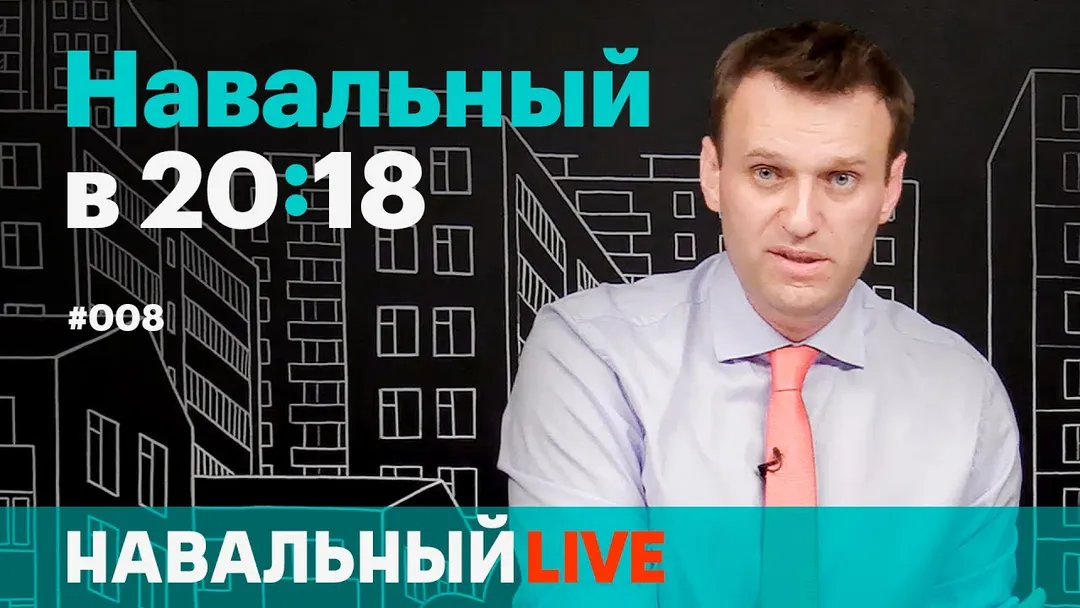
Navalny at 20:18. Broadcast #008. The June 12 rallies, “renovation” in the State Duma, and the “secret” Panama archives
[music]
Hello, Moscow. It’s 20:18, which means that in
the Navalny Live studio, I’m Alexei
Navalny, here to discuss with you
the latest news and answer your
questions. I hope you’ve built up quite a few over
the past week. If so, then please write
to us on Twitter, not in the YouTube chat
because it flies by at an enormous speed.
On Twitter, please use the hashtag
#Navalny2018. There was a lot of news this
week—take, for example,
that hearing when former
FBI Director Comey testified before
Congress. He’s probably in the closed session
right now; we’ll discuss that. But to start,
of course I want to begin with the June 12 rallies.
That is the main thing happening in
the country right now, and without any exaggeration, without
any, I don’t know, bragging, I
can say with complete certainty that right now
the administrations of most major
cities in the country are doing nothing
other than trying, one way or another,
to stop us from holding these rallies.
Because the geographic spread of the rallies
this time is simply astonishing. Right now
I’ll give you a bit of statistics: in total,
we have 211 events registered.
172 applications have been submitted. The difference in
the numbers
is due to—explained by, sorry—the fact
that in some cities we simply don’t
have enough feedback.
This is a genuine grassroots
movement: people themselves are doing what they want. We
organize or help organize only a fairly small number of groups and
rallies ourselves, or take part
in organizing them. In the overwhelming majority of cases,
it’s simply people—you wonderful people—
who decided to hold these rallies. So,
172 applications have been submitted, and of those,
the authorities approved—meaning permission to
hold them was granted for—115. That means in 115
cities there will be perfectly
safe, fully legal,
absolutely excellent rallies. We have
only
26 refusals. As I said on the last
program, the authorities have now realized
that it’s pointless to refuse, because people will
come out anyway, so there aren’t many refusals,
of which
21 came without any alternative being offered—that’s what
you’d call outright lawlessness. In 5 cases, the alternative
didn’t work. Some small towns
got refusals there, so they’re going to the district center.
I want to say that this is absolutely
wonderful. It’s amazing what’s happening
in these last few days.
Wherever you go, someone comes up and says,
“See you on the 12th. I’m in Moscow,”
“See you on the 12th. I’m in such-and-such city, but
we’ll still see each other on the 12th.” That’s very important.
And as I already said, there is nothing in
Russian politics right now more
important, and the authorities understand that
very well. That is exactly why all these
these
panic-driven
lectures at universities and schools, these
summonses of activists in various cities for
special “talks,” these attempts to convince
an entire generation of young people that they
shouldn’t go to rallies, shouldn’t do
anything, that it’s extremely harmful, extremely
dangerous—well, that means it’s extremely useful. It is
safe, and that is the most important thing, because
when we discuss—if you happen to be discussing—
whether to go to the rally on the 12th
or not, just answer a simple
question:
Have you received more answers on corruption,
at least regarding the investigation *He Is Not Dimon to You*?
Has anything happened over these months that
personally convinced you that, well,
maybe it’s not worth going? The answer is no. Well,
of course not. On the contrary, everything that has happened
has been either this kind of demonstrative rudeness,
as in the case of Usmanov, or again this kind of
demonstrative contempt.
The authorities haven’t even tried, not even a little,
to answer anything or refute our
information.
Medvedev could have said something more than “nonsense,”
“don’t stir up trouble” (a dismissive Russian phrase). No, they have been 100%
focused entirely on
getting in our way, and sometimes this takes completely
comical forms. Bring up—show
the image from Naberezhnye Chelny. I really
liked it. In Naberezhnye
Chelny,
there is some wonderful young woman—I gather
she’s an employee of the city administration. Well,
where is my image from Naberezhnye Chelny?
It’s not there.
Sorry, then—I’ll tell you everything
in words; they didn’t prepare the image.
There is an administration employee there
named Alina. On May 17, she approved
a flash mob—a flash mob that from 7 a.m. to 10 p.m.
will take place in all the city squares
of Naberezhnye Chelny, without exception. That is,
everywhere, in any square in Naberezhnye
Chelny, there is supposedly some
administration employee of Alina’s
holding a flash mob there, and therefore we cannot
hold our
anti-corruption rally. And this perfectly
shows just how panicked the reaction is
specifically to the geography of our
protest. That is our main task right now:
geography—to show that more
cities are taking part, to raise this
issue everywhere, including in small
towns. And if it seems to you, well,
how much longer can we keep shouting, how much longer can we
keep making statements, how much longer can we keep spreading this
This video, handing out leaflets—after all, it's already...
I saw that it already has 23 million views on YouTube,
plus 5 million on Odnoklassniki (a Russian social network), so 30 million in total.
People—come on, guys, 30 million people in a
country of 145 million is a lot. But that's
still far from everyone. Our task through these
rallies is to create and gather around us
a critical mass of people who
cannot be ignored. The authorities, of course,
will do everything they can to make sure we don't
succeed. That's what this whole contest is about:
we are gathering people around us,
and they are doing everything so that people won't
join us, or will be afraid, spreading
all kinds of nonsense. In some places, they ban it.
They're ready to put up visuals like this, in huge
letters. People wrote to me: well, show us
Naberezhnye Chelny after all—everyone's interested.
Here, you see, this so-called approval is just
some scrap of paper scribbled together on the spot, and
there was an administration employee sitting there,
and she was simply listing every square, every
possible venue there is in
Naberezhnye Chelny. But put it back.
Thank you very much.
Will that stop us? Of course not.
Will it stop the residents of St. Petersburg that
in St. Petersburg,
one of the cities where the application was not
approved—and I've received
just a huge number of questions about it? Well,
here it is.
In St. Petersburg, they sent us to the middle of nowhere,
and naturally it's impossible to hold our
anti-corruption rally there. Will you call on
Alexei to take part in an
unauthorized protest?
There are no unauthorized protests,
none.
What there is, in this particular city,
St. Petersburg, is two crooks:
Governor Poltavchenko and Vice Governor
Albin, who do not want an anti-corruption rally to be held in the
city, for an obvious reason:
because they
have been running this city incompetently
and have simply robbed it. They
have looted it. Just look at what
the whole story with Zenit Stadium has turned into.
It's just some kind of clown show. News about
Zenit Stadium—it's just a spectacle, seriously.
And now again, the pitch—
that magnificent pitch they
allocated a ton of money for, which they ceremoniously
declared finished—has to be relaid. The roof
leaks. The retractable roof doesn't retract.
The roof won't open, the sliding field won't
slide out. All of this cost billions. So
do you think Poltavchenko and
Albin want to be held responsible for all this? Do
the people who made billions off it
over many years want
anti-corruption rallies? Of course they don't. But
we have to hold them. So without question,
I believe—and I now call on all residents
of St. Petersburg to come out at 2:00 p.m. to
Marsovo Pole (Field of Mars), for a real
proper legal rally—legal
because we have the right to rally there.
The same goes for Vladivostok,
where it turned out that there are no places at all
where people can
talk about corruption. It's obvious why.
Because power in Primorye (the Russian Far East region) has been seized by
actual bandits and thieves. That's exactly what they are.
No qualifiers needed. They can sue me
like Usmanov did, they can do whatever they want,
but I'm not going to say it in some
different wording or with softer language.
In Vladivostok, in St. Petersburg, and in other cities,
they are bandits and thieves. What bothers them less is
the federal agenda—they may even be ready
to gloat over Dimon (a mocking nickname for Dmitry Medvedev) and
his sneakers, but of course they do not want
people gathering in their cities and
talking about corruption inside those cities,
in Vladivostok in particular.
So our shared task is to come out and
exercise our constitutional rights.
Especially since in St. Petersburg last
time, on March 26, something
amazing happened. What happened in St. Petersburg
then—could you please play the video? I
can't
stop admiring it. It was truly
a wonderful, magnificent sight: 10,000
people in the city's main square,
and they reminded everyone watching
that video in fear what the city
of three revolutions is. I very much hope that
the people of St. Petersburg will come out this time in even
greater numbers and put these
people sitting in Smolny (St. Petersburg city administration) in their place,
and those sitting in other administrative
buildings, who despise
the city's residents so much that they assign them
some out-of-the-way sites. Our place is not on the
outskirts—our place is in the city center, on
Russia Day. We have every right to come out under
Russian flags with our slogans about
defending the country.
This is important.
What's happening matters. Have you seen the latest
Levada Center poll about whether people even
understand what kind of holiday June 12
is? Most citizens of the country
have no idea what holiday it is. There's
some day off—Russia Day—but what
does it mean? Something about the flag, or
someone freeing someone from someone else,
or some declaration being signed. This
holiday has no political,
ideological, or meaningful content. But
we are doing this because our rally is,
in essence,
a rally against a broken country. They
really have broken the country, when even
the most enormous corruption scandals...
Crimes that millions know about
have received not the slightest answer, nor
has there been even the tiniest formal
investigation—not even a local police officer is dealing with it.
That means the country is broken in every
sense—in politics, because
members of parliament stay silent; in terms of regional
authorities, because governors stay silent; in
terms of the media and newspapers, because they too
are mostly silent—not to mention
television. In that sense, the country is broken.
And on the 12th,
we are coming out to fix it.
More than that—
because, as I already said, we are gathering
around us people who are not prepared
to stay silent and who are ready to change this
political space by bringing, and continuing to bring,
into the public agenda the question that
officials should answer to us, should
respond to questions. Naturally, many people
are asking about the Moscow rally.
Moscow City Hall, as usual, is showing off
because these are
crooks and swindlers who want to
take a jab at us somehow,
who constantly want, in one way or another,
to humiliate us
in some especially petty way.
But nevertheless,
as things stand now, the application has been approved.
The rally will take place at 2:00 p.m. on Academician
Sakharov Avenue; gathering starts at 1:30 p.m. A map has appeared.
Here you can see the exit from Komsomolskaya metro station.
Gathering starts at 1:30 p.m. There is not much room there
for a march as such; some kind of
grand battle and bureaucratic fuss is going on right now over whether
they will allow us to put up video screens. You
can see the street bends there, so
video screens are simply needed so that
people can see better. Of course, they
will try to do something to our sound system,
something underhanded—in other words, they will do
their usual small, nasty
dirty tricks, the kind the Moscow mayor's office is capable of
and, really, seems to exist for.
Nevertheless, it is absolutely necessary
to come; it is absolutely necessary
to take part. And yes, they may cut off the sound
on us—so what? I remember I had
a fairly large rally in Sokolniki
during the campaign in 2013, and
some OMON riot police officers cut off the sound there.
They ran up and took me straight off the stage
and put me in a police van. So what difference
does it make what happens to me? Even
if they cut the sound, you should come to this rally
for yourselves, in order to
fix the country, in order to get
answers, in order to show that, well,
actually, we do not agree that in
Russia there has been established
a feudal state, that in
Russia a system of self-rule has been established. Therefore,
Moscow, 1:30 p.m., Academician Sakharov Avenue—
be sure to come. That is the most important thing.
So, I owe you something, and I keep being reminded about it.
I am constantly reminded, and that debt
concerns our investigations department.
For the rallies on the 26th, we announced
a contest for the best poster and
promised the winner sneakers like
Medvedev's. We have not forgotten our promise.
There were just so many
photos with simply wonderful,
amazing posters that our
investigations department—the very one behind the sneakers story—
grew a little overwhelmed while
looking through it all, and it took time
to choose the best poster among those that
were submitted. But nevertheless, we did it, and with
pride and gratitude I present to
you the winner. Please show us
this young woman. We do not know her. Her poster is fairly
simple, but our
investigations department thought that this
simple poster—
this simple poster very well symbolizes
the importance of what is happening: that we will not forget
and we will not withdraw our demands. We will
wait for these answers, we will demand
these answers, and no matter what they tell us,
no matter how they try to seize the agenda,
no matter how they try to push at us with their
television, we will still say:
guys, we are waiting for answers. We have not forgotten, we have not
forgiven. Let
Dmitry Medvedev explain where the
70 billion rubles went. Let
Vladimir Putin explain why Dmitry
Medvedev was allowed to take 70
billion rubles for himself. Why is the FSO (Federal Protective Service) guarding some
dachas that were, apparently, bought with
what were supposedly private funds, and so on and so
forth? That is why we liked this poster.
The investigations department chose it as
the main winner.
Dear author, please write to us
at
the email address fbk@fbk-info, but please
confirm somehow that it is really you; we will verify
your identity. Medvedev's sneakers are
men's; you can either receive them, or we can
buy you a men's pair in the right size, though I do not
know whether there is an identical women's version.
We will try to buy a women's pair. So once
again, congratulations to the winner,
still unknown to us for now, and once again I thank
everyone who took part in this poster
contest, because it is very important. It
helps spread information online;
people like it, and more people
learn about what is happening.
Komi
This is an astonishing story; it happened
literally just now. It is completely
fresh news.
The former FBI director, it is true, gave
testimony
before
the U.S. Senate
This story is at once
monstrous and wonderful.
It feels monstrous to me because
it seems monstrous because
it’s starting to resemble, a little bit,
Russia. I had just turned on today’s
broadcast after landing and driving from the airport.
It was all live, and
the word “Russian” was being said there
constantly: “We know the Russians are
interfering in our elections, we know the
Russians did all these bad things,”
“former Director Comey, do you know that
the Russians were involved in all this? I know
the Russians were involved in all this,”
“there were suspicious contacts with Russians
there, with our officials, there were suspicious
contacts.” Frankly, this already
looks very much like what I’m constantly
accused of: that I meet with
some ambassadors — “Navalny meets with
ambassadors,” whom, by the way, I don’t even meet with,
and that supposedly means something, that it’s
something improper, it already looks
criminal — any contact with
foreigners.” It very much looks like
part of the American establishment has
simply adopted all these
Putin-style tricks, where, well,
just like in Russia we have “the Americans” and
“the State Department,” and all these
TV propagandists run around talking about Americans
and the State Department, in exactly the same way now everyone
is running around talking about Russians. It really sounds
wild, because I, for example, had the good fortune
and pleasure to spend a short
time
studying at Yale University, and
all my life I thought that would be
a major plus for my personal
growth and for my biography. But now even
at meetings with
supporters, I often hear: “What were you doing at Yale
University? That seems kind of suspicious, doesn’t it?”
I studied there, man. There’s nothing
suspicious about that. We should
welcome people who studied at
the best American universities. And the
same thing is happening in the U.S. now: any
contact with Russians is treated as
criminal — uh, it is treated as
suspicious. Yes, of course, no one
doubts that Putin and the security services
hacked those emails. They were trying to
interfere somewhere, and of course they will
use the slightest, uh,
frictions in relations
between Republicans and Democrats in order
to wedge themselves in, drive a split, do something
to set people against each other, shift attention
onto themselves. That was certainly happening, but
the paranoia toward Russians in any
form has now somehow become completely
and looks
strange and fantastically
wrong. And it seems to me
that in the medium term this
will, of course, hurt us even more than
any sanctions, because people will simply
be afraid to communicate with Russians, with our
businesspeople, with our representatives.
That will be a major problem for business,
because it will be: “He met with a Russian,”
“there must be something wrong with him, let’s conduct
an investigation into whether he met with
Russians.”
I hope this hysteria
dies down a little, especially since I
recently spoke with a
correspondent
from a very respected American newspaper. He
was interviewing me and asked me
something, and then said this phrase: “Well,”
“Russia isn’t really that
interesting to everyone in the U.S. right now.” I told him, “How
is it not interesting? Are you kidding? I open
the newspapers and see nothing but Russia, Russia, Trump,
Russia.”
And he said an interesting thing:
it interests everyone only
as an instrument of struggle, as a mechanism
for Democrats to fight Republicans, as a mechanism
for
bringing down Trump’s ratings. But actually
what is happening in Russia itself,
Russian domestic politics, is not
all that interesting. In other words, this is purely
the use
of a foreign-policy
foreign-policy problem to
solve domestic problems. Absolutely.
You’ll tell me now: “You sound like Putin,”
and I think Putin even literally
used that exact phrase. But it certainly seems
that in this whole enormous
discussion, that is largely what’s happening: it is
simply a struggle among domestic political
groups in the U.S. that find it advantageous
to endlessly use the topic of
Russia right now. And so when I watched
a bit of the broadcast, it looked,
I repeat, rather bizarre. Why was it
wonderful?
Well, you can see in the photo this
man — the former FBI director.
He testified today, raised his hand, said,
“I swear to tell only the truth,” and answered
the toughest questions, quite harsh
and directly. They were put to him — not
that they were rude, but they were definitely tough
questions. They had some kind of, of course,
closed session there, but in the open part
of his testimony, we saw and heard all
the most important questions that
American society is asking its intelligence agencies.
asks the FBI, and in particular, uh,
asks the former FBI director point-blank:
they ask him directly: was there
an investigation into this or that person, and what
did you do? Did it turn out that you were
being fired because you
halted that investigation?
Did you suspend it? What were your
feelings? What were they whispering in your ear? And
tell us something specific. And so,
here’s the question, my dear YouTube viewers:
Can you imagine the current
director of the FSB, Bortnikov, or the former
FSB director, Patrushev, appearing in exactly
the same way before the Duma, before the State
Duma, before the Federation Council, and answering
at least some of these kinds of questions? Like, what
really happened with the Ryazan bombings (the 1999 apartment bombing incident in Ryazan)?
Was it an FSB training exercise, or was it really something
suspicious? And what actually
happened in Beslan?
The Mothers of Beslan ask that question at
every single mournful anniversary
of that terrorist attack. They stand there with signs
with those questions written on them, and they
are arrested and jailed for several days,
but no one answers them. I would be very
glad to see former FSB director
Patrushev in exactly that position,
right there in the State Duma, where he would
answer where he got a house worth no
less than 1 billion rubles in Serebryany Bor
that the Anti-Corruption Foundation
found and filmed—we showed you
that house, and so on and so forth.
We have never had that—not in
the Yeltsin years, not in Putin’s time, not in
the Soviet era. Never at all. That is what
the country should aspire to. That is what
the political system should aspire to.
That is what it really means:
the people’s elected representatives sitting in
representative bodies,
in a representative body—sorry—
in representative democracy, asking
the questions that matter to the people. They
may want, perhaps, to get some publicity
with a sharp question. Fine—that’s how
politics works. Let them get publicity, but
those officials must answer. It doesn’t matter if it’s
the security services—if they have some secret
information, then, well, in that case, in
the closed session they can answer. But at the very
least, a substantial portion of the answers to
those questions must be given, just like that,
live on air for everyone to watch,
so that any senator or
congressman, having received such a question from
their voters, could voice it there. That’s
the kind of State Duma we need. As for us,
all this time we haven’t had a single
parliamentary investigation, not a single
tough question. Neither representatives of
law enforcement nor the security services
have ever been asked one. Why, even Medvedev
came to the Duma,
we discussed it on this program,
and there were no tough questions at all—nothing.
That is what democracy should look like, and we
will definitely achieve it, so that both the
president and the heads of the security services
will be obliged to come in from time to time and give
testimony under oath. And now, you know,
in the Usmanov trial I summoned
Medvedev, and everyone writes to me: come on,
not only Medvedev—even some of his
former classmates—that’s unrealistic, that’s
nonsense. Why are you filing
a motion to call these witnesses? But
why is it unrealistic? That is exactly how it
should be arranged. If there is
a serious court proceeding with
a huge amount of press present, that
means there is major public interest.
Officials, including high-ranking
ones, both former and current, should come and
answer all questions just like that, like
little rabbits, and we will definitely
make that happen.
Alexei, please comment on the situation with
Murad Amriev. Total
lawlessness is happening, Aslan Sovev asks me.
Well, total lawlessness is happening. This is
completely insane. An MMA fighter,
if I’m not mistaken about
that abbreviation,
the tournament system he competes in—I
saw the news today: in Chechnya
a blood feud has been declared against him, and now he is running
from city to city. Somewhere in Bryansk,
some murky Chechen special forces unit
surrounded a police building; now they’re extraditing him from
Belarus. But it looks outrageous, and I
have said this many times and I’ll say it again:
if any official or
journalist or anyone at all declares
that they have declared
a blood feud against someone, they must be immediately
arrested, because blood feuds
are prohibited. There cannot be
any such thing as a blood feud in Russia. This really is
lawlessness: some strange people,
bearded, armed, claiming to represent
who knows whom—apparently some kind of
security services—they travel around Russia and
literally try, not even just to
intimidate people, but to seize them, openly
kidnap them in broad daylight, including
taking them out of police custody.
This is yet another example of a broken state. It
simply cannot be allowed to happen.
Even in those so-called cursed
1990s, this did not happen. Yes, there were kidnappings from
Russian territory, but not like this—not with
strange people roaming from city to city and
hunting down someone who had somehow
offended them, in order to carry out
their blood feud. That simply cannot
This is absolute madness.
Alexei, do you think Putin, on the 15th,
will announce that he is running for a fourth term?
Artyom Salikhov asks me. I think
he will not announce a fourth term then. But I
have not the slightest doubt that he
will run for a fourth term. I think
there will simply be
a lot of
endless prearranged questions to
which Putin will, as usual, respond by rattling off
statistics, and say that it is still too early
to think about the election. We are busy working on things. And of course, a great deal
very much
of what Putin says on the 15th during
his Direct Line call-in show depends on how
our rallies go. They moved
this Direct Line broadcast to a date after our
rallies precisely so they could gauge the situation. They are
sitting there now, thinking, watching how many
people will actually come out. Will we be able
to ignore this issue again, or not?
Will we be able to brush it off and say
a couple of words along the lines of, well, some
"this gentleman," as they like to say,
has spread some rumors, but in
court they were all refuted; a few
people came out in various cities, but overall
law enforcement agencies will, of course,
sort it out"? Or will so many people come out
that this issue
can no longer be ignored, and Putin will have
to speak clearly and in detail on the 15th
specifically about Medvedev and
about certain episodes, and explain why
under his presidency something like this can
happen.
There are many questions about whether I will run a marathon
with Roizman. No, I will not run a marathon with
Roizman, unfortunately. Although
Yevgeny was actively inviting me, but I am not yet ready to attempt a
marathon. I do run
a little, and I dream of running a half marathon, but
a full marathon, no. Let Roizman run it on his own.
I admire the way he prepares for these
marathons; he runs very well. I would very much
like to, but for now I am afraid I am not ready.
I will not lie.
So, we discussed Comey, and I
said that this is an example
of remarkable transparency: the former
FBI director answers questions before the whole country.
Now let us compare that with what
is happening in Russia. Here is my question:
do you even remember this person?
Show us a photograph of a man
whom almost certainly no one remembers.
I bet you have forgotten him, and this is,
by the way, the Prime Minister of Iceland, with
an unpronounceable name and surname that I will not even
try to say.
But the point is that he resigned
after the publication of—remember those—
the Panama Papers, the offshore leaks.
Many months ago, documents were published
that pointed to
cases of corruption or failures
to disclose information in various countries, and
the Prime Minister of Iceland, a very wealthy
country where the average salary is, I think,
more than $5,000 a month, resigned
simply because
if I am not mistaken, there was an offshore company
registered in his father's name, and he
failed to mention it. Legally, he was not even
required to disclose it, but people
took to the streets of Reykjavik and said, well,
you are the prime minister; even if you are not
legally obliged, you still should have
told us, of course, that your father
has an offshore company; that is connected to you too, somehow.
And the man resigned. And what
did our Prosecutor General's Office say then? Please bring back
the quote. There was also
a major scandal here too: in those Panama
documents, a large part was devoted to
Russia. As you remember, many
schemes involving billions of rubles were exposed, and then they
said—well, the wording got cut off here—but
he promised, I can see it on the screen. But
this official, and so on, promised that
they would openly report to society on how
the investigation into these Panama
offshore schemes was proceeding. What do we see this week?
The position has completely changed, and now they
say that all of this is for official use only,
that it cannot be discussed, and
that, generally speaking, they thought, well,
this is probably not interesting to Russian
society.
So apparently it can all be forgotten, precisely
because, by the way, this happened since
no one protested. Well, if no one is protesting,
they are outraged on Twitter, they post on Facebook,
they write things, but there is no one in the streets, so
the issue can gradually be washed away. But just think about it:
really.
A cellist was found—a childhood friend
of Putin's—with $2
billion in his account, and that account
was being filled by Rosneft, its subsidiaries, and
other state-controlled companies. That is,
in other words, there was found
Putin's offshore wallet. We do not
doubt, do we, that this wonderful
cellist Roldugin was not in a position to
earn $2 billion. Even
if you are the best cellist in the universe,
you cannot earn that much money. But
somehow he got that money.
State companies were paying into it. So what did
Putin and Roldugin manage to say to us then?
They mumbled something like: with this
money he buys
wonderful musical instruments and
gives them to someone. Where are these musical
instruments? How many cellos, even ancient ones,
could you buy for $2 billion?
dollars, and no one told us about it.
And now everything has been classified. Why?
Why is it classified? It’s obvious why. Because
the results of the inspection can show only
one thing: that state-owned companies
were effectively paying bribes to Putin himself
by transferring personal funds to the offshore account
of Roldugin, and that is why now everything can
be hushed up, classified, everything can
be forgotten. But we must not forget.
Because what does $2 billion in the account
of this guy mean?
It means that everyone in Russia who needs a paid
operation could have had it done—everything could have been made
free. People often tell me,
“Stop using paid
operations, sick children, and expensive
medicines as examples.” No, I will not stop
doing that. Because really, how can we
claim that we are
a social state, we claim that
we have
free healthcare, and I would bet
that every one of you has
some acquaintance—or an acquaintance of an acquaintance—
who either raised money for their own
paid operation, or for their child’s
operation, or else helped some other
person they knew raise money for a
paid operation.
And people all over the country do this, all these
wonderful, noble people are involved in
it. But none of this would be necessary
at all. Those $2 billion that were simply
stolen from state companies into Putin’s offshore account—
into Putin’s offshore account—everyone, every single person
could have been treated; everyone who
needs expensive medicine and cannot
afford it could have been given that
medicine for free. All of us would have become
better off. All of us would have been healthier. We all
would have been happier if they had not taken those $2
billion away. That is why, once again,
we need to come out on the 12th, because if we do not
come out, then it’s $2 billion there,
$2 billion here, and in the end
we end up with no decent roads,
not a single high-speed highway,
in Russia—neither road nor
rail high-speed
line exists here.
Because what runs between Moscow and
St. Petersburg—the Sapsan—is a fast train, but
of course, you cannot even remotely call it
high-speed. We have nothing. But
we do have wonderful cellists.
And
speaking of that, I cannot help but recall
the remarkable continuation of the story with
the renovation program: there were absolutely
astonishing hearings in the State Duma on
the renovation program. First of all, almost
no one was allowed in. They did not even
let in some deputies of the Moscow City Duma, and
real residents of the five-story apartment blocks
were not allowed in either. Everything there was filled with some kind of
well-wishers who had come from a list. Well, you
probably saw it, so I will not go into detail
about how there was some kind of unauthorized
rush by those who were not let in. But
a phrase was uttered by Minister Kozak
that was absolutely
fundamental to Putin’s Russia. This is
what everything is built on. Let’s
listen, if you have not heard it yet: “In 1991, a decision
was made
regarding apartments in multi-unit buildings. If
those rights are made absolute and are not
limited in any way, the residential building will certainly fall apart.
“There is no need to absolutize the right
of property.” In a normal country,
a minister who said something like that would have resigned the very
next day.
It is just unbelievable: “There is no need
to absolutize property rights,”
because otherwise it will lead us to something
bad, things will go badly for us. But everywhere else
they do absolutize it, and people live perfectly normally, and
it is precisely in countries where private
property is respected that things actually work. Notice this:
they already consider even this part of
privatization to be somehow not
real. “How could that be? In the 1990s,” he says,
he says,
“in those first years they just handed apartments out to whoever happened to get one.
What a disgrace. They should not have
given them away like that; they should really have been given to some
deserving people. But instead we
gave them to everyone indiscriminately. What a horror, what a mess
we made of it.”
But in fact, those apartments were received by the people
who lived in them, who actually
worked in the Soviet Union, who
had earned those apartments. Those apartments were, more often than not,
small and poor-quality. It was a small
piece of property that people
received in exchange for their hard labor, and
now even that is supposed to be meaningless? Well,
that’s something. Why “absolutize”
it? It’s just some apartment, after all. It is only
everything this person owns. Why should
we care about that? And these same people—
the government, United Russia (the ruling political party), all of them—
when I say that, for example, I do not
like the loans-for-shares auctions, and in general I
do not consider privatization fair or
sacrosanct, they immediately start shouting, foaming at the mouth,
“Populist Navalny, what are you
trying to do? You want the oligarchs
who took part in the loans-for-shares auctions
to pay more taxes? That is impossible!”
They all say it is impossible: the property
has changed hands already. What are you saying? Stop saying that.
That’s revolution, or something like it.
So apartments, and the privatization in which
millions of people took part,
the only truly honest
privatization that has taken place since
of the Soviet Union, so to speak.
We can talk about that here, to sum up.
it needs to be reconsidered. Well, they privatized
your apartment in a five-story apartment block (the typical Soviet-era low-rise building), that's a kind of
conditional property right, basically.
Usmanov's.
Oleg's, Potanin's, Prokhorov's, whoever's
you like, some fishing-industry
all these people who seized
giant raw-materials enterprises—well, their
property rights are treated as absolute, monolithic.
That means no one can touch them, no one
should, and we supposedly don't even have the right
to tax them for having privatized, for next to nothing,
what in fact
is worth billions. But these
pathetic residents of five-story blocks—well, their rights
shouldn't be absolutized. Well, that's
I understand, of course, that maybe my
program sounds strange because I
don't know—turn it on and listen for an hour
to me constantly getting outraged about something, but I
can't help being outraged. Because, really,
in fact,
he says this, and the deputies are sitting there, and next
to him is the mayor of Moscow, and next to him another
minister, and it's shown on television, and
nobody gives a damn. And nobody at all
is going to be outraged, and you don't see on TV
people clutching their heads
and shouting, "My God, what did Kozak say?
You're the populist here! They say
Navalny is a populist—how can you
insult all these people? How can you
possibly strike at the very foundation of a market
economy, the foundation of normal
human existence in society—private
property—and just like that
cross it out and say it must not be
absolutized? You've just struck a blow
at everything.
People won't buy anything if, if
they're told, "Guys,
even your ownership of your apartment
isn't really 100 percent yours.
How can we expect them, then,
to buy stocks? How can we expect
them to buy bonds?
How can we persuade them that they should
go into small business and help develop
the economy—or large business, or any kind of business at all?
Who is going to register as a sole proprietor and pay
taxes? Of course they won't do that
because from the State Duma podium
fundamental words are being spoken to the effect
that private property in our country
is being denied. This is simply, simply
a monstrous thing, absolutely, and I would very much
like Kozak to resign, for him to
apologize for his words, explain
what he meant by them, for Medvedev to
apologize for them too, and for Putin, during his live call-in show
on the fifteenth, to apologize for them as well,
and then for all of them to resign
and for a new government to come in
that would say: you know, a person's right
to own an apartment
is absolute, and a person's right
to the land under their building is absolute. And yes,
of course there may be cases—rare cases—
when these apartments need to be taken from people,
but I don't know, say we're building a nuclear power plant
or some important infrastructure
facility. But even in that case, the right
of property still remains absolute, and
there must be a buyout at a fair price,
possibly even above market value, because
this is the most important thing our society rests on,
a society that tries to call itself
itself
capitalist.
Sergio Pogano asks me: Do you agree
that the renovation program and the hellish roadworks
in Moscow are one big grab ahead of
something serious in the near future?
Not only do I agree, I talk about this constantly.
And something serious in the near
future is simply that the money will run out.
These trillions still exist, they're still sitting in
the budgets. Moscow's budget is 2 trillion rubles a
year.
For renovation, they're already saying 3.5
trillion
rubles they want to spend—that is, over
the course of several years.
Money is still coming in while the price of oil
remains relatively high, and they are
carving it all up, no question about it.
All these mega-projects, especially in Moscow, are
exactly one big grab. It's the last days
of Pompeii. It's an attempt—or rather,
a highly successful operation to
skim off the last petrodollars and
ship them out to various offshore havens and
turn them into wonderful villas with, uh,
uh,
on the southern coast—not even of Crimea, but
of France.
Vladimir Volkov asks me: Alexei,
when you become president, what will happen to
television?
Honest journalists will work in television.
Television will not belong
to the state, television will not
belong to oligarchs; it will
compete internally. There will be
freedom of speech. In other words, it's very
clear what should be done with television. Speaking
of television, we have
Ksenia Sobchak.
For the last few months she has simply
been battering me and besieging me—well, not exactly
that, but saying that she is
a quality journalist and demanding that I
give her an interview, and that she will have some
super-sharp questions, and that she will
wipe the floor with me—and today at 11 p.m.,
simultaneously on TV Rain and on our
On the channel, you’ll be able to watch Ksenia
wipe the floor with me with her
super-sharp questions that she’s been saving up
for several months. It’s going to be
a wonderful collaboration with the TV channel
Dozhd (TV Rain), and it will be on their website, and this
video will be available for free, and it can be watched
by absolutely everyone. And on our channel too,
everyone will be able to watch it for free,
absolutely everyone. They’ll use it to
attract a larger number of
paid subscribers, and that too
is something the media
— independent media — should be encouraged in; they need to get
money from somewhere. So that’s the idea
behind this campaign. Unfortunately, on the same
day, maybe I’ll just be a little
too much for you.
I’ve been talking for an hour now, and at 11 p.m. I’ll be
talking again. But at least at 11 p.m.
the thing will happen that I’m, so to speak,
or rather, the thing I’m criticized for will come to an end
by many journalists who say,
“You’re broadcasting there on your own Navalny Live, but
what about our tough questions? How come you
don’t answer something like that — something
you can’t answer?” At 11 p.m., watch
Ksenia — it’s going to be brutal.
I’ve been flooded — flooded with questions about
a rather strange press release that
circulated today. The wonderful
organization Open Russia, which I
think highly of and which is an ally of ours,
our ally.
Can we show it on screen, or
a snippet of the press release? Here it is:
“A campaign called the ‘Permanent Regiment’ will take place in Russia, and
its ‘heroes’ will be Putin, Sechin,
Kadyrov, and others.” In other words, they
are supporting our
anti-corruption rallies on June 12, but they’re coming out
with this campaign
called the ‘Permanent Regiment.’ So of course I’m
grateful to Open Russia for
taking part in the June 12 rallies and protests across
the whole country — that’s great. But I find the name
‘Permanent Regiment’ extremely,
extremely unfortunate. The idea itself — carrying portraits
of those who have overstayed in their positions and who
should resign, because
these really are people who
have been sitting there for decades — is absolutely right.
But call it, I don’t know, something like
the “Disgusting Company” or the “Repulsive
Eight.” Don’t call it
the ‘Permanent Regiment,’ because that will offend
a lot of people, because it’s obviously
an echo of the ‘Immortal Regiment’ (a public memorial march honoring relatives who fought in World War II).
The Immortal Regiment is a wonderful initiative
that was created by journalists from Tomsk’s
TV-2, which, incidentally, was later
shut down. Hundreds of thousands of people take part
in this event.
And it’s a very good initiative, so I don’t
think there’s any need to
play around with names related to it so
heavily. I hope Open Russia
— maybe they’re watching me — Mikhail
Borisovich, hello — will come up with some
other name. In substance, of course,
they’re right: we do need to stand against
these people who
have dug themselves into their posts.
Nelogichny wrote to me: “An interesting
bit of math: with $2 billion, you could buy
seven and a half million
cellos.” I don’t know, that seems a bit
too cheap for a cello to me.
The assumption is that Roldugin, whom
we were talking about, buys some expensive
Stradivarius cellos. But even so, I
don’t think old Stradivari made
that many cellos and other musical
instruments that you could
spend $2 billion on them. Even if he bought
all the existing instruments,
you still couldn’t spend $2 billion.
So we understand, of course,
that no musical instruments were being bought
on any large scale. Sure, maybe they bought one cello,
two or three — but all the rest of the money
went into Putin’s personal wallet, simply stolen
from the state budget.
These are our campaign headquarters, and what’s happening with our
headquarters? First, I want to
say thank you. There’s a man named
Leonid Volkov — he appeared on screen — and
right now he’s walking around the office constantly
singing, “Unfortunately, birthdays come only
once a year,” and that’s because
my birthday was on the 4th, and I wrote that if
you want to congratulate me, just send
some money to the election campaign. We
received 1.5 million rubles (about 16,000 USD), and
now Volkov goes around
lamenting that my birthday doesn’t
happen all the time, because the money
is very much needed. So thank you very much to everyone
who has funded this
campaign of ours — on the 4th, before that, and
after that as well. We need money, and we
spend it rationally. We’ve now opened 44
headquarters, we’re constantly traveling around
the regions, and we’re doing major work under
pressure — pressure that is, of course, now
simply unprecedented. I began
the program by saying that right now local
administrations
are occupied with only one thing: stopping us
from holding rallies
on June 12. And the second task for all
administrations, at least in major
cities, is to stop us from opening our
campaign headquarters. In this photo is
our Moscow headquarters. Moscow is not
some godforsaken backwater, not some small
region known for lawlessness. In
our Moscow headquarters, it’s on Brestskaya...
The fortress is holding out there; they've already cut off the electricity.
They tried to shut it down, but we have a lease agreement.
For several months. We told them, "You do not have the right—"
"—you do not have the right." They changed the locks, simply by force.
They burst in there. Well, then they simply
cut off our power. Do they have the right to cut off
the electricity? Of course they do not.
It's complete, absolute lawlessness. We brought in generators,
they cut it off, and as you can see, a huge
number of people still come to
these campaign offices, despite the fact that the power
is being cut, despite the fact that
they deprive us of premises, first in one place, then
in another. Our Volgograd campaign office has been operating out on the street
and organized its work for several days
after they forced us out of
several premises in a row, and we
will continue this work, because we have
the main thing—two main things. First,
the knowledge that we are right. We are right, we
understand that we are doing what people
need. And second, you support us.
There are already more than 110,000 volunteers now.
In every populated place in Russia, there is
a volunteer for our campaign, and of course they will
keep evicting us from our offices. We
understand perfectly well how afraid they are of this
election campaign, how afraid they are
of the very creation of a real political
network. Not the kind that usually exists in Russia
as a political structure—
some party with regional
branches that mostly do nothing,
sometimes waking up once every
four years for elections. More often than not, they
do not wake up at all.
They wait for some money to be transferred from
the federal headquarters. But we have a real,
genuine political structure in
which tens of thousands of people work
for free. They are ready to hand out leaflets,
they are ready to campaign. Of course, that
terrifies them. They do not understand what to do
with it, how to fight it, but
they resort to their favorite methods—
not even favorite, really the only
thing they can still do.
If they had—if they had
set up, by the entrance to our office—sorry—
their own campaign picket outside our office, where
people would stand and tell everyone who
comes in, "You know, Navalny is mistaken about
this. These parts of Navalny's platform
are unrealistic. And here he slandered Medvedev,
and here he unfairly offended Prosecutor General
Chaika, and here Roldugin
actually bought cellos worth
$2 billion, rather than simply stealing that
money"—but they cannot say that.
Because we are right in all of our
criticism, and the provisions of our platform
are realistic and supported. They have nothing to object to,
so instead they cut off the power in
our office. But that's all right. We can probably
do many things without electricity, however
ambiguous that may sound.
As we're talking here about pressure and the shutting down
of campaign offices, a window just flew open with a bang, and
I hope riot police (special forces) don't climb in through it right now.
But on the other hand, if they do climb in and
burst in, this channel—this
episode—will get a huge number of
views. In huge letters they wrote:
the donation link is right there on the screen. Say
that they should just click the letter—click
the letter on the screen—and you'll be able to send
us money. Lots of questions about the condition of my eye.
Oh, that eye—it is a constant topic on this program.
I have just flown back from Barcelona,
where
the surgeon finally removed my stitches. As for my eye, I
already feel like a whole
person again. It no longer bothers me
so much.
The doctors are very pleased. They say everything
is going well, that maybe my
vision will recover—not one hundred
percent, of course—but it is getting
better than I expected. Everything is very
good. A useful tip for anyone going
to see a doctor in Barcelona: do not call him
a Spanish surgeon, because when I
said something—some kind of
compliment about Spanish surgeons—everyone there
was offended and said, "We are Catalan
surgeons, not Spanish ones." That is also, by the way,
an excellent example of how, within
a prosperous country—what on earth is going on, everything here keeps
opening up. Excuse me, please. I
hope—I do not know whether you can hear these
frightening sounds.
How, within
a wonderfully developed country, there can be
serious confrontation. But one part
of the population—a large part of the population—
demands independence,
not wishing to recognize themselves as Spaniards, not
wishing to submit to Madrid, yet nevertheless
they live, and everything is fine. Everything
works. The federal system works.
Madrid does not take the money away, does not appropriate it
from Barcelona, and so on and so
forth. Everything is very good. So thank you
very much for the questions about my eye. It is much
better now; the stitches are out, and in that respect everything has
become much better for me. As for the contest,
a lot of people are asking about the contest.
Here at the Anti-Corruption Foundation, people
all laugh at me because I adore
contests, and every time I say that
I am about to announce some contest, everyone
rolls their eyes, because I wanted in
this broadcast to announce some kind of contest for
June 12, but everyone told me not to. Still, I will
announce it somehow later, before
the 12th.
You have probably seen that I announced a contest
for creating YouTube channels.
including regional ones. To be honest,
I believe in it. I understand the skepticism many
people have who say that only
crazy people will take part in all this.
But even now, it's far from being only
crazy people, and we're seeing quite decent
content. I have the statistics here. As of
today, 293 applications have been submitted to
participate, 171 channels are operating, and the first
videos have already been recorded by 89 people, and I
continue to strongly urge everyone
to take part in all of this.
Well, even from the standpoint of—excuse me—
money and fame. Look at all these
YouTubers who have channels with millions
of subscribers and equally massive fees.
With very rare exceptions, these are people
who made themselves entirely on their own.
They set up a camera, and a girl just started
talking about her life, that's all.
Now, to buy advertising from her, you have to pay hundreds of thousands
of rubles (roughly thousands of U.S. dollars). Same with Ivanгай (a popular Russian-speaking YouTuber), these are
all people who simply started doing it
themselves. They had no producers, nothing.
YouTube gives us amazing opportunities,
so I truly believe that
YouTube can beat television—or at
least land some painful blows against it.
I believe that among the viewers of this
program right now, there are people who
could run interesting channels. If you're
a journalist, if you're a political activist,
if you're simply someone who cares
and wants to speak out, then you need to
do it. And it's important because, well, I
will spend a million rubles (about tens of thousands of U.S. dollars), we will spend
a million rubles, because a million rubles
is what we'll raise to pay prizes
to the winners. But to
launch one small regional
newspaper, you need several million rubles.
To launch one small
regional TV station, you need several
tens of millions of rubles, whereas a channel on
YouTube costs almost nothing. But in terms of
view counts and actual
reach, if you want it, if you work
properly, if you
really try, you will become the most influential
person in your city. I'm not
exaggerating or joking right now.
10,000 subscribers on a channel that
operates in a city of over a million people
is an absolutely realistic goal. That
means you're the most popular
journalist. It means you're being watched by the
governor,
the deputy governor, the entire administration is watching.
They're all curious to see whom you'll criticize in
your new episode. They all watch you,
they all listen to you, and
local advertisers will come to you. You will become
an influential person. If you're—well, again—
a journalist or studying at a journalism school,
then it's practically your calling to take part in this.
You don't need to go around to various newspapers
asking them to hire you, and then
have some vile editor-in-chief
tell you, "You can't criticize this person,
but that one you can criticize. And here
we have sponsored content—we're obliged
to publish it so that our newspaper
can survive." Why do you need any of that?
Start your own channel. On it, you can
if, again, you really try,
earn more than journalists at
any newspaper. If you're a political activist,
if you want to make a name for yourself, if you want to inspire people to follow
you, then do exactly the same thing in
Russia.
I think there are probably 103 or 105
channels right now with more than
a million subscribers, and all these people are
just that: a computer, a webcam, and
the internet. They have nothing else.
Determination and hard work—and millions
of subscribers. And that's money, that's influence. And
most importantly, it's an enormous benefit to people
that your channel can bring. So once
again: take part. Don't be afraid. Don't be shy.
And it won't turn out badly, it won't, if
in the end, from this whole effort, we get
two or three decent, regular channels
that talk about their own
regional news—I will be happy. But
I think
there will be many more of them.
Alexei, what do you think about
the beating of a young man at the administration building in
Novorossiysk?
Well, you know, you could really use a template here
for the question, "What do you think about
this or that?" and my answer would always include
the word "lawlessness," of course. Yes, this is yet another
sign of a broken state. A man
came to the Novorossiysk city administration
to submit an application for a rally on June 12. What happened
to him? He was thrown out, he was attacked
right inside the city administration building.
Then, uh, some kind of scuffle
continued outside, after which he
was detained by the police—a person whose only
goal was to gather a group
of people. He was representing a group of people
who wanted to gather peacefully in the streets
of the city and say: we're tired of corruption,
we don't want to be robbed, we
want answers to our questions. And
these bandits and thieves attacked him in this way.
Of course it's lawlessness, of course.
It's a symbol of what's happening in our
country. It's a symbol of the fact that, unfortunately,
by no
you know,
evolutionary methods
or methods of self-improvement will any
fight against corruption happen. We should not
wait around hoping that Putin will suddenly, on his own,
whether he decides to do it in a fourth term or a twenty-fourth term
Perhaps I’m a little afraid when it comes to corruption
this will not happen—we have already reached the point where
such a stage that this will not happen without
outside pressure. Therefore, we need to keep
putting pressure on them. But of course these
people have millions
they have stolen. These people are terribly afraid of us
terribly afraid, because they do not want
to lose all of this. They do not want to lose
what they have already stolen; they do not want
to lose the opportunity to steal more and more
and more. Therefore they will
resist, and they will
push back. From time to time, some
people—well, of course, someone may suffer, someone
may be attacked—but nevertheless, overall
there are many of us
the likelihood of some negative outcomes
is small. The authorities intimidate us, each person individually
they intimidate us individually, but
they are afraid of us—they are terribly, terribly
afraid of all those people who
will come out on the 12th, and then those who will force
a change in the political paradigm that
exists in Russia and make it so that
a real fight against corruption begins
make it so that officials start
answering your questions. On the 12th
we will meet you in the streets
of Moscow and St. Petersburg, in
Vladivostok, Novorossiysk, and all
the other cities. So, if there is
official approval, go; if there is no approval
go anyway. This is our right, this is our holiday
This is our Russian flag. Thank you very much
see you next Thursday
[music]