What Navalny Is Offering Police Officers
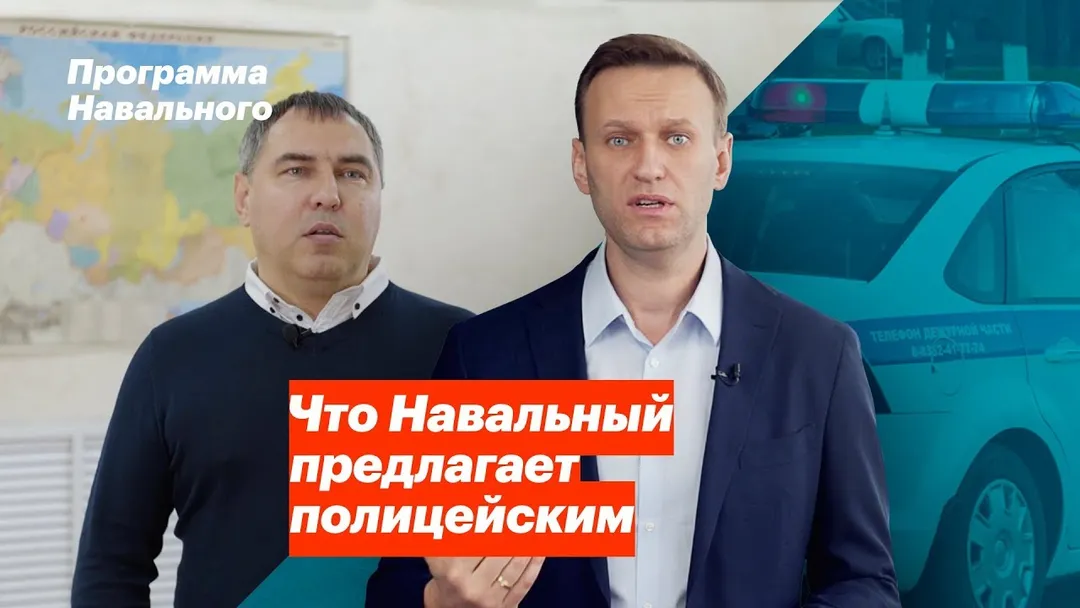
Police officers are generally assumed to all be
on the side of the current government and against the opposition.
That it, in particular, has nothing to offer them.
In its platform. But that is one hundred percent
not true, and my program is written specifically in the
interests of real police officers
who do the work that citizens need
every day. Right now, we are allocating
insane amounts of money to all kinds of so-
called security and law enforcement personnel.
But none of it reaches people like Roman Khabarov, district police officers,
criminal investigators, and rank-and-file personnel.
Simply nothing gets through. My name is Roman
Khabarov.
I am a retired Ministry of Internal Affairs officer with 20 years of service,
14 of them spent working
as a district police officer and senior district police officer.
I retired in
2011. My salary
was about 18,000 rubles.
You need to understand that the daily work of a district police officer
is about 80 percent reduced to writing
various kinds of paperwork: statements,
explanations, certificates, reports, rulings,
conclusions. There is no other way
for management to monitor their employees and
evaluate their work, as our authorities apparently know of none
except to look at how many papers they have
written and about what. In addition, officers
are forced to buy at their own expense
practically all office
supplies.
They buy their own paper and pens,
refill printer cartridges, replace light bulbs
in their offices. In other words, the Ministry of Internal Affairs
allocates no money for this at all, and
of course this also affects
employees' ability to work.
In addition, officers are not provided with
housing. I do not know of a single case when
a district police officer, myself included, received
an apartment—not after six months, not after a year,
not even after five years. As a rule, apartments
were actually given to the 'needy'
managers, because managers
always seem to be in great need of
better housing. As a result, officers
for years
live in very difficult housing
conditions, with their parents, even though they already have
families and children of their own.
They are cutting the people who actually do the work—there is a term for it,
"on the ground"—that is, the same
criminal investigation officers,
district police officers. For example, if in 2010
in the department where I worked, in the Levoberezhny District Department
of the city of Voronezh, there were 44
district police officers, now there are 30. I know for certain that
most decent police officers
want to take satisfaction in
their work. They really want
to help people. They want to have
time for that. But it is
truly just insulting for a
country: 2 trillion rubles are spent
on security and law enforcement
activities, more than 1 trillion on
the police alone, yet every rank-and-file police officer
will tell you how he buys
printer cartridges with his own money,
how not even the most basic expenses are covered,
and about the half-ruined condition
of police stations—but you can see that
for yourselves. On the one hand, we have
a monstrously bloated number of police officers and
security personnel in general. In terms of the number
of police officers per capita, we are
among the top countries in the world. But in the fight
against crime, this has no
effect whatsoever. Overall, the so-called
security and law enforcement agencies, excluding the army, include 2
and a half million people. On the other
hand,
the most important police officers—the ones who
work on the ground—are always in short supply, and
they scrape by in fairly miserable conditions.
The enormous sums being allocated right now
are being devoured by an oversized bureaucracy,
the generals, and monstrous corrupt
procurement schemes, where everything is bought for two or three
times the market price. So who is interested in that?
Certainly not the citizens of Russia.
My program is about
making the real priority
the front line of policing: police stations,
district police officers, criminal investigators, inquiry officers, and
investigators—the people who work with the public and in
whose area of responsibility lie 90
percent of the crimes committed in the
country. They need to be given funding. They need
to be given apartments.
They need to be given equipment and gear using
the latest technology, and I will do that
when I become President of Russia.
