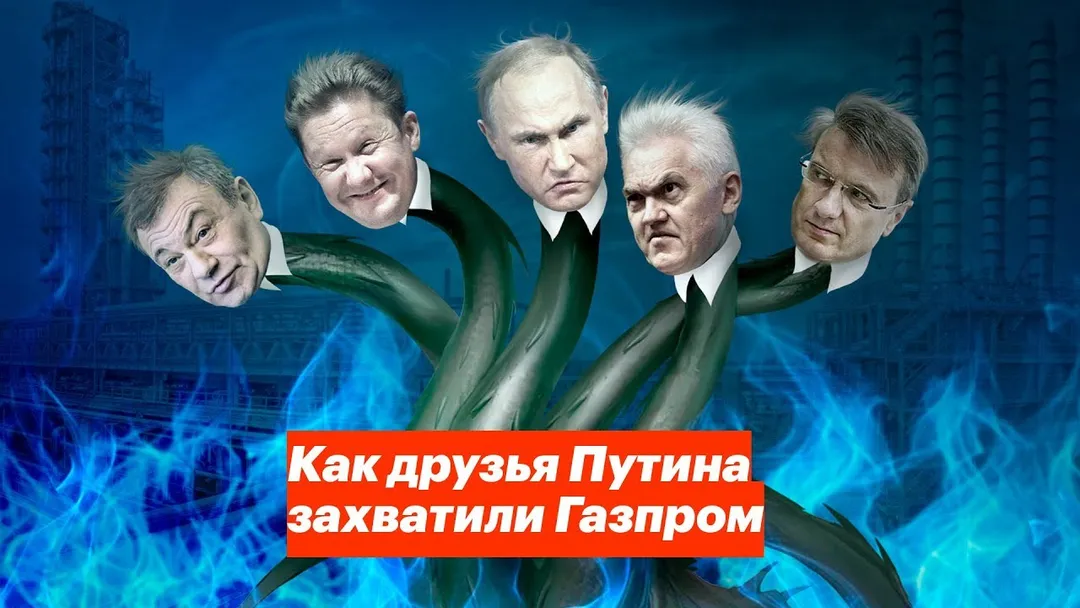
How Putin’s Friends Took Over Gazprom
Hi, this is still not Navalny, but Nikita
Kulachenkov, and today I have for you
a story about our national treasure
about Gazprom, that “treasure.”
A couple of weeks ago, a scandal broke out.
An analyst from Sberbank’s investment subsidiary
published a critical report
about Gazprom and was immediately fired, and then
his boss was fired too, and then the head
of Sberbank, Gref, had to call one
of Gazprom’s offended contractors and
apologize. The contractor was not Kadyrov,
as one might assume, but Gennady Timchenko,
a longtime friend and close associate
of Vladimir Putin. An amazing story.
True, reports like this are absolutely
standard practice in the work of investment
departments at major banks. They are issued
regularly and are essentially reviews
of the stock and securities market—expert
opinions based on news about
the company, financial statements, mathematical
models, and forecasts. Such reports
are sent to the bank’s investor clients,
who in turn can
use them to make decisions
about which securities to buy and which to sell,
and so on. But this particular May
report led to a major scandal.
People lost their jobs, and the issue was widely
covered in the media. I’m sure you’re also
curious: what could possibly have been written
in this dry, formal
document for it to end so badly?
Today I’ll tell you about it.
Here in front of me is that very
ill-fated report. Let’s dig in.
First, let’s understand what exactly this
document is about. It’s 43 pages of text, as we can see
from the title:
about the Russian oil and gas sector.
From the table of contents, we can see that the report has two
major sections: one on Gazprom and one on Lukoil.
We’re interested in the part about Gazprom.
The report’s main point is stated right away in the brief
summary on the first page.
But before we look at it,
we need a bit of context: Gazprom’s affairs
have not been going well for quite a while. In 2008,
the company was worth three hundred
sixty-seven billion dollars, and
as we now understand, that was the best
time in Gazprom’s entire history.
But at the time, it was thought to be only the beginning.
Putin said that only victories lay ahead,
talked about dreams coming true,
and about Gazprom as our national
treasure. Gazprom CEO Alexei
Miller
claimed that by 2016
the company would be worth one trillion dollars.
Want to guess how much it is worth
now?
A trillion? Maybe half a trillion? Well,
maybe at least as much as in 2008—300
billion? No. Gazprom is worth fifty-four
billion dollars. Agree,
for an investor who believed
Miller and Putin in 2008, that is, to put it mildly,
a disappointment. The company is worth 20 times
less than was forecast, and the
investor has less profit, fewer
dividends, the shares are cheaper, and the dreams
stubbornly refuse to come true. So what went wrong?
That question has been hanging in the air for ten years, ever since
things started going wrong. Who is to blame?
Why did this happen? What is the reason?
Why is a truly gigantic,
promising company, under the close
watch of the president and
government, worth one and a half times
less than the Starbucks coffee chain? Gas
pipelines are not just a national treasure;
they are what all of Europe rests on—not
depends on, but literally rests on. Here,
look at the chart: this is the market capitalization
of well-known companies. Here
is the most valuable, Apple; here is Netflix,
that TV-series company—it is worth almost 100
billion dollars; Disney is right nearby; here is
the aforementioned Starbucks; and here is Gazprom.
For comparison, they promised it would be up
here,
but instead it’s down here. That’s the context. And now
let’s return to Sberbank’s report, because
it tries to answer these questions, and
its conclusion is simple: unlike normal companies, Gazprom
simply does not have the task
of being profitable. Gazprom has
a different agenda. Gazprom exists not
to generate profits
for its shareholders—that is, the state and other
private investors—but rather to
enrich the contractors who service
Gazprom. We are talking about well-known
friends of Putin already
mentioned—Timchenko
and another childhood friend of the sportsman (a sarcastic reference to Putin),
Rotenberg. Another observation from Sberbank’s analysts:
Sberbank.
Instead of pursuing
economically sound projects,
Gazprom is busy serving the so-called
geopolitical interests
of our country—in other words, the ambitions of that same
Putin. That is why Gazprom’s value does not
grow. All free cash
that could have become profitable
investments or dividends for
the state and shareholders is spent on
dubious, loss-making projects. To
support this assumption,
Sberbank analyzes three Gazprom megaprojects
that we’ll now discuss. Power
of Siberia is a pipeline between Russia and
China. The entire project costs 60
billion dollars, or 3.7 trillion
rubles—meaning it costs more than all of Gazprom.
The project was launched as part of the so-
called “pivot to the East” in 2014.
At that time, the Russian state decided that
from then on, we would be friends with the Chinese and
signed a 30-year gas supply contract.
The Power of Siberia project effectively
replaced the cheaper Altai route,
which would have cost $10 billion.
For contractors, of course, it is far more
profitable to build something for $60 billion than for $10 billion.
The contracts for construction of the main section
of the pipeline were divided roughly equally
between the companies Stroytransgaz
and Stroygazmontazh. One belongs to
Gennady Timchenko,
the other to Arkady Rotenberg. They received
multibillion-dollar contracts without any competitive tendering. The
project has two major problems.
First, the project benefits exclusively
China. China will be able to dictate the terms
because it has alternative
suppliers.
But for Power of Siberia, China is
the only possible buyer, and if
China refuses to take the gas
at the proposed price, there will be
nowhere else to send it. So the price will have to be lowered
and the Chinese persuaded to buy it
after all. Second, Sberbank analysts
built a mathematical model and
calculated that the project can pay for itself
only if oil prices are above $110
per barrel. First of all, prices have not been that high since 2014,
and second, at that price it would be more выгодно for China
to reduce volumes under Power of Siberia
and buy gas from Central
Asia or liquefied natural gas, which
is delivered by specialized tankers. Sberbank
writes that the net present value
of the Power of Siberia project
is negative, at minus $11 billion.
I’m sure many viewers of this channel already
know perfectly well what net
present value is, but just
in case, I’ll rephrase: even if you count all
the potential future payments that
Gazprom will receive for supplies through Power
of Siberia,
it still would have been
more profitable simply not to build anything at all.
Doing nothing would have been better by $11
billion. The next megaproject
analyzed by Sberbank is Nord Stream
2.
This is a project to expand the existing
gas pipeline to Germany. One of the key
reasons for building it is
geopolitics: the pipeline will allow
more gas to be pumped while bypassing Ukraine.
The project is estimated at $17 billion,
of which one-third of the costs will go
to construction on Russian territory. And
a month ago, one of the contractors was selected without
a tender: Stroytransneftegaz.
The company is half-owned by
Gennady Timchenko. Notably,
Gazprom tried to hide the contractor and
blacked out the details in electronic
documents. The only problem was that they did it
so clumsily that journalists highlighted
the blacked-out text, copied it into
another document, and immediately figured everything out. Don’t
worry, Rotenberg wasn’t left out either.
His Stroygazmontazh is building for
Nord Stream the initial compressor
station. Once operational, Nord Stream 2
may recoup the investment in 20 years, but
its net present value
is again negative, amounting to minus $6
billion. The third project,
TurkStream, is a new gas pipeline along
the bottom of the Black Sea to Turkey.
Here too, the desire to bypass Ukraine is clearly
an important, if not the main,
reason for construction. A
pipeline directly to Turkey and
potentially to Bulgaria would allow
savings on payments for gas transit through
Ukraine.
But it still will not be possible to abandon transit completely,
and neither project opens up any new
export markets for Russia.
The cost of TurkStream is estimated
at $21 billion, of which more
than half will fall on the Russian section.
That means it will involve the same
unaccountable friends and contractors as always.
Details on the amounts and
contractors for the Russian section of TurkStream
are not given in the report.
Apparently, in this case Gazprom
blacked everything out properly in the documents. But we do know
for certain that, for example, the compressor stations
were built by Rotenberg’s Stroygazmontazh.
The losses from TurkStream will be even
greater than from the more expensive Power of Siberia.
It will recoup its investment only after 50 years, and
its net present value is,
attention, minus $13 billion.
Even if it operates for half a century,
it would still be better simply not to build it. But that
is not all that is written in the report. According
to Sberbank, Gazprom’s next megaproject
will be replacing old pipes on
existing pipelines. Gazprom has no
clear rules for replacing pipes: some
are changed after 20 years, while some remain in service
for 50. Management decides when to replace
them. Right now Gazprom spends
about $4.5 billion
a year on this, but after completing
Power of Siberia, TurkStream,
and Nord Stream 2,
Gazprom may be able to spend
$15–20 billion a year on it
for the next 15 years. This will greatly please
those who will be supplying the pipes and their
lay them. But why does Sberbank think that
such a megaproject will begin? Existing
pipe manufacturers in Russia are currently operating
at only about 50 percent of
their capacity. The situation is far from ideal.
Then suddenly, near Zagorsk (now Sergiyev Posad), a new
pipe-rolling plant is built.
It very quickly receives approval for
supplying pipes, along with a contract worth one point something
billion rubles from Gazprom.
At the same time, Gazprom terminates its old
contracts with other pipe manufacturers.
And again, surprise: one of the known
owners of the new plant turns out to be
Putin's former university classmate, Nikolai Yegorov.
After the report was published,
news emerged that indirectly
confirmed the analysts' assumption
at Sberbank about an upcoming megaproject.
Gazprom and the Zagorsk Pipe Plant
signed a scientific and technical cooperation
program for 2018–2023. The plant
will supply more and more different kinds of pipe,
while Gazprom, with the help of its old
contractors, will lay them. It is obvious
that this megaproject will not bring
Gazprom any income at all in this case.
The profits are reserved only for
the suppliers and contractors.
What Sberbank's analysts wrote is
not some kind of revelation. All of this
has long been obvious and had been said
before. The scandal is that, for the first time,
such an opinion was published in
a report by Russia's state-owned
Sberbank. For two decades,
Putin has been building a system in which
it is easy to quietly
carry out any scheme. During this time,
Gazprom, a state-owned company that
earns money from natural
resources, has effectively turned into his
personal pocket company — a company
that serves neither you and me, nor even
its shareholders, but simply whoever Putin wants it to serve.
There is no need to think that this is
a management mistake or a miscalculation. No,
Gazprom was deliberately designed and
organized to work this way. Today we were talking
about the people around Putin.
Gref, by the way, was there too 30
years ago, in the 1990s. These people sat in the same
offices at St. Petersburg City Hall.
Back then, people still unknown to anyone would come to them:
Timchenko, the Rotenbergs, and Nikolai Yegorov.
The new pipe plant comes from the same circle. They
studied together with Putin in graduate school.
Medvedev was there too. He had joint business ventures
with the billionaire cellist Roldugin.
There are no random people there at all.
You understand — and there cannot be any, because
any sane person who found themselves
in Gazprom by accident
would immediately sound the alarm. This whole scheme
is glaringly obvious and could have become
the plot of some mafia TV series.
But unfortunately, this is our
everyday reality. But even here,
allow me a little optimism, which
is, by the way, shared by the dismissed authors
of the scandalous report: if Gazprom
gets new management — bluntly speaking, if
all that Putin-linked crookery is thrown out of there —
if the whole concept changes and the company
stops pouring money into useless
loss-making projects that nobody needs, then everything will quickly
fall into place.
It certainly will not be worth a trillion, but four times
more than Gazprom is worth now — maybe. Let us
try to make that happen as soon
as possible. Thank you for watching our channel.
Subscribe — they tell the truth here.