Navalny's Team
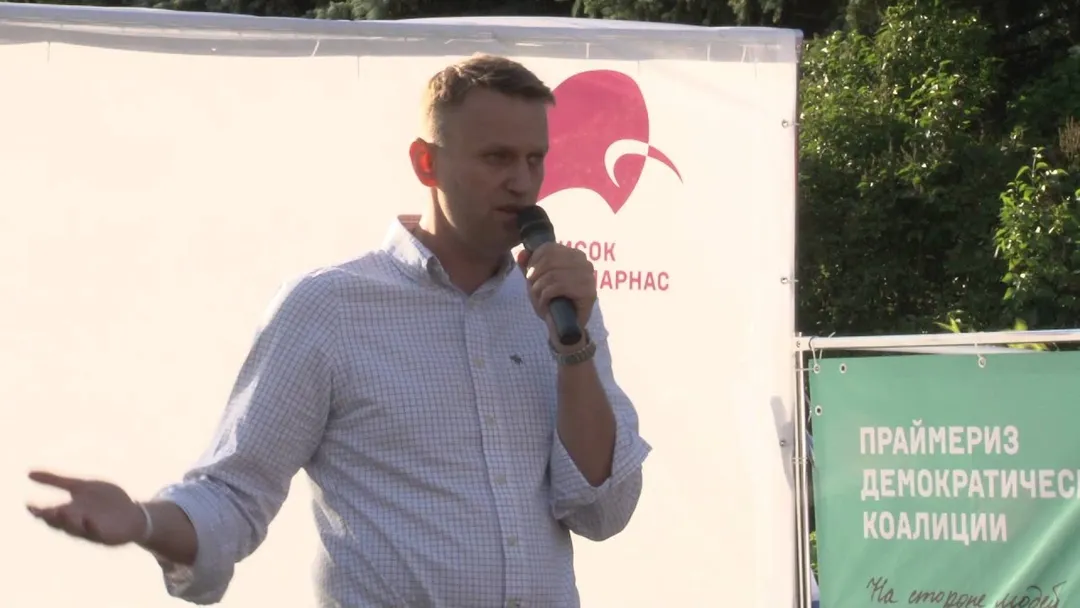
whether
Hello, dear
residents of Kostroma. To be honest, I really
doubted
that there would be so many people here. Thank you very much
to all of you for
coming. Who am I? My name is Vladimir
Andreichenko. I live in Kostroma, and I am taking part
in this event called
the primaries
Since I am taking part in this,
what the coalition is proposing
resonates, I believe, with every ordinary
resident of the region and, more broadly, of the country. That
is, it means a free press,
an independent judiciary, and rotation of power
Believe me, as a former official, if someone
says rotation of power is a good thing,
that means something.
So why am I convinced
that in the
coalition’s appeals I did not see
any incitement to revolution. I did not
see calls for rallies. What I saw
were proposals and an invitation for ordinary people
to try their hand at politics and
solve their own
problems. Another thing I liked
about this principle
of the coalition—being on the side of the people—is that it may not sound
very lofty, but I believe it is a very
serious responsibility to be on the side of
the people. It is very hard to earn people’s trust,
and even harder to preserve that
trust. The program, the policy points
being proposed by the
Democratic
Coalition—I can tell you that they do not
contain a single threat to the Kostroma
region. What is being proposed? Interbudgetary
relations—that matters to us.
Direct mayoral elections are important. And I believe that
the people of Kostroma are capable of, and should, choose
their mayor. Elections for governor without
the municipal filter—that is normal.
Corruption and embezzlement of public funds as well—after all,
no one is going to say those are
good things.
For all these reasons, I am taking part in
the primaries. The primaries were organized
and their main driving forces were two
political parties: the RPR
PARNAS party and
the
Progress Party. My colleague and at the same time
competitor
in these primaries is a member of the political council
of RPR
PARNAS, Ilya Yashin. Yes, he lives in
Moscow. He will now come up to this podium and
tell you why he wants specifically to be on the
side of the people of Kostroma, what he will tell you
is that he came here not to deceive you, but
that he is ready and wants to work for
Kostroma and for the needs of Kostroma.
Thank you. Hello, dear
residents of Kostroma, I really did come from Moscow,
and now I will tell you why I
did it. Some time ago I received
a letter, a letter from residents of Kostroma
and the Kostroma region, in which they
told me, essentially, what I already
knew, what we all know: that
for a long time now we have been
conditioned to believe that we have no
rights. We have been conditioned to
the idea that who will represent our
interests in the legislature is decided by others,
who will be president is decided by others, what laws there will be
is decided by others. I was asked to come here in order
to freshen the air here. I am not
connected either to officials or to oligarchs.
I am a completely independent person, and I was
asked to take part in the Democratic Coalition’s primaries
here in
Kostroma in order to run in the elections,
become your candidate
and defend your
interests. And I have good news:
for the first time in a long while, you and I
have a chance to change something. For the first time in
a long while, you and I have a chance
to break this vicious circle, when you and I
have no ability to influence
anything. The same faces have been in
parliament, in the Kremlin, and here in the Kostroma
region for 15 years—the same faces. It is time to
change something, because the faces are the same,
but so are the same broken
roads, and the same awful
housing and коммунal services. Nothing
changes. Let us try to change that.
Right now we are holding primaries. Few people
know what that is—it is an unfamiliar word.
[music]
a list of candidates. We want
to form a people’s list, not there in the
quiet of offices, where politicians
make deals among themselves, but when citizens
themselves nominate their candidates. They
compete with one another honestly. In
open competition there emerges
a truly strong people’s list.
That list goes into the elections, wins, and
forms a faction in the Duma that
works in the interests of the people, on the side of
the people. Therefore, I ask you
to register for these primaries,
take an active part in them, and in
September come to the elections and vote
so that others do not decide for us. Because
to significantly raise the standard of living here
in the Kostroma region and in the country, we will only be able
to do so only
by pressing and forcing this government to work
in our interests. Am I
right?
Will you support a visiting Muscovite like me?
A touring outsider, convicted three times. But the man
whom you all know very well—Alexei
Navalny. Thank you very much, dear
friends. I’m very glad to see you here.
Please, everyone who’s standing,
come closer—those behind the little fence, too.
I’m glad to be speaking in your wonderful, very beautiful
city. I only have one
question: has there been some kind of
bombing in the city lately or something? I
was driving today along Prospekt Mira (Peace Avenue), and I just couldn’t
understand—what on earth has been happening in
this regional capital? I don’t
understand. And before I say
why I came, and answer all your questions,
let me tell you a little anecdote, just so you
understand. A joke—but really, it’s the real-life context
in which we work. Today the guys
were setting up the stage, the structures, the backdrop, and
they put out chairs. Then a representative
from the administration came and said the chairs had to be removed. And
the police weren’t even insisting on it. Remove the chairs. Why?
“It’s an order.”
From the deputy governor. First you put out chairs,
and then you’ll start a revolution.
So everyone sitting on a chair—you
understand that this is the prologue to a revolution. Why
did I come here to see you?
I came here so that together
with all of you here in Kostroma
Region, we could enter into a conspiracy—form
a conspiracy. And yes, a conspiracy is supposed to be
something secret, but I’m saying this
completely openly.
I want you to take part in it—you, the police officers
guarding this rally, the people
standing with placards, even
the wonderful woman who just
told me, “Go away, you with your American
passport.” I’m sure you’ll want
to take part in this conspiracy because
it will be a conspiracy of people who love
Kostroma Region against those who
hate it. Look, when I
was preparing, I went to the website of
the Ministry of Regional Development to see where
Kostroma Region stands
and what the official
information says about it now. And it says
it’s a bankrupt region. Worse than Kostroma
Region, apparently, only Kamchatka has debt
that practically equals its revenue; income is minimal;
everything depends on transfers from the federal
budget, and so on. It’s just some kind of
nightmare. I really don’t understand:
do people in Kostroma Region not
work? Are they drunk all the time? Or
did they steal something from themselves? Why
is Kostroma Region running at a loss?
Absolutely—why? Do you have an answer to
that question? But on the other hand,
if I look not at the official websites
but at normal ones, where people
actually write things, here’s what I learn about Kostroma Region.
Tell me yourselves: Kostroma is
the cheese capital of Russia, Kostroma
is the jewelry capital
of Russia,
the flax capital of Russia, and one of the
key cities of the Golden Ring (a famous tourist route through historic Russian cities), and a
major tourist city in Russia.
So the question arises: how the hell can a city
that is famous for all this, where many people
work—why is it a loss-making
region?
A bankrupt one? I want to form a conspiracy with you
against the people who are trying
to turn Kostroma and Kostroma
Region into a bankrupt region.
They take all the money away to Moscow
that is earned here, and they
simply steal every day by taking away all
the money. I know that for certain, and this is
the most important point of our program. I’m simply
looking at how much tax you pay here.
The main plank of our platform,
the one we are campaigning on, is this:
return money and powers to the regions.
The value-added tax that
you pay here—what percentage of it
stays here, and how much goes to Moscow?
Who knows?
Zero stays with you here.
We believe, demand, and want
you, as part of this conspiracy, to demand
together with us: guys, we want
40% of the value-added tax
to remain here, where we actually pay it.
These are your prices. When you pay in
a store, you indirectly pay this tax, and
that would bring in an additional 4 to 8 billion
rubles, and the problem of Kostroma Region’s deficit
would be solved immediately. Then it would be possible
to allocate not 980 million rubles a year to roads, as now,
but 1 billion or 2 billion. I think
we all want that together.
We also want excise taxes on alcohol and tobacco
that you pay here—which directly affect
your healthcare, because
people drink and smoke, they get sick from it, and you
pay for those hospitals, and so on—but
right now Moscow takes 60% of the excise tax, and 40%
stays with you. We’re not proposing to take it all away.
Our program is this:
let’s reverse it—60% stays here and 40% goes to
Moscow. And that would bring in an additional 500 million
rubles. This year your healthcare
budget was cut by 340 million
rubles. So we’re saying: let’s change that, and
you’ll have additional money for
healthcare. In Kostroma
Region, medicines that people are supposed
to receive free of charge are not being given to them. You
know there were scandals—an unfortunate disabled child
had to sue
the governor over medication, and while the case was going on,
the girl died—she couldn’t get
the medicine. The money exists—it’s just that right now
the official position of any deputies
who sit in your city assembly
and in the regional legislature, United Russia sits there, and
its official position is that
guys, we want to hand over all the money
to Moscow. Why would Moscow ever give you
any money back if, apparently,
your deputies are saying, no, we are completely
fine with it, let everything go there
Within this conspiracy, we want
to unite people who will finally
create the one party
the one political force, people who will say, well,
enough already—there is plenty of money in the federal center
as it is: oil revenues, gas revenues,
customs duties. We want
at least some of our money, the money we pay,
to stay in our region. Second,
the theft—the spoons, the dacha (country house)
Yakunin, the head of Russian Railways, the state-owned
railway company, bought himself
an estate for more than 1 billion rubles
(about $11 million). Your
Kostroma
to St. Petersburg train is being canceled from July 5, right?
That’s right? Yes, yes. So the question is: shouldn’t
we join you in a conspiracy
so that finally someone says, what the hell
is Yakunin doing spending 1 billion rubles
on a dacha when he has no such income, while you
are having this train canceled, even though it costs
far less, after all
And so we look at these
endless mugs who have
an official salary of 1 million rubles, but build
houses worth 100 million, 20 million, 50 million rubles—this is
illicit enrichment. But obviously, if
an official—look, he has
even a high salary, 150,000 rubles a month
(about $1,650)—that’s a very high salary. Your average
salary in the region is what?
25,000.
Officially, 21,000.
Officially, Rosstat (Russia’s state statistics agency) says 21,000 rubles
(about $230), though it’s probably less. An official
earns 100,000, but at the same time builds himself
a dacha for 10 million rubles—where did he get
the money? He stole it. Saved it up, saved it up—by stealing
a little at a time, and
eventually accumulated it. That’s obvious to me, it’s obvious to you
it’s obvious to the whole country, but
when we say this is illicit
enrichment, stop stealing, then this
official says: Navalny, that’s slander
you’ll go to court, I’ll have you held legally
liable. And where I got the money from
is none of your business, nor your
fellow Kostroma residents’ business—you have no right
to ask us such questions, the officials say
I want us together
to form a conspiracy of people who demand
that we do have the right to ask such questions
About this seed farm—your
newspapers all wrote that 154 million rubles were stolen
that’s a very large sum for your
region. How did the case end?
Amnesty. Nothing was built, the money was not
returned, no one was held
accountable, everyone feels
just fine. But let there at least appear in the
legislature someone who says: I demand
criminal charges. I
demand it, I demand these 154 million rubles be returned
Because right now there are no such deputies, there simply
aren’t any, that’s all. Supposedly there are
people’s
representatives sitting there, drawing salaries, doing something
but the person who will raise
their voice is not there, and that person should be there
because all of you here want that
There are probably lots of people who do not
agree with my political
position on everything. But surely each of us
agrees that crooks like these must be
held
accountable. Your roads are in
a monstrous state, but if we look
at our Anti-Corruption Foundation
which analyzes how road tenders are awarded
we see nothing but
a monopolistic scheme there—there is no competition at all
naturally there are no roads, people are enriching themselves
we need deputies who will deal with this
we need such deputies. I want
you to elect those deputies yourselves
The idea
behind the party list is very simple
for example, I am even officially
forbidden from forming blocs right now, and I don’t
want to anyway, but you have elections in 2016
in September 2015, the task before us
before all of us is how to
put together a list in Kostroma Region
that you will believe in, so that
you will come to the elections and finally send to the
Duma deputies who will demand that
your money be returned to you and that they start
fighting corruption. We have already decided
how to answer this question
in the only possible way:
you should compile this list
you—these local people, or Yashin
for example, who came from Moscow and wants
to represent your interests—they come
to you and say: guys, we want to be
the face of the Kostroma opposition, please
trust us. After that, you come to the
primaries and decide who should be
first, who should be second, who should be in
a winnable spot and become a
deputy. Do you need someone older,
younger, local, or an outsider? That is not a question
Navalny from Moscow can decide, nor
should Navalny from Moscow decide it. I
believe that you should decide that question
you, the people of Kostroma. The main purpose of my trip
is to convince you that, well, in fact
democracy really does work, and me
Journalists were asking today, "So, Alexei..."
"So who will head the party list in Kostroma?" And I
said, "Guys, I'm happy to tell you that
I don't know. I really don't know. Because
I don't know who you
will vote for. Enough already—I'm sick of all this,
all this politics and these big-headed politicians
from Moscow. When Moscow leaders decide everything
themselves, it leads to a situation where you're
simply not interested in voting for such
lists. So either you don't go to
the polls, or you spoil your ballots. As a result,
there is no opposition. In power there is only
United Russia. We all suffer, they steal,
there are no roads, and so on. We have to change
this situation. I urge you to believe in
the fact that what we are doing is genuinely honest:
to register, look at
the candidates, talk to them, ask them
questions, and choose the list that
will go to the election and beat
United Russia—the party of crooks and thieves—and
bring into the Duma people who will finally
say loudly, and make sure that
the official voice of Kostroma Region
sounds like this:
"We demand a fight against corruption." I
am sure we will do this, and together with
you—together with you—we
will break into parliament, and after that we
will definitely win, because
well, I simply do not believe that what
is happening in the country now will
go on forever.
This country extracts such enormous
amounts of oil and gas, we are one of the richest
countries, and yet we live in poverty. In your region's second-largest
city, right here in
Sharya, they shut off hot water for five months
in 2015. Come on—that's un
thinkable. Here, hot water should be shut off
for 14 days. But in practice, for how long
do they shut it off? A month. A month. Why the hell are you
paying more than 15% of your monthly budget for housing and utility services
(utilities), right?
Then why do people say, "No,
that can't be, that just can't be,
it can't be that all the nation's wealth is going
to these oligarchs." In 1990, we had
officially recognized dollar billionaires
ten or maybe eleven people; now there are 120
official dollar
billionaires in Russia. What did they
make their money on? I don't understand. They
made it on the fact that your region became
bankrupt. They siphoned everything off into Swiss
bank accounts.
So once again, I urge you: we are
forming a patriotic conspiracy with you
against the thieves, together with everyone—with the police, with
Center E (the anti-extremism police unit), which is filming us right now
on camera—with everyone. Because nobody likes
this. A patriotic conspiracy against
crooks and thieves, for the people of Kostroma. Thank you
very much. I'm ready to answer your
questions. Let's start first with the
woman who said that I have two
passports. I promise you—please, your
first
question. Go ahead, go ahead.
Tell me, I'm interested. I'll give you the
microphone, just briefly, okay? Did
the American
[music]
embassy pay you? And how much did the
American embassy pay you to come
here? All right, tell me then,
was it Obama who bombed your roads after all?
You bombed the roads. In 1991
I bombed the roads? In 1991
in 1991 I destroyed—you destroyed
the country? I destroyed
the country? Excellent, thank you.
Thank you very much. Let me give you the microphone—no
need? All right, fine. I can answer, I can
answer. What's your
name? Thank you very much for that question. I
am glad it was asked, because
here's what happens: some
people come out and say
they are against corruption, and that means the
American embassy paid them, and in
1991 they somehow
bombed something. In 1991 I was
in school, you understand? I didn't bomb
anything. And as for the American embassy, I don't
know what's in that embassy. Where is
this America? Very far away. What I do know is that
there is no hot water here. I know that here
everything has been stolen. I can see Yakunin's dacha (country estate)
right here and now. Second question.
Let's have the second question. How did the trial end
when you stole
Kirovles? How did the trial end when I stole from Kirovles?
At
Kirovles? The Kirovles trial ended very
simply: I was sentenced to five years, but the
next day, people came out into the streets of Moscow
who know that all of this is a lie,
who understand that these are corrupt officials and
crooks trying to lock me up.
The next day they released me, and as you
can see, as you can see, I am standing here before
you. And no matter how much they try to brainwash us
about America—guys, why should I talk
about America? I want to ask a question. I don't
know—there are a bunch of police officers standing here. I
want them to think to themselves
here we have a director, a former director
of the FSB, Patrushev. In our booklet, you can
see that his wife bought herself
a palace in Serebryany Bor for 100 million
Please tell me, in short, how
can an FSB director, while in government service, buy
himself a house for 1 billion rubles? Is that possible?
That is betrayal and treason. Those are
the traitors of Russia—all those who simply keep stealing
from the budget endlessly. Well, I've given you
the chance to ask two questions. So
that’s enough, we want to ask questions too. Dear
friends, we need to change the agenda.
Next. I don’t want to talk about America. I
want to talk about housing and public utilities in the city of Kostroma.
I want to talk about why you are
being robbed on the roads. I want, I want to talk
Sorry, about your great friend
Vladimir Vladimirovich Putin’s friend named
Anatoly Serdyukov. Now tell me,
please, where is Anatoly
Serdyukov now? He was removed, he was removed. So let me
tell you that Serdyukov, the man we were
told on television had stolen 20
billion rubles, did not spend a single day in the
defendant’s dock. He was amnestied, and
now he heads a federal
state enterprise in the field of
defense. I don’t like that. And I’m
not interested in America or some
American embassy. I simply want
Serdyukov to be jailed. Do you
want that? Well, let’s vote: who is in favor of
bringing Serdyukov to
justice? Please...
American embassy.
That is what we will rally around.
We will unite around this. Next
question. Go ahead.
revolution... many of you probably know me.
know me.
I worked at... under Boris... I
want to speak about the roads: I fell and broke my hip. Yes, I
on November 16 of that year I fell, broke my hip, and
for three years I’ve been suing and just trying to survive.
And then suddenly, on November 8, I’m told that the
person responsible for the roads is bankrupt, some kind of
manager. We have roads, and they are all under
a bankrupt entity, which is why there was such terrible ice. He
holds two jobs, and his administration
is driving the company into bankruptcy. They do not pay taxes
on purpose; this is done deliberately. They don’t pay taxes.
He holds two jobs and receives two
salaries, and they are not planning to pay me either.
That’s how it is, and my whole body...
The point is that the enterprise that has
the roads on its books has been formally
declared bankrupt, and it cannot even
pay compensation. So what are we talking about?
How is it possible that in one of the richest
countries in the world, which has sold oil and gas
for 3 billion in recent years, our
road maintenance enterprise ends up
bankrupt? This is abnormal. This is what
we are joining together against; that is why I am
standing on this stage. Let’s have the next
question. Yes.
Please, your attitude toward Mikhail
Kasyanov? My attitude toward Mikhail
Kasyanov, toward Mikhail Kasyanov, my
attitude is good. I’ll explain: he was
prime minister in Putin’s government,
and, by the way, he served for three or four years
as prime minister in Putin’s government. And
even by Putin’s own admission, he was
prime minister—indeed, he was
the best prime minister
of Putin’s government. And in that sense,
I follow his work. I am not going to be his
lawyer; without me, he is perfectly
capable, I’m sure, of coming and answering
questions. But I follow his
activity over recent years, and I see that
he is, in fact, a fairly
sincere person engaged in independent
political activity. Kasyanov probably could have—I am
sure of it—as a former prime minister,
like all the others, headed some
state bank or something of that sort,
become an oligarch, and so on. But
none of that happened. So Kasyanov
heads the RPR-PARNAS party. You know
that my party, the Party of Progress, was liquidated;
they are not allowing us to register it.
They are too afraid. He made this
party available for holding democratic
primaries and honestly said that he was ready on one
condition: that the candidate lists be formed by people from Kostroma.
This is very important, because the
deputies you elect will be
accountable only to you—not to me, not to Kasyanov,
and not to anyone else. And that is exactly how we want it, so that
the deputies sitting there do not feel
indebted to Navalny. Because
what if tomorrow I become a bad person and
demand that they cover for
corrupt officials? And then, at that moment,
the deputy will say, ‘Lyosha, go home, get out of my
Kostroma, because I was elected on a list formed by
people from Kostroma, not by you.’ Next
question. Tell me, this young man
is shouting, ‘This country isn’t Bolotnaya (a reference to Moscow’s Bolotnaya Square protests)... go back to your own...’
America.’ Judging by appearances, you came here from
Tajikistan. Please come over here.
Come here. Go on, come over, come over. Yes, come over.
Both of you.
Come over, come over, both of you, come over.
Come on, come over.
All right, if you tell me, ‘Go back to your own
America,’ then I’ll tell you, ‘Go back to Uzbekistan.’
You, come here. Let’s take a look.
Kostroma. There you have it, you see—the wonderful
authorities took two migrant workers
paid them 300 rubles each, and they are afraid to come
up here. So come here, guys, come over.
I’m not going to eat you. This is a peaceful
rally. This matters, this matters. I’ll give you
a chance to speak. Come over, come on.
Come over.
Come here. There, you see, that’s exactly how it works.
You understand? He stood up and shouted about ‘your America.’ Once
again, please, no incidents. Just
let them stand there, let them stand there and listen, and so
on. Fine. As soon as I send you to
Dushanbe, I’ll immediately go to
[applause]
America. A local issue of interest...
I want to ask for help. In general, under the former...
Governor, damn it, so, on behalf of...
the fans of Spartak club, about the stadium...
Spartak was handed over to Dynamo just now...
all my friends go to training sessions, even...
the poor kids in Karavaevo, 7 km (4.3 miles) from
the city. Our hearts ache, we all...
the enterprises contributed, all of them, Metalist...
Mashina built Spartak—this stadium...
is 50 years old, and by some stroke of the pen, with chatter and...
empty drivel, they signed it away and handed it over to the cops.
We want this stadium back, like it was...
That’s it.
Uh...
The only way I can do this...
I can’t do it alone. You need your own deputies.
They shape the budget, they approve the budget
of the region; among other things, they also form
property committees, they elect...
their own deputies. They distribute everything, they
are the ones who should be dealing with this. You have, you have...
a lot of similar situations. Maybe...
after all, I’m not a local person, not...
entirely, but the right analogy here is...
some well-known pond here that recently...
Shai Pond, yes, the one someone tried to...
build over—the person who heads
the committee on
ecology. Well, that’s exactly why you need
to bring in decent deputies so that this
crooked nonsense doesn’t get through, because a person
gets elected in this district saying, ‘I’ll stand up for you,’
and then tries to build over your own pond.
So voters need people who
will shape the budget in such a way that
there is funding for this
sports club, who will demand, as
I’ve already said and will never tire of repeating, that
excise tax, VAT, and part of the
mineral extraction tax stay here, and then you
will have money for everything. Once again,
this is important. Today I spoke with many people,
and unfortunately you yourselves have been
sold this whole paradigm: that here
in Kostroma everything is terrible and we’re
very poor. You’re not poor at all—where did you
get the idea that you’re poor? Just look
at how much tax you yourselves
pay. If even some of it stayed with you, you’d be able
to...
to support yourselves—and that’s exactly how it should be.
Because, after all,
who is Russia for? Explain to me—what is it for?
Why do you pay excise tax and VAT here—so it can go to
Chechnya? They’re doing fine there as it is.
There’s enough money; we maintain the army, we have enough
oil money, plenty of gas money, as I already
said, and plenty of customs revenue.
A lot. Right now, Russia’s national idea
should be to let
people live normally, so that, damn it, your
money stays with you.
How
is it possible to dismantle this system when there...
after all, everything is...
like that?
There’s no clever trick—if only there were a simple button
I could walk up to and just press once,
and...
But it won’t be easy. On the other hand,
we are the majority in our
country. We’ve been sold the idea that we’re some kind of
you know, people with democratic
views, of whom there are many in every
city, who stand for elections, for
justice, for a fair
distribution of national wealth. We’ve
basically been made to think that there are
just too few of us, while some rather narrow-minded
people are very numerous and outvote us everywhere.
That’s complete nonsense.
On every issue on our political
agenda in this country, 70 to 80%
of people are with us. So how do we change this
system? By uniting, including in order
to go to the polls. Of course, the system is rigid,
of course it’s all the same old mess, if they
appointed this governor for you. What did you call him—
Zhora Bordyur or something? Like...
Gosha Bordyur? If the whole region is laughing because they
appointed some clown—a clown who simply
steals money. He’s pointless and
useless. Everyone seems to agree with that.
It seems impossible to break through the system, but we need
to mobilize, we need to mobilize. We know for sure
that if we ourselves make
a small effort, and each of you
goes up to someone and says, ‘Listen,
friend, neighbor, acquaintance, girlfriend—there’s
a party, there are deputies, and they stand for
our Kostroma money
staying here. Don’t sit at home—right now, in these elections, even if only
20% of people come out and vote—if everyone comes,
if everyone votes, that’s where the breaking of
this system will begin—not a revolution, but a normal
evolution, when we force officials
to change something. Because of course, who
would ever voluntarily give up? In our booklet,
look at the page with the salaries
of the heads of state companies. My favorite figure—
I keep repeating it, you’ve probably heard it too—you know the salary?
What is it?
5 million rubles a day (about $55,000-60,000 per day). Where have you ever seen that in a
state company? It’s simply
madness. You tell people and they don’t
believe it. I often tell
people I know, I meet people, and I tell them: 5
million rubles a day. ‘No way, that can’t
be true, it doesn’t fit in your head’—but it
is true. Obviously, they themselves will never
give it up; they will never give up
the opportunity to steal, to steal the nation’s
wealth without control. But
we need to apply pressure. That’s why I came here, and we
need some kind of group to emerge
of people who will pressure this government
and force it to change. Let’s take the next
question: do I believe in fair elections?
Excellent question. And do you believe in fair...
All right. Raise your hands, those who believe
in fair elections.
In—
Good. So, I’m facing an optimistic
audience. I
can see that. I want to tell you the facts. Fact
number one is that when it comes to
voting for United Russia,
your region is second from the bottom. One of the
lowest voting rates—that’s a fact. As for
voting for Putin, you are in last
place. In Kostroma, people do not vote for Putin.
That
is a fact. It’s obvious. Why? Because
it’s not that you’re voting for some supposedly good candidate, it’s simply that you
know everything has been stolen and ruined.
So don’t vote? From this I draw
the conclusion that, first of all, of course everything
will not be easy, but on the other hand
the conditions are there.
So the elections will be fair if we
force them to hold fair elections. If
we draw up a list and send
a fairly large number of people,
if observers take part, if we sign up
hundreds—we did this in Moscow, and we’re doing it here too.
When I ran in the elections in Moscow,
they told me too: “What are you even getting yourself into?”
“You’ve got a criminal case against you.” I was
put on trial right in the middle of the election
campaign, and I was even jailed during
the campaign. There was no television coverage,
there was no money. “What are you getting into? You’ve got
absolutely nothing.” Nevertheless, in
Russia’s largest city, where 10% of the country’s
population lives, I got 30%. It wasn’t all for
nothing. If we force them to hold
fair elections, they will hold them for us. We just need
to push them. A little more optimism,
friends. Next question.
Alexei, good afternoon. We came from Ivanovo
to be, so to speak,
part of this. And I have a question. Well,
the problems are most likely the same.
It’s a subsidized region, which means the governor
looks in only one direction—where the money comes from. So
the situation for small business is absolutely
identical, just like with the roads—maybe a little
better, but he measures his effectiveness
by his ratings, by how high he
climbs. My question is this:
after three of these announcements—it’s
such a nightmare—to constantly be ready with
a bag packed and come in. Please understand me
correctly: why
Niko’s question: haven’t I gotten tired of endlessly
drying rusks (a Russian expression meaning preparing for prison)? Well, yes, I have.
Really. If I had been speaking
here two years ago, I would have said:
“Guys, I’m a respected lawyer, I have
high fees,” and so on. Now I
really can tell you that I am
a three-time convicted repeat offender; I was expelled
from the bar association as someone criminally
convicted, and so on and so on.
But if, in order to speak the truth,
I need to dry rusks, then I’ll
dry them, because that is the most important thing
for me. What matters deeply to me is that, standing on
this stage, I know that I am not lying in a single
word. Besides, in fact I’m
saying fairly obvious things.
Yes, you looked at the little booklet. But it’s all
documents, unfortunately.
Corruption is out in the open; there’s no need even
to prove anything. But I simply get
pleasure from speaking the truth in
our country. In other countries, in
societies before ours, this is simply
the constant story of humanity:
decent people fight bad people;
bad people—crooks, thieves, and murderers—
try to stop good people from speaking
the truth. But the whole history of humanity, again,
tells us that good, sooner or
later, wins. I believe that it
will win. I simply believe in Russia. I believe—I don’t
know—even in that woman who
came up to me and talked about the embassy. I
basically believe that at some point
she’ll figure it out: when she
turns on the hot water and nothing
comes out, she’ll understand that Obama is not
on the other end of the pipe drinking up
all the hot water. She’ll understand. I believe in
people. Maybe someone will consider my position
naive, but it is truthful, and for its sake I
am ready to dry as many rusks as necessary.
[applause]
Thank you. My last name is Leontyeva. Kostroma.
So, the Kostroma Regional Duma
has more than thirty members, and yet
despite the fact that in more than
half of Russia’s cities a law on
“children of the war” has been adopted,
these leading figures, so to speak, have
settled in for three or four convocations
working in the Duma—that is, they are already
permanent fixtures.
Yes, and in April they allowed themselves
despite the fact that in neighboring
regions—around 35 or 40 regions—
this law on “children of the war” was adopted, they
They refused.
They refused.
May I make a comparison?
There are far more people in the regional Duma.
Compare it with the Moscow City Duma.
That’s how it works in our
country. Thank you very much. It’s not even really a question,
more of an opinion. But the idea is very important: the fact that
these people sit there for years—these deputies really
were in the Communist Party, then
they were with Chernomyrdin in Our Home Is Russia (a pro-Kremlin party of the 1990s), then
for a while they became
“democrats” and signed up
for Fatherland, then Unity, and now in
United Russia—the same old faces are still sitting there.
for years. At the same time, if I asked you
whether there are, in your Duma, at least, I don't know,
a couple of deputies who really
will stand up for your
interests—just one or two.
There might be one name
that comes to mind, but most often there are none.
Support for United Russia is among the lowest
in the country—30%—but United Russia in your Duma
holds
85%. How does that happen?
That's exactly the problem. That's why
we are holding this rally: it's time
to kick United Russia out of there.
If they have 30% support, then let them
keep their 30%, and let normal deputies
form the majority and pass
the right laws. Next question.
Kostroma, thank you for giving me the floor.
Thank you. Dear residents of Kostroma, for 17 years I have
been corresponding with officials at the very
highest level, up to and including the President
of the Russian Federation—no fewer than two
dozen during his third term. In total,
my appeals have been sent
regarding repression and the issue of
returning the diplomat of the Kingdom of Sweden
from the Galskoye Cemetery in the city of Kostroma
to Sweden, where he should be, in
Malmö, in the family burial place.
This is a man who, for those who do not know, saved during the years of
the war, more than 70 years ago—today already
already
around 100,000 human
lives among the Jewish population. He was
abducted by SMERSH (Soviet military counterintelligence) and taken to
the Lubyanka, where he was held, and in prisons across
Moscow, including for about two years at
the Lubyanka, where he was interrogated
before being sent to
a prison transport convoy.
While
on Red Square in 2013, I was
arrested by people dressed in police uniforms, in
a group of 13 to 15, and taken to
Kitay-Gorod, and subsequently to the district police station.
By court order, in
again. This was because I had repeatedly sent
appeals
to Prosecutor General Chaika and others. The military
prosecutor's office sends only brush-off replies everywhere; not a single
appeal has been considered
on its merits. Counterintelligence, the FSB,
the head of the military prosecutor's office openly
mock me, saying instead of giving
the answer I request in my appeal,
in writing: 'Especially important government
prisoner.'
Then in another brush-off reply: 'released prisoner.' This is
despicable. If Wallenberg
had been released, a plane from
Sweden would have
landed immediately, and he would have been escorted
back to his homeland. At present
they send me brush-off replies over the signature of General
from our FSB, who instructs them to send
these dismissive replies.
And this is
outrageous.
Thank you. It's difficult for me to comment on this
specific situation. Judging by the passion with which
you describe it, I do not
doubt that you are doing something
noble. And on the one hand,
you understand, we have huge—there are
military archives, there is the Main Military
Prosecutor's Office, the Ministry of Defense, which
should be dealing with this, yet they are silent. So again, I am not ready
to comment on this situation. But this is
a question about the quality of government in general. And why
are they silent? We have a fantastical number of officials
—fantastical.
It's a question of the quality of government. Let's simply
discuss this particular issue one-on-one afterward.
Next question. Would you like to ask a question?
At the rally on December 7 last
year,
you said, 'I'm scared, but I'm used to it.' What are you
doing for your personal safety? Because
we are all very
worried about you. Well, listen, who should I be afraid of?
Look how many people are protecting me—and
you too, including people in uniform, and so on. But seriously,
what can you really do here?
Even if I had the money
to hire four bodyguards
and have them stand there like in a Hollywood movie,
in dark protective glasses, big guys like that,
huge men—still, competing
with the state is impossible.
You know who killed
Nemtsov (Boris Nemtsov, Russian opposition politician). He was killed by Chechen
policemen, if you can call them
policemen—really just some kind of bandits,
bearded thugs.
Everyone knows that right now the FSB is officially
trying to question this Yeremeyev—yes, that's his
surname—who officially
helped organize it,
in a republic that is supposedly part of Russia.
They can't even come and question him. What's more, he
officially left through Grozny
International Airport. Now he is in Dubai.
So
I understand that the situation is such that
there may be, I don't know, dangerous
situations. But again, that does not
stop me, and I believe that none of
us should be stopped by it. Because
these acts of terror, including against
Boris, were carried out—they were
intended simply to kill one person
and intimidate everyone else.
We have to keep doing our work. Next question.
Yes, Alexei, I'm very glad to see you. You
know, we have great respect for
your work. My son and I came specially
from Ivanovo to see you.
live
Can you imagine—we know that you
are taking part in the elections here in
Kostroma. In Kaluga, they watched you
speak; in Novosibirsk; when in
Ivanovo—well, yes, I’ll make it everywhere.
Listen, to be honest with you,
I get so much pleasure from this. After all,
I spent a year at home under house arrest, and
by the final stage of it, my entertainment
during that house arrest
was simply opening a map and
imagining where I would go, and my wife
used to call it something like “Alexei is out walking again.” I
would look at the map and imagine where I
would travel. I’ll try to get everywhere, but that
is not an easy task in our situation—there are
a lot of obstacles being put in our way, first and foremost.
Of course, right now I’m traveling to cities where
elections are taking place. But people are the same everywhere, and
everywhere people want to hear a word of truth, and
to be honest, sometimes it even upsets me that
someone can come and say
fairly banal things—nothing I’ve told you
just now is something you yourselves don’t already
know without me—
and yet it somehow becomes popular.
That’s the wrong situation. I want
to achieve this:
I want my job to disappear, so that all
these stories of mine about corruption and so on
would no longer be needed, because I would
talk about someone, and people would tell me, well,
that’s enough talking—there he is already
sitting in the defendant’s dock. If I talked about
Serdyukov, they would tell me, stop talking about
Serdyukov—he got 10 years. If I
talked about all those United Russia party members,
you would tell me, enough already, they’ve all been
held criminally liable under
the law on combating illicit enrichment.
I will definitely achieve that. I hope
that together we will definitely achieve it,
and that our conspiracy will work, my friends. In
our team there is a doctor who
told me something: “Alexei, the meeting shouldn’t
last more than one hour, because
you’ll leave all your voters out in the cold and
they’ll all come down with pneumonia.” Thank you
so much, my friends. Thank you for
coming and spending your time
to listen to me. I urge all of you not
to delay—register and
build your list, the list from which
victory will begin—and it will begin
in Kostroma. Thank you.
[applause]
s
