The Kremlin takes revenge for May 5, Gabrelyanov resorts to name-calling, Roskomnadzor humiliates itself
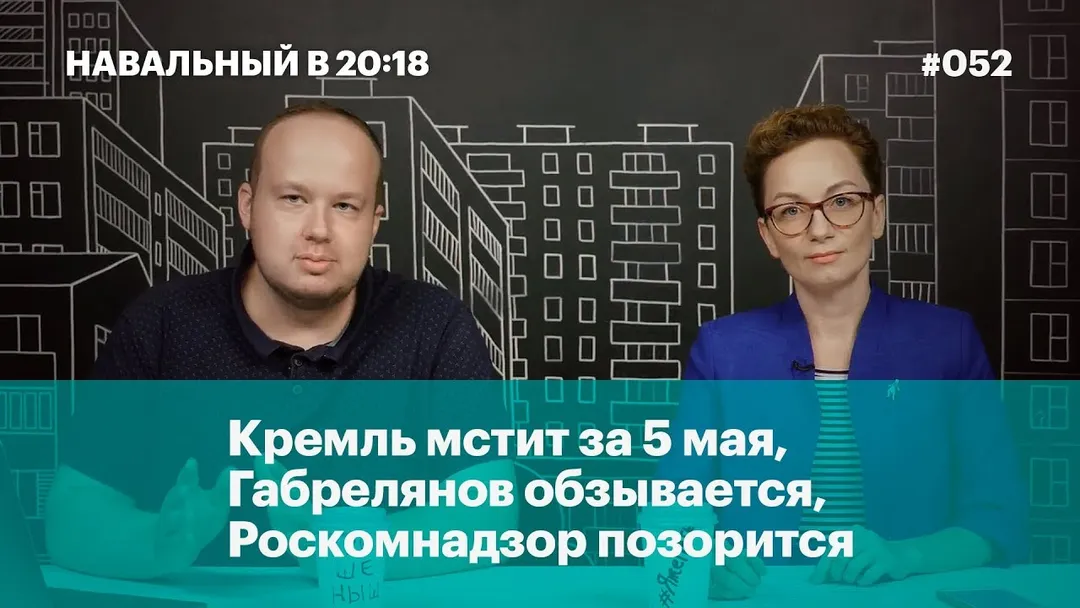
[music]
Hello everyone, and today is Thursday.
It's 8:18 p.m., and we're live on the TV channel—
the YouTube channel—
I'm getting carried away there—on the YouTube channel
Navalny Live. Before we begin: Navalny 2018.
As you can see, Alexei Navalny
is unfortunately not in the frame today because
he is serving an administrative arrest.
But in the studio, you have me, Georgy Alburov, and Lyubov
Sobol. The day before yesterday, a court sentenced
Alexei Navalny to
30 days of administrative arrest for organizing
the rally on May 5. He is expected to be released
around June 15.
Yes, exactly on the 15th, in fact.
There is even an exact time when we'll all see him.
Of course, we're really looking forward to it and hope he'll get out
maybe even a little earlier.
Well then, let's move on to the first update
about how Alexei Navalny's administrative
arrest is going. It turns out that
he isn't just sitting there doing nothing, but
is studying Python—
for those who don't know, that's a programming language.
So I think that when he gets out, he'll be able to write
some neural networks that will
expose corrupt officials and
make our work a little easier.
Great idea. Tell me, you spoke
today with Ivan Zhdanov, who
was there, right? Yes, I saw a person who
saw Alexei, yes.
I asked him to tell me how Alexei is doing there.
Alexei is doing well, except that
they won't let him eat Doshirak (instant noodles) with a fork,
which, in my view, is a violation of human rights,
and they confiscate his e-reader, which
is also quite inconvenient, because in the
special detention center there are fairly strict
limits on the number—on the number
of packages and the number of kilograms that
can be brought to you there, to that detention center.
So you can't exactly bring a whole library in there.
That is, books are most efficiently brought in
in electronic form.
I mean, if you bring several
paper books, then that's exactly that many
kilograms of food, fruit, and water that you
won't be getting when they bring things to you,
because it's either books or food.
Yes, that's how it's set up.
So e-books are quite a
good and convenient way out of the situation
so that you can bring more things in there.
But as we can see,
the authorities really don't like the fact that
Alexei has something to read, and they
confiscate it. Well, let's assume we can guess
why a fork isn't allowed, but
why an electronic device isn't allowed—I have no idea.
Well, you know how our bureaucracy works.
You yourself ran into it very closely today.
A very close encounter, so to speak.
We'll tell you about it a little later—a small spoiler:
my co-host barely
made it to the broadcast because today she was
stopped by the police as she was leaving her house. But we'll tell you
more about that a bit later. What else
can we say about Alexei? For now,
there isn't any more news, only this:
—
Will there be a congress—a founding congress?
A party congress? A party congress, under the working
title—yes, the working title, definitely—
will take place in Moscow on May 19.
It will be a fairly technical
event, because right now, as you
may have noticed, we are not conducting any
active campaign to recruit
party members, because now is not the time
for that. What we need now is a structure that
would be as compact as possible,
as mobile as possible, so that all the people
who signed up for the party—and only the minimum
number required, the minimally
necessary number under the law—could all
quickly come to Moscow, quickly
organize meetings, quickly
sign documents, run to the Ministry of Justice,
and so on. That requires there to be
not too many people involved, and right now we are going through all
these technical procedures. On the 19th, in
Moscow, the congress will take place, and we have already
done this some 135 times, by various estimates—
well, in the latest news they said, by various
estimates, 7 to 8 times—7 or 8, yes, but you
didn't count the number of documents
that were submitted in the regions, because in
the regions, when you hold
a founding meeting of a local
branch, they reject those too.
If you add everything up,
the number runs into the hundreds—
hundreds of applications to the Ministry of Justice. That's the story.
Oh, and I completely forgot to say: please
ask your questions in the comments on
YouTube, on Twitter,
wherever you're watching us.
We'll definitely try to read all
your questions—at the very least read them, and at best
also answer them when
there's time for that. So, what's next?
And click—go ahead and click,
right here Valery
Pankrukhin is greeting us. Thank you, Valery, we greet you too,
and he's asking about—well, about me.
Yes, some of you probably already know
that this situation came up when
I was detained
on January 28, live on air—you all saw it.
So, they had to let me go home both
at the stage of administrative detention
and later at the court stage as well—whether it was
a fine or not—because
there is a certain ruling
by a cassation court stating that the mother
of a young child, and even of a minor child,
a child cannot be detained for more than
three hours — that’s the correct legal wording.
So today I finally memorized it for good, and
administrative
administrative arrest
Consequently, neither does
administrative detention, since for a person
to whom administrative arrest does not apply,
administrative arrest
In plain Russian, that means
they can hold me for three hours and then they have to let me go.
So today, with a perfectly clear conscience,
everything all nice and proper, nothing to worry about,
having been thoroughly briefed on all this today,
I was riding around with my clear conscience,
through Moscow, thinking that now I’d arrive,
they’d say something to me there, I’d refuse
to sign it,
and leave — let them choke on it. It all started with
what? Just tell me, how does your day usually go?
Usually? And how did this one go?
A highly unusual day, to put it mildly.
I knew that this evening I’d be on air with you,
Georgy, and it’s a great honor to host
the show I started back in 2017, so by a certain time I had to
go get makeup done, yes.
So I tried to head out at that time, and
after that — we have video — I walked out of the house.
We were texting — well, not exactly like that,
we were talking on the phone, and for a few minutes
I was getting ready, trying to make sense of how people even get into the apartment,
how all that happens there, and so
how did it happen? I’m asleep, I hear the intercom,
something through my sleep — someone came up, you know,
who was it? And remembering that across
all of Russia
not only the coordinators of Navalny’s headquarters
but also volunteers had been detained, and in some
cities, like Leningrad (St. Petersburg), they were basically sweeping up
everyone root and branch — well, not literally, of course,
but that’s how they seem to think — so I
thought, half-asleep, well, this is probably about me.
Then they rang the intercom again, and they
did it in that way — as if they’d taken the receiver off — they ring
and then stay silent into the handset. That’s how they were calling me.
Maybe they were breathing heavily or something — I don’t know.
I didn’t go over. I don’t know. But still,
I had this warning bell go off, right in
my head — just the night before, while falling asleep,
I’d been looking at the latest messages from our
headquarters: urgent, urgent, someone detained here and there,
and then this intercom rings, and I think:
very suspicious.
But I woke up, everything seemed fine, no one else
called again. I’m getting ready, thinking, alright then,
what a wonderful
evening broadcast I’ll have today — just needed a topic
to talk about. And then a topic presented itself.
Three men came up to me.
Three guys in uniform said, “Hello,”
“Your documents.” Well, a classic of the genre. I
had gone out without my passport. I said, “Come with
me, I’ll show you the document,” and at that point
it was already clear — as if they really needed my documents?
As if they didn’t already know who I was. But honestly,
then they asked me, “Is your surname Malakhovskaya?”
Malakhovskaya. Well then — bingo, you win, you win.
You win a sightseeing tour of Moscow.
To what destination, I didn’t know in advance. Let’s
watch the video below.
“I introduced myself to you, I came up,”
“introduced myself. Please, your passport.” “No need.”
The conversation went on in that spirit for quite a while.
“I came up.”
“But right now, can you at least once more...” 500
meters.
“Why? Where are we going?” “I’ll tell you — to the central...”
“Could you show some identification, because I’m afraid...”
“I’m a real police officer.”
“Fine, but how am I supposed to know you won’t kill us?”
“How?”
So this warrant officer, together with the others,
drove me, along with other citizens, to the Tverskaya police station.
For a long time they wouldn’t tell me where
they were taking me, but in the end they did tell me, so all was fine.
They brought me where they said they would, though as I’ve heard,
it can go differently. So then
our wonderful lawyer came to see me,
Sasha Golovach, and he stood his ground despite the fact
that Inspector Bandura kept resisting,
kept insisting and saying that yes, he had the
right, and that this very amendment,
this Constitutional Court / Cassation Court clarification,
was supposedly only advisory in nature.
And so Bandura would look at me
and decide whether I should be detained or not,
whether I was dangerous to society or not, and if
I did turn out to be dangerous, then he still had every
right to do it. But Golovach said, no, no,
absolutely not, because no, Bandura,
said, “Submit a motion and I’ll grant it.”
That is, he absolutely wanted it
to look as though it was his
own good will — Bandura’s benevolence, out in the field.
Still, in the end he let me go. Basically, he understood everything,
I think, because Golovach was convincing.
And
he granted the motion. I’m with you now, and
I’m not sure what else I can add.
Since many people are asking what for, and
that’s logical, because I’m a mother and
a decent person — and a journalist, of course —
this is a story about how hard it is for a journalist
to work in Russia right now.
There is nothing in the case materials except our
wonderful May 5 broadcast. It’s an excellent
reason to watch our broadcast again.
You want to know what Malakhovskaya is being
threatened with — jail, a fine, they want
revenge? Great: it’s for the broadcast, above all
for excellent journalistic work.
Look: apart from that broadcast,
apart from the photographs and a disc
— and no one even knows what’s on the disc — but
you’ve seen the photographs — apart from those,
there is nothing else in the case file.
I’m very glad that today you managed
to end up free and that you’re here.
today, and that’s a great reason, generally speaking,
to jump into talking about journalistic
work. After all, you were doing what, in
any normal country, would be considered
completely normal: when something happens, a journalist
covers it; when
a protest takes place, they cover it.
Good journalists who take their work seriously
approach it
and treat their profession responsibly
go live from the scene and explain
what is happening there in real time.
That is exactly what you were doing, and for that
they want to lock you up for 15 or 30 days.
It’s just that, under the law, they can’t
do it under Article 20.2 as an organizer — the “honorable” charge,
12 and so on. What’s more, attentive
commenters on Twitter write: if you are
the organizer, then why is Navalny sitting in jail?
Release him too, then. Yes, but Navalny
of course should be released — and even aside from that, he should
be released because there was no
crime, no offense whatsoever in
his actions. Rallies and public
events in Russia, under the law, are
subject to a coordination process, a notification
procedure; they are supposed to be somehow
discussed with the authorities, and it cannot be
that the authorities simply say no, we
won’t give you any venue at all; you told us
you wanted to go there, but actually
you should go somewhere else, to another part
of the yard. That is not allowed by law, and
Navalny, of course, must be immediately
released.
I’ve actually been trying for quite a while already
to steer the conversation toward journalists,
because this week we published an
investigation.
An investigation about someone very widely hated,
I think especially hated by many,
someone who completely
discredits the profession and is, generally, a very
fine example of a real
piece of journalistic trash: Aram Gabrelyanov.
Well, and partly his son too, the Gabrelyanovs.
We found, no less, that these
prominent patriots, these people who
were for Putin, as Gabrelyanov said,
back when Putin was not yet Putin, and these people
who in our country
are associated with all the vileness, all the
dirty work that is required by
the authorities — people who conduct surveillance,
seize CCTV footage,
so they can show videos shot from below
of opposition figures’ meetings, people who
publish illegal wiretaps, people
who do the dirtiest work of all —
that is what Gabrelyanov is.
His LifeNews, Izvestia, and the rest — his entire
media holding, which exists on
our money, yours and mine — and we discovered that this
man owns a wonderful apartment of almost 150
square meters (about 149 sq m) — and where do you think? Not in
Saransk, but in Paris, not far from the Bois de Boulogne
right there, very close by, right near the water.
You peek out for a moment,
look out the window, and it’s not the Kremlin
of dear Putin, whom you love so much,
but the Bois de Boulogne — and if you go a little farther,
the tower too, yes, if you look just a little
farther away, the Eiffel Tower is also
perfectly visible from Gabrelyanov’s window.
Please play the video
of this building itself, how we filmed it.
.
I am not ashamed, my friends: we are flying over
sunny springtime Paris. On the left
you can see the Bois de Boulogne,
a gigantic city park. It is a very
old and famous park. During the day
lots of Parisians and tourists relax there, but
at night, to put it mildly, it transforms.
The Bois de Boulogne is widely known for having become
Paris’s red-light district.
Every day, hundreds of sex workers offer and provide
their services there, of all genders
ages, and orientations. And it is very
symbolic that the apartment of this clown and his
diamond-loving family is located right on the edge
of this forest — closer to his colleagues.
This building is at 74 Boulevard Maurice
Barrès.
The apartment is on the fourth floor, with a balcony
overlooking the Bois de Boulogne.
The total area is 149 square meters (about 1,604 sq ft). The apartment has
a large living room, a study,
and two bedrooms.
The apartment also comes with a parking space
in the underground garage.
If this building happens to seem
unremarkable to you, don’t rush — take a better look
at the Gabrelyanovs’ Paris property from
a bird’s-eye view.
Not far from the center of a European capital,
with a huge park right in front of the windows,
which you can admire from the balcony, a quiet
gated inner courtyard, and of course
the Eiffel Tower. Gabrelyanov bought this
apartment in 2009 and paid
1.8 million euros for it, or 80
million rubles.
Well then, that was the very
very expensive Gabrelyanov apartment in
Paris. And there is quite a broad context
to this story, because Gabrelyanov
had long been assuring everyone that he had
no foreign real estate at all.
If people asked him about it on Twitter,
he would say: no foreign real estate,
none. Then he started saying that anyone who found
foreign real estate belonging to me could
go ahead and keep it. Well, you found the
foreign real estate. A couple of days have already
passed, and it still hasn’t been handed over to us, although we
are waiting and hoping that Gabrelyanov, in his
honesty, will give it to us. That’s all.
So during that time, we looked into it.
So, this whole excellent investigation
we want to know what we need; I alone, we have
ours, to say that his heirs are also involved in this
are dealing with it, but first, the wonderful
Gabrelyanov gave a response after we
published this investigation. He—we
expected that maybe he would somehow, in essence,
refute everything. Well, that he would say it was
some namesake of his, born on the same
day as him and having a son with the same
name. Fine, then Aram in the evening
got confused, found many diamonds, and figured out what
to answer. Gabrelyanov replied—let me
read it out—he replied by calling
Navalny a “little rat.” I
don’t know how to pronounce it correctly,
but that’s what it was.
Aram Ashotovich Gabrelyanov, and on Twitter
which he mentioned—if we turn on
the camera, I can even show it—we wrote on
the cups the word “little rat,” and as you
can see from this inscription,
we don’t have a separate person whose job it is
to draw on cups, so we have to
do everything ourselves with our clumsy little hands.
As for the investigation itself, how
it began and how long it lasted,
honestly, for me personally it’s quite
pleasant to talk about, because I can
talk about the project for a long time. For me, as
a non-professional—honestly, to put it bluntly—
going on air with something like this is quite convenient.
The investigation itself was fairly
long-running for us; it was
spread out over time quite a bit, because
at first we found
Gabrelyanov’s Cypriot company,
Ranson Limited, which they had
set up quite a long time ago.
And then we officially requested the financial statements
and received them.
We saw that among the founders were Aram
Ashotovich and that there was a father and son involved.
If you strip it down, everything there was fairly
official, and in the documents, in
the statements, there was of course no
address for the Paris apartment. But it did say
that on this company’s balance sheet there was
something worth more than—well, it wasn’t clear exactly what—
worth more than about 3 million euros.
Then there was the hacking of Gabrelyanov’s email—that was
a couple of years ago—when it was discovered that he had
some kind of real estate abroad,
but it wasn’t clear what exactly.
And then, probably about a year later, we
discovered that Gabrelyanov’s
mother and wife had been living in that apartment.
Gabri Leonova.
And in some Paris telephone
directory, they had apparently left this
address as their contact
address, and that’s when this case more or less
came together for our investigation, because
we learned the address and requested
the records for that address. In
France, the system is set up rather inconveniently:
you can’t request someone’s real estate records by a person’s name
or by a company’s name.
That delayed this
investigation quite a lot until we found
the Paris phone directory. We requested
the documents for this property and saw that it was
that same Cypriot company we had already
found earlier. Then, after some time,
it turned out that for some reason—still
unclear why, for reasons of their own—
they transferred this company from
they transferred this apartment from the company to
themselves, paying tens of thousands of euros in tax.
And it turned out that in the actual
purchase agreement there were some fairly
interesting things mentioned: something for 50,000 euros
and lots and lots of expensive furniture, which
was also included. But what’s interesting is that this
apartment is worth 1.8 million, and there’s maybe 50
to 100 thousand worth of furniture there, so where
did the other more than 1 million euros go? We still
can’t figure it out. Well, maybe it’s all still
sitting in that company, or
maybe they bought a yacht, a scarf, a car, or
they just forgot about the money—they’re
rich people.
It’s not hard to do. They forgot five keys to
this apartment.
Bring them—we’re waiting for the keys. We’ve already
basically written down who moves in when
in this apartment, who vacations there and when,
so please don’t disappoint our
colleagues. They’re really hoping you’ll fulfill
the terms of the bet, after all.
Only rats keep their promises, so we’re waiting for you.
Well then, wait—how did you film it, how
did we film it? Yes, of course.
We filmed it, and about a year ago it wasn’t me filming,
it was my colleague from the investigations team.
We weren’t even filming with our new drone then
because we didn’t have it yet. We were filming literally with whatever
we had on hand, just so we had something to shoot with, but
we got decent footage. They even chased
the person filming with French police,
but it all ended quite
successfully. The shots of the mouse or rat
and the beautiful pan toward the Eiffel Tower—we
managed to get that, and it turned out quite
effective. I won’t ask about the creative
plans of the investigations department—that favorite
question of journalists. Creative
plans? The plans are to work. Work means
doing investigations, publishing them,
telling stories, making videos—those are our
creative plans.
Obviously, I can’t say anything specific,
because the more specifically we
spell out what exactly we’re
working on, the greater the chance
the greater the risk that something
won’t work out.
and the greater the threat from
the people we investigate.
That’s why we always work under conditions of
strict secrecy, and no matter how much I’d like
to tell some
cool stories—which, believe me, believe us, we have
a lot of—but every story
has its own time.
In the wonderful Russia of the future, your memoirs
will be very popular, I think. We also wanted
to separately, wrapping up the topic of May 5,
yes, and Navalny’s arrest, and the detention
—
today—we wanted to talk about
how many staff members from our campaign offices were detained and
arrested: 28 administrative reports were filed against employees
of our offices, 163
days of arrest—I’m honestly thrown off by these numbers in total.
Altogether, people will spend under arrest, and
for May 5, 1 million 231
thousand rubles in total fines (about 1.231 million rubles).
There is even one criminal case.
In general, yes, these figures
are being updated literally every
hour—more and more arrests in the regions. Well, this
can only be explained by one thing: the protest action
on the 5th went very well—well enough to
seriously irritate the authorities, especially
since it was timed to Putin’s inauguration. All of this
is very unpleasant, and honestly they may
be thinking: we need to make it so that for people
it feels risky to come to these rallies, and so
they keep piling on these jail terms.
The fines are piling up too—they’ve gotten to the point where even
people who held so-called
authorized rallies and pickets—that is,
events that the authorities had formally approved,
basically saying on paper, yes, come hold it—
even in that case
people are now being detained. So this
line between “authorized” and
“unauthorized”
has been completely erased, and now there is
no difference whether you go to a protest
that was authorized or not authorized—
your risks are roughly the same, and they
decrease as the number of participants
in the protest increases. If 100 people came to a rally
and 10 were detained, your chance of being
detained is 10 percent. But if
10,000 people came and the same
10 were detained, then it’s 0.1 percent. So the more
people there are, the lower your chances of being
detained.
And one more thing: since I had a chance
to speak with our lawyers, the point is
that, as I understand it, they can’t just
detain you and let you go; they can
detain you and then give you some kind of small
fine or something else. The thing is, they
seem to have a kind of quota. They’ve taken on
a plan and they have to fulfill it, and if
a person ends up on the list, they have to process them.
That is, well, in their work there are lots of these
lists—in St. Petersburg and other regions as well—
where officers simply compile
A4 sheets with people listed on them. Friends,
what does this mean? It means that it does not mean
the people who were detained actually did anything.
They could have just been passing by and gotten caught up in it;
their surname was written down, and then they came for them.
So this goes back to the same question:
“What am I being punished for?” For nothing, really, for nothing.
You just ended up on a list. There’s a face,
the surname showed up, the face showed up—okay,
let’s take a look, and maybe while we’re at it we can pin something on them
too. That’s roughly how it’s done.
It works this way even with journalists: you
are essentially being targeted—they want to jail you
even though legally they won’t be able to do it
for covering protests the “wrong” way.
Gabrelyanov earned money for his apartment
from our money because he
covered these events the “right” way. That’s how this
system works. Let’s move on.
Roskomnadzor in action.
Roskomnadzor literally every
week gives us a reason to talk about them.
This time they blocked
several million more IP addresses,
including IP addresses used by WhatsApp,
Viber, and
Book and other services, and we have
a comment
from our expert consultant. And now
Vladislav Zdolnikov, who
is on the front line
of this fight with Roskomnadzor for
a free internet.
Please play Vladislav’s
comment.
In fact, this looks like some kind of
drawn-out, low-quality comedy
series, but today Roskomnadzor once again
shot itself in the foot and for some
time blocked a huge number of
IP addresses belonging to popular resources, and
among them, for example, were 329
addresses used by the WhatsApp messenger and the CDN service
that is used, among others, by Apple
and Google. This led to partial
inaccessibility of these services. There were even
some addresses of Russian internet service providers and
ordinary Russian users.
This can only be explained by the mechanism
Roskomnadzor uses to block resources.
They have a special computer to which
a device is connected with the Telegram app running
or with the website they want
to block. This computer
tracks the IP addresses that
the application connects to and then
in a semi-automatic mode sends them
to be blocked.
And if some ordinary user was again connected to this computer, or
if someone was using these resources,
that would explain why
those IP addresses ended up in the registry.
ordinary Russian users
is explained by the fact that on this computer
a torrent client was running, and at the same time these
monkeys with grenades, and for some reason, as
usual, they brazenly lie that WhatsApp IP addresses
were not added to the registry, even though everyone saw it
the most interesting thing is that right now
at this moment, there remain just over
10 million addresses in the registry, and Telegram
meanwhile perfectly
continues to work, and all this hellish
rampage, this hellish meaningless rampage,
has no effect whatsoever on how it works
and today we’re being told that today these
addresses—WhatsApp, Facebook, apparently—
were unblocked
an hour after being blocked. Also today in
Russia, disruptions began affecting Viber
and we even have a kind of map where
you can see
the hotspots of these disruptions, and as you can see on
the map, messenger outages were
recorded not only in Russia but also
most of the problems were reported
still, most of the problems were reported by
residents of Moscow and St. Petersburg, Samara
Saratov, Yaroslavl, and Nizhny Novgorod
in just one month, Roskomnadzor (Russia’s federal media and communications watchdog) managed to
block about 1 million IP addresses
belonging to Google and Amazon, and there were also widespread
disruptions in online games
and resources that even scientists use
well, scientists—you know that better than I do, a hundred
times better than we do, and today I, as a scientist,
personally just saw a message on Twitter
saying that not a single messenger works
except—well, the funny thing is, you know, all these
officials who passed the laws on
blocking Telegram and who are enforcing
this law—this Telegram blocking, this
internet blocking
they themselves are all on Telegram, and I
simply, for work-related reasons, have
quite a lot of contacts in my phone
including some from Roskomnadzor’s leadership
and State Duma deputies, but not because
I call them, but because at night when filing
and calling around—well, not because I call them, but
because, well, I obviously come across these
numbers somewhere and add them in VKontakte so I can
look at the nickname and photo in
messengers; that can be quite
effective in investigations when you
don’t have a photo of some person of interest
and then that person goes and puts
such a photo on their profile picture, and you
just grab it right there; in those kinds of
contacts, there are quite a lot of them—Milonov,
for example, is in Telegram. Yes, yes, yes, we
the investigator who handled my
criminal case at first, so
his avatar used to be Tigger, the cartoon character
and when Crimea happened, he
changed Tigger to a grizzly bear—he became
more menacing. So, as for the investigator, I
have plenty of contacts, and in my contacts
I can see that all these people have
kept using Telegram and
continue to use it, even, damn it,
Ampelonsky, if you remember—he was the
former press secretary of Roskomnadzor
who was placed under house arrest without
the right to use the internet—and there he is, sitting
on Telegram. Not only is he using
the internet
thereby violating the terms of his house
arrest, he is also violating
the decision of his own former agency
which banned the use of it
Google wasn’t working today either; it’s hardly likely that their
knowledge there began with me myself—if
before, when I opened the internet and
some site wouldn’t open, I’d think,
damn, some site must be down, oh well
I’ll check later. But now, if I immediately
see that the internet isn’t on or something isn’t
working, I turn on a VPN and that’s it—everything
works for me, works quite well. It’s a kind of
technical education for people
because at my home, half the devices there
dropped off when this
Roskomnadzor started this carpet
bombing, and I just bought a router
the cheapest one, spent half a day
setting up a VPN on that router, and now I
now have a VPN network at home, on which
everything opens, though not very
quickly, and the regular network, if not for
Roskomnadzor, I would never have gotten to this, and
now apparently they’ll be intercepting
slightly less of the traffic that I
send onto the internet. One more small piece of news
in internet education, so:
on Tverskaya Street, Beeline internet isn’t working
at all—it shows that it’s there, but
in fact it isn’t. But there is Moscow Free Wi-Fi there
Sobyanin (Moscow mayor Sergey Sobyanin) made sure that even on Kutuzovsky
there’s internet everywhere
I had the windows open because of the heat
maybe it flew in to me like that
it started crackling, they took it away, I tried myself
to catch the internet—it worked great, didn’t
even try anything, but we’re glad you stayed in touch
during the shoot
she’s somehow calmer, and yes, we
will move on now—you choose, shall we talk
about the bridge or about Tuleyev? Well, let’s
talk about Tuleyev, of course. Tuleyev interests me much more
I haven’t driven over the bridge—cool, but here
this was one of the most
extreme experiences of my life
because we—you’ve probably seen
the investigation into Tuleyev’s residence—we
went there and filmed simply
an enormous, gigantic plot in that area
of a million square meters
with quite a lot of buildings; all of this
is a state residence in which
where Tuleyev lives and which he uses
this state residence, and knowing the special
legal regime in Kemerovo Oblast
or rather, the absence of any real legal
regime, and everything that goes on there in general
how people are thrown in jail there lawlessly, how
people are detained, we decided not to
fly straight to Kemerovo
the way Mikhail Svetov did
when they were simply sent back from the airport
by the security services back to Moscow, so we flew
via Novosibirsk
Sergei Boyko helped us there, the coordinator
of the Moscow headquarters—well, rather,
the Siberian one—he helped us
So we drove from Novosibirsk by car
with a huge new drone in the trunk, and
headed to Kemerovo
I thought I’d sleep on the way because
I hadn’t gotten enough sleep on the flights, but it was the most
terrible road I’ve ever seen in my
life. In Magadan
I lived for a couple of months when I was there
during the election campaign, and the roads were far
better. Here you drive on a road with two lanes, one
going one way, the other going the opposite way, and
it’s hell: potholes everywhere, some kind of
speed bumps that make you just
slam around at 120 km/h (about 75 mph)
It all looked absolutely awful, and
it was obvious where the money goes. The money goes
when you arrive in Kemerovo Oblast
you can immediately see it doesn’t go to the roads, it
goes to Tuleyev
to his luxurious lifestyle, while the people who
drive on those roads are simply putting
their lives at risk. While I was riding, I got a bump
on my head because our car
was bouncing around like this
I thought we’d have to raise money for a new drone
because the old one in the trunk
had definitely been smashed. Wait, Georgy, is this
that not the dacha that supposedly doesn’t exist? It’s the dacha
that supposedly doesn’t exist. You probably saw—not
just you, but the prosecutor’s office saw it too
they saw your report. As we got
closer to this dacha, and as
the road got worse, it became clear that the dacha
must be impressive. And indeed,
that’s exactly how it turned out—there was quite a lot
there. Naturally, we filed
a complaint with the prosecutor’s office and everywhere else
we needed to, because Tuleyev
left his post, but nevertheless
continues to use this
state residence
What the hell, I ask? Fine, if you’re
the head of a region, maybe you’re entitled to something
while you’re in office—but when you leave and this
luxurious residence
surrounded by forest, with fresh air, its own
artesian well—when all of that stays with you
what the hell? And why, I ask,
do all the other residents of Kemerovo live in
conditions of outright environmental
catastrophe, while you sit there in a pine
forest sipping water from an artesian
well, breathing in pine air and living the good life
when you have no right to be there
We wrote about this, and it outraged us
We have a recipe for
the prosecutor’s office. It goes like this: Dear
prosecutor’s office, how do you find that residence?
Tuleyev’s presidential-style residence, how
do you find it? You drive along your usual
potholes, and once the potholes
suddenly end, that’s where it is
When they end, that’s when you turn
toward the place where the road gets better and better
You’ll know you’re on the right track when the air gets warmer—warmer
warmer—Tuleyev
That’s it. And the air changes too
it becomes easier to breathe, which means you’re
getting closer
which means you’re closer to Tuleyev. Though I don’t know
about that “easier to breathe” part, by the way—we may
be exaggerating, because he’s already
started feeling unwell after two investigations. Well, yes, he
even made a rather ridiculous statement
saying he was leaving politics because
because
he was offended by our investigation, because
we had supposedly destroyed his faith in
people by flying a drone over his dacha, of course
That’s flattering enough for us, because
to have a character like that as
a little star painted on our plane is, of course,
nice, but we understand that he’s hardly
likely to be telling the truth, because Tuleyev
is a pretty nasty, slippery type
who adapts to the situation and at
any given moment says what people
want to hear from him. He’s trying to rise above it
and claim that the investigation morally
humiliated him. Today everyone can see
this supposedly wonderful, sweet man who absolutely did not
want to morally humiliate anyone, but simply
Honestly, it’s infuriating. Sorry, if investigators are writing this
about all this—is it a joke or not? In fact
Tuleyev himself filed it against us
Can you imagine? We did an investigation about someone
and he personally filed a complaint against us
with the prosecutor’s office. That’s never happened before
But now I have a recipe for
you: if the prosecutor’s office forces you
to retract something, don’t forget
to show directly once again
what exactly you are retracting. Because in fact
the prosecutor’s office is refuting something we never
said. The prosecutor’s office issued a statement
saying that Tuleyev does not own this
dacha and that they are considering
opening a criminal libel case, and
but we never said that this
property belonged to Tuleyev. Look at
our investigation—we say all along
and even show official documentation that it is not
legally registered in his name; it is registered to
the administration, and all of it is funded
from the budget. I mean, it used to be recorded under
Tuleyev's account, and fewer budget funds
were spent on it. But now all of this is maintained
at the expense of the budget, with the very money
that is already lacking for roads and other needs there.
Tuleyev lives there, and why the hell is he living there
when, from the moment he resigned from the post of
governor, it's completely unclear? There are no
legal grounds whatsoever for him to remain at
that dacha. That's what outraged us. He
is now the 'People's Governor,' apparently, and the newspaper
has split everything into 'the people'—he's become 'people's,'
a 'People's Governor.' That's enough about the house, I'll
tell this story. We hadn't even published it
on air yet—you can talk about it freely, it's
or are you asking about something else?
For now, if you want, by the way, ask questions about
what's going on now—we'll still be
telling the truth. We have some
residents of Kemerovo staying on the air, and
we'll be talking with them, so if there's something
interesting... Still, what I wanted
to add—well, first of all, 'People's'
Governor'—what is a 'People's'
Governor, exactly? A 'People's Governor'
is a title, a title called 'People's Governor,'
which they awarded in Kemerovo. You might think it was given to
Tuleyev because, well, there simply were no other
governors there. And this title was established,
this award, this order—or whatever it is—
by a man who worked under Tuleyev
and who, for some reason, for a short
time became acting governor. Well,
apparently Tuleyev decided not to
sign the decree awarding himself
the title of 'People's Governor,' so he appointed
some other person governor for a few days,
and that person signed the
decree. And then Tuleyev once again became not just
governor, but also the 'People's Governor.'
And now for the best part: this is not
just a title you can add to your
Wikipedia page. First of all, you get
some kind of gold star that you
hang around your neck, and it really is made
of gold. It comes with a description, like
it's suspended in such a way that it doesn't hang too far forward,
with another heavier part at the back,
and it's officially issued to you.
And not only do you get this gold trinket,
issued to you by our
you are also entitled to monthly cash
payments—something like 60,000 or 100,000 rubles
which, for Kemerovo Region,
is a lot of money. And Tuleyev invented
this title for himself and effectively awarded it
to himself through an aide, and now everywhere
he proudly calls himself the 'People's'
Governor,' even though there had never been any governor other than
Tuleyev at the time it was awarded, and in
Kemerovo there never had been.
Everyone was talking about him and the KAMAZ truck (a Russian truck manufacturer), KAMAZ, KAMAZ,
and Putin, Putin and the KAMAZ. In fact,
of course, after Putin drove the
KAMAZ, everyone started discussing his traffic-law violations.
In particular, he was not
wearing a seat belt, not buckled up. Like everyone,
when I'm in a car, I
would scold him for that whenever there's someone
to set an example—of course you should always buckle up.
As someone who tries to follow the rules, I always wear mine,
but Putin did not buckle up.
But I don't really see much point in discussing that
in itself, because this is exactly how everything works
in this country—this constant refusal
to buckle up, this total disregard, because
well,
why bother with seat belts at all?
Whether you flew or not, whatever—don't make me
comply. But really, this
whole story, in my view,
well,
it seems to me that would have been too much—it
would have looked straight out of the TV series *Truckers*.
Anyway, in reality the story
of Putin's relationship not with these
codes and rule-following as such,
whether traffic regulations or the Air Code,
but his relationship with all these
pieces of paper, as he seems to regard them,
has a long history. Because Putin has already
ridden without a helmet and without a license on a
motorcycle together with the biker group the Night
Wolves. That too was a direct
violation of traffic law, and back then they said
that if the road is closed off, then
it somehow ceases to be a road, or
becomes some kind of place of public use,
a place for public presence
of citizens—some kind of
bureaucratic nonsense.
A senior traffic police official said that, and Putin was let off the hook then too.
Even before that, Putin had also violated
the code—this time the Air Code—when he
piloted
a seaplane; I think it was a Be-200,
that EMERCOM aircraft
used for fighting fires. And
at that time Putin, obviously having no
pilot's certificate,
without having undergone any flight
training, any medical clearance, any
pre-flight medical exam—well, this was not
the EMERCOM plane in Oryol that was putting out
a fire, but still, here too Putin
was on an aircraft, and Putin, with no
training whatsoever, sat in the captain's seat,
the left seat of the aircraft, and
was flying the plane—and again, nothing happened to him.
Maybe, perhaps, what—
maybe he doesn't need a license? But here
he was, in fact, violating the law.
Someone might get the impression
that Putin has some kind of special legal
status, that he can violate
codes that are meant to increase
people's safety—and the answer is: yes.
That really is how it works: Putin can break the law
and the traffic police won't do a damn thing to him for it.
They won't do it; instead they come up with 150
different tricks, 150 such legal
constructs that would make any lawyer's
brain explode, and all of it only so that
Putin won't be fined 500
rubles (about $5), because really, how could Putin
and a 500-ruble fine possibly exist in
the same world? Under this government,
that simply cannot happen. So the question is: can the same happen with
Slutsky? No way with Slutsky. I keep waiting
for Slutsky to hit a thousand traffic fines,
and when he does, I'll probably celebrate it with a cake.
I'll probably bring a cake to the Anti-Corruption Foundation (FBK), because Slutsky
is now at 960-something fines, but
as I understand it, he's switched to
another car. We were sent a photo from
the State Duma (the lower house of Russia's parliament)
where he's no longer in his own
Maybach, the one that had almost a thousand
fines on it, but is already in another car
that is, damn it, gold-colored.
Which, honestly, surprises me in Slutsky's case,
though it does nicely complement his
image. But I think we'll mark the thousandth fine
somehow in our narrow circle, and we'll keep investigating.
Nadezhda Baranova writes
something absolutely correct about that same nonsense
that
I don't know whether it's awkward for you too,
but really—what traffic rules, what air safety?
Putin constantly violates the Constitution.
I wanted to say that it's rather amusing
that you say this in front of Georgy
—the surname there was Tuleyev.
And here, basically, you're being told
about the recognized Slutsky, which means
it's all turned into a kind of verbal camembert
where words just float around
and live their own lives, not knowing that you
are talking about a cake and the thousandth fine.
But listen, we live on not knowing what exactly lies
behind each of us. Of course we know that behind
each of us there are a couple of
FSB officers (Russia's security service) assigned, who probably also
mark our
small joys and lifeless
defeats among themselves. Like, so, your car wouldn't start?
Your car?
So your FSB guy bought a cake for the colleagues,
because that has to be celebrated somehow too, and I
only find out about it later, off camera.
Today the bridge appeared on Google Maps,
so yes, I'm already aware of the Crimean Bridge story.
Russia's Investigative Committee
has opened a criminal case against an American
journalist. The investigators—well, not only
Russian journalists do this, you know—they give
these formulations. The investigation found in an article by Tom Rogan
calls for terrorist
activity aimed at destabilizing
the work of the government bodies of the Russian
Federation. By the way, the article is titled
"Ukraine Should Blow Up Putin's
Crimean Bridge," and its content, broadly speaking,
matches the headline.
The Investigative Committee also did not ignore
even the editors of the *Washington Examiner*,
against whom a preliminary inquiry is underway
over the publication of the article.
Who knows, maybe
after the broadcast I'll get 150
messages saying what an ignoramus I am for not knowing such a
great publication, but to me that means
it's some outlet of that sort—not exactly the *New York Times*, let's say.
Not really. I'm just saying here that I wouldn't
claim to be some expert on American media,
but this is a fairly long-running
and already well-established policy:
offense, offense, offense. You can never
say enough of it when you yourself
take offense at absolutely everything possible.
Day and night they sit there looking for something
to be offended by—who else has insulted them, whom else
they can open another criminal
case against.
Listen, and this publication that
nobody even knows—who found this article in the first place?
This article?
It all somehow fits into the same overall
context: they're looking for someone
to be offended by, someone to prosecute. And here
all you need is to put together three words: bridge, Ukraine,
and that's enough for them—whatever the status of the outlet is,
whatever it's about, none of that matters.
Everything lined up. And it didn't start there either—already on
PlayStation Network things are still working badly,
still.
A great many websites, a great many resources,
are working very poorly. Telecom
is working great, Roskomnadzor (Russia's media and internet regulator) is working
terribly, and the internet, of course, is now
under heavy attack.
This is one of the most important topics right now, so
what else did we want to discuss? There was
a good topic that literally appeared
an hour or two before our broadcast. Let me
read it out: a bill has been introduced in the State Duma
on fines—fines for
abusing the right to hold
rallies. United Russia, represented by deputies
Gribov and Vyatkin, believes that people should be
fined if a notification is submitted without
the intention of actually holding the event. This law,
naturally, is yet another one of those 150-thousandth
laws they came up with supposedly for
the sake of fighting corruption, and I'll tell you now about a wonderful case
that fits the wording of this law perfectly
perfectly,
but in which it will never
be enforced, and no one will ever
be fined. When we submit
notifications for rallies in the regions,
dozens of them in every region,
we get the reply: guys, sorry, this place is
already booked, we've received notifications for
all 50 key locations in the city.
there will be events there
so please go instead to
the cemetery
twenty kilometers from the city, there in
sector A2, you can meditate as much as
you like, but without any hand gestures, amplifying
sound-amplifying equipment, so as not to disturb anyone
and these constantly invented pretexts
for refusing permission to hold rallies, saying that
someone will be there and will be
holding something there, and this happens every time
it keeps happening, every single time when
we are refused, the people who work in
the campaign headquarters look at the refusal to hold
the event, where it says what will be held and where
and why you cannot be there
and hold a rally; people go
to the place where they wanted to hold
the rally, and where they were told the place would be
occupied, where someone else’s
rally would already be taking place. They come and look
to see what is supposedly going to happen there, what exactly
is happening there, where that grand rally is
because of which they denied me this venue
people come and end up seeing
emptiness, a flat expanse, just
the scorched Lenin Square
usually there is nobody there, and this whole
law, if adopted, will first of all of course
formally, if we take this
law seriously, if we seriously
approach the enforcement of this law, then first of all
of course it should apply to
the administration that invents pretexts
to refuse to provide this venue for
holding the event, and to those people who together with
the administration filed this fake
application in order to push
our rallies out of the central squares. Those are
the ones who should be held accountable under this law. Well,
naturally, naturally, they will not be held
accountable for it. And then the next thing is this:
when we submit applications for rallies
having learned from bitter experience, those applications
are filed for several locations at once so that
if permission is denied for one
venue, we can move to
another venue that is also suitable
for us from our point of view. And obviously
a rally cannot take place simultaneously
in several places, so as a precaution
such applications are submitted, and then they
are promptly withdrawn if approval
is received. Nothing terrible
happens; nobody mobilizes
police units to guard all
the locations at once
but most likely this will be used
somehow against us, possibly in exactly
the scenario I just described
or perhaps something else, but never
under any normal circumstances will it ever be
used to punish
the administration that violates
this law dozens of times a day across the
country. But even if this scenario
that you described as unrealistic—that is,
when the administration simply doesn’t produce anyone
and just says, “Look, on the square—listen,”
even if, I think, you go to the prosecutor’s office
for your whole life seeking enforcement—it still won’t
lead anywhere, or wherever people like to file complaints
they’ll bring out the Cossacks (state-aligned paramilitary/traditionalist groups)
and say, “There was some event there, the goat ate the list, two
grandmothers showed up—we had registered 55 people for it”
well, four grandmothers came, and they were holding it
we can’t find the paperwork right now, but they definitely
were there, so everything is fine.” So
that’s how it will be. I’m already sick and tired of
all this bureaucratic formalism
that the authorities constantly engage in, and we
know perfectly well all their tricks, how
they will carry things like this out. And then
that brings us to another wonderful
law—just how, really, how
monstrous it is. Explain to me the law on
criminal prosecution for assisting
anti-Russian sanctions—what exactly is it?
of course, this is a law for some people
and a different law for others at the same time. That is,
we already know in advance that no
Sberbank or Gazprom, for directly
complying with anti-Russian sanctions,
because Sberbank—good Lord, if you somehow
don’t know—does not operate in Crimea because
it does not want to fall under sanctions
so the law is written as if directly
for punishing them, but what matters here much more
is not the law that punishes
for complying with sanctions, but the law
that introduces criminal liability
for helping to bring those sanctions about
because that one is clearly aimed—well, it is
written even less with us in mind
and more with people like Kara-Murza (Vladimir Kara-Murza, Russian opposition politician) in mind, who
quite actively and rightly
lobby for these sanctions. Let me repeat:
these so-called anti-Russian sanctions
are sanctions against specific crooks
who steal from you and me, who
buy things—like Rotenberg’s watches, or some
hotels and theaters in Germany—and put
our money into them, money that
was taken out of the country
and imposing sanctions on Rotenberg
Timchenko, Kovalchuk, Malofeev, and all the rest
this whole horde of parasites
is an action in the interests of every
citizen of Russia: the less these people
are able to take out of the country
the better it is for you and me. And of course the authorities
find this infuriating, because their
long-term life plan—these
Rotenbergs and Kovalchuks—is to steal here
and then live with their children under protection somewhere in
Portofino, enjoying themselves there
while the rest of us live here, and now they
see this place merely as a territory for making money
This isn’t about their money or the mine they come to,
where they arrive and from where, effectively, they haul away
their little stash of gold and then carry it off to
some little chest somewhere in Europe.
But that irritates them, and the problem is one of understanding,
because they themselves brought into circulation
these absurd laws of theirs.
In general, with their own
Kiselyov-and-Solovyov-style propaganda (a reference to pro-Kremlin TV hosts Dmitry Kiselyov and Vladimir Solovyov), even the very phrase
“anti-Russian sanctions.” And now
I have to sit here on air, twitching,
explaining that they are not anti-Russian
sanctions. Anti-Russian sanctions are when you go to a store
and, because of them, instead of normal European
products, you’re forced
to eat some incomprehensible Kuban cheese
that costs twice as much as
French cheese, even though, you understand,
that at least would make some sense.
We literally, literally have four
minutes left, and I’d like a small
musical, so to speak, a musical
interlude. You won’t sing, I hope?
No, the Georgians will do it for me. They
put on a rave. You look at it and think: all right,
I don’t know what’s coming next—what kind of thing is this?
After a rally in Georgia, a crowd demanded
the resignation of the prime minister and the interior minister
so as not to repeat the Russian
scenario, when police beat people. But there,
the beatings were, let’s say, a little more
mild—lighter stories when it comes to human rights.
Supposedly it all started over some kind of drug issue;
raids began on nightclubs.
But what people didn’t like, of course,
wasn’t that someone was fighting
drugs. What they didn’t like was how it was done, because
it looked too much like us—like what happens here.
All that arm-twisting, dragging people out without
any due process—pulling them this way and that.
People came out in crowds, and I want to show
what it looked like: a rave in Georgia in front of—well, in front of
the Interior Ministry.
[music]
Yes, and now we’ve seen that building—
the parliament building.
Why think small? Go straight for it, you know.
The Beautiful Russia of the Future (a political phrase meaning a democratic, reformed future Russia) is when
a country’s citizens gather and tell
their authorities: we want things to be like
they are in Russia—we want them to be like in
the Beautiful Russia, where the police are honest,
the courts are fair,
and institutions are independent—that’s the dream. But now
as things stand, when people gather,
what they fear most is that it will turn out like
Russia—with the same kind of police. That, of course,
is frightening. And I hope that in the Beautiful Russia
of the Future, all of this will be fixed, and Russia
will become an example for its closest neighbors
and for the rest of the world.
Bring that wonderful time closer together
with us. Bring it closer, as we do—bring it closer
even better than we do. We’re saying goodbye now—see you, bye.
Bye.
[music]
