Press briefing: the first steps of the Democratic Coalition
Hello, thank you very much for coming.
Our Democratic Coalition, created
only recently, already includes
six parties and several
public associations, and today we have
gathered to say a few words
about the very specific
steps our coalition is taking to achieve
our first and entirely clear goal,
namely, to give political
representation to the enormous
number of citizens who share
our ideals and convictions, who believe
that Russia can develop as
a normal European state, and
who are not satisfied that Russia
is now effectively in the position of a servant
to a corrupt regime, and
these people are currently not represented
anywhere at all. Unfortunately, we see that
decent deputies are literally
few and far between, persecuted few, both in the federal
organs of government, in the
State Duma, and only a handful in
the regional legislative assemblies. We
declare that we are going into
the State Duma with a single list based
on RPR-PARNAS, and our first
practical steps are entirely
tangible: millions of our
supporters across the country will join us. We call on
people to join us. We are going into the elections, and we
announce that we are organizing six
election campaigns in three regions:
the Novosibirsk Region,
the Kostroma Region, and the Kaluga Region,
as well as elections in the cities
that are the capitals of these regions,
where the legislatures are also formed, in part,
through party lists. These
regions were selected so that they
would reflect the diversity of our
country. Novosibirsk is, above all,
a center of our country's scientific potential.
Kostroma is a region that has traditionally
been considered economically depressed, although
the only reason for that condition
is simply incompetent leadership. And
the Kaluga Region is the place where
until recently there was a major bet on
large-scale industry, and which is now experiencing
all the problems associated with the crisis
in the automotive industry in particular.
And why are we confident that our
Democratic Coalition, this time in the
elections, will not repeat all the mistakes
made before, and will truly receive
support and will gain
political representation?
Because this time we are firmly
determined to eliminate that
real gap that has always existed
between political parties and
grassroots activists, between the real
voter. All of our candidate lists
will be built on a competitive
basis through procedures similar to
primaries. These will not be the kind of fake primaries used by United
Russia (the ruling political party), but real primaries, and we want
to make sure that every
person who enters the voting booth
and marks their ballot knows perfectly
well that they are voting not for people
chosen by some
Moscow politicians, but for those who were
selected in their own region by their own people. And we
truly want, in this way, to be
able to assure everyone that the best people will be
included in the election
lists. To conclude my brief
remarks, I simply want to draw
attention to one thing, to say that we
know this for certain. We simply
know it: opinion polls
show that there is a huge
number of people who simply
need there finally to be
a Democratic Coalition, a democratic
party that overcomes the barriers and
for the first time in the past 13 years is
represented in the State Duma.
In particular, we also understand very well
that many of these people are disappointed
because in recent years they have been
told only one thing: that all of this is
meaningless, that it's impossible to get anywhere,
impossible to win, and even if you do
vote for these people who
today call themselves opposition figures, tomorrow
they will change colors and support the authorities. Well,
we will prove to everyone that this is not so. We
will do everything to win the support
of these people and, relying on them, together with
them, build a new Russia. Thank you.
Thank you very much. I now give the floor to the secretary
of the Federal Political Council of the RPR
PARNAS party, which will be the party on the basis
of which we will run: Konstantin Lyublin.
Thank you, thank you, Alexei. I would like
to focus on several substantive
issues in the platform with which the coalition will go
into the regional elections. Of course,
it is primarily regional, but in one way
or another the agenda will be mixed,
since a number of systemic issues that
exist in the regions are connected with
the federal
level. Here they are
listed. Excuse me, could we have another
slide—the first one.
So, the main thing we are going
into these elections with is the idea
that
representatives of our coalition, even if
there are only a few of them in regional parliaments,
will be able to solve people's real
problems. Therefore, the main slogan, as we
see it, is: the coalition, or RPR-PARNAS, is on
on your side or on the side of the people, we
will discuss this in more detail in the
near future. But the whole point of our
participation in these elections comes down precisely to
this, and the example of Boris Nemtsov,
who not long ago took part in the elections in
Yaroslavl, vividly demonstrates that even
one person, if he works in the
legislative assembly, if he is an expert,
if he is a professional, if he wants
to act, can turn
the situation in a region upside down. You know how
Boris fought for citizens' rights in
the Yaroslavl Region, how he ensured
the fight against corruption, above all in the area
of procurement of expensive medicines,
and, as is well known, one of the vice
governors was even subjected to
criminal prosecution over these facts.
Therefore, the whole purpose with which we are going into
these elections is to be on the side of the people,
to represent their interests and to ensure
that people feel there is
a political force that represents
their interests not virtually, not just in words, but
in practice. Next, please.
The next slide, yes.
So, the main political theme is
federalism and local self-government,
which have been destroyed in our country
today, and as we go out to
people during the election campaign, we must explain this to them and seek
to ensure that the very establishment of the institution of
local self-government and federalism
is the guarantee that all the problems
people face locally will be resolved, and will be
resolved by their own authorities, by the people themselves, and under
their control. Therefore, the working slogans are:
"Where the people are, there must also be money and powers," and
the second slogan is: "Against the vertical of
power, for the power of people on the ground." And
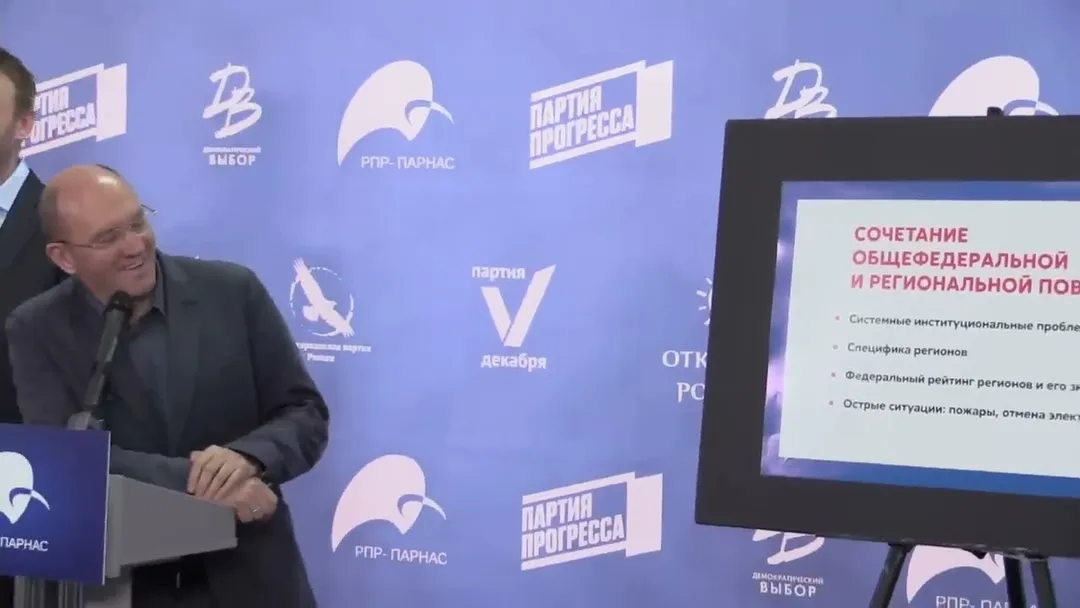
finally, on combining the federal and
regional agendas in our
campaign: of course, there are some urgent
current issues, such as the ongoing wildfires,
or, as was very successfully done here, the issue
of the cancellation of suburban trains. These are all
urgent current
topics.
Yes, but it seems to me that it is very important that
when we address people's problems at the
local level, whether we are talking about the system of
education or healthcare,
we explain
to people that there are systemic
institutional problems at the
federal level, on the resolution of which
depends
for example,
healthcare. The healthcare reform has not worked;
it turned out not to be properly aligned
financially between the federal and
regional levels, and we must
explain to people that until
institutional decisions are made at the
federal level, the problem of
healthcare locally cannot be
resolved. And second, as Alexei has already
mentioned, there is the situation in the region...
It was possible to attract substantial investment to the region,
including foreign investment in the auto industry, but we
must explain to local people that
completely economically unjustified
political decisions by the authorities at the
federal level in the sphere of foreign policy
led to the creation of
a man-made crisis that has
directly affected the residents of
the Kaluga Region, because there the
problem of unemployment is extremely acute,
since all these industrial enterprises there
in the region are closing, and all this
this
highly qualified workforce now
needs to be employed somewhere, and we
must clearly convey to people that this is
the result of the federal authorities' policies.
Thus, the combination of federal and
local issues will give us the opportunity
to win the trust of citizens locally, and we
will certainly find people who will be
capable of, first, approaching things professionally
and expertly when dealing with specific
issues, and who will be willing to do everything necessary
to represent the interests of people on the ground.
Thank you, and let me give the floor
to the next speaker. This is Vladimir
Milov, the leader and head
of Democratic Choice. Vladimir,
please. Thank you, Konstantin. I will share a few thoughts
on the substance of the agenda, because it is
very important.
First of all,
people respond to very concrete,
pragmatic ideas that actually
reflect the pressing needs
of voters in specific regions.
First, of course, above all,
it is the fight against monopolism and clan-based rule.
Take Novosibirsk and Kaluga, for example.
These regions are far apart
geographically, but the situation there is very similar.
There in Kaluga, for example, Governor
Artamonov has been in office since time immemorial, first as
the first deputy...
a kind of regional mini-Brezhnev (a reference to Leonid Brezhnev, the long-serving Soviet leader),
and naturally everything has been built entirely around him.
All local businesses are tied to his inner circle,
and naturally everything has been cleared of
even basic competition. A similar
situation exists in Novosibirsk, where Governor
Gorodetsky has only recently taken office, but before that
he served three full terms as mayor, and before that
he was also first deputy there, and so on. In other words,
it is all the same faces
who have truly shut down social
and economic mobility, the opportunities for
competition, planting their monopoly everywhere.
We will fight for political turnover instead of clan rule.
We will fight to bring a breath of fresh air
into regional and local
politics, so that the floodgates are opened for
normal competition. Of course, we will also
fight for a redistribution of tax revenues
from the federal center to the regions
and to municipalities. You know that today
both the regions and municipal governments in our country
have been robbed as a result of harsh
fiscal centralization, which for more than 10 years
has been carried out.
And that, essentially, is one of the ideas.
Please understand us correctly: there are still many
substantive issues we need to discuss further. Yes, but
what we and our colleagues in the party
will be proposing to our coalition
partners is simple: any faction, or
even just a single deputy in a regional legislative assembly
who gets elected should immediately submit
a proposal to introduce
to the State Duma, on behalf of
the regional legislature, amendments to
the Budget Code. We will simply draft them
specifically—yes—so that taxes are returned to
the regions and to municipalities.
That immediately makes local political debate
much more compelling, in a way,
because it will instantly become clear which of
the parties in power do not actually want
to return the excessively extracted taxes to the
region. Of course, we will also propose a broad
anti-crisis agenda of our own, and in fact
for example, if you look at
regional budgets, there is plenty there
that can be cut—for example, enormous, completely
unsustainable spending on supporting
media outlets, whose only real purpose is this:
these local media outlets—just read them—they
are basically worthless; for the most part, they
are engaged in praising governors,
mayors, and ruling officials from United
Russia. There are also huge expenditures on all kinds of
unnecessary economic megaprojects funded from
the budget. We propose reallocating
this money to support socially
vulnerable workers who
are being laid off as a result of, for example,
businesses collapsing because of the crisis—
a crisis created by the authorities, created by
United Russia. We propose sharply
reducing the pressure—simply freeing
small and medium-sized businesses from all kinds of pressure, burdens,
shutdowns, and so on. Small and medium-sized
businesses are, unfortunately, exactly what
regional authorities are actively targeting. We want
to give small businesses a chance to live
and breathe. We will have many such
substantive points. I did not put together
slides, because I think we still need
to refine them further before bringing them
to completion. But we want to show that we
have a substantive agenda. We have
something meaningful to present to people, specifically on local
issues that concern residents
of these particular regions. So I am
confident that our substantive program will be
a rich one, and I now give the floor to
Leonid Volkov, a member of the party’s Central
Council.
of Progress. Good afternoon, and a few words about
political tactics. After three
presentations on political strategy, we
already have a fairly clear agenda, agreed
among our coalition
partners, for how exactly we
will put together the lists that
will be able to perform successfully in these three regions
in the elections.
Why are we confident that we can
count on success not only in
Moscow, not only in the very largest cities?
Novosibirsk is a large city; Kaluga
and Kostroma are not as large, yet we can
still perform successfully. The strategy has already
been discussed: it is a combination of the federal
and regional agendas, with an emphasis, of course,
on specific regional problems. This also includes, in terms of tactics,
the tactic of
forming a people’s
list. What matters greatly to us, first of all, is
to identify
people who are independent, well-known, and influential
in their regions—people whom voters are ready
to support. And second, perhaps even more importantly,
people for whom activists
are ready to work, for whom activists are ready
to drop all their own affairs over the summer
and go volunteer—hand out leaflets, stand
in pickets, inform people, and so on. We, in
general, want
to combine the experience of what are probably the two
most successful
major opposition projects of recent
years, taking the best from that experience. This is
the experience of the 2013 Moscow mayoral campaign,
built first and foremost on
broad volunteer involvement. We know
that there, in large cities, especially in
Novosibirsk, but also to a significant extent in
Kaluga and Kostroma, we will find quite
a lot of people who, together with us,
will create that kind of momentum, create
political
pressure and a presence in the streets, and will be able
to tell other city residents—people just like them—
about our list. And we
will also adopt the best
from the experience of the Coordination Council elections.
Remember all those debates, the political
compass, that whole vivid pre-election
story that helped, in fact,
bring out some new faces and show
that there are actually many substantive, serious people
who share our ideas—very many of them.
There were many of them then at the federal level,
and there are many in every region as well. The nomination of
candidates by the voters themselves will be
The key idea behind our primaries is active
substantive programming in the form of debates
and everything else, unlike the way it is done by
United Russia at its own events. And of course
then there will be a vote, which will take place roughly
in mid-June. We will begin immediately after
the May holidays; they will last a month. And
by mid-June we will move on to
the vote to form the list. Why
this
list and this campaign have prospects, and it
can count on strong results
This is
an example of fresh polling data from
one of the regions, Novosibirsk
and we are continuing to study the other two intensively
as well. We will have data soon too
Here is an example: 91% consider corruption
one of the most pressing problems, which
means our agenda fits the region’s expectations
quite well. And just as we did this
in the Moscow elections
we will be able to do the same in
Novosibirsk, Kostroma, and Kaluga
We know how to explain to voters
the connection between every pothole in the road
and corruption cases involving the local authorities and
the federal authorities, and at the same time the political field is
actually completely empty
where we can simply find our
voter and bring them to the polls
through an active campaign. Nearly 60% are hearing
about the upcoming elections for the first time, and 30% even
of those who have heard
still have no idea at all
whom they will vote for. So, aside from
the fact that we will of course compete for
the electorate of other parties, we have nearly
three-quarters of the region’s voters who so far
have not been reached at all, and with whom
we will work. We are ready to do this
we know how to do it, we will run a vivid campaign
and achieve a strong result. Thank you
very much, friends. If there are any questions, we
are ready to answer them
Please. Rey
How ready are the leaders of those parties
that joined the coalition to fight
for victory?
Well, let Vladimir answer for himself
As I already said, the people’s list—any
Muscovites, even federal-level figures, those who
want to be vote-pullers, and those who do not
want to be—
there is one people’s-list primary. Even if
you are some ultra-super Muscovite who
won an Oscar and, I don’t know, heads
a federal party, only through
the primaries. My colleagues will add more, but for now
we are not planning and do not see much
point in sending Moscow teams into these
cities, and I am sure that cities
as strong and independent as Novosibirsk
would of course not be happy about that at all. We
have people on the ground—not with us, but there are
people locally who can head
such lists. Vladimir
Just a very brief point: this
does not exclude party leaders from taking part in
the election campaign, that is
It is absolutely obvious that both Alexei
Navalny and Mikhail Kasyanov and Vladimir
Milov will all take an active part in
the campaign, travel to the relevant
regions, meet with
people, and promote ideas
this
In some cases, Moscow leaders may also
run for office. But my prediction is that not this
year. The specifics are simply such that in these
regions there are their own promising
regional politicians; they know what
to do, and it is important to give them room. We
for example, in our party, have a simple
principle with colleagues: you run where you live. I
ran twice for deputy
of the Moscow City Duma in my district of Moscow, where I
have lived for more than 30 years. Yes, both times I
was barred from the election, but I will run
again next time, specifically in
next year for the State Duma
in a single-member district. I do not think that
this year we should expect any major
vote-puller nominations from our coalition
Again, I agree with my colleagues that
the lineup will be determined by the primaries. But
my prediction is that it will mostly be
local politicians. I want to add
that the practice of using vote-pullers is not about
us at all. Nemtsov headed the PARNAS list in
Yaroslavl, but he was not a vote-puller; he
headed it not in order to hand over the mandate, but
in order to then sit in the Yaroslavl Duma
and work like hell. Each of the
Moscow leaders of the coalition will assess for themselves
their readiness to work in the same way
in Siberia, Kostroma, or Kaluga; if they
feel that readiness in themselves, they will go
and take part in the primary, if all goes well
As for the participation of Moscow leaders
they will participate. As for me, I do not know
how long I will still have the ability
to travel, to leave Moscow at all. You
know that I have that problem. But
everyone will go to Novosibirsk, to Kaluga, to
Kostroma, into courtyards and neighborhoods, shake hands
and meet people, as one is supposed to do in
a real election campaign, that is
we will move away from the format where
the regions are left to fend for themselves and forgotten during the campaign
Everyone will go, and everyone will provide the necessary
help, all that is needed. Next question
please
Regarding the court hearing: if you are
affected tomorrow or in the future, how will that affect things?
Some other person will be standing here instead of me
the remaining three
the remaining members of the coalition
will continue working as before, and
my physical inability to take part
somewhere, I am sure, it will not hurt; my colleagues
will be able to do everything. We, of course, understand
that the level will be more serious
of resistance, precisely because
Answering the first part of the question, there is every
chance; for us it is important to overcome these
barriers; for us it is important to show that
for the first time in 13 years, a coalition has emerged and
started clearing the barriers and gaining
political representation. You
may know that today
the head of the Novosibirsk branch
of RPR-PARNAS appealed to the Investigative Committee in connection with
statements containing direct threats to his life. He
has recordings of those statements. They
tried to burn his car literally this
night, so we understand perfectly well that
the resistance will come along
administrative lines, along the lines of
what everyone understands: there is a huge
number of voters who are unrepresented,
a huge number of people who, on all
issues, are dissatisfied with what is happening,
who understand that Russia should
develop along a different path. Who
represents their interests? Show me even
one party or one deputy who
directly says: I support a European
path of development for Russia, I support democracy,
independent courts, honest media. Even here,
those who formally belong to the opposition
on these three most important basic
points make all sorts of
reservations; we do not. There are many people
who do not want anyone to make
reservations, and we are ready to rely on these people.
These people exist, and I am confident in our success.
Next question.
Please, I
will answer. It is not actually such a difficult
question.
The issue is simply in
which regions have regional
campaigns. We examined all these regions quite
carefully from a political
and sociological point of view; we looked at
their
electoral support for United Russia,
for opposition parties, at the cost
of running a campaign, distance from Moscow,
at the political culture, so to speak,
how much it is
um, accepted or not accepted
to falsify elections. In Russia, unfortunately, this is
very important to take into
account, as well as how many strong
local leaders, activists, people
and potential candidates we have there. And finally, another
last important factor is what
percentage of the population is urban, and how much
the regional capital accounts for a substantial share
of the region’s population. Well, so to speak,
it is clear why—because, so to speak,
we want to run a vivid, compact,
low-cost campaign within cities; in
some regions we simply
would not have enough strength and resources. Well,
if you apply these criteria and
carry out these elementary
calculations, then in fact
anyone who understands even a little about
Russian electoral politics would
have arrived at the same
list. We do not know of any such setbacks so far.
But we do have positive experience
with fundraising in the Moscow mayoral election, and we
are confident that even taking into account what we
see—the authorities are constantly trying to
cut off fundraising methods connected
with electronic money and so on—we
know that cases are being opened against
activists. We are confident that these campaigns
can be financed simply through
money from ordinary people. I just wanted to add
to why these regions were chosen:
because they are very different. It is important that
the ideological, political, and
technological approaches that we test
in this campaign will be applied in
the 2016 elections. These regions
are very different: in Kaluga, you can
bring election observers from Moscow; to
Novosibirsk, you cannot bring anyone from Moscow.
Kaluga is industry;
Kostroma is now a depressed
region, absolutely; Novosibirsk is an academic/scientific
hub with science towns; again, Kostroma is completely different.
These are different regions in which there will be
different campaigns, different amounts of money,
and different levels of difficulty. Therefore, we will be able
to work through all the technologies that
we will later be able to apply across the country, everywhere
from Vladivostok to the Moscow Region.
Next question.
Please, I wanted to ask you about
attention to social issues. Specifically,
how exactly are you going to address this topic?
And, more specifically,
there is now a discussion about the pension
age, about raising it, and so on. Is there
some position on this—how will you
speak on it?
Well, it is obvious that social
issues in regional elections
will occupy, uh, one of the central
places, because it is at the local level that people encounter
this sphere first and foremost. The two main
areas are healthcare and
education. Obviously, they will
be at the center of attention, and it is obvious
that the reform now underway, launched at full
speed,
the healthcare reform, has stalled and
has been reduced to so-called optimization
of the budget-funded network. People are dissatisfied; people
are justifiably complaining about the situation that has developed.
the situation, because the quality of services
in healthcare provided at
the state's expense has sharply—well, if not
declined, then at the very least it is not improving
roughly the same situation exists in the field of
education, so there are also many
nuances here that rise to the broader public
federal
agenda. The issue of the retirement age and
pension reform is absolutely
federal in nature; there is no
regional
specificity here. The situation with the pension system
concerns all citizens regardless of
which regions they live in. We
have a firm position here that
the funded component should
remain. But the federal authorities have made such a mess of it
that
it requires an entirely separate discussion
on this topic. For now, I would prefer not to
start it. Mikhail, an important question. With your permission,
colleagues, I'll give a somewhat more detailed answer.
Point one: first of all, throughout our entire
budget system, both at the federal
level and the regional level, there is a problem of
this kind of bloated appendage that
has built up over the past 10-plus years. These are
completely unnecessary expenditures, above all on
the bureaucracy
supporting all sorts of state companies close to officials
and flashy pet projects—that is,
essentially, this is money thrown away
that often produces no return. And third,
these various tricks of theirs, like
supporting state media that
lie to everyone about how good they are and how
wonderfully they do everything. As for
this appendage, the recipe is very simple:
cut it to hell. There is a great deal there
that, with our expertise
and our experience, we can competently
propose cutting without any
consequences. Those funds, plus the funds
that we hope to secure from
a redistribution of taxes from
the federal center, should be directed to
social programs. Unfortunately, the authorities
today are doing exactly the opposite:
for themselves, for the beloved
bureaucracy and the structures close to it,
they find extra fat to trim elsewhere
by cutting social programs. We are
categorically against this. As for
social programs in education
and healthcare, here is the important
point: along with the reduction of
staff, bonuses, and
funding, bureaucratic
pressure has increased. In recent years they have been forced
to fill out all sorts of reporting forms, so
in reality they spend more time writing than
working—teachers, doctors, and so
on. We are categorically against such a
system. Along with increasing, rather than reducing,
funding, we consider it very important
to strip officials of the authority
to pressure this system and instead introduce
some form of professional oversight—that is,
communities of medical professionals
and teachers that would set
standards and so on, instead of
bureaucrats doing it. This is what we will
propose: to remove this bureaucratic pressure.
And on the retirement age, we have not
agreed on a single common position, but I
will state mine: I am categorically against even
talking about raising the retirement
age. This is a fundamental issue. It is not
an accounting issue or a fiscal issue.
A high retirement age exists in
countries where life expectancy is dramatically
higher and where the overall health situation is
dramatically better, and
people there, after 60, are not running from
pharmacy to pharmacy because they are all ill; there
the situation is normal. Yes, they can
afford to keep working. Here, our
authorities have not met these basic requirements
in terms of life expectancy and
public health, yet they want the retirement
age to be like in Europe. First make
everything else like it is in Europe. These are
simply the basic requirements for any
normal, responsible government. Thank you.
You clearly had a question about money.
Will there be limits on funding, or
will some personal funds of coalition participants
be involved, for example?
It should be understood that in any case
financing an election campaign is
something very
strictly confined within legal boundaries.
Nevertheless, despite this, during
for example, my election
campaign for mayor of Moscow, we raised 103
million rubles (about 1.1 million USD), with every person providing
passport details and so on. Therefore,
the emphasis, of course,
in fundraising will be specifically on
this kind of grassroots fundraising from individuals. As for
money from coalition participants, well, each
member of the coalition will make some kind of contribution
in its own way. As for, say, money
from Open Russia and so on, it should
be understood that Khodorkovsky, even if he
wanted to finance something, would find it
extremely difficult to do so in his
legal situation and given
the current legislation, yes.
There will be a question about the economic
program, naturally.
Well, I am sure that by the summer, by the
launch of all the campaigns—I mean
around late June or early July—the coalition
will come forward with a unified platform for participation in
the 2016 elections
and will already be formed as
specific sections of this common platform
with concrete political positions for
the 2015 elections in the regions
that were selected. That is, we were talking
about having a general federal framework
for the political content of participation in these
elections, but there are regional specifics, and
the most important element will be the content
the substance tailored specifically
to each individual region. Am I
understanding correctly that this is based
on— No, this will be a joint effort. I
am sure
and the main participants in the coalition
have something to contribute in terms of intellectual
input to the preparation of this platform
we are an equal partnership, we
really are. I am sure that everyone brings
their own contribution. At the same time, our shared
ideological principles are reflected in
the coalition agreement, and a general
election platform is needed for the
2016 elections. This time, again, I
just want to draw your attention: these are three
campaigns in the regions; they are regional
campaigns with their own specifics. This is not
just something written up in Moscow
where everything was invented, from the logo
to the brand colors. These are
regional people; this is a people’s list that
also largely reflects
the political preferences of the people included
on that list, but within the framework of our
basic ideological
coalition agreement. Next
question, please. In the handout we were given,
it says that as a rule, the winner of the primary
takes first place on the electoral
list and also gets the right to
choose a single-member district for themselves first.
What exceptions can there be to this
rule? Well, for example, if they do not want to run in a
single-member district. Well, yes, it is clear that
it is impossible to regulate everything. We will always
be guided by the principle of, let’s say,
reasonable sufficiency. We do not want
to write a set of rules with 200 points so that
later someone can say, “Look, here in Article
12.1 of the regulations...” We proceed from the assumption that
all participants in the primaries, so to speak,
are adults who will sit down and
ultimately agree on the distribution of
certain territorial subgroups and all
these legal and technical
details, taking into account the need to maximize, well,
the coalition’s result itself. That is,
roughly speaking, it is clear that if
some local figure has built up support
in a particular district and they
can prove it, then it may be more important
to put them forward in that
territorial subgroup for the coalition’s overall
success. So that reservation was made
in order to give us room
for this kind of natural
and normal coalition discussions. In addition,
there is also an important purely technical issue.
Suppose a person wins the
primary, and then it turns out that they
do not have enough documents for registration
or our investigations department finds—
sorry, that they have a bank account in
another country. In other words, the person
simply cannot run anywhere for technical reasons.
To put the list at risk—and have the entire
list removed because of them—therefore here
simply because of bureaucracy and complex
legal issues—just imagine, in
Novosibirsk, the list must contain 79
people. We have to put 79 people on the
list, and that is the minimum number. Despite
the fact that there are obviously nowhere near that many winnable seats.
But we still need
to prepare documents for 79 people,
certificates, their
property statements, declarations—all of that.
So we can depart from the primary principle
only if one of the participants
cannot be included on the list for objective
reasons. Next question.
[music]
who was the main driving force behind this
democratic coalition. Simply put, if
this tragedy had not happened, Boris Nemtsov would be standing
here with us now. I think this
act of terror pushed everyone toward more
active steps and once again
demonstrated that although
we are a coalition and not a single party, and we do have
differences on one issue or another,
against the backdrop of what is happening, those
differences cannot be considered
fundamental. Last question, we are
wrapping up, please. Yes, two questions.
First, on the technical side: in the lists, should half of the
members be...?
This is a technical issue, but...
And the second question: your opponents there
will
surely
try to bring up the issue of Crimea in the agenda
and pull certain individual statements out of context.
How will you deal with that? I will answer
the technical question first. So, once
again, as of today, electoral
legislation for regional elections
—and federal elections as well—is structured
in such a way that it contains
an enormous number of bureaucratic
barriers. For example, the case of
the Novosibirsk Region has already been mentioned.
At minimum, the list must contain 79
people, even though only 38 seats are being contested,
and even theoretically, with a
100 percent result, a party cannot
win more than 38 seats. And in reality,
I do not know, probably under
the most favorable scenario, our coalition could
count on getting 10–15 seats there if we
get 30% of the vote there. Even so, we
have to put together a stack like this
of documents and bring in paperwork for at least 79
people, though 100 would be better.
Because if we are left with fewer than
79 names on the list after, say, some are knocked out
because of paperwork errors, then our
list
is removed in its entirety. That means
we have to submit documents for
100 people, even though in substance, well,
the top of the list will really be about 10–15 people.
That is why the regulations, which in particular
we handed out to you—the primary rules—
include a provision stating that
the primary will in fact determine
the slots corresponding to 40%
of the seats. So if, say, there are 38
mandates at stake, then 40% of 38, as it is not hard
to calculate, is 15. So we will
be contesting the first 15 places, and everything
below that, as everyone does, will be
well, filled, so to speak, with some
technical candidates. In particular, this
will allow us to meet the requirement for
50%
party representation
without any problems, because we will still
have to add another 85 people at the bottom anyway.
And all of them will be party members,
while it is clear that none of
them will have any chance of getting into the
regional legislative assembly. This is simply compliance with
this absurd bureaucratic barrier.
There are many such traps, but we know them all.
As for the use of sharp issues by the media or
by anyone else, or
themes—please, not just Nashi activists (pro-Kremlin youth movement members), but any people
can ask any questions. Each of us
has substantive answers
that we are not ashamed of, on any
issue. But you see, just as
this 86% is a kind of fiction
that exists only in VTsIOM (the Russian Public Opinion Research Center) polls and not in
real life, so too here the question is:
Why do the roads in Kostroma resemble
Luhansk after shelling?
You cannot answer that by saying, 'But at least
Crimea is ours.' We are absolutely convinced that there is
a real agenda connected with
corruption, connected with censorship at
the regional level, connected
simply with enormous inflation, a low
standard of living, unaffordable housing,
and a collapsing housing and utilities system, for which every year
federal targeted programs are adopted.
It is repeatedly declared that
utility rates must be frozen, that the increases must stop
and people must be protected, yet everything keeps happening
in exactly the same way. Therefore, we are confident that
the real agenda will completely push aside
these sort of Moscow-made
phantoms—the idea that we should endlessly discuss
Ukraine. But we are also ready to discuss Ukraine, the war, and the deaths of
people. So once again,
colleagues, I am concluding our
press conference. I would like
to thank you all for coming. I
am sure that our coalition and the members of our
people’s list will go out into the streets of the cities
and answer absolutely every question. I
am sure that we will receive broad support.
If we are allowed to take part in the elections, we
will make sure that ordinary people—
a huge number of ordinary people—
finally get political
representation, first in their
regions, then in the State Duma (the lower house of Russia’s parliament),
and then we will win a majority in the
State Duma, and we will finally
make Russia develop like
a normal European country. Thank you
very much.
Let's go.
