After the arrest. Navalny is back on air at 20:18
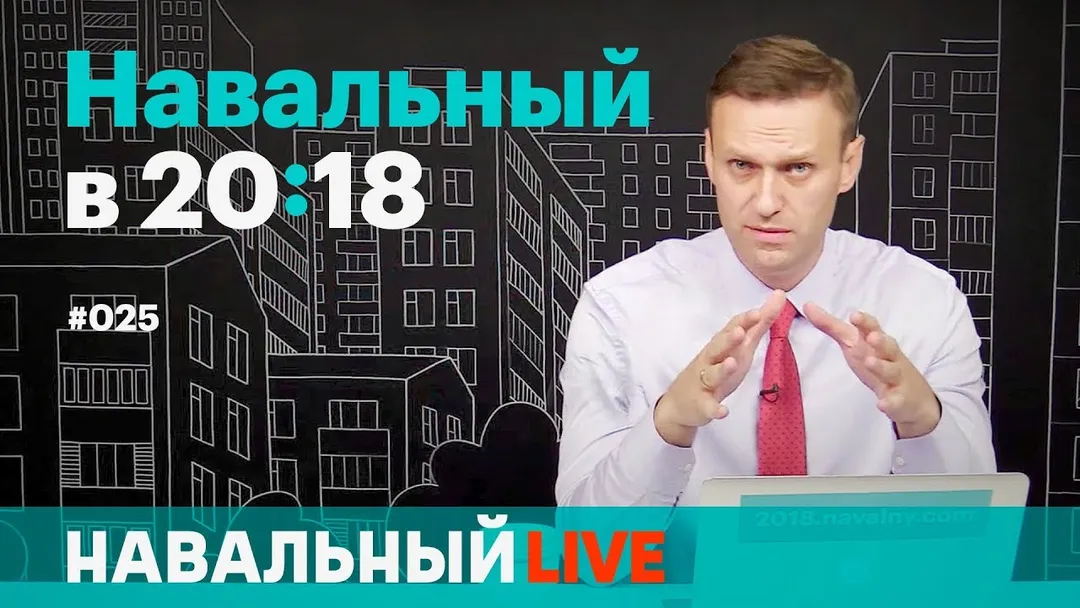
[music]
It’s 8:18 p.m. in Moscow, which means
finally, finally I’m with you live on
the air on the Navalny 2018 program after a 20-
day break
which, however, happened through no fault of my
own. Thank you very much for watching. Please don’t
forget to like our videos.
I came here so I could be with you again.
I missed you terribly. During
this arrest, I realized how important it was for me
to have this program, how important it is to me, including
because, well, if you like, it helps me
put my thoughts in order by talking them through
with you. I probably understand some things better
myself that way. Ask me questions
on Twitter with the hashtag #Navalny2017, and on
VKontakte you can ask too. And of course I’ll start
with my arrest, my
time in the special detention center. There are a huge number
of questions—I can see the questions.
People are asking: how did it go for you there, did everything
go all right? Everything was excellent this
time because I myself asked to be put in a
non-smoking cell. It was my seventh
arrest, and only on the seventh time did I think
to do that and say, guys,
give me a non-smoking cell. It was
wonderful: you lie there, read, and nobody
is smoking around you. Well, that is, a non-smoking
cell means that out of five people, only
one smokes, which is generally quite
bearable. And the best thing
about a non-smoking cell—this is, so to speak, my advice
to everyone, even if you smoke
but not very much: ask them for a
non-smoking cell, because in a non-smoking
cell
you most likely won’t end up with a drug addict.
A drug addict is the main problem: he doesn’t
sleep at night, he paces around, suffers,
struggles, may try to hang himself, he
will bang on the door—and all drug addicts
smoke. If you’re in a non-smoking cell, then
most likely there won’t be a drug addict with you, and you
can sleep peacefully, you’ll be able to
read peacefully. In 20 days, I read 20 books.
There are a lot of questions about which
books I read. I’ll probably write
a special post recommending some of what I
read. Everything went well for me.
Leonid Volkov got out of
detention yesterday—the head of our election
campaign as well.
He got through it fine. It’s actually awful
that during an
election campaign we have to discuss things like
this—and yes, it sounds strange—whether
there were drug addicts, whether it was a non-smoking cell, whether someone served time successfully
or unsuccessfully. But these are the actual realities
of our lives. Why is this happening? Because
we’ve become too big. In fact, the main thing now about our
campaign is
the scale of the enormous political network
we’ve created—
effectively for the first time in 25 years in
Russian politics—because no one
has ever done this before. And it’s not even about me
being some kind of super-
candidate, though I am an excellent candidate, but about the fact
that we built this network, and they are genuinely
afraid of it. Because, well, it’s unpleasant for them to see
these big rallies, unpleasant to see this
large number of people, unpleasant to
see
thousands who are ready to campaign door-
to-door, because the Kremlin
understands: this is a real election
campaign. What is an election campaign supposed to
do? It’s supposed to persuade people. It’s not
about appearing on the internet, not even
about posting clips, not about videos—it’s about
persuading people. We built a system
that can reach and persuade a great many people,
and that’s why they constantly need to
isolate me. And now, as part of
the same strategy, they keep jailing Volkov.
Here’s the map—you can see how many
headquarters we’ve opened all across Russia. He
is supposed to go to Nizhny Novgorod on November 7,
and he has another court hearing there.
There’s a chance they’ll lock him up again for another 20 days,
but this time we’ll be prepared, and
without him none of our processes will
stop. So there’s really nothing good
about these 20-day
detentions. There’s nothing especially extraordinary or terrible about them,
but of course it is a sign of how much they
are afraid. So, guys, once again I want
to say: we’ve done well to build this, we’ve
done well to manage to finance
it, and in general we’ve done well. In the detention center,
everyone supports us. All right, there are a lot
of questions about Maltsev, very, very, very
many questions about Maltsev. So I should
say this: how do I feel about
the “revolution” on 5/11/17?
I support rallies, and I certainly
believe that Maltsev’s people—
I know there are many of them across the country; whatever
city I go to, Artpodgotovka (Maltsev’s movement) always
shows up. It really is
quite an extensive network as well. They
have every right to hold an event on 5
11 17—hold an event on 5 11 17. I
personally support them. But in order to
hold an event well, you need to prepare it
well. As I understand it, the Artpodgotovka movement has
after all spent quite a
long time
working on this preparation, although
of course they are now being hit with
fairly serious repression. So I can
say that the rallies they
want to organize have my full support.
People are writing, “Welcome back, welcome back.”
Thank you very much. What’s the name of the cat in the window?
Ah, yes, there is a cat in the window behind my
with your back to the window, by the way
it's unnamed, but you could call it something
what shoe size do you wear? 45–46
well, of course, of course, a huge number
of questions
guess which new candidate for
president—of course, Ksenia Sobchak—and
everyone wants me to somehow
comment on Ksenia's campaign
Sobchak. Many even say, Alexei,
it kind of seems like you're not very eager to
comment on Ksenia's nomination, and
and to some extent those people are quite right
I've already said quite a lot about Ksenia's campaign in
my—not in the last episode—Navalny 28
in my previous program, you can
find it, watch it, and say once again: Alexei,
how wise you were, you saw it all coming, but
at the moment I have one main, really
the only comment
regarding Ksenia's campaign. It
is this: Ksenia Sobchak,
being
a citizen of the Russian Federation, over
35 years old, and not, thank God, being in
a place of detention, has every
right to put herself forward as a candidate
an adult makes an independent
choice
[music]
the responsibility for that choice lies with her
she made it, she is running in
the presidential election and has every right
to do so. I would very much like to
limit all my comments on this subject
to exactly that formula, because
come on, guys, do we want to be smart or do we
want to be fools? Because if we
keep discussing this endlessly, we'll be
fools. We'll be doing exactly what people
want from us. They want me to
discuss it endlessly, for me to
argue
issue appeals, respond to statements, and so on
some criticism, other criticism, a challenge to
a debate—of course, debates, everything else
that's exactly what the people in the
Kremlin want from me, and I will try to make sure
not to give them that pleasure
Ksenia Sobchak, who has every right
to run—I read, while I was sitting in a cell,
and, and
well, her announcement letter in the newspaper *Vedomosti*
I had a lot of time there
so I had time just to count, it was
interesting: my surname is mentioned there
four times, while the surname Putin is mentioned
once. That's rather interesting. Thank you
very much, Ksenia, for remembering me, but I
unfortunately won't be able to repay in kind
and
I'm not exactly ignoring it, but there are
candidates—Zyuganov, Yavlinsky, and others
various candidates—and if necessary
to speak about them, I will speak about them, of course I
will do all that. We won't keep silent about anyone
or completely ignore anyone, but
let's not be fools, and let's not
play the game that people
expect from us
Together with you, I created this political
structure that I talked about at the very beginning—these
170,000 volunteers, 80 campaign offices—not
for some kind of
engaging in media
stunts, back-and-forth sparring at these
elections
I am interested in one candidate. His name is Putin,
Vladimir Vladimirovich
he is my opponent. He is the country's biggest
corrupt figure. He is the person
who is stealing the future of
Russia, and I am entering this election in order
to fight him, in order
to remove him from power, in order
to build, together with you, a normal,
prosperous Russia. That is the task of my
election campaign. Other candidates
exist—fine, let them—but our
this structure is for something else, wonderful, but
let's not use a cannon to shoot sparrows
and let's not spend it on
things it was simply not
created for. There are a few more things I wanted
to say on this subject, not even
well, they don't concern Sobchak, they don't concern
her at all. There's a question: all right, but
could we support someone else instead?
Say someone really great
appears tomorrow and declares that they are
a real candidate, and
we support them if you're not allowed
to take part in the election. Well, to that question
there are two answers
First: I have the right to run in the election, I have
that right
so if I'm not allowed in, then these will no longer
be elections. And second, in this
context, more importantly: if you're
a serious candidate, you shouldn't
announce your candidacy five months before
the election campaign, when one of those
months even falls over New Year. Why are we
going into this election? What for? You nominated
me, you fund the campaign
you support it, you spend your time—for
what? You do it so that I actually
fight, so that I actually
campaign among people, right? That's why
you're doing it. That's why we honestly launched
the campaign more than a year in advance. Over the course of
many months, we built the system
I assure you, and I say this responsibly:
it is impossible to collect 300,000 signatures
in the remaining five months if you don't have
the infrastructure. It's impossible
and even 100,000 signatures would be very difficult
to collect. So any great candidate
who has just appeared and doesn't have
everything we've been building for the past nine months
he can't campaign—so why go into
an election if you can't campaign, if you can't
persuade even the grandmothers sitting on a bench? You
don't have the infrastructure for that,
you don't have campaign offices for that, and in five months
it's impossible to build them, no matter how much money you have.
So I can simply say
with regard to all the candidates at once:
I have no doubt, by the way—though maybe
I'm mistaken
that more candidates will appear, as others have,
but they have to appear—that's logical. But
honestly, guys, let's admit to ourselves:
did we really think that as things got closer,
the Kremlin wouldn't come up with something
interesting for us? It will, and many more times
you and I will, many times over in this
election, be surprised, horrified, and run into
staggering
lies, staggering hypocrisy,
endless deceit—we'll still see
a lot more in this election
campaign. They'll come up with plenty more. So
the thing is, any candidate
may appear, but you only need to ask
them one question: my friend, how are you going to
campaign? Where are your campaign offices? Where are your
volunteers? And once again
I come back to what matters most:
what has happened so far with this election, and
maybe even election day itself will be
less important than this enormous
structure that we have actually
created. For the first time, we proved to ourselves and
to everyone else that such a structure can
be assembled, that it can be built without help
from the Kremlin, without any huge sums of money. All
of this can be done—and we did it. And
Maxim, send greetings to Magnitogorsk.
Greetings to Magnitogorsk. If I ask people
to come out to a rally against air
pollution, I won't get expelled, right? For your
volunteering at your campaign office, asks
Maxim. They won't expel you. They may try to intimidate you,
but they definitely won't expel you for that.
At least, we have not had—
we have never seen, ever, any kind of
similar examples. To wrap up this topic, two
things, guys.
You need to remember them, because right now
this whole discussion
about the election—who's running, who's not, whether we should
boycott it or not boycott it,
whether it's acceptable to take part in an election
where your candidate was barred and you were
offered a different one—in the course of
this discussion, two themes will constantly
keep coming up. I want to emphasize
them, because people will
mislead you about this. In every
election they mislead people, and this time they
will do it again. So, two points.
The first point goes like this: how can
you not take part in the election? You have to
use the opportunities of the election
campaign—you can't ignore them, it's
very important. And here you should say to those
who say that: use them right now.
What exactly
opportunities does an election campaign
open up for you that you don't already have now?
Can't you campaign to people? You can.
Can't you make videos, give speeches, make
statements, do something? Of course you can.
You can do all of that. More than that,
before the formal election campaign
even begins, it's actually
easier to do it, because you don't need
an election fund, you don't need
a special licensed printer, your hands are
completely untied—so do something, at least.
What special opportunities do you need?
I don't know—take the Yabloko party, for example.
What opportunities does it have during elections
that it doesn't have between elections? There are no such opportunities.
So most often, this is really just
empty chatter. When people do nothing between
elections, they won't have
any opportunities during the election either. And
the second thing is similar. People will
say: but how can that be? We have to do
something—on election day, after all.
A boycott is
just lying on the stove (a Russian idiom meaning doing nothing), while we'll be doing something.
And then the immediate question arises: but what exactly are you
doing? What does your 'doing something' consist of?
We say that we are against
a boycott; of course we're in favor of participating in elections.
But all candidates must be allowed onto the ballot.
And if a candidate who has the
full legal and moral right
to take part in the election is not allowed to run,
then it isn't an election. And the point is not that
the election should be boycotted.
The point is that you should not take part in a disgraceful
procedure where our candidate has not been allowed to run
and we are being asked to vote for someone
we may not even want to vote for.
So the point will not be that
we will run a broad, powerful
campaign to persuade people and prove to them
that this cannot be called an election,
that taking part in it is shameful, disgraceful,
and impossible—that is what it will be about. Unfortunately,
and, let's be honest,
I don't want to insult anyone or name names,
but when was the last time, in our
elections, that parties or candidates actually
did anything at all? Remember, there was once
Mikhail Prokhorov in 2012, and he
over the course of his entire election campaign
held, if I'm not mistaken, eight meetings with
voters—or six, or three, whatever.
And everyone said: now that's what real work
in an election looks like. As for a boycott—what, just go
do nothing? But I, for one, have work to do...
held six meetings with voters
So all candidates have
the opportunity to do something right now
just as I am trying to do, because
you are funding my campaign, and right now I am
speaking live on air
tomorrow I’m leaving for the city of Ivanovo, and I have
a rally and meeting with voters there at 6:00 p.m.
Come by, by the way.
the city of Ivanovo
at the Krasnaya Talka Memorial. From Ivanovo I will
go to Kursk, and in the square by the Merkuriy Stadium
there will be another meeting of mine. From
Kursk I will go to Tambov, and on the grounds of
the Bashnya shopping center there will be another
rally and meeting with voters. Any
candidate has the opportunity to do this
but for some reason I don’t see anyone
actually doing it. Of course, we
shouldn’t be filled with either despair or anger, because
there’s a lot of talk on this subject: whom will you
support, whom won’t you support, what will you
do if there is a boycott, what if
there is no boycott — this endless
discussion keeps raising one question: why
aren’t you working? If you are
a candidate, then go ahead — like Navalny —
get moving, go to Ivanovo, and from Ivanovo
to Kursk.
If you don’t do that, then overall
you are not real candidates and have no
right to count on any support. I
believe that I can count on your
support because I am working. Let me
see what you’ve written to me here — a very
large number already
I can see a huge number of questions have come in. Will you stream
on Twitch? You promised — asks
Reanimator4. Yes, I will. I still hope
that this will take place next Tuesday,
this sort of public online game of mine for
us. It’s an important thing, and we’ll try there
to raise some money, and also entertain you, and
have some fun ourselves.
So next Tuesday I’ll be doing that.
About RosYama (an anti-corruption road repair project): I sent a complaint through
the website about a pothole to the traffic police, but the pothole still hasn’t been
repaired. What should I do? Since we’re on the subject,
remember, we have such a project — google it,
RosYama, it’ll come right up. This is a popular
question that comes up quite often. I just
want to say that we have actually
done a small redesign there and updated the site,
and now there is a feature there called
People’s Oversight, and any user
can use it and, figuratively speaking,
poke negligent officials into action.
All right, let’s look at more questions. “What is this stupid
stubbornness?” Osip Berkovich reproaches me. “Not to have
a backup plan B? Dear Osip,
please tell me, why do we need a plan B? What
exactly should plan B consist of? Our
plan A is to participate in the election, which we
have every right to do. Elections are
the plan.
And in fact, in an election we
participate in order to win, in order
to bring a large number of people into the political process,
and that is
plan A — and really the only plan,
because all these plan Bs are some kind of
contrivances and machinations, and they are machinations
indeed; they are already something absolutely
secondary or tertiary. What will we
do if elections are about simple
activity — campaigning and voting? That’s
what we are engaged in, and we have every right
to do it. How many more signatures are needed
for Panfilova to let you onto the ballot?
asks Alexei Alex Boss. She doesn’t
— Panfilova —
decide that. Panfilova is simply
a Putin functionary who says whatever
she is told to say by the Presidential Administration.
For me to be allowed onto the ballot,
it’s not even signatures that are needed — what’s needed is public
opinion, this very sense
of political reality that in the Kremlin, including
through opinion polls, will show that
it is impossible not to let me run. This cannot be measured
by purely quantitative indicators, but it
can be done, and we will, we will
try to achieve it.
Right before the broadcast, an amazing thing
happened — let me find it. So, in Ivanovo,
I’m speaking tomorrow, and today
schoolchildren published a recording involving
a ninth-grade student from School No. 14; he has
this audio recording posted on VKontakte (a Russian social network). Well,
it’s the same thing: some people come in and
hold talks with all the older
students, telling them how
they must not go there. And there is this
wonderful dialogue:
“How old are you, young man?”
The teacher says: “Fifteen?”
“Then sit quietly at your desk, keep your nose
in your textbooks and notebooks. Do you
have the right to vote? No, you don’t.” There it is —
you see, that very neatly
captures our main
conflict with them, and their main method
of fighting us, their main message:
“Stick your noses in your textbooks; you
have no voice at all — whether you’re 15 or 18, it doesn’t matter,”
no matter what age. Listen to this —
it’s an absolutely astonishing dialogue. And so
I would really like it if anyone
watching from Ivanovo would go and
try to spread this around so that
city residents as well
can see how the authorities
treat them — not even me, but them.
Just think: a teacher stands there
in front of a student whom she is actually
supposed to educate, and says, “You
stick your nose in your notebook; you
have no rights here whatsoever.” That’s it.
So what kind of citizens does it want to raise?
This regime. Next, an important point:
this happened for me, for my brother, for
my family, and in general for my
political work: we won in the
European Court. Huge thanks to everyone
who supported me. You can see this kind of
headline on the main page—this case is very
important. It legally proved that the case,
the Yves Rocher case, had in fact been fabricated.
That is exactly what happened, because they recognized the so-
called Article 7, which
states that there was not even any subject matter
of a crime—in other words, effectively
the European Court said: guys, you
fabricated the case, and then also staged
an unfair trial, so everything must
be overturned. You must pay
compensation to the Navalny brothers, and this is already
our second victory in the European Court in
major criminal cases like this. There have
also been many smaller victories
in administrative cases. And pay attention,
guys, because the Kremlin constantly—and
not just the Kremlin, but even some
supposedly liberal media outlets—write, well,
that Navalny cannot run because
he has a suspended sentence. They
are obliged to write that Navalny is not
being allowed to run despite the fact that
he won in court
in both cases and proved that they were fabri-
cated.
This is the most important thing, because even
under Russian law, I
have every right to run, because
we had all these fabricated
cases overturned. I have the rulings in my hands, while they
have nothing. I have a decision in my hands
stating that all of this
their whole legal
casuistry should be scrapped. So, what do you think of Yandex?
Vitalik Yaroybetin asks. I think poorly of it.
Oleg Navalny is now sitting in something like
North Korea (the DPRK)—namely,
in prison. What do you think it is like for him now?
What is it like to be sitting there at all? He served three
years, two of them in solitary confinement, and now
he is still there, even though he has a document in his hands
—not just a document, but a ruling—
from the European Court saying that Oleg
is completely innocent and should be
released, but they still will not let him out. This is
the situation we have found ourselves in, and of course
we will now appeal to the Supreme
Court, file cassation appeals, and demand
that he be released, because
there is a European Court ruling, yet he
is still sitting in those prison cells.
Do you think Roizman would be a good
competitor? Pavel asks me.
Well, Roizman is an outstanding politician
and a terrific guy, and an excellent mayor
of a city, but as far as I understand, he is not
planning to take part in the presidential
election.
Alexei, I’m 20 years old, I’m studying and working abroad,
and I gave up Russian citizenship. Will I be able
to get it back after you win
the election? Well, I very much hope so. One of the
reasons I am running is so that all
the people who left Russia—and there are
huge numbers of them, working-age people—
who leave and work abroad, we
would like them to return. By the
way, the simplest way to increase
economic growth is simply for those several
hundred thousand people to return to Russia.
If they start working here, our economy will immediately
make a huge leap upward. And so,
despite the fact that you gave up
your citizenship—Anton Pavlov writes—
if you submit the documents, your
Russian citizenship will be restored, if you
previously had it. You are also asking about
Poklonskaya, if I understood correctly.
She had been reminding people about Chaika,
and then seemed to come out in your defense—why?
Well, there are a lot of very funny headlines right now
about Poklonskaya coming out
on Navalny’s side,
doing something together with Navalny, and so on.
It’s a simple story.
Prosecutor General Chaika spoke rather
dismissively about Poklonskaya, and
did so in a personally contemptuous way,
in connection with their inquiries regarding the film
*Matilda*, and Poklonskaya, to her credit,
turned out not to be so timid
a woman. Although I could say many
negative things here
about Poklonskaya—her activities are very
strange—but she really did, you can see it on my
blog, right there on Red Square,
record a video where she directly goes after Chaika,
basically saying: so, you care
about your children, who
are enriching themselves, more than the interests of the country?
In other words, she wraps all of this
in her own sacred-monarchy rhetoric and all that
about *Matilda*, but if you throw out that nonsense,
it is practically a dissident speech. It is very
interesting to see what will happen because of it.
Very interesting. I mean, she basically
just went rogue and really
—sorry for switching into this
slang—went rogue and jumped on Chaika.
That is what is happening, and of course
we should grab a bucket of popcorn each
and watch what happens next, because
it is genuinely very interesting. What do you
think about shutting down propaganda
news outlets? Someone asks on Twitter about RT.
I think that would be wonderful.
I support it, and honestly, the channel
RT should be shut down. They
receive hundreds of millions of dollars,
billions of rubles, from the state budget.
They make a terrible, disgusting channel.
It's very deceitful and propagandistic.
It's incompetent and unprofessional.
It should be shut down, and all its employees
should be dismissed.
And they should no longer have any opportunity at all
to work in any media outlets. iOS or
Android, asks me, Kitty 69:
I use both myself—don't throw
tomatoes at me or write things like,
"I use them myself." Alexei, when are you
coming to Vladimir? Alexei, when to Rostov? Alexei,
when Volgograd? I really, really
want to get to Rostov, I really want
to get to Volgograd, I dream of a trip to
Krasnodar.
But
right now the situation is this, I'll tell it like it is:
in all the cities with populations over one million,
in all the major cities, except Krasnodar,
which isn't a million-plus city, there is a flat-out refusal.
Completely illegal, with no offer
of an alternative venue. They are afraid of our
rallies in big cities because, well, in
small and medium-sized cities too,
quite a lot of people come, but in
million-plus cities, that's thousands—many
thousands of people. They are terribly afraid of that
image. Even local officials, they
get very agitated afterward, and then
they write to the Kremlin and call, saying, "Hello,
what were we told here—that you were so
great, and that these
opposition people were just marginal nobodies? Well, look, in
our city, look what kind of rally
they held. Of course, we've said a million times
that nobody came, but everyone in the city
knows a ton of people showed up. What do we do?
Some mixed signals are coming through, and that
really disorients the local elite. And
the Kremlin is terribly afraid of this, so
apparently, in major
cities we will now hold only
unauthorized rallies, because we
were actually willing to accept some
bad venues, venues far from
the center, but now they aren't giving us any at all, and
that's their position. So right now we have
something like 200 applications filed in parallel
for next week, and only a handful
have been approved—and those are very small towns,
with things like 10 a.m. time slots, that sort of thing,
which is impossible to accept. So, unfortunately,
despite the fact that we very much want
to go to Vladimir and to southern Russia,
to Rostov and the city of Krasnodar,
for now, in terms of unauthorized
rallies, it isn't working out. But we will not
stop—we will hold unauthorized ones too.
Is another large-scale
nationwide rally being planned?
asks Roger. Yes, it is.
It's being planned. We can't not do them. We could
avoid planning any rallies if
we had other levers: television,
normal participation in regional
elections, in local elections, in
State Duma elections; if we could campaign;
if we could sue the authorities
and win those cases; if the
Prosecutor General's Office were doing what it
is supposed to do;
and if our corruption complaints were actually considered.
But since none of that works at all,
what else is left for us to do besides
hold rallies? We will keep doing it. It's a big,
difficult job, especially now in the
cold season, but we'll do it. And
guys, it's important here not to listen to these
know-it-alls and not get upset about whether
more people came or fewer people came.
It's impossible to always maintain
a high pace. Sometimes fewer people will come,
sometimes more—that's normal.
You just have to keep doing this work.
It's difficult, routine political
work to organize all of this, but we
will do it. How is the campaigning going?
You asked about your... and what
does the polling say? asks Nimlesku.
The polling is good. We can see that
people are noticing our election
campaign. I won't give exact numbers, but
we're satisfied with how things are going. Apparently,
the Kremlin sees similar polling,
which is exactly why they keep
jailing us.
Yulia Lavanda writes that a
"Navalny 2018" sticker saved her from a drunk
man from the administration. Well, I'm only
happy if a "Navalny 2018" sticker
saves you from a drunk man from
the administration—great, then put up
all the stickers you can, please, and save yourselves from
drunk men.
Shurik asks: Alexei Anatolyevich, why
did you ignore the question from the journalist
from TV Rain (an independent Russian TV channel) in Ramenskoye at the meeting with people? Well,
yes, there are just a huge number of
people running after me with questions.
That one was about Ksenia Sobchak. I answered it
quite thoroughly in the previous broadcast, and I've answered it now too.
As I already said, I'm not going to do
what people expect from me and endlessly
repeat the same thing over and over. After all,
you don't run after me with questions about Zyuganov
or Zhirinovsky or Yavlinsky, and I'm not going to
answer those either. I came to the
rally in Astrakhan in order to
speak with
Astrakhan media and talk with
the townspeople, and endlessly harping on
all that stuff everyone is tired of is not what I plan to do.
240 new questions.
Scientists here—turn the cup around.
I turned the cup around. We are not against; we don't have
a campaign against anyone, we have a campaign for you. Right, but
Volgograd again—what do you think about
the attack on Filin
Yes, this is the topic—the attack, and they...
Felgengauer—I’ve known her for a long time, we’re friends.
And
Yulia is friends with her too; she’s generally a
close person to us, and a journalist whom I’ve
known for a long time—an excellent journalist. Like everyone else, I was
of course shocked by the attack on
her. Fortunately, she is recovering. Today
she actively replied to my message, which
means she already has a phone in her hands and
I don’t know, maybe she’s even watching the broadcast.
Tanya, hello—I wish you a speedy recovery.
A lot has already been said; I can add
only a few rather un
original thoughts about that very
—I apologize—the atmosphere of hatred
that plays a part in all of this, because
I know it from the practical side.
First of all, by the way, let’s look at
a short video where the attacker
gets past the security post. Here he takes
a spray canister and, as I understand it, sprays
—first he holds out a pass, then
sprays the security guard in the face and fairly
swiftly gets through and runs off, clearly knowing where to go. I
have been to Echo of Moscow many times, and I can
tell you that if you’ve never been there and you don’t have
a clear plan for how to get to some
place where Tatyana Felgengauer is sitting, it’s
quite difficult. There are always a lot of people in
that place; departments of the
Moscow city government are located in that high-rise on
Novy Arbat, so it’s not some kind of
deserted
back alley. If you were running away like that
from security guards, they could catch you near
the elevators—there are always lots of people there. You need
to know where to run. So, honestly,
it doesn’t seem to me at all that this person is insane.
For now it’s hard to say whether he was acting on someone’s orders or not.
Clearly.
But as for the atmosphere—things like this
happen because the authorities make them possible.
Possibly because, first of all,
it whips up all these lunatics, you know.
There are a lot of mentally unstable people around,
people who are genuinely, from a
medical point of view, ill.
We know that many of them experience
certain flare-ups in the spring,
during
but this endless trash on
Russian television affects them worse than any
spring ever could. It really does affect them; it
simply agitates these people
and pushes them to run around
everywhere with knives. This is the direct
responsibility of the Russian authorities.
This atmosphere of hatred and propaganda—after all, just
a few days before the attack on Felgengauer,
there was a film about Echo of Moscow journalists in which
they talked about what terrible
foreign agents they were, and they showed
how, supposedly, some main target—well,
you understand, every madman in the country with
a disturbed mind could think: well, of course, for the
defense of the country from the CIA, I ought to
stab her with a knife. That’s the first thing. And second,
there are completely practical things I can
speak about from my own perspective. Show the
ruling that my lawyer sent me today.
Remember when I was attacked
and had brilliant green antiseptic splashed into my eyes
—I don’t know whether it’s visible or not, perhaps
bring the red frame closer—well,
in short, it says there that the prosecutor’s office
canceled the decision
refusing to open a criminal case
and points out to the police that they
did not establish
the whereabouts of the attackers and did
absolutely nothing. That is, here
several simply
elementary steps are listed that the police
should have taken in order to find
the people who attacked me, but they did not do this
over the course of several months.
They didn’t do a single one of them; that is, they
did nothing at all. Why did this happen?
Because they were told not to do anything.
There is a laughable point there saying that
the police were unable—the police did not
establish the whereabouts of these
attackers—Petrenko, Kulakov, and the others.
These people are in photographs at every rally.
There are loads of these thugs walking around there,
helping the police fabricate cases
or simply harassing
people. And when they
go to every rally and stand there
under police protection, every time they are
photographed and posted on Twitter: oh, there’s
that guy who splashed Navalny
with
a caustic liquid in the eyes—here he is,
standing at a rally next to
police officers; they came together, and
the police say, well, we couldn’t
determine their whereabouts. This is
a completely deliberate policy. Therefore
every lunatic knows that, first of all, he’ll be
incited by television, and second, he
understands that the state will, by and large,
most likely stand up for him; he will either
not be found, or they’ll help him evade
responsibility, or they may even reward him
altogether, encourage him, maybe give him
something of that sort.
And that is exactly how all of this, all these ideas,
work. Maybe, yes, maybe
he isn’t even insane, but some cynical
person who understands that it is necessary,
that these so-called “liberasts” need to be
attacked.
And then they’ll somehow reward you
and encourage you, because, well, judging by
what we’ve seen in Navalny’s case, it’s clear that...
You just have to walk up and attack a person, and then
the state will be the one protecting you.
So this happens regardless
of any personal motives or impersonal ones.
The motive is not what happened to Veronika, or some street incident, or Matilda—whatever.
What happened to Felgengauer (likely referring to journalist Tatyana Felgengauer) — that’s the point.
The responsibility for this, for all of it,
undoubtedly lies with the state.
The state cultivates and whips up lunatics,
and gives these lunatics, crooks, scoundrels, and
bastards free rein, and then on top of that
provides them with political cover and political protection.
Vladimir asks me: “Alexei, what do you”
“plan to do with the propagandists?”
They have wrecked, Jesus, wrecked the lives
of many people. We can’t just brush that aside.
To say “shoot them”? Well, execute them —
of course we are not going to do that to propagandists, to
the main propagandists, people like Solovyov.
First, they will have to account to us for their
property. We’ll run them through Article 20
of the convention — they will have to explain
where they got their money. As for all the minor pro-
propagandists who usually just receive
a salary — we’ll simply fire them. They should not
be working in the media. We’ll throw them out.
There was a line like that in some film — was it in *The Diamond Arm* (a famous Soviet comedy)?
What was it Leonov said? “Yes, boss, because”
“I’ll fire you, and all of you”
“will have to become honest people again.”
Or was that in *The Adventures of Baron Munchausen*?
Anyway, the gangster threatened them: “I’ll throw you out,”
“and you’ll have to become”
“honest people again.” And they shouted, “Boss, anything but that!”
Wasn’t it on Lenta.ru?
Anyway, never mind. That’s exactly what we’ll do with them:
we’ll simply fire them all, and let
them look for jobs where they won’t
be doing the one thing they do now — the thing they’re used to.
Potrokha2005 asks: “My parents”
“are watching your show for the first time.”
“Send greetings to Voronezh.” Hello, Voronezh!
Thank you very much for watching our
program. So, getting back to Twitter, I see
what people have written to me here.
“Alexei, yesterday Belkovsky reproached you for this,”
“saying that you want to judge people without being”
“a judge.”
And the president is not the head of the judiciary, but
Belkovsky is right. But I do not want to judge anyone. I
keep saying that I will send
these people to the dock.
Look, at every rally I say
the same thing: we will send all those people to the
dock, and I will not control
that trial. It will be independent of me, and
there will be jury trials, and probably
for some of these people, we want them
to be imprisoned — but they may even be acquitted, and
we will be upset that they were acquitted, or that
they escaped responsibility. I am not
going to be the one putting anyone in prison. That is not the job
of the president. But to send them to the dock —
that I will do.
“How will you react if they don’t allow you to take part in”
“the election?” Lyoshka Frolov, I will be very
upset. I hope that you
will be upset together with me,
and angry too, and then
together with you, my dear Lyoshka Frolov,
we will go across Mother Russia
telling everyone that if they did not allow
this person — the one who built the system
together with everyone else, and who has every
legal and moral right to run — then this means
these are not elections at all, and going there is shameful
and indecent. That’s what it is, Lyoshka — you and I
the two Lyoshkas will go around Russia and
campaign among the people. “Are you planning”
“an overseas campaign tour?” asks
Ivan Ivanov.
It would be great to say right now:
“The weather in Russia is getting worse, so perhaps the south
coast of France would be an excellent place
for a campaign tour.”
But no, we’re not planning that. Though seriously,
there is in fact a huge diaspora in London —
200,000 of our citizens with passports,
and maybe 200 or 400 of them there who will
actually vote. There’s also a huge diaspora in
New York and in California, and they need
to be campaigned to. But we will do all that
through the internet. There’s no opportunity
to get there, and really no need
to go there, because if I have to choose, Rostov is not
less worth visiting than going to Rostov, or
Volgograd, or Krasnodar. That’s where I’d rather go
than to New York — New York can come later.
In Armavir, a young man was sentenced to 15 days
in jail for swearing after another picket protest,
after which he was harassed by people from
the local administration, they say. Well, yes.
Actually, I even have some small-scale
statistics on the pressure being put on our
headquarters. Look: as of October 7,
71 administrative reports had been filed, and 16 people
had been arrested.
They received from 3 to 25 days in jail. Another 15
people were fined from 1,000 to
250,000 rubles (roughly from about $10 to $2,700 at the time), and 17
people were sentenced to compulsory labor of
20 to 40 hours. So the Kremlin simply
can no longer fight us in any other way
anymore.
So, strange as it may sound, this is
good news. It’s terrible for those who are
being arrested, and we will help them — we already are.
We are doing legal work with
all these people. We’ll talk more about it.
We will win all these cases in the European Court of Human Rights.
But overall, well,
guys, it’s a good sign. It means that
with tricks,
with deception and propaganda, they can
do nothing to us anymore. They cannot
defeat us that way. The only thing left is to jail people.
And they are jailing people. That means we have to pay some
price for our striving for freedom.
Anime asks me
Alexei, what kind of political
system do you envision for Russia?
after four years of your presidency?
A great question for a beer-fueled anime.
After four years of my presidency,
the presidential term will be reduced to four years.
The State Duma will be re-elected; it
will be independent and will have the right
to conduct parliamentary investigations.
All parties will be allowed to participate in elections. After four
years of my presidency, the judicial
system will not depend on me; the president of the Russian Federation
will not control it — it will be independent. After
four years of my presidency, the Federation
Council will be elected by direct vote.
After four years of my presidency,
we will elect governors by direct
vote, as well as city mayors and heads
of urban settlements, heads of rural
settlements, and so on. In other words, we
will bring elections back at every level, at every
stage. After four years of my
presidency, all mass media
will be completely free, and censorship
will truly be fully banned. What do
you think, asks Oleg from STTM?
Can Yevgeny Roizman — second question —
about Roizman, a popular figure,
run? Can Roizman take part
in the 2018 Moscow elections, and would that be a good
idea? Well, Roizman can
run.
He can — and he is — a great mayor of
Yekaterinburg. It would probably be a good idea, but if you ask me,
whether he could run in Moscow
elections — after all, he’s a person
from Yekaterinburg.
He’s really a local guy there,
Sverdlovsk/Yekaterinburg through and through,
to the marrow of his bones, and it’s unlikely he’d want
to go become the mayor of another city. Well, that
would honestly even be
strange. Mikhail Suvorov asks: how will you
solve the problem of nepotism in the regions —
in Krasnodar Krai and Rostov Oblast, for example?
Oh yes, it’s a gigantic
problem there. But it’s solved the same way
the broader problem of corruption is solved:
through an honest judicial system and public
oversight.
If there are independent mass media,
then when someone appoints
their nephew, or uncle, or
aunt,
the media sees it,
they immediately go after that
official, and he gets fired for
that very nepotism. That’s the only way to ban it.
USA1024 asks: what source is best
for reading the news? Read the news from the blog of
Alexei Navalny, from the 2018 program. Well,
no, listen — Meduza is a great outlet,
there was also a very good new outlet that
Ossetinskaya launched — Mediazona, a great
new outlet. In general, there are some very good people
— not many, unfortunately, but there are a few
outlets where you can read
the news. So, Belkovsky has jumped on me again
— apparently I should check what’s going on there.
Why is Belkovsky jumping on me again, Daniele?
Sobyanin has again proposed raising
the fee for work permits for migrants.
Admit it — was it you who bit him? It wasn’t me
who bit him.
United Russia members are lying and deceiving again,
because we’ve said many times that
something needs to be done about migration in the city.
There are simply so many migrants. Here I am,
sitting in a special detention center, and around me there are only
migrants most of the time. They’re fine people, by the way.
Actually, this time the Kyrgyz guys
were in the minority among the migrants I met. There have become
too many migrants, and Sobyanin is forced to respond
to public demand that something
be done about migrants. And they’re proposing
some nonsense, like raising the fee for
a work permit for migrants — but they’ll
pay it? Come on. They already pay nothing now.
No, this is nonsense, absurdity. They’re
making up some rubbish. Right now, everything
is arranged in such a way that they’re
hired without any documents, and then
— by the way — thrown out without being fully paid
their wages. And sure, go ahead and raise that
work permit fee — make it really steep, raise it
twofold — then even fewer people will pay it.
In reality, there is no oversight at all. First of all,
we need a visa regime
with the countries of Central Asia so that
it won’t be possible to simply go and buy
a ticket and come here even without an international passport.
"Just buy yourself some pepper spray already,"
someone says to me. Damn it all.
Why would I need pepper
spray, and what exactly would I do with it? Just spray it at
the staff? Navalny 2018 has had that image
on the screen for too long, way too
long. I’m going to spray them with pepper
spray. Ivan Spitsyn asks: Alexei, what do you
think about the death penalty? I
am fundamentally opposed to the death penalty.
I recognize that I’m in the minority.
The majority of the country’s citizens, and even
a significant number of citizens
with democratic views, so to speak,
support the death penalty. I am categorically
against the death penalty. We’ve already spent so long
talking about Medinsky. I wanted to say:
can you show me Medinsky, and then
I’ll skip the case involving the theater figures?
I’m simply running out of time. About Medinsky, I
just want to say a couple of words, because I
studied in the 1990s. Just one small
comment — not even specifically about Medinsky.
Back in the 1990s, there was simply this
accepted norm,
not even just a norm — it was considered good form.
Basically, everyone copied their term papers.
Essays, whatever you like, even diploma theses—everything.
It didn’t even raise any questions from anyone at any
point. I mean, it was obvious they had copied it.
Back then, for one thing, there was much less internet,
and it was harder for instructors
simply to check some paper for
plagiarism, and this happened constantly. If there was
a person who didn’t copy their term paper,
they seemed kind of odd. And then all of this
just passed as normal, and there was this Referat dot
ru website—probably still around now. It was a mass
phenomenon. I just want to say that
we are trying to overcome it, and
a lot has been done lately.
It really does seem that now, finally, fortunately,
it has become bad form
to copy term papers and essays; people have started
doing things themselves. And what did we do? We
showed the whole country that it’s great—that is,
in Medinsky’s case (Vladimir Medinsky, former Russian culture minister), it wasn’t even copied—it was
just
But as I understand it, it was nonsense there, in that
his doctoral dissertation or whatever.
That doctoral dissertation—but we showed that the entire
system for evaluating academic work actually
isn’t worth a broken grosh (an old Russian coin; i.e., it’s worthless). It doesn’t
work at all. Any nonsense,
any plagiarism—it covers all of it up. But
here’s the thing:
we—I apologize for putting it this way—but what kind of
example are we setting for our children? And my
point is: how are we going to convince
a ninth-grade student—Kolya (a common Russian boy’s name)—not to
copy, but to do his essay properly?
Of course he’ll say: why are you telling me this?
Look, we had a culture minister, and
his doctoral dissertation was apparently declared
nonsense, and then the whole state
defended him.
He didn’t resign, and in general he’s still
sitting pretty, so leave me alone—I’ll
go to Referat dot ru and download everything
I need. This is a terrible thing.
It’s really a major blow to the education
system, and afterward we’ll still need
to work for a very long time to change things,
to improve the system’s image. Alexei, you
said that there are plans to abolish
the Unified State Exam system (EGE, Russia’s standardized school-leaving exam). What would you replace it with?
That’s what I’m being asked, basically.
I’m not saying I will abolish the system.
I’m saying that right now it isn’t working,
because either in all regions
the exam is administered equally, or else all of this
loses its meaning, because there are some
regions where everyone simply scores better on the EGE
than anyone else. Well then, in principle, it
largely loses its purpose. And why do they
all get top marks on these exams, entire
regions at a time? The same old corruption. So
what do I think about promoting volleyball? Yes, I
generally
support promoting any sport.
That’s a question from an expert from Uill.
It’s the right thing to do. Any
sport gets people moving, and they get sick less often.
Roughly speaking, it’s beneficial.
The more people do sports and physical exercise,
the less they go to
clinics, and the less money needs to be spent
on their treatment. So
Lyoshka Frolov again—Lyoshka Frolov, the same one
we were campaigning with, apparently. My whole
family thinks you’re an American
spy. I’m trapped. Well, Lyoshka, work with
your family—show them some
videos, explain things, and have
some educational talks with your relatives.
Why did the headquarters ignore the continuation
of the protest on October 7 at Manezhnaya Square (in Moscow), at
Palace Square (in St. Petersburg)? You could at least have
mentioned it.
Dunk Lamp is asking me. Guys, look,
a lot of things have to be done on your own.
A special feature of rallies—and of rallies in general—is
that many issues
have to be resolved situationally, on the spot.
People say, well, this or that wasn’t organized there,
but many things are simply impossible
to organize. So
the headquarters organizes the rally in general; it
handles that. On the seventh, we—we
organized rallies in St. Petersburg—the rally in
St. Petersburg. In all the other cities, this
was done by local headquarters, and they deserve a lot of
credit for doing it. After
rallies, different things can happen, and
that’s already a matter of local organization.
The headquarters can’t regulate all of that, and
I mean, what is headquarters, after all?
I’m sitting here, Volkov is sitting here, some other people are too;
some have been detained. Someone has to take
responsibility for calling people out—or
not calling them out. There can be different
points of view. So I always stand
unequivocally for people’s right to assemble
peacefully and without weapons, and I support any
continuation of protests. But in many
ways, here people need to try to act
independently and not rely on headquarters.
Now my favorite question is being asked
by me—“Crazy Alexei”.
What if you get killed?
Will the campaign continue the fight in the elections?
If I’m killed, everything will become even bigger.
Because you’ll be very moved and
put my portraits on T-shirts,
make red flags with mourning
ribbons, and go out marching. But really,
seriously speaking, the point isn’t
me personally or any individual department—the point is the system
we have created. The point is how we
can persuade and mobilize people. So this
is definitely not something done only for
election day. It is a political
mechanism—a political mechanism,
a mechanism of political struggle that we have created.
for all of us, and we will continue to use it
use it
whether I'm around, or whether I get tired of it, or
if the day after tomorrow I say, guys, that's it, I'm
out, I suddenly really love Putin—it doesn't matter, you
are still here, which means this mechanism needs to be
expanded, strengthened, and used
going forward. So, question forty-two:
has come in.
What will happen to the Moscow headquarters? Where
should people come? Bacon, Alex, Bas—something got garbled here.
Yes, we do have problems. As you know, we are
constantly being evicted from our Moscow headquarters.
Various FSB people (Russia’s security service) run to the landlords
and pressure them, so this is already the third time the address has changed.
Soon we'll simply announce
the new address. A lease has apparently been signed there.
No sensible European
will come to Russia and tie their whole life to the country
while getting a residence permit is such a nightmare.
But for Tajiks, the simplified procedure works just fine.
Viktor writes: that's absolutely right, this is
the idiocy of our immigration system.
Any resident of Central Asia can just come here,
but if you live, say, in Spain,
France, or England, and you're a highly
qualified specialist,
you come to Russia to work for a high
salary and pay substantial taxes, and you
will go out of your mind trying to arrange all the necessary
permits. It's absurd. That's why we clearly
say that we must introduce a visa
regime with Central Asia, and visa-free
travel and simplified work permits
with developed, wealthy countries. In other words,
if a country is richer than ours,
then please, let people come, let them
come and spend their money here. But
if a country is poorer than ours, then sorry,
it's better to keep a visa regime in place.
How is all this set up? How is your eye?
Fine. We need a healthy president, well,
or so says Ivan Ivanov.
I'll say this: order matters, and yes, a healthy
president matters too. My eye is fine—much
better than it could have been. Next: the results
of the contest. Daniil Blinov asks about the results
of the YouTube channel contest. Well,
everything was delayed because of the arrest, but
a new jury has been created, as I understand it.
There was a post about it.
Maybe I'm not putting it quite right, but while I
was under arrest, we created a jury, people are
watching, and we will announce the results of this
contest. I apologize that we dragged it out.
When will the Twitch stream be? I've already said
that it will be on Tuesday evening.
Ildar Kharisov asks: what do you think,
does blockchain technology have a future in
government bodies and systems?
Maksim Torkin asks whether there is a future
for blockchain. Yes—an excellent, wonderful
future. We need blockchain. Remember what
happened with the Chaika children and Rosreestr (Russia’s state property registry). There
the name Artem Chaika, for example, appeared, and there was
real estate registered in their names, and then
they removed the name Artem Chaika and
replaced it with some kind of blank nonsense.
Rogozin did the same thing—that is, they
hide themselves inside Rosreestr, and
if the registry itself were based
on blockchain, obviously, they would not have been able
to do that. This is very important for us, because
it would deny our crooks
in government the ability to cheat,
forge documents retroactively. That
would be extremely important. So blockchain has
a huge future, a very big future
in the system of state administration. Next.
Should experiments on embryos be allowed?
How do you feel about Lukashenko? Well, I
I mean, Lukashenko has thrown
half the country in jail. Just look at
the opposition figures who are imprisoned there. But
Lukashenko is a person who, after all,
violates basic democratic
procedures. Alexei, what will you do about
the cost of university tuition?
Prices have risen terribly.
asks Viktoria. Education
should be free. That is my
principled position, because
for the state, this is not a populist position
at all—it is very rational and quite market-oriented.
The more educated a citizen is,
the more taxes they will pay later into
the budget. So it is in our interest to educate people
—and to treat them too; I mean, to educate and treat people.
We're talking about the fact that, after all,
if right now there were, as people here were suggesting,
a canister of that
tear gas, I would spray it into the control room right now
because they're laughing at me
and at my slips of the tongue. Is there any point
in using contact lenses to
protect yourself from caustic liquids?
asks San Sanych 1988. I'll start with this:
the doctor told me something funny: those who
bought those big goggles,
the kind that make you look like a skier, and walk around all the time
trying to protect yourself from all this—well, maybe you could.
But it seems to me that it would look very
strange if a presidential candidate
were walking around all the time in huge
goggles. It's strange, and
impractical.
It's still impossible to implement in practice. 5:11:17.
I see a lot of messages like this:
What position will your brother Oleg get
if you become president? Will he be
in politics and business?
asks Roman Kre-mon.
First of all, I would like my brother
first and foremost
to be released from prison in accordance with
the ruling of the European Court. Second,
let my brother Oleg do whatever
he wants to do, but with all my
because of great love for my brother, he cannot
count on any—yes, and he does not
want that either. He has known me for many years; he will
understand that no privileges
or preferences in connection with any of my
positions
current or future, he cannot receive
them, and most likely quite the opposite: he
will understand that the system we
create will examine through a magnifying glass
any activity of his, and
that is exactly how it should be. You should know what
the president’s relatives are doing.
Alexei, they’ve brainwashed me into thinking that your
arrests will prevent you from
running for president. What do you say to that?
asks Will.
Yes, that is exactly how they brainwash people.
Look, lately the Central Election Commission
and the Prosecutor General’s Office have all said that
Navalny cannot run because
he has a conviction, blah blah blah blah blah blah
blah. So, we open the Constitution, and there
it is written there in black and white. Therefore,
the task—this is part of our election
campaign—is to explain to people the lies of this
government. We talk about corruption, we
talk about propaganda, about inequality and
poverty, and we explain why we have the
right to put forward our own campaign. It is also
a simple thing: guys, if they do not let
me in now, and we accept it, we agree, well
all right, they did not let me in, as they say, well
we have to do something, let’s still
take part in these elections somehow, well
they didn’t let us in, they didn’t let us in—and that will be
the first and main step toward them
never again allowing any independent
real candidate in—the kind of
candidate who actually works,
the kind of candidate who
can campaign and persuade people, and therefore is
dangerous. They will never again allow such a person into
the elections if we accept this. What do you think of
Navalny’s Instagram, asks
Parachute Me Blitzkrieg, but I suppose I should
say that it is sexism, objectification,
because Navalny just posts
simply
various cute, attractive girls,
volunteers. But I like that
Instagram. Now the feminists are going to come after me again
simply after this, after
this statement. Is there a possibility of
putting Volkov forward for president if
the Kremlin manages to lock you up for a long time?
asks Daniil. Leonid Volkov
is the head of this election campaign
and my political ally. Volkov is
a smart man, and he understands just as well
that if we go with Plan B—if
they do not allow the candidate in, and we say, all right,
fine, don’t allow him, we will give you another one
instead; don’t allow this one, fine, to hell
with him, let’s vote for the one
you put forward for us—that is a dead end,
a road to nowhere. Elections can only be elections, and this
is a fight for your own candidate, and in no
other way can they function.
You cannot replace one candidate with
another, because then it is no longer an election.
You will simply lose votes.
In this connection, therefore, Volkov undoubtedly
as an intelligent, educated, very
advanced person can hold any
posts, but in this election campaign
he is a person who understands very well
what is happening; you cannot fool him.
Alexei, what will happen to the Central Bank? Will you
nationalize it? Formally, it does not
need nationalization; it is not
a state authority, our
Central Bank. But nevertheless, it is
independent only formally. Simply put,
the Central Bank should be doing what
it is supposed to do under the
documents that define its mandate; it should not
be involved in gigantic
enormous corruption schemes
as is happening now. From what year
will the transition to a professional volunteer army begin if
you become president, asks
Chiominzai. Unlike Mr.
Putin, who since the 1990s
has been saying that a transition is planned
to a professional volunteer army—or, recently, he
said that at some point in the future Russia
will switch—the first decree on beginning the
transition to a professional volunteer army was issued in
1996, when
Yeltsin was president and Putin was simply working in
the presidential administration. As for Alexei
Navalny, he will begin the transition to a
professional volunteer army immediately—well, to the extent
that it is practically possible. There is enough money in
the Russian budget, a sufficient
amount, and Russia’s army should be
professional. Let’s organize a rally in London;
let the whole world know about it. That is
a guarantee of being allowed into the elections before the international
community, writes Darphin. Dear
Endorphin, the international community and all that—I will
wrap up our program with this: the international
community is, of course, a great thing, but
no one will grant us liberation—not God, nor
the tsar, nor a hero, you understand. No London,
no international community is going to
deal with our problems; they have more than enough
problems of their own. We must work here,
we must hold
rallies here, we must campaign here
in order to win. We will certainly
win. Tomorrow I will be in Ivanovo.
Come to my rally at the Krasnaya Talka Memorial
at 6:00 p.m. The day after tomorrow, Kursk;
on Sunday, Tambov. Come, I’ll be waiting for you.
I will be very glad to talk with you
and speak with you. Goodbye, until next time.
If I'm free on Thursday, I'll be happy.
[music]