Mortgages Like in Developed Countries: 2%
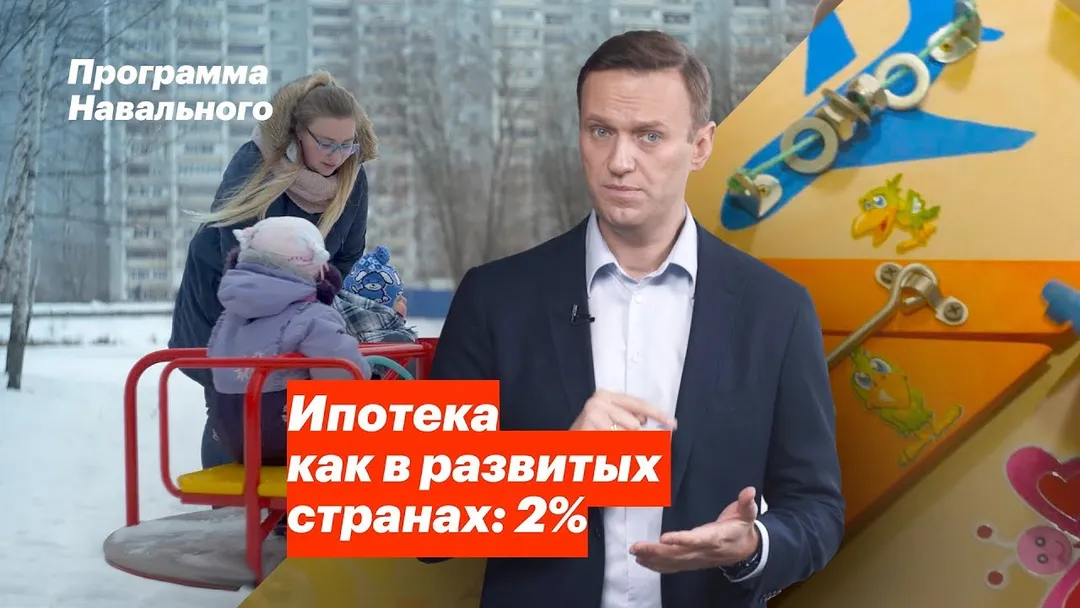
I'm about to show you a family, and I'm sure that
hundreds of thousands, maybe even millions
of people will say, "This is exactly about us," and that
is true, because the story called
"We Have Nowhere to Live" is one of the most
common stories in our country. Vitaly
and Ksenia both work, and overall they
earn enough to
buy a home with a mortgage
— but only if they lived in another
country, where interest rates are reasonable. But
in Russia, they are such that it is practically
impossible. My name is Vitaly, and this is my
wife, Ksenia.
We currently have two children. I work in
banking. Right now she's on maternity
leave. At the moment, we live in a
rented apartment in the Moscow region. Our
average monthly family income is
about 90,000 rubles (roughly $1,000), so the larger
part is earned by me. I run
my own business. We also receive
child benefits.
For example, for our older child we
currently receive 50 rubles a month (less than $1).
We spend most of our income on
loan payments — about 40,000 rubles (roughly $450), so
there were times when things were hard
financially and we had to take out loans.
It ended up that we were covering some loans
with others. The second major expense item
is, of course, housing.
Since it's rented, we spend on the apartment
from 30,000 to 33,000 rubles (about $330–$370), depending on
utility costs. Half of that amount is paid by
our parents — they help us. All the rest
of the money we earn is spent on the family. We
were planning to buy our own home and
naturally take out a mortgage for it.
We looked at one of the residential developments.
The housing there came to approximately
5 million rubles (about $55,000). We contacted
several banks and realized that
the monthly payment over 30 years for that
amount would come to around forty-
three thousand rubles a month. At the moment,
we simply cannot afford that. That was
the minimum monthly payment
we were offered.
And the problem is that even something like
maternity capital (a Russian state family support subsidy)
is not accepted by banks as a down
payment.
So in order to take out a mortgage,
you also have to save up money first. So right now we
simply have no choice between an apartment
and a house — we are staying in rented housing. We
live here.
Go to a bank right now and try
to get a mortgage, and they'll tell you:
11 or 12 percent. And for
the overwhelming majority of people, that
instantly closes the door to
buying a home. But why 11 percent?
After all, according to the Finance Ministry
and the Central Bank, inflation is currently in the range of
2.5 to 3.5
percent. And at the same time, the Central
Bank is throwing around hundreds of billions and
trillions to rescue bankrupt
bankers, giving them money at
zero interest.
When someone from Putin's circle needs to get
a loan, they get money from the state
— nearly $2 billion at 3
percent annual interest. So it turns out that we
with our high interest rates are forced to
compensate the banking system for
cheap money for corrupt officials,
Putin's friends, and relatives. Right
now, taking inflation into account, we can
make mortgage loans
available for 25 or 30 years at 2 to 2.5
percent annual interest. This would require
relatively modest
spending
— certainly far less than what
the Central Bank is currently throwing around
left and right. And then our mortgage
market would start working like it does in normal
countries.
You know, in the Netherlands it's 2.5
percent, in Switzerland 1.7
percent, in Japan 1.6.
I want to become president so that
any family with two working
adults
has the opportunity to buy a home
with a mortgage at the same rates as in
developed countries. This is a direct responsibility
of the state.