Navalny’s Circles: The Judicial System (full version)
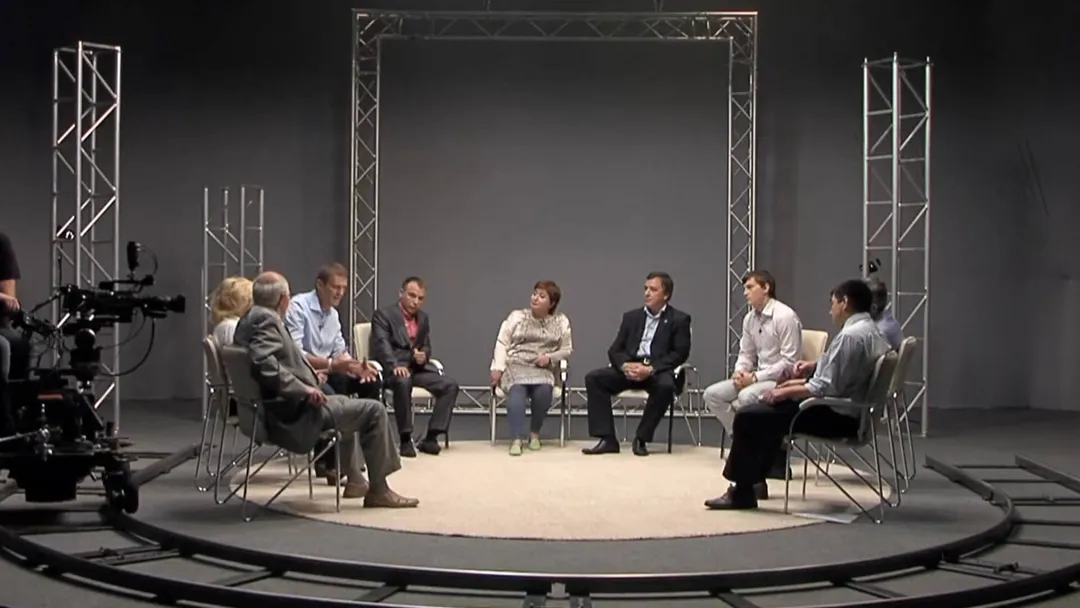
Friends, thank you very much for coming. For
us, this is very important, both for me and for
the members of my team, to maintain an ongoing
dialogue with professional communities
on one issue or another, and of course the topic of
reforming the law enforcement system,
reforming the judicial system, is something that concerns
Muscovites very deeply. However, it is impossible
to run for the office of Mayor of Moscow
to run for one of the
most important political offices and say nothing
about judicial reform, about
how we want to see it, at least
within
the competence of Moscow as a constituent entity
of the Russian Federation: the system of justices of the peace
falls under its authority, and today I wanted
to talk with you about what needs
to be done, what we want both the judicial
system in Russia and the law enforcement
system in Russia to look like. In fact,
the powers of any constituent region of the Federation,
and especially of Moscow, the capital and a city
of federal significance, are much broader than
you said, and they are written into the Constitution.
We just rarely look at it—we’ve forgotten a little.
And do you think this is how it works
right now? This is exactly how it works now,
although everything functions in a somewhat peculiar
way. I think it is hard to imagine anything more grotesque in the 21st
century, in a civilized country, it seems to me,
than a judicial-and-law-enforcement
system conceived as a single
whole. It is the collapse of law—not simply
as a system of letters and words, but as
a civilizational value, as
a universal regulator of human
relations. Because there cannot be
a judicial-law-enforcement system.
There must be a court as a branch of power, and there must be
a law enforcement system as part
of the executive branch, accountable
to the courts. That is roughly the framework,
the coordinates I see for starting this conversation. And what
specifically can the Mayor of Moscow
do, for example, with the courts, with Olga Yegorova (former head of the Moscow City Court)?
What can Sobyanin do? Well, if
the city of Moscow is a subject
with the right of legislative initiative, and there is
government in this city, Moscow—yes, including
the head of the executive branch, the mayor—
then there is one channel of influence right there. That is,
any authority, whether it is the Mayor of Moscow, whether it is
the president of the country, or the head of a rural
settlement, must of course begin with
self-restraint and be law-
abiding above all, in order to have the right
to demand the same from others later on. In
practice, yes, it turns out that the head
of the city, the mayor of the capital, for example, has
a direct relationship to the police (militsiya, the former Russian police structure), to
appointments, and it is unlikely that anyone would ignore
his orders.
So the mayor appoints police officers too?
Well, again, if there is a court, then one can go
there and say that the police chief
is behaving improperly, that the prefect is behaving
improperly, and any citizen can
do that, let alone the mayor. But if
there is no court—well, a Court with a capital
C, one addressed as “Your Honor,” yes, and one that
meets the criteria of
independence and inviolability,
and acts according to the law—then who does and who does not? For that
there must be a court. If Mayor Navalny
were to lose court cases all the time, that would
be good. Sometimes that would be good, even if
I personally believe there must not be
a situation where everyone knows that suing
the mayor is pointless because against the mayor
you can never win, as it was
exactly right, under Luzhkov (former Mayor of Moscow). Then
the system does not work. But when we speak
about courts, first of all about the federal
courts, I know there is an opinion that
the current personnel selection system
will in no way ever allow us
to arrive at a system in which judges are at least
partly independent. What do you think
about that? Friends, doesn’t it seem to you that
we have just identified the main
problem: that this shell of state
well, of state power, in fact
does not work, and what does work is a system
of informal internal arrangements,
of loyalties—that is, formally we have
one thing written down, but in real life we get
something entirely different. Yes, and moreover
it begins with the registration of those same
crimes; that is, everywhere
there are these loopholes where
what appears to be a system divided into
independent blocks is in fact
built into an absolutely informal
system of independent agreements at
all levels. So what are we
to do about that? We can, after all, rightly
talk a lot about it. These are not even loopholes anymore; this is already
a system—the actual system, precisely.
It is like this today; that is,
the state functions this way in all its
manifestations, including in the sphere
we are discussing, and people are selected
accordingly. Today the main source of replenishment
for the judicial corps is not even people
who have taken off their uniforms—that is, yes, the second most important
source, which in itself is also
not entirely right, when
so many people in uniform come
and then put on judicial robes. But the main
source today—who is it? It is young women and
young men who from a very early age,
essentially from their school years, have been secretaries and assistants
to judges, who, you could say, with their mother’s milk
absorb all this, yes, and they simply do not
realize that it is wrong.
They are convinced that this is exactly how
everything is supposed to be, that there are insiders and there are
Let me interrupt for a second—very often you hear this view
from judges: yes,
court clerks. Well, where else are we supposed to get
them? There’s no other pool of candidates. Although
at least court clerks know the procedure.
And who are we supposed to recruit—lawyers?
The legal profession—lawyers are busy with bribes.
The academic community, meanwhile,
exists completely detached from practice. So what
do you think about this view,
which is in fact being imposed
by the executive branch: that the courts themselves and their
staff are the only кадровый
resource for forming the judiciary? It seems to me
that this is a mistake. In fact, those
judges who think this way are mistaken, because
the practice of countries around the world
shows that the judicial system should
draw, first and foremost,
from the legal community, from academia, from circles like
civil society. But when it comes to
court employees, even in some
countries there is simply a cooling-off period
before someone can take up a judicial post if that person
worked in the court apparatus for a certain number of
years: they must either work elsewhere
or complete further study, and so on. And in
my view, this issue of
forming the judicial corps, if
it is resolved, is one of the key
tasks—including, it seems to me,
for an elected mayor, since he can
at least influence it. It was rightly
said, and I saw in your
program the point about the formation of justices of the peace
and introducing elections for them. But are people
ready for that?
We included this in the program, and I
absolutely believe that Moscow residents are ready
to elect their justice of the peace by direct
vote. There is a lot of debate here, and
a lot of criticism directed at us, and people try
to prove that a judge is, after all, some kind of
high-level professional possessing some sort of
sacred knowledge. Although from my point
of view, a justice of the peace does not need any sacred
knowledge at all.
Still, the formation of justices of the peace
does, in principle, presuppose
certain requirements for candidates, which currently
exist under federal law, and
second,
in some regions there are
public opinion studies
showing
that the population is ready
to elect justices of the peace. Yes, this kind of
transparency, which is closer to an
elective system than an appointive one,
should exist under any method of granting
judges their powers. That is obvious. But I want
to return, Alexei, to what you
said about what people in the judiciary say.
Why should the judicial corps be formed from clerks and assistants?
That is what they
say, and in fact they say it very sincerely. And
this is a very deeply rooted
idea. Spell out what the real, not formal,
criteria are today. After all, what is the criterion now?
A judge is considered to be working well if everything is in
order from the standpoint of procedural
requirements: all the papers are filed in
the proper order and on time,
the whole hearing went as expected—'All rise, court is now in session,'
everything was said as it should be, the parties sat in their
places, questions were asked,
what more do you need? The court assessed everything in its totality.
But this 'process' is not really a process at all;
it is external formalism, yes.
Process is about something else. If we are talking
about judicial process, it means adversarial proceedings
between equal parties, and a judge as an
independent arbiter who helps them
present their position. That is what
process is. But that is not the process they mean
when they talk like this—they mean this
external procedure. And the second criterion,
again in practice, is that a judge is good if
their decisions are 'stable,' meaning they are not
overturned by higher courts. But
what if—heaven forbid—the higher
instance was wrong and the judge was right? That is the first point. Second,
if we deprive a judge of the right
to have an independent opinion, then that is no longer a judge.
So, is there a pool of candidates now? Where
should we draw them from? From the same place the
civilized world draws them from, exactly as was rightly
said: the bar, legal scholars,
lawyers, and, as they used to say, from the broader
national economy—that is, from the legal
community in all its aspects, those who
are ready. But in order
to get into the courts today, you need to have
the right connections. I have dealt with this myself; I have already
spoken about it and worked on these problems. So,
a young woman comes along; she did not get into some
university, and there are always notices on court doors
saying they need clerks,
couriers, and so on. She gets a job there
as a clerk. At first she works in the
court office, then later
it turns out she is smart and writes without grammatical mistakes.
After some time, the court chair
takes notice of her, and when he likes
that she is efficient and writes well, he
helps her enroll in law school.
Five or six years pass,
she studies part-time, gains the required experience,
reaches the necessary age, and then she comes to me
and says: 'Hello, I’ve brought
my application. I want to become a judge.'
'Tell me,
please, are you married? No. Do you have children?
'Of course not.' Why 'of course'? Children do not
appear because of a stamp in a passport. How
are you going to hear family cases
involving the fate
of a child? Of course there is no answer. Second question:'
Do you know how to conduct an interrogation? Of course. And where
did you learn that? As for me, I keep the record—they
ask the questions, and I, well, record it
so it stays in my head. I say, my dear, I
see it on television, uh, the way they show
the figure skating championships, but I
have never—not once. Everyone explains the mistakes, but I have never
declared any desire to take part. Well,
how can that be? First a person should work
as a court clerk, then as an assistant
to an investigating magistrate, then as an
investigator, then as a deputy
prosecutor, then as a defense lawyer, and only then
not before around the age of
—so that they have seen everything from all sides and
gained a certain amount of both professional and
life experience. When girls come in
to court straight from university, they know
nothing about life, not just the law.
It is understandable that they do not know—there was nowhere to learn it—but
they understand nothing about life
at all.
Every judge has an annual target—200 cases a
year must be delivered.
I have never seen a judge like that. But
if you calculate it empirically, yes, then
there are no acquittals—well, there are none; the courts are without
acquittals, if you do not count
jury trials. And, by the way, magistrates' courts. And why
are there acquittals in magistrates' courts? Because
there are many cases there where the state has no particular
interest, so accordingly one can
acquit. Why?
You see, the second thing is, uh, this:
the ferocity of the punishments being imposed
even regardless of guilt and the degree
of culpability—simply a ferocity that
is disproportionate to everything, to any
legal criteria, and even from the point of view of
common sense. Where does this come from? It comes from the fact
that this law enforcement system
has fused together, and moreover it kind of
overwhelms the judiciary, because
the judge understands that the important people are always those
who brought the case to them. They will keep watch; if anything happens,
they will make trouble for the judge. So one has to
conform to what is expected from that
side—that is all. Judges themselves say directly
that we have very few
acquittals because
if a case has made it to court, then that means everything
is settled. If there were any problems, it should have
fallen apart at the investigation stage; if
it did not fall apart, then they did not lock someone up for nothing. We
all know that, yes—and we have always had 'enemies of the people' (a Soviet-era political label)
around, and all of this is very persistent, very much alive.
It really is. Well, cases do reach—what I
mean is, cases reach court
only because in our system
the defense is probably in a more
humiliated position compared with
law enforcement agencies.
Law enforcement agencies themselves have
the right to obtain evidence; they have
a great many powers for that, whereas the bar
has virtually none at all. Who today are our
most
active authors of legislative
initiatives? Even those who formally do not have such a right:
the Investigative Committee
and the Prosecutor General's Office. And in what
direction are they pushing things in this sphere
of criminal procedure? Only in
one direction: they are taking us back to
the inquisitorial spirit of the totalitarian era.
And where are the alternative
legislative initiatives from those
official actors whose proposals cannot simply
be ignored? Speaking of that initiative,
I wanted to add
that it was absolutely right to say
that
a fundamental
reform of the procedure for appointing judges
and ensuring their independence is necessary, but it is clear
that this is a very long-term undertaking. Besides
how the judicial system is formed, there is
substantive law itself—criminal
law, administrative law—and there is procedural
law; that is what was really being discussed, yes.
If the rights
of the legal profession are changed, that will affect outcomes even with the current
judicial corps.
The consequences of this situation with the courts
can be remedied, for example, through
case reviews over the course of
decades, yes, because it is obvious that
there are a great many unjust convictions, and
people are simply sitting in prison, including
—Olga will back me up—an enormous
number, tens of thousands of people, are imprisoned
after being improperly convicted. It seems to me
that an amnesty initiative from the city of Moscow
for those cases that are most likely
to have been
fabricated, and that do not pose too great a
danger to the public, would be a very
important initiative.
Within the expert community, many well-developed
good and sound proposals do not receive
implementation, including under the formal
pretext—which I return to again—that there is no
subject with the right of legislative initiative
ready to defend them in such a way that they
could not simply be dismissed out of hand. Trial by jury—
the systematic destruction of trial by jury—
this is not only against
justice; it is also a distrust of people, of
citizens, including Muscovites (residents of Moscow). What is this supposed to mean—
that they, too, are incapable of understanding, that they can
be intimidated, and so on? These are
insulting statements, this kind of
blanket smear, used in part to cover up
the systematic, systematic reduction of trial by jury
to some negligible margin,
which is what we already have today. There are
alternative proposals in the expert
community; there are, there are such measured
that don’t require some kind of terrifying
revolution either, it seems to me. No one is
working on this, because everyone realizes
that the current government
The political authorities are, in many ways,
based on the fact that they control
the judicial system, and therefore any
legislative initiative, naturally,
will be blocked. That is precisely why it is important for us
to change the political
leadership in power
the Moscow City Duma, the State Duma, and so on. When
United Russia loses its majority
with which it blocks everything under the sun in
the State Duma, then we can
hope that at least some
bills and legislative
initiatives will be considered. It is
elementary: a place should be governed by the people who live in it.
And what should be done? Not long ago, someone wrote to me in
a private message—a justice of the peace
whom I do not know, and from a district very far from me.
She told me that she had recently been
to the Moscow City Court, where she was called in for a dressing-down
because she had liked
the wrong posts on
Facebook. Well then, that kind of dressing-down
that judges are summoned to should be
publicly burned, together with the person who
organized it. Only a free judge
can judge free people; everything
else belongs to those old times.
By the way, you were talking about
juries. Quite rightly so, because
in Tsarist Russia (pre-revolutionary imperial Russia), after all, there was a monarchy
—a monarchy. What more totalitarianism could you want?
And yet there, juries heard all
cases. No,
don’t be shy about saying that they are incapable of understanding the full
complexity of these cases and this evidence.
Good Lord, what is needed from jurors is
life experience, some kind of everyday
practical wisdom, and nowhere has anyone
said or proven that a law professor is
more competent or smarter than some
tailor, shoemaker, turner, locksmith, and so
on. Why don’t you trust us? You know,
the authorities can feel that times
are changing. It is very subtle, judging by
Moscow’s prisons—they are
being renovated. That is, they are being renovated
in some way. So, do you think they are
preparing them for themselves? Well, I think they have come to an understanding
that adversarial process in
the courts begins with competition in
politics. But still, if our
society somehow manages to achieve
real political competition, then what
should be done? Suppose Alexei becomes
the head of our capital. Then what
can a person who genuinely wants to
change this system actually
do, given that
the system is what it is? It
constantly reproduces itself; people
cannot be replaced all at once. So where is
the link that needs to be pulled? Well, one simply needs
to look at the real
powers. What we were saying about
the system of justices of the peace is entirely within
the relevant authority. A law could be passed tomorrow, and
tomorrow one could begin introducing elections for
justices of the peace. And that is very important, because
an ordinary person living an ordinary
life has 90% of their contact with the judicial
system limited to the system of
justices of the peace. Why would such a person go to court?
Their rights were violated, there is a divorce,
division of property, and so on—these are all
matters for justices of the peace. And so I think that
the very first move in this direction—
electing justices of the peace in Moscow—would
be nothing short of a tremendous revolution
in the judicial system as a whole, which would then, of course,
interact with
federal judges on the basis of those
powers that, as you say,
fall under its jurisdiction. That is much more
compli
cated, but nevertheless we need to move in this
direction. We simply need to understand that there is no
single magic key that
you can just pull out of Koschei’s egg (a reference to the villain Koschei the Deathless in Russian folklore), and then everything
will suddenly make us all happy. It will not happen. It is hard,
long
systematic, persistent work that
must, on top of everything else, also be highly
professional. We need to learn to outplay them on a
professional
field as well—not only on the political one, but also on the
professional one. There has to be a fusion
of both. None of this is simple at all.
For example, when I look at the judges of
the Basmanny District Court (a Moscow court often associated with politically charged cases), I wonder how they are not
afraid to hand down these obviously
unlawful decisions. Is there really nowhere inside them
any doubt that in three
years they could all be imprisoned for this, for
so plainly
violating the law? Alexei, many of them sincerely
believe that they are doing the right and
useful work.
Many of them are genuinely convinced that
this is how it should be: on that side are
outsiders, on this side are our own people, and on this
side there is always the prosecutor. This shows up even in
small things. Do you think they are not
afraid that the outsiders in their system, the system of
coordinates, so to speak, will sooner or later take
power? It seems they, too, have
some people behind them, and then things will go badly for them.
Perhaps something like that exists somewhere on a subconscious level,
perhaps not. But you see, again,
in order to fear something in a meaningful
way, one must possess
certain knowledge—for example, historical knowledge.
I am very often asked at meetings,
All right, suppose they elect you mayor. But you
You understand, the Investigative Committee is against you.
So what are you going to do about it,
with the Investigative Committee? What are you going to
do with the prosecutor's office and so
on? What should the strategy of
interaction between the mayor and the
repressive machine of the law enforcement
agencies that exists right
now be? First of all, of course, don't
set yourself up—that is, calculate the risks.
And for that, once again, you need a professional
team. Yes, any decision must not be
vulnerable, at least by formal criteria. Yes,
it's clear that subjectivity is another
matter, but there must be a legal basis behind
everything any manager decides, especially
such a major official as the mayor
of Moscow. And
second, public authority must be
clear and transparent. In office, among other things,
don't lie, don't steal—don't lie and don't
steal. Unfortunately, there is no miracle
mechanism here either that would
fix this. Yes, but again, what is needed is a court. When the court is the kind
with a capital C, the one that says, "Your
Honor," and that truly is a
court, then the situation becomes
different. We keep entering a certain cycle
that at some point needs to be
broken, and whoever takes that on takes
on major risks, of course. It should
be understood. It's like the Kirovles case (a well-known Russian criminal case against opposition figure Alexei Navalny): three
times it was closed, yes, by professionals, but then
came
Bastrykin (Alexander Bastrykin, head of Russia's Investigative Committee). You can't do without idealism all the same.
I also agree with my colleagues that
there are a great many people in this world working within
the system who absolutely hate these
informal arrangements and would like
to live by the principle that it is better to serve
than to be servile. So you have to go to
the security service officers, yes, to
investigators, to prosecutors, and say: Guys,
friends, let's live in a normal country
where each of you will serve, not
make money. There are many people
who still go into this line of work, broadly speaking,
guided by values, and even
statistics show that under the age of 24 there are almost
no investigators or
law enforcement officers who
get involved in corruption schemes, because
the system breaks them later. But for now
they came in as normal people. Those are the people
you need to appeal to. And again, about money:
you understand, yes, some make money—but not all.
Many stay because
they think they won't find another job
and they think this job is
privileged. Many come there,
you know, probably for some kind of
thrill, while others come and say
to themselves: if not me, then who? You understand? And what—
you left? No, I left. I left for health
reasons. I had simply gone three years without
a vacation, and I just
ran out of strength. Well, I left because
I understood that I did not want to serve this
system. I was a small person,
a tiny cog, but I did everything
I could. I wasn't afraid; I defended my
point of view everywhere. You know, when lawyers came to you
with motions on, on...
whatever the issue was—lawyers came to me very rarely
with motions, because I
did everything necessary to
actually find the truth, rather than
rubber-stamp things, as often happens now,
generally speaking. You know, dear colleagues, since
we've started recalling personal experience, yes,
please don't take this as immodesty—just
as an example from very recent court
practice, specifically in the Basmanny District Court (a Moscow court often associated with politically sensitive cases), the issue
of a pretrial restraint measure was being considered in
relation to my client—the Bolotnaya case (the prosecution of participants in the 2012 Bolotnaya Square protests).
I was speaking, naturally, with
objections. Opposite me sat an
investigator with the rank of major, who had just
received it while working on the Bolotnaya case. I
finished my statement and sat down; he, at this
small table, with us facing each other,
whispered to me: 'Dmitry Vladimirovich, brilliant
speech—couldn't agree more.'
'But you understand,' this newly minted major
said back to me. I want to say
that I too was an investigator,
the head of an investigative body. This
was in the bad Brezhnev years, then in the
not very clear-cut perestroika years.
I also knew how to do what you described, and
I did it. Now the stock answer is: 'Well, you
understand'—meaning, how investigative teams are formed
for commissioned cases and
why they are formed that way: they gather from all
over the country lieutenants and senior
lieutenants and train them on these
cases, and from a very young
age they come to understand what is really
needed to be a 'good' investigator
today. Then they disperse
after finishing, while some remain
as employees of the central office and
build careers. That's how it is in my cases,
for example. And everyone sees all this; it is very
wrong. But I do agree on one thing: these
young guys absolutely need to be shown an
alternative. Misha, why did you leave
investigative work? I know you're one of our idealists.
Well, 'idealist' is a bit much. It just didn't work out for
me somehow with the investigative authorities. In
principle, the only thing I can add
at this point is that it started
about three, maybe four years ago: all the people,
especially the young ones, who knew how to ask
questions like, 'Why do we have to do it this way, and this
way?'—on the 'valuable instructions' of various
supervisors, they were pushed out, and
they were gradually forced out bit by bit...
Promising cases got buried under piles of other cases from
In my professional experience, I’ve seen two such
striking moments when officers from the
criminal investigation unit would burst in, kicking the door open, to see a
judge who was already getting ready to go home. His
workday was over, and they would shove
a handcuffed person in there. In handcuffs. And
they would say, “We’re out here putting criminals behind bars,”
“and you’re getting ready to go home? Sit down and
judge this one.”
That moment—with all the younger
staff I speak with from time to time—the thought
got stuck in my head: what a complicated thing the criminal procedure system is
in general. It’s an extremely complicated thing, and we work
as best we can. But we do work. So in the end
we get what we get.
You know, still, on the subject of
interaction between an elected mayor and the
Investigative Committee and other agencies,
yes, it seems to me I’d still like it to happen in
a different way, so that he
would interact differently, and so that the elected mayor, as a result of
public audits and oversight of
the work of all government bodies in the city of
Moscow, would in fact
forward materials whenever
any violations are discovered,
sending the relevant materials to
the appropriate authorities, and that this
be done publicly and openly. But tell me,
are there any Moscow-specific
bonuses for Moscow special forces, or
does that not apply? What about Moscow judges?
Well, Moscow bonuses do exist for
Moscow investigators and police officers
—though as far as I know, they were removed in Moscow.
No, there are no Moscow bonuses now,
as far as I know. More likely, this is regulated
primarily through housing issues
and various things connected
with infrastructure. Then again,
the chief judge needs parking,
the kind people complain about—he wants
to park, he needs parking here, he
needs parking there. He needs to solve
some problem with the boiler room, something
happened with utilities and court maintenance, because here
the chief judge is simultaneously
the court’s director, its facilities manager, and everything
else under the sun. So through these everyday
things—apartments, pipes, and parking—they can
squeeze people. And this system
has been refined very well. There are veterans’
organizations that are used to funnel support through, yes,
I agree, through veterans’ organizations, and
there are businesses that are told, “Guys,
you need to help,” and they bring things—not, not directly into
offices. They give to those who know whom
to give it to, because later
the veterans’ organizations end up looking very
good, because they “find” money
for apartments, for victims, and so on.
This
system of bribery has existed for a very long time.
That’s it.
I know less about the
systems we’re talking about today, but
I do know that to get into
the Higher School of the KGB (the Soviet/Russian state security service), yes, for insiders it was $25,000
—and the border guard academy belonged to the same
system too, just a bit less. So tell me,
this person who today
paid $25,000—is he capable of
being
a noble fighter for the interests
of his own people? For insiders, maybe—but outsiders?
Outsiders, no.
He has only one thought in his head:
an investment has been made. What return,
what percentage will there be? He has to make that money back. The mayor needs to push the idea of a municipal
The idea of a municipal
police force needs to be raised. Exactly.
Precisely a municipal police force—right now
yes, yes, in its current form the police
are impossible under federal law, but we
talk about this in our platform. More than that,
we propose what may be, for some, a rather
unusual way
of partly solving the problem, but one we
believe in: hiring private security
companies. That doesn’t necessarily mean those
awful private security outfits we know today,
but the Moscow mayor’s office can absolutely
hire simple patrol personnel like that
—outsourcing, outsourcing. I’m afraid that by its very
nature the system will
reject cooperation, because
here are literally two examples. We started talking about cameras
just now. We had an idea here:
let’s discuss this—
there are cameras everywhere, practically speaking, so
why not use crowdsourcing? Put
pensioners on it, for example, bring them in
through the internet—maybe that’s what’s needed.
Pensioners, fine, whatever—but they tried it
at least. But we understand
what these cameras are like. So there’s a stream
of information coming in, but no one is actually
monitoring it anyway. There was a scandal that
half of them were dummies, and half didn’t
transmit footage at the required resolution,
yet billions of rubles were spent. At the Anti-Corruption Foundation,
we worked on this a lot,
and that’s why they don’t allow
public oversight of the cameras, because
the cameras show nothing. The mayor’s office
must—the mayor’s office must defend the rights
of Muscovites, and if the mayor’s office understands that
there are grounds to believe that this particular prefect (district administrator)
—and the mayor’s office sees from the documents and believes that he
stole 100 million rubles from the housing and utilities system (about 100 million RUB),
then it must insist on
exercising its rights as the injured party.
That’s all. I’m not saying that as mayor I would
call a judge and shout, “Come on, lock up this
good-for-nothing deputy prefect.” No—the mayor’s office simply
hires a proper lawyer itself,
an attorney, and says: please defend our rights.”
the victim's... Go ahead, introduce yourselves, friends.
Thank you very much. Our time
is coming to an end. I am very grateful that you
came. I am very grateful for those valuable
comments regarding the personnel system
for selecting judges, regarding those possible
reforms that can be implemented. Our program
is a living thing, and we would like
it to keep improving and evolving,
to get better, and we need criticism, we
need feedback. We will definitely take all of it
and integrate it in order
to try together to build a society
that is better, including in terms of judicial
reform of the court system
and the law enforcement system. Thank you
very much. Hooray! Thank you very much.
Thanks, everyone. Uh... L.