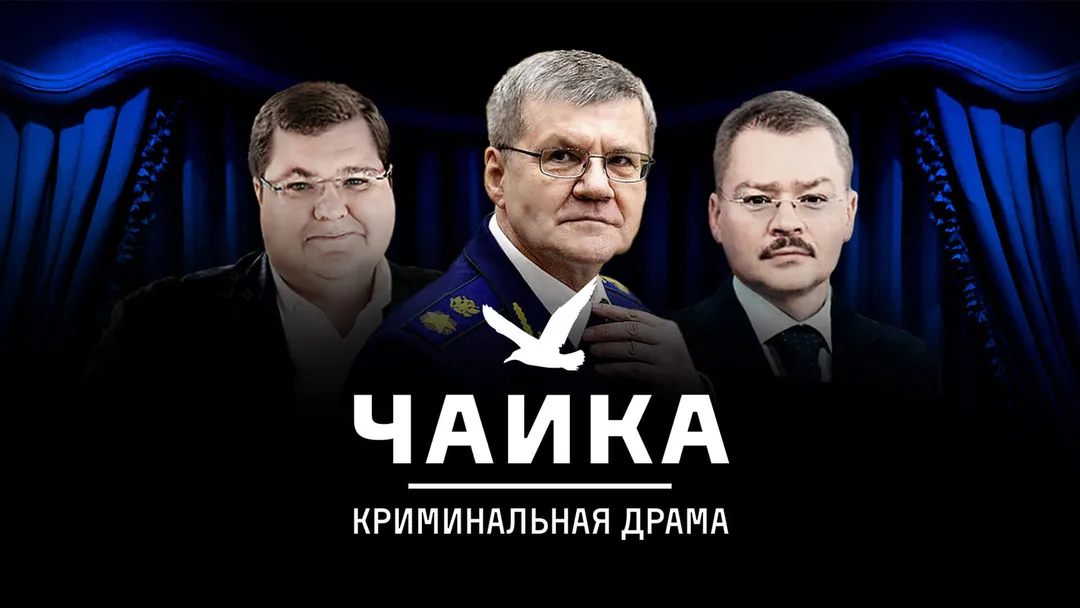
"Chaika." A film by the Anti-Corruption Foundation (ACF).
In May 2014,
the Greek press was flooded
with reports about an opening ceremony of
an incredible scale for a new hotel.
Here it is — this five-star
seaside hotel in Halkidiki,
the main resort area of mainland Greece.
Judging by the interior finishes,
you could tell that the construction
had cost tens of millions of euros.
Above ground,
there were luxury rooms for
$4,000 a day, and below —
taking up almost even more space —
a spa complex finished
in solid marble.
The opening ceremony is hosted by a well-known
Russian master of ceremonies.
The evening’s main star is singer Philipp Kirkorov.
It is clear that the investor spent
an enormous amount of money. Acrobats, entertainers,
and magicians — all of them were brought in from Russia.
The same goes for
the entire technical staff, right down
to the florists and lighting technicians.
Remarkably, the ceremonial speech on stage is delivered by
none other than Russia’s Minister of Culture,
Vladimir Medinsky.
In the hall, he is being listened to by Russia’s elite:
businessmen, regional leaders, and politicians.
The evening’s climax is a fireworks display and laser show.
Projected onto the hotel building is
a giant Russian flag.
Who paid for such a lavish celebration,
and whom is the Minister of Culture
personally congratulating from the stage?
Reports say that the hotel’s owners are
investors from Russia.
It sounds as though we are talking about some well-known
oligarch or hotel magnate. But that is not the case.
In this video, the real owners of the hotel
solemnly
cut the ribbon.
Recognize him? This is Artyom Yuryevich Chaika,
the son of Russia’s Prosecutor General.
You are almost certainly seeing his face for the first time.
Despite his relative
prominence,
until quite recently, no one
knew what he looked like.
Artyom Chaika,
a central figure in the most high-profile
anti-corruption case of the 2010s:
the case of the illegal casinos outside Moscow.
The fight against corruption in the law enforcement
agencies is moving forward...
At the addresses listed online, there really were
illegal casinos... It seemed that after this exposé,
the process would spread across the whole country...
— For money, they could open a criminal case, close one,
make personnel appointments, and so on...
In the end, the case fell apart.
But it became the first mention in many years
of the Prosecutor General’s son.
It turned out that, with direct and
unlimited access to the highest levels
of power and effectively immunity from any kind of
prosecution, by the age of thirty he had already
become a dollar millionaire.
In terms of the number and variety of assets
owned by Artyom,
they resemble an entire business empire.
Hotels and sand quarries,
concrete plants and salt deposits —
spread across Russia and beyond are
the diversified assets
belonging to the son of Prosecutor General
Chaika.
— Thousands of people work for him,
and the turnover of his companies runs into hundreds
of millions of dollars. But what
Artyom Chaika and his associates do
has nothing to do with business.
It is gangsterism,
corporate raiding and intimidation under
the protection of
the Prosecutor General of the Russian Federation,
Yury Yakovlevich Chaika.
When we became interested in the story of the hotel
in Greece, we uncovered a mafia structure
of enormous scale,
closely tied to the Prosecutor’s Office
of the Russian Federation.
It turned out that the illegal
casinos outside Moscow
were just one of several sources
of enrichment for the younger Chaika.
For more than fifteen years now, together
with his father’s subordinates, employees of
the prosecutor’s office, Artyom Chaika has been taking control
one after another
of key assets in Russia’s largest
regions.
Today, he is a dollar millionaire.
In Europe, he is seen as an oligarch and
an international investor,
but in reality
he is merely one link in a vast
corruption scheme
created under the protection of his
father,
Yury Chaika.
Artyom Chaika did not invest in
the Greek hotel alone.
Alongside him was
the hotel’s second owner.
Her name is Olga Lopatina.
Why would Artyom take some
random woman on as a partner?
— Olga Lopatina is the
former wife
of Deputy Prosecutor General
Gennady Lopatin.
She is listed in his asset declarations for 2009
and 2010. In 2011, she disappeared from them.
And all the property that had been registered
in her name disappeared along with her, too.
In other words, there was no
division of property. This is a common
scheme in which an official,
wanting to formally
distance himself from a business, simply divorces
his wife
and says, "Well, there you go, I'm so generous,
I left everything to my wife. All the property, the entire
business, and now she lives her own life, I live
mine, and I have no idea what's going on with her anymore."
Judging by everything, the Lopatins' divorce appears to be a sham.
In a recent 2014 photograph, on Olga's right hand
a wedding ring is clearly visible.
Besides, Olga and Gennady actively
interact on Facebook: they play online games
and like each other's photos.
And apparently they divorced simply in order
to conceal property and income.
Here is Olga's last
declaration before the divorce.
Income: 0 rubles. There is no way to explain investments in a luxury
hotel in Greece with an income like that
.
And ownership stakes in the foreign company that founded
the hotel would also have had to be disclosed
in the next declaration.
The most interesting question, of course,
remains this: where did the wife of the deputy
prosecutor general
get the millions of euros needed to buy a hotel
in Greece?
Olga Lopatina did not state in her declaration
that she was involved in the sugar trade.
She is the founder
of two companies specializing
in sugar — one in Moscow and one in Krasnodar Krai (a region in southern Russia).
In fact, Olga Lopatina, the wife
of the deputy prosecutor general, has very strong reasons
to hide this business.
Her business partners,
the co-founders of the sugar
enterprise,
are Angela-Maria Tsapok
and Natalya Tsepovyaz.
They are the wives of the leaders of the Kushchyovskaya organized crime group
Sergei Tsapok and his right-hand man Vyacheslav Tsepovyaz.
So it turns out that the wife of the deputy prosecutor general
is in business together with the wives
of some of the most brutal gangsters
in modern Russian history.
The gang effectively ruled
an entire district of Krasnodar Krai for
20 years.
During that time, the criminals were responsible for
hundreds of rapes and dozens
of murders, corporate raids, seizures of businesses,
and the bribery of officials.
And of course, the final crime was
a mass murder.
On November 4, 2010,
the Tsapok gang burst into the home of a local
businessman who had somehow fallen afoul of them,
and, one after another, killed 14 people,
including three children and an infant.
The Tsapok gang burned their victims' bodies.
— In this short and boring extract from
the Unified State Register of Legal Entities, there are, in fact, answers to very important
questions. How did they manage to control
a huge share of the businesses
in Krasnodar Krai? How did they manage
to terrorize the entire population?
How were they able to remain
unpunished for so long?
It's simple: they were protected by
senior officials in the Prosecutor General's Office.
After the mass murder,
the Tsapok gang members were finally arrested and imprisoned.
Most of the gang are now
in prison, and its leader, Sergei Tsapok,
died of a heart attack in 2014
in his cell.
The investigation into the Tsapok gang's crimes
was conducted under the special supervision of the head
of the Investigative Committee
Alexander Bastrykin.
The Investigative Committee's best personnel were assigned
to solving the case.
All the more surprising, then, that in the course of this
investigation
the investigators never found out that the Tsapok gang
were doing business together with the wives
of high-ranking
prosecutor's office officials,
even though the connections were obvious:
a criminal case had already been opened against Tsapok
and then immediately canceled by order of
regional prosecutor Leonid Korzhinek.
In Lopatina's sugar business,
besides the Tsapok wives, there is also a fourth partner —
Nadezhda Staroverova,
the wife of the head of administration
of the Prosecutor General's Office, Alexei Staroverov.
In November 2014, he was suspended from
his post after, in his country estate outside Moscow,
a weapons cache and members of
the so-called GTA Gang were discovered,
a group of bandits who had killed and robbed 14 people
on highways in the Moscow region.
The prosecutor was sheltering them under the guise of his security detail
and household staff.
The money earned together with the wives
of gangsters, Olga invested not only
in the hotel.
According to Greek land registry records, not far
from the hotel
you can also find her villa.
Marble, stained glass, gold,
huge chandeliers and furniture in the style
of Louis XIV — "prosecutorial baroque."
Olga's Greek villa was built by the same
people who built the Pomegranate hotel.
On its website, the developer
boasts of another project —
yet another villa on the seashore.
Construction is in full swing: excavators are
creating an artificial landscape and have even
built a special acropolis-style gazebo.
The villa’s windows offer a magnificent view
of the holy Mount Athos. According to the documents, the owner of this villa is
Artyom Chaika.
The local press writes that Artyom first came to Greece
on his honeymoon.
His father instilled in him a love for this country.
Yury Chaika has repeatedly said that
he visits holy sites every year.
Artyom Chaika’s neighbors smile and say
that a friend of Putin’s lives next door.
The Greek press is full of stories about
the country’s most luxurious and expensive hotel.
Travel agencies sell VIP tours
to the Pomegranate spa complex on the shores of the
Mediterranean Sea.
Behind all this stand the son
of the prosecutor general and the wife
of a deputy prosecutor general.
Family members of officials
whose job is to fight
crime and corruption.
But this is only the beginning of the story. Hotels and villas
are what Artyom Chaika and Olga Lopatina
spent money on,
money earned long before that.
The Pomegranate hotel is owned by a Greek company.
This document is an extract
from the legal entities register.
And here are this company’s financial statements:
Artyom Chaika’s signature.
In Greek, only the surname is really legible here.
If you run the text through an electronic
translator, the details become clear.
For example, that the son of Russia’s
prosecutor general
lists as his country of residence
Switzerland.
— In the documents appointing the president of the hotel
and of the company he owns, it is stated
that Artyom Chaika holds
Swiss identity documents.
That means this person pays taxes there,
owns real estate there, and lives there.
We found that property.
In Swiss registries, listed under the son of Russia’s prosecutor general
of Russia
is this small house on
the shore of Lake Geneva.
And on the mailbox, the inscription reads:
Monsieur and Madame Chaika.
We checked the land registries.
But it turned out that this house
does not belong to Artyom’s family.
— The practical purpose of this house
is basically clear. It is not meant for
living there, but rather to:
a) accumulate residency time
for official paperwork,
obtaining citizenship
or something else.
b) to have a mailing
address in Switzerland, where the Swiss authorities
could send correspondence.
Obviously, the search
had to continue,
and that if Artyom Chaika had already decided
to tie his life to Switzerland,
then one should look for a house on a more prosecutor-general
scale.
What gave us hope was the fact
that the small house whose mailbox
bore the name “Chaika,”
was owned by a certain
Lisyurenko family.
As it turned out, this family was far from
random.
Liliya Lisyurenko is a friend of the family of Deputy Prosecutor General
Gennady Lopatin.
Artyom Chaika’s real home
was found practically “around the corner,”
a couple of kilometers from the house with the mailbox.
A year ago, Artyom Chaika bought
a mansion for nearly 3 million francs.
That is about 3 million U.S. dollars.
Stylish and modern housing,
an excellent terrace,
you can set up a table and drink tea overlooking
Lake Geneva and the Alps.
It appears that
Artyom and his family are planning
to move to Switzerland
for good,
but it does not stop with real estate.
The house has to be maintained,
and that requires accounts in local banks.
In addition, the legal entities register reveals
his own company as well,
a law firm.
Artyom Chaika is trained as a lawyer.
The firm is truly a family business:
until March 2015, a stake was owned by Igor Chaika,
the prosecutor general’s younger son.
He then transferred his shares to his older brother.
The Chaikas’ firm specializes in
setting up Swiss businesses,
asset management,
immigration matters,
a full range of legal services,
including import and export.
the firm is called FT Conseils,
where “FT” are the initials of his partner,
François Taren.
We went to the address where
this company is registered,
to check whether the son
of the prosecutor general
really does business in Switzerland.
Monsieur Taren was there, but refused
to speak with journalists.
(speaking in English)
Monsieur Taren knows Russians well.
In the 1990s, he helped with obtaining
Swiss citizenship for Sergei Mikhailov,
known in the Russian press as
the head of the Solntsevo organized crime group, nicknamed
"Mikhas."
In addition, Taren worked at the firm
Juridical House. Until 2007, it was owned by the son
of the former head of administration of Russia's Prosecutor General's Office
Nazir Khapsirokov, now a senator,
Murat Khapsirokov.
This firm handles the Chaika family's accounts
in Switzerland,
and manages their assets.
Since 2003, the family accounts of the prosecutor general
have been receiving millions of dollars.
That money is used to buy houses by the lake and
hotels by the sea.
The Chaikas say the source of these funds is
the operations of a shipping company in Irkutsk.
To understand how the son made millions of dollars,
the prosecutor general's son,
we need to go to Siberia.
The Lena River begins in the hills near Lake Baikal.
It was in Irkutsk Oblast
that Russia's prosecutor general began his career,
Yury Chaika.
This is also where his son Artyom started his business career.
Artyom's object of interest was the shipping company in
the town of Ust-Kut.
It is 1,000 kilometers (about 620 miles) north of Irkutsk.
The shipping company had the status of a
strategic enterprise for national security
because it supplied fuel
and food to Yakutia (Sakha Republic).
In 2002, problems began
with these northern deliveries.
This is what the fleet of the Upper Lena
Shipping Company looks like now.
Until the late 1990s,
it looked different.
The northern delivery operation
used seventy large tankers and
river-sea class cargo ships.
In 1999,
Artyom, together with State Duma deputy
Bashir Kodzoyev,
founded the company "Laena."
It issued the shipping company a loan of
$2 million to repair its motor ships.
When the money had been spent, "Laena"
demanded early repayment of the loan.
The shipping company barely repaid it,
but then had no money left for current operations.
Deputy Kodzoyev
asked the federal service for financial
recovery to declare
the shipping company bankrupt,
while Artyom Chaika, a graduate of the law faculty
of Irkutsk University, drafted a program for
financial recovery.
To do this, he proposed transferring management
to his own people.
The shipping company's director did not agree.
Then Chaika placed one of his
former classmates among the shareholders
and convened a meeting to change
the board of directors.
That did not work either.
Then criminal cases were opened against the directors of VLRP
but not by the regional transport
prosecutor's office,
rather by the city prosecutor's office in Irkutsk.
It was headed by Albina Kovaleva,
a friend of the Chaika family.
— There is a whole infrastructure in place for this.
Chaika himself comes from Irkutsk Oblast.
All the employees
of the prosecutor's office are effectively
his appointees.
There is Albina Kovaleva
with a unique position.
The woman is,
I think, over 70,
maybe even over 80.
She still works in the
prosecutor's office, although by age she should have
retired long ago.
Her position is something like
"the prosecutor general's representative at the prosecutor's office."
A very interesting way to draw a salary and
influence certain processes. And the prosecutor's office
is, after all, a legal marketplace of violence.
At first glance, an insignificant
figure in this story,
State Counselor of Justice
2nd Class, Albina Kovaleva,
worked in the prosecutor's office
of Irkutsk Oblast alongside Yury Chaika
and still influences his decisions.
Her son, Dmitry Berdnikov,
was appointed mayor of Irkutsk immediately after
the city abolished mayoral elections.
Dmitry himself does not hide his friendship
with the prosecutor general's son.
— Are you in a very close relationship with the son
of our prosecutor general?
— You know, we have always been involved in completely different things.
And the fact that we are friends, you probably understand,
that a good friend is always a good friend.
It does not matter whose son he is. I would not attach any excessive
importance to our relationship.
According to the media, Albina Kovaleva's protégés include:
Russia's prosecutor general Yury Chaika,
Deputy Prosecutor General
Ivan Semchishin,
the prosecutor of Zabaykalsky Krai,
former Tomsk Oblast prosecutor Vasily Voykin,
Saratov Oblast prosecutor
Vladimir Stepanov, and
Murmansk Oblast prosecutor Maxim Yershov.
Also among them is Igor Melnikov, the prosecutor
of Irkutsk Oblast, as well as
Krasnodar Krai prosecutor Leonid Korzhinek,
the very one who covered up for the Tsapok gang.
All these officials come from the prosecutor's offices
specifically from Irkutsk Oblast.
As for Artyom Chaika, Albina Kovaleva is also said
to have had warm relations with him. It is reported that
he publicly calls her his “second mother.”
The shipping company director who stood up to
Chaika and the prosecutors, Nikolai Palenny.
Here is how he described the attack on his companies in
December 2002:
— The conflict
between... not between, but over the enterprises of
the Upper Lena Shipping Company, the Kirensk and
Alexeevsk fleet repair and maintenance bases
has already been going on for,
roughly speaking, 2 years. This conflict, which
is being created for us,
is being created for us by a group of,
as I would say,
not entirely
decent people.
And among those behind it is
the son of the justice minister, Artyom Yuryevich Chaika.
It creates a very negative environment for
the work of our enterprises.
At that time, Nikolai Palenny still hoped that he
would be able to reach the country’s leadership
and prevent the looting of a state-owned enterprise.
— We want, so to speak, to warn
our State Property Ministry against hasty steps.
So that they do not take
these hasty steps to
replace the management
and so that they do not bring into our region
some outsiders from who knows where
to our northern lands. And not decide
the fate of our managers like this.
That is no way to run a state.
At 11 a.m. on December 30, 2002,
Nikolai Palenny left his own
apartment in this building to go
to the garage for his car.
An hour later, at 12:00 p.m.,
he would be found hanged in the garage.
No criminal case was opened.
The cause of death was declared to be suicide.
Only later were journalists anonymously given
these documents
from the forensic medical examination.
They mention here a ligature mark.
That is the mark left by a rope on the neck.
Its length is 41 centimeters.
That is the circumference of the victim’s neck.
In other words, the mark is continuous.
Whereas in a suicide by hanging, the noose does not
completely encircle the neck.
Despite the fact that by all indications it was
obviously a murder,
law enforcement and the prosecutor’s office
never investigated Palenny’s death.
Where did the ships go?
For the first time, we are revealing the scheme used to siphon off
these state-owned assets.
The river-sea class dry cargo ships were assigned
to two fleet bases,
the Kirensk and Alexeevsk bases.
These bases signed contracts
for cargo transportation through the parent
company:
the Upper Lena River Shipping Company.
After the death of the shipping company director
Palenny,
the ships, without any legal
grounds, began to be controlled by
a self-appointed management company
with a similar name, “United
Upper Lena River Shipping Company.”
It had been created only recently
and was registered at the same address as
Artyom Chaika’s other companies:
5 Mashkova Street, Building 1, Moscow.
So what happened to the ships?
Through a chain of fraudulent court
rulings
and the insertion of front
creditors,
the shipping company was forced
to pay off its debts with vessels.
As a result, 16 ships ended up with
the Moscow equestrian club
“Serafimovo.”
The club is controlled by the same people as
“United Upper Lena River
Shipping Company.”
Behind them are Artyom Chaika and his partners.
Another five ships
were sold to a front company.
Within six months, they were re-registered
to Chaika’s companies.
Several ships were sold for next to nothing
to Maltese offshore companies.
And more than ten motor ships
were leased personally by Artyom Chaika.
The special rate for the prosecutor general’s son
was three times below market rate.
The ships that were not suitable
for sea transport,
were simply abandoned,
while the proceeds from the sales went through a classic
money-laundering scheme.
They were transferred to one of the Latvian banks,
where they were moved from account to account until
they were transferred to Switzerland
to the Chaika family’s accounts.
Over time,
they were converted into houses on the shore of
Lake Geneva.
Artyom Chaika did not stop
with the takeover of the shipping company.
After that,
several people from his team moved into
the salt business, also in the Irkutsk region.
This is the Tyret salt mine,
the fourth-largest salt deposit
in Russia by extraction volume.
In November 2011, the state-owned
enterprise was sold for 660 million rubles,
although estimates put
its value at three times that amount.
With the help of the head of the Irkutsk branch
of Rosimushchestvo (Russia’s Federal Agency for State Property Management), Fetisov,
the owner of the mine became
a brand-new company
"Solidarity," linked to Artyom Chaika's business network.
— Fetisov, in fact,
is a former police officer.
Irkutsk city prosecutor Kovaleva,
Albina Semyonovna, later moved
first to the regional prosecutor's office
and then headed
the justice department for the registration of
real estate transactions.
Fetisov headed
the security department of that agency, and later
in time, when
Chaika had already become Prosecutor General,
Kovaleva became an adviser
to the Prosecutor General,
and Fetisov moved to the post of
head of the Federal Agency for State Property Management (Rosimushchestvo) in
the Irkutsk Region.
It turns out that Pavel Fetisov, who became
head of Rosimushchestvo
in the Irkutsk Region,
had previously worked under
Albina Kovaleva.
This whole
reshuffling, this
so to speak, Fetisov's closeness precisely
to that team,
which
worked with Chaika for a long time in various
positions,
gives grounds to suppose that
the appointment—that is, one of the purposes
of appointing him to this post—
was specifically
the privatization of the Tyret salt mine.
The other participants
in the privatization auction for
the largest salt mine were simply
not allowed in.
— There was straightforward
intimidation there, in the sense that there was at least one group of
people who wanted to take part
in the auction for its sale, and they were simply
told: "Guys, how many criminal cases
do you want on each of you? Take your pick:
pedophilia,
a perfect charge, right, and that's it—life immediately
ends.
Any pretrial detention center in Russia. Want to sit with HIV-positive
inmates? With tuberculosis patients?
Any service you like."
People said: "No, no, no, thank you, we no longer
want to have anything more to do with
the Tyret salt mine."
That is how completely different assets across the
country change hands with the
assistance of the prosecutor's office.
For some, the business tool is
an IPO; for others, it's their father's subordinates.
Artyom Chaika's next target is
the Vorobyovskoye salt deposit
near Kaluga.
In 2013, applications for the tender to develop it
were submitted by four participants,
two of whom,
including the leading contender,
the main player on the Russian salt market,
the company "RusSol",
had their applications rejected on the grounds that they
"did not possess the technical
means necessary to carry out work on
the site."
Allowed to participate were "Maloyaroslavets
Salt Works"
and the "Tyret salt mine."
The first belongs to Chaika-linked entities
through the company "Galit,"
the second through affiliated persons.
How is such a tender possible?
It is possible. Under the protection of regional prosecutor
Dmitry Demeshin.
He is closely acquainted with Artyom Chaika.
So closely that he calls him "brother."
A month after the tender, Demeshin
received the rank of major general
and moved to Moscow,
where he headed the department for combating
corruption at the General
Prosecutor's Office.
And here is Artyom himself,
burying a capsule in the foundation
of a plant for producing salt
from the Vorobyovskoye deposit.
In the footage, posing next to his brother Artyom is
the Prosecutor General's younger son
Igor,
but more on him later.
Oleg Karapetov, director of a sand quarry, came face to face with how this raiding system
of the younger Chaika operates.
The director of the sand quarry was Oleg
Karapetov.
This sand quarry, not far from
the Vorobyovskoye salt deposit
also near Kaluga. Oleg Karapetov worked here
his whole life, and last spring all
access roads to the largest explored sand quarry in the Kaluga Region
were blocked by felled
trees. Under the office windows,
a car stood watch around the clock
with employees of the prosecutor's office inside.
— The prosecutor's office was there all day,
two or three people at a time conducting inspections,
and at that point I began to understand
that something was clearly wrong here.
That was the purpose of their visit: to shut down
the enterprise.
The quarry's license was revoked.
One of the reasons given by the prosecutor's office was
that the bulldozer did not have a steering wheel.
I traveled many times, met with people everywhere,
and they all pointed in the same direction— these were not ordinary people,
well, up there, to the top, and that was that.
I believe that the prosecutor's office
is now carrying out this so-called "justice."
Several years ago, the Mostovsky quarry
got new neighbors.
The deposit on the other bank of the Ugra River
was handed over to the company
Siberian Element — Renta K.
When the companies became competitors for
sand supplies for the reconstruction of
Kiev Highway,
inspections began at the Mostovsky quarry.
In every case, the initiator is the environmental
prosecutor's office.
— Whom have I caused losses to? No one is making any claims.
Everywhere, it's the prosecutor's office.
I've worked here for forty years,
and I'm not afraid of anything. Crush me, crush me—let people hear this.
Shameful!
We're building a state governed by law,
and you are the first ones meant to uphold it. I'm saying this to you here in front of everyone.
— I will now draw up a report on the refusal to provide documents
and on a 90-day suspension, so that means we'll proceed this way.
— This Siberian Element has
one founder,
an individual—
Artyom Chaika.
So that's what this is about... I tried to reach the higher-ups in Moscow,
but no one was willing to make contact, and people also tried
to settle the matter.
Somehow, I...
I've been trying for a year now.
I went to see the minister a couple of times,
they're decent guys, after all, we're inspected every year,
every year... And these people, honestly,
they point here too, and point upward there
as well.
They say, 'We can't do anything,'
'go to court.' Everywhere I was told: 'Stick to the courts.'
It looks like racketeering.
During these inspections, the prosecutor of
the Kaluga Region was
Alexander Yuryevich Gulyagin,
the son of the current Deputy
Prosecutor General of Russia—
Yury Gulyagin.
The quarry workers suspect that
it was he who gave instructions to his
staff and, in doing so, acted in the interests of
his superior's son—
Artyom Chaika.
In his spare time, when not taking over state assets,
Artyom rides motorcycles.
He's a biker.
This year, with his own
motorcycle club, Iron Birds, he went to Minsk
for the opening and closing of the motorcycle season.
Local journalists filmed him
in a column of motorcyclists, in the company of his brother Igor.
The younger son of Russia's Prosecutor General,
like Artyom,
went into business while still a student
and by the age of 27 had achieved impressive
success.
His approach is different from
what his brother does.
He mainly makes his
money from government contracts.
His business is inseparably tied to winning
multi-million-ruble tenders
for landscaping,
urban improvement, and waste removal.
He secures his victories
through administrative leverage and a network of
affiliated firms, which each time enter into
cartel collusion
in order to win the tender.
One of the largest in Europe, a new skate park
was opened today in Ostankino. The site
covers
no less than one hectare (10,000 square meters). — As part of completing the park,
the reconstruction of Ostankino Park
a great, enormous amount of work was done.
— I remember, you told me about this.
Three days later, this largest-in-Europe
skate park was closed for reconstruction.
It turned out that riding in it was simply dangerous to
life.
— This is just a total disaster.
I mean, if a small child
falls in here, they'll probably be screaming, and
like...
no one will be able to get them out at all.
Yeah, it's extremely dangerous, all warped and uneven.
I don't know, whoever drops into it
would probably deserve a lot of
money just for dropping in here.
Just overall, the quality of the surface,
yeah, it's shoddy.
The construction was clearly not done according to proper standards.
The skate park was part of the reconstruction of
the large Ostankino Park.
It was carried out by the company CityStroyService.
Besides it, the tender also included the companies
Innovations of Light,
BalticStroyCompany
and Navigation Solutions.
Innovations of Light
belongs to Igor Chaika, the younger brother of
Artyom.
At first glance, these are just four
companies founded by different people from
different cities.
However,
these firms are closely connected to one another.
First, the addresses of their offices
and branches match.
At one point, three out of the four companies
used the same
legal address in a business center on
Presnya.
Second, the owners of two of the companies are connected
through the company Dealsa.
This firm was sold by the owner of CityStroyService,
Denis Galagan, to the owner of
Navigation Solutions, Alexander Tsurkan.
It is believed that Tsurkan's firm
with Igor Chaika's help won a 15-year
contract for waste removal in Moscow
worth 43 billion rubles. Dealsa, by the way, was
registered in the same business center in
Moscow.
Moreover, all four companies effectively
use the same staff
and do not even try to hide it.
On job websites, they advertise each other’s
vacancies. The architect of
CityStroyService
creates projects for BalticStroyCompany
and Igor Chaika’s Innovations of Light.
The same developer built
websites for all four companies
in the cartel.
That same developer also made brochures for
Tyretsky Salt Mine
and even a website for a Greek hotel:
an asset of Igor’s brother, Artem Chaika.
Thus,
in various combinations,
four companies that appeared unrelated at first glance
jointly took part in and won
14 tenders worth more than 2
and a half billion rubles.
This scheme clearly has all the hallmarks
of a criminal
cartel conspiracy.
— These four companies came to the auctions
working in coordination with one another; one of them
would win, while the others staged fake competition.
At the same time, we know of at least 14
such episodes. These very same companies share the same
addresses, employees,
directors, and even the same
website designer.
And in the tender for landscaping
at Ostankino, they submitted applications
from the same IP address and at exactly
the same time.
The Federal Antimonopoly Service has already extended
the review period several times over the cartel-collusion complaint.
There are no results.
But Igor Chaika’s business is booming.
In May 2015, the Vienna Philharmonic
under the direction of Riccardo Muti
gave a concert in an unexpected place:
the town of Klin in the Moscow region.
This festival was Igor Chaika’s triumph.
Igor was an unpaid adviser to the region’s governor,
Andrei Vorobyov, on cultural affairs
.
His responsibilities included projects such as
creating logos and brand books for towns around Moscow,
sound zoning for the town of Klin,
the restoration of country estates,
holding weekend fairs and
celebrations in honor of Orthodox saints.
Here is how Igor Chaika described his work in an interview
with TV Rain (an independent Russian TV channel) during the festival:
— In 2014, we managed to attract
more than 800 million rubles in off-budget investment
and many festivals, many parks
that opened in the Moscow region
were created, among other things,
with off-budget funds.
— And what share was your own money?
— Well, what difference does it make... Listen...
— Don’t be modest. — No, I will be modest,
because I am an Orthodox person,
and one must be humble.
In this video,
the humble Igor Chaika boards a helicopter.
As if to emphasize the special status of their
young boss, the security guards worry
about his safety.
Even less humble is the special motorcade
that accompanies the young official
on his trips around the Moscow region.
Sometimes Igor Chaika
drives the car himself.
He even gives his older brother
a ride on business.
Before his appointment, Igor
Chaika said that he wanted to go into government.
To clear the way for him, they even fired
the deputy governor for culture.
But a year and a half later, on July 20,
Igor Chaika left his adviser post,
explaining that he had been unable to give up
his assets.
And besides building parks,
Igor has an entire network of industrial
companies.
According to its charter, Aqua Solid
deals in chemicals, but
in reality
it owns a large concrete production facility.
Visual Technologies
makes road signs and plaques.
And in 2014, Igor’s company T-Industry
bought from Russian Railways (RZD) 50% minus two shares of
the concrete-sleeper manufacturer Beteltrans
for 3 billion rubles at a rigged
auction.
— In my view, this tender was purely formal,
because the two participants, A-Terminal
and T-Industry, are affiliated
and obviously form a cartel,
because they are managed by one
and the same entity — a Dutch trust.
No matter how much Igor wants to appear to be a modern
Western urbanist official,
he conducts his affairs in the same way as his
older brother Artem.
In dubious tenders, he
wins government
contracts. While Igor was staging a tender
for concrete, Artem bought
a crushed-stone production business from the same Russian Railways (RZD).
One may assume
that the brothers are in business together, but for Igor,
it seems, this is too delicate a question,
and he avoids answering it.
— Do you involve Artem Yuryevich in any way
in preparing the projects
that you are developing here,
perhaps connected with New Jerusalem (the monastery complex near Moscow)
or with the Trinity Lavra of St. Sergius (major Russian Orthodox monastery), and here — with Klin?
— Well... you know, I think that about the activities of
my brother, it would be better to ask my brother.
Ah... well... because you, it seems, approached me
for an interview about Tchaikovsky,
and have already moved on to completely different...
different topics.
— We’re simply starved… starved for information.
…not related to Pyotr Ilyich’s anniversary
and are basically taking this opportunity to ask
the questions that are of interest to
our... well... viewers, audience.
I understand, but...
as for my brother, of course,
it would be better to ask my brother.
In fact, Igor knows very well
how his older brother’s business is structured,
because he himself is part of that business.
For a year and a half, Igor worked
on Klin’s public image.
Thanks to his brother’s ties with this woman:
Alena Sokolskaya,
the head of the district.
Her husband, Alexander Kozlov, a former
deputy Moscow prosecutor and a person implicated in the case
about protection rackets for casinos.
The head of her administration, Eduard Kaplun,
the former prosecutor of Klin, is also implicated
in the gambling case.
Igor’s brother, Artem, appeared in the case
as the organizer of a criminal network.
There are other connections as well. Lawyer Elizaveta Berezina
is simultaneously a partner
in Igor’s Moscow law firm
and is taking part in bidding for a salt
deposit in Artem’s interests.
She is in fact the founder
of Galit LLC,
which provided fictitious
competition in the tender for
the Vorobyovskoye deposit. Artem’s company
in Switzerland, until June of this year,
belonged specifically to Igor.
Before that, the brothers’ lawyers worked with the son
of the former head of administration of the Prosecutor General’s Office
Nazir Khapsirokov.
To businessman Ponomaryov
Igor registers his stakes
in a construction company.
That same Ponomaryov transferred ships
out of the Verkhnelensk Shipping Company for Artem’s benefit.
As a result, Igor turns out to be part
of a huge system that involves
the entire leadership of the prosecutor’s office.
For example, prosecutors in Kaluga Region
helped Artem gain control
over salt deposits.
Prosecutors in Irkutsk Region helped seize the shipping company.
Together with the Lopatin family, Chaika runs
business in Greece; through the Lopatins, Chaika
is connected to the Tsapok gang in Krasnodar Krai,
where the prosecutor is a protégé
of Albina Kovalyova — Leonid Korzhinek.
Her protégés also safeguard the family’s interests
in Tomsk, Irkutsk, Murmansk, and other regions.
Witnesses say
that, using his connections, Artem flies
around the country and tells regional
prosecutors which criminal cases
to open and which to close.
— We have gone beyond the bounds of our usual
anti-corruption investigation,
because this is not just corruption,
there is robbery, murder, racketeering.
This system is beyond punishment, because it was
built by those who are supposed to punish.
So many people are involved in it
that the country’s top leadership
of course knows what is happening,
and there is such a thick file of kompromat (compromising material) on
Yury Yakovlevich Chaika that he is
completely controllable.
He does whatever he is told.
That is exactly what he is there for.