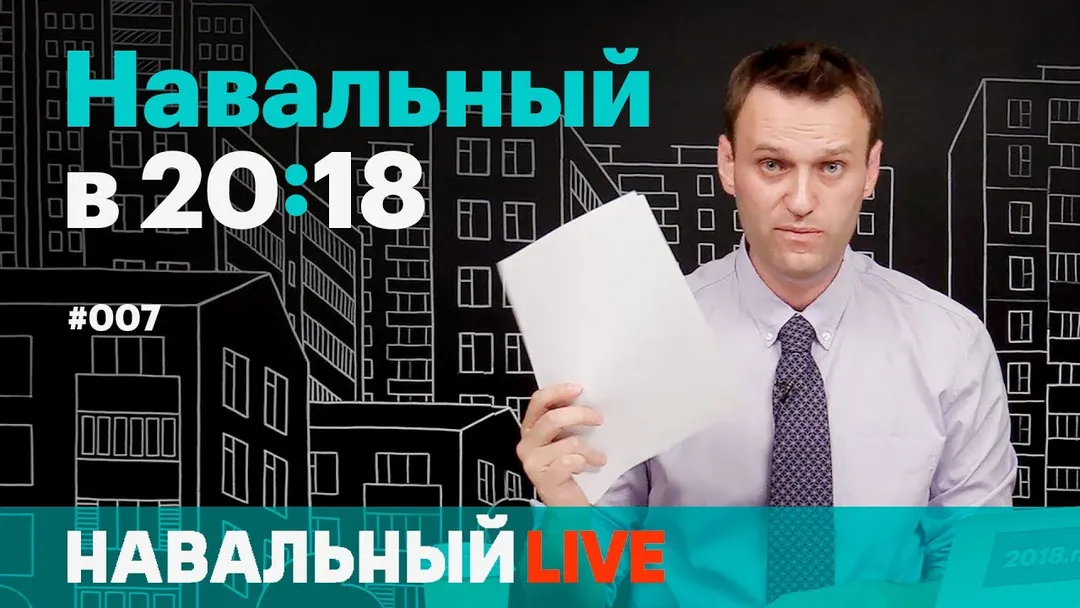
Navalny at 20:18. Broadcast #007. The June 12 rallies, the “renovation” poll, and the “presumption of trust” in the police
[music]
Good evening from Moscow.
It’s 8:01 p.m. in Moscow, which means we’re live in the studio.
This is Navalny Live. I’m Alexei Navalny, here
to talk with you,
answer pressing questions, and
discuss the issues that were the most
important over the past week. And if you
have questions, please send them to me
on Twitter with the hashtag
Just please don’t be upset that I can’t
answer every question, and many of them
slip by me—there are just an enormous
number of them coming in. The program’s editors
pick some out and send them over to me here. I
will try to answer as many questions
as I can. I feel tremendous
relief that I can begin today’s program
not with Alisher
Usmanov, who was undoubtedly one of the
main
stories this week. And of course we
will talk about that, but more questions came in
about the June 12 rallies, so I’ll start
this program with that topic, because otherwise
for the third time I’d have to begin with
Usmanov, and then this would all turn into
some kind of Usmanov show on the Navalny
Live channel. This week the process of
filing applications began, and I can say that
as of right now, in the June 12 rallies
people in 209
cities across Russia have said they want to take part—220 cities in total,
but the difference, the difference, the difference
is explained by the fact that abroad, our
compatriots want to hold
similar actions outside
Russian embassies and consulates. But 209 cities are
in Russia itself. I can’t give an exact
figure for how many applications have
actually been submitted yet, because this is still a spontaneous
process. We are not controlling it; it is, it is
truly a huge movement
of people who want to take part in our
second anti-corruption rally. But definitely more than
100. And the most important thing I want
to say about this is that, for now, most of our
applications are being approved and granted, and
that is a wonderful thing, because
the authorities have been forced to change their attitude
toward our rallies. Of course, we should
thank everyone who came out to
the unauthorized protests on March 26,
because it became possible to explain to those
people in the Kremlin, the ones who think
they can ban everything, that no—here
a ban won’t work. You can ban as much
as you like, but people will still
come out. As I understand it, that is exactly why
they have now changed
their tactics: they are issuing these approvals
because they understand that in any case people will come out
into the streets, because people have realized that
it is impossible to jail everyone, impossible to
intimidate everyone, impossible to arrest everyone. And
this achievement has, of course, been paid for
with days spent in special detention centers
under administrative arrest by
several dozen people. Naturally,
the highest price has been paid by the three
people who, as of now,
have been arrested on criminal charges. But they
proved that in reality there is nothing terribly
frightening about this. People came out into the streets
in cities all across the country, from Vladivostok
to Kaliningrad, and we all became convinced that
we need to keep going out, not be afraid,
and take part in unauthorized protests.
So for now, we see a trend that
the authorities do not want escalation. They
obviously are not going to meet all our
demands immediately, directly
after the June 12 rally. But at least
we have broken that pattern: they are no longer
trying simply to prove to us again that
“Guys, don’t come out, we’ll arrest all of you.” You
cannot arrest all of us. That is absolutely
certain. However, despite the fact that
right now, I can tell you exactly, we know that
there are currently 46 approved actions and, uh,
29 refusals. In different places, for various, uh,
reasons, it varies: in some places no
alternative was offered, in some places the alternatives
offered so far do not suit us. But overall the trend
is that more are being approved. But of course
these people in the Kremlin would not be themselves
if they didn’t, well, try to mock and humiliate us
over this. Yes, they are forced, for the most part, to
approve our actions. But
of course they want to sneer at us, so
we are seeing completely
outrageous, downright rude things happening in some
regions. For example,
Nizhny Tagil: in Nizhny Tagil, the application
was approved, but it was approved in
a locality that is formally
part of Nizhny Tagil’s territory—88 kilometers (about 55 miles)
from the city—and, I think, they scheduled it for 7
a.m. In Kazan, they also issued
approval for the rally, but
for 7 a.m., explaining that otherwise it would be
very heavily
affected by football fans. In Ufa,
it’s a similar situation. Krasnodar—please
put this on screen. It’s absolutely astonishing. Here,
you see, this spot here—I honestly don’t know
the geography of Krasnodar very well,
to be honest—but this is the place where
the application was approved, and again for 9
a.m. And now the next
image—this is wonderful. I don’t know, is this
some forest clearing or wasteland somewhere on the outskirts of the city, and
this wasteland was designated as the approved site for
holding our anti-corruption
rally.
This is actually a telling thing—what
is happening, the way they mock us. Yes, they
are forced to do this. They understand.
that they understand they have to give us these
permits, they understand that people will still
issue them. But they sat there and thought and thought
about what they could come up with there in the Presidential
Administration. There they were, sitting in these city halls, there
all this local housing and utilities stuff. Well, what can we do
ah, please give us some place like Nizhny
Tagil, for example—what can we do
to really put the squeeze on them?
I can only express my own opinion.
Of course, in these cases we need to
go out into the city center even more actively, even more forcefully
of the city. I mean, are we people or not, after all?
I mean, come on—Nizhny Tagil, you understand,
is a major city, and they say, well, you
go 88 kilometers (about 55 miles). They look at us with a
smile: you want to protest corruption, guys?
Fine, go 88 kilometers and somewhere
out there in some remote settlement
hold it. How are you supposed to respond to that kind of rudeness?
These people who, in fact,
are nobody—no one even elected them, they
represent no one—and they tell us,
well, your place is 88 kilometers away. So
I think that, of course, in those cities, if
the authorities don’t—well, don’t start behaving
normally and don’t stop being rude, then of course
people need to go out into the streets and exercise their
constitutional right: at 2 p.m., in the city center,
with Russian flags. And they keep
saying all the time, well, the place is occupied because
there’s a holiday celebration there. And what about us?
We have Russia Day celebrations too—we are
citizens of Russia, we have Russian flags,
we’re celebrating too, and we need to come out.
That is completely normal. Again, there’s no need
to be afraid of anything. All right, in an isolated
case, with a very small probability,
someone might get 10 days in detention—well, for this
it’s worth serving 10 days. As for me, I’ve
done that many times.
All the rallies were authorized, absolutely
peaceful, and we simply want to say the
words we have a right to say—we have
that right. Well, if there’s this kind of rudeness, you understand,
they give us some swamp filled
with water—the authorities in Syktyvkar. Well then, of course, people need to
go out to the central square. Sergey
Rud writes that in Chelyabinsk everything
was approved. Well yes, wonderful.
Approved—wonderful. They approved it.
In Chelyabinsk and in some other cities they gave out
perfectly normal venues in the city center,
some of them even better ones.
Later, perhaps, but nevertheless
all the same, Cub Illizium writes to me, I
see that officials have a good sense of
humor, only the people aren’t laughing. But in
fact, yes—at first I look at these
swamps and, yes, it’s funny. Sure, they had their laugh and
it’s a kind of joke, but, well,
it really is infuriating, you have to admit.
It really is infuriating. Why do these people—why do they
think they have the right to treat us
like this? I think it’s very important
to gather even more people for the rally and then
go with Russian flags,
joining the general demonstration.
Let’s see what they do with us then.
In Moscow, naturally,
there are a huge number of questions about
Moscow. So, there will be an authorized rally in Moscow,
so on June 12, put everything aside
and plan on going to
a demonstration that will be absolutely
safe and very peaceful.
We’ll say what we believe
needs to be said, from a big stage into a large
loudspeaker. But naturally, in Moscow
we know what the Moscow authorities are like—
they are also
those same hypocritical, unpleasant people who
always want to show how
clever they are, and how they can treat us,
how they can mock us. And
please show the picture of that location.
They really did allocate Sakharov
Avenue. Well, all in all, it’s a normal place,
nothing terrible about it. It was precisely in
that place that, I think, the second
big rally took place during the protests of 2011–2012.
But the wonderful thing is
that they approved both a march and
a rally. And the second image,
please—we simply measured it on Yandex Maps
and for the march they allocated
360 meters (about 1,180 feet). And on top of that, as you can see, the stage
is a little around the corner, arranged that way so that
people who don’t fit in will be
standing there and simply won’t be able to see what
is happening on the stage. So what are the
Moscow authorities doing? All right, take down the images,
thank you. They are deliberately creating
inconvenience. They are making it so that the rally
well,
is harder to organize, so that
it won’t look as good, so that there won’t be
a real possibility for a march, so that everyone comes,
stands around—first of all, for an hour and a half
at the metal detectors, and then goes in, and this so-called march
after that lasts 10 minutes, and then on top of that
the stage won’t even be visible.
But again, it’s obvious rudeness, and these people are simply
taking pleasure in it. Yes, I wrote about this once in
my blog several times. Honestly, this
gets to me, maybe even
more than corruption itself: the way they sit there and
snicker nastily, thinking about how they
can, yes, let’s laugh at
them—let’s allocate a 360-meter (about 1,180-foot) route for the march,
ha-ha-ha, how funny. And let them
talk about corruption during their
360-meter-long march. Naturally, we sent a notice to Moscow City Hall
saying that
we do not agree with this position. But what
they are proposing is simply unsafe.
First of all, naturally, such a crookedly arranged
rally, where people won’t be able to see the stage,
will force people to move closer
and of course it will create unnecessary crowding there
there won’t be any real benefit, but it will create unnecessary
such density that the people who come to the
march—the march itself—they won’t really get, but
to put it bluntly, they also won’t really understand
what is supposed to be happening, so we
are, once again, acting entirely peacefully
within the framework of a normal dialogue, which of course is
quite difficult for us to conduct emotionally
because what we really want is to tell this Moscow mayor’s office
plainly everything we think about it
and simply announce that we will, without any
approvals whatsoever, go to Tverskaya Street
where once again they are telling us there will be a
Russia Day celebration, and we will join that
celebration, but for now we have sent them
a very polite letter, strictly in
accordance with the law, in which we
ask them, well, not to be so rude to the residents
of the city of Moscow and to create some kind of
normal arrangement in which the stage is in a
normal place and the march is a little
longer than 300 meters. In any case, on the [date unclear]
there will be a normal
authorized rally in Moscow, so make plans
put everything else aside and
come. We can see that across the whole country
of course they are being forced to approve all
these
because they have no choice—they understand that
people will come, but extraordinary efforts
are being made to keep people from coming
you of course know a lot about how at
universities they are giving lectures and showing
videos saying that I’m Hitler, but today I was sent
an absolutely astonishing report as well
Please show it
please—one of the towns outside Moscow (in the Moscow region)
Well, I blurred it out so that the person
who sent it to me
—his surname was visible there—because he asked me to
do that. But in one of the towns outside Moscow
and, as I understand it, all across
the Moscow region this is happening. What actually
happens is that a police officer comes
and goes around to all the local activists
and has a talk with them, explains something
to them, and writes up a detailed report
of the working meeting, in which, as you can see,
it literally says at the bottom that if you
are taking part in the rally, then indicate how
you are getting to the site of the event—here,
he will be traveling by public
transport. It’s very funny, and more than once
people have told me about this. Thank you.
Take the report off the screen. The person was telling me that
the people who were drawing all this up—he
was laughing, and that police officer was laughing too, and
of course they were filling out the report and
discussing what nonsense the
higher-ups were engaged in, how stupid all of it was, and how
properly one ought to protest against all of this
by holding rallies. But nevertheless, this is what
the police are doing on a mass scale, and apparently
in our country they evidently have nothing better
to do. Next topic: Shpakov. In the last program
I said that it would be good
to raise money for
another Russian political prisoner
Alexander Shpakov
who has now been absolutely unlawfully
jailed. We showed the video of how he
was literally doing nothing, and they dragged him into a
bus. He has a mother left behind who
is very ill—she is essentially bedridden
—and a daughter whose education still needs
to be paid for. I proposed raising
500,000 rubles (about $8,500 at the time). That money was raised
that very evening, and as of today
we have collected a total of 877,000 rubles (about $15,000), which even
created a bit of a dilemma for us: whether
to give Shpakov’s family 500,000 and the remainder
to the family of another political
prisoner, or to give all 877,000 to him. But
we decided that since we were collecting it
for him, and you were sending money for him, we
will pass all the money on to the Shpakov family
and we will show you the receipts, everything properly. I
just wanted to say a huge thank you
to everyone who transferred this money so quickly
This is extremely, extremely important. With any person—
yes, of course, they cannot imprison everyone
Yes, of course, the authorities
grab only a few people, a very small number
in order to intimidate hundreds of thousands. We
understand that, and we are not afraid, but it is very important for us
not to forget those few people
to support them and, excuse the expression,
to keep them going, including with money
their families, who lose their breadwinner for
some period of time. So once again, thank you
so much to everyone who showed such
solidarity. Now let’s move on to
our Alisher Burkhanovich Usmanov
Usmanov. The court—if it can be called a court
at all—you probably saw in the news
that it established the following things
First, that Usmanov did not pay bribes to anyone
—neither to Medvedev nor to Shuvalov. In our
investigation there was nothing about Shuvalov, but
Usmanov’s lawyers rather
thoroughly went through all the instances
when I wrote something about him on my blog
probably going back to 2011, and for
each case they sued me. I
did indeed write that he had paid a bribe
to Shuvalov, and that was not my
investigation—it was an investigation by the Wall Street
Journal, the American newspaper. So anyway,
the court ruled that he did not pay bribes to Shuvalov
did not pay bribes to Medvedev, does not impose censorship at
the newspaper *Kommersant*, and
pays his taxes very diligently. Interestingly,
on this whole issue of rape or no rape
the verdict, the court ruling,
contains absolutely nothing at all, despite the fact that
Usmanov’s side was making a great deal of noise about it there
What people wrote to me most often, in huge letters,
was: please, a little slower. I actually
speak this fast only because
I'm nervous. Sorry, please.
I'll try to speak more slowly. So,
the main thing they wrote
in their ruling—the whole point of
this entire exercise—was to remove the film *He Is Not Dimon to You*.
It sounds like only the parts
concerning Usmanov need to be removed. But since in our case
everything is interconnected, and from the video
it's impossible to remove just that. Of course, they
are demanding that the entire film be taken down,
and of course, as I've already said several times,
I posted the video, I even wrote it on
a cup: of course I will not delete this video.
And the Anti-Corruption Foundation will not delete
anything either. We are not going to do that, and we are not
going
to publish the truth, you know,
publish an investigation, and then say,
"Oh, well, the court has forbidden us
to publish this truth, the court told us
to remove this truth." Of course I will never do that.
And the biggest number of
questions are coming in precisely about this: so
what happens now, what will happen next?
Olga Lobachyova asks: on
what grounds did the court conclude that you personally
are the owner of the account and that you personally must
delete the video? What
evidence was there? The thing is, they didn't
prove it—I said it myself. Well,
Usmanov's lawyer asked me, "Was it you
who published it?" I'm not going to say, "And you
prove that it was me who published it." I'm not
going to play that game. I said: yes,
I published it on my personal account.
I stand by and am ready to prove every word
of what was published there. So they didn't
need to prove that fact.
What happens next is this: well, court bailiffs will come to me,
they'll say, "Here is the court
decision—delete it." And I'll tell them I won't.
After that, they'll probably
keep chasing me around, these bailiffs,
they'll fine me for failure to comply with
the court decision. Well, I do not recognize this
court decision. Let them fine me.
Today Vadim Kobzev, my lawyer,
he
put forward this version in *Novaya Gazeta* (an independent Russian newspaper),
I think, that this could be used
to change my suspended sentence
to a real prison term, because there will be
an administrative case for
failure to comply with a court decision, and that could be used
to argue that I am, so to speak, chronically
violating the law. But I don't know—I think
that this is
unlikely. Theoretically and legally,
it is possible, but in any case I am not
going to delete anything, and I am not going to comply with this
court decision. What do you think about
the rating of your investigation on
KinoPoisk? It's at 9.6. Yes, indeed,
I saw that on KinoPoisk (a Russian film database and review site), our film
was given a rating of 9.6, but there it's already ahead of
*Forrest Gump*, *The Shawshank Redemption*, and
all the masterpieces of world cinema. Well,
I take our film calmly. I
understand that of course it is inferior to *The Shawshank Redemption*,
*Forrest Gump*, and films like that, but
it's pleasant for me—it's support, the fact that people
are spreading the film now, and the fact
that they are giving it a high score simply as a sign of support,
giving it a high
rating. So, returning to the court decision,
a large number of people wrote to me, including
respected people whose opinions
I listen to, and I wanted to dwell on this topic
separately.
"Alexei, you're a presidential
candidate. You're a lawyer, an attorney. How can you
write things like, 'I don't care about
the court's decision, I'm not going to comply with it'? That
undermines trust in the judicial
system. That's not good. Couldn't you
express yourself a bit more
carefully about this court decision—say
that it's bad, that it's unjust,
and therefore you won't comply, but nevertheless
you still have a high level of trust in
the judicial system, because that's so important,
and blah blah blah.'
Well, I'm not going to do that, and this is my
principled position. I truly
do not respect the courts of the Russian Federation. I
believe that the courts of the Russian Federation and
its judges are the worst of all. They are worse than those
who rig elections, they are worse than those
who fabricate criminal cases, they are worse than those
who lie on television, because
the judicial system is the main pillar
of this corrupt regime. The judicial
system is one of the pillars of society.
It is the place where disputes are resolved. That's how I see it.
And you think so too: there should be a place
where we can come and someone will judge between us. This is
one of the most important things humanity has created.
Our lives are
an endless conflict, and there must be a place
where we can come and achieve at least
a somewhat fair decision. Such a
place does not exist in Russia. You can call it a
court, you can put a sign on it,
you can say, "Look, in the picture hangs the famous
Themis statue installed at the Supreme
Court of Russia," and you can see that this is very
symbolic, because the classical
Themis has a sword, she has scales, and she has
a blindfold, because she must not
see who has come before her. She must
deliver justice for everyone regardless
of who stands before her.
But Russian Themis is like
an auntie who looks at the person who
has come before her: if it's an official, then...
If this is the authorities, then it's some Usmanov-type figure.
It always rules in his favor.
I do not respect that kind of judicial system, and
I never will. All authoritarian
regimes are sustained to a large extent by
the judicial system—first and foremost by
the courts, and only then by censorship,
lies, and the repressive apparatus. But
of course the courts are the main thing. That's
what is happening in Venezuela right now, yes.
The opposition there went into
the elections, it won the elections, it gained
a majority in the National Assembly, and
yet Maduro still retains
power in the country. He dissolved parliament
relying on the judicial system. There
are a few lying crooks there
whom he controls. They hung a sign above
themselves saying "court" and say, "Respect
us because we are the court. You can see
it says 'court' here. So everyone is supposed to
respect a court ruling," and they overturn
everything. They are not interested in the will of the people,
they are not interested in rights—people's rights mean nothing
to them, nor do their aspirations or hopes. They are not
interested in the fact that people there are now
living in poverty and standing in enormous lines
to buy food, because they are the court.
And we should not treat the Russian courts
with any respect at all, and I am not going to
treat them with respect.
Here's another example, from
my own personal
experience. I was at a session of the Presidium
of the Supreme Court—the highest instance in
Russia. Supposedly, that is where
the cream of the legal community has gathered—the best
lawyers in Russia, the most respected
people. And there I am, supposed to sit
across from them and feel reverence. My
God, the courtroom is so beautiful. Everything there
is arranged so elegantly, the chairs are
placed just so, there are columns standing there, and
the only thing missing is wigs, and
over all of it there practically hovers
the message: respect
the court. You have no right to say anything against us,
even if you do not like it. Still
you must respect it. But I am sitting there, and I
see that among the members of this Presidium sits
Deputy Chairman of the Supreme Court Oleg Sviridenko,
and I know that he is sitting there pretending to be
a great jurist, but he was recently
caught with a stolen
dissertation.
There was an investigation—I was not involved in it. It was
the academic community Dissernet (a Russian network that investigates plagiarism in dissertations); they
found that the gentleman had a stolen
dissertation. And he sits there in that robe, and
above him it says 'court,' but the dissertation is
stolen. And when complaints were filed about
all of this and they tried to strip him of
that academic degree—and they should have stripped him of it
because the dissertation was stolen—
it was sent to the very same dissertation
council of which he is a member, and it all
came to nothing. There was a huge scandal,
journalists
were all over it, there was a lot of talk
about it, but he remained a Doctor of Sciences,
and he demands some kind of respect for himself.
No, I will not respect that. I know that they are
not distinguished jurists at all, just people with
stolen dissertations. I am not going to stay
silent about it. I am not going to feel
any respect for them. Today news came in:
in the Moscow City Court they discovered
You can see the photograph, yes, published by Mediazona (an independent Russian news outlet)
—a person
chained to a wall.
And there are reports, there is testimony, that
these people are chained up like this and beaten,
or chained up and kept that way for
a fairly long time in
that restrained state. Supposedly,
this—well, it looks monstrous—
is meant to be used so that
so that
people under investigation can review
the case materials and not run away anywhere. I
do not understand why they need to be chained up. It
looks quite strange. And if there is concern
that they will destroy the case materials
or eat them, they could tear them up with one hand
or stuff them into
their mouth. And in general this looks
wild. They are people under investigation—they are not even
convicted; they are presumed innocent. They
are being chained up, but in fact all of this
is being used as
a torture device. Imagine that you are
chained by the hand like this and you have to
sit there for hours. And it is well known that in the
Moscow City Court, people under investigation wait
for hours before they are taken into the courtroom, and
they sit in that position, they are beaten,
they are tormented. A large number of
testimonies were published today.
Am I supposed to respect a court like that?
And
the Moscow City Court is the largest court in Russia. Do you know
what comment they made today about
this? They said: well, this
is not
our responsibility—those torture rooms are not something the Moscow City Court is responsible for.
Just
fantastic. In a normal country, in
the beautiful Russia of the future—well, in principle,
what should have happened is this:
the court chair, Yegorova, should have
said, "I am shocked that in our court
something like this is happening, that people are being tortured
right in the building of the Moscow City
Court. I am immediately filing a report with
the police. We want to completely dissociate ourselves from what
is happening. It is absolutely unacceptable." But
instead they say, "Well, it's not us. It's
the police, you know," they tell us.
The city court: and here we’ve even got a wall as well.
It’s padded with foam, so when people in there are
being beaten with batons, we can’t hear it. Excellent
soundproofing, so we don’t know anything
about it. Let the police deal with it.
So what, I’m supposed to respect a judicial system like that?
I’m supposed to respect these people for
all this? I’m not going to do that.
I don’t consider the judicial system at all
to be a judicial system. It’s just a bunch of
hangers-on and lackeys who simply serve
this regime for quite a high salary,
by the way.
So then, Elmir Shamsudinov
asks: in Ufa, at a college, they held
a talk about the June 12 rallies. Anyone who
goes, they said, would be expelled. They’re lying. No one
is going to expel anyone. Last time too
they threatened that. It’s impossible. If someone makes
statements like that,
record them on your phone and
upload it to YouTube. That’s your best
guarantee of safety. No one is going to
be expelled, and at least so far no one has been.
A student paying tuition submitted an application to
hold a rally, and then he was called in
and told, “Listen, withdraw the application and we’ll move you from
a paid place to a
state-funded one.” A funny situation, right?
If you want to switch from a paid place to a state-funded one,
you can promise them something.
“Transfer me, but please don’t make me withdraw
the application,” or ask them to have
someone else found. I mean, we
understand what’s happening: the Kremlin has given
clear instructions to the authorities: don’t do
anything except make sure that on June 12
as few people as possible come out. Our
response is what? To bring out as many people
as possible. Because if we don’t come out, they’ll
go on stealing.
They’ll steal everything, from our future to, I don’t know,
the sun itself, like in a
fairy tale.
So, Valentina Kosterina rewatched it.
Today *He Is Not Dimon to You* ended up on Pornhub.
There’s never been more irony. Valentina, you don’t
have to watch it on Pornhub; for now we still
haven’t had it removed from our main
account, but it really was
funny. And we won’t remove it from our
main account, so you’ll always be able to
watch it on the site, on the blog at
navalny.com/dimon
navalny.com. Well, okay, it’s amusing that
it was even uploaded to PornHub. It’s a good
demonstration that they still won’t manage
to delete it completely. Sure, they’ll try
to block something, I don’t know,
maybe they’ll come here by force,
make me give up my passwords, log into
the YouTube account, and delete the film. So
what? I’ll just restore it again. I
just want it to remain available. I want
people to keep sharing it, because
it’s all the pure truth, and all our
claims against Medvedev are justified, and we
will keep saying that if
the country’s prime minister controls foundations
into which 70 billion rubles (about 70 billion RUB) were pumped, and
expensive real estate was bought, then he must
answer to us, to everyone.
You can’t do that, even in a rich
country, much less in one this poor, so
so yes, upload it
everywhere. Yury Yershov: the more people come out, the
faster this rotten regime will
collapse. Exactly. The fact that it’s rotten doesn’t
mean some kind of catastrophe is inevitable. It
means things will get better. When this
regime goes, there won’t be some kind of
terrible revolution, people won’t be
running through the streets. Things will improve. In a
fairly short time, we’ll simply become
richer, because these people
who seized all this have dug in and
are trying to convince us that if they’re gone,
there’ll be civil war. But
they’re lying. Without them, we’ll simply live
better and more prosperously, because they’ll stop
so thoroughly
robbing us. “I showed the film to my grandmother,” writes
Evgenia Parker. “She came up with some of her own
arguments, reminded me that her pension
was increased by 54 rubles this year — like a spit
in the face. She doesn’t believe it.” Television
propaganda works very well. Of course
television propaganda works
extremely well. Besides, remember: it may not have
been all 18 of Putin’s years in power,
that television propaganda has been operating, but at least
since 2003 it’s all just been brainwashing.
So your
grandmother has had
— excuse me — her ears filled with this nonsense for 15 years. Do you
think showing her the film once
will work? No. Keep working, talk to
your grandmother more often, look for new arguments.
We’re not going to have an easy victory. The country has
obviously been stupefied. But my broadcast
gets anywhere from 600,000 to 1.5 million viewers,
by the way. Subscribe to
our channel, definitely. And even when
a recorded video, not a live stream, gets a million views, that’s good,
2–3 million people watch it, but
they are broadcasting to audiences of millions
every second across several channels.
So there’s no need to think that with one
film we can somehow
overcome that. There are lots of questions about the St. Petersburg International Economic Forum.
Today I was on the program *Where’s the Money?* with
Vladimir Milov — the best
economic program out of those
currently around — and we discussed there in quite some detail
the St. Petersburg economic forum.
You can watch it, but let me show you
the St. Petersburg economic forum in a single
picture. Show the picture — there it is.
And there’s Tula Region Governor Dyumin.
Putin’s former bodyguard is signing
an agreement with the prosecutor general’s eldest son,
Chaika’s son, and an agreement
to continue building a salt monopoly.
That’s what the Chaika family business is doing — there it is in full.
The St. Petersburg Economic Forum — there you have it,
the whole Russian economy, the whole of Russian business.
In Russia, Putin’s former bodyguard
signs an agreement with the eldest son
of the prosecutor general. That’s it — no one else in Russia
has any prospects of doing anything. Everything
that happens is within the inner circle,
which keeps reshuffling property,
which makes money, as we can see,
once again from raw materials. What is salt? The same thing —
a raw commodity. These people have sunk their teeth in, and they’ve already
latched onto Russia, onto its national
wealth, and now they hold
various forums for themselves, do various things, some kind of
panel sessions. But to real life, to
real business, to real development,
this has long had nothing to do with any of that. But
what will any foreign investor do
when they look at what’s going on? Sure,
sons and bodyguards are
doing deals with each other, wheeling and dealing. Where
is there room here for normal business? There
simply isn’t any. So this entire economic
forum... The boy, the boy detained on
Arbat (a famous central street in Moscow) — I’ll probably be the million-and-first
person to comment on this
topic. Everyone has already spoken out, but I still
want
to comment on it, first of all
because it was interesting to watch
the discussion. At first, everyone
was outraged and said, “What a disgrace,”
“the police are arresting a boy,” and I
also wrote that these police officers
are criminals and should be put on trial immediately
for what they did to the boy and his
mother. But then this whole thing started
where everyone began to doubt: well, maybe that wasn’t his mother
but his stepmother, and the boy was apparently
begging, and the boy’s real mother
showed up, and it seemed like this trend began
where we all started saying, “Well, this is
all kind of ambiguous, not quite
what it looked like at first glance,” and several
people wrote to me: “Well, Alexei, you
should take back what you said about
the police being criminals, because
everything there is
complicated.” Okay, let’s think about it
this way. A simple line of reasoning that I have
in my head — I’ll try to share it
with you. Let’s imagine the worst
case: the boy’s evil stepmother
forces him to beg passersby for money
by reciting *Hamlet*, beats him if
he doesn’t bring in enough money, and spends the money
on drugs or on
making this boy
drink vodka too, and the boy is somehow supporting
some horrible dens — that is, let’s imagine
the absolute extreme, the very worst. Well,
even if that is true, it means
one thing: this boy is one of the most
unhappy people in the world. His life is
simply hell, a nightmare. And then let’s
ask ourselves: should
the scene we witnessed
during the detention of this boy
and his maybe-mother, maybe-stepmother — let’s
briefly watch the video again
once more.
Please.
No, I won’t let the child go.
Please, think about what you’re doing to the child.
I
said it. I said it.
No. What
are you doing? He has a mother, he’s alive... Passersby don’t
understand what’s happening, someone is filming it
on a phone — and this is supposed to be care for the boy?
Well, that’s why I wrote what I wrote, and I still
believe that the police officers, of course, should
be put on trial, regardless of what exactly
was going on there. Of course, everyone has a complicated
life; there are no simple situations — stepmother,
mother, everything is complicated, everyone hates each other,
you know how these things happen in families,
it’s always very complicated, everyone suffers,
they got divorced, they can’t divide the children. But
what I want to say is that this is not
a contribution to the public good
when the police grab this boy and drag him
somewhere while he screams, because after all
he is still a little boy. And if he is, all the more so,
a beggar, then he certainly didn’t become a beggar
because life was good. He is suffering, and they
drag him away, leaving him with trauma for the rest of
his life. The police are supposed to exist
to make people’s lives
easier. We created social workers, we
created commissions for juvenile
affairs in order to
help minors who find themselves in
difficult situations. If the police saw
a boy who, well, appeared to be begging,
they should approach him and, in the most
polite, gentle tone, say: “Dear
boy, what’s your name? Where is your mother? Can
we call your mother? Give us her
phone number — you don’t have a phone? Here is ours,
try calling your mother yourself
from our phone. You don’t want to call your mother? You don’t want to say
anything? All right. Then may we simply
sit here beside you and
watch over you for now so that no one bothers you?”
And they should sit down next to the boy and keep an eye
on him, while they themselves call a social worker,
and then a polite lady would come to the boy,
her eyes full
of compassion, and she would not grab
him by the scruff of the neck or drag him away, but would say,
“Dear boy, what happened to you?”
How can we help you? Maybe you need...
a psychologist. Maybe we can feed you. Maybe you're...
hungry. Come on, tell us. Where is your mother? And...
what can we do? Come on...
let's sit down somewhere. I'll take you there. We want...
to help you, boy. That's how it should...
work in a normal system, and there should be no dragging
anyone away, neither in front of passersby nor
even if no one sees it at all.
That's the only way it should happen, and...
no other way. The police and all these
institutions are supposed to help society. And
whether he's a beggar or not a beggar,
first of all, he's not a beggar. This is still
street art — he's performing, reciting all this.
Excuse me, but near practically every
church we also have these beggars sitting there. Well, they
sit there quite legally, they have
the right to sit there. Someone may not
agree with me, but it's a Russian
tradition to end up on the church steps ("на паперти" — begging outside a church); the expression
itself reflects the idea that in Russia, near
churches, unfortunate people sit. Yes, maybe
they are professional beggars, but
you can't say they are happy.
Right? Again, they're not there because of a good
life. They sit there and ask
for money, and they will keep sitting there asking
for money. That's how it works, especially in a poor
Russia like the one we have now. No one is
dragging them away, no one is hauling them off anywhere. That's how it should be.
This is what happens. Unfortunately, when it comes to
these
professional collectors of alms,
the police simply take money. They saw a boy
who hadn't paid some kind of tribute for
this wonderful spot in the city center, on
Arbat. That's why they dragged him away. That's why
this happened — not because they wanted
to help the boy, no way, not to help.
You can't help a boy like that if he's crying, if he's screaming in
the car. So I absolutely believe that
the very framework of this discussion is wrong:
we start trying to figure out what's going on
inside, but we, we, we know that none of this
"they're drug addicts," "someone beats him if he doesn't
beg for alms" — none of that is the point.
If this is happening for some reason, then people
need help. If the state
for some reason wants to get involved at all, then it
should provide help, including to this
unfortunate boy. I'll
give you an example from the practice of
American police. Anyone who has been to the
U.S., or lives there, may have encountered
a situation like this. At least many
of my acquaintances have encountered
it. If you're in some unfamiliar
city walking at night, you're a suspicious
person wandering around some
residential neighborhood. Everyone lives in one-story
houses, and a person is walking, and the police see him.
What do the police do? Well, if the person isn't
— let's say — carrying a TV or holding a rifle,
they don't even start
checking documents right away: "Citizen,
stop there, show me your papers." They drive up to him
and ask, "Where are you headed?" You tell them,
"I'm going home, leave me alone,"
and again they won't say, "Oh yeah? Hands on
the hood, we're checking you." They'll say,
"Come on, we'll give you a ride," because they want
to drive him home and make sure
he goes into his apartment — which means he's not
just loitering around. That's how it should
work. If the person says, "I'm not going,
my home isn't there," and can't
name an address, then probably the police
will follow him, or check, or
take an interest. But no one will simply
drag a person away just because he's
just a person. The police are supposed to help.
An example from my own experience:
when I was studying at Yale University, I
lived in New Haven. It's considered fairly
problematic in terms of
safety, although personally I never
noticed that. It seemed super
safe to me. So the police offered
a special service:
if you're coming back late from
the university to your home, they can
give you a ride. There's a special phone number,
and the police come for you — university police
or regular police — and they literally, like
a taxi, just drive you home. More than that,
if you don't want to be driven
and you're used to walking, someone will come to you
and walk with you, simply like
a personal bodyguard, and chat with you on the way.
I know this from personal experience.
When Zakhar was little, we had a
nanny. They were out walking somewhere in the evening,
it got dark, and I'm sitting at home when I see some kind of
police car bringing my child and the nanny, and
I say, "What on earth happened?" They say,
"Well, we just thought
it was getting a bit dark already, so I called,
and they walked us home." So she was walking with
the stroller, and a police officer was walking beside her.
That's what the police are for: to increase
the public good, to care for
citizens, not to catch them and torment them. Since we've
started talking
about all these arrests of children, I was asked
about this Holi color festival
and the unrest that took place in
Chelyabinsk. Now that is a real example of idiocy.
So here's what happened: they announced
a Holi festival, a festival of colors,
then banned it, but the teenagers came anyway
and staged a full-blown — I don't even
know — some kind of riot with the police and
a showdown. I was simply stunned. Well, my
wife went to this Holi festival with the children.
Holi — honestly, I really...
Here's a photo from Yulia's Instagram, I
found it специально. Honestly, I really...
I was sure it had nothing to do with it.
with some Indian gods — it was just
some paint manufacturers putting on
a promotional campaign and handing out these paints so that
everyone could throw them in each other’s faces.
Wonderful, everyone’s having fun. It turned out
that yes, it’s some kind of pagan holiday in
honor of a Hindu goddess. Well, and Maslenitsa (the traditional Russian pre-Lenten folk festival),
what is that? It’s also a pagan holiday, and
if the church is unhappy with an Indian
pagan holiday, then let’s ban Maslenitsa too.
In any case, nothing at all is happening
except that children and their
parents are having fun and smearing each
other with paint.
[applause]
You see, there’s some kind of scuffle, people grabbing cars,
disorder, and shouting “AUE” (a Russian criminal-prison subculture slogan). You see, what is
the point of this idiocy? Idiocy
has produced more idiocy — that is, children
are shouting the slogans of the criminal underworld, and in doing so
they begin to set themselves against
the state, they begin to relate this way
to
to the state, they begin to relate this way
to the police. How else could they relate?
Why is all this needed? Why this stupidity?
What our authorities are doing — this
constant “don’t allow it” and “ban it” — it simply
brings nothing but problems and costs us
an enormous amount of money. In Chelyabinsk,
the crime situation is difficult, and the police,
instead of doing their
actual job, were breaking up all these
festivals. And remember, a year ago, two
years ago, everyone was saying — human rights activists,
politicians, and I said it too — that when the authorities
start devouring everything around them, when this
mad Leviathan begins to consume
people, jailing them for likes and reposts,
it cannot stop. And everyone always
treats this as some kind of
rhetorical phrase — “the authorities won’t stop
and will keep making things worse” — but in fact
people think it’s nonsense. It’s not nonsense.
You see, that is exactly what happens.
It’s impossible to stop; there always has to be
something else to ban. If the city authorities themselves
and the police themselves internally feel
like bodies that exist only
to prohibit things, then that is what they will
keep doing all the time. They’ll be banning
the Holi festival, and in the beautiful Russia
of the future, everyone will be able to throw
paint at each other — but not brilliant green (a harsh antiseptic dye often used in Russia for attacks and harassment).
As much as they like, until they’re blue in the face, painted every color under the sun,
please — it’s the right
of citizens to do that. Lav Rosla asks:
how do you feel about people in power
starting to follow your example and
use YouTube — for example, the channel
of Roizman (Yevgeny Roizman, Russian politician). Wonderful — Roizman launched
a channel, and I urge people to subscribe to it.
It really makes my heart glad. I very much want
there to be as many channels as possible, for them
to appear in the regions, so that people speak out,
because this is our chance to defeat
the monopoly. In this very first program, in
my first broadcast on Navalny Live, I
said that we launched all this in order
to show everyone that this can be
done, that none of this is expensive, that
completely non-professional hosts
like me can do it. I’m terribly scared to host
every broadcast — it’s the scariest thing
I do in my life. People often ask me
this question: aren’t you afraid to go to
a rally? Aren’t you afraid of detention? No,
that’s not scary. Hosting Navalny Live
is genuinely scary. Even today I tried
to reformat the program and have
Kira Yarmysh, my
press secretary, sit here with me so that, well,
there’d at least be some kind of dialogue, so it wouldn’t be
so scary alone. But we discovered that
these images that appear next to me
wouldn’t appear
properly — they would just show up over her head — so we had
to remove Kira from the broadcast after all. So
of course I support what everyone is doing,
these wonderful
broadcasts. Dmitry Galkovsky with a boy...
There’s nothing complicated about it. And the cops, in any case,
are criminals; at the very least they should have been dismissed from the Interior Ministry.
But they were not fired. As we know, the Interior Ministry
did apologize after all, but nevertheless they
were not dismissed, no one sent them to the dock,
and what is most striking
to me in this story — did you notice?
The authorities immediately came out in
support of them. Here’s a quote from Neverov (Sergey Neverov, a senior United Russia politician):
Why? It seems obvious — everyone
was outraged, so Neverov and
United Russia could have been outraged too and said, well,
why are the police wasting time on nonsense? But no, they
feel obliged, every time
society is outraged by something, to
say that you are outraged for the wrong reasons.
In every single case, every single time when
people are unhappy about something, they absolutely must
justify the worst ghouls,
the police officers who engage in nonsense,
those who torture, and so on. The authorities
consider it necessary to stand
on their side, on the side of the villains, and
to identify themselves completely with them.
Renovation — I seem to have gotten carried away talking, I
see.
It’s 21:08, and I definitely want to get to the topic of
renovation, because we conducted a poll and
as I promised, I’m going to tell you the results
of that poll exactly as they are. Echo of Moscow will be
very pleased right now, but
we need to know what honest sociology says,
what Muscovites really think
about renovation. In short, they
rather support renovation. Let’s
go to the first slide, so, first...
Slide: Do you know anything at all about the renovation program?
Here we can see an interesting
thing: older people, for the most part,
are more aware of the renovation program. This
suggests that Sobyanin's (Moscow Mayor Sergei Sobyanin's)
system of television and newspapers,
and all the many other channels, worked quite well
on this issue, while younger people
who use the internet are less informed
about the renovation program. But nevertheless,
most Muscovites still know about it or
have at least heard something. Now, slide number two,
please: do you support or not
support the program? Here Sergei
Semyonovich (Sergei Sobyanin) is probably rejoicing, and they will now
be saying that even opposition figure
Navalny, with his honest polling,
admitted that people support it. Yes, we can see that
most Muscovites support it or
rather support it, but
what is absolutely
remarkable is that we have seen how, over the past
few months, Sobyanin and the mayor's office
have quite significantly changed their
original program. Today
it was announced that they removed perhaps
the most outrageous provision, the one stating
that among the votes, those of people who did not
vote would automatically be counted as in favor.
Now they have said that
those votes will be divided proportionally.
This shows that those
10% of active opponents are in
the minority. But their role is absolutely
essential in order to protect
the interests of the majority. If it were not for these
active 10% who were outraged on
social media, went to rallies, and
the renovation would have gone ahead in its most terrible
form, the most corrupt
and most nightmarish one. But these 10% came out
and, with their opinion, protected everyone, and
once again this shows how important it is
to voice protest, how important it is
to take to the streets, and that any position held by the authorities
can be broken if you act.
Please show us the next slide.
Active
Citizen — fictitious citizen, as we
know, an absolute fraud.
The mayor's office did a pretty good job, and most
people — and interestingly, by the way,
young people too — think this is the right
way to account for Muscovites' opinions
regarding
the renovation program. In this slide, of course, I
don't like the fact that everyone has been so thoroughly brainwashed and
people believe in the Active Citizen system.
Active Citizen is absolutely
fraudulent.
Still, the fact that people generally welcome
electronic democracy, direct
voting on the internet — if only it
were honest. That would be very good. Next
slide, the last one: do you agree or not
with the demands of the participants in the rally
calling for the cancellation of the program? Here
it gets interesting, because we can see that
the share who agree or rather agree is larger than
the number of those who are dissatisfied. Very actively
dissatisfied are 10%, but they are supported by
a larger number of people. That is, even those
who are generally inclined to support the program
still think it is right that people come out and
speak out, that it is right for people to come forward with
their own specific concerns, and they
support this — uh — more people
support these active 10%. Although
nevertheless, honestly, we are not going to
manipulate the data if the data
may not seem quite as nice to us.
Of course, it would be a great slide if
we could now show that 90% of Muscovites fully
share the protesters' demands, but that is not
the case. We are showing you things as they
are. Putin said something that
honestly just stunned me. I would like
to say a few words about it. Please show
us that quote. You see, I
have already dealt with one U.S. president, and
another, and a third.
Presidents come and go, but policy
does not
change. You see, here I am sitting there as
the president of Russia, and past me, like
commuter trains, U.S. presidents rush by:
one, two, three, four — my God,
some riffraff, some fussy little people,
while I alone am this kind of political
pillar, staying in my place, while they over there
just keep changing and changing. Well, fools, so what?
If they change, that means they are weak. Their presidents
and their strange state. And what is interesting is
that they boast about this — they really
think this is cool, and the population is supposed to
be convinced that it is cool. Some kind of
idiots, those Americans, changing their
presidents. We have one president, and he
stays put. That means he is better because
he has stayed longer. And this is an important thing
that we need to understand and that we
need to answer in response to all this nonsense
about flickering presidents and our
stable one: the main consequence of the fact that
you, my friend, have been sitting there for 17 years while past you
others flicker by is that in Russia
the average salary is 36,000 rubles, while in the U.S.
the average salary, converted into rubles,
is 187,000 rubles. That is what it means.
Rotation of power means
concrete prosperity for citizens. Well,
then he should give an interview and say: here I am,
I sit here while they keep changing and changing. Well,
and yet somehow they still pay people
187,000 rubles, while here it is 36,000. That is what
it means. So this is simply very
important. I decided to dwell on this because, unfortunately,
even among ordinary people there are
There are people who say, “Well, ours—our guy—”
“our president is better, because over there they all”
“keep changing, while ours stays in place. Maybe that”
“is a sign that there’s no one better.” No, it’s simply
the reason why we are poorer, and I can’t
at the very end—not that. It’s good that I managed
to, well,
to respond. “Navalny is awesome,” someone writes to me.
AUE—that’s the “Unified Anti-Corruption Order” (a joking reinterpretation of the Russian criminal slang acronym AUE),
nothing criminal about it. Well, no, I think
even though we can decode
AUE as the “Unified Anti-Corruption Order,” still
let’s refrain
from using that chant too widely.
Now, the police—yes, speaking of AUE.
Today we were simply stunned—I was stunned
to the depths of my soul—by the deputy interior
minister, Mr. Zubov, who stated
that police actions must, a priori,
be considered lawful. Everything a
police officer does is absolutely legal, and if
you don’t
like something, then go to court. And then came the
fantastic phrase: “It must be in the blood”
of every person. In other words, with our very blood
we are supposed to absorb a certain respect and
submission toward the police. And maybe I wouldn’t have
been so angry about that phrase
—outrageous, insulting, and simply
indecent, of course—if I didn’t know who
Deputy Minister Zubov is. Because we’ve been watching this
gentleman for a long time. He was the very
same person who, on behalf of the Interior Ministry,
spoke out against our draft law on
combating illicit enrichment, against
ratifying Article 20 of the convention.
Back then, he spoke for the Interior Ministry and said
that this article must not be introduced because
there must be a presumption of trust
toward officials. And when an official
speaks out against Article 20,
speaks out against fighting illicit
enrichment, speaks out against our
concept that officials must
explain where their wealth comes from, I—I
do something very simple: I go
to the Interior Ministry website, look at the person’s asset declaration,
look in particular at Mr.
Zubov’s declaration—and what do I see there? An official,
a police officer, in government service his whole life: one
Range Rover, another Range Rover, a Land
Rover, a Jeep, a GMC. And his income is 5 million rubles (about $55,000),
his wife’s income is 8 million rubles (about $88,000), and this man
is now trying to prove to me that I
and all of you must have in your blood
—forgive me—respect for him.
We are supposed to assume a priori that he is right about
everything, that he enjoys a presumption of trust, and that we should
just salute and accept that
these people can do whatever they want
with us. No, I’m not going to do that, and
it’s impossible to do that. But answer us,
please, Igor Zubov: where did you get
all of this? What does your wife do that
she has an income of 8 million rubles (about $88,000)? That’s quite a large
income. I think very few of our
viewers earn 8 million rubles (about $88,000), but every one
of us—absolutely all of us—is interested in one thing: with
what money did you buy two Range Rovers?
Why do police officials—well, of course we believe
that a deputy interior minister should earn
a good salary—but I strongly doubt
that even in a developed country like
Germany, for example, a deputy interior minister
would, first, be able, and second,
want to buy such
luxury cars—or that his wife
would have such an
unexplained income.
And we do not need any kind of
respect for you “in our blood.” We
consider it necessary, important, and
the only possible approach that officials
treat people with a presumption
of innocence, that officials proceed from the understanding that
—well, of course, we will not automatically
consider everyone thieves—but if there are these signs,
if you’re an official driving around
all around us in a Rover, then
answer the question. That is how a normal system should exist and function.
It is for this system that we
will all come out, including on the 12th—June 12
—into the streets. And once again I urge everyone
to file applications as actively as possible. If you haven’t
managed to submit an application in your city for a
rally, then apply for a picket. Urge
as many people as possible to come
to these rallies. Spread
the word. Explain why we are going,
why we want answers to
our questions, why instead of answers we are
being told insulting things, why people are
laughing at us—and we are not going to
put up with it. We do not need any submission
before these people “in our blood,” and we will never
agree to what they are offering
us—that they think they
should have a presumption of innocence, while we
are supposed to, like somewhere in Syktyvkar (a city in northern Russia), on some
swamp far from the city center,
stand quietly behind a birch tree and say,
“Excuse us, please, we have a small
little question about corruption…” That
is not going to happen. We will come out onto the main square
and we will say loudly what we want and
what we have a right to. Thank you very much
for being with me on this broadcast.
Subscribe to our channel—here
they tell the truth. Until next
[music]
Thursday.
Uh.