Navalny’s Circles: Education (full version)
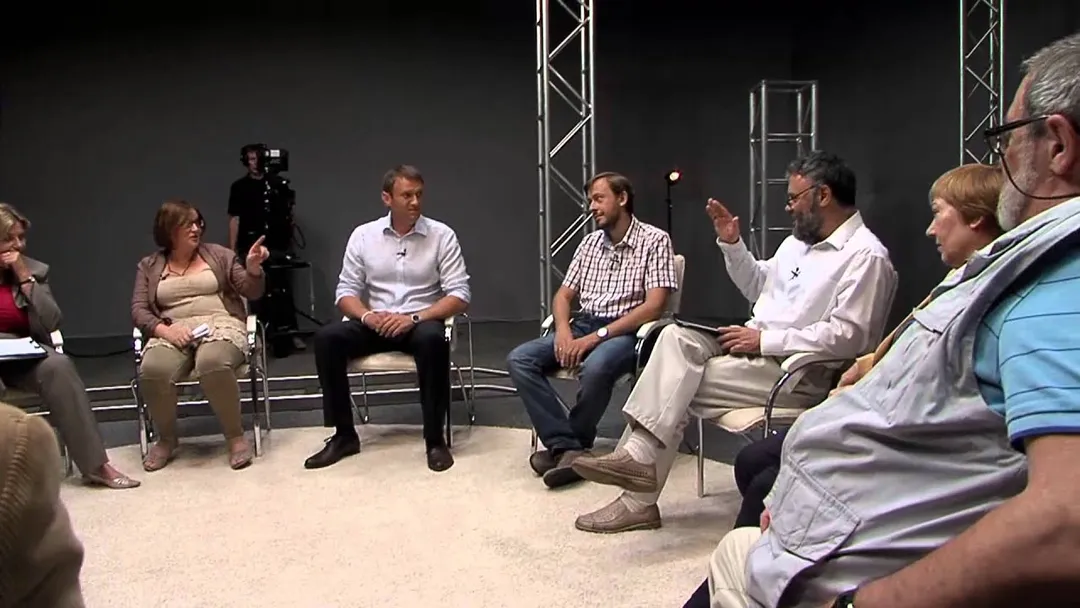
Friends, thank you all very much for
coming. For me and for the members of my
team, it is very important to maintain an ongoing
dialogue with professional communities
so that we can develop our
program, improve it, and listen to
critical remarks. Today
we wanted to talk with you about
education, about the problems that
concern Muscovites, and about the problems
that concern teachers. In other words, I would
like to discuss today the issue
of schools and the role of parent
committees. I know there are mixed
opinions on this, as well as the problems
that worry teachers, in particular
the monstrous bureaucratization, when teachers
have to spend entire days filling out
forms and instructions, and often do not
have enough time to teach
children because they are occupied with this
formalism. So I suggest that now
we simply discuss all these things in a friendly, informal
discussion. Well, what you said
about
this, apparently, suggests some kind of revival
of Soviet traditions, because I remember
sometime in the early 1980s
reading in the newspaper *Izvestia* (a major Soviet/Russian newspaper) a piece by a
teacher who supposedly wrote it while sitting on a
suburban train, and the piece was titled, “When
Are We Supposed to Teach?” And it was precisely about
the need to fill out endless
paperwork. I fondly remember
those years when it was possible to work according to
an individual program, and not a single official interfered with it.
People say, “the cursed nineties” (a common Russian phrase about the 1990s).
No, I’m not saying that, I’m not saying they were “cursed.”
In terms of salaries, yes, absolutely, but
as for freedom—yes, freedom is more valuable.
That’s right. Right now,
there really is endless, endless
filling out of all this paperwork. Back in the day,
again, in Soviet times, we breathed
a sigh of relief when
lesson-by-lesson planning was abolished and only
thematic planning remained. Now everything is back in full
force—it’s a complete disgrace. I
had to go through it myself with
teacher certification, when it is necessary
to compile this so-called portfolio, and
then I arrive with my so-called
portfolio at the Education Quality Center
and I see a line there of very
anxious elderly women teachers. And this
certification says absolutely nothing
about quality, about what kind of teachers they really are.
In my view, it is the same with the licensing
of schools, when there is simply a huge number
of formal complaints.
Bureaucratization is not even about the number
of officials; bureaucratization lies
in the official’s unchecked power and total
lack of accountability. He can make
any decision, and for none of his
decisions is he held responsible. But his decisions
must be carried out by us, ordinary teachers. That
is what I consider bureaucratization. It is, of course,
a factor that really
gets in teachers’ way: bureaucracy.
What is interesting in this connection
is the following: this
bureaucratization is definitely not needed by parents,
and they often do not even see it.
Teachers do not need it either. It is simply unclear
who it is for at all, or what it is for. But in our country, the official
has become the main figure in
the educational process—not the teacher, not
the student, not the parent, but the official. The official
should be a servant; he should perform certain
technical functions. He should really
not even be noticeable. But this is true everywhere, not
only in education, and yet it turns out that
no. What is more, oddly enough, the official
really creates for himself
completely unnecessary work, because
most of these endless papers
just end up on a shelf and have no significance
for decision-making, let’s say.
I wanted to say that I cannot even
imagine who reads or analyzes
these papers.
If I may, I would note two points.
First, successful international experience, which
Moscow officials themselves often cite
as an example, is the experience of Finland. There was
a very successful education reform carried out there
that allowed
Finland to rise to one of the top places
in all educational rankings. They began
by completely debureaucratizing
their education system. Not only does the
teacher not write these endless
papers, but moreover the teacher does not even
undergo certification. In other words, the free time
that teachers have, which, which
the great thinkers of pedagogy spoke about,
is fully preserved for their self-development
and further growth. That is the first point. The second
point: if you go to the website
of the Moscow Department of Education, this
actually relates to the question of why all
this exists—why all this information
is being collected. There is a section there
called “Official Statistics,” if I
am not mistaken. You open this section
and you are then invited
to choose one of the options for those statistics:
view by general education,
secondary specialized, vocational,
and so on. You open general
education, and a document downloads that
turns out not to be statistics
open
to city residents, but rather a list—a list
of the data that a school must
provide to the Moscow City Department of Education.
There is nothing else there.
You know, this list impressed me so much
that I even downloaded it so I wouldn't be
making empty claims—I’ll quote it for you.
These are the indicators from the sector passport for 2011
—five pages, five whole pages, and
the data here include the presence and number
of boiler houses, counted in units, utility payments,
All right, fine, let that pass—utility
expenses, the price of coal in rubles
per ton—we’ve been using coal for a long time.
So, there are five pages here with supposedly valuable
data. For example, every school is supposed
to provide its average score on the Unified State Exam (EGE, Russia’s standardized school-leaving exam).
Wonderful. That’s necessary. I think everyone
will agree that these are very, very useful
data—even for professionals like us.
Not everyone would agree.
The question is about the EGE as such—but a figure, a figure is needed.
Yes, a figure is needed. I’m not saying that it should be used
to evaluate a school, no.
That’s not the whole point.
But still, a number—well,
all the more so... all right, I understand this is
a debatable issue, fine, excellent, all right—but
the number is being collected, that’s a fact, and
accordingly, one would expect that these data
should be presented somewhere for
the public to review. There is, after all, on the
portal of the Moscow City Department of Education,
a section called “EGE in Moscow,” and within it
a subsection called “Statistics.” You open it
and see that the latest
processed data are for
2010. That is, the EGE that was taken
under Luzhkov (Yury Luzhkov, former mayor of Moscow). Yes, excuse me, but the figures
for Sobyanin’s EGE (Sergei Sobyanin, current mayor of Moscow at the time) I am forced to learn from
his election program. I absolutely
agree with you that the website is absolutely not
informative, but in fact all the information
can be obtained from various
other places, if a parent wants to.
The issue is different: the issue is how much
the statistics presented actually help
both parents and teachers, and here I
agree with you that, for example, in my
field—education economics—I
couldn’t get anything from the Moscow Department’s website
except that in
2010 or maybe 2011
spending per student was 67,000 rubles,
and now it is more than
120,000. But there are no mechanisms, no calculation methods,
none of that is there. But perhaps that isn’t
necessary either, on the other hand. It’s just that
right now the issue is especially acute when it comes
to changes in financial mechanisms, and
often to the question of merging educational complexes. I
actually wanted to talk about that, because
the merger process comes up at every
meeting I have with voters. I can
visually identify all the parents
who have school-age children:
when you mention school mergers, they
immediately start shaking. And when I
tried to analyze why my
school—the school my daughter attends—is being merged,
with the neighboring school and kindergarten, maybe
it’s a reasonable decision. But where is the explanation?
Any explanation at all? My wife is on the parent
committee—there is no explanation. The principal
cannot formulate an explanation,
the teachers cannot, the local deputies cannot.
Why is this happening? It’s a purely
Moscow phenomenon; there’s nothing like it anywhere else.
There has been
nothing this mass-scale in major cities
at least among the several
megacities I know well.
The point is that maybe mergers
are not a bad thing, and the Department of Education
refers to the experience of twenty years ago,
when educational complexes were being created—
Yamburg’s complex, Rachevsky’s complex, and
so on. But what is troubling here
is something else. What is troubling is how, in such a
city, one model can be chosen
and treated as if it were the only correct one.
Most likely, there should be
a diversity of different model options.
And here I would like to pick up on both your
words and what Eduard Lvovich was saying, and
it seems to me that this is generally an alarming
trend in modern education. It is
a return. You said twenty years ago, and Eduard
Lvovich said: a Soviet tradition, in the sense
of bureaucratization. Look, in general, for us
the Soviet school has started to be spoken of as
a model. Suddenly a huge number of people
are saying: look, we supposedly had
a great country, great achievements, and all of that
was given to us by the Soviet school. Let’s
recreate the Soviet school, and today everything
will be fine again, and we’ll return to that same
result. And that, that is a serious
mistake, because the Soviet school, precisely
by virtue of its uniformity and its orientation toward
a single educational path for everyone,
uniform textbooks, uniform curricula, cannot
meet the challenges of our time today.
Today is a different time, today there are different
needs. Today a person must
leave school being ready
to choose, ready to learn anew, whereas
no body of knowledge—no knowledge at all—can
last a lifetime; it all changes anyway.
Yes, we change professions
seriously. And therefore this tendency
to return to the Soviet model—which, well, we all
understand perfectly well is visible not only in
schools and not only in Moscow—
and in some sense it is a reflection of broader trends. It
is dangerous precisely from the point of view of the future
of the country’s education system; it drives us into
a dead end that we have already tried
to get out of. I would like to say that in
education it is very important to watch for these
returns to the past. We need to move forward, not
backward. Well, in fact, this too is a return.
formal, because this really is
not a return to the real Soviet school system, but rather
what is being portrayed is a very
idealized image. It was actually quite strong in some respects
I myself started out at a school in a working-class district
where there were 45 pupils in the first grade
then, after completing eight years of school, I moved to
the best school in the city, with completely different
conditions. Yes, that’s true. This is a return to
a myth — that’s a very precise way to put it — and it is
all the more of a dead end, because it
raises a very important problem, because, well,
I work in higher education, so to speak
not in secondary school, but this problem affects me too
as someone who
receives graduates from the general education system
and quite often, with them
people
we have to spend a great deal of effort on
bringing people up to
the required level. But the problem
really is very complex, this whole issue
On the one hand, yes, there should be
freedom of choice, there should be
differentiation in quality, and at the same time
there is a huge problem: how do we
ensure that much-desired equality
of opportunity, so that
a person with abilities — how do we
bring them forward, how do we enable them to realize their
abilities? By the way, you’re wrong to change
it — you speak of the problem of choice and
differentiation by quality
Differentiation should not be by
quality; quality should be high everywhere
Differentiation should be by content
No, you see, objectively quality
will still end up being differentiated
and precisely in order to realize
that equality, perhaps there must be
different educational trajectories
That paradox of the situation is exactly what people are not
thinking about. And Moscow would actually be a very
convenient platform for working this
out — an excellent testing ground
That is, when people said that the more, the more
variety there is, the better
education would be — that was taken very seriously, and now
all of that is collapsing, and in this sense
people always talk about the problems of good schools
and say little about
the problems of struggling schools, and in principle
a great deal of attention needs to be paid to that as well
It is necessary to raise
the quality of poor schools, yes, to a high
level, rather than lowering the quality of good schools
to a more
low one. But mergers are leading us in that direction. Well,
for a struggling school to become a good one,
you cannot simply
mechanically merge it with a good school;
you need some kind of special
rehabilitation programs
to be organized for that. And in general, this is
not a very well-developed area right now, and perhaps
we should start with teacher-training
universities; for this, some
methodological approaches are needed, and money needs to be invested in it
to figure out how to do it
so that in places where drugs are being sold, where, broadly speaking,
criminalization is underway — where it has effectively become a center
of crime — in some schools there is a great deal of this
and they need to be worked with. Well, here I would
like to add that in fact
the current policy of the Department
of Education is in fact aimed precisely
at what you were talking about: equalizing
students’ starting opportunities
and this is reflected in the fact that
these standards were introduced, and the standards were introduced
for everyone — specifically, per-student
funding standards, that is,
and they were set according to the highest benchmark
For upper secondary school, it is more than
120,000 rubles (about $1,300–$1,400 at recent exchange rates), which was not the case three years ago. Three years
ago, as I recall, gymnasium-style
and lyceum-style classes could receive, and schools could receive
as much as five to ten times more
funding than schools in working-class outskirts
Now the Department of Education does not do that
Now funding is in fact
equal for everyone. But on the other hand, this
leveling-out leads to the fact that
equality of choice, we
are largely replacing it with a situation where we
flatten the best performers and do not give
the best a chance to develop. And isn’t this
the real driver behind school mergers?
Because here everything gets replaced by
manipulation of statistics so that
a good school receives more
money: several other schools are attached to it
and formally they end up with
a formally larger amount
of money, because I have heard many times that
the reason for consolidation is that
if we attach everything to a good school,
it will become much richer and everything will be
absolutely wonderful. It’s just that Moscow’s policy
is aimed at
bringing schools together, creating large educational complexes
Whether that is good or bad, time will tell; I am not
prepared to judge, for example
But financial mechanisms are not
the cause of this; rather, it is most likely
some kind of political decision that
is being made, because naturally
a small school requires
additional, increased funding in order
for a child to receive exactly those
opportunities that a child
studying in a school complex has. Yes, if I may add here
as I understand it
the logic of consolidation looks roughly
as follows
If a school is good, then that is
the credit of the school’s management; if a school is
bad, then accordingly that is a failure on their part
of school management: if we
apply the management model of a good school
to a weak school by attaching the weaker one to
a strong one, then supposedly we will thereby
pull that school up. But it seems to me that this logic
is fundamentally flawed, because
it is by no means certain that the principal of a good school
is also a good
crisis manager, an anti-crisis
manager. Yes, in any case there is no
direct causal link between the two.
He may be very good at managing an already
well-established, stable system, but
then he gets a school that has
problems. Besides, yes, I think
my colleagues will support me here: a good school
— and there are not that many of them in Moscow, by the way —
is a very, very delicate kind of
organism, and breaking it by
merging it with another school, even an average one,
is very, very easy. It disrupts
the internal climate, and teachers accordingly
will have to move, including to
other schools. Yes, and most likely
the sick organism will infect the healthy one, and
the healthy one will not survive. I understand
the logic. I understand that under certain
circumstances it may even be
the right approach. Yes, but again, time
will tell. But in my view the risks are too
great, and the likelihood of negative
consequences is higher than the likelihood of positive
ones.
No, there is a very important point here.
This really is case-by-case work.
You need to analyze very carefully what
to do with each specific school. But here we have
something like a campaign, so to speak, a kind of
mass collectivization (a reference to Soviet-era forced consolidation). I was given an example
at one meeting with voters:
they told me about a school to which
they had attached
a technical college there...
and now they are attaching more schools.
Right, right. It is as if, conditionally speaking, we pour
a bucket of noble wine into it and
expect to get something wonderful. Another image: a passenger car is driving,
and next to it a heavy cart-horse is pulling a wagon.
The car moves fast, while the horse moves
slowly. So let us unhitch the horse from the wagon
and hook the wagon up to the car. But then
there is a good driver in the car, so just watch
how it will go — until when, or whether it will move at all.
This is the logic of Putin's regime. I once
read in a book that one expert
spoke with Putin's team back in the early days
and said: why are you proposing complicated
solutions? We need simple ones; we do not understand
complicated ones. Incidentally, the return to
the Soviet school model is one of those simple
solutions.
Here we should also pay attention
to one more aspect. In fact, this kind of
merger is impossible without a decision by
the governing council. Then the question
arises: why are school governing
councils — how independent are they
in making management decisions? Why
do they give their consent to such
a merger? Because in principle
Moscow legislation has created
a certain barrier: a merger
must be voluntary. Why then, as you
say,
is this campaign-style approach happening in every
school? Citizens— wait, this is...
Isn't the question really whether teachers
are very strongly subordinate to the principal?
The governing council is not teachers. It is
parents, parents. Not entirely — there are examples,
there are examples where mergers were fought off,
when active parents were involved.
This can be done; technically it is
quite simple. The problem is that
these councils include only those parents
who already do what the principal
tells them. Any troublemaker is simply
squeezed out. The Department of Education is simply
pursuing a policy of asking
the public how ready they are to take
governance into their own hands.
You know, people are afraid. They are afraid that if they...
What are parents afraid of?
It is perfectly clear: if I make a fuss, they will
treat my child badly. That is
what everyone is afraid of. All the teachers speak
as if with one consolidated opinion:
do it this way. And if you go make a scene,
tomorrow you will have a problem. One must
understand that very well. By the way, I have
a question here
about how teachers' salaries are determined. I
have tried to understand it. There are probably, certainly,
people who definitely
understand how it is calculated, but frankly
it is not a simple system. To what extent is there
here
an element of arbitrariness, or manual control,
on the part of the principal,
who in this way controls
the teachers and turns them into
a consolidated mass with which
no parents' councils can then really
deal? Alexei Ivanych (a familiar form of patronymic), well, we begin the school year
by signing off on
the pay allocation sheet, and in that statement it says
how much I receive for teaching hours,
how much I receive for an extracurricular club, how much I
receive for various credentials or distinctions, and so
on and so forth, and there is a final total amount.
At least that is how it is for us; I do not know
how it is in other schools. To what extent are there
bonuses, discretionary funds — that is the issue,
namely, to what extent there is room
for manipulation. In fact, this model
was introduced not only in Moscow but
across Russia as a whole, and it places
the school principal at the center. In other words, no one...
No one can tell him how, exactly, to do it.
how to formulate the incentive system—this is
set out in the remuneration policy
of the given educational institution, which
I would note that this has not only
drawbacks, but also serious advantages, very serious ones.
Advantages, yes—but again, it all depends on
how the governing board, the school council,
and the trade unions performed, and so
on. Because when the resolution was issued
on the introduction of new pay systems,
No. 583, it stated that the director
of an institution—not only an educational one—
could receive no more than five average
salaries for the institution; now they have reduced
that gap to somewhere around 2 to
2, or somewhere up to 3, but in any case
no one except the school principal can
determine how much this or that
teacher will receive. Now, here you
mentioned trade unions. The problem is that we
hardly have any militant, functioning
trade unions in Russia, including in Moscow.
I don’t know about Moscow, but as for Russia, I don’t
agree with you. There is a small union,
Teacher, a real trade union, because
sorry, the Merkulov/Pерово union
is not a trade union. I disagree with you, it
is not a trade union, because in Moscow there isn’t one.
There is only Teacher. No, there is a trade union,
Teacher—it is a very serious one, but it simply
doesn’t cover, yes, a large
number of teachers. And the main thing is that
the problem is the same: whenever any
social activity by teachers or
parents leads to a situation where
a person comes into conflict with the principal,
they get less money, they get some kind of
problems for themselves, and so on. This is not only
a school problem.
I would like to draw attention to one point
that has been mentioned, and here we will
touch on it indirectly here.
Since terms were mentioned, such as
“good school” and “bad school.”
Yes, this is also written in your program:
financial indicators should
depend on performance results
of the school. Well, frankly, in the
program this sounds weak,
declarative. A school’s performance results
are a huge, serious problem—the
most difficult issue, which people have only now
approached from the angle of the Unified State Exam (Russia’s national school-leaving exam), and everyone
saw—or rather, many saw, as I understand it,
not everyone—that many saw the danger
of such an approach, because as soon as
people start evaluating results, there arises
a very powerful temptation for all participants
in the educational process to tweak
those results. Yes, and not only for the student,
for whom it is beneficial, but also for the teacher whose
work is being assessed. I do not want to say that everyone
does this; of course there are many people who
take their own profession honestly,
but a system in which it is advantageous—when a minister,
not in Moscow,
thank God, but a minister of a republic,
gathers people and says: do whatever you want, but
make sure the Unified State Exam is at the national average, and
so on and so forth. That is, as soon as the Unified State Exam
becomes
an indicator, it becomes distorted.
That is Campbell’s law; it is a well-known thing. Not
only that—this is related to the question that
schools’ performance results must be treated
seriously. First, this is why we
hold meetings like this: in order to
fine-tune our
program. And second, and most importantly, when
we say that school funding
should depend on indicators,
I do not mean only exam scores, of course we
understand that a teacher who turns a C student
into a B student may even
deserve to receive more money than one who
simply works
from the outset in a strong school, where
all the students score 100 points. Naturally, we understand
that probably a person who works with
children with what is called attention
hyperactivity syndrome, yes, which nowadays
seems to be diagnosed in everyone, should receive more
than someone who works in an excellent
school with children from well-off families. Of course,
this must be a complex issue which, nevertheless,
we need to try to reduce to some
objective indicators. Right. So,
the performance results of a school—I come from
a family of teachers; my father is a school principal
and my mother worked in a school all her life.
For as long as I can remember, from about
six or seven years old, people were talking about how
to evaluate a teacher’s work. This problem is not solved.
The problem, in fact, is: what is a good
school? Everyone knows—it is the one everyone wants to go to.
A good teacher—everyone knows that too.
Although formalizing it is impossible.
You see, this is also connected with
this latest campaign now underway:
the introduction of the so-called effective
contract, even though no one has yet
explained to me what it actually is. And it is still the same
enormous problem: how do you assess
the result, how do you measure it in complex
fields like education, in
healthcare, where the result is difficult
even to define—what counts as a result? Where
the result, as a rule, is
not an individual result but
a collective one. A graduate, after all,
is shaped by the whole school, not
by just one, let’s say, Ivan Ivanovich.
In short, it is a difficult question. This is
indeed one of the
key issues, and in international practice
the evaluation of results does not always
work in such a simple way: “Aha, a good result.”
So, we'll give you more, and you'll get worse results.
If your results are poor, we'll shut you down — and that's far from
always the case; more often, the outcomes are bad. Let's
sort this out.
Why is that, and what needs to be done to bring you
up to at least the average level? You've touched on
a very important problem, actually.
You really cannot tie
funding directly to results, um.
That is, baseline funding according to a set standard
should go to everyone, and then
there should be a system of programs, um, programs
of support with funding for schools that have
many children with difficulties, with deviant behavior,
or children for whom
Russian is not their native language, at the very least, and
additional programs for schools with
an advanced level, and so on. There should
be a whole range of programs that would
supplement that standard
funding that goes to the school. But
when we simplify and flatten this environment,
when we make it primitive, then accordingly
there is no point expecting results, because
there can be no single overall result, no single overall quality.
Quality can only be measured by
certain individual elements, and only in
that case can we say that
yes, under this program we achieved
a certain result, and next
year we will continue funding it.
That's also an option — these kinds of modules, so to speak.
Yes, you take on a module,
and you receive funding. What I wanted
to draw attention to is that you cannot
measure things only by USE scores (the Unified State Exam); that's dangerous. This is already
clear to everyone. Otherwise, then it will just be Chechnya and
Dagestan (Russian republics in the North Caucasus); in five years they will be in every
region, and that's absurd when, for us,
one of the indicators of a regional governor's
effectiveness is the result on the
USE. Well, what do you think any
governor will do? I personally believe that
USE results should belong
to the child and should not be known to anyone
except them — that's my position.
Because then it would be impossible
to manipulate them. As a parent, of course I
would still like to know the average score on the
USE at a school. I understand that probably for
most teachers this is something
painful, but people want to know it, this is
something everyone wants to know. Our desire immediately becomes
a match tossed into a bonfire that
heats everything up.
The USE should be separated from the school altogether — that's what needs to happen.
This is, of course, not a Moscow-specific problem, but in
general, there could be separate centers where you take the USE; it is
not necessarily
being discussed that the USE should exist only
for university admission. Another interesting
move: Bolotov, who at one time was
one of the chief advocates of the USE, at the Yaroslavl Forum
in April of this year, in effect
acknowledged that this strong distortion
is, as it were, directly
a feature of the USE system, and proposed
a monitoring system so that the quality
of education would be assessed not by the USE but by
a monitoring system. Just a few days
ago, Medvedev signed a decree launching
this monitoring. I don't want to say anything either
good or bad about the monitoring
because it doesn't exist yet. I'm afraid it will again be
some kind of bureaucratic
and serious burden. But at least
the idea of separating the USE from the evaluation
of school performance — this monitoring, in what
form will it take? Will they come into lessons? No,
of course not; we'll be the ones filling things out.
Yes, I think that when you hear the word “monitoring,” it
means there will be correlations of one thing with
another, and all those little tables of yours that
you'll be churning out endlessly again.
Or will it be some kind of chart-filling exercise, and then
if it were the child's property, then this
could be... If I may add something — yes.
Since I was already mentioned at the very
beginning of the discussion, I am not
a supporter of evaluating a school by the average
USE score, but whether we like it or not, we cannot get away
from using USE results
in assessing the quality
of teaching. As was rightly said earlier,
this is what concerns parents.
It is a kind of final outcome, and moreover an outcome that
covers not two, say, not two students,
not 2%, but all students. These are genuinely
quite useful data. So we
should be asking here that
first, the format of the USE should truly
make it possible to assess a child's learning, and
second, about
a system for combating corruption around the USE.
What we've ended up with is rather
a story like this: suppose we have, conditionally speaking,
a car with low suspension, and it
doesn't drive well on our
roads. Well then, maybe we should repave the roads somehow.
Yes, the situation is that
the quality of the USE affects the quality
of education, because people are not teaching,
they are coaching for the USE. But that is not always
the fault of the USE, you understand. That is, maybe
we should work with teachers? No, not
always, not always. The point is that the subjective
factor — as soon as the USE becomes an evaluation metric,
it objectively begins to distort things. I'm not
saying that we should use it
directly. As far back as three years ago, I
and colleagues from the journal *Teaching
History at School* wrote a letter,
an open letter at the time, then still
to Education Minister Fursenko, in which
we proposed introducing a correlation coefficient
between USE results and school grades. That is,
what is the idea?
The idea is this: yes, all of us — yes, here at school...
the grading system, and everyone knows that
it really is, in fact, a fucking
system, and everyone knows that a grade of three in
one school is a five in another school. Well,
that's a fact, yes. So the Unified State Exam (EGE, Russia's standardized school-leaving exam) results need to be
linked precisely to that grade. That is,
if a teacher was giving fives all year
through 11th grade, and that teacher's student scores
60 points, then something at that school is
wrong, because that already tells you
this needs to be worked out, and yes, accordingly
that way, broadly speaking, well, at least we will
be able to understand something. God forbid
that they should hang
a plaque on the school wall saying that last year our children
scored 70. Actually, Alexei
Anatolyevich, it seems to me that when you
say that, as parents, you are interested in
the EGE results, you as parents
haven't fully thought through your position
because it seems to me that what interests you as
parents is which university the child can get into
the child
enter. That is, even if it remains
the child's own information and you know nothing about it
but you do know where the graduates were admitted
that would also be quite
satisfactory for you as a comprehensive assessment. For me,
by the way, a brief digression:
all my life I lived in places where there was only one
school, in military towns, and when my
wife, who was born in Moscow, after
our daughter was born, said, "Let's choose
a school," it was a revelation to me
Choose? They're all the same. In
general, what difference does the school make? So when
I started looking into it as a parent,
it turned out to be this huge, astonishing whole world
there's enormous stress there for parents, for
children, this race for the "best" school, for
teachers, and so on. So
of course it's not just about the EGE. I want her to
get in, I want her not just to
get a top grade in English. I want
her to actually know English
naturally. And this, this, this is really
the whole issue of the best school. I believe that the concept of
the "best school" is simply different for each
student. For a child with certain
difficulties, the best option may be
a special education school, while for another
child who works better with their hands,
the best school may be one with more of those kinds of subjects
like that. So this is a question of
differentiation, yes, and the question of what is "better"
is connected precisely with that. And the EGE is
just standardization, nothing more
that's all. And right now we're again seeing
a return to the Soviet unitary system. In
the 1990s, schools of different
types did emerge, and this is exactly what the education system
needs to develop. This needs to be
introduced and encouraged so that there are schools
of different types, so that, well, truly
you understand, legally and lawfully
gymnasiums, lyceums, ordinary
schools, special education schools, and so on, can exist
including, by the way, language schools. And a very
important issue is private education
simple arithmetic alone
shows that a private school in Moscow
simply cannot survive. The cost
of rent is such
that neither a kindergarten nor a school can
operate. This is an important issue for us
in general, the cost of rental rates. Because
right now a private school appears
in only one case: when a developer
builds up a district and decides to allocate one
building for a private
school. The city's task is to make sure that
everyone who wants to open a private school and
has qualified staff
or a private kindergarten has
the opportunity to do so, because this
for the city and the city authorities is
not a business, it's part of residents' infrastructure. That
is, these are simply opportunities that
residents should have. We should not profit from this
the city does not need this
rent; the city needs children to be educated
children
the city's children. I completely agree. Also, right now
there is the problem of special education schools
special schools. Since we've
brought it up, they are planning to transfer them from the
Ministry
of Education to the Ministry of Social
Protection, and these children are in effect simply being
removed from the general system. Instead of inclusion,
they are being pushed, on the contrary, into this ghetto, and
the problem of inclusive
education in Moscow really does exist, although
there is a program, there is neither
funding for it, nor teaching guidelines, nor any
real programs, nor classes that
would serve as pilot projects—there is nothing at all
and the system that would allow children with
special needs to study in an ordinary
school, or, if they want, to be able to
continue studying in a special education
school that remains
within the education system, also
exists, and attention needs to be paid to it as well
It may seem secondary, but
it is a very important aspect of the human-centered
nature of our government in general. Yes, if
we have, so to speak, built ramps badly
and, by the way, done it absolutely atrociously
one could show and describe a great deal
then inclusion in
education absolutely must be there
because otherwise there will be no one to use those
But this issue is not being solved, first of all, there is no real
that's exactly why not a single school is ready to take wheelchair users
because a ramp is not just
a financial investment. The question is whether this
child will be able to feel comfortable
It has to exist. Well, we need programs, we need...
We need teaching guides, we need people, training, and so on.
I know a school in Anapa (a resort city in southern Russia), an ordinary school,
where
the principal—I don’t remember the school number, I mean,
I just know the principal personally, I don’t remember the number.
So, the principal decided on her own, out of
a sense of mission, that at her school
children should study together with other children, including
children who use wheelchairs. She convinced the parents of this,
and convinced the children too, even though her school
is not especially accessible—there are no ramps.
So what did they do? The older students there
carry them when necessary. So, from this—well,
that is, this is a huge... You say, yes, it’s
a huge undertaking: we need methods, we need
programs, we need all of that. But if there is
goodwill, if there is a genuine desire, it
works. But right now, it is being held together by
the selfless dedication of certain people, not by
any kind of
system. And this also requires money.
Additional money. Because children who are in
mainstream educational institutions are
very expensive students to support—these are children who are
ten times more expensive than an ordinary child in
a regular school. That money really should
follow that student.
When, after the closure of a
special-needs school, a child comes into a regular
class—yes, that child needs additional
funding, and quite substantial funding at that.
They are supposed to have a tutor for each child—
a separate tutor for every child, according to
the standards—but in reality this is nowhere to be found. If
you have a child sitting in a classroom, then
that child should have—well, the child should have
a person who is constantly with them,
accompanying them and helping them. But where is
that? We don’t have it. Well, thank
God, this is ultimately not a financial problem so much as
a staffing problem.
And
this is a question for our universities; it is
Moscow financing—these are such...
The Moscow education system—it can’t be said that it is now
—you can’t say that it is now
receiving a huge amount, a truly huge amount,
of investment. But these are capital
investments of a very questionable kind.
This is also what I wanted to say:
the Department of Education’s financial activity is not at all
transparent. What does it do,
where does it spend money, what does it buy—there are no
reports, nothing. We know nothing. And in fact,
there are plenty of cases when
some extremely expensive equipment is purchased
at inflated prices, then it gets dumped in a basement,
yes, and it just rots there, and no one
distributes it, because the money has already been spent
and that’s it, end of story. And in principle, this is
not purely an education problem. As we were discussing with colleagues,
the question is how much money municipalities and districts
actually have. That is, they are practically
financially
completely
powerless. It is not the municipalities that finance schools.
Well, this is, by the way, another
problem: to what extent is it
really sensible to finance everything from this
monster,
rather than asking whether there is a need for some
degree of decentralization. As for how we relate to this,
I personally believe that
the need is very great indeed.
That is why we wrote into the program that all
funding and authority concerning simply
school education should be at the
municipal level, because that is where
the deputies live, the children who go to
school live, the parents live, and the teachers live.
And they will absolutely be able to make any
decisions, from routine or
major repairs all the way to
whether to merge schools or not. I personally
absolutely believe that the effectiveness
of these decisions will be higher than if they are
made personally by
someone at the top.
The question of changing the whole system is not simply
about appointing new officials at the
municipal level. It would also require
breaking things up a little and restructuring them.
Who are these regulations for?
If—well—who decides what
schools in Maryino (a district of Moscow) should be like, other than
me, a resident of Maryino, and the local deputies?
And when local teachers from
my school tell me, “You know, we’re
filling out 133 forms every month,” I
say: I don’t need that, I don’t need forms.
There is some minimal
federal standard—send that in, and
for everything else, please focus on
my children. That is a normal approach. It seems to me
that this is the only possible approach:
the local community should regulate it.
This goes back to the fact that in America, originally,
local communities in general
formed around schools; in fact, their
municipalities were built around
them and play a colossal role. We should
return to that. In a small American
town, 80% of the tax that is collected
goes to funding the local school. That is
the main reason they pay
local taxes at all. In general, that is how it originally
came about: taxes arose as
a necessity.
I think this is a very important point.
But I would return to it and
emphasize it: this is a question of returning to
uniformity versus the need for diversity
in education. That is, education
in Moscow should ultimately be organized in such
a way that children can find
their own educational opportunities,
their own educational paths.
In this sense, incidentally, tutors could also play a role.
The tutors that were mentioned here could also be
important, but it seems to me that the system so far
Well, the system has not yet incorporated them. They
do exist, but the system still has not adopted them.
It seems to me that for Moscow’s
education system especially, when, well,
there really is an enormous number of options available here,
this is not a military town
where there is no choice of school. This is a very
important issue. I either didn’t see it in your program
or perhaps it simply isn’t there, but
when we are talking not about finances but about
substance and content, this may be the very
first thing that should exist at all:
diversification of strategy, of course. Otherwise we
But here, again, we run into
a certain contradiction, really.
To devolve everything only to the municipal level—that is, as it were,
there should also be—I’m not talking about the municipal component
from the parent’s or child’s point of view, that’s clear, but the point is
precisely that
choice requires going beyond
the boundaries of one’s own municipal district; there must be an opportunity
there really may be
several levels of school governance in
this sense, so that
again, I don’t mean that, as it were, a school
really, a school in
a municipal district—but there could also be
a municipal school with a specialization, with provision for that.
But look, regarding municipalities:
under our current political situation,
when municipalities are controlled by United Russia (the ruling political party),
excuse me, but we have
a problem with extracurricular clubs. This is
well known. These clubs and studios,
municipal ones, used to operate in buildings that
belonged to the municipalities, and this
was the story of the entire 2000s,
when established groups were simply forced out
—groups that children had attended
for years. Why was this done? Because
it was corruption. Because sitting there was
a person who didn’t give a damn about any
municipality; he just needed to launder money.
That’s why he came there as a deputy, and so
to say that we’ll simply devolve things to the
municipal level and everything will be fine—that
is also wrong, because the issue is that
power there must belong to the people in that
municipality. And here, unfortunately, we
run into problems far bigger than
simple organization. We are talking about
education—education, the judicial
system, and healthcare—we will not fix any of them
until the political issue is resolved properly.
As for school and municipal clubs,
they are also very important, but
there also need to be certain municipal-level
barriers to prevent situations where,
if an institution is located here, it can
be subjected to this kind of forceful intervention—so that
some private security company doesn’t come in and throw it out.
That is exactly what happened all those years. I would support
that, yes. The topic of supplementary education
also doesn’t really appear in your program, and that
is probably a gap. It is an important thing.
A great many people care about it—both the best
students and, perhaps conversely, even
the weakest students as well, because, say,
and teachers too, of course. At one point, in some
music school, they told me that whoever
comes to us to study the bayan (a type of accordion)—you understand who
comes to study the bayan. If they don’t come to us,
they’ll just stay out in their courtyard,
and become that same street hooligan crowd. But here
there are still boundaries, and maybe a social elevator (path to upward mobility)
of some kind, and so on. So
this is a very important part of education
that for some reason remains somewhat
At present in the country—no, no, no, it does not
remain neglected. There is a presidential decree
on the development of supplementary education, and money is
currently being directed there. That is, up to 2020, they may
actually develop this area even too intensively,
namely supplementary education,
in order to fulfill the presidential decrees.
The danger here is that all of this becomes overly formalized.
All of it.
Take a school theater studio: before,
well, whoever signed up with me—I had
a separate register for supplementary
education, and I would write down the list of participants
in my theater studio.
Now, in order to get this
opportunity to attend the theater
studio, parents must register
their child on the website of the Moscow Department of Education, and I
then, accordingly,
also have to fill out
a certain form.
The rule that two are free—two per month—this is
very correct. Why? Because
they report participation rates of 130 and 140 percent,
and so on. That is impossible.
This is not the development of a supplementary education system, when
a person first comes to one club, then
signs up for a third, fourth, fifth; everywhere
teachers are assigned, and everywhere
money starts flowing. This makes supplementary
education paid. That is not
right. Secondly, it encourages schools to push
something out of the regular school program into supplementary
education—that is, to shift it into paid
services. Supplementary education institutions are
supposed to be free, and in fact
no.
An increase in funding for that area is in fact
happening now under the state
program, so that is actually
not correct. But the fact that you simply registered people—
in Perm, for example, the electronic registration system
and electronic vouchers and so on
for placing children in supplementary education institutions—
that system works well.
Yes, it is true that budget money there only covers
roughly two hours a week, but
The rest is paid for by the parents. This system
works, but without oversight. When we write off
it under the name of Vanya Pupkin (a generic placeholder name, like “John Doe”). Excuse me, uh,
15 hours a week there — that’s already, so to speak,
the kind of system that no longer flies. Now everyone
thinks, well, it’s just a control system. It
should not simply lead to
bureaucratic hell for teachers. We have
mechanisms of oversight, but the registration itself
After all, in many ways we build these things on
trust: the parents themselves sent
a simple text message
to sign up, and it took them 15 seconds
This works because, after all, a large
share of the money is spent on all sorts of things or
simply squandered
on so-called major renovations, each of which
has 100 million rubles (about 100 million RUB) written off
under the table, and where there is absolutely no
oversight — it’s completely closed off. Try getting even
a single school renovation cost estimate — it’s impossible. But
on the other hand, a teacher who spends whole
days filling out forms because of
an extra 300 rubles (about 300 RUB) for an after-school club — the main thing is
that these limits of two are hypocritically
explained by saying it’s bad for the child’s health
to attend more than two clubs. Although this is
a complete lie, of course. Health-
preserving technologies are simply some kind of catastro-
One important topic that, it seems to me,
we absolutely need to touch on in our
discussion is a problem of recent years,
probably the last seven years: children of
migrants in schools. How widespread is this, really?
To what extent do we actually
have classes in Moscow where a large
share of students do not have Russian
as their native language? Well, no more than — my
daughter-in-law works at such a school where
they can barely fill two first-grade classes.
They have a great many immigrant children.
The problems are these: a child comes in
wanting to enter fifth grade, but their knowledge
is only at a second-grade level. In her
class, there were 10 children at the start of the year,
who were migrants; six left. They are constantly
moving around, their parents do not take care of their schooling,
and no one works with them on the Russian language.
That is their terrible problem. At
home they naturally speak their native language,
and at school no one, and no special
— there are special schools where this
is developed; there is experience in Moscow with schools where
they work with such children. But here is the important thing:
if we create specialized
schools, then we will be creating a ghetto
plain and simple.
If integration, after all, and not
segregation, is the goal, then support programs for children
for
additional classes are needed.
This really does require
additional resources. If a child arrives,
they may, for example, have to repeat a year,
but they will study and catch up on
the areas where they are behind, as in all countries
that deal with this today — it is possible
to do. In situations where parents, as you
say, are not involved — well, you cannot
force them.
And very often, among us, even our own
migrant parents are often
more interested than
one might expect. Naturally, it is harder for them
to integrate into society; it is harder for them
to succeed. They are like the children
of emigrants — you know, our emigrants, yes?
They are very focused on making sure their children
receive a good education,
integrate into this society, and that too
— we know examples of this. Well, I also will not
name a specific school outside Moscow (in the Moscow region),
where the principal says quite unequivocally
that, so to speak, among the children of
local alcoholic parents,
there are significantly more problems than among those
who sleep in greenhouses there, but they
go to school, they take an interest, they
ask questions; it matters to them that their child
gets an education, because for them
it is a chance to break out of this
poverty. Language matters to them. There is also
another, opposite problem:
preserving the ethnocultural component.
Nevertheless, yes, yes — balance is necessary.
Perhaps a school directly with an
ethnocultural component is not something that should
be built around just one group. Maybe either
multicultural schools of some kind, or
special centers where children come after school
to study their own language — that would be
better than attending such schools with a single component. Well,
mm.
It’s a fact, yes, it does happen. Absolutely right. So,
the problem is actually very old.
The first schools with an ethnocultural
component appeared in Moscow at the end of
the 1980s, around 1989.
I would be glad to
pass along to Alexei Anatolyevich such a
report. I am not promoting it; I did not
write it. It is from MIO, 2007: *Integration*
*of Migrants: The Moscow Experience*, from 2007. So,
I worked with it, and you know, it is a very
simply astonishingly interesting story.
As for these schools, there are not very
many of them in Moscow; I think there were more
than four dozen in 2007. Moreover,
the authors
identify five types of schools with an
ethnocultural component. Only in
one of these types is it
truly a monoethnic school where
the majority are
children of some, let us say, non-titular
nationality, yes — corresponding
to that particular ethno-, that particular
ethnocultural group. These are otherwise ordinary schools, that is,
For example, there is School No. 1086 in Konkovo (a district in Moscow) — it is
a Korean school; indeed, about a third
of the students are ethnic Koreans. But these are
the descendants of those Koreans who were left to us,
if you'll pardon the expression, as part of the
heavy legacy of the tsarist regime,
whom Stalin had already deported at the end of the 1930s.
The situation is different now: it is no longer simply Armenians
coming together in one school to preserve
Armenian culture. Now we simply have
just two.
You know what's interesting?
The Moscow city government sees this problem.
In the mid-2000s, they
launched a pilot project to create,
that is, to set up Russian-language schools within
general education schools. There, a one-year
program gave a child
from a migrant family — usually aged 6 to 14 —
the opportunity
to study Russian as
a foreign language. The program also provided
psychological support to help them adapt
to a new environment, and so on. For a year
or a year and a half, the whole thing worked.
The Moscow City Department of Education
met at some roundtable discussion and
decided — I think this was in 2007 — that
the experiment had been successful and should be rolled out.
They said an experimental
platform should be created. Again, that was in 2007; now it is
January 2013. A trick question: how many do you
think such schools
had been created in Moscow by May of that year?
I don't have the data. That many?
The same number? I have the figures.
Thirteen. Thirteen. Unfortunately, there are no figures for how many children study there,
but these are data
from *Rossiyskaya Gazeta* (the Russian government newspaper) for May 2012.
So, there are no exact data on how many children
study there specifically. But in one
school, 46 are enrolled; accordingly, 46 times
13 gives 598 — roughly 600
people, as you rightly said,
for roughly 2 million migrants. Though there is
another, even more interesting point. Do you
know how many
representatives of Central Asia there are in Moscow,
according to the 2010 census?
Let me remind you, it counted not only citizens,
but the entire resident population present at the time.
100,000 people.
Well, that differs from the general impression.
Moreover, according to the census, there are fewer Turkmens in Moscow
than Poles.
Thank you.
Thank you very much. For us, this was a very important
discussion. And as I already said, for me and
my team, it is important that the program remain
alive, that it be expanded, that it
continue to develop. So I am very grateful
for the additions and for the criticism
that was voiced regarding the program. Important points
for me that were raised today include
the fact that we must finally free teachers
from this routine of filling out
endless paperwork; that the process
of merging schools must not be
mechanical; this is exactly the kind of
hands-on management that needs to be
introduced. And there were other important things: we spoke
today about the problems migrants face in schools, about
the problems of special education schools, and so on.
Thank you so much.
Thank you, thank you very much. Very cool.