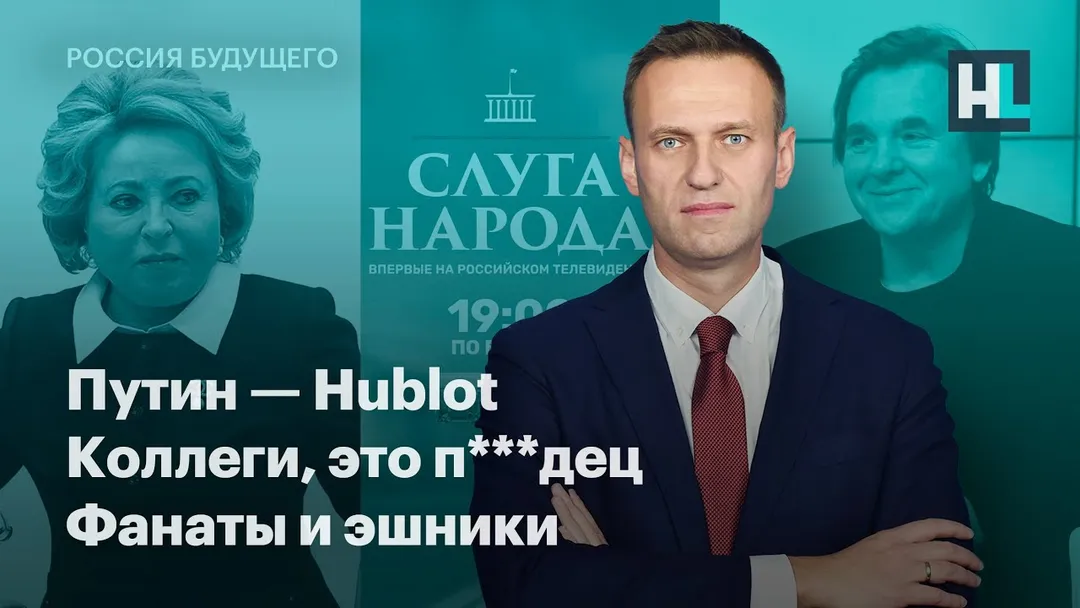
Putin is Hublot. Colleagues, this is f***ing insane. Fans and Center E officers (Russia’s anti-extremism police).
[music]
Good evening, everyone. It is exactly 8:00 p.m. in Moscow,
which means that in the studio
it is time for the program *Russia of the Future* and Alexei
Navalny, or,
as the Kremlin media called me this week, a lavishly living windbag.
That is what the Kremlin media called me this week.
Please send your questions, suggestions, comments,
and complaints to me, the lavishly living windbag,
your questions, suggestions, and comments,
on Twitter with the hashtag #RussiaOfTheFuture.
As the program goes on, I will try
to talk a bit about what I had planned
and to answer your questions.
I want to begin with an unplanned
topic, but life itself has brought us to it.
It is a very important issue, and everyone is discussing it endlessly:
why is it that in Russia
the economy does not grow, wages do not rise,
nothing develops, and people are fleeing?
Two hundred thousand people leave the country every year,
and right now we are seeing
the answer. If you open any
business news feed, or go on Twitter,
and read it, you will see that it is all filled
with the unfamiliar letters Nginx and the name
of someone you most likely had never heard of before:
Igor Sysoev. If you are not involved in website development,
then, to my shame, I honestly
knew nothing either about the existence
of the company Nginx
or about Igor Sysoev himself. And now
the company is being searched, as I understand it,
Sysoev himself has been detained,
and one of his business partners
has also been detained. And this is, in fact,
a very big and very
important case that explains why, in
Putin's Russia, nothing will develop.
Because the company Nginx,
despite the fact that you may not have
heard of it—I repeat, if you are not in the website business—
website development,
is a very large and very successful project.
Of course, it is not on the scale of Yandex,
but in fact it is probably not something
that should be compared that way. They make web servers, and on those
web servers runs half of the Russian
internet—more than half of the Russian internet.
It is the most popular web server in the world.
Recently, part of this company's shares were
sold to an American
major IT company for
$700 million. In general, everyone expected
that Sysoev would soon
become a billionaire. In other words, this is a big,
cool, successful business—the exact kind of business
that just recently
Putin was talking about when he said: let us help
these people; we need breakthroughs
in the field of artificial intelligence. You are all sitting here,
so smart, programming something,
coding something,
creating something wonderful and groundbreaking.
And very recently, Putin told us a million times
that these businessmen should not be harassed,
that businesspeople should not live
under the threat of criminal charges. Here is Putin, for 34 seconds,
defending business, saying that today
almost half of all cases—45 percent—
opened against
entrepreneurs are dropped before they ever reach
court.
What does that mean? It means that perhaps
for some reason or other, or for reasons that are not clear,
dear colleagues, in order
to achieve the large-scale goals that stand
before the country, we need
to get rid of everything that restricts
the freedom and initiative of entrepreneurship.
Honest business should not
constantly live under the threat of prosecution, constantly
feeling the risk of criminal or even
administrative punishment.
Business should not constantly face
the risk of criminal or administrative
punishment. And there is an absolutely astonishing
document—I cannot show it to you
in full, because there is a lot of fine print there—
but look at what is written by the investigators.
What has now infuriated and driven mad not only
the entire IT community, but also all lawyers,
of course the entire business press, and indeed
any normal person—let us look at
a fragment of the ruling. In fact,
why are they now conducting searches at a successful company
and detaining its founder?
Unidentified persons, no later than October 4,
2004, having obtained access to the rights to
a certain program, unlawfully reassigned to themselves
exclusive and copyright rights to it.
Roughly speaking, what are they accusing
this very Sysoev of?
Of the fact that in 2004—that is, 15 years ago—
15 years ago,
while working as a programmer at Rambler,
he coded something,
then created his own company, and that company
was successfully sold, earning hundreds of millions
of dollars. And now Rambler and
the well-known oligarch Mamut have come to him
and said: listen, you made that thing back in 2004,
and at that moment you were working
for us, receiving a salary from us, and were, so to speak,
our employee, so all of that
is ours, all of it is ours, it should
belong to us—hand it over. And this is
simply astonishing. First, 15 years have passed.
Second, as far as I can see, people are writing
that even the criminal provision itself
under which he is being charged was introduced
into legislation later, in 2006. But
third, if you have any dispute
over this matter, then sue him in
civil court. But no—the whole scenario there, in fact,
is exactly the same as in every such case:
the sequence of actions begins with
mass searches and detentions of everyone.
to terrorize him, not let him out of the office, but
after that, sort it out later — just take away
all that money from him, and actually there's also
an interesting thing here, so this estate-like mindset, as with
something I was completely unfamiliar with, I didn't know
it even existed, is that if you
think that maybe one of the reasons
why there's such a massive crackdown now
by the state against him is that he, like all
IT people, shows off too much
and says bad things about Putin — no.
As far as I saw on Twitter today,
some of his statements were published, and they
were, well, as people usually say, fairly
pro-regime, local-flavor kind of stuff,
meaning the guy most likely, basically,
supports Putin. Yeah, whatever,
whatever — and then the investigators came running and
all these papers, these orders, but
an order like that, under which of course
the judge should be arrested immediately, and
the investigators should be arrested immediately,
because you cannot carry out
mass searches on the basis of something like this:
that you worked for someone 15 years ago.
So all this is exactly as
many people are quite rightly writing today,
people connected to this field.
And the subtitle of our topic, "the incubator
of Russian startups," I simply took from
one person's Facebook post, where he
quite rightly writes that in Russia, really,
pretrial detention centers (SIZO, Russian remand prisons)
are the real startup incubators, because
they grab everyone, drag everyone in, accuse everyone,
bring claims against everyone.
Stanford University, where all those people studied
who went on to build their giant
companies like Google and so on — they
started building those companies while
they were still studying at Stanford.
Stanford doesn't come out and say, "Now everything
belongs to us." That's not how the IT market works, and
in principle, that's exactly how it should work.
You work for someone —
say, the Anti-Corruption Foundation — but while
working there, coding, you became
an excellent lawyer, or an excellent technician,
you invented something, and then became
a billionaire. But it would be pretty strange
if I came back 15 years later and said:
"Girls, there are two of you sitting here with me
helping me go on air — 15 years
ago you did something really great,
so everything you've done, all of it,
belongs to me." It sounds absurd, but in
practice, in Russia right now,
searches are happening, detentions are happening.
There are many different theories about what exactly
they want to take from this man. Leonid Volkov
Leonid
wrote that he has a theory that this
whole conflict is because through his
servers
a large part of the Russian
internet operates, and they want somehow to force him
to become an FSB employee (Russia's security service),
so that he would help block
the internet or something like that. There are other
versions too. I have my own version.
And please, let's show
that photo of Igor Sysoev again. It seems to me
that it actually explains everything.
Just imagine that
you and I are from the Presidential Administration,
the FSB, or oligarchs like Mamut, and here we
sit there looking at this little guy and
simply understand that the crime itself
is that he has $700
million. How can some
random nobody in a shirt,
some pathetic programmer,
a bespectacled nerd, have $700 million?
That in itself is considered criminal.
No, no — $700 million can only
belong to a man who knows how to live,
who buys a yacht,
who buys a plane, who builds a huge
palace.
But these mustached, weird little guys —
come on, really — they were just
sitting at a computer.
Can that really be considered a contribution to
creating something big if you're just
sitting at a computer?
It's enough to pay you a salary —
take your $1,500 a month
a month and be grateful you were even allowed
to sit in the office. That's really
how all of them think.
And actually, it seems to me — I'm practically
certain — that right now this man
will simply be squeezed. Maybe this publicity
will save him a little. Maybe the fact that he
politically takes such a pro-Putin
position will help him. But despite all that,
now that they've come after him like this,
they'll simply take some portion of
those dollars from him, because he shouldn't have
been showing off. And for the rest of us,
what we'll get is one more new mass
exodus of programmers to anywhere at all,
including Belarus. You know that already now
Belarus has become a paradise for IT,
and huge numbers of people from Russia
are moving to Belarus because for
tech specialists, from a business standpoint,
it's a freer country. There you can
actually work normally.
To Belarus, to Cyprus, to America,
of course to Germany, to Israel —
people will scatter in every direction and
take with them their taxes, their
ideas, their salaries, their money, their
future, and we will simply become, as a result of all this,
a little poorer.
And Mamut, who organized all this —
the business press is already writing about this openly, and
some supposedly successful generals
who will become successful once he slips them some money
of course, a little richer, and that’s how it works, unfortunately
that’s how Russia is set up, unfortunately, and
and so, unfortunately, we have nothing
good to look forward to as long as there is no authority except
the special Olympics you’re apparently waiting for
apparently
Valentina Ivanovna Matviyenko, who after
these sad events I
spoke about on the previous program, between
the last program and this one
it finally became clear that Russia
really will be punished very severely for
Putin’s little doping escapades, and
for four years. Let’s take a look, do we have
a graphic, probably, showing what we
will miss—we’ll miss a great deal in
international competitions: the Summer
Olympics, the Winter Olympics, the World
Championships, the Universiade (international university sports games)
to hell with them, no great loss, those
Universiades are just a pointless waste
of money, but for thousands, tens of thousands
of professional athletes, this is simply
right now
a horrible, nightmarish time. They don’t understand it
they don’t understand that they went into
sports schools their whole lives, they spent their whole lives
preparing so that at this
Olympics they could win—and then, oh no, nothing, nothing
will happen. They’ve all been left with nothing
The story of one biathlete really struck me
there’s Larisa Kuklina, she’s from the Tyumen region
she grew up in an orphanage, and her whole
life she invested in one thing:
to win at the Olympics. That was her
chance to achieve her dream
Well, I hope Larisa will be all right
maybe she’ll compete there not under the flag
and so on, but it is precisely people like this
who have now lost their chance to fulfill
their dream
because of Putin—specifically because
one day Putin told Mutko and that whole
gang of his that, damn it, it was so important for us
to win at the Sochi Olympics that, to hell
with it, let’s fake everything. Guys, the FSB (Russia’s security service),
drill through it, make a hole in the wall
and pass it through there, swap out
the urine samples
Putin personally made that decision, and now because of it
145 million people are suffering
who live in our country, but
Valentina Matviyenko said that no,
there is a solution: we should hold our own
Olympics. Let’s take a look. Matviyenko:
I think Russia has such
colossal experience
in holding international sporting
events of the highest level that we
can hold them in our own country; if
you like, our own Olympic Games. The proposal
is for world-class athletes to take part in them. We must, must
push back against the politicization of sport
this is unacceptable. Thirty-one thousand
people are watching us live. Well yes,
Russia can do everything on its own, after
all. We can do absolutely anything, we can
hold our own World Cup in football (soccer)
we can create our own Nobel Prize
and award it, we can hold our own Olympics
we can do absolutely anything at all
by ourselves
After all, we can hold a beauty pageant
an international Miss Universe, and
the only participants in it will be
the women who sit on the Federation
Council (the upper house of Russia’s parliament). That wouldn’t be bad either, because
after all, as Valentina
Ivanovna said, Russia has vast experience, and
there’s no need to politicize—what even
is this, really?
The sheer brazenness, cynicism, hypocrisy—it’s unbelievable
“Don’t politicize it,” they say. The whole world
was shouting, from the moment they first caught us
with this doping—not us, we weren’t
to blame for anything; they caught Putin and his crooks
with this doping. And yes, yes, and between
the first time they were caught and the second moment
when they started falsifying things again
fabricating case materials, the whole world
was shouting: guys, don’t do this, don’t
do this, because
all athletes suffer, all athletes in every
country
work themselves to the bone their whole lives to win, and
nobody likes the fact that you simply
at the state level—not just at the level
of some crooked coach or some
team, but at the state level
start falsifying all this. You have simply
broken the whole of sport this way, because
competing at all has become completely
meaningless. The whole world was shouting that this was exactly
what must not be done, that there was no need
to politicize it. But you see, Putin
puffed out his cheeks (put on a show of bluster)
he simply cannot admit anymore that he was
caught in his lies, and everything
he does, all the instruments of governing
the country, are always some kind of
fabrication—from elections to the Olympics
it’s always some endless fake
and he keeps going down that path of fakery
Well, apparently—I don’t even know what
comes next—we’ll have some kind of fake
Olympics. There used to be things like the Friendship Games
in 1984, when
only some athletes came; I even
remember them a little, although I was very
young then, when there were the Friendship Games, and
it was all—well, all the adults around me
joked about it, and it was pretty clear
why: because it was an attempt
to hold our own Olympics
but everyone understood that what had come were simply
some third-rate, second-rate competitors
The athletes were changing something, the Olympics, and...
it's a mockery, and it really is just...
just some kind of nonsense, but the Party (the ruling political machine)...
said it had to be done, the senile General
Secretary said yes, yes, and all of it
was carried out. By the way, now
I'd like to recall Mutko's words from three years
ago, when he said that Russia's suspension
from the Olympics would not be a tragedy.
Let's remember what Mutko said:
"It won't be a tragedy for us if we're not allowed in,
for the country. We won't go, we won't be there,
there won't be some number of medals. They made it clear to us, and we
stopped politicizing
the results of the Olympic Games long ago. For us there are already
other tasks and values now." But the question
is something else entirely, and that is...
31,000 people are watching us live.
Artyom Loshchin asks me: "Alexei,
why do you keep calling everyone 'those guys'?
'Little guy' and that sort of thing — why do I use
that kind of wording for everything? Well, what am I supposed to
call Mutko? This
guy comes out and says, 'Well, for us this
won't be a tragedy at all if we don't
go to the Olympics. Well, there just won't be
some number of medals.'
Of course it's not a tragedy for him, but for
that very Larisa Kuklina (Russian biathlete), it is
a tragedy. Mutko is doing perfectly well already,
very rich, with huge apartments,
a big dacha (country house),
he's most likely a millionaire,
probably a multimillionaire. His face is this
wide, he's got a great haircut already,
everything is great for him now, while things are not
so good for us. So when I say
'those guys,' it's just for variety,
because on my show otherwise I'd
just have to endlessly use
the word 'crooks,' even though the word 'guys' doesn't
always carry a negative connotation. So,
Danil asks: what do you think about the news
that Putin accepted the resignation of the Irkutsk
governor? I read that some
guy from the Emergency Situations Ministry (EMERCOM) was appointed
acting governor of Irkutsk
Region. I think Governor
Levchenko was basically
eaten alive there.
They kept going after him and going after him. As you remember, he won,
he was one of the governors who
won in a second round against a United Russia candidate quite
unexpectedly. Irkutsk and the Irkutsk region
are quite protest-minded, and there everything really
came to a head.
They beat United Russia there, after which Levchenko
was simply methodically destroyed. I
think that maybe they reached some kind of
agreement there,
forced him somehow, pressured him into submitting
his resignation now in order to, in order to
to
carry out the transition more smoothly,
so that at the next
elections there wouldn't again be a harsh, harsh
confrontation. Maybe Levchenko
was promised something in exchange for a voluntary
resignation. But in any case, I hope that
in Irkutsk Region
they won't end up with a United Russia governor,
some outsider governor. This man, I think
his surname is Kobzev,
is from Voronezh Region. So why
was he appointed there? Because, as you know,
there was flooding there recently,
but let's be honest: there are a lot of myths
about EMERCOM, but it most certainly is not
some super-efficient
structure. It absolutely is not,
not for a second. So I look with great
skepticism at the future under
an outsider governor sent to
Irkutsk Region.
So, people are asking about the Moscow City Duma, about
the deputies a lot — I'll talk about that. They're also asking
about Zelensky too, and about the TNT channel,
I'll say a bit more about that later. Right now I want to talk about
those verdicts that were handed down last
Friday after our own broadcast.
It was a heavy feeling, all of it. I
personally went to one of the sentencings, and
Vladimir Yemelyanov got a suspended sentence.
I went to hear his verdict, but it was
obvious that what saved him were his grandmothers.
He's an orphan.
He has two grandmothers depending on him, and simply
he was given a suspended sentence — an absolutely
unlawful suspended sentence, because
a real prison term for this person would have led
to an absolutely colossal
negative public backlash. For the same
reason, thanks to the absolutely
proper, in my view, honest conduct of Yegor
Zhukov and the large support group
he had, he also got a suspended rather than
a real sentence for the absence of any crime.
But there were others — let's look at the full list
of verdicts. There is
Yegor Lesnykh, who got three
years in a penal colony. There was, on the one hand, a rather
touching moment at first,
when he proposed
to his fiancée right there in the courtroom,
and then they sent him away for three years. That completely
stopped being a touching moment.
Maksim Martintsov got two and a
half years in a penal colony. So what we saw
again was the traditional
disgusting Putin-style aikido, in which
when society goes into an uproar,
everyone starts rushing to defend someone —
remember how they defended Golunov, then defended
Pavel Ustinov, and now they started
defending Yegor Zhukov.
They say: okay, okay, okay, if hundreds
of thousands of people are demanding it, then right now we'll
let them go — but we'll still imprison someone.
As a society, you simply can’t all at once
stand up for everyone at the same time. That really is one of
our problems: we can’t unite like a wall
and stand absolutely for everyone simultaneously
all at once.
That’s just how public consciousness works.
Some people get more support,
others get less support. That’s just how
life is, and they understand that life works
that way. So they just take
a few random people—these ones here—
and say: these we’ll let go, let go, but these ones
we’ll make an example of and give them three years
for nothing. And then there was also
we saw an absolutely disgusting,
revolting speech by Putin, a very
revolting one, at what is now called
the Human Rights Council, but
I mean, the Human Rights Council is now
really nothing more than a gathering
of ghouls, and at this gathering of ghouls Putin
this time felt simply
wonderful.
And he
delivered what was in fact one of his
worst and, let’s repeat, most disgusting
speeches in all his 20 years. Let’s
listen—41 seconds—about why a cup will, in the end,
actually eventually turn
into a bullet, and why we need to be careful about that.
Someone threw some kind of plastic
cup at a representative of the authorities,
threw it—nothing happened. Then a plastic bottle,
again nothing.
Then they’ll throw a glass bottle,
then a stone, and after that they’ll start shooting
and smashing up stores.
We must not allow that. Everyone
has the right to express their point
of view and state their position by all
possible, available, but lawful
means. That’s what it’s all about, that’s the whole point.
First of all, every one of you has heard
this strange and absolutely
perverse logic
most often from your own mother or from
a teacher: you didn’t clean your room,
tomorrow you won’t clean at all because I yelled at you,
tomorrow you won’t clean at all, and
the day after tomorrow you’ll mouth off to me and your father,
and then you’ll run away, and then you’ll become
a criminal and start killing people, and
they’ll throw you in prison. Or: what, you were late
to class because your friends held you up? Then
tomorrow you won’t go to class at all,
and the day after tomorrow, if your friends suggest
jumping off a balcony or a bridge,
you’ll go running after them and jump too?
You hear that and think: who even
talks like that, what does that have to do with anything? But when
it’s your mother or a teacher saying it as a
rhetorical device,
that’s understandable. But here it’s the head of state,
who is, after all, a lawyer, and he is directly
saying at the Human Rights Council that
these cases are completely fabricated,
and that this is a kind of ritual punishment,
because all this horror story he told—
about how after that
they’ll go do this, and then they’ll go
kill police officers, then they’ll go to stores
to loot and burn them—
none of that happened. A paper
cup
was there, a plastic bottle was there, that’s it, stop. You have no right
to make any extrapolation
beyond that, because everything else
was invented, made up. And now he says, I
just had them all locked up because, well,
they were talking online. Today they talk online,
and tomorrow who knows what they’ll do.
He didn’t imprison him, he gave him a suspended sentence—but that is still
an unlawful criminal prosecution all the same.
I’ve been given suspended sentences twice.
That’s not some simple matter. It means
you have to report in to the penal supervision system,
they can imprison you at any moment, and
there are many, many other restrictions—absolutely
unlawful ones. Lesnykh got three years.
Why will he sit in prison? Because for Putin this is
a kind of pedagogy, you see. He is
teaching us a lesson
this way—so that you guys
won’t get any ideas. Sure, he only
threw a cup, yes, he didn’t burn down a store
right away, but obviously, good Lord, you’re
that sort of crowd, I know you, you’re the kind of people who,
if we let you off now, you’ll burn
a store down. But all we want is for them
not to steal.
We just want our
candidates to be allowed on the ballot, and nobody
wants to burn down any store, and everyone
understands that perfectly well. But that fiend—and
the Human Rights Council—
was nodding along, sitting there nodding like this.
Disgusting—good Lord, there’s no such thing as
using the word “disgusting” too much today, but that’s
just how it is. The head of the Human Rights
Council, one Mr. Fadeev—in this photo
you can see him sitting there, this old fossil—and there he also
spoke and said, well yes, of course, I
am against
amnesty for these people. Are you really the actual
head of the Human Rights Council? He
is against
amnesty. Innocent people were imprisoned by
the state—our system works like this:
innocent people are jailed, but if people get very
upset, they can sort of be released under
an amnesty, and that way everyone saves face, and
the authorities don’t seem to have backed down, and
people get out. But then this man comes out
and says:
we are against amnesty, let them stay in prison, because
sure, today they threw a cup, but
tomorrow they’ll start shooting down airplanes. And this
is happening—this is happening right in front of us.
in our eyes, so campaigning against Putin
and United Russia must be done always and everywhere—they are
criminals. At the Human Rights Council
it was openly acknowledged that a crime had been committed
a crime: to intimidate others, they imprisoned
completely innocent people. In that sense
we have every possible basis
legal, moral—any kind you like—to fight
this government.
How can we fight them?
Alexei
asks me—JJ, I suppose that's how it's pronounced—
tell us what's going on again
with Admiral Kuznetsov. Admiral Kuznetsov—I
really want to say—has brought together
the topic in a truly astonishing way with the mayor
of Lipetsk, Yevgenia Uvarkina, who
put out a video—well, not exactly put out a video, I
mean, she simply sent it to a chat
with some local officials—a
short video address.
She was outraged with one of her deputies and
other subordinates who, evidently, work in
the Lipetsk city administration, where she
was venting her anger. But the video became a hit;
someone simply forwarded it, and as a result
we learned more about the mayor of the city
of Lipetsk, who, by the way,
I even showed on my program—I
started looking into it a bit and remembered
where we know her from. This is the very same person
who
once already
while speaking at a meeting with
voters, said to someone, “Listen,”
“you ask such, such
a tricky question—do you happen to have a Jewish
surname?” If you remember, that caused
quite a stir. We'd better
watch it first—let's do 23 seconds.
A family-style conversation already—what are you
even saying? She's quite a character,
peculiar.
And so she made this video, and this video
actually—I’ll talk later
a bit about Admiral Kuznetsov—it's simply
yet another excellent example
and an explanation of why nothing will happen. Here
she is a leader of United Russia, one of
its leaders, and she was elected by local deputies. She has
all the power—all power in our country
belongs to United Russia. So what does she need
to do in order to make at least someone, in at least
some way, actually work?
Record videos like this—
fair warning, it's pretty obscene—
and send them to her colleagues in
the executive branch and her fellow party members in
United Russia. Let's listen—one and a half
minutes.
Colleagues, this is—I can’t really reproduce the rest
of it.
Colleagues, this is...
The time is 9:01. Clearly, clearly, working
equipment—one piece, then two pieces of equipment set up,
equipment,
three, four, five, six—and silence. And
there are no people, and nobody [__] is quickly
cleaning up. Where are the people? What the hell are we doing?
And this is with the countdown—you have to deliver by the 20th, the 20th
is the handover, Monday, the governor—and you
understand that by Monday, that's the 10th,
by then the maximum should already be done here,
work should be boiling, just boiling over,
and yet once again, nobody here is
taking hold of anything, nothing gets done. For two years
these miserable sheep pretend that they are
doing something, cleaning up trash ‘intensively,’
‘intensively.’ Every morning, send me video at 8:10
so I can see that all the equipment is in place,
that everyone is working. I want to see on video the number
of people, the amount of equipment, for every
site.
What are you doing?
Well, we... nevertheless,
all the same.
Excuse me, but you can’t remove words from a song.
Did you notice, by the way, that at the end
she says her solution is
that every day at 10 a.m. she wants video sent to her
showing what is where and what is happening—and this
happens at every construction site. Remember
when the Vostochny Cosmodrome project collapsed the first time,
Rogozin was shouting that in his office
there would be screens, and on those
screens there would be video, there would be cameras. Sobyanin
says the same thing: in my office
there are constantly video screens, and I watch
the daily progress, because not
a damn thing works in this country, nobody
wants to do anything. And yes, she
sends these tirades in part
because she is not a popularly elected
mayor—United Russia appointed her,
and basically everyone understands that the main
task of United Russia is, well, basically to steal
something. And in general, all these officials are there
in order to steal something. And if, say,
by the way, you fail to do this,
then no videos need to be sent around—if you
didn’t skim something off that construction site and
kick your share back a little upward and
a little to the people in uniform, then you
will be dealt with pretty quickly.
That is literally the only effective
part of our system that actually works. But
otherwise the system doesn’t work worth a damn.
There is no governability. It seems to us that this is
some tough Putin regime that—well, yes, they
jail people, they repress people,
and we think these are the kind of people who built
an unjust, thieving, corrupt
but effective vertical of power. But no, not a damn thing—
nothing here can happen properly, and
Admiral Kuznetsov is also a perfect
example of the mess that reigns in
the country. Remember how this Admiral
Kuznetsov is Russia’s aircraft-carrying
A cruiser is practical in Russia? In Russia, no.
As for real aircraft carriers, our navy has none.
We basically don't have them at all—historically speaking.
Historically, we have been a land-based country.
Our navy has historically been fairly weak, and this—well, this thing here—
it's not nice to call it this, of course,
a tub, let's say, but it has not been very successful,
and it is not a very successful ship.
For some reason, our authorities marketed it as
a great warship that threatened everyone.
And so it sailed halfway around the world, first to
Syria back then, and everyone laughed at it,
the whole world laughed, because as you
could see, it was sailing along burning diesel and
fuel oil, and everyone was photographing that smoke.
It burned through hundreds of millions of rubles' worth just in
diesel fuel.
It made the trip there and back, came back, and
then they said, you know, because it had been
used so intensively, it now needed everything
replaced immediately—all the engines—and repairing it
would cost 60 billion rubles (about hundreds of millions of U.S. dollars), 60
billion—an absolutely
fantastic sum.
They allocated that money and said it would
be repaired now, then later they said it would be repaired after some time,
and now it has turned out that, well, I
don't think it hasn't burned up—there is a
fire there of a completely
serious scale, one that shows that
things are really very bad with our
aircraft-carrying cruiser Admiral Kuznetsov, or
Kuzya, as the sailors themselves call it.
And this too, you understand, is the main
symbolic ship, and we can't even repair it.
There have already been all sorts of incidents around it,
there were those stories when
scaffolding and construction cranes fell there,
simply because everything is a mess.
The Putin system has in fact taken us back
to something like the 1990s, when there was
endless, constant chaos, because
well, if
Yeltsin was simply drunk all the time,
then Putin is either constantly swimming in a
pool or playing hockey,
playing hockey, or else he is busy with
some kind of personal war with Trump or some
other thing, coming up with some kind of
special operations and declaring that
another ISIS headquarters has been bombed, or that he
is helping Cuba, or conducting some kind of
negotiations with Belarus—that is, he is busy with
big foreign policy, with all that
chess game in which he is supposedly a great,
brilliant strategist. But in reality,
down below, absolutely nothing is happening,
there is no governance at all, there is only
some endless chaos. That's how the system
works. Maksim Chaika asks me:
"Alexei, please comment on the sentence of 6
and a half years in a penal colony, maximum-security, for two guys for
supporting the Rostov fire victims. I
spoke about this a lot on the program
today—or yesterday, probably yesterday. There was an
appeal. It is absolutely unjust.
Really, these two people were simply
standing in a one-person protest during the so-called
Maltsev revolution (a reference to opposition activist Vyacheslav Maltsev), just in
a picket, and both of them got 6
and a half years each. One person there was given a suspended sentence,
someone who really was just passing by,
literally just a passerby, but they grabbed him too,
and then apparently decided not to say,
"sorry"—instead they gave him a suspended
sentence. How can I possibly feel about this?
It is absolute lawlessness, and we
all honestly hoped that between
the first verdict and the appeal there would be
public outrage. I talked about them several times here,
and in general many people
were outraged, and we hoped they might at least
reduce the sentence a little, because they were simply standing
in a one-person protest and they had signs in
support of the Rostov
fire victims—those people whose homes were burned down
in order to clear space for
developers. The system is monstrous; they
simply devour people.
Officials, security officers, anyone at all—people who do not
feel a drop of pity. More than that,
it really turns out they derive
sadistic pleasure from taking two
completely random people with
placards and throwing them in prison.
And it's like Putin says:
today they stand there with a placard, tomorrow and the day after tomorrow they'll be standing there with a
grenade launcher. Are we supposed to
wait until they actually have a grenade launcher?
Better to lock them up now,
give them 6 and a half years while they are still at the
placard stage. And at this logic everyone just
twirls a finger at their temple and says, "Are you completely [__]?"
But this logic really
is built into the foundations of governing
the state. That is why in this country
this regime must be resisted, and we need to fight it
however we can. We have quite a lot of topics
with asterisks replacing swear words,
but I cannot pass over the wonderful events in
the Moscow City Duma.
There, the head of the Moscow City Duma,
United Russia member Alexei Shaposhnikov, whom we
almost defeated—there is not a single
day when I do not regret that, well,
personally, this was my own failure. As you
remember—let me remind you—this
Alexei Shaposhnikov was the subject of our investigations, and
we published exposés about him.
In his district, he really should have
lost, but he had placed there
the Smart Voting candidate instead,
Yefimov. But I failed to notice that this
Shaposhnikov, a cunning crook, had also put there
a spoiler candidate with the same surname, Yefimov. We
sent everyone a mailing saying, "Vote for
Yefimov against Shaposhnikov," and even on
election day all our Telegram channels
And everywhere, all of us sociologists were saying,
that Shaposhnikov had lost and Filimonov had won.
Because people in the exit poll, as they were leaving the
polling station, were saying, “We voted for”
Yefim.
And it was clear that Shaposhnikov had lost.
But some people, damn it, voted for one Yefim,
while others voted for another, and Filimonov, taken together with both of them,
they got more votes combined
than Shaposhnikov did, but in the end Shaposhnikov
won because they split the vote
between themselves. And I’m just worried about my own personal
failure: I wasn’t able to explain how
to do it properly. But this
Shaposhnikov, he really
really went off the rails. I showed you in the previous
video—we can show that previous video too—how
Shaposhnikov once let it all slip there, where later
in the Moscow City Duma (Moscow’s city parliament), not realizing
that his microphone actually hadn’t been
turned off. If possible, show it.
If you can’t, then show the new one where he
We had a big discussion here
about whether I could say this
word on air. Well, just to be safe, I decided not
to—it’s probably not a good idea, after all.
It’s probably obscene. But Shaposhnikov,
nevertheless, uses it quite freely
at meetings. Let’s watch a short
video. And on item 1, ours are against
the appointment of, well, Kalachev...
Alexander—you’ve probably heard it; if not,
thank God. But then someone came up to him,
and she says, “Well, I understand
that they’re all like this here, but we
have to do something,” and this is already the umpteenth time.
And yet, in the Moscow City Duma, they still can’t
manage to get this man somehow
removed from office or do something
about him. More than that, this very
Alexei Shaposhnikov, whom I’ve actually
known for quite a long time—back in the day,
a hundred thousand years ago, Dmitry Gudkov
(a politician you probably know) was obsessed with this
idea of a Youth Public Chamber, and into
that Youth Public Chamber he
tried to bring in various people. I remember there was
I remember there was
a young Rogozin, the younger Rogozin,
he invited Yashin there too,
and among others, Alexei Shaposhnikov as well.
Yes, that’s where I met him, in that
Youth Public Chamber. And now
look how important he’s become: he now heads, in the
Moscow City Duma—you’ll laugh—the commission
for verifying the accuracy of declarations on
the legality of income. In other words,
this is the man who is supposed to check
whether deputies have properly filed
their declarations, and whether they have enough
income to
explain where all this
property came from.
It’s just insane, because we caught
Shaposhnikov with an entire penthouse that appeared from
who knows where. But fortunately, the Communist Party deputy, the brilliant Stupin,
—fortunately, there is Stupin, a genius of a CPRF (Communist Party of the Russian Federation) deputy—
asks a question there; you’ll see in a moment.
He asks the presenter, Stepan Orlov, also
a United Russia member, whom we also investigated,
and Stupin asks him
how this can even happen.
Let’s watch. “From the leadership of this
commission, I would like to hear
your assessment of what has been stated in
many media outlets, according to which
Alexei Valeryevich Shaposhnikov
owns a seven-room apartment with an area of
270 square meters (about 2,900 square feet) at the address Moscow,
22 Zoologicheskaya Street, apartment 118.”
And for the head of a commission on
ensuring the accuracy of income and
expense declarations, that’s, well, rather significant, isn’t it?
What’s important is that when you actually check this
information, this information in the public domain
currently has no relation to the
matter under consideration.”
“It has no relation to the matter under consideration?”
A man comes out and says, “You know, we have a commission for checking
income declarations, and we propose
Shaposhnikov for it.”
And then he’s asked: “So he has a
seven-room apartment from an unknown source—who
is he going to investigate, himself?”
“Excuse me, that has no relation to
the matter under consideration.” There you have United
Russia in all its glory. This party needs to be crushed
by every possible means. And by the way, they’re
terribly upset that we keep going after them.
We released investigations—you remember—
you remember,
about Shaposhnikov, about this Orlov, and about
one of my favorite deputies in the Moscow City Duma,
deputy Lyudmila Stebenkova, a truly
remarkable woman, who now simply
can’t stop herself. She has already
spoken several times and talked
about me and about—well, just during
the discussion of any issue, she starts
with, basically, “Why is it that
Navalny is conducting his fake
investigations?” Here is her speech on the topic of
investment—a fragment of her speech
about Moscow’s investment attractiveness:
“And I find it very strange that the pseudo-
investigations of FBK, a foreign agent
under Navalny’s leadership, which today
under the guise of fighting
corruption collects money from citizens
of the Russian Federation in the form of so-called
donations, with the aim of manipulating
public consciousness and, in the long run,
overthrowing the constitutional order, is not
regarded as fraud.”
“So-called donations”—that’s what she was saying during a discussion of
investment
attractiveness in Moscow. And here is what she
said during the discussion of the issue of
the Moscow mayor's report
The issue is that not only was a coalition formed,
between the Communist Party and Navalny,
but also with his foundations and Bakkarin, an agent who, under the guise of
fighting corruption through
all sorts of pseudo-investigations,
is effectively calling for the overthrow of
state authority.
That's what this is about. First. Second,
yes, these elections were dirty.
Dirty elections, and Navalny
indeed, in his so-called investigation, he
as I said, in the so-called investigation,
so at this point, to imagine
either Navalny or those associated with him who are
in the Moscow City Duma, which Mr.
Zyuganov mentioned last week, but they
are, accordingly, pushing the whole narrative
that Noginsk and BK are also pushing,
and foreign agents from BK—just cogs in the machine, godfathers of it all.
Who made these elections dirty?
Of course, foreign agent Navalny. That is,
I wasn't the one barring candidates, I wasn't the one fabricating
votes.
I wasn't the one who organized electronic voting where
votes were stolen, and yet somehow I am the one
calling for the overthrow of the state
system. Ms. Stebenkova is constantly
watching my program and recording
funny videos for me on Twitter as a
response.
If our government consists of people like you,
lying, vile thieves like the entire leadership
of your Moscow City Duma, where in reality
the leadership is nothing but thieves,
from United Russia, then of course I am calling for
the overthrow of this government and of this
system, because you are the worst thing
that exists in our country. Of course we
will, in the end,
overthrow you sooner or later. To wrap up the topic
of the Moscow City Duma, I can't help but respond
and note that, stepping away from
the Communists, he asked an absolutely
correct question to the chairwoman
of the Moscow City Court, Egorova, who came to
the session.
to this meeting, and whereas before there
everyone just sat there without paying attention, now there came
a terrifying, angry woman
who organizes all the fabrication, and
now at least someone is asking
questions. Let's look at this; it's important.
Olga Alexandrovna, from your answer regarding
the verdict in the case of Pavel Ustinov,
to whom Judge Krivoruchko gave
a real prison sentence, you
replied that he was not subject to liability.
At the same time, could you say whether there is any
responsibility at all for a judge
for issuing a knowingly
unjust sentence, confirmed
by a higher court? Does such
disciplinary liability exist, up to and including termination
of powers? For what reason was Krivoruchko
not held accountable? Deputy, this question does not
relate to the matter under consideration. I
have already answered. This is important for appointed
officials. I have answered all of you on these questions
regarding the candidates.
What a painfully nervous reaction.
And yet disciplinary
responsibility
does exist. To ask whether there is responsibility for
a judge who unlawfully imprisoned
a person, knowingly and unlawfully, in prison
as in Ustinov's case
— Judge Krivoruchko can face disciplinary action up
to dismissal.
Just think what a severe punishment that is—
dismissal, an honorable retirement. Because of
this Judge Krivoruchko, several
people are already in prison, and not even because he
jailed them completely unlawfully, but because
they are already starting to imprison those people whom we
are seeing targeted simply because they are enraged by the behavior of Krivo-
ruchko and the entire Moscow City Court, by what is being written
— curses online, and so these
judges, these people, are tracked down, identified, and jailed. Well,
you see, this old lady
gets nervous and refuses to answer.
Shaposhnikov is sitting there at the podium
ringing his little bell—well, there you have it.
That's exactly why none of them should be given
any slack whatsoever. As for the protest
by football fans, I'll say this—I hope I have enough time.
Yevgeny is asking me:
"Ilya Maddison Davydov joined
the LDPR. How would you comment on that?" To me
it seems like some random person—is he or
isn't he? I'm not very familiar, maybe he's
some fairly well-known YouTuber, Ilya
Maddison, so not exactly a nobody. Well, that is
a stupid thing to do, joining the LDPR. Maybe
they paid him money or promised him
some place on a list. It's hard for me to understand
the motivation of a person who joins
the LDPR, which of course
— if United Russia is the party of crooks and
thieves,
then the LDPR is a party of utterly hopeless people.
Well, Crimea will probably speak for itself.
A frequently asked question is: whose is Crimea?
Let's discuss whose Crimea it is. A really
great investigation has just been published by the outlet
Proekt. I recommend it—just google it and read it.
It shows very well whose
Crimea is now: damn it, it belongs personally
to Vladimir Vladimirovich Putin and
to some of the people around him,
who have created
a lawlessness that still goes beyond the bounds
of even the usual Russian kind, because as soon as
this annexation happened, they simply
really started doing whatever they wanted—
building enormous dachas (country houses), enormous
palaces, and not only that, simply seizing
land and constructing various open-air sites.
for tatami mats—well, this whole story is about
the project I wrote about started with the fact that
it turned out that an entire huge settlement
called Oliva had been subjected to
some kind of
there was some sort of secret
secret order under which people could not
register any rights within
this settlement. For example, if your grandmother
left you a shed, or a house, or
something else as an inheritance, you go to Rosreestr (Russia’s state real estate registry)
and say, “Please register it for me,” and they
tell you, “No, that’s prohibited by a secret
order.”
And any legal actions in general
in the settlement—please show the picture of the house—weren’t
done.
They created a security zone around Putin’s dacha (country residence), and within
that framework, everything that’s shaded there is
the security zone of Putin’s dacha. And there, basically,
you can simply say that nobody—no grandmother,
no grandfather, no young person, no old person—
nobody can register anything.
Because this is, so to speak, Putin’s land, and
he’s going to enjoy himself there, he’s going to
play hockey there—they’re building an entire ice
arena—and he’s also going to
have meals there, and for that they’re building
some enormous
I don’t even know—huge, absolutely huge
and tatami mats, giant tatami mats, out
in the open air.
There, you can see some kind of antennas
that simply jam mobile communications; flights are prohibited,
and
quadcopters immediately lose all
control. And meanwhile, some
people who have lived there their whole lives
are treated as if they are absolutely nobody,
completely nobody. And in this
publication, there’s a genuinely very funny and very
absurd incident described: local
residents once came to the beach as usual
and
were sitting on the beach, apparently eating something or
drinking, or just sunbathing, and then
scuba divers crawl out of the sea—
it turns out they were military divers—
and they demand documents from the vacationers, I mean
you just have to imagine it.
The level of frustration of people who came
to a beach they had been going to for many years, and
there were Soviet
and later Ukrainian
officials and all sorts of bureaucratic crooks there
all the time, but even so, the beach
was always open to ordinary people, and you could always go into the mountains
there, you could walk there often. Now everything is
blocked off: divers emerge from the sea, and in
the mountains there’s a described case where some local resident
was walking with his girlfriend when out of the forest came some kind of
gamekeepers, and they said not to come here again
because it wasn’t just forbidden—
the area was also mined, so that
people like you wouldn’t wander around here. Be sure to read it.
It certainly makes
an impression: in a system where Crimea
is still in a kind of gray
zone—with sanctions, endless disputes, and all that—
into this gray zone
where the law wasn’t really functioning very well anyway,
there burst in
greedy people eager to build palaces there.
All these FSB towers, these compounds,
Medvedev’s dacha, Putin’s dacha, and
they’re simply spending billions to build
some previously unseen, unheard-of
astonishing structures where they will, supposedly,
spend their time.
Now, to the questions. Let me ask Narek Esayan’s question:
“How do you feel about the arrest
of Ivan Zhdanov?”
Guys, how could I possibly feel about that?
The director of the Anti-Corruption Foundation
was arrested and jailed for ten days. Well,
do I feel good about it? Of course not.
I feel bad about it. He was simply detained here at the office,
dragged away somewhere, and given
ten days on some kind of
charge over a tweet he wrote
in the summer. But I hope he’ll be released on
Monday—he’s supposed to get out. Listen,
this is just another example of how the Anti-Corruption Foundation
is being crushed. I
didn’t even bother telling you about it anymore
because there are simply so many
routine examples of the campaign against us
that you’re probably tired of hearing about it.
Alexei asks me:
“Are they trying to push Shuvalova out of the Communist Party of the Russian Federation (KPRF)?”
Yes, this is connected with the Moscow City Duma
communists, of course, and there are different
factions there. They are under heavy pressure from
the Presidential Administration. Under pressure from
the Presidential Administration, they are forced
to keep condemning us, and in particular
they are forced to condemn Yelena Shuvalova,
who isn’t exactly “friends with us” so much as
she is on good terms with her own voters. And when
a voter comes to her and says, “Hold
a roundtable, invite FBK (the Anti-Corruption Foundation) and
everyone else,” she holds the roundtable.
And local people come—140 people.
No one bans the roundtable,
but then they start condemning her because she is
supposedly connected with
that evil Navalny and FBK. But in that
sense, I hope—and am even confident—that
most KPRF deputies
will withstand this pressure,
defending not us, but simply
the interests of their voters, which we
also very much are. We don’t want anything
special from deputies, especially KPRF deputies;
they are simply doing what
normal deputies are supposed to do. Sofia Deryuga
asks: “Alexei, what do you think
about the situation with officials who
They gave themselves New Year’s holidays lasting
almost a month. What are they so tired from?
It really is an amazing thing: State Duma deputies
and, in general, a large number of
officials arranged it so that
this time the holidays are such that they’ll simply spend a month
hanging out somewhere—wherever they
want to hang out, abroad or otherwise.
It’s just some kind of astonishing life. Before this,
we had never seen holidays of this
length. At the same time, what’s interesting is that when it comes
to me, they seem to be operating under
the exact opposite talking points. Someone somewhere
came up with them, and now I’m constantly being chased
by these girls and boys
with cameras from RT and from Rossiya 1
and from the channel where Askar—
who knows—asked me: why have you been on
vacation 15 times lately and
spent 22 million rubles
I was stunned. I ask: 22
million rubles? But they just keep going on
saying, “Comment on how you managed to spend
22 million rubles on vacations.” By the way,
at that court hearing I attended
last Friday,
a girl from
the Rossiya 1 TV channel ran up to me.
Apparently Askar ZD or the channel’s management
sent her over so that, basically,
they could respond to our investigation. Askar
was trying to pin me to the wall with shocking reports about
how I had spent 22 million rubles
on vacations. We had a fun conversation.
I can show you a minute of it;
you can easily find the longer videos on YouTube.
Investigation.
The point is that your colleague, a journalist
from a state TV channel, is rather
talentless, because her program
airs deep in the night, and its ratings
probably aren’t much different from yours.
Please tell me, can your ratings
support your lifestyle? Does your job
allow you to buy a yacht or a plane?
[music]
Do you personally own a plane or a yacht right now?
Personally? No. All right, let me begin then.
Let’s assume you work at Rossiya 1,
hosting a late-night program.
Would you be able to afford a plane then?
And why do you think she’s talentless?
I assume that if your
TV channel put her in the schedule
on Sunday at 12:30 a.m., then I think you
consider her a talentless journalist, and
I’m asking you whether that salary officially
allows her to buy a plane and
a yacht. I answered your question just to see. I already
answered you; now please answer mine.
Can a Russian citizen like Askar Za-
desh do that?
. What kind of question is that?
About talentlessness and so on—it’s unusual for them.
You ask a question, and my daughter got admitted...
turbo
No answers.
You can find the full video online;
it’s pretty funny. With all her questions
and my answers, by the end she was already...
State television.
They’re so used to simply lying
endlessly, and so used to working from
pre-prepared questions and pre-prepared
answers, that when you ask them
an elementary question, you immediately leave them
stumped. And at the same time,
they are absolutely not prepared to apologize. But
if a unique situation arises
in which people from our
television,
the head of our television apologizes to
someone, then of course it will never
be to us or before us—but to
Americans they are ready to apologize. And
one of the things that really
struck me this week was
the announcement of a book by journalist Joshua Yaffa.
He’s a good young guy. He wrote
a book about Konstantin Ernst, the man who
built this machine of lies called
Channel One. These are people who
lie all the time, endlessly, constantly
lie. And among the most famous items in their
very large collection of lies, there are two
main crown jewels. One is, of course, the well-known
story about the “crucified three-year-old boy” (a notorious fabricated Russian TV story from 2014), which
was told on Channel One,
and to this day no one has publicly apologized
for that lie. And the second story is this:
unfortunately, I can’t show that segment
because Channel One will get me banned.
But remember Mikhail Leontyev,
now Rosneft’s press secretary,
a journalist who used to work for Luzhkov’s (former Moscow mayor Yuri Luzhkov’s) shady television setup,
then moved to Channel One
and hosted a program there where he simply
lied nonstop. And after the
Malaysian Boeing was shot down over Ukraine,
he aired an entire sensational report
claiming that there were satellite images, and that in
those images there was a Ukrainian Air Force plane.
You can see them showing these
images, supposedly taken from a satellite,
and this little streak here, supposedly,
is the fighter jet, and this is the missile flying
to shoot down
the Malaysian Boeing. Naturally, everyone started
laughing at it. It was complete
nonsense. And when journalist Joshua Yaffa
asked Ernst, “Well then, please explain—
please,”
“it was obviously a lie”—what did Ernst
say to him? “Yes, we made a mistake. We’re all
human.” He didn’t say it in exactly those words;
he didn’t say, “Yes, we brazenly lied on air,” but he did admit
that it was incorrect information. But he admitted it
to a reporter from *The New Yorker*.
And he didn’t admit that to you on Channel One, did he?
He didn’t say that to a single Russian
media outlet, no—not on Twitter or on
Instagram or anywhere else, not to a single Russian
person, not to any Russian journalist. He didn’t
say that our TV channel, which
exists on your money and receives
billions, brazenly lied—or, well, made
a mistake, as he would put it. But with Americans
it’s different. It’s just a different treatment altogether.
American correspondents showed up—
a person from the First World, a real person,
not just some [__] who watches
our channel—someone they can just spit on, who cares
about him? But in front of them, you have to apologize.
An American named Joshua Yaffa,
with an exotic name, writing for *The New Yorker*,
you see—so to a person like that
you can’t just lie outright anymore. To him they say: yes, we
made a mistake.
This attitude toward us, toward all the residents of our
country as genuinely second-class people,
is exactly what comes spilling out of this
current government, plain as day.
He would never, ever have said that to any
Russian correspondent—nothing like that.
But in front of Americans, they offer a slight
apology. In front of Russians? As if they’d ever
apologize—they couldn’t care less. And this same
Leontyev, now working at
Rosneft, that very press spokesman,
that journalist, that drunk, who now says
all sorts of funny little things
in defense of Sechin and Rosneft—he, by the way,
said: well yes, we understood, yes, this was,
to quote him exactly,
“From the very beginning, Kostya and I understood that
this was, to some extent, an intellectual
provocation. There were no assertions that
what we were saying in the segment was true.”
Brilliant: you lied in the segment, and then
you say, well, we understood that this was...
Why call it a lie? What a crude
word. It was an intellectual provocation. And
anyway, in the segment we never claimed that all
of it was true. There was no such assertion that
it was true. We merely said there were
satellite images, and in those
satellite images you can see that a Ukrainian
fighter jet shoots down the plane, and that
Ukraine is to blame for everything.”
But there was no explicit claim there that it was
true, so that means it was an intellectual
provocation. It was simply a brazen and utterly
disgusting lie—but again, that was said
only because an American asked.
When we ask about it, they won’t answer us.
You’re asking me about the fans—
and yes, this is an important topic
to cover.
Because in the example of what
is happening now with the fan
movement in general, in the example of this
small outburst, this small demonstration,
this slipping out of the authorities’ control, we can see
that even people loyal to this government understand
that simple loyalty gives you
nothing—absolutely nothing—not even the most basic
elementary rights. We all know perfectly well
that the fan movement, of course,
is diverse. Whenever I generalize here, I already know
I’m simplifying things. But overall, it’s no secret to anyone
that it was precisely the fan movement
that the authorities always used and deployed
for their own purposes, including attacks on the opposition,
and so on and so forth. And then
we saw
the following astonishing turn of events.
I apologize in advance if somewhere
I say something wrong—I don’t know
football that well—but here’s what happened.
Spartak fans don’t like
the footballer Dzyuba, who was once at
Spartak and then moved to Zenit, and there’s
a long and complicated history of mutual dislike there. But
basically, lately they’ve had
this pastime, which is, naturally, fairly
insulting to Dzyuba and fairly
indecent—but that’s football, more or less, and
fans who behave a bit beyond
the boundaries of standard decency are
an inseparable part of football.
It’s their fan business, their own score-settling
between clubs. They chant
various obscene taunts about him, insulting him
from the stands. Well, that’s football—they insult Dzyuba.
Obviously, some people don’t like that,
others don’t like it either. Fine, they don’t like it.
Then negotiate with the fans
or do whatever—take some measures
that are accepted in modern football. But
this is the authorities, this is Zenit, this is Gazprom.
And according to some media reports, Dzyuba
held a meeting there with the management of
Gazprom and the management of Zenit and said,
“You know, guys, if you can’t protect me,
then I don’t understand why I’m
playing for this team.”
And how did they decide to protect him? That’s right: with the help
of the police. So when, once again,
Spartak fans came
to a match against Zenit, above their section
they hung some giant
loudspeakers that drowned out their
obscene chants.
But even that wasn’t the main thing. Before the match and after it,
they literally started
being hunted down by the cops.
Those very people from Center “E” (Russia’s anti-extremism police unit),
the Center for Combating Extremism, were busy
catching fans who were using obscene language to insult
Dzyuba at the stadium. Insults there are, of course,
a bad thing, but generally speaking we
assumed that this definitely was not
extremism, and certainly not something for which
people should be beaten, shocked with Tasers,
or have some of them arrested for 15
days—but, well...
This really is a great turn of events.
The point is that in response to all this,
the fan community, first of all,
the first to react were the fans
of Zenit, who, as a sign of solidarity with
Spartak fans, also began leaving the
stadium. Let’s take a look. Well, after 32 seconds, as I understand it,
the fans simply have a routine like this:
they sit and watch the match for a while,
and then, as a sign
of protest, they leave the stadium after 32 seconds.
Dancing.
And now, in solidarity, fans
at many clubs are leaving the stadium, and this is
truly—I believe this is
a remarkable development, because this
has, of course, long since gone beyond the bounds of
football. They are leaving because they do not
agree with the fact that the police beat them,
that they are arrested and jailed, that in disputes
between clubs and players, all these
long-running stories about who looked at whom,
who played how, and so on—but for us
as a society, which may not, on the whole,
be very interested in football,
or for that part of society that is not
interested in football,
well, let them sort things out among themselves—but
when the police start beating and jailing them,
when state-owned Gazprom is engaged in
organizing a campaign against
the fans—that is called
state lawlessness, and of course I
express my solidarity
with all these people who are protesting
despite the fact that many of
them, including quite aggressively, have
defended this government and beaten people in order
to protect it. Those actions were
disgusting, but the authorities are now treating them
in a way that is no less disgusting.
In some sense, even more disgusting.
After all, this is the state, this is the police—you
can’t do anything to them. What methods do they resort to?
They start arresting fans.
But this is simply lawlessness. By the way,
there was also an interesting reaction from such
hardline pro-Putin people as Edgard
Zapashny—you know, that famous
animal trainer who is ready
to tear his clothes off in public
for Putin, who simply adores this government
and practically licks its boots, literally.
So when this person was asked about
this situation, he said the problem is
the lack of accountability: “I would send in the OMON (Russian riot police),
I’d crush these supporters, break
some of their bones, and tomorrow they’d speak
to me respectfully.” And you just want to say:
is everything all right with your head at all?
“He’d crush them, he’d break
their bones”—what kind of bizarre, obscene
little ditty is that, “break their bones”?
What even is this? This is football; that’s how it works there.
And if you want to reach an understanding with some
fan group, you have tools for that.
You have leverage.
There is the press, there are players, there are
relationships between clubs and
supporters, and without
supporters, clubs do not exist.
You can regulate it. But these people want
to do it precisely this way: “I’d break
their bones.” There you have it.
So, the fans are walking out. Let’s see how
the situation develops from here.
I’ll end the program with the story about the Hublot watches,
which have probably become the main
sensation and topic of discussion on the Russian
internet—another example of how, good Lord,
this government is afraid of everything. We laughed a lot
at how afraid they were of the Yakut shaman (a Siberian spiritual figure from Yakutia),
who, of course, once again
set out on his journey to Moscow. He was again
detained, arrested again, and taken away.
Good Lord, some guy is walking to Moscow, and everyone is
watching it—and his followers too.
And now they got scared of Zelensky’s series
and Zelensky’s jokes.
What happened was this: the TNT channel
quite obviously bought the rights to the series
*Servant of the People*, starring Zelensky.
It’s a comedy series, with lots of different
jokes. Naturally, they
started airing it—they showed one
episode. They bought the rights and paid
a lot of money for them, that’s obvious too. But of course
they started cutting out certain parts. Let’s
watch a few seconds of the original.
To do that, we need to go to the clip—or rather, first
let’s look at what aired on TNT,
and then we’ll look at the original, that is, what
was shown on Russian television.
Konstantin went to the river... [inaudible]
I recommend them—there are only four pairs in the world.
Agreed, think about it.
What a strange, incomprehensible scene.
And now, here is how it looks in the original
series *Servant of the People*: “And Konstantin went
to the river...”
“Hublot. By the way, do you know who owns them?”
“It’s very cold, but I recommend them to you—there are only
four pairs in the world. Agreed? Think about it.”
[music]
They made a joke about Putin—fine. You bought
this series, you cut it out, and after
people noticed that it had been cut,
a call came from the Kremlin and they banned the series from being shown
altogether. But guys, we understand very well
that, first of all, the very idea
of showing Zelensky’s series on
Russian television was initially
approved by the Presidential Administration.
But then—no way, hold on, there are
some jokes in there, even if they were cut out, and
people would later remember those cut jokes on
the internet—we have to ban it.
And this is a huge power, one that...
The police, the National Guard, the FSB (Russia’s security service), and all the rest—
all of them have become so thin-skinned, really.
They flinch at any joke, any jab, any teasing,
at any slogan or post on the internet—they’re afraid of everything.
They’re so delicate. You see, just a little bit of pressure—
once they were squeezed a bit in the Moscow City Duma,
they immediately started speaking out and shouting that
these had been dirty elections, that Navalny had ruined things for them, and
that, in general, everyone was some kind of hostile agent,
foreign agents.
We need to understand that this—
this is a signal: the way they recoil from absolutely anything,
from any little thing—good Lord, even a joke, “Putin Hubble”—
ha-ha-ha—actually, it’s not all that funny.
They got scared, and at a meeting in
the Presidential Administration, they decided
to ban it. All this shows that, in fact,
this is not some mighty and
powerful government at all. If we apply
a bit of effort, we can really, so to speak,
bring them to their senses. And judging by what
they’re doing, it’s plainly obvious that bringing them to their senses
is exactly what needs to be done. Thank you very much, everyone.
Watch my program. See you
next Thursday. Bye.
[music]