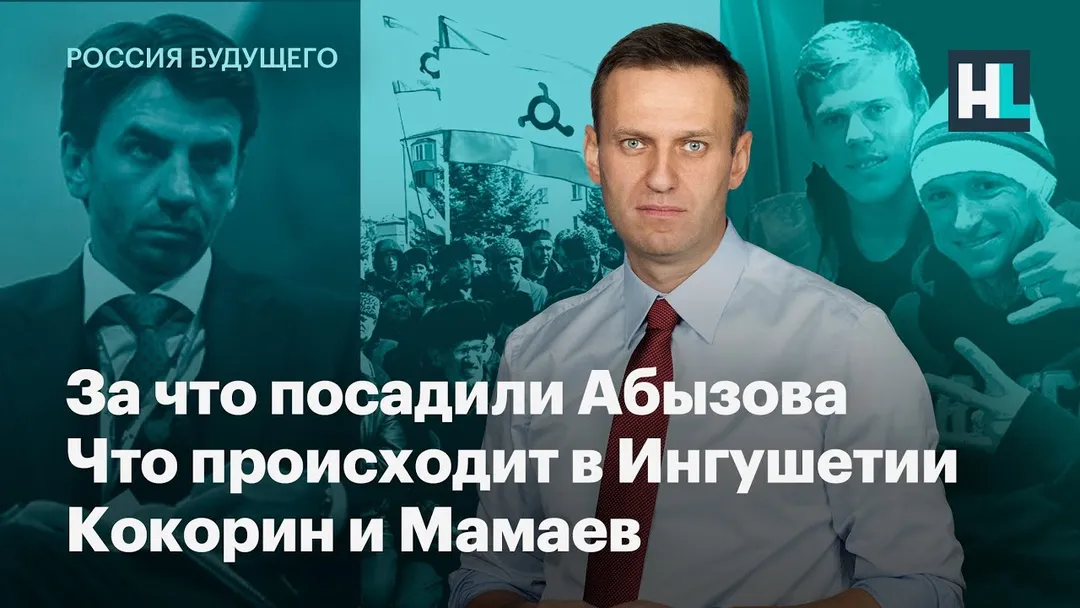
Why Abyzov was jailed, what’s happening in Ingushetia, and Kokorin and Mamaev
[music]
Good evening. It’s 8:00 p.m. in Moscow, which
means we’re live with the program
*Russia of the Future*, and I’m Alexei Navalny
— or “Alexei, who steals grants,” as
the media in Novgorod Region called me this week
.
They got offended, along with their
governor, because we supported
the medical workers’ strike there — and we supported it
gladly, because
the medical workers won. I’ll say a little more about that
during the broadcast. Let me remind you that you
can ask me questions using the hashtag
#RussiaOfTheFuture. Post them on Twitter; they’ll
put the questions on screen, and I’ll
answer them without any censorship, without
any special selection of those
questions. You can ask
me anything. I’ll start with the fact that
today was an awesome, amazing day.
It’s always an amazing day when you’re
surrounded by a lot of people
who are on the same wavelength as you. And I
spent today with exactly those kinds of people
— today and yesterday. Yesterday we had a kind of
working meeting, and today we
re-established our party, Russia of the Future,
for the ninth time. Guys, for the ninth time, I
held a founding congress for the party.
We had people there from 56
regions — real, live people. I think
no one has the slightest doubt
that we have a large, active
regional structure, that we have
more than 500 supporters, which is what’s required
under the law on political parties. But
even so, our party is not being registered. For
eight times in a row we were denied; now for the ninth
time we’re submitting this application, and
that’s great. We’ll keep doing it. We are
completely confident in ourselves. We understand
why they won’t register us: because we would
wipe out United Russia. I mean
not just us, our party — all of us together,
you and me, all the viewers of this program — we
would simply crush them. And, well, essentially
that’s what the Kremlin is afraid of. As a kind of
reproach, people often tell me, “Well, you’re
wasting your time on nonsense with this party.
You should be doing other things. It’s obvious
they’re not going to register it.” First of all,
the situation can change. Second,
the fact that we’re trying to register a party does not
mean that we aren’t doing other things —
fighting corruption, or
holding rallies, or anything else. We have a
multi-track strategy, as always.
We do a lot of things, and we keep adding
new projects — new directions, whether it’s
trade unions or Smart Voting — but
we never abandon the old ones. If we’ve
decided and said that we would seek
party registration, then we do it. And
huge thanks to all the great people
who support our party
and came to the congress today. It was really
wonderful and great.
There are two extremely gratifying things I want
to mention. Gratifying, because I don’t like
United Russia, I don’t like Putin, I don’t like
Medvedev, I don’t like Sobyanin,
and it gives me great satisfaction when the fight against them
becomes very concrete and very
specific — real political struggle
in real elections. In our
political system, which is generally so constrained,
what can we do? We can hold rallies,
we can, here and there, on
the air, criticize them, we can release videos,
but from time to time we can
enter into direct confrontation with them in
elections. I’m always in favor of that kind of confrontation.
I did it myself in the mayoral election; I did
it in the presidential election, where I
wasn’t allowed to run. But still, you have to admit,
there was a confrontation there. And in September there will be
elections in several regions,
including Moscow.
And today Lyubov Sobol announced her candidacy.
You all know her very well. She is
one of the longest-serving employees of the Anti-Corruption
Foundation, and I’ve known Lyuba for many years. She’s
excellent.
She has an excellent background: she graduated from the law faculty
of Moscow State University
with honors. And with that degree with honors,
she didn’t go work for some corporation — she
came to the FBK (Anti-Corruption Foundation). Back then, there was no big team; she
joined RosPil (Navalny’s anti-corruption procurement project). She
investigated corruption in public procurement.
She’s a superb candidate, and she is running
in the city center — that’s Arbat,
Khamovniki, and Presnya. And not only those
residents, but all Muscovites in general
— and really the whole country — if, if we
manage to get her elected there as a deputy,
she’ll be a great deputy, because Moscow
is always a national-level story. Let’s watch
a short clip.
Let’s watch a bit of Lyubov’s video, where she once again
in her trademark voice tells
us that she is running in the election. This is
Lyubov Sobol: “In September, Moscow will hold
elections to the Moscow City Duma.
And I’ve decided to take part in them, in District 43.
That includes the Arbat, Presnensky,
and Khamovniki districts. I decided to run because
I want to stand against corruption and
the lies of the current authorities. At the Anti-Corruption
Foundation, that’s what I do, but elections are
an opportunity to make our voice sound
louder, and I want to use that
opportunity. Today we launched a website for
preliminary contact collection for those who
live in District 43 and are ready to support me
in the election. The link to the site is on the screen
and in the description. I understand that collecting
Collecting signatures, and the campaign itself, will be very
difficult.
But I’m ready to do it. I want to say
to Sobyanin and the other United Russia members everything
that I, and thousands of Muscovites, think. That’s why I’m
running for the Moscow City Duma and asking
for your support.
You’ve seen the link — go there and sign up.
Why am I so excited
and spending so much time on this? In the previous
program I talked about Mylov; now I’m
genuinely speaking with enthusiasm about Sobol.
Because politics is always
a confrontation between specific people, and it’s
great when there’s a candidate about whom
we know that she isn’t afraid.
They injected her husband with some kind of
substance — they ambushed him outside his building,
gave him a shot in the leg, and he blacked out. We
understand that this is being done by Prigozhin, the
so-called “Putin’s chef.” Sobol has been investigating his
activities for many years. Now she has
organized a class-action lawsuit for
the parents of the children who were
poisoned by rotten food supplied by this
same “Putin’s chef.” She’s going to wage
a real battle, and of course that
makes me happy. And I know for sure that
at least one election
campaign, I know for sure, is going to be uncomfortable
for them. There’s also Sobol, so that makes two
election campaigns where there will be
a genuinely brave, not cowardly,
candidate who will tell
the blunt truth and will truly
fight. And that’s just great,
you have to admit — even watching it is great.
I’m simply calling on everyone
to take part in all of this. Those who live in the
district should, of course, give their signatures.
Those who don’t live in the district should just follow it,
I don’t know, repost information,
support them, chip in some money. That same
Sobol — just look at how interesting things are
with the lawsuit she initiated.
Already now she has
forced Prigozhin to pay 300,000 rubles
to those parents whose children
were harmed, if they agree to withdraw
their lawsuit. In other words, she
organized a collective court complaint, and
now they’re going around to all these parents
and saying: we’re offering you, from Concord,
300,000 rubles if you withdraw the lawsuit. Like,
of course we didn’t poison your children, but if
you’re willing to drop it, we’ll pay you
300,000 rubles. You can look at her Twitter;
all the documents confirming this are there.
What’s more, now they’re already
offering 5 million rubles to break up
this lawsuit. They approached one of the parents
and said that if you make it so that everyone
pulls out,
we’ll pay you 5 million rubles.
But it’s great when politicians do
things like this. He thought he was
very cool, all-powerful — this “Putin’s chef”.
Everyone knows him; he has contracts worth 139
billion rubles.
Today, Proekt (an independent Russian media outlet) published a great
investigation about this crook. They
analyzed not only his Moscow
contracts for supplying food products
to social institutions,
but across the country as a whole, and
found that it’s the same story everywhere.
Everywhere, it’s the same: here they found
polyethylene, there worms, here some kind of
spoiled products.
This is in Leningrad Region,
Kaliningrad, Pyatigorsk, Tver — in other words, he
supplies low-quality products across the entire country
and has received 139
billion rubles from the state,
from us, from you and me. And he thought he was
really tough, super-mega tough. Then along comes
some Sobol, and she starts genuinely
kicking this man around so hard
that he’s forced to go around trying
to bribe people, paying them 300,000
rubles. Isn’t that great? It is. So
let’s follow these amazing
adventures
of Sobol, Prigozhin, and Sobyanin, and everyone
else.
And especially — by the way, I
read something this week,
a very minor news item, but I happened to see it on
Facebook and thought I should tell you about it
as an example of just how far, how utterly far,
these authorities have descended into absurdity.
So, Sobyanin — you know that he is actively pushing his
renovation program, and as part of it
they spend enormous
amounts of money on PR, feeding us a stream
of lies about how wonderfully the renovation is going.
And I saw that on social media people noticed
and started discussing how Sobyanin
came to a housewarming party for the Merzlyakov family,
or the Kurochkins, somewhere on Shchyolkovskoye Highway.
So Sergey Sobyanin arrived, and
in the traditions of the Soviet Union, they
show us: oh, an ordinary family, and to them
comes the mayor. They open the door: hello,
Sergey Semyonovich, we weren’t expecting you. He
says: hello, Kurochkins. And they
lead him inside and say: thank you, Sergey
Semyonovich.
Look what a wonderful apartment this is.
A two-room apartment.
Here we have linoleum, and here
parquet. Would you like some tea, Sergey...
we’ll make you some tea right away. Come in.
And they show us all this sickly-sweet garbage,
what a great guy he is, what a
wonderful, improved Moscow — and people noticed
it.
But strangely enough, in quite a lot of detail...
They show an apartment with lots and lots of
rooms, supposedly for a big family, like this.
An expensive kitchen.
But there’s no washing machine, and then
they show that the kitchen is arranged in such a
way that there’s a microwave with curtains hanging
over it, so those curtains would catch fire if someone
used the microwave. And there are other
small details that show this is
not a real apartment.
They really filmed it in a showroom. They either
set up some kind of separate apartment, well,
or they had just specially furnished
an empty, nonexistent apartment where no one
named Kurochkin lives. And I don’t know, maybe
some Kurochkins do physically
exist, but maybe their surname isn’t, I don’t know,
Kurochkin or Vasichkin — but I mean, it’s a complete
absolute fake.
Good Lord. With a city budget — a budget
of 2.5 trillion rubles (about tens of billions of U.S. dollars) —
you still don’t have any real Kurochkins, their
real apartment? Let their apartment
be less beautiful, maybe a bit
run-down — like a real apartment belonging to
real people. But no, damn it, they’ve taken
their lying to such a point, they’ve reached
such a level that you can’t even call it perfected —
there’s no imperfection left. My team
exposed it instantly. It’s just
the degree of contempt they have for us is such
that their PR people say: come on, give us some Kurochkins,
let’s just grab
some people, drag them into a showroom or some
apartment, and film an ideal tea party there
in an ideal apartment. And that’s what they did.
Well, they need to be hit back for this, they need
to be hit back — Sobyanin and all these scumbags and crooks,
the United Russia members sitting there in the Moscow City Duma
need to be shown: no, enough already,
stop doing this crap. For that we need
people like Sobol and Melkova.
I hope other candidates will appear too.
For that, we need
Smart Voting. Register right
now. If you live in Moscow, in Moscow or in
St. Petersburg, or in any region,
register right now, because
we have to knock United Russia out, and in order
to knock them out, the only
way is to vote
in a consolidated way. When everyone goes off in different directions,
you vote for yourself, you
vote for some other nice
candidate — we all together must
vote for one person, and then we’ll
pick off the United Russia candidates. That’s the only
way this works. Now I’m being asked here
a question.
Fini Kulise Nicula — I see a user with
that name — asks: why so many party congresses when
there’s already a lawsuit? Meaning, why do you
keep holding congress after congress when
you can appeal to the European Court?
But we have appealed to the European Court many
times. But the European Court takes years
to deliberate. Just because the name
Navalny appears in the complaint doesn’t mean
the European Court will consider
our complaint any faster.
There will be a decision, and we have no doubt that
it will be in our favor, because this is
absolutely blatant lawlessness. But we don’t
know how many years it will take, and we
still keep declaring, time and again, that
we have the right
to register our party.
Sergey Kapitonov asks:
Could they arbitrarily refuse to register
Lyubov Sobol? What do we do then? They absolutely could
refuse to register Lyubov Sobol arbitrarily, but
what’s more, I don’t want to demotivate anyone,
including Lyubov Sobol.
I think that outcome is likely,
because they’re afraid of fair
elections in this district. But I hope that
the residents of this district will understand that this is
the best option for them, and they will support
Sobol.
Does Sobyanin want someone in the Moscow City
Duma sitting there who
will go for his throat over those same
food supply contracts? Notice that
for several months now, Sobyanin has
basically been getting dragged by Sobol, and he
stays silent.
He hasn’t said a word. He only said something like,
“I’m taking the situation under personal control,” but he
says nothing about the supply contracts
for food, because it’s a scheme, because
it involves billions of rubles, and Sobyanin is
benefiting from it too.
Does he want Sobol
to win the election? Of course not. So
will they try to keep her
off the ballot? Of course they will make such an
attempt. But our task is to fight back, and our
task is to defend our candidate.
In any case, the task right now is
to collect a huge number of signatures,
and launch a powerful election campaign.
Well,
if there’s a refusal to register or something else,
then we’ll make a separate decision. I
think that, of course,
all of Sobyanin’s and United Russia’s hopes for the
Moscow City Duma elections are tied to the fact that, first,
they will falsify the results. For that they invented
online voting,
which is completely beyond public oversight. And
second, they will try not to
register candidates, because they’re
simply afraid of them. But in any case, we
must carry out our threat and
nominate strong candidates, and where we don’t
have strong candidates, support
through Smart Voting, well, simply
opposition candidates, even if they’re not quite as strong.
cool
like Sobol, but at least we
know they’re not United Russia members. Well then,
let’s talk about
arrests. Of course, the main news this
week is that this one was jailed, that one
was detained — it’s enough to make your eyes dart around.
There’s so much to discuss, and it’s just
so satisfying that they’re devouring each other, and not
a single one of them deserves even a drop of pity, because
we understood they would start eating each
other alive. We told them: you bunch of
crooks, you think you’ll always
live like this — we’ll be the ones getting jailed,
while you keep making money, because
the system supposedly protects you from us.
But the grass under your feet is running out.
Autumn has come, the economy has fallen, and
the easy pickings are drying up, the feeding base
is shrinking, and the guys have started eating each
other, and that’s wonderful. Let them eat each other. Let’s
start from the other end. The latest
arrest is Ishaev — that is, Ishaev and
Abyzov are two symbolic cases that
have happened. Let’s start with him, the former
governor of Khabarovsk Krai.
If you live in Moscow or St. Petersburg, in
the European part of Russia, the surname may
ring a bell — like, sure, we’ve heard it
before, but who the hell knows where
it’s from — somewhere way out in the Far East.
But if you live not only in
Khabarovsk Krai but in the Russian Far East
in general, then you know that
Ishaev is like Luzhkov in Moscow (Yury Luzhkov, former longtime mayor of Moscow).
If they arrested Luzhkov tomorrow,
it would mean roughly the same thing for
the entire Far East, because
Ishaev is that kind of monster who sat there since
1991 — Yeltsin appointed him back then.
He’s just a completely thieving face,
the kind of guy who ran everything — basically a gangster and
a murderer, I’d say — who did whatever
he wanted. His son seems to be just the same.
Reports say he was detained too. It’s that kind of
brazen family of entitled rich kids.
Some time ago, his grandson committed
let’s take a look — the grandson looks very
colorful, what a stylish little dude.
He caused a traffic accident.
The victim in that crash suffered serious
injuries. That’s Ishaev’s grandson right there,
a street racer type, naturally.
Of course, he got away with it. The criminal case
was closed because they supposedly
reconciled with the victim — meaning they simply
paid the victim off.
Obviously, they used administrative leverage
to pressure the police. So this is the kind of
family that did whatever it wanted.
But what kind of clout, for example, in Moscow — in
Khabarovsk Krai?
After all, Ishaev had been in power since ’91.
He has some substantial
support base. So why was he arrested?
There’s the official version, and there’s the real
version. I don’t really doubt that
the real version — and I’ll say this too — is
true.
Because, among other things,
the official version sounds genuinely
ridiculous. In the latest news, at first they said
it was about timber or something, that he
stole wood — like, he stole timber.
But that’s not actually what the criminal case is about.
It was stated that the injured party in the case was
the company Rosneft, and this
Ishaev, after he was removed from the post of
governor, was made presidential envoy, and
later became a vice president of Rosneft, and
he leased out, for the company’s representative office,
a building in Khabarovsk to Rosneft that
belongs to him through some
intermediaries. And this building has an area of, you won’t
believe it, 284 square meters.
I mean, come on, you have to admit that’s genuinely funny.
The guy was stealing for years
and years, by the millions and millions, and now they’re
charging him with leasing something out at an inflated
price.
Some ridiculous, pathetic office somewhere
in Khabarovsk.
I saw some angry posts from some
Kremlin guys: Ishaev leased out
a building in Khabarovsk
at the price of a Moscow building — my God,
what a shocking crime. Well, of course, that’s
complete nonsense. Sobyanin lays paving tiles in Moscow
at four times the price, spending
billions on it. Rosneft buys things
at roughly four times the price — so what building are we even talking about?
So why was he arrested?
Ishaev was arrested for the elections, because the governor
matters, he has some kind of
authority and still possesses
major levers of influence in Khabarovsk Krai, and
you remember that in the last election there was
a conflict between United Russia and not-United Russia,
and Khabarovsk Krai was one of
the regions where the United Russia candidate,
nicknamed Horseshoe — surname Shport — lost badly,
in a landslide. And here you see Ishaev and Shport
in this photo. And, as usual, all these
regional crooks and bosses often
pull this kind of stunt: there was a setup where
Ishaev is a United Russia man, he sort of
seemed to support the United Russia candidate Shport,
but in reality he supported the LDPR (Liberal Democratic Party of Russia)
candidate Furgal, who in the end
won. Everyone knew it then, and everyone knows it now.
And in Khabarovsk Krai everyone knows it, not just
some grand political strategists,
just ordinary people. And what we’re seeing now
is a kind of public flogging.
They’re arresting him, and apparently the investigators
— I heard — are coming forward with a proposal for
house arrest, which also seems to me
to confirm this — it supports this
the version
if they had really wanted to either
jail him to boost Putin's ratings, or
for some other reason, they would at least have
gone after him properly. It would've looked angry, brutal. But here they're simply
showing all the other governors
a straightforward public flogging: oh, so you didn't
support our United Russia candidate, you were playing
some kind of political game, well then
sit in jail for a while.
So sit there. You'll be pushed away from
the feeding trough. You thought you were some heavyweight
and basically untouchable? No such thing.
No one is untouchable — you have to back our people.
Why? Again, because Smart Voting
works. I mean, before,
it wouldn't even have occurred to someone like him
to think of it
to pull off this combination — to somewhat
support this one
but in reality somewhat support
that one, because with United Russia, Putin
and everyone else used to get, bang, 60 percent right away
automatically. But now, no — now it's the opposite: if
you're not from United Russia,
bang, people will hand you 34 percent right away
because they don't want to support United
Russia. That's why Smart Voting
is working now, and all these kinds of things
are working, and the Kremlin is very afraid
that the elite will start, start playing
this kind of double game.
Anton, I see people are asking me: Alexei,
why are Abyzov's own people putting him in jail? Let's
talk about our
Mishanya Abyzov. This really is a very
interesting thing, a symbolic thing.
How does a man who was minister for Open
Government, a close associate
of Dmitry Medvedev — don't forget, Abyzov
headed Dmitry
Medvedev's council of supporters. You're probably laughing now
because, in principle, something like
Dmitry Medvedev's council of supporters
— or Dmitry Medvedev supporters בכלל — is
very strange and funny. But that's how it seems now
after our film *He Is Not Dimon to You*
(*Он вам не Димон*, an anti-corruption documentary). But in 2011 — or rather, in
2010, when Medvedev was still
president — he thought he was quite
a big deal, and he had this council of supporters, and
Abyzov was one of his closest
guys.
And now something very funny happened: as soon as
he was arrested and people started paying
a lot of attention to it, Medvedev — who has
a VKontakte account — removed him from his friends list
within an hour. I mean, really —
good Lord, what petty people. But
he headed your council of supporters. You
came up together with some kind of
idiotic Open
Government project and ran around with this Open
Government thing. A lot of people probably don't
remember, but there were meetings with bloggers
and all sorts of gimmicks — all this 'open'
government stuff.
Medvedev really loved it; it was his thing.
He was all about openness,
about open data, and they were all running around there
together. He could at least have waited a little — I mean,
why throw him out of your friends list within an hour?
Why did his own people devour him?
Well, basically,
the question we need to answer right away
is this: should we feel sorry for
Abyzov, who at first was super-cool
and now has fallen to just 'Mishanya'? If you've seen
the coverage of him in court and in the tabloids, they
actually describe a fairly
disgusting phenomenon, when journalists
under the guise of public monitoring commission members
slip in there with a camera, and the next
day headlines come out saying, 'Abyzov gave
his first interview from detention.'
But anyway, they went in to see him,
and he
while talking there with
them, was mumbling something half-asleep — he'd been
interrogated all night, and the guys with the
camera were saying, 'Come on, Mishanya,
stand up and answer the people.' And so, from
being Medvedev's super-cool friend, Misha
Abyzov came crashing down. So the question is:
should we pity him? Well, look, he doesn't
really look like such a horrible
nasty stereotypical official — not like Sechin
or Ishayev. He seems more like
an unshaven, likable
and fairly easygoing person.
I spoke with him once on the phone
or maybe even twice. He's probably the only
minister, the only high-ranking official
I ever talked to when we
submitted our initiative on combating
illicit enrichment to that very
Open Government.
The phone rang, and they said: it's Abyzov himself,
the real Abyzov, not a prankster. We actually
spoke quite politely, but he said
— well, he didn't explain why our bill was bad;
I explained to him why our
bill was good. He didn't understand anything.
I mean, he was basically playing at
this kind of democracy. Should we
feel sorry for our Mishanya? No, we shouldn't. I don't
feel sorry for any of them, and especially not for him, because
I want everyone to understand very clearly:
understand this.
Abyzov is a terrible thief and a corrupt official.
I mean, the guy literally stole everything.
Absolutely everything — anything that was lying around,
anything that wasn't nailed down, and even things that were.
He worked at RAO UES (Russia's former state electricity monopoly), and even by RAO UES standards
— and that was basically a thieves' outfit
under the leadership of the thief Chubais — even there
he was considered completely lawless. But
as a matter of fact, what they've jailed him for now is
What I described back in 2017 may
be something some of you remember.
At the time, there was a huge
scandal in Novosibirsk: utility and housing service rates were sharply increased.
They went up dramatically, and a rally was being prepared there.
It was being organized by
my colleague sitting next to me, Sergei Boyko, and I
came to that rally and spoke there, and in order
to help the people of Novosibirsk, we
did a small investigation and showed
Abyzov's real estate in Italy.
Back then,
he had an unfinished building there, and I
briefly described what the scheme consisted of.
Abyzov being summoned to court in Siberia—let's
remember.
A one-minute flashback to 2017, where I
talk about what is now being
presented to us by the Investigative Committee
as some kind of major revelation: Abyzov—
the Italian estate of a minister
in the government of the Russian Federation
—Mikhail Abyzov, the very man
who owned the entire energy sector
of the Novosibirsk Region, and now there is
an energy monopolist there, Sibeco,
which, broadly speaking, is the one raising
the rates. This monopolist is part of
Abyzov's holding through a chain of companies.
Through these
Abyzov-linked Novosibirsk energy companies,
you can trace a direct chain to the offshore structure
that owns the Italian estate.
We are looking at a plot with an area of 346,000 square meters
and an estimated value of about
750 million rubles.
The houses range in size from 200 to 630
square meters. Next we see
a tennis court.
We go around it, and immediately we are
greeted by a private golf course,
and behind it, vineyards. Right there
there is a fountain, and here is another one a little
farther away, right in the middle of the area in front of
Abyzov's houses. Slightly to the right, we can see
a huge covered garage
for about 15 cars. And of course, what kind of
estate would it be without its own
artificial pond?
I don't know what the FSB (Federal Security Service) and
the Investigative Committee were investigating there, but everyone knew this.
And it is confirmed by documents. We
knew it, and we told you about it two years
earlier. The entire energy sector of the Novosibirsk
Region—a huge chunk of the energy industry—
belonged to Abyzov, and he acquired it
through corrupt schemes, tariffs, and so on.
Everything worked for him. He simply
siphoned money from everyone, and of course he had
a scheme for moving that money abroad,
and he moved it out. And now, suddenly,
we are being told
by men in blue peaked caps, "You know,
it turns out Abyzov owned the entire
Siberian energy sector, received money from
inflated tariffs, sold something there
to the state, and moved the money abroad."
Abroad.
Really? And we, supposedly, had never
talked about this before? Even though this
Italian estate was registered to
the very same offshore entities that owned
the energy assets. And now
Abyzov
is being arrested and dragged off to prison.
Actually, what is really interesting is how he
became a rich man. He was
one of the young billionaires, and in
the Russian Forbes list they didn't much like
writing about him, because he was that type of figure:
pleasant on the surface, and at the same time close to Putin, because
he seemed relatively young,
and all our so-called liberal
intelligentsia—really pseudo-liberal—
that super-mercenary glamorous crowd—
absolutely adored Abyzov. How did this man
make his money? I'll explain briefly
once again, so that no one
is under any illusions or feels sorry for him, because
already a whole flock of various
charitable foundations are ready to post
bail guarantees for Abyzov, and Anatoly
Chubais and so on and so forth are involved. Don't
feel sorry for these people. How did he become rich? Well,
there was the gigantic energy system
of the former Soviet Union, in Russia, and it
was reformed by Chubais, who created for this purpose
the Russian Joint-Stock Company of the Unified
Energy System. And there was a separate piece
called Novosibirskenergo. It did not
fully belong to RAO UES because it
was large, very valuable, and very important.
And a large block of shares there belonged
to the local authorities, the government
of the Novosibirsk Region, and together with Abyzov they
set up a very simple scheme. Abyzov was
a local crook who handed out all sorts of
bribes to everyone. They created
artificial debt: he supposedly supplied
something to certain enterprises
in the Novosibirsk Region.
They failed to pay once, and then said,
"We can't settle with you,
so let's give you shares in
Novosibirskenergo instead." And they did. And that is how
he became the owner of all of it.
After that, he went to work for Chubais.
Anatoly Borisovich (a formal Russian first name and patronymic). And now one
of the unpleasant things is that everyone is
discussing Abyzov, but if we need
to find the person without whom Abyzov
could not have carried out these schemes and
stolen billions,
then if we want to find that person,
we need to look at photographs
from that same Italian villa. Who is standing there?
What people are there at that
villa? Well, the very same beloved...
Anatoly Borisovich
together with his wife in Tuscany at
Abyzov's villa, they are holding glasses of
champagne and discussing something. This,
this is exactly that organized
criminal group that stole everything. So,
when Abyzov had already started working under
Chubais at RAO UES (Russia’s former state electricity monopoly), as his deputy. About
this, Nilov wrote in detail in an article
he published, but overall this is a well-known
story. Anyone working in
the energy sector will confirm it for you. Abyzov
was engaged in
privatizing service companies. That is,
say, there is generating capacity,
roughly speaking, there is a power plant, and there is
a company, or a part of this
power plant
that handles servicing, repairs things,
the workers there who fix things,
but they are needed all the time, because things keep breaking down.
It’s a huge enterprise, and they decided:
let’s privatize all of it, and then on the
free market, within the framework of
competition,
other companies will appear, and then
there will be outsourcing, and the price
for these services will go down. Great idea. Abyzov was
in charge of this, and he really did
privatize all these service
companies.
And then, six months later, it turned out that
oops, they had all ended up with him.
I’m not exaggerating here — that is exactly
what happened. There was a deputy chairman who
oversaw the privatization of service
companies, and somehow they all
ended up in his personal ownership.
Then, some time later, he
bankrupted them, but in fact his
billions came precisely from that.
He simply stole everything, and all these
people — let’s look at the list
of those who came there for him
to post surety for him: Arkady
Dvorkovich, Anatoly Chubais,
Natalya Timakova. Then the philanthropists
got involved as well: Ksenia Rappoport,
Nyuta Federmesser, Chulpan Khamatova.
For some reason, I have not seen these people
posting any
sureties for anyone more or less
decent. Though, in my view, Khamatova did for
Kirill Serebrennikov as well,
she also submitted a surety there.
But for the Bolotnaya defendants (participants in the 2012 protest case), or for
ordinary people who were unjustly
put on trial, they did not post surety. But for
this complete crook, they do — and then they look on with wide
eyes, with tears standing in their eyes.
This whole situation perfectly shows
the sadness and horror of modern
Russian charity — or rather,
of the big charitable foundations. There are
many wonderful, amazing people
working there, and of course they
do a lot of good. But overall, the essence
of Russian charity
has been that people like
Abyzov steal a billion, and then
allocate 7 million rubles to charity
(about $75,000 at recent exchange rates), and we are supposed to say, oh my God,
God bless him, thank you,
thank you so much, Misha,
you philanthropist — and then kiss this
Misha and say, what joy, what
happiness. No, guys, we need to look at
this differently.
We need to remember that he stole a billion,
and we would not need any charity
at all, and all these children would be treated for free
— these kids.
If these people did not steal and
loot so much. That is why I am talking about this
for so long and in such detail. I hope
that all these people — I mean, I have no
illusions about Dvorkovich, Chubais,
Timakova, and, Lord, Voloshin was there too,
posting surety for Abyzov — well,
it is completely pointless
to appeal to their conscience, and of course they are the same
as Abyzov — members of his criminal
group. But these philanthropists
— come on, guys, you should be ashamed. I
understand that over there in Italy, together with
him, you hang out and drink champagne from
crystal glasses, but you should be
ashamed.
To post surety for this
disgusting swindler and thief. And at this hearing
there was another absolutely astonishing
thing. When I read it,
I just cried. So, they were discussing
the issue of house arrest as a preventive measure. Well,
naturally, the investigators were saying something like
lock him up, and the lawyers were saying no, don’t lock him up,
let’s do house arrest — which is normal enough,
that is what defense lawyers are supposed to do.
But then this phrase was said:
you know, let’s place Abyzov under
house arrest, because he has
apartments in Moscow and a dacha in Barvikha (an elite suburb outside Moscow),
because — and this is a direct quote from
Mediazona’s live coverage — because
summer is approaching, it will be hot, and it would be
preferable for Mikhail Abyzov to spend the
summer
period at the dacha. I do not know what
happened in the courtroom at that moment. I hope
the judge simply burst out laughing, and
even Abyzov himself, I hope, laughed too.
And then I realized where I had actually
heard something almost word for word like this before. I mean, really,
what great people writers and
poets are, how perceptive and precise
they are in capturing things about Russia, because
this whole “well, let him be under arrest,”
“but at a dacha in Barvikha” — that is practically verbatim.
quoting a famous poem 12
seconds, you all know it: "There is no war, I will accept anything"
I will accept exile, hard labor, prison, but
preferably in July, and preferably in Crimea
yes, yes, that's exactly it, I will accept anything
exile, hard labor, prison, but preferably in
July, and preferably when it will be hot at the
dacha in Barvikha (an elite suburb near Moscow), simply amazing, simply
unbelievable. As for—I see
questions. Zak Saturday.
Why did Abyzov call Medvedev when he was being arrested?
Artyom Loshchin will ask me. Well, I don't know
whom exactly he called there, whether he did at all, but with that kind of
opportunity, whom else was he supposed to
call?
He headed the supporters' committee for
Medvedev.
I doubt it. When he was arrested—I've been
arrested many times, as you know—
you don't really manage to make many
calls. I think I myself would hardly have
been able to do it quickly, but I think that
of course he did turn to Medvedev
but it didn't help him. Why was he
jailed? There are many theories. It seems to me
that some of them are completely idiotic, such as
the idea that it was somehow meant to boost Putin's ratings
or that it was an attack on Chubais. More likely, not on
Chubais.
I think it was about a narrow circle—that Abyzov had been
servicing them financially for quite
a long time. I have a very simple explanation:
it's called redistribution. They are
simply dividing up among themselves what has already been stolen,
what has already been looted. As I said, the feeding
base is shrinking. I often talk about
how everything in the country belongs to a thousand
families—well, about a thousand families—and
that whole pie is shrinking, while at the same time
things are getting worse and worse from every side.
The economy is declining, and if people's incomes
have been falling for five years in a row, then
people spend less and buy less, so everything
contracts. And those thousand families somehow
don't have enough.
They used to want to buy houses of 5,000
square meters, and now they have to tighten their belts
and buy ones of 4,500 square meters instead.
square meters. And I have no doubt there
was just some ordinary little conversation there
between some, I don't know, FSB officers
or oligarchs or Putin's friends, and they
ended up having, in a sense, a rather
"fair" conversation, like, well,
we seem to be short on money.
That Misha, Abyzov—well, he's a thief and
a crook, after all. He blatantly stole energy
assets, cheated everyone in the
market, and nobody likes him anyway. So let's take
everything from him. Would that be fair?
To take everything from Abyzov? And anyone
would answer: of course, that would be fair.
They can take everything. What's more, I
would say that, in fairness, taking everything from
Abyzov would be justified. It's just that this should not be done
by some other crooks. In fairness,
Abyzov, together with Chubais, should be
put in the dock for this
put on trial for this
corruption.
Then all of it should be returned and put back
into the market, into the market economy, so
that these would become genuinely normal
private assets belonging to normal
businesses.
They were former top managers of RAO UES (Unified Energy System of Russia),
who had been executives and then became
owners. So they
judged it according to their own underworld-style notions and reasoned as follows:
well, this businessman is a crook,
a con man and a scoundrel, and on top of that he lives in Italy.
Is it fair that he has all this?
It's unfair. Let's strip it from him, let's take it.
Then they will seize it
and sell it to some
Fridman or Vekselberg. This is being discussed
very actively.
Not just discussed actively—they have
official legal disputes between
Vekselberg and Fridman on one
side, and Abyzov on the other. Maybe
they ordered something, maybe
they paid for something—something like that. But the point
is, this is
redistribution: they take from one
another what was stolen, and the thing is, everything
was stolen. That's exactly the point: from the standpoint of their
own notions, some people are sitting there—
Putin's friends—and for any
asset, whether Lukoil or, I don't know,
Surgutneftegaz, for anything at all you can
say: come on, is it fair that it belongs to
him, to that oligarch over there? It's unfair.
Let's take it. If we take from anyone, the
public will support it. Will they
be happy that this person's assets are being seized?
They will be happy.
That's how Putin's system works. Here
there is no secure
property ownership. They devour one another, and
that's wonderful, because
first of all, once again, it is karmic
retribution for all of them, and especially for Abyzov,
who was a public figure and who
declared that our law on combating
illicit enrichment was somehow this
bad thing, unnecessary, unnecessary, and
impossible to apply. You remember—well,
some of you remember this story—
when Putin was running for election, he said that
the public should be allowed to submit
a bill, and that it would be necessary to collect, that is,
100,000 signatures. We rather quickly
collected 100,000 signatures for two
bills: one banning
officials from buying expensive cars costing
more than, say, 2 to 2.5
million rubles.
And the second point is about combating illicit
enrichment — that people who cannot
explain their wealth should
be held criminally liable, and
Abyzov was exactly the kind of person
who went around saying — and this is a direct
quote — that right now
Article 20
of the anti-corruption convention
is optional for adoption and does not fit
with Russian law because
the Constitution enshrines the presumption
of innocence. They set things up very nicely for themselves.
And I liked the article under which we
could ask, “Mikhail, explain after all
how it was that you, as a manager, ran
a huge chunk of Russia’s
energy sector, and then suddenly
became its owner? That is probably
illicit enrichment.” And Mikhail
Abyzov said that we did not need such a
law, and he thought he was untouchable,
while we would keep getting thrown in jail for 15 days at a time
and the system worked only for him. And
now he has seen that this is not so. And once
again, my formula for all these people is:
we should give them exactly as much sympathy as
they gave
to those who were jailed arbitrarily
and when people were tortured. However much sympathy
all these systemic liberals — from
Chubais to Abyzov, all these Dvorkoviches,
Voloshin, and all the rest — contributed, that same amount of
sympathy should be given to them when they
are jailed. And they will be jailed, because these
people will devour one another and take
from each other those very stolen
assets. So that your
proletarian hatred may flare up — especially since
the next topic is proletarian
hatred — I want to show you a video. It
just came in today. It is 51 seconds long.
Kaliningrad is a major city. In one of the
districts — no, wait, I am mixing it up,
I was mistaken — it is the town of Sovetsk
in Kaliningrad Region. Well, anyway, in
one district of the town they connected gas, and
now I will show you 51 seconds of what
a ceremonial
event for the launch
of gas looks like. They lit a gas flare, and
in 2019, in Kaliningrad Region,
which is, after all, located in Europe
and is our outpost there, and in
some sense even a showcase — look
at this and stop feeling sorry for Mikhail
Abyzov, because it is precisely thanks to
Mikhail Abyzov that in 21st-century Russia
the launch
of a gas connection to a district looks exactly
like this. At the gas launch and flame-lighting
ceremony, taking part is the governor of Kali-
ningrad Region, Anton Andreyevich Alikhanov,
Deputy Chairman of the Government
of the region, Alexander Semyonovich Rolbinov,
[music]
It is funny, but it is also awful: ruined
shacks, nightmarish shacks, mud — this is
just unbelievable. Poor people are standing all around.
It really looks like some kind of horrific
ghetto.
The governor’s Mercedes, the governor himself,
and some other bureaucratic mugs with him
are standing there, and “zavalinka, zavalinka, Rus’” — a little song
about old Russia. Good Lord, why do we, why
do we live like this and put up with all this? But
this really looks like
one of the most horrifyingly Russophobic
videos — a video about this government’s hatred for
its own country. The governor arrived in
his Mercedes,
in a Mercedes, to this
unpaved, filthy lot.
They connected gas there, do you understand, in 2019, and
they are ceremonially opening it with a song about
the zavalinka (a traditional bench by a peasant house), for heaven’s sake. In a country with
an unimaginable amount of money, this is how
we live — thanks to all these
wonderful oligarchs. And many people consider these
remarks of mine to be proletarian
hatred, that I am somehow stirring up
hatred toward the rich by showing, say,
someone’s villa in Italy — that this is incitement of
hatred toward the rich. And I was reproached for this
by the famous TV showman and star Maxim
Galkin, in fact one of
the most famous people in the country.
Speaking on the program “Hard Day’s Night” (a TV talk show), after
that we
had a bit of a polemic
on Instagram. I actually
give Maxim Galkin credit for the fact that he
did engage in that debate
instead of, like many others, pretending
that such a person does not exist.
Let us first watch 57 seconds of
Maxim Galkin on TV Rain (Dozhd).
Navalny has chosen for himself such a clever
path.
It fits so well with the proletarian
subconscious of the masses, because after all he
is playing on Bolshevik proletarian
hatred. In reality,
even when he exposes officials, he is still playing
the pipe of hatred toward wealth, that is,
it is all obvious — he says, “This one
acquired his wealth illegally,” but forgive me,
there are all sorts of ways people can grow rich,
and all kinds of things happen. But wait a second, with all
due respect for the work
of Alexei Navalny,
when he accuses my
television colleague Vladimir
Solovyov over his real estate, I
have a question: why are you accusing him?
He brings colossal ratings to his
channel; his channel, Rossiya-1, sells
advertising much more expensive thanks to
the existence of Solovyov on Telegram, he owes him
he owes him regardless of whether it is
a state channel or not, to pay
big money, and Solovyov has the right
to use that money to buy—playing the tune
of hatred toward the rich
What tune the hell am I supposed to play?
When I see this whole song and dance about the village bench
and I see this monstrous poverty
every day, and at the same time Abyzov with his
Italian estate, and all these
well,
Chubais-types
and Dunya Smirnova (Avdotya Smirnova, Russian filmmaker) with whom, how they
walk around there with a wine glass amid all of this
all sorts of people like Chulpan Khamatova (Russian actress) walking around—well, you
can call it
proletarian envy, if you like
call it whatever you want, but I’m talking about the fact
that yes, I really do find it somehow
deeply unfair that these people
robbed everyone here, and then here they are
sort of setting aside for us
some pennies so that, well, there
some of your children, who will be
luckier, can get into our
charity foundations and get treatment there
and
but overall, of course, you continue
to make us pay—let the Novosibirsk Region
keep paying an inflated tariff so that
Abyzov can keep getting money. That is
my tune. If that’s proletarian hatred, I don’t
mind, by the way. Back then as well
people in Novosibirsk already fought it off thanks to
Boyko
thanks to the people who came out to the
rally; even then the mayor, the Communist
Lokot (Anatoly Lokot, former mayor of Novosibirsk), by the way, ended up supporting this
rip-off operation and supported Abyzov then
but if you want, I played in front of him
yes, I played the tune of hatred toward
wealth—I showed that Italian
estate of Abyzov’s, and somehow they
backtracked. Not enough, but still
I find it not just unfair but
disgusting, and I will never stop
talking about it, and yes, I will keep stirring up
hatred toward these people who
became rich unjustly and unrighteously
who got rich simply through
theft. As for
Vladimir Solovyov, basically our
further argument with Maxim Galkin (Russian comedian and TV host)
came down to this: he says, well
fine, officials are officials, but why are you
going after Vladimir Solovyov, because he is
a top professional, he has high ratings
and he brings in a lot, a lot of money
to his channel. Even when I objected and
said that he brings in nothing—the money
for the channel comes from us, because the channel
Rossiya-1 is deeply unprofitable, and you and I
pay 17 billion rubles a year (about hundreds of millions of U.S. dollars) there
to keep this thug outfit afloat
including the disgusting Solovyov
Galkin said, well, still
he gets ratings, so that means
he’s a talented host. I noticed
that many people started nodding along like that
even Sobchak (Ksenia Sobchak, Russian media personality) came in and wrote: yes, I
don’t agree with him, but what a talented
Vladimir Solovyov he is
So, well, this is going to be a strange
video, because I’m going to be sitting in the corner
of this video now. I can’t do otherwise, because
the Rossiya-1 channel sends us strikes
if we cut out clips of Solovyov and his
disgusting lies, so under the rules
of YouTube, if I sit here like this
in the corner of the video, they won’t be able to
hit us with a strike. But I’d like to show you something about
Vladimir Solovyov’s professionalism
Many have probably noticed this
in his programs, in particular
Evening with Vladimir Solovyov, he invites
all kinds of monstrous
trash
who call themselves experts. This
monstrous trash lies monstrously, and Solovyov
nods along with them. But here is one absolutely super
super lie that really caught my attention
Let’s watch 45 seconds, and I’ll sit in the
corner—just wonderful
“In response to a Western journalist, our
great Russian actor Yevgeny Leonov
was asked, ‘Have you ever been abroad?’
‘Sure—Poland, Czechia, Germany.’
‘As a tourist?’ ‘No, in infantry.’ But this, this is
an objective fact, yes, it is recorded in
that very interview for Western mass
media.”
“Why?” “I went on foot.” “Ivan Vasilievich, one
moment—an objective fact, yes,”
“recorded in that very interview for
Western mass media.” And
these bastards are just lying to your face. It’s the comedy *Thirty-Three*
Probably many younger viewers of this
program haven’t seen it, but people
my age and older have all
seen this comedy, without exception, and know perfectly well
that first of all, Leonov is one of the most
famous—possibly the most famous
Russian actors
He did not fight in the Great Patriotic War (the Soviet term for World War II on the Eastern Front), because
he was too young then. He
worked at a military factory, and this is
a famous dialogue from the Soviet comedy
*Thirty-Three*, about a man who had three
teeth
so everyone thought he was an alien
and these scoundrels took this dialogue
and presented it as if it were an interview, meaning
an interview with Leonov—an ‘objective fact’
that he supposedly told foreign journalists
and Solovyov, the greatest professional, just
goes, ‘Yes, yes, yes, that happened, that happened.’
Now that’s professionalism.
the endless lying he engages in
taking advantage of the fact that all the real ones were pushed out
Parfyonov was kicked out, Kiselyov was kicked out, who
the good Kiselyov was kicked out, Savik Shuster was kicked out
no, all the others too—Svetlana Sorokina and
and so on and so on
all of them were gradually
driven out—some moved to Ukraine, some
gradually simply stopped working there
as journalists, some went to YouTube and
have done quite well there, like Parfyonov
and he continues making documentary
films there and so on. But when they were all
on television, Solovyov was there too, but he occupied the place
he was supposed to occupy—he was of no interest to anyone
just a [__] third-rate host, and
now, since he has no one to compete with
there he is everywhere, on every program, as far as
I can tell, he’s already peddling this garbage of his every
evening. Why? Because he’s ready
to lie twice as much. He’s ready to lie and
to nod along, saying that a dialogue from a famous
comedy was actually a documentary
interview that was given to foreign
journalists. This vile
clown, this so-called expert Kulikov, the
next day—since it really caused a stir—
he was pressed on it and told, well,
you’re lying, and he admitted it, saying,
I misspoke, then remembered—but that
doesn’t change the meaning, because it’s
a cultural archetype.
But the fact is, that ‘slip of the tongue’ was just
unbelievable, you understand—he simply lied.
And this Putinist
expert tells us all this was somehow about
cultural archetypes. Vile
disgusting crooks. So, what is happening
in Ingushetia (a republic in Russia’s North Caucasus), in Ingushetia?
Is there an uprising in Ingushetia, or
unrest in Ingushetia? In Ingushetia
something is happening connected with the fact that
people have had enough—they were insulted, humiliated, and they
did not calm down and did not fall silent, because
the last protests there were four
months ago, and they were connected with the fact that
part of Ingushetia’s territory was handed over
you can’t even say it was handed to the Chechen
Republic
but more specifically to Ramzan Kadyrov, and
no one explained what had happened. There were
protests, and in various ways they were
somehow shut down
people were deceived, strung along, but
then they came out again and acted quite
aggressively. Let’s watch a few
videos, and when you watch them
you understand that this really is
serious. Let’s play 49 seconds—this is Magas,
the capital of Ingushetia—this is what’s happening there.
[applause]
uh
uh
[music]
yes
uh
how
And someone might say that this is
outrageous—throwing chairs at
police officers. But I would say, you know,
what’s outrageous is that they were even
being dispersed at all. Why the hell can’t the residents of Magas
who live there, in Ingushetia,
why can’t they gather in their own
main square and ask a question:
Explain why part of our territory
was handed over to someone.
They have every legal right to do that, absolutely.
Absolutely. Why should you disperse them, and
should they be throwing chairs? How else
are they supposed to react to lawlessness?
What’s lawless is that across the entire
republic, mobile internet was shut off.
I mean, that’s just some kind of extreme
boorishness, so that people couldn’t
contact each other, send these
videos, and among other things make it harder
for these videos to reach the rest of
the country. Someone called all
the major companies there
the ‘big three’ telecom operators and said, you know,
cut the internet, and they said okay and
cut the internet. People, apparently, paid for that.
There are service terms and conditions.
Half a million people live in the republic.
How can they just go ahead, without a court
order, and switch off the internet? But they did. Go ahead,
watch this 27-minute clash that
is happening there, which shows it
from a slightly different angle—just look at what they’ve
driven these people to. Twenty-seven seconds, let’s roll it.
[applause]
[music]
38,000 people are watching us live
right now. I hope that among them there are
at least some residents of Ingushetia
whom I absolutely want to support and
express my solidarity with, because you
see, we—we’re not in Ingushetia, you
have never been there, just like me, for example, yes, you
don’t know exactly what’s happening, but we can see
some very simple facts.
Part of the territory has been transferred. No one explains why.
Everyone more or less understands that there’s either
oil there or something else—someone wants
to make money, and as I already said
earlier on this program, it’s simple:
Kadyrov wants to make money for
some of his oil people or someone else; he
made a deal about it with Yunus-Bek Yevkurov
but then come out and say it openly: you know,
we decided to make money off this territory
but we’ll share some of it, so to speak,
with you. After all, only 500,000 people live in Ingushetia
altogether—we’ll do something for you. But
no, instead they were told: just shut up.
And this Yevkurov comes out and starts up this
that so-called Caucasian masculinity
it was basically this idea that here in the
Caucasus, you must not go out into the streets, and that it's
beneath the dignity of a real man,
to go out there and demand something.
Apparently, what is worthy of a real man
is quietly selling off part of your land.
And now,
what's most remarkable and absolutely right is that in
Ingushetia, the people taking part in these
protests are already putting forward political
demands. They are demanding Yevkurov's resignation,
they are demanding the dissolution of the government, and they
are demanding the return of direct elections for
the governor. In other words, they are demanding
democracy, popular rule. They are demanding
that their voice be returned to them. So, well,
of course their demands are right. When
they come out and block the Kavkaz highway, well,
we understand that, of course, some people are stuck there,
and
and probably for those who found themselves in that situation
it's extremely unpleasant. But what else are they supposed to
do? Those 30 seconds while they
block the Kavkaz highway
[applause]
[music]
[applause]
[music]
[applause]
[music]
[applause]
[music]
[applause]
And these videos are nowhere to be seen, and on
television they aren't shown, even though in reality
the republic is in an uproar. I mean, for a republic of 500,000
people,
these are very, very large and significant
protests. They matter to all of us.
By the way, there's a very widespread
opinion that nothing will ever work out in Russia
because there is this supposedly terrible
Caucasus, where people are supposedly even more
corrupt, where the tradition of corruption
is supposedly even stronger than in the rest of
Russia. That is partly true, because
the Caucasus is indeed even more susceptible to feudalization,
even more so. But look: in Ingushetia
they are demanding democracy right now. In five
days, a new rally has been scheduled; it will be on
Monday, and I hope that many
people will take part in these processes,
in these protests, and will achieve some kind of
democratization, will get answers to the
question of why part of our
territory was given away. But what's interesting is that when
something similar happens in Moscow, it is
the opposition that does it, and look—immediately there are
criminal cases, detainees, 15-day jail terms,
1,000 people locked up. In Ingushetia,
that isn't happening, and once again we see
a very different approach to all
the national republics. Look at what
is happening now in Yakutia. In my previous
program, I spoke in detail about the unrest
that broke out there after
a migrant from Kyrgyzstan
raped a local resident, a Yakut woman.
And there, it was precisely this kind of ethnic protest;
it was specifically Yakuts who entered into
confrontation with migrants. And an absolutely
incredible thing happened: the president
of the republic said today, essentially, 'free
of migrants.'
If some Russians here in Moscow
demanded a city free of migrants,
criminal proceedings for inciting hatred would immediately
be opened against them. But there,
the president of the republic does it, and nothing happens.
More than that, he issued a special decree and
closed off a number of
sectors of the economy so that
migrants could not work there.
In fact, strictly speaking from a legal standpoint,
governors do have such powers—though not
such broad ones. They can restrict
foreign labor, but first of all,
this does not really apply to the former
Soviet Union, so those very
Kyrgyz migrants, in theory, cannot be restricted that way. And secondly,
well, secondly,
what happened there is unprecedented: they banned them from working in
food service, hospitality, and so
on. So in effect, they are trying
to make Yakutia free of migrants, and
it's impossible to imagine any
official making statements like that or doing things like that
about any Russian region. But in Yakutia,
when they were faced with an ethnic
protest—an ethnic protest against migrants—
you can't exactly start talking about 'Russian fascism,' can you?
It's inconvenient, so everyone pretends
that nothing of the sort is happening. Well,
in fact, what they are doing
in Yakutia right now is a strange thing that
will lead nowhere. But we
understand why they are doing it: they need to
calm the residents down, so they are simply
telling them stories like, 'We've
passed a law, so there will be fewer immigrants,'
but across the whole country we are supposedly
saying that migrants
are hardworking, industrious, that there are no
problems with them. Still, in general, I would like
to see migration restricted overall, and at least
a visa regime introduced with the countries of Central
Asia. We have conducted many
surveys on this topic: 85 to 86 percent of the population
would support the introduction of a visa
regime. But that is not happening, it is not
happening.
Instead, there's some kind of absurdity with the construction of
a wall, like in *Game of Thrones*, between
somewhere—that is, a virtual border between
Yakutia and Kyrgyzstan—and a wall is being erected there.
It's complete nonsense, but it's happening
when they feel the need to throw the public a bone, well.
So once again, we’re seeing this kind of data.
Quite disgusting.
We’re seeing some pretty disgusting double standards right now.
More than thirty-eight thousand people are watching me right now.
I’ve already gone a little over my one-hour limit.
But I still have a couple of topics left, including one about Anya.
I want to tell you about her, because in the country—
a new mayor has appeared, and her name is Anya Shchukina.
Shchyokino.
And that’s actually really great, no—
no irony here: a 28-year-old woman has become the mayor of—
the city of Ust-Ilimsk, for one simple reason:
people there hate United Russia.
When the United Russia members
removed the main candidate for mayor of that
city, from the Rodina party, people simply, out of
principle, said: “Oh really? In that case,”
“we’ll go and vote for 28-year-old Anya from the LDPR (Liberal Democratic Party of Russia).”
And they did vote.
She was elected with 44 percent against 37 percent.
They beat the United Russia candidate and made her mayor.
Why? Because people spontaneously organized
that very “smart voting” around a candidate.
They said, “Fine,”
“we’ll concentrate on one person and elect”
“that person. It doesn’t matter who she is, it doesn’t matter”
“how old she is — any person is better for us”
“than a United Russia candidate.” So this spontaneous
voting in Ust-Ilimsk worked.
It works everywhere for us, and we need to keep doing it.
And we need to keep doing it, because the reaction from
United Russia was just priceless.
One former head of the local branch of the Young Guard
in that very Ust-Ilimsk
wrote a post on VKontakte, I think.
He deleted it pretty quickly, but he wrote it.
Because he wrote what he really thinks.
This is what a United Russia member thinks about people. I’ll quote him directly:
“People, residents of your own city, you don’t
understand what you’ve done. You don’t know a damn thing about
politics. You are a very limited
herd.”
“If you don’t understand that, then you’re [__] and”
And this is what United Russia is telling us.
You don’t know how to vote, you’re
[__] and a limited herd, so
stay in your stall.”
“And we know who should be mayors, who
should be governors, and who should
run the energy sector, and so on, and so
on.” That’s it.
Register for Smart Voting.
So that this person—
well, so that he understands that he’s the one who belongs
[__] — he’s the one who should be driven into a stall, not
normal people. As for Kokorin and Mamaev, I
haven’t said anything on this topic while it was
being discussed everywhere, everywhere, everywhere.
Because, among other things, I absolutely
believe it was right to hold them
criminally liable.
Because they really did start
a fight. But now the case is already heading toward
trial, and I wanted to draw your attention to
the following: let’s take a look. It was a fairly
ugly fight, to begin with.
Let’s look at those 26 seconds of what
Kokorin and Mamaev actually did.
Basically, drunk, wasted thugs
completely numb from their own
sense of impunity, jumping someone.
But this may sound strange, and yet I
now actually want to speak up in defense of
Kokorin and Mamaev. They’ve been held
for half a year. What’s more, I just
read about it.
I hadn’t realized the scale of it. There were, well, two
episodes — you saw them — and basically
all the court is examining is these
two episodes you just saw: 26
seconds. There are 18 investigators on it — 18! What is
that supposed to be? Both of them
should get 15 days. I know absolutely nothing
about Kokorin and Mamaev, and I’m not
into football.
To my shame, if you ask me
which team Kokorin and Mamaev play for, I
have no idea. I don’t know whether they’re good
players or bad ones. But I can see that these two
drunken hooligans started a fight and should
be held criminally
responsible. Both of them need to be punished.
But they’ve been kept for half a year in pretrial detention.
Eighteen investigators have been assigned; they’ve turned it into a show
for the whole country. A lot of people can’t even
get criminal cases opened
when their apartment has been robbed,
when someone has been raped, when someone has really
been beaten — or lightly beaten, as happened
in this video — and
no one deals with those cases either; there aren’t enough
investigators. But here, apparently,
you can assign a team of 18 people
to investigate something for half a year.
And now there’ll be a trial, a long trial, and they’ll
keep showing us Kokorin and
Mamaev endlessly — footballers, scandals, all of it.
Blondes and brunettes — they’ve turned
justice into some nasty, vulgar
farce. Kokorin and Mamaev need to be punished,
and then the person who assigned 18 people
to their miserable case
— a case that isn’t worth
a damn thing, and that a magistrate could have resolved
in a single day — should be jailed too. That’s how I think
it all should work. Remember, there used to be
a section called “And Everyone Laughed”,
in Soviet Pioneer youth magazines,
they really, really loved that kind of thing. And
a truly remarkable episode happened in
Bashkiria (Bashkortostan), where
where, by the way, such an accomplished crook as
Radiy Khabirov is running in the election,
and he tells us that he pays
good salaries to doctors, good salaries
to nurses. There was a great
meeting of the staff at a maternity hospital there.
And let’s take a look at what people there actually said.
reacted to
the words about what their real
salaries are
27 seconds doctors no she the latest UNIAN
atolla at 60–65, obstetrician 35, and 4 she 20
[music]
people aren’t laughing at jokes, they’re laughing
at the information there and at what their
salary is
you heard the figure, 21.3, they
say junior medical staff get 21.3 — that
means that a nurse, an orderly, or
a feldsher (mid-level medical practitioner)
on paper, on average, gets 20.13, and
people burst out laughing
because it’s obvious that they actually
earn somewhere around 15 — that’s poverty right there
you see, this is where it comes from — these are interconnected
vessels: Abyzov with his villa in Italy
Ishayev, Putin, Medvedev, all the rest, and
the people who laugh at salaries of 21,200
to 21,300 rubles because they dream of earning
21,300 rubles. I wish that in this maternity hospital
people would also — I don’t know — organize some kind of strike
because in Novgorod Region
we helped the strikers, and they won
in fact, really, there now
they called off the strike because, because
they held firm under pressure, and most of
their demands were met, or almost all
the demands were met. But as for what I need
to say about holding strikes — it turns out yesterday there was
a nationwide Russian strike
by truck drivers. Today on Twitter
by chance I saw in the news that
they were staging a strike — they were driving at
low speed somewhere, and about this
absolutely nobody wrote anything, nobody knows, and
I just wanted to say to the truck drivers, to the
truckers’ union: guys, seriously
are you in kindergarten or what? If
you’re carrying out an action like a strike
if you have hundreds of
thousands of people taking part, come to me, I’ll talk about it
at least hundreds of thousands of people will
hear about it from my program, we
will make sure that many people in the country
find out. Because to hold
a strike in such a way that nobody
hears about it is, at the very least, ridiculous
that’s why they don’t care about your demands
you can justify it all you want, but from
blocking some road in the middle of nowhere on
Rublyovka (an elite Moscow suburb), nobody’s life got any worse
so before doing things like that
a strike, properly, against the system
against Platon (Russia’s truck toll system) — come to us and we’ll help you, and
we don’t need anything from you in return. I’m not
going to ask you to go around there with
placards for Volny or anyone else
you want to support, and most importantly whether you support Putin or not
within the framework of your strike
that’s all — we’ll help you completely
selflessly. I want to end the program
with a very funny story, a rather amusing
story from the city of Belgorod about the new
you may have seen it, but I still want to
show it. There, the city mayor was being inaugurated
was taking office, and, and let’s
listen to this music — he came out at 21
seconds, for the greeting and oath-taking
the floor is given
to Golda, well, and to Yuri Vladimirovich, I ask everyone
to stand
[applause]
[music]
where was the lightsaber? That’s what was missing
— Star Wars. But the continuation of
this story is even funnier because
the Empire Struck Back, and that
same music — which was good, because he didn’t
come out to the dun-dun-dun-dun theme, he
came out to the Rebels’ march. But after that
the head of the department
of culture, who apparently was responsible for this
event, was fired because
well, everyone laughed about it on
social media. So in this way, it turns out
that in the end the Imperials fired
the poor victim — the rebel who
played their anthem. I just want to say
you can’t take things with such beastly
seriousness. So they played music from
Star Wars, everyone laughed, everyone
noticed that there is in
Russia such a cool city as Belgorod
why they fired the person is unclear
therefore I call on the authorities of Belgorod
Region not to give in to the Imperial
stormtroopers and to reinstate the person
who played that great Star Wars
music. And many thanks to everyone who watched
see you next Thursday
[music]