Navalny at 20:18. Broadcast #016. The Golden Youth and Neo-Feudalism, Ulyukayev and Sechin, Rap Battles
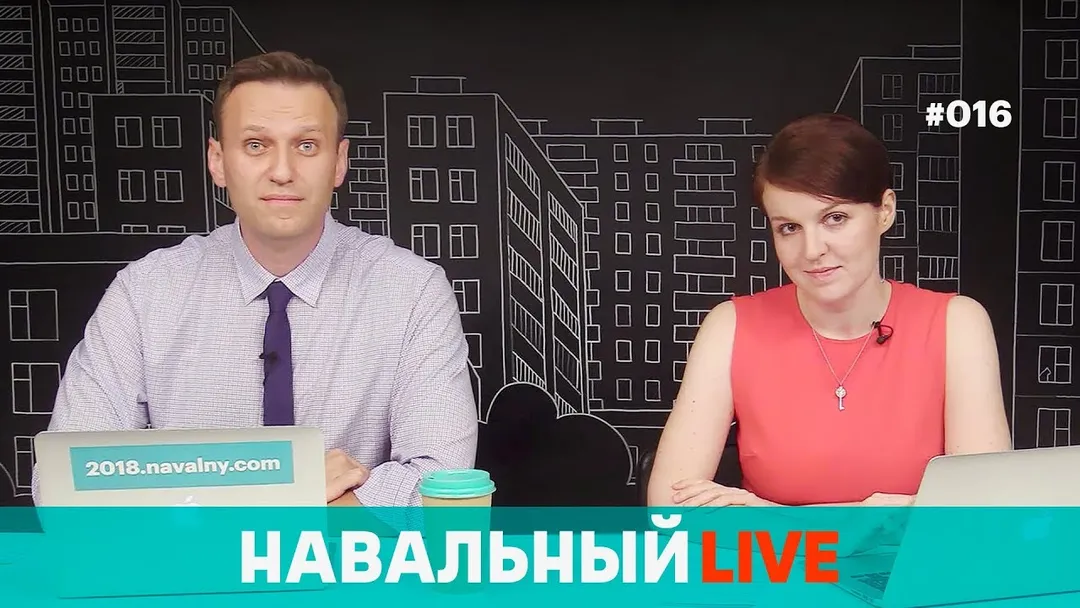
[music]
Hello, good evening. It's 8:18 p.m. in Moscow.
That means we're live in the Navalny Live studio.
Alexei Navalny is here to
discuss important issues with you,
the key issues of the past week, and Kira Yarmysh, who,
I hope, won't let Alexei dodge
answering these questions. She won't. I
hope so too. We have to begin with,
unfortunately, a disturbing and terrible,
I would say, topic: the terrorist attack that took place
just now, a few minutes ago,
probably half an hour ago in Barcelona. There are already
13 confirmed dead, I think, and 25
or 30 injured.
Our condolences to everyone. I can imagine the horror
that tens of
thousands of families across Russia are in right now, unable
to reach their relatives,
their loved ones who are in
Barcelona. It's one of the most popular
tourist destinations
not just for Russia, but for the whole world. But from Russia,
in any case, it's millions a year, hundreds of
thousands now, and tens of thousands who
are in Barcelona right now. It's
the most popular place Russian tourists go
after
Egypt was closed off and travel to Turkey dropped off.
So of course everyone went to Spain, and this is
a truly terrible situation.
And
what stands out, it seems to me,
is that
a new method has now firmly taken hold,
a new way of carrying out terrorist attacks: very cheap, very
simple, very accessible to anyone. It's
just a vehicle. Before, at least,
the security services fought
terrorist groups
by catching them when they tried to buy
components for explosives
and other similar things; dogs
would go around sniffing for explosives. But with a vehicle,
what can you do? You just go,
rent one for 100 euros, and that's it.
There was shooting not far from the site of the attack, and
hostages in a children's café. So there,
as I understand it, right now
the people who carried it out have barricaded themselves in.
What are the latest updates?
The latest update I'm seeing is this:
it was just released at 20:18.
At least 13 people have been killed, and 32 wounded.
Witnesses reported gunfire not far
from the site of the attack. The truck driver took
hostages in a Turkish café. Whether he has
accomplices is unknown. Yes, but still,
the main number of deaths, as I understand it,
were not even from the shooting — they were
specifically from the use of a vehicle,
an ordinary minivan that you can find anywhere,
and easily rent.
I was in Barcelona for the first time in my
life quite recently, when I went there for
surgery, and I remember when I came up to
that street, I actually went around it
along parallel streets, because I thought I wouldn't
go there. It really was like
a constantly overcrowded bus. In that
sense, of course, any big city
is now becoming vulnerable to these
new kinds of terrorist attacks. It's a major challenge
for the security services and for society as a whole, because
it's extremely difficult to control.
In fact, this kind of attack can
be carried out by a lone individual. He doesn't need any
complex preparations, and he can do it
under the influence of some spontaneous
factors.
We hope your relatives and loved ones are
all right, and that those of you who have
someone in Barcelona will be able
to reach them soon. Our main topic
today is, of course, our friend
Kolya. I even wrote on my cup:
Hi, Kolya.
Hi. Today we released
an investigation about
Nikolai Choles, who turned out to be the secret
eldest son of Dmitry Peskov. Yes, people are writing to us
saying they haven't watched the video about
Peskov yet, or haven't finished it. Well,
please watch it — it's 13 minutes long,
but
please do.
By the way, she's our supervisor — she oversees
the video production side, and
these videos are her constant headache.
When I don't like something, I say,
"Make this part funnier, and here
find a funny insert," and Kira goes
crazy looking for a funny clip. But
every second — truly every second —
of the video is a huge, huge stress.
So I know very well how long it is:
14:28. And you know Nikolai Choles's story well,
but now let's, over the course of
literally 1 minute and 51 seconds —
I've timed it — give a brief summary of what
we released today.
Hi, this is Navalny. Oh, what's this
beautiful car in the photos?
Let's take a closer look at the lucky guy
who owns it.
I've seen that mustache somewhere before, but our
story is still about Nikolai. He's even
more interesting than his dad. You can live perfectly well,
for your own pleasure, at the very
highest level, while doing absolutely nothing.
He uses only the best
cars. The court hearing transcript says
that in 2009, Dmitry
Peskov's offspring, together with two acquaintances, attacked
a teenager near a local McDonald's,
took his money, and beat him. And
a few months before that attack, he had been
given a 10-month suspended sentence for
another attack on a young woman from whom he
snatched a phone. He has not worked since 2015.
Nowhere. Subscribe to our channel here
they tell the truth.
A reminder: you can send us questions
on Twitter using the hashtag #Navalny2018. We
want to hold several
polls today—one on YouTube and several
on Twitter. And our first poll on
Twitter, Navalny, and his VKontakte page
Navalny Live—all the links to our social media
accounts can be found in the description of this
broadcast.
This is what they tell us after every
investigation of ours that involves
officials' children. What do they tell us? They say
some generic, hypothetical Vladimir
Solovyov says you must not investigate the children
of officials. Officials' children are not
to blame. They did not choose their fathers, and
therefore it is very unethical to attribute the sins
of their parents to them. So every time we are
accused of populism and of
targeting completely innocent people.
Indeed, this is the main line of defense,
the Kremlin's main line of defense, and of the
officialdom in general in this situation. They do not
want to discuss the substance of where this
jobless guy got a Ferrari, or why
this unemployed guy flies on a
private jet. They say, well, these are
children—how can you go after children? And
that is the question in our VKontakte and Twitter
polls. Please go there and vote. We are
asking: is it acceptable to conduct
investigations concerning the children
of officials, or are they just children who should be
left alone? And Nikolai Choles himself
did comment to us, gave us some kind of
response. He commented to RBC, and he
called our investigation a horror, a nightmare,
and a provocation.
Well, that is a fairly complete
comment—you rarely get even that much.
So, 15 minutes before the release of the
investigation, we called him. There was an
interesting reply. We did not even
post it. We said: Hello,
we are from the Anti-Corruption Foundation,
could you comment on where you got the money?
Did you really serve time in an English
prison? To which he said: Anti-Corruption Foundation?
I have nothing to do
with corruption—and hung up. And so far
there have been no other comments. As
usual, Peskov is silent. Frankly speaking,
there is not, unfortunately, a large enough press corps
that would force someone to comment
on this—Peskov, Peskov's deputies, or
officials in Russia in general. As far as
I understand it, RBC probably tried to
reach him, and were told that Peskov
is on vacation.
But in general, it is interesting how they reacted to this. Echo
of Moscow (a Russian radio station), yes, Echo of Moscow talked quite a lot
about it today.
They discussed this investigation despite
the fact that Alexei Alexeyevich is on excellent
terms with Dmitry Peskov, but nevertheless
he still somehow let all of this go on air.
Yes, I am a presidential candidate,
I suppose. Let's just conduct
a thought experiment: you have become
the president's press secretary. You
are in that position. You have children. Your children
have been caught in some awful
corruption-related scandal. They have Ferraris,
and, well, you understand where those
Ferraris came from, right? But you do not want to explain it to everyone.
So I am simply
interested: what is one supposed to say in
Peskov's place? It is hard for me to imagine what
Peskov, hypothetically, should say in
a normal country, where this behavior by him
and his son would be considered something
improper. In a normal country—speaking of
a normal country—people would resign.
But obviously he said what
they always say: I do not know, there are
more important problems. For example, the Barcelona
terror attack, and you are asking about some
nonsense. And anyway, this
what does he usually call you—an unknown
gentleman,
a nobody,
is saying some nonsense as usual,
trying to score points for his
political campaign. Therefore,
questions like these, given that at the end
I urged people to sign in support of me—
by the way, I urge you once again to sign—
those signatures are needed. Their line of
defense would probably look something like this: well,
he just wants to gain political
capital. So here we stay silent, but if
suddenly someone does show up—if by some miracle
a brave reporter appears who
corners you with a recorder—then you will
have to say that this is, well, a person
in search of cheap PR,
who has repeatedly published false
information. Who has won in court against him?
Look, Alisher Burkhanovich successfully did
that, so of course we cannot
take any of this seriously. But
of course it is sad that there is no press in this country
that would do its job after us,
because we have laid out the facts, and in
a normal situation, of course, the media should now
pounce on them in order
to perform their function, in order
to get likes and clicks, in order
to get more traffic and report
important information. But that is not happening.
The information Peskov provides
is usually just 'no,' and everyone runs headlines
like 'Peskov commented.' You open
the article, and it just says: 'No.' By the way,
Outrageous things always make the headlines.
Instead of saying, "Peskov declined"
to comment, they make it sound like Peskov
commented, or that Peskov denied it.
Here, it seems to me, it will be harder for him,
because this concerns him personally, and it is
true, of course. Please write to us in
Twitter with the hashtag #Navalny2018.
What would you say
would sound plausible? Let's put together a talking-points memo.
Well, obviously people like Vladimir
Solovyov
Well, the whole set of propagandists, they
will have to say something in defense of
Peskov. Defending him is extremely difficult,
because, well, here you have a young fool and
layabout with these Ferraris, and on his
social media he posted it all himself. This isn't some spy
investigation—he, he, he is saying: guys, I have
a Ferrari, I took a picture with it,
look. And basically, we just showed
all of it. We have an official document from
an English court. In fact, it is hard to refute
this. But we remember a completely
fantastic statement, for example,
from Vladimir Solovyov after the rallies
on the 12th, because we are all
children of corrupt officials—he said that the people who came out into the streets
were the children of corrupt officials, you see.
People are not idiots: they are against corruption, and he
looks at them and says, well, obviously, they
all had iPhones, so they are the children
of corrupt officials. So these people are
so magnificently hypocritical that
they will come up with some kind of justification
anyway. So let's help them
come up with one—write in.
Let's read this: people are writing to us that children need to be
kept under a huge magnifying glass, especially
when they later become
officials and successful businessmen. Well,
basically, that is true. This is apparently on
the question of whether children should be investigated.
Look, I am not trying to take the side of
Peskov, but my children, for example, are kept
under a huge magnifying glass, and I really do not
like it. On the one hand, I am
a political figure. I am a presidential candidate.
Well, I am not an official, but I
am claiming that I want to lead the
state, and probably all the same
rules apply to me as well.
Yes, they do apply. Again, in some
normal country, where there would be normal attention paid to you,
they would not be following your children so closely
through the streets when they are going to
school. Right, I mean, people came to my son
at kindergarten; people follow my wife and
my children around, filming them with cameras. Uh,
I really dislike that very much, and so
the question here is simply to understand where
the line lies between public
oversight and the point where you can simply
take any politician you do not
like and just terrorize them for no reason.
Do you remember, by the way, the situation with
Chirikova (Yevgenia Chirikova, a Russian environmental activist), when they sent
social services to her, which threatened to
take away her children during the whole situation with
the Khimki Forest (a major environmental protest near Moscow)? That was
one of the reasons why she left the
country and is now in political
exile. So, by the way,
on the question of whether children can be touched—well,
they go after children to the fullest extent.
Uh-huh.
In Irkutsk, at our campaign office, they beat up the son
of the man who rented us the office space,
they beat him terribly. And in that
sense, they have been targeting children for a long time. And
Please tell us,
the poll is running on Twitter—what are the
current results, can we
get them yet? There are no results yet, they say, but
go to Twitter and VKontakte and answer
the question: uh, is it acceptable to
conduct investigations concerning
the children of officials?
That is a different matter.
The FSB (Russia’s security service) following people through the streets is
still a different thing, on the question of
where the line is.
I agree, I absolutely agree, and in that
sense, probably if it turned out that my
daughter had a Ferrari and I could not
explain where the money for that
Ferrari came from, or if she posted photos of how
instead of going to school she was
flying on a private jet—well, then probably
those would be signals indicating that
such investigations—this kind of investigation—
should indeed be carried out, rather. But
we keep saying "investigation," but
strictly speaking, what is there to investigate here?
The investigative part on our side, of course,
consisted in the fact that we dealt with
the English court documents and compared many
things. But really, the main
evidence regarding Nikolai Choles (likely referring to Peskov’s elder son) is
Peskov’s elder son’s own
Instagram, essentially.
He does not hide this lifestyle; he
shows it off, throws it in our faces. So
uh, just as there were in fact the children
of Zheleznyak (Sergei Zheleznyak, a Russian politician), if you remember.
One of his daughters was precisely
the reason after which people especially
wrote a lot about how we were acting unethically
.
by drawing attention to children who were
not guilty of anything. There, indeed, the daughters
were not guilty of anything. They were simply
studying peacefully. One works at the BBC, I think,
the eldest—the eldest married a
Scotsman, and the other daughters, as far as I
know, too—at least one more is in
Europe. And Zheleznyak simply claimed 4
years ago—probably five by now—that they
They said they would come back after finishing their studies. Well, here they are.
Of course, they never came back, and that was
one of the reasons why we made
an investigation about them, and not because of their personal
qualities. Overall, no one is really to blame for anything
except Peskov himself and except
the system that
is being built—they are building this very
new feudalism, when this is no longer
an isolated phenomenon. We are simply seeing, on a massive scale,
a situation where senior officials,
while holding government posts,
primarily in various security and law-enforcement
agencies, appoint their children
not even just to some positions
where they can earn a lot of money—
they become the nominal heads of
state corporations, banks, and everything else. And
it seems to me that this theme of the new
feudalism is the main issue here. This is
the question we have on YouTube.
Take a look—right here in this player, in the
right—yes, the upper right
corner, there is a poll. There we are asking
you
what you think: has this new
aristocracy, this new feudalism, already reached
a threatening point in Russia, or
threatening proportions that
really could harm
the country's future, or has nothing
that terrible happened yet? Because, after all,
nepotism and cronyism do exist
in other countries too.
Bill Clinton and Hillary Clinton—we know
people like that. We know George Bush Sr.,
George Bush Jr.—we know people like that,
we know people like that. And now,
who is the Prime Minister of Canada? Justin Tru-
deau. And whose son is he? The son of that guy—I can't remember
his name—who was also
Prime Minister of Canada, a famous
Prime Minister, Trudeau. In that sense,
one of
the explanations that the Kremlin
constantly gives us when asked, well,
why have they appointed their own children everywhere, is:
they say, this happens everywhere, in fact, even in
developed democratic countries. Children
very often follow in their parents' footsteps,
become politicians, and obviously
their famous last names help them.
What would you say to that, Kira? You don't
agree with that, because it seems to me
—it seems to me, of course, that this is far from
the main thing. In fact, it was probably negligible in terms of
importance among the reasons why Clinton did not
win that election in the U.S., because
she was Clinton's wife. It seems to me
that people were simply tired of that. They
deliberately chose someone completely
the opposite, someone who was not part of
the Clinton world. That's a different situation, but all the others—
George Jr., George Sr., Trudeau, and
so on and so forth—the children do not
simply vanish into thin air; they exist. But
obviously, we all understand that in the West
they hold their positions thanks to their
personal qualities, whereas in Russia a person
holds a position not thanks to
personal qualities, but because
their father put them there. What's more, I really
think this has already become some kind of general
Russian system. It even pushes people,
children who do not even want to be part of it,
into it, forcing them in. That is, it seems to me
that Peskov's daughter would be much
happier living her life in France. Before that, she
had always, as far as I remember, only expressed
that desire. And now she has to
poor thing, deal with either
shipbuilding or
legal proceedings—without understanding anything about it.
And for you personally, does this
system of feudalism get in the way?
Well, of course. Show the secret
photo—Kira didn't know I was going to show
this photo.
A secret photo. And this secret
photo—she really didn't know. You
can see little Kira Yarmysh in it,
taking part in the TV program *Umniki i Umnitsy* (*Smarties and Clever Girls*, a Russian academic quiz show),
a secret from Kira's biography. She
came from Rostov-on-Don
to get a chance to enter
MGIMO. As you know, it is an extremely
prestigious university, and ordinary people rarely get
in. Tell us, you had to
win this program, right? You actually took first place?
Well, no, it wasn't
first place—there were eight winners there.
I was one of the eight. Right.
You studied well,
prepared for *Umniki i Umnitsy*,
probably learned whole
fields of knowledge?
Specialized in something? Well, it's complicated there,
you can't really specialize in anything there.
They give you several topics, usually one month for
one topic, and the topics can be absolutely anything.
For example, in my final the topic was
great politicians, scientists, or figures of
the arts, without any
territorial or time limits, so
it covered everyone. So tell me, as
someone from the regions
who studied and worked in order to come
to Moscow and make something of yourself—how exactly does
this system get in your way? You ended up at the
Anti-Corruption Foundation—well, not graduated from it, but
joined the anti-corruption organization
where, of course, a very cheerful kind of work awaits you.
But you were interrogated, weren't you?
There was one here at the Foundation, and as I said, I was here,
yes, and then there was an interrogation. I wanted to get into—
When you were on *Umniki i Umnitsy*, where did you want
to get into? Well, at that point in my life I generally
dreamed of...
to work at the Foreign Ministry, but I’m very glad. Do you
have the feeling that in the Foreign Ministry there is
this kind of nepotistic system that
makes it hard to break through?
At MGIMO (Moscow State Institute of International Relations), probably half
of the students are children of diplomats
who studied at MGIMO themselves and then
got their children in there. No, not exactly that
they “got them in” — I can’t say that. I’ve never
noticed any terrible corruption or
bribery there. Well, maybe I just didn’t
notice it. But as for *Umniki i Umnitsy* (a Russian academic quiz show for students),
that was a completely fair program. There
you really can’t find fault with anything there,
everything was above board. No, I didn’t bribe anyone, and no one
bribed anyone on my behalf. It seems to me completely
impossible to do that. Well, and that’s exactly
why I emphasized in my video
this very problem: it’s not just
some guy with a Ferrari
who upsets us because we don’t have a Ferrari.
These guys with Ferraris simply
bring social mobility to a halt. They don’t
give anyone a chance to get anywhere.
Because they get in, they
take all the best positions, even if they are, say,
people without even a secondary-school
education, or even people who have served time in
prison, with dubious biographies — and they still
have a 100% chance of landing
somewhere, while everyone else’s chances shrink.
That is extremely demotivating for people. So,
people are writing to us there [__] about this topic — not
exactly about this topic, but the only
question is: are we judging the Peskov film — isn’t it
too small-scale after “He Is Not Dimon to You” (Navalny’s anti-corruption film about Dmitry Medvedev)?
Well, by that logic, I should release
an investigation — we should release
an investigation about Dimon (Dmitry Medvedev), then an investigation
about Putin, then an investigation about the UN Secretary-General
Ban Ki-moon, or whoever it is now, and then about the Pope,
and then stop working. We are the Anti-Corruption Foundation,
we look for manifestations
of corruption, we challenge them, and we do
just day-to-day work. And in that sense,
releasing films is not — I mean, we’re not
a TV channel, and I’m not a director who
is constantly trying to outdo some
previous achievement: we won one set of awards, now
we need new awards; you got, uh,
something at Cannes, and next you
need to win an Oscar. This is our job, and the people
who fund the Anti-Corruption Foundation
send us money so that
we can do our daily work.
Big officials, small officials —
the largest share of our
investigations concerns
regional public procurement, where
billions are stolen — more has been stolen there than
Nikolai has, so whether it’s small-scale or not,
I don’t think in those terms. Any
corruption is terrible, and Peskov’s son —
the son of one of Putin’s closest associates — is no less
terrible, considering that we understand perfectly well
that Putin, the security services, whoever you like,
all know very well what is going on there.
Next, some thoughts for us about the fact that
we have two polls.
On Twitter, on the first question, people tell us
that “the apple doesn’t fall far from the tree,” uh,
93%, while the view that “they’re children, so you shouldn’t go after
them” got
7%. And on VKontakte, it’s even higher —
96% say that investigating officials’ children is acceptable, and
3% say it isn’t — three and a half. And on YouTube, there’s a poll
about the new feudalism:
has it become a threat to Russia? Those who think so are
96%. But the poll is still ongoing. Still,
if someone thinks otherwise, if someone doesn’t
agree with this, please write to us
with your opinion — we’ll read them out and respond to them.
This new feudalism is
really a very big problem. I
don’t say this often, but I actually
am genuinely convinced — this is not some
conspiracy theory of mine — that Putin is effectively
building a monarchy. It’s no coincidence that lately
quite a few politicians have
said that they want a return of
the monarchy. In reality, he and his group,
understanding that they are, broadly speaking, people who
in the fairly near future
will have to leave power, well, for
biological reasons, are preparing their
children. These are not just my speculations,
it’s not something I’m saying
just to make more people angry. We
see it in practice — that’s what is happening. They
want to hand the country over to their children in order
to guarantee themselves
security and a very wealthy, very
comfortable old age.
And on the subject of this being far from
an isolated case, we even have
a little quiz. You see how we decided
to entertain you — even quizzes. We’re now going to
show you some people, and you’ll
try to guess. And write in
the comments on YouTube, on Twitter, and so
on, who they are. So, show us contestant
number one.
Please tell us, do you recognize this
young man? Who is he? He is
an important person for the country, and we’re
interested to see whether you recognize whose child he is.
This is terrible. You work as the press secretary
of the Anti-Corruption Foundation — you should know these
people, recognize them anywhere, in a dimly lit
subway car, anywhere at all —
pull out your phone and start filming
them. Well then, let’s see how well
the viewers of our program can recognize
this person. A hint: he is a major
state banker. What are people writing to us there? What
questions have come in so far? You can’t judge a person by
their происхождение — you just need to
Put him on trial — that's the radical view.
If you stole, go to prison. What difference does it make
who your father is? That's absolutely true. I, without
any irony, believe that's how it should be. Besides,
of course, if the children of some
Zheleznyak are minors, then they are not
to blame for anything. It's just that their father is
a hypocrite and a crook. But if it's an adult
young man who consciously
acts as one link in this whole chain, then he
of course must bear responsibility
together with his entire family, naturally.
Naturally, the main villain here is Peskov,
or rather, the biggest villain is Putin,
who knows all about this perfectly well.
The other villains are our
law enforcement agencies, including that very
FSB (Russia’s Federal Security Service), which is supposed to monitor
things like this and knows perfectly well what
is going on there with this family, is aware of all
these yacht trips, but does not
do anything and instead covers up corruption, and
Peskov. The people who give him bribes
are villains too. All of them should be sitting on the
defendants’ bench. But Kolya too — he is
part of this system.
Exactly right. As for the FSB, how
can Russia’s FSB fight
this nepotism and feudalism if
Mr. Bortnikov’s son is now sitting, uh, on
a bank’s supervisory board, and now also on
the management board of VTB, a state-owned bank,
which, by the way, is a troubled bank that
is constantly costing the budget more, with the state pouring
budget money into it. And this
wonderful representative of the tribe,
the dear son, sits in this state bank and receives
an enormous salary, thereby effectively legalizing
his father’s essentially illegal income. So that money can come into the family,
he doesn't have to receive it only by
taking suitcases of cash from people;
the son can simply bring home
an enormous salary, which at VTB is also
measured in suitcases. Exactly.
Not the Bortnikovs. Show us the next one,
please — the next character.
Write to us, please. You were guessing for a long time,
— two minutes — though that’s probably because
there’s a slight delay on YouTube.
I think he’s easy to recognize. But did you
recognize him? He does look like him. All right, let’s
see whether our viewers can figure out
who this is. And while they haven’t guessed yet, let’s
answer a question someone is writing:
Why did Peskov decide to talk to you?
How did you manage it? He didn’t
decide to talk to us.
When you call them, they always — well,
first of all, you either get the assistants,
or they simply, automatically,
tell you right away that they won’t talk to you:
call the assistants. Or in general, I mean,
they just hang up. So it’s very
hard to get them to talk to us. Ah —
you mean in the video, where we have
that clip where he answered us that he doesn’t
work there? That’s a trade secret — we won’t
say exactly what we did. But when we
uh, already after that, on the eve of the
release, just a few minutes before the investigation came out,
we simply asked him point-blank there and then:
man, what’s going on? He
refused to talk to us. And
it is extremely, extremely difficult to get people
like that to answer. And when I very often
see complaints from journalists — why didn’t you
get a comment from that side?
They don’t give comments. How can I tell journalists
— why don’t you get a comment from them?
Because they don’t give one. When was the last time you
saw a United Russia party member
on some uncensored channel, or at least
one that isn’t fully censored — on Echo, on
Dozhd (TV Rain),
giving an interview to Meduza or
RBC or anyone else? They do not want to give
any comments. It’s the best and most
successful strategy: just stay silent.
So, we’ve already got the answer. In fact,
a lot of people guessed it, but the first was
someone with the username “not a writer,” who said it was Tsyfry. Although
there were other guesses — something about drilling,
a black car, a flashing beacon, everything as
it should be. And I think we’ll see an active
continuation of this wonderful man’s career.
Show the next picture,
please.
I think this one can also be recognized. Do you recognize him?
No? Then here’s the next person.
I’ll give you a hint: he is also
a banker and an energy executive. Meanwhile, we’re being asked:
“Alexei, I have a question for you:
if you become president, won’t you keep the country hooked on
the oil needle, and won’t your children become
a golden burden on the Russian budget?”
The whole country has been put on it, and we need to take
our country off the oil needle. And by the way,
maybe it will be easier for you to
guess this person. His father, in fact,
over the last few years, gave
several very funny interviews — that is, after some 15, uh, years
of Putin being in power, he gave several very
funny interviews saying that it was time
to take Russia off the oil needle. That is,
they’ve been sitting there for 15 years, for 15 years
getting the country even more hooked on oil, and now
suddenly they’ve started thinking about it. And I
already have the correct answer — yes, please tell us.
It’s Ivanov. Exactly right. It’s Sergei
Ivanov Jr. He worked at Gazprom,
then at Gazprombank, and now, uh, at
in 2011 he was chairman of the management board
of SOGAZ, and now he is a senior vice president
at Sberbank. By the way, I remember that even
I — I am a member of the minority
shareholders’ committee of Sberbank,
and I wrote angry letters there: why did you
hire, uh...
the younger Ivanov, because, well, it’s obvious
quite clearly that
this is not
an appointment
based on the principles of meritocracy, that is,
that we hired a good employee on a permanent basis
as Gref says, but simply
giving a cushy job to someone’s son so that
the Ivanov family gets more money through
the state-owned Sberbank. So,
why I won’t impose this nepotism
is very simple: not because I myself
don’t want it. I mean, of course, because I myself
don’t want it. But even if I did want to,
the changes I am proposing in
the political system, the reforms that
we will carry out, simply won’t allow me
to do that, because we will free the media
and there will be no state media, at least not
certainly not in such numbers, and
parliament will have more powers
parliament will be able to conduct investigations, including
into the president; there will be
independent prosecutors, independent
investigative bodies, and an independent judiciary
If it so happens that I become
a bad president and suddenly decide
to appoint, I don’t know, my
nephew, uh, to head Gazprom,
the press and parliament will come after me
with investigations against me. I’ll
simply get impeached. That’s exactly how
it should work. We should not
believe in any particular person; we should
build a new system. Let’s
show the last one, and then we probably
actually have a lot of these
sons of the elite. But that would probably require a 24-hour
broadcast. Who is this young man here?
Do you know him? Aha, by the way, this is
his father currently has very major
political influence. Not many people know this young
man by sight
but keep an eye on him. He, he will be
very, very important
Great suggestion: make a map of all
the sons of the elite and who holds what post. It would be
a massive spectacle, a vivid illustration of the scale
of the disaster. There would be quite a bombshell effect
Media outlets have done similar kinds of
maps, investigations; there was an article in Meduza (an independent Russian media outlet)
and even a game: recognize the person or figure out
where he works. That’s all true, but they just
keep multiplying and multiplying
We’ll do it; we’ve wanted for a long time to make something like
that. It’s just that, you see, every time
when we
publish something that contains a large
amount of already known information,
people start shouting: well, what kind of
investigation is this? Everyone already knew all this. But you’re
absolutely right: here we simply need
to systematize all of it and make it accessible to
the general public. Speaking of the general
public, please help
us spread that very
investigation—and this
broadcast as well. Please like it
The correct answer is
someone wrote to us that it was
apparently that’s what they thought. There were also
guesses that it was Harry Potter
Khovansky (a Russian blogger) has a completely different hairstyle, and not
always a glass behind his back or something, I don’t know
whether he looks like Harry Potter, but I know one thing:
that Vladimir Kiriyenko, the younger son of the very
same Kiriyenko who was once
prime minister and is now
deputy
deputy head of the Presidential Administration
for domestic
policy—the very person who
is responsible for media lies,
falsifications, uh, rigging, and the appointment of
governors. In other words, basically for the entire
repressive machine, including the fight
against our election campaign
As soon as he was appointed, his son
immediately became
senior vice president of the company
Rostelecom, also a company under
state control, and also this
this, uh—well, you can’t really call him a
boy, but a young man at least
handsome, yes, maybe. Yes, they all are
good-looking, seemingly normal guys, but I
am not going, through the state-owned
Sberbank, through the state-owned
Rostelecom, or through the state-owned VTB
to keep paying this bunch of crooks over time
huge salaries. That’s what they are appointed for
because the point is so that the
Kiriyenko family ends up with
several million dollars more
They simply appoint his son to this
position, where he then legally
receives enormous sums of money. And so when
we once again ask where
this lifestyle comes from—where do
all these cars and everything else come from? Not a single
minister, even in a developed country, could afford
that. They say: well, excuse me,
his eldest son works as
a vice president at Rostelecom, uh, he has
large legal income. That’s how it works
That’s how it was with Shuvalov, remember?
He took bribes from Abramovich and from
Usmanov, and then he goes around saying, well,
how can that be, I have legal income. He
legalized that bribe and put it on paper
and now they say: yes, yes, I can buy
a private jet, I can use it to fly
my dogs around on that private jet because
after all, I have legal income—look
at the payment slip. But what do we care about your legal income?
We understand that it is corrupt income
So in the case of Kiriyenko, Patrushev,
Bortnikov, Fradkov, we understand that this is
in effect
it is still corrupt income anyway. And what are we supposed to do?
We’ve received a critical comment here.
Many people go to work with their parents; this is
a common practice, they tell us.
That’s all fine, go ahead, by all means, you can go
work with your parents, but
when your parents work in
public office, there are certain rules.
In Soviet times, there was even a direct
ban on
close relatives working as one another’s
bosses and subordinates.
Probably, in our situation, in our country,
that is the right approach. And then, excuse me, what
we showed you was not about people who simply went
to work. Did Nikolai Chudes go
to work for his parents? Nikolai Chelsea did not
go to work just anywhere — he went to work
for a man who owns a Ferrari,
who flies by private jet.
Did young Bortnikov go to work for his dad at the FSB?
No, he went to work at a state bank, uh,
Kiriyenko, Fradkov — they all went to work
at state banks.
Some kind of Gazprombank — Gazprombank, too,
is effectively a bank under
state control. Insurance companies,
state corporations — as many as you like.
The Patrushevs, both Rogozins, Chaika, Zolotov —
the former governor of St. Petersburg,
good Lord, Matviyenko — there are so many of them
you could list them endlessly. They did not go to work
with their parents in government service; they went
to work where the money is — big money.
To get set up this way is
always feudalism: the fathers and mothers
control the political institutions of power,
while the children sit on the estates, and the whole country
thus ends up under their control — and
both money and power are in their hands, and no one dares make a move. And
here are the poll results. Let’s look at
Twitter, or, uh,
for some reason, on Twitter
there turned out to be more supporters now of the view
that children should not be investigated — 8 percent said
that, while 92 percent said they can be. And now,
on VKontakte, on the contrary, people are more radical there.
They think children can be investigated:
97 percent, and accordingly 3 percent think
they cannot. And on YouTube, apparently feudalism
has become no threat to anyone — everything is still the same, yes,
96 percent to 4 percent. Well, that means at least
we did not offend any of our regular
viewers with our new investigation, and we
will continue doing this because
we believe exposing this system
is very important. Dear officials, if you do not want
the FBK (Anti-Corruption Foundation) poking around in your children’s social media,
then let them live in accordance
with your legal income, and we will not
pay any attention. But not noticing
a Ferrari behind them was simply
impossible. We would not have
— professional organizations did that.
All right, and now
from feudal lords, their children, and the builders of this new
system, let’s move on to the next
topic: a man whom the system
has cast out.
To another collector who was less
fortunate, it seems.
This week, our system has given us two corrupt officials.
This week began
— rather, the trial began, the trial of
Alexei Ulyukayev. To the surprise of many people,
this trial was open, and
completely
astonishing testimony emerged on the first
day of the substantive hearing. We have
a short audio clip with a transcript.
It is very important to listen to. Many thanks
to the publication Mediazona,
which provided us with this video. But before
we start listening, we have a new poll
on Twitter and VKontakte. Just tell
us, please, given that, well,
Ulyukayev seems to be fighting Sechin and
blaming Sechin, yes, for his, uh,
misfortunes, and Sechin seems even worse,
in this situation, do you feel sorry for Ulyukayev
or not? A simple poll on Twitter and VKontakte.
Go there — all the social media links are in
the description for this video. And now let’s
listen to a 1-minute-20-second audio recording of Alexei
Ulyukayev, his statement in
the Zamoskvoretsky Court
in 2016.
2 million US dollars as
a token of gratitude for issuing a favorable
opinion on carrying out the transaction for
the acquisition of a stake in Bashneft had already
been presented; in case of refusal, he would obstruct
the lawful activity by submitting
negative opinions.
Personally, this turned into an excellent result of
our operational-search
measures: a bribe was taken on an especially large
scale, in the amount of 2 million US dollars, in
relation to the Federal Security Service (FSB).
This is an outright provocation on your part.
It is based on knowingly false
grounds.
The chief executive director, Sechin’s
head of security,
and others connected with Sechin in this matter
have stated that the transfer to me was planned in advance
by FSB officers who, over the course of
several weeks, relying on
false testimony, waited for my unlawful
demand for a bribe to be made. Naturally, they did not
get it, because nothing of the sort happened. In the end,
realizing this, he personally
called me himself and, under the pretext of
discussing important current issues
of the company’s operations and a desire to show me
the company,
persuaded me to come to the company.
Rosneft completely ignored the accusation
these circumstances were completely ignored
the transfer of the bag allegedly handed over by Sechin
which, taken together, leaves no
doubt regarding the commission of
a provocation
So, we’re asking everyone: do you feel sorry for him or not?
Sorry for Ulyukayev? And today I saw a news report
saying that VTsIOM (Russia’s state-run public opinion center) conducted a poll, and almost
half of Russians believe that the trial
of Ulyukayev is a show trial
while at the same time almost everyone is convinced that he
is guilty, but nevertheless believes that this is
a demonstrative action rather than a sign of a real
fight by the authorities against corruption. So this
is seen as a real anti-corruption effort by
35%, and I also think that Ulyukayev is guilty
I’ve spoken on this topic before; we recorded a video
about it, but it seems to me that he is being tried
not for what he is actually guilty of, and, uh,
I don’t have any sympathy for him — Ulyukayev doesn’t
make me feel sorry, first of all because I even wrote a blog post
on this subject. I suggest simply
a universal formula for discussions like this
about whether Ulyukayev deserves pity
or not, whether Chubais and other so-called "white" figures deserve pity
or any of the others, as opposed to everyone else
the liberals, who of course, it seems to me,
will all eventually be jailed sooner or later. Well,
the so-called systemic liberals
— the formula should be as follows:
it should be this
you should feel sorry for all of them
exactly to the extent that they felt sorry
for Eldar Dadin (Ildar Dadin, Russian opposition activist), who
at the times when he was being tortured in
the penal colony, beaten, had his head shoved into a toilet
and was threatened with rape. So tell me,
did Ulyukayev write any posts about it? At least
not even resign — just
write something somewhere, say somewhere
that this was wrong — which of them
said even a single word? So why
should we pity them now? Aren’t they the creators of this
system? They are part of this system, they are
responsible for the fact that the system is what it is.
It’s just that when it was devouring other people, they
were perfectly fine with it, and now they think that
because they themselves have suffered, everyone must now feel sorry for them
So, do you agree? Here’s what Yevgeny writes:
Danilchenko says: “No pity. Both are crooks.” Meaning
Sechin and Ulyukayev. And we’re also being told that
Ulyukayev is simply a scapegoat. Well,
that’s basically what we’re talking about. Probably
he is a scapegoat. But I remember how
I, as a minority shareholder in VTB Bank
— a terrible, disgusting bank, the first bank
that I investigated
and published many documents about corruption in —
I attended shareholders’ meetings, and
Ulyukayev was the chairman
of the supervisory board and very often chaired
those shareholders’ meetings, silencing people
like me and not allowing us to say a single word
while doing everything possible to shield the management
In other words, he was covering up corruption, he
was part of it. His declared income
was 59 million rubles (about $900,000 at the time) — 59 million rubles
in 2015, and by then that was already
less than a million dollars, and his wife had 15
million dollars. Where did they earn
that million dollars? How did they earn
that million dollars? We don’t understand. And yet
he is a government official; he was never involved in
commercial activity, and nevertheless
he had enormous income. I have no doubt
that he was involved in corruption, but now
he is being jailed, uh, because of his conflict with Sechin, and in
what was just said now
what struck me most was this
of all
— simply the way they talk to each other.
I mean, right there in court, in front of journalists,
a story is being told about how
there was a summit in Goa at night, and at that
summit Sechin approached Ulyukayev and said
“Come on, Lyosha (diminutive of Alexei), help move this along,” and Alexei
replied, “All right, I’ll move it along,”
“just make it 2 million — dollars or euros, whatever,”
“give me a suitcase full of cash.” And the other one said
as if jokingly, “Fine, I’ll give it to you,”
and that was that — they just went their separate ways.
One thinks he tricked the other, while the other
uh, thinks he persuaded him. Then
Sechin called him and said,
“Come and pick up what’s due to you.”
It is completely unclear how the money was ultimately
transferred, because first of all there is no, uh,
video of the arrest proving that this is true, and
second, at first the press release said that
he received 2 million dollars, and then
that he was searched personally, and then
it turned out that the money had allegedly been placed in some kind of bank
safe-deposit box, and it is unknown
— and Ulyukayev never came to collect it. So then
later there was a version that
that
let me put it this way: they established the existence of
the minister’s claim to this
money
— which is completely unclear. But that’s not the point.
The point is that in principle they could talk about it so
easily — they talked about it
openly, and that is absolutely astonishing.
It means one main thing: that inside
the Russian government, at the level of the very
highest-ranking people — Putin’s closest friend
and ally, and a minister — between them
they really do make arrangements like, “Come on,
we’ll push this through, and we’ll give you a suitcase
full of money.” Maybe, as one version had it,
Ulyukayev wasn’t asking for it for himself
but to reward his staff, and
we know that high-ranking
officials are paid extra in cash, in
envelopes. Right. And it’s clear where that cash
comes from. But in exactly the same way it is brought from
certain state-owned companies in suitcases
So, in other words, talking about suitcases gets personal.
In this system, that is something quite ordinary.
Otherwise, neither Ulyukayev nor the
state prosecution would be talking about it.
I mean, Ulyukayev is not testifying that
Sechin brought this up with me, and I
clutched my chest and ran off to complain
to Putin. And that I had a heart attack, that I was
in shock. You know, like when someone starts shouting,
"Help! Thugs are taking my eyesight away! They're offering me a bribe!"
No, this is completely
normal. Fine, okay, and everyone just
kept quiet, nodded along, like, "Uh-huh, what are you
talking about?" In this system, there are no
innocent people. They are all involved. And when
we say that within the highest
echelons of power there are no corrupt
people, that is simply not true. They are all
tainted. Every one of them is compromised; really, they are all
corrupt, practically speaking.
A corrupt official who takes actual
bribes brings us to the next question.
Kira asked: if all of his crimes were uncovered,
the scale would be colossal — they would have to jail families too, and
there would be unfair trials. That is
inevitable. Is he not afraid that in 50
years he will be called a second Stalin? I am not afraid,
because there is no need to hold unfair
trials. We need jury trials.
A normal, proper jury trial in
which we understand that we can
lose. Whoever it is — I do not know whom I
like or dislike, I love no one in this government.
I do not know — maybe Peskov will end up in the dock.
I know absolutely everything about him.
We know about the yachts and the watches, all of it,
and so on, but I will not have — and should not have —
any mechanism for putting pressure on the court.
And it will be a jury trial. If
the Investigative Committee, the prosecutor's office, or
whoever else did a poor job and failed to
convince the jury, and they acquit Peskov — well,
of course I will be furious, but there will be
nothing I can do. We do not need show
trials. If Ulyukayev is your corrupt official,
then jail him for real corruption.
Do not invent this circus about whether there was
a suitcase full of money or there was not.
They said there was a suitcase with money, that
he was caught red-handed — well then give us
the surveillance footage. Show it to us.
But none of that really exists. It very much
looks as though Sechin set him up.
And that is how it worked. In other words, this is
deception and yet another insult to
justice. Many people really
do feel sorry for Ulyukayev, but the way he is being
jailed is not for what he is actually guilty of. And
that is still disgusting. So no,
you just should not do it that way, that is all. We
will try everyone honestly. And we have
the poll results: do you feel sorry for
Ulyukayev? On Twitter: yes, 14%; no, 86%.
On VKontakte, 86% said yes — though how many of them
support Putin?
I feel sorry for everyone who supports Putin.
Anyway, on VKontakte, yes, almost 20%, and 80%
said no, they do not feel sorry for him. You see, it seems to me
that these are the main reasons,
because everyone understands very well that
it is all pretty obvious.
He was part of this system. He was probably
an unpleasant person. He is guilty of many things,
but they are jailing him simply through
lawless abuse. I mean, I can simply see that
— and again, sorry, I keep talking
about the European Court — but later it will
go and overturn this sentence because
the charges as they were originally announced in
the press and then put down on paper do not
actually correspond to what they
read out in court.
Ulyukayev's lawyers were even outraged
that the written indictment
they had been shown did not
match what was read out in
court. They have already changed many things
because they have no evidence, and
that is probably why, well, there
one in five on VKontakte feels sorry for him.
All right, let us move on. Let us hand it over. I
am sorry, of course — you are probably tired of
discussing this all week, but we
cannot avoid the topic, especially since
Kira has been driving me crazy lately.
I mean, now she has
watched all the rap battles.
Not all of them, but soon she will start speaking in rhyme and
gets very upset with anyone
who looks down on these battles or
says something
wrong about them. You have probably watched
or heard about the battle on Versus in which
the participants were
Oxxxymiron and
Slava KPSS, also known as Gnoyny, and we want
to discuss it. Well, we probably will not
debate which punchline was the best or
the worst. We were asked to ask who won.
Will I say? What am I, stupid? Why would I
say that, so that either Oxxxymiron's fans
hate me or Slava's fans
do? No, I will say this instead:
as they say, it was not friendship that won, but
participation is what matters — all the viewers won,
everyone who watched. That is the most disgusting answer.
Good Lord, I am running in an election. Why would I now
blurt something out and create a whole bunch of
people who would
curse me for that answer? But in fact,
the best punchline is obvious anyway. Let us
play it.
Let us play that part of Slava KPSS's performance where
he said something that I personally liked very much.
It is at 41 seconds.
"He's Not Dimon to You" (a reference to Navalny's anti-corruption film about Dmitry Medvedev) was bolder in that respect
than your [__] album. I'm not a politician, I'm
an artist. I don't file complaints — I write tracks."
But like a politician, you're a populist. Otherwise, why
did you latch onto the topic, acting like you cared so much about Russia?
So much that you were losing your nerve cells from stress, but when
protests were happening here, where were you? Sitting in England.
And so much so that if you compare Egyptian
myths with *Bandit Petersburg* (a famous Russian crime TV series), you'll see
the path of a single hero beneath the guises of these two
the hero's journey
monsters: smashing things up, taking treasures, building
a shrine. He's a hero not because he's a jock and
a fighter, but because he simply can't do otherwise.
Cool, awesome, amazing.
But we want to discuss something because
we found it funny how suddenly
the entire Moscow intelligentsia—that is,
roughly speaking, all of Facebook—discovered
this and said, "My God, it turns out that
there are these amazing Versus battles and
these amazing people whom
tens of millions of people watch. Where have we been
all this time?" And we saw a mass fascination
and some completely, well, kind of
superlative comments
about all these battles.
[music]
Right. The fact that basically the entire press
started writing that
3 million people watched it overnight, and everyone
really did—RBC and *Vedomosti* (major Russian business media), everyone
wrote about it. I mean, obviously, this had never
ever happened before. The only question is:
where were all these people? Had they been living on the Moon
or something before?
There had already been battles like this before, with
huge numbers of viewers.
In 2015, for example—well, take the well-known 39 million views
for Oxxxymiron vs. Johnyboy. I mean,
39 million people—do you realize what
that means? Maybe the latest battle will beat
that record in a couple of years, but 39 million
people—that's not just a lot, that's basically the entire
young population of the country, practically all of it. And by
"young people," let's say we mean those up to
about age 35 watched it. Well, yes—although
all right, with Oxxxymiron you can still write it off as
him being popular. But, man, take, say,
Khovansky vs. Larin—16... in 2016
it got almost 33 million. I mean, or someone else—
you saw it too—Larin and
Dzhakharov also got 22 million, though that was in 2017.
What I mean is, clearly
this didn't start yesterday, uh, and the work has been drawing
such a huge audience. Absolutely.
Exactly. This is a phenomenon that involves
involves
thousands of people directly as participants,
and millions watch them. And what turned out to be interesting
is that there are two
completely parallel realities.
There's this world
of the media establishment, so to speak—
Facebook, newspapers, journalists—whose
audience is actually fairly small—
and then there's a gigantic world, a giant
planet with tens of millions of viewers:
YouTube, and these battle videos in particular. And they
didn't notice each other at all. It's
really interesting, and it reminded me of the situation
with our first rally on March 26, after which
—good Lord—how many times I was asked
the question: "Was it a surprise to you that
young people suddenly came out to protest?"
No, of course it wasn't. How could it possibly have been
a surprise to us when we'd seen those
VK groups, we'd seen those
followers on Facebook, we'd seen the organization itself—
people, even in small
towns, making all this happen. We
understood it. Well, maybe the scale was
a little bigger than we expected, but overall
it was roughly what we wanted and had been working
toward. And it's actually frustrating
that our whole media elite somehow
just
—not exactly "missed" it, because that's impossible—
but they simply don't see
the giant elephant that's right there in their
room.
They're too absorbed in these constant
micro-conflicts inside their little
cosmos. We have a poll, please—on Twitter. We want
to run a poll, please, on Twitter.
And on VK too: did you know about these rap battles
before the latest battle came out
between Gnoyny
and Oxxxymiron?
By the way, as for Oxxxymiron, I
sort of got acquainted with him—I don't know him personally,
I've never met him—but I too was once
part of that same
Moscow intelligentsia that simply
didn't see the elephant in the room. But that was back in
2013. We've now dug up my
tweets. I apologize—there's one that's not very
clean, from when I was looking for Oxxxymiron
in 2013. Please show it. I, uh,
asked who the most popular
rapper was at the time, and they told me there was this guy
Oxxxymiron—and Oxxxymiron replied to me right away.
Show his reply. Ah yes, that's what
happened. But at least from
that moment on, I knew there was such a
huge phenomenon.
I didn't learn about them yesterday. I found out about them
later than I should have, but
still, not yesterday.
I had no doubt.
Here's an interesting thing: many people wrote—and this,
by the way, also shows how little
people understand what's going on there—they
already dashed off columns and posts, but
they still don't want to understand what's happening.
They say one of the reasons for this super-
popularity of battle rap is that censorship—
that it's a censorship-free zone. I,
on the contrary, think
it's more like—well, everyone says that in
society there is a demand for frank, open conversation.
They have a frank conversation, well,
it just happens on a very small scale; they
aren't shy about saying things to each other's faces
everything they think, but on any larger
scale they clearly... well, okay, and
there's censorship when they bleep out
certain things, like remarks about Patriarch
Kirill (head of the Russian Orthodox Church) or about Chechens, but also the very
procedure itself shows it, of course, when they
don't speak openly and directly about certain things
which, exactly, seem to many people
to rap newcomers—people new to rap—they
look at all this and it seems to them that this is
absolute liberation. I mean, people
are yelling at each other, right there
face-to-face at that distance, and so it
seems like the freest thing imaginable. Not at all.
No—we have a short little 15-second clip
about how censorship works at
these battles.
I don't believe in you like... Jubilee, this is
not a position, it's voluntary castration.
Your so-called friends don't exist, they don't
exist, just like a nation doesn't—don't make
that face as if it's so awful; even the
Patriarch was once sperm too.
So, that bleeping wasn't done by us;
that's the original recording of the battle, meaning
they were the ones who censored it. The person
was speaking, well, because he wasn't saying
anything outrageous—he was criticizing Patriarch
Kirill. He said something there about
Chechens, and by the way, he was forced
to apologize afterward—well, in the tradition of
Ramzan Kadyrov (head of Chechnya), and he did it, but
Slava KPSS himself clearly did not want this
censored; the battle organizers censored it
and it's fairly obvious that
there is a great deal of self-censorship there.
As for politics in general, rap is in itself
a culture of political protest,
of social protest, but you won't see
any protest there, and basically this
this little fragment about ganglia—
England?—and the mention of "He Is Not Dimon to You" (an anti-corruption film about Dmitry Medvedev), well,
okay, Gordon is an excellent example in
this sense.
People say it's an excellent album, and certainly there are
a huge number of—not even just
references—it's an album about social
problems and injustice, but everything there is so
metaphorical, so metaphorical. No, I'm not
criticizing it. Listen, a person creates as
best they can create; I can't say,
"Oxxxymiron, please go ahead and put your
rhymes about Peskov in there, come on, compete with something..."
You watch the battle—what can that even
be compared with? And something else—well, naturally, this is
a creative process. But overall, unquestionably,
it seems to me it's impossible not to notice
the obvious self-censorship and the avoidance of, uh,
political topics, even though of course rap
should be talking about that. I mean, roughly
speaking,
modern rap, despite the fact that I
wrote a post saying it's a wonderful phenomenon and
it's great that so many people are
watching it, because it's a competition between two
poets competing in the Russian
language. That's cool. Yes, there's profanity, but
all the same, it's a competition of poets; it's not
a fight, it's not, I don't know, who can eat
more hamburgers faster—it's a competition
of poets. But still, modern rap
is not DDT in 1985 (a Soviet/Russian rock band), it's not
Kino in 1986 (a Soviet rock band). They are clearly avoiding
political topics. What are we hearing there from
our audience? Do we have the results from
VK? "I've been watching for a long time"—almost 70 percent.
"Just found out about it"—around 10 percent, and
"Don't want to know"—almost 20 percent. I watch—
how much? 70 percent. Well, there you go.
Our viewers there are more... that's VK's
Twitter—what about it? No results yet?
Twitter—none yet, there's some kind of
technical problem there. But at least
our viewers on VK know these
uh, these battles well. And that's great, uh,
which means that at least what
we're doing now—placing this kind of emphasis on
YouTube, we've now put more
emphasis on it—this suggests that, well, somehow
we probably sensed a little earlier than this
trend where the
political nerve lies. Though still too late,
probably. Many of the things that we
are doing now should have been done back in
2011 or 2012, and perhaps
that beautiful Russia of the future would be
a little closer to us. But, well, if you knew the cards,
you'd live in Sochi (a Russian resort city). We need to
work better now; we need to do
more right now. But here, given that
we have what we have, please help us,
join in this work.
Like and share.
I was practically about to end on that
grand note. Go ahead, please. Yes,
so, on Twitter: "I've been watching for a long time"—46 percent, "just
found out"—28, and "don't want to know"—26. You see,
the audiences really do differ quite a lot,
the Twitter and VK audiences, in fact.
Twitter still leans heavily toward
that Moscow media crowd which
only found out recently and is generally fairly
self-contained. I'm not complaining right now,
I'm just saying: it's self-contained. It
likes discussing itself, it likes the
events that happen within it, and it doesn't
really need these rap battles. But now rap
battle has been added to that mix, and we all
hope that this, uh, this interest in
YouTube, this interest in, well, these things, won't
be limited to just some kind of
metaphorical discussion of the political
agenda, but will also add
real discussion of the political
agenda and political problems. Thank you.
Many thanks. All the best—we’ll see you.
next Thursday
[music]
