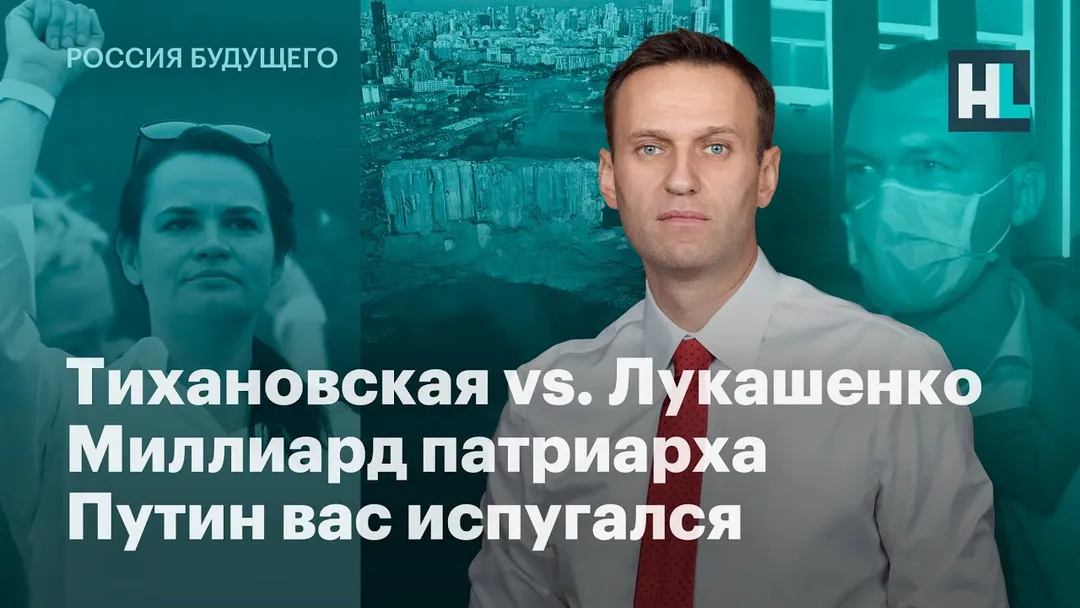
Tikhanovskaya vs. Lukashenko. The Patriarch’s Billion. Putin Is Afraid of You
[music]
everyone,
good evening, it's exactly 8:00 p.m. in Moscow, which
means that the program is live on air,
Russia of the Future, and I am its host, Alexei
Navalny, or, as a person involved in
"shaking the regime in Belarus," as I was called by
the Tsargrad TV channel. My
mug today, just like on the last broadcast,
incidentally shows that I
am, of course, in solidarity on this day with
the people of Belarus. But I
am not shaking any regime at all — I am demanding
the restoration of the rule of law in this
wonderful brotherly country. Today we will
talk in detail about what
is happening. Let me remind you
that you can send me questions, wishes, and complaints
using the hashtag Russia of the Future
on Twitter. If you don't use it, I won't be
answering. We have a button
that says Sponsor under the channel; you
can click it, subscribe, and become
one of the people standing behind
the Navalny Live channel and providing it
with regular support. We also have a link
below where donations are available, and
every contribution matters. Let me remind you
that we are still — this is probably already the fourth
broadcast in a row — continuing to raise money to pay
the fines of those people who last year
were not afraid to go out into the streets,
organized mass rallies against
the fact that they were deprived of the right to nominate their own
candidates. These people now have to
pay money on behalf of all of us, so we
are raising it for them. Please don't forget
to subscribe to the channel. But
what shall we start with? Erwin
Wake Of asks me about the case of the Khachaturyan sisters
and the New Greatness case. Let's
start with that. The case of the Khachaturyan sisters
is now
soon to be heard by a jury,
and my position has not changed:
I absolutely believe they are not guilty.
Yes, the sisters killed their father, but they
did so in response to years of
prolonged abuse — not just
mistreatment, but violence, including sexual
violence. In that sense, their actions
clearly constitute necessary
self-defense, and of course they should be
acquitted. I do not understand why
the Russian prosecutor's office
changed its position and is demanding
that they be convicted of premeditated murder.
Notice: not even for
exceeding the limits of self-defense — as if,
well, yes, he raped them, beat them, tortured them,
abused them, one of the girls was even recognized
as mentally unfit — but still,
he was driven to that point, so they
should somehow have acted more appropriately,
I don't know, gone to the police
if they hadn't already, or whatever else, or
just fought him off with a stick — but instead they
stabbed him with a knife right away. At least the prosecutor's office could have said
that — it would still have been outrageous, but
from the standpoint of a legal
construction, that would at least have been something one could
discuss. But here they are simply saying
that this was premeditated murder. That is
outrageous. I believe the sisters
must be freed. I hope that
since they will be tried by a jury,
they will be found not guilty. But this will be a very
interesting
and important trial. One very interesting and
important trial ended today — it was the
New Greatness case. It really is
somewhere
— I saw this metaphor today — a train
racing into the abyss passed one of its most important
stops. In
fact, that is true. Today's
sentences in the New Greatness case
were monstrous. There were several
defendants; several of them received
suspended sentences, but three people received
enormous terms — 7 years in prison, 6 years in prison,
and among them was one of the main
defendants, a man named Kostylenkov,
who last week
published a long letter in which he described in detail
the torture he was subjected to. He was
raped, he was
raped with the handle of a meat tenderizer,
the kind you use in the kitchen to pound meat or
chicken and the like. Under that abuse,
he gave a confession, and today
the court answered the question, essentially:
if you cut a person to pieces and
force him to confess to something, will that
still be considered the queen of evidence, and will it
work in a Russian court? Today the answer
was yes, it works perfectly. As with
the entire New Greatness case, it is absolutely
and totally fabricated. But the logic of
the system works like this: one day
some
they
— corrupt, vile, disgusting officers of the
security services, the Interior Ministry, the FSB — decided to earn
themselves a promotion, and to do that they did
the following: they inserted themselves into an ordinary
group chat of opposition-minded young people.
There are a million such chats in every region,
and they started writing, "Hey guys,
wouldn't it be great to overthrow Putin's regime?"
Putin has had enough of us. The guys reply that
yes, Putin has worn us out,
it would be good to drive him out. And then there were
some fifty people in that chat,
completely unfamiliar with one another and, as I
understand it, not connected in real life either. And
one person named Ruslan — yes, the one
about whom it later turned out that he was not
Just some kind of mug.
First thinner, then less so.
Thinner-looking — the person you see on screen is Ruslan D.
who, officially, in the materials of this
case is listed as an FSB agent, and
this very Ruslan D. writes in the
chat: "Cool."
We’re all so cool here, so we’re going to
carry out— well, hey, I’ve got
a place, let’s meet in
the premises at night. There were kids sitting in that chat,
poor kids, looking for something exciting, well,
young people wanting to hang out — so, let’s
meet at this place. And they met.
They started discussing some kind of naive struggle,
that sort of thing. Then, at the next meeting,
Ruslan D. brings papers and proudly says,
"You know, guys, I drafted the charter of our
organization. Let’s adopt it, let’s do it."
And they adopted it. So this is how it unfolded, step by step:
he rented them a space, he
wrote their charter for them — an FSB agent — and they
accepted a few more people, and three of
them, in addition to this Ruslan, were
also agents, either from the MVD or the FSB.
That is, out of ten people there, four were
simply agent provocateurs from the security services.
So basically, some kids
who were clueless and just wanted
to socialize in that group chat
were dragged into an organization that
the authorities themselves created, and today they were given 6 to 7 years
in prison. And yes, of course, they don’t
talk about how they went out to a
training ground and practiced
throwing Molotov cocktails.
They went because those very
provocateurs came and said,
"Guys, we need to prepare. Let’s go
to the training ground and throw
bottles with gasoline somewhere. It’ll be fun, like,
you could go out for shashlik (barbecue),
you could go for a walk in Gorky Park,
or you could go somewhere and throw
bottles with gasoline — that seems even more
romantic, something to remember."
And that is how this whole
case was built entirely on provocation. After that,
once they were detained,
several people were tortured, and under
torture they wrote down all kinds of nonsense about
how they supposedly wanted to overthrow
Putin by violent means — and there you have it,
the case is ready, the statistics improve,
great, our agencies are fighting
extremists — by destroying the lives of completely innocent
people who were guilty of nothing. They ruined their lives, and even
those who got suspended
sentences today had previously been held in a SIZO (pretrial detention center). This
Ruslan is probably celebrating a new
rank, or a cash bonus, or
something else, while someone else will spend seven years
in a penal colony for absolutely nothing. And this case is, of course,
very important. Why is this stop on the route so important?
Why here? Because, well, because
it was all so blatant — not even
just "stitched together with white thread" (an obvious frame-up) — I mean, if you look directly
at the case materials, this isn’t
made up, it’s not the lawyers’ position — it’s right there:
it literally says that an FSB agent came,
wrote their charter, rented them an apartment, rented
them a space, arranged everything, and then
boom — somehow it turned into an extremist
organization. And on top of that,
someone was tortured. And in this case
there is absolutely nothing resembling
a legal basis, and yet
they still got seven-year terms. You get that much for
murder, and these people did
absolutely nothing. And this
will continue. I understand that
this doesn’t sound very optimistic, but it will
continue. And the remedy, the answer to this, is
1 million people out on the streets of Moscow.
I’ll probably repeat this several more times
during this broadcast, but you see, nothing else
works anymore. Public
outcry, newspaper articles, lawyers expressing outrage,
open letters being written, petitions or
things like that — there was a very
representative
group of very well-known people there, Akunin,
journalists, all sorts of prominent figures — everyone
was outraged, everyone spoke out, and it made absolutely
no difference. The prosecutor asked for what they asked for, and that was that.
Only one thing works. We’ve seen
how many times have we seen people
released — but it works
in only one way: when out in the streets
without any permits, simply
a large number of people come out. That is
the only thing our authorities still respond to.
They don’t care about anything else.
The ducks are swimming by, I can see them on the screen. A reminder:
you can go to the description, click
the link, and send these ducks off. They’re
very much needed, these ducks. Let me remind you,
they’re swimming along carrying money that isn’t
coming to us — they’re not crawling to us, they’re swimming
to independent candidates: Yasha,
Galyamina,
Sobol, Alburov, and everyone else
who need large amounts of money.
I have a question here from Albert.
No, well, and Flue asks me
a great question: "Alexei, explain why it’s necessary
to register for Smart Voting
if I already understand its principles?
So what’s the point of registering?
Albert, the point of registering — the main
point — is that they’ll shut us the hell down
completely two days before
Smart Voting, and otherwise we won’t be able
to get in touch with each other. So if you go to the description
of this video — right now, literally
right now — and look at the link for
the registration — there it is, right there on our screen —
and you’ll notice that it’s
It’s a strange link because the very first one
the link we had was simply smart dot
com, or maybe it was even smart dot vote, and
so why are we using such a strange
link? Because that site was
blocked for us, and this one is hosted on
a special service whose servers
are difficult for Roskomnadzor (Russia’s media and internet regulator) to block.
That’s why we need you
to register, so that
first, we can stay in touch with you
if our site gets taken down, if
some attack knocks out a bot or
something else goes wrong, we can at least send you an email
or send you a text message. In other words, we need
many different ways to contact you
because you yourselves—you live where they
know you, but in Novosibirsk, or Tomsk, or
in Izhevsk, I guarantee you probably just
don’t know who to vote for, because
all these people, all these surnames, will seem
the same to you. Besides, on the
last day, something may change.
Someone may be removed from
registration, and information you saw
on the site three days ago may already be
out of date, and we need to make sure that
on the eve of voting, we have a way to
reach you and send it. Second, though,
we need to see how many people
are registering so that we understand
the forecast, so that we can give candidates
some recommendations.
And so on and so forth. In other words, this is
planning. Smart Voting
is a big, big campaign. It’s not
just me calling for it—Smart
Voting is something a large number of people work on,
from programmers to, forgive me
Lord, political analysts who sit there and
figure out who people should vote for. So
for this systematic work, we need you
to register. Besides, observers on
the Smart Voting website—you can sign up
as an observer there as well, and so
please go there and sign up. This is
a very important thing. It’s not that we need
it just because it’s nice when people simply
support us and say, well, I support it,
I understand the principles, but I’m not going to register,
and thank you for that too. But if you
do register, you enable us
to build a fighting machine that
will take on United Russia.
So.
Serdita writes in: “Alexei, for the third
week already”—lots and lots of exclamation marks—“for three
weeks I’ve been asking what the overall
strategy is for three-day voting.
P.S. I’d like details on collecting
signatures for the Yekaterinburg mayoral election.”
So.
Well, the strategy with three-day voting—
our strategy is observers. We’ll recruit
lots of observers. What other strategy
could we have? I don’t like
three-day voting. We believe it
was introduced in order to make
falsification easier, and we will prepare many,
many observers and explain to them
all these new tricks that didn’t exist before,
like these so-called safe bags—some kind of
bag whose number has to be written down, and
you have to make sure that at 5 p.m. they put these
ballots into the bag, sealed it, and then come back in the morning
to verify the safe bag number, recount
the ballots, and so on. We have one strategy:
to persuade you to sign up
as observers, and then to train you and
try to protect our votes through
observation. In general, the strategy for
three-day voting is
that we need to oppose it, and
again, 42,000 people are watching us live
right now. I’m repeating in today’s broadcast for the second time
this phrase: until we see
huge numbers of people out in the streets, we will not
be able to say, ‘Cancel your damn
three-day voting, your early
voting.’ Nothing will happen. In 2012,
there were lots of people in the streets, and that’s why
they introduced video cameras, and for a while
elections became a little more honest. Then
somehow we stopped
going out into the streets about this so much and so often,
and so they rolled everything back, and they’ll roll it back
even further. So now
both we and the Kremlin are testing three-day
voting in the elections that will take place in
September, and we are testing observation. But
overall, by the State Duma elections,
I think there absolutely needs to be some kind of
major campaign to abolish all of this,
because, well, three-day voting
makes a lot of this largely meaningless.
A question is coming in about the explosion
in Beirut—what do I think about Beirut?
Well, what do I think? I think this is
a terrible tragedy. The explosion really was
horrific. One striking feature
of this explosion, from a media perspective,
was that there were
two explosions. Something started exploding first,
and naturally everyone around began filming
with their phones—the smoke, the fire, and so on—and
that’s why the main explosion was captured on
a huge number of mobile phones.
And the footage really does look
stunning. Those 17 seconds—if you watch them
from two angles, from the water and from the city—
it’s enormous.
A huge number of people were killed. It’s a terrible tragedy,
there’s no other way to describe it, no other word for it.
Irony—the word itself seems inappropriate
to use here. It’s just this
striking fact that it turned out
that the owner of the ship and of this cargo,
the owner
The owner of the vessel is an entrepreneur from Khabarovsk.
So it’s as if Khabarovsk somehow reached all the way
over there. Basically, the only thing I want
to say is that, of course,
what happened, happened
because there was a cargo of ammonium nitrate being transported by
an entrepreneur from Khabarovsk from one
place to another, from Batumi to Mozambique. Actually,
it’s very interesting, and Meduza published
an interview with the captain of this
vessel. I recommend everyone read it. But it wasn’t
just fertilizer they were carrying — it was fertilizer that is essentially
a component used in explosives.
The cargo was impounded and kept
in the port for several years, and that sounds like
simple negligence, just sheer incompetence,
but in fact it was
incompetence shaped by political conditions,
because all of this was happening in a country —
Lebanon — where, as is well known, a lot is
controlled by an organization like
Hezbollah, and in particular the port
was controlled by Hezbollah. And we saw,
we are seeing an example of how this is an absolutely
political setup: these guys, in order
to achieve their own goals,
control chunks of the economy,
the port in particular, make money from it,
and use that to finance their
activities. So they take the money,
but they don’t know how to run a port,
and so wherever there are these
politically motivated arrangements,
that really overtake or replace
professional management, this is the kind of thing
that happens. I mean, basically,
anyone who knows even a little bit
about this would probably be
horrified if you told them that
components for explosives were just sitting there for years
stored somewhere together with a warehouse
full of fireworks somewhere in the port. But that’s the kind of thing
that could happen. Read the interview
with the captain — it’s very interesting. He talks there
about how they struggled with this
cargo, how the crew was basically abandoned, how they weren’t paid,
how the crew of this vessel
was stuck on board because they weren’t being paid,
and the Russian embassy and consulate
didn’t care about them at all. Every day, every day, the captain
wrote emails to Putin: ‘We have
nothing to eat, we’re stuck on this ship,
please do something, we are
Russian citizens, get us out of here.’
Some local resident was bringing them,
for Christ’s sake, food every day
and basically saving them. Go to Mediazona and read it,
it’s quite interesting.
Finn.
Dirk asks: Alexei, are you planning
to supplement the Smart Voting project
with a strong recommendation to come to
the polls only on the final
official day of voting? Well, not exactly
a strong recommendation, but our lawyers
have several different opinions on this.
Some of them say that this is
some kind of made-up thing
that doesn’t really have much
practical significance, while others say it
does. But we discussed it, and overall
we decided that it definitely won’t make things worse,
so yes, absolutely, yes, we
believe people should come vote on
the last day — specifically on the day of
official voting, not before that. By the way,
this whole idea that people should
vote on the last day also came, in part,
from Belarus, where
multi-day and early voting
have existed for quite
a long time, and early voting there is
always a method for massive fraud, which is
exactly what is happening right now in that
wonderful country, right this very moment.
Andreev Odin asks: what do you think about
Lukashenko’s statement that they were deliberately
infected with coronavirus? The interview with
Lukashenko is out now.
If I say more, you’ll all run off to watch
that interview. Don’t run off. He gave
an interview to the well-known Ukrainian
journalist Gordon. I haven’t had time
to watch all of it — I only saw bits and pieces.
Lukashenko said a lot of
wild things there, but the parts
I did watch generally suggest
that they simply describe
a man who has been in power for 28 years,
or however long he’s been there, and who has
completely lost touch with reality.
He thinks the world revolves around him,
that he is the most important thing, that everything happens around him.
If there’s coronavirus, then it was deliberately
used to infect him — I mean, this is a complete
loss of contact with reality, which
can happen to anyone. It happened to
Putin because he has sat in power for 20 years.
It would happen to me too, or to
anyone else — to Lyubov Sobol, to Ilya
Yashin, to absolutely anyone, to
Barack Obama — it would happen if someone
stayed in power for 20 years, especially if
that power were effectively
absolute in nature, as in Belarus or
Russia. In that sense, we’re simply
seeing a guy who says all kinds of
deranged things and
doesn’t doubt for a second that he is
right, because simply
his entire 20-plus years of life as
a leader
and effectively the country’s monarch have turned
him into someone unhinged — and would do the same to anyone,
because, as I’ve said many times, the history
of humanity proves one thing to us: when
you stay in power for more than ten years,
you start to lose your mind.
And this
week marks the anniversary of this whole fabricated case.
And I want to brag a little to you—we,
I want to brag, and we should all be proud of each other,
you and us alike.
A year ago, this happened—here, seven
seconds, let's watch. There it is—the door being cut open.
Just give it seven seconds—this is how, this is how
it all began.
[music]
So, a year ago, these guys came rushing in.
I only found out about it the next day,
because at the time I was in a special detention center.
They brought
me the newspapers I subscribed to, and from the papers
I saw that a criminal case had been opened against ACF
over money laundering, with searches here and there.
Searches took place in hundreds of locations
simultaneously, and this was undoubtedly the largest
simultaneous
operation by the Russian security services since
something like 1937 (the year associated with Stalin's Great Terror).
That is absolutely true. Over all this time,
they carried out more than 300 searches. The case
is being handled by 141
Investigative Committee investigators across 45
regions of Russia. Bank accounts have been frozen—
248 of them—with 60
million rubles on them (about $650,000), including
some that are still frozen to this day, belonging to
people who have absolutely nothing
to do with us—just unrelated people with the same last name.
There were cases like that. And a year ago, all our
money was declared criminal, and we were labeled
a criminal organization. All of us here,
making broadcasts and videos, just by talking, were supposedly
engaged in laundering income
obtained by criminal means. And we
understood that the authorities' goal
through this case specifically was simply
to destroy the Anti-Corruption Foundation (ACF)
as an organization—its structure,
its finances, everything else,
its institutional setup—because people in
the regions started being intimidated and driven away,
legally and politically. Well,
we've held out for a year now, and I'd
even say we've become stronger. We've had
to keep twisting ourselves into knots
to keep operating,
fully legally, paying
salaries, damn it, paying taxes, and so on,
and so on. But we're doing it thanks to
your help, so this is really, really
great. Because after all, this was originally
carried out pretty crudely
in order to scare people. But still,
all these video clips of searches—
you know, when everyone's ordered to stand
against the wall and so on—35 seconds. When you're
inside it, it's pretty unpleasant.
well,
it's that whole thing: 'Everybody stay where you are!'
They rush in like in a movie, announce themselves,
and start shouting.
Here at FBK and on Navalny LIVE,
the staff are already pretty experienced with this kind of thing,
so it doesn't make much
of an impression on them. But in the regions, of course,
when people saw videos like this,
for example from Chelyabinsk—30 seconds—the idea
was obvious: to make sure that
everyone else watching this would think 30
times before coming to work at our headquarters
or interacting with us at all.
In Chelyabinsk, people were being
dragged by the legs.
I
well,
So, what was I actually going
to brag about at the beginning, and what we should
all be proud of, is that almost
no one left. If we closed any
regional offices, we closed them only because we simply
didn't have enough money to keep them running. But in
the central structures and the regional
structures, almost no one left. And in that
sense, we are genuinely proud that
we work with truly excellent people—
reliable, decent, and brave. And thank you
very much as well—please keep
supporting us. Someone here is asking me:
Yevgeny Toptunov asks, 'What happens if I
send you a donation? Will they put me
on a blacklist?' Go ahead and send it. [laughter]
Don't be silly. It's impossible to put all
these people on some blacklist, and there
is no such thing as a blacklist. That's exactly what
they're counting on.
All that will happen is that one day Toptunov
will be 200 rubles poorer—or, I hope,
more—and will have helped the project.
They can't put you on a blacklist,
because there is no blacklist to put you
on. The only list you can be added to is the list
of good people who support
good causes. So this is absolutely
legal—you can send
donations. They are trying to steal your
donations by freezing them, while we are
trying to get hold of them before that
and use them somehow. We
are acting completely legally. This
criminal case is enormous,
interregional, with 141 investigators, and it is
totally, absolutely fabricated, and it should be
treated exactly that way.
There is essentially no danger
in sending us
donations. Now, about Khabarovsk—
Elena
Vlasova asks: 'When should we expect notification of whom
to vote for in October? I'm from Smolensk,
and I'm very worried that Smart
Voting won't reach us again.' Elena,
Smart
Voting works for us in all
cities with a population of, I think, more than
three hundred thousand, so in Smolensk it
will definitely be there.
When should you expect the notification? Look, we can't
send you the notification right now.
The final
candidate—their registration, as far as I know, can be
five days before the election or three days
before the election, depending on a number of
regional legal provisions, so
you'll receive the notification right beforehand. If we
sent it to you now, then in two
weeks, in mid-August, they'd simply
see whom we recommended and remove
him from the election altogether, so
we'll send it in the final days,
right before it—but you will definitely
get it, no doubt about it. And in Smolensk,
Smart Voting will work. Your
Elena Vlasova, dear, the task is to bring as many
people as possible into Smart Voting.
Why? Once again: all 3,000 people
watching this live—the most important [snorts]
thing is why Smart Voting works.
Because how many people will turn out? Take
Smolensk as an example—how many people in Smolensk will
come out to vote? Twenty percent at most.
With that low turnout, 20 percent, if
just 3 percent of people
take part in Smart Voting, then
our 3 percent, with 20 percent turnout,
turns into what? Fifteen percent.
Did I calculate that right? Right—15
percent. And by adding a full
15 percent to any candidate's column, taking it
from the other columns, we very significantly
increase his chances of winning. And if
this is the candidate we correctly identified, the
candidate who would otherwise have come in second,
we are practically guaranteeing him
victory over the United Russia candidate. But we need—we
still need 3 percent of Smolensk residents.
Smolensk—do we have 100 percent of them?
We do have 3 percent, we do have a hundred
percent. In Smolensk there are far
more people—yes, there are 60
percent against United Russia, 70
percent against United Russia—but we
need them all to vote together through
Smart Voting, so bring them in,
bring in as many people as possible. This
is it.
Well, that's the main job. For me
to persuade 53,000 people here out of
these—50... 3,000 people are watching right now.
By the end, by the end of the week,
a million people will have watched this broadcast. Of
that million, 350,000
people live in the territories where
voting will take place. Altogether, this
voting covers, well, about 40
million people living in that part of
the country where elections of one level or another
will be held in September. And what we need
is for those 350,000 people—you, the viewers
of this program—to persuade another 34
million people. That is absolutely possible,
and it will one hundred percent give us victory.
Fraud is an additional factor. We
will monitor it and resist it, but to win
technically, mathematically, we can beat them, and
it's not that hard. But everyone has to
make an effort. Register for
Smart Voting at
This week we discussed this
arrested United Russia member. I made a
short video about it today on
Instagram, but we wanted to talk about it
in more detail because, well, the situation
really struck me. The newspaper
—those pro-government papers, like
Komsomolskaya Pravda—and they put out
these kind of gloating reports: an arrested
United Russia member—look what a шикарный house, a mansion.
A mansion, and here's the raid taking place, so
his
his house, and
a car was found there, and so on. I
look at this and think, damn, where have I seen
where have I seen this house? Then I realize
that I saw this huge, beautiful house in
our investigation that we released
three years ago. Let's first take a look at
the search and raid of this house. The raid, by the way,
deserves separate mention—it just looks wonderful, the way they
raid ACF offices, break down doors,
rush in, people are screaming, and
here it's just a fairly small
group of people, and everything looks much
more relaxed than at an ACF office.
Let's watch a minute and a half of the search and raid
of the home of this especially dangerous United Russia member.
Let's do it.
Police, don't
the phone
on the floor, prohibited
weapon on
the steering wheel, yes, narcotics, items prohibited
in civilian circulation.
Saw it.
Which, you'll agree, is pretty funny: some
guy climbed in there somewhere, looked around. Our
preparation for raids, of course, looks
much more impressive. And when, in the ACF case,
on the first day they carried out searches
simultaneously in something like 50 or 70
regions, all at once, according to Moscow time,
on the same day—here it looked
a little different. And this sad
man walking around in his underwear that you saw
appears to be the owner of the dacha (country house).
And the guy's name is Alexei Grishin.
What's notable about him is that he's a vice-rector of Moscow State University,
and before that he was part of the team of
Governor Merkushkin, whom we
hate.
But everyone hates him. He was
But we've talked a lot here about
Lukashenko.
Of course, we're talking about Putin here.
But Merkushkin is basically Lukashenko squared.
For many years, he was the head of
the Republic of Mordovia, and then he was removed from there
and sent to Sama— to Samara
Region, not Saratov, Samara
Region. Then he ended up in Moscow, while
absolutely nothing touched him. And this is
the most fanatical, the craziest, the most
unhinged person there. On the territory of
Mordovia alone, he built at the same time
both a gulag and constantly
there were these Chechen-style elections, Chechen-style
percentages in elections — meaning that there
it was simply, out of all the non-Caucasian
republics, the worst lawlessness
by far. Merkushkin in
Mordovia, of course, stole a great deal,
stole a great deal, and actually this
Grishin who was arrested — he was the minister
of construction in Mordovia. Well, I also don't
know whether it was on the stadium in Saransk
they built or on something else, but they siphoned off
so much money they could have built
some gigantic, well—
these... and let me show you a video
from our video that came out as long as three years
ago. Let's rewind three years now and you'll see
a heavier me with a strange haircut
doing an investigation into
Mordovia. One minute. Langer Pushkina
invests his money not in his home
province at all, but settles down in a completely
different place. On Rublyovka, we found an entire
settlement belonging to the Merkushkin clan.
Living there are his son, two
of his son's business partners — one of them is also a
former deputy of the Mordovian State Assembly and
minister of construction, now in the new
Samara Region. Just look at this
beauty — you can immediately tell a regional
official lives here. We estimate the value of the construction minister's real estate
at 360
million rubles. The plot and house of Merkushkin's son
are worth 264
million rubles. The business partners
settled for something more modest — their houses and land in
total are estimated by the ACF at 121 million. As you can see,
the entire Merkushkin clan built themselves country homes
not in the village of Bolotnikovo near
Saransk, not in the village of Smyshlyaevka near
Samara. They all talk about what great
regional patriots they are, but in reality
they pull money out of their home region and
invest it in real estate on Rublyovka.
Ah,
I felt nostalgic looking at this clip
from the video. Our video production really
was still just a black wall back then, yes, but
still, we've come a long way since then.
That's what it looked like three years ago. Over these rather
years, it's pretty funny. What I want to say is this:
people tell us, "Oh, just look at what a
huge house. It's obvious he was cooking up
something. How else could it be? He used to be an official, now
he's a vice-rector at Moscow State University — let's jail him.
Horrible, horrible, horrible — let's jail him, let's
horrible, horrible, horrible. But then you all ran over to his
palace — and why don't you look at the other
palaces? Merkushkin's, for example —
everything else there is exactly the same: the same
officials with the same kinds of houses, the same
Mercedes cars, the same art
galleries, gold, piggy banks, bars — it's all
the same. But, you see, they pretend
as if they stormed one house, and
as if that house is somehow on the Moon
or on Mars, as though nothing else
is happening. I just—
three [clears throat] years ago, we were
shouting about this loudly, and everyone kept telling us
it was nonsense. But now at least one
person has been jailed, while all the others
around them keep stealing. Merkushkin
still hasn't faced the slightest
punishment. Do you really think a minister
could steal that much without his
governor knowing? Of course not. But this is United
Russia, and one of them somehow
fell out of line and ended up
taking the hit, while everything else still
remains one of the many, many mafias
inside United Russia that sit there
sorting out their own business, taking care of their own little arrangements. They all
remain in office, and this United Russia
is what we need to knock out. It's the foundation under
Putin's feet, and we need to strike at that
foundation, including through Smart
Voting right now. So please
register for Smart Voting and
take part.
So, Timofey Platonov asks me:
have I heard that many opposition
that many opposition politicians
in America are being boycotted by Twitter, bla—
that Twitter blocks many of them? Could the same thing
be pulled off with you? No, I haven't heard
of American politicians
having their Twitter accounts blocked.
It seems to me that the situation there wasn't exactly that.
The situation was that Twitter —
Twitter's administration — labeled
some of Trump's tweets as, like,
misleading information, or
I think they deleted one of his tweets,
which caused some kind of
massive scandal. But as for
Twitter blocking some large
number of politicians, I haven't
heard of that, Timofey.
[clears throat] Platonov: Alexei, Smart
Voting works, I've seen it for myself. What
do you think the system will come up with against
candidates backed by this kind of voting? The system
against this kind of voting
comes up with one thing: not letting anyone in at all,
not allowing Smart Voting candidates onto the ballot
— we'll talk a bit more about that today.
Let's discuss the first point in more detail, and the second one too.
they'll come up with a way to rig the elections.
even if they lost badly in terms of votes.
just throw them out somewhere, dump them somewhere.
Is it harder in Tomsk or in Novosibirsk?
and somewhere it's easier to dump them, in Voronezh or in...
in Tambov, where falsification is constantly going on.
Our task is to take part in these waves
of voting and deploy thousands of
observers. Thousands of people have already
registered.
And the task before us is— I was
asked something today like,
"Alexei, why do you look so sad?" And I was like:
I'm sad because we need 1,000
observers, thousands across the country,
to assign them, give them guidance, make sure they understand
how they'll work, train them, and so on.
It's a colossal amount of work that we
are doing, but most people
don't particularly notice it. But we have to
do it. And you need to sign up
to be observers, and we'll do this
difficult work. But if you, the
observers, aren't there, then there will be
no point in doing it. So in that
situation, I probably won't be walking around sad, I'll be
cheerful because there'll be less work. But in the
end I'll be even sadder,
because all the votes will be stolen.
Alexei, good evening. I'm being asked
by Maxim: who washes the writing off the mugs? Do you have
Navalny's cook? But a cook is supposed
to cook something. I can't say that I
personally wash the writing off the mug. Somehow
it works by itself. You come in and ask me
to write something on a mug, and I
say, "Write this and that," and then it
appears, apparently already with the inscription on it. And...
Patriarch
Kirill surprised us this week by
for the first time in many, many
years, he—well, a senior representative of the
Russian Orthodox Church—actually began, more or less,
to justify his wealth. The pressure of
public opinion over his
well, obvious non-
godly, non-Christian lifestyle,
Patriarch Kirill's lifestyle,
has become so great that
he has now had to say something
on the subject. It was quite interesting.
Let's listen—one minute and 15 seconds.
Patriarch Kirill urges people not to believe
that he has six billion
dollars. "When you read the most terrible
things about the patriarch, about bishops and
priests, remember that
there usually isn't even a drop of truth in them.
But all of this is aimed at
discrediting those who proclaim God's truth
so that people
stop listening and trusting. Once I was
simply astonished in a conversation with one
of the bishops. We were flying together from one
country to another; at the time he was serving abroad,
and he said to me in a brotherly way—we had
known each other for a long time—he said, 'Your Eminence,
please help us with money,
things are very difficult for us.'
I said, 'But we transfer money to you.' 'No, from your own
personal funds, please help.' I
tensed up—what do you mean, from my own funds? But
listen, they say he has six billion dollars.
I looked at him: 'Bishop, are you joking?'
'No.' So
this nonsense has reached the mind of a bishop—he believes
it.
So everything they say and write is most often
meant to make us stop speaking
God's truth.
There you go.
It's told almost like a joke, like, ha-ha-ha,
even some bishops believe it. But
whether Patriarch Kirill has six billion
dollars in personal assets, personal property,
I don't know. If he has one
billion dollars, I wouldn't doubt it. I just
I
haven't seen a bank statement, but
looking at what's going on around the ROC (Russian Orthodox Church),
looking at this ziggurat they've
built in the Moscow region, the so-called
military cathedral, for absolutely
unimaginable sums of money; looking at
the huge number of very specific,
strange, shady operations in
which the ROC is involved, which cannot be explained by anything
other than greed,
then
if they're enriching themselves, that means the money is there,
they're stashing it somewhere; if they're
stashing it away and so many
operations are taking place, then there is a lot of money there.
But it's good that he's trying to justify himself—
that means he does, after all, feel
the pressure from people, he feels the pressure
from the Orthodox community, to which many of
us belong—I belong to it too—and
I absolutely believe that the leaders of the ROC
need to be called out, they need
to have this beam in their eye pointed out to them, or
speck, or whatever you want to call it—we need to draw
attention to it, because the lives
these people lead are indeed super-luxurious.
But as for the truth they
say they speak—yes, he had a longer
speech there where
the patriarch says that all this
is being done to smear the Church, because
the Church also speaks rather
bravely—so bravely that it
even tells the authorities the truth. When I
heard that, I immediately
remembered—and I think you did too—that
wonderful video of Patriarch Kirill
speaking fearlessly and telling Putin the truth.
That looked very funny. 43
Patriarch Kirill is, in a matter of seconds, cutting in
to Putin’s face with the blunt truth. I must
say this completely openly, as someone
who is called to speak the truth without
paying attention either to political
expediency or to propagandistic
emphases.
About the fact that an enormous role in
correcting the crookedness of our history
was played personally by you, Vladimir Vladimirovich. I
would like to thank you. You
once said that you work like a
galley slave. It is worth
noting only one difference: a slave never had
such dedication, whereas
you have an extremely high output. I
with all boldness and directness, without any— you
know, I’ve really gathered myself and want to
Vladimir Vladimirovich, lick your
little boots, kiss your feet, and
say that you are the very, very, very, very
best in the world. Watching this is very
disgusting—very disgusting for everyone to watch,
for everyone in general, probably for believing Christians
to watch this; it is doubly disgusting.
But we all remember the watch incident,
when they were in one photograph
and then disappeared. And then there was the famous
story when the watch was photoshopped out, but
in another photograph you can still see the reflection
of the watch anyway. That is,
a completely
luxurious,
ostentatiously luxurious lifestyle
of the hierarchs
of the Russian Orthodox Church and
the top brass of the Russian Orthodox Church, and the insane
spending, and the obviously corrupt projects
like that very church outside Moscow
associated with Shoigu and Putin—these, of course,
caused so much outrage that
Kirill has been forced to make excuses. And
it is good that people are paying
attention to this. And if
we’re talking, by the way, about those people who
are forced to talk on television about
the wealth of Russians—there was not a funny
incident, but a sad one: a presenter was fired,
Alexandra Novikova, who worked at
GTRK Kamchatka, and you surely all
remember her—last year she gave us the most
memorable video,
with the most, most infectious
laughter. I’ve watched it many times, but every
time I watch it, I laugh along with
her. Let’s recall it: one minute 27
seconds. Indexation also affected the
set of social services included in the payment. From
February 1, its value will amount to just
over 1,500 rubles per month,
of which almost 900 rubles a beneficiary can
spend on necessary medications,
137 rubles can be allocated to
purchasing a voucher for a health resort stay to
prevent major illnesses,
and the remainder for free travel on
intercity transport to the place of treatment
and back. Excuse me. [laughter]
Live
[laughter]
[laughter]
[laughter]
on air—just
[laughter]
you simply can’t help laughing at this. The remaining
‘intercity transport’—did you hear that?
No, 137 is for, for
[laughter] the trip—no, for the health resort voucher.
The rest is for the intercity trip, all the way
to the place of rest and back, you understand?
1,500 rubles, of which 900 go to medications,
137, and the remaining
money—she laughs.
[laughter]
Alexandra Novikova—although while everyone
says the situation is sad, in fact for the people
who receive this subsidy for
intercity travel. But I suppose one can
congratulate her on no longer being
a presenter at GTRK Kamchatka, because she
organized a rally
in Petropavlovsk-Kamchatsky in support
of Furgal. Good for her. I don’t know
exactly what political views Alexandra
holds, but she went ahead
while being an employee of federal
television in the region and organized
a rally in support of Furgal—that’s very cool.
Even if that meant her work in television
ended and she was fired. Well, here
you can’t exactly say we express support and
condolences—Alexandra, you got fired
from rotten, corrupt television, so
thank God. I hope she finds
some better use for herself. I saw somewhere
that Open Media later wrote
that she was even thinking of going into politics.
Well, there you go—let her run in
her hometown against
a United Russia candidate. I have no doubt that
she would be elected if she remains this kind of honest
and normal person; then she would probably
also get Smart Voting’s support.
As for salaries—yes, by the way, that was a funny
moment, but now we’ll move on to describing a really
rather sad thing, because
specialists from RIA Rating conducted
a very large study, a huge one,
and they calculated the real
median salary in Russia. The median
salary is a more accurate
indicator than the average salary in Russia.
It turned out that this very salary is
34
thousand 500 rubles
in 2020.
An oil-producing country that simply
also claims to be a great power.
What a great average salary we have: $476.
Dollars. Poverty,
and destitution — those are the two words that
describe both the Russian people and the state of
the Russian economy. A huge country,
with an enormous military budget, with
Patriarch Kirill (head of the Russian Orthodox Church), which
claims it doesn’t have $6 billion.
Surely there’s at least one person with
some of these palaces, Foreign Ministry
vineyards, bears, the second-largest
number of billionaires in the world after the U.S.,
billionaires.
All the most expensive yachts in the world
belong to Russian citizens. A large share of
the most elite real estate in London
is bought by Russian officials, and the average
salary in the country is $476.
Dollars. Less than in Romania, much
less than in the Baltic states. These people have truly
driven the country not just into poverty —
if you have $476, you’re not
destitute, you can eat and put
500 rubles (about $7) on your mobile phone,
but that’s not what we would want
to aspire to in 2020. This is absolutely not
what our country deserves. This is
absolutely not what people can reasonably
expect when they have an education. But
we’re not living in Africa — everyone here is
literate, there are huge numbers of
people with higher education. People
finished school and know how to, I don’t know, solve
integrals. A significant number of
people, at least, still remember them from school.
They haven’t forgotten those integrals. We have
an educated population, we have
some industry left — and yet it’s $476
a month, 34,500 rubles a month.
And again,
I’ll repeat it three times on today’s program:
until hundreds of thousands and millions
of people take to the streets and this government is not
brought down — I’m saying it plainly — nothing
will change. We will go on
languishing in this poverty, in this same
report it says that rising
inflation in the foreseeable future will
eat away at these miserable 34,000
rubles, and at this, excuse me, accelerating
pace, the whole nation will grow poorer. Real
incomes continue to fall,
fall and fall, prices are rising, and in that
sense these miserable 34,000
rubles will become less and
less and less, because this
government is incapable of doing
anything to raise people’s incomes. And this
isn’t just my opinion — it’s
verified empirical experience going back to 2013.
Since 2013, for seven straight years, incomes
have been falling. The government can do
absolutely nothing, and it will not do
absolutely anything now, just as
Lukashenko can do nothing, just as they can do
nothing in Zimbabwe or in
North Korea. Until power changes,
there will be no positive changes
at all. Well, on that note, let’s move on
to Khabarovsk — there are a lot of questions here
about Khabarovsk. What
will happen there in Khabarovsk? Medvedev’s statements
about the need to take into account
the supporters of Furgal, about Solovyov’s joke —
our regular listener Solovyov, so to speak,
Solovyov, that is.
There are also a lot of questions about Degtyaryov,
about our
new investigation. But Khabarovsk
has frozen at a kind of equilibrium point. That is,
it surged, it put itself at the center
of attention, and
the situation has to be resolved, and now
Putin is sitting and waiting for everything there to
die down, while we’re all waiting for
something to happen there — I don’t know, for it to erupt
or for the federal authorities to give in. And who will
outlast whom in stubbornness: the people of Khabarovsk or
the federal authorities, who for now
are showing zero desire to make
any kind of compromise? For now, Khabarovsk, to the
credit of this wonderful city, is
not giving up. Every Saturday we watch
their rally there. Every
Saturday at 12 noon there is a large
rally, and every single day at 7 p.m.
on weekdays there is a smaller
rally. And this time there was
an absolute downpour, very bad
weather, and it was already quite cold in Khabarovsk.
Nevertheless, there was once again a huge demonstration.
Everyone is marching and shouting: we’re coming, we’ll put an end to Putin —
we don’t need him. Nine seconds from Khabarovsk.
A huge
march took place — look at the vivid
photos, it was like an umbrella march. But we
conducted a poll right there at this
rally, and it
from the point of view of sociological science
is not very representative, but
for measuring at least
the mood of the people who are taking to the
streets, it’s quite good. We decided not to
publish it, because we are still very
careful about making sure our
sociology is done strictly by all the rules
of sociology. But I can tell you that
there, an overwhelming
majority —
let me remember exactly — something like 80
percent of people say that these
fines, pressure, arrests, and other
things
have not changed their position, and they will
either keep coming out, or be even more
confirmed in their view that they need
to take to the streets. So Khabarovsk is not
giving up. It is very important to express support for it.
We’re not seeing solidarity protests in support.
We’re not seeing rallies spread on a mass scale
to other regions, although in Siberia and the Far
East we do see fairly large
demonstrations of support. I explain this
by the fact that these are, of course, still very much
local issues. Everyone sympathizes
with Khabarovsk. Everyone understands. Polls have shown
that the majority of Russians, Russians
support the Khabarovsk residents’ demands, but any
kind of mass rallies—I don’t know, probably
shouldn’t be expected across
the whole country anytime soon. But this Khabarovsk
vendetta is continuing, and what’s interesting is that the authorities
probably seem to think that just
a little longer and people will leave the streets, because
they’re behaving, of course, more and more
brazenly. And now Degtyarev has already
—it would seem this man ought to
keep quiet, but no.
This video wasn’t very popular on
social media, but I want to show you 28 seconds
of it.
So, they brought him this
tractor, and Degtyarev walks around
it and says that all of
this is thanks to Putin, or thanks to
the local officials. Twenty-eight seconds of praising
Putin. Here.
This is important, you know. These tractors under the federal
project—these are
not some glorious local administration effort, yes, this
was Vladimir Putin, making the decision
under the federal project, who sent tractors like these
to the regions for restoration
work. For some reason, no one here likes
to talk about this in Khabarovsk Krai. Three
tractors, you understand. And he’s singing the praises
of Vladimir Vladimirovich in such a way that
you’d think Vladimir Vladimirovich paid out of his own pocket, or, I
don’t know, built the tractor himself or stole it from
the Americans in Ukraine, grabbed a tractor
and hauled it across the border and gifted it
to the people of Khabarovsk, and now they’re supposed to bow
at his feet. These tractors were bought with tax money,
including the taxes of the people who
live and work in Khabarovsk Krai. But still,
it would seem Degtyarev should have kept quiet
so as not to anger people, but apparently he somehow
feels secure in his position. The LDPR, by the way,
has already said that they
will indeed nominate him for the gubernatorial
election. But if Furgal is not allowed to run
—although it’s clear that Furgal will either
be released under public pressure, or that
won’t happen, and then there definitely will be an election, and
then they’ll put forward Degtyarev. I’ll be
interested to see whether they try
to make him governor. We’re doing what we can
to contribute to making sure that behind this
this lying,
disgusting politician, our
investigation came out. It was released last
Thursday; I told you about it on Friday.
Degtyarev responded to us, and we immediately
responded to him as well. It seems to me that we
have, in that sense, finally
buried him. But first, let’s watch
a minute and a half of Degtyarev
explaining that the remarkable house and
apartments that appeared in his
parents’ possession after he took part
in all sorts of schemes are somehow perfectly
normal, and that they sold everything in Samara and bought
real estate in Moscow. A popular
question: Mikhail, please comment
on Navalny’s investigation—what is
that little house in the Moscow suburbs?
Yes, it’s a great little house. I like it there, I
miss it. That’s the house where my
parents live, who
sold all the property they had accumulated over their entire
lives. Just so you know, my father is
71
years old.
They worked [music] abroad a lot.
That’s where we started. So, having sold everything,
they built a house in the Moscow suburbs; there
they live and help raise their grandchildren. We regularly
bring them there—or used to, yes.
And what else is there to discuss? I looked at it—
nothing interesting, as always, numbers pulled
out of thin air. But the facts are true: yes, there is a house,
there are apartments [music], only—well,
to hell with it, let’s get back to the business at hand.
As for where it came from, I should probably
answer that jab: the house has an extension
that hasn’t been registered yet, because it’s still
unfinished. As soon as it’s completed,
my father—he’s been dealing with it for quite a long time—
there’s still finishing work going on there.
[music] There’s never enough money, as always. Once it
is finished, it will be registered, just like
all Russian citizens do. Let’s get back to business.
To the affairs of Khabarovsk Krai, which concern us
far more than—what is this—
some real estate in the Moscow suburbs. First of all,
notice that they said it was the most
popular question, so well done
to everyone asking it. Second,
what a disgusting lackey this host is.
Good Lord. “Ah, to hell with it, let’s
get back to the issues that
interest our people in Khabarovsk more than
some house in the Moscow suburbs.” A house in the
Moscow suburbs belonging to the governor
of Khabarovsk Krai—and this journalist is on the take.
This journalist is bought and paid for, just
disgusting.
A vile, miserable lackey—just, my God.
Where did he even come from? They just sent this
Degtyarev over, and already he’s ready
to throw himself at his feet and practically lick
his boots.
Disgusting. In that sense, this kind of
pro-government journalism is just
disgusting. These people are the worst people in the world,
worse than the officials themselves, I mean.
Degtyarev, who lies in absolutely every
word—even he looks a little better
than this nasty Khabarovsk
journalist—"journalist," in quotation marks. But it's great
that Degtyarev said all this. And he, well, by
he's a member of the LDPR, of course, but essentially, by
his nature, he's a United Russia man. He's a former United Russia member, but
he's a former member of the youth movement
of United Russia, Walking Together—remember, there was
such a movement in support of Putin—then
he was in United Russia itself. He lies
very easily, without thinking about
the consequences. And Georgy Alburov, who
was, in fact, the author of the main
investigation, immediately called him out—come here,
Degtyarev—and systematically proved that
Degtyarev is lying. Well, you understand, in
principle, his lie was obvious
to anyone—the idea that you could
sell real estate in Samara and buy
real estate in Moscow—well, let's just say, that
its implausibility is obvious to pretty much
anyone who has any idea
how much real estate costs in the regions and
that even in the very best region, the amount of
real estate there is nothing like Moscow. But
here are 57 seconds from Georgy Alburov that
completely destroy the acting
governor of Khabarovsk Krai
Degtyarev. He claims that this
part of the house isn't finished. OK, let's open
the satellite images from 2015. Here
the main part of the house is being built, which
is now officially registered, and this is the very
same supposedly unfinished extension. 2016:
a roof appears here and there. 2017:
a lawn appears, and any traces of
construction disappear altogether. 2018:
everything is already taking shape, and
there's a pond and another structure, and since then, over
the past two years, absolutely nothing has changed.
Let's look at this extension from
our drone. No matter which side we
look from—this one, that one, or from
this side—there are no signs whatsoever
of construction, not the slightest. The answer
is simple: all of this is finished and not
registered purely for petty
fraudulent reasons. They found 70 million rubles for
the extension, but paying the proper amount of taxes for all this
was beneath Degtyarev.
That's too low for him. I condemn
Georgy for using that word, but
still, it's wonderful that
Degtyarev already understood that we had
video footage—at least of his
statement, the second part of the statement that
Alburov refuted. And as for his claim that construction was still
ongoing and that's why it wasn't being registered, we
will refute that with video, because it clearly shows
that there has been no construction there for many years.
It's a completed building. If you don't
register it because you don't want
to pay taxes, that's still bad, because
he's still a United Russia man. But still, the first part
of Georgy's rebuttal, where he
systematically proves that it couldn't
possibly be the case that you sold something in
Samara and bought something in Moscow, because
in Samara they not only did not
sell—they actually bought even more. The most
important thing Degtyarev says is that
his parents simply sold all their
property and used the proceeds
to build a house outside Moscow. Let me
first clarify that all of his parents' property
was in Samara, and I decided
to take a close look at how many Samara
apartments they would have had to sell in order to buy the plot
and begin construction of a thousand-square-meter
house two kilometers from the MKAD (Moscow Ring Road). The
correct answer is: zero Samara apartments.
The plot was bought in October 2013,
one month after Degtyarev took part
in the Moscow mayoral election as
a minor helper to Sergei Sobyanin, and
the first apartment in Samara was sold in
October 2014—that is, one year
after the plot was purchased and construction
had begun. This is what the plot looked like in
2014: the house foundation had been laid and construction was in full
swing. So what was this, you might ask,
some kind of golden apartment in Samara that
made such a large-scale
70-million-ruble project possible? At 78 square meters, it was
a completely unremarkable apartment in
a Samara building constructed in 1990.
The upper price limit for such an apartment in
2014 was 5 million rubles at most.
The thing is, Degtyarev's family not only did not
sell all their property in Samara to
build the house—they actually bought more in
2016, when active
construction of the house outside Moscow was underway. They
bought a 100-square-meter apartment in Samara in
a newly built residential complex
called Historical Quarter, and this apartment cost
at least 8 million rubles.
I
am very glad that our
Anti-Corruption Foundation (ACF) made some
small contribution—now everyone knows
that Degtyarev is not just some strange
loudmouth and windbag, but also a corrupt official and a liar
who lies directly to the residents of Khabarovsk
and to the whole rest of the country. I looked—well, I won't
try to predict whether he'll get elected, but nevertheless
for now, meanwhile, Governor Furgal
is sitting in Lefortovo, in that kind of
detention center where he is as much as possible
deprived of access to any information. Members of the
Public Monitoring Commission visited him, and his
peace of mind—well, look, an interview with him came out in
Moskovsky Komsomolets; it's worth reading.
There Furgal simply describes what kind of
absolute lawlessness he is facing. They don't even
pass on letters from his relatives to him. He has been sitting there
for a long time already—more than three
For weeks, there hasn’t been a single letter there, just
nothing for him from anyone—not a note from a loved one,
nothing from relatives or children is being
passed on. The man has been plunged into complete
isolation, and on top of that, in Lefortovo (a high-security Moscow prison)
it is now practically impossible to get in there.
Lawyers hardly get to meet with him at all, and
the letters don’t just go through Lefortovo’s own censorship
department—they also go through the investigators,
and absolutely nothing is being given to him. But this
is also indirect confirmation
that he bears no guilt whatsoever—well, truly none.
If there were any
evidence that he really
took part in criminal groups
or was involved in murder, they would have
dumped that evidence on us long ago,
and Furgal himself
would have been given some chance
to defend himself, the way Degtyarev did,
and they would have rebutted his arguments,
or at least issued denials from the standpoint
of PR. But that isn’t happening. Why?
Because there is no evidence at all.
The case was entirely made up by Trutnev, as I
explained in my video. Trutnev, on
Putin’s orders, fabricated this criminal case crudely, absurdly,
and stupidly. That’s why
we are now—and that’s why things turned out this way.
Everyone from Khabarovsk asks me, as Savelyev does,
the same key question:
for more than three weeks now,
people in Khabarovsk have been coming out to protest, but
nothing is happening, and the authorities are not
reacting at all. What should they do next? This
really is the main question
everyone is asking themselves. But let’s
simply proceed from experience.
Experience
shows that this
government does something only when it senses
that there is some real threat or
that there will be a real shift in public
opinion. From that point of view, the people of Khabarovsk
need to hold out as long as possible and
keep coming out, because time, on the one
hand, works against them, because
they have to come out every Saturday,
every Sunday—they need to keep going and going and
going. On the other hand, we can see that
through our joint efforts, more and more people
in the country know
about what is happening in Khabarovsk. The more
people know, the more people in
Khabarovsk—the more Khabarovsk residents
will be supported. This all needs to be politicized as strongly as possible
so that for Putin the threat is not simply
that he gets asked about Khabarovsk,
that people ask him about Khabarovsk and he
has to say something in response,
or that they say, well, they’re making noise again in Khabarovsk.
The threat has to look like this:
the more people in Khabarovsk go to
rallies, the lower your chances become
of getting someone elected governor in
other regions. The more people there, the
longer they keep protesting in their Khabarovsk,
the lower the probability that even a candidate from
United Russia will be able to win for real.
You’ll have to falsify the results everywhere.
That is political threat number
one. We have the example of Shiyes (a station in Arkhangelsk Region), where
in Arkhangelsk Region, as I have already
said several times, it seemed
the situation was absolutely hopeless. After all,
it wasn’t even Khabarovsk—it was way out in the middle of nowhere,
just this station, and there was some kind of
tent camp there. But nevertheless,
the previous governor was removed because
the whole country—because they monitored it all,
United Russia, Putin, all these polls—they monitored
everything and realized that all of this
was being supported, and the confrontation itself
was working against the authorities. So they, at
least as of today, have
announced
that there will be no construction there.
So in a sense they fulfilled the protesters’
demands. In Khabarovsk, things are still
more complicated, but there, on the other hand, you have an entire city.
So the strategy can only be
this: long, tedious, and difficult, but
to keep going.
Stay there, politicize the demands,
spread information. Second, well, I
believe—and our poll showed this; I mentioned it here
just now, there are 71,000 people watching us live—that
for those who didn’t see it, I
said that we conducted a poll of those who
actually come out to the rallies in
Khabarovsk about methods of struggle going
forward, and they say
that strikes, walkouts—they support them there,
up to 30 percent of people do.
[clears throat] In that sense, all methods
of peaceful protest—a citywide
strike, for example—are hard to organize, and
to be honest, it’s not clear how exactly
to organize one. The last time
there were strikes—well, miners staged some
small ones in the 1990s, and before that
strikes were a major social phenomenon. But
nevertheless, it is possible—and necessary—to try.
Strikes, blockading buildings,
coming out and not dispersing—in that sense,
the protest can also be escalated.
Of course, one can say: well, you’re advising all this
because you’re sitting in Moscow, not
in Khabarovsk. Of course that’s true,
absolutely true. Any
escalation carries the risk of some larger
confrontation. But we can see that the authorities
have already started jailing people anyway.
They arrested one person, then two, then three, then ten,
and their strategy is precisely this creeping
erosion of the protest: to wait until everyone
gets tired of it. So it is necessary, well,
it is necessary to keep coming out. I once suggested that they should...
At one of the rallies in Moscow, I said
that I still support
this phrase. I believe that this is exactly how it should be
done, although many people did not like it. I was told
that this kind of message means, basically,
demotivation. But until we start
going to rallies as if they were our job, nothing
will change. So as long as they are happening,
we need to go to them every evening, every
Saturday and every Sunday, as if going to
work, because that is your job
in freeing the country from a gang of crooks
and, among other things, because your salary
would be higher. If the average salary now is
34,000 rubles, then it will stay at that level
or become even lower because of Putin
until we remove Putin and United
Russia from power, salaries will not rise
If you want a higher salary, go to rallies, and
dear Russian, this applies to me as well
Well, all right, for me this means
you protest, you get locked up, you protest, you get locked up, well
I do it anyway: you protest for 17
days, you sit in jail. They wanted to see you protest for a month
and sit for a month, but there is no other way anyway
there is no other way, and we understand that very well
Apparently, this brings me to another point:
Putin has already become afraid of us
and his enormous fear for himself and for the party
United Russia is visible even now, ahead of these
elections that will take place on September 13
I mean, you would think these elections
are something hardly anyone knows about, and we all
more or less do not care about them. It's like,
Navalny is running around like a madman shouting
"Smart Voting, Smart Voting"
Look at the two main regions. This one here,
Arkhangelsk Region, where
they changed the governor there, removed
the unpopular one and put in another person
who, well, does not seem to have been involved in anything
bad, but they nominated
a candidate from Shiyes, Oleg Mandrykin, and he
even collected signatures and passed
the municipal filter, but then they still
said, "We will not let him run," and
did not
let him. They removed the doctor from the ballot because
they understand, Putin understands, that in
Arkhangelsk Region, if there is
a candidate who is, so to speak, a candidate of the people,
he will simply win, one hundred percent
It is impossible there for any
United Russia candidate to win, so they remove him from the election. In
Komi, it is the same. In Komi, protest sentiment is very high
there. There was a fairly strong candidate there
Mikhailov, from the Communist Party, and you
understand, how can you remove
a Communist candidate? He definitely had
plenty of municipal signatures. They removed him from
the election because otherwise they cannot win
Putin is very afraid. This is
fear. We can even see that they are so afraid of Smart
Voting that right now
they have started rushing to remove candidates. Here in
Nizhny Novgorod
it is just total lawlessness. But
at first they seemed to start registering them
then they removed all independent candidates from
the election because they understand they will lose
It is very funny
and not funny at all. Then comes the explanation of why they were removed
That is, you submit signature sheets
and then some handwriting expert
is supposed to give you a summary table in which
the data are, like, here is the real data
and here are your data, and your data do not
match the real data from the GAS Vybory system
Now let us look at what kind of
table they produced in Nizhny Novgorod
Look, this is not a joke. What do you think
what data can be verified using this
table? First of all, this is called nonsense
second, this is called something illegal
third, this is called outright mockery
public, demonstrative mockery
and, of course, it is also called fear
because we will sweep Putin out
Putin and United Russia in
Nizhny Novgorod can simply be thrown out just like that with
the help of Smart Voting. They
understand this, and they do not allow candidates to run. But
just because they did not let someone onto the ballot there
does not mean anyone here should skip the election or refuse
to take part in Smart Voting
overall motivation may drop, which is understandable
Ladies and gentlemen, with the help of Smart
Voting, we support the strongest
candidate, the one who has a one-hundred-percent chance of winning
As we saw in the example of Moscow, with
the help of Smart Voting, we can back not just
a weak candidate, but even a technical spoiler, a look-alike candidate
Remember the famous Solovyov look-alike?
We even got a look-alike elected as a deputy
some completely random person, just so long as
it was not a United Russia candidate. That happens too, but
that is more complicated. So they are simply
very afraid and will
keep trying somehow
to remove candidates. In Voronezh, they removed
a candidate. Twenty seconds from Voronezh: our
coordinator there, Yevgeny Karpov,
talks about how he too was removed over
signatures. I think that if we do eventually
start speaking up instead of staying silent
as voters, and defend our interests
rather than those of the Central Election Commission
then probably
our children in the future will be able
to choose candidates for themselves, rather than from the one
that someone else offers them. This is just
awful
Yes, do you understand, we are already saying that our children
will be able to choose whatever candidates they want
rather than the ones from the United Russia party. And in order
for that to happen, that is exactly why
we need to protest and we need to make
some effort, because they are very
They’re very afraid. Now I’m going to move on to
a discussion of Belarus, and everything that’s happening there
it
is very—well, it’s simply
boiling over much more intensely there now, but the roots
are roughly the same: both Putin and
Lukashenko understand that they cannot win elections
fairly, and all they have left
is to cheat. In Izhevsk they removed
them, in Voronezh they removed them, in Nizhny they removed them, in
some regions they’re still there, and that’s exactly why
it’s so important to help those who
are still in the race. We have some in Tomsk, and there are also
candidates in Cheboksary, there’s Semyon Kochkin
in Novosibirsk. Of the cities that
are taking part in the elections right now, Novosibirsk is the
largest city. Please go there, wherever
you live, to the website nsk2020.ru
if you want to help. Find the candidates there,
they’re listed there. You can, through the app
Sberbank Online, very conveniently donate
money to the candidates—I’ve tried it myself. Go there,
support them informationally, even if you don’t
live in Novosibirsk—and if you do, all the more so.
This is very important because this
fear Putin has of losing must be
implemented.
He should lose, and in order for
him to understand that his country no longer
supports him, and so that we
understand it better—though you and I already understand it. The people
around us who sit there endlessly
repeating this line: how can Putin
be defeated, there’s nothing we can do, this
wall can’t be broken through—you can bang your head against it all you like,
but you can’t break a concrete wall.
There is no concrete wall, no concrete
wall at all. If just 3 percent
of the active population, 3 percent, would
get to work—namely, go to rallies,
take part in voting—then that’s it, there would be no
Putin regime in
half a year. It’s just that we ourselves so often
don’t believe in our own strength, and we
need some victories and successes to
simply reassure ourselves of our own power, and that
is very important to do now, on the eve of
the September 13 regional elections.
Belarus. The photograph
of a person
with binoculars standing on a chair—what does it mean?
Show the photograph: a person with
binoculars on a chair, there’s such a photo.
This is probably the best symbol of what
is happening right now in
the Republic of Belarus.
Early voting has begun there [clears throat],
and already now the early
voting is being totally falsified, but
that’s their main instrument, really,
for falsification,
which Lukashenko constantly uses. And
now Putin, who always does what
Lukashenko does, is beginning
to use it in Russia too. In Belarus,
it’s considered normal when in early
voting 35 percent of people have supposedly voted,
and all 35 percent of those people supposedly
voted for Lukashenko. And that’s it,
the outcome of the election is effectively decided.
I’ve already written down the figures for how many
they have there already, right now,
they already have more than seven—around 7
percent. And these poor observers
aren’t being allowed into
polling stations, they’re being thrown out of polling stations, they’re being
arrested there. The only way
to observe in Belarus now is to
stand under the windows with binoculars.
If you think this is just some
curious photo I showed you
of a guy with binoculars on a chair—no, it isn’t.
Show the video: here’s another similar
observer, not even looking through a window in front of a school,
but standing behind a fence, having to watch from there.
Please show it, here.
He’s standing behind the fence, looking through binoculars,
because that’s the only possible
way to monitor
anything at all. That’s what it has come to there.
And that is our future if we do not
go out into the streets. And there, well, you can
simply count the people who
enter the school grounds, and already now
it’s clear that turnout is inflated by about
two and a half times. Show the protocol
that I saw: first one observer
received
one—one of the few observers managed to get in after all—and
on Tuesday evening he received a protocol.
You see, it says 36 people on it, but in the
morning he gets another protocol, and in it
it’s already 96 people. That’s how elections work
in Belarus. But if you say to that:
ours work more or less the same way too,
well, yes, in our country they work like that in Chechnya,
they work like that in Tatarstan, in
Mordovia too. But, for example, in Tomsk
or in Novosibirsk, or in Khabarovsk,
they still work a little differently.
In Belarus it varies from precinct to precinct
much less—it happens there totally, and that’s why
they’re hounding observers. There are already about
ten people arrested; they’ve received from 6
to 10 days of arrest. Why? Because
simply—because they tried, they
said: how can this be, we’re observers, you do not
have the right to remove us from polling stations. And for that—
ten days, off you go. But the main thing
is that no one believes anymore
that Lukashenko can win, much less
win with his favorite result of
85 percent. And Belarus is now
now at—well, I [clears throat]
don’t know if it’s the home stretch; it’s the
home stretch from the standpoint of the election,
but at a major crossroads in terms of
what happens next, because
the authorities, represented by the president and by
the ministers and so on, they
have demonstrated, first of all, madness
and second, madness in terms of
declaring outright the method: that we will
basically disperse all of you to hell, even
stylistically, it looks, it looks
of course, pathetic, well
and then there is this thing Putin is always
telling these stories of his about how
well,
we are the most stable country around,
there is poverty all around, and we are an island of stability, and
we are also respected in the world. Well, that is complete
nonsense, but at least you can tell
people at home this crap that the time has come
for the world to respect us; before, they did not respect us, and
now, thanks to Putin, they do. But
Lukashenko is saying roughly the same
thing. One minute and 28 seconds from his, from his
rather emotional hour-and-a-half speech
delivered entirely in the style
of the Soviet Union, Soviet
space. For decades we have been unable
to resolve a whole mass of frozen conflicts
in Transnistria
the Caucasian tangle of contradictions, the Armenian
Azerbaijani conflict. Moreover,
we got Ukraine as well, and now
on this geopolitical fault line today
stands Belarus, the only
calm
link in the center of Eurasia, living
by its own mind. That is why today it is being torn apart
Now
a few words about reforms and change.
The call
by the opposition to bring about change
through a return to the principles of the 1990s and to restore
the 1994 Constitution
is a gift to criminals.
The path of destroying everything to the ground and then
is not our path. The Belarusian people have had enough of revolutions and destruction
in the last century.
Will Belarus endure? Will it be able to withstand
this hybrid clash, this war? Those who
do not understand: if the Belarusians fall,
they will be next, all of them.
The poisoned arrows today are aimed
at Lukashenko.
Literally.
They literally repeat it. All these
former CPSU functionaries
who, after the collapse of the USSR,
seized power and turned up as presidents, wherever
they happened to be—in Russia, in
Belarus, somewhere in Turkmenistan, in
Azerbaijan, in Uzbekistan, in Kazakhstan—
it is all the same: supposedly, we have the most
stable country, Lukashenko is the only
island in Eurasia, supposedly. Well, of course,
because in Switzerland, in France, in Portugal,
in Germany, the whole population there is just
jealous, damn it, dreaming of ending up in
stable Belarus, the envy of all Eurasia.
You see, people in South Korea who
earn salaries ten times higher than in
Belarus would of course give that up
for the happiness of being led by
Alexander Grigoryevich Lukashenko. But he
says the same thing with complete seriousness.
All this [__] about
how we have exhausted our quota for revolution
literally—they say this literally. And those
who want change, they supposedly want to take us back
to the cursed '90s—literally. This whole gang
of crooks from the CPSU, this kind of authoritarian
international, literally repeats the same
thing. And all these, their whole clique,
or whatever you want to call them, these
faces sitting there in some kind of
Column Hall of the House of the Unions (a historic Moscow venue),
naturally, they will applaud, because
they are close to the trough; they understand that
their ability to steal is tied
only to their authoritarian leader, wherever
that may be—in Belarus, in Russia, in
Kazakhstan, anywhere. It is all the same: with
that leader is connected the possibility
to steal. That is why they support him, and
that is why for two and a half minutes
they stood and gave a standing ovation. I
watched it and thought: this is straight out of
my childhood. I will not show the full two and a half minutes,
but let us watch 30 seconds of it.
They are applauding not a beloved one, but the beloved one, and
giving it away.
And so
with those stone faces, they really did stand there for two
and a half minutes and just
clapped their hands like this. Look at their faces.
It is because everyone is genuinely in shock. First of all,
everyone understands very well
the public mood. Second, well, in front of
you stands a president saying: this
beloved, beloved—I do not know—this beloved
this country, this country in which
people live, and those people are supposed to choose all
authority. There are observers, there is some kind of
procedure. What does 'beloved' even mean? He simply
went and appropriated a country of 10 million
people, and well
I just
when
watched it, I of course very much felt like
I was back in my Soviet childhood, in that
Young Pioneer organization, all of it—it was just
so similar. Let me just not
deny myself the pleasure: 24 seconds
of how it was. But when Alexan
der Grigoryevich Lukashenko had only just joined the
CPSU, the words were:
for centuries, the heroic
Soviet people
There is this senile fool speaking, and the same kind of
people in various medals stand there and clap, and
at the same time everyone understands: my God, this is
insanity, this is some kind of nonsense.
it’s happening, but people are against it, and people
are getting poorer, and nobody wants that, but there he is
just keeps pushing ahead, and that’s why every time it’s very
interesting how this works in principle, well
there it is: the king is naked. What is the support based on?
What is it holding on to? Nothing, not popular
support either, but still this inertia
is structured in such a way that once this
whole congress thinks, damn, this is still, this is
some kind of total trash, everyone is standing and clapping
and clapping and clapping, and somehow
it keeps going and keeps going and keeps going and
keeps going, but this time actually there
really
really
quite unambiguously
the authorities, understanding that there will be no voting
for them anymore, and that the actual
result of the vote will not be one
that Lukashenko will be able to publicly, as it were,
announce, or even if they stage some large
percentages and hold a second round, yes, he cannot
simply allow himself to declare that
well, Tsikhanouskaya made it to the second round
and so they are sending out in advance
the interior minister, who simply does not
talk about legality, but comes out and
says that a difficult task lies ahead
morally and physically, and also
promises support in advance to all
police officers who will be beating people
let’s listen. Dear
colleagues, officers of the internal affairs
bodies and servicemen of the internal troops
of the Ministry of Internal Affairs, for more than a quarter of a century we have lived in a
stable, dynamically developing
state whose priorities are
the well-being of the people
a peace-loving
foreign policy and national
security. On August 9, the election
for the President of the Republic of Belarus will take place
This most important socio-political
event will become not only another milestone
in the development of the sovereign country, but also
a serious test of the resilience of the entire
law enforcement system
There lie ahead
significant psychological and
physical strains. Right now
on the internet and on city streets we
are observing active provocative
activity by certain citizens. You have been given
the right to act on behalf of the state
to protect the interests of citizens and their lives, and
remember: in carrying out your official duties
you may count on the protection of your
rights and lawful interests
We are the united body of the Belarusian police
and will do everything so that the election passes calmly
and without complications. This is
a direct declaration, you understand, by the minister
of internal affairs, and in that kind of voice, as if
as if, I don’t know, declaring war, as if
this were not an election, but actually
something like that
and that they will become not only a milestone, but also
a serious test. And why will they become
a serious test? You could simply
announce the result as people
actually voted, and there would be no test
at all, and the personnel could stay in
their apartments, I don’t know, drink beer at home, but
they understand that there will be a serious
test because on the ninth
— Sunday — there will be voting. As I understand it,
they do not want to announce
the result on the 9th; for that they’ll use the 10th and
announce a completely fabricated result, and
that result will satisfy no one, and the Interior Ministry
is for, well, let’s go out and start
I don’t know, beating these people and
dispersing these people who are demanding
a normal, simple thing: just fair
elections. And yet they are called
provocateurs — these truly
normal, wonderful people who
are ready to go out into some forest just
to take part in a rally for a candidate
who is simply the wife of the real candidate
and there are also three women there, you’ll hear about
them — all of them are great. These are people who
didn’t even become candidates intentionally, but rather by chance, and yet
simply because such a huge number
of people are not ready to put up with it, so they, well,
are literally going into the forest, where, by the way,
when I heard that they were
holding a rally in the forest, I thought, my God,
how much Belarus resembles Russia. In
that same Saransk, as was already mentioned here,
Governor Merkushkin — I remember when I
was holding a meeting with voters, we were not
given a single venue at all, and one
of our supporters had
a small plot of land there, about a 20-minute drive
from the city — literally just a field and a forest — and
we took a bus and brought people there
because in the city it was impossible
to meet, and now exactly the same thing is happening
absolutely the same. Earlier they
used to give Tsikhanouskaya the most miserable
venues, and then even those venues started to be
taken away, with them saying that here
there are repairs going on, here children are performing, and
here we have little sailors dancing, but in
Brest I saw a rally where, in
the literal sense, it was in a forest. Let’s
look — in 52 seconds — at how many people
gathered for a rally in the forest
to support candidate Tsikhanouskaya
who supposedly is only the wife
of the real candidate, but, by the way,
has already become a real candidate herself. We need
ourselves, our desires, and our
persistence
to go out
to stand, write, speak, vote
to observe, to express
to hammer away
either
we stay where we are, and then even more awaits us
more crisis, or we give it everything we've got
we fight and make the dream of the last 25 years come true
of the last 25 years: we
want a new country—a free
and happy Belarus. Well,
she is, of course, a real candidate now,
I mean, it's just an astonishing fate for
a person—she seemed to be at that point
where it's very hard to stand, and she truly became
a real candidate who united
literally the whole nation, united everyone
really, this is a normal path into a new
future—for change, for simply
not living in insanity, because what
is happening now is, of course, absurd
absolutely illegal actions, so to speak
They had a rally in Soligorsk, and they
were given a venue—they could hold it
without any provocations, of course
but at that venue they suddenly started urgently changing
the sewage system. How many times has this happened at our
rallies? And the people who come
at the start are simply detained
let's watch that clip, 12 seconds
what
you
you'll see the same thing: faces covered
dragging someone away somewhere—so this is what they
want to build a country on? What for—this
'island of stability,' the best country in
Eurasia? Seriously? Because if you have
the best country in Eurasia, do you really need to
cover faces like this and drag
someone away in Minsk? As a matter of fact, right
now events are unfolding there. They were supposed to
have a very, very large rally
in Minsk. Naturally, they were allocated
a very inconvenient venue, but when
the authorities realized that a lot of
people would come, they announced that at that venue
there would be some kind of concert for
Railway Troops Day
and, moreover, railway troops in
Belarus supposedly don't really exist at all—it's some kind of
small brigade—and yet they're holding some kind of
concert. Naturally, they started
building something and laying some tracks. Tikhanovsky's team
was forced to cancel this
rally, because that's exactly what they wanted
—so they could say, basically,
'let's bring people in anyway' and provoke something
'you ruined our wonderful'
'railway workers' holiday.' They issued
a statement—the three remarkable women
saying that they were moving it to
Kyiv Square. Let's take a look. Hello,
Minsk friends, unfortunately we have
received an official refusal to hold
the rally in Friendship of Peoples Park
therefore, at 7:00 p.m. we will go to Kyiv
Square. There is an open day for institutions
of supplementary education
called 'Kaleidoscope of Creativity,' which
is organized by the city authorities. We will be
there, we will be together. See you there. And in the
end, they sent everyone to Kyiv
Square. What is happening in Kyiv Square
Why am I telling this in such detail?
Because I want to end the program
with this video, which literally
arrived just before the program began
and it also seemed very symbolic to me
of what is happening there. There is
an official event of some kind
an official children's celebration
so there is an official stage
there are sound technicians who are supposed to
play music for these children, but this
official setup—and then ordinary people simply started gathering
ordinary people, and then
these sound guys just went ahead and
played Tsoi's song 'Changes,' which
of course in Russia nowadays people tend to treat a bit
ironically, perhaps, or
they're simply tired of it because it's played all the time
endlessly. But in Belarus, to do
that now—if you work somewhere as a sound
technician, you see that people have come and
instead of some children's song
you go ahead and blast out the song 'We are waiting for
changes'—that's a major act. Let's
watch and listen
today, as I saw, the last day
Well, you see, that's one way to act—to make
a civic gesture. It's this kind of
seemingly small thing—that the staff of the Palace
of Youth went ahead and played this song—that is
simply, but also in some sense, directly
powerful
a hope that not everyone necessarily has to
be afraid. Yes, you may be fired from this Palace
of Youth, but your whole future life
that lies ahead is still more important than
whether you keep working in this
palace all your life, doing
what amounts to working for
a dictator, and then for his children, and then
for his grandchildren, and so on and so forth. That is
far worse than making a brave move
and trying in some way to help your country
As I wrap up the program, I wish all citizens
of Belarus success in the upcoming election. I
know it will be a difficult situation, and we all hope
that events
will develop peacefully, that the forces of good
will prevail, and
that the citizens of Belarus will finally get
the chance to choose for themselves the government
they want, and to move in the direction
they want to go, and no one will
order them around. Thank you very much, see you
next Thursday
[music]
[music]
[music]
[music]
[music]
[music]
[music]
[music]
[music]
[music]
[music]
[music]
[music]
[music]
[music]