Navalny on the senator’s shooting incident, Otkritie Bank, and Putin’s villa in Vyborg
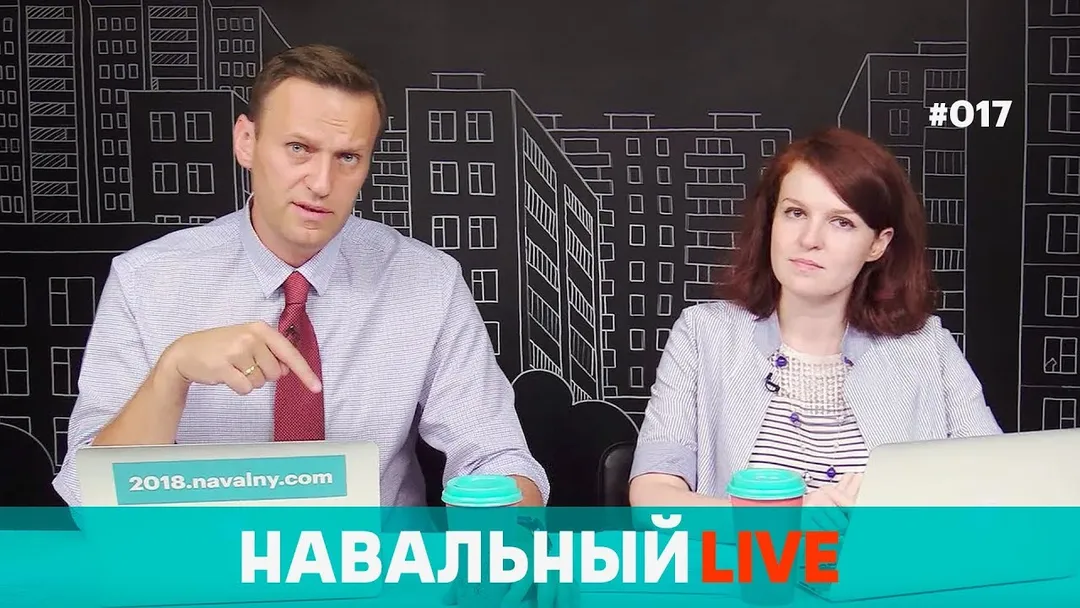
[music]
Good evening. In Moscow, it's 8:18 p.m.
That means we're live in the Navalny Live studio.
I'm Alexei Navalny, and Kira is helping me.
Yarmysh, and we're here to answer
your questions and discuss this week's
most pressing topics, the things that concern you.
Please send your questions on
Twitter or VKontakte using the hashtag Navalny
2018. We'll try to answer them first.
To begin, I wanted
to apologize to those viewers,
those YouTube viewers who last
Thursday came here to YouTube and
found that there was no program. I simply
overestimated the reach and power of my Instagram,
where I wrote that I was going away on
a six-day vacation and would miss one
program, and unfortunately many people
really did miss the broadcast.
Please forgive me. I'll try not
to miss it whenever possible. We
even plan the schedule of my regional trips
around the fact that I need
to always be on air. This program is very
important. Where shall we start, Kira? We'll start with
the story about the shooting in a hotel.
Yes, we'll begin our broadcast with the story of
the hotel shooting, because
this is exactly the kind of thing I want to spare you from, my friends.
This is why I'm
running for president at all, because, well,
it's impossible. This is just an incredible story
about Putin's elite—this is exactly what they're
like, how they live, what their lifestyle is,
and the level of their absolute, total
impunity. So, here's the story.
Of course, we've seen it
in the press, but still, let's
go over it all again. A former senator, a member
of the Federation Council (Russia's upper house of parliament), there was also some
fancy title—he was an adviser to an aide,
an adviser to an aide to President Sergey
... an adviser to an aide to the president—
Umar Dzhabrailov, by the way, who also once
ran for president of Russia,
got, well,
78,000 votes—that's 0.1 percent. Well,
never mind. He was a well-known person, a very
well-known person, an official
who was quite close to the current authorities.
And as I said, a typical
representative of Putin's elite. So, as
we learned today from the press, under the
influence of drugs—well, to put it bluntly,
forgive me for using
that kind of language, but let's say it plainly:
high on cocaine, with a pistol in his
hand, the former senator was walking around the hotel.
Security guards and surveillance cameras saw him.
Then at some point he went back into
his room and started shooting into the ceiling with
that pistol, explaining it by saying that
supposedly his dinner had been brought not by
a waiter but by a cleaner, and he fired five
shots into the ceiling. He was apparently so offended
by being served incorrectly that he
pulled out the pistol he had.
Officially, it was an award pistol,
and what's separately astonishing is that he
had a permit to carry this
pistol, actually.
An award weapon is a rather strange thing
for a person who is not
a serviceman, but he also had
a permit
for the award pistol and ammunition for
it, and he started firing this pistol.
The hotel security guards, as I understand it, not
wanting to get involved with an influential
businessman of Chechen origin,
called the police. The police arrived,
and he told them, "I'm going to
shoot back to the very end now."
After that, they did detain him after all
and took him to Kitay-Gorod. I've been there many times,
I was detained there too, but you know,
when I was taken there, what happened later to
Dzhabrailov did not happen to me, because
as the newspaper told us,
Moskovsky Komsomolets, at the police station
in Kitay-Gorod they declared "Fortress Plan"—that
is, they effectively barricaded themselves in,
because they were afraid of certain
I don't even know what to call them—associates,
countrymen, bodyguards, friends,
of businessman Dzhabrailov and former
official Dzhabrailov, and the police
barricaded the Kitay-Gorod police station. This is the very
police station whose jurisdiction includes
the Kremlin, whose jurisdiction includes
Red Square. If a hooligan
is picked up on Red Square, he'll be taken to
the Kitay-Gorod police station—that is, the heart of Moscow,
the heart of the country. The police station goes into lockdown because
it's afraid that, uh,
the senator's friends are about to storm in. And he explains to them—
here's the headline from Moskovsky Komsomolets
that you can see now—what explanation did he give them?
Well, he said that
he was angry because he had been
served incorrectly.
An unfortunate mistake, and therefore he
fired.
The explanation was that he didn't know how
to use the pistol and started trying to
figure it out.
Did you hear about the mistake? I heard
the following. That's all—why was he released?
It was an award pistol. He
didn't know how
to use it, what to do with it, and
started figuring it out. Just imagine: at night, in a hotel,
in a hotel,
the perfect time to figure out how
a pistol works. And in the course of these remarkable
investigations, he fired into the ceiling, then again,
and again, and then again—five shots into
the ceiling. Then the police came, and he
for some reason told them, “Now I’m going to”
“shoot back to the very end.” But
it’s astonishing, yes, but we kind of keep
joking about it. And in general, quite a lot
of people laughed about it online. But in essence,
this is monstrous trash. They released him
on a travel restriction pending trial, even despite
the fact that it was obvious he was under the influence of drugs.
And today there was already
expert confirmation that yes, there was
drug intoxication—drug intoxication.
So, uh, he was high on cocaine; that is,
generally speaking, not even metaphorical. And now
it is a fully established legal fact. And that is exactly
what it was. We can see the headline.
A little later they showed us that he
explained the shooting as “checking the weapon.” So
they released him. Even if he had not
fired the pistol, that in itself is
an astonishing fact. I apologize for bringing up these
sort of personal details from my
biography again, but I quite often end up under
administrative arrest, and with me
there are quite often drug users locked up as well. Usually
they make up no less than 30–40% of the
people in a cell, and they get 15 days for
drug use. And this happens
like this: local operatives, uh,
if they know there’s a drug user in the area, simply
grab him near the entrance to his building and take him for testing.
They draw blood, and within half an hour
it turns out that they are in a state of
drug intoxication, and they get 15 days.
No, all right, 15 days—I actually wanted to say
I wanted to talk about today—well, yesterday, rather,
there was a news post on Facebook: Ilya Zhigulyov
—a journalist from Meduza (an independent Russian news outlet)—his brother, and
he has already been in pretrial detention for 9 months
on charges of drug dealing.
But those drugs were planted on him,
and
the police refuse
to take a polygraph test. They
refuse, and of course all the testimony
of the police officers is accepted without
any questions.
And as I understand it, on September 11 there should be
a verdict, and he is facing
up to 10 years.
Please look it up—Ilya Zhigulyov.
Type it into Facebook and you will find his post.
It is really something useful to read
for every citizen of Russia, about how
drugs are planted and how
criminal cases are fabricated. And that is exactly why
I decided to start with this. Why do I
want to say that this is something I want
to rid the country of, why I am running for
president. It is simply impossible to look at this.
Yes.
They plant drugs, and this person has been sitting
for several months already—in pretrial detention, 9 months.
He is in pretrial detention right now, during
this broadcast. Our campaign headquarters coordinator in
Volgograd is on trial.
On
them they are demanding that his travel restriction pending trial be changed
to
detention in custody because he
went to ShtabCon, our event, and
the criminal case opened against him
was over a Photoshop image. Do you
remember that story with the green antiseptic dye (zelyonka) and
the Motherland Calls statue? That is, he
is accused of having
posted a Photoshopped
image online, and because he went to
Moscow they are arresting him. Meanwhile, the man who
fired a pistol into the ceiling while under
the influence of drugs was released.
This is simply impossible, it’s just—
it is absolutely monstrous, I don’t even know
whether to call it trash, injustice—
there are not even words that
can convey this
disgusting style of Putin’s elite. These are
people who have realized just how far
outside the law they are. Absolutely no one can
do anything to them—not the police, not
the FSB (Russia’s security service), no one at all. Just imagine what
would happen to any opposition figure
if he, I don’t know, were simply
walking around drunk in a hotel, not to
mention pistols and shooting.
Many years in prison, an unjust
trial. But with these people, anything goes, and
after all,
they can kill anyone.
Naturally. By the way, Dzhabrailov
was once accused of
having killed his American
business partner—there was such an accusation.
Uh, it could not be proven, but nevertheless
at least there were some grounds
to accuse him of it. And
you and I understand perfectly well that, well, God forbid
you run into him in that hotel corridor—
into some generalized “Dzhabrailov.” Yes, this could just as well be
some Rotenberg or
Ramzan Kadyrov or Timchenko or
some son of Peskov, the one about whom
we published reports, who committed
an assault in the United Kingdom and here beat
his own grandmother. He will shoot you, he will
shoot your relative, he will
shoot anyone—the maid, the waiter—
and nothing will happen for it. A whole caste has formed
of people who are absolutely
above the law. And this is not happening
secretly, you know—not like a case was hushed up
and nobody knows about it, complete
silence, as it was in the Soviet Union, when
some
party boss from the regional committee (obkom) was throwing his weight around, something
got beaten, broken—well, somewhere at the top it was
discussed, but it never reached the wider public. Here
it does reach the public—newspapers write about it, yes.
quite large even under censorship
and everyone understands: yes, they’ll let him go
and
and they let him go — can you imagine what
happens? For example, the same thing happens in Chechnya. Well,
I’ve spoken with Chechens. Roughly
about these kinds of things. Well, yes, they say that
you can kill anyone, and people are killed
accused of being terrorists or something
or extremists — they just take you somewhere
torture you, shoot you, and dump your body
and your relatives can never find you
and these are no longer isolated cases
these are things that happen all the time
that’s why I’m running in the election, because, well,
equality of everyone before the law is not even just
some pretty phrase that
sounds nice to say — it is a real
need that we need right
now, because we do not want to see
senators firing pistols; we do not
want to see State Duma deputies — remember
there was that story, remember, about the golden
pistol? No?
Kira, we wrote a post about it a very
long time ago — a State Duma deputy who was
walking around the State Duma with a pistol and got into a scuffle
with another deputy, Zhuravlyov from United
Russia, the leader of the Rodina party — there
a golden pistol fell out of his pocket
a golden pistol, literally, and then
well, I mean, you just laugh
because basically, in any normal
country, this sounds like some bizarre
and disturbing — people with golden [guns], why are they carrying
them around? Why does Senator Dzhabrailov need
this pistol? He has a huge number of
security guards, and as we know at least from
similar scandals, after all
not that long ago, in 2014, there was
some kind of clash between his security and
those Night Wolves bikers led by “The Surgeon” (a pro-Kremlin motorcycle club leader)
there was gunfire into the air there too
a damaged car — they were settling something, I mean
these are literally gangs
operating outside the law, not
somewhere in the forests of Chechnya, but right in
the center of Moscow, and a police station in
the center of Moscow shuts itself off from them because
of these fighters — so what are
ordinary people supposed to do, even in Moscow, let alone
Chechnya? That is why
the government needs to be changed, if only so that
when a person reads a headline like this
this morning the headlines started: senator
Dzhabrailov arrested, detained for
starting to shoot somewhere in a hotel at
the ceiling — you can tell in advance how it will all end
people immediately started writing, and I immediately wrote: well,
obviously, at most he’ll get a travel restriction
and it will all end in nothing — and that is exactly what
is happening, and it will end in nothing. I
personally strongly doubt that they will even
take away his gun, and I certainly do not believe in any
arrest, prison sentence, real
verdict — everyone knew, 100 percent of people knew, that
that this is how it would go. Here is a representative of the Putin
elite — and of Kadyrov’s elite as well — he
even without Kadyrov, on his own. I think
not just think — I’m sure, simply based on
the nature of his business, which also exists
through ties to the authorities — first under Luzhkov (former Moscow mayor),
and now under Sobyanin’s and Putin’s
he can do this, they can do this
they can do it — they just walk around shooting
That is why the authorities need to be changed, at least so that
people would read headlines like: former
senator started shooting at the ceiling, and they
would understand: well then, soon we’ll
see his trial, he’ll end up in the defendant’s dock
and then he will apparently receive
some sentence, suspended or real, but
he must receive some kind of punishment
proportionate to what he did. And what he did
again, was this: an apparently cocaine-intoxicated man with
a pistol in a public place. Well,
that is pretty, pretty serious, I think. We
have a report here on Mediazona saying that
Dzhabrailov was not issued an award pistol
to Dzhabrailov. So this may have been
not an award weapon at all
Well then that sounds absolutely incredible
if he — if he did not have a permit
for the pistol. I had written that it was
an award weapon given to him by Minister Nurgaliyev
but now I’ve seen that the pistol apparently
— apparently a news update has just appeared
let’s do a poll — we can do
a poll on Twitter and VKontakte
Today I was arguing with Pavel Chikov, a
very good lawyer and human rights advocate, the head
of the human rights organization Agora
who, by the way, said he was outraged by
Dzhabrailov’s actions but believes that
he should not actually be arrested, nevertheless
even despite the brazen nature of this
uh, misconduct — crime, I would say
let’s vote on VKontakte and on
Twitter: should he, should he
be arrested — Umar Dzhabrailov — for
such an interesting
happening that he staged
I can see it now: the Interior Ministry says billionaire Dzhabrailov was not
issued an award weapon. Ten minutes ago the Interior Ministry
is telling us — billionaire Dzhabrailov, I see
this headline — was not issued an award
pistol. Then the question to the Interior Ministry is: guys, why
did you let him go? I don’t understand then
so an apparently cocaine-intoxicated man with
an illegal pistol fires into the air and
you release him under a pledge not to
leave? This is just unbelievable. Right now I
see news that for our coordinator
Alexei Volkov the prosecutor is demanding
house arrest. This is the very same
wonderful person from Volgograd
who, simply because he traveled to
Moscow for a gathering of coordinators for
in a criminal case opened because of
a picture on the internet, he will be kept under
house arrest, as the prosecutor is demanding
— incidentally, under an article that does not even
provide for actual deprivation of
liberty. That is, there is a direct ban on
restricting the freedom of people charged under it. But I
I hope he remains under a travel restriction, but
something tells me they are about to impose
house arrest on him, while Dzhabrailov, with his
pistol, which we did not even issue,
will remain free. What will the people feel
who are now sitting in pretrial detention centers (SIZO) over the rallies of March 26
and June 12, in SIZO and already in prison? What
will their parents feel? What will
they feel?
And what about ordinary Russian citizens? We have
a prison population of one million people. I do not
doubt that out of that million people
some 200,000
are innocent, or people who are guilty
but, generally speaking, should not have been
in prison. And they will look at this and—well,
or rather, they will not even see it. Of course
the newspapers write about it, but on
television they say nothing about it either.
Well, some fairly
major newspapers covered it, and we talked about it on
our program. Probably around a million
people in the country know about it, but all
the rest—the rest will be listening to
Putin’s Direct Line (the annual televised Q&A), where he will say that in our country
everyone is equal before the law, the rule of law is for
everyone, and
well, this is how it actually works. So this
once again shows the importance of
spreading information, because
regardless of whether someone considers
themselves an opposition supporter or does not consider themselves
one, regardless of politics,
regardless of any person’s views, any person’s
position on foreign policy—on this, absolutely
no one can agree. Take any
person off the street and tell them
this story—they will simply be furious, because
if you imagine yourself or your child in the place of
that waiter whom
Dzhabrailov threatened to shoot because
his lunch or dinner was served incorrectly—
we have a poll going on,
right, yes, but so far there are no
results. Please write in
with your opinion on this topic. Do we have anything yet?
Mostly, to be honest, everyone is
discussing Doshirak (a popular instant noodle brand), not what is written on
your cup.
I do not understand why everyone is so
hung up on Doshirak. Truly, my most
popular photo in the last
few months is a random
photo of me eating, frankly, a Doshirak cup taken
from one of the campaign staffers,
because I missed lunch, arrived,
had missed breakfast and lunch, and said: give me
something to eat. And on the way I ran into
one of our staffers, Olga Guseva,
who said, I have Doshirak. I
said, give it here, and ate it. They photographed it,
and people have been discussing it for two days. Uh—
it is unhealthy, I think. I got used to eating it in
special detention centers (short-term detention facilities). From my own experience I
know that, despite the fact that it tastes good,
when you eat it for three days in a row, you really
feel as if your stomach is being eaten away by
terrible acid. So probably if
you really want to eat, or you are
really hungry and need to eat something
right now, as happened to me, then you can
try it. But overall—well, I wrote
on the cup, yes, simply because
for people who are reaching for Doshirak right now,
because I am already starting to want
something else: eat some kind of
fruit, or just do not eat Doshirak if there is
anything else available, simply put.
In a cell, it really is the most common
item, because boiling water is available there without
restriction, and it comes with everything—a little fork, there is
a little fork, exactly right, very
convenient. It is dry, it keeps for as long as
you like. Usually there are huge
bags stuffed with this Doshirak. You
pour hot water over it, stir it quickly, and eat. But
if you are in real life and
can, I do not know, eat vegetables and fruit,
porridge, meat—
do not.
Do not. Take care of your stomach and eat
it only if, God forbid, you find yourself
somewhere with no access to other food.
We have been talking about Doshirak for too long. So,
people are also writing to us—apparently this is already for the next
topic. I am actually very interested
to hear about Otkritie, because
I use it actively.
I am very interested in talking about
Otkritie.
The main topic, as you said today, yes.
Absolutely. I think this is the main topic.
I think that despite the fact that a great
deal is being said about it, people are still talking
too little, and not talking about it the way it ought to
be described. Because what happened with
Otkritie,
for which a bailout was announced, in effect
means that Otkritie Bank became the property of
the Central Bank, and therefore
a state-owned bank. Only 25%
remains—well, according to the Central Bank, a stake for
the shareholders. What happened is one
of the largest fraudulent, mafia-style
deals of our time, which we
are witnessing right now. It is happening before
our very eyes, and it is being carried out by the shareholders of
Otkritie Bank together with the wonderful
employees of the Central Bank and with the personal
involvement of Elvira Nabiullina, who, uh, actually
is very inclined to be fond of our
the liberal public, the progressive segment of society
some kind of economic bloc, but
this
essentially a gigantic fraudulent scam
What happened? Let’s call things
by their proper names. Otherwise, everyone writes about the bank’s resolution
saying that Otkritie Bank was poorly managed
and went bankrupt. Otkritie Bank
actually rose into the ranks of major
banks precisely thanks to Elvira
Nabiullina, when she became head
of the Central Bank. It was constantly receiving
money from the Central Bank; it
was constantly receiving funding for
the resolution of other banks. For example,
Trust Bank was one of the most well-known
examples. It received a huge amount
of money for Trust’s resolution. And now it is already
clear that at the time Otkritie was experiencing
financial problems, and nevertheless
the Central Bank assigned Otkritie the resolution of
another huge bank. But before that, they had also
absorbed Nomos-Bank, which
was actually larger than Otkritie. They had
rather dubious deals involving
Eurobonds. In other words, this was a
constant
close and highly suspicious
relationship with the Central Bank, and obviously it
was personally overseen by Nabiullina, and Otkritie
was pumped full and full and full
of state money. When its problems began
at Otkritie—yes, it was already clear even from
the public reporting that things were not going very
well—it still kept receiving money, and
even for the resolution of other banks
And now something astonishing is happening.
We have a quote from a Central Bank
employee, a deputy chair of the Central
Bank, Tulin. Let’s take a look at it.
Please show us that quote, where
Tulin tells us that
in the reporting—apparently, no, this quote is in
the reporting not of the Central Bank
Sorry, in Otkritie Bank’s reporting. Here it is:
this
They submitted inaccurate reports, and
there were material changes, and the bank’s capital
as published in the reports was
apparently significantly overstated. You know, that is
an astonishing thing. So here we have it:
the bank effectively collapsed; it would have gone bankrupt
if not for the Central Bank’s bailout
Obviously, that is a failure, and the Central
Bank—which, let me remind you, receives reports from ordinary banks
twice a day, which
constantly monitors them and tracks
their compliance with various indicators—suddenly
tells us: well, apparently something there was
overstated. Well, if it was overstated,
then you press the red button
and open a criminal case. So it turns out
these people falsified the reporting.
If they falsified the reporting,
then why are you saving them now? Why
do the private shareholders retain part of
Otkritie Bank? Why are you once again pouring
huge sums into it? Again, calling things
by their proper names, what happened is that the bank
collapsed because of bad management.
The bank went bankrupt despite the fact that
the Central Bank was obviously
acting on corrupt motives
when pumping it full of money. It still went bankrupt, and
now, to save this bankrupt
bank, we have to
pay out of our own pockets. That is what they are writing about, and
about Otkritie: the Central Bank has effectively
bought it out by printing unbacked
rubles—that is, at the expense of us, the taxpayers,
by increasing inflation.
So, are we right in understanding that right now
many—you’ve seen the headlines—many
media outlets and analysts
have calculated that no less than 1 trillion rubles
will have to be pumped into Otkritie Bank. And there
are different estimates, from 0.8 trillion to
1.2 trillion rubles. In any case, that is
an enormous amount of money—effectively
money creation, that is, roughly speaking, the money
will be printed in order to, uh, save
someone’s capital. Yes, of course we do not want
ordinary people,
depositors of Otkritie Bank, to suffer, but
generally speaking, we understand that most of them
do not have very large accounts there,
and the overwhelming majority of those
people would simply have been covered by
deposit insurance—their deposits are insured. What
the Central Bank is doing is saving rich
bankers. It is saving bankrupt
bankers. It is saving bad bankers.
Again, take these private minority shareholders.
Let’s remember: there is Mr. Fedun,
an oligarch and billionaire from Lukoil; Mamut,
an oligarch and billionaire; and Belyaev himself,
one of the founders of Otkritie Bank, is also,
as I understand it, a multimillionaire. Uh, who else is there?
Gangvin, and all these
various gentlemen. And why should we
be saving them? Why should they
get to keep 25% of Otkritie Bank, or
indeed any percentage at all? But if
they went bankrupt, if we are using our own money
to save them, if we are saving them with money
that will lead to inflation,
that will lead to rising prices, and when we buy
food in the store, we are effectively
financing the rescue of Otkritie Bank—then
why do we need any of this? This is
a truly colossal scam. I don’t even
want to say it, but it almost
diminishes the cases we
work on. Compared with this,
those dachas we showed
suddenly do not seem all that important anymore. One trillion rubles
—one trillion—
into Otkritie Bank, and the whole
Russia's financial system
a well-known topic, as I understand it
the shareholders of Otkritie Bank and the Central
Bank is now explaining this with the famous
"too big to fail" argument, meaning it is too big and
if we don't carry out this bailout now, then
everything there, absolutely everything, will fall apart, it will all
collapse
Well, first of all, Otkritie Bank is not so
big that everything would collapse — that's the first point
second, well, what are we supposed to do now,
pay for this every time?
I mean, fine, if it is too
big and
the banking system will freeze up there, well
then let's untie it from the rest of the
banking system, let's
finance whatever actually needs
to be financed, but excuse me
saving the capital of some oligarchs
that got stuck in Otkritie Bank, saving
the bank's shareholders and preserving for them
some kind of equity stake — well, that is
complete nonsense, this is not at all
any kind of rescue of the banking system; moreover
in fact, the nationalization of Otkritie Bank
will lead to the state
now controlling, uh,
60% of the country's banking capital, that is
Russia's banking system
belongs to the state. Putin will not
admit this, Putin will not admit it
and the Central Bank won't admit it either. You know perfectly well why they
won't — because they will lie, distort things, and
say, well listen, what is a state bank?
It's something that belongs to the government;
for example, VTB is a state bank, a bank under
state control, Rosselkhozbank is some kind of
And Sberbank belongs to the Central Bank
yes, yes, and Otkritie belongs
to the Central Bank, and the Central Bank is a
supposedly independent body. Central Bank employees
including Nabiullina (Elvira Nabiullina, head of Russia's Central Bank) herself, are not even
civil servants. But that is
a huge lie. We understand that all of this is
the state; we understand that there was, well,
simply, uh, a major corrupt deal, and in
the course of this corrupt deal they either
uh, in the course of a series of corrupt deals, either
squandered this money — well, a significant
part of it was apparently stolen — and now we are supposed to
compensate for all of it under the pretext
that otherwise the banking system will collapse. Well,
what is the point of such a banking system? It has
once again become state-owned, and everything around it is
state-owned, that is
the long-term consequences for the banking
system from this state
control will be far, far worse and
more negative than if Otkritie were
allowed to go bankrupt now. At the very least, all
those people who were running things there
as well as the Central Bank officials
who were pumping Otkritie full of money — they
should be disqualified, they should be driven out, they
must never again be involved in any
banking business. That's the only way. And this is
very, very bad. It will lead to
negative long-term consequences
Maybe let's also do a poll about Otkritie
as well, but first let's wrap up
the poll about Dzhabrailov (a Russian businessman)
on Twitter: yes, he should be jailed — 97
percent, no — 3. And on VKontakte: yes, he should
be jailed — 98%. Well, as usual, VKontakte
more than Twitter, but overall the
poll results are fairly obvious, especially
in light of the latest news that even the
gun there, it turns out, was unlicensed
let's do a poll about Otkritie
or rather not even about Otkritie, but about the Central
Bank, because, well, we understand the people
who worked at Otkritie — they are businessmen, they
acted in their own interests, they were there
whether corrupt or not corrupt
but they openly stated their goal: we want
to make money. But the Central Bank
looks a million times worse here
Nabiullina looks a million times
worse here. They receive salaries, they ride around in
those black cars, they are vested with
enormous powers in order to
control the banking
system for us, in order to
monitor banks' performance indicators, and they
are not paid in order to
come out and say this thing, that the bank's capital
was substantially overstated. And I have
a question then for the audience on Twitter and
on VKontakte: do you trust the Central Bank
after what happened at
Otkritie Bank? Do you have any trust
in the Central Bank as a regulatory
body
a supervisory body, a body that
is supposed to keep an eye on inflation
target inflation, and, broadly speaking, a
major
regulatory body that monitors the
state of the economy and has
fundamental importance — do you trust
it? You can vote on
VKontakte and on Twitter. What are people writing to us?
A question continuing this topic: is there
any thought that after the bailout the Central Bank will sell
Otkritie and get the money back? Yeah, sure
if you have that thought. And all the rest —
did they sell it? Did they sell Sviaz-Bank? If you
can give me an example of how a
nationalized bank, after a bailout,
was sold — Globex, maybe? They haven't sold a single
bank. They keep all of it for themselves
They talk about it: we'll sell it, we'll
privatize it, we'll do something. But not once
have they actually sold anything yet. So there is
no doubt that now they will pour
money into all of this and leave it all in place for
at least the next few years, that's how it will be
A state bank will be sitting there, well,
some kind of crooks on the management board and on
cheap government money, building
their own, their own wonderful, uh,
their wonderful business and making
huge profits. By the way,
I wanted to discuss something that, well,
is probably already intuitively clear to anyone
person.
Whether they actually understand how
a bank works or not, for
the sake of rescue—you yourself said it, look.
Let me ask your opinion. Haven’t you ever
had anything with Otkritie yet?
Well, have you ever bought something on credit—
a washing machine, a car, just something, well,
I guess, probably?
You paid it off, you paid it off. But 40
million people in Russia couldn’t
pay theirs off. Our total debt
of private individuals—just ordinary people—to
banks amo- amounts to about 11
trillion rubles (about $120 billion). These are people who bought
their washing machines, and they can’t
pay them off, they have no money, and after these
people come debt collectors, trying
to squeeze something out of them. Yet we allocate for
the rescue of Otkritie Bank, well, basically,
one trillion here—it was one trillion
here, one trillion overall—a broadly comparable
sum. The question is:
If presidential candidate
Navalny were to say, let’s just forgive some people
their loans altogether—oh, I can
imagine what would start.
Oh, everyone would cry out: what terrible
populism! How can we just hand out
money? That would fuel inflation, it would
breed irresponsibility among people
who should have thought, damn it, before
buying their microwave oven. But
here exactly the same thing is happening.
We’re simply giving a trillion rubles
to pointless, incompetent, shady
bankers and officials, including people at the Central Bank,
corrupt ones, and there, without any
interest, we are effectively forgiving debts. We
even let them keep some part of
their shareholder capital, and everyone says:
what a great economic decision this is.
This isn’t populism, it’s saving the banking
system. But how is that any different? If we’ve decided
to just hand out money like that,
then why not
Well, at least then we’d be giving money
to cover
bad financial decisions,
paying for bad bank management.
Then let’s give money to these
poor people who bought themselves a washing
machine and are short 500 rubles (about $5) to
make the payment.
Mamut is a close friend of the Yeltsin family (Boris Yeltsin, Russia’s first president). Putin
has to look after not only his own
friends, but the Yeltsins’ friends too. Well,
Mamut is no longer just a close friend of the
Yeltsin family—Mamut is a close friend of the Putin family too.
Mamut has done a great deal for Putin.
In particular, as we know, he destroyed
Lenta.ru, which had been an independent outlet.
He has badly damaged the Russian internet. Well,
he would probably say, I’m developing the Russian
internet, like, uh, Alisher Usmanov—but we
know perfectly well that he is one of
those carrying out a policy of censorship within
the internet, and he’s doing some
dubious things with, I assume,
corrupt ties to the Moscow city government right now
around all these damn schemes.
So, uh, this isn’t about the Yeltsin family. I don’t know.
I’m not going to speculate here and
guess whose money is being saved, whose
deposits are being rescued at Otkritie Bank. Or
if we do speculate—maybe Chubais’s, maybe
Medvedev’s, maybe someone else’s.
But it’s very clear that there are some
powerful interests there—maybe even Nabiullina’s herself, I don’t know.
But one thing is absolutely clear to me: this whole
thing,
well, not just dubious but obviously
criminal scheme with Otkritie Bank is
about saving the money of some major
officials. That’s exactly what it is. And we’re handing over
money, yet it doesn’t even occur to anyone
to say, let’s, uh,
somehow lower mortgage interest rates.
Can you imagine how many
free mortgage loans—well,
free in the sense of interest-free mortgage loans—we
could have
given to people who need
housing, who work honestly, who would
take the loan and pay it back, unlike
Otkritie Bank, which cannot
return its money. How many people who
really do have some
objective difficulties could have had
their consumer loans paid off. And
remember the foreign-currency mortgage holders? Yes, yes.
The discussion was: ah, those scoundrels with foreign-currency
mortgages—they were the ones chasing a better deal, they
took out their loans in foreign currency, and now they
must pay the price for having
turned out to be such cunning fools when it came to
loans. And there they are, standing there
with their children or setting up tents
somewhere, demanding not even that they be
forgiven, but that their loans be converted into rubles at
some exchange rate. No, those foreign-currency
mortgage holders get nothing. But here, by all means—
Mamut, Fedun, you are our best friends.
Belyaev, wonderful—you managed the bank terribly,
you all went bust together, you
were supposedly rehabilitating other banks for hours, and now
you’re on the verge of bankruptcy. You lied about some
cable or something—what was it, two weeks ago?
Everything was supposedly fine, and then, uh, our
cable snapped, I think, and that’s why the ATMs, they...
they issue them to individuals. Everyone says, yes, yes, yes.
The cable, the little cable. Listen, do we have
that great screenshot that
the technical support service sent out
from Otkritie Bank? It's an amazing thing. Here,
just on its own, simply an example of
how much they take all of us for idiots
around them. And how much this bank,
Otkritie, has latched onto money and thinks
that all of this is, uh, well, this very, uh, very
proper thing. Well, I don't know, if we can find it now
and find the screenshot, we'll take a look.
No, that's not exactly the one, more like, yes,
this is what Rocketbank sent us.
Rocketbank also sent this to its clients.
Rocketbank is like
an offshoot of Otkritie Bank. And what do we have?
It got even better. There was also this
message that Otkritie's support service
was sen- sending out, and it was all framed
in this tone: great, good
news, our bank is now under the control
of the Central Bank. That means 100%
reliability, deposits are under no threat.
And generally, well, this really was
written as: good news.
It's amazing.
What they should have written was: our bank
has gone bust, our management is
incompetent, and we've been nationalized.
But no, good news, which means everything is
great. Well, once again, I'll repeat,
I apologize if I keep droning on like a parrot
repeating the same thing: this is a gigantic mafia-style deal
in which the leadership
of the Central Bank is implicated. They all should, of course,
either be put on trial for this or
simply be thrown out of their jobs,
because what kind of banking supervision
can they possibly
exercise if one of the
largest banks, as they themselves now
say, was submitting fake reports to them,
and they saw nothing. Well, rather, they didn't see it
just like in the situation with the snapped cable
where they were also, in a way,
playing along with all of it. What are our viewers writing to us?
They're writing a lot of things, but right now I wanted
to ask a question not about Otkritie, but
they're asking about Kirovles (the Kirov timber case), though we've kind of drifted off into Otkritie. Let's
move on.
Briefly, I'll say right away about Kirovles: I'm going to
Strasbourg. I
on the fifth or sixth—on the fifth there will be
a briefing
on the Kirovles case before
it is considered by the Committee of Ministers.
So there is some movement there; I'll go
and will be representing this
body that will be considering
the question of why Russia is not
complying with the European Court's ruling on
Kirovles. I'll be explaining what
is happening in my case. I am the rapporteur there—well,
in the sense that I am the applicant.
In that sense, I'm not going there as
a presidential candidate; I'm going simply as an
uh, unlawfully convicted person.
So there is some movement there.
Now, back to Otkritie—what are people writing to us about Otkritie?
Well, some bloodthirsty people are also saying that
they are against rescuing either banks or
mortgage borrowers, right?
Guys, this isn't rescuing either banks or
mortgage borrowers. This is rescuing specific
oligarchs who keep money in
Otkritie, rescuing specific officials
who profit from the oligarchs who
kept money in Otkritie. So, well, we're not
saying that we need to
switch on some kind of economic Darwinism and
if a bank is dying, well, to hell with it, immediately
bankrupt it and let all those
depositors end up out on the street, losing
their money, running around with their cards,
standing in huge lines. None of that
is necessary. That's what, broadly speaking,
the deposit insurance system was created for, and
of course it can be arranged so that
95% of the people who had deposits in banks, including
at Otkritie, do not suffer, and
society and the state's economy
are interested in making sure that a large
number of people are not harmed. But what
is happening now is specifically the rescue of
enormous fortunes, and us paying for
gigantic corrupt deals. And once again,
once again:
American trillions, tens of
billions—any Krestovsky Stadiums (the Saint Petersburg stadium project),
Crimean Bridges, and all these World Cups
are just nervously smoking on the sidelines compared
to the money that was stolen
during the bailout of Trust Bank, all these
schemes involving Russia-30 eurobonds
and everything else.
What else do we have? The results of the poll:
On VKontakte: Do you trust the Central Bank? Yes,
6.6%, no 93.4%. On Twitter: yes, we trust it,
11%; no, 89%. So people are clearly
hardline and uncompromising, but overall
uh, people do not trust the Central Bank. Well, I
honestly don't even know how that trust could
remain. One thing interests me: will
Elvira Nabiullina once again receive this year the prize
from Russian—who is it there?—some
some banking associations that every
year award her the prize for best central bank
governor? It seems to me they should literally
take,
take Otkritie's banking license and print right on
it: Best Central Bank Governor,
and present it to her. What a
star. Well done—solved all the problems, printed
a trillion rubles, covered the money,
shut things down incompetently, ga- gave money
to the 'competent bankers.' What are people
asking about this topic?
I can't stay.
People ask us, well, does Nabiullina call on us to do this?
"Hand out money to missionaries, for example."
Or, look: "Nabiullina, hand out..."
"...money to pensioners." Well, of course that sounds
like a populist slogan, but what can you do?
Nabiullina is doing exactly
the opposite. "Nabiullina, collect..."
the pensioners' money and hand it over
to the shareholders of Otkritie Bank"—that is what she
is doing in practice, without exaggeration.
The pensioners will pay for all of this, uh...
That is what is really happening. It's the same
kind of thing that seems to sound, like, well,
completely unrealistic and
well, not realistic, right? "Nabiullina, hand out
money to pensioners"—impossible. But the reverse is entirely
what is happening. She collects money from
pensioners and gives it to oligarchs,
to these banking fat cats,
these fat cats.
Yes, yesterday people may have been surprised by my
vehemence against Otkritie. A lot of people, you know,
think that I shouldn't say anything
bad about Otkritie, because at one time
the bank's shareholders, as is well known,
went to Bolotnaya (the anti-government protest rallies in Moscow), and even at some
public events said that they were
for change. Well, great—when they were
for change, that was very good. But
first of all, they somehow very quickly
stopped saying, uh, that they were for change
after, apparently, they either got
slapped down there, or sorted out their own banks,
their own financial issues. In other words, we can see
that overall these people, who may be
pleasant to some and whom people don't want to criticize
because they speak good
English and probably also don't, uh,
like obscurantism of some kind—but between
change and those wonderful, uh,
financial relationships with central
banks that enrich them in absolutely
fantastic ways, they chose precisely that
illegal enrichment, not change at all.
They are pillars of this regime, and they
are robbing us, even despite the fact that there was
a period in their lives, uh, when they
wore white ribbons (a symbol of the 2011–2012 protest movement). Again, not about
Otkritie—back again, I just now see
the news after all.
Our coordinator in Volgograd has been found, yes? Or rather,
they've imposed house arrest at his registered address in
St. Petersburg.
That is, not where he actually lives—all of this
just so that he has to leave Volgograd.
Scumbags, crooks, people with absolutely no
conscience. Just imagine: a person, over
a picture, without even proving that he
posted it—a Photoshopped image. He came
to Volgograd, and he lives in Volgograd. Well,
that's where his life is, but at the same time
he is officially registered in St. Petersburg, so they put him under house
arrest at his place of registration. That means he
has to leave now.
He'll be sitting there under house arrest, while
the investigative actions will take place in
Volgograd.
Easy, Alexei, don't say any
phrases that can't be said on a live
broadcast and that will later be used
against you. But this is the very definition of
villainy. The fascists who do this—these are
people who are enemies
of our country and enemies of the people—these
all these scumbags in the Volgograd courts and
the Volgograd Investigative Committee offices and
everywhere else, who do not want
to deal with real cases and instead simply
torment the people who are associated with
our campaign. I hope, and I would like
to make sure, that they of course
receive fair and severe punishment.
Let's all work together to make sure
that this happens. What is our
next topic?
Let's move on to the next topic. One more
unscripted question: everyone is
asking nonstop about Valery
Solovey.
People are asking whether you will cooperate with him
and whether we listen to his recommendations.
He gave a lecture for us at the St. Petersburg headquarters, he
was on *Cactus*—Valery
Solovey, the well-known political scientist,
who has become famous in recent years for some
fairly accurate predictions. In particular,
he had a prediction that the war—the war would take
the position of head of the presidential administration...
So the broader public learned about him
from that prediction. I've known him
for quite a long time, probably since
around 2007 or 2009. That is, I
know him fairly well. I don't really understand
—and he was your teacher, wasn't he?
He was, yes, and also the head of the department, and
my...
As you can see, everyone here in the studio
knows him well.
They know Valery Solovey. Well, I believe that
he is an outstanding political scientist, an excellent
publicist, truly a person who
understands politics. I just don't really
understand what "cooperate" means in this context. He is
an expert. He came on air in a bow tie,
as he usually does, in a bow tie, and
said what he thinks.
He interpreted certain political events.
We are grateful to him for coming. He
came to our St. Petersburg headquarters and gave
a great lecture there. You can find it on
YouTube and watch it. In that sense, I—well, I
see him from time to time. I carefully
read his publications and interviews.
So yes, I think well of him. But again,
what does "cooperate" mean? Listen to him?
Listen to him? I listen to all smart people
and read them carefully. Even...
even though I don’t always agree with them
or they don’t agree with me
they criticize me, but I try
to listen to smart people, and Slava I certainly
consider a smart person.
Great, all right, let’s move on to the next
topic, my favorite one: the Peskov segment. We’re
going to guess what he’ll actually say
when he comments on it.
He did comment on it, yes. Peskov replied that
he didn’t really reply at all. You of course remember
our investigation that came out two
weeks ago. It concerned
the son of Dmitry Peskov, Putin’s press secretary,
Putin.
Nikolai Choles, whom we showed to the whole
country—and most importantly, we didn’t show
the son, we showed his lifestyle. We
showed his spending. What did we have there?
There were cars,
there was
a Mercedes,
motorcycles, there were private planes,
private jets—in other words, this is a person living
the life
of a millionaire. At the same time, we proved and pointed out
that he doesn’t work anywhere, he, uh,
doesn’t even have a secondary education. He came to
Russia from the United Kingdom, where he served
a year and a half, yes, for assaulting
a teenager and taking his mobile
phone. Here too he gets involved in
various criminal incidents; in
particular, he ran over his own grandmother, uh, and he
doesn’t work anywhere, tears around in a car,
what was it, 116 traffic fines in a year, and the question was
a simple one: Mr. Peskov, where does your son
get his money, and isn’t Nikolai’s luxurious
lifestyle
evidence that Dmitry Peskov
receives bribes from his friends,
possibly, in particular, from, uh,
the billionaire Ziyavudin
Magomedov of the Summa Group?
And Peskov said in response: please show us
the quote. He does not want to discuss
his family; he does not intend to
discuss his family with us. But
that’s a great answer. I mean, it’s a wonderful
answer. He hasn’t seen it and doesn’t want to see it. We
really like that too—you know, it’s like
that famous Photoshop
image, right, where a person is sitting in a car
and there’s some monster outside the window. He closes
his eyes and says, if I can’t see it,
then it doesn’t exist. He doesn’t see it and doesn’t
want to see it. And he doesn’t want to discuss his
family. But we’re not interested in discussing his
family; we’re interested in discussing his family’s money.
No one is, uh—well, really,
what’s going on with your private life is not our concern. We’re not digging into
some kind of
internal relationships, family
matters—those are always complicated, many wives,
many children, complicated relationships—but
we’re interested in something else. If he were
just, say, some young
man with a rough temperament, and he
had gotten those 116 fines and drove a
Lada Priora or a Lada Granta, or, I don’t
know,
got into a fight with someone or something
happened, but he wasn’t flying on
private jets—you understand—we wouldn’t have been
interested in Peskov’s son. But as it is, we are
interested in him, his money, and
the huge number of our problems—in
fact, all the problems of our country—
are connected precisely with this style of life. We
have, well, similar examples too. For now,
show the headline. We just
looked at this quite recently.
There was a case in Finland where
Finland’s prosecutor general was removed
from office, yes, because
his brother had provided services. I mean, he
was actually working somewhere and providing
real services—services worth €74,000
to employees of the prosecutor’s office. So there
was, essentially, a conflict of interest: his
brother was providing services to employees
of the prosecutor’s office for professional training, but
even so, the prosecutor general resigned—
actually, he didn’t even resign, he was removed
from office. And the amount was €74,000
for actual services. Those
€74,000 are significantly less
than the cost of any of the cars
significantly less than the cars
used by Peskov’s son. And this
happened in Finland, one of the
richest countries in the world, yes, one of the countries
with the highest salaries. That happened there. More
recently, in France, there was
a scandal, and it was, I think, the interior
minister who left—was forced
to resign—because there was
some kind of scandal involving the employment of his
daughters.
And here, he doesn’t want to comment; he
isn’t interested in discussing it. Because of this, all
our problems exist: officials are completely
unaccountable. But again, I’m running in the
election because, well, because this
needs to be changed in the beautiful Russia
of the future. If and when I become president,
every official at the regional level—I’m
sorry, Kira, if you were my
president—
there should be a woman president in
Russia. But let’s imagine that you are
the president’s press secretary, and it suddenly turns out
that your son, nephew, or grandson
drives Teslas and flies on private
planes, and
publications about it appear on the
internet—you will have to explain
where that money came from. You will have to.
you should hold one within 24 hours
a press conference and explain where
all of this came from. That press conference
should end in one of two ways: either you
explain it, or it ends with you saying,
"Guys, I can't explain it. I'm resigning
because, well, I'm the subject
of an investigation." That's why especially
I like the fact that he says he hasn't seen it
and doesn't want to see it. I mean, this is
supposedly none of his concern at all. It doesn't
matter what people say about him — he just
isn't going to look. They don't want to see
anything at all. And his boss
— write to Peskov — didn't notice, yes, didn't notice
his own dacha (country house) that we published about.
You've probably seen our investigation. Well,
in fact, it was more of an add-on to
TV Rain's investigation (an independent Russian outlet), which unfortunately
for us — unfortunately for us — they
beat us to it. Good work by TV Rain, well done to them.
They published a report saying that one of
Putin's friends built him a luxurious
dacha, restoring the famous Villa Sellgren
which you've probably seen in
the Sherlock Holmes films, and that this dacha
is used for Putin's vacations, and there is
confirmation that he has been there. Here we're
showing a short clip now, because
what we can add — what we were able to add
to TV Rain's investigation — is specifically
a drone flyover of this dacha. There it is — it's
a huge complex covering 48 hectares
(about 119 acres); an entire peninsula is fenced off there.
There are villas there measuring 700 square meters
and attached to it is a new structure of, I think,
2,000 square meters.
There's a small historic villa,
and then something two or three times larger — a huge
extension. But as you can see,
the view is stunning. It really is a very
beautiful place. It's really wonderful there. Well,
watch this video if you haven't seen it yet.
Naturally, the shoreline there has been seized and fenced off;
no one else is allowed
in there anymore. It's guarded by the FSO (Federal Protective Service), and the
security measures there are fairly serious.
Well, and all the, uh,
facts basically indicate that this is
really Putin's villa. TV Rain came to
that conclusion, and we came to the same conclusion.
There is absolutely no doubt about it. But did they say anything
about it? You monitor
the media.
Did Putin say anything, did any of them say anything? No one
said anything. It's just that Putin's
friends, who effectively hold
his money, build this elite real estate for him, and
well, you can
stay silent too: we don't want to see it,
we'll stay silent. People keep asking us this all the time,
it's a frequent question, so apparently it won't
hurt to repeat it: how did we film
a specially protected site with a drone?
Well,
there's no problem with that. Guys, let me explain once again
and remind you once again that we've filmed
the dachas of FSB generals
FSB leadership, members of the Security Council,
the Security Council,
Medvedev's, and everyone else's, including
those guarded by the FSO — they can be filmed with a drone
using an ordinary civilian drone. You can
go and try it. And why is it different at the Kremlin?
Because they deliberately kind of broke the
GPS system there. You've probably seen it — either
experienced it yourself or read in the
media that very often you
can be in the Kremlin or near the Kremlin,
check your phone,
open GPS, and it shows you as being in Vnukovo (Moscow airport).
That's done so that people can't
fly drones over the Kremlin. But a system like that
is difficult, basically impossible, to organize
across the whole country, including over all these
villas — it can't be done. But take
that same Medvedev villa, for example,
about which, amusingly, everyone wrote that it was
the FSB that filmed it with its own drone, and that we couldn't have.
There is officially
a no-fly zone over it. We published those
documents too — that is, the Russian government
established a no-fly zone over it.
So technically, flying drones there
is prohibited. But who can really stop you?
Just come and film it. It flies fast,
and it can be launched from a fairly large
distance. It's
completely mistaken and wrong to think
that they can somehow completely
shield themselves from us and that nothing can be filmed.
Can we sneak in there? No, we can't.
We'd simply get shot — and we can't exactly ask
the staff for permission. And we can't approach it by water either.
But from the air
you can. We use that and keep
doing it. Not every site can be filmed this way,
but this one in particular
we did manage to film, despite the fact that
it belongs to Putin, and despite the fact that it
is guarded by the FSO. So, that's that question dealt with.
We actually have very little
time left and lots of topics. We have little
time and many topics. What else did we want
to discuss? We wanted to... So it seems to me
this was actually one of the main
questions of today's broadcast. Today we
reached 600,000 — yes, really.
Thank you so much. I hope everyone
watching these broadcasts has added
their signature in support of his campaign. We
collected 600,000 signatures, which is twice
as many as are needed for the official
nomination of a presidential candidate. We,
by the way, also know that today the media
reported that Putin will also
run via signature collection; he, uh,
doesn't want to be nominated by United Russia.
so he also has to collect 300,000
signatures. We don’t see him opening
campaign offices, but these really are achievements.
Please show the map. What does
the map with our offices look like? These red
dots are not just random little markers
that we put on a map based on where
signatures came from, or where we have volunteers, or
which cities are especially important. These are our 76
offices, each of which has
its own premises, a campaign office coordinator,
a lawyer, and a large number of volunteers.
This is our organization, which we, together with
you, built with your money. We
created it because our campaign
is funded by your donations, and
this truly is our huge shared
achievement—the largest
political organization that is
an independent political organization. In fact,
even among the dependent ones—United Russia (the Kremlin-backed ruling party),
the Communists, anyone at all—they don’t have
an organization of this size. Of course, no one
has 150,000 volunteers, no one has
offices like these that are funded
by the very people who come to
these offices. So, guys, once again, thank you
so much. Thanks to all those
coordinators who work
and every volunteer who works. Thanks to everyone
who sends money, because keeping all
this running would have been impossible without you. Well,
let’s keep working. We need these signatures.
We want to collect a million of them
so that
we can approach
the actual formal nomination procedure
in an even stronger, more impressive way. So in the description for
this video and on our website, Navalny
2018, you’ll find links. If you’ve already signed,
bring one more person with you.
Post the link on social media.
Keep supporting us financially.
You can see that we
spend your money better than Otkritie Bank
does, better than Senator
Dzhabrailov, and better than this whole
state apparatus, because we
really do work—we work effectively,
we try to work
in a way that makes you want to stay
with us and keep supporting us. You
can see photos now from our staff convention,
which took place
the day before yesterday. It lasted two days. We brought together
coordinators from all over the country and
trained them on how to
use IT systems, how to
use networks, what to do with video
surveillance, and so on. In other words, all of this
is very important. We are doing real,
serious work together. Everyone who has
ever contributed even a kopeck (a tiny amount of money) to our
campaign is, well, a co-author
and co-owner of this system. Everyone who
has signed is part of this
huge movement for the Beautiful Russia
of the Future, where there will be no senators
shooting at ceilings while under the influence of drugs,
or even without drugs shooting at ceilings; where there will be no
Central Bank that
hands out loans to shady
bankers; where there will be no
illegal arrests of innocent people; where there will not
be, uh—there may be press secretaries’ children, but they
will not be living in luxury off the system, and there will be no
illegal presidential dachas (country residences). Thank you
very much for watching this episode.
An important question—you’re interrupting me at
such a dramatic moment. Yes, well, my
job is to ask about the program. Everyone is asking about
the program—when will we present
the expanded version? We will present
the expanded version. We were supposed to do it
at that very staff convention on the 29th,
but a program is the kind of thing you
always want to make better, and the presentation
has to be more engaging. We do have
a program—it’s written—but honestly,
it’s a bit dull. We want to create case studies,
special ones, sort of
—I’ll explain, just give me a minute, or she’ll ask
to extend the airtime, by the way. Well, after all,
this is our channel, we can
of course keep talking, but we won’t
do that, uh.
Usually, a program is just posted on a website so that
it exists; at most, maybe 1,000
people out of all voters read it, and then you can
say, “We have a program—it’s 20
pages, go read it.” We want it
instead to be a program that actually brings us
more votes, so we’re simply
working on making the presentation, excuse me,
more interesting. But
the program exists, and we will publish it. We’ll be
publishing it over a short
period of time, because it’s the kind of thing that stays
alive and interesting the more questions we’re
asked. Because every time someone comes and
says, “What are you going to do about this?”
About housing and utilities, for example? And what about
management companies, homeowners’ associations, and so on?
So the program is simply our view
of what the Beautiful
Russia of the Future will look like. And we will keep doing this
for many months, describing our vision
of the future. But basically, for as long as
we are involved in politics, we will keep, uh,
doing it. This is the main task of any
political organization, of any
individual politician. Can we stop now?
Wrap it up. Thank you very much, Kira. Thank you,
guys, for being with us. Next
Thursday, come to 2018—we’ll be discussing
current issues with you. Good luck, bye.
[music]
