Taking Over Municipalities, Tinkov Destroys NEMAGIA, Russian ISIS
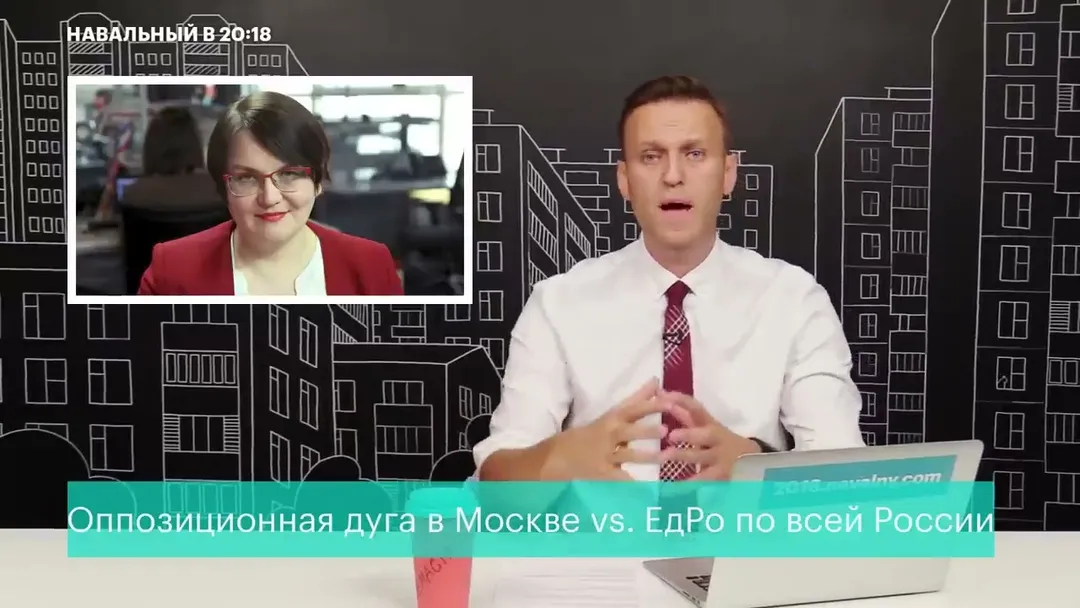
[music]
Hello. Good evening. It’s 8:18 p.m. in Moscow.
That means we’re in the studio of the channel
Navalny Live. I’m Alexei Navalny, here
to answer your
questions and discuss the latest
events with you. Please write on Twitter using
the hashtag #Navalny2018, and I’ll try
to answer. I’ve been flooded—I can see I’ve been
flooded with questions about “He Is Not Dimon to You” (the anti-corruption film about former Prime Minister Dmitry Medvedev). We’ll definitely discuss it.
But first, let’s begin
with the municipal elections in Moscow,
elections that took place across the country.
Something very important happened. I want to
discuss it, because the elections that took place in
Moscow and
the remarkable success of a huge number of
candidates for municipal deputy seats—this is
such a remarkable, outstanding event
that it’s very interesting to watch and can be
interpreted in many different ways.
We saw that at first
there was no interest in the municipal
elections. And, to be honest, I didn’t have much interest in them either.
Then
everyone started writing, “Come to the polling stations,”
then there was huge excitement: what does this mean?
It means we won and got
hundreds of deputies elected. Now there’s already a bit of a
trend toward analyzing these results, and
I can already see somewhat skeptical
articles appearing on the subject that, in fact,
there are actually fewer independent deputies
than before, that the municipal
filter can’t be passed, so it’s not really such a
victory. Take that graphic off for now—it’s too early.
I
wanted to discuss these things and give my
point of view on all of it.
So what happened? Let’s first understand
what happened. Is it a victory or not a victory? What will
the mayor’s office do about it? And what, well, needs
to be done by municipal deputies in order
so that
somehow use and capitalize on these
events. So, what happened?
Sergei Semyonovich Sobyanin, together with his
wonderful political strategist and ally,
Anastasia Rakova, outsmarted themselves.
That is the main thing that happened with
the municipal elections. They had
a fairly coherent concept. I understood it,
and, generally speaking, I believed it would work.
I’ll admit that honestly here. It
consisted of the following: they needed to win
in Moscow, a city where protest sentiment is fairly high.
So they were going to
depress turnout—that is, not invite anyone to
these elections, so that no one would
show up except specially mobilized
state employees and a small number of
people who, well, always go to
elections—primarily elderly people
who come out because they always do.
For them it’s a form of socializing.
They come, get some kind of bun
or pastry, maybe run into
some neighbors, vote, and go
back home. And most often—in 90 percent of cases,
or rather 95 percent of cases—the voting
is very conservative, in favor of the authorities.
They don’t know anyone else. So, overall,
the concept was fairly coherent.
The opposition, by whipping things up on Facebook,
could bring out about 3 percent
of the electorate. That was already clear from
the previous State Duma elections.
So Sobyanin and Rakova figured:
we bring out 10 percent of our people, and they
bring out at most 3 percent of theirs; they get
a dozen or two dozen
deputies elected, while we basically win,
because we have our endless network of GBU housing services (state-run municipal maintenance agencies),
Zhilishchnik, and simply all our grandmas and
grandpas, who dearly love
the wonderful Vladimir Vladimirovich
Putin and Dmitry Anatolyevich Medvedev,
who came to the polling stations in the morning,
all cheerful, and voted.
Twenty-five seconds on how they did it.
Thank you very much.
How lovely, wouldn’t you agree? What
happy people, the way they vote at
the polling stations. And the idea was that in the evening
news reports they would show all the same thing,
only now with great election
results: that United Russia had won
everywhere, while the opposition got 10,
maybe 20 seats at most. But
they miscalculated one thing: among their
core voters—the very same grandpas and
grandmas who go to elections
regularly and vote conservatively for
the authorities—dislike has recently grown
for Sergei Semyonovich Sobyanin and Vladimir
Vladimirovich Putin. That is the single most
important fact of these elections, because
the mayor’s office reads the reports about itself
that it commissions, saying that
everyone loves Sobyanin. It turned out that no,
Moscow’s elderly don’t love
Sobyanin either. And that is what led to the fact that
the opposition—
Dmitry Gudkov’s excellent project,
which I really ignored at
first because it seemed rather
unsuccessful to me,
which I ignored not only at the beginning but, well,
to the very end, honestly—brought in 3 percent
of the voters, and the grandpas and grandmas
added another necessary percent
the extra percentage needed so that
so that
an astonishing thing could happen: United
Russia was completely swept out of everything
that is now called
the opposition arc in the city of Moscow.
Let’s take a look at the map of this.
the opposition districts. Please show them.
Slide. Here, on this slide, you can see
all the places where the majority went to
the opposition.
Now the slide showing where the majority went to
United Russia.
There, you can see it on the other one. And now the slide where
the results of the 2013 vote, where I
took part in those disgusting elections.
Here you can see the darker areas on the
map — those are the places where I received the
highest percentage. So indeed,
for several years now, in all the most recent
elections, there has been a clear
trend: from the Airport district and further to the
southwest, there is a zone where the opposition
gets quite strong support. There are a lot of
amusing pieces right now about how
this zone coincides with places where
bike-sharing stations are located, with places
where Azbuka Vkusa stores (a premium grocery chain) are located, and so
on and so forth. But basically these are
the neighborhoods with the highest standard
of living, with the most expensive real estate,
where, traditionally, the
technical intelligentsia and the scientific
intelligentsia lived — the most progressive
districts of Moscow. And in these districts,
with those percentages, United
Russia was practically wiped out.
And that is a tremendous achievement.
Now I would like to speak separately about
whether this was a victory or not. Please show
the slide that was accidentally shown
right at the very beginning and is now very
popular. And when people look at this slide,
many reason like this: well,
look, there are now even more United Russia deputies,
and as a result of the work
of Gudkov’s project and as a result
of the work of independent groups,
what happened was simply that Yabloko
absorbed the seats of independent
candidates and took them from A Just
Russia and the Communists, but in essence nothing
changed, and United Russia even got
more seats. But that is an absolutely incorrect
interpretation.
The victory in these elections lay
not at all in the fact that many
deputies got in. The municipal filter still
has to be overcome — and in general, the municipal
filter
is not a matter of mathematics; it is a matter
of politics. Even if you have many
deputies, if they do not want to let you onto the ballot,
they will not let you on.
The main victory, of course, is that
something that had not happened in Moscow for a very, very
long time has now happened. The last independent
municipality in Moscow was back in the 1990s.
It was the Presnensky District. Now
there are about a dozen districts where there are
independent deputies who hold
a majority there, or where United Russia is simply
not represented at all. That is a tremendous change, and
from this there may — or may not — emerge
quite remarkable and, uh, also
major developments. What will the Moscow city government do
about this?
I think, I am sure, that of course they are
very worried. They are probably getting
a major dressing-down from the Kremlin, because
the Kremlin suffered a very serious humiliation.
At the polling station in the Gagarinsky District, where
Putin voted, they got zero mandates. At the
polling station in the Ramenki District, where
Medvedev voted, they got zero mandates. And
after all the pomp surrounding it, it turned out
they were simply dragged face-first across the table.
And now the Moscow city government, I am sure of it,
will start doing what it does
even better than rigging elections: it
will gradually start buying off deputies, it
will gradually start corrupting
deputies, it will start deceiving them. Well,
it will engage in that sort of thing. That is precisely
why — take note — they are
first and foremost now targeting
the municipalities where the most
active and experienced people won. Take Yulia
Galyamina, who won an honest
majority in Timiryazevsky. Over the course of
yesterday,
the results at one polling station were falsified;
they took one mandate away from her. And just like that,
now her majority is no longer eight votes;
she is in the minority with seven votes.
They still hold a blocking stake, but
nevertheless she lost the majority.
Why? Because they understand that
Galyamina will be difficult to deceive or
bribe. She has different ambitions, and she does not
need money or favors or anything
else. She wants to be elected to the
Moscow City Duma; she wants to be elected to the State Duma,
relying on her district as a base. The same kind of
pressure was brought to bear on
Konstantin Yankauskas in Zyuzino, where he
built a team; he managed to hold them off. I
am sure that the greatest pressure will fall
on Ilya Yashin, who
made his campaign as political as possible,
won a majority in the Krasnoselsky District,
and this too is truly
a remarkable, outstanding phenomenon, because
Yashin was like a locomotive — he
openly said these were candidates of
Solidarnost (the opposition movement). He spoke less
about some municipal
agenda — courtyards, benches — and instead talked about
Putin, Medvedev, Sobyanin. In other words,
the man was bluntly telling the unvarnished truth, and
going door to door with that blunt truth.
His political affiliation, his affiliation with the political
opposition, and his repeated detentions
and arrests are well known to everyone. But the man
finished in first place by a huge margin.
ran the whole team and is planning
to get involved in political matters. And
so Mary will naturally want
to turn that, uh, into a working format
for the new deputies, something along those lines. Well,
let's be friends. Let's
work together on local
issues. There is, broadly speaking, an example of how this
exists in Moscow: independent
municipal councils. A year ago, in the Shchukino district of Moscow,
United Russia lost its majority there
and some very decent people were elected from
the Communists and from Yabloko (a liberal political party); the council was headed
by a deputy named Grebennik, a very experienced
and good person, but overall there were no
remarkable heroic feats there
to speak of. So this is what happened: the opposition
took over the district, seized power in
the district, but nothing happened there
because there was no proper
politicization. Of course, they were on their own, they were
being pressured, they were understandably nervous, but now
city hall will want to make sure that this
victory is not capitalized on. Kirill
Rogov, the political analyst, wrote a rather
excellent article, one of the best
articles on the results of these elections. He
wrote something very true: that getting
deputies elected is good, winning municipalities
for our side is good, it's a victory. But it will only truly
become a victory when we are able
to turn these deputy
seats into real political struggle
when it becomes clear that part of Moscow
has been taken over by opposition deputies, that
part of Moscow is controlled by the opposition, yes.
Of course, uh,
these deputies have very few powers
but they do have some powers, and now
they will, uh, by various cunning means,
well, be corrupted, absorbed into
the machinery of power and its wake.
Sorry, but we have to admit: this has always
worked. For many years I watched
Yabloko deputies get elected, and
however many there were, for example in the Moscow City Duma,
only one deputy, Bunimovich, remained and
did not join United Russia. All the others
switched over to United Russia. However many there were
from SPS (Union of Right Forces), only one, Kataev
Dmitry Ivanovich, did not join United
Russia; all the rest gradually ran off
to United Russia, despite the fact that they had run
in the elections under fairly, uh, radical
slogans. So now they will start
gradually poaching deputies, and I have received
many questions: what exactly is
a Moscow deputy? In fact, nobody really
understands it at all. Do they receive
money or not? Please show
the chart from which we can, well,
understand a little better what
a Moscow deputy is. Does he
receive any money at all?
So, look, there is the head
of the municipal council. Well, for example,
I hope Ilya Yashin will be elected as
that head; he is entitled to a salary
of 85,000 to 120,000 rubles per month
(roughly per month). Ordinary deputies do not receive
a salary, but they do receive so-called
compensation for their expenses each quarter.
That is from 40,000 to 90,000 rubles in different
municipalities, plus, uh, the head is entitled
to an official car, and all deputies
are entitled to
voluntary medical insurance
policies, which, well, are actually
quite expensive. So there are
some levers of influence. They may seem minor, but
there is still some means of pressure
and so far we have seen that this always works
quite effectively. Especially since, well, for
objective reasons, this will of course
run into the kinds of resistance
and contradictions even within the opposition
that will simply arise objectively. Well,
simply because these are
people driven by personal ambitions. For example,
in the Khamovniki district already now
yes, all the seats there were won
by opposition representatives. Formally, they
all ran from Yabloko, but there are two
rival groups there: one has
eight people, the other has seven, and
both groups are made up of very good people, but
they do not like each other, and each side
is trying to appoint its own head
of the municipality. And, uh, I hope all of this
will turn out fine, and I say this so that
among other things, the residents and deputies
of Khamovniki put a little pressure on them
along the lines of: make peace, guys. But
the objective truth, the plain truth,
is that more often than not there are
some splits, people start
scattering into different parties. This will happen
inevitably. Therefore,
our task
those of us who are watching all this, those who
voted, is simply to keep an eye on the
deputies we elected and
help them, and if necessary put pressure on them,
ask and demand that they
act politically, that
they make some political
decisions. Yes, they have very few powers.
Show us the slide: what powers do
municipal deputies have?
It may sound impressive, but
in reality it is not that significant, though
there is something. For example, major renovations of all
residential buildings cannot be approved without the signature of representatives
of the municipal councils; you cannot approve
a building's major renovation without them. They approve the local
budget, which is laughably small —
just a few million rubles — but they do have
the right of legislative initiative in the Moscow City Duma.
— this is a great thing; it can be used
to make use of it, to introduce bills, and
to discuss them and force the Moscow City Duma
to somehow make decisions on these
bills. They have the right
to hold local referendums, because
it will be very difficult to do, because
all significant issues have been assigned to
the jurisdiction of the city Duma. But there are, actually,
some very curious, funny
powers. We discussed this with Ilya Yashin
who came here. I started looking at
this charter and discovered that, for example, they
can establish awards. That
will be quite amusing when the leadership
of the Krasnoselsky District, for example, starts
instituting some kind of awards. Uh, maybe
it’s a bit of trolling, but generally speaking,
why not? There are
funny photos of Putin together with
his crooks, all standing there together and
handing them medals.
Yashin could very well present some
commemorative badges, for example, to those people
who, uh, keep watch on the bridge and guard
the Boris Nemtsov memorial site. They
are attacked, they defend themselves, they honestly
keep up their vigil. Why not
award some commemorative badges on behalf of
the residents of the Krasnoselsky District? A small thing, but
it would sting badly. The same goes for
holding local celebrations.
Well, you could say, uh, by the way,
the main places where all kinds of
rallies are held are precisely on the territory
of the Krasnoselsky District, and that same
Yashin could quite easily declare: “You know,
the residents’ opinion is that, uh,
this does not obstruct pedestrian passage. We support
holding rallies.” Despite the fact that
rallies are regulated by the city of Moscow, nevertheless
they would no longer be refusing just
some applicant — they would be refusing
a representative of the people,
a representative of this body. There are
other funny things too. For example, Yashin would become
the head of his district’s draft commission.
And probably the funniest, most ironic thing
is that the head
of the local police department would have to
come once or twice a year and
report to the municipal
assembly and to the head of the municipal
assembly in Krasnoselsky — again, that
would be Yashin — on his work. Which is, well,
terribly ironic, because in
Krasnoselsky, as I recall, at the local police station
Yashin was twice brought in
in handcuffs. And now, it turns out, the police will
be reporting to him. But the most important thing
is what, in my view, they should — what
municipal assemblies should begin their work with:
with exercising their main
political power — the ability
to express no confidence in the head of the executive
authority of their district and thus, in effect,
in Moscow City Hall. Well, this needs to be done.
It’s like if, imagine,
the opposition had won a majority of seats in
the State Duma, and then
the head of government came there to
report to them, and they said, “Well, Dmitry
Anatolyevich, sure, we don’t really
like you very much, and you stole 80 billion
and built various dachas (country houses) with it, but we’ll
work constructively with you.” But
that’s impossible. Why win
elections if you then agree to work with
these people and not express no confidence in them?
So I very much hope that these newly
elected municipal assemblies where
the opposition holds a majority will, after all,
politically make their position toward
this government clear and declare no confidence
— adopt official resolutions
expressing no confidence in the local head
of the executive branch, and in general in Moscow Mayor Sobyanin.
After all, that’s what they were elected for; they
were elected because people do not like this
local government. Well, it will be very
interesting to watch whether they do it
or not. So, George Seno asks me:
could it be that the Kremlin
is trying to pretend that now, all of a sudden, we have
democracy? They did try to create that impression.
The idea was that there would be no major
falsifications.
Well, it’s not exactly that Gudkov’s project was being given
a green light, but it wasn’t being obstructed.
At the same time, our volunteers were out there
for the municipal campaign, and no one touched them.
Our volunteers are constantly detained in
Moscow. So there was a green light so that
they could, well, win 20–30 seats, and then say,
“Well, the opposition performed modestly, uh,”
they just didn’t expect that
pensioners would vote against them, and that
even if not en masse, they would still vote,
and that this would lead to a complete defeat within
this opposition arc. And
in the Babushkinsky district, Lena asks me:
“In Babushkinsky, was Lisovenko the head — that same
one, the pilot? Everyone remembers his
attacks on Navalny during that nasty
campaign. All five seats are with United Russia again, and
he’s among them.” Yes, because as I already
said, this little shift
that took place, which Gudkov’s project helped bring about,
did, after all, lead to the fact that
it became possible to win in the opposition belt. But
in difficult districts with very large
populations — like mine, Maryino — that
was not enough. Let’s just look at the math
to make it clearer.
Please show the slide with the numbers,
not percentages, because they don’t really
make anything clear. Show the absolute figures for
the election.
We don't have that slide, so let me just
say it out loud: overall,
the number of people who voted was
1.1 million in this
election, out of about 7.5
million voters. So this
Facebook electorate, which was actively
at most 200,000 people, and Moscow City Hall
had hoped that these 800
thousand people would be their very
strong, reliable electorate. But in the
opposition belt, that strong, reliable
electorate turned out to be not strong at all,
nor reliable. But out on the outskirts,
in the peripheral districts, uh, it still
worked. But that's exactly what
our campaign has to work on. We
aren't, after all, focusing our efforts on
campaigning in lovely Khamovniki and
Arbat; we travel around cities. This
weekend—tomorrow I'm flying to Murmansk,
then I'll be in Yekaterinburg, and then
I'll be in Omsk. In other words, we'll be
campaigning, and the real question of
victory is victory where there lives
well, this kind of
voter who's hard to reach,
who doesn't have an Azbuka Vkusa (upscale grocery chain) nearby,
who doesn't rollerblade, who isn't
a hipster. Those people can also be
persuaded. We'll do that. But that is
the campaign's main task.
Alexei asks me: Cheburashka, tell me,
wasn't it against the law not to cover the election?
Wasn't City Hall supposed to cover
this event? Well, essentially, yes, it was illegal.
Of course they were supposed to do it. They
ignored it because they had
that strategy. And there were, and still are, many
analytical articles showing
that Moscow City Hall newspapers wrote about the election
far less—sorry, far less
than in any other
I live in a district where there is an unquestioned
pro-government bloc among the municipal deputies, and the majority
of Muscovites continue to live in these districts.
That's true—let me stress once again:
since most of us still
live in districts where
United Russia still rules, and this
noble Facebook impulse still hasn't
reached there. It's very important for us that
in the opposition belt there be real
genuine political work
by municipal deputies. That way it will be easier for us
to live in our districts.
Alexei asks me: Yury Skop, are you
going to enter into a struggle for influence over
the opposition deputies? Well, I hope it
won't be a struggle. I mean, I don't need
to wage some special fight for them.
Probably with City Hall—uh, no, what we need is simply
to keep an eye on these deputies. I can
say that the Anti-Corruption Foundation
is ready, right now,
and I'm saying this on air, to every municipal
assembly and every deputy: we're ready to provide
help if they want to fight
corruption in their district. It's not
easy, it's confusing, it's digging through
procurement records and documents—very few people know how to do that.
Most people aren't
interested in it. We're ready to do that boring
work if you help and
take this on—send inquiries, uh,
demand information from City Hall,
express no confidence in them—in other words, fight
against the corrupt officials. We are fully
ready to help. Well, that's what our
struggle for municipal deputies consists of.
[music]
So,
Vadim Vlasov: where there are no United Russia members,
independent deputies won't be allowed to work properly,
and people will still be steered toward their own
deputy. We've seen that before.
Once again, guys, so you understand:
municipal assemblies have very, very few powers,
extremely few.
So
basically, in order to get anything done,
these newly elected
municipal deputies need
to engage in—I'm not afraid to say it—
PR as well, including staging bright, visible
actions, doing things that annoy
the authorities. Only in that case will they be
noticed, and their work noticed,
because, well, they have very
few powers. So what you really need is a great deal of
determination. So first and foremost I
am, of course, placing my hopes on
the established groups that made it through in these
elections and are led by, well,
people like
people who really understand politics:
Linkauskas, Zyuzina, and Galyamina in
Timiryazevsky, of course, Yashin in
Krasnoselsky,
and Gagarinsky District, where there are absolutely
amazing deputies—truly fantastic
people—and there are such
serious people there. So I hope
they will be the flagships leading all of this forward.
I'm being reminded that I should
say that today we're running an experiment, and
the stream is not only on YouTube, but is also being
restreamed on VKontakte, Facebook, and even
Odnoklassniki. We're broadcasting there now too,
so if your grandmother or aunt
is always hanging out on Odnoklassniki,
you can confidently go tell her: come on over
to Navalny Live—Bosch is live on air
to watch.
Come watch our broadcast.
Your Jesus Christ, what blasphemy.
Someone asks, with a sad emoji, where Kira is.
Kira is helping me off camera, but she isn't
is taking part in the broadcast. Although without her it's very
hard for me to host, because one woman
wrote me a letter: "Hello, Alexei,
I'm a pensioner, and of course you do a great job
hosting broadcasts together with Kira, but it bothers me
to hear you say
that you're afraid to host a broadcast alone. A president
shouldn't be afraid of anything." That letter
made an impression on me. I thought that
I really ought to overcome myself and
try to go on air alone. Uh, "Bring Kira back,"
people write. "Where is Kira?" A lot of
"Where is Kira?" with the hashtag "Cut Tinkov"—now
we're going to talk not about magic, but there's no need
to cut anyone.
Briefly about the election results across
Russia, because Moscow is of course
wonderful, but the rest of our country
it is
90% of the voters.
Two main things I want to say—
three main things. First, you shouldn't think
that surprising things happen only in Moscow.
For example, in the city of
Asbest, United Russia just as much
suffered an absolutely crushing
defeat, simply a crushing
defeat, and they were simply swept out of
the local assembly there by Communists, LDPR (Liberal Democratic Party of Russia), who, who
are just local regional activists, but
the work—even in places like that. Well, Asbest isn't even
Yekaterinburg; it's a much more
difficult city in terms of organizing, but nevertheless
people turned out there and defeated United
Russia. It's just that unfortunately this is discussed far
less than the wonderful
successes of municipal deputies, but such
miracles happen all the time. Number one.
Eternal number two is, of course, the elections in
Sverdlovsk Region, where there was essentially
a rehearsal for what happens if they do not
allow the main opposition
candidate to run. By the way, Yevgeny
Roizman, who was not allowed to take part in these
elections and who would now have become governor
of Sverdlovsk Region, has an anniversary today—
he turns 55. I congratulate him. I hope, I
am sure, that we will achieve the point where Yevgeny
will take part in elections and become
governor of Sverdlovsk Region. He will be
an excellent governor. And of course everyone
is asking whether the boycott worked or
didn't work. I refer you to an article by
the mathematician Sergei Shpilkin. He
became famous because in 2011 it was
precisely his mathematical publications
where he proved with concrete figures
the falsifications that took place in
the elections—that really started the wave
of publications on the subject, and then there were
mass protests. In other words, this is a person who
understands very well what he's talking about, and
he proved it with numbers. Just google
Sergei Shpilkin and you'll find the article.
He proved that in fact the boycott
worked. And in the city of Yekaterinburg,
because of the boycott campaign, 10% of voters
did not come to vote. But as you
know, in Sverdlovsk Region they
countered that by organizing a lottery at
all polling stations and raffling off cars,
apartments, and that brought in an additional 14
percent of people. That's a lot. One of
Shpilkin's conclusions is that, essentially,
holding lotteries at polling stations
will in effect be a method of
falsification, because the result
they get is comparable
to ballot stuffing, it's comparable to inflated counts, and
probably soon we'll have to expect
some kind of nationwide lotteries or
the spread of this practice to
all regions. And nevertheless,
when I say "boycott campaign" in
Sverdlovsk Region, let's be honest
and say that for us it consisted of me
putting out one video, a couple of times
appearing in this, speaking on this
program; Yevgeny Roizman made a couple
of videos, gave several public
speeches, several Facebook posts.
There was no real campaign. Nevertheless,
10% of voters listened and did not
take part in these elections, and they shared
our view. Therefore I absolutely believe
that a large-scale mass boycott can
happen, but it requires work—that is,
just a video is not enough. Third,
the last thing I wanted to say about
uh
the elections across the country.
Let's take a look at the gubernatorial election results.
No one pays attention to this,
but it seems to me that this table is
absolutely amazing, fantastic, and
very interesting in the sense that, well,
guys, we're often told that Putin
is so great, that he has such enormous
popular support, and that he is unique in this
support from the people. And now let's look
at this table. Good Lord, what do
we see? Any random clown, a former
Putin bodyguard, or just some
obscure people who came to these
republics in order to take part in
elections from Moscow—nobody even knows
who they are. From this list, at least
five governors, uh, would not have been able
to vote because they did not have
residential registration in that area.
Just look at what they got:
89%, 88%, 87%. And Putin in the last election
got 71%. It's right here, this last
line. So all these people who
are in the table turn out to be
bigger than Putin, more unique
politicians. Then let's talk about them
and say that there's this, what's-his-name there in
the Mordovian region, in the Republic of Mordovia
Vladimir Volkov—so if there is Mordovia, then there isn't
Vladimir Volkov; without Vladimir Volkov there is no Mordovia, and
to repeat all this nonsense about them as well
then they are all unique, then any one of
them can replace Putin. Right? We
understand that this is not the case. It's just that under
conditions of
monopoly, under conditions of censorship, under conditions of
falsification, anyone can get
86%, 84%—Putin, Medvedev, Shoigu
Natalya Poklonskaya, Dmitry Rogozin. In
that sense, we need to understand very clearly, and
not let ourselves be deceived into thinking that they get
their percentages only under conditions of
monopoly and falsification, and each of them
can boast of their 80 percent
or 89, but we understand perfectly well that all of this is
fake, completely fake, and these numbers should not be believed
at all. Nemagia
I can see that I'm just getting
something with Nemagia here—I’m flooded
with questions about Nemagia, but in general that is
right, because probably this is a question
best addressed to me
There was a search of the home of Alexei Pskovitin
Let’s watch a very short video
—you’ve all seen this already. Let’s
take a look
at a short clip that was filmed at the door
of the apartment
where the search was taking place
Play it. Tell us who they are
So, what is Nemagia, for those
who may not know? It’s a channel run by two
young men who are based in
Kemerovo, and they make reviews about various
things, different people, different
events, and mostly they, well, in the
typical internet, YouTube style,
criticize them. They did reviews—of me too
they criticized me as well, though moderately. Well,
it’s an interesting channel, a popular channel
Freedom of speech—they have the right to criticize whoever
they want. They criticized Oleg Tinkov
and released a fairly long
video about him, criticizing his bank and him personally in
various terms, and, uh, this led to
rather serious consequences for
the bank—the whole internet was filled with
photos of cut-up Tinkoff cards
It effectively turned into a kind of manifesto
against banking bondage, against this
kind of interest-rate slavery, as I understand it
They struck a blow against Oleg
Tinkov’s business, and then suddenly it happened that he
sued them, but also at the home of one of
the participants in this channel there was a
search—they broke down his door, and at his
grandmother’s home there were searches too. Well, this was
a real intimidation campaign, and it turned out that it was all over
a criminal libel case. And this is the second
time in Russia’s history when, over a libel case
—which until quite recently had been
decriminalized, and which certainly is not
some kind of serious offense—
they actually conduct a home search with seizure of
computers. This is the second time, because
the first time was with me—there was a
search of my home in a libel case, based on a complaint by
that crook, former police officer Pavel
Karpov, who was involved in
the Magnitsky case, and who claimed
that I had libeled him. Uh, I was summoned for
questioning; during the questioning I was personally searched, then
they took me home, there was a search there, and they seized
all the computers—they took the children’s computers too
and phones, the full treatment. So
I, uh,
know a little about this, and I can
give my personal opinion here, since
Tinkoff loves suing everyone
so here’s a disclaimer: everything I’m saying
is my personal opinion
based simply on my observations. I
am absolutely, relying on my own
experience, convinced that this was of course a заказное дело (a commissioned hit job), that
the police were paid to go there, or
their bosses were paid so that they would do it
—this does not happen
There are no searches in libel cases; there is
no need to search anyone, there is nothing
to look for there. What evidence could one
possibly find? And Nemagia isn’t hiding. They
are saying themselves: yes, we released a video about
Tinkov. So there is no need to seize
computers in order to prove that
it was they who did it. This is purely
a заказ (a paid-for operation). We understand perfectly well that any
banker, any major businessman, has
has
connections with various
state authorities; he, well, by
this Russian tradition, has
assigned contacts from the MVD (Interior Ministry) and the FSB (security service), and
let’s be honest, each of them
keeps some
high-ranking police officers or
FSB officers on the payroll, and my version is that
Oleg Tinkov
being a clearly nervous person and
someone who takes things very personally, he
simply called one of his
police generals there, whom he pays
a salary, and said: “Petrovich, they’ve come after me here
—what are you getting 50
thousand dollars a month from me for? Please, tear apart
these bastards who are interfering with my
business.” And what can Petrovich do?
Well, Petrovich sent out some guys from
Petrovka 38 (Moscow police headquarters); they went, broke down the door
and started terrorizing these
guys from Kemerovo, started taking away their computers. And
that is exactly how all of this happened. I
have not the slightest doubt. This could not
have been ordinary, normal
procedural actions. No one would ever
have gone from Petrovka 38 otherwise
That’s how it works. Even if someone wanted to
carry out a search in a defamation case, they would
write to the local police. They would give them
instructions: please question your
local residents, conduct a search at their homes.
The local officers would come and do it. But when people
fly in directly from Petrovka
(Petrovka 38, Moscow police headquarters), break down doors—well, this is
obviously a hit job, in my personal opinion.
Based on my own experience, I do not for a
single second believe that this could have
happened just like that. This is a personal
vendetta by Tinkov.
He
simply decided, in this way, to destroy Nemagia
— ruin them, wreck their lives,
terrorize them, take revenge because they
hit him where it hurts — they hit his
business. I’m not ready—I honestly
haven’t even watched their long
film yet; maybe I’ll watch it now. I’m not ready
to say how right they are regarding
the bank. Maybe they’re right, maybe
they’re wrong, but they have their own opinion. As for
Tinkov himself, well, unquestionably
he’s a very unpleasant person,
eccentric, but very unpleasant, and
many people criticize him. He built
much of his bank’s PR on criticism,
confrontation, and scandals, so in theory he
should be ready for this kind of thing, because
he himself is constantly stirring up scandals and
going after people. And when people went
after him in return,
he decided to handle it through the police,
with searches and everything else. So I can
say to the Nemagia channel, which is not
exactly a very friendly
channel toward me, that of course
I can only express my support.
Oleg Tinkov, I hope you
stop this nonsense. Sue them if you want—
please, sue them. If they caused you
damage, calculate the damages and file a claim.
As people often tell me, go to
a Russian court. But all these tricks with
the police will, of course, do damage to Tinkoff Bank
ten times greater than the damage
caused simply by Nemagia’s film.
And I hope he stops and doesn’t keep
engaging in all this very
shameful nonsense, and
moves all of this into some kind of civilized
format. It’s extremely unpleasant, but I
also, by the way, suspect that even
within the Interior Ministry system
people won’t be very happy about this, because
well, of course, to the leadership of the MVD (Ministry of Internal Affairs), it’s obvious that
this is a paid hit job. To anyone
who has any connection and understands how
the Interior Ministry system, the FSB (Federal Security Service), and the security services in general
work, it’s obvious this is a paid job. For
money, they all went there, and it turned into
a huge scandal across the whole country. All of
YouTube is talking about nothing else.
I think there will be some kind of
consequences from this. Tim TT writes: “Tinkoff is the best bank.”
“Tinkoff…” I can’t, uh, quote what
Nemagia called him—“pathetic thugs.” Quite
possibly, listen, it’s quite possible that
they are pathetic thugs. They still have the right
to run their channel. Why break down their door?
No one has the right to do that, or to seize their
computers. There was absolutely no investigative need
or public necessity to do this to these people,
to break down the door and conduct searches at someone’s
grandmother’s home, even if it’s a defamation case. Well,
fine—then you have to prove
that these people said something false, and that they said
it knowingly.
There is no need to search a grandmother’s apartment for that.
This is a hit job, and it is being done for a
perfectly clear purpose. Just as they did to me,
they want to take away computers, they
want to take phones and dig through them,
to find some compromising material—some of your
photos, home videos. Maybe you
photographed someone naked,
or took naked photos of yourself, and they’ll post it
online, and then they’ll use that to
blackmail you. They always do this—in
every criminal case, against every enemy,
in every commissioned case, this is the first thing
that happens: they rush in, take away phones,
computers, and start digging through them not
in search of evidence, but in
search of personal, sensitive,
compromising information. That’s all. We have
a poll running on YouTube, on
Twitter, and on VKontakte: who is right,
Tinkoff or Nemagia? Let’s
vote. I can see fairly, uh,
quite different opinions here. People are writing:
“Tinkoff is corrupt,” writes Sergey
Yakovlev. Well, I don’t know. As I already said,
it is my value judgment that he has
police officers on his payroll, that he paid
them. I have no evidence on this
matter, so I’m not prepared to say
whether he’s corrupt or not. He’s a rather
unpleasant person.
Daniil Kranikov writes: “Were they looking for defamation in their home?”
Yes, apparently they were looking for defamation.
Take a look—maybe the defamation is lying
under the bed.
So, what else are people writing about Nemagia?
“Petrovka 38 subscription service: home visits.” Well, yes,
that’s how it works here. It’s long been known that the
Investigative Committee and the police, unfortunately, are like
call boys—they simply do these
things for money, and it’s obvious to everyone
that this is being done for money. Let’s
move on to the next topic.
It has now emerged that our entire country has been
mined with bomb threats.
And
this
is quite a surprising phenomenon, because
It started on September 10.
First there was Sterlitamak, then, I see, seven planted
bombs in Perm, then Yuzhno-Sakhalinsk, then
on September 11, Chelyabinsk, Ufa, and so on.
There was simply a wave of calls and,
accordingly, evacuations because of bomb threats.
Vladivostok, Chelyabinsk, Krasnoyarsk—that is,
hundreds of thousands of people were evacuated from
various institutions. This is not
an exaggeration, because in Moscow alone
100,000 people were evacuated yesterday,
and today it is continuing, as far as I
understand. Detsky Mir on Lubyanka (a famous children's department store in central Moscow), I think,
was evacuated today. I mean, these are
huge shopping centers with enormous
numbers of people, and
the authorities' reaction to this is very interesting,
because, I mean, mysterious
events are taking place involving millions,
and hundreds of thousands have been evacuated. They
go and tell their
relatives and other people, so
millions of people know this is
happening, but basically the only
coverage of all this is only on
the internet and in some small
media outlets. I saw
statistics today showing that this is not
being covered on the federal TV channels, and that
naturally gives rise to the wildest conspiracy
theories, especially given how the authorities
as usual are reacting to this in a super idiotic
way, because the first version
from the Russian authorities, when everyone started
asking, "Is something else happening?"—well,
naturally, it was the "Ukrainian trace." They
said there had been some calls, these
IP telephony calls from Ukraine. Well, naturally
everyone started laughing at that and
saying, uh,
"Maybe someone found Yarosh's business card there too"
(a sarcastic reference to Dmitry Yarosh, a Ukrainian nationalist often invoked in Russian propaganda). Really, it's laughable: whatever
happens, they look for a Ukrainian
trace in everything.
Bravo—our FSB found a better version.
And with a straight face, simply forgetting that
yesterday, and even an hour ago today, they
were talking about the Ukrainian trace, they started
saying:
"We conducted
some kind of preliminary investigation, and
found that these mass
phone calls—well,
they were made from territory under
ISIS control, and members of the Islamic
State are making these calls." Well, let's just say
it is,
a dubious version. I don't really believe it,
because after all, these are all voice calls.
It's hard to imagine that, you know, ISIS has
an entire call center of people who can
call in fluent Russian
some police department in Perm and say, "Hello,
good afternoon, in your shopping center
number such-and-such, a bomb has been planted, and in
an hour it will be detonated."
Well, unless the people calling there had
a distinctive accent and were saying all the
things that members of ISIS are usually supposed to say
when they warn about
some terrorist attack. These phone
conversations—in huge numbers, hundreds of them—
must have been recorded, because all
such calls are recorded, and we would
probably like, given what is
happening, for greater clarity or
to reduce panic—well,
some confirmation of these versions.
If ISIS is engaged in this kind of
sabotage—not terrorism, sabotage—then, well,
let's hear a few of the calls.
Show them to us, play them, and then we'll
know that's the case. If it's from the territory of
Ukraine, well then play for us those
mass, hundreds of calls from the territory of
Ukraine, where apparently residents of Western
Ukraine, with their characteristic accent, uh,
are saying that shopping centers have been mined. But
there's none of that either, nothing.
There is no information on television at all—
silence, while hundreds of thousands of people are being evacuated. And
my version, of course,
is that this is part of military drills.
Large exercises are underway right now called
Zapad 2017, and the Russian
authorities, in their ultra-idiotic fashion,
are engaged in this nonsense.
Actually, as part of drills, probably, as part
of ordinary life, it is necessary
to conduct drills periodically, uh,
Emergency Situations Ministry drills,
civil defense drills,
to understand how quickly
it is actually possible to evacuate
several sites in the city of Perm or
Yekaterinburg, how quickly people can be
evacuated from different cities, whether
panic arises, whether those
warning speakers hanging on poles
work, whether the sound carries, whether the proper
telephone system works, I don't know, whether there is heating in
bomb shelters, whether there is some food supply, and
so on and so forth. That is, after all,
emergency situations and civil
defense are a major field. But
all of that is understandable, it needs to be tested. Well,
listen, this exists in all countries.
Many countries are concerned about their
security—Israel, or the United States, which is
constantly threatened
by various attacks, South Korea or Japan,
which are in a situation where
they are constantly being threatened with the possibility that
North Korea, uh, will launch
a missile with a nuclear warhead at them. But they
don't engage in this kind of nonsense. They probably
also conduct, uh, some emergency
drills there, but nothing like this.
the idiocy of simply starting to
evacuate people en masse there, and no one
explains anything. Sure, of course, I suppose
you can't say, "Guys, tomorrow
there will be a drill and we'll be evacuating
the department store"—because then no one
would take them seriously. But you can't
evacuate them for several days in a row
without saying a single word, making up
some nonsense. Make something up about Ukraine,
some nonsense about ISIS, and just completely
throw everyone into confusion, without
saying anything on the main TV channels—
it's just abuse.
These aren't really drills. What's the point?
Other countries manage to do this
normally, even countries that are in
an even riskier situation. But here,
with us, it's because fundamentally
they just don't care about people. They sat there
and came up with some drill scenario: let's
carry out evacuations all across the country. And
when people ask us what's
going on, what will we tell them? What will we
not tell them? Why should we tell them anything?
No, on the contrary, secrecy is good.
Let's write it up so that, under the conditions of the
Zapad 2017 exercise (a major Russia-Belarus military drill), we'll create an atmosphere of secrecy
and nightmare. Once again, we'll say some nonsense
so that everyone is scared. What's the point of that?
Who is better off because of it? So this is just
yet another manifestation of the stupidity
of this government. I don't see anything else in it.
For now, our poll on the question
of Nemagia looks like this:
who is right? Nemagia has 97 percent on
YouTube, 95 percent on VKontakte, 85
percent on Twitter. Twitter, as usual,
is our most, let's say, distinctive platform, and for
Tinkov it's 2 percent on YouTube,
on VKontakte, accordingly, four and a
half, and 15 percent on Twitter. So
we can see that users' sympathy
is, of course, primarily
on the side of the Nemagia project, and it's clear
why. Even if, on the substance, Tinkov
is right—even if it turns out that Nemagia
was blackmailing him, or did something
or extorted money, or wanted to get
an advertising contract, but they weren't given one,
so out of spite they
released the film—even if that's true,
once they started doing these things like
breaking down doors and
searching grandmothers' homes, Tinkoff
simply nullified any possible claim to being right,
because you're acting like a thug: you hired
police officers who behave like
bandits. Tinkov is genuinely trying
to present himself as a kind of lite version
of Ramzan Kadyrov (the head of Chechnya, known for his strongman style). It's just that Ramzan
Kadyrov has his own police, while this guy
paid to hire detectives from Petrovka (Moscow police headquarters), and here they are
showing up and staging this clown show,
scaring people. It's disgusting.
Alex Stafford writes: the bomb threats are connected
to the film *Matilda*—that's what the leader
of Christian State, Alexander
Kalinin, said. We'll talk about that now, but
I think that's nonsense; it can't be
connected to that, it's unlikely. About *Matilda*,
Mikhail Razor 206 asks:
Should we expect to see you on Twitch? And how will we
handle esports in the beautiful
Russia of the future? In the beautiful Russia
of the future, we will treat esports
wonderfully and support it in every possible way—
or rather, not exactly support it directly;
the state should not be specially
developing it. The state
should leave it alone and simply
create conditions for the development of
the whole computer gaming industry, including
the Twitch industry. As for expecting me on Twitch,
you should—I just don't really understand how
or where I should start. What, stream myself playing
some game? It's a little funny. Especially since
I, hmm, haven't really
been playing much lately, although I used to play
and I do know how to play some games. So
you can expect me on Twitch—we're thinking about how
to get into it. If you have good advice,
send it along. Uh, users are asking me
under the name 'For a Russia Without Thieves and
Oligarchs'—great name, by the way. So the
question is: what will you do with oligarchs
who are friends of Putin? We won't do anything
to oligarchs who are not friends of
Putin, and even with those oligarchs who are
friends of Putin but are not implicated in
corrupt deals, we also won't do anything
to them—except that if they
took part in privatization deals,
they will have to pay
a compensatory tax. Otherwise, there is no goal
to specifically hunt down, kill,
or jail oligarchs, or conduct
searches at their homes. If they work,
pay taxes, did not participate in corruption,
did not buy Medvedev palaces, houses, and yachts,
then fine—they are citizens just like
everyone else. What will happen to the people
on the Magnitsky list if you become
president? I will send the accused to trial. But they
will be dealt with by an honest court and an honest
Investigative Committee.
And responsibility for the calls has already been taken
by Christian State; its leader
even gave an interview about it.
Il-Kar tells me, and that means that
of course we now need to move on to
the last topic, probably. Judging by
the time left in our program, this is
the creation of our very own homegrown Russian
people's ISIS, because there's simply no
other way to describe it. But
if earlier we joked a little about this
topic—ha-ha-ha, and all that—
state-sponsored, deeply hypocritical and
deceitful conservatism mixed with
a Christianity that does not exist—this is an attempt
to create a kind of Orthodox Christian Iran.
And now we can see that it is being built
at a breakneck pace, in huge strides.
And indeed, it already looks very much
like ISIS (the Islamic State), without exaggeration.
Let’s look once again at this
letter. Show the end of that letter
that the movement “Christian
State,” which suddenly appeared,
started sending out to movie theaters.
Pay attention to this astonishing—if
you can read the tiny
print—the phrase: “If screenings of
*Matilda* begin tomorrow, theaters will burn; people
may also be harmed. These actions
will begin out of desperation, by those who
love God and their people so much that
they are ready to go to prison or even to
their death for them.” But this is exactly what amounts to
a literal copy of ISIS’s style,
the Taliban’s, and that of any other radical
Islamist groups. You understand—people didn’t talk like this
even in Chechnya; this is how
madmen have started talking.
“We love God so much that we
simply cannot do without
setting a movie theater on fire. We love
God so much that someone must immediately
die.” That is exactly what they write.
They simply swap Christianity for Islam,
change a few words around,
and replace *Matilda* with cartoons of the Prophet
Muhammad—it is all exactly the same. This is directly
borrowed from that rhetoric, and it is monstrous.
And one more thing—let’s look at the same issue
that struck me. Go to
the Open Russia website and read the interview.
Spend a few minutes. Read
the interview with Alexander Kalinin,
the head of this movement,
“Christian State.” Show, please,
this excerpt: they ask him,
“What are your brothers prepared to do?” Your
“brothers”—even that is copied. And then:
“4,000 people submitted statements. Everyone
wants to prove themselves in the proper way.
After this, nothing will stay the same. Some are
ready to act—some to burn things, some
to pray. But everyone is ready to act.”
Guys, once again: this is a calque, simply
a literal imitation of what ISIS does.
It is monstrous. This is exactly why ISIS
is considered a terrorist entity.
This is something Russia did not have,
and something that for many years
was impossible even to imagine. In fact, Russia was only quite recently
an atheist state.
The Soviet Union was an atheist
state. All the people here who
still hold senior positions
were officially atheists, and suddenly,
out of nowhere, we have these
these very
supposed or real religious fanatics
who are threatening, no less, to
burn everything down. These interviews are published, while
for similar interviews given by members
of ISIS, media outlets are blocked,
and Roskomnadzor (Russia’s media and communications regulator) issues
warnings. But here, nothing
happens. Last time we talked about how
there was an attempt in Yekaterinburg
that was, plainly, an attempted terrorist attack.
I read a text by the well-known
publicist and political figure,
public activist Konstantin Krylov, and it said something like this:
he is a right-wing conservative man,
all the Donbas stuff and so on, but he wrote
an opinion that, in a way, makes sense:
“Why are you so afraid of these
Orthodox terrorists? Why don’t you treat them
with at least a gram of the same
tolerance that you show toward Islamist
extremists? Because whenever
there is a bombing carried out by Islamists,
all the liberals—or many of them, naturally—
rush out and of course start
repeating like a mantra: ‘Islam is a religion
of love and peace; all these
bombings have nothing to do with it.’ But the Orthodox
haven’t blown anything up or burned anything down, and yet
you’re all already furious here and
hate them.” On the one hand, that
point of view does, of course, have
a certain logic to it. But on the other hand—what are we
supposed to do, wait until they actually do something?
They tried to set this movie theater on fire.
And the thing is, once you
create all this—many people think, and
perhaps they are partly right, that this is of course
a kind of
mock terrorism, specially
invented so that we would discuss it endlessly.
I’ve probably been discussing *Matilda*
for the fourth or fifth time already.
I’m really sick of discussing it.
Soon the program will be called
*Matilda in 2018*. It’s tiresome, and all of this was invented specifically
for that purpose: so that
we would discuss it endlessly, distract
attention, and so that, as in the Ustinov case,
the split would once again occur not along the line of
pro-Putin versus anti-Putin, but along the line of
Orthodox versus non-Orthodox. And perhaps
these are, in a sense, mock terrorists—but
the thing is, you will not be able to
switch them off.
Oleg Kozyrev wrote something very true.
He is an opposition activist who himself
comes from a Protestant background and originally from
the Christian democratic movement.
He said that if you create religious
extremists, if you manage them, if you
finance them, if you encourage them, if you
allow them to write things like this,
And if you think you'll be able to get rid of them that easily,
switch them off,
stop funding them, stop
supporting them, stop
approving some huge
religious processions for them, then you're mistaken, because
even though they are pro-Kremlin religious
activists, they are still religious
activists. You can't just switch them off like that.
Ninety percent of them, even 99 percent of them, are
absolutely deceitful, hypocritical people who do not
believe in God, who don't, I don't know, read
the Bible, who know nothing, who aren't simply doing it for
money—but one percent are
people with extreme motivation. When the Kremlin
takes away their money and stops
supporting them, they won't go anywhere, and with all these
ideas about how
someone wants to burn something, and someone wants to
pray, and someone wants to pray and then
burn something—they will remain, and they won't stop at nothing;
they will definitely set things on fire or blow things up. They
cannot be switched off; they cannot
be driven away. They'll go underground. They have
extreme religious motivation, and on top of that
they're also crazy. And once they were
encouraged in the idea that in the name of love for God
you must burn or blow something up, they
will definitely do it. So what is
happening is an absolutely monstrous thing
that will work against our children,
against our grandchildren, indeed against
Russia's future in general. I have to wrap up. I'll
finish by saying that tomorrow early in the morning I
am flying to the wonderful city of Murmansk, uh,
then I'll be in the wonderful city of
Yekaterinburg, then in the no less
wonderful city of Omsk. Guys, please come
to these meetings, please. We will be
speaking there. Then next week we will
most likely have a kind of
Far East tour—we'll see, depending on
logistics and requests. All these meetings are
officially approved. The authorities really like
to say a lot and scare people by saying, don't
come, because that means it's
extremism or unauthorized rallies.
We file for official approval everywhere.
The weather will be very different: in Murmansk tomorrow
it's expected to be +4°C and rain, so it will be
a rather difficult meeting. I hope that
someone will come in that kind of weather. I won't
be there alone. Then we'll go to
Yekaterinburg, where on the contrary there will be extreme
heat. In any case, I will be very glad to
see you. I will be ready to answer any
of your questions. I will keep doing this
work that any
candidate is supposed to do. See you in the cities. See
you next Thursday, therefore
on air. Thank you very much. Take care.
[music]