Events in North Ossetia, lies about the death toll, give people money
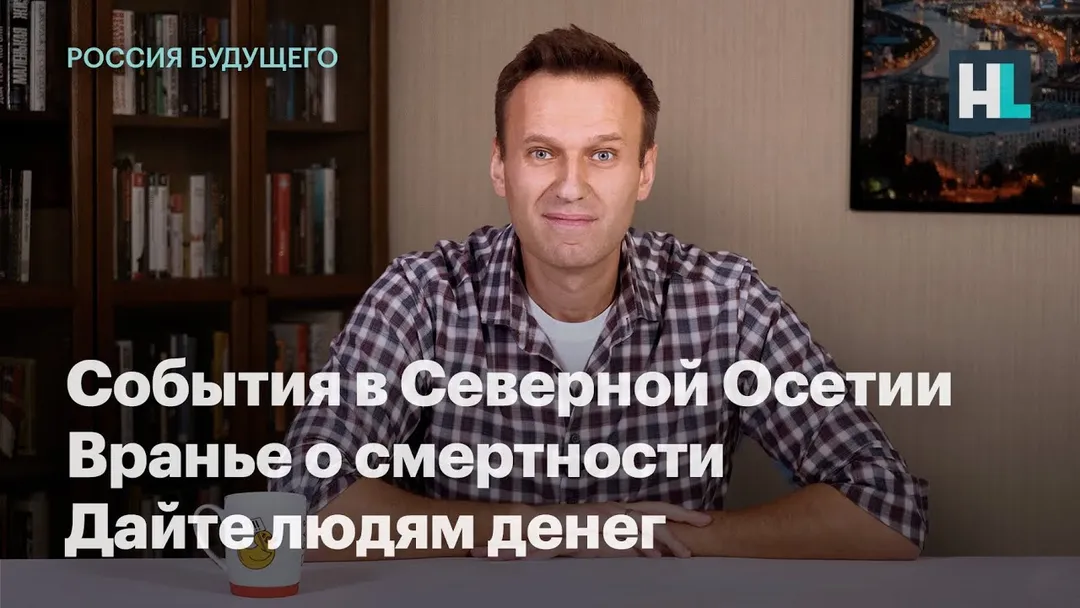
Good evening, everyone.
It is exactly 8:00 p.m. in Moscow, and once again I’m with you from my home,
the host of Russia of the Future, Alexei Navalny.
Or, as some would put it, the man ready to destroy Russia’s economy
for the sake of ratings—that’s what various Kremlin media outlets were calling me this week.
Because this week I launched the campaign
I had been talking about in previous broadcasts, when I said that we had to do
something that would force them to provide aid to people.
I decided: I’ve said it once, I’ve said it twice—now it’s time to actually do something.
Together with my colleagues, I launched this campaign, and so here we are,
and as I understand it, we started this broadcast with 17,000 people already watching live.
Thank you very much for
joining your
and my favorite stage, let’s say, of the format,
when I endlessly ask you to sign one thing after another.
I really am asking you to sign things—right now, in the description of this video, there are links
to our Five Steps website, a link to the VKontakte petition, and a link to the petition.
So please sign
everywhere you can, in all three places.
It’s very important.
Do it as a gift to me for the third anniversary of our program,
because the very first episode aired on April 20, 2017.
So for three years now, I’ve been hosting this every Thursday—well, except for the summer break
during the summer holidays. I host this program, and I’m amazed myself that I’ve kept it up all this time.
I’m incredibly glad that you watch it.
It’s been a major experience for me.
As you can see, I’m getting some things right.
Whereas before I used to dread Thursday approaching,
and was really afraid of going live, now I’m just nervous.
As you can see, I still haven’t learned
not to trip over my words, especially when I speak quickly.
But still, there is a result.
You and I—and I say this fully and absolutely
honestly—we’ve done something really cool, because in April
of course, with the coronavirus, people are staying at home.
There’s a huge amount of attention.
But if we look at the number of unique viewers,
unique meaning not devices, but actual individual people,
Google counts actual people here.
Almost 9.1 million unique viewers watch Navalny Live broadcasts—that’s awesome.
This really is major television,
made only by us together.
So thank you very much.
We now have more than 5,000 friends of
our channel who clicked the Sponsor button.
Next week, probably on Wednesday, I’ll do a special stream of that kind.
We’ll have a private broadcast
for those who are second-, third-, and fourth-tier sponsors.
I’ll be answering all sorts of your questions, so join if you’d like.
So thank you.
Thank you so much for watching and supporting us.
And in general, I’d say YouTube is growing right now across the board—channels are growing, new people are coming in.
Even Vladimir Solovyov is showing up, whom I talked a lot about last time.
It’s great that we’re taking everything good
and that a lot of the bad stuff is being dragged here from television onto YouTube,
and that YouTube as a whole is pushing out that vile, disgusting television.
People from the older generation are starting to watch YouTube now.
That’s very cool.
I put a lot of personal effort into this as well.
And it’s great that you support it.
38,000 people are already watching
live, and a large number of questions are coming in.
I can see Stanislav and Maya asking: direct financial assistance,
and the cancellation of utility payments—this is part of our Five Steps program.
That’s excellent support for the population.
Don’t you think loan holidays should also be introduced?
After all, the share of the population burdened by debt is very high.
Absolutely right.
A high percentage of people are in debt, and many are even refinancing existing debt.
But I was simply proceeding from the fact that, in principle, this measure
with various caveats, had at least been mentioned by Putin.
There’s quite a lot of hypocrisy in that announced measure,
because in practice, for large mortgage loans,
it’s hard to get a payment deferral, but at least something is being done there.
But of course, of course,
it is absolutely essential to do this now, because if a person isn’t going to work,
that means they have no money.
That means, absolutely certainly, no matter how hard they bang their head against the wall
or whatever else they do, they simply won’t be able to make their loan payments.
And our banking system, with its fantastic profits, for example,
from last year, can certainly now help create a situation
together with the Central Bank, in which they do not collect on loans.
For the duration
of this quarantine self-isolation and, in turn,
receive some assistance or compensation from the state.
We’ll talk about that.
I want to start with the price of oil.
A few days ago, we had an astonishing evening,
when the whole country watched first with interest, then with horror,
and then simply with laughter, as the price of oil fell dramatically,
entered negative territory, and dropped to minus $37 per barrel.
No one could understand what was happening, and well, people do understand
that behind this drop in some abstract price
for oil—which none of us has ever actually seen with our own eyes—there would follow
a very real fall in the ruble and rising prices for absolutely everything.
So we were all watching.
Then, of course, there were many articles, and people explained to us,
telling everyone that it was only the futures contract that had fallen—the May futures contract.
In reality, it wasn’t all that dramatic.
In that regard, I strongly recommend watching, on our own channel,
Vladimir Milov’s program, where he breaks it all down very well.
He explained the oil price situation even before it fell so dramatically.
After oil entered negative territory then,
we were told, well, now it’s rising.
Nevertheless, the next day the price kept falling anyway, and this time it was already
not just that particular futures contract, but a derivative deal, a derived price.
Let’s not get bogged down now in lengthy discussions
of various financial instruments, but the price of physical oil also fell, and
that, of course, caused obvious bewilderment
and even shock among a great many citizens of our country.
After all, over the past several weeks, Russia’s behavior—more specifically,
Putin’s successes—had been described as nothing less than an unquestionable success.
That was even the title of Dmitry Kiselyov’s report on the matter.
“Unquestionable Success.” Vladimir Vladimirovich
Putin came in and supposedly fixed everything without saying a word.
Let’s take a look.
On Friday it became clear that the new international agreement on reducing
oil production for the sake of a fair price and preserving the industry itself would work.
This was preceded by personal contacts between the leaders of Russia, the United States, and Saudi Arabia,
followed by a phone call between Putin and Trump.
Two days of intense work by delegations from two dozen countries finally produced a result.
You see,
various delegations met, but it was Putin in particular
who stepped in, who spoke, and then unquestionable success came upon us.
In the previous program I showed you how, when there was
a government meeting supposedly about measures to help the population during the crisis,
the first person to speak after Putin was Energy Minister
Novak, and he began his remarks with a bunch of praise and flattery.
Thank you, Vladimir Vladimirovich, for helping so brilliantly,
for helping so brilliantly, and your personal role was extremely important.
I’m not going to show the whole thing, but still, here are 20 seconds.
Let’s watch it, just to remember this disgusting bootlicking.
Allow me to thank you, dear Vladimir Ilyich,
for your personal involvement in a series of negotiations with the top leadership
of Saudi Arabia and the United States of America.
This made it possible to overcome disagreements
between some of the parties to the agreement and
reach the necessary compromise.
And I also wanted to pass along the minister’s words,
and those of the participants in the talks, who also asked me to convey their gratitude
to you for your leadership and for Russia’s leading role in concluding the agreement.
I see I’ve gotten a long question.
Ahem—they’re asking me: Alexei, tell us about Vladikavkaz.
Federal TV didn’t say anything about it.
Could it really be censorship?
Could it really be censorship?
What do you think yourselves?
Of course I’ll talk about Vladikavkaz. It’s a hugely important story.
But right now I just want to—
First, about oil and a couple of other topics.
So, about oil. You see, they—
I mean, several times
they flipped right before our eyes, doing a full 360 in midair.
At first they said the OPEC deal was terrible, absolutely terrible.
What a great guy Putin was for refusing to sign all of it.
Then they started saying what a great guy Putin was for rewriting everything after all.
He saved the situation again because he personally spoke with everyone,
and still it all collapsed.
They kept saying it was unquestionably a success, and then it all fell apart.
And, well, you see, on the one hand,
would it be fair to say that Putin
is to blame for this, that he personally drove oil prices down so dramatically?
I mean, of course, both he and Sechin
are utterly incompetent people who don’t understand what they’re doing.
And most importantly, they don’t have anything resembling a consistent strategy,
because at first they were signing this deal, building up OPEC+,
and Putin personally invested enormous effort in it, and then
they basically threw all those people overboard, including the Arab sheikhs, leaving them humiliated and powerless.
And the sheikhs started working against us.
That too was a personal decision by Putin and Sechin, who for some reason suddenly reversed course and started
working against OPEC.
Now once again they’re in favor of OPEC,
and are again pretending to support this cartel arrangement.
So there is no strategy at all.
These are people who, broadly speaking, don’t understand what’s happening.
But probably you can’t personally blame them for the fact
that they wrecked the oil price for us.
But the thing that absolutely
needs to be discussed when we watch these, these
changing numbers, is precisely this.
Why is it that in Russia we all keep staring endlessly at this chart?
Why does every dog, every baby, and every old lady in Russia
know that it’s very important for oil prices to be high?
Because everyone knows that our country, painful as it may
sound, is nothing but a raw-material appendage.
We were told that Putin had, of course,
lifted Russia off its knees, because
before it was a raw-material appendage, but now it was different, better.
But it turned out that after 20 years there is nothing at all—nothing at all.
And all of us, the whole country, look at hydrocarbons and think, good grief,
if it drops now, then tomorrow the ruble will—
the dollar will be 100 rubles, and that means my salary has fallen by another 30%.
That means my sneakers will go up by 20%,
and an imported mobile phone will rise by 15%.
And we discuss this endlessly.
Though why should we have to discuss it? I mean,
has the Russian government done, done even
anything to overcome this dependence on the raw-material needle?
No, it hasn’t. But it talked about it endlessly.
I remember a 2008 article very well, because I wrote
several posts about it and referred back to that article every time.
Do you remember Sergei Ivanov, who was once seen as Putin’s successor?
He wrote a whole article about how Russia
would get off the oil needle with the help of special economic zones.
And there was so much talk—good Lord, remember it?—that now we’d set up these economic zones
and finally get off the oil needle, because it was so important.
Putin himself said so many times how necessary it was, how important it was, to get off the oil needle.
Let’s remember.
And where is the money made?
In oil, gas, and metals.
The structure of the economy is not being modernized.
Our economy
still has an obvious raw-material orientation.
The most important task for our economy, the most important task for the government,
in the near term, is to diversify our economy, to make it
modern and driven by the latest technologies.
The raw-material orientation of industry increases the country’s dependence
on external markets and on fluctuations in global prices.
And this inevitably leads to Russia becoming more dependent on imports of goods
and technologies, entrenching
our role as a raw-material appendage of the global economy.
The economy is still not diversified.
A significant share of added value
is created in the raw-material sectors of the economy.
Do you understand?
So there was a young Putin, and then Putin grew old.
And Putin once seemed kind of fresh—well, not fresh exactly, just ordinary.
And then he became somehow very artificial,
all tightened up and very smooth, and he says the same thing over and over.
Year after year he says the same thing and does the exact opposite.
Our dependence on the price of oil, on raw materials specifically, it—
it increases year after year.
And so here we are, and it’s 2020.
Of course, there are many countries for which this matters.
It matters for Norway, it matters for Canada,
obviously for Arab countries too—it matters for many.
After all, it matters a great deal to oil consumers as well; it matters a lot to China too.
But who in those countries follows the oil price?
Nobody does.
Apart from professionals, nobody really gives a damn.
Do you follow the price of wheat?
Do you follow the price
of, I don’t know,
some kind of heavy industrial machinery?
No, you don’t.
You don’t follow the price of rolled steel; if you do,
or pig iron specifically, then you probably work in the industry.
Otherwise, you don’t pay attention to it.
Don’t argue, because you don’t care.
Any country’s economy consists of many elements.
And only here do we have one single element—
oil companies that belong either to Putin or to Putin’s friends—
and he is interested in absolutely nothing else.
And all he needs is a high oil price.
And he believed in it like a maniac.
Here are those five seconds on video.
And then there was that very famous claim that if the price fell below $80 per barrel, everything would collapse.
You’ve seen it a billion times.
Let’s watch five more seconds.
If global prices stay at $80,
all production will collapse.
He really believed it, you understand?
He believed it all those years.
But now, of course, everyone is laughing.
The price is $19, and nothing has collapsed.
But by that point, the man had already been president for 15 years.
He genuinely believed it—that all of that was nonsense, that none of it was needed.
There was some small business, some kind of business going on—just nonsense, just rubbish.
As he puts it, traders, kiosks—some kind of garbage.
Some people walk around asking for things.
Like, over here they dug something up, the pipeline started leaking, money comes in, and of course,
it’s not going to fall. How could it possibly fall?
After all, Igor Ivanovich told us so—he’s the top guy in this whole thing,
he told me the price wouldn’t fall below $20.
And he kept repeating it and believed it. So,
guys, once again, this isn’t a very original thought.
As long as these people remain in power,
nothing good awaits us, because they don’t understand anything at all.
They understand absolutely nothing.
Their idea of the economy is exactly this:
a hole in the ground, a pipe, money—that’s it, nothing else needs to be done.
That’s why, basically,
I’m urging you to subscribe, and they don’t want to give people any money at all,
because, in their view of the world, it simply isn’t necessary.
The fewer people there are, the better.
Putin’s ideal Russia is a hole, a pipe, a factory, and money coming out of it.
And some people guard it.
Private security guards walk around with assault rifles
there are extractive industries around it, and the rest of Russia is empty.
Because the rest of Russia is just ballast.
Some people asking for help, wanting pensions,
making demands, and then you have to stage some kind of elections for these idiots.
Why are they needed at all?
If they didn’t exist, that would be ideal.
So in the wildest fantasies of this whole gang,
what would happen as a result?
The coronavirus would just—like this, snap of the fingers—
cut Russia’s population in half, and for them that would be simply perfect.
That would mean half as many pensions, half as many
subsidies, benefits, child allowances, everything else.
None of that would need to be paid.
That’s who they are.
Instead, now they’re worried and discussing
how they need this vote,
how they still have to persuade people of something.
And this nationwide vote—I see there are a lot of questions about it.
By the way, they’re asking: “Alexei, has this stream been blocked again?”
We forgot to put me in the corner of the screen, so we’ll have to do that
when showing TV footage.
But you don’t always have to do that.
From some channels we can just show it directly, but with some especially
when dealing with especially nasty channels, I sit in the corner like an idiot.
You watch me and some NTV footage, but in any case
it’s all fair use.
The thing is, they really can temporarily take down my streams,
because they just file mass complaints.
That’s how YouTube works: when a lot of complaints come in, they first
and only then sort it out, and once they do, they see that we’re right,
that we’re using these news clips and recordings of political
figures
for entirely non-commercial purposes, without making advertising money from them.
So YouTube restores them afterward.
But by then we’ve already lost several hundred
thousand views, sometimes a million views, and there’s nothing you can do about it.
That’s how the Kremlin learned to fight us.
So, the nationwide vote—the all-Russian vote on the Constitution.
You may already have forgotten that it was even looming on the horizon.
It’s back on the agenda again, and it’s already being said
that it will probably take place at the end of June.
And it turns out that the outlet Mediazona published a major report
showing that there is, in fact, a massive campaign underway in the regions of the country,
using budget money and money from various contractors,
that is, through gray schemes, to produce all sorts of videos
in support of the Constitution, and then those videos are distributed,
sent to officials all across Russia.
Apparently, there’s a system for this called “Passiv.”
They make these videos and then send them to all officials and civil servants
so that they can spread them through their regional public pages and groups.
I’m telling you, guys: subscribe and share our video.
They simply have a centralized system under which these people—
civil servants, officials—are required to distribute these videos.
And the videos are very—well, Mediazona published them. They’re...
They’re very timely.
For example, there’s a video about how great doctors and the coronavirus...
We’ll defeat it. And to do that, you absolutely have to vote for the Constitution.
Let’s take a look.
We have been
attacked—attacked treacherously and suddenly, without a declaration of war.
The enemy is already on the territory of our country.
We are threatened by a billion tiny invisible creatures.
The coronavirus is a vile killer.
It strikes the weak, the sick, and the elderly.
But we are not defenseless.
565,000 Russian doctors are ready to face the enemy head-on.
Every medical worker is now a soldier on the front line.
They risk their lives to save us, and every one of them is a hero.
I want to address doctors in particular,
paramedics, nurses,
staff at hospitals, clinics, and rural medical stations,
ambulance services, and our scientists.
You are now on the front line of defending the country.
We are grateful to our doctors and will do everything to make their work easier.
We will stop the enemy through voluntary self-isolation, with masks and disinfection as our weapons.
We will destroy it with quarantine, the latest medicines, and vaccines.
There are 147 million of us.
In this war, the best medical professionals in the world are fighting on our side.
We will win!
And then the general conclusion is drawn that for all this, you need to vote for the Constitution.
How that is connected is unclear.
Why giving Putin additional powers would help doctors
win this war is not very clear—but it isn’t supposed to be clear.
They just need to set up this system
of brainwashing.
There’s an even more absurd example there, which I’ll show you now.
Though this has only the slightest connection to Putin’s powers.
He wants to appoint judges.
For example, there are orcas, whales—orcas swimming in the sea, and it turns out the orcas...
Are you not living well there?
But if we vote for this Constitution,
things will be much better for you.
To save the orcas, you need to vote for Putin.
Let’s watch.
This video too.
We’ll put up with it.
We all understand that.
Honestly, it really does sound like schizophrenic nonsense.
It will be easier for volunteers to save orcas if we adopt the amendment
to the Constitution.
But this is not aimed at you — it is aimed at a little girl
who really loves orcas.
Well, I mean, we all love orcas. She watches and says, “Oh my God, orcas!”
Willy was captured, and the volunteers saved her.
And of course, we’ll save another orca if we vote.
And the little girl runs to her grandmother, shouting, “Grandma, Grandma,”
“please, please go in June and vote for the Constitution.”
“I’m a sweet little girl, and I want to save as many orcas as possible.”
And the grandmother says, “Come here.”
“My little sunshine.”
And they say to the mother, “What a compassionate girl she’s grown into.”
“Of course, my dear, I’ll vote for the Constitution,”
“and together with you we’ll save orcas.”
That’s basically how it works.
People laughed at them, but this
is calibrated and aimed precisely at this,
to cynically deceive people of all ages.
Now, I saw a question here, Alexei,
how do you persuade relatives and friends to sign these petitions?
Because it looks pointless — but it does not look pointless.
Right now they’re coming up with stories about orcas, about doctors, and so on.
We need to build an exactly opposite message.
Here’s the point.
Hard times have come.
There’s an epidemic. You’re not giving people a kopeck.
We made clear demands:
give every adult 20,000 rubles and 10,000 rubles per child right now.
They didn’t give a kopeck.
No money — not a single vote.
That is, we still do not recognize this entire constitutional vote at all,
and there is no point in going there.
But those who do go — all these grandmothers and everyone else —
they’ll go anyway; they’ll be deceived somehow, pressured,
talked into it; there’ll be free pastries handed out — they have money for that.
There’s enough money for that.
But we need to convince grandma, mom, and everyone else
that there will not be a single vote for Putin
until they give people direct cash assistance.
And the conversation should go like this: when the little girl
runs up to her grandmother and says, “Grandma, Grandma,”
“please vote for the Constitution, because Uncle Vova (a familiar form of Vladimir) said we will save”
“the orcas,”
the girl’s mother and grandmother should say, “You know, sweetheart,”
“we love you very much, and we love beauty, and Willy’s beauty too,”
“but we will not vote for Putin, because you’re a child, you need to eat every day,”
“and thank God, eat well, grow up healthy — you’re such a smart and beautiful girl,”
“But we need to buy you shoes, we need to buy you clothes.”
“We also need something to eat.”
“And Uncle Vova Putin did not give us even 0.01 rubles”
“from the reserve fund that all these years”
“was filled with our taxes, filled with our taxes.”
“So, despite all our love for orcas, Uncle Vova Putin will not get a single vote.”
“I’ll go, they’ll force me to at the factory,” says the mother.
And the grandmother says, “Well, I always do, so I’ll go this time too.”
“But both of us understand that our votes may be stolen, so out of principle”
“we will vote against, and a great many people will do the same with us.”
That is what the grandmother and mother should say to their girl.
Because on the Five Steps website, 1,000,000 people have already signed.
It is important that people realize this themselves — then they will stop thinking they are just a drop in the ocean.
When they understand that 1,000,000 people along with them have supported
certain demands, that is extremely important.
It’s one thing when it’s just some petition that somebody signs.
It’s another thing when our news sounds like this:
several million people supported specific demands
abolishing utility payments, providing direct assistance,
canceling taxes for small businesses, and giving financial aid to small businesses.
These clear demands must be heard; we must keep repeating them, and only in this way
can we fight all these crooks and swindlers, and Valentina
Tereshkova, who is of course connected today with
the most
ridiculous news story of the day, but at the same time
the saddest news story of the day for residents of one part of Yaroslavl Region.
Because Valentina Tereshkova — I couldn’t resist,
perhaps out of petty vindictiveness toward her as a person,
someone who was once such a
positive, almost super-
heroic figure in Russian history, and has now, of course, unquestionably become a negative one.
A few years ago, she
opened a bridge in Yaroslavl Region — because in our country,
every little thing like a bridge is staged
with maximum pomp.
They opened a bridge, a major bridge over a river,
and Valentina Tereshkova came and inaugurated it — thanks to the great party, the government.
Let’s watch the video from the opening of this bridge.
Built together
and just enjoy it.
That’s how it is now, not like it used to be.
One would break, then another, but this one will last forever.
So as not to be late in greeting the guests, as tradition requires, with bread
and salt, people gathered half an hour before the appointed time.
For the opening of the bridge in the settlement of Borisoglebsky, the first woman cosmonaut came,
Russian State Duma deputy Valentina Tereshkova, along with the regional governor
Sergei Yastrebov.
At the residents’ urgent request
if I like it, we’ll
move it somewhere else.
“Walk across it and enjoy,” the locals say.
And Valentina Tereshkova jokes that they’ll move the bridge somewhere else,
and you should thank us, because we’re just so wonderful.
“The governor and I gave you this bridge, put it here for you.”
“Please appreciate it.”
Let’s watch the report,
on television.
What you just saw
was Channel One, but everything else can no longer be shown on Channel One.
They only show it on local news. And this is what it looks like.
The middle of the pedestrian bridge in the settlement of Borisoglebsky literally
folded in half.
Because of strong wind, there was a break in
the metal structure holding the crossing up.
Fortunately, there were no people on the structure at the moment it collapsed.
However, now
to get to the opposite bank, locals have to make a considerable detour.
It is worth noting that the Borisoglebsky pedestrian bridge was commissioned at the end of 2015.
It was built on the site of the old one.
A major bridge — “walk across it and enjoy,”
“walk across it and enjoy” — and it folded into two parts because, well, because
they obviously stole half the money allocated for the bridge, and everything broke and collapsed.
But they won’t show that on television anymore.
Of course, this may seem like a minor detail, but it is an excellent metaphor for everything that is happening.
First they build us
this kind of Potemkin village (a fake showpiece facade), a bridge where half the money was stolen.
But we are supposed to be grateful for it and say, “Let us kiss your hands,”
“dear deputies, dear governor,” and then the whole thing goes to hell.
It came together, fell apart, and they’re not showing that on Channel One anymore.
And he said, “You’re a grandmother to that old lady”—well, why move over, I don’t know, you’re the one...
It didn’t collapse into pieces; it just folded up that way.
So you carefully hop down there—it’s only about a meter (3.3 feet).
Good grief, can’t you jump? It’s fine, isn’t it?
And then a little bit upward.
And then you’ll go along there, dragging some kind of cart behind you,
with a loaf of bread and some milk on it, and you have to haul it over to the other side.
It’s a very powerful image, I would say, of what’s happening
in Russia as a whole—in this huge, oil-rich country—with this bridge.
That’s why it’s so important to subscribe, because we
must set our clear demands against this Potemkin village (a fake façade meant to impress).
83,000 people are watching us live.
If 88,000 people correct me—if you’ve subscribed or are about to subscribe—
the main thing is to spread this everywhere, recommend it to people you know, and we’ll
reach our first 1,000,000.
I say this every time today, and it’s the absolute truth.
And still, a lot of people sit there thinking that
everyone has already subscribed, so why should I look like an idiot posting it on my social media?
I’ve only got 20 followers, I’ve already sent it to all of them. It doesn’t do anything.
That is the main obstacle.
Please, don’t be lazy—subscribe. So,
I think—they keep asking me.
What do you think—will they keep the pass system after all this clothes-shopping nonsense is over?
They ask me.
And there are a huge number of questions like that.
Do you think the authorities will extend the quarantine after April 30?
In other words, there are a lot of questions about the police law.
I see people asking about introducing these passes across the whole country,
about the duration of the quarantine.
As for whether it will be extended after April 30—
That’s 100% certain.
I’m convinced that
in its current form—let’s say, in its current Moscow form—
all of this will last at least until the end of the May holidays.
But people are already saying this; some sources are already writing about it.
The first possible date being mentioned
for some lifting or easing of these quarantine measures
is after the May holidays.
Mid-May is being named as the date.
Well, it’s as if the Kremlin has calculated that probably after that,
it’ll be hard to keep this going beyond the beginning of June.
So.
But I’m convinced all of this will last until mid-May. And
of course, it will depend very heavily on the real, actual picture
of the disease situation, which the authorities won’t be able to hide.
We’ll see it in hospitals anyway—our relatives will,
we ourselves will see it all in hospitals—but at least until mid-
May, and most likely until the beginning of June.
But after that, restrictions will remain to one degree or another.
And most importantly, a lot of people are asking
and everyone is thinking about this, and I am too.
We can see that right now, essentially, the authorities
they have
some 30
different things—10 kinds of actions—they need to take.
They need to give people money, provide treatment, carry out testing,
fine people on the streets, introduce some kind of passes.
There are all sorts of different things that need to be done.
And yet, for the most part, they’re doing nothing.
That is, they’re doing absolutely nothing.
When it comes to helping people, they’re doing very little in terms of
medical measures of any kind, but they’re doing an enormous amount,
much more than all other countries, when it comes to
this police repressive machine.
And it’s already unclear why, right now, a law is being passed
that allows police to break into cars and search people
in event zones and cordoned-off areas.
That means that, excuse me, any place at all
can be declared a cordoned-off area tomorrow, and within that area
they have the right to search you and break into your car.
Well, that’s something else!
Can you imagine what a field day that gives the police—breaking into cars too.
And of course, this looks completely insane, and it seems to me absolutely
obvious that the authorities have now come up with this neat little trick.
Well, not that they invented it—lots of countries have done it.
In all these authoritarian, backward countries, rulers
figured this out long ago: at some point they introduced a state of emergency.
Something blew up, or someone blew something up,
they introduced a state of emergency, and the public said, sure, of course.
Let’s, of course,
declare a state of emergency—they did, and then sort of forgot to cancel it.
In Egypt
there was a state of emergency for 22 or 24 years.
And that was the case in many Middle Eastern countries.
We certainly believe that a state of emergency should be introduced now,
because what is happening now is, in effect, a war.
But legally, it does not exist.
You have no right to demand compensation for anything.
But we can see that they’re sort of forgetting to introduce a state of emergency now.
At the same time, restrictive measures are coming into force, and they clearly want
to keep them, in one form or another.
For example, I’m almost certain they’ll pull a fast one,
and say, well, let’s reopen the shops and restaurants.
But of course, mass rallies and mass gatherings must remain banned,
because that would be terrible.
Can you imagine—rallies,
especially rallies against the government, like in North Ossetia.
Or rallies demanding financial compensation.
A terrible, terrible idea.
Obviously.
Especially since, they’ll say, the moment a person opens their mouth to shout
“pay compensation,” the coronavirus flies straight into that very mouth.
But if it’s a rally demanding the adoption of the Constitution, then on the contrary,
the coronavirus flies away.
That’s a joke, of course.
But look, that is exactly how it will be until the moment they adopt
these amendments of theirs, until the procedure of
super-mega fabrication and falsification—they will ban
the holding of any mass events, I’m convinced of it.
And to one degree or another, they’ll try to keep their police measures in place.
And I draw this conclusion
because already today they are lying, and Sobyanin in particular is lying
in an utterly brazen, astonishing way—91,000 people are watching live,
probably a large share of them from Moscow, many of them, accordingly, from Moscow.
Guys, this is important, so everyone understands.
Right now Sobyanin, and with him the federal government, for some reason,
and Sobyanin especially, need to be asked: why are you sticking your nose in there?
They’re saying that passes like the ones in Moscow need to be introduced across the whole country.
Let’s listen to this.
Today in
Moscow, starting today, automatic
—I stress, automated automatic monitoring—
has been introduced for all citizens traveling by any form of transport.
I hear colleagues saying that the electronic pass system
needs to be rolled out to the regions, especially the neighboring ones.
I believe it can be extended not only to the neighboring regions,
not just to nearby regions but to other regions as well, for the sake of control.
travel by air and rail transport,
intercity and international travel, intercity
and interregional bus transportation—we are continuing to work on all of this actively.
That is why I am also inviting colleagues
to join this work so that we can begin testing these models.
They are extremely important for containment measures
and self-isolation.
This is the lie
they will be feeding all of us for the next few months.
And this lie consists of one main element:
that Moscow introduced this cool, trendy pass system that supposedly really helps
ensure that people isolate more
and spend less time out on the streets, which means the virus spreads less.
Really great, really wonderful.
All thanks to cameras, police checks, passes,
and all these measures being expanded and expanded, stripping people of their civil rights.
But hey, at least it works.
At least the virus is not spreading
through supposedly useless, clueless passersby on the streets.
Fortunately, there is Yandex, which lately, of course,
has been cooperating a lot with the authorities and doing all sorts of unpleasant things.
But they do one very useful thing:
they calculate a self-isolation index both for Moscow and for the whole country.
Yandex can calculate this easily, because when any of us goes outside,
walks or drives down the street, we have a mobile phone in our pocket.
And for most people, especially if you are driving,
Yandex is switched on there, and it records data on where you are moving.
It is very, very easy to calculate quite accurately how much people
are complying with this self-isolation index at any given moment.
Are they staying in one specific place—in an apartment—or are they
moving around somewhere? And they publish this self-isolation index.
Let us look at the chart they publish—let us look at the chart.
Well, who knows, nothing is clear.
Some kind of bars,
it shows bars.
This is the self-isolation index, it is above three, there are some peaks and drops.
Basically, you cannot make sense of it.
But it is clear that lately the self-isolation index has been fairly high.
Now let us look at this rather brutal chart that was drawn by
a very rough but very revealing chart drawn by
Oleg Stepanov, head of our Moscow штаб (campaign office); I took it from his Twitter.
Let us look at it,
you see here: no passes.
And here: passes were introduced.
All those bars on the left side, where it says “no passes,”
are exactly the same as the bars on the other side.
So it is a gigantic lie that their system
had any effect at all.
People are observing this isolation voluntarily;
all their pass system did was create crowds in the metro.
And they staged this whole absurd circus with the police,
detaining people, people with dogs, dragging off elderly people arriving somewhere.
In the previous program I showed you mothers being detained, and so on.
So from the standpoint of the actual self-isolation index, no—it did nothing.
Here are data more recent than the ones Stepanov had.
Let us take a look.
These are Yandex’s latest self-isolation data.
You can see here
that the charts
on the left and right differ very strongly.
Well, of course they do not.
We can see that there is no fundamental difference
between the situation before the passes and after the passes.
And all of this—hundreds of millions of rubles spent on cameras.
Now some Moscow police officials are busy with it, telling each other stories.
But all of this is completely refuted by Yandex’s objective data.
It does not work at all, because people are normal,
you and I are normal people, we do not want to get sick, right?
And we do not go outside unless there is a need to.
And if there is a need, well, then we will go anyway.
We will go to the store.
If you still work at a factory that makes sausage,
then of course you are supposed to keep going to work there, because that enterprise
is still operating.
If you are a metro train driver, you still go to work,
you get the pass and go anyway.
So before the passes were introduced, people stayed at home,
and those who had to go out, went out.
And after the passes were introduced, exactly the same thing happened.
So what matters is this:
it is all a lie.
And you—especially those of you who live in Moscow—should, in your own circles,
shape public opinion and say clearly: enough lying.
In Moscow, the pass system does not work at all.
Besides, to this day nobody understands what the pass system in Moscow actually is
or how it is supposed to function.
First they introduced their passes, then they said, well,
we also need to buy the cops some 11,000 tablets,
because otherwise they cannot check these codes.
Everything else is just fantastic, apparently.
So you introduced some kind of super-system and said
that the police would enforce it—but how exactly are the police supposed to read it?
Are they supposed to walk around empty-handed, or what are they supposed to use to scan all this?
It is simply genuinely unclear how any of this is supposed to happen
and how it is all implemented.
It is all just one gigantic sham,
in which the authorities lie and spend millions.
The police have turned simultaneously into enforcers
and into idiots in the eyes of the public.
And I spoke about this at length in the previous program and in this one as well.
I will repeat it.
I think there is absolutely no need to be shy about saying this anymore, because
well, it has simply led to completely absurd situations.
There is a great video—let me show you. In Bryansk,
well, I mean,
the police were likewise made to go around checking something or other.
And here is an absolutely amazing dialogue on a street in Bryansk.
Let us listen to the reason these lackeys give for approaching people.
“The reason for the stop is the currently elevated level…”
“Here we call it a high-alert regime.”
“What is your reason for being here? On what grounds?”
“The grounds are set out in the decree.”
Brilliant. The government of Bryansk Region.
On the territory of Bryansk Region
no state of emergency has been introduced.
But at the moment these are only recommendations.
I am not saying it is prohibited by law.
Therefore, I believe you are asking improperly right now, yes,
and I am not going to answer you.
“No? Why not?”
“Well, for example, this is still Russia—the Constitution, Article 27,”
for instance.
All the best.
“What is this supposed to be?”
“Then show your documents.”
“I do not have to show them to you—you do not have that right.”
“Well, actually, yes. All the best.”
What the hell is all this even for, then?
So what is all this even for?
A person is just going about their business.
But really, if you go outside—I go out of the house and head to the store—
of course, sometimes I see a couple of young idiots walking around,
turning off somewhere,
naturally, they stop by Krasnoye & Beloye (a liquor store chain), buy something there, and move on.
But these people broke self-isolation not because they needed bread.
They decided to buy some booze and go drink it somewhere.
And they should be condemned for that.
But okay, even so, nothing super dramatic is happening.
They decided to grab a bottle of beer and drink it somewhere, at home or in a park.
But no one held some huge mega-rally, no one opened
a café or canteen or some other food place, and no one created a line where everyone gets infected.
Still, overall, people are following all this fairly responsibly.
Again, as I’ve said on many recent broadcasts.
They’re complying in a disciplined way.
Considering that for a month and a half before that, they were told every single day that
the virus was nonsense, that it would all pass quickly, and that it was no more dangerous than the flu.
But now they
keep pushing and pushing precisely this police-enforcement aspect
and Sobyanin is imposing it on us in the interview that came out today.
A couple of hours ago, he literally said that, well, actually, of course,
we’re satisfied with the measures and for now we are not planning to send troops into Moscow,
because, well, I mean
that’s what they’re doing—they’re deliberately preparing people for it.
This is where we are now, and this is where they want to get to.
That’s why they first float some completely insane idea about sending troops into Moscow.
You know, Muscovites, on the whole, you’re behaving yourselves.
So of course we were planning to drop napalm on the streets,
but, well, we decided not to for now—to hold back.
We wanted, of course, to go into the markets and shoot everyone
who bought less than three kilograms of groceries.
But for now, at a meeting of the Moscow city government, we decided that this measure
would be excessive.
And they keep saying things like this so that people will say, well, all right,
at least they didn’t bring in the troops,
so let them just keep some endless pass system in place.
And this system they’re trying to build,
it’s a Chinese-style system under which everyone
is supposed to be monitored through their mobile phone
with everyone forced to install an app on their phone.
And to put up as many cameras as possible so everyone can be tracked.
And they need this exclusively for
political control, which at some point also becomes, well, completely
meaningless and insane.
But they simply like it.
They get off on the very idea
that they can say to us: All right, guys, what exactly are you showing off for here?
You users over there.
Maksim Chernousov asks me: Alexei, tell us, what’s the story there
with Sechin and Vedomosti?
And Maksim Chernousov sees that Sechin is there
trying to devour the newspaper Vedomosti over some questions about Navalny.
And it’s so satisfying to press a button and find out where Maksim Chernousov lives,
or at least say to him on air: Hey, Maksim, you there,
just think about it,
I know where you live, I know what you do.
And the governor of Tomsk Region really outdid himself
Sergei Zhvachkin, an absolutely disgusting character.
He’s exactly
a perfect example of the governor of a super oil-rich region.
I mean, there it is: oil everywhere, money gushing straight out of the ground.
And at the same time, total poverty, total collapse.
But this scarecrow goes on air,
and, you see, he doesn’t consider it necessary to say anything
about helping citizens, or to answer the question of where people are supposed to get money.
We’ve been sitting without work for a month and a half.
And he sits there saying: You’re criticizing the authorities.
But just remember: we know where you live, and we’ll find every one of you.
Let’s listen.
Most of this news is spread through the internet.
And those
who spread it think this is some kind of
protective little trick, that they’ll never find me.
Almost all the negative news,
the kind that today smears the authorities and law enforcement with mud,
the kind that talks about the country in ways that,
I won’t say what percentage,
but most of it comes from abroad, and we know that,
we even know from which countries.
I think you can guess too.
But some of this news comes from people in Tomsk,
and some people are making money from it, and we know that too.
And some are just trying to make themselves look like heroes.
But, my dear friends,
if you think that by hiding behind different nicknames,
as if behind a medical mask, you’ve hidden yourselves today,
appearing today as a girl and tomorrow as a boy,
you are mistaken.
The state knows your surnames and addresses.
And today is wartime.
I ask you to bear that in mind, and don’t take offense.
When you cross the line, we will be forced to stop you.
And I want
those who own internet sites to listen as well.
This concerns you too.
These are different times now—don’t play games, don’t play games,
and don’t be offended later by the state,
because the state is the state precisely because it knows how to defend itself.
You can see how he’s absolutely reveling in it.
You just want to ask: what business is it of yours, you civilian scarecrow?
Sitting there in your little sweater by the Moscow City Court,
saying, We know where you’re writing all this from, we’ll track every one of you.
What does it have to do with you at all?
I mean, tracking someone like that—you’re a governor, a civilian official,
with limited powers, and you have absolutely nothing to do with it,
even if someone really does need to be found.
You have nothing to do with that.
But of course, if there are critical comments, if you criticize
the authorities, then we’re watching every one of you.
And he rolls those words around in his mouth with such pleasure.
The state is the state because it is capable of defending itself.
But what does “the state” even mean here, and what is this “semi-wartime” supposed to mean?
Who exactly are we at war with?
Or what exactly is going on?
But if we’re in semi-wartime, in a state of emergency—then again,
let’s take five steps back: the reserves are enormous,
they’re pumping them straight out of the ground here in Tomsk Region.
Give us a little money. No, you’re not entitled to a little money.
Your job, dear citizens, is to sit
there on the other end of the internet and be afraid of me, Sergei
Zhvachkin—or whatever his name is.
Because I sit here and say it
simply because he’s a crook and a thief, and sufficiently
disgusting as a person for the United Russia system
to appoint him governor. A normal person
would never be elected governor.
He’s nasty enough and thieving enough for them to make him governor.
And then he instantly transforms and says, "Well, I am the state,"
"I am capable of defending myself, that's why I am the state,"
"So you'd better watch out."
And you think that because you've put on a mask over there, we'll find you.
So it's obvious that all of this is one gigantic lie.
They are, of course, cooperating with certain social networks,
which give them data; they catch some people, or simply bait
some people
into leaving comments so they can draw up additional reports.
Overall, they're idiots over there in the anti-coup business; they can barely catch anyone at all.
But look how they've really gone all out, how much they're enjoying it
There was another video going around on the same topic.
A really great one this week.
But actually, I checked, it's from 2017,
but I still decided to show it, because in it
there's this fool named Yaroslav Topilin,
an especially outspoken fool, from that very organization of cyber patrols.
A cyber patrol is basically one of those groups of people who keep watch over us,
to make sure we don't say anything improper on the internet. He was asked
an excellent question: "Could you please tell us, what is prohibited information?"
And he gave an absolutely brilliant answer.
Let's listen.
The regional branch was created
in December of last year
on the basis of the Information Security Department
at Volgograd State University.
We submitted an application to Moscow, to the central office, and created a regional branch,
for which there is a corresponding certificate from the director of the Safe Internet League.
Now then, the patrol. What does it do?
Its main goal is to create a safe internet.
That is, there must be no prohibited information on the internet.
And the second goal is education on issues of information security.
And what kind of information is considered prohibited?
Prohibited information includes
the information that we do not see on television.
Come on, you have to admit, that's simply genius.
There must be no prohibited information on the internet.
And what is prohibited information?
It's whatever they don't show on television.
In just two sentences, the man described the ideal world
of all these people: Zhvachkin, their Putin, their Sechin, their Peskov, and all the rest.
An ideal world in which everything is forbidden unless it's shown on TV.
We have absolutely no powers at all.
The police, meanwhile, can do whatever they want, even completely absurd things.
And here is yet another video from Cheboksary.
There are a million videos like this.
But I still want to show you how
they detain people who are out walking with children and drag them off somewhere again, like idiots dragging them away.
Where are you dragging them in Cheboksary?
But they drag them away anyway, because, you see, the state
must defend itself.
And every, every idiot in uniform,
is now the state, and thinks it has the right to do whatever it wants to them.
Nothing can be denied.
Just look, everyone is doing it, everyone is watching, everyone is doing it.
This is what's going on in Cheboksary.
Who attacked whom?
You knocked her down.
Here's another thing.
Look, look at what they're doing here.
This is how our police work.
Just the police,
I filmed it, I filmed it, it's nothing serious.
About the city.
It's all the police.
People.
Look at what they're doing here.
She was out walking with the children
my mother, that's all.
And then they just took the woman and knocked her down.
What is this? She—?
They said, "Come on."
Don't touch women.
Look at what our police are doing.
Before that, she won't be there.
What should you do? Don't touch her.
Don't touch her—put her in, put her in.
But the point is.
Just look, a child,
do you understand, a child, a child
what kind of trauma is this child supposed to have?
And this is that Zhvachkin, the governor.
The governor of Tomsk Region said, "This is a concrete implementation,
that is, a demonstration of how the state defends itself in practice."
Well, they chatter on up there, but when it comes down to the ground,
in practice the defense of the state turns into a woman lying on the ground,
a crying child, and simply—well, no one even understands yet
what is happening or why we are paying for this.
105,000 people are watching live, and later one and a half
million people will watch this program.
The whole country needs to be taught to hate all these people.
I mean, just watch the video.
I genuinely hate this entire regime.
And we simply need to explain to everyone else that this is what must be done,
because we are signing concrete demands.
And for that, you need to sign.
Go down to the description on this site and leave your signatures in all three places
and say that we demand income compensation, payments right now.
For the time we are sitting at home, they are giving us nothing.
But look, against that same backdrop, this woman isn't given a single kopeck,
yet they drag her away while she screams, and three big cops haul her off somewhere.
This is nothing less than a genuine occupying punitive force.
We have an image; I wanted to put it up right before the broadcast,
something insulting, unpleasant for the police.
Here is the image. You see?
Of course, I think that for decent police officers
and there are quite a lot of them, it's very unpleasant to look at.
Let's keep it on screen in support of it. A bit longer,
so they feel more ashamed.
Because every police officer, absolutely every one, no matter whether
he works in patrol service or, I don't know,
in the juvenile affairs commission, or just processes permits,
should look at this image and think: do I want the whole country
to believe that I work for an occupying authority like this?
Because what the police are turning into now is exactly this: they walk around
like idle thugs in the street, checking people,
and saying things like, "Hey granny, come here, give me that, and get moving."
"Nothing is allowed here, otherwise we'll hang you out to dry."
Then, amid screaming, they shove you into a car and take you to the Gestapo.
That is unpleasant for police officers.
So police officers should also do something.
They should be outraged by something, at least a little outraged, by the way.
In the previous program I talked about it, in fact,
about police ombudsman Vladimir Vorontsov; on his
in his.
public page, on his VKontakte page
and on his Telegram channel there was published
an audio recording.
So why do these idiotic situations keep happening?
I showed them to you last time,
and I'm showing them again now—the entire internet is full of them,
and we all forget to ask, my God, why are they doing this, why is this happening, what's going on?
But maybe these three cops in Cheboksary are just morons?
Quite possibly—they're just idiots who decided to drag some old woman off somewhere.
She's screaming, and they're dragging her away.
But really, are they idiots or not?
Their superiors are far worse.
I said on the previous program that this is a kind of downward escalation of idiocy,
because that video published by Vorontsov,
or rather, not video but audio, published by Vorontsov, the Police Ombudsman,
and then our headquarters in Novosibirsk, Sergey Boyko, got involved.
They found this woman, and now...
So take a look at the video with her photos, showing how they send down
these quotas for the number of arrested and detained people.
How police in every district are told to go out and detain passersby.
That's what they say directly. Let's listen.
So, look,
everyone is to cover Lenin Square, the parks, the public gardens,
except women with strollers and the elderly.
Anyone aged 16 and up, process every single one of them so that we have reports filed today.
And a fairly good number of them.
By the 17th, send it to the main directorate group
and send me the information as well, so I can compile it for Igor Viktorovich.
And for the report to the chief.
To our esteemed boss.
Today we work until
each district has around 10 reports.
There are plenty of people out walking in the streets, so let's get to work.
If by 5:00 p.m. we don't have results, then we keep working.
Dear supervisors!
Except for Police Department No. 7, your results have been deemed unsatisfactory.
Get people moving, organize the work—do it in emergency mode.
Send in your results by this evening.
I said there must be no fewer than eight to ten reports.
These are the instructions Major Elena Ustinova is sending out.
Well, here again you can see this amusing method of communication.
Lower-ranking police officers simply receive instructions like these,
voice messages.
And it starts.
And, well,
some of the police were outraged and, thankfully, sent it to Vorontsov.
Vorontsov published it—good for him, that's great.
But overall, there really is a person sitting there,
a major paid with our taxes, and in all seriousness isn't afraid of a damn thing.
Saying: right, detain everyone, no exceptions.
So, people of Novosibirsk, I'm simply urging you: think about it,
what kind of police force is your enemy, because there are people sitting there,
and she was given these orders by the regional headquarters, the provincial one, and so on.
That is, someone is sitting there and thinking,
and they literally write: detain everyone, no exceptions.
Did they do something bad to you or what?
But if they violated self-isolation, then maybe we should go out
and simply ask everyone to return to their apartments?
No, to hell with that—we detain everyone until we've written them up.
Ten reports in every district.
Keep working.
There are plenty of people out walking in the streets. This?
All of this really does sound exactly like the work
of an occupying administration dealing with the natives—everyone, no exceptions.
We've been hearing it for three days already.
Probably it's this audio
while the visuals are circulating online.
So, has anyone been fired over this?
No? Did they remove any police officer in Novosibirsk?
No? Did Kolokoltsev (Russia's interior minister) apologize for it?
But they should apologize.
Because this is how they really talk about us, about their own citizens, who, once again,
to come back to the point—haven't been given a single kopeck.
A person is going to work, or going to the store for lemonade.
He just went outside because he'd been sitting there, thinking and thinking,
damn it, Major, there's no work, no salary—what am I supposed to do?
And his wife is nagging him, saying, 'Kolya, for God's sake, go borrow some money.'
But he already...
He has nowhere to borrow money from.
Kolya is desperate—there's no money to buy food.
Kolya, our youngest... I don't even know.
There are already holes in his shoes.
Please, find some money somehow.
So he goes out and walks, thinking, my God, where do I get money, where do I get money?
And then the cops come up to him and say,
'Show your documents. Come with me. Come along, we'll write you up.'
What kind of country is this?
And this Kolya—shouldn't he get something at least once in his life?
Kolya worked at his factory or, I don't know,
unofficially as a mechanic somewhere—he wasn't formally employed anywhere.
And there are 31 million people like Kolya in this country, not formally employed anywhere.
He worked off the books—is that somehow his fault?
Of course not. It's the fault of our state as a whole—it created a system
where the shadow economy makes up 40% of the economy.
Nobody formally hires people with official employment records because payroll taxes
are very high.
And we have a huge number of people, excuse me, working this way unofficially.
And now nobody is paying them any wages, and
they can't come forward and say they're unemployed,
and therefore should receive assistance—they'll get nothing.
In this Putin system, these people simply don't count at all.
And yet they still paid either direct taxes or at least indirect taxes.
They paid.
Every time Kolya bought a liter of gasoline, he paid excise tax
and when he bought alcohol, he paid excise tax, and so on and so on and so on.
Kolya has been paying the state all his life anyway.
And now they give him nothing.
Nobody gives a damn about him.
And then some Elena, who by the way does get a salary, says,
'Go detain that Kolya and write him up.'
So yes, of course—it's hard not to hate all these people.
And we need to put forward our constructive
agenda and say that until you pay every person
right now, in April, 20,000 rubles and 10,000 rubles per child,
until you cancel utility and housing payments for the period while we're stuck at home,
you have no right whatsoever to make a single demand of us.
And that will carry weight when 1 million people sign onto it
and when, well, the whole country starts talking about it.
When any governor, any official, appears in public, the first question
they'll be asked is: 'So when are you going to pay people?'
There is a reserve fund—you have 17 trillion rubles sitting there,
so pay somebody something, at least.
That's extremely important. More broadly...
I can see
a lot of questions about hospitals, about the specific situation, about infection rates.
What do I think about the statistics?
Marina asks: in Lyubertsy, doctors had to complain to the FSB (Russia's security service) today,
because everyone in the ward was dealing with coronavirus.
Indeed, a high-profile case like that
did happen in that sense.
In other words, a lot of this completely insane stuff is happening.
This is important.
We need to understand
that right now, when it comes to the real number of infections, the authorities
are, of course, going to massively falsify the statistics
and first and foremost the death statistics.
If you look at the official data they publish—we have a chart here—
you can see
the infection chart.
You see, the bars have already started to dip a little,
and people are already starting to...
And our authorities are starting too.
Putin said that, apparently, we have reached a plateau.
That is, a plateau is the point where the number of infections is no longer rising.
So they,
on the one
hand, say that we have now moved into one of the leading positions in the world,
we are not in first place, but we are already among the top countries in terms of infections.
They are lying, and continue
to lie in an absolutely outrageous way about the number of people tested,
because, as we know, people around us are barely being tested at all.
They say that we are already second in the world in the number of tests conducted.
As you can see, only the United States is ahead of us.
And we have already overtaken Germany, where
all those other countries are supposedly carrying out nonstop testing.
On the one hand, everyone says there are no tests, no reagents, nothing at all.
But according to the statistics, it turns out we have already tested practically everyone on earth.
The scale of the lying is enormous.
The next lie we are going to see
will be about mortality.
Lenya Volkov, by the way, has launched a YouTube channel.
Be sure to subscribe to it.
I will put a link in this video's description.
He has a good format there.
He asks a specific question,
takes a topical question and gives
an interesting, accurate, and specific answer.
And today he wrote a post
about one strange feature of the mortality statistics.
Let's first listen to his minute and a half, and then I will show you the chart.
I specifically asked him to record something for our program and explain in detail
why he believes the mortality statistics are clearly being manipulated.
VOLKOV
Many have already noticed that Russia's official data
on coronavirus is remarkably stable.
Every day, the statistics show
that the number of deaths is about 1% of the number of cases.
That is a very good figure, and it does not change over time.
It is like in Germany, Israel, and South Korea—in countries that have been very successful
in fighting the coronavirus.
But there is one oddity.
After all, people do not die on the same day they are admitted to the hospital.
Strictly speaking, today's death statistics should be compared
with the number of people who fell ill some time ago.
For example, let's go back 14 days and build a chart like that.
Let's see how many died today compared with
how many fell ill two weeks ago, which is roughly the average duration of the illness.
And this is where the oddities begin,
because the chart starts to look completely different.
We can see that it drops sharply.
That is, earlier
it worked out that every day, some six,
seven, or 8% of those admitted to hospitals two weeks earlier were dying.
But for today it is less than 3%.
So it would seem treatment has become three or four times more effective.
Or is there some other explanation for these numbers?
For example, we might see a picture like this if
deaths were no longer being properly recorded, if people who died from coronavirus
were being reassigned to some other causes of death.
These charts and tables are always hard to follow by ear, but this is important.
Let's focus and first look at the table
Volkov is talking about. It is very simple, and his reasoning is simple too.
A person does not die the moment they are brought in.
But if things are really that bad, then it would generally happen about two weeks later.
On average, death may even come earlier.
So, what they are showing us is the overall mortality rate.
You see the table, the column highlighted in red,
and to the left of it is the overall mortality rate—it is low.
And they keep telling us our mortality rate is so great, so low.
But if we—please bring the table back—if we instead look
at mortality in relation to those who were hospitalized
two weeks earlier, we see that the numbers, while they were still honest,
were very grim: 9%, 7%.
That is a very high mortality rate, much worse than in Europe.
And, unfortunately, it probably does generally fit our understanding
of our rather bleak healthcare system. And then Putin says, well,
actually we have made major improvements and everything is fine, after which
the mortality rate somehow immediately starts to fall.
Even in relation to, in relation
to the data from 14 days earlier, this number of
registered patients.
And it looks very much like that.
Now let's look at the chart.
This is exactly what he was talking about with the two charts.
You can see
the green chart is mortality as shown by the official statistics.
And the blue chart is the one with the 14-day lag.
At first it was much higher,
and then, after Putin spoke, it immediately started going down.
What does that tell us? It very strongly...
Well, as Leonid put it delicately, it very strongly suggests
that they are simply not—well,
they are reclassifying them. It is not that they are burying bodies at night
in hospitals, in hospital courtyards, somewhere secretly disposing of corpses.
No, not like that at all.
They are simply moving them into other categories.
A very interesting and important thing
was told to me today by a doctor, a very smart and knowledgeable one.
He told me the following. Alexei, I asked him directly,
saying that I would be speaking on the program today, a lot of people would be watching, and I had
a clear sense that they were hiding the mortality figures and tampering with the death data.
Is that really the case?
And he said to me: Well, Alexei, look at
the Russian data on
mortality by age, at the ages of those who died, and you will see that
there is some kind of anomaly happening in Russia.
Because there are a great many young people among the dead.
By the way, just before the program, the chief doctor of Hospital No. 15 posted a video,
and he says the same thing—he is not even talking about mortality.
He says there are many severe cases among young people, a great many severe cases.
This is a peculiarity of Russia.
Let's first watch the video.
This is the hospital's chief doctor.
Recently, very many
patients are being brought to the intensive care unit
young patients in extremely serious condition,
who require mechanical ventilation.
The intensive care unit is operating under a heavy load,
there are, I repeat, very many patients, and every day there are more and more of them.
and more young patients around the age of 40,
who are being brought in already in serious condition.
There is only one way to avoid this situation,
either you remain in self-isolation,
and if any symptoms appear, immediately
contact a doctor and stop unnecessary contact with other people.
Then, perhaps, it will be possible to avoid
such a severe condition,
and ending up in intensive care.
And in doing so, you will save
both your own life and the lives of your loved ones.
The chief physician's video is absolutely right, where he once again
warns everyone and says that there is no need
to treat what is happening lightly.
But he also says that there are a great many seriously ill young people.
And so,
going back to what I was saying, this doctor says to me: "What do you think,
why do we have so many deaths among people considered young, aged 40 to 50,
far more than in other countries in percentage terms?"
I said, well, I don't know, maybe because our
healthcare is so bad that all the young people here are dying.
He said no, it's explained by something very simple.
When a 75-year-old patient who has coronavirus dies, she dies.
What does she die from?
Not from being unable to breathe.
She has some lung damage from coronavirus,
and her heart gives out because she already had a condition,
namely,
a cardiovascular disease, or diabetes, or cancer.
In other words, by the age of 75, people
simply have a whole range of possible causes.
You know, any doctor can find ten different diagnoses
that could explain what they died from. And quite plausibly.
And each cause would be real.
So yes, there was coronavirus.
The virus was there, but formally that person died because the heart gave out,
and so the diagnosis they record is something heart-related
or a stroke, or a heart attack, and so on and so forth.
And I think they will probably go on manipulating these mortality figures.
But overall, if there were objective data now,
mortality data regardless of the stated causes,
then we would see that overall mortality is rising sharply. It's just that elderly people
are being shifted into other categories, other causes, even though they died.
That is, they died because they caught coronavirus.
But no one is going to send a pathologist to prison,
because he will say, well, it was a heart attack, and it really was a heart attack.
And the fact that the heart attack happened because of coronavirus is another matter.
And we didn't do the test.
Many people are being forbidden
from getting tested directly, and with a younger person it's much harder to pull that off.
If a 40-year-old patient is admitted and dies,
he usually doesn't have that whole bouquet of illnesses,
he dies precisely because his lungs simply failed,
he couldn't breathe, and they are forced to record it that way no matter what.
Besides, such a patient usually has lots of relatives.
A wife or husband is crying,
making a scene and not allowing the diagnosis to be changed just like that.
But with an elderly person, well, everyone knows there were already some illnesses.
And I think this is a direct indication that they are now
manipulating and falsifying the mortality figures, and they will continue doing it.
Why?
So that they can more quickly
say that everything is fine here, that things are no worse here than in Europe,
so that they can lift the quarantine sooner, because they do not want to pay
people money; they simply do not want to provide that assistance.
In other words, in this sense they have planted themselves on this with both
feet, both hands, and are clinging to it with everything they've got.
They don't want to pay, so it's easier for them to sacrifice
some number of people and end all this earlier.
And to lie to us that we have already reached a plateau and there is no growth in new cases,
if only, first of all, they can avoid losing face and keep lying,
that some Dr. Myasnikov says we have a miracle,
namely that the mortality rate from COVID is low.
We do not actually have that, but there will be a lot of lying about it.
Are you following?
And in general, there is an enormous number of utterly absurd things happening.
For example, I saw a question here—someone also asked me about Yekaterinburg,
what I think about the fact that there, in Yekaterinburg, the only
hospice in that huge city of over a million people was built by the whole city together.
Roizman (Yevgeny Roizman, former mayor of Yekaterinburg) did a lot of work on that hospice. It really was some kind of
major undertaking.
A very important public project.
In that huge city there are many terminal cancer patients.
They are living out their final days and have the chance
to spend them in that proper hospice.
And now they are taking it over for coronavirus patients, which is truly absurd.
And Roizman is absolutely right to write—as I saw, he posted an appeal on Twitter
there in Yekaterinburg. I myself saw with my own eyes
a gigantic, colossal building,
a palace built for the presidential envoy, and it is now standing empty,
because, as I understand it, it is empty because they made it
so outrageously expensive—it really is a palace.
There are photos—there, you can see it, right?
And no one has even moved in there yet.
Let's actually make that into a coronavirus hospital.
No, they won't do it there.
Global experience shows that sports facilities and expo centers are used for this.
I can't say for certain,
whether that expo center was actually built, but I think they did build one in Yekaterinburg
—there were a huge number of scandals around it.
Money was stolen there, and the expo center is perfectly suited for
creating a temporary
hospital for coronavirus patients.
I saw various opponents of Roizman saying things like this
when he wrote: why the hell did you take the only hospice?
Cancer patients haven't gone anywhere.
These people with cancer are still dying; they still need some kind of care.
Why did you take the only hospice?
You have plenty of other buildings. And some people wrote to him, knowing
that Yevgeny Roizman is very protective of the Yeltsin Center (a public museum and cultural center dedicated to Boris Yeltsin),
"Then let them take the Yeltsin Center."
Yes, let them take the Yeltsin Center. That's what I think.
What's the problem?
They would take a good building, and all the infrastructure is there.
If a temporary hospital needs to be set up, it's better to do it in the Yeltsin Center,
than in the only hospice, where right now there are still
unfortunate, dying people who have nowhere obvious to be moved to.
But it is absolutely
impossible to do this in the same building; they would have to be moved somewhere because of it.
I mean, these are genuinely completely insane things.
And every day, of course, we receive new
absolutely hellish accounts of the state of our healthcare system.
And proof that if you are an ordinary person
and cannot cause an uproar on Twitter by drawing in media personalities,
then your encounter with our healthcare system will be very, very bad indeed,
and the doctors themselves will also have a very, very hard time.
In this situation, Dmitry
Volov, our
an employee; he worked at RBC for many years, but now he has ended up,
hospitalized with this diagnosis: 5% lung involvement.
We wish him a speedy recovery.
He sent us a video, and he asked—he said, “Dima, I understand,”
“that this is hard for you, that you’re sick, but please give us,”
“a firsthand report on what’s happening to you.”
If you just suddenly end up in a hospital in the Moscow Region.
Let’s watch—two minutes from Dmitry.
Good afternoon, this is Dmitry Volov.
I got sick last week; I developed a fever and a cough.
The examination showed
that I have bilateral
pneumonia with
65% involvement in both lungs.
Ground-glass opacities indicate a very
high risk
that I have COVID-19.
For almost five hours I sat in the corridor
of the outpatient clinic, just on a bench, waiting for the ambulance.
Then I was taken
to Balashikha Hospital, Branch No. 3.
There I waited about an hour in the admissions ward.
The conditions in that hospital were simply monstrous.
It was filthy, completely unsanitary,
the wards clearly had not been cleaned for a very, very long time,
there were cockroaches crawling around, horrible metal beds,
that were impossible to sleep on.
In that wing,
there were only two nurses for seven rooms.
But there’s only so much they can do—there simply aren’t enough staff.
Fortunately, I wasn’t there for long.
In the afternoon, after lunch,
the doctors gathered a group
of about 20 to 30 people
and sent us, with our belongings, by ambulance to
the former maternity hospital in Finskoye,
where I am now.
The conditions here are, of course, better.
Here all the doctors wear full
protective suits.
I don’t know about the treatment.
So far I’m only being given antibiotics.
In terms of the level of medical care,
this Balashikha maternity hospital building is simply excellent.
Everything is very new, very clean, spotless.
And here, all the doctors—
at least, I haven’t seen a single doctor who wasn’t
fully outfitted from head to toe, with all the necessary protective gear.
Everything they need.
It’s a shame it isn’t like this everywhere.
That’s putting it mildly.
It’s a pity it isn’t like this everywhere.
And we’re talking about the Moscow Region here.
A person gets hauled off to an infectious-disease hospital in the Moscow Region,
the second most populous federal subject of the Russian Federation.
An extremely rich region.
The governor here is a billionaire, his brother is a billionaire,
and seemingly all the governor’s relatives are something of the same sort.
Vorobyov’s people—some kind of billionaires.
These people have an unimaginable amount of money.
And yet the place is in total collapse.
There’s maybe one place like that,
and only when you start posting pictures on Twitter and saying, “Look,”
“cockroaches,” do they gather everyone up and move you somewhere else.
As soon as Dima sent the photos, Sobol started posting them.
Look, our employee was there—and then they rounded them all up and transferred them somewhere else.
If you’re just an ordinary person without Twitter
and without any public attention, you’ll just lie there the whole time with those cockroaches.
It’s absolutely monstrous.
But at the same time, why did I especially want
to say this about the Moscow Region?
Because this same governor—
Vorobyov—simply stunned me to the core.
A genuinely sad situation happened there.
A United Russia party member, deputy chairman of the United Russia faction,
deputy Ivan Zhukov died of coronavirus.
Well, death is terrible—awful.
Our condolences to his family and loved ones.
We’re not going to discuss the fact that he was a United Russia member.
That is precisely what we do not want to discuss.
But what was Governor
Vorobyov’s reaction to the death of this United Russia politician, Ivan Zhukov?
This morning passed away,
as all of us who had known him for a long time called him,
Vanya Zhukov.
Ivan Nikolayevich Zhukov today
passed away this morning.
May his memory be bright.
I think I speak for everyone when I say:
award him the Order
for Courage and Valor, valor.
I mean,
I don’t want to mock Zhukov here, and
his relatives probably don’t want to hear this, but—
is Governor Vorobyov in his right mind?
An order for valor and courage?
For what?
For dying?
All that happened was that he got infected.
And your hospital couldn’t save him?
Why should he be awarded an order for valor and courage?
And what about everyone else, then?
And if they aren’t United Russia members and die in that same hospital?
Do they get anything—some order, some benefit,
money maybe? Sign the “Five Steps” petition too.
Why does everyone else get nothing at all?
But here’s a United Russia member who, well, did nothing except die.
And that is still awful.
I don’t want to sneer or be sarcastic and so on, but the man simply died.
So why on earth should he get the Order of Courage?
Take the chief doctor at Kommunarka (the Moscow COVID hospital)—he may be a decent enough guy,
right? Protsenko. But he got coronavirus.
There is nothing heroic about that.
What’s more, he apparently wasn’t even wearing his respirator properly.
So what, shall we make him a Hero of Russia?
And what shall we make everyone else, then?
We have 10,000 infected right now.
Let’s make them all Heroes of Russia.
Alexei Alexeyevich writes to me: “In the Republic of Mordovia, in my district, doctors”
“ask relatives whether they may list coronavirus as the cause of death.”
That’s how our statistics are compiled.
You see, that is exactly
what I mean when I say they manipulate mortality data.
Why this one?
Because he was a United Russia member and he died.
We’ll give him the Order of Courage, but this other man in Mordovia died—
he’s not a United Russia member, so they’ll say, “Well, what should we write here—that it was coronavirus?”
“Or maybe we should just write that he died of something else?”
It's just, well, basically,
hypocrisy and a desire to build two separate systems.
An aristocracy, and then all the rest — the scenery and the rabble.
It always slips out, no matter what they're talking about,
but you could simply say: well, our colleague, our comrade, has died.
This is a terrible situation.
Condolences to his family and loved ones.
But no, damn it, we have to give him a medal.
For what? Another medal to add to his medals?
So that some payment is due, some money, and all the rest of it.
We won't give that to everyone else.
But to him — absolutely, definitely.
There are a lot of questions about this, but those questions aren't being asked.
They're dead asleep.
Like, you're a believer, Alexei, right?
I gave an interview to TV Rain (an independent Russian TV channel) yesterday, and they asked me a lot about this.
And here too, I see it — like, you're a believer, right.
And all those Orthodox people like you,
the ones with Orthodoxy of the brain.
So you went to Easter services and now you've infected everyone.
What do you think about that?
What I think about it
is this: of course, the Russian Orthodox Church should have taken
a very clear, sensible, pro-state position.
But right now our state is dealing with all this,
it had been busy with all sorts of nonsense, but it seems that right now
it recognizes the danger of coronavirus and the danger of public gatherings.
And as we know, the church
and all these official hierarchs of ours are people who stand at attention like this.
Tell them something tomorrow, and they'll obey.
Well, not all of them, of course.
There are genuinely believing people too.
But this whole top brass of the Russian Orthodox Church, unfortunately,
and I say this as a believer, these are people
who, in my view,
mostly don't believe in God, which means that if tomorrow they're told to worship
fire or draw some stars
on the ground, they'll draw them as long as they're being paid.
And in that sense, since they're so ready to fall into line, then they
should have been told clearly: yes.
Easter is a holy holiday for every Orthodox Christian.
But this is an extraordinary situation right now.
So please, fathers, convince your flock not to go anywhere.
And in that connection, I want to show you another very sad, very sad video.
I don't want to needle anyone, I don't want to mock anyone,
but this is exactly
a case of absolutely criminal inaction, a collusion
between the state and the whole top brass of this
Russian Orthodox Church, as if they had turned into dissidents,
and publicly told people to their faces that all of this was nonsense.
Now we're going to watch a video,
again, a very sad one.
It's a priest.
Let me find it — sorry, please, I've gotten lost in my own script.
Pardon me.
The rector of the Epiphany Cathedral
and Luzhkov Cathedral, Archpriest Alexander Nikitin,
released a video in which he said that, of course, all of this was nonsense,
that God would save people from any coronavirus. What happened to him?
He died of coronavirus.
Let's watch the final video.
Well, by doing that, we are abolishing God's work altogether.
If we say, let's close the churches.
What does that mean?
That the Lord does not act in the church, that His action, God's grace,
is somehow limited because we do not trust God.
Let's just close the churches instead.
For what?
Because we do not trust God.
Here is the latest
Divine Liturgy, after the liturgy.
I always try to say a few words to my parishioners.
And with great responsibility
I approach what I have to tell you.
You say that here too, in the church, we can get sick.
I say with full responsibility that here
we can get sick; we are all in danger.
And this danger has brought us here, to the church,
to God, so that through prayer together,
with repentance and feeling, we may turn to God for His help. I
believe that
yes, we can get sick here, we can become infected.
It is by God's allowance, but God is capable of healing us.
So yes, you can hide,
barricade yourself somewhere, wait it out wherever you like,
but that still does not guarantee that it won't affect you.
This disease.
Well, you understand,
a lot could be said here about the things he was teaching
or make tasteless jokes about it being God's will.
But the situation here is what it is.
They understand
that very religious people
really do see this as the very foundation of faith.
A person believes that God exists, that everything is by God's will, and he will come to church on Easter
and kiss that icon along with 30 other people because he was told
that no harmful microbe can cling to an icon, to a holy icon,
because here we are standing in church and the ringing of the bells drives it away.
Many of them said this in complete seriousness,
that special vibrations come from church bells.
And so, of course, no coronavirus comes near,
because the vibrations drive it away.
And here the Russian Orthodox Church and Patriarch Kirill, and this whole
crowd of state functionaries, should have been calling
these people and writing to them, saying: dear
clergyman, stop saying this out loud.
Things are already hard and complicated enough as they are.
If you cause it so that as a result
of holding the sacraments at Easter
there is a further rise in infections, you will be punished very severely.
That is an order from the state.
All of them, these priests — most of them,
are ready to campaign hard for the Constitution, for Putin, for United Russia.
For anything at all.
So just this once, let's use them all for something good.
Let them tell their flock that they shouldn't go.
I mean, still, an enormous,
overwhelming number of believers take all this perfectly normally.
It's obvious — there's an epidemic.
So there's no need to go out,
you can calmly pray at home, and nothing terrible will happen.
But this kind of ostentatious fundamentalism
that they were demonstrating — and the ironic victim, the victim
of it being this priest himself — all of that is, of course, simply ужасно.
And here I certainly believe that this,
if anyone got sick as a result of all this, is directly,
of course the fault
of people from the Russian Orthodox Church, sad as it is to say — and, by the way, to this day.
The number of priests
take our whole quasi-medical establishment here
keeps doing it even now. You see, at the same time we are saying
that a permit system needs to be introduced across the whole country, because it’s a total nightmare.
Sobyanin comes out and says, well, fine, for now we’ve decided not to introduce it in the army.
At the same time, people appear on Channel One
— Elena Malysheva, the country’s chief TV doctor.
And all the little old ladies sit in front of the TV and believe every word.
And they say: coronavirus is a miracle of miracles.
Awesome! We’re actually lucky, because it’s nothing serious.
Kids don’t die, only the elderly do.
Well, that’s great, because everyone could have been dying.
A miracle of miracles! Let’s watch.
Elena Malysheva was saying there was nothing to worry about.
Why now?
I keep explaining every time that I now believe this virus
is a miracle, an absolute miracle.
Children don’t die, don’t get sick, don’t end up in intensive care.
That’s up to age 20.
The people there are 70, 80, 90 years old.
Ask any doctor, that’s exactly how it is.
So what do we expect from people then?
And here I wanted to move on
because a huge number of people are asking me about North Ossetia.
Oh, and by the way, before we get to North Ossetia, Darina, people are asking me: Alexei,
here in Perm, all doctors working with COVID are signing non-disclosure papers.
Is that also so as not to spoil the statistics?
Well, of course. Of course it is.
In general, this is a pretty absurd piece of nonsense,
when doctors are made to sign some kind of non-disclosure paper.
And to those doctors who are being told to do this, let me suggest, by the way,
first of all, first of all, make a huge scandal out of it, and second,
pay attention to what is happening to doctors right now.
Before moving on to North Ossetia, I still want to touch on this important topic.
Remember, Putin said that all doctors
working with COVID would now get an extra 800,000 rubles.
Let’s listen to it to refresh our memory.
For doctors directly
working with patients infected with the coronavirus,
this extra payment will amount to 80,000 rubles per month
for mid-level medical staff, paramedics, and nurses
and 10,000 rubles for junior medical staff.
25,000 rubles per month.
As for ambulance doctors, who also work
with coronavirus patients, they will receive 50,000 rubles per month.
Paramedics, nurses, and ambulance crew drivers
25,000 rubles.
All of that sounded great, of course, but naturally what did it lead to?
They don’t pay, and if they do, it’s to a very limited number of people.
And as usual, the trickery was in the details.
Take note, and I know that many doctors and medical workers in general are watching this broadcast.
Guys, be outraged.
They arranged it so that if you work in a hospital like the one in Kommunarka,
they explicitly wrote down that you work directly with COVID, you’re fully covered.
Whether they paid something or not, these are specialized
specialized hospitals opened for COVID, and they pay those people.
Now, here’s the question.
A doctor is usually sitting quietly
at an outpatient appointment,
and sick people come to see her.
Excuse me, doctor,
I’ve been coughing, I probably have a viral respiratory infection, or maybe coronavirus?
Ha ha.
Please, listen.
It hurts here, it hurts there.
So a person who is sitting there anyway, a doctor in the spring
at an outpatient clinic, constantly sees people with respiratory infections.
In the current situation, 80% of those respiratory infections are coronavirus.
None of them are being paid.
None of these people are getting paid.
And of course, therefore, obviously, let me start with a positive proposal,
because right now it is completely obvious.
These doctors need to be divided into several categories.
Some are working directly in intensive care,
in all this gear, in diapers,
people work for hours at a time because they can’t leave,
they need to be paid the maximum, maybe even more than 80,000 rubles.
Then there are those who are seeing patients now and every day come into contact
with sick people, and those people are breathing right in their faces too
every second, and every other person breathing in their face
while they’re filling out some chart for them, is infected with this virus.
The danger here is exactly the same.
These people need to be paid, and nurses need to be paid too.
And there’s a third thing that nobody thinks about.
You know that we have a lot of doctors who were basically
shifted onto a self-financing system, and that’s how they get paid.
And the metric is how many patients you saw,
how many insured patients you sent through the compulsory health insurance system,
how much money your hospital received — and you get a percentage of that.
A huge number of doctors were transferred onto this strange system,
and now their scheduled appointments have been canceled,
and they won’t get anything at all except some bare base salary.
That’s also a pretty strange system, you have to admit.
So Putin went on television and said: we’ll give 80,000 rubles.
In the end, they gave it to some people,
that is, to those who are literally on the front line.
They paid them.
But everyone else who lost their scheduled appointments
or who are actually on the same kind of front line,
just one that doesn’t look as dramatic without those yellow suits and masks,
they are paid nothing.
This is the most important thing, medical workers: guys, if you stay silent,
then you will never get paid anything at all.
All through today’s program I’ve been saying: don’t stay silent.
If you want to secure 20,000 rubles per person, sign petitions and make a scandal.
If you are a medical worker, contact the union.
Likewise, don’t sign anything.
And make a scandal, because they will give you money only
if you demand it, and if you don’t demand it, you’ll get nothing — just like in North Ossetia.
So then, that 800-800 — is that from Terminator, or the liquid-metal robot?
Alexei, what can you say about the rally in Vladikavkaz?
Igor Chernyakov asks: Alexei, what is the situation now for those
who were rounded up after the rally in Vladikavkaz?
A lot, a lot.
What happened in Vladikavkaz really was the most important event
of the week. And
we saw that there was a rally there, and a lot of people at the rally
really were shouting that there is no coronavirus, that it’s all nonsense.
And now the federal authorities are basically presenting it in exactly that way.
As if it was all just some crazy person whom they have now arrested.
His name is, his name is Vyacheslav Bitarov.
He is a well-known person in the republic.
Oh Lord! Vyacheslav Bitarov — excuse me, please.
Right now, probably everyone from North
Ossetia watching me is very upset.
Sorry, Vadim — what kind of person is he?
Deev. He is
an opera singer, a well-known person.
And he is a man with rather exotic views.
First of all, he is a kind of dissident; he really rejects all of this.
Second, he is involved with some kind of USSR-style group, something like that.
In other words, exotic views.
And they arrested him simply to silence him completely.
They have now fabricated several cases against him.
So, first they opened against him
a criminal case for allegedly spreading knowingly false information,
and then they started transferring him through the prison system and, naturally, cooked up
a second criminal case, claiming that he had supposedly struck some police officer,
In other words, he is someone people listen to, and that is why they want to lock him away.
No one in North Ossetia had heard of him.
But, you know,
can one really
be so outraged at the people gathered in North Ossetia that some of them
really came out and shouted, “There is no such thing as your coronavirus”?
Against the backdrop of the fact that, as I already said, all our authorities
had been saying exactly the same thing for several months.
Elena Malysheva is now going on air saying, “Coronavirus is some kind of bizarre miracle,” and so on.
As for North Ossetia,
it seems to me that the main thing to understand about this situation
is that people there took to the streets because they have no money.
And in this situation, where in the North Caucasus generally speaking
people survive through informal employment, and corruption is everywhere,
with a particularly severe kind of corruption and a much poorer population
than in the rest of Russia, not to mention the major capitals.
People try to earn a little money wherever they can, and taxes
they naturally try not to pay, because it is impossible, and they work wherever they can.
Some in agriculture, some in manual labor of one kind or another.
They have all been forced inside; everywhere they are being told, “Stay at home,”
and so they stay at home.
And now, here is the most important point.
Vyacheslav Bitarov, the head of the Republic of North Ossetia, is a very, very,
very, very wealthy man, because he owns
a large industrial enterprise,
including the Bavaria brewery, incidentally, an agricultural company, and so on.
When he was elected governor,
he placed it in trust management under his son, Zelimkhan Bitarov.
So all of North Ossetia knows that the president
of their republic runs a huge business.
And every person—put yourself in the place
of an ordinary Ossetian from Vladikavkaz.
He is being told, basically:
When I talk about Russians,
I say “Kolya, don’t go there,” so here, let us say, it is Vladik,
“Vladik, please do not go to work at your auto repair shop,”
or wherever you work in agriculture,
or run a small business repairing things, or you are not allowed
to work—say, I do not know, delivering furniture or something—because of corona-
virus. Stay home. We will not give you any money because of the coronavirus.
And this man, this Vladik, knows that at the very same time
all of the republic president’s enterprises are operating.
Can you imagine?
That is why people took to the streets.
That is why they are angry.
That is why they understand that there is a gigantic lie in all of this.
An ordinary person thinks: well, is there a virus or is there not?
But apparently, for me, the virus exists.
But for the president, apparently, there is no virus.
Because when the brewery is operating, well, they will classify it somehow.
They say that a brewery is part of the food industry.
Is that so? Apparently so.
And food industry enterprises, we are told, are not being shut down during the coronavirus.
Well then, the question arises:
is it really so essential to keep producing beer during an epidemic?
Well, what can he say?
Apparently it is important, because people sit at home and drink beer.
But this is not some super-mega military factory,
It is not the most urgent, top-priority thing in the world.
But he does not care. He is allowed to do it.
And during the epidemic he continues not just to make money.
The president of the republic
is making a lot of money—more than in normal times,
because alcohol consumption has risen significantly, while everyone else is getting poorer.
That is why they poured into the streets.
That is why they listened to this man,
that is why they came out and said, “Yes, we do not believe in any virus,
we want to work.”
Let us watch the video
from North Ossetia showing how it happened. Go ahead.
When?
When Bitarov himself came out onto the square and started—he came out,
stood there and said, “Guys, this virus really exists.”
And people there simply shouted back at him, “Resign, get out of here.”
Let us watch those few seconds.
Go ahead. Several thousand people really came out.
The president came out and said a few things to them, but the republic is small—everyone knows everything.
And again, everyone has the same thought in mind: “You are telling us
the virus exists, and we have to stay home.
But you yourself keep making money, do you not?”
“Every second, money keeps flowing into your pocket.
What about us?”
And here I return once again to the five steps, to the demand
to pay every person 20,000 rubles per adult and 10,000 rubles per child.
If President Bitarov had gone out there and said, “Guys,
you know, yes, my brewery is operating, while you are not allowed to work.
I think I will go right now, pick up this phone here,
the one without buttons,
call the presidential administration, and say, ‘Put me through to President Putin,’
and I will say that the residents of our republic are asking that everyone now receive
at least 20,000 rubles, because there is no money.
And this is the official position of our republic.’
Everyone would have applauded him—civilians and police alike—and everyone would have been very pleased,
because at least there would have been a position from an official figure
when they come and tell people to disperse.
And even then, the local police—the local police refused to disperse them,
as I understand it.
But from what I understood from social media—it is hard to make out exactly what is happening.
Still, as far as I understand, the local police refused to do it.
In the end, everyone was dispersed by OMON riot police from Rostov, who were there,
who had been deployed there.
There were also some
incidents involving violence—stones were thrown, and all the rest of it.
24 seconds.
Let us watch.
Go ahead. Two.
Well, in the end they dispersed them,
and as I understand it, more than 70 people there are now under arrest.
A criminal case has been opened against this Vadim Chagaev.
I have no doubt that, entirely in the best traditions of the Investigative Committee,
this is exactly how they always do things.
Now it is one criminal case,
in a week another criminal case, then a week later mass searches.
Then they will arrest another five people or so.
In other words, they will try
to intimidate all these people in order to preserve their
status quo, which consists in the fact that the president, his family, and his business
are untouchable—they must remain in place forever.
And as for caring about these people—they just don't give a damn.
And in that sense, this utterly candid,
almost magnificent in its disgustingness video is the one with the female official.
As you saw, people gathered there in front of the Government House, and a woman,
an official, is filming it all from inside that Government House and commenting on it.
And just how much her words, her remarks,
are steeped in contempt for the people who gathered there.
Like, there they are—idiots, freaks. They came out because they have nothing better to do.
Let's listen to these few revolting seconds.
Let's see
what they're doing.
With Katyn.
Rushing over to look,
comrades,
sheep.
Drive them out, drive them out.
17, 18.
When are they going to eat carrots?
A crowd of layabouts.
This is, in its very essence, truly disgusting.
This is perhaps the most important
video we've seen in recent weeks.
I mean, this wasn't the president's wife sitting there.
BITAROV: Obviously, yes. It's just an official.
There they are—scum, vermin. Drive them away, drive them away.
A crowd of layabouts.
An official at her workplace.
You see, it doesn't even occur to her that things are fine for her
because she's there with a job and a salary.
At the end of the month, money will be deposited onto her bank card,
and she'll live on that money.
And that money was paid by those very people there—those so-called layabouts running around in crowds everywhere,
those vermin, those layabouts.
And yet they're dismissed as just layabouts.
They came out because they simply want to survive; they want justice.
The shadow economy.
Yes, the country is set up in such a way that people, as I said at the beginning
of the program, work without any formal employment paperwork.
And on top of that, they get nothing there.
In Moscow, you can at least apply as unemployed, gather some paperwork,
and get 19,000 rubles.
In Ossetia, no one will give you anything at all.
And what they announced there—Putin presenting it like some great favor?
"We will help families with children."
Fine—but how much are they giving?
2,800 rubles for families with children under seven.
And if the child is eight, damn it, do they suddenly not need money?
You know, my youngest child is 11, and I understand very clearly
that an 11-year-old child costs
much more to support than a 3-year-old.
Sure, with a newborn there are diapers and all that.
But the older the child gets, the more problems there are,
and the more expensive it is to support them.
And these people, whose children are eight years old, get zero,
so they came out onto this square and said: Hello, give us something,
you're forcing us to stay home, fine, we'll stay home—then give us support.
Again, all of this has to be discussed in the context that there are
17,000,000,000,000 rubles—17.7
trillion rubles in cash that could be used right now,
to give all these people 20,000 rubles per adult and 10,000 per child.
A family of four would receive 60,000 rubles.
They wouldn't go to any square, they wouldn't be shouting about anything,
but instead they have to be given nothing.
And when they come out and ask, they're called scum, vermin,
a gathered mob of layabouts running around—drive them away.
Again, you see the whole setup: an aristocracy.
They're simply the bosses and the masters just because they happened to end up
in that building, while some kind of slaves run around below asking for things—drive them away.
That's what they say to those police officers.
Fortunately, the local police there—and officers from Rostov as well—helped too.
The police did not side with the people.
Some people are getting a few handouts now, but everyone else gets nothing.
So they have to be driven away.
And in that sense, despite the fact that there were different kinds of people at that rally,
I urge everyone not to fall
for this talk that only fools gathered there.
In fact, absolutely normal people gathered there.
Some of them came with the slogan, "There is no virus."
But that slogan is actually driven by something real.
Where did it come from?
Because a person comes and says: I believe there is no virus,
because it doesn't apply to the governor,
it doesn't apply to his business.
So why the hell does it apply to me?
There is no such thing as a selective virus.
So of course, absolutely, I believe we need to
support all the residents of North Ossetia, especially those who took part there.
Shame on all the police officers who carried out the dispersal.
Why were they storming the Government House there?
Well, they were demanding the governor's resignation—they have every right to do that.
Were they using violence?
Some people started throwing stones only after they began dispersing
the 2,000 people there.
It wasn't 200,000 people who gathered,
there was no threat at all, but they still had to be dispersed, jailed, and given nothing.
And I believe that the most important task right now
—well, it would be good to bring the whole country out into the streets right now.
But from the standpoint of the epidemic, we simply cannot call
for something as irresponsible as mass rallies right now.
But the whole country needs to be turned
against the authorities on specific grounds.
I'm not afraid of that wording specifically, so I am calling on you.
I think later they'll pull out some fragments of what I said, from right here,
these supposedly aggressive statements about turning people against the authorities.
But that is exactly what I am urging all of you to take part in.
One and a half million people will watch this program.
That number alone is enough to truly create the sense
that the whole country hates this government
and demands that it pay people money, that it use the reserves,
which the country accumulated precisely in order to pay people.
And until they pay out at least something, we really need to
say it directly:
Not a single vote, not a drop of support.
We will sabotage absolutely everything.
Because, guys, this is a crucial turning point.
But fortunately, in our lifetime,
we have not seen any grand world wars.
For most of us, these are the most extraordinary events
of our lives, what we are seeing right now.
And this is an enormous crisis for Russia.
And in this enormous crisis, even now,
we are still not prepared to use the reserves to support citizens.
And yet, many times over the past several years,
during Putin's time in power, we have watched how each time Putin
has handed out those reserves to oligarchs without any problem at all.
Deripaska got some, Usmanov got some—money is handed out to everyone
left and right, and with great enthusiasm too; banks
are helped, bailouts of one kind or another are arranged, while for ordinary people—even though the money exists—nothing is given.
So, naturally, there are a huge number of questions.
Comment on Peskov’s remarks.
Why should I comment on what Peskov said?
Let me play someone else for you.
Sergei Guriev is, by the way, the most famous Ossetian
in the neighborhood.
He was born in North Ossetia.
And, by the way,
he seems to have some rebellious genes.
And the most famous Russian economist
in the world right now, really without any debate,
and he wrote, together with his colleagues, Konstantin SONIN
who is another one,
a very well-known Russian economist who works at the University of Chicago,
articles arguing that yes, the reserve fund
exists, and it can and should be used.
To distribute this money to people now.
I asked Sergei Guriev to do something specifically for our program.
Many thanks to him.
He recorded a video about whether this is, well, populism
and an unworkable proposal, as Peskov says.
Peskov has already responded, he has commented, he is already being forced
to react to the number of signatures there already are.
He says it’s nonsense, it’s populism, it’s unworkable.
But here’s the thing:
we can outweigh Peskov
many times over
with truly heavyweight intellectuals like Sergei Guriev,
who absolutely support this sensible idea,
which is being used in many other countries.
Let’s watch Guriev.
Direct cash payments to the public during a crisis
are the most effective way to support people.
It is no coincidence that many countries around the world have taken this path.
Almost all developed countries have, in one form or another, made payments, direct payments
to families during the crisis, during lockdown, as a result of the coronavirus epidemic.
Russia should follow this path as well.
First, the Russian state does not have precise information about
which of us earns more or less, or whose money will run out first.
Because of the crisis, because of the lockdown,
caused by the crisis,
many people will have no income at all.
Many people already have no savings.
About two-thirds of Russians do not have enough savings
to live for one or two months without income.
Therefore, Russia should pay its citizens,
for example, 20,000 rubles a month every month for the duration of the lockdown.
Over two months, that would amount to 4,000,000,000,000 rubles.
The second reason Russia should do this
is that Russia can afford to do it.
Russia has the National Wealth Fund.
Today, this fund has 11,000,000,000,000 rubles in liquid assets.
Therefore,
Russia can afford to pay its citizens
on precisely that hard day for which we, Russian taxpayers,
saved this money—to help citizens at this very hardest moment,
when many Russian families genuinely do not know
how they will get by, how they will survive these weeks or months of lockdown.
As a Russian taxpayer who has paid taxes for many years
into the Russian budget, who helped build
the National Wealth Fund out of my own income, I demand that
this money be spent to support my fellow citizens who have found themselves in a difficult situation.
And it is very important for us ourselves to talk about this,
because they will keep telling us there is no money, that this is populism, that it’s nonsense.
What kind of nonsense is this—giving money to everyone?
That’s something we often hear now from people we still haven’t convinced
and will keep hearing more and more.
They say, what nonsense, you can’t just give money to everyone. You can.
And here you have a world-famous economist saying that 20,000 rubles
for every adult is exactly what should be done.
Sergei Guriev says the money can be distributed right now—the funds exist.
More than that, this is standard international practice.
I’m happy to cite Guriev—thanks to him, to SONIN, and to everyone else.
But really, I didn’t come up with this.
Alexei Navalny’s brilliant idea, just as is happening in countries all over the world,
is happening right now in all sorts of leading Western countries.
And there, nobody says this is populism—it’s seen as a sensible measure.
In fact, it doesn’t even occur to anyone to dispute it.
Great—my older brother Alexei writes to me: stop presenting your petition
as a “request.”
It is a demand that the state must act on,
it must ensure the safety and health of its citizens.
Absolutely right.
Nobody is even really criticizing it, basically.
And basically, let’s put it this way.
We built up a reserve fund, we saved a lot of money.
What for?
I mean, what was it for?
So really, what kind of extraordinary event could happen?
What would we be supposed to spend it on? War.
An enemy attacks us.
A flood, a fire, half the country burns down.
Some kind of disaster, some horror.
Money is urgently needed.
And there it is, in the reserve fund.
In exactly the same way, if I asked you simply
to make a list of terrible things
that could happen, you would say: war, fire, flood, epidemic.
An epidemic would always be on that list.
Well, that’s exactly what we saved this money for—in case of an epidemic.
Okay, the event has happened.
Let’s distribute it.
They’re not distributing it, they’re staying silent.
They call all of this populism, and that is extremely irritating.
But we are forced to
keep commenting, keep talking, and sooner or later make them give out this money,
if we really turn the whole country against them over this.
The first step here should be collecting at least 1,000,000 signatures.
Because
once there are, you know, 1,000,000 signatures, first of all, it becomes news.
Then any person
even someone who does not follow politics closely,
knows that there are some guys who have put forward an initiative to give money to everyone.
Now economists support them, they have the numbers to back it up, and 1,000,000 people
have already signed.
This is not some fringe initiative.
That is exactly why I am asking all of you very strongly not just to sign—all the links
are below—but also to urge everyone else to do the same, so that we reach 1,000,000.
That will be impossible to ignore.
But they are not ignoring it now.
Look, right now every official
the better ones are talking about these payments,
and the worse ones are saying these payments should not be made.
So in a certain sense, we have already forced this very important discussion onto the agenda.
MAKHACHEV—now that’s a great guy, I’m very pleased.
He is a senator from Buryatia, and he ran in Ulan-Ude.
I don’t know him at all, I’ve never even seen him in person.
But judging by his speeches, I would have supported him on this very program.
When he ran for mayor of Ulan-Ude, the election there was rigged.
Unfortunately, he was not elected.
But here is the only person speaking at the Federation Council meeting,
and he is talking about exactly that. A very good speech. Let's listen.
Despite President Vladimir Putin's latest address, I believe
that the measures being taken to prevent the consequences
of the spread
of the coronavirus are only half-measures.
A self-isolation regime has been introduced.
It has given the executive branch, the authorities, a huge number of powers,
but has placed no responsibility on it.
The president's promise to preserve workers' wages
has in reality turned into sending them on unpaid leave.
After forcing everyone into self-isolation, the authorities preferred
to ignore the fact that two-thirds of Russians had no savings at all.
Businesses will only be able to receive the money the authorities are allocating for wages
in the second half of May, and even then with quite a large
number of conditions that must be met.
And until then, companies will have to pay
their employees' wages themselves.
In their view, business owners simply have nothing left to pay them with.
What was Russia's National Wealth Fund reserve created for?
3,000,000,000,000 rubles.
How does the Central Bank of Russia explain its refusal to use it?
Why is buying a stake in Sberbank considered more urgent in the face of such an acute crisis?
Amendments to the Code of Administrative Offenses and the Criminal Code were rushed through
related to fines for violating self-isolation rules.
It is claimed that the fines are not meant as punishment,
yet there are regular reports about the drawing up of huge numbers of
violation reports.
People are falling into an even deeper financial hole,
which could trigger spontaneous and irreversible processes across the country.
In this difficult time, I propose declaring a quarantine under a
state of emergency, with the resulting support measures for businesses and the public.
We are people, we are this kind of lobbying machine,
we can support these people, and they'll be just fine.
This one. MARKOV
We just need to support him all together and say what a great guy he is. We're pushing this thing forward.
And everyone who speaks against it—they need to be crushed.
They simply need to be morally destroyed.
And that's exactly how it's done.
The policy is: we support these people, we don't support those people, and we do everything possible
to make sure they fail.
United Russia, and all the others too, are now sitting there among themselves
saying, damn, what do we do?
Because the public, people, are going to hate us,
because they know the money exists, and we know
the money exists, but we're not giving out a single kopek.
It's only, for God's sake, 20,000 rubles for every adult and 10,000 for each child.
That's easy.
No problem for the budget at all, none whatsoever.
It could easily be allocated. But we're not allocating it.
So what will happen in the September elections?
And we should be standing there saying
Yes, yes, in the September elections we will tear you apart and destroy you.
And look, guys, these aren't just viewers of Navalny's program,
this is several million signatures, and you'll be finished,
if you don't give us the money now.
This is very important, even if you personally
got lucky, everything is fine for you, you work in the public sector
or you are still getting a salary and haven't been hit too hard, folks.
But everyone is getting poorer, because
if we have 147 million people in the country, and of them
30 million are in the shadow economy or small business and so on,
they have been completely deprived of income.
If 30% of the country suddenly becomes poorer now,
well, they won't starve to death, and nothing, I don't know, nothing like that, probably,
nothing directly life-threatening
will happen to them—they'll manage somehow, basically.
But things will get very bad for them, and along with them
things will get worse for us too, because a country's GDP is made up of,
and in general a country's wealth is made up of everyone's income.
You see, if 30 million people are suddenly under extreme stress,
that will affect us too.
That is why we need to fight for this.
Even if you are still receiving your salary,
you should still fight to make sure those who are not receiving one do get it.
Because if they get it, things will be better for you too, absolutely.
Not to mention that it is simply the fair thing to do.
And we must not allow this government to treat the whole country like this,
to make people save up—like, you know, someone who went hungry,
denied himself everything in order to bake a gingerbread.
And then hard times come, and that gingerbread is hanging right above him.
And he is told: no, you can't have it. You see, this is different.
He says: but that was for a rainy day, give me a piece.
No, this is not a rainy day for you.
This is a rainy day for Rotenberg and Deripaska.
We'd rather give it to them.
We cannot allow the authorities to behave like this.
REZNIK How brilliantly
St. Petersburg Legislative Assembly deputy Reznik spoke—three minutes of his speech.
But I am going to show it in full, because this is exactly what
every deputy in every regional legislature should be doing and saying right now. In Moscow, many
people are speaking too; in fact, there are people who are speaking out, and I assure you,
there will be many more when we collect 1 million signatures.
Because lots of politicians across the country, naturally, want to be part of
a strong movement of 1 million people; they do not want to be outcasts.
So as soon as there are a lot of us—visibly a lot, in the form of signatures—
there will be much more support as well. Reznik. Let's watch.
So here we have reached the essence
of today's session: what the government is submitting as its top priority.
The only thing the government is submitting
at this time is relief for officials.
On April 18, the president signed it, and now the government
is submitting it as a top priority.
Of course, officials are people too.
Well, tell me this.
Officials, of course, need a postponement in order to
declare their property and income, because they have something to declare.
And many people will soon have nothing left to declare.
But is there anything on the agenda, colleagues, about direct payments?
Is there anything about helping people pay their utility bills?
Anything on real assistance to business, direct payments,
or serious tax breaks?
As far as I can see, none of that is on the agenda.
Just as there is nothing on the agenda
—dear Yuri Borisovich, who is once again not listening to me—
about a state of emergency, which people are demanding.
Because a state of emergency means the state's obligations to the people,
and not, as I told Sobyanin and Filippov, just a quarantine.
Yesterday, Alexander Beglov said at the government meeting,
Make noise at the federal level.
The city does not have enough money. I am ready to raise the issue.
I am ready to support the governor on this issue.
But where are all these proposals from him or from his like-minded colleagues in the
United Russia faction?
None of that is on the agenda, but on the agenda there is
Dear colleagues!
There is a letter from the Interregional Deputies' Group of regional parliament members.
Yabloko, the Communist Party of the Russian Federation,
and independents like me, demanding direct payments from the president and the government.
This is on the agenda.
The Five Steps are being discussed
for Russia—Alexei Navalny's open letter to the president and the government.
Colleagues, less than two days.
500,000.
More than half a million people have already signed.
Even the president's press secretary, Mr. Peskov, said he would look into
why we are not discussing this.
If you don't like these plans, if you don't like these programs—where are the other programs?
Dear Vyacheslav Serafimovich, you sincerely and passionately—I say this
without irony—speak in support of the current political course.
And we heard your passionate 15-minute speech before the break.
But you did not convince me.
I do not see any coherent plan to help people, only incantations.
What I do see is something else: the authorities are utterly immorally dividing up the spoils. The plan
of the authorities is this: a crown for Putin, a virus for the people.
That's what I see.
Ksenia, one thing—
There are some things she
is holding on to.
Do you want it to start now?
Go ahead, continue.
Vyacheslav Serafimovich, I think—nothing.
I'll give back double the time I took from you.
Please. I'm finishing, I'm finishing.
Dear Vyacheslav Serafimovich,
I simply want to note that I listened to you carefully,
and I want you to listen to me as well, because this is a parliament.
Different points of view must be heard here.
The last thing I'll say.
Anatoly Vladimirovich Drozdov, yes—and it's all about populism.
Which is what I asked about at the very beginning.
We often hear the word populism in response to our proposals.
I believe this is not populism; it is elementary concern for people
and basic decency—to demand direct payments to citizens.
That is why I am demanding it.
And do you know what populism is in the harshest and most current sense of the word?
It is when those officials for whose sake we are hastily passing a law,
and, let's be honest, many deputies too, bent over double,
stand behind the tsar (a sarcastic reference to Putin) with their tongues hanging out.
Do you understand?
It's quite a moment when Reznik
starts talking about the tsar twice: the first time, 'a crown for Putin, a virus for the people.'
And the last time, they just cut him off immediately.
But it is very important to say it.
And it is very important for us to support such people,
because this discussion must continue.
And when
people discuss whether the government is helping or not helping,
whether Putin has announced some measures,
each of us should immediately say to everyone around us:
how much money did you receive
personally—exactly how much money did you actually get?
Not some benefits, not some 'we'll sort out your taxes with Kostin' or something else.
How much money did you receive? Everyone will answer: zero.
Or they'll say, 'Well, I got 2,800 for my five-year-old child.'
That is, frankly speaking, not enough. And
that's that.
My God, Basta!
I mean the rapper Basta—right before the broadcast, I hope we managed
to find this video. I was watching his interview with Shekhtman; rather, I was sent a clip of it.
Well, he's a good musician, and quite a pro-Putin person,
who, incidentally, at one time even supported raising the retirement age.
And here he was showing that too, though he later apologized.
Well, but overall.
That is, obviously, he has a pro-government
orientation.
And what is he saying now?
Well, he cannot say anything in defense of the authorities.
I don't know what he wants or doesn't want, but the injustice of what is happening
is so obvious that even the rapper Basta, whom we have not seen at any
rallies, is also saying, like, where is any help for people?
Basta. Let's listen.
I'm playing the clip. It is very important because it is the typical reasoning
of an absolutely normal, sensible person.
He may not be deeply involved, but he is simply speaking from common sense, saying, like,
where have we been paying taxes all this time? So there you have it: Basta, a rapper.
And Guriev, an economist.
And they are essentially saying the same thing, despite having completely different backgrounds.
Guriev says: we paid taxes, and now we want them to be distributed.
And Basta says: well, we paid taxes too.
So why aren't they giving out this money?
This is exactly why I think it is so important to sign the petition.
Because he too is saying the right things.
The rapper Basta.
But what is the misconception?
That the state must act at a loss to itself.
That it must cancel housing and utility payments.
One of our measures is that it should do this—it should do it at a loss.
There is no need to do anything at a loss.
And that is the key point.
And right now, the ideal thing about the present moment is that our state
does not need to borrow money, and it does not need to cut anything.
We do not even need to stop paying salaries to some meaningless
and harmful people in order to implement these measures.
In the Five Steps, there are five specific measures, and we have calculated how much they cost.
Nothing needs to be cut.
There are these accumulated 17 trillion, and we can spend 10 trillion of that.
You're probably sick of this graphic that I keep putting on the screen.
But it is important to understand this.
There is no need to economize on anything, and there is no need to do anything at a loss.
These funds simply need to be allocated to people,
and not to oligarchs, as they have probably always done and will do again.
Once again, many questions arise.
Do these funds actually exist at all?
And indeed, the thought is already creeping in
that maybe there is no money there at all. But no, the money is there.
In reality, they simply do not want to allocate it.
And we must.
That is, this must become a mass demand, so that more and more people
speak out, and speak out more clearly.
Because if our program were better known,
then the rapper Basta would probably already be saying this too.
He would not be talking about losses to the state or some vague measures, but would say: listen,
guys, the money is all there.
There are five specific measures.
Everyone supports these five measures; they are being implemented in other countries.
Do it right now.
And that is why all of this really needs to be hammered home and explained in simple terms.
And you and I are
the vanguard of the population.
No one else will do this besides us.
If those 2 or 3 million people who follow the news
do not convince the rest of the country, nothing will happen.
Then all the others will simply be deceived by these officials of ours.
You see, Peskov comes out and says that he
our Dmitry Peskov literally said
there is a lot that is populist, superficial, and has nothing
to do with how the country and the economy actually function.
You know, Dmitry, I’m not even going to talk
about your watches, yachts, and everything else. There.
But from real life, from the real economy, here is video footage from Chelyabinsk,
where people are filing police reports
against pensioners who, with a huge commotion,
keep pulling food out of the trash,
because expired food is thrown away, pensioners rush over and fight over it.
And that is why the country’s residents are worried.
That is the real problem.
That is the real economy.
And this is not superficial knowledge, but the very
deepest and most essential reality we have right now.
28 seconds from Chelyabinsk.
Pensioners got into
a fight over expired food; residents of a nearby apartment block on Samoletnaya Street complained
about elderly people who started arguing at the dumpster.
From early morning.
At 8:00 a.m.
elderly women here sort through expired goods.
The reason is the neighboring supermarket, which throws expired products into the trash,
and people immediately swarm over like ants.
And then they start fighting when they can’t divide up the expired food.
Don’t think
that these are homeless people who came running from somewhere to collect expired food.
And this is something it is extremely dangerous to underestimate.
Many of us are in a difficult situation,
but we often underestimate the fact that right now the situation is such that
1,000,000 families
every day are thinking about where to get money for food,
they borrow and borrow, practically pawning whatever little savings they have.
I mean, probably not many people will literally die of hunger.
That is, if all this lasts until the end of May.
But these people will be in a very, very bad way.
And there are a huge number of such people.
And, as I already said, along with them, things will be very, very bad for us too.
But there is another factor as well, yes, we,
after all, are people: some can borrow, and some cannot.
What will a person do if he has no money?
Maybe he will beg if he has no strength.
If he does have strength, he will take by force.
But people will be driven to desperation.
And we must remember that in this country
no one even knows whether there are 3 million or 5 million migrants.
And what they will do tomorrow, when no one is helping them and nothing is being handed out to them, no one knows.
It’s impossible to send them all home; they are living somehow, in unclear conditions, while everything is shut down.
That’s small business for you.
There are many construction sites where they used to earn money.
What will they do?
And now we are already seeing, somewhere in Dmitrov,
a huge fight between migrants who, for now,
are not yet beating each other up for money or for
food, but for jobs — and that is already getting close to all of this.
They really did start a mass brawl.
Let’s watch 40 seconds of people fighting over who gets to work now.
It’s striking.
Like this.
This one came here for a stroll.
Well, there it is — real life.
Yes.
So in effect, they are fighting for food.
There is no money, there is nothing.
That’s why they literally started a fight, like something out of, I don’t know, books
about the late 19th or early 20th century.
Workers got into a fight because a whole crowd showed up, and there were only three jobs.
That was competition for survival.
The same thing is happening now,
and with each passing day it will only go further and further.
We have already seen what happened in North Ossetia (a republic in Russia’s North Caucasus).
People poured into the streets because they had nothing to lose.
A person thinks: better to take my chances with this coronavirus.
At least I’ll go out and demand something.
And this will affect absolutely everyone.
And this is real life.
When we are told
by these major public figures who are speaking out against the idea of our
of any proper plan to provide help,
to help people — there are only a few of them so far, and they are supposedly the respectable sort.
Well, Peskov is not one of them.
Elvira Nabiullina is respected by many; she came out and said it should not be done.
That is, directly.
Handing out money directly.
And in our situation, there is no such need
for now, says Elvira Nabiullina.
What a great
statement, of course, dear Elvira.
But that may be true in your situation — there may be no such need.
What we are seeing, however, is a very different situation.
And besides that,
I mean, basically, you understand, guys — sorry that I’m saying
such obvious things, but what, in essence, is the answer?
Let’s think it through as well.
Have you heard what the officials are saying?
What, in essence, was the answer to someone who is now sitting there
without a salary, someone who has truly been left without wages and without income?
What did Putin or Nabiullina or anyone else say to that person?
What is the answer, as in: what plan are we offering you?
You little worm sitting there without a salary? No plan at all.
Then there is Mikhail Zadornov, also
apparently a respected man, who gave a long interview to the channel Russian Norms.
Elizaveta Osetinskaya.
He says that, well,
we cannot do this because in fact we are not a rich
country; rich countries do this, but we are a poor country, so we will not do it.
30 seconds. Zadornov.
This is something rich capitalist countries use, and we are not rich.
We are a developing country, manager.
That is, we are a country
with a very average level, from the standpoint of
the global income hierarchy.
We are too poor to hand out
money.
Our per capita income is equal to that of the Chinese.
Not everyone has realized that.
But the per capita income of the Chinese — who, by the way, number
1.4 billion — and that of a Russian, that is, one out of 140
or 146–147 million people, is absolutely equivalent.
You know what?
But when it comes to rebuilding roads in Palmyra (in Syria), what then?
Then we are an incredibly rich country.
When it comes to waging war in Ukraine?
We have plenty of money for that, plenty of money to puff ourselves up.
In terms of the number of billionaires per capita, excuse me, we are right at the top.
We are behind only the United States, Germany, and China — fantastic!
When it comes to billionaires, we have everything; everything is perfectly fine there — we are a very rich country.
And one of those billionaires happens to be Mikhail Zadornov’s boss.
At VTB Bank, KOSTIN is sitting there. Everything is just fine.
When it comes to giving money to the public, you know, we’re not such a rich country.
All right, then let’s give less.
A rich country.
The United States is giving $1,200 per person, about 90,000 rubles.
We’re talking about giving 20,000 rubles per person.
So that’s much less than in the U.S.
Canada is giving 2,000 Canadian dollars,
And we’re giving 20,000 rubles per adult.
Much less,
because we’re not as rich, but let’s at least give people something.
Is that supposed to be an answer?
We’re saying: give people money.
Fine, we’re not such a rich country, okay.
So what?
Then what are we supposed to offer the person you’re demanding stay at home?
Otherwise you’ll haul him off to the police,
or the troops will shoot him, as Sobyanin (Moscow’s mayor) tells us.
So what’s the answer?
What exactly is the proposal for these people?
Why aren’t we giving them a single kopek?
That sounds, at the very least, pretty strange.
German Gref also seems like a decent enough person, knowledgeable, intelligent.
You can’t accuse him of being just some typical government idiot,
he’s more like this:
he comes out as well and quite
thoroughly and gently says, well, you know, we can’t,
we simply don’t have the mechanisms to distribute it.
Let’s listen to German Gref.
In many countries,
they chose the path of simply handing out money, giving money to the population.
That includes the U.S., Europe, and so on.
Shouldn’t we have taken the same path?
Maybe not on the same scale, but still support the population.
You know,
This is like in that old joke: name
three reasons why we should retreat.
Reason one: we have no shells.
It’s the same here.
We don’t have that many shells.
If the United States of America
can afford to issue
quite calmly, in a very short period of time,
$3 trillion in debt, placing it on the market
among investors around the world, and channel it into their own economy,
we do not have such a source
of market-based money,
as the United States or European countries do.
We do not have that many instruments
through which we can raise that amount of money.
So one wants to ask German: who stole all our shells?
You know, our dear state banker,
there was just a very strange deal in which the government
bought Sberbank shares from the Central Bank.
In other words, from one pocket
they moved it to another, paying 2 trillion rubles for it, 2 trillion rubles.
But that is exactly what we are proposing.
It would cost a little over 2 trillion rubles.
Those very same much-discussed 20,000 per adult and 10,000 per child.
Right now, in April,
the Reserve Fund—how does he put it, well,
the U.S. can borrow, they can print money, but here, for us,
it’s sitting there, it’s sitting there right now.
That Reserve Fund exists.
Why are you so diligently pretending not to notice all this?
Why tell us stories about some rich countries?
We’re not a rich country, but we do have those trillions of rubles.
Why can’t they be handed out?
Possibly, in fact,
I think Gref does not
like this video, but that’s all the more reason to remind him of it.
The essence of this line of thinking becomes clear,
if we recall a video, one minute and thirty seconds long, where he generally
discusses the political structure, how everything in the country should be arranged.
And there he is, speaking at a forum, cameras rolling, people sitting there, and in complete seriousness
he says: you’re saying such strange things here, like we should give power to the people.
How can we give it to them when they have neither information nor technology?
In other words, they’re not yet ready to take power.
Let’s recall it.
Let’s do that simply because this man is the head of the main state bank, well,
and, in essence, Sberbank is basically the entire Russian banking system.
Let’s watch.
You know, ladies and gentlemen, I want to tell you that you are saying frightening things.
Frankly, what you are saying frightens me.
Why are you proposing to hand over
power into the hands of the population?
And if every person is able to participate
directly in governance, then what exactly are we governing?
As soon as all people understand the basis of their own selves and identity,
it will be extremely difficult to govern them—that is, to manipulate them.
People do not want to be manipulated.
And when they have knowledge,
any form of mass governance
implies an element of manipulation.
How are we to live?
How can one govern a society like that, where everyone
has equal access to information,
everyone has the opportunity
to judge directly, without filtered interpretation,
to receive information not filtered through analysts trained by governments,
political scientists, and the huge machines that are unleashed
upon people’s heads—the mass media, which are supposedly independent.
But in reality, we understand that all mass
media are still
engaged in building and preserving social strata,
so how can one live in such a society?
And frankly, your line of reasoning makes me uneasy.
What is astonishing in its
candor is that this line of thinking really is, well, widely accepted,
this is how they see their own elitism.
I mean, how can ordinary people?
They’d be directly influencing things.
And we, after all, are such wise people—the elite, the strata,
we understand that it’s not all so simple.
And so the mass media and we ourselves can wisely manage everything here.
And in the end, they’ve been wisely managing things for 20 years.
And when the epidemic hit, it turned out that, as he put it,
there are no shells, no money, no state.
We’re not poor—or rather, we are poor.
So maybe your management isn’t all that wise after all?
Then what exactly have you been doing all this time?
Why does German Gref have a fancy plane he flies around in?
Why does he have a huge salary, and so do all those people sitting in that hall?
All officials have enormous, colossal salaries.
All their relatives are millionaires; they have built a paradise for themselves.
And they explained to us that they deserved these privileges, this money,
these beautiful houses, because they possess special knowledge.
and because they make our lives better, because we ourselves are kind of dim-witted, bloody
or prone to revolutions—that's Buyanov's idea—and that's how they rule us.
But it turns out they ruled and ruled, and there's nothing there, nothing at all.
And so we won't give you anything.
And that's basically how it is.
Meanwhile, down below there's this enormous mountain of money—17 trillion rubles—just sitting there unnoticed,
and we're like, hey, look over there—what is that glittering over there?
Is that, by any chance, a mountain of gold?
And they try to block it from view and say,
you don't need anything.
You know, we're sort of out of ammunition.
Look, there's a great show on TV.
Let's watch it.
They're showing The Irony of Fate on TV (a classic Soviet New Year's film). Don't think about it.
That's really how it's set up.
That's why I'm saying people need to sign, we need to involve 1 million people,
so that everyone knows this mountain of money exists, it's sitting there,
and that right now a small amount of money could be given to everyone from it,
just to help people get through this difficult moment, that it really is possible
to cancel utility and housing payments for a month—it would cost next to nothing.
Suspend taxes for small businesses—all of this can be done.
But they keep telling us it can't be done.
And now another remarkable snippet from Zadornov's interview has surfaced.
It turns out that all this time the state has actually
been investing like crazy in, believe it or not, healthcare.
In fact, everything we were supposedly saving up,
we are apparently a completely poor state and at the same time a very social one.
All this time,
it turns out we were funding the social sector—healthcare again.
ZADORNOV
By the way, he's genuinely considered one of the better specialists in the field.
So there he is, sitting there and saying: yes, healthcare takes up
a huge share of the budget, essentially.
There are pension payments,
and 4 trillion rubles in healthcare spending.
Though, to be fair, that includes—and is mostly made up of—regional budgets.
That is,
contrary to popular belief, our
defense spending is around 2 trillion rubles,
and it ranks
fourth or fifth.
Basically,
in the hierarchy of state spending within the country's consolidated budget.
So essentially, the bulk of the budget that is collected
goes to public-sector salaries, pensions, the Health Ministry, education,
and then defense and security.
And so that's what we get, you see?
And we sit there while they tell us: look, guys, there's no money, we're a poor country,
but everything we had, we spent on healthcare.
Dear Mikhail Zadornov, I have a question for you from viewers of
our program in the city of Derbent, which is in Dagestan.
Please watch this video and explain to me, damn it,
where those annual 4,000,000,000,000 rubles went then?
Dagestan supposedly gets a lot of money,
we send huge amounts there, and the local officials take it all.
And Alexei Navalny, as people sometimes
like to recall, held rallies under the slogan 'Stop Feeding the Caucasus,' meaning
precisely this.
If we're allocating huge sums of money,
where does it all go?
So tell me, please, Mikhail Zadornov, German Gref,
and everyone else—why are we getting videos like this
from Derbent?
Now.
Somewhere.
Everyone's gone.
The girls got sick.
Your room is cold.
They got cold, got sick, diagnosed with a cold.
On IV drips here
Second day
of treatment.
That's the scale of it.
And this is
the temperature.
And body temperature
in these conditions—well, how can you possibly send as few
medical staff in here as possible?
Laundry is being done here,
caps are being handled here.
The very
suddenly for her during the incident
and I'm reporting this upstairs; I'll be there soon.
As of May 20, here.
In the medical unit.
I was leading Natasha, how?
Slowly, like a mother, and slowly, like what?
Where are the 4,000,000,000,000 rubles?
This is Derbent, a large city.
Nurses are lying in a drying room, stacked three tiers high.
They're all lying there with suspected COVID.
But if COVID is suspected, they probably do have it.
When I watched it, I kept thinking there was something it reminded me of.
And then I realized: it's a prison. Except my cell,
where I was, was much better, because no one there was lying in three rows.
At most I had
these bunks in two rows, and the distance between them was greater.
This is worse than prison.
A hospital where nurses are lying there—nurses.
What 4 damn trillion
rubles a year for healthcare—where is that money being allocated?
And the most brilliant part is this.
I mean, this whole story had a cherry
on top, courtesy of the chief doctor of that hospital, who said
debt.
And Sheikh Magomedov, the chief doctor, the chief doctor
of the central city hospital, said: Give back what...
It was staged, it was staged.
An internal inquiry is now underway into this incident.
There's no one there now.
Apparently there's no one there now, though that's not certain, the chief doctor tells us.
And, uh—listen, guys, I refuse to accept this reality myself, and I urge all of you to do the same.
I refuse to accept a reality
in which we're told that for 20 years we spent huge amounts of money.
Now we're told we can't help anyone, and at the same time we have sick
women stacked in piles in a drying room—
female nurses lying there with suspected COVID.
I refuse to accept this reality, and I urge you to do the same.
2.5 hours, 02:35.
This is my third live broadcast in a row.
Apparently, I've found my niche.
I've seen a lot of
comments saying, please don't do this anymore—2.5 hours is too much.
Well, somehow I just can't make it any shorter.
But 110,000 people are still watching us live.
Don't accept this reality—it's a bad reality. I
we should all be furious across the whole country
in Vladikavkaz, in this Derbent, in Moscow, in St. Petersburg—everywhere.
Because, well, it's impossible, impossible.
I mean, the Izhevsk hospital expects people to put up with all this, good Lord, with a bucket.
Why do I say it's worse than prison, worse than prison?
I've never seen anything like it.
I don't know what "good" looks like. I don't have that much experience.
I've only had a few arrests for 15 or 30 days.
But I've never seen anything like this in a cell
in an Izhevsk hospital ward for pneumonia patients.
Let's take a look.
This is our room in City Hospital No. 2.
This bed here, which fell apart, damn it, last night,
has totally worn me out already.
Here's another bed over here.
And this here, damn it, this thing
this right here, according to the chief doctor of this hospital,
is, is...
what do they call it, a portable toilet—this bucket with a lid.
This, this thing right here, is supposedly a portable toilet,
and it's not even full yet—it's tiny.
Two grown men are supposed to use this piece of crap.
A "portable toilet,"
I'd like to know—does he even realize that?
No, what kind of portable toilet is that? What is this supposed to be?
This is our...
Here we are, walking out of the room.
Across from us.
Us. In short, they absolutely refuse to move us anywhere else.
They've got some urgent construction going on here,
they've smashed everything up, and they're hammering away here nonstop, for God's sake.
Yesterday they locked us in like this,
in a very interesting way.
They took a pipe like this
and shoved it in.
Like that.
That's how they isolated us yesterday.
You understand, this is all that's left for us.
There's nothing else left in this country.
Precisely because we stay silent,
precisely because we stay silent, even though there is enormous wealth, they give us nothing.
And here you go—this is your share of Russia's national wealth
this so-called portable toilet, they tell us, pointing at a bucket
and some metal bar they use to lock the door.
And this is really happening.
And Izhevsk, after all, is the capital of a federal subject (a Russian region).
Izhevsk isn't some little village.
And this isn't the 18th century—it's the 21st century, in a wealthy state, and this cannot be tolerated.
And this is just one small part of it, though many criticize it.
People say, "A petition? What the hell kind of petition is that?"
"What we need are rallies, a revolution, let's buy rifles or something and go charging in."
Everything can and should be done.
But it's also very easy to sign and send it to your friends
and create a situation in which 1,000,000 people are demanding something,
1,000,000 people are demanding it—then they start listening.
When the authorities realize it's over, that they're finished—and there was a question: what will happen then?
Viktor Gubernii asks: what will happen with the September elections?
You know, that reminds me of a joke about a blonde.
Blondes will probably scold me for this, but they asked her, "What is the
probability that you'll meet a dinosaur on the street?"
She says, "Fifty-fifty: either I will or I won't."
That's my forecast for the September elections too: either
we crush United Russia, or we don't crush it.
And we have to crush it.
Especially in a situation where they allocate zero money to everyone.
But that's our duty.
Everyone must make the maximum contribution to destroy this party.
And every one of those deputies, at every level, should be sitting there right now,
afraid, coming in and saying, "Guys, maybe we should pay something out,
because if we don't, we're done for."
And that sense of doom has to be created, including through signatures—signatures matter too.
Record: 2:40.
I'm on the air, but please wait another three minutes,
because I have to commit a crime in solidarity.
I have to commit
an insult against the authorities, an act of insulting the authorities,
because I can't do otherwise.
Please show me the picture.
I posted it on Twitter, by the way.
You can see the picture, and in it
Putin is taking a ventilator away from a patient.
And that means helping his friend Donald.
That's what it is, basically.
I mean, it's a direct depiction of what was happening in Russia,
We were sending ventilators to America while taking them away from our own patients.
So in that sense
it's a cartoon by the caricaturist Yolka, but it's absolutely true to life.
And, I mean, it's even funny—he published everything correctly.
So now this picture is considered criminal,
because the Labinsk City Court in Krasnodar fined a man,
holding him administratively liable for insulting the authorities.
In all seriousness, they looked at this picture
showing Putin taking away a ventilator, and said, "Well, that's an insult to the authorities."
They actually prosecuted the man, they really did.
And I say: fine, then prosecute me too.
You are filthy crooks, judges serving vested interests.
This isn't the first time I've said it—I had a court case there myself,
Deripaska sued me there. That's the kind of town it is.
An astonishing situation.
Deripaska has a hold over that city.
The locals call it all sorts of names, forgive me.
If I'm putting the stress in the wrong place, excuse me—and they keep telling us in every possible way
that this city is, of course, completely in Deripaska's pocket, and Deripaska
files lawsuits there against everyone—against me and, I think, against the newspaper
the Financial Times—because all the judges there are nothing but tame lapdogs.
There was even a time when
the chief judge got indignant and said, "Why are we being called yard dogs?"
Nine seconds?
Let's remember. So far, it's only us
giving negative reviews of our court.
Here, my mother says on camera what they called us—that we are
Oleg Deripaska's yard dogs.
You are Oleg Deripaska's yard dogs. You are a disgrace.
You disgrace all judges; you are simply vile and traitors to the country,
people who for some reason are called judges while acting as Oleg Deripaska's servants.
When there are courts like this, politically motivated in his favor,
and you are the shameful servants of the current authorities,
who fined a man over this caricature.
But I also just wanted to remind you.
On the one hand, we're told: yes, the whole city is in Deripaska's pocket,
but he's such a wonderful, noble man, he's not just some
you know, millionaire because he grabbed some Siberian
aluminum plants during privatization with his friend Chubais.
No, he's also supposedly such a good man, such a benefactor to the town.
Look, he built us some paths,
fixed something here, and patched up a fence over there for us.
And here, look, he decorated something with glitter.
And look, in our little village club he hung a disco ball,
and now all our pensioners can dance boogie-woogie and all that.
And we're expected to listen to all of this.
And then a fragment of a conference call meeting ends up online.
It features the head of the health department for the entire Krasnodar region.
A very wealthy region, by the way, one of the
richest federal subjects in Russia.
And they are literally discussing how there are no shoe covers, nothing at all,
that they need to sew shoe covers for the doctors, and the orderlies should sit down and make them.
And this lady official is probably a very wealthy person.
She says outright: “What are you doing over there in Obninsk?”
“Just put the orderlies to work and have them sew shoe covers for you.”
Let’s listen.
Today, for example,
according to this monitoring, we are genuinely short of basic shoe covers,
so our hospitals cannot fully комплект protective suits because we have zero shoe covers.
Please tell me, what is so difficult about making shoe covers?
I understand the issue with protective suits, of course.
I mean things like face masks, goggles, or respirators.
But shoe covers? It’s just sewing together two pieces of cloth.
Take any fabric, put
two or three orderlies on it, and they’ll stitch them up for you.
People are sitting at home now with nothing to do.
Why are you waiting for manna from heaven?
Who is going to bring them to you?
Aren’t you ashamed that the dental clinic brought you eight suits last night?
The dental clinic sewed them for itself, and the district central hospital couldn’t manage under the same conditions?
Please tell me, why can’t you sew them for yourselves at all?
What exactly is the problem in your little backwater?
Offer 1,000 rubles and pay someone.
Any woman who knows how to sew can do it.
Seamstresses, by the way—this situation exists in practically all hospitals.
And this is happening again after those 4 trillion rubles.
What, in your village you can’t make our shoe covers?
Well, of course, of course.
Because apparently this is how medicine, how healthcare, is supposed to work: orderlies should sit there
and sew shoe covers, you see?
Meanwhile, Oleg Deripaska kept moving higher and higher up the billionaire rankings.
While allocating virtually nothing and outright bribing judges,
and they would try and punish people over cartoons,
all to keep reproducing this poverty, to leave people with even less,
to punish everyone who is dissatisfied while also making them sew shoe covers.
And on top of that, when you go outside,
the police fine you, and then they jail you if you’re unhappy about it.
So, guys, this system must be hated, and it must be fought.
You need to sign against it, and against all these judges.
And this weak-willed court, and that woman, and the health department
must be hated, because they are nothing less than an occupying force.
And no one but us—just as she says, “What do you think,
that someone will come to you, some kind person will send shoe covers, and everything will work out?”
It’s the same for us: no one but ourselves.
That woman, Deripaska, that chief doctor
from the rural hospital, the one who calls it all staged,
when women are lying there in rows—no one but us will drive them out.
No one but us will collect 1,000,000 signatures.
No one but us will bring down United Russia’s approval rating.
So let’s do it. 02:45.
I’m live on air. Please forgive me
for the fact that
I stayed on air so long, but there were a lot of important topics.
Next week I’ll first do a closed broadcast
for those who are friends and sponsors of our channel,
and then next Thursday I’ll be live again.
I’ll try to hold back, but who the hell knows whether that will work out.
Thank you very much.
See you on Wednesday—on Thursday. Bye.