Wagner and Lukashenko. Shnur in Khabarovsk. Spartak fans under repression
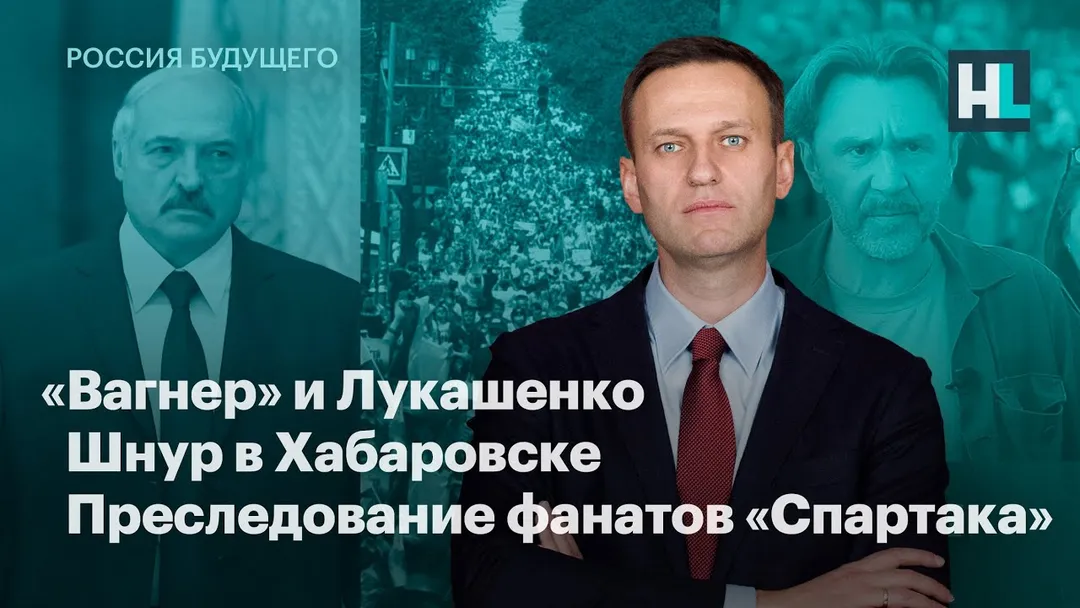
[music]
Hello, dear YouTube viewers and viewers in
Moscow, it is exactly 8:00 p.m., which means that
your favorite program is live on air,
Russia of the Future, and I am its host, Alexei
Navalny, or this week, the blogger for
poisoning lice, Ekaterina Vinokurova.
Ekaterina Vinokurova
A correspondent for our beloved, our jointly beloved
state
television channel, Russia Today (RT), she
was showing off obnoxiously on Twitter, and I
suggested that she disclose the size of the salary
the salary she receives from this
state television outlet. She said that
she would do it in exchange for my
I published my declaration in full this
week. Anyone
curious about how much I earn
and how my income is made up can go
and take a look. But Ekaterina Vinokurova
has now spent four days—four days have passed somehow—and
is pretending she did not notice, did not
pay attention; in short, she is refusing
to tell us what kind of
salaries are paid on state
television to people like her—
completely useless, needed by no one, and
most importantly, working on television
that is watched by approximately zero people, well,
or two, or maybe four—but in those moments
when we want to have a laugh and
also tune in and watch, then we are still
among the viewers. Otherwise, no one watches.
The unhurried course of preparing for my
program was changed literally in the last 10
minutes by deputy Yevgeny Stupin,
a deputy of the Moscow City Duma, an excellent
deputy elected
through Smart Voting, because he sent me
a reply that had in turn been sent to him by
the Investigative Committee regarding
the video that was published in many places,
and I was probably one of the first to publish
it on my Telegram channel.
Then we discussed it here with you a lot.
Do you remember?
A man turned on loud music,
a neighbor came to him and complained about him,
then Rosgvardiya officers (Russia’s National Guard) came,
and they simply started telling the guy directly,
“Right now we’ll plant drugs on you.”
Let’s watch 57 seconds from that incident,
which was discussed a great deal—millions
of views for that video—and all of us
of course, the whole country was outraged.
Just imagine: they simply come and
threaten to plant drugs,
so matter-of-factly, as if they do it every
day. “Seven seconds. Don’t want that?”
28,000 people are watching live,
and I think every one of you absolutely
agrees: well, guys, we saw
a crime. A person is being directly
intimidated, told, “We’ll plant drugs on you,”
“you’ll go to prison,” and deputy Stupin, well,
who wrote in—good for him, once again thanks
to everyone who voted for him—he wrote:
“Guys, look at the video, it’s all right there,
a Rosgvardiya officer says, ‘We’ll plant
drugs,’ and so on. Open
a criminal case.”
Stupin received a reply today. Let’s
look at it—they simply write,
the sheer level of brazenness: there are
no grounds; this appeal and this video
accordingly do not contain sufficient
data indicating signs of any
crime. Well of course—but what
signs of a crime? Just Rosgvardiya officers
while performing their duties
make a real threat to a person: right now
we’ll plant drugs on you. No
crime there, apparently. I don’t know—what then
would have had to happen? For them to pull out
a weapon and shoot this person? Or
to actually plant drugs? No
crime. But if you throw your
paper cup at a Rosgvardiya officer,
some large man with a big belly in
a bulletproof vest,
then the Investigative Committee—Bastrykin (head of Russia’s Investigative Committee)
might as well have a flashing light go off on his cap, and he runs
to open a criminal case.
But if they tell you, “Right now we’ll
plant drugs on you, and you’ll go away for several
years to prison, to a penal colony—want that?”—they
see nothing, notice nothing. Yet another
example of how, at locomotive speed,
this whole thing that
for some reason, out of habit, we call
the law enforcement system has long since
ceased to be that, and it simply spits in the face
not only of ordinary citizens, but of deputies too. And
even in the most high-profile cases—if this
guy
who had turned on the music had later written a post on
Facebook saying, “You know, can you imagine, guys,
Rosgvardiya officers came to me and
threatened to plant drugs on me,” then we
would say, well, maybe they threatened him, or maybe they
didn’t—how can you verify it? It would need
to be investigated. But here
it is all there, and they understand perfectly well that everyone will
see it, yet demonstratively say,
“You know, we do not consider that there are
any signs of a crime here at all.” In other words,
this is something everyone should be told about,
something everyone should be shown, simply because this
original video, as I already
said, was indeed seen in all
the major VKontakte communities by millions
of people. Everyone should be told how
the story developed: that even here
the Investigative Committee saw no
crime. Then where will it see one? Last week, following our
publications last week,
well, and since we are already on the subject, we found
We started talking about police lawlessness
last week. If
you remember, I showed you a video of a man
in sheer terror, running around his apartment
in his underwear because the door to his apartment
was being broken down and sawn through by police. Then they
stormed the apartment and tackled him
right in front of his child. It was a completely
or at least a very disturbing video, which I
will show you again now so you remember.
But this whole story took an interesting
turn, because
this man's relatives got in touch with us
and told us what is happening there.
And believe it or not, the situation has gotten much
worse. But first, a 35-second reminder.
So here it is: the apartment being stormed at two o'clock
in the morning, with a man who does not even understand
what is happening.
[music]
[music]
It is unpleasant to watch, of course, but it is worth
watching
because overall the situation turned out to be
even worse. It turned out that
despite what the local authorities
were saying — that this man had posted something
on social media and therefore it was necessary
to urgently search his apartment — no, that was not
the reason. He is now facing
charges — the man whose apartment was stormed — of
insulting a government official.
It turned out that in Kaliningrad, while standing near
a store called Euro Spar,
he allegedly said something to a police officer
— apparently something rude — and the officer
took it as an insult. In other words,
roughly speaking, I do not know whether he told
the officer to go to hell or not — he said
something to the officer, the officer felt insulted, and somehow
his superiors felt insulted along with him
to such an extent that this happened
in the evening, and they issued a special
order stating that there were urgent
circumstances requiring them, that very
night at 2 a.m., to storm
this man's apartment and break down
his door in the middle of the night in order to
look for some kind of evidence that he
had insulted a police officer the day before while standing near the store.
And if you think that
that was the end of the situation — no.
Against this unfortunate man
another criminal case has been opened
because he, obviously being in a
highly distressed state — which is understandable,
with children crying, practically an infant there —
said something to the investigator who
was conducting this absolutely illegal
search. In other words, all these people who
stormed his apartment, they are all
criminals from the point of view of the law. They
had no right to do it, and the investigator who
conducted, as I understand it, or conducted
this search
— I mean, that person themselves should simply
be jailed tomorrow, plain and simple. These are
obviously illegal actions.
And so the man said something
that was obviously unpleasant to the investigators. I myself
am always saying unpleasant things to them, and
they opened yet another criminal case against him
for threatening an investigator, namely
threats or violent acts
in connection with the administration of justice
or the conduct of a preliminary
investigation. In other words, the local
committees, the whole police gang, who
felt
— not exactly that trouble was brewing, but that they
had found themselves in a very bad situation
because the whole country saw how they
broke down a man's door for absolutely no reason
and terrified his family. And obviously, in order
to protect themselves and put more pressure on
this man, they opened
more cases against him because he was not
happy that in the middle of the night
they burst in and broke down his door. So there he is,
interfering with them breaking down his door, outraged by it,
he is obstructing them,
and supposedly threatening investigators
with violence. Of course, we are not
going to respond to anyone with violent
actions, but
all these people absolutely should simply
be sent straight to the defendants' bench
immediately. And they are all police officers, and
the whole gang — the prosecutor's office,
the investigators, those SOBR officers (Russian special rapid-response unit),
bursting in there — I mean,
just imagine again
the speed of the decision-making: you
tell someone off near a store — it happens,
that can happen to anyone —
and the officer is offended, and he can immediately make it so
that an order gets issued, SOBR or
OMON (Russian riot police) gets called, and in the middle of the night your door gets
broken down, and on top of that an investigator shows up right away. And
this is what is called one hand washing the other,
mutual cover-up. All law enforcement
agencies have turned into an organized
criminal group. And this criminal
group includes, of course, not only
police officers and investigators, but also, without question,
judges are among the main, one of the
key participants, and we are seeing this
fully in the case unfolding
right now — the case they have piled onto
Pskov and his associate named
Alexander Dorogov. This is a very important case.
I mean, do not treat it as though
Navalny, in the first half of the
program, is just talking about random guys
who have been thrown in jail, so it is not very
important. The case of Kotelevsky and Dorogov is
actually very important because
regular viewers of my program, you
You probably know Kotelyevsky, or at least remember him.
He’s this bald guy who lives in
the Moscow region. They have a whole
group of video bloggers who, for
the past several years, have been engaged in
fighting specifically against police
lawlessness, and in 90
percent of cases, that fight consists of
walking around with a camera and filming various
violations committed by police officers, and
so,
two of these YouTube bloggers, Kotelyevsky and
Dorogoy, were arrested and jailed; criminal charges were brought
against them, and now they are
being held in pretrial detention (SIZO, a Russian remand prison).
Their associate Andrei Filin spoke about this.
Let’s watch—just 9 seconds.
Hi. Today, July 29, were violently
detained by a group of twenty officers from
SOBR (a Russian special rapid-response unit),
our friends and colleagues Alexander Dolgov and
Yan Kotelyevsky. They were detained—you all
know why: for speaking their truth, for their
investigations. Over the last several
videos on Yan Kotelyevsky’s channel
have dealt with the funeral business in
the Moscow region.
Many of you have had to deal with funerals, and
many more will have to, and everyone knows
that it’s very expensive—but is that really the
case? In the Ramenskoye urban district,
whoever removes the body is the one who organizes
the funeral. For some reason, that’s how it’s done. The topic is
grim, and very profitable for those
who are involved in it. Among those involved, according to
statements by Dorogoy and
Kotelyevsky, are police officers—and who exactly
is protecting them remains to be found out.
But for now, the investigative authorities
are questioning Kotelyevsky and
Dorogoy. The guys are being held in a temporary detention facility
in the Moscow region, in Gorlovnya,
and as far as we know, the police have already
begun interrogations.
But that information was from a day
ago. By now, both of them have been arrested.
Kotelyevsky has done various investigations.
You heard that striking phrase: many of us
will have to deal with funerals. But
the thing is—why? This is a very important
case, because for several years now Kotelyevsky has been
genuinely battling
a kind of judicial-police mafia
from the Moscow region, and he has made life
very difficult for them. They have literally been dreaming
for years of putting him behind bars,
but never quite dared, because, well,
he’s a fairly public figure. His most famous
case was Kotelyevsky’s
—though in fact he’s had many cases.
He was constantly exposing police officers and judges
in the Moscow region, but the most famous case
was that one day he was filming
a police station with a camera, as they
were walking around—he was filming it.
And, and
he was detained because the police
were very unhappy that he was filming them.
The matter involved some plot of land
that police officers had allegedly seized illegally.
They detained him unlawfully, dragged him in, and
he was filming them and recording audio, and
they detained him and jailed him for 15 days.
The thing is, when Kotelyevsky was
locked up, he had some kind of phone—it wasn’t
a smartphone, just a phone with a really good battery—and he
didn’t turn it off. That phone ended up among the
physical evidence.
And it just kept continuously recording everything that
was happening. In particular, that phone
was brought, along with the evidence and case materials,
to the judge. Who was the judge again?
Let me tell you exactly now.
It was Judge Golysheva, and the recording
simply captured Judge Golysheva
explaining to the police—there are several
hours of recording there—something like, ‘Your
witnesses are gone? That’s nonsense. You did everything
right. Rewrite it, boys. Let me
play you one clip—1 minute 19 seconds
from the longer recording that caused
a huge scandal. I mean, all of this
made it obvious that the judge should be removed—there was an obvious
criminal conspiracy there.
The unlawful arrest of Kotelyevsky—
I mean, it was really, truly
a genuine criminal offense: bringing someone to
administrative liability—in this case, arresting
a person known to be innocent. And this
was a unique case,
proven by an audio recording of conversations
between a judge and the head of the local
police department. Here’s a short excerpt—
19 seconds from that recording.
Careful, just watch—it's hard to listen to.
It’s all very, very bad there.
There are no outsiders—everyone involved has an interest.
Miss consultant, confidential, official
order.
It’s simply a judge and a police officer sitting there
discussing how to jail an innocent
person, and she says, ‘Well yes, there were no attesting witnesses,’
‘Yes, he’s shouting—of course he’s right.’
And I’m thinking: so why was he
forbidden to film? There’s no such rule anywhere.
‘Let’s make something up.’ And there they are, discussing
how to actually jail an innocent
person for 15 days. And that judge, of course,
should have been stripped of her status; she herself should have been
jailed. It was a huge, huge scandal. And how
did it all end? With nothing. She
is still a judge. But still, the scandal
did happen. Naturally, those police officers, that
judge, all of them—they basically painted a
target on his back, or on his fine
wonderful bald head—a target. And on him,
and everyone else from the channel and the movement there,
that remarkable group of people—I’ve long
I know them — they’re my comrades, very good people.
These guys are really just being
systematically targeted for imprisonment, and
right now their case strongly resembles
the case of that Police Ombudsman (a Russian police accountability activist), and I
understand that the essence of it is this:
that Kotelyevsky was standing there, and a car drove into him,
and then they said, “Oh yes, you
damaged our property because
the car got scratched,” or something like that.
That’s what supposedly happened, and then they accused them
of extorting money from a police officer
under the pretext that they wouldn’t
file a complaint against him. So basically, the whole case
is built on police testimony, exactly
the same way as in Vorontsov’s case, the Police Ombudsman case,
when one of the police officers said,
“He extorted money from me, extorted money from me,”
and that was enough for a criminal case, pretrial detention, and just
because we’ve entered this kind of period after the adoption of
the constitutional amendments in our
country where total lawlessness is happening
absolutely everywhere, yes. Unfortunately,
we’re not taking to the streets as often as
we need to. You have to come out, you have to show up, because at this
level of lawlessness, they saw that
the Ombudsman case went through, and they opened exactly the same kind of
case against these guys. And it’s
very important to follow how this
develops, because here you can directly see
a police-and-judicial mafia — bandits,
in the Moscow region, sitting there and jailing young men
who fought against them, and fought very
bravely. Go to the movement’s channel,
go to Kotelyevsky’s channel,
read everything, watch everything, and support
him in any way you can, because right now, of course,
public attention is needed. So many people are being jailed
right now that it seems like hardly anyone is even writing about it.
Well, sure, I saw that Mediazona (an independent Russian media outlet) wrote about them,
and someone else did too, although this is of course
an extremely high-profile case: they’re simply jailing
an activist who fought against
corrupt police officers and judges.
They’re putting him in prison for nothing. There are a lot
of questions about what’s happening with
our Smart Voting. My God, how
glad I am — I’m so glad you’re asking me questions
about Smart Voting. I’m practically ready
to tear up, because we
— well, I personally, all of us — spend an enormous
amount of time on this. We’re trying to convince everyone
how important it is to take part in Smart
Voting, to register. People are coming around
slowly, because everyone thinks
that with some silly thing like
registration, then showing up and voting,
nothing can happen. It can.
It can happen — this is an important precondition
for other events to take place.
So thank you to everyone who’s interested.
The campaign is underway. We have thirty-nine
regions — the updated figure now is 39
regions where Smart
Voting will be active. In total, campaigns at various
levels: there will be 66 city council elections in 33
cities, including major cities
with populations over one million. This is very important, and right now we’re
going through a difficult process:
signature collection is wrapping up for almost all
candidates, and for other candidates
the decisive moment has come, when
it’s being decided whether they’ll be allowed onto the ballot — many people
have been allowed through,
while others are being kept off the ballot. There, of course,
a completely lawless
situation is unfolding. I wanted to say a couple of words about Tambov.
Tambov — you know the saying, “The Tambov wolf is your comrade” (a Russian idiom meaning “you’re no friend of mine”) —
as a region, from the point of view of
dislike for United Russia, it’s actually very promising.
But enormous
falsifications keep happening there. The authorities there aren’t just
corrupt, not just bad people —
they’re outright bandits, and very
blatant ones at that. A group of people from
our штаб (campaign office), led by our chief of staff,
Diana Rudakova, is running in the Tambov city council elections,
and they’re not being allowed onto the ballot — and not being allowed on
in the finest traditions of — remember there was
that famous meme about Darya Timurovich?
The one who was supposedly born and born in
Novosibirsk.
When people submitted signatures there, the procedure
works like this: you submit signatures for a candidate,
then someone in the commission sits there,
some guy, and those signatures for the
candidate get entered into some list, and that
list is then checked against the database. If
the specialist wrote not exactly “Darya Timurovich”
but, say, “Dari Timurovich,” they go, “Oh, look,”
“there’s a mismatch — it says ‘Dori Timurovich,’”
“and here it even says ‘Dori Timurovna,’”
“so the signature is invalid,” and
that’s it. I mean, it’s a complete sham.
But what’s happening right now in
Tambov
is exactly this: all three of our people
are currently being kept off the ballot.
Let’s watch for a minute — Diana
Rudakova, the head of our team, will explain
what’s happening. Three out of our four
candidates — me, Egor Slivin, and
Anna Nefedova — submitted signatures to the
election commission last week.
We collected the signatures very carefully, with
a double safety margin, and they went through
several of our internal checks.
We submitted the clearest, most legible ones to the
commission.
But the verification of signatures by the district
commissions was carried out with the most serious
violations. One stage of the verification through the
GAS Vybory system (Russia’s state election database) took place entirely in our
absence, and commission representatives
deliberately distorted the surnames of the signatories
so that the names would not match the voter database,
and all subsequent stages of the verification
were based on data distorted by the commission.
the data, and then it was up to
a handwriting expert who simply
arbitrarily threw out genuine signatures
of voters. We war—
[music]
You were probably wondering what happened — I
cut out. I really did
go offline. Vladimir Putin struck back
with a counterblow. You understand, this is a powerful, extremely powerful
technology. What just happened is that our
electricity was cut off. Just some
guys cut the power in order
to, for a few seconds,
stop my program. And 57,000
people were watching live before
the electricity went out. I hope
they’ll come back, but it’s just, well, like
I was just talking about this — how in
Tambov they won’t let our candidates run
and are engaged in petty fraud
and you can simply watch this petty
cheating with your own eyes. Well, I don’t know
there, we’ve turned it back on now. We probably need
to leave someone by the electrical panel around the clock
some kind of armed guard there, because
some people will come again and
switch it off, and I’ll disappear from the broadcast again
So, getting back to Tambov, we
have once again found ourselves in a situation where
voters — ordinary people, as in Moscow
and it was the same in Novosibirsk — have to
prove that they’re not camels, meaning
they literally have to come in and
say: I’m here, I exist, I am this person, this is
my signature, it’s genuine. And to them
the graphologist and the commission member will say
well no, wait a second, do you have
a graphologist’s certificate? No. But I
do have one, so I know better
whether this is your signature or not. Here are
18 seconds
one of those people who is now
going around this commission proving
that he is who he says he is
I am Vyacheslav Andreevich Yershov. My signature
in support of candidate Diana Borisovna
Rudakova was recognized as invalid. I am
outraged. I demand that the signature sheet be recognized as
valid, because these are my
constitutional rights as a voter, and
I demand that Diana Borisovna be allowed
to take part in the election.
And there you have the situation: there is a person, there is
his signature, and the commission says the signature is fake
and the person goes around proving it. Rudakova
goes around proving that the Tambov mafia
simply does not want to let these people into
the election, because they will win these
elections, then they’ll sit in the assembly and
keep them under control. We will now
nevertheless push for registration of
many candidates in many cities
Some have already been registered, and they really
need any help you can give — with registration,
campaigning, voting, financial
support, or simply sharing links, and so
on. Because, as we know, in
practice, in regional elections there is
low turnout, and a person can become
a deputy with a tiny, tiny
number of votes
That is exactly why our Smart Voting
strategy is so important. We still haven’t finished
collecting signatures everywhere yet, so for those who
for example live in Belgorod, I want to draw your
attention: there are still three days left there
for our great candidate
Maxim Klimov, who is running for the local
legislative assembly, to collect 3 percent
of all voters’ signatures. But that’s hard, really
it is
In the summer, collecting 3 percent of all signatures
for him
to take part in these elections — three days
are left. Please go to his website
and if you live in Belgorod, help him
however you can. First of all, I forgot to say that
right here, I can see right now that
a little duck named Sergei is floating by. You
can click below and send these
ducks
We are still continuing to raise money for
paying the fines of those people who
took part in the Moscow City Duma elections
and were not allowed to run, like Rudakova
They called everyone into the streets, and they were then
hit with enormous multi-million-ruble fines
and of course we want to compensate
those fines on the principle that we all
protested together, so let’s all chip in
100 rubles each (about $1). This is very important. By the way,
speaking of chipping in 100 rubles each
I wanted once again to
thank all of you very much for taking part in our
fundraising campaign. The whole story with
them taking away FBK (Anti-Corruption Foundation) from us was that we
were very afraid of losing those
7,000 of our regular donors, and I
talked about it here on the show, we released a video
and now we have 15,000 regular do-
donors. So we really thoroughly
rubbed the noses of all those guys in
the Kremlin, Prigozhin, and everyone else
who did this. It’s really cool, we
are very proud and very grateful to you. It’s also
a huge responsibility. An awful lot of
people signed up specifically for monthly
donations
During the presidential campaign we had, I think, more than 100,000
people
send donations, but they
mostly sent them as one-time contributions. But this kind of
large-scale support from 15,000 people
every month — of course, we’ve never had that before
There’s also a link in the description — a lot of
fundraising links there. Go there
click
join in if you can
If you want to support us, Vitaly,
asks me: tell us, do you know anything
about the logging around
Lake Baikal?
I know they’re building major rail lines there, and I
know that, naturally, under the cover of
that rail construction, they’re cutting down
a huge amount of forest, including
areas that don’t actually need to be cleared, simply
so that, while the work is going on, they can cut it down and, as usual,
send it off to China. I don’t know
all the fine details there;
I only know what’s been reported in the media. So let me
look into the issue.
Damn, if you keep using these kinds of
usernames like this one — “sorceress” and it rhymes with
swear words — I can’t read them out loud.
Anyway, a girl with a very obscene
username asks me: what do you
think about the situation with Chaika’s wife (likely referring to the family of Yury Chaika, former Russian Prosecutor General)?
Taking away her passport, threatening to take the children
just to keep her from leaving — I think I’ll talk about that.
It really is a divorce story of the year. I
do have it in the plan; we’ll cover it in the show, but
first I wanted to tell you about this.
It turned out that the first part of the program
is entirely devoted to political repression. So
here’s a question for you: what do you think is currently the
biggest and yet completely
non-high-profile, almost unknown
mass political case with a large number of
defendants? Well, if you
think about it, you might say the Moscow Case, although
that one has already more or less ended. There was
the Bolotnaya Case (the prosecution following the 2012 Bolotnaya Square protests), and there are other cases underway,
including cases against Crimean Tatars, and so on.
But no — the biggest repressive case right now is obviously
the case against — you’ll be surprised —
Spartak fans, and more broadly
against the football fan movement. I
briefly talked about this in the last or the one before last program.
There was a question about it here.
But Ilya Yashin released a really good
video on his channel, and it once again
drew attention to the fact that we need to talk about this.
After all, we know that Spartak fans —
who just a few years ago
were seen by the authorities as unquestionably
their own supporters — were, you know,
guys with right-wing leanings who
were perceived as a counterweight to certain
liberals. But then it became clear fairly quickly
that Spartak fans — and
the football fan movement in general —
cannot be politically mobilized
for any one political force, whether the authorities
or the opposition.
Because it includes completely different kinds of people, and
the football fan movement instantly
splits apart as soon as people start
discussing the political agenda.
And the authorities don’t like the football fan movement at all.
First, they want there to be
a kind of political monolith — a monolith
that is pro-Putin or otherwise politically uniform.
Second, they generally want
to take everything under control, and they view any
actions or movements as
hostile acts, and they’ve simply
started putting people in prison.
Spartak fans held what was basically just
a completely harmless event: a bus carrying the players
was driving by,
and they blocked the road in front of the bus —
a small secondary road —
for a moment.
They waved flares and shouted, “We love
Spartak!” It was all great, all fine, and
then they dispersed. In other words, it was the kind of action
everyone does to support their favorite
team. It’s nice for the people sitting in the
bus to hear that.
Even so,
a criminal case was opened. There were hundreds
of searches, and dozens of people became defendants
in the criminal case. In terms of scale, it really is
an absolutely outrageous case — bigger
than, for example, the Moscow Case — and yet
almost no one knows about it. Let’s
watch a clip from Yashin’s video, about 37
seconds long.
An important political case that, unfortunately,
no one is talking about: on June 15,
Spartak players were heading to Tula
for a match against the local Arsenal, and the
red-and-white supporters gave the team a colorful
send-off. They unfurled a banner,
put on a flare show, and for a couple of minutes
held up the movement of the bus and
the police escort vehicles.
I want to stress right away that this happened
not on a busy highway, but
in the area adjacent to the stadium, where
there are hardly ever any ordinary cars.
It’s mainly club
transport that moves through there.
But agree, it seems that nothing terrible
happened. Yet against Spartak fans
a criminal case was unexpectedly opened.
Three supporters were detained immediately,
and the next day they were released under
travel restrictions, but that was only
the beginning. Over the next several weeks,
the police identified 70
Spartak supporters who may have
taken part in this action.
Searches were carried out in their apartments, and there began
interrogations, face-to-face confrontations, and other
investigative actions. All of these guys
are being charged under Article 213 of the Criminal
Code — hooliganism. The maximum sentence
under it is 8 years. The supporters
put on a fairly ordinary performance;
previously, no one was imprisoned for something like this.
Even though the laws were the same, there are no victims,
no one was harmed, and it’s not just that Spartak has no
complaints — on the contrary, the club
officially thanked the supporters for
for the vivid show of support and for the motivation
of the players, Spartak captain Georgy Dzhikiya
even said he was ready to pay out of his own pocket
to cover any fine for the fans if
the police had any complaints against them. 59,000
people watching live in real time
the viewer count recovered after
that — our electricity was cut off
thank you very much for watching, I mean
Yashin is saying the right thing here
there are no victims, nothing at all, and in general
what is the problem? The problem is disobedience
to our police state. Before it starts
locking everyone up around them — basically, their
machine works like this: they need
new cases
new employees are hired, they expand
the anti-
extremism centers
they need new cases. If some people
are running around, singing something, waving flares
and didn’t warn their handler from the
center, then
somewhere along the line they start locking people up, and
there are no victims, no one at all, but
nevertheless people are actually being imprisoned — these are
quite simply real repression, like
everyone stays silent. I know that football
supporters, real Spartak fans, don’t
kind of troll me a bit because
at one of my meetings with
voters in 2013, I was asked which
team I support. Well, it’s a Moscow
team, I live in Moscow, so I support Spartak
well, anyway, that’s that
I said I support Spartak, but at the same time
later, in an interview with Dud (Yury Dud, Russian journalist)
he asked me who the head
coach was and which footballers were there, and I know absolutely
nothing about it. If you asked me now
who the head coach is, or who plays, or
what division they’re in, I would have
no idea at all. And honestly
speaking, I’m not very interested, but
of course, like any other
person, it concerns me when, for absolutely no reason,
they open a massive criminal
case in which, essentially, hundreds of people are being processed
and jailed, and I’m simply baffled every
time by the position of the rest of
the football movement, which
stays silent and watches: these ones got devoured
and the next ones will be devoured too. Of course, in every
country there are police units
that, well, kind of keep an eye on fans
because it’s quite a lively
social group that can do various things
including, of course,
there are some related stories, yes
especially in the past, involving crimes
committed by fairly organized
groups. And in general they also have
certain traditions, like arranging fights somewhere
or something else, but overall that doesn’t
concern ordinary people — they fight among
themselves. But even so, one can
more or less agree that this requires
some kind of police oversight. But damn,
locking these people up for nothing is the most
genuine police lawlessness; it is
the most real political repression
these people are, unquestionably — if
they start imprisoning them — they will be
prisoners of conscience, and they will be
political prisoners, despite the fact that they are
fans, and maybe they hold
right-wing views or left-wing views — that no longer
matters in the slightest. Therefore
I simply want to draw attention to this
case
so that people follow it, because, well
basically no one is — I mean, practically no one
is writing about it, just a small number of
outlets: Mediazona writes about it, Sports.ru writes about it, but
overall, the scale of this case is nowhere near
matched by the scale of its coverage, because
well, people seem to think, like, why should we feel sorry at night for
fans — Spartak fans, or, I don’t know,
Zenit fans — because they supposedly
once, back in 2012,
were against the protesters. First of all
these are completely different people now, and second
it doesn’t matter what views they
hold — the system devours anyone
today they’re devouring Spartak supporters, and
forgive the banality, but
tomorrow they’ll devour you in exactly the same way
so solidarity is everything to us. So
Dmitry Zair-Beg asks: Alexei,
hello, what can you say about the New Greatness case
I saw your post about the torture of
Ruslan Kostylenkov — how would you
comment on the prison terms requested by the prosecution?
A completely fabricated case, fabricated
entirely
from the first word to the last
invented by FSB officers
Even officially, that whole so-called
terrorist group
had nine people, of whom four
were undercover agents — that’s according to the case materials
the group, that is, consisted of
some unfortunate
young people who were recruited through a
Telegram chat, and undercover agents from the FSB and
the MVD (Ministry of Internal Affairs), who wrote all these documents, and
now, simply in order to get
a few more stars on their shoulder boards, are trying
to put these unfortunate kids in prison, actually asking
for terms of 6 to 7 years. And on top of that
they torture them — torture them in absolutely monstrous ways
read Kostylenkov’s letter in
Meduza — there was rape, really, I mean
it describes utterly nightmarish things
that are happening. 2,000 people are watching us
live right now. So, there are a lot of
questions here about fabricated criminal cases
the utter horror of our situation, of our
The point is that if I
cover in my program all
the politically fabricated criminal
cases, I won’t be talking about anything else
at all. Every episode would end up being
a gigantic Thursday broadcast, and it
would be devoted exclusively
to political prisoners, because
there are simply more and more of them
and more and more, and
there are now so many of them that people have
stopped paying attention to the individual cases
but I’m trying to highlight this however I can
but
of course, all of this is very sad and depressing
So, Ivan Grigoriev, Alexei, in
an interview with Pivovarov, Sobchak said that you
lied about her coming to your home
the story, the proposal disappeared, paid for, bla
bla bla bla bla bla. Ivan Grigoriev, come on
seriously, in 2020, to believe Ksenia
Sobchak
or any word she says? It’s just that by now we
simply have a great deal of
empirical experience showing that she simply
lies all the time, in every word. How can you tell
that Ksenia Sobchak is lying? She opens her mouth
that’s all. And in that sense, there’s really nothing else
left to discuss
The fact that 2,000 people will watch live
about coronavirus—there was a time when coronavirus
when I was sitting at home
and doing broadcasts from home, it was always
the last topic of the show, when there were already a lot of
viewers—the biggest audiences watched that
those were the biggest hits, everyone was very
interested. Now we’re all already sick of
the topic of coronavirus, yes, we no longer
want to discuss it, we’re tired of it, and in general
it’s not interesting. But nevertheless, a new, to put it mildly,
very interesting process is underway
because in the regions it’s either the first wave
or the second wave, but there it’s simply
a catastrophic situation. All those
videos we saw of ambulances
of ambulance vehicles that
were standing in huge lines—they’re gone only in
Moscow now, because in Moscow
an enormous amount of money was invested
and now all of this has shifted to the regions, while
the number of people dying is enormous
Our situation is better than in the United
States of America
where the biggest catastrophe is happening
in that sense, but overall things are very, very
bad. And it’s interesting that this
week Putin spoke about coronavirus
Let’s take a look: it’s already mid-to-late
late July 2020, and Putin is already forced
to say that the situation with coronavirus
continues, continues to be
very difficult
[music]
If I knew how to roll my eyes that theatrically
that well, I would be rolling them
very hard right now, because, well,
seriously, what a primitive little tactic
they used. I mean, in a way
it’s actually surprising they didn’t
do it earlier. There had already been searches
there had already been internet shutdowns, but
just, like, turning off the lights—that hadn’t happened yet
So, Vladimir Vladimirovich, you are
an amazingly sophisticated
politician. Wonderful—I’ve forgotten what I was
talking about. I really forgot what I was saying here
but Sergei Andreev asked a good question
Hello, whom will Smart Voting recommend
if in one
region two opposition candidates are blocked from
running? Excellent question, dear
Sergei Andreev. If these are
gubernatorial elections—who in
gubernatorial elections—I assume
you’re asking this question in connection with
the gubernatorial elections, and even
specifically in Arkhangelsk, where they registered
a candidate from the SR party (A Just Russia),
which is great, and his surname is Mandrykov. He’s
a real candidate, and as I understand it, he
supports our position very well. It seems
he will be able to take part in the election, and there
is also a second candidate from A Just
Russia, also apparently not a spoiler
a woman, unfortunately I don’t remember her name. In
gubernatorial elections, everything is much simpler
you don’t even need Smart Voting there
because you are voting for a runoff
that means you vote for any
candidate
except the Putin-backed one, except the United Russia candidate, because
the goal is for the other candidates
together
to get more than 50 percent. That
means there will be a second round, and in the second
round, the candidate who received the most
votes in the first round should be the one to win
because everyone will need to rally again and
vote for him. As for the first round
of the elections—that is, all the other ones, the
really important elections for regional legislatures
city councils, municipal councils, and so
on—well, that’s exactly what Smart
Voting is for. Because if there’s one
opposition candidate, everything is clear, but if there are two, three, or four, and
if it’s not clear at all which of them
is actually the opposition candidate—and in 99 percent of cases
that’s exactly how it is—you come to the polling station and
look and see nine names there, and you
have no idea who these people are. Well,
let’s be honest: for a city
assembly or even a regional
legislative assembly, you don’t know
any of these people, not a single one, except in
very, very rare cases. And we
will take on all of that heavy lifting
all that tedious work in 33, or however many I said,
34 regions across 66 election campaigns
We’ll look at each person and examine
their previous results, and so on.
And then we’ll figure out who has the best
chance of winning, and who is
almost certain to come in second, and we
will give you that person’s name so that
through smart voting you can vote
for them. Because if you don’t have
the surname, you won’t know yourself whom
to vote for. Or you may think that you
are more of a left-wing kind of guy,
so you’ll vote for the Communist, while someone
who’s a liberal will vote for Yabloko (a Russian liberal party), and
the United Russia candidate will win, because that is exactly how it
works. So we’ll see who is stronger and
suggest that, setting ideological
differences aside, everyone vote together for
candidate number two so that they win, just as
happened in Moscow, and it will work
if you register for
the voting. So, about Putin—I was saying
about that, and
I wanted to show you an 18-second video where
Putin says that the situation is very
difficult with the coronavirus in the country.
The situation remains difficult, and as
they say, it could swing in any
direction. That, by the way, is exactly why
we have gathered here, and therefore there are no
grounds for complacency, for
relaxing, or for forgetting
doctors’ recommendations. Remarkable
words—truly remarkable things to hear at the
end of July. How can that be, Vladimir
Vladimirovich?
The situation could swing in
any direction; we must not become
complacent—it is very alarming.
Well yes, it is very alarming. But who was that
person sitting in this same bunker
some 65-year-old man with a large number of
plastic surgeries, who quite
recently was saying that everything here had
been sorted out, everything had stabilized,
so much so that
I order preparations to begin
for a parade. Let’s take a look at who that
man was. Thirty-three seconds: given that
the situation both in the country as a whole and in
most regions
the armed forces themselves remains
stable, and in many places
is stabilizing after passing the peak
of infectious disease,
it is possible to make the following decision:
I order the start of preparations for the military
parade in honor of the 75th anniversary
of victory in the Great Patriotic War (the Soviet term for the Eastern Front of World War II). So,
you see, two months ago everything was so
stable and great that a parade had to be held.
And back then everyone was saying—and
I was saying it too—what are you
doing? You’re going to infect a huge number of people.
Let me remind you: the parade took place in
a huge number of cities in the regions. I
said that in the regions you would simply create
first with the parade and then
with the voting a second or
an additional first wave of the epidemic there. Everyone
said, what nonsense.
The situation is stabilizing—and now
it turns out it has become alarming, and now
it is alarming. So why then
did they announce the vote?
And I remember how Vladimir Putin spoke about
how, in principle, everything was fine and it was possible
to finally return to considering
the most important issue of our time:
his constitutional amendments. Eighteen seconds.
But we proceed from the assumption that as
the situation with this pandemic improves, we will of course
return to normal life, including
having to think about further
work on the constitutional amendments. So,
we were returning, returning to normal
life, and then it turned out that in some places the situation is
serious.
Already this week it could swing in
any direction, and so on and so forth. Well,
Putin’s concept, as you and I
discussed a month ago, two months ago,
was fairly clear: they would say that
the epidemic was over, everything had
stabilized.
What’s more, I was already predicting back then—
a great prophet, though it wasn’t
hard—that they would start lying about a miracle
vaccine and say that Russian doctors were the first
to invent a vaccine, and we can see that this is
happening right now. But still,
this talk about a vaccine,
about human trials—all doctors are reacting
with sheer horror to the talk that
human trials are already underway and that they are already
planning—this is putting it mildly—to
roll out this vaccine. And everyone, naturally,
jokes that a country that is incapable of
producing insulin properly is now
trying to claim that it has invented
and will produce a vaccine against the corona-
virus. So, obviously, all of this is
a lie.
But the plan looked smooth: in Moscow
everything had more or less passed; there were no
endless lines of coffins for anyone to see in
the regions.
And to hell with it—let them die there; we’ll
say it’s all over, we’ll hold
the parade, we’ll hold the vote, and then
we’ll also say that we were the first to invent
the vaccine, and it will become the story of how
Vladimir Putin defeated the coronavirus. Well,
in other words, it looked smooth on paper, but
the ravines somehow appeared along the way.
And now those lines of coffins, after all,
sadly, do exist in the regions—an enormous number
of deaths. And in fact, there
it’s somehow not even very noticeable that any kind of
a turning point, stabilization, or something else
there’s nothing even close to that
there was a funny incident connected with this corona
virus, and with this mask
mandate—you know that in many
regions it is still in effect
in many regions the authorities are busy
doing some strange things: first they
ignored masks, and now
they’re forcing everyone in the metro—ordinary people
are being fined over these masks, while Sobyanin (the Mayor of Moscow) actually
just a month ago—he first introduced
a mask mandate in all establishments, and
then publicly, on camera, met with
restaurateurs and wasn’t wearing a mask, and
what’s more, like a day before that he said
that restaurants were reopening with masks, that everyone in
restaurants would be required to remain
in masks—and then he held a meeting, sitting there without
a mask. Let’s recall it, let’s watch these 30
seconds
I hope we’ve gotten rid for a long time of those
restrictions that were in place
and we didn’t make these decisions lightly; all
the decisions were considered very carefully
we monitor every stage, and this past
Monday—last Monday—we once again
checked
whether we were making a mistake; we looked at all the trends
the data, case detection rates, and
hospitalizations, the numbers, the overall picture
everything is declining, which is why we’re fairly
confident. Good. Well, naturally, when
this segment was shown, people watched it
and said: so, you just introduced
a mask mandate and now you’re sitting there without a mask, and
they filed complaints against him. Not even just
to troll him, but out of genuine
outrage—how can it be? You scare everyone and
fine them, while you yourself sit there demonstratively, on
camera, without a mask. And then a month passed, and
the first replies started coming in, and this is what
the wonderful Moscow government even
responds
Well, the official reply says
that evidence of committing an
administrative offense has not
been provided. So here’s the video, here
you are—you’re just hypocritical crooks. Here
is the video: Sobyanin has no mask on. No, this
video was shown on Moscow’s official
television. Does this video
prove that he was supposed to be wearing
a mask and wasn’t? Apparently not. No evidence
has been established—they write this down on paper, literally
paper will put up with anything. They really do
write this on paper and send it out, so
it can be framed and discussed on the
program
*Russia of the Future*. It’s just, simply, pure
window dressing, the real thing, and this
is, of course, also a great example of how
this escalation of brazenness is happening. Basically,
a year ago, two years ago, sure, they lied
deceived, cheated—they always did—but
not quite this openly, this directly. Still,
they at least tried somehow; they wouldn’t have
answered a question like this. You see, we
write to them: why was Sobyanin without a mask?
Fine him. They could have said something like
we lost the request, it never reached us—but they
don’t even say that anymore. They say
you haven’t proven that he was
without a mask. Just wait, there’s more to come. At the end of the
program we’ll discuss Belarus, where
things are much worse—that’s exactly where we’re
heading. I’m asked quite often,
why such an idiotic decision gets made, or
why such an idiotic decision—where
the root of this idiocy lies
Well, in many ways idiocy in Russia
is self-reproducing, and it is simply
determined by the laws and the established
order. But all the same, there still has to
be somewhere a kind of generator
of stupidity, a generator of harmful decisions and all
this foolishness
that someone came up with, and then it
grows to gigantic proportions
costs huge amounts of money, and so on. And
this week we saw
a perfect example of such a thing. More than that,
the generator of stupidity itself came out and
explained how it had all been done. More than that,
they proudly declared
that what they had done was supposedly
not stupidity, but some great, grand
achievement. So, you saw that
there was a hugely pompous, expensive
it wasn’t enough—just a parade, damn it, just
a parade wasn’t enough for Putin; he needed
he apparently wants to hold them endlessly
to please the Supreme
Commander-in-Chief, so he also held
a naval parade, and of course
but the main madness—aside from
the fact that during an epidemic, and in general
it’s unclear why you would hold this
naval parade, which is very expensive, by the way—
the crowning touch of the insanity was
the situation with the remains of the unfortunate
Admiral Fyodor Ushakov. Fyodor Ushakov
a great Russian admiral, had wished to be
buried somewhere there, in his
homeland in Mordovia (a republic in Russia), and he was buried there
his will was carried out, and he lay peacefully
in his grave all those years
but Putin needed a parade, and they literally
dug Ushakov up out of the ground and started
hauling him around the country, for heaven’s sake—I mean
they literally organized a kind of tour
they called it, supposedly, transporting the relics
of Admiral Ushakov, but I mean, really
they dug up a corpse and started with this corpse—and
they solemnly carried him from one
city to another, along rivers and seas
and supposedly used it to bless everything
the footage is monstrous, but I’ll show it
A bit of news.
At 21 seconds there’s a photo report, but besides that,
I wasn’t even going to dwell on this here,
about the Chinese and how they kiss these skulls.
They rummage around in these relics—it’s some kind of
nightmare. At 21, there’s a segment about how they’re transporting
Ushakov—the relics of Admiral Fyodor Ushakov.
A reliquary has been brought to Kronstadt and is now
located in the Naval Cathedral building. It was
brought from the Sanaksar Monastery (a men's monastery in Mordovia),
in Mordovia, for Navy Day.
During his lifetime,
he was among the founders of the Black Sea Fleet
and took part in the Russo-Turkish War.
Ushakov won 43 battles and did not
lose a single ship. The man was
a military man, an outstanding and honored figure in our
history. But he was a military man—he didn’t
talk to animals in the forest, he didn’t
heal people, and the Virgin Mary didn’t appear to him
or anything like that, as far as I know.
He was a military man. Before he died, he said,
“Bury me normally, please, just put me in the ground,
and I’ll lie there quietly.”
But they dug him up and started hauling him around
the country. Why? You’d be surprised. And while
they were showing this on television too, with
great pride, Putin was saying that he was sitting there,
flying on a plane, reading a book,
and an idea came into his head.
They should hold a naval parade, like
they used to do back in the old days.
He picked up the phone and called some guy—
the Defense Ministry chief,
the head of the navy, the commander—
and they started preparing it. I mean, just
do you understand? A crazy old man is sitting there, and into
his head pops some thought: “Wouldn’t it be nice
if, you know, it were all vivid and grand? Me, there in
Kronstadt, standing there, with people in uniform
next to me,”
“and then ships sail by and everyone salutes
me. Beautiful picture. So let’s
go ahead and organize something like that for me. And also,
dig up Ushakov and start carting him around
the whole country.” That is exactly how Putin,
more or less, explains how he came up with the parade.
Incidentally,
while on the plane,
for secondary reasons,
I happened to come across
it.
The man likes reading
historical literature, so he cooked up a parade.
Good thing he doesn’t like reading
science fiction, otherwise he’d have
said, “Let’s build a hyperboloid
of Engineer Putin the size of a 100-story
building,” or something else. I mean, let’s hope he doesn’t
start reading literature on
agriculture, because then he’d say, “Let’s
go ahead,” he’d say,
“let’s reverse the Siberian rivers so that
they flow into Central Asia, like some people once
wanted to do”—the same kind of lunatics who
ran the Soviet Union. It really was
a gathering of senile fools, and one petty tyrant
says, “Well, I was doing some reading and decided
to hold a parade,” and the others
stand there nodding: “Yes, yes, yes, of course,”
“as soon as we got the call, we immediately
thought, wow, we had exactly the same idea,”
“brilliant, absolutely, let’s do it right away.”
As for, say, buying apartments for military personnel,
or fighting the coronavirus,
or not holding a parade because of the corona-
virus—because that really needed immediate attention—but instead they held
a parade and some other highly ceremonial event, and
“let’s dig up Ushakov and carry him around
the whole country.” And they did it.
They spent billions on it and once again
infected a whole lot of people. And now we sit here
discussing why we have no money, why
we need to treat even more
people, and why our situation is
so difficult. Because there is a generator
of senility and idiocy, and he has
a specific name: Vladimir Putin. He
comes up with stupid, foolish things because
after 20 years in power, he’s lost his mind, like
any person who spends 20 years
in power. Of course he’s gone off the rails—I think his
mind is completely gone. Anyone would. If I sat
in power with that kind of power for 20 years,
I’d probably end up the same way. I like reading
different literature too,
and I’d probably come up with some nonsense as well, and everyone
would say, “What a brilliant idea he’s had.”
Like, say I love—I don’t know—
doing a show on YouTube. So let’s make it so
that everyone is forced to have
YouTube on, and at 8 p.m. on Thursdays
everyone has to switch to that YouTube, and those who don’t
—well, never mind—
we’ll fine them for disrespecting
the authorities.” And everyone would say, “What a wonderful
idea. Alexei Anatolyevich is a genius—how did
that never occur to us?” That is exactly what is happening.
Exactly the same thing: a person is going mad,
and the crooks and thieves around him
use his senility to achieve
their own ends, to steal. And if that theft
needs to be covered up with the corpse of Admiral Ushakov,
whom they dig up from the grave, they’ll
do it with pleasure. And sometimes, even
in an authoritarian country where everything
is supposedly under complete control, there happen
things that absolutely
no one can foresee or predict,
where it’s not even that a conflict happens or
something breaks down, but rather that something
gets exposed—when it’s no longer just people who are against
the authorities, like me,
or like you, but when at least some parts of that
same power structure start talking about the lawlessness
that’s going on and, well, show us
the underside of how all this is really put together.
And of course, I want to tell you about the split.
There was a question here about
Marina Chaika, and to be honest, we
when we saw it, we were honestly a bit stunned
because this whole family here is
the children
of Artyom Chaika, the elder son of the prosecutor general
Chaika — in other words, Chaika's grandchildren
sitting there. Yes, when we released
the *Chaika* investigation, which you can watch
on YouTube — after *He Is Not Dimon to You*
it was our second-most-viewed
investigation. All these children grew up right before
our eyes. We searched for photographs, we
dug through social media, we — well, we followed
them. But here — show that family photo again
of the family — there's a boy, Sergei, sitting there, and we
the last photo of him that we
had found showed him as a tiny child
on a private jet, and there he is sitting there, and we, we
suddenly see that they're on YouTube. I don't
want to somehow... well, they
really seemed to be in a very difficult
situation, and then suddenly they themselves voluntarily
show themselves — these children
and, as it turned out, the unhappy wife too, and they
talk about how, well, they want to
make it public: the wife wants a divorce
from Artyom Chaika, who is not just some thug
but also the son of the former prosecutor general, and now
the presidential envoy to the North Caucasus Federal
District, and still a man who
controls the whole system. He isn't just
refusing to give her a divorce — he won't even give her passport back
A person has simply been driven to such despair
Just imagine: this person is the wife of
yes, Artyom Chaika — Marina Chaika, right,
Marina, Lord, I forgot
I keep forgetting the names of our, you could say,
characters. Just imagine the level of
despair Marina Chaika has reached, and how afraid she is
that the authorities can do absolutely anything
take away the children, kill her, send her off
to a psychiatric hospital — simply because she
asked for a divorce from the prosecutor general's son
Let's watch a clip from her appeal
1 minute 57 seconds. The whole thing is only 4 minutes; you
can find it on YouTube. But here's the essence of
what she says in this short
video
My name is Marina Chaika. These are my children
Maria, Sergei, Dalia, and also Ossei Oles
.
I am the wife of Artyom Chaika, the elder son
of the former prosecutor general. This video appeal
may seem somewhat strange
but I am making it out of desperation. I am simply
a woman who wants to divorce
her husband, Artyom Chaika. We lived together for
21 years, and now we are in the process of
what should have been a calm separation, but instead I am under
threat. I am not seeking any division of property; I do not
want anything from my husband. I only want them to return
to me
at least my passport, because for almost
two months now — and you did not mishear that
because of this I have been forced to file
a lawsuit, and I also want to get my
documents from the notary
Irina Yuryevna Glavnaya, who also
refuses me, saying that without
a passport she has no right to hand them over to me
even though she is obliged to do so. And at this
moment, thanks to my husband, I effectively
have no rights, because without
documents — and because he
wields unlimited power
to pressure all state bodies, as I understand it
I now simply understand that my
family is under threat — and these are not empty words
especially the children, because I had
conversations that made it clear that
the judges would protect the man. I ask
the press and everyone to support me
and pay attention to this case, only because
I have no rights left other than the right to
public protection — nothing else remains for me
You have just seen the prosecutor general's grandchildren
and, in fact, Yuri
Chaika is still a very senior official
He is a presidential envoy; one of the most powerful
officials in the country. And in fact
that is exactly why they still continue
to have the ability to do
absolutely anything. Of course, unquestionably, I
despite all my negative feelings toward
the Chaika family
both sons, the prosecutor general himself, and
that whole prosecutorial gang in general
I feel
great — one cannot help but feel great
sympathy for this family, for these children
who are guilty of nothing, and for the wife, because
they have now experienced firsthand
that lawlessness, that
absolute arbitrariness that was suffered by
everyone else who ever dealt with the Chaikas
They took away businesses in exactly the same way
People died in mysterious circumstances, as you may remember
including the owner of the Far Eastern Shipping Company
and so on. Any person
who crossed this family
ended up having something very bad happen to them. And now
now this is happening to them — and, damn, again
just imagine the level of despair. Obviously
she was told: I will take away
your children, and in general I will do whatever I want
to you, and
and he will do whatever he wants, and she understands
that he really can do anything, and
his father will get involved too, and you will have
neither the police nor the local committee
nor the notary on your side — everyone, absolutely everyone,
will be against you. And suddenly, from being the grand
wife of the prosecutor general's elder son
you find yourself in a position even lower
than that of an FSB officer, because
an FSB officer is at least a person to whom
no rules apply
laws
And if you're a wife who wants a divorce
from the son of the prosecutor general, then you're basically
a target — they won't even issue you a passport
at all. Of course, she says she isn't
dividing any property, but Marina Chaika
certainly ought to say a big
thank-you to the Anti-Corruption Foundation because
thanks to the fact that we released this
film, Artyom Chaika ultimately transferred his
numerous assets
to nominees, after all, and to his wife as well, and in the
event of a divorce, she of course
should receive a very, very large
share of the property — she would become a very wealthy
woman. So this Chaika clan is probably
shaking every last bit of money out of her, and they'll do anything for
documents, anything at all, because some things
we talked about in this film, and some things
we didn't talk about in that film
simply because we didn't know. I think
that's what this is connected to
— this desire, so intense,
to crush his own wife, that he ran off
to record those videos on YouTube
The property situation there is extremely, extremely tangled
— you remember that Chaika's children
were the first ones who, in Rosreestr (Russia's property registry),
changed their names — that famous business with
the mustaches and everything else.
I mean, in that sense, it's like, let's
Marina Chaika can say: let's
divide the property. But what property? In
Rosreestr, it says that Artyom Chaika
has nothing. Here there's some kind of letter code
and who can look it up? It'll be some
letter code
and it's secret. And she'll be saying: but this is
my apartment, my children live here, and
they say: it's secret, you can't. And if you
show off, you won't have a passport, and then
something, somehow, something there altogether
it looks like there's something wrong with you, and now
we'll sort out your parental rights — snap, and that's it
— and the judge looks you in the face and says: deprived
of parental rights. That can happen easily,
just that easily. So
I sympathize with Marina Chaika's family and her children
who of course are not to blame for the fact that
around them, their relatives are
crooks, bandits, and murderers. And this is
an excellent example of how the system
is built and devours absolutely anyone
and no matter how powerful you are, as soon as
you come out against this
mafia, tomorrow suddenly you'll be stripped of
all rights altogether. It can affect anyone
So don't ask me here about
Deripaska
or something about him taking away the recipes
of Babushka Agafya. Unfortunately, I don't know anything about
that, so I won't say anything. And Static
Caulfield asks me whether there's anywhere
real statistics on coronavirus in Russia
— no, there are no real statistics, there aren't
but there are a huge number of studies
done by doctors and mathematicians
that show, based on various
indirect data and mortality indicators,
they show a lot. After all, there are
indeed data
on mortality showing that
mortality has risen very sharply. It's just
all being recorded as non-hospital
pneumonia or something else, but
without a doubt all of this
is being concealed very carefully
Somewhere — I don't remember which journalists
— I think it was in Yekaterinburg — they
ran an experiment
They simply stood watch outside a COVID
hospital by its morgue, and then
compared the officially reported
statistics on how many had died with the number
of bodies taken out of the COVID hospital
No one else is treated in that hospital, and
it's clear that all the bodies
were connected to coronavirus, and there
the official statement was supposedly that
two people had died, but they observed
six bodies or something like that. So in that
sense, the falsification of statistics is happening
on a truly staggering, outstanding scale, and
even so, nevertheless, even by the official
falsified statistics, Putin is forced
to come out and tell the whole country that
the situation is very serious. So despite
the fact that we've stopped discussing corona
the situation really is very
serious. Shnur (Sergey Shnurov), my new neighbor, by the way,
we're sitting here in the office and
across from us is the TV company
RTVI, whose head
has become Sergey Shnurov, and this week he
did some amazing, strange,
incomprehensible thing
He went to Khabarovsk with great fanfare;
it was specifically Governor
Degtyarev who announced his arrival, and everyone was waiting
to see whether Shnurov would finally do something
bad or something good. But judging by his
recent behavior, his participation in absolutely
that kind of Kremlin party stooge act
and on the RTR channel, all of it looks
strange. Everyone expected some kind of
grand nasty move from him and thought he was going
there as some sort of Kremlin emissary
to shut the protests down. And the protests
really are happening — today is the 20th day
of these protests, the 20th day, and today is Thursday
Just look at what Khabarovsk looks like
today, on the 20th day of protests, on
Thursday, with a sea of people
You can see the city — there are thousands of people
walking through the streets
By now, no one is even asking anymore
A happy city, happy people who
have finally simply decided that we no longer
I will never ask for any
permits for rallies again — I’ve been saying this for a long time.
You keep saying we simply need to stop
asking for them. Yes, there will be some detentions.
1 222 32
But in the end, we will achieve it, and
there will be no need for those idiotic
approvals anymore, no need to apply for them, and we
will exercise it directly, the way it is
written in the Constitution — a notification-based
procedure. In Khabarovsk, people are simply marching
for the twentieth day already.
The Kremlin doesn’t know what to do about it
at all, because, well, dispersing them
is frightening, but if they don’t disperse them, it is supposed to
die down on its own — except it isn’t dying down, and it’s unclear what
to do. And the protesters themselves, broadly speaking, don’t
really understand where this is going
to develop next, but for now they are full of
determination, and they’re doing a great job. As for
Degtyarev, they sent him there, and
the Kremlin’s idea, as I understand it,
was that they believed that, well,
the people of Khabarovsk had elected the LDPR
(Liberal Democratic Party of Russia), so, like, what difference does it make?
They’d get another LDPR guy, and he would
say all sorts of funny, silly things, and
they would swallow it. But they didn’t swallow it; they
didn’t like Degtyarev at all.
And
and it’s great that they didn’t. Besides,
what angered them even more was that
Degtyarev is originally from Samara; basically,
he’s a Moscow politician who ran twice
in the Moscow mayoral elections.
And as I understand it — well, I don’t want
to unfairly take shots at
Sergey Shnurov, but the idea was precisely that
Shnurov would go there, do a big
interview, and show the people of Khabarovsk
and tell them what Degtyarev is really like —
that he’s, well, a normal person, that he has
a human face. And the refrain there
kept being the same thought: basically,
wait, don’t rush, just
let’s all calm down, let’s not
take part in mass protests,
let’s all go home, and then some kind of
trial will happen, and maybe there will be elections, and
maybe
Degtyarev
will take part in them, or maybe he won’t — but overall
he seems like a normal enough person whom
people could put up with. But I’d say the interview
had more or less the opposite effect.
Not that Shnurov was especially
playing along, but Degtyarev’s own answers
were such that you just watch and
realize it. What absolutely stunned me — and
stunned many others too — was this answer
about… let’s look at a few clips from the interview.
I showed all of these in my video
on the main channel, regarding
this question: if Putin wants one thing, if
the people of Khabarovsk want something, if
the governor wants something — who is more right here? Tell
me. Look, you have three opinions:
Putin’s opinion, Zhirinovsky’s opinion, and
the opinion of the people of Khabarovsk. Which of these
is the main, prevailing one for you?
Putin’s opinion, Zhirinovsky’s opinion, and
the opinion of the people of Khabarovsk — the views of all three of these
parties do not differ on
a single issue. Not on any issue at all — take any one
you like, pick one at random, and I’ll
tell you they are absolutely identical.
But specifically on the agenda of Khabarovsk Krai (region),
between...
It was both amusing and, really, hard to say
anything. Whatever purpose
Sergey Shnurov came there with, he could only
either pretend, or perhaps he genuinely
felt only this kind of
bewilderment — like, “What are you even talking about?”
Putin’s opinion and the opinion of the people of Khabarovsk are not
the same — people who have been marching through the city for 20 days already and
shouting “Putin to trial!” Those are not identical opinions.
I mean, it’s just that this person is saying
some nonsense, while at the same time saying,
“People, just endure a little longer.”
Stay here a bit longer, and basically, well,
no matter how hard you try in your interview — which, in fact,
didn’t really contain those
tough questions; there was a lot there
that we expect from a good
interviewer — it still doesn’t come together
into any kind of
normal, or even remotely
human image. Everyone understands that
they sent a complete fool here.
A monstrous one. Today we released
an investigation — an important one, actually — about the fact that
this idea of
Degtyarev as just some simpleton
from Putin’s camp is completely wrong. He is actually a very
cynical man whose business,
whose work — as with the party overall —
in the LDPR mainly consists of
political prostitution. That is, they
pretend to be the opposition, while the LDPR
is a big party, and it varies, and in some
regions — after all, Furgal was LDPR too — but nevertheless
he behaved absolutely normally in
Khabarovsk.
Some people are now leaving
the LDPR because they do not like Zhirinovsky’s
position — that he betrayed Furgal. There are different kinds of people there.
But Zhirinovsky and the Moscow
clique around him are engaged in
systematic political prostitution
and make money by pretending to be
the opposition. Degtyarev is, of course, one of the
champions of this, and we released an investigation.
Watch it on the main channel — about how
back in 2013 he took part in the
mayoral election and then, just a month later, became
70 million rubles richer (about $1 million at the time). Here’s a short excerpt
from our investigation: 2013, the election.
the Mayor of Moscow
and in the end receives his two and a
half percent, and exactly one month later
our not-so-wealthy Degtyarev suddenly has money in his pockets
appearing in
the cash. His father, a simple gynecologist from
Samara, on October 9, 2013, bought a plot of land
of 16 sotkas (about 1,600 square meters / 0.16 hectares), two kilometers from the MKAD (Moscow Ring Road), and
began building actively. According to the documents,
the house is a modest 266 square meters. We fly up to
the house registered in Degtyarev's father's name
and see a rather nice, well-kept property.
On the left is a greenhouse, in the middle the main house,
and by the fence a trampoline for Degtyarev's children — he
has four of them. The building where the
inflatable pool stands is actually part of
the main house.
We fly a bit farther and see satellite
dishes and four chimneys. No doubt, this is exactly
where
the political magic of the LDPR (Liberal Democratic Party of Russia) happens.
This is a banya (traditional Russian bathhouse). On the other side of the building
there is a parking area, very convenient for
driving in with the family Mercedes. The entire
plot covers an area of
1,600 square meters, but the most
interesting thing here is something else: according to the paperwork,
the size of this enormous building with
the parking area, bathhouse, and God knows what else is only
266 square
meters. But we can all see that the real
area is somewhere around 1,000.
We estimate it at no less than 70 million
rubles, and the market value of a house like this
in this residential settlement is about 100
million rubles.
Mikhail Vladimirovich earned the money, built the place,
and then the money ran out.
But he wants, wants more real estate.
So what is to be done? Well, there are new
elections ahead. By a special order
from the Moscow Department of City Property,
the city sells him, at a practically symbolic price,
an apartment — an excellent apartment, almost
100 square meters in Akademicheskaya. One like that
costs 25 million rubles. This apartment
modest Degtyarev immediately registers
in his mother's name.
This is done as urgently as possible
so that the acquisition
and disappearance of the property would not
show up in the declaration. Nearly 80,000
people are watching us live, and here
Art Client Shortcake writes to me: "Svetov
was right to say that the people of Khabarovsk need to
hate Putin more
than the governor sent in from outside." Right,
absolutely. But we released the video in order
to
tell people more clearly about the outsider governor,
so that people
would hate the one who sent him to them —
the governor is, of course, part of the Kremlin's plan here. Overall,
the idea is to shift the confrontation from
Khabarovsk residents versus Putin
to Khabarovsk residents versus Degtyarev. He wants
to divert the blow, and that is exactly why,
as I understand it, there also came
Shnurov — in order to, well, somehow
make the story more about
Degtyarev.
Dio Stark Thor Quad asks me:
"All right, a question, Alexei: what do you think about
Shnur's film about Khabarovsk? It all seemed on point,
but it still left some kind of bad
aftertaste." I think that Sergei Shnurov
himself, despite having volunteered
at first to play some kind of, well, not very
pleasant role, simply realized that
he couldn't do it. Did you see how
he was walking the streets there? I
watched the livestream for a while
that our people were doing: Shnurov is walking down
the street, with something like 1,000 people around him, and
something like half of those thousand people
are saying, "Explain this: did you come here
to cover for Degtyarev? What, did you come here
on the Kremlin's orders?" And he was just constantly
making excuses. When our correspondent
Nizovtsev interviewed him there for the channel, he
was simply constantly forced
to justify himself for things he hadn't even done yet. And in
that sense,
to be fair, as for Shnur,
honestly, you can't really accuse him of
or say that he was working for
the Kremlin there. Maybe he had been given some instructions,
and the whole thing looked suspicious,
the channel looked suspicious, and everything looked very dubious, and
there are lots of questions about why on earth Shnurov even
needed any of this. But he probably just came,
saw that if he now did something like that,
if he did it now — no. And if he simply
went against the truth, lied somewhere, or
helped the Kremlin,
and played along with the authorities against the people of Khabarovsk,
no one would forgive him for that. He is, of course,
a very popular artist, everyone knows him,
everyone loves his songs — in Khabarovsk,
in Moscow, everywhere else — we all love
singing along.
Especially when we're not in the most
sober state. All of that is great, but you
simply can no longer allow yourself to
do that, so to speak, because there would simply be
an avalanche of negativity. Shnurov sensed that very well,
you have to give him credit for that.
He didn't do anything bad, but what he did was rather
fairly
toothless — an interview with a couple of those
more or less acceptable questions. Degtyarev did everything himself;
he has long been saying all sorts of foolish things.
But as for his political evolution,
Shnurov will of course be interesting to watch.
The authorities have clearly recruited him,
but he clearly believes that he
will be able to outsmart the whole system of power,
that he'll slip through the raindrops, so to speak.
So, the opposition wants one thing, while the authorities want another.
And then he somehow just goes bang, bang, bang,
bang, bang, and does everything his own way, and on top of that,
something no one else has managed to do. I'm afraid
that it won't work out.
And as for Sergei Shnurov, well, the hope is
at least for now, we still have
hope that he will behave like
a decent person. I'll be running into him very soon—
our office centers
are directly across from each other, and all the employees at RT
eat at the same place, a kind of
food court where our FBK (Anti-Corruption Foundation) staff have already
seen him many times having lunch.
I'll run into him somewhere, and I promise to ask him
this question, and then I'll tell you how my conversation with
him went. As for Khabarovsk,
of course, the authorities' strategy has already
kicked in. We can see that it's shifting a little
toward targeted repression. They are still afraid
to disperse people en masse, understanding that
it's impossible to do. But, well, people have been marching for 20 days,
and who the hell knows—what if these
people of Khabarovsk are so stubborn that even after
40 days they'll still be out there marching? There is great
hope being placed on the cold weather,
that September will start there now,
the school year will begin, and that will drive people away
from the protests. But what if not? What if tomorrow they
just go and enter the administration building
and refuse to leave, or do something else like that?
That's very frightening, so now there has already
begun this kind of effort. And the symbol of all this,
of course, has become the absolutely
disgusting situation involving
a disabled man who became, just this past
Saturday—and many of you saw it
in the video—let me show 13 seconds of a
man walking on crutches. Yes, he simply became
one of the symbols of the protest—a man on
crutches.
He joined the rally and started walking.
[music]
A lot of people saw it, and everyone said,
just imagine how fed up the authorities must be with all this
if even a man without a leg came out and is marching against
the authorities, for Furgal, for the demand
for his political rights, for
the governor to be tried here, for
real evidence of his guilt to be shown,
for the election results to be respected, and so on.
So just appreciate the sheer taste
of this vile—if I may put it that way—
word.
Filth—let's use that word for these authorities.
This man was shown in many places, and he
became one of the symbols. So they came to
his home with the police and started drawing up
a report against him. And now, attention—guess
what for? For walking without a mask. Here is
1 minute 22 seconds in which this protest participant
explains what happened to him.
Good afternoon. On July 25, I was at the rally in support of
the governor of Khabarovsk Krai, Sergei
Ivanovich Furgal. The situation was basically this: after
two days, I got a call and was invited in.
I said, all right, I understand. For
what? No, I didn't go there right away.
When they arrived, they started saying that a
report would be drawn up against me, a report for
the fact that I had supposedly been there without a mask. And I
said that I would not sign anything.
They told me, fine, then you will
need witnesses to the procedure.
I said, no problem, just don't call
a witness
your own employee. One employee
immediately started citing the article about refusing
to give testimony.
I said, excuse me, gentlemen, but why are
your employees
also currently without
masks? Why don't you say anything about that? They
said that
that had nothing to do with it—I was the one who was supposed to wear a mask.
So that's the kind of situation that was happening.
And then I said that I would not sign anything.
Again, I repeat, I
specifically told them: you do not have the right
to detain me. I will stand up and leave.
And I did just that—I got up and headed for the exit.
I was told that I would be
summoned to court. Just take in
all of this and appreciate this
great man, who has one leg,
saying, 'I'll stand up and leave,' and then he stood up and left. But for them
it's very important to detain someone. There are no
obvious leaders there, none at all.
The clear leader of all this is sitting in
prison—Furgal—so they latch onto
simply visible people. This man,
a disabled man with one leg, was shown everywhere, and
they started drawing up a report against him. And then there is
also the owner of
the 'Furgalmobile'—he was simply driving around
in a minibus with 'Furgal' written on it
and playing music—and they jailed him for 8 days.
Scumbags, simply put. They're already dragging in random
people. And here we have
a question from a viewer:
'Alexei, Putin's silence
on Furgal—is that a sign of confusion?
What will the Kremlin do
if Khabarovsk doesn't give in?' Another question:
'Pasha Bulakhov: if people protested for more than a year,
will Khabarovsk be able to
hold out?'
No one knows. We can see that in Khabarovsk
the mood is determined. Yes, judging by
what is happening there, the mood is very
determined. And Putin's silence is
connected precisely to that. On the one hand, it's the usual
strategy: we do not yield to
pressure. On the other hand, they do love
this kind of aikido approach
—they like to seem to relax,
to throw people off, deceive them, and then jail them.
someone's—well, I mean, the uniqueness is that
Khabarovsk's uniqueness right now is that they were not
successfully deceived—that's it, that's how I'd put it.
They couldn't be played for fools. And at
the Moscow protests and in many other places,
through a clever combination of tactics, people were simply
well, excuse the expression, but they were strung along.
You could add “like suckers,” or not,
but in Khabarovsk, that did not
happen. There, everything was stated very clearly right away:
“Don't feed us all this garbage.”
“We don't need Degtyaryov,”
“we don't need Trutnev,”
“Bring him back, that's all—or else we'll keep
coming out.” It's very important that this worked, and unlike
unlike all
the other protests, if you look at how things are developing
in Komsomolsk-on-Amur,
the mayor and the head of the city assembly came out.
Let's take a look: the man in the black
T-shirt is the mayor of Komsomolsk-on-Amur,
Alexander Zhornik, and the man in the suit is Vladimir
Ginzburg. They came out to the rally participants—
officials, the city mayor and
thanked them for taking part.
Can you imagine? When else has that happened in
Russia—that people come out to what is formally, from a
technical point of view,
an unauthorized event, and the mayor
comes out and says, “Well done, all of you”? That
is the Kremlin's worst fear. That's why Putin
is silent—because he doesn't know what to do.
Let's watch this clip for a few seconds.
It helps.
And I'll say more about each of them, because you really can
roughly... the point came through clearly.
If
You know, usually this kind of talk is the sort of thing
I would say when I come to some
region and people come out, I tell them: “You're doing great,”
“the fact that you came out here—each of you deserves
a monument. All of Russia hears you.”
But here, the city mayor and the speaker
of the city assembly come out and say:
“You deserve monuments. Thank you for
coming out.”
“All of Russia hears you.” This is a super-
unique situation that
of course requires
enormous—truly enormous—patience,
and enormous emotional commitment, especially from
the residents of Khabarovsk themselves.
I understand that, of course, everyone wants—
they want it, and we want it too—for this
to spread to other cities. So far, that
isn't happening, although in the Russian Far East
there are actually quite a lot of
rallies, simply because the situation there
is so unique: they are defending
Furgal, whom people know in many
other cities. People sympathize, and we
can see that people across all of Russia sympathize.
Polls show that most people
are on the protesters' side, but that level of
personal emotional involvement needed
to actually go out into the streets isn't there. But the people of Khabarovsk
are holding on, and of course any support—even a like
online—will help them a lot, and it is very
important to them. That is exactly why it is also very
important that Gosha Kutsenko
—yes, he was once Putin's authorized representative
and Sobyanin's representative—went on
Instagram and recorded a video in support of
Khabarovsk. Good for him. “For 44 seconds, I'd like
to address the residents of Khabarovsk and
the Russian Far East.
Despite the fact that on the central
TV channels you have been unheard for two
weeks now, when I go to bed I know that at that
very time you are going out into the streets. And I don't know
who will turn out to be right and who will be to blame, but right now
the truth is on your side. A huge
united crowd has come to the theater
of justice. Open the doors—we want
to be present for all of
this honest, open, candid
dramatic performance.
I am with you in this audience,”
you know, speaking as an actor. Well done, really.
Clearly.
And by the way, no one paid him for that, no one
forced him to do it, and obviously no one even
asked him to record it. Nevertheless,
he felt it and
recorded it. And that is very important, and it is a very
big fear for the Kremlin, because actors,
creative people in general,
are, of course, usually very loyal to the authorities, with
rare exceptions,
or they try to keep quiet. Alexander
Gudkov, who is perhaps now one of the most
well-known entertainers and, in general,
artists in Russia, also said on TV Rain (an independent Russian channel)
quite directly that when he looks at
Khabarovsk, he understands that it is the best thing
happening in Russia right now. Fifty-nine seconds
of Gudkov fearlessly saying things
knowing that hundreds of thousands,
millions of people will hear him. In that respect,
my heart just—well, it makes me want
to kiss every one of these people, because
what is happening here is a deeply collective,
proper way of thinking, to me, and it is
the kind of thing that makes life worth living right now.
Khabarovsk is the main place right now, well,
for me, because what is happening
in Khabarovsk shows that we are all living people.
We are not dead, we have not gone numb, we have not
grown rigid—we are alive, we are Russians, and that
is right. And this unrest is the right
response.
The residents of the city are standing up for their rights.
I would add my voice to theirs, that we all
—well, that's not quite the right word, of course—but
in any case, what is happening in Khabarovsk is, for
me, basically equivalent to Russia itself.
Those are very important words, after all. But
to sum up about Khabarovsk:
It’s clear how the situation will develop:
either people will get tired and there will be fewer of them,
and then some leaders will be jailed,
or
if we don’t, you know, just
fantasize that tomorrow huge protests will simply take place in every
city,
like the demonstrations in Khabarovsk,
that would, of course, be a better course of events.
But people ask me:
what about Yekaterinburg, what about everywhere else,
many cities in Siberia and the Far East,
and of course we support all of that.
But overall, it seems to me the strategy should
be to support Khabarovsk
with all our strength. Khabarovsk
has to keep coming out, and it will keep coming out. And right now
polls show that 45 percent
of respondents—well, about 45 percent of people surveyed—
support the protesters in
Khabarovsk, and around 60 percent are following events closely.
Only 16 percent do not support them,
and some percentage
say they don’t know yet
or haven’t decided. When support is no longer
45 percent but 65 or 75 percent,
then Khabarovsk will win. And in that sense,
the influence of each of us
is of crucial importance. Here’s another question:
why isn’t anything being shown on federal
television? Well,
because they don’t want
to show it, because the people who watch it
start supporting Khabarovsk. Our
role is very important, and it is
to help break through
the information blockade so that
the whole country continues to support them. And
when a certain threshold of support
is exceeded, Putin—as a somewhat
unhinged but nevertheless fairly cunning and
rationally minded person—will probably
try, once again, to trick and
deceive these people, but at least by meeting
some of their demands. Their demands
are very clear, and I don’t think they should
be either broadened or narrowed. That means:
Furgal in Khabarovsk, an open trial,
evidence—if there is no evidence,
then let him go. But if not, if he
remains in custody, then direct
gubernatorial elections right now, not
the appointment of Degtyaryov, but elections right
now. These demands can be met, and
if they are met, if Khabarovsk
is supported... Naturally, most of the questions I get are about Belarus.
Most of the questions are about Belarus,
about Belarus—the one I drew on
the mug—and of course right now the thoughts
of a huge number of people are with Belarus.
We don’t understand what is happening there; very few people
understand what is going on, and Lukashenko
probably understands it least of all.
He understands least of all what is happening there.
But this is very important, because
Khabarovsk is a kind of
unique situation, a highly unique one, whereas
Lukashenko is Putin’s political father and teacher,
the man who built a regime that
Putin simply copied in full.
Lukashenko is just two or three years ahead, and
now, depending on how
these elections end,
a great deal depends on that, including what kind of
scenario Putin and his government will try
to stage in Russia. So,
the news coming out of Belarus
simply stunned all of us—we were
left open-mouthed when we saw reports
about some Wagner people being detained and
so on. Let me, again,
add a small disclaimer: I am not some kind of
top expert on Belarus,
probably not really any kind of expert at all.
Yes, not a super-expert, not really an expert,
but I have spoken with some
people, so if there are people who
understand the situation well, forgive
any inaccuracies. The way I see this
situation is as follows:
in the past, elections in Belarus always
followed roughly the same
scenario.
By the way, on Tuesday
early voting starts there, and
early voting there is always around
30 percent—that is the main
mechanism for falsification. They simply
stuff the ballot boxes on a massive scale, unlike
in Russia, where there are at least some
observers, and in some commissions
there are regions where there is less fraud
and regions where there is more. In Belarus, it is simply total,
100 percent falsification everywhere, and there
they simply draw the result. And before, all
of this happened roughly like this: they
would write in 85 percent, and then some
figures would say, well, yes, of course
it was inflated, but he got 60 percent anyway, so
fine, whatever. And we had something similar,
actually, in the last
presidential election: Putin completely
fabricated the results, and then out came
Sobchak, who was apparently brought in for exactly that, saying:
well, sure, they drew in some extra votes there,
but overall he still got more than 50 percent, and
people just shrugged and said, well, maybe he did.
And now a unique
situation has emerged in which I personally don’t really believe
that Lukashenko’s approval rating is 3 percent. That just
doesn’t happen—that an authoritarian leader
has been in power for 30 years and has an approval rating of
3 percent. But no one knows what his real rating is,
including because Lukashenko
himself banned opinion polls.
And now it is obvious that the majority of the population
will not believe 85 percent—
they clearly won’t even believe 50 percent.
It’s hard to predict.
And what result will be announced in the
election? Lukashenko will get eighty
five percent, and Tikhanovskaya
— and the rest, they’ll probably just make up around 7 percent, I think.
I assume they’ll put them in third place as usual,
not even second. But now,
no one will believe it at all — not 85
percent, not even 50 percent for Lukashenko —
no one will believe it, and that has completely changed
the situation. And as I understand it, my
analytical assumption is this:
the entire leadership
of the Republic of Belarus was sitting there, officially, and thinking:
how do we, well, sort of
let some candidate through
who would be weaker, so everyone would believe that
he — or rather, she — got 85 percent, and
someone among them came up with the idea
that seemed brilliant to them: let’s
allow Tikhanovskaya, but we’ll lock up Tikhanov
— he’s already in jail,
we’ll jail Babaryka too, and we’ll definitely start locking everyone up.
In Belarus, that happens
all the time — we’ll start jailing everyone, well, maybe let
someone through for appearances, and she’ll get very little support. Sure, let’s do it.
Tikhanovskaya — they probably also thought
the public would say: these are basically military-type people,
collective-farm types (from the Soviet-style farm system), like,
let’s put a woman on the ballot — who on earth is going to vote
for a woman? No one is going to vote
for her. Of course she’ll get 5 percent.
She can’t possibly get more than that. No one
votes that way, ha ha ha — how could anyone
vote for a woman?
And besides, her husband is in jail.
The woman is just horrified, she doesn’t know what
to do, she never wanted to get involved in
public politics, she has no team,
she isn’t prepared for any of this. I mean,
it’s like, you know, being thrown off a boat
into the sea and being told not just to learn
how to swim — they threw you from a boat into the sea
and said: you know, Tikhanovskaya, you’re
competing in the world swimming championship.
Swim. And while she’s swimming, these
wonderful women around her,
and that photograph has already become
iconic. Suddenly, it worked. And whatever
picture they may have painted in their heads,
this crude, collective-farm-style
deranged власти — and let me remind you that to this day
the KGB is still officially called the KGB in the Republic
of Belarus —
this worldview in which a woman cannot be
an independent political actor,
it backfired. And now what’s happening there is
absolutely astonishing rallies
in every city, drawing
tens of thousands of people. And I’m sitting here thinking:
right now there’s a rally in Minsk
with an enormous number of
people, and here in Russia, any rally
we immediately compare with another one,
like: was it bigger than the one on
Bolotnaya (the major Moscow protest site), or smaller than Bolotnaya?
Or when Navalny travels and speaks, was that
bigger than the rallies in
2013, or smaller than in
2013 or 2018?
In Belarus, nothing like this has ever happened before.
There’s nothing to compare it to. It’s absolutely
unprecedented.
And the authorities, who had assumed
they would let this poor Tikhanovskaya through,
that she would stand there crying, not understanding what
to do, saying some foolish things,
and that no one would support her — instead,
people suddenly rallied around her. The men
were jailed or driven out of the country,
and the women united and became symbols, and
thousands of people come to them. For the authorities, this
was an absolute shock.
So what do people do when they’ve been in power for 30
years and are suddenly faced with the shock and
the threat that no one will believe them in the election
when they say they got 80 percent? These
people — in Russia, in Venezuela, in
Uzbekistan, in Azerbaijan, everywhere, in any
authoritarian country of the former Soviet
Union and elsewhere — they all come up with the same
thing. They can’t think of anything else.
They start talking about
an external threat.
And on the one hand, everyone is shocked listening to
these stories from Lukashenko about how
Russia is supposedly a threat
and mercenaries have arrived to stage a revolution.
At first I also thought,
what kind of nonsense is this? It’s just
complete nonsense. But we have this
wonderful colleague, Vlad Lenus,
he’s from Belarus, and on his Twitter there’s
a very long thread where he simply
explains it all. He’s a political scientist by
training, explaining what’s happening. And
he said something like: Alexei, the fact that you’re
surprised just shows that you don’t
understand a damn thing. Most importantly, you don’t
know the history of our elections, because
Lukashenko has always done this: before every
election, some crazy story appears about
how
— well, about how, supposedly,
some people are threatening something or
planning acts of sabotage. In 2006,
they detained representatives of
and announced that money and weapons had been seized from them.
Let’s watch the video — 45 seconds. This is 2006.
It says there that the elections are becoming an attempted seizure of power.
And the proof of this is supposedly the following:
Recently, they have repeatedly come across
actual materials from the opposition and
from individual presidential candidates to their
supporters, urging them on March 19 to take to the streets
to defend a supposedly stolen victory. What is underway
is not preparation for a peaceful protest, as
the organizers claim.
the so-called revolution, okay
a planned violent operation involving bombings
explosive devices, arson, and active
provocation of the apparatus into using
chaos
you won’t seize power that way in the 14th century
years ago, and almost literally the same thing
they talk about chaos, war,
the horrors that will happen, and how all this
ended back then for the participants in this affair
they were brought to trial there, and they
were given several months of arrest
but as for terrorism and weapons, none of that
was there; it turned out that all of it
was completely made up, and in that sense
any intelligence service in an authoritarian state, really
any intelligence service, you see—when
I don’t know, the FSB, the KGB of Belarus, or even the CIA
of the United States tells you something, you need to understand
that 90 percent of it is, basically,
a lie, because any intelligence service in any
country is simply engaged in lying
endlessly—that’s basically the whole point of all
intelligence services: they just lie constantly
and a politician who is in power at least
thinks about the consequences, but if today you
lie and then get caught
well, intelligence guys just lie
all the time—so what if you got caught, you got caught
caught doing what? I was just doing my job
it was a disinformation operation, that’s what they—they
just make things up; in 2006 they
lied, then 2010 comes around and you
see reports coming out saying that
already from Ukraine then, not Russia, from
Ukraine they supposedly brought in a whole busload of weapons
let’s watch 33 seconds
this cargo was detained at the Belarusian
Ukrainian border; it was being transported by a group of
foreign nationals, all of whom worked
as instructors in radical organizations
in Belarus. During interrogations it emerged that the purpose
of their trip was to take part in unrest in
Minsk
only a few days remain until Day X
the candidates are becoming increasingly
outspoken toward President
Lukashenko; direct threats are being heard. Well, you see
there was this solemn report, and it
was shown on every channel
they showed the weapons—but how did it all end?
when there was an actual case there, people were beaten
people were accused, cases were fabricated against them
but there were no weapons
and no terrorism in the verdict
none of that appeared in the case; it was all an absolute
total fabrication from beginning to end
a fake report—they planted the
weapons themselves, filmed it themselves, and they did this
every time, and they keep doing it every time. Lukashenko
tells fairy tales; now Russian
leader Putin talks about European
and American plots; somewhere out there, people in
Uzbekistan or Tajikistan have
exactly the same kind of ruler telling
I don’t know, stories about Chinese, American,
or Russian threats—they invent and tell
all sorts of nonsense, inventing various
terrorists. Why? Among other things, to
make fewer people go to
rallies. Tsikhanouskaya was holding these
rallies, and all the Belarusian authorities, Lukashenko and all,
the whole regime was in absolute shock, and they
this morning gathered all the candidates and
told them, in all seriousness, these
stories about some Russian
mercenaries, and said that there would also be some other
groups arriving to carry out terrorist attacks
so, whether you hold rallies or
don’t hold them, be careful. All of this
is being done for one reason: to
intimidate people and make it harder to hold
rallies. If earlier Tsikhanouskaya
could hold them normally, this time
there are metal detectors, metal barriers, everything is
fenced off. Nevertheless, at the rally—you can
see now—this is the first time when her
rallies are surrounded by nothing but
barriers. Even so, right now in
Minsk there is a rally of 30,000 people. For
Minsk, even 13,000 people is an absolutely
fantastic number; there has never been anything like it
before. And at this rally there is a woman—the wife
of a political prisoner—who became a presidential candidate
simply because they jailed her
husband—not because she was pushing to become president, but because
Lukashenko and his regime laughed
at her and thought that she wouldn’t be able to do it, and that
those who gathered around her
wouldn’t be able to either, and that Belarusians wouldn’t be able
to properly assess what was happening. They also
thought people would look and think: well, she’s frightened and
confused, just a woman—let’s vote for
the tried-and-tested Alexander Grigoryevich (Alexander Lukashenko’s first name and patronymic)
instead. But people, as it turned out, said
no—and nobody believes any of this. That’s where
this whole Wagner-guy story came from. Let’s
watch this segment that was shown
on television—it really
looks very comical. One minute, eight seconds
the detention of the fighters by law enforcement
agencies of Belarus, acting on received
information about the arrival on our territory
of more than 200 militants to destabilize
the situation during the election
campaign
each of them had only a small piece of hand luggage
with them, and between them they had three large
heavy suitcases, the loading of which into the
vehicle was carried out by
several people. Of course, the funniest
piece of evidence was that they did not drink alcohol
that is, of course, when
a bunch of Wagner guys arrive and don’t
drink alcohol, that really is
suspicious—that’s the most suspicious thing
the fact that they weren’t drinking
alcohol. And it’s obvious that there was simply
This is all very carefully staged.
It’s not just something some journalists
made up and immediately put out in a report.
The president holds a meeting with the Security Council,
where Lukashenko says outright, directly,
and at that Security Council meeting they say
that these were people from that
private military company, Wagner. Twenty-four
seconds.
Tonight, at approximately half past midnight,
in a town outside Minsk,
32 people were detained,
citizens of the Russian Federation,
members of a private military organization,
company.
Wagner. It has been established that all those detained
have been identified with absolute certainty as
members of the Wagner company. You see, I mean,
later they report the same thing there as well,
just like in 2006, just like in
2010, and these really are
Wagner fighters, because they showed them and many
people recognized them. So here, essentially,
there are two possible scenarios.
No one can say for sure, no one really understands what
this is. Either these were ordinary Wagner
fighters who were constantly traveling, and I—I
don’t believe that Belarus was
some kind of permanent hub for
sending mercenaries somewhere.
Because you can’t send lots of people through another
country; obviously,
they were being flown directly there,
but small groups,
I have no doubt, were sent through
Belarus, maybe through
Almaty, through Kazakhstan—that’s entirely
possible. Some small groups
of up to 30 people could be routed that way.
So either this was a joint
operation, where it had been agreed that they
would travel, and Lukashenko simply decided
to act treacherously and then
have them arrested on camera and accuse them. But
to be honest, I’m much more inclined to believe
that this was simply a joint
performance by Putin and Lukashenko, and that
Putin just, you know, like someone handing over actresses
or girls to a brothel, handed over all these
Wagner guys simply as theatrical
props. Why? Because, well, look:
look at the U.S. embassy—
they hung up a rainbow flag, and Russia’s Foreign Ministry
has been screeching about it for three weeks, you understand?
They issue statements, Maria
Zakharova says something or other—for three weeks
they’ve been talking about it. Someone in
some English newspaper wrote something
about World War II,
and the whole ministry is busy with it.
Putin writes a response article, everyone
is outraged—and here?
But even if we assume, yes, that Russia doesn’t
acknowledge that these are
Wagner people, still, in Belarus
30 Russian citizens are detained. They
admit they are Russian citizens
and accuse them of organizing a
coup—and everyone is silent.
Well, the Russian embassy said something like
they were some people who were
traveling in transit. But when some nonsense
happens and someone accuses
the Russian authorities, Maria Zakharova
usually immediately downs a bottle of vodka,
tears her shirt open,
runs off, and starts spouting her usual nonsense,
issues statements, writes Facebook posts.
Here, nothing at all. Peskov said only:
‘We’re looking into it,’ and the Foreign Ministry is silent.
The deputies are silent, Senator Pushkov isn’t mocking anyone
on Twitter.
In other words, all these loudmouths,
all these TV talk show regulars,
Vladimir Solovyov included, are silent. And
that is, in my view, the best
proof that this is simply
a stitch-up. And more than that, Lukashenko simply
comes out and says directly that this is
about the Russian authorities, and the Russian authorities
are already, basically, making excuses.
Let’s look at Lukashenko’s remarks:
44 seconds at the Security Council: ‘I see that already
Russia
is already making excuses, saying it’s almost as if
we ourselves brought them here.
But of course—they have to somehow justify their
dirty intentions. So I would very much ask
that in this situation, regarding this fact,
there be maximum honesty and openness.
If these are Russian citizens, then
let’s say so directly.
If they are Russians,
then we must immediately contact
the relevant bodies of the Russian
Federation so that they explain what
is happening.’ The leader of the closest,
most literal Union State (the Russia-Belarus supranational framework),
Russia’s closest ally—well, officially and legally,
there is no closer ally of Russia, officially
or legally, than Belarus—and he
comes out and says this about the Russians.
I mean, in this
situation, the Federation Council, the State
Duma, the Russian Foreign Ministry, the Kremlin, the presidential
administration, political analysts, propagandists—
they should be shrieking at such a high pitch
that it turns into ultrasound. But they’re silent.
Everyone is silent. So my prediction is this:
there are different things that could
have happened. Maybe Putin and Lukashenko
did this without full coordination. But my prediction,
of course, is that simply
Lukashenko’s plan is that after the election,
it will somehow all be forgotten, like,
they were arrested and then, as in 2010,
first they showed a bus with weapons—where
that bus with weapons was, what bus with weapons—that’s the question.
We kind of glossed over that, like there were three minor flaws.
Let's think about the future, let's show—
We'll show you how to take care of cows.
Or something like that. That's exactly the plan, but—
At the same time, Putin definitely hates
Lukashenko. That's a fact. They can
kiss in public as much as they want, but Putin
hates him because Lukashenko ruined
the neat, elegant plan for extending terms, and
the "reset to zero" of term limits.
Which could have happened through
the unification of the two countries, and then everything would have
looked great, with rising approval ratings.
Putin got boxed in.
He had to change the constitution, and his approval rating
fell as a result. So that's why he
really dislikes Lukashenko and wants to somehow
do him dirty somehow, I don't know exactly how, but he definitely
has absolutely no intention of overthrowing him and
definitely has no intention of supporting
the democratic opposition. I mean, these are
just two people who are fairly similar in
mentality. It's just that Lukashenko is, of course,
much craftier, and so it's a matter of who outplays whom.
It's that kind of split-up struggle, but for now
it keeps getting tangled up, so Lukashenko
keeps surviving and outmaneuvering Putin, and he's
still more of a
seasoned player on this particular field.
It's a bulldogs-under-the-carpet kind of fight.
How the situation will develop there—well, people ask me,
what do you think, will there be
martial law there, what will happen, how will things
develop? I think—well, I don't want to talk about
the worst, but what is happening in Belarus
is unprecedented. Thirty thousand people came out, but we
understand what will happen in the election. In the election,
they'll simply draw up 85 percent,
and third place, and some tiny result—
for Tikhanovskaya, and absolutely no one will
believe it. And people will probably go back out
into the streets again. And judging by how
Lukashenko is conducting these campaign
events—Tikhanovskaya travels around and meets
people at huge rallies, while
Lukashenko shows up and, as
a meeting with voters, as
a campaign event, they show him how
people are being dispersed in the streets with water cannons.
Let's watch a report about that.
The president was shown
special tactical exercises with a
special forces battalion.
It's just going to be complete trash, you know.
And as a campaign event, instead of
showing, you know, what they can
show you—our achievements, our accomplishments—
this is what they show: this is how we'll deal with our, our
fellow Belarusians, people just like us—beat them down,
disperse them, shoot them, and blast them with
water cannons, and—
So, of course, for now the situation
looks very encouraging from the point
of view of public support for this
for Tikhanovskaya and the opposition as a whole. And it
looks very alarming from the point of view of
Lukashenko's actions, because he is acting
very aggressively, bulldozing ahead. And of course we all
hope for some kind of peaceful
outcome. A peaceful development of events
means a transfer of power, so that
Alexander Grigoryevich (a formal first name and patronymic used in Russian-speaking countries)
finally realizes that he is not
a tsar.
He should not be a president for life.
He can choose some other
format for himself, and life in
Belarus
has existed for a long time. Minsk, this city here,
has existed for many, many years, and it will
continue to exist for many, many years after
him, and nothing
terrible will happen if he acknowledges the real results
of the election, if he recognizes the entirely legitimate
demands of the people, and there are no
water cannons. But overall, this is a very
very alarming situation, simply.
I really want to support all those
wonderful people who are now in Minsk
simply demanding their basic
rights, and they are being subjected to repression,
repression that is extremely, extremely harsh
and, in its absurdity, completely insane, utterly insane.
It's impossible to imagine something like this in
Russia, for all our problems.
It's impossible to imagine. This
week in Minsk, people came—it was an
official event—they were allowed to come
and bring written guarantees
for candidate Babaryka, who is in
prison. And they came and brought these
guarantees. They were let into the building, they
went inside, and they were told, "Come this way,
go to that office" to submit them. They
went into the building,
and there they were detained, taken out through another
entrance, put into a police van (an "avtozak," a vehicle for transporting detainees), and immediately taken away,
then placed under administrative arrest.
Let's watch a report about that. Today I
came across a new kind of "creativity"
—as much as that word can apply—from
the chekists (security-service officers). Today people were going to the
reception office of the GUBOPiK/security authorities.
to file motions regarding the preventive measure,
to have the restrictions lifted for Viktor and Dmitry Babaryka,
and here was a very curious bit of "creativity."
There were no lines, it was quiet all around,
people were entering the reception office
one at a time. Inside, they took their phones,
turned them off, took their passports, and led them down long
corridors—and those corridors led each person
straight into a police van. Then we
sat there for some time, and then people
started being taken away. I've now spent half a day there.
For some reason, there is still very little
information about this, so I decided
to record this and tell people about what an
fucking brilliant piece of "creativity" they came up with.
The authorities are filthy, so excuse me, please, I...
I didn't censor a single word in this segment, but...
It sounds like a joke, but it's actually true.
At least this person was released, and I...
today read on Facebook about another one.
He was jailed—just like that—for shouting,
down the corridor as someone was being led to a police van,
and then they took him away and gave him 14 days in jail for it.
So how the situation will develop...
absolutely no one understands at all.
It's completely obvious that Lukashenko
still has some kind of core
of supporters, but clearly now that core
of supporters, that base of support, is nowhere near
enough for him to once again
declare that he has 85 percent, and we
can see from the reality on the ground
that the core of support is with Tikhanovskaya; there,
with this broad, collective Tikhanovskaya movement, which already
includes many different people, and into which has also gone
the general outrage over what's happening—it
is truly enormous, and right at this very moment
on the streets of Minsk there is perfect
confirmation of that. So, it's clear that
Lukashenko is not going to give up power just like that.
We all hope for a peaceful
outcome, and we're all keeping
our fingers crossed that everything turns out well there.
Thank you very much to everyone who watched my
programs. See you next
Thursday. Bye.
[music]
