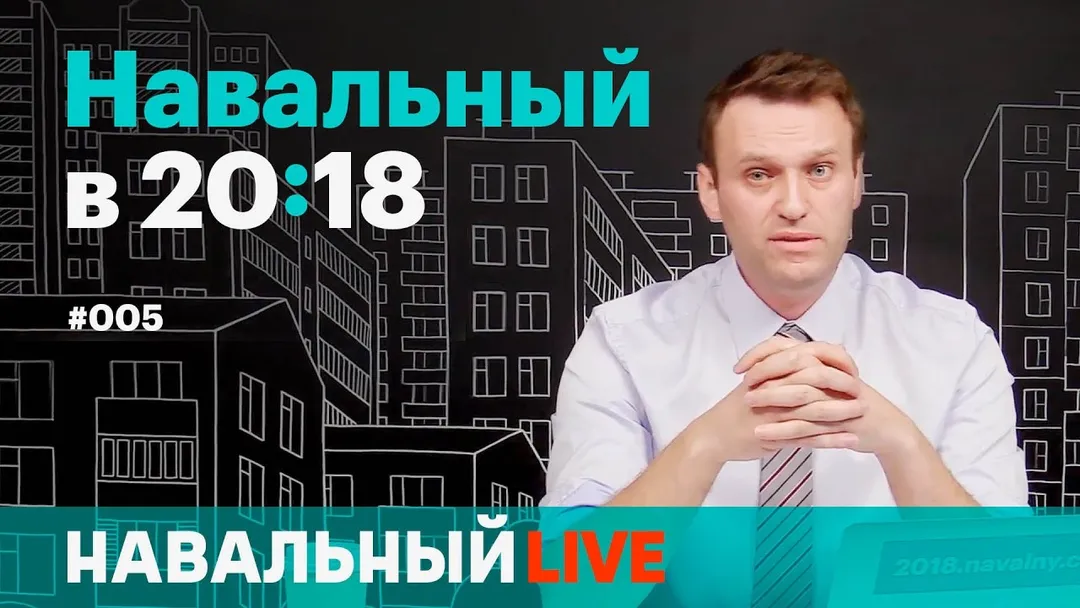
Navalny at 20:18. Broadcast #005, 18 May
[music]
In Moscow, it is 20:18. This means that
we are live on the Navalny Live channel.
I’m Alexei Navalny, I’m with you, I’m here
to answer your questions,
and talk about the events that have taken place
over the past week. If you want
to ask me something, please write
with the hashtag
#Navalny, and probably the topic I’ll
obviously start with, because it was
not just the news of the day, and not
only for me — it was the main story
of the day across all the news outlets:
the appearance of a wonderful new
video blogger, Alisher Burkhanovich Usmanov.
One of Russia’s leading oligarchs,
with a fortune of, I think, $15
billion — well, maybe $15 or $13 billion,
according to the latest Forbes list, still $15 billion.
He actually recorded a video, a video
for me, 12 minutes long. Maybe you
watched it, maybe you didn’t finish it; we
made a one-minute highlight reel for you from
those 12 minutes. Let’s watch it and then
discuss it. Please roll it.
Grumbling about the internet? I have a much deeper
relationship with it than you do. I don’t
use it — I develop it. Of the two of us,
you’re the criminal, and most importantly, you’re lying when you say I don’t
pay taxes.
You lie about where you pay taxes, and in general, do you
even pay taxes? But I do pay taxes,
and only in Russia. I also feel like
saying that what I sense is terrible envy —
the envy of a loser and a failed businessman who
started his business with kickbacks on petty
deals. I just want to explain this to you
so you won’t be jealous. I bought everything
I have, including a wonderful
boat and a plane, because I live
a happy life, Lyosha, unlike you.
Although, in principle, it’s impossible to understand how
one can compare salaries in Russia and
the United States, economies
that differ by a factor of ten. You will still
have to answer to me, Lyosha, and
your attempts to insult me are like a pug barking at
an elephant. Shame on you, Alexei
Navalny.
What a self-made businessman. Literally
the Russian Elon Musk, the Russian Bill Gates.
He earned everything with these very hands, all by himself,
personally built all the mining and processing
plants, paid all his taxes in Russia,
and pays enormous salaries to his workers.
It’s enough to bring tears to your eyes. What a
wonderful man. It’s interesting
that all the stories told by Russian
oligarchs about how they became oligarchs
and about what they do in Russia are
more or less the same, and Usmanov
demonstrated that they always sound
roughly like this: “Well, I was an ordinary Soviet
person, and then for a billion dollars
I very honestly bought some factories.” And where
did you get those billions of dollars? Where
did that money come from? “My friends and I
got a loan,” Usmanov tells us — $15
billion — and very honestly bought something. But in
order to get a $15 billion
loan, you probably need collateral
of $3 billion. Is anyone going to give a $15 billion loan
like that? No one gives out that kind of loan,
but somehow they managed it.
So yesterday you had nothing, and
today you’re buying, for $1.5 billion or $2
billion, some mining and processing
plant, and we’re supposed to consider that
a satisfactory story that we
should listen to and say, yes, yes, yes,
what an honest businessman. I have here
a huge number of questions about
Usmanov, and I’ve divided them into
these
thematic groups, and I really do want
to respond to this in detail, because this is
of course something that goes a bit beyond
the bounds of what usually happens in
Russia, and it seems to me fairly
symbolic, first of all. Well, what is this
in terms of
form? That in itself is a separate thing that raises
interest. I had what you might call
an anthropological reaction: I watched this video
and was simply amazed, because it was either
the 1990s had returned to us, or some
big parody of the 1990s. But the man
is sitting there completely seriously, and he
knows he’s broadcasting, he wants to broadcast to
an audience of millions, and he says, “You,
Lyosha, must answer to me. You
must apologize to me.” And this very
format of address — you know, “I’m
the most important one here. I’m not ashamed of the fact
that I’m used to intimidating everyone,”
I know
that everyone is afraid of me, and even through
the internet, you look at me and are afraid,
because I’m so tough.” At the same time, these
same people, this same Usmanov — look at any
video of him at some Putin council meeting,
and all these oligarchs are just
lackeys who tremble, who
bow and scrape there obsequiously,
giggling
before the godlike Putin and Medvedev, but when it comes
to everyone else, this is exactly how
they address them: “Be afraid of me. You must
apologize to me.” Well, we are not afraid.
No one is going to apologize to you,
because we know who you are, and
we will answer all
of these
statements of yours. So what is this? Well,
why? A very common question is: why did they
do this? Indeed, Usmanov is
most certainly not the most public
He’s an oligarch, and he gives interviews quite rarely.
He’s trying, well, sort of like this—
probably less than the other oligarchs, but—
I have this kind of
explanation:
that this is,
of course, a request from the Kremlin, possibly
from Medvedev, possibly from Putin himself, in
order to, well, simply shift the discussion.
They don’t want there to be a confrontation
with Navalny—but with a generalized Navalny, meaning all of us.
All of us are against Medvedev and Putin. All of us are asking
Medvedev and Putin questions about their
corruption. They want it to become
some kind of clash between Navalny and
Usmanov. Better that he criticize oligarchs
than criticize us. That’s exactly why
notice that on his channel it
is actually titled that way—the PR people
for Usmanov titled the video “Alisher Usmanov
against Alexei Navalny.” They want
to shift it. Guys, that’s not going to work.
Of course, Alexei Navalny is against
Alisher Usmanov. Of course, I consider him
an extremely harmful person, an oligarch
who contributes nothing useful. But
we will not forget that
in this whole
framework of ours, and in our investigation,
Usmanov is simply one episode, yes.
This man gave a bribe, gave a bribe
in the form of a luxurious mansion, and we know what for.
And we’ll talk about that a little later, but this is
just one episode. He’s simply one of the
oligarchs who carries money into the
Kremlin’s coffers, and we remember that
the main villains here are Medvedev and
everyone knows that, in that sense—
they will not
succeed. Though we would gladly
argue with Usmanov himself, and as for
Usmanov, we have plenty to
discuss. So, what is this essentially?
We’ve discussed the form, we’ve discussed why it was done.
What is it in essence? As it seems to me,
the Kremlin asked Usmanov to make
this response, and after that, clearly, his PR people
and Usmanov himself, who seems to me
to have gotten a bit carried away, came up with their own
version of how it should look.
It turned out very interestingly because
essentially it came out as this kind of, well,
oligarchic
manifesto: “We are so
great, we believe that, basically, we are
real, legitimate businessmen. You do not
have the right to ask us any
questions, and if you do ask
questions, then you’ll answer to us and
you’ll be apologizing. Today on Twitter I saw
this very apt thought: that this
address is not to Navalny; it is an address
to the population: this is how we will
talk to you if you
talk too much, if you ask
too many questions—well, obvious
questions about where this money came from,
obvious questions about how, in Russia at all,
oligarchs can exist in a fairly
poor country that only recently
emerged from
socialism—how these oligarchs appeared, and
what the source of their wealth is.
At the same time, again, no one is generalizing.
We understand that oligarchs, wealthy people,
are different. There are people who
earned their money completely honestly. Yes, they are also
billionaires. I always give, for example,
the guys from Yandex as an example. Well, not
“guys” exactly—I don’t know any of them personally, I’ve
seen them a couple of times, but
they really are billionaires, and they really are
the kind of billionaires whom we
all respect very much, and to whom we say,
“Thank you very much for creating,”
for example, Yandex. But to people like Usmanov,
we do not want to say thank you, and we never will. But
their manifesto amounts to this: that we all
owe them.
And even this address, apparently,
was recorded on that very boat
he talks about—you can see the drawn curtains there,
that kind of furniture, and several
people wrote to us saying it was recorded on the yacht, on
that very yacht, Dilbar, which costs €400
million, and just today news came out that
—it’s on the screen right now—saying that it was
recognized as one of the best yachts in the world
among vessels with a displacement of over 3,000 tons (metric), that is,
among the very largest yachts, Usmanov’s yacht
won an award. He bought it for €400
million. He got that money from these mining and
processing plants, where the average
salary—which he also talks to me about, saying,
“we pay this kind of salary there, people should
be satisfied”—is
38,000
38,000 rubles a month (about €400 / $430), that’s the average salary there,
for people who toil there in hazardous
working conditions.
These miners—and he sits on
a yacht, recording these addresses, and
says, “You won’t prove that I’m a dishonest
man. Everyone, apologize to me. I
pay you a wonderful salary: 38,000
rubles.” Well, Alisher Burkhanovich,
that is exactly why you have a fortune of
$15 billion—because you do not
pay proper taxes or proper wages to these
people. You cannot buy a yacht for €400 million
if you pay your workers 38,000 rubles
because it is impossible to live on 38,000 rubles.
And no matter how brazenly you
tell us that this is all wonderful and that you’re
somehow ennobling people in poverty—this whole
system, where the authorities allow it,
the oligarchs profit from it, while the people
remain poor—we will
to talk about this. Despite all these
your
manifestos, the next thing I’m often asked about is
which I get asked a lot about:
whether I see this as a
threat. Well, it’s framed in such a way
that of course it looks like a threat. I
absolutely do see it as a threat. Another
matter is that I’m not afraid. Quite a lot of these
swindlers come out with
these kinds of threatening statements. It is
certainly a threat. But if he has billions—
if someone believes that
he siphoned money out of the Russian budget,
essentially stole it from us—this is
national wealth. The ore that
they dig out of the ground belongs to me
and to you and to everyone—it belongs to all of us.
But if they think that he has
$15 billion and a yacht on which, as
he says, he’s enjoying life, then should I
be afraid of him? No, I’m not afraid at all,
not one bit. But I absolutely do see it as a
threat. My family sees it as a threa—
but nevertheless, we will talk about it, and I
will not stop talking about it.
I won’t stop.
As for a response: I’m simply leaving tomorrow morning
to open several campaign offices on the Volga. We
need to open five or six offices,
so I won’t be able to record a truly immediate response,
but of course
at the beginning of next week we will
publish that response. Besides that, today quite a few
media outlets
wrote about it—I saw RBC
and TV Rain saying they were ready to organize
some kind of debate, and asking whether I’m afraid to come
to such a debate. I was asked today
many times already: no, I’m not afraid. I’m addressing
Alisher Burkhanovich Usmanov in particular
formally and respectfully, and I say: yes, I am ready to take part
in such a debate. Best of all, let’s hold it right
here. Come here to the Anti-Corruption Foundation
and we will once again tell you
what we know about you.
Come, sit right here next to me, and we’ll
discuss every issue, starting with criminal cases
in Uzbekistan and ending with boats,
salaries, and who pays taxes there.
Let’s do it. If
you are not afraid of this dialogue, if you are ready
to answer not in the format of
some YouTube video, but in a debate format,
then please—I’m not afraid of that. I’d also like to draw
by the way
everyone’s attention and remind
the wonderful Alisher Burkhanovich
Usmanov that it is here in Russia that he
is so rude to everyone and records videos like these. There,
it’s ‘Alexei, you must answer to me,’ and
basically, ‘all of you listen to me.’ But when he
was buying the Arsenal football club, I just
looked it up now, and he
answered like a meek little rabbit, like a timid little girl,
obediently answering all the questions from the British media—37
questions from *The Guardian*, where he was
asked about rape allegations and all
the criminal cases. He answered every single
question nicely and didn’t talk back to anyone at all.
Why? Because he is afraid of them. He
is afraid of English judges. He is afraid of
English public opinion. He
answered those questions because
Arsenal fans were against his purchase
of the football club. But here, in
Russia, he comes here and acts like he owns the place,
thinking he can be rude to anyone.
When he goes back there—to Switzerland
or to the United Kingdom, where he
spends most of the year—there he will once again
sit quietly and answer very politely
questions
from the public and from the media.
My friends, our task is to create a country like that
and to conduct ourselves in such a way
that all these oligarchs—from Usmanov to
Abramovich, from, I don’t know, Roldugin to
God knows who else—all of them, in fact any
people, would be obliged to answer here just as
thoroughly and diligently as they do in
the United Kingdom. Here, they
talk about how they and Putin will tighten
their belts, while inside the country where they
make their money, they treat everyone with open contempt,
demonstratively so. But where they
invest their money, they become these
nice, pleasant guys. We must behave
differently. It depends on us. Then they will
record different videos—less arrogant ones—and
not from a yacht worth €400 million, but from
some other places. We must conduct
ourselves differently and demand from them
one last but very important thing. At the end
of his video, Usmanov says that
Navalny is trying to prove that in
Russia all business is somehow bad,
corrupt, whereas business in Russia is not
like that. This is important: no
Usmanov is not Russian business,
and I absolutely do not consider him
part of business. I do not consider him part
of normal business. I do not consider him part
of capitalism, if you like, because he
is harmful to business. He
is the opposite of capitalism. In normal
capitalism, no Alisher Usmanov would ever
have emerged, and we do not see this kind of
oligarch in Germany, in the United States, or anywhere
with a developed market economy. They
cannot appear there. And here we draw,
of course, an absolute Chinese wall
between normal business, which
unfortunately in Russia is barely
surviving, and even wealthy
people who created something new,
who brought public benefit, and
people like Usmanov, who have done no such thing.
essentially nothing except what they acquired as
their own property one way or another. And yes, I
consider it to have happened through privatization deals,
because Usmanov got it from
Gazprom. He thinks privatization
only means buying directly from the state, but when you
buy from Gazprom Invest, that is also
the same kind of privatization, the same kind of
illegal one. We draw a Chinese wall here. I
do not consider him representative of business. I do not think
he has the right to speak on behalf of
Russian business. He harms it. Because of
people like Usmanov, business in Russia
develops badly. So, let me
see what questions there are here.
Was he imprisoned for rape or
not? Well,
fortunately, I was probably not in
the same cell with him in an Uzbek prison, but
the story about rape comes from a book by
the British ambassador to Uzbekistan at the time,
and this man is a historian by profession.
He is recounting that history now, and I fully trust
the British ambassador to Uzbekistan
who described all of this and who clearly
wrote that Usmanov was imprisoned, among other things,
because of rape. I don't know.
I don't have any confirmation of that
apart from that book, but I trust the book
quite a lot. So if Usmanov wants
to argue about this, let him argue not with
me, but with the former British ambassador.
Did Usmanov inflate the likes? Yes, I saw it on
his channel where he posted that video.
Of course he inflated the likes. Well, what do
you think they were going to do?
If all their lives they have... Well, of course they
are going to inflate likes, but again, it's
ridiculous. They thought they would come onto
the internet and that here they could, basically, fool everyone
the same way they did on
Channel One (Russia's main state TV channel), but people here are a little
different, and all their manipulations are immediately
visible, visible to everyone, so for them here
it will be... We can see that there is an active
Kremlin intervention in the internet, in
particular in
YouTube over the last few weeks,
especially over the last week with these
wonderful clips
by Ali Wox and so on, but I don't think
they are going to have an easy time here. Why
does the UK cover for all of them? Listen,
the UK acts within
its own logic. They see that there is
a country whose population, for some reason,
allowed itself to be robbed, a population
that somehow, well,
allowed a small group of people to take all
the money from oil and gas sales, and the authorities
of this country
are doing exactly the same thing and hauling
billions into the UK. So what are they
supposed to do? Stand at the border
and say, 'No, you are mistreating Russian
people, so we will not accept your money'?
Of course they won't do that. They
say... well, they are somewhat squeamish
about all of this,
but money is money, and it keeps flowing into
the country. So oligarch Usmanov brought it in. Yes, this
money—they understand that this money is
more or less stolen. But it is not the job of
the British to fight for our happiness.
The next topic I wanted to discuss
is something that, of course, was to be expected,
but it absolutely enraged me:
the sentence handed down to Yuri Kuly. It was
the first sentence issued in connection with
the March 26 rally. Please show the photograph.
Here you can see
the moment for which, quite literally,
this man received 8 months in a penal settlement
colony. So you should not think that
a colony
is some kind of resort or a very light
punishment—it is quite close to prison.
Most importantly, he did nothing. Yuri Kuly is simply
an honest man who
came to the rally because he had every
right to do so. And yes, at some point, when
as you probably saw, or were there yourself,
the police completely unlawfully
rushed in to disperse everyone—yes, the man braced
his hand against a police officer, and today he was given
8 months in a penal
settlement colony.
Why so quickly? Because, first of all, it is
extremely important for them to intimidate everyone. It is extremely
important for them that no one come to the rally
on June 12, and now, of course, they will start
saying, 'See? Don't go to the rally.'
After all, they can't squeeze all of us,
they can't crush everyone, so they grab one
random person, like this
actor, and demonstratively jail him for nothing
in order to frighten people.
Cases are now being opened every day. They are connected not
only with rallies; they are connected, in general, with
the expression of independent
opinion. There are already so many cases now
connected with, I don't know, likes and reposts
that even newspapers have stopped writing about them.
And the main protection for people like Kuly
and everyone else, of course, is that
we must not be afraid. We must, in
particular, continue going out to these
rallies. Yes, there is this
damn awful lottery, this hellish, devilish
situation in which we understand that at any
mass event they can seize one person
and just like that give him 8
months, like Kuly. That exists. But the question for
us is: will we be afraid or not? I am not afraid. I
now want even more to go on June 12,
because I see this
absolutely innocent
normal, honest Russian man who
they just threw him in prison, this crook and
the interesting thing is
the thing that personally affects me here is
that the main prosecution witness
at the trial against Kulya
was this pathetic drunk who
splashed me with brilliant green (a common antiseptic dye in Russia), or rather
some kind of muck mixed with brilliant green, while lying in wait
for me near
the office. And there’s nothing there — there’s no case at all.
No case whatsoever. I also got a lot of
questions: tell us how the criminal case is progressing.
After all, Putin said
that he does not accept political violence.
Yes, United Russia said, using this case as an example,
that of course any
extremists from any side must be
punished. The Moscow police headquarters and the Interior Ministry said
yes, yes, yes, we are opening a criminal case, there will be
an investigation, absolutely. And a lot of people wrote to me then,
and journalists said,
well, after statements like that, of course there will be
an investigation — someone will be jailed, or
at least something will happen. So my lawyer,
Vadim
Kobzev, went to the police the day before yesterday.
Nothing is happening. No one is questioning me.
I have not been recognized as a victim. I said, well,
listen, go and find out, take a look at
whatever case materials there are. I’m going to show now
a fragment of the complaint that
he
wrote after his visit.
So this is a legal fact:
what we established is that, first of all, as the victim
I still have not been recognized; no examination has
been carried out. I have medical documents,
a whole pile of these medical documents already,
from Russia and from Spain. To this day
my right eye can barely see. These documents have not been seized,
and no investigative actions whatsoever
are being carried out. The funniest part is this:
the latest claim is that the identities of the attackers have not
been established. And that’s wonderful, because
on the internet they have already
been identified — photos, surnames, addresses,
where they all live. This happened
several weeks ago, but the Russian
police officially still do not know
who these attackers are. Well, this just
shows the connection: this attacker was a
false witness in Kulya’s case. That is, he
helped put an innocent citizen in prison
and in return receives immunity from criminal
prosecution, which gives him the ability
to keep breaking the law. That is the whole point
of this government: you can steal
billions, you can do whatever you want.
How many cases have there been where they run over
people at crosswalks, drive drunk,
and every time there’s a scandal around it
in the media, but nothing happens because
they work for the authorities. They have
immunity, they have permission to do
whatever they want. But when it comes to us,
for any independent word, suddenly around you
someone is already running around with some kind of report
for at least an administrative
offense. This once again shows
how important it is for us, including
to go out to rallies, and also not
to stay silent, so that all this власть
can see how many of us there are, and how many people
are not going to stay silent. A question from
Andrei Voronov: Will you be able to help
Kulya?
As far as I understand, as far as I know, he has
quite a good defense. Unfortunately,
he was simply
deceived. He was illegally held for several
days and was denied access to a lawyer.
As far as I understand, even his relatives
were not notified, and so he was basically
set up, as they say. He was told:
sign that you are guilty and you will get
a suspended sentence. Today at sentencing he
said exactly that. They asked him: why did you
admit guilt and agree to the special procedure (a simplified trial process)?
He said: well, because I was promised that
I would get a suspended sentence. Well, as usual, these liars
always lie. They deceived him. They
promised him a suspended sentence — just confess to everything.
He confessed, and only after that
was a lawyer allowed to see him, and he
of course received a real prison term. But
his defense is good now. I do not
doubt the prospects of this case in the
ECHR (European Court of Human Rights). The other thing is — and honestly,
I’ll say this — he will win at the ECHR, but it is quite
likely only after he has already spent 8
months in this penal settlement
colony. And I think his lawyers themselves
will do that. But if they come to us, to me, for
that kind of help, we will certainly
provide him and everyone else with all the help
they need. And of course we will
try to fight for every person, and
many human rights organizations
provide that kind of assistance. The next topic
is the rally about
the renovation program, from which I
was escorted out together with my whole family.
There were a huge number of questions before Usmanov
and before Kulya. I had actually planned to make this
the main topic, because so many people
are asking. It is actually very important.
First, the rally went well. Quite a
lot of people — no, not quite a lot, a great many
people, over 20,000, came. That is
wonderful. They came to express their protest.
They once again documented and showed
and confirmed that this is not a situation where
everyone agrees with this renovation program. Moscow City Hall
is lying. If 20 — 20,000
people came out, then many, many times
more people are dissatisfied
with what is happening. We are now conducting
a large sociological survey across Moscow.
in order to show some kind of
real picture. Whatever the actual data
turn out to be, that’s what we’ll publish, even if
the results end up contradicting
what I’m saying—though I doubt it. We’ll
publish this poll. We’ll see the real
public opinion. Because no one at
VTsIOM (the Russian Public Opinion Research Center), of course, can be trusted, so the rally
happened, fine. So why was I
removed? Why did this whole scandal arise over whether it was a
political rally or not? It’s
quite
simple. For several years, together with
Sergei Mitrokhin, who is now one
of the leaders of Yabloko (a Russian liberal political party), I headed an
organization called the Committee for the Protection of Muscovites. I
was at, well, probably hundreds of rallies
devoted to infill development
including the resettlement
of five-story apartment blocks, rallies of those who want
to be rehoused, and rallies of those who do not want
to be rehoused. So I’ve long known and
understood how this works, and I’m very
calm about these kinds of
conflicts when they happen. So,
guys, let’s once again run a
thought experiment—my favorite
exercise. You are the Moscow mayor’s office. I am your loyal
advisor and PR man. I come to you and
say: Hello, Sergei
Semyonovich. Everyone is unhappy with our
renovation program. Several thousand people have already joined the Facebook groups.
There will
definitely be a major rally
against this renovation program. This rally will be
scandalous, and at this rally everyone will
be calling for our resignation, and this rally
will be noticed in the Kremlin, and they’ll
really tear into us. It’s quite possible that this
rally will undermine our chances and shave
a few percentage points off us in the
upcoming mayoral election. Putin will understand
that this whole renovation issue, this rally,
will cost him a few percentage points, and
so they’ll be furious with us there, and
there will be a scandal. So, Sergei Semyonovich,
let’s think up what the
situation with this rally should be. Well, the solution is obvious:
if you can’t stop a protest, you need to
try to
lead it. So you just, well,
look for the initiative group, plant
some people in it—and we saw some
strange former PR people from Prokhorov’s team
or current deputy ministers from Tula
Region—and you go to them and
you start, at the same time, a little
to intimidate them, a little to bribe them,
a little to deceive them. You say: we’ll
give you permission, but please
just keep politics out of it. And I’ve discussed and observed this a million times.
Every time
there’s a rally, even some courtyard protest against
the head of the district administration, someone
from the initiative group, or the deputy head of the district administration, immediately shows up
and says: well, we understand your problems,
but please, all these politicians—
they’re trying to get publicity off this issue,
don’t, don’t let that happen under any circumstances.
We’ll solve your problems, and your, say,
Ivan Petrovich’s personal problems—we’ll try
to solve them too. Just please, without all this
politicking. Otherwise some local
deputies who want to get elected will come, and on
the back of your misfortune they’ll try to promote themselves.
So there’s no need to politicize it. And here
exactly the same thing happened. And this
should be treated calmly. It does not
mean that this initiative group contains
some kind of villains. Well, I mean, there are a couple of
real villains and crooks there, yes—you already know their
last names. But that’s inevitable; essentially it’s
inevitable: any rally, any protest
movement, one way or another, gets
hijacked. People are weak; it’s fairly easy
to go up to someone and say: listen, you
make sure they don’t speak
with harsh criticism, don’t demand
resignations, and God forbid they mention
Putin—and in return, you personally will get
a better apartment before the relocation. It’s hard
for many people to resist that kind of
prospect. That’s why this whole
theme of ‘depoliticization’ was imposed.
They were all running around there, in all that
commotion, when different people
came rushing up and started giving instructions
to the police. Some guy comes up and
starts shouting too: we didn’t agree
to this, politicians should or shouldn’t
speak—but I thought he was just some guy from
the initiative group. But later, in
the photos, I saw that it was the deputy head
of the Security Department, Chernikov,
I think that was his surname. So, he was
directly in charge there.
Again, there’s nothing especially terrible
about this—it’s a natural thing. You just need
to distinguish the maneuvering of the initiative group from
the people who came out in general.
And naturally, the Moscow mayor’s office will continue
its attempts at what they call
‘depoliticization.’
It’s not that the mayor’s office or the Kremlin are
literally afraid of the rally itself. So 20,000 people came out—
fine. They’ll disperse, they
will definitely, 100 percent, disperse. They are not
afraid of the rally in and of itself; they’re afraid
that it will be harder to get re-elected. They’re afraid
of their ratings falling. Because
it’s one thing to rig things when you have 45%
support; it’s another thing to rig them with
25%—that’s not always possible. They’re afraid
that more and more people will
stop liking them. They’re afraid that—
wow, 25,000 people turned out, and in the
resolution it will say: we demand
Sobyanin’s resignation, we demand resignation
Putin, because Putin is responsible. Well,
we remember that. And anyway, how did we find out
about the renovation program? We saw it on Channel One
(Russia’s main state TV channel): they showed a meeting between Sobyanin
and Putin where they announced to us that, basically,
there would be renovation in Moscow. So this is
an agreement between two people, and they bear
equal responsibility, naturally.
The authorities want this not to be mentioned; they
do not want
the number of people asking this question
to grow. It’s like: let’s judge
all this without politics—just the residents
of five-story apartment blocks will discuss it all. Well, that’s
something else—residents of five-story blocks, and 2 trillion rubles (about 2 trillion RUB),
this does not concern only Moscow, because
this money will be taken from Moscow’s budget.
It concerns everyone watching right now.
If you’re sitting somewhere in Khabarovsk
late at night or early in the morning, watching
this broadcast, it concerns you no less than
it concerns me. Because where did these 2 trillion
rubles come from? Well, that’s where they came from—they were taken out of
your Khabarovsk through this
unfair financial system,
and brought here. And now they’re deciding
what to do with them in connection with renovation.
So once again, there is no need to worry too much
about, well, the depoliticization
of the organizers, members of the organizing
committees, and speakers being chosen
by vote. Democracy always helps.
There is always someone dissatisfied, but at least
it is clear who people voted for.
Don’t let yourselves be deceived, but
at the same time, don’t tear your hair out over
the fact that, my God, somehow the Moscow mayor’s office
got involved in one rally. There is nothing
terrible about that. I want to say
something important: we, the Anti-Corruption Foundation
(FBK), are filing a lawsuit tomorrow against
the Moscow government over the renovation issue,
because
pay attention to this resolution
of the Moscow government under which voting is now
taking place in the Active Citizen system
(a Moscow e-government voting platform). They tell us that however
people vote, that is how it will be. At the same time,
the voting is being actively falsified—we
see it, we simply see it directly.
For example,
these multifunctional service centers
announced that on the first day
30,000 people voted—or whatever it was, 20,000 or
30,000 people—and every single one of them
voted in favor of
renovation. Yes, not a single vote against.
Moscow City Hall—well, that is impossible. It is
statistically impossible. There is simply no way
that thousands of people
could vote and every last one of them be in favor.
So we understand that the vote is being fabricated.
But please bring back
the previous image, if possible. In the
resolution it says that this is a
resolution on taking Muscovites’ opinions into account.
If you read it carefully, you
will see that this vote
does not obligate anyone to do anything. Even if
entire buildings vote against it, the Moscow mayor’s office
is not obliged to follow that. It takes opinions into account,
but makes the decision independently. Well,
it “takes them into account” somehow: we took your opinion into account,
but decided you are an idiot and that we know better
whether your building should be demolished or not.
This system obviously violates
property owners’ rights, because, well,
there is an established procedure: a general meeting
of homeowners. That procedure
is mandatory. And all these votes on
Active Citizen—
Alexei, and we are filing suit because
they are deceiving people. Because you cannot
use voting on Active Citizen
as the final expression of
the city residents’ opinion. Besides, we have also now
launched a survey in some buildings.
In certain buildings that are slated
for demolition, we are simply going apartment by apartment and
will be ready to publish the raw data,
whatever is needed, and then we will see how closely
the voting on Active Citizen
matches the vote that we conduct
through this fieldwork method.
We will carry it out. I doubt
that everything there will match. Questions—
for some reason I do not see any; they are not sending me questions.
Are there none?
No questions? And he shakes his head
and says—writes to me in all caps—there are no
questions. The problem has been solved in an amazing
way: I have been talking about it for 20
minutes, and there are no questions. Even though it seems to affect
several hundred thousand
people. In any case,
I think I have covered the topic in considerable detail,
and we at the Anti-Corruption Foundation will
be actively working on this and
will expose corruption in this area
as well. I urge everyone—well yes, they are writing
that there are no questions. Everyone
is only calling for Sobyanin
to be put in jail. I can say that I believe
not everyone should be thrown straight into prison; everyone
should first be sent to the defendant’s bench.
That would be more proper. At the very
least, this whole renovation issue
certainly deserves criminal
investigation—apparently a place on the defendants’ bench.
Another large block
of questions that came in concerns the blocking
of websites in
Ukraine, and this affects me very
directly, because I not only
consistently speak out against blocking in
Russia, but I myself am also
being blocked. And, well, there are many questions about how I
feel about the fact that this is being done in
I feel exactly the same about Ukraine: I’m against it.
In general.
There is a lot of data, a lot of
research showing that as a result of
the blockings in Ukraine—well,
first, they won’t be enforced,
and second, they will damage the economies
of both Russia and Ukraine. Yes, absolutely.
And if the task of the Ukrainian government
is to inflict economic damage on Russian
companies—well, damage will indeed be done.
Many people here think that, well,
sanctions from
Ukraine are nonsense, that it’s an insignificant country—
that’s what people say. Foolish people who haven’t
looked at a map, people who haven’t even
read Wikipedia and don’t realize that Ukraine has
a population of 45 million. Well,
let’s subtract Crimea and eastern Ukraine,
and even in the territory that
is controlled by official Kyiv, there are no fewer than 40 million
people. That’s a huge market. Russia has
144 million—so that’s roughly a third of that market—and our
internet companies, Yandex, VKontakte,
Mail.ru, were certainly counting on that market.
I think about 11% of VKontakte’s traffic
comes from Ukraine, and this will be
a major blow to Russian companies,
a big, serious economic blow.
Damage will be done.
The other thing is that comparable damage will also be done to
the Ukrainian economy as well, including that.
So I believe there should be no
blockings at all, even despite
whatever logic
they may have constructed for themselves in Kyiv.
Overall, for the Ukrainian government, the negative
effect on the Ukrainian economy will be
bad. It will be large, it will be
significant. Europe will criticize them,
and it will be absolutely right to do so.
International organizations will criticize them too.
I mean, so far we still haven’t
seen a single precedent where
blocking anything, especially such
large systems and search engines, has led to
anything good. Nothing good will
come of it. But I actually wanted to say something else.
Show me my favorite.
Volin on website blocking in Russia. Here.
Well—where did it go? There, please. And this is
the communications minister, Volin. Why did I say
he’s my favorite? Well, because this
man actively pushed for
TV Rain (an independent Russian TV channel) to be thrown off all cable networks.
This man
actively promoted and supports
blocking inside the country. So you see
what he says about blocking in Russia.
Now show what he says about
blocking in
Ukraine. It’s just—well, well, well—and a lot has already been said about it.
These quotes
have all been shown, but do you understand what’s
so astonishing? It’s not just that they
spout this kind of nonsense and
propaganda on television—they are trying to convince people on the internet too,
even the more advanced,
better-informed segment of citizens. They
despise people so much, think of them as such
cattle, that without even blinking they change
their position by
180 degrees. My blog, Alexei Navalny’s website,
was blocked twice, in 2014
and in 2015, and individual posts of mine
are blocked constantly. And all this
crooked lot was delighted by it and
said, yes, yes, yes, let’s block
Navalny, he’s such a terrible
extremist, yes, yes, yes, let’s block
Navalny because
well, he criticizes Putin, and you mustn’t
criticize the head of state,
you mustn’t criticize the authorities at all. There were many
different justifications.
They unblocked it fairly quickly.
We went to court. These were absolutely
illegal decisions, and we secured
the unblocking. Things had to be deleted, and all of them—
all this
officialdom
kept proving how proper and lawful it was to carry out
blockings, including of my websites in
Russia—thousands, tens of thousands
of blocked websites, pages, posts, and
so on. And now, when blockings are happening there, they
are publishing instructions on how to bypass
the blocks.
And again, what amazes me about this is
just how contemptuously they treat
Russian citizens. Fine, there are 140
million people, 80 million use the internet
regularly. But of those 80 million, at least 20
million—a substantial number of Russian citizens—
know quite well about the problems of
blocking, take part in this discussion,
and follow it. At the very least, the entire IT
industry, the whole community, is closely
engaged with it. There was just recently
an attempt to pass the Yarovaya law (a package of Russian anti-terror legislation), which also involved
a lot about blocking, and we were told how
important it is to block information in order to
fight terrorism—and then suddenly, bang, it
happens in Ukraine, and suddenly it’s a complete 180,
and all these 20 million people are like, my God,
how can you lie straight to our faces like this?
And they don’t care at all, not in the slightest. And these same
people then go somewhere, they
go back to their—I don’t know—they go back
to their families and behave like
normal people. They go to some
company, to friends, and think that they
should be treated like normal people, and
that is astonishing. I’m curious—
how do they even see themselves?
When their hypocrisy is simply
known to every person who simply
meets them on the street—how do they even...
They talk about it with their friends. Well, probably there,
they wink at each other and say, "Well, yeah, well..."
"And what about those fools? Today I was saying..."
Like, today I said this, haha, not bad.
We even just swapped Russia for
Ukraine, and my press secretary took one
and the same statement and put it out—haha, brilliant, we
did all of that.
Well, these are astonishing things,
astonishing things about this government—this
happens constantly on many issues.
But still, sorry for going on so long
about this—it never stops
amazing me, among other things. Well,
just from an anthropological point
of view—how can you lie like that constantly?
Why? Just stay quiet. You've already said so much.
So many falsehoods and lies about blocking in Russia, but
then let someone else talk about blocking in Ukraine.
Find another official for that.
You lied about Russia, and let him lie about
Ukraine. Let's split it up—a division of labor, lying
on different topics. But no, damn it, they keep
lying about the exact same thing. That is, of course,
remarkable.
So, now questions are coming in about khrushchyovkas (Soviet-era low-rise apartment blocks).
A huge number of them now. "I live in a
khrushchyovka, and on the contrary, I don't agree with you about demolition
because nobody is surveying people."
Listen, guys, I'm sure that if we
just count how many people do not want
demolition and how many people do want demolition, those
who want demolition will be more numerous. Well, I've often
talked about my wife's grandmother,
who lives in a five-story building. She wants
it demolished. They didn't include her in the program, and she
very much wants demolition. For quite a
long time, together with Mitrokhin,
I worked on cases like this.
There was the Phenolny Gorodok ("Phenol Town") case—those buildings there are not
five-story buildings but nine-story ones. They were
built using construction materials
that release phenol
for many years. You can't live there.
Children there
get sick. There are simply excessive levels above the maximum
permissible concentrations of phenol and other
substances. With these people, I organized rallies,
and pickets, and they even held hunger strikes.
That is, we
devoted many
months to this, and nobody demolished those buildings. They run around and
shout, "Guys, please relocate us, demolish
our homes." There are unsafe dormitories that
are saying, "Demolish us." Buildings spend years
begging: "Please, we can't live in
buildings like these." Fine, Moscow—but in
whatever city you've lived in, I'm sure you
know a five-story building in your city,
or a three-story one, or a barracks-style building. Even in
the near Moscow suburbs, barracks still exist, and
you know perfectly well
that they are in a monstrous condition, and in 2017
it is simply shameful and disgraceful for a country that
claims to be a great power
to still have barracks. And yet they have not been
demolished to this day. And these people dream
of being relocated, of at least having
repairs done in their buildings, but no one
is going to do that, no one wants to do it, and
everyone tells you there is no money. And
at the same time, apparently in this same country there are 2
trillion dollars for demolishing homes where people
do not want it. So yes, of course, many
people do want demolition. I think many at the
rally opposed
the renovation program because they want demolition of their own buildings,
but theirs are not being demolished, even though they want that.
Or maybe they are being demolished, but people do not want
a lack of clear rules. They say, "Well, explain
to us where you are relocating us. Why are you relocating us
there? Why are such decisions being made?"
Therefore, the first step in this renovation program
—here is the positive agenda, let's move to
the positive agenda. People keep telling me,
"You criticize,
but you don't offer anything positive." So I
am offering something positive to the Moscow city government.
First: full disclosure of how
the voting is conducted, and publish
all the data so that everyone can verify
their own vote, and so that all of us can verify
who voted how. Second: make
the movement of all
funds completely transparent—who we will be
buying apartments from and at what price—so people can see where
the first 100 billion
rubles (about $1.7 billion at the time), which have already been allocated, will go. And
third, and most importantly: if you have started
the renovation program and are going to demolish something,
then let's first demolish the homes of those who
for many years
have been asking for demolition. Let's simply publish a list: "Over the last 15 years, the Moscow mayor's office has received appeals from residents of the following buildings
to the Moscow mayor's office over the last 15 years
from residents of such-and-such buildings
demanding that they be declared unsafe
and that residents be relocated. We will do that first.
Just say that. Leave alone
the brick buildings in the city center, or
anywhere else, really. Demolish where
people dream of demolition." But they do not do that
because most often such buildings
are located in places that are not particularly attractive
for development.
So, Denis Kamensky asks me:
"For me and many of my friends, access
has been cut off; without using certain
programs, VPNs, it is impossible to access VKontakte and
Odnoklassniki and so on. I
take it this question is from Ukraine. Well, yes,
they are being blocked, so access has, in effect, been cut off.
Naturally, that is how it works: a block has been
put in place, and without a VPN you will not be able
to get around it. But the consequence of this will be that
you will simply have VPNs everywhere,
everyone will be using Chrome with that turbo mode,
with which all these blocks
will be bypassed. But won't that lead to...?
a positive effect for Russia, you know
like, they introduced blocks in Ukraine, and
therefore Russian officials
while criticizing the Ukrainian ones, will in Russia
block less. I definitely don't
think so. Many people wrote that this
would help Russia slow the pace
of blocking a little. I'm convinced of the opposite.
For a while, our crooks will criticize
some Ukrainian figures, but already
in a month we'll see completely different
rhetoric: they'll be blocking even more here.
And to all the outrage — "Why are you
blocking this website?" — they'll say, "Well,
Ukraine blocks things too, and Europe,
the enlightened Europe, stays silent. Just look at
the EU, NATO, UNESCO, and I don't know who else
staying silent about those blocks. But when it comes
to Russian blocks, you start making a fuss
like a herd. What, did Navalny stay silent when
Mail.ru was blocked in Ukraine? Then we'll
block your site too." And I'm sure that
this will become an escalation of mutual
blocking, and of course the authorities will use
this moment for PR in order to
push through these blocks. Listen, Andrei
Vladimirovich, what will happen to the federal
TV channels if you are elected? Will
the main propagandists be lustrated (removed from office after a regime change)?
A question like this comes up on every program.
I think I answered it last time.
And the fact that this question keeps coming up speaks to
how painful this issue is.
Uh, the main federal channels will remain
the main federal channels; it's just that
they won't all belong to the oligarch
Yury Kovalchuk, and one of them won't
belong to the state, as is the case now.
They should belong,
first of all, to different owners. And most
importantly, censorship must actually
be prosecuted by law. I believe that
the media, in principle,
should not belong, in particular,
to oligarchs. Alisher Usmanov should not
— whom we discussed at length today — he
should not own the newspaper *Kommersant*.
He has no business owning *Kommersant*.
Even setting everything else aside — well,
the man makes his money from mining and
ore-processing plants; he shouldn't be getting into
the media, because he buys media
in order to manipulate them. Using
the example of *Kommersant*, we've seen that
he turned it into a rather
at times very unpleasant media
outlet, where the journalists themselves
admit that yes, there is censorship. "Well, we kind of
try to be decent, but
there is censorship here." That should not exist.
And so, when it comes to the federal channels,
the state should do nothing. It
should leave the mass media
alone. This is the most important
social and public infrastructure
without which nothing develops.
So I will leave the media alone and
I will jail those officials who interfere
with them and
get in the way. A user with the nickname "It's Me"
writes: "Our building is a three-story dorm, full of
cracks. It's not being included in the program
for dilapidated housing. We've appealed
everywhere, with absolutely no result." Well,
that's exactly what I'm talking about. I simply think
that your three-story dorm is located in
a place that's not attractive for investment, and
if some city hall officials there
want to grab a prime plot of land,
they don't consider your plot
prime, so you'll be stuck in
your dorm. Or maybe there's some complicated
ownership structure and it's inconvenient for them
to resettle people. And yes, they've sort of forgotten about you, but meanwhile
they run after buildings with 4-meter
ceilings, where people are perfectly happy
with their homes.
Many Runet (Russian internet) users there are not
aware, asks Dima SS, suspecting that
in Russia an enormous number of
Russian-language Ukrainian websites are blocked. Well, not
an enormous number, but we know there are
dozens of Ukrainian websites
blocked on Russian territory. Well,
there are major news sites still
blocked — Kasparov.ru and Grani.ru — and
no one can get those blocks lifted. This is
absolutely illegal, just absolutely
an illegal blocking of Kasparov.ru or
Grani.ru, and it has existed for years.
I think they were blocked in 2014 or
2015, so
that is,
for several years now we haven't been able to
get this resolved. But you can't say it's truly
a huge number yet — though we're heading in that direction.
Now the Ukrainians have blocked
VKontakte, Odnoklassniki, and so on.
Of course, the retaliatory measure will be
the blocking of simply a huge — as it says
here, a huge number of
Ukrainian
We'll try to shut ourselves off entirely from everything
Ukrainian, from anything remotely Ukrainian,
with a huge
wall. So, what other questions do we have? When
you become president, what will your
solution to the conflict in Ukraine be? Wow,
that's quite a question to end on.
We have 4 minutes left in the program.
Let's go ahead and pick it — I'll answer.
Of course I'll answer that question. I've answered it many times
already; they ask it at almost every meeting.
[music]
Let's stick to the questions on today's agenda.
And I'll answer them. People ask me
where I'm going next. We have a tour of the Volga region, and I
fly out tomorrow afternoon, and we're opening six
for campaign offices, come forward.
Please—yes, you may have heard that we
are having problems opening campaign offices, and
Volkov often talks about this—these
problems do exist.
Indeed, over the last two weeks we’ve
seen a very clear trend—really,
FSB officers (Russia’s security service) have been showing up, not even hiding that they’re not
just some random people in plain clothes, but going to
our landlords and simply
intimidating them—sometimes outright threatening them to
an extreme degree. Well, I don’t want to get it wrong which
specific city it was—Volkov told me about it—
but they literally came to the landlord
and said—and she was a brave woman,
the kind who said, “I’ll rent you office space,
I support you and I definitely won’t back out”—to her
they came and said, basically, “We’ll open
a criminal case against you, expel your son from school,
throw you out, and you’ll be living in the gutter.” Well,
they dumped all that filth on her,
and she terminated the contract with us, and
it’s hard to blame her for that. In other words, they’re
trying to obstruct the creation of our network.
They can see that we’re running a real
campaign. They expected there would be nothing
except, at most, some online broadcasts, but
we have a real campaign with real
offices and a huge number of volunteers.
More than 100,000 people have signed up, and
so of course right now they’re simply
shaking—no one else has 100,000
volunteers. If 100,000 people
do something every day in order to
spread our information, in order to
spread the message that
people need to take a critical view of the regime,
go to rallies, and so on—well, of course
that’s going to be a problem for them. They’re frightened by the number 190—
190 cities that have already signed up to
take part in the June 12 rallies. All of this
scares them, and so
they’re trying to slow the pace of development of our
regional network. But they act
only by the methods they know how to use.
So they held a meeting,
and said, “Well then, what are we going to do? Well,
let’s hire some sellout entertainers; they
can fight with them on YouTube, and
let’s also send FSB officers to the campaign offices,
who will just scare everyone.” Well, that
does create certain problems for us. I
want to use this opportunity to call on everyone who
has premises in the cities we need—well,
come forward, anyone who isn’t afraid to help us with
this. But overall, of course, this will not
stop the development of our regional
network. Nor will it halt or
prevent it, because in the end
our network and our election campaign are
not about premises—they’re about people, and people are not going
anywhere. And as long as you keep watching
this channel, as long as you help
us spread information,
we will keep working.
By the way, that reminds me—
Oksana is giving me that terrifying look again
and
silently whispering: subscribe to our
channel. Every time we get more than a million
views—or around a million—but
the channel has 300,000 subscribers, which is excellent
for a channel that has only been operating for
two months. But please, don’t be lazy—
find the button below and click it.
Click the button—subscribe to our channel. And
all the more so because people tell the truth here, and
will keep telling it. You saw that we’ve
launched
several shows. I’m very pleased with how
Sergei Smirnov’s program from
Mediazona is going—he hosts an excellent, terrific show.
Vladimir Milov’s show on economics—I
really think it is
the best thing out there right now, the best thing you can
watch on economics. It’s explained in a very
very accessible way, and his guests are
wonderful. Today there was an interesting
discussion—go watch it. They’re writing to me in all caps,
in giant all-caps letters: subscribe
to Instagram, subscribe to Instagram.
Unfortunately there’s a problem there: if you type into
Instagram “Alexei Navalny,” my
real account doesn’t even come up.
Some other people come up instead, who unfortunately
are selling fake
T-shirts or scamming people. Navalny 4
is my real account, please
subscribe to our channel. As usual, we’ll
meet again in a week. I’ll
be here to try
to answer your questions—any questions—and
honestly, based on my understanding
of the situation, based on what I know, see, and
hear from you, to talk about what is happening in
the country. Thank you very much for watching
this program. See you next
week. Goodbye.
[music]